Cambridge A Level Information Technology (from 2017) 9626 — 2020 May/June Paper 3 · Variant 3
9626/33/M/J/20 · 12 questions · 90 marks · ≈101 min
The question paper and its mark scheme, free to read here and free to download. This is Cambridge’s own paper, exactly as it was sat.
Question paper16 pages











Mark scheme9 pages
Answers below. Sit the paper first if you are practising.
Questions as text
Q1 · Describe how computer-controlled 3D printing creates objects
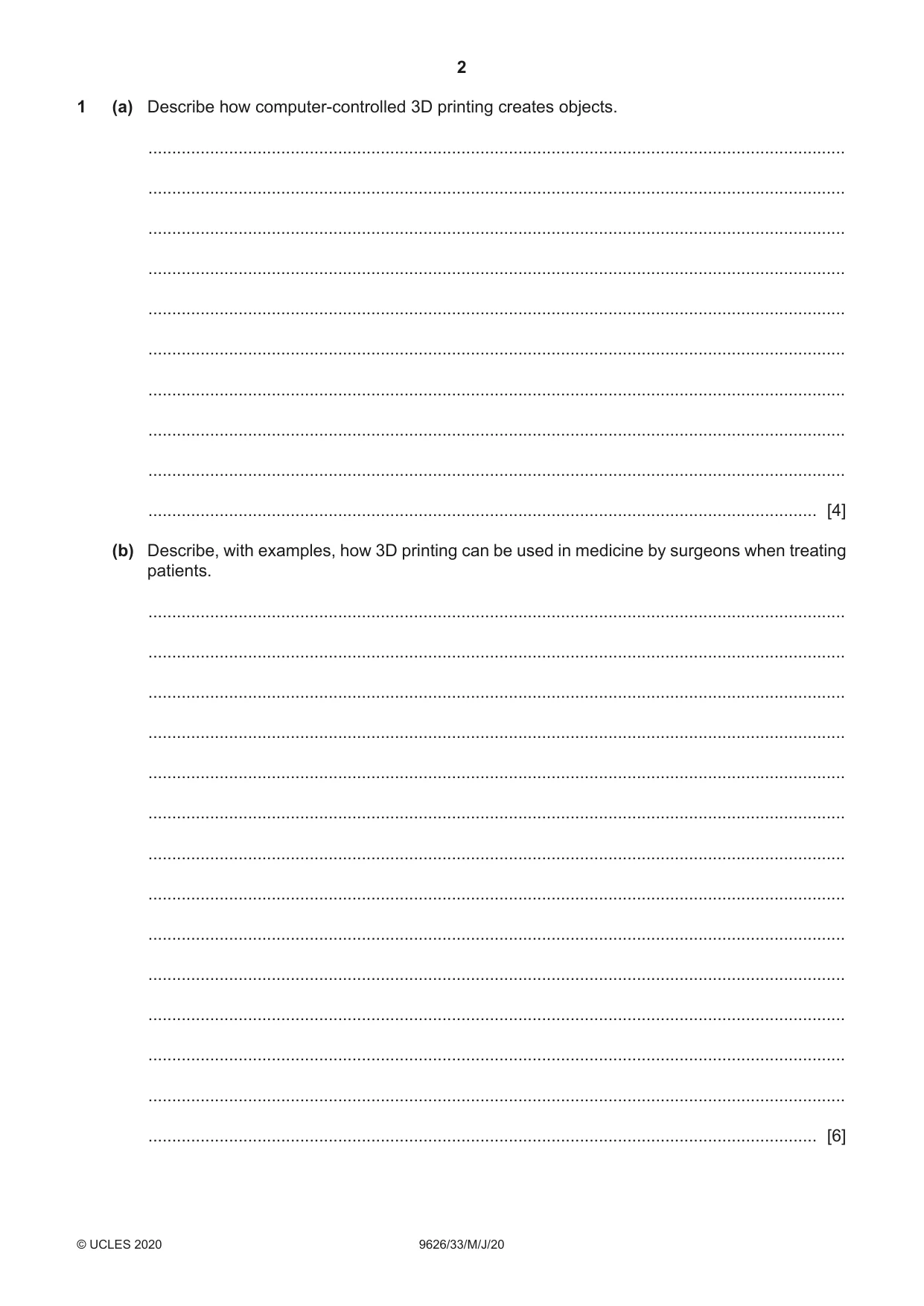
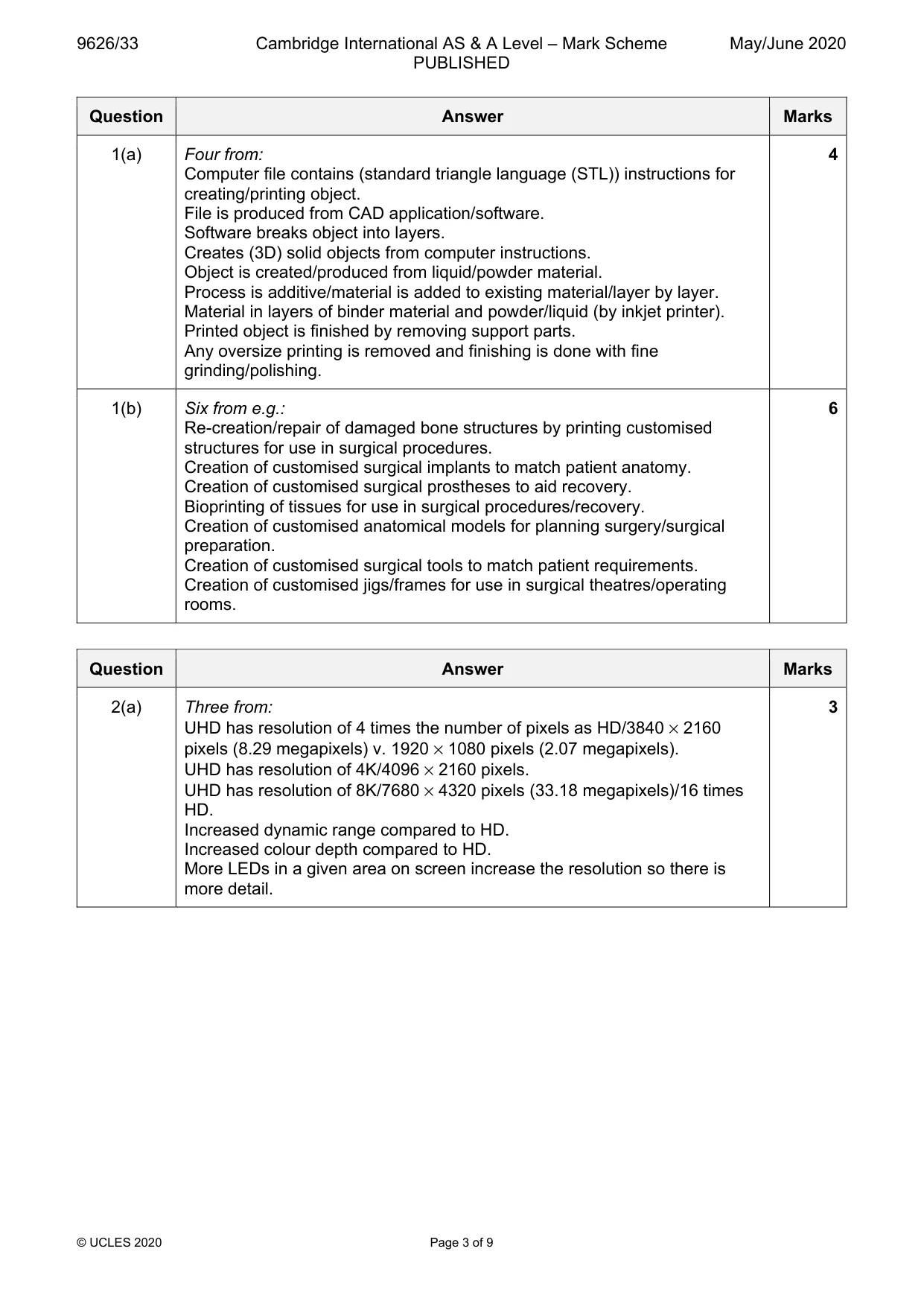
1 (a) Describe how computer-controlled 3D printing creates objects. ................................................................................................................................................... ................................................................................................................................................... ................................................................................................................................................... ................................................................................................................................................... ................................................................................................................................................... ................................................................................................................................................... ................................................................................................................................................... ................................................................................................................................................... ................................................................................................................................................... ............................................................................................................................................. [4] (b) Describe, with examples, how 3D printing can be used in medicine by surgeons when treating patients. ................................................................................................................................................... ................................................................................................................................................... ................................................................................................................................................... ................................................................................................................................................... ................................................................................................................................................... ................................................................................................................................................... ................................................................................................................................................... ................................................................................................................................................... ................................................................................................................................................... ................................................................................................................................................... ................................................................................................................................................... ................................................................................................................................................... ................................................................................................................................................... ............................................................................................................................................. [6]
Mark scheme: Question Answer Marks 1(a) Four from: 4 Computer file contains (standard triangle language (STL)) instructions for creating/printing object. File is produced from CAD application/software. Software breaks object into layers. Creates (3D) solid objects from computer instructions. Object is created/produced from liquid/powder material. Process is additive/material is added to existing material/layer by layer. Material in layers of binder material and powder/liquid (by inkjet printer). Printed object is finished by removing support parts. Any oversize printing is removed and finishing is done with fine grinding/polishing. 1(b) Six from e.g.: 6 Re-creation/repair of damaged bone structures by printing customised structures for use in surgical procedures. Creation of customised surgical implants to match patient anatomy. Creation of customised surgical prostheses to aid recovery. Bioprinting of tissues for use in surgical procedures/recovery. Creation of customised anatomical models for planning surgery/surgical preparation. Creation of customised surgical tools to match patient requirements. Creation of customised jigs/frames for use in surgical theatres/operating rooms.
Q2 · Ultra-high definition television is available from video streaming services over the…
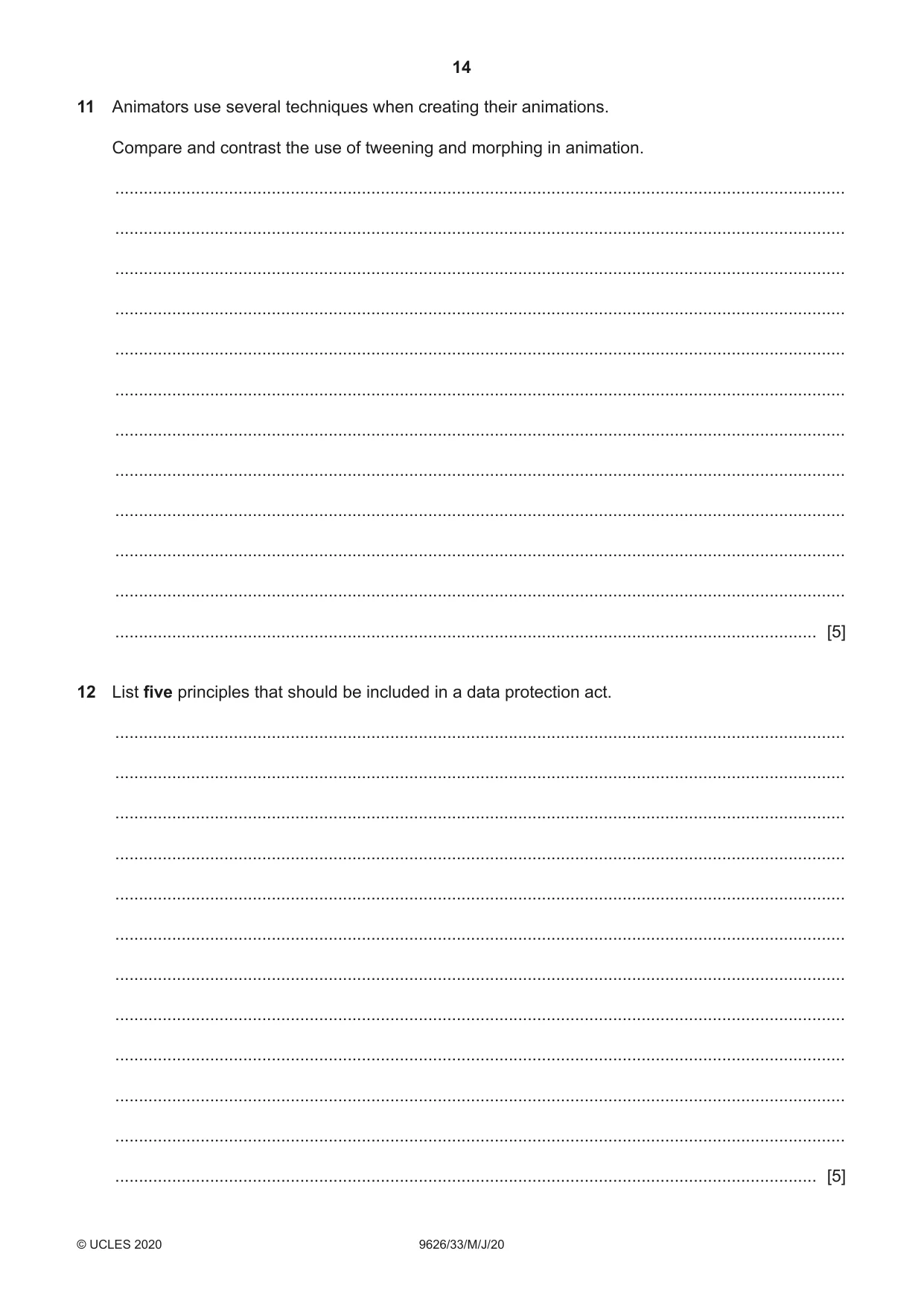
2 Ultra-high definition television is available from video streaming services over the internet. (a) Describe the features of ultra-high definition television systems that improve the viewing experience. ................................................................................................................................................... ................................................................................................................................................... ................................................................................................................................................... ................................................................................................................................................... ................................................................................................................................................... ................................................................................................................................................... ................................................................................................................................................... ............................................................................................................................................. [3] (b) Analyse how the different types of transmission media used by internet service providers affect the availability of ultra-high definition television to their customers. ................................................................................................................................................... ................................................................................................................................................... ................................................................................................................................................... ................................................................................................................................................... ................................................................................................................................................... ................................................................................................................................................... ................................................................................................................................................... ................................................................................................................................................... ................................................................................................................................................... ................................................................................................................................................... ................................................................................................................................................... ................................................................................................................................................... ................................................................................................................................................... ................................................................................................................................................... ................................................................................................................................................... ................................................................................................................................................... ................................................................................................................................................... ................................................................................................................................................... ................................................................................................................................................... ............................................................................................................................................. [8]
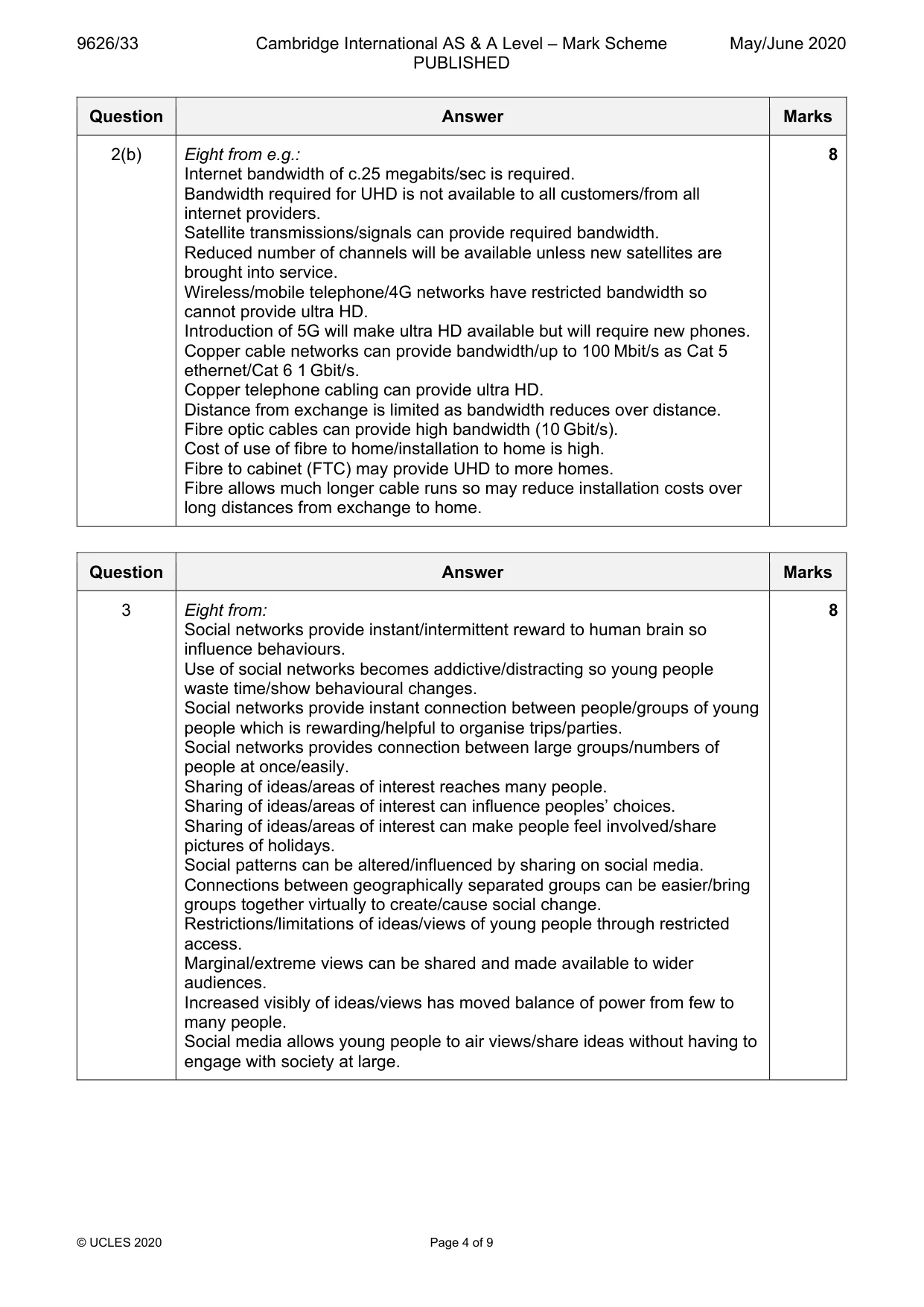
Mark scheme: 2(a) Three from: 3 UHD has resolution of 4 times the number of pixels as HD/3840 × 2160 pixels (8.29 megapixels) v. 1920 × 1080 pixels (2.07 megapixels). UHD has resolution of 4K/4096 × 2160 pixels. UHD has resolution of 8K/7680 × 4320 pixels (33.18 megapixels)/16 times HD. Increased dynamic range compared to HD. Increased colour depth compared to HD. More LEDs in a given area on screen increase the resolution so there is more detail. 2(b) Eight from e.g.: 8 Internet bandwidth of c.25 megabits/sec is required. Bandwidth required for UHD is not available to all customers/from all internet providers. Satellite transmissions/signals can provide required bandwidth. Reduced number of channels will be available unless new satellites are brought into service. Wireless/mobile telephone/4G networks have restricted bandwidth so cannot provide ultra HD. Introduction of 5G will make ultra HD available but will require new phones. Copper cable networks can provide bandwidth/up to 100 Mbit/s as Cat 5 ethernet/Cat 6 1 Gbit/s. Copper telephone cabling can provide ultra HD. Distance from exchange is limited as bandwidth reduces over distance. Fibre optic cables can provide high bandwidth (10 Gbit/s). Cost of use of fibre to home/installation to home is high. Fibre to cabinet (FTC) may provide UHD to more homes. Fibre allows much longer cable runs so may reduce installation costs over long distances from exchange to home.
Q3 · Analyse the role of social networks in changing social patterns among young people
3 Analyse the role of social networks in changing social patterns among young people. .......................................................................................................................................................... .......................................................................................................................................................... .......................................................................................................................................................... .......................................................................................................................................................... .......................................................................................................................................................... .......................................................................................................................................................... .......................................................................................................................................................... .......................................................................................................................................................... .......................................................................................................................................................... .......................................................................................................................................................... .......................................................................................................................................................... .......................................................................................................................................................... .......................................................................................................................................................... .......................................................................................................................................................... .......................................................................................................................................................... .......................................................................................................................................................... .......................................................................................................................................................... .......................................................................................................................................................... .......................................................................................................................................................... .................................................................................................................................................... [8]
Mark scheme: 3 Eight from: 8 Social networks provide instant/intermittent reward to human brain so influence behaviours. Use of social networks becomes addictive/distracting so young people waste time/show behavioural changes. Social networks provide instant connection between people/groups of young people which is rewarding/helpful to organise trips/parties. Social networks provides connection between large groups/numbers of people at once/easily. Sharing of ideas/areas of interest reaches many people. Sharing of ideas/areas of interest can influence peoples’ choices. Sharing of ideas/areas of interest can make people feel involved/share pictures of holidays. Social patterns can be altered/influenced by sharing on social media. Connections between geographically separated groups can be easier/bring groups together virtually to create/cause social change. Restrictions/limitations of ideas/views of young people through restricted access. Marginal/extreme views can be shared and made available to wider audiences. Increased visibly of ideas/views has moved balance of power from few to many people. Social media allows young people to air views/share ideas without having to engage with society at large.
Q4 · A company is concerned that their personnel files may be viewed and used by unauthorised…
4 A company is concerned that their personnel files may be viewed and used by unauthorised people. The company uses access rights (permissions) to protect their files when they are stored on their network and encryption when the files are sent to other companies by email. (a) Explain how the use of different access rights (permissions) applied to files can be used to control access to files. ................................................................................................................................................... ................................................................................................................................................... ................................................................................................................................................... ................................................................................................................................................... ................................................................................................................................................... ................................................................................................................................................... ................................................................................................................................................... ................................................................................................................................................... ................................................................................................................................................... ................................................................................................................................................... ................................................................................................................................................... ................................................................................................................................................... ................................................................................................................................................... ............................................................................................................................................. [6] (b) Describe the advantages of the different encryption methods for protecting files when sending them over public telecommunications systems. ................................................................................................................................................... ................................................................................................................................................... ................................................................................................................................................... ................................................................................................................................................... ................................................................................................................................................... ................................................................................................................................................... ................................................................................................................................................... ................................................................................................................................................... ................................................................................................................................................... ................................................................................................................................................... ................................................................................................................................................... ................................................................................................................................................... ................................................................................................................................................... ............................................................................................................................................. [6]
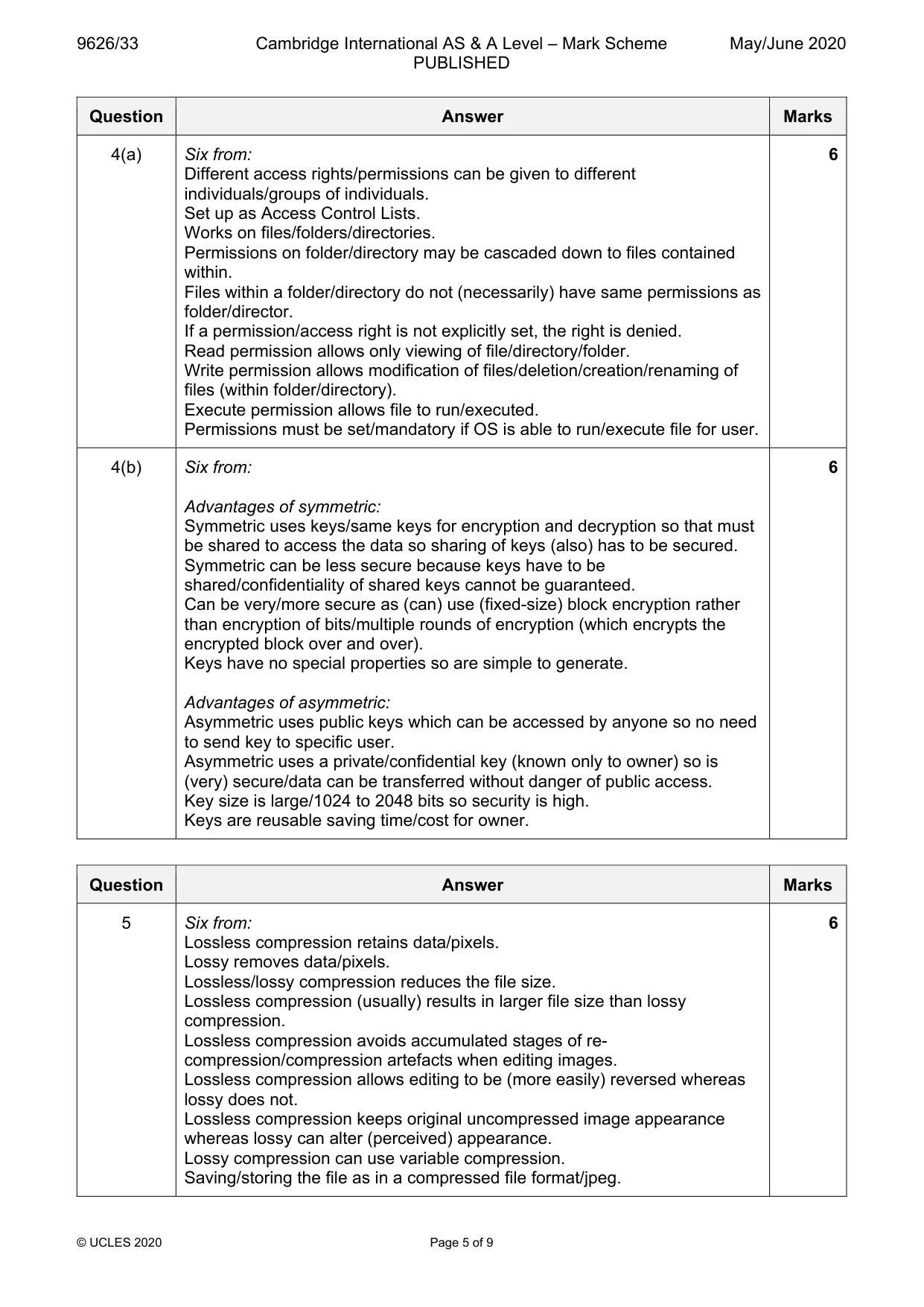
Mark scheme: 4(a) Six from: 6 Different access rights/permissions can be given to different individuals/groups of individuals. Set up as Access Control Lists. Works on files/folders/directories. Permissions on folder/directory may be cascaded down to files contained within. Files within a folder/directory do not (necessarily) have same permissions as folder/director. If a permission/access right is not explicitly set, the right is denied. Read permission allows only viewing of file/directory/folder. Write permission allows modification of files/deletion/creation/renaming of files (within folder/directory). Execute permission allows file to run/executed. Permissions must be set/mandatory if OS is able to run/execute file for user. 4(b) Six from: 6 Advantages of symmetric: Symmetric uses keys/same keys for encryption and decryption so that must be shared to access the data so sharing of keys (also) has to be secured. Symmetric can be less secure because keys have to be shared/confidentiality of shared keys cannot be guaranteed. Can be very/more secure as (can) use (fixed-size) block encryption rather than encryption of bits/multiple rounds of encryption (which encrypts the encrypted block over and over). Keys have no special properties so are simple to generate. Advantages of asymmetric: Asymmetric uses public keys which can be accessed by anyone so no need to send key to specific user. Asymmetric uses a private/confidential key (known only to owner) so is (very) secure/data can be transferred without danger of public access. Key size is large/1024 to 2048 bits so security is high. Keys are reusable saving time/cost for owner.
Q5 · Describe how compression is used when storing bitmap image files
5 Describe how compression is used when storing bitmap image files. .......................................................................................................................................................... .......................................................................................................................................................... .......................................................................................................................................................... .......................................................................................................................................................... .......................................................................................................................................................... .......................................................................................................................................................... .......................................................................................................................................................... .......................................................................................................................................................... .......................................................................................................................................................... .......................................................................................................................................................... .......................................................................................................................................................... .......................................................................................................................................................... .......................................................................................................................................................... .................................................................................................................................................... [6]
Mark scheme: 5 Six from: 6 Lossless compression retains data/pixels. Lossy removes data/pixels. Lossless/lossy compression reduces the file size. Lossless compression (usually) results in larger file size than lossy compression. Lossless compression avoids accumulated stages of re- compression/compression artefacts when editing images. Lossless compression allows editing to be (more easily) reversed whereas lossy does not. Lossless compression keeps original uncompressed image appearance whereas lossy can alter (perceived) appearance. Lossy compression can use variable compression. Saving/storing the file as in a compressed file format/jpeg.
Q6 · Telecommunication companies are using fibre optic cables to supply internet services…
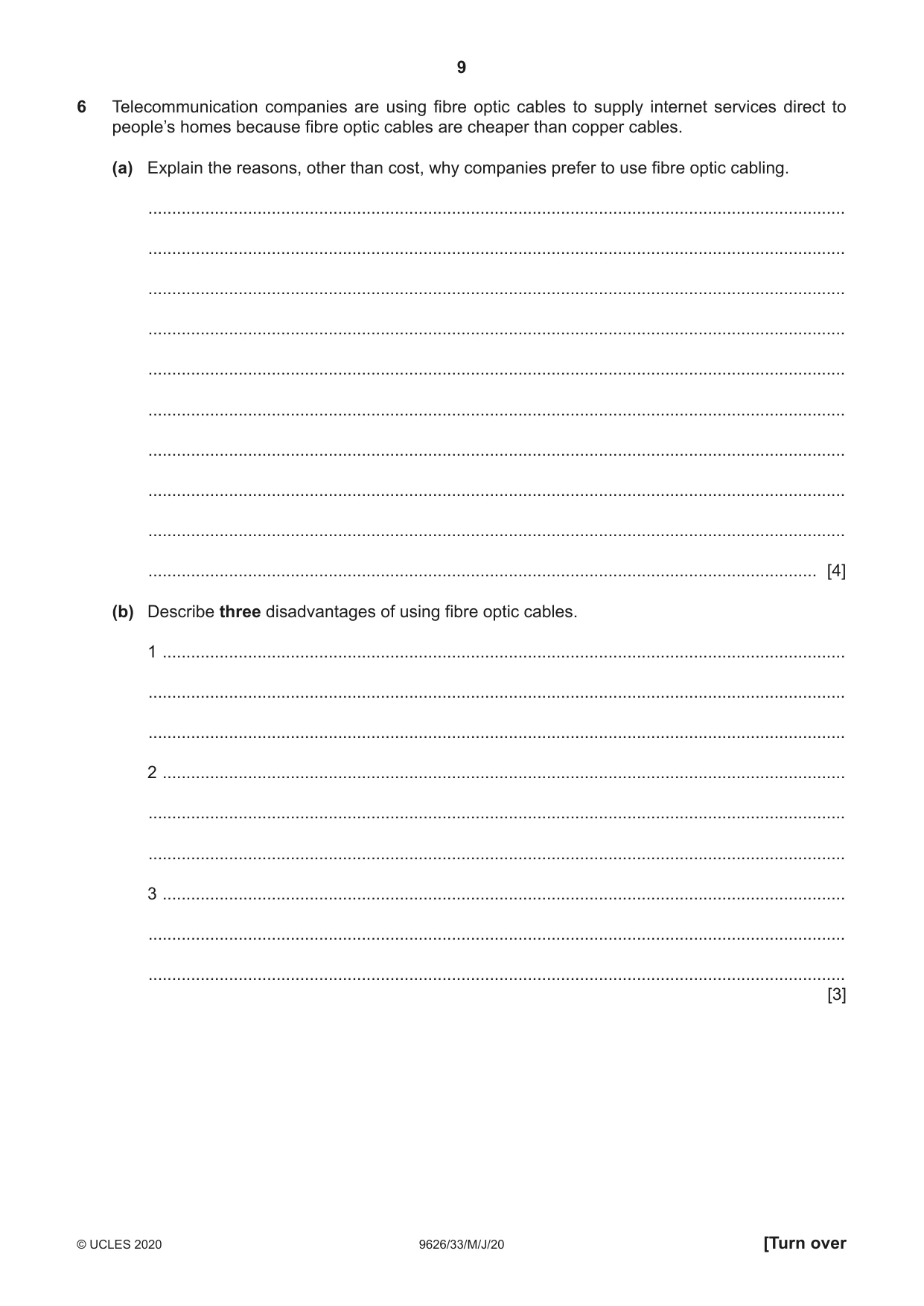
6 Telecommunication companies are using fibre optic cables to supply internet services direct to people’s homes because fibre optic cables are cheaper than copper cables. (a) Explain the reasons, other than cost, why companies prefer to use fibre optic cabling. ................................................................................................................................................... ................................................................................................................................................... ................................................................................................................................................... ................................................................................................................................................... ................................................................................................................................................... ................................................................................................................................................... ................................................................................................................................................... ................................................................................................................................................... ................................................................................................................................................... ............................................................................................................................................. [4] (b) Describe three disadvantages of using fibre optic cables. 1 ................................................................................................................................................ ................................................................................................................................................... ................................................................................................................................................... 2 ................................................................................................................................................ ................................................................................................................................................... ................................................................................................................................................... 3 ................................................................................................................................................ ................................................................................................................................................... ................................................................................................................................................... [3]
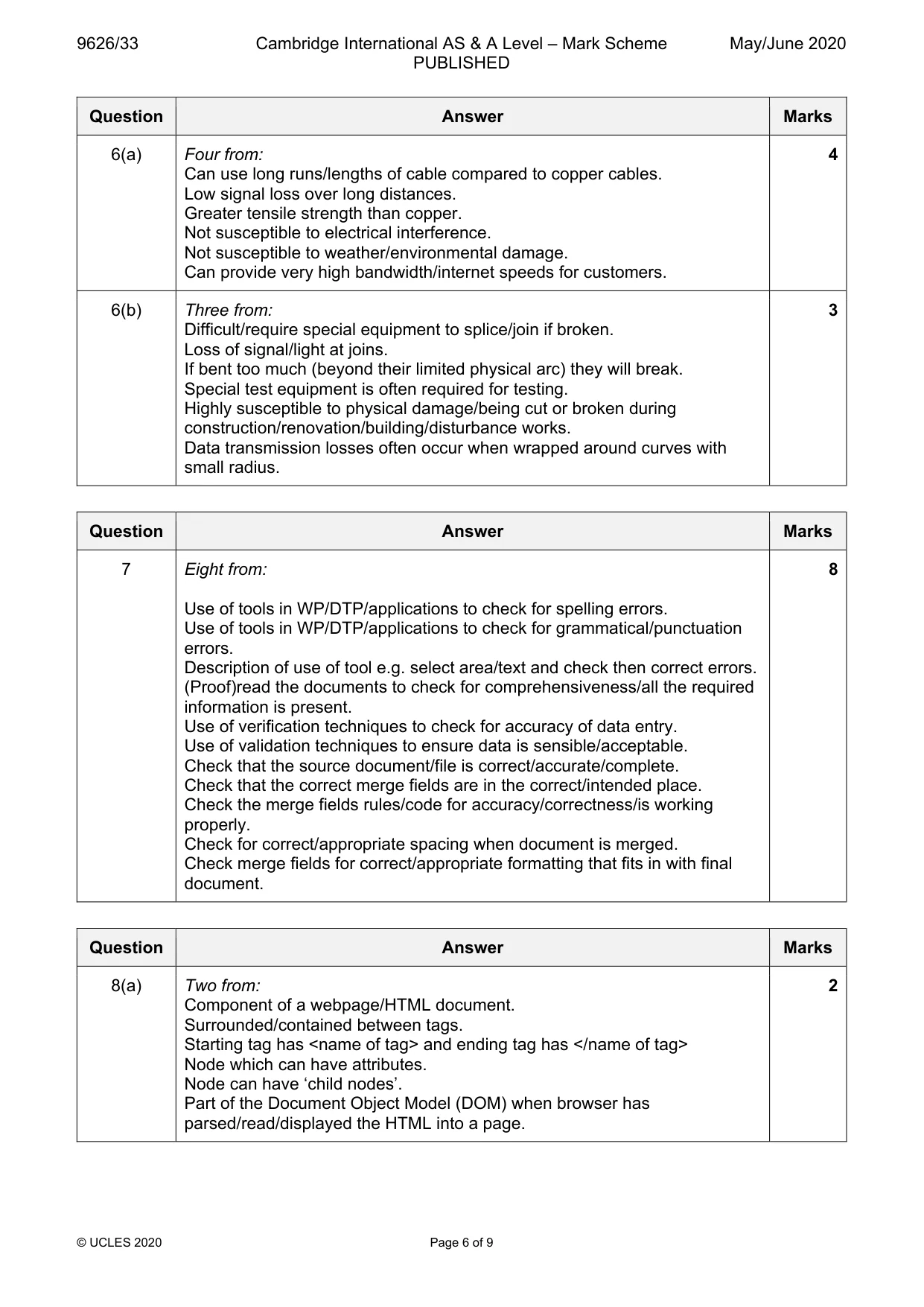
Mark scheme: 6(a) Four from: 4 Can use long runs/lengths of cable compared to copper cables. Low signal loss over long distances. Greater tensile strength than copper. Not susceptible to electrical interference. Not susceptible to weather/environmental damage. Can provide very high bandwidth/internet speeds for customers. 6(b) Three from: 3 Difficult/require special equipment to splice/join if broken. Loss of signal/light at joins. If bent too much (beyond their limited physical arc) they will break. Special test equipment is often required for testing. Highly susceptible to physical damage/being cut or broken during construction/renovation/building/disturbance works. Data transmission losses often occur when wrapped around curves with small radius.
Q7 · When creating company documents for use in mail merge, staff must try to ensure that the…
7 When creating company documents for use in mail merge, staff must try to ensure that the documents are accurate and free of errors. Describe the methods that could be used to eliminate errors when creating mail merge documents. .......................................................................................................................................................... .......................................................................................................................................................... .......................................................................................................................................................... .......................................................................................................................................................... .......................................................................................................................................................... .......................................................................................................................................................... .......................................................................................................................................................... .......................................................................................................................................................... .......................................................................................................................................................... .......................................................................................................................................................... .......................................................................................................................................................... .......................................................................................................................................................... .......................................................................................................................................................... .......................................................................................................................................................... .......................................................................................................................................................... .......................................................................................................................................................... .......................................................................................................................................................... .......................................................................................................................................................... .......................................................................................................................................................... .................................................................................................................................................... [8]
Mark scheme: 7 Eight from: 8 Use of tools in WP/DTP/applications to check for spelling errors. Use of tools in WP/DTP/applications to check for grammatical/punctuation errors. Description of use of tool e.g. select area/text and check then correct errors. (Proof)read the documents to check for comprehensiveness/all the required information is present. Use of verification techniques to check for accuracy of data entry. Use of validation techniques to ensure data is sensible/acceptable. Check that the source document/file is correct/accurate/complete. Check that the correct merge fields are in the correct/intended place. Check the merge fields rules/code for accuracy/correctness/is working properly. Check for correct/appropriate spacing when document is merged. Check merge fields for correct/appropriate formatting that fits in with final document.
Q8 · Nigel is creating a website which uses JavaScript
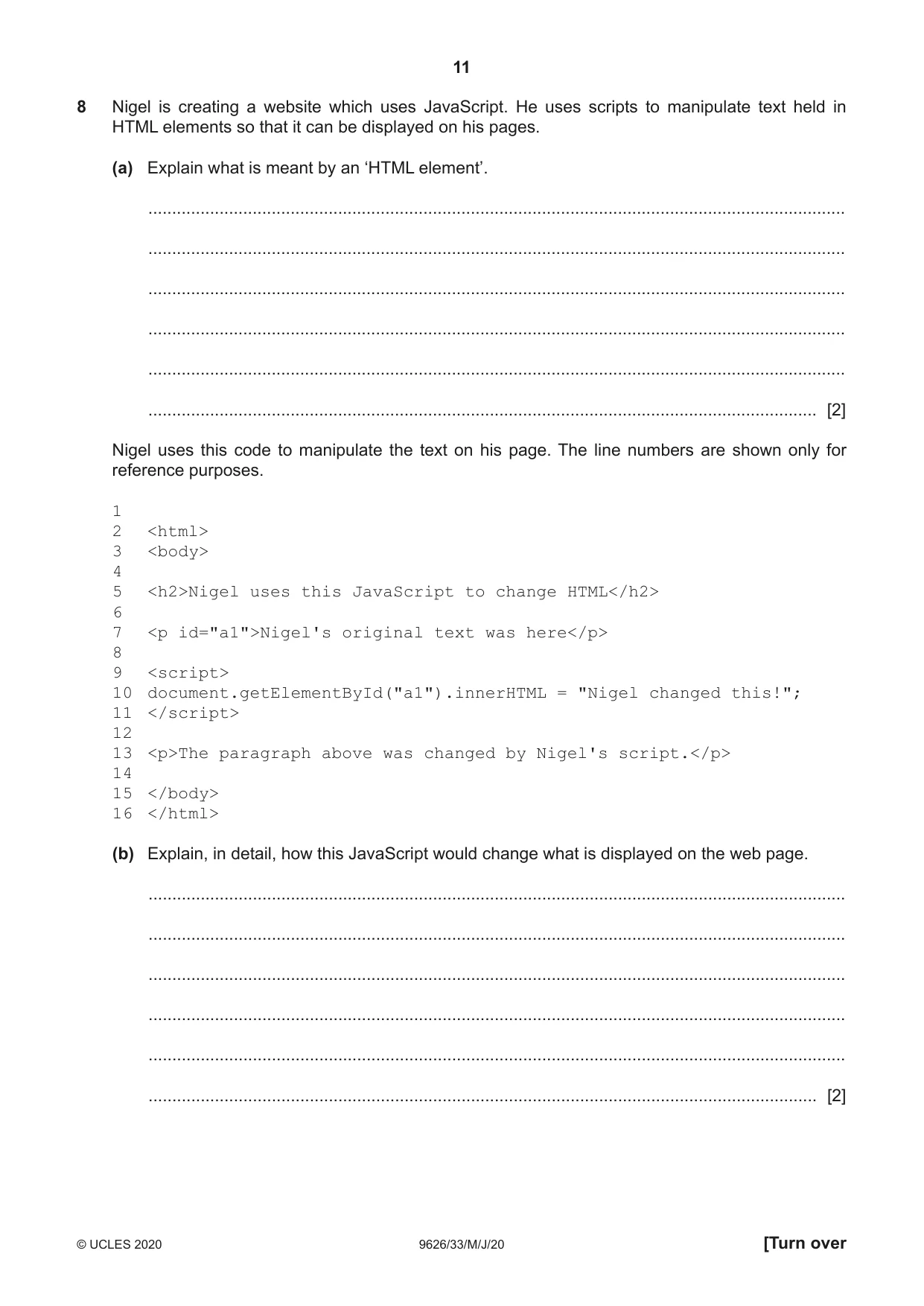
8 Nigel is creating a website which uses JavaScript. He uses scripts to manipulate text held in HTML elements so that it can be displayed on his pages. (a) Explain what is meant by an ‘HTML element’. ................................................................................................................................................... ................................................................................................................................................... ................................................................................................................................................... ................................................................................................................................................... ................................................................................................................................................... ............................................................................................................................................. [2] Nigel uses this code to manipulate the text on his page. The line numbers are shown only for reference purposes. 1 2 <html> 3 <body> 4 5 <h2>Nigel uses this JavaScript to change HTML</h2> 6 7 <p id="a1">Nigel's original text was here</p> 8 9 <script> 10 document.getElementById("a1").innerHTML = "Nigel changed this!"; 11 </script> 12 13 <p>The paragraph above was changed by Nigel's script.</p> 14 15 </body> 16 </html> (b) Explain, in detail, how this JavaScript would change what is displayed on the web page. ................................................................................................................................................... ................................................................................................................................................... ................................................................................................................................................... ................................................................................................................................................... ................................................................................................................................................... ............................................................................................................................................. [2]
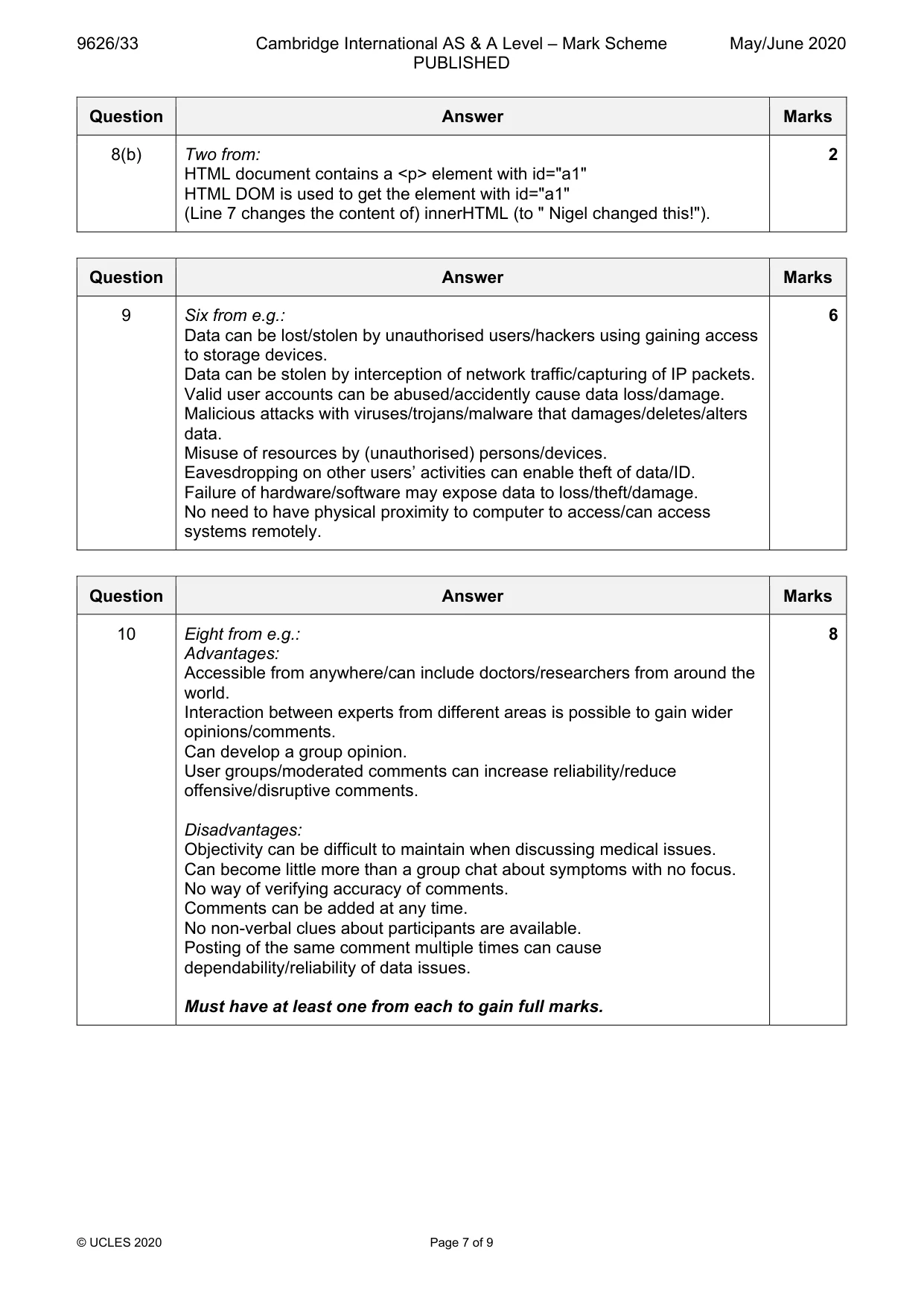
Mark scheme: 8(a) Two from: 2 Component of a webpage/HTML document. Surrounded/contained between tags. Starting tag has <name of tag> and ending tag has </name of tag> Node which can have attributes. Node can have ‘child nodes’. Part of the Document Object Model (DOM) when browser has parsed/read/displayed the HTML into a page. 8(b) Two from: 2 HTML document contains a <p> element with id="a1" HTML DOM is used to get the element with id="a1" (Line 7 changes the content of) innerHTML (to " Nigel changed this!").
Q9 · Describe the security issues that may arise when computers are networked
9 Describe the security issues that may arise when computers are networked. .......................................................................................................................................................... .......................................................................................................................................................... .......................................................................................................................................................... .......................................................................................................................................................... .......................................................................................................................................................... .......................................................................................................................................................... .......................................................................................................................................................... .......................................................................................................................................................... .......................................................................................................................................................... .......................................................................................................................................................... .......................................................................................................................................................... .......................................................................................................................................................... .......................................................................................................................................................... .................................................................................................................................................... [6]
Mark scheme: 9 Six from e.g.: 6 Data can be lost/stolen by unauthorised users/hackers using gaining access to storage devices. Data can be stolen by interception of network traffic/capturing of IP packets. Valid user accounts can be abused/accidently cause data loss/damage. Malicious attacks with viruses/trojans/malware that damages/deletes/alters data. Misuse of resources by (unauthorised) persons/devices. Eavesdropping on other users’ activities can enable theft of data/ID. Failure of hardware/software may expose data to loss/theft/damage. No need to have physical proximity to computer to access/can access systems remotely.
Q10 · An internet forum is a discussion site which can be used to collect data from people
10 An internet forum is a discussion site which can be used to collect data from people. Messages are posted on topics in threads. Data from the postings can be analysed and used in research. By weighing up the advantages and disadvantages, evaluate the use of a forum to collect information from patients for use in medical research. .......................................................................................................................................................... .......................................................................................................................................................... .......................................................................................................................................................... .......................................................................................................................................................... .......................................................................................................................................................... .......................................................................................................................................................... .......................................................................................................................................................... .......................................................................................................................................................... .......................................................................................................................................................... .......................................................................................................................................................... .......................................................................................................................................................... .......................................................................................................................................................... .......................................................................................................................................................... .......................................................................................................................................................... .......................................................................................................................................................... .......................................................................................................................................................... .......................................................................................................................................................... .......................................................................................................................................................... .......................................................................................................................................................... .................................................................................................................................................... [8]
Mark scheme: 10 Eight from e.g.: 8 Advantages: Accessible from anywhere/can include doctors/researchers from around the world. Interaction between experts from different areas is possible to gain wider opinions/comments. Can develop a group opinion. User groups/moderated comments can increase reliability/reduce offensive/disruptive comments. Disadvantages: Objectivity can be difficult to maintain when discussing medical issues. Can become little more than a group chat about symptoms with no focus. No way of verifying accuracy of comments. Comments can be added at any time. No non-verbal clues about participants are available. Posting of the same comment multiple times can cause dependability/reliability of data issues. Must have at least one from each to gain full marks.
Q11 · Animators use several techniques when creating their animations
11 Animators use several techniques when creating their animations. Compare and contrast the use of tweening and morphing in animation. .......................................................................................................................................................... .......................................................................................................................................................... .......................................................................................................................................................... .......................................................................................................................................................... .......................................................................................................................................................... .......................................................................................................................................................... .......................................................................................................................................................... .......................................................................................................................................................... .......................................................................................................................................................... .......................................................................................................................................................... .......................................................................................................................................................... .................................................................................................................................................... [5]
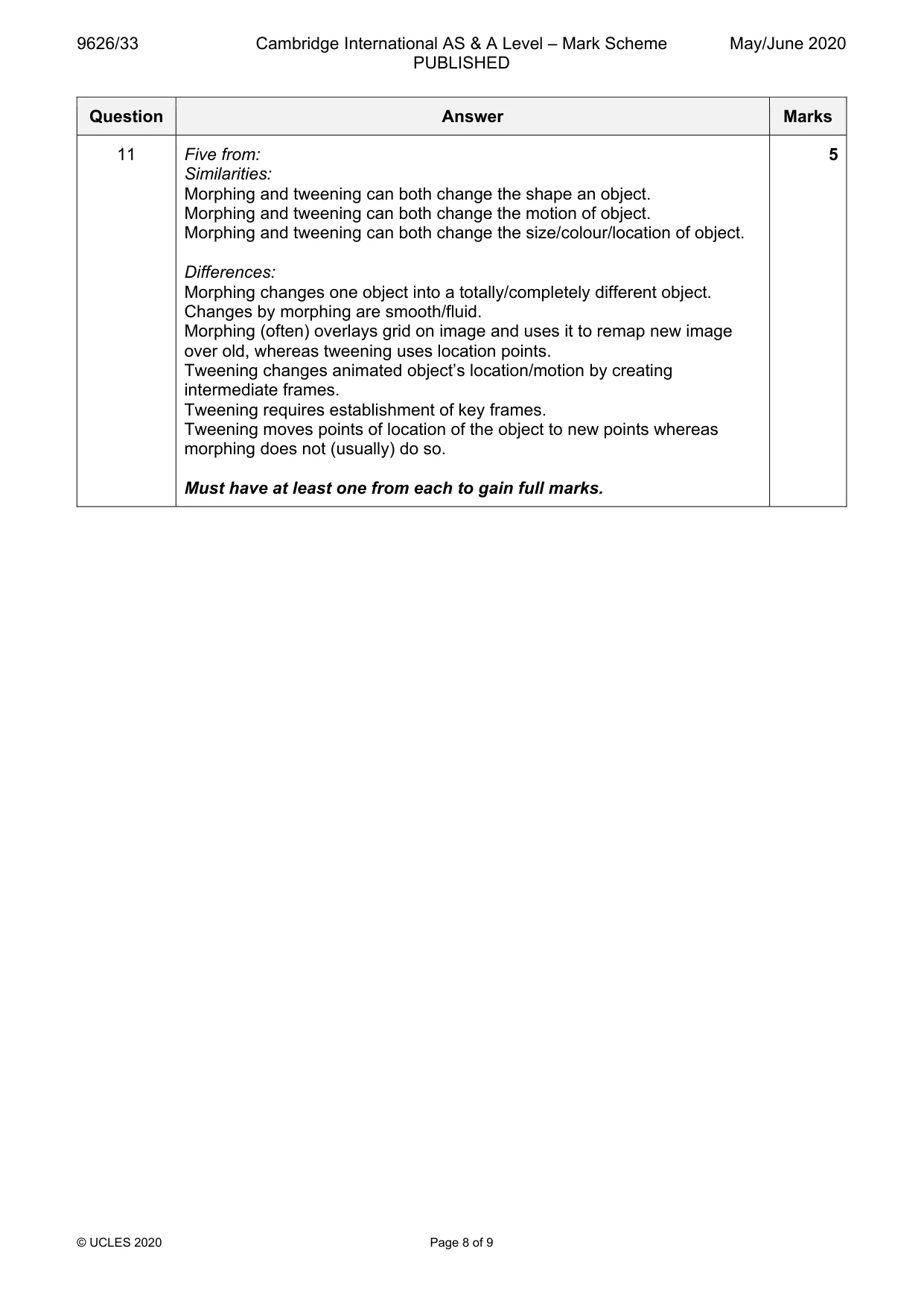
Mark scheme: 11 Five from: 5 Similarities: Morphing and tweening can both change the shape an object. Morphing and tweening can both change the motion of object. Morphing and tweening can both change the size/colour/location of object. Differences: Morphing changes one object into a totally/completely different object. Changes by morphing are smooth/fluid. Morphing (often) overlays grid on image and uses it to remap new image over old, whereas tweening uses location points. Tweening changes animated object’s location/motion by creating intermediate frames. Tweening requires establishment of key frames. Tweening moves points of location of the object to new points whereas morphing does not (usually) do so. Must have at least one from each to gain full marks.
Q12 · List five principles that should be included in a data protection act
12 List five principles that should be included in a data protection act. .......................................................................................................................................................... .......................................................................................................................................................... .......................................................................................................................................................... .......................................................................................................................................................... .......................................................................................................................................................... .......................................................................................................................................................... .......................................................................................................................................................... .......................................................................................................................................................... .......................................................................................................................................................... .......................................................................................................................................................... .......................................................................................................................................................... .................................................................................................................................................... [5]
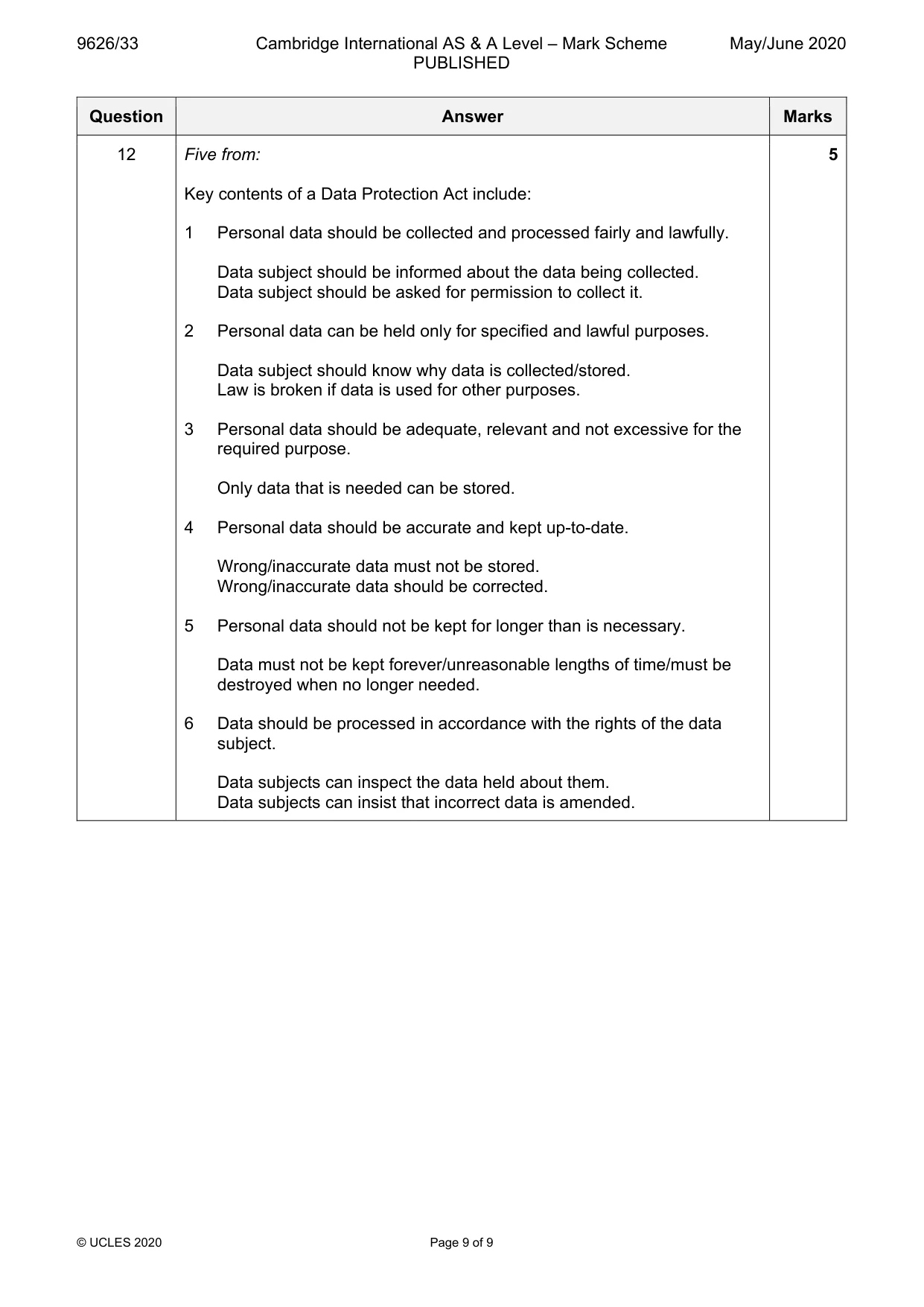
Mark scheme: 12 Five from: 5 Key contents of a Data Protection Act include: 1 Personal data should be collected and processed fairly and lawfully. Data subject should be informed about the data being collected. Data subject should be asked for permission to collect it. 2 Personal data can be held only for specified and lawful purposes. Data subject should know why data is collected/stored. Law is broken if data is used for other purposes. 3 Personal data should be adequate, relevant and not excessive for the required purpose. Only data that is needed can be stored. 4 Personal data should be accurate and kept up-to-date. Wrong/inaccurate data must not be stored. Wrong/inaccurate data should be corrected. 5 Personal data should not be kept for longer than is necessary. Data must not be kept forever/unreasonable lengths of time/must be destroyed when no longer needed. 6 Data should be processed in accordance with the rights of the data subject. Data subjects can inspect the data held about them. Data subjects can insist that incorrect data is amended.
What was in this paper
The subtopics covered by these 12 questions, and how many questions each got. Open one in a new tab to see every Cambridge question on it.
Other variants, same session
The paragraph above was changed by Nigel's script.
14 15