Cambridge A Level Information Technology (from 2017) 9626 — 2019 May/June Paper 1 · Variant 3
9626/13/M/J/19 · 90 marks · ≈101 min
The question paper and its mark scheme, free to read here and free to download. This is Cambridge’s own paper, exactly as it was sat.
Question paper16 pages






Mark scheme10 pages
Answers below. Sit the paper first if you are practising.
Paper as text
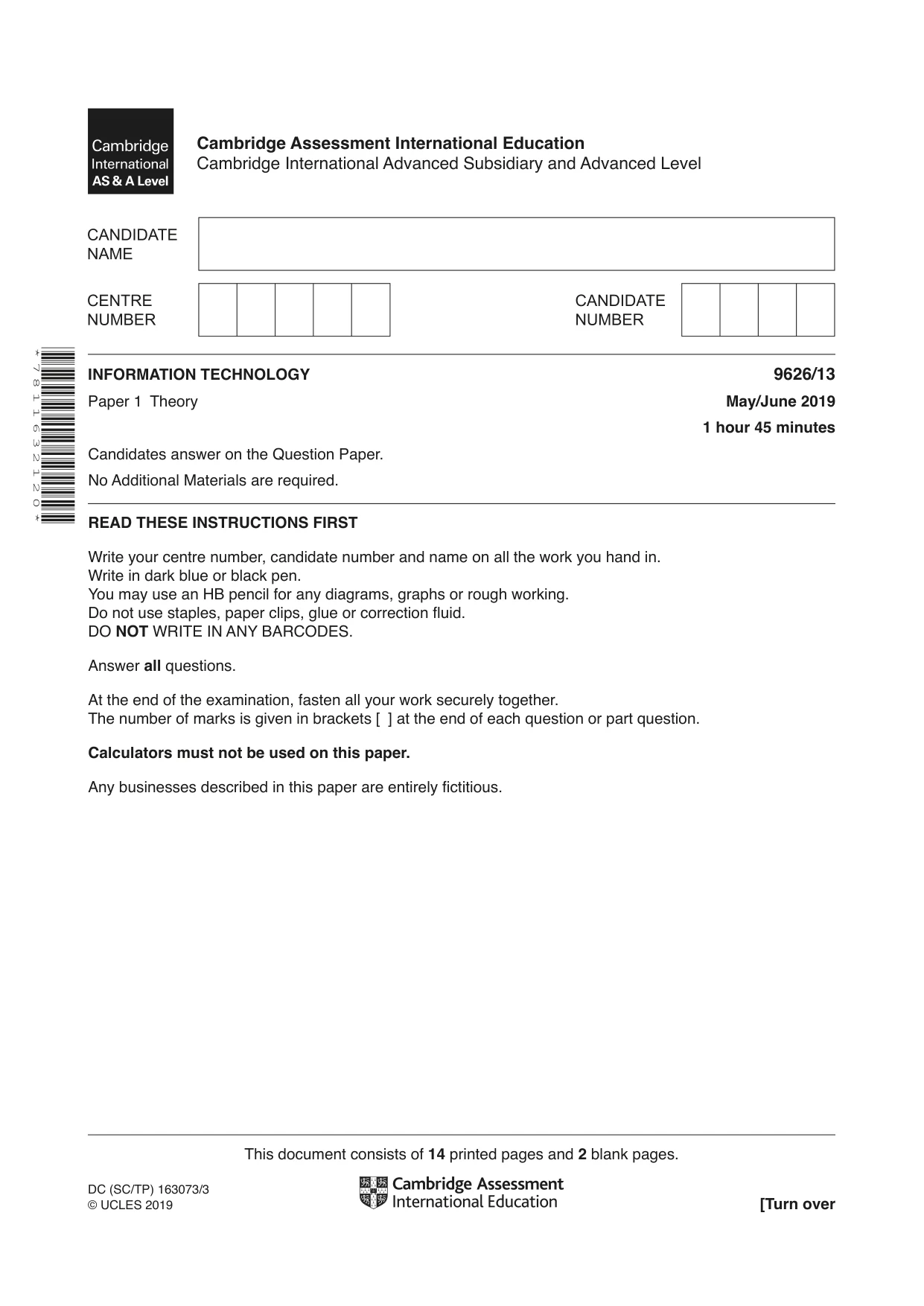
Question paper, page 1
This document consists of 14 printed pages and 2 blank pages. DC (SC/TP) 163073/3 © UCLES 2019 [Turn over Cambridge Assessment International Education Cambridge International Advanced Subsidiary and Advanced Level * 7 8 1 1 6 3 2 1 2 0 * INFORMATION TECHNOLOGY 9626/13 Paper 1 Theory May/June 2019 1 hour 45 minutes Candidates answer on the Question Paper. No Additional Materials are required. READ THESE INSTRUCTIONS FIRST Write your centre number, candidate number and name on all the work you hand in. Write in dark blue or black pen. You may use an HB pencil for any diagrams, graphs or rough working. Do not use staples, paper clips, glue or correction fluid. DO NOT WRITE IN ANY BARCODES. Answer all questions. At the end of the examination, fasten all your work securely together. The number of marks is given in brackets [ ] at the end of each question or part question. Calculators must not be used on this paper. Any businesses described in this paper are entirely fictitious.
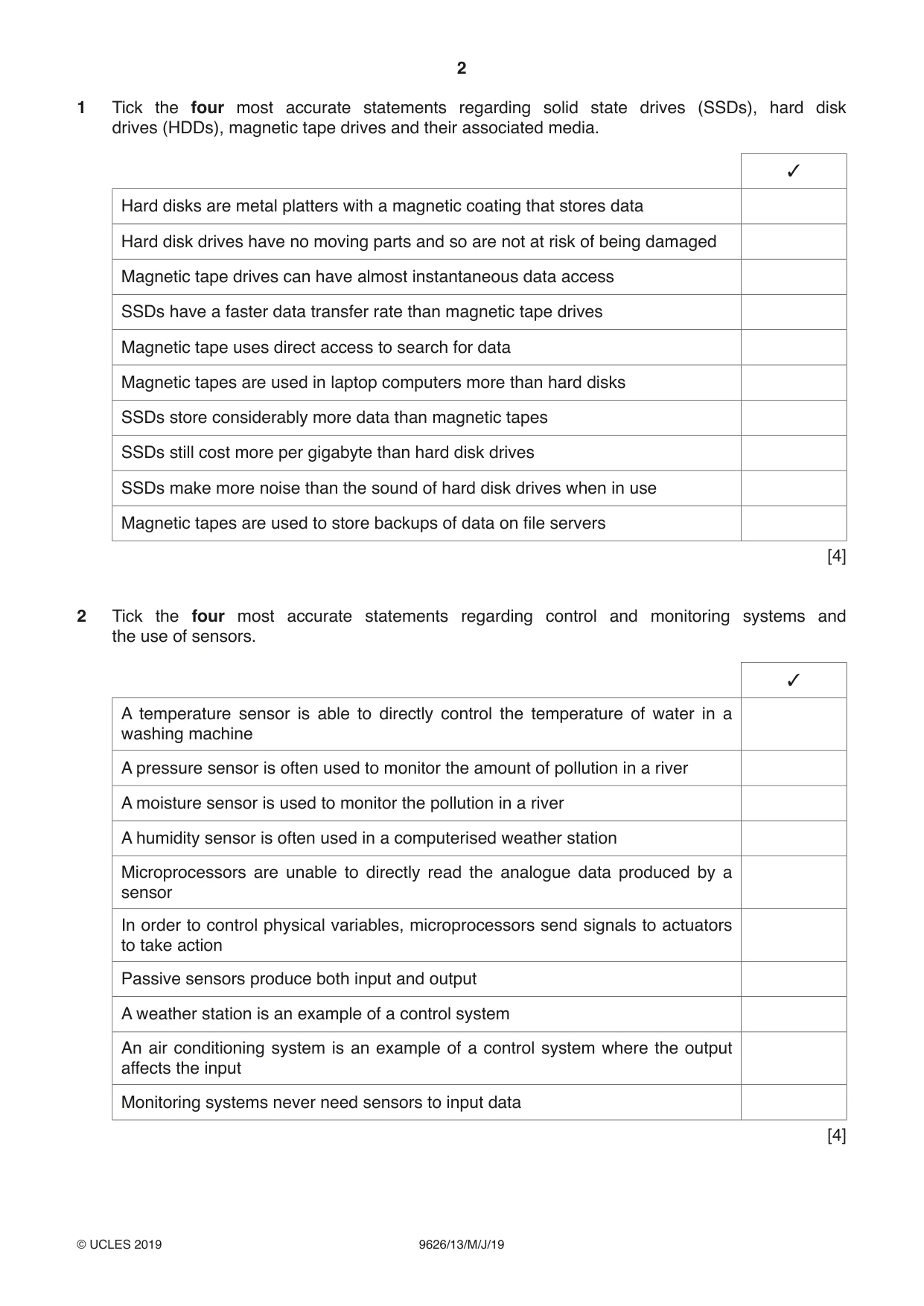
Question paper, page 2
2 9626/13/M/J/19 © UCLES 2019 1 Tick the four most accurate statements regarding solid state drives (SSDs), hard disk drives (HDDs), magnetic tape drives and their associated media. ✓ Hard disks are metal platters with a magnetic coating that stores data Hard disk drives have no moving parts and so are not at risk of being damaged Magnetic tape drives can have almost instantaneous data access SSDs have a faster data transfer rate than magnetic tape drives Magnetic tape uses direct access to search for data Magnetic tapes are used in laptop computers more than hard disks SSDs store considerably more data than magnetic tapes SSDs still cost more per gigabyte than hard disk drives SSDs make more noise than the sound of hard disk drives when in use Magnetic tapes are used to store backups of data on file servers [4] 2 Tick the four most accurate statements regarding control and monitoring systems and the use of sensors. ✓ A temperature sensor is able to directly control the temperature of water in a washing machine A pressure sensor is often used to monitor the amount of pollution in a river A moisture sensor is used to monitor the pollution in a river A humidity sensor is often used in a computerised weather station Microprocessors are unable to directly read the analogue data produced by a sensor In order to control physical variables, microprocessors send signals to actuators to take action Passive sensors produce both input and output A weather station is an example of a control system An air conditioning system is an example of a control system where the output affects the input Monitoring systems never need sensors to input data [4]
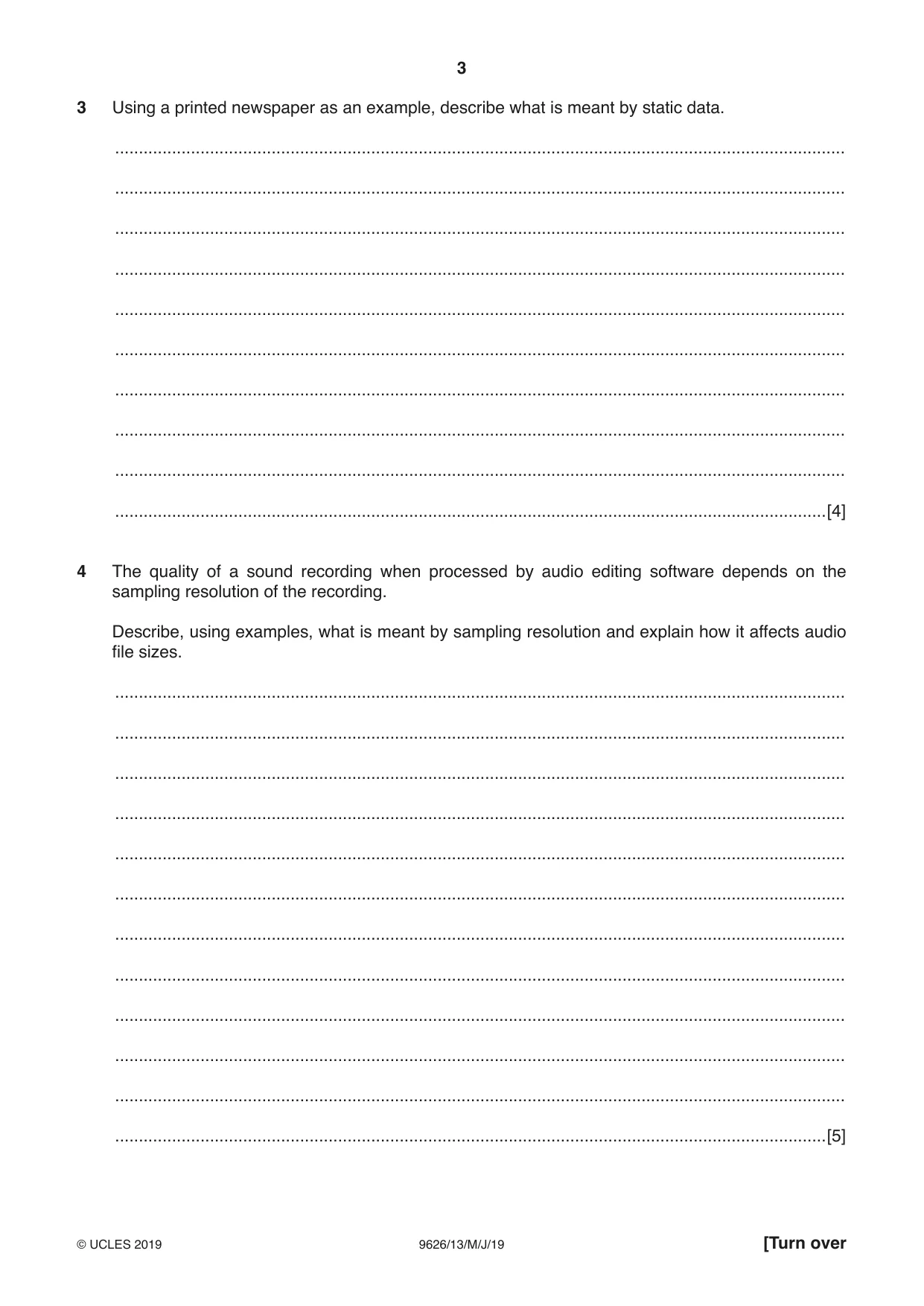
Question paper, page 3
3 9626/13/M/J/19 © UCLES 2019 [Turn over 3 Using a printed newspaper as an example, describe what is meant by static data. … … … … … … … … … …[4] 4 The quality of a sound recording when processed by audio editing software depends on the sampling resolution of the recording. Describe, using examples, what is meant by sampling resolution and explain how it affects audio file sizes. … … … … … … … … … … … …[5]
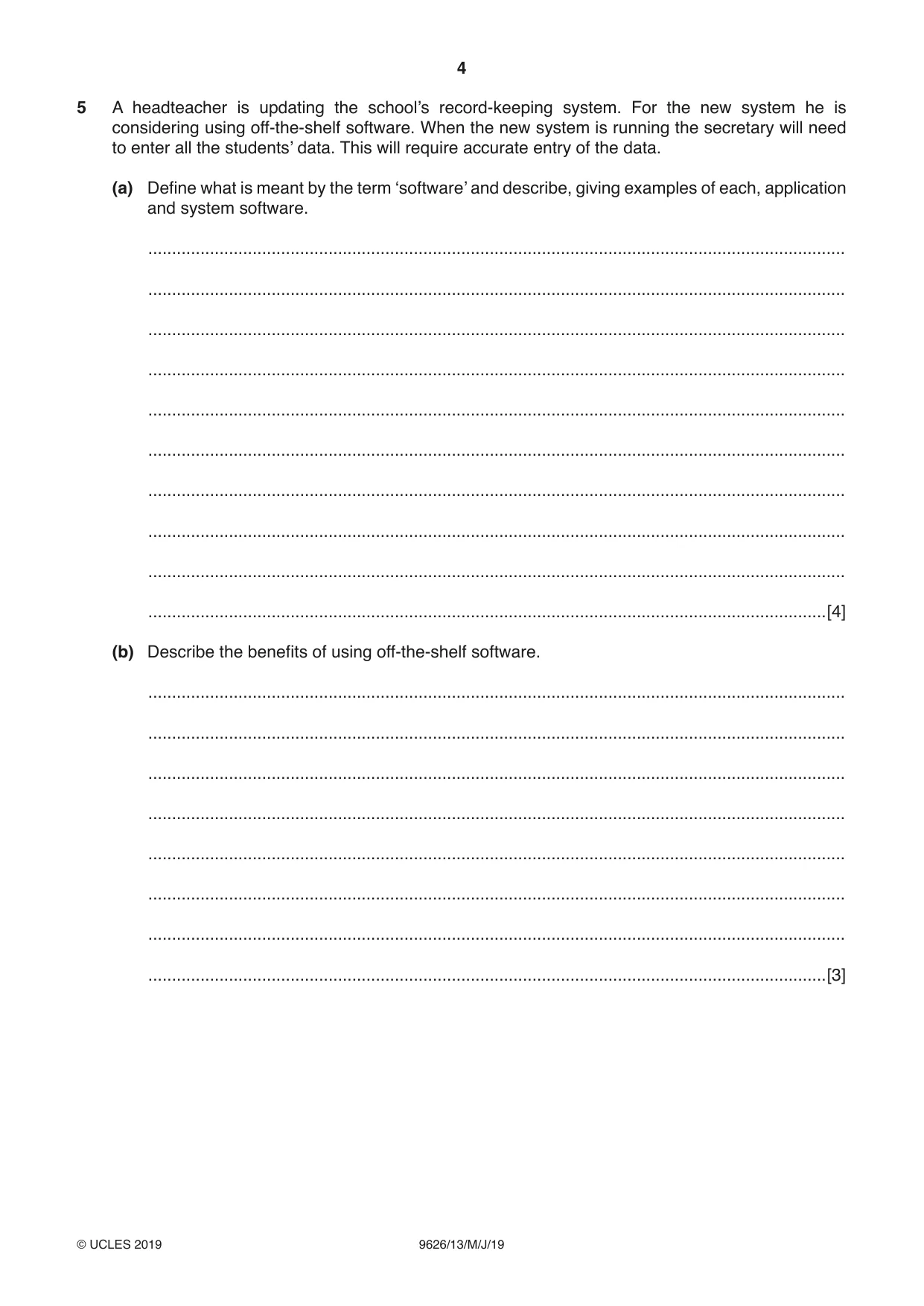
Question paper, page 4
4 9626/13/M/J/19 © UCLES 2019 5 A headteacher is updating the school’s record-keeping system. For the new system he is considering using off-the-shelf software. When the new system is running the secretary will need to enter all the students’ data. This will require accurate entry of the data. (a) Define what is meant by the term ‘software’ and describe, giving examples of each, application and system software. … … … … … … … … … …[4] (b) Describe the benefits of using off-the-shelf software. … … … … … … … …[3]
Question paper, page 5
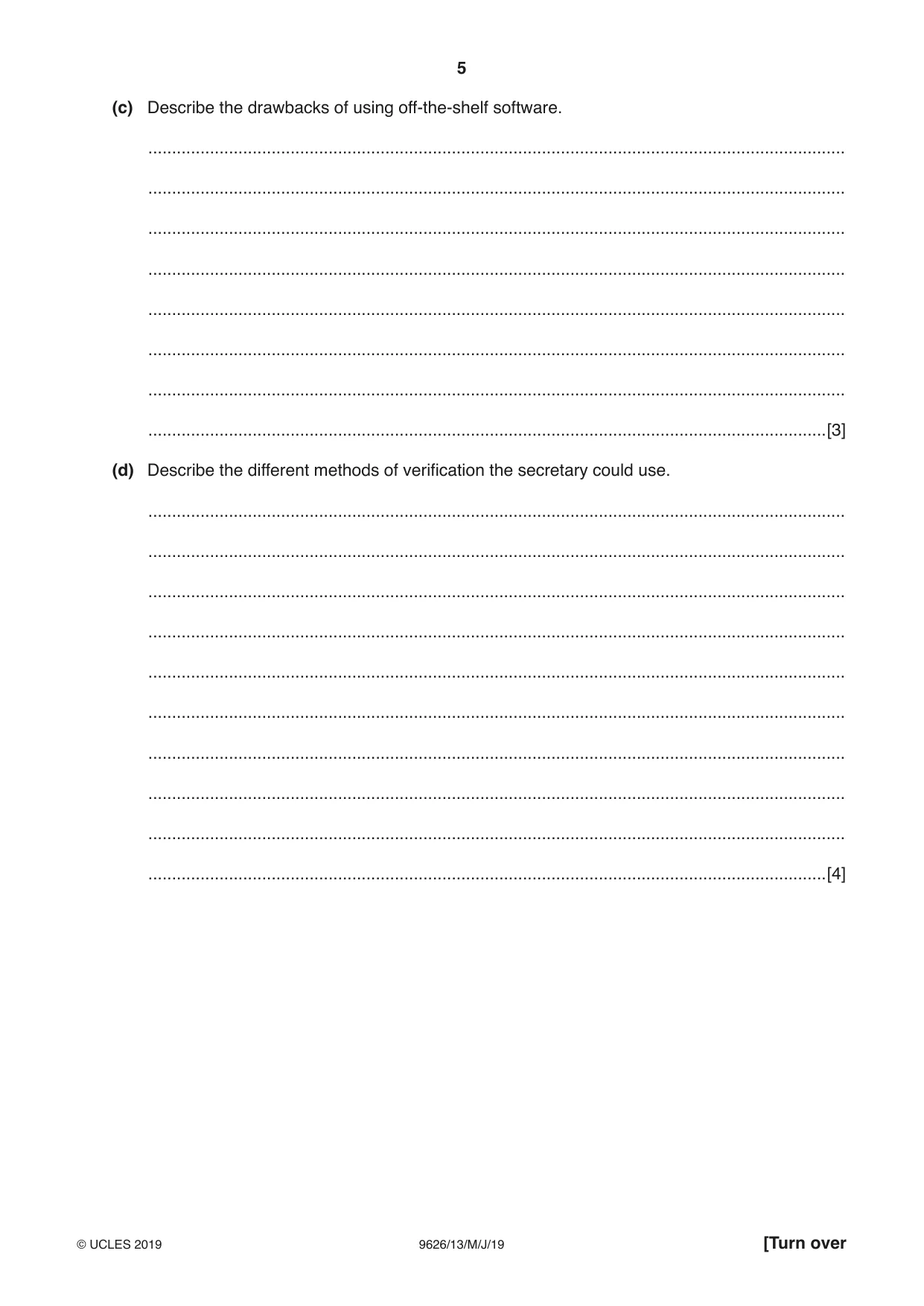
5 9626/13/M/J/19 © UCLES 2019 [Turn over (c) Describe the drawbacks of using off-the-shelf software. … … … … … … … …[3] (d) Describe the different methods of verification the secretary could use. … … … … … … … … … …[4]
Question paper, page 6
6 9626/13/M/J/19 © UCLES 2019 6 Spreadsheets are commonly used to create models of real situations. Using examples, explain why the characteristics of spreadsheets are suitable for producing financial models. … … … … … … … … … … … … … … … … … … … …[8]
Question paper, page 7
7 9626/13/M/J/19 © UCLES 2019 [Turn over 7 The encoding of data can often require the use of codecs. Describe the features of this type of encoding. … … … … … … … … … … … … … …[6]
Question paper, page 8
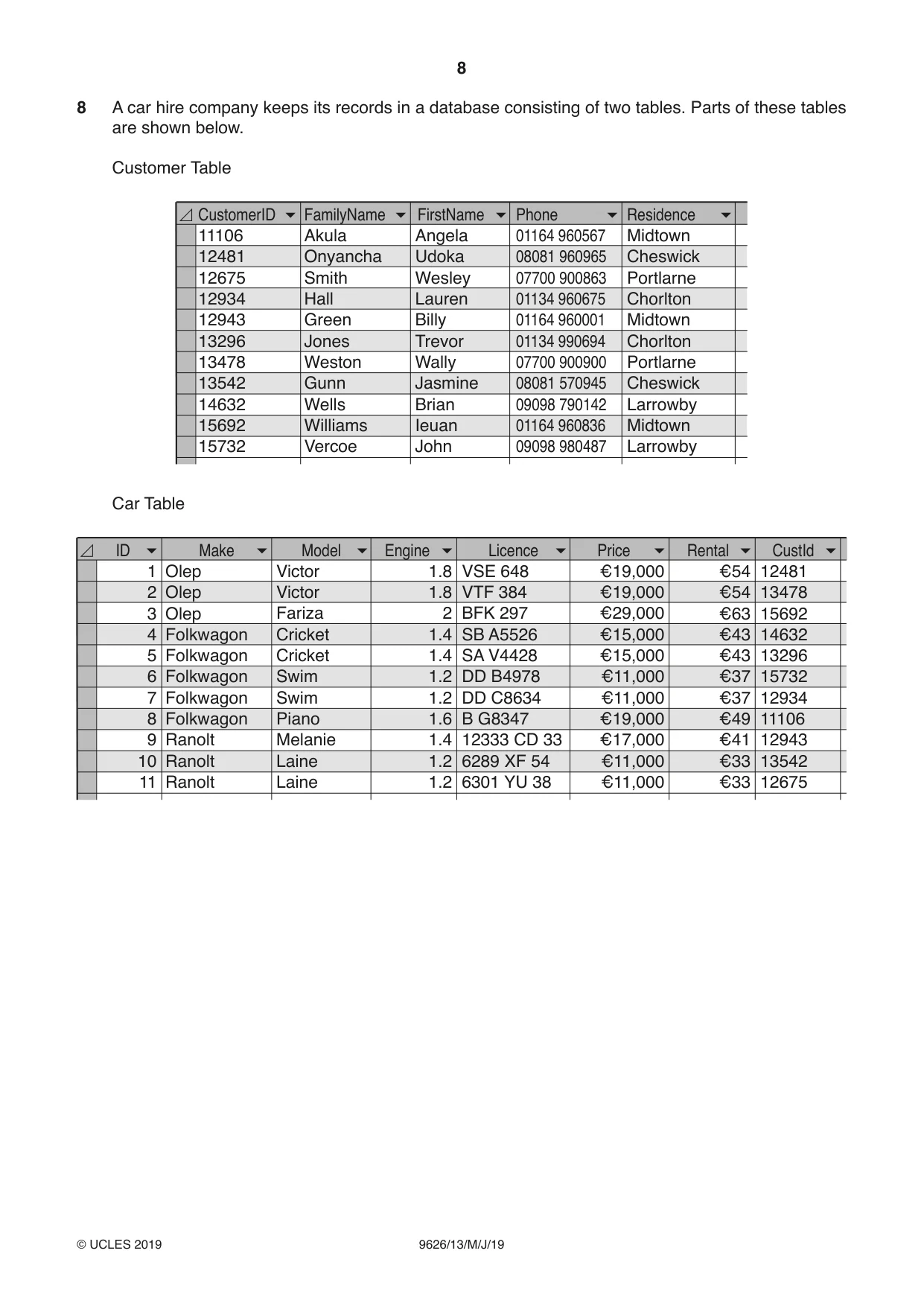
8 9626/13/M/J/19 © UCLES 2019 8 A car hire company keeps its records in a database consisting of two tables. Parts of these tables are shown below. Customer Table 11106 12481 12675 12934 12943 13296 13478 13542 14632 15692 15732 CustomerID FamilyName FirstName Phone Residence Akula Onyancha Smith Hall Green Jones Weston Gunn Wells Williams Vercoe Angela Udoka Wesley Lauren Billy Trevor Wally Jasmine Brian Ieuan John 01164 960567 08081 960965 07700 900863 01134 960675 01164 960001 01134 990694 07700 900900 08081 570945 09098 790142 01164 960836 09098 980487 Midtown Cheswick Portlarne Chorlton Midtown Chorlton Portlarne Cheswick Larrowby Midtown Larrowby Car Table 1 2 3 4 5 6 7 8 9 10 11 1.8 1.8 2 1.4 1.4 1.2 1.2 1.6 1.4 1.2 1.2 €19,000 €19,000 €29,000 €15,000 €15,000 €11,000 €11,000 €19,000 €17,000 €11,000 €11,000 ID Make Model Engine Licence Price Rental Olep Olep Olep Folkwagon Folkwagon Folkwagon Folkwagon Folkwagon Ranolt Ranolt Ranolt Victor Victor Fariza Cricket Cricket Swim Swim Piano Melanie Laine Laine VSE 648 VTF 384 BFK 297 SB A5526 SA V4428 DD B4978 DD C8634 B G8347 12333 CD 33 6289 XF 54 6301 YU 38 12481 13478 15692 14632 13296 15732 12934 11106 12943 13542 12675 €54 €54 €63 €43 €43 €37 €37 €49 €41 €33 €33 CustId
Question paper, page 9
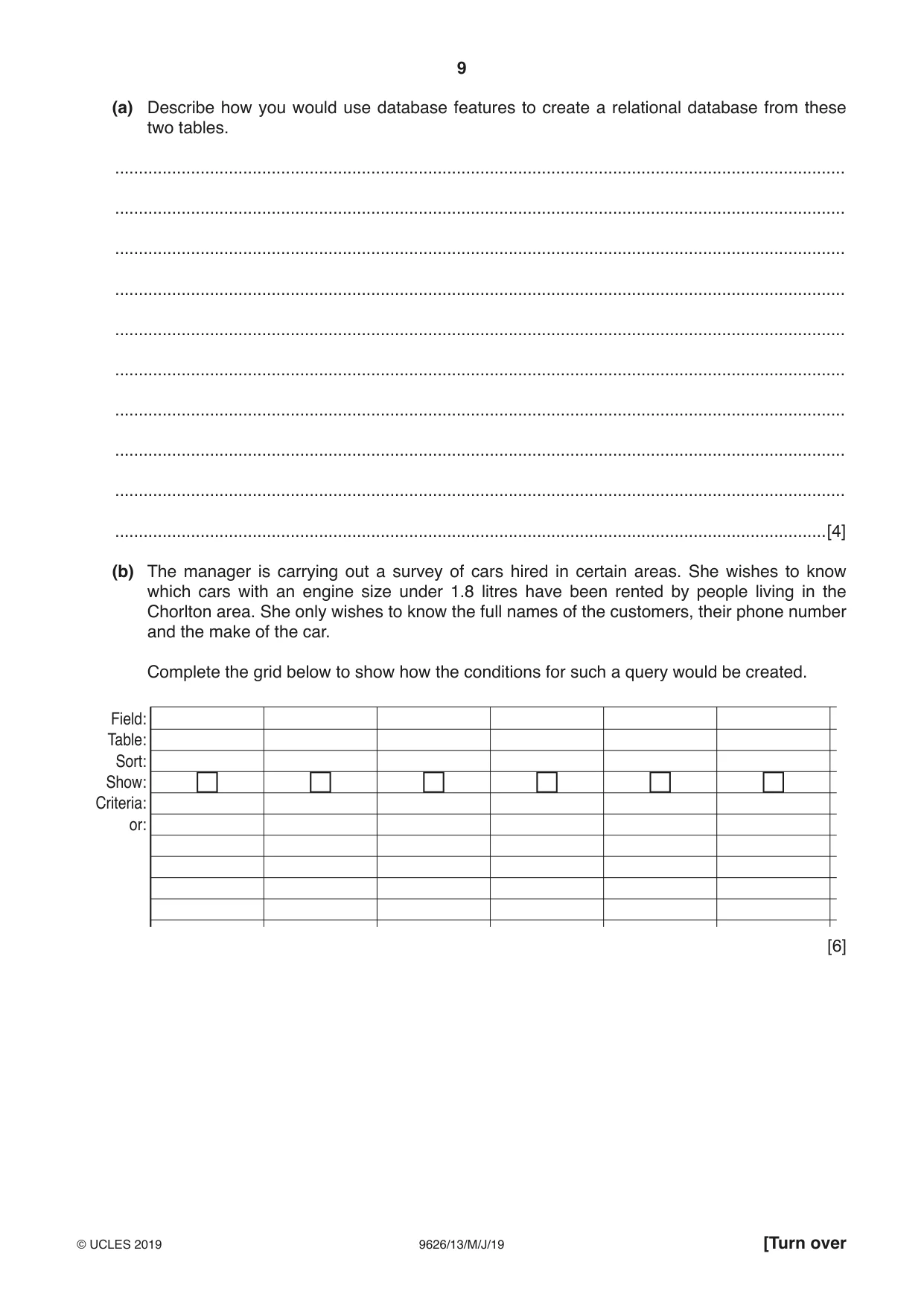
9 9626/13/M/J/19 © UCLES 2019 [Turn over (a) Describe how you would use database features to create a relational database from these two tables. … … … … … … … … … …[4] (b) The manager is carrying out a survey of cars hired in certain areas. She wishes to know which cars with an engine size under 1.8 litres have been rented by people living in the Chorlton area. She only wishes to know the full names of the customers, their phone number and the make of the car. Complete the grid below to show how the conditions for such a query would be created. Field: Table: Sort: Show: Criteria: or: [6]
Question paper, page 10
10 9626/13/M/J/19 © UCLES 2019 (c) Explain why it would be extremely difficult to validate the Licence field. Include in your explanation, a detailed description of three validation checks, other than a presence check, which could normally be used on any alphanumeric field from the database shown on page 8. … … … … … … … … … … … … … …[6]
Question paper, page 11
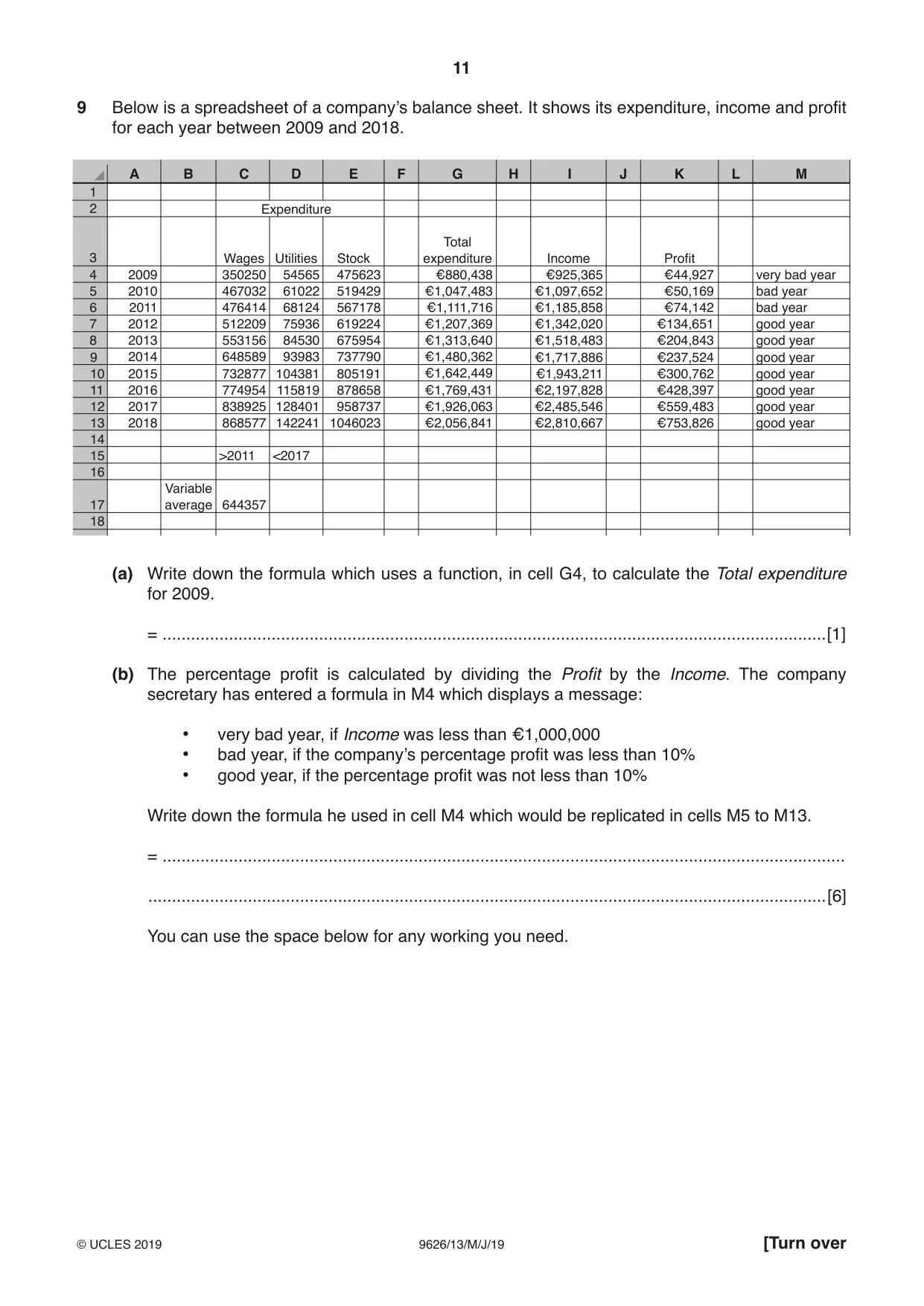
11 9626/13/M/J/19 © UCLES 2019 [Turn over 9 Below is a spreadsheet of a company’s balance sheet. It shows its expenditure, income and profit for each year between 2009 and 2018. 1 2 3 4 5 6 7 8 9 10 11 12 13 14 15 16 17 18 Utilities Stock Income Wages Expenditure Total expenditure Variable average 2009 2010 2011 2012 2013 2014 2015 2016 2017 2018 350250 467032 476414 512209 553156 648589 732877 774954 838925 868577 >2011 54565 61022 68124 75936 84530 93983 104381 115819 128401 142241 644357 475623 519429 567178 619224 675954 737790 805191 878658 958737 1046023 €880,438 €1,047,483 €1,111,716 €1,207,369 €1,313,640 €1,480,362 €1,642,449 €1,769,431 €1,926,063 €2,056,841 A B C D E F G H I J L M K <2017 €925,365 €1,097,652 €1,185,858 €1,342,020 €1,518,483 €1,717,886 €1,943,211 €2,197,828 €2,485,546 €2,810,667 Profit €44,927 €50,169 €74,142 €134,651 €204,843 €237,524 €300,762 €428,397 €559,483 €753,826 very bad year bad year bad year good year good year good year good year good year good year good year (a) Write down the formula which uses a function, in cell G4, to calculate the Total expenditure for 2009. = …[1] (b) The percentage profit is calculated by dividing the Profit by the Income. The company secretary has entered a formula in M4 which displays a message: • very bad year, if Income was less than €1,000,000 • bad year, if the company’s percentage profit was less than 10% • good year, if the percentage profit was not less than 10% Write down the formula he used in cell M4 which would be replicated in cells M5 to M13. = … …[6] You can use the space below for any working you need.
Question paper, page 12
12 9626/13/M/J/19 © UCLES 2019 (c) The manager wants to be able to find the Variable average of the wages bill for any sequence of years between 2009 and 2018. He has set up the spreadsheet to calculate the average between 2011 and 2017. To calculate the average between any other sequence of years he will just change the conditions >2011 and <2017. Write down the formula he will need to use in C17 to calculate the Variable average. = … …[6] You can use the space below for any working you need.
Question paper, page 13
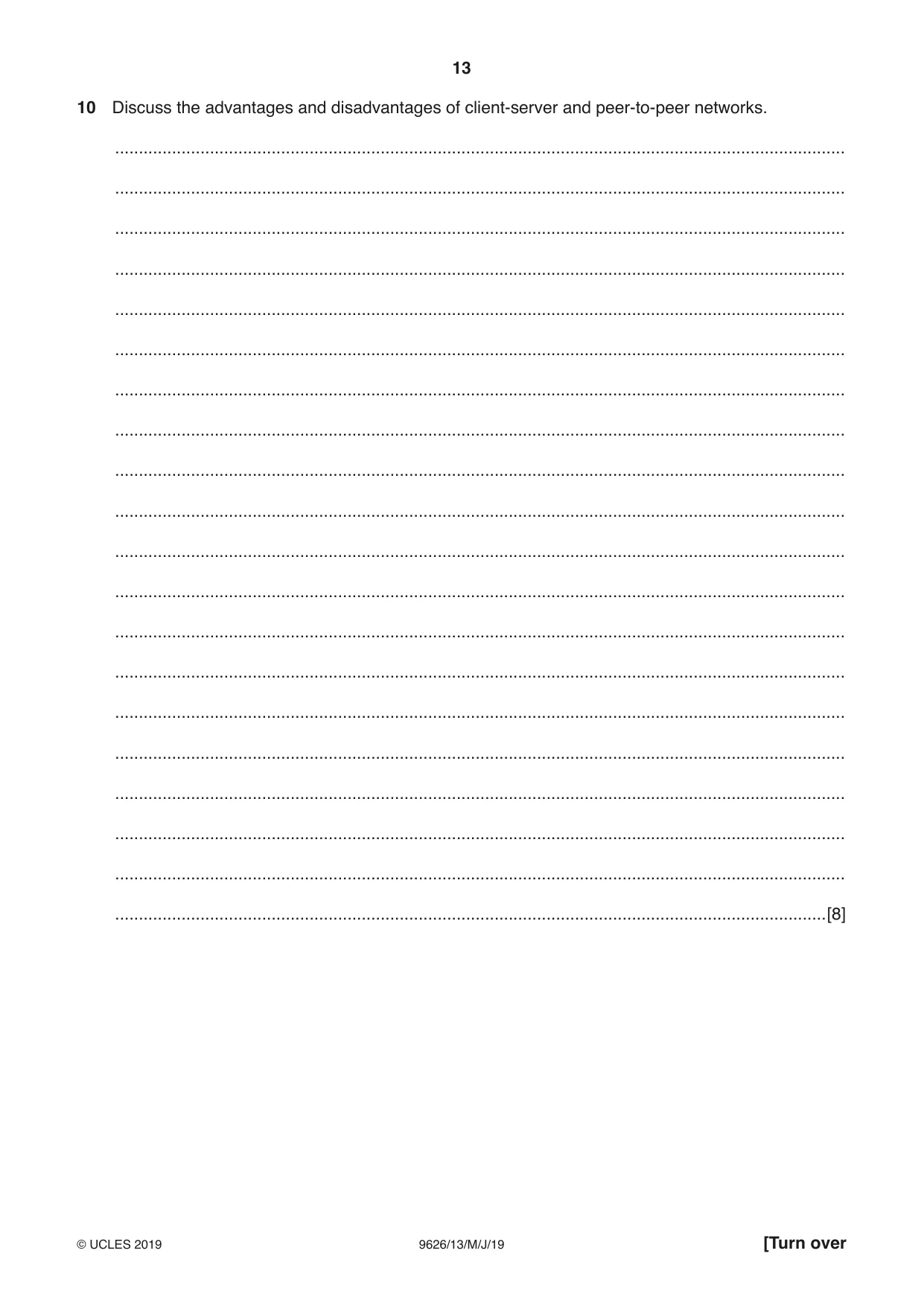
13 9626/13/M/J/19 © UCLES 2019 [Turn over 10 Discuss the advantages and disadvantages of client-server and peer-to-peer networks. … … … … … … … … … … … … … … … … … … … …[8]
Question paper, page 14
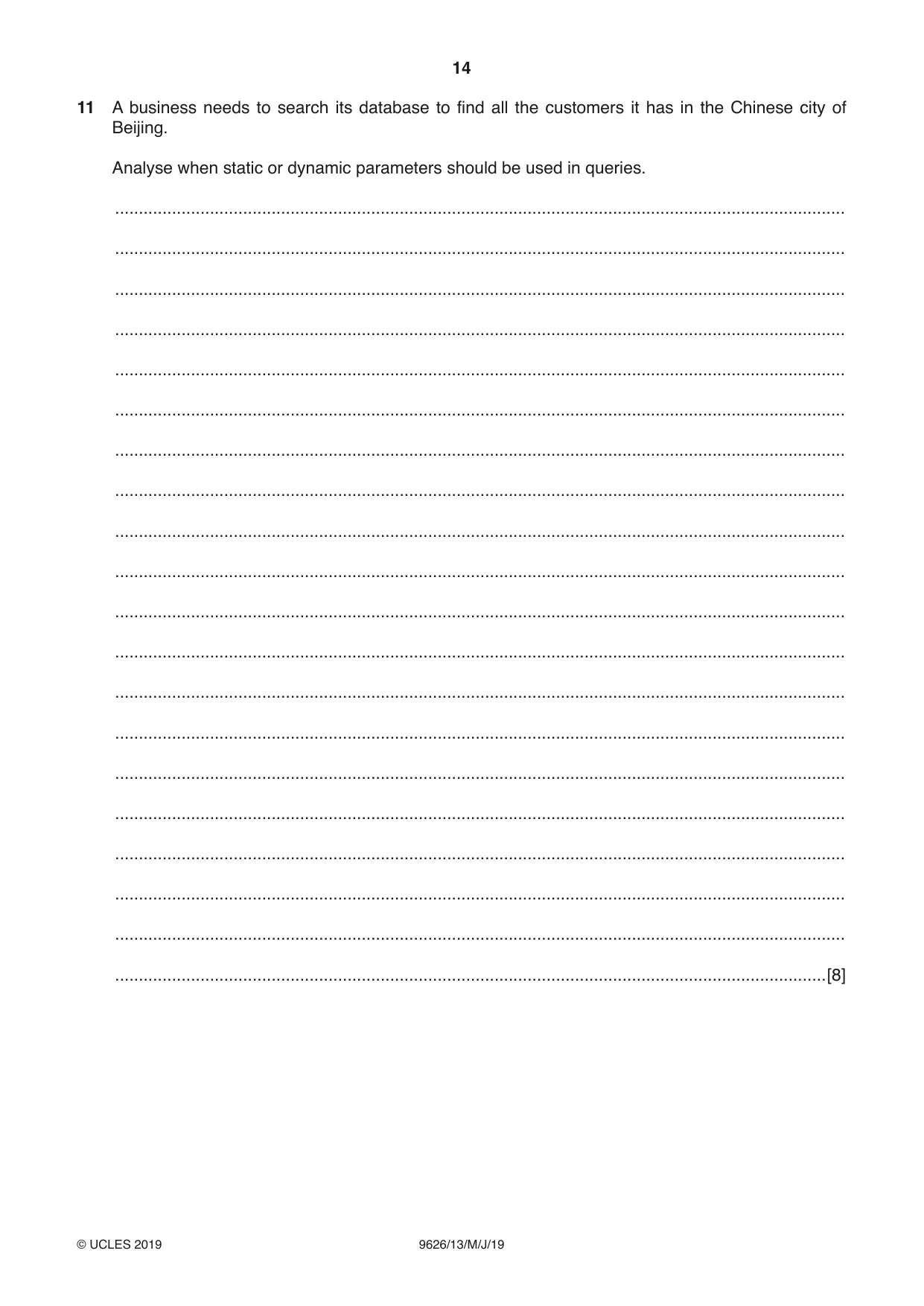
14 9626/13/M/J/19 © UCLES 2019 11 A business needs to search its database to find all the customers it has in the Chinese city of Beijing. Analyse when static or dynamic parameters should be used in queries. … … … … … … … … … … … … … … … … … … … …[8]
Question paper, page 15
15 9626/13/M/J/19 © UCLES 2019 BLANK PAGE
Question paper, page 16
16 9626/13/M/J/19 © UCLES 2019 Permission to reproduce items where third-party owned material protected by copyright is included has been sought and cleared where possible. Every reasonable effort has been made by the publisher (UCLES) to trace copyright holders, but if any items requiring clearance have unwittingly been included, the publisher will be pleased to make amends at the earliest possible opportunity. To avoid the issue of disclosure of answer-related information to candidates, all copyright acknowledgements are reproduced online in the Cambridge Assessment International Education Copyright Acknowledgements Booklet. This is produced for each series of examinations and is freely available to download at www.cambridgeinternational.org after the live examination series. Cambridge Assessment International Education is part of the Cambridge Assessment Group. Cambridge Assessment is the brand name of the University of Cambridge Local Examinations Syndicate (UCLES), which itself is a department of the University of Cambridge. BLANK PAGE
Mark scheme, page 1
This document consists of 10 printed pages. © UCLES 2019 [Turn over Cambridge Assessment International Education Cambridge International Advanced Subsidiary and Advanced Level INFORMATION TECHNOLOGY 9626/13 Paper 1 Theory May/June 2019 MARK SCHEME Maximum Mark: 90 Published This mark scheme is published as an aid to teachers and candidates, to indicate the requirements of the examination. It shows the basis on which Examiners were instructed to award marks. It does not indicate the details of the discussions that took place at an Examiners’ meeting before marking began, which would have considered the acceptability of alternative answers. Mark schemes should be read in conjunction with the question paper and the Principal Examiner Report for Teachers. Cambridge International will not enter into discussions about these mark schemes. Cambridge International is publishing the mark schemes for the May/June 2019 series for most Cambridge IGCSE™, Cambridge International A and AS Level and Cambridge Pre-U components, and some Cambridge O Level components.
Mark scheme, page 2
9626/13 Cambridge International AS/A Level – Mark Scheme PUBLISHED May/June 2019 © UCLES 2019 Page 2 of 10 Generic Marking Principles These general marking principles must be applied by all examiners when marking candidate answers. They should be applied alongside the specific content of the mark scheme or generic level descriptors for a question. Each question paper and mark scheme will also comply with these marking principles. GENERIC MARKING PRINCIPLE 1: Marks must be awarded in line with: • the specific content of the mark scheme or the generic level descriptors for the question • the specific skills defined in the mark scheme or in the generic level descriptors for the question • the standard of response required by a candidate as exemplified by the standardisation scripts. GENERIC MARKING PRINCIPLE 2: Marks awarded are always whole marks (not half marks, or other fractions). GENERIC MARKING PRINCIPLE 3: Marks must be awarded positively: • marks are awarded for correct/valid answers, as defined in the mark scheme. However, credit is given for valid answers which go beyond the scope of the syllabus and mark scheme, referring to your Team Leader as appropriate • marks are awarded when candidates clearly demonstrate what they know and can do • marks are not deducted for errors • marks are not deducted for omissions • answers should only be judged on the quality of spelling, punctuation and grammar when these features are specifically assessed by the question as indicated by the mark scheme. The meaning, however, should be unambiguous. GENERIC MARKING PRINCIPLE 4: Rules must be applied consistently e.g. in situations where candidates have not followed instructions or in the application of generic level descriptors. GENERIC MARKING PRINCIPLE 5: Marks should be awarded using the full range of marks defined in the mark scheme for the question (however; the use of the full mark range may be limited according to the quality of the candidate responses seen). GENERIC MARKING PRINCIPLE 6: Marks awarded are based solely on the requirements as defined in the mark scheme. Marks should not be awarded with grade thresholds or grade descriptors in mind.
Mark scheme, page 3
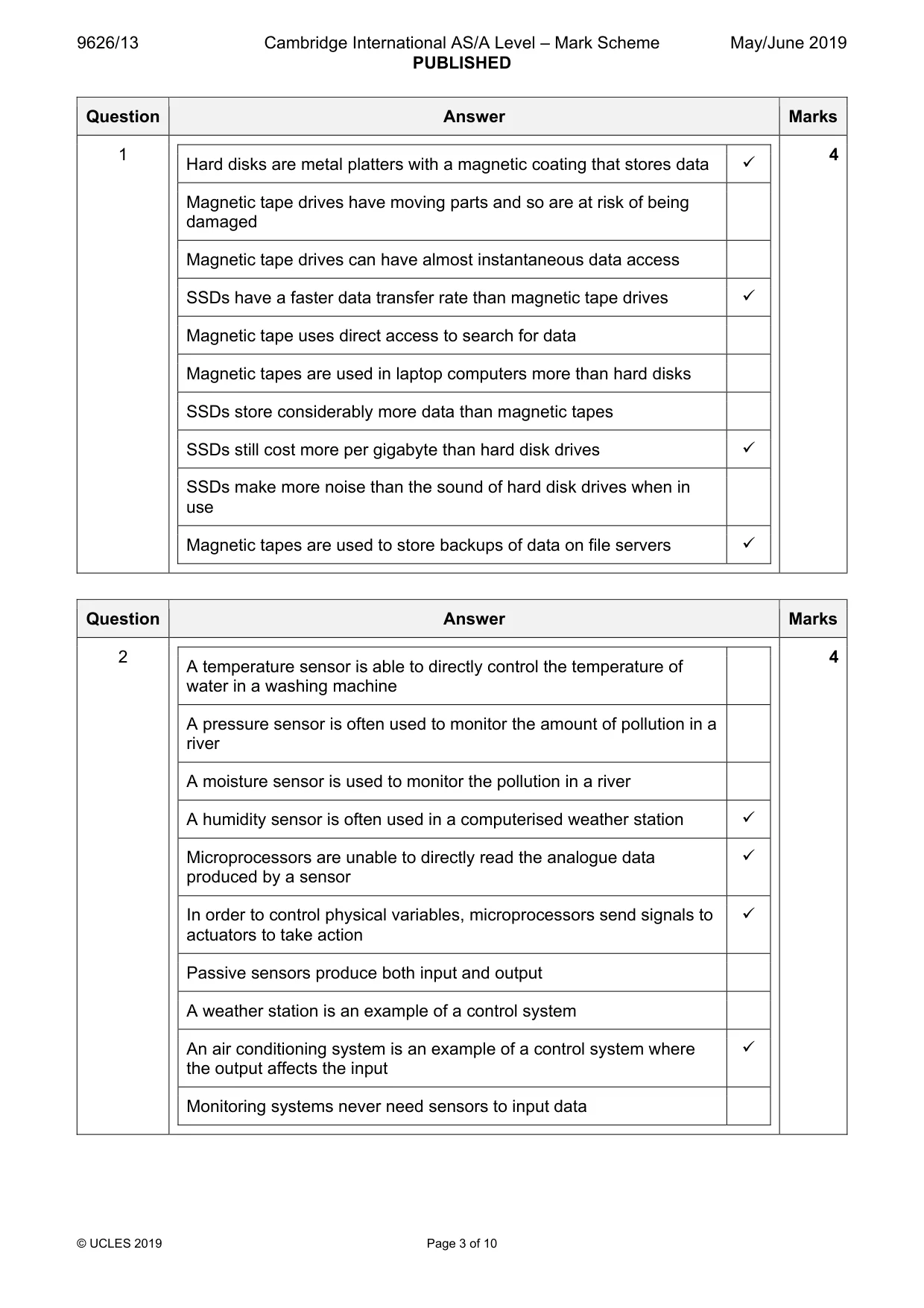
9626/13 Cambridge International AS/A Level – Mark Scheme PUBLISHED May/June 2019 © UCLES 2019 Page 3 of 10 Question Answer Marks 1 Hard disks are metal platters with a magnetic coating that stores data 9 Magnetic tape drives have moving parts and so are at risk of being damaged Magnetic tape drives can have almost instantaneous data access SSDs have a faster data transfer rate than magnetic tape drives 9 Magnetic tape uses direct access to search for data Magnetic tapes are used in laptop computers more than hard disks SSDs store considerably more data than magnetic tapes SSDs still cost more per gigabyte than hard disk drives 9 SSDs make more noise than the sound of hard disk drives when in use Magnetic tapes are used to store backups of data on file servers 9 4 Question Answer Marks 2 A temperature sensor is able to directly control the temperature of water in a washing machine A pressure sensor is often used to monitor the amount of pollution in a river A moisture sensor is used to monitor the pollution in a river A humidity sensor is often used in a computerised weather station 9 Microprocessors are unable to directly read the analogue data produced by a sensor 9 In order to control physical variables, microprocessors send signals to actuators to take action 9 Passive sensors produce both input and output A weather station is an example of a control system An air conditioning system is an example of a control system where the output affects the input 9 Monitoring systems never need sensors to input data 4
Mark scheme, page 4
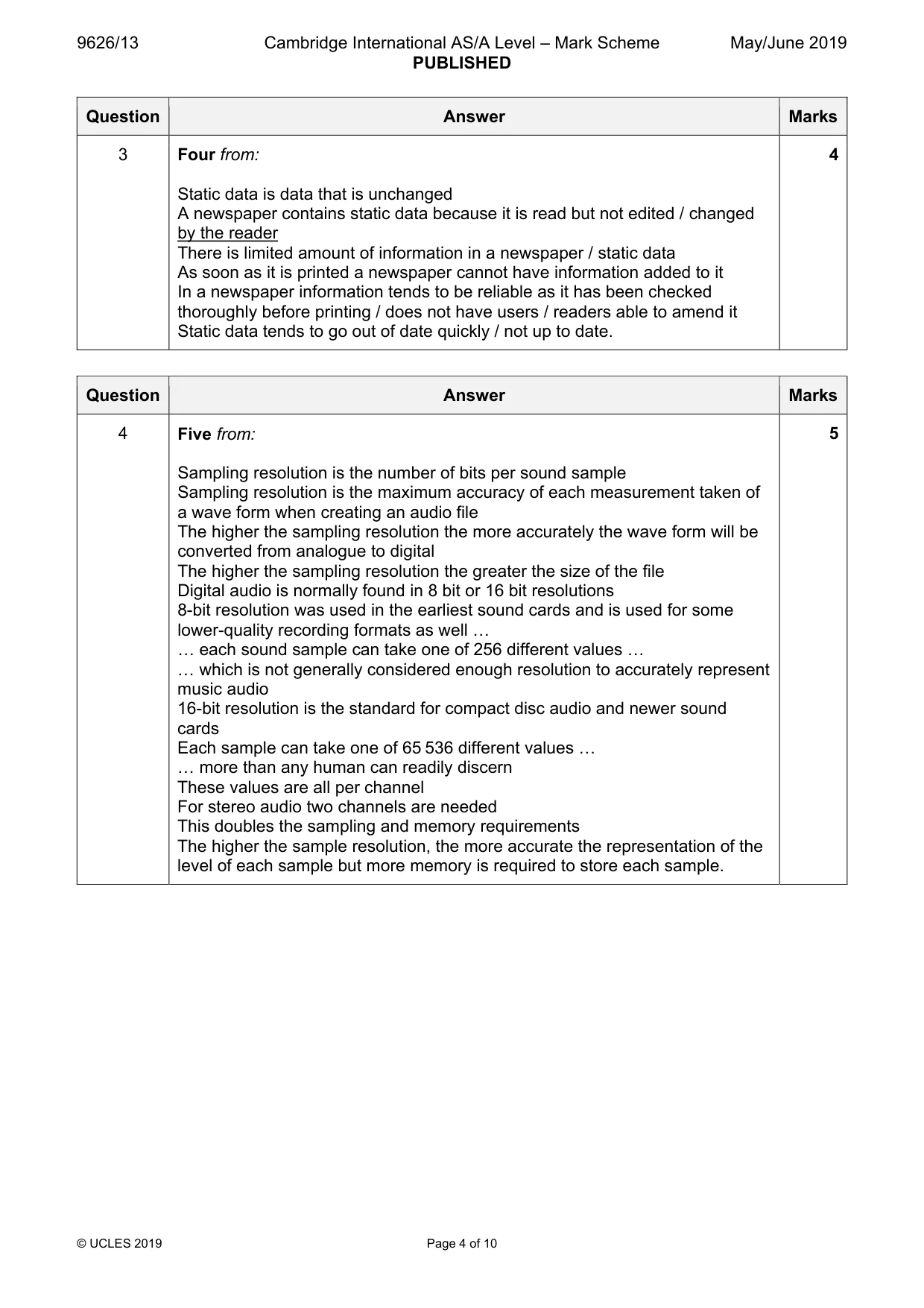
9626/13 Cambridge International AS/A Level – Mark Scheme PUBLISHED May/June 2019 © UCLES 2019 Page 4 of 10 Question Answer Marks 3 Four from: Static data is data that is unchanged A newspaper contains static data because it is read but not edited / changed by the reader There is limited amount of information in a newspaper / static data As soon as it is printed a newspaper cannot have information added to it In a newspaper information tends to be reliable as it has been checked thoroughly before printing / does not have users / readers able to amend it Static data tends to go out of date quickly / not up to date. 4 Question Answer Marks 4 Five from: Sampling resolution is the number of bits per sound sample Sampling resolution is the maximum accuracy of each measurement taken of a wave form when creating an audio file The higher the sampling resolution the more accurately the wave form will be converted from analogue to digital The higher the sampling resolution the greater the size of the file Digital audio is normally found in 8 bit or 16 bit resolutions 8-bit resolution was used in the earliest sound cards and is used for some lower-quality recording formats as well « « each sound sample can take one of 256 different values « « which is not generally considered enough resolution to accurately represent music audio 16-bit resolution is the standard for compact disc audio and newer sound cards Each sample can take one of 65 536 different values « « more than any human can readily discern These values are all per channel For stereo audio two channels are needed This doubles the sampling and memory requirements The higher the sample resolution, the more accurate the representation of the level of each sample but more memory is required to store each sample. 5
Mark scheme, page 5
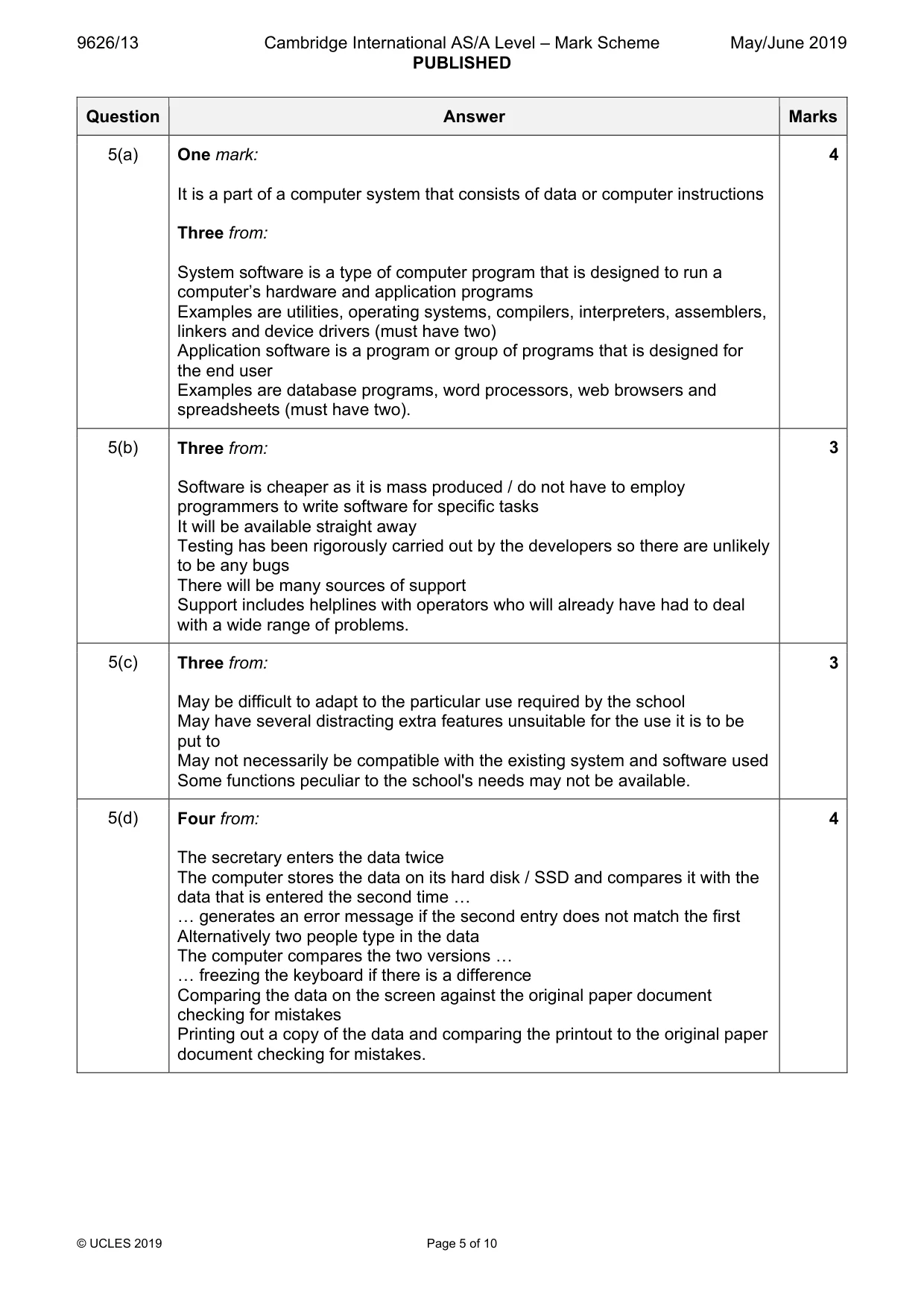
9626/13 Cambridge International AS/A Level – Mark Scheme PUBLISHED May/June 2019 © UCLES 2019 Page 5 of 10 Question Answer Marks 5(a) One mark: It is a part of a computer system that consists of data or computer instructions Three from: System software is a type of computer program that is designed to run a computer’s hardware and application programs Examples are utilities, operating systems, compilers, interpreters, assemblers, linkers and device drivers (must have two) Application software is a program or group of programs that is designed for the end user Examples are database programs, word processors, web browsers and spreadsheets (must have two). 4 5(b) Three from: Software is cheaper as it is mass produced / do not have to employ programmers to write software for specific tasks It will be available straight away Testing has been rigorously carried out by the developers so there are unlikely to be any bugs There will be many sources of support Support includes helplines with operators who will already have had to deal with a wide range of problems. 3 5(c) Three from: May be difficult to adapt to the particular use required by the school May have several distracting extra features unsuitable for the use it is to be put to May not necessarily be compatible with the existing system and software used Some functions peculiar to the school's needs may not be available. 3 5(d) Four from: The secretary enters the data twice The computer stores the data on its hard disk / SSD and compares it with the data that is entered the second time « « generates an error message if the second entry does not match the first Alternatively two people type in the data The computer compares the two versions « « freezing the keyboard if there is a difference Comparing the data on the screen against the original paper document checking for mistakes Printing out a copy of the data and comparing the printout to the original paper document checking for mistakes. 4
Mark scheme, page 6
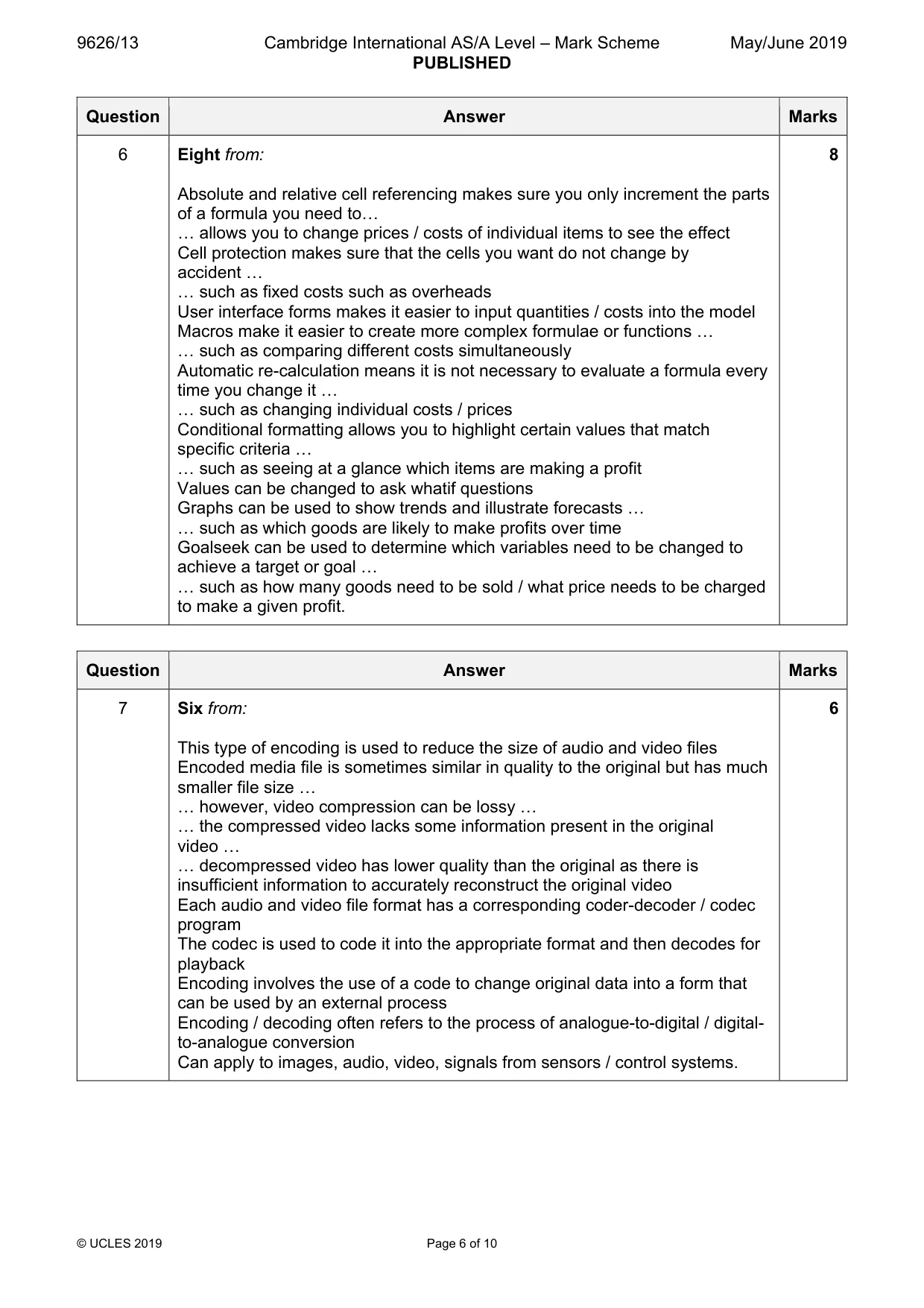
9626/13 Cambridge International AS/A Level – Mark Scheme PUBLISHED May/June 2019 © UCLES 2019 Page 6 of 10 Question Answer Marks 6 Eight from: Absolute and relative cell referencing makes sure you only increment the parts of a formula you need to« « allows you to change prices / costs of individual items to see the effect Cell protection makes sure that the cells you want do not change by accident « « such as fixed costs such as overheads User interface forms makes it easier to input quantities / costs into the model Macros make it easier to create more complex formulae or functions « « such as comparing different costs simultaneously Automatic re-calculation means it is not necessary to evaluate a formula every time you change it « « such as changing individual costs / prices Conditional formatting allows you to highlight certain values that match specific criteria « « such as seeing at a glance which items are making a profit Values can be changed to ask whatif questions Graphs can be used to show trends and illustrate forecasts « « such as which goods are likely to make profits over time Goalseek can be used to determine which variables need to be changed to achieve a target or goal « « such as how many goods need to be sold / what price needs to be charged to make a given profit. 8 Question Answer Marks 7 Six from: This type of encoding is used to reduce the size of audio and video files Encoded media file is sometimes similar in quality to the original but has much smaller file size « « however, video compression can be lossy « « the compressed video lacks some information present in the original video « « decompressed video has lower quality than the original as there is insufficient information to accurately reconstruct the original video Each audio and video file format has a corresponding coder-decoder / codec program The codec is used to code it into the appropriate format and then decodes for playback Encoding involves the use of a code to change original data into a form that can be used by an external process Encoding / decoding often refers to the process of analogue-to-digital / digital- to-analogue conversion Can apply to images, audio, video, signals from sensors / control systems. 6
Mark scheme, page 7
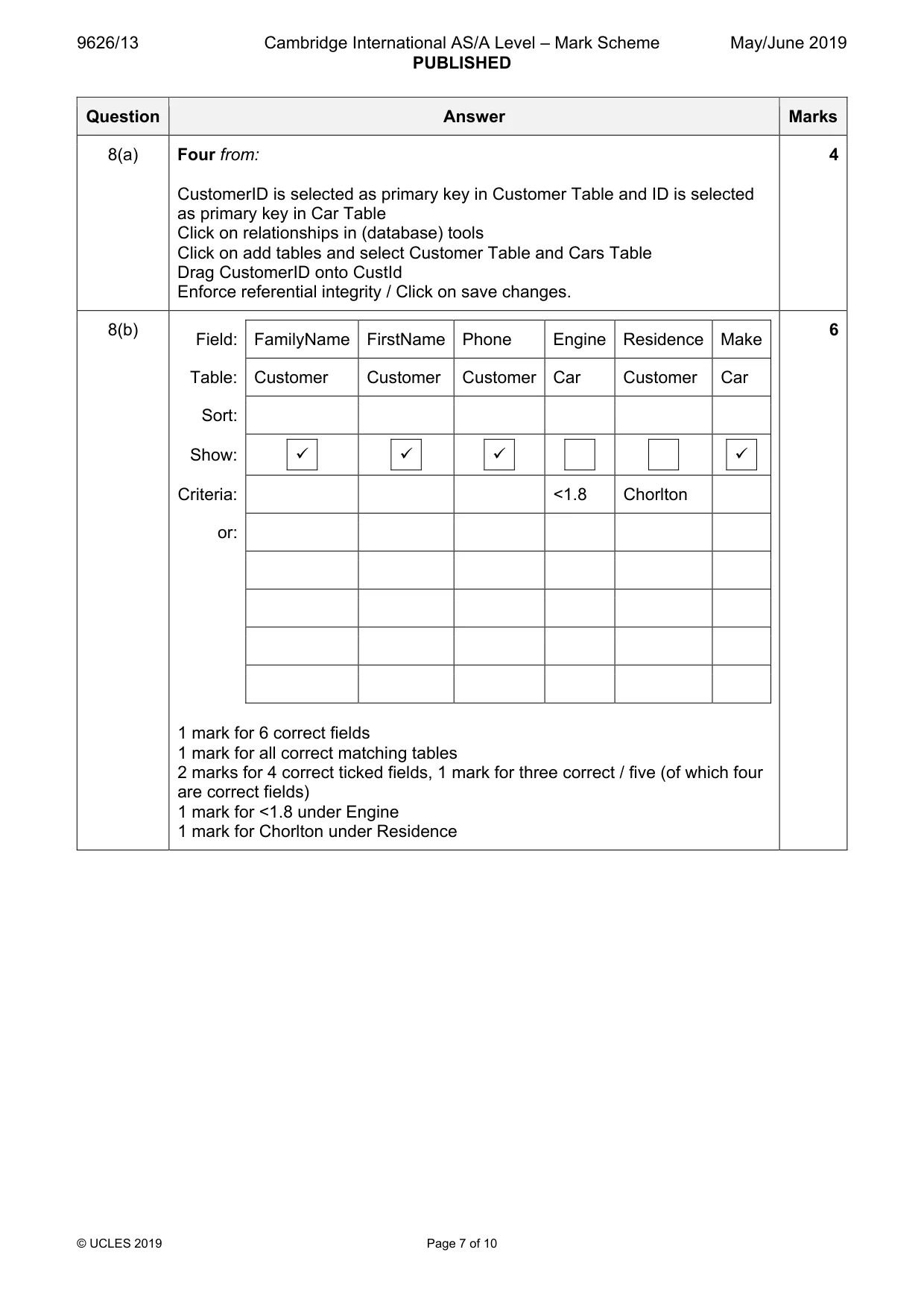
9626/13 Cambridge International AS/A Level – Mark Scheme PUBLISHED May/June 2019 © UCLES 2019 Page 7 of 10 Question Answer Marks 8(a) Four from: CustomerID is selected as primary key in Customer Table and ID is selected as primary key in Car Table Click on relationships in (database) tools Click on add tables and select Customer Table and Cars Table Drag CustomerID onto CustId Enforce referential integrity / Click on save changes. 4 8(b) Field: FamilyName FirstName Phone Engine Residence Make Table: Customer Customer Customer Car Customer Car Sort: Show: 9 9 9 9 Criteria: <1.8 Chorlton or: 1 mark for 6 correct fields 1 mark for all correct matching tables 2 marks for 4 correct ticked fields, 1 mark for three correct / five (of which four are correct fields) 1 mark for <1.8 under Engine 1 mark for Chorlton under Residence 6
Mark scheme, page 8
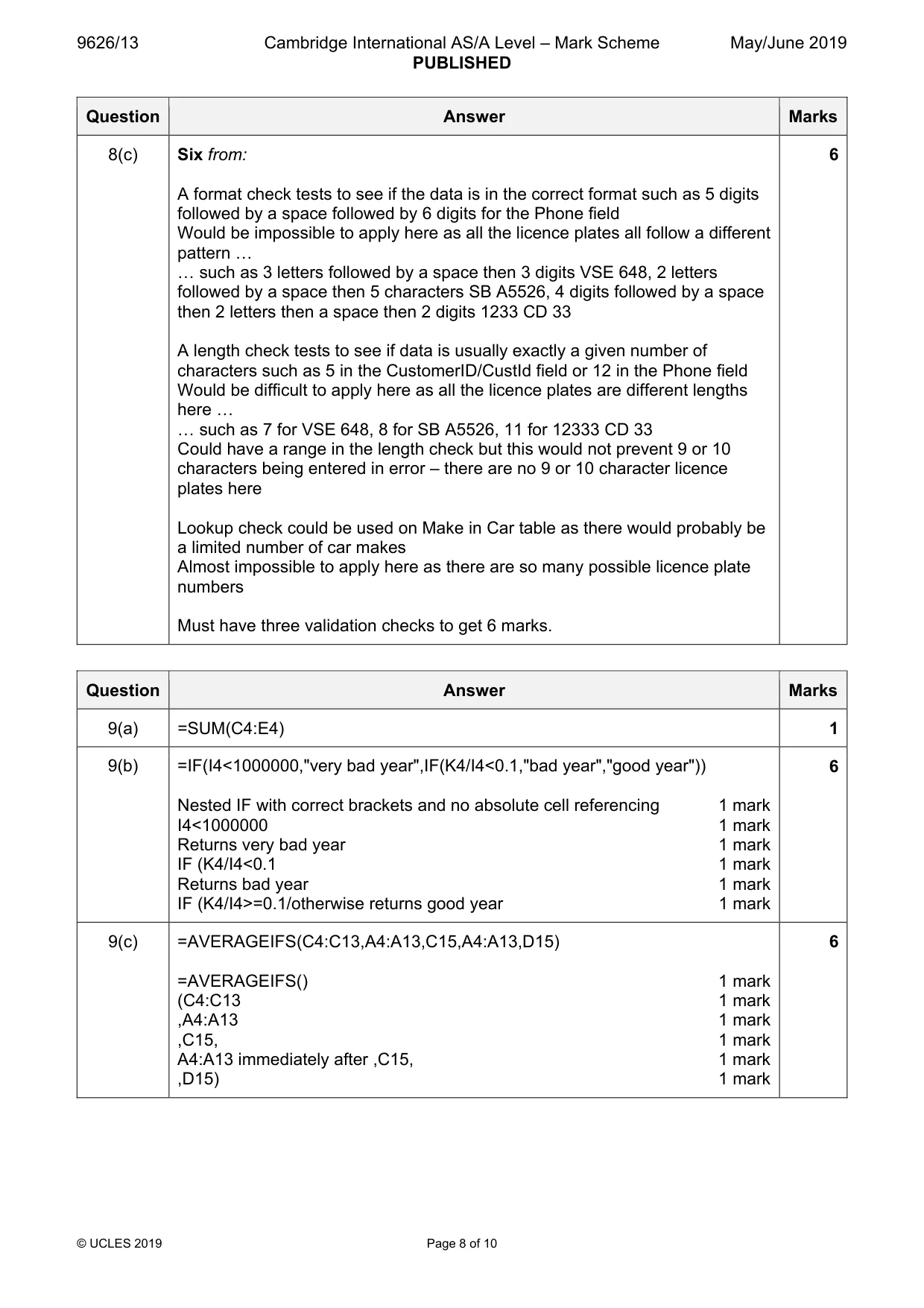
9626/13 Cambridge International AS/A Level – Mark Scheme PUBLISHED May/June 2019 © UCLES 2019 Page 8 of 10 Question Answer Marks 8(c) Six from: A format check tests to see if the data is in the correct format such as 5 digits followed by a space followed by 6 digits for the Phone field Would be impossible to apply here as all the licence plates all follow a different pattern « « such as 3 letters followed by a space then 3 digits VSE 648, 2 letters followed by a space then 5 characters SB A5526, 4 digits followed by a space then 2 letters then a space then 2 digits 1233 CD 33 A length check tests to see if data is usually exactly a given number of characters such as 5 in the CustomerID/CustId field or 12 in the Phone field Would be difficult to apply here as all the licence plates are different lengths here « « such as 7 for VSE 648, 8 for SB A5526, 11 for 12333 CD 33 Could have a range in the length check but this would not prevent 9 or 10 characters being entered in error – there are no 9 or 10 character licence plates here Lookup check could be used on Make in Car table as there would probably be a limited number of car makes Almost impossible to apply here as there are so many possible licence plate numbers Must have three validation checks to get 6 marks. 6 Question Answer Marks 9(a) =SUM(C4:E4) 1 9(b) =IF(I4<1000000,"very bad year",IF(K4/I4<0.1,"bad year","good year")) Nested IF with correct brackets and no absolute cell referencing 1 mark I4<1000000 1 mark Returns very bad year 1 mark IF (K4/I4<0.1 1 mark Returns bad year 1 mark IF (K4/I4>=0.1/otherwise returns good year 1 mark 6 9(c) =AVERAGEIFS(C4:C13,A4:A13,C15,A4:A13,D15) =AVERAGEIFS() 1 mark (C4:C13 1 mark ,A4:A13 1 mark ,C15, 1 mark A4:A13 immediately after ,C15, 1 mark ,D15) 1 mark 6
Mark scheme, page 9
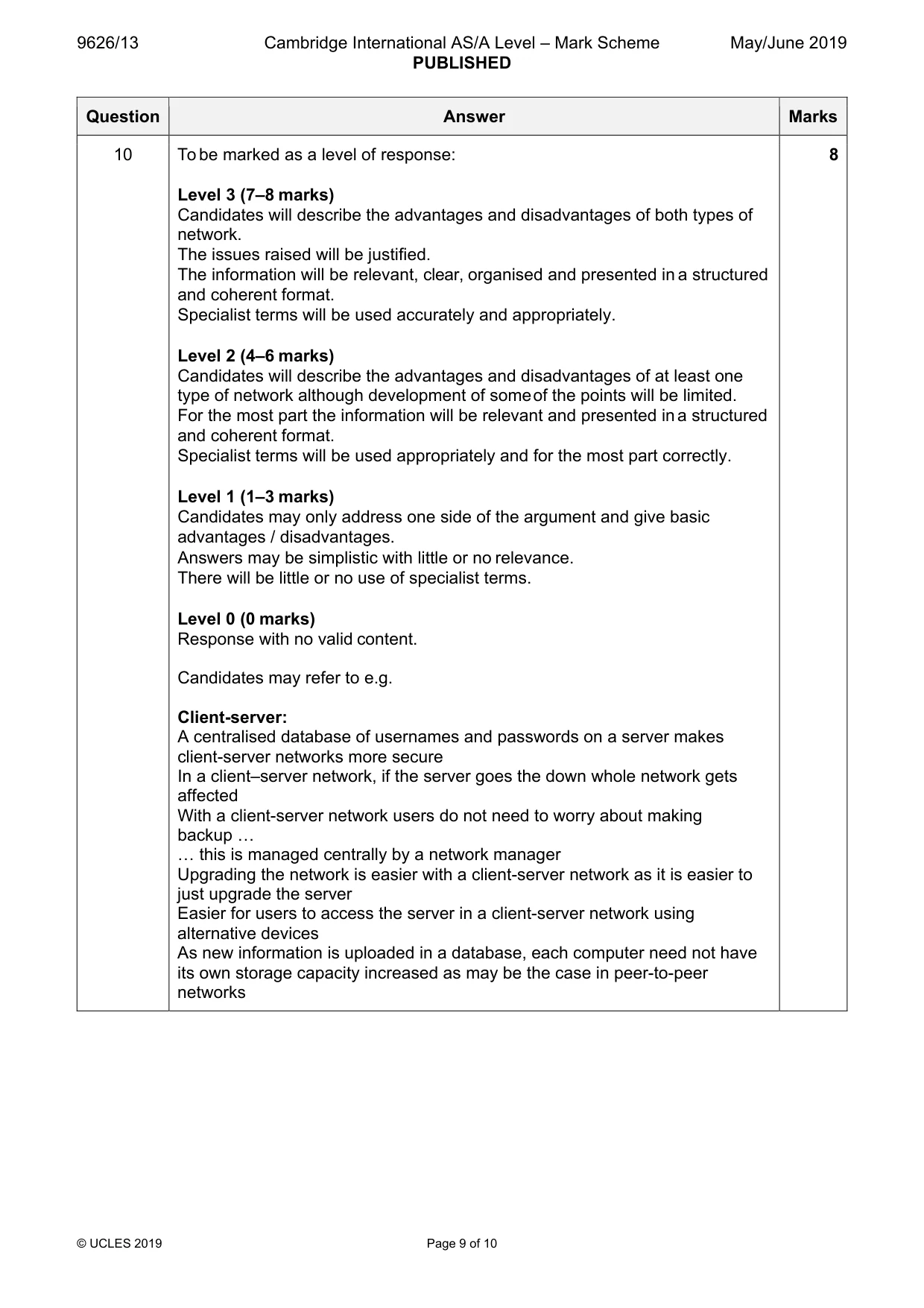
9626/13 Cambridge International AS/A Level – Mark Scheme PUBLISHED May/June 2019 © UCLES 2019 Page 9 of 10 Question Answer Marks 10 To be marked as a level of response: Level 3 (7–8 marks) Candidates will describe the advantages and disadvantages of both types of network. The issues raised will be justified. The information will be relevant, clear, organised and presented in a structured and coherent format. Specialist terms will be used accurately and appropriately. Level 2 (4–6 marks) Candidates will describe the advantages and disadvantages of at least one type of network although development of some of the points will be limited. For the most part the information will be relevant and presented in a structured and coherent format. Specialist terms will be used appropriately and for the most part correctly. Level 1 (1–3 marks) Candidates may only address one side of the argument and give basic advantages / disadvantages. Answers may be simplistic with little or no relevance. There will be little or no use of specialist terms. Level 0 (0 marks) Response with no valid content. Candidates may refer to e.g. Client-server: A centralised database of usernames and passwords on a server makes client-server networks more secure In a client–server network, if the server goes the down whole network gets affected With a client-server network users do not need to worry about making backup « « this is managed centrally by a network manager Upgrading the network is easier with a client-server network as it is easier to just upgrade the server Easier for users to access the server in a client-server network using alternative devices As new information is uploaded in a database, each computer need not have its own storage capacity increased as may be the case in peer-to-peer networks 8
Mark scheme, page 10
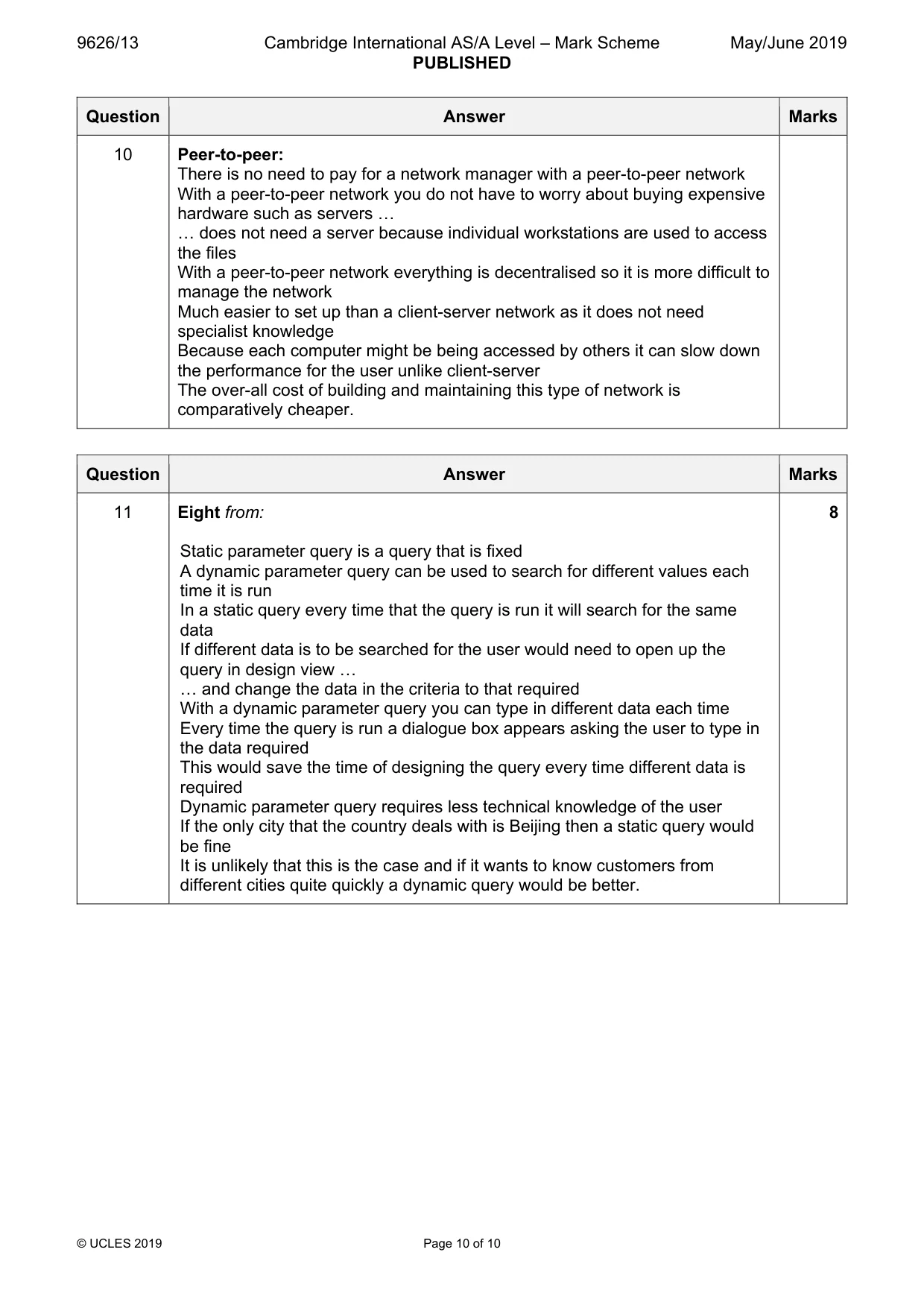
9626/13 Cambridge International AS/A Level – Mark Scheme PUBLISHED May/June 2019 © UCLES 2019 Page 10 of 10 Question Answer Marks 10 Peer-to-peer: There is no need to pay for a network manager with a peer-to-peer network With a peer-to-peer network you do not have to worry about buying expensive hardware such as servers « « does not need a server because individual workstations are used to access the files With a peer-to-peer network everything is decentralised so it is more difficult to manage the network Much easier to set up than a client-server network as it does not need specialist knowledge Because each computer might be being accessed by others it can slow down the performance for the user unlike client-server The over-all cost of building and maintaining this type of network is comparatively cheaper. Question Answer Marks 11 Eight from: Static parameter query is a query that is fixed A dynamic parameter query can be used to search for different values each time it is run In a static query every time that the query is run it will search for the same data If different data is to be searched for the user would need to open up the query in design view « « and change the data in the criteria to that required With a dynamic parameter query you can type in different data each time Every time the query is run a dialogue box appears asking the user to type in the data required This would save the time of designing the query every time different data is required Dynamic parameter query requires less technical knowledge of the user If the only city that the country deals with is Beijing then a static query would be fine It is unlikely that this is the case and if it wants to know customers from different cities quite quickly a dynamic query would be better. 8
What you needed in this session
Cambridge’s own grade thresholds for 2019 May/June, Paper 1 · Variant 3. A higher threshold means an easier paper — the bar moves with how the cohort did.