Cambridge A Level History (pre-2015) 9697 — 2011 May/June Paper 3 · Variant 3
9697/33/M/J/11 · 100 marks · ≈113 min
The question paper and its mark scheme, free to read here and free to download. This is Cambridge’s own paper, exactly as it was sat.
Question paper4 pages
Mark scheme12 pages
Answers below. Sit the paper first if you are practising.
Paper as text
Question paper, page 1
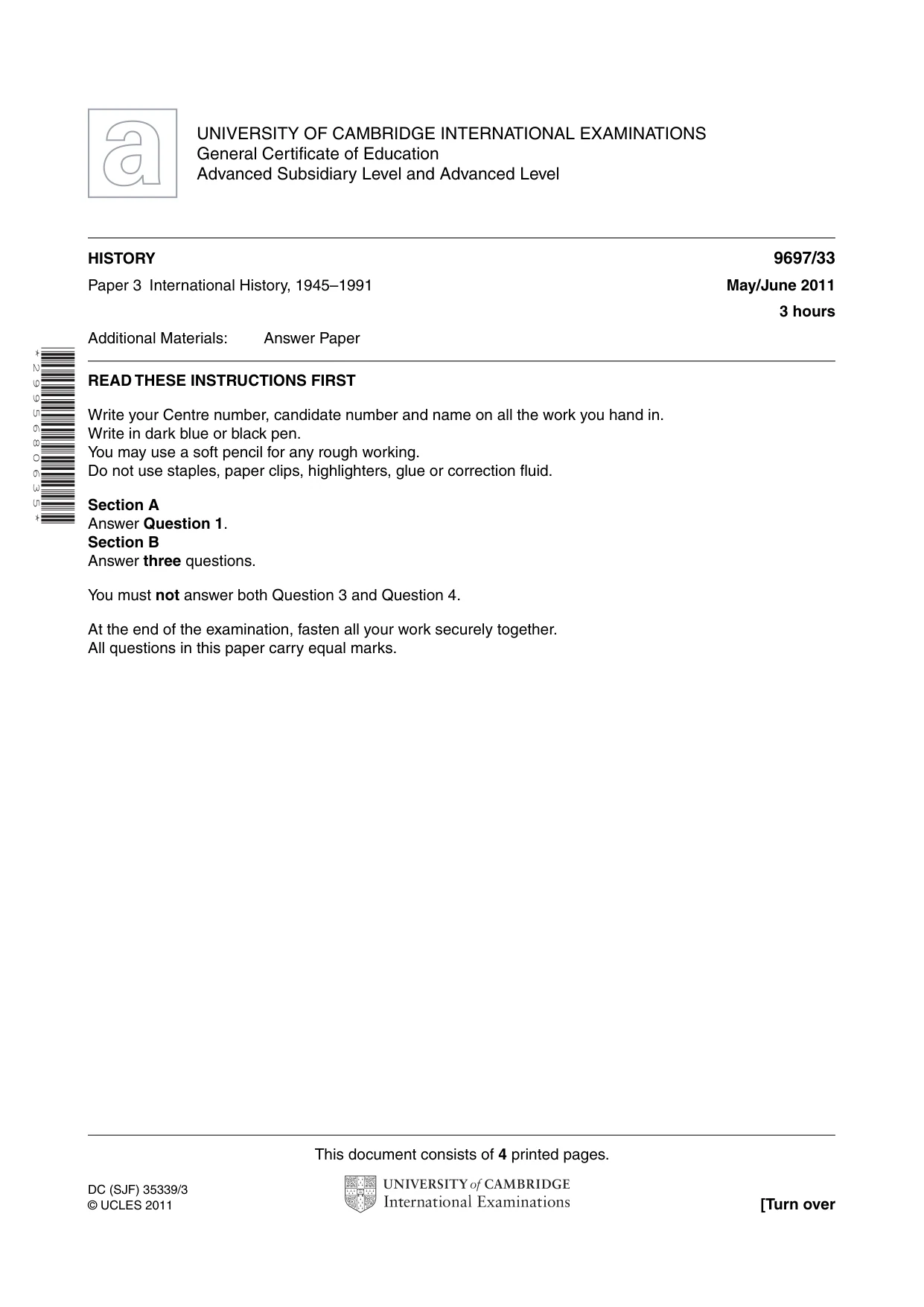
This document consists of 4 printed pages. DC (SJF) 35339/3 © UCLES 2011 [Turn over UNIVERSITY OF CAMBRIDGE INTERNATIONAL EXAMINATIONS General Certificate of Education Advanced Subsidiary Level and Advanced Level READ THESE INSTRUCTIONS FIRST Write your Centre number, candidate number and name on all the work you hand in. Write in dark blue or black pen. You may use a soft pencil for any rough working. Do not use staples, paper clips, highlighters, glue or correction fluid. Section A Answer Question 1. Section B Answer three questions. You must not answer both Question 3 and Question 4. At the end of the examination, fasten all your work securely together. All questions in this paper carry equal marks. * 2 9 9 5 6 8 0 6 3 5 * HISTORY 9697/33 Paper 3 International History, 1945–1991 May/June 2011 3 hours Additional Materials: Answer Paper
Question paper, page 2
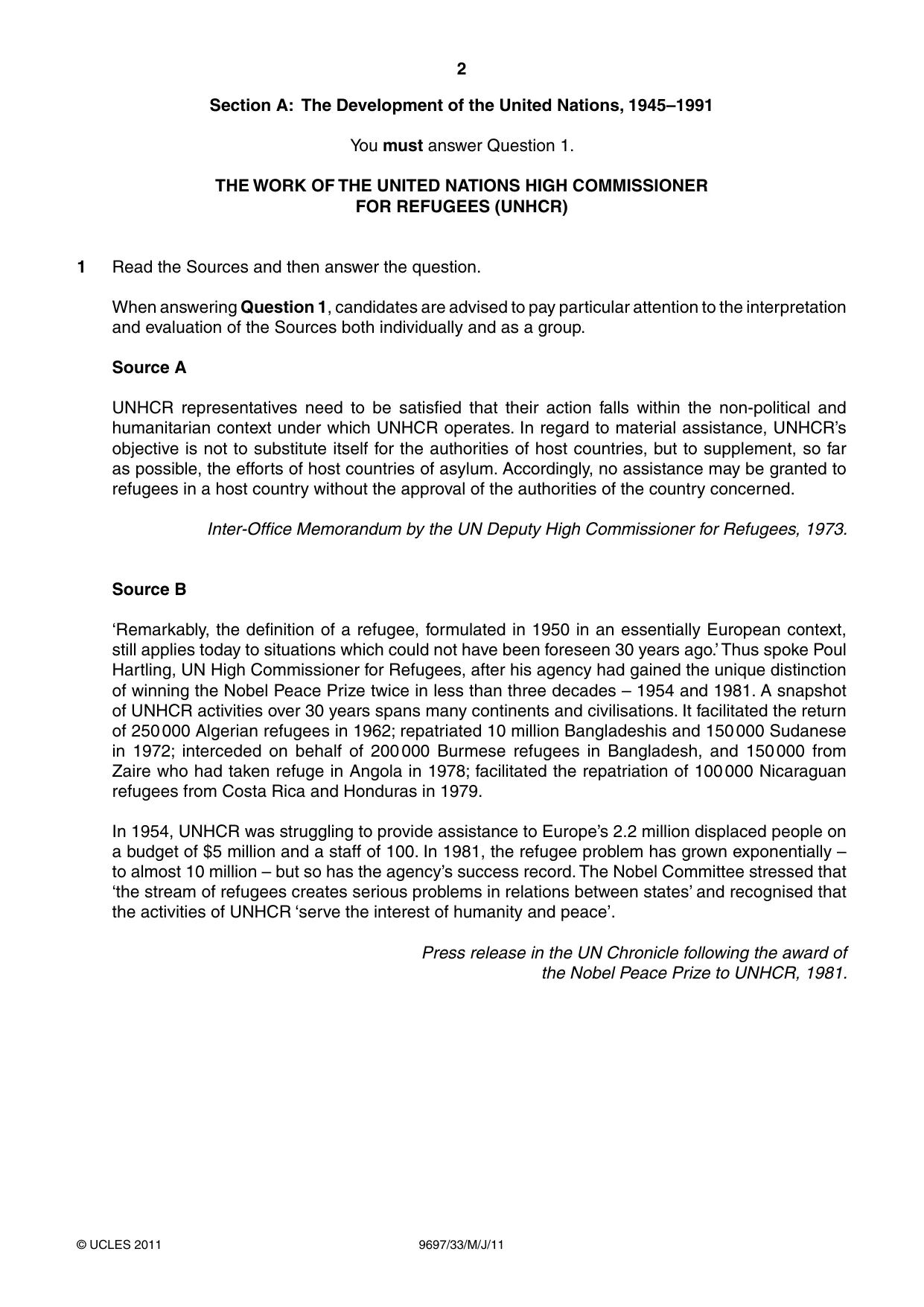
2 9697/33/M/J/11 © UCLES 2011 Section A: The Development of the United Nations, 1945–1991 You must answer Question 1. THE WORK OF THE UNITED NATIONS HIGH COMMISSIONER FOR REFUGEES (UNHCR) 1 Read the Sources and then answer the question. When answering Question 1, candidates are advised to pay particular attention to the interpretation and evaluation of the Sources both individually and as a group. Source A UNHCR representatives need to be satisfied that their action falls within the non-political and humanitarian context under which UNHCR operates. In regard to material assistance, UNHCR’s objective is not to substitute itself for the authorities of host countries, but to supplement, so far as possible, the efforts of host countries of asylum. Accordingly, no assistance may be granted to refugees in a host country without the approval of the authorities of the country concerned. Inter-Office Memorandum by the UN Deputy High Commissioner for Refugees, 1973. Source B ‘Remarkably, the definition of a refugee, formulated in 1950 in an essentially European context, still applies today to situations which could not have been foreseen 30 years ago.’ Thus spoke Poul Hartling, UN High Commissioner for Refugees, after his agency had gained the unique distinction of winning the Nobel Peace Prize twice in less than three decades – 1954 and 1981. A snapshot of UNHCR activities over 30 years spans many continents and civilisations. It facilitated the return of 250 000 Algerian refugees in 1962; repatriated 10 million Bangladeshis and 150 000 Sudanese in 1972; interceded on behalf of 200 000 Burmese refugees in Bangladesh, and 150 000 from Zaire who had taken refuge in Angola in 1978; facilitated the repatriation of 100 000 Nicaraguan refugees from Costa Rica and Honduras in 1979. In 1954, UNHCR was struggling to provide assistance to Europe’s 2.2 million displaced people on a budget of $5 million and a staff of 100. In 1981, the refugee problem has grown exponentially – to almost 10 million – but so has the agency’s success record. The Nobel Committee stressed that ‘the stream of refugees creates serious problems in relations between states’ and recognised that the activities of UNHCR ‘serve the interest of humanity and peace’. Press release in the UN Chronicle following the award of the Nobel Peace Prize to UNHCR, 1981.
Question paper, page 3
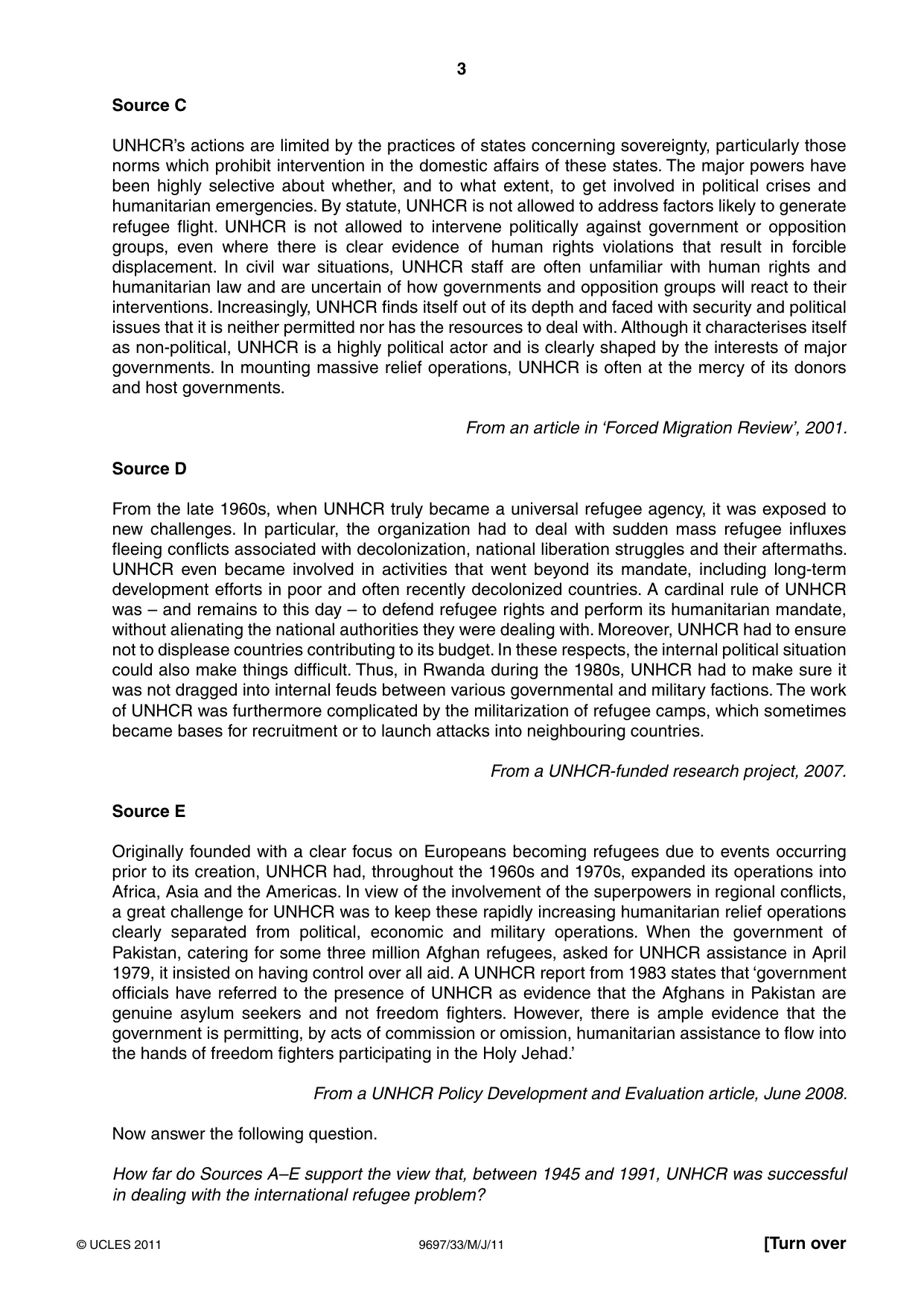
3 9697/33/M/J/11 © UCLES 2011 [Turn over Source C UNHCR’s actions are limited by the practices of states concerning sovereignty, particularly those norms which prohibit intervention in the domestic affairs of these states. The major powers have been highly selective about whether, and to what extent, to get involved in political crises and humanitarian emergencies. By statute, UNHCR is not allowed to address factors likely to generate refugee flight. UNHCR is not allowed to intervene politically against government or opposition groups, even where there is clear evidence of human rights violations that result in forcible displacement. In civil war situations, UNHCR staff are often unfamiliar with human rights and humanitarian law and are uncertain of how governments and opposition groups will react to their interventions. Increasingly, UNHCR finds itself out of its depth and faced with security and political issues that it is neither permitted nor has the resources to deal with. Although it characterises itself as non-political, UNHCR is a highly political actor and is clearly shaped by the interests of major governments. In mounting massive relief operations, UNHCR is often at the mercy of its donors and host governments. From an article in ‘Forced Migration Review’, 2001. Source D From the late 1960s, when UNHCR truly became a universal refugee agency, it was exposed to new challenges. In particular, the organization had to deal with sudden mass refugee influxes fleeing conflicts associated with decolonization, national liberation struggles and their aftermaths. UNHCR even became involved in activities that went beyond its mandate, including long-term development efforts in poor and often recently decolonized countries. A cardinal rule of UNHCR was – and remains to this day – to defend refugee rights and perform its humanitarian mandate, without alienating the national authorities they were dealing with. Moreover, UNHCR had to ensure not to displease countries contributing to its budget. In these respects, the internal political situation could also make things difficult. Thus, in Rwanda during the 1980s, UNHCR had to make sure it was not dragged into internal feuds between various governmental and military factions. The work of UNHCR was furthermore complicated by the militarization of refugee camps, which sometimes became bases for recruitment or to launch attacks into neighbouring countries. From a UNHCR-funded research project, 2007. Source E Originally founded with a clear focus on Europeans becoming refugees due to events occurring prior to its creation, UNHCR had, throughout the 1960s and 1970s, expanded its operations into Africa, Asia and the Americas. In view of the involvement of the superpowers in regional conflicts, a great challenge for UNHCR was to keep these rapidly increasing humanitarian relief operations clearly separated from political, economic and military operations. When the government of Pakistan, catering for some three million Afghan refugees, asked for UNHCR assistance in April 1979, it insisted on having control over all aid. A UNHCR report from 1983 states that ‘government officials have referred to the presence of UNHCR as evidence that the Afghans in Pakistan are genuine asylum seekers and not freedom fighters. However, there is ample evidence that the government is permitting, by acts of commission or omission, humanitarian assistance to flow into the hands of freedom fighters participating in the Holy Jehad.’ From a UNHCR Policy Development and Evaluation article, June 2008. Now answer the following question. How far do Sources A–E support the view that, between 1945 and 1991, UNHCR was successful in dealing with the international refugee problem?
Question paper, page 4
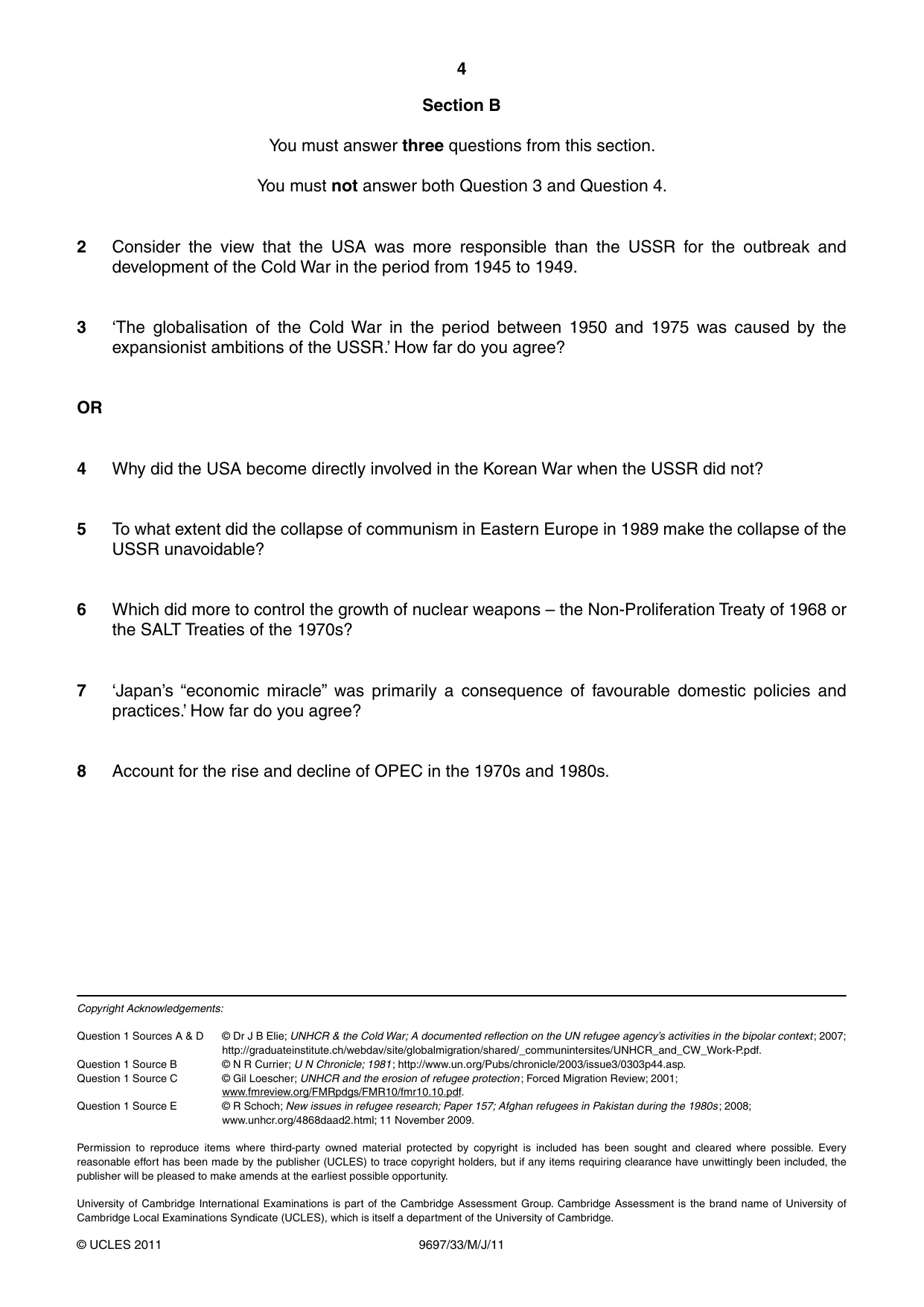
4 9697/33/M/J/11 © UCLES 2011 Section B You must answer three questions from this section. You must not answer both Question 3 and Question 4. 2 Consider the view that the USA was more responsible than the USSR for the outbreak and development of the Cold War in the period from 1945 to 1949. 3 ‘The globalisation of the Cold War in the period between 1950 and 1975 was caused by the expansionist ambitions of the USSR.’ How far do you agree? OR 4 Why did the USA become directly involved in the Korean War when the USSR did not? 5 To what extent did the collapse of communism in Eastern Europe in 1989 make the collapse of the USSR unavoidable? 6 Which did more to control the growth of nuclear weapons – the Non-Proliferation Treaty of 1968 or the SALT Treaties of the 1970s? 7 ‘Japan’s “economic miracle” was primarily a consequence of favourable domestic policies and practices.’ How far do you agree? 8 Account for the rise and decline of OPEC in the 1970s and 1980s. Copyright Acknowledgements: Question 1 Sources A & D © Dr J B Elie; UNHCR & the Cold War; A documented reflection on the UN refugee agency’s activities in the bipolar context ; 2007; http://graduateinstitute.ch/webdav/site/globalmigration/shared/_communintersites/UNHCR_and_CW_Work-P.pdf. Question 1 Source B © N R Currier; U N Chronicle; 1981 ; http://www.un.org/Pubs/chronicle/2003/issue3/0303p44.asp. Question 1 Source C © Gil Loescher; UNHCR and the erosion of refugee protection ; Forced Migration Review; 2001; www.fmreview.org/FMRpdgs/FMR10/fmr10.10.pdf. Question 1 Source E © R Schoch; New issues in refugee research; Paper 157; Afghan refugees in Pakistan during the 1980s ; 2008; www.unhcr.org/4868daad2.html; 11 November 2009. Permission to reproduce items where third-party owned material protected by copyright is included has been sought and cleared where possible. Every reasonable effort has been made by the publisher (UCLES) to trace copyright holders, but if any items requiring clearance have unwittingly been included, the publisher will be pleased to make amends at the earliest possible opportunity. University of Cambridge International Examinations is part of the Cambridge Assessment Group. Cambridge Assessment is the brand name of University of Cambridge Local Examinations Syndicate (UCLES), which is itself a department of the University of Cambridge.
Mark scheme, page 1
UNIVERSITY OF CAMBRIDGE INTERNATIONAL EXAMINATIONS GCE Advanced Subsidiary Level and GCE Advanced Level MARK SCHEME for the May/June 2011 question paper for the guidance of teachers 9697 HISTORY 9697/33 Paper 3 (International History, 1945–1991), maximum raw mark 100 This mark scheme is published as an aid to teachers and candidates, to indicate the requirements of the examination. It shows the basis on which Examiners were instructed to award marks. It does not indicate the details of the discussions that took place at an Examiners’ meeting before marking began, which would have considered the acceptability of alternative answers. Mark schemes must be read in conjunction with the question papers and the report on the examination. • Cambridge will not enter into discussions or correspondence in connection with these mark schemes. Cambridge is publishing the mark schemes for the May/June 2011 question papers for most IGCSE, GCE Advanced Level and Advanced Subsidiary Level syllabuses and some Ordinary Level syllabuses.
Mark scheme, page 2
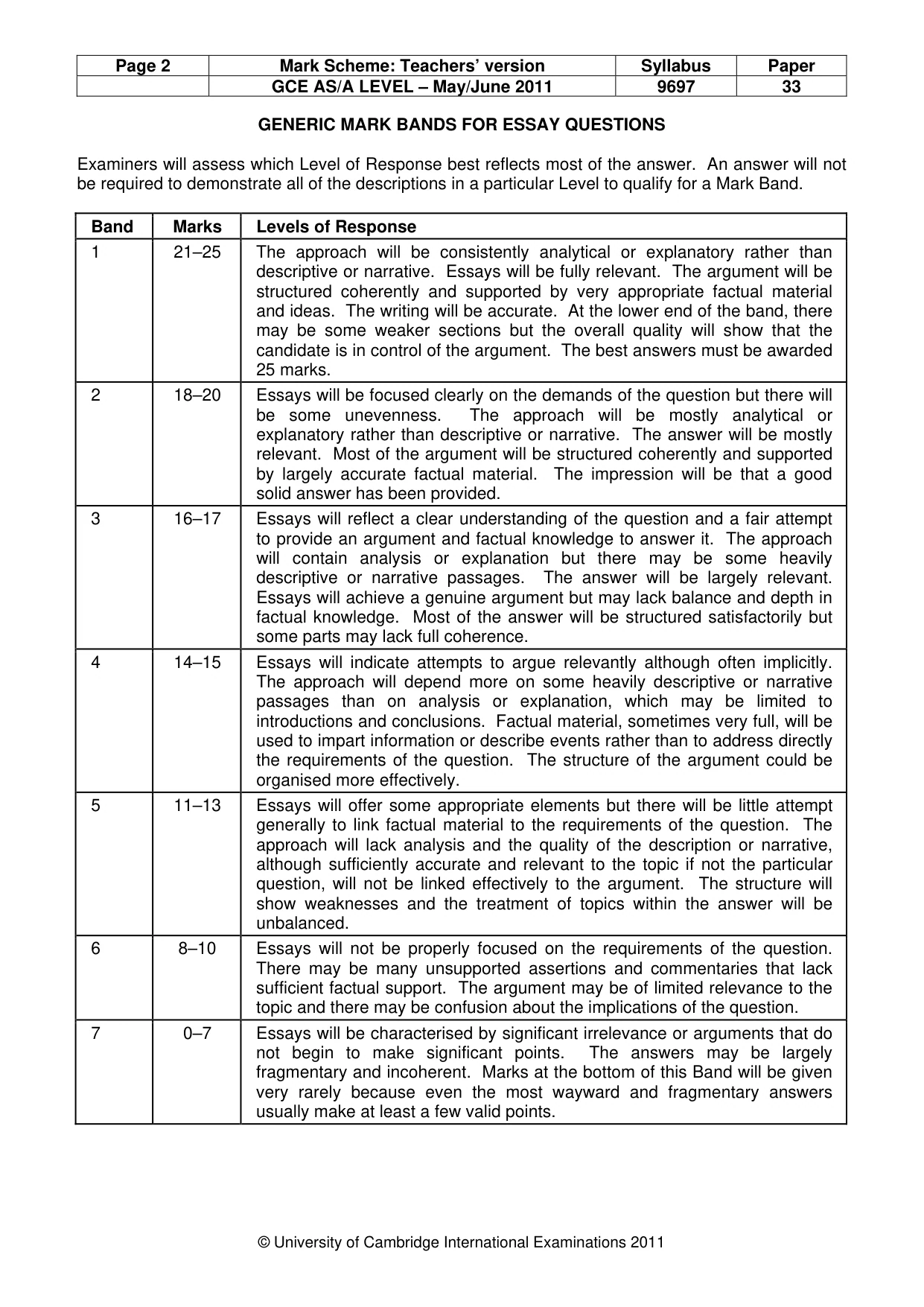
Page 2 Mark Scheme: Teachers’ version Syllabus Paper GCE AS/A LEVEL – May/June 2011 9697 33 © University of Cambridge International Examinations 2011 GENERIC MARK BANDS FOR ESSAY QUESTIONS Examiners will assess which Level of Response best reflects most of the answer. An answer will not be required to demonstrate all of the descriptions in a particular Level to qualify for a Mark Band. Band Marks Levels of Response 1 21–25 The approach will be consistently analytical or explanatory rather than descriptive or narrative. Essays will be fully relevant. The argument will be structured coherently and supported by very appropriate factual material and ideas. The writing will be accurate. At the lower end of the band, there may be some weaker sections but the overall quality will show that the candidate is in control of the argument. The best answers must be awarded 25 marks. 2 18–20 Essays will be focused clearly on the demands of the question but there will be some unevenness. The approach will be mostly analytical or explanatory rather than descriptive or narrative. The answer will be mostly relevant. Most of the argument will be structured coherently and supported by largely accurate factual material. The impression will be that a good solid answer has been provided. 3 16–17 Essays will reflect a clear understanding of the question and a fair attempt to provide an argument and factual knowledge to answer it. The approach will contain analysis or explanation but there may be some heavily descriptive or narrative passages. The answer will be largely relevant. Essays will achieve a genuine argument but may lack balance and depth in factual knowledge. Most of the answer will be structured satisfactorily but some parts may lack full coherence. 4 14–15 Essays will indicate attempts to argue relevantly although often implicitly. The approach will depend more on some heavily descriptive or narrative passages than on analysis or explanation, which may be limited to introductions and conclusions. Factual material, sometimes very full, will be used to impart information or describe events rather than to address directly the requirements of the question. The structure of the argument could be organised more effectively. 5 11–13 Essays will offer some appropriate elements but there will be little attempt generally to link factual material to the requirements of the question. The approach will lack analysis and the quality of the description or narrative, although sufficiently accurate and relevant to the topic if not the particular question, will not be linked effectively to the argument. The structure will show weaknesses and the treatment of topics within the answer will be unbalanced. 6 8–10 Essays will not be properly focused on the requirements of the question. There may be many unsupported assertions and commentaries that lack sufficient factual support. The argument may be of limited relevance to the topic and there may be confusion about the implications of the question. 7 0–7 Essays will be characterised by significant irrelevance or arguments that do not begin to make significant points. The answers may be largely fragmentary and incoherent. Marks at the bottom of this Band will be given very rarely because even the most wayward and fragmentary answers usually make at least a few valid points.
Mark scheme, page 3
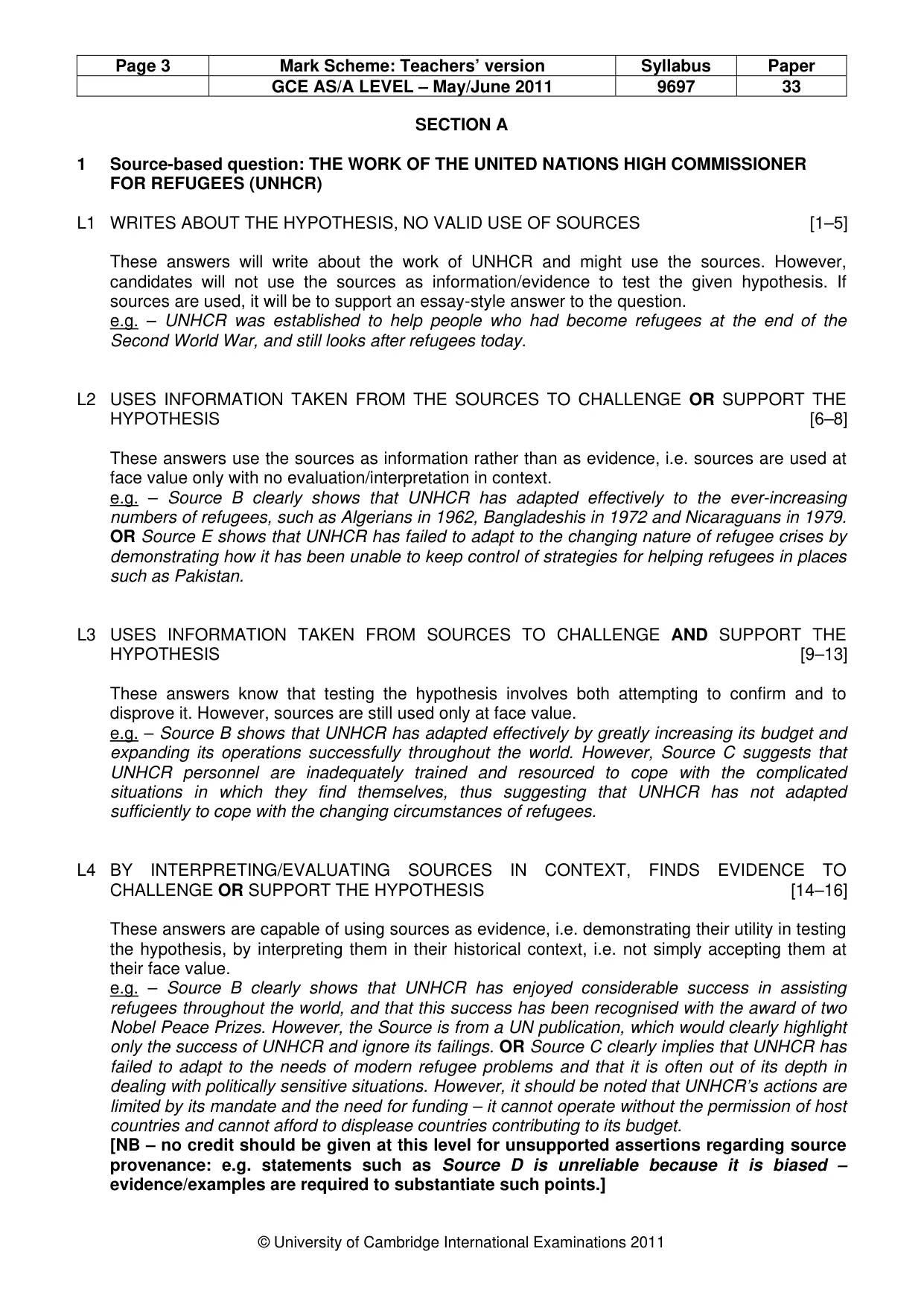
Page 3 Mark Scheme: Teachers’ version Syllabus Paper GCE AS/A LEVEL – May/June 2011 9697 33 © University of Cambridge International Examinations 2011 SECTION A 1 Source-based question: THE WORK OF THE UNITED NATIONS HIGH COMMISSIONER FOR REFUGEES (UNHCR) L1 WRITES ABOUT THE HYPOTHESIS, NO VALID USE OF SOURCES [1–5] These answers will write about the work of UNHCR and might use the sources. However, candidates will not use the sources as information/evidence to test the given hypothesis. If sources are used, it will be to support an essay-style answer to the question. e.g. – UNHCR was established to help people who had become refugees at the end of the Second World War, and still looks after refugees today. L2 USES INFORMATION TAKEN FROM THE SOURCES TO CHALLENGE OR SUPPORT THE HYPOTHESIS [6–8] These answers use the sources as information rather than as evidence, i.e. sources are used at face value only with no evaluation/interpretation in context. e.g. – Source B clearly shows that UNHCR has adapted effectively to the ever-increasing numbers of refugees, such as Algerians in 1962, Bangladeshis in 1972 and Nicaraguans in 1979. OR Source E shows that UNHCR has failed to adapt to the changing nature of refugee crises by demonstrating how it has been unable to keep control of strategies for helping refugees in places such as Pakistan. L3 USES INFORMATION TAKEN FROM SOURCES TO CHALLENGE AND SUPPORT THE HYPOTHESIS [9–13] These answers know that testing the hypothesis involves both attempting to confirm and to disprove it. However, sources are still used only at face value. e.g. – Source B shows that UNHCR has adapted effectively by greatly increasing its budget and expanding its operations successfully throughout the world. However, Source C suggests that UNHCR personnel are inadequately trained and resourced to cope with the complicated situations in which they find themselves, thus suggesting that UNHCR has not adapted sufficiently to cope with the changing circumstances of refugees. L4 BY INTERPRETING/EVALUATING SOURCES IN CONTEXT, FINDS EVIDENCE TO CHALLENGE OR SUPPORT THE HYPOTHESIS [14–16] These answers are capable of using sources as evidence, i.e. demonstrating their utility in testing the hypothesis, by interpreting them in their historical context, i.e. not simply accepting them at their face value. e.g. – Source B clearly shows that UNHCR has enjoyed considerable success in assisting refugees throughout the world, and that this success has been recognised with the award of two Nobel Peace Prizes. However, the Source is from a UN publication, which would clearly highlight only the success of UNHCR and ignore its failings. OR Source C clearly implies that UNHCR has failed to adapt to the needs of modern refugee problems and that it is often out of its depth in dealing with politically sensitive situations. However, it should be noted that UNHCR’s actions are limited by its mandate and the need for funding – it cannot operate without the permission of host countries and cannot afford to displease countries contributing to its budget. [NB – no credit should be given at this level for unsupported assertions regarding source provenance: e.g. statements such as Source D is unreliable because it is biased – evidence/examples are required to substantiate such points.]
Mark scheme, page 4
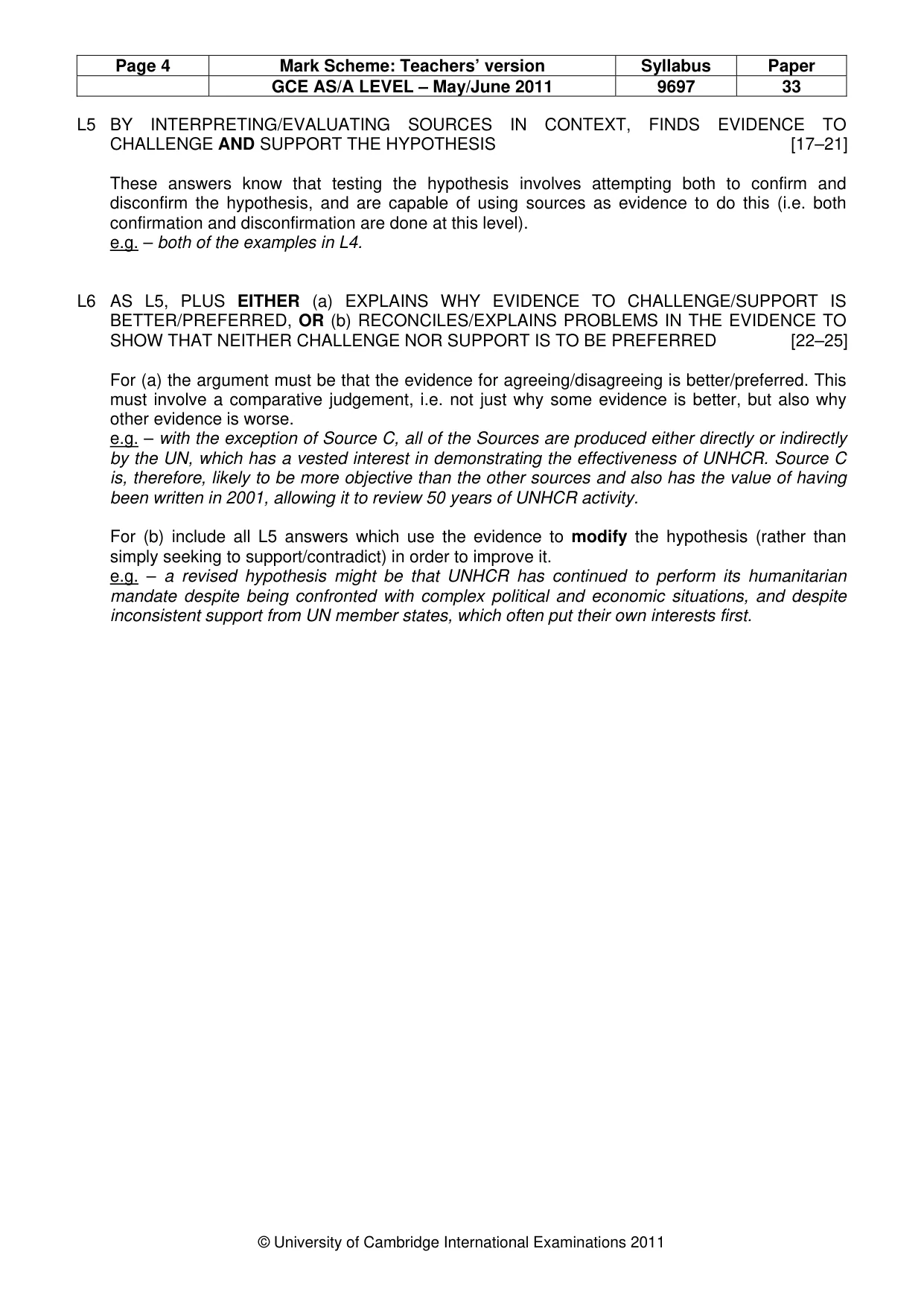
Page 4 Mark Scheme: Teachers’ version Syllabus Paper GCE AS/A LEVEL – May/June 2011 9697 33 © University of Cambridge International Examinations 2011 L5 BY INTERPRETING/EVALUATING SOURCES IN CONTEXT, FINDS EVIDENCE TO CHALLENGE AND SUPPORT THE HYPOTHESIS [17–21] These answers know that testing the hypothesis involves attempting both to confirm and disconfirm the hypothesis, and are capable of using sources as evidence to do this (i.e. both confirmation and disconfirmation are done at this level). e.g. – both of the examples in L4. L6 AS L5, PLUS EITHER (a) EXPLAINS WHY EVIDENCE TO CHALLENGE/SUPPORT IS BETTER/PREFERRED, OR (b) RECONCILES/EXPLAINS PROBLEMS IN THE EVIDENCE TO SHOW THAT NEITHER CHALLENGE NOR SUPPORT IS TO BE PREFERRED [22–25] For (a) the argument must be that the evidence for agreeing/disagreeing is better/preferred. This must involve a comparative judgement, i.e. not just why some evidence is better, but also why other evidence is worse. e.g. – with the exception of Source C, all of the Sources are produced either directly or indirectly by the UN, which has a vested interest in demonstrating the effectiveness of UNHCR. Source C is, therefore, likely to be more objective than the other sources and also has the value of having been written in 2001, allowing it to review 50 years of UNHCR activity. For (b) include all L5 answers which use the evidence to modify the hypothesis (rather than simply seeking to support/contradict) in order to improve it. e.g. – a revised hypothesis might be that UNHCR has continued to perform its humanitarian mandate despite being confronted with complex political and economic situations, and despite inconsistent support from UN member states, which often put their own interests first.
Mark scheme, page 5
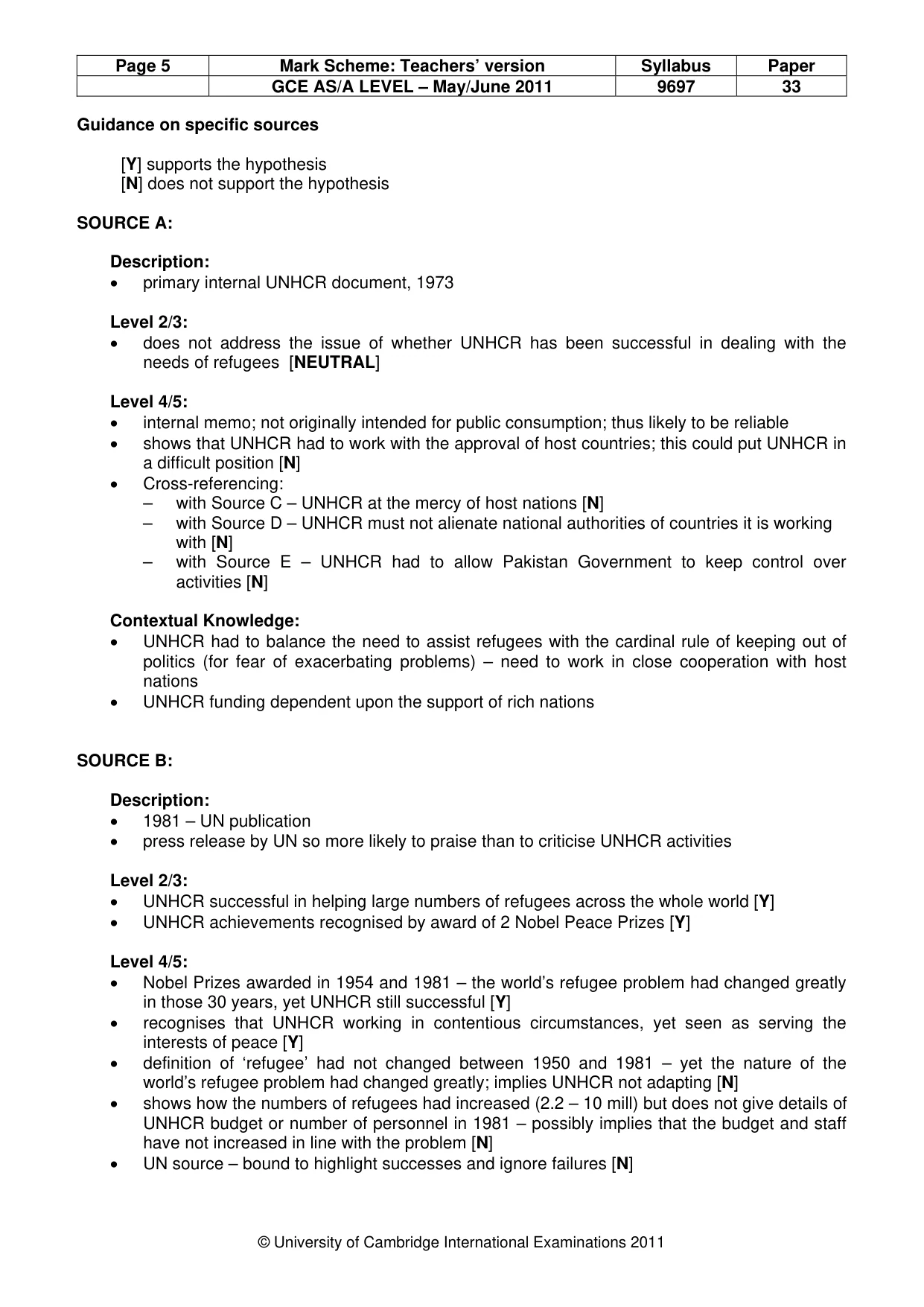
Page 5 Mark Scheme: Teachers’ version Syllabus Paper GCE AS/A LEVEL – May/June 2011 9697 33 © University of Cambridge International Examinations 2011 Guidance on specific sources [Y] supports the hypothesis [N] does not support the hypothesis SOURCE A: Description: • primary internal UNHCR document, 1973 Level 2/3: • does not address the issue of whether UNHCR has been successful in dealing with the needs of refugees [NEUTRAL] Level 4/5: • internal memo; not originally intended for public consumption; thus likely to be reliable • shows that UNHCR had to work with the approval of host countries; this could put UNHCR in a difficult position [N] • Cross-referencing: – with Source C – UNHCR at the mercy of host nations [N] – with Source D – UNHCR must not alienate national authorities of countries it is working with [N] – with Source E – UNHCR had to allow Pakistan Government to keep control over activities [N] Contextual Knowledge: • UNHCR had to balance the need to assist refugees with the cardinal rule of keeping out of politics (for fear of exacerbating problems) – need to work in close cooperation with host nations • UNHCR funding dependent upon the support of rich nations SOURCE B: Description: • 1981 – UN publication • press release by UN so more likely to praise than to criticise UNHCR activities Level 2/3: • UNHCR successful in helping large numbers of refugees across the whole world [Y] • UNHCR achievements recognised by award of 2 Nobel Peace Prizes [Y] Level 4/5: • Nobel Prizes awarded in 1954 and 1981 – the world’s refugee problem had changed greatly in those 30 years, yet UNHCR still successful [Y] • recognises that UNHCR working in contentious circumstances, yet seen as serving the interests of peace [Y] • definition of ‘refugee’ had not changed between 1950 and 1981 – yet the nature of the world’s refugee problem had changed greatly; implies UNHCR not adapting [N] • shows how the numbers of refugees had increased (2.2 – 10 mill) but does not give details of UNHCR budget or number of personnel in 1981 – possibly implies that the budget and staff have not increased in line with the problem [N] • UN source – bound to highlight successes and ignore failures [N]
Mark scheme, page 6
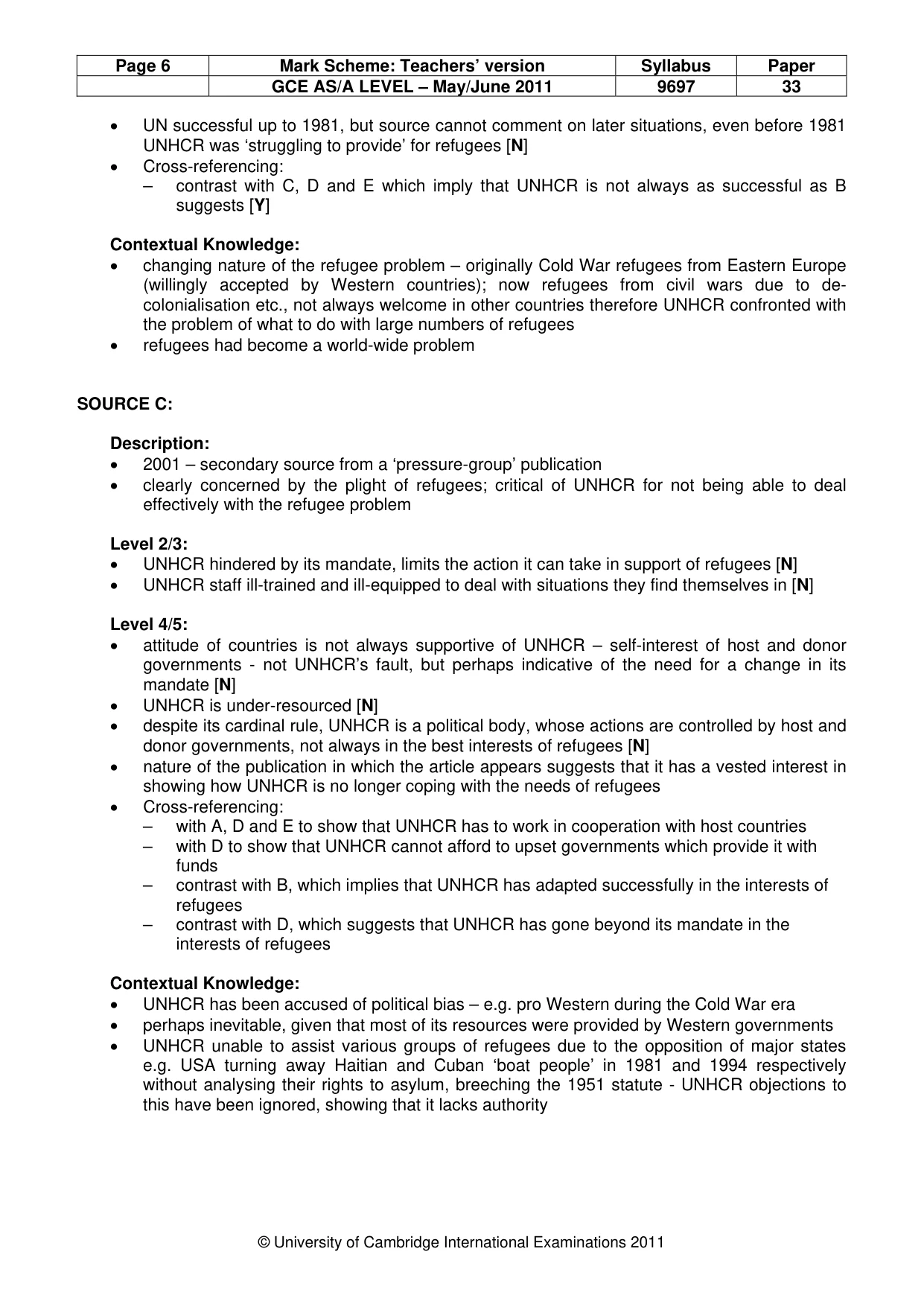
Page 6 Mark Scheme: Teachers’ version Syllabus Paper GCE AS/A LEVEL – May/June 2011 9697 33 © University of Cambridge International Examinations 2011 • UN successful up to 1981, but source cannot comment on later situations, even before 1981 UNHCR was ‘struggling to provide’ for refugees [N] • Cross-referencing: – contrast with C, D and E which imply that UNHCR is not always as successful as B suggests [Y] Contextual Knowledge: • changing nature of the refugee problem – originally Cold War refugees from Eastern Europe (willingly accepted by Western countries); now refugees from civil wars due to de- colonialisation etc., not always welcome in other countries therefore UNHCR confronted with the problem of what to do with large numbers of refugees • refugees had become a world-wide problem SOURCE C: Description: • 2001 – secondary source from a ‘pressure-group’ publication • clearly concerned by the plight of refugees; critical of UNHCR for not being able to deal effectively with the refugee problem Level 2/3: • UNHCR hindered by its mandate, limits the action it can take in support of refugees [N] • UNHCR staff ill-trained and ill-equipped to deal with situations they find themselves in [N] Level 4/5: • attitude of countries is not always supportive of UNHCR – self-interest of host and donor governments - not UNHCR’s fault, but perhaps indicative of the need for a change in its mandate [N] • UNHCR is under-resourced [N] • despite its cardinal rule, UNHCR is a political body, whose actions are controlled by host and donor governments, not always in the best interests of refugees [N] • nature of the publication in which the article appears suggests that it has a vested interest in showing how UNHCR is no longer coping with the needs of refugees • Cross-referencing: – with A, D and E to show that UNHCR has to work in cooperation with host countries – with D to show that UNHCR cannot afford to upset governments which provide it with funds – contrast with B, which implies that UNHCR has adapted successfully in the interests of refugees – contrast with D, which suggests that UNHCR has gone beyond its mandate in the interests of refugees Contextual Knowledge: • UNHCR has been accused of political bias – e.g. pro Western during the Cold War era • perhaps inevitable, given that most of its resources were provided by Western governments • UNHCR unable to assist various groups of refugees due to the opposition of major states e.g. USA turning away Haitian and Cuban ‘boat people’ in 1981 and 1994 respectively without analysing their rights to asylum, breeching the 1951 statute - UNHCR objections to this have been ignored, showing that it lacks authority
Mark scheme, page 7
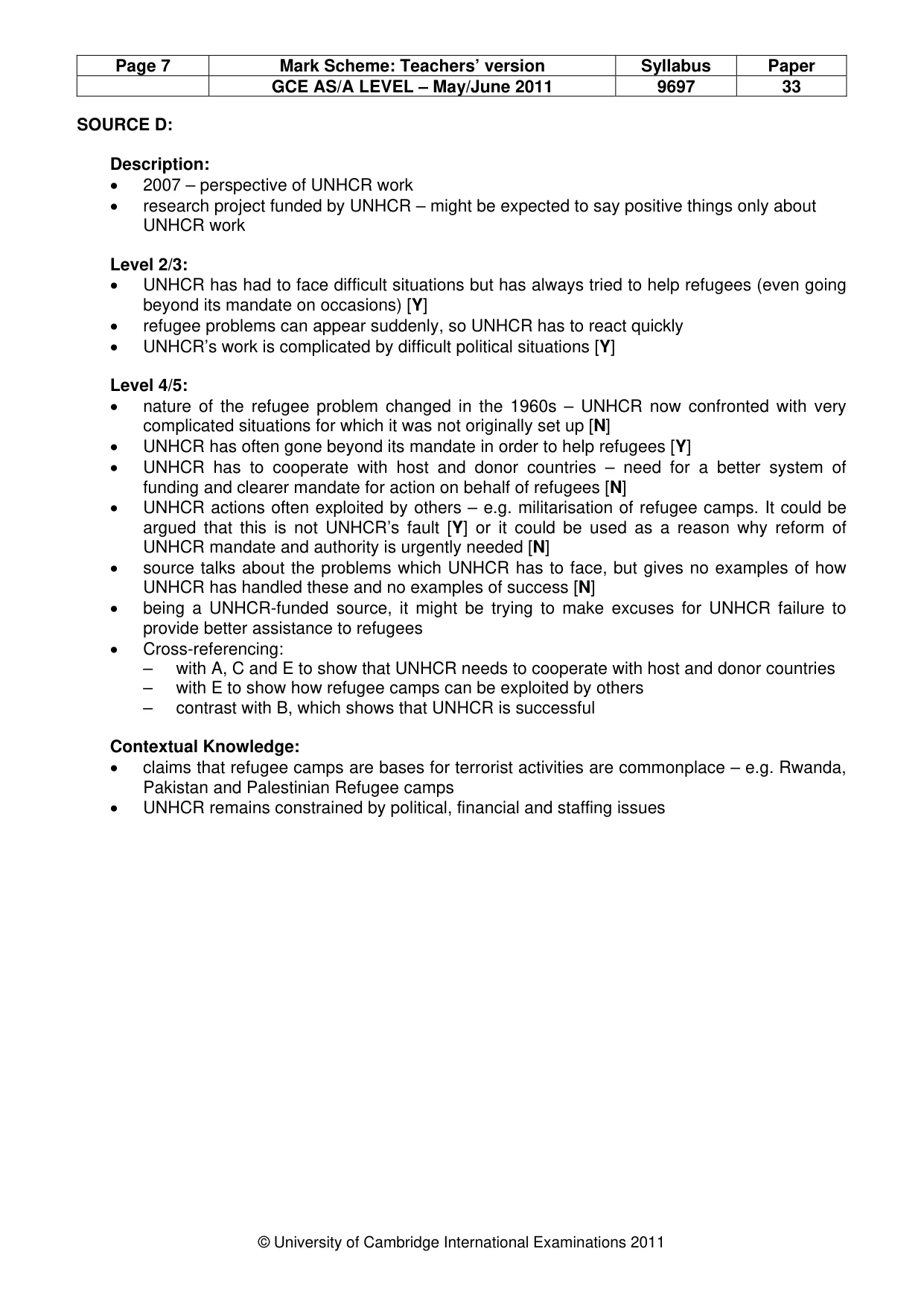
Page 7 Mark Scheme: Teachers’ version Syllabus Paper GCE AS/A LEVEL – May/June 2011 9697 33 © University of Cambridge International Examinations 2011 SOURCE D: Description: • 2007 – perspective of UNHCR work • research project funded by UNHCR – might be expected to say positive things only about UNHCR work Level 2/3: • UNHCR has had to face difficult situations but has always tried to help refugees (even going beyond its mandate on occasions) [Y] • refugee problems can appear suddenly, so UNHCR has to react quickly • UNHCR’s work is complicated by difficult political situations [Y] Level 4/5: • nature of the refugee problem changed in the 1960s – UNHCR now confronted with very complicated situations for which it was not originally set up [N] • UNHCR has often gone beyond its mandate in order to help refugees [Y] • UNHCR has to cooperate with host and donor countries – need for a better system of funding and clearer mandate for action on behalf of refugees [N] • UNHCR actions often exploited by others – e.g. militarisation of refugee camps. It could be argued that this is not UNHCR’s fault [Y] or it could be used as a reason why reform of UNHCR mandate and authority is urgently needed [N] • source talks about the problems which UNHCR has to face, but gives no examples of how UNHCR has handled these and no examples of success [N] • being a UNHCR-funded source, it might be trying to make excuses for UNHCR failure to provide better assistance to refugees • Cross-referencing: – with A, C and E to show that UNHCR needs to cooperate with host and donor countries – with E to show how refugee camps can be exploited by others – contrast with B, which shows that UNHCR is successful Contextual Knowledge: • claims that refugee camps are bases for terrorist activities are commonplace – e.g. Rwanda, Pakistan and Palestinian Refugee camps • UNHCR remains constrained by political, financial and staffing issues
Mark scheme, page 8
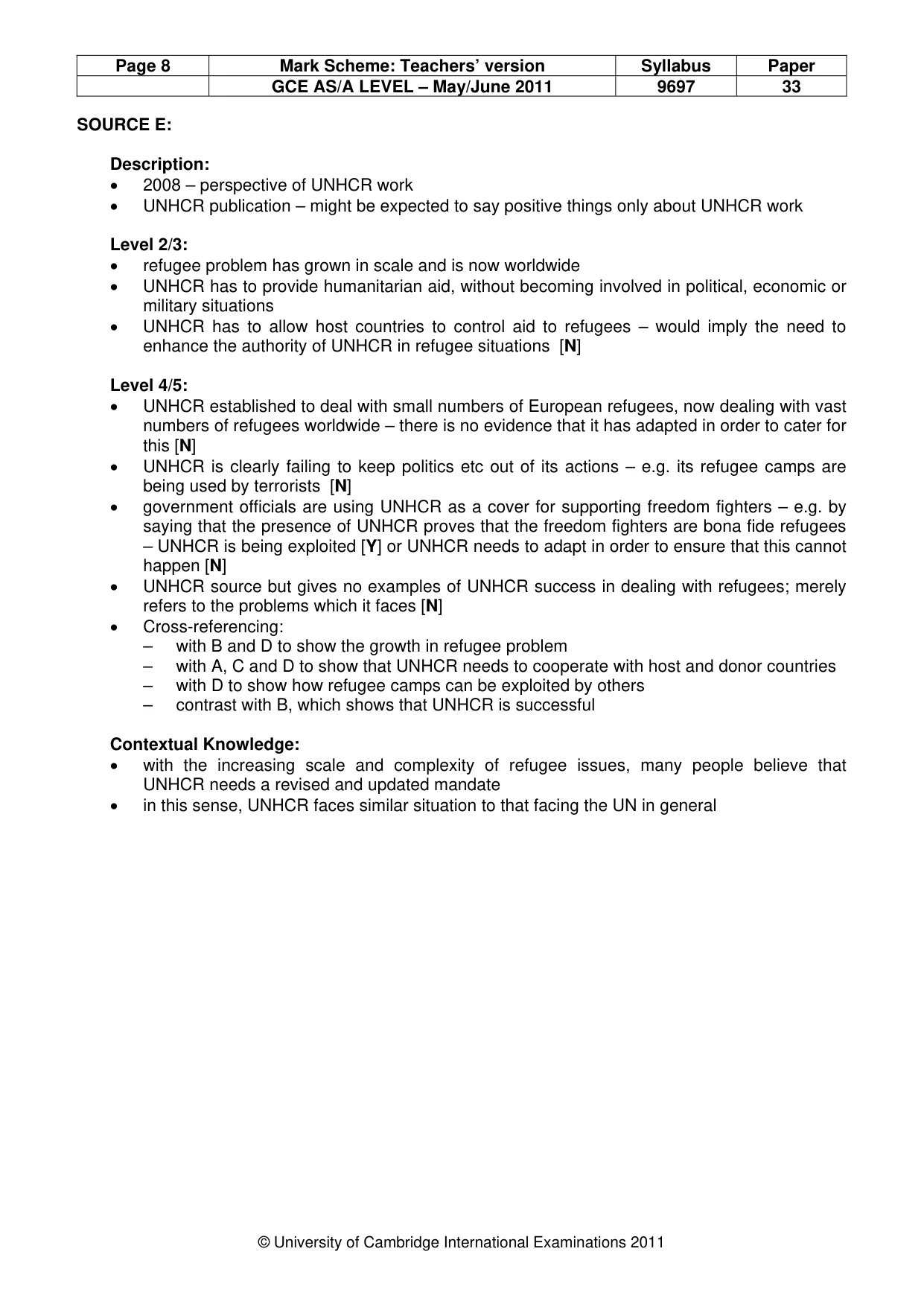
Page 8 Mark Scheme: Teachers’ version Syllabus Paper GCE AS/A LEVEL – May/June 2011 9697 33 © University of Cambridge International Examinations 2011 SOURCE E: Description: • 2008 – perspective of UNHCR work • UNHCR publication – might be expected to say positive things only about UNHCR work Level 2/3: • refugee problem has grown in scale and is now worldwide • UNHCR has to provide humanitarian aid, without becoming involved in political, economic or military situations • UNHCR has to allow host countries to control aid to refugees – would imply the need to enhance the authority of UNHCR in refugee situations [N] Level 4/5: • UNHCR established to deal with small numbers of European refugees, now dealing with vast numbers of refugees worldwide – there is no evidence that it has adapted in order to cater for this [N] • UNHCR is clearly failing to keep politics etc out of its actions – e.g. its refugee camps are being used by terrorists [N] • government officials are using UNHCR as a cover for supporting freedom fighters – e.g. by saying that the presence of UNHCR proves that the freedom fighters are bona fide refugees – UNHCR is being exploited [Y] or UNHCR needs to adapt in order to ensure that this cannot happen [N] • UNHCR source but gives no examples of UNHCR success in dealing with refugees; merely refers to the problems which it faces [N] • Cross-referencing: – with B and D to show the growth in refugee problem – with A, C and D to show that UNHCR needs to cooperate with host and donor countries – with D to show how refugee camps can be exploited by others – contrast with B, which shows that UNHCR is successful Contextual Knowledge: • with the increasing scale and complexity of refugee issues, many people believe that UNHCR needs a revised and updated mandate • in this sense, UNHCR faces similar situation to that facing the UN in general
Mark scheme, page 9
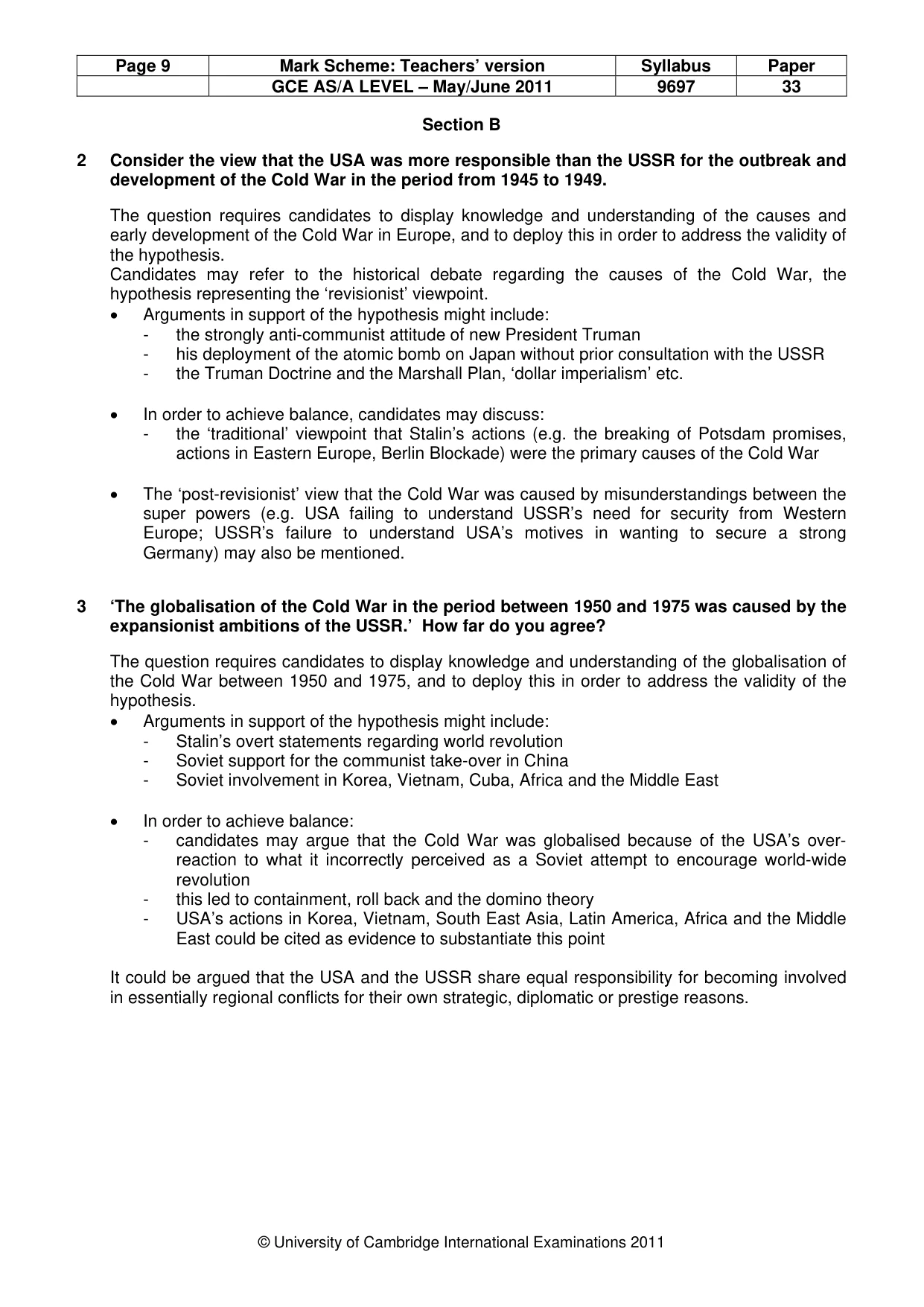
Page 9 Mark Scheme: Teachers’ version Syllabus Paper GCE AS/A LEVEL – May/June 2011 9697 33 © University of Cambridge International Examinations 2011 Section B 2 Consider the view that the USA was more responsible than the USSR for the outbreak and development of the Cold War in the period from 1945 to 1949. The question requires candidates to display knowledge and understanding of the causes and early development of the Cold War in Europe, and to deploy this in order to address the validity of the hypothesis. Candidates may refer to the historical debate regarding the causes of the Cold War, the hypothesis representing the ‘revisionist’ viewpoint. • Arguments in support of the hypothesis might include: - the strongly anti-communist attitude of new President Truman - his deployment of the atomic bomb on Japan without prior consultation with the USSR - the Truman Doctrine and the Marshall Plan, ‘dollar imperialism’ etc. • In order to achieve balance, candidates may discuss: - the ‘traditional’ viewpoint that Stalin’s actions (e.g. the breaking of Potsdam promises, actions in Eastern Europe, Berlin Blockade) were the primary causes of the Cold War • The ‘post-revisionist’ view that the Cold War was caused by misunderstandings between the super powers (e.g. USA failing to understand USSR’s need for security from Western Europe; USSR’s failure to understand USA’s motives in wanting to secure a strong Germany) may also be mentioned. 3 ‘The globalisation of the Cold War in the period between 1950 and 1975 was caused by the expansionist ambitions of the USSR.’ How far do you agree? The question requires candidates to display knowledge and understanding of the globalisation of the Cold War between 1950 and 1975, and to deploy this in order to address the validity of the hypothesis. • Arguments in support of the hypothesis might include: - Stalin’s overt statements regarding world revolution - Soviet support for the communist take-over in China - Soviet involvement in Korea, Vietnam, Cuba, Africa and the Middle East • In order to achieve balance: - candidates may argue that the Cold War was globalised because of the USA’s over- reaction to what it incorrectly perceived as a Soviet attempt to encourage world-wide revolution - this led to containment, roll back and the domino theory - USA’s actions in Korea, Vietnam, South East Asia, Latin America, Africa and the Middle East could be cited as evidence to substantiate this point It could be argued that the USA and the USSR share equal responsibility for becoming involved in essentially regional conflicts for their own strategic, diplomatic or prestige reasons.
Mark scheme, page 10
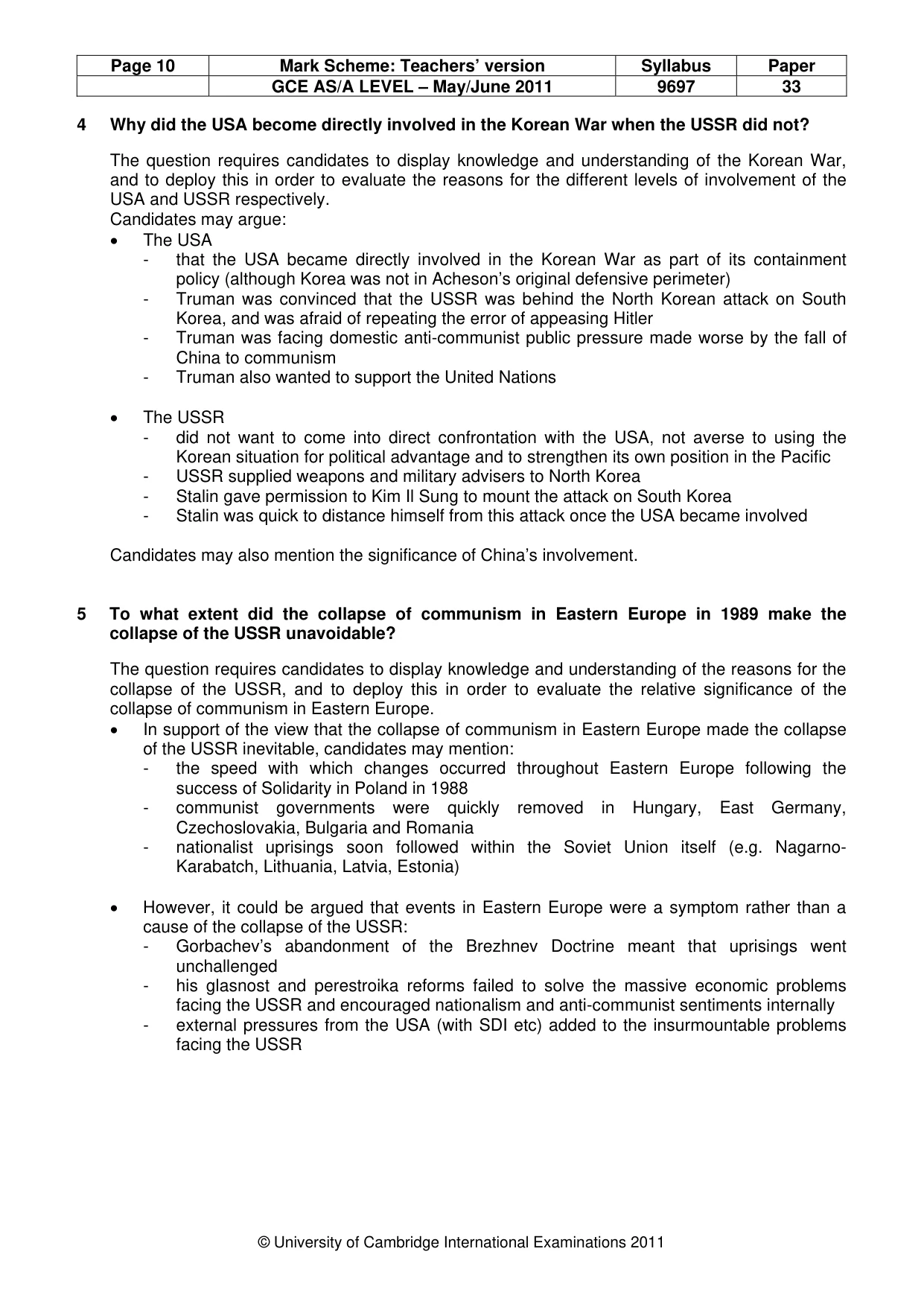
Page 10 Mark Scheme: Teachers’ version Syllabus Paper GCE AS/A LEVEL – May/June 2011 9697 33 © University of Cambridge International Examinations 2011 4 Why did the USA become directly involved in the Korean War when the USSR did not? The question requires candidates to display knowledge and understanding of the Korean War, and to deploy this in order to evaluate the reasons for the different levels of involvement of the USA and USSR respectively. Candidates may argue: • The USA - that the USA became directly involved in the Korean War as part of its containment policy (although Korea was not in Acheson’s original defensive perimeter) - Truman was convinced that the USSR was behind the North Korean attack on South Korea, and was afraid of repeating the error of appeasing Hitler - Truman was facing domestic anti-communist public pressure made worse by the fall of China to communism - Truman also wanted to support the United Nations • The USSR - did not want to come into direct confrontation with the USA, not averse to using the Korean situation for political advantage and to strengthen its own position in the Pacific - USSR supplied weapons and military advisers to North Korea - Stalin gave permission to Kim Il Sung to mount the attack on South Korea - Stalin was quick to distance himself from this attack once the USA became involved Candidates may also mention the significance of China’s involvement. 5 To what extent did the collapse of communism in Eastern Europe in 1989 make the collapse of the USSR unavoidable? The question requires candidates to display knowledge and understanding of the reasons for the collapse of the USSR, and to deploy this in order to evaluate the relative significance of the collapse of communism in Eastern Europe. • In support of the view that the collapse of communism in Eastern Europe made the collapse of the USSR inevitable, candidates may mention: - the speed with which changes occurred throughout Eastern Europe following the success of Solidarity in Poland in 1988 - communist governments were quickly removed in Hungary, East Germany, Czechoslovakia, Bulgaria and Romania - nationalist uprisings soon followed within the Soviet Union itself (e.g. Nagarno- Karabatch, Lithuania, Latvia, Estonia) • However, it could be argued that events in Eastern Europe were a symptom rather than a cause of the collapse of the USSR: - Gorbachev’s abandonment of the Brezhnev Doctrine meant that uprisings went unchallenged - his glasnost and perestroika reforms failed to solve the massive economic problems facing the USSR and encouraged nationalism and anti-communist sentiments internally - external pressures from the USA (with SDI etc) added to the insurmountable problems facing the USSR
Mark scheme, page 11
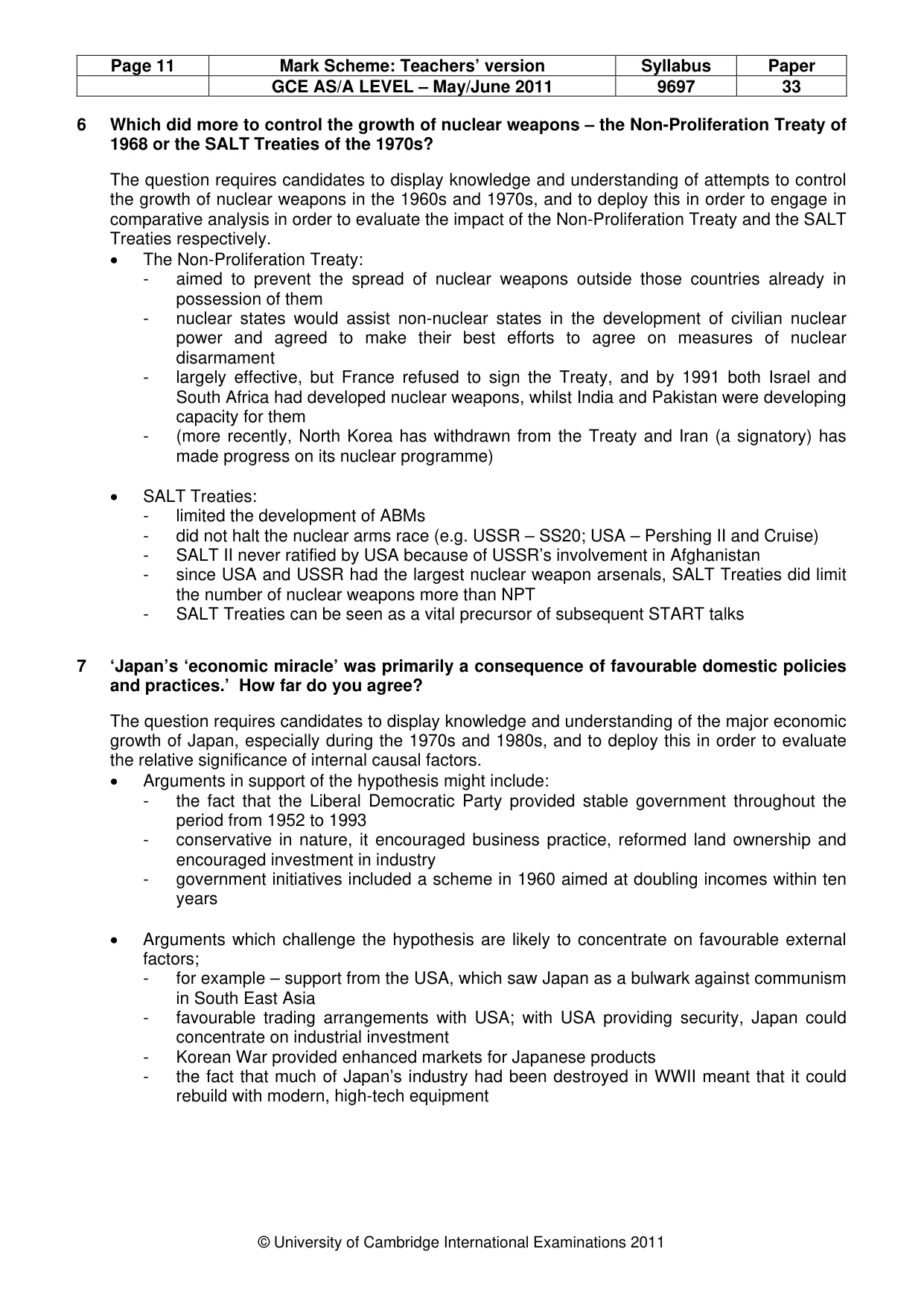
Page 11 Mark Scheme: Teachers’ version Syllabus Paper GCE AS/A LEVEL – May/June 2011 9697 33 © University of Cambridge International Examinations 2011 6 Which did more to control the growth of nuclear weapons – the Non-Proliferation Treaty of 1968 or the SALT Treaties of the 1970s? The question requires candidates to display knowledge and understanding of attempts to control the growth of nuclear weapons in the 1960s and 1970s, and to deploy this in order to engage in comparative analysis in order to evaluate the impact of the Non-Proliferation Treaty and the SALT Treaties respectively. • The Non-Proliferation Treaty: - aimed to prevent the spread of nuclear weapons outside those countries already in possession of them - nuclear states would assist non-nuclear states in the development of civilian nuclear power and agreed to make their best efforts to agree on measures of nuclear disarmament - largely effective, but France refused to sign the Treaty, and by 1991 both Israel and South Africa had developed nuclear weapons, whilst India and Pakistan were developing capacity for them - (more recently, North Korea has withdrawn from the Treaty and Iran (a signatory) has made progress on its nuclear programme) • SALT Treaties: - limited the development of ABMs - did not halt the nuclear arms race (e.g. USSR – SS20; USA – Pershing II and Cruise) - SALT II never ratified by USA because of USSR’s involvement in Afghanistan - since USA and USSR had the largest nuclear weapon arsenals, SALT Treaties did limit the number of nuclear weapons more than NPT - SALT Treaties can be seen as a vital precursor of subsequent START talks 7 ‘Japan’s ‘economic miracle’ was primarily a consequence of favourable domestic policies and practices.’ How far do you agree? The question requires candidates to display knowledge and understanding of the major economic growth of Japan, especially during the 1970s and 1980s, and to deploy this in order to evaluate the relative significance of internal causal factors. • Arguments in support of the hypothesis might include: - the fact that the Liberal Democratic Party provided stable government throughout the period from 1952 to 1993 - conservative in nature, it encouraged business practice, reformed land ownership and encouraged investment in industry - government initiatives included a scheme in 1960 aimed at doubling incomes within ten years • Arguments which challenge the hypothesis are likely to concentrate on favourable external factors; - for example – support from the USA, which saw Japan as a bulwark against communism in South East Asia - favourable trading arrangements with USA; with USA providing security, Japan could concentrate on industrial investment - Korean War provided enhanced markets for Japanese products - the fact that much of Japan’s industry had been destroyed in WWII meant that it could rebuild with modern, high-tech equipment
Mark scheme, page 12
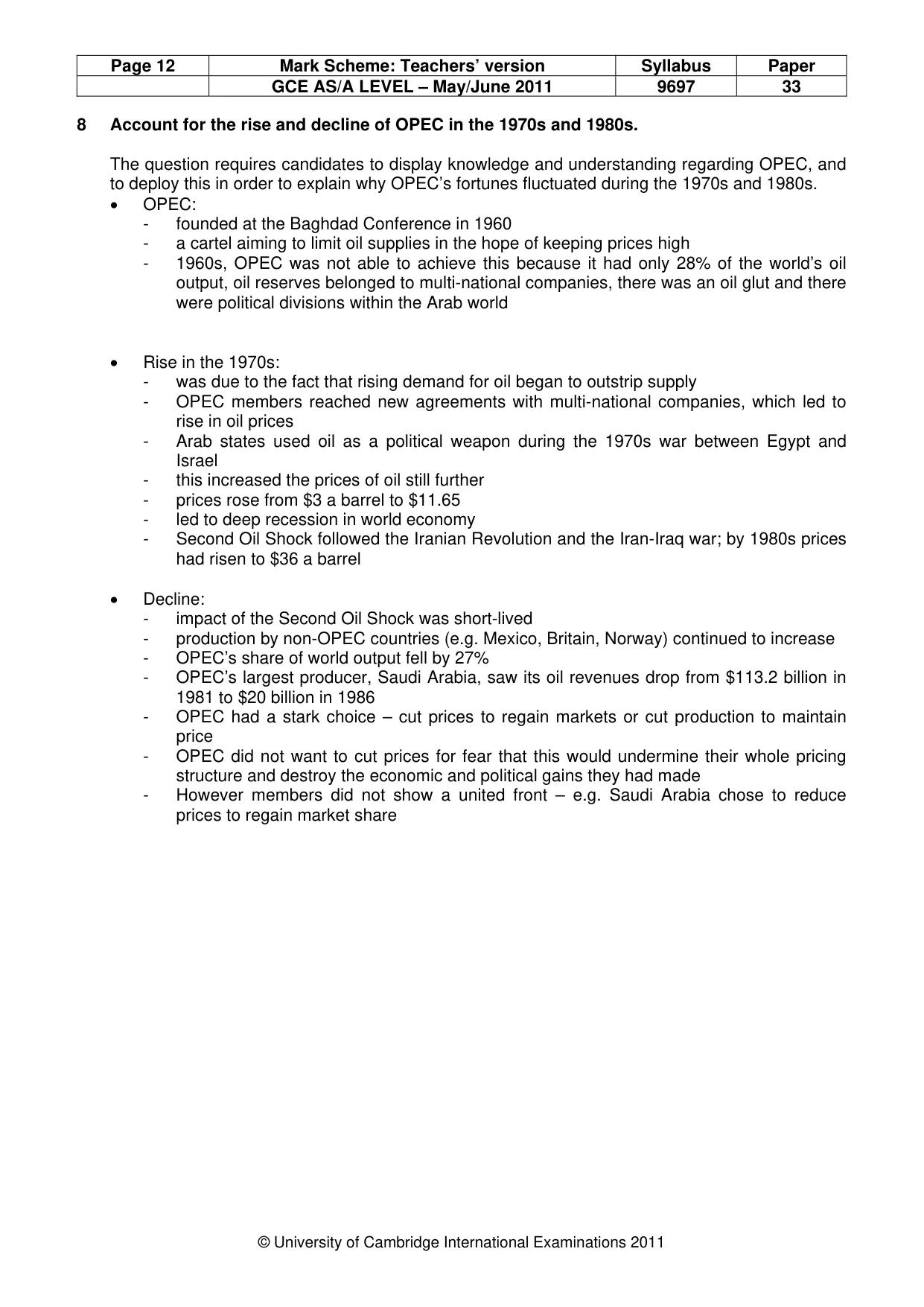
Page 12 Mark Scheme: Teachers’ version Syllabus Paper GCE AS/A LEVEL – May/June 2011 9697 33 © University of Cambridge International Examinations 2011 8 Account for the rise and decline of OPEC in the 1970s and 1980s. The question requires candidates to display knowledge and understanding regarding OPEC, and to deploy this in order to explain why OPEC’s fortunes fluctuated during the 1970s and 1980s. • OPEC: - founded at the Baghdad Conference in 1960 - a cartel aiming to limit oil supplies in the hope of keeping prices high - 1960s, OPEC was not able to achieve this because it had only 28% of the world’s oil output, oil reserves belonged to multi-national companies, there was an oil glut and there were political divisions within the Arab world • Rise in the 1970s: - was due to the fact that rising demand for oil began to outstrip supply - OPEC members reached new agreements with multi-national companies, which led to rise in oil prices - Arab states used oil as a political weapon during the 1970s war between Egypt and Israel - this increased the prices of oil still further - prices rose from $3 a barrel to $11.65 - led to deep recession in world economy - Second Oil Shock followed the Iranian Revolution and the Iran-Iraq war; by 1980s prices had risen to $36 a barrel • Decline: - impact of the Second Oil Shock was short-lived - production by non-OPEC countries (e.g. Mexico, Britain, Norway) continued to increase - OPEC’s share of world output fell by 27% - OPEC’s largest producer, Saudi Arabia, saw its oil revenues drop from $113.2 billion in 1981 to $20 billion in 1986 - OPEC had a stark choice – cut prices to regain markets or cut production to maintain price - OPEC did not want to cut prices for fear that this would undermine their whole pricing structure and destroy the economic and political gains they had made - However members did not show a united front – e.g. Saudi Arabia chose to reduce prices to regain market share
What you needed in this session
Cambridge’s own grade thresholds for 2011 May/June, Paper 3 · Variant 3. A higher threshold means an easier paper — the bar moves with how the cohort did.