Cambridge A Level Global Perspectives (AS Level only, until Nov 2015) 8987 — 2015 May/June Paper 1 · Variant 1
8987/11/M/J/15
The question paper and its mark scheme, free to read here and free to download. This is Cambridge’s own paper, exactly as it was sat.
Question paper4 pages

Mark scheme6 pages
Answers below. Sit the paper first if you are practising.
Paper as text
Question paper, page 1
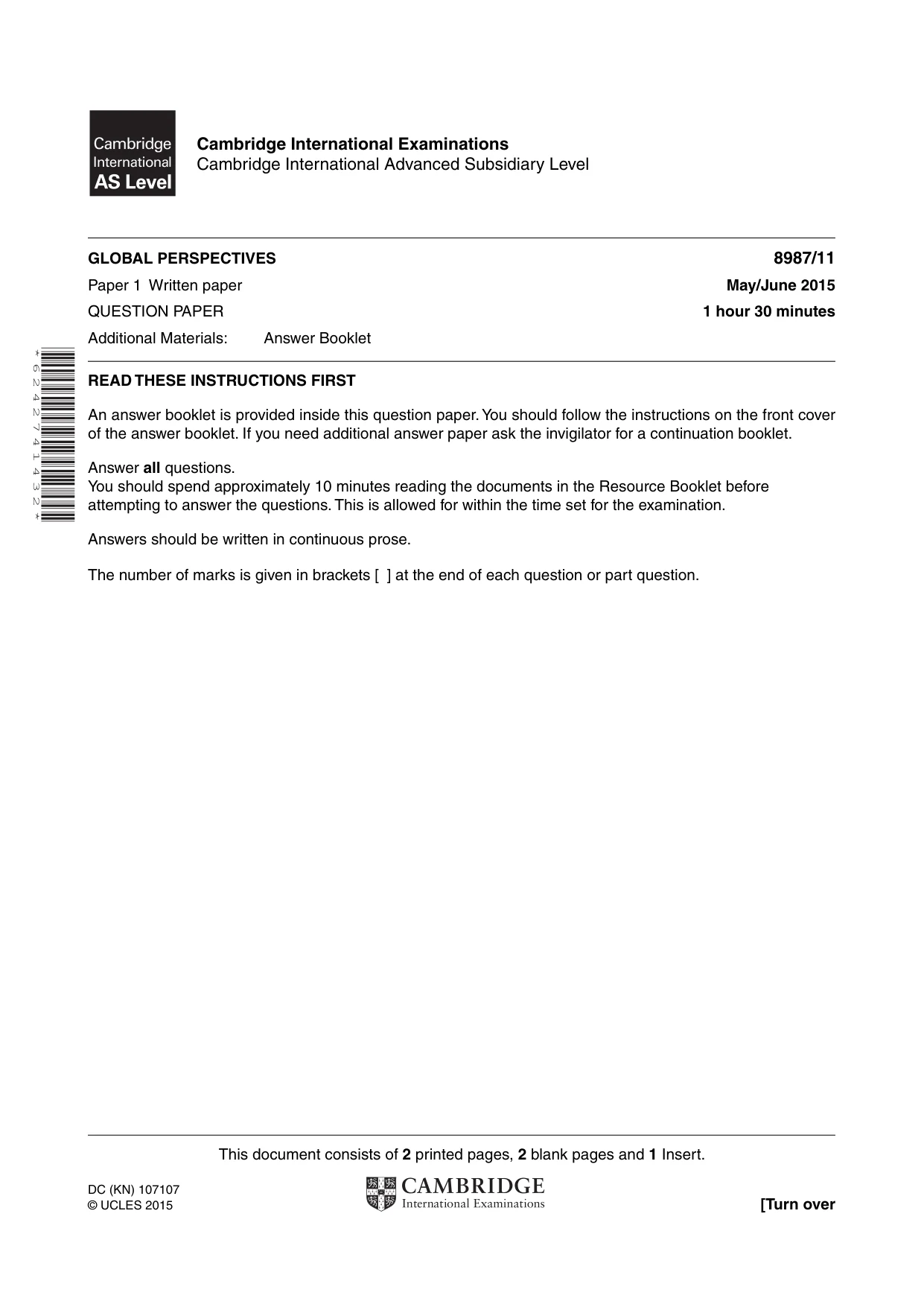
This document consists of 2 printed pages, 2 blank pages and 1 Insert. DC (KN) 107107 © UCLES 2015 [Turn over Cambridge International Examinations Cambridge International Advanced Subsidiary Level * 6 2 4 2 7 4 1 4 3 2 * GLOBAL PERSPECTIVES 8987/11 Paper 1 Written paper May/June 2015 QUESTION PAPER 1 hour 30 minutes Additional Materials: Answer Booklet READ THESE INSTRUCTIONS FIRST An answer booklet is provided inside this question paper. You should follow the instructions on the front cover of the answer booklet. If you need additional answer paper ask the invigilator for a continuation booklet. Answer all questions. You should spend approximately 10 minutes reading the documents in the Resource Booklet before attempting to answer the questions. This is allowed for within the time set for the examination. Answers should be written in continuous prose. The number of marks is given in brackets [ ] at the end of each question or part question.
Question paper, page 2
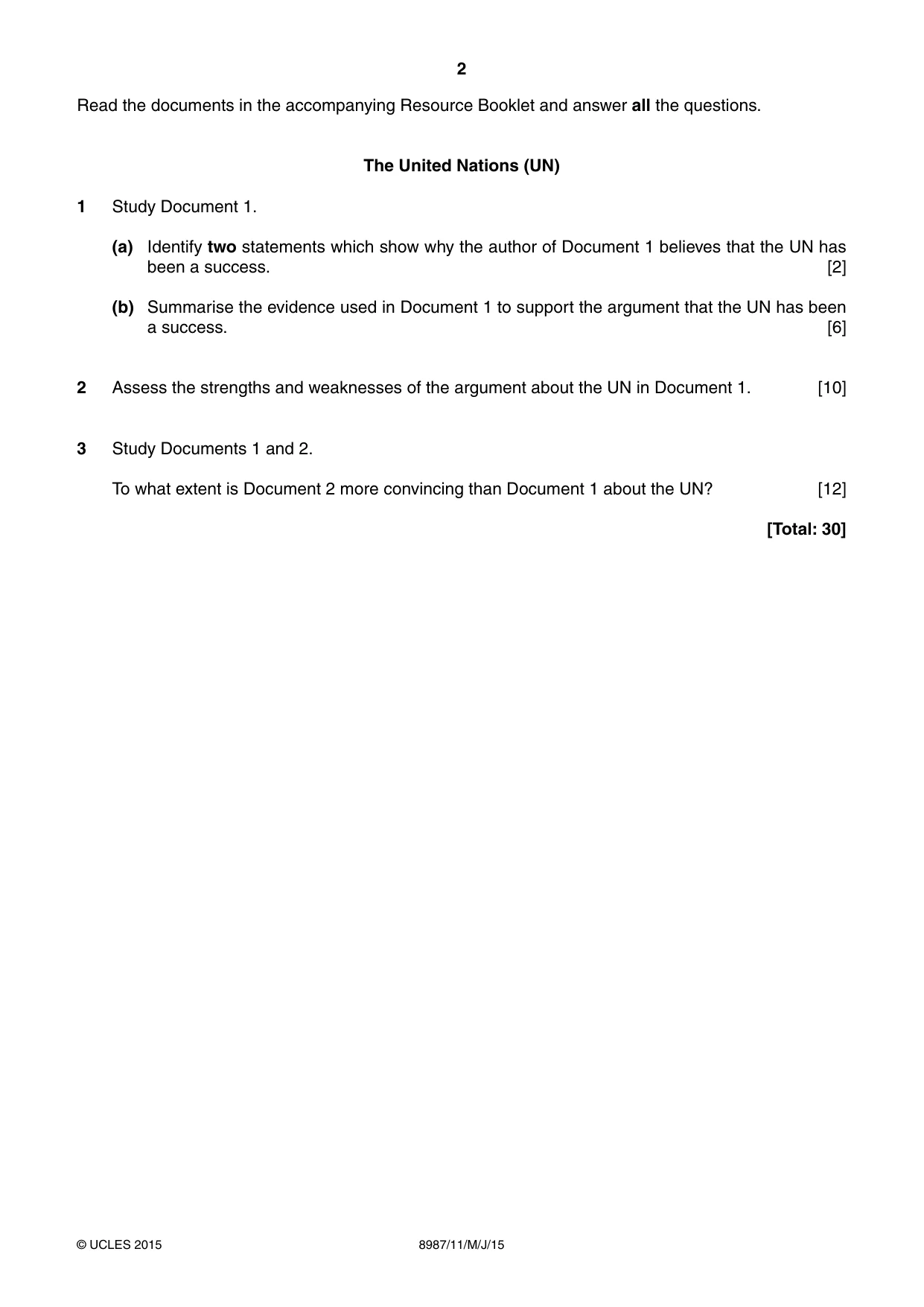
2 8987/11/M/J/15 © UCLES 2015 Read the documents in the accompanying Resource Booklet and answer all the questions. The United Nations (UN) 1 Study Document 1. (a) Identify two statements which show why the author of Document 1 believes that the UN has been a success. [2] (b) Summarise the evidence used in Document 1 to support the argument that the UN has been a success. [6] 2 Assess the strengths and weaknesses of the argument about the UN in Document 1. [10] 3 Study Documents 1 and 2. To what extent is Document 2 more convincing than Document 1 about the UN? [12] [Total: 30]
Question paper, page 3
3 8987/11/M/J/15 © UCLES 2015 BLANK PAGE
Question paper, page 4
4 8987/11/M/J/15 © UCLES 2015 BLANK PAGE Permission to reproduce items where third-party owned material protected by copyright is included has been sought and cleared where possible. Every reasonable effort has been made by the publisher (UCLES) to trace copyright holders, but if any items requiring clearance have unwittingly been included, the publisher will be pleased to make amends at the earliest possible opportunity. To avoid the issue of disclosure of answer-related information to candidates, all copyright acknowledgements are reproduced online in the Cambridge International Examinations Copyright Acknowledgements Booklet. This is produced for each series of examinations and is freely available to download at www.cie.org.uk after the live examination series. Cambridge International Examinations is part of the Cambridge Assessment Group. Cambridge Assessment is the brand name of University of Cambridge Local Examinations Syndicate (UCLES), which is itself a department of the University of Cambridge.
Mark scheme, page 1
® IGCSE is the registered trademark of Cambridge International Examinations. CAMBRIDGE INTERNATIONAL EXAMINATIONS Cambridge International Advanced Subsidiary Level MARK SCHEME for the May/June 2015 series 8987 GLOBAL PERSPECTIVES 8987/11 Paper 1 (Written Paper), maximum raw mark 30 This mark scheme is published as an aid to teachers and candidates, to indicate the requirements of the examination. It shows the basis on which Examiners were instructed to award marks. It does not indicate the details of the discussions that took place at an Examiners’ meeting before marking began, which would have considered the acceptability of alternative answers. Mark schemes should be read in conjunction with the question paper and the Principal Examiner Report for Teachers. Cambridge will not enter into discussions about these mark schemes. Cambridge is publishing the mark schemes for the May/June 2015 series for most Cambridge IGCSE®, Cambridge International A and AS Level components and some Cambridge O Level components.
Mark scheme, page 2
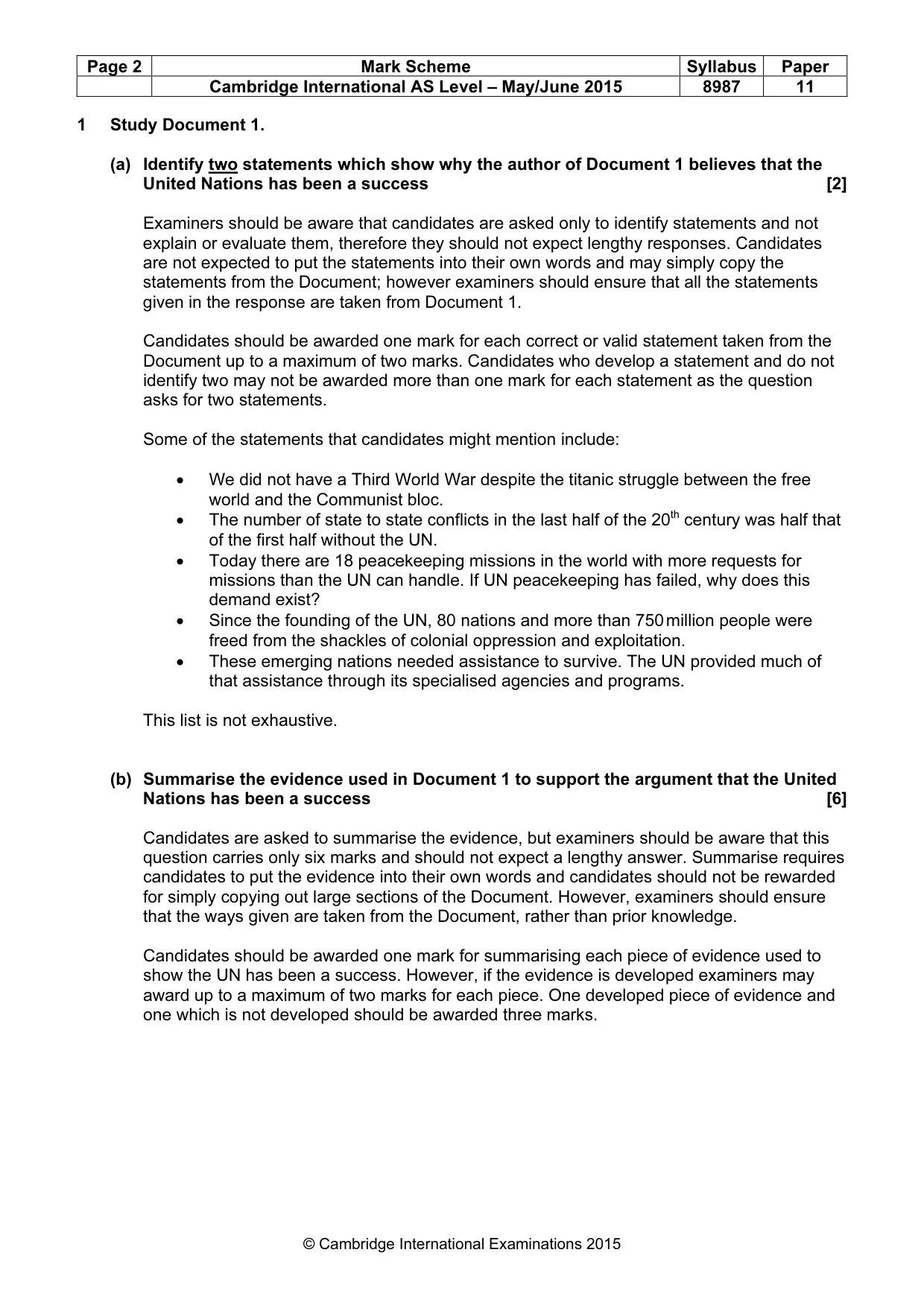
Page 2 Mark Scheme Syllabus Paper Cambridge International AS Level – May/June 2015 8987 11 © Cambridge International Examinations 2015 1 Study Document 1. (a) Identify two statements which show why the author of Document 1 believes that the United Nations has been a success [2] Examiners should be aware that candidates are asked only to identify statements and not explain or evaluate them, therefore they should not expect lengthy responses. Candidates are not expected to put the statements into their own words and may simply copy the statements from the Document; however examiners should ensure that all the statements given in the response are taken from Document 1. Candidates should be awarded one mark for each correct or valid statement taken from the Document up to a maximum of two marks. Candidates who develop a statement and do not identify two may not be awarded more than one mark for each statement as the question asks for two statements. Some of the statements that candidates might mention include: • We did not have a Third World War despite the titanic struggle between the free world and the Communist bloc. • The number of state to state conflicts in the last half of the 20th century was half that of the first half without the UN. • Today there are 18 peacekeeping missions in the world with more requests for missions than the UN can handle. If UN peacekeeping has failed, why does this demand exist? • Since the founding of the UN, 80 nations and more than 750 million people were freed from the shackles of colonial oppression and exploitation. • These emerging nations needed assistance to survive. The UN provided much of that assistance through its specialised agencies and programs. This list is not exhaustive. (b) Summarise the evidence used in Document 1 to support the argument that the United Nations has been a success [6] Candidates are asked to summarise the evidence, but examiners should be aware that this question carries only six marks and should not expect a lengthy answer. Summarise requires candidates to put the evidence into their own words and candidates should not be rewarded for simply copying out large sections of the Document. However, examiners should ensure that the ways given are taken from the Document, rather than prior knowledge. Candidates should be awarded one mark for summarising each piece of evidence used to show the UN has been a success. However, if the evidence is developed examiners may award up to a maximum of two marks for each piece. One developed piece of evidence and one which is not developed should be awarded three marks.
Mark scheme, page 3
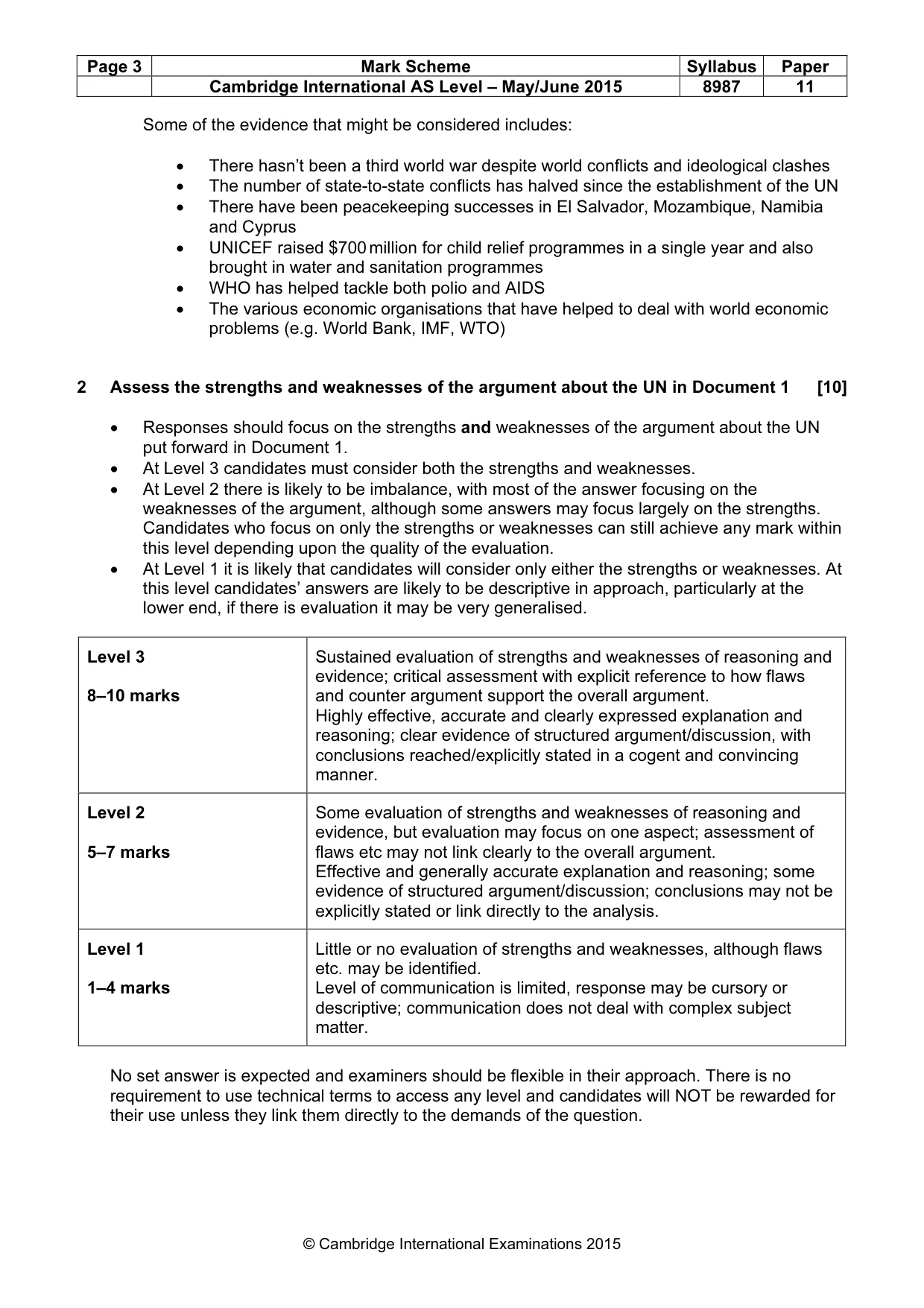
Page 3 Mark Scheme Syllabus Paper Cambridge International AS Level – May/June 2015 8987 11 © Cambridge International Examinations 2015 Some of the evidence that might be considered includes: • There hasn’t been a third world war despite world conflicts and ideological clashes • The number of state-to-state conflicts has halved since the establishment of the UN • There have been peacekeeping successes in El Salvador, Mozambique, Namibia and Cyprus • UNICEF raised $700 million for child relief programmes in a single year and also brought in water and sanitation programmes • WHO has helped tackle both polio and AIDS • The various economic organisations that have helped to deal with world economic problems (e.g. World Bank, IMF, WTO) 2 Assess the strengths and weaknesses of the argument about the UN in Document 1 [10] • Responses should focus on the strengths and weaknesses of the argument about the UN put forward in Document 1. • At Level 3 candidates must consider both the strengths and weaknesses. • At Level 2 there is likely to be imbalance, with most of the answer focusing on the weaknesses of the argument, although some answers may focus largely on the strengths. Candidates who focus on only the strengths or weaknesses can still achieve any mark within this level depending upon the quality of the evaluation. • At Level 1 it is likely that candidates will consider only either the strengths or weaknesses. At this level candidates’ answers are likely to be descriptive in approach, particularly at the lower end, if there is evaluation it may be very generalised. Level 3 8–10 marks Sustained evaluation of strengths and weaknesses of reasoning and evidence; critical assessment with explicit reference to how flaws and counter argument support the overall argument. Highly effective, accurate and clearly expressed explanation and reasoning; clear evidence of structured argument/discussion, with conclusions reached/explicitly stated in a cogent and convincing manner. Level 2 5–7 marks Some evaluation of strengths and weaknesses of reasoning and evidence, but evaluation may focus on one aspect; assessment of flaws etc may not link clearly to the overall argument. Effective and generally accurate explanation and reasoning; some evidence of structured argument/discussion; conclusions may not be explicitly stated or link directly to the analysis. Level 1 1–4 marks Little or no evaluation of strengths and weaknesses, although flaws etc. may be identified. Level of communication is limited, response may be cursory or descriptive; communication does not deal with complex subject matter. No set answer is expected and examiners should be flexible in their approach. There is no requirement to use technical terms to access any level and candidates will NOT be rewarded for their use unless they link them directly to the demands of the question.
Mark scheme, page 4
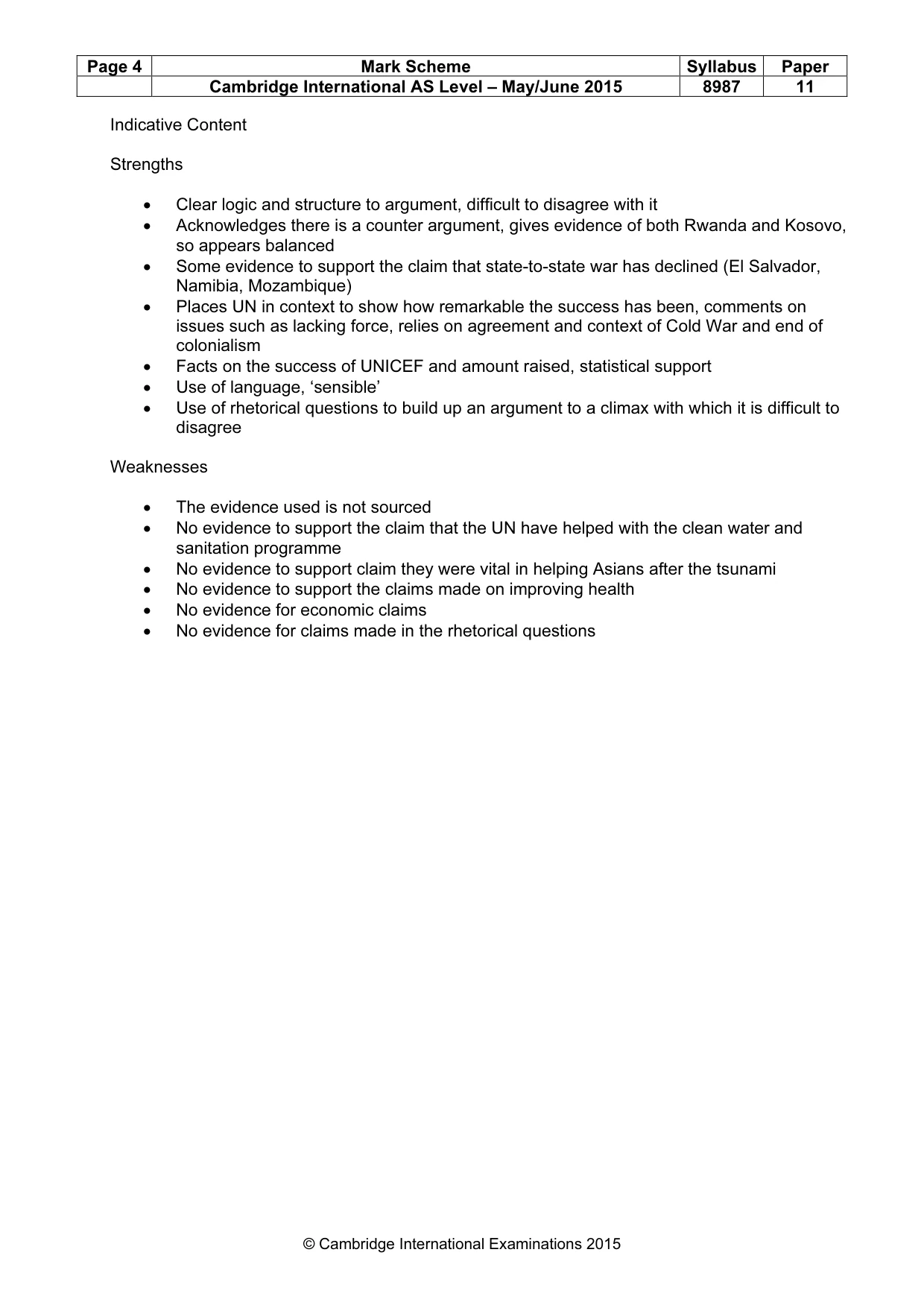
Page 4 Mark Scheme Syllabus Paper Cambridge International AS Level – May/June 2015 8987 11 © Cambridge International Examinations 2015 Indicative Content Strengths • Clear logic and structure to argument, difficult to disagree with it • Acknowledges there is a counter argument, gives evidence of both Rwanda and Kosovo, so appears balanced • Some evidence to support the claim that state-to-state war has declined (El Salvador, Namibia, Mozambique) • Places UN in context to show how remarkable the success has been, comments on issues such as lacking force, relies on agreement and context of Cold War and end of colonialism • Facts on the success of UNICEF and amount raised, statistical support • Use of language, ‘sensible’ • Use of rhetorical questions to build up an argument to a climax with which it is difficult to disagree Weaknesses • The evidence used is not sourced • No evidence to support the claim that the UN have helped with the clean water and sanitation programme • No evidence to support claim they were vital in helping Asians after the tsunami • No evidence to support the claims made on improving health • No evidence for economic claims • No evidence for claims made in the rhetorical questions
Mark scheme, page 5
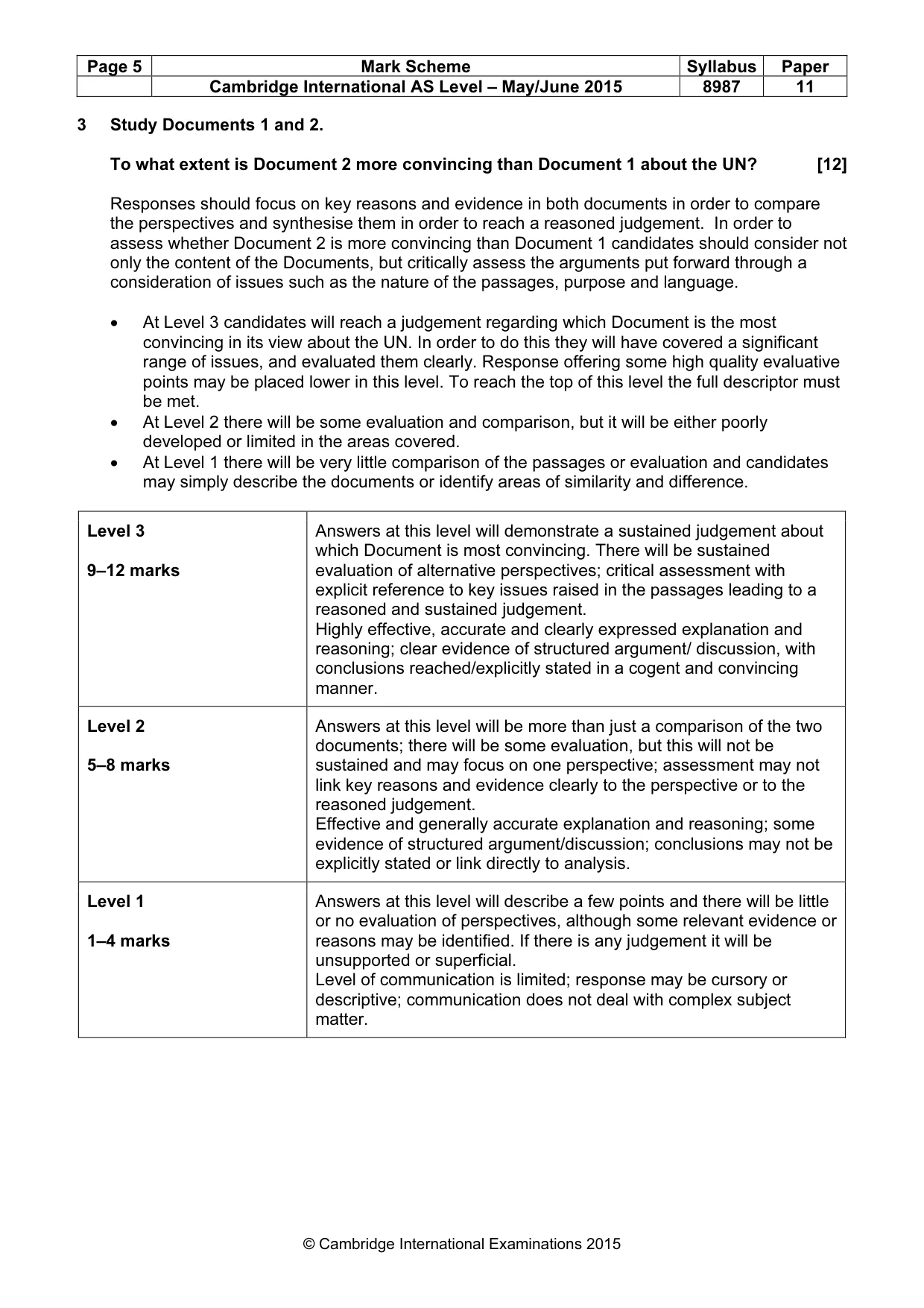
Page 5 Mark Scheme Syllabus Paper Cambridge International AS Level – May/June 2015 8987 11 © Cambridge International Examinations 2015 3 Study Documents 1 and 2. To what extent is Document 2 more convincing than Document 1 about the UN? [12] Responses should focus on key reasons and evidence in both documents in order to compare the perspectives and synthesise them in order to reach a reasoned judgement. In order to assess whether Document 2 is more convincing than Document 1 candidates should consider not only the content of the Documents, but critically assess the arguments put forward through a consideration of issues such as the nature of the passages, purpose and language. • At Level 3 candidates will reach a judgement regarding which Document is the most convincing in its view about the UN. In order to do this they will have covered a significant range of issues, and evaluated them clearly. Response offering some high quality evaluative points may be placed lower in this level. To reach the top of this level the full descriptor must be met. • At Level 2 there will be some evaluation and comparison, but it will be either poorly developed or limited in the areas covered. • At Level 1 there will be very little comparison of the passages or evaluation and candidates may simply describe the documents or identify areas of similarity and difference. Level 3 9–12 marks Answers at this level will demonstrate a sustained judgement about which Document is most convincing. There will be sustained evaluation of alternative perspectives; critical assessment with explicit reference to key issues raised in the passages leading to a reasoned and sustained judgement. Highly effective, accurate and clearly expressed explanation and reasoning; clear evidence of structured argument/ discussion, with conclusions reached/explicitly stated in a cogent and convincing manner. Level 2 5–8 marks Answers at this level will be more than just a comparison of the two documents; there will be some evaluation, but this will not be sustained and may focus on one perspective; assessment may not link key reasons and evidence clearly to the perspective or to the reasoned judgement. Effective and generally accurate explanation and reasoning; some evidence of structured argument/discussion; conclusions may not be explicitly stated or link directly to analysis. Level 1 1–4 marks Answers at this level will describe a few points and there will be little or no evaluation of perspectives, although some relevant evidence or reasons may be identified. If there is any judgement it will be unsupported or superficial. Level of communication is limited; response may be cursory or descriptive; communication does not deal with complex subject matter.
Mark scheme, page 6
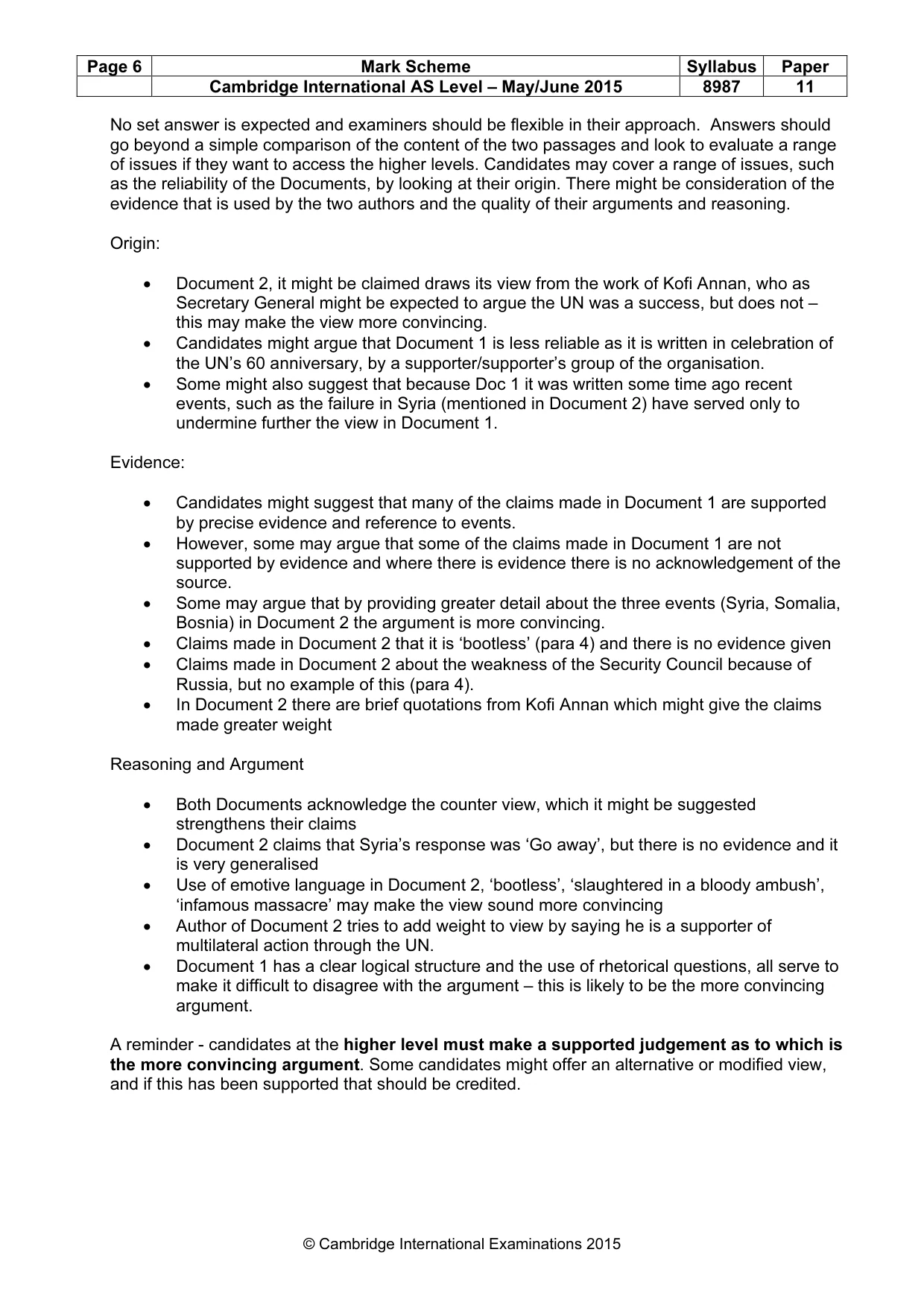
Page 6 Mark Scheme Syllabus Paper Cambridge International AS Level – May/June 2015 8987 11 © Cambridge International Examinations 2015 No set answer is expected and examiners should be flexible in their approach. Answers should go beyond a simple comparison of the content of the two passages and look to evaluate a range of issues if they want to access the higher levels. Candidates may cover a range of issues, such as the reliability of the Documents, by looking at their origin. There might be consideration of the evidence that is used by the two authors and the quality of their arguments and reasoning. Origin: • Document 2, it might be claimed draws its view from the work of Kofi Annan, who as Secretary General might be expected to argue the UN was a success, but does not – this may make the view more convincing. • Candidates might argue that Document 1 is less reliable as it is written in celebration of the UN’s 60 anniversary, by a supporter/supporter’s group of the organisation. • Some might also suggest that because Doc 1 it was written some time ago recent events, such as the failure in Syria (mentioned in Document 2) have served only to undermine further the view in Document 1. Evidence: • Candidates might suggest that many of the claims made in Document 1 are supported by precise evidence and reference to events. • However, some may argue that some of the claims made in Document 1 are not supported by evidence and where there is evidence there is no acknowledgement of the source. • Some may argue that by providing greater detail about the three events (Syria, Somalia, Bosnia) in Document 2 the argument is more convincing. • Claims made in Document 2 that it is ‘bootless’ (para 4) and there is no evidence given • Claims made in Document 2 about the weakness of the Security Council because of Russia, but no example of this (para 4). • In Document 2 there are brief quotations from Kofi Annan which might give the claims made greater weight Reasoning and Argument • Both Documents acknowledge the counter view, which it might be suggested strengthens their claims • Document 2 claims that Syria’s response was ‘Go away’, but there is no evidence and it is very generalised • Use of emotive language in Document 2, ‘bootless’, ‘slaughtered in a bloody ambush’, ‘infamous massacre’ may make the view sound more convincing • Author of Document 2 tries to add weight to view by saying he is a supporter of multilateral action through the UN. • Document 1 has a clear logical structure and the use of rhetorical questions, all serve to make it difficult to disagree with the argument – this is likely to be the more convincing argument. A reminder - candidates at the higher level must make a supported judgement as to which is the more convincing argument. Some candidates might offer an alternative or modified view, and if this has been supported that should be credited.