Cambridge A Level Global Perspectives (AS Level only, until Nov 2015) 8987 — 2014 Oct/Nov Paper 1 · Variant 1
8987/11/O/N/14
The question paper and its mark scheme, free to read here and free to download. This is Cambridge’s own paper, exactly as it was sat.
Question paper4 pages


Mark scheme6 pages
Answers below. Sit the paper first if you are practising.
Paper as text
Question paper, page 1
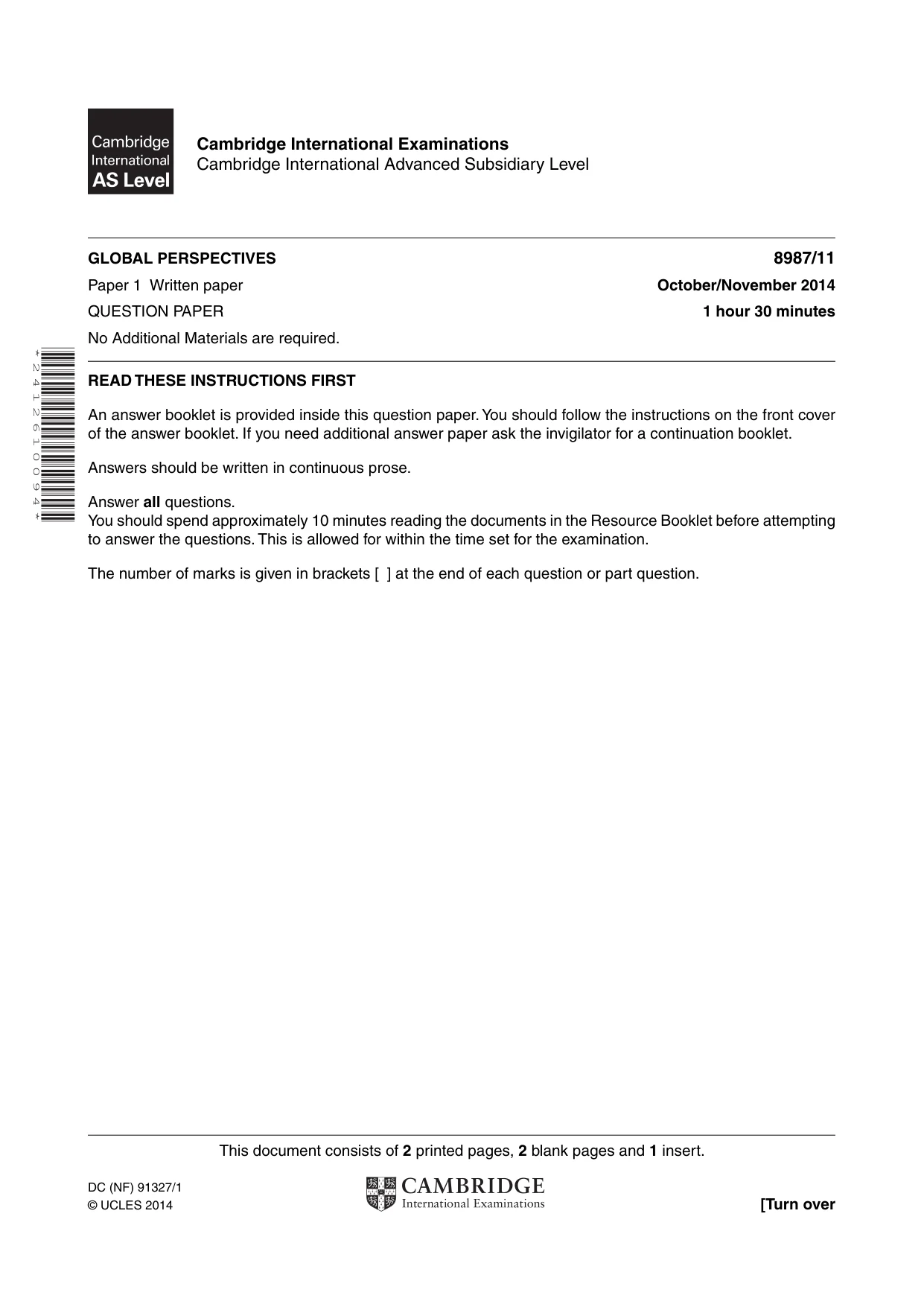
This document consists of 2 printed pages, 2 blank pages and 1 insert. DC (NF) 91327/1 © UCLES 2014 [Turn over Cambridge International Examinations Cambridge International Advanced Subsidiary Level * 2 4 1 2 6 1 0 0 9 4 * GLOBAL PERSPECTIVES 8987/11 Paper 1 Written paper October/November 2014 QUESTION PAPER 1 hour 30 minutes No Additional Materials are required. READ THESE INSTRUCTIONS FIRST An answer booklet is provided inside this question paper. You should follow the instructions on the front cover of the answer booklet. If you need additional answer paper ask the invigilator for a continuation booklet. Answers should be written in continuous prose. Answer all questions. You should spend approximately 10 minutes reading the documents in the Resource Booklet before attempting to answer the questions. This is allowed for within the time set for the examination. The number of marks is given in brackets [ ] at the end of each question or part question.
Question paper, page 2
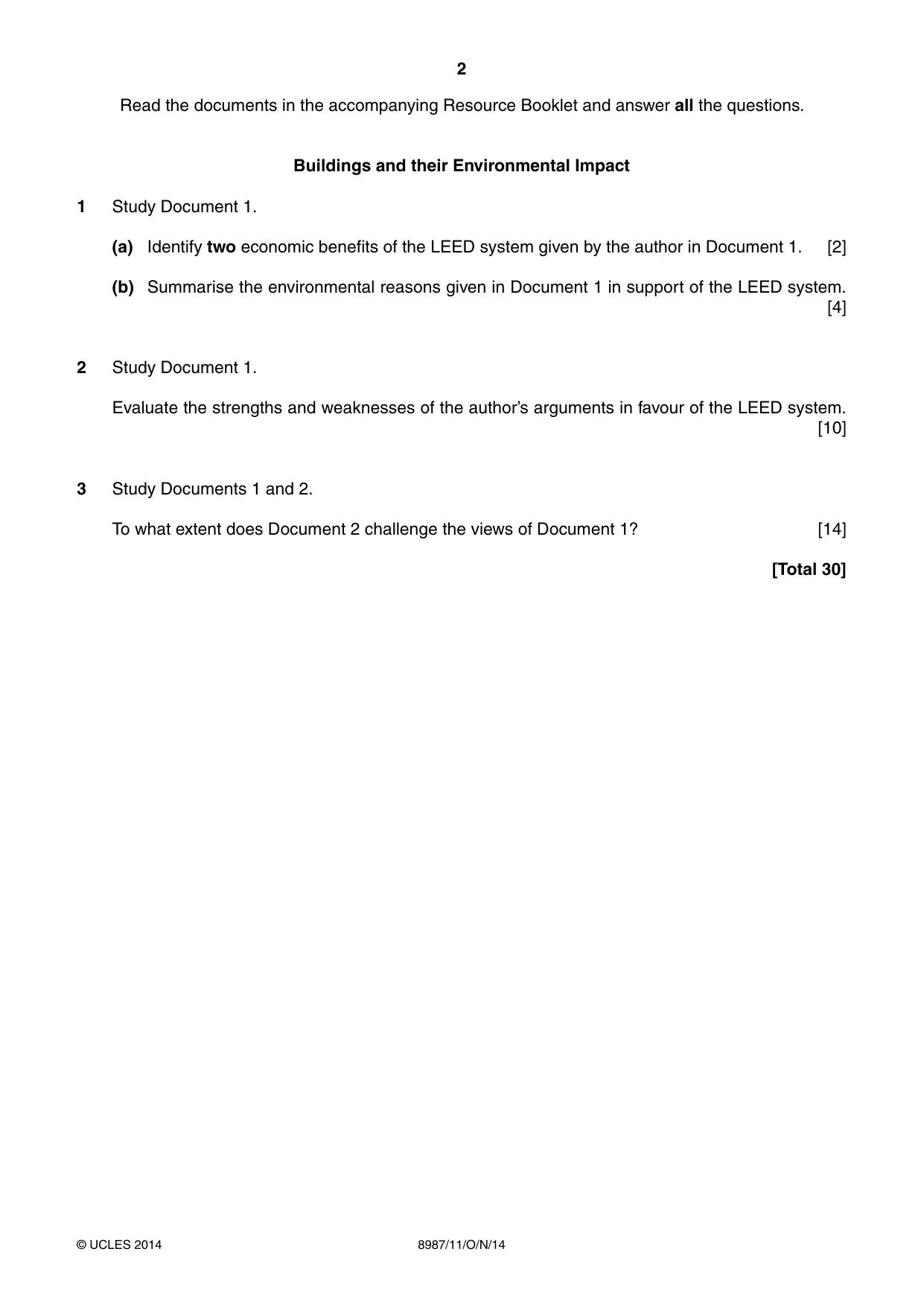
2 8987/11/O/N/14 © UCLES 2014 Read the documents in the accompanying Resource Booklet and answer all the questions. Buildings and their Environmental Impact 1 Study Document 1. (a) Identify two economic benefits of the LEED system given by the author in Document 1. [2] (b) Summarise the environmental reasons given in Document 1 in support of the LEED system. [4] 2 Study Document 1. Evaluate the strengths and weaknesses of the author’s arguments in favour of the LEED system. [10] 3 Study Documents 1 and 2. To what extent does Document 2 challenge the views of Document 1? [14] [Total 30]
Question paper, page 3
3 8987/11/O/N/14 © UCLES 2014 BLANK PAGE
Question paper, page 4
4 8987/11/O/N/14 © UCLES 2014 BLANK PAGE Copyright Acknowledgements: Document 1 © adapted: Jeff Schaefer; LEED – Impact on New Construction; http://ezinearticles.com/?LEED-Impact-on-New-Construction8id=1144826; April 2008. Document 2 © adapted: Auden Schendler; Top Green-building System is in desperate need of Repair; http://grist.org/article/leed/; 2005. Permission to reproduce items where third-party owned material protected by copyright is included has been sought and cleared where possible. Every reasonable effort has been made by the publisher (UCLES) to trace copyright holders, but if any items requiring clearance have unwittingly been included, the publisher will be pleased to make amends at the earliest possible opportunity. Cambridge International Examinations is part of the Cambridge Assessment Group. Cambridge Assessment is the brand name of University of Cambridge Local Examinations Syndicate (UCLES), which is itself a department of the University of Cambridge.
Mark scheme, page 1
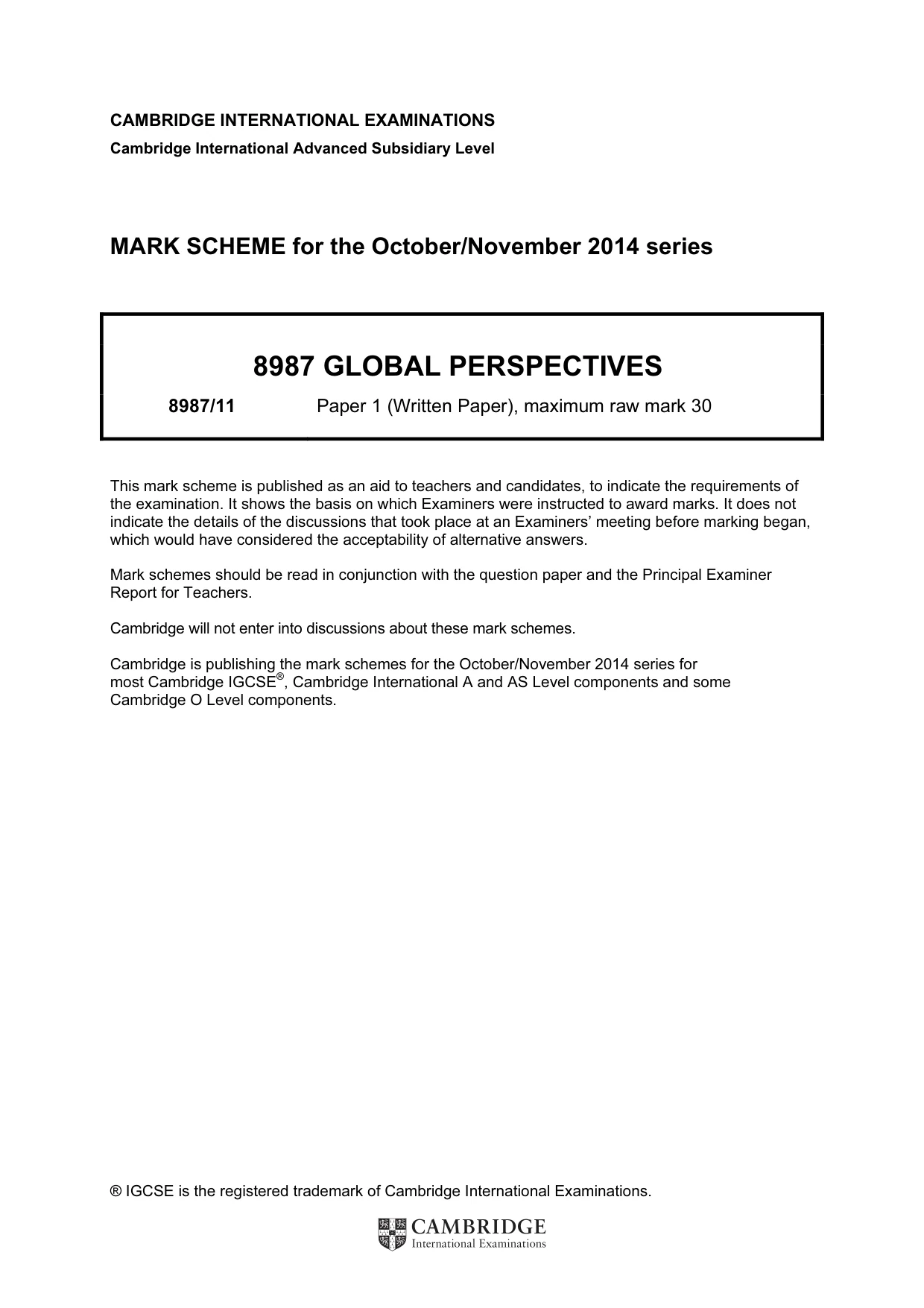
® IGCSE is the registered trademark of Cambridge International Examinations. CAMBRIDGE INTERNATIONAL EXAMINATIONS Cambridge International Advanced Subsidiary Level MARK SCHEME for the October/November 2014 series 8987 GLOBAL PERSPECTIVES 8987/11 Paper 1 (Written Paper), maximum raw mark 30 This mark scheme is published as an aid to teachers and candidates, to indicate the requirements of the examination. It shows the basis on which Examiners were instructed to award marks. It does not indicate the details of the discussions that took place at an Examiners’ meeting before marking began, which would have considered the acceptability of alternative answers. Mark schemes should be read in conjunction with the question paper and the Principal Examiner Report for Teachers. Cambridge will not enter into discussions about these mark schemes. Cambridge is publishing the mark schemes for the October/November 2014 series for most Cambridge IGCSE®, Cambridge International A and AS Level components and some Cambridge O Level components.
Mark scheme, page 2
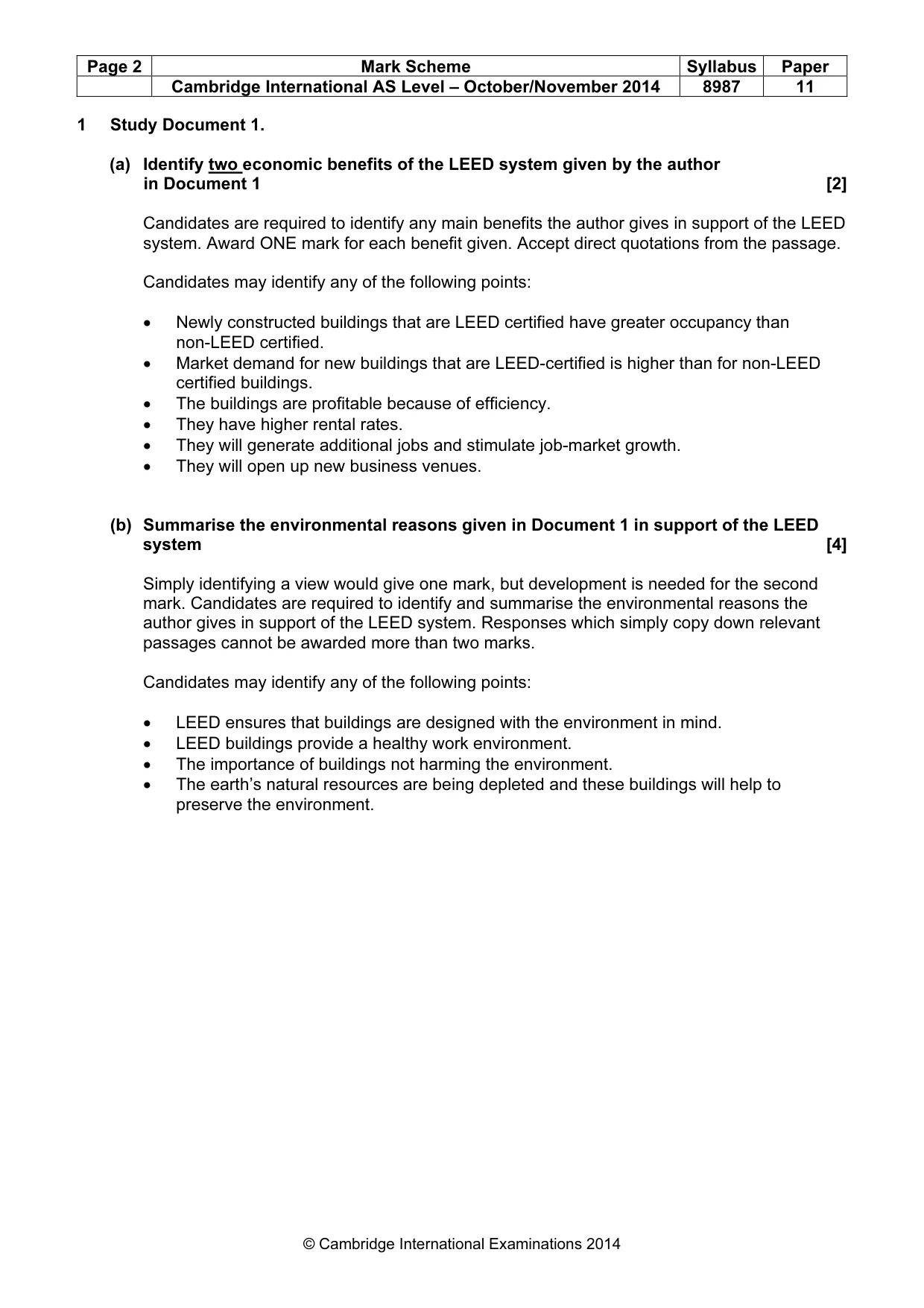
Page 2 Mark Scheme Syllabus Paper Cambridge International AS Level – October/November 2014 8987 11 © Cambridge International Examinations 2014 1 Study Document 1. (a) Identify two economic benefits of the LEED system given by the author in Document 1 [2] Candidates are required to identify any main benefits the author gives in support of the LEED system. Award ONE mark for each benefit given. Accept direct quotations from the passage. Candidates may identify any of the following points: • Newly constructed buildings that are LEED certified have greater occupancy than non-LEED certified. • Market demand for new buildings that are LEED-certified is higher than for non-LEED certified buildings. • The buildings are profitable because of efficiency. • They have higher rental rates. • They will generate additional jobs and stimulate job-market growth. • They will open up new business venues. (b) Summarise the environmental reasons given in Document 1 in support of the LEED system [4] Simply identifying a view would give one mark, but development is needed for the second mark. Candidates are required to identify and summarise the environmental reasons the author gives in support of the LEED system. Responses which simply copy down relevant passages cannot be awarded more than two marks. Candidates may identify any of the following points: • LEED ensures that buildings are designed with the environment in mind. • LEED buildings provide a healthy work environment. • The importance of buildings not harming the environment. • The earth’s natural resources are being depleted and these buildings will help to preserve the environment.
Mark scheme, page 3
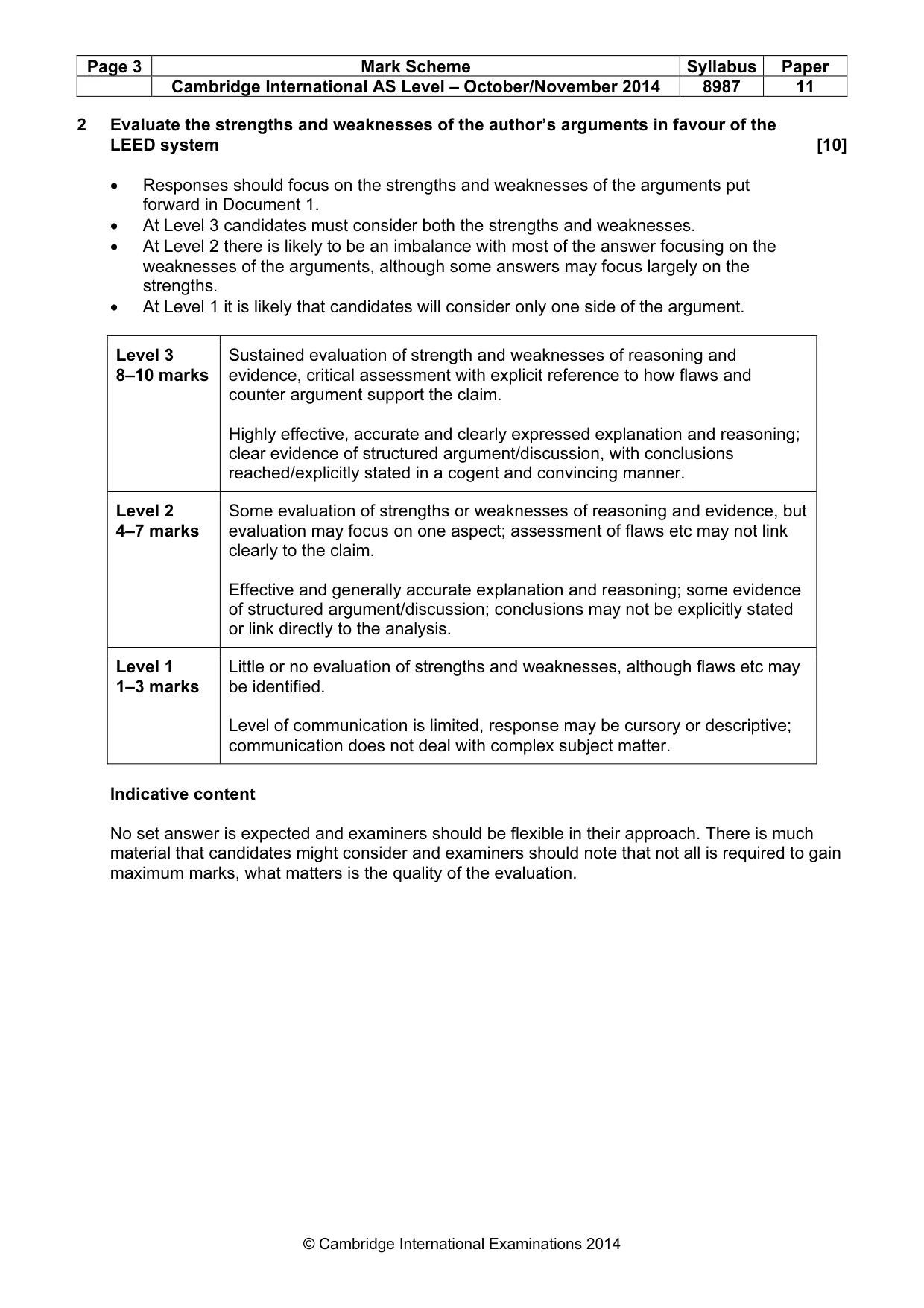
Page 3 Mark Scheme Syllabus Paper Cambridge International AS Level – October/November 2014 8987 11 © Cambridge International Examinations 2014 2 Evaluate the strengths and weaknesses of the author’s arguments in favour of the LEED system [10] • Responses should focus on the strengths and weaknesses of the arguments put forward in Document 1. • At Level 3 candidates must consider both the strengths and weaknesses. • At Level 2 there is likely to be an imbalance with most of the answer focusing on the weaknesses of the arguments, although some answers may focus largely on the strengths. • At Level 1 it is likely that candidates will consider only one side of the argument. Level 3 8–10 marks Sustained evaluation of strength and weaknesses of reasoning and evidence, critical assessment with explicit reference to how flaws and counter argument support the claim. Highly effective, accurate and clearly expressed explanation and reasoning; clear evidence of structured argument/discussion, with conclusions reached/explicitly stated in a cogent and convincing manner. Level 2 4–7 marks Some evaluation of strengths or weaknesses of reasoning and evidence, but evaluation may focus on one aspect; assessment of flaws etc may not link clearly to the claim. Effective and generally accurate explanation and reasoning; some evidence of structured argument/discussion; conclusions may not be explicitly stated or link directly to the analysis. Level 1 1–3 marks Little or no evaluation of strengths and weaknesses, although flaws etc may be identified. Level of communication is limited, response may be cursory or descriptive; communication does not deal with complex subject matter. Indicative content No set answer is expected and examiners should be flexible in their approach. There is much material that candidates might consider and examiners should note that not all is required to gain maximum marks, what matters is the quality of the evaluation.
Mark scheme, page 4
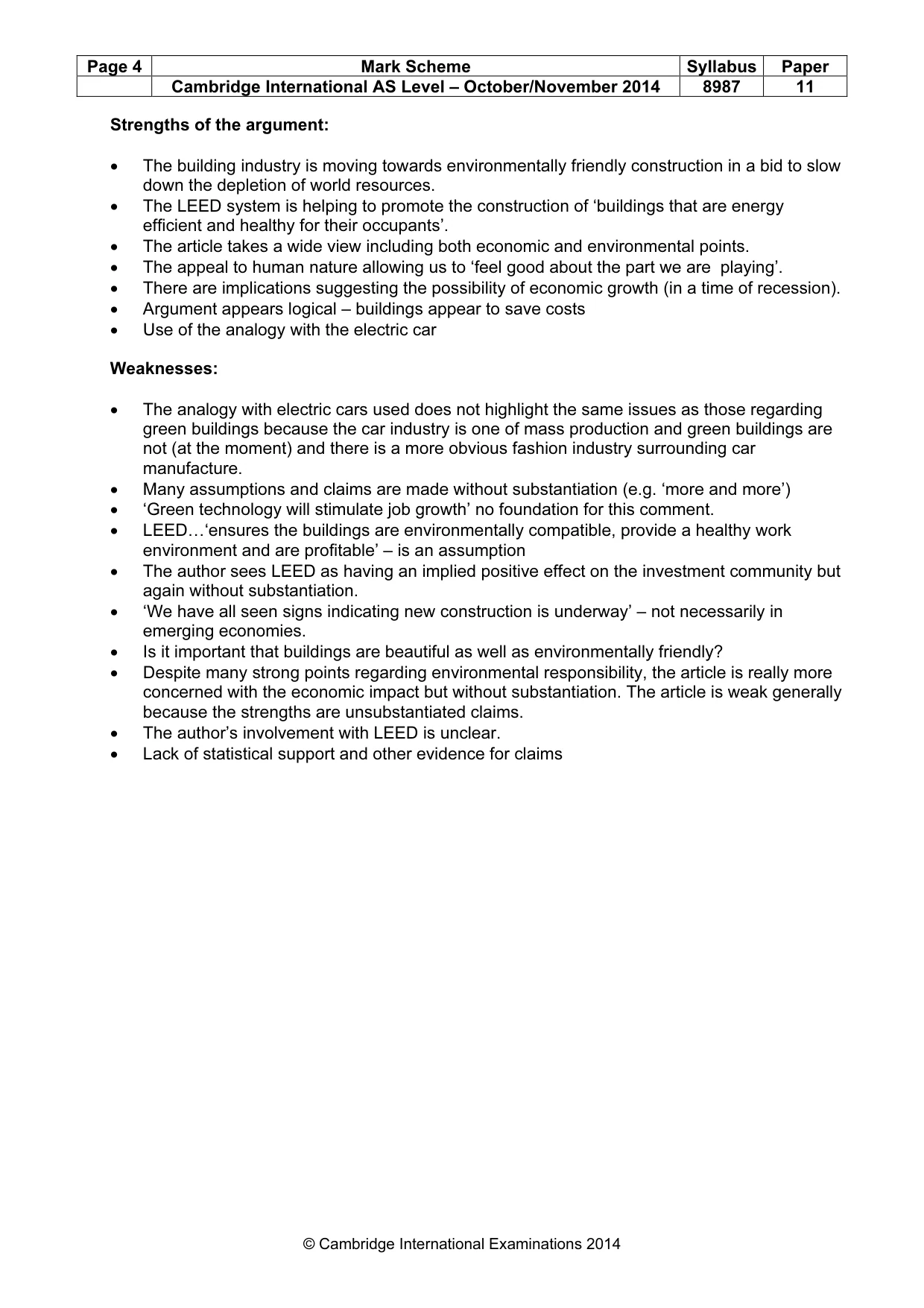
Page 4 Mark Scheme Syllabus Paper Cambridge International AS Level – October/November 2014 8987 11 © Cambridge International Examinations 2014 Strengths of the argument: • The building industry is moving towards environmentally friendly construction in a bid to slow down the depletion of world resources. • The LEED system is helping to promote the construction of ‘buildings that are energy efficient and healthy for their occupants’. • The article takes a wide view including both economic and environmental points. • The appeal to human nature allowing us to ‘feel good about the part we are playing’. • There are implications suggesting the possibility of economic growth (in a time of recession). • Argument appears logical – buildings appear to save costs • Use of the analogy with the electric car Weaknesses: • The analogy with electric cars used does not highlight the same issues as those regarding green buildings because the car industry is one of mass production and green buildings are not (at the moment) and there is a more obvious fashion industry surrounding car manufacture. • Many assumptions and claims are made without substantiation (e.g. ‘more and more’) • ‘Green technology will stimulate job growth’ no foundation for this comment. • LEED…‘ensures the buildings are environmentally compatible, provide a healthy work environment and are profitable’ – is an assumption • The author sees LEED as having an implied positive effect on the investment community but again without substantiation. • ‘We have all seen signs indicating new construction is underway’ – not necessarily in emerging economies. • Is it important that buildings are beautiful as well as environmentally friendly? • Despite many strong points regarding environmental responsibility, the article is really more concerned with the economic impact but without substantiation. The article is weak generally because the strengths are unsubstantiated claims. • The author’s involvement with LEED is unclear. • Lack of statistical support and other evidence for claims
Mark scheme, page 5
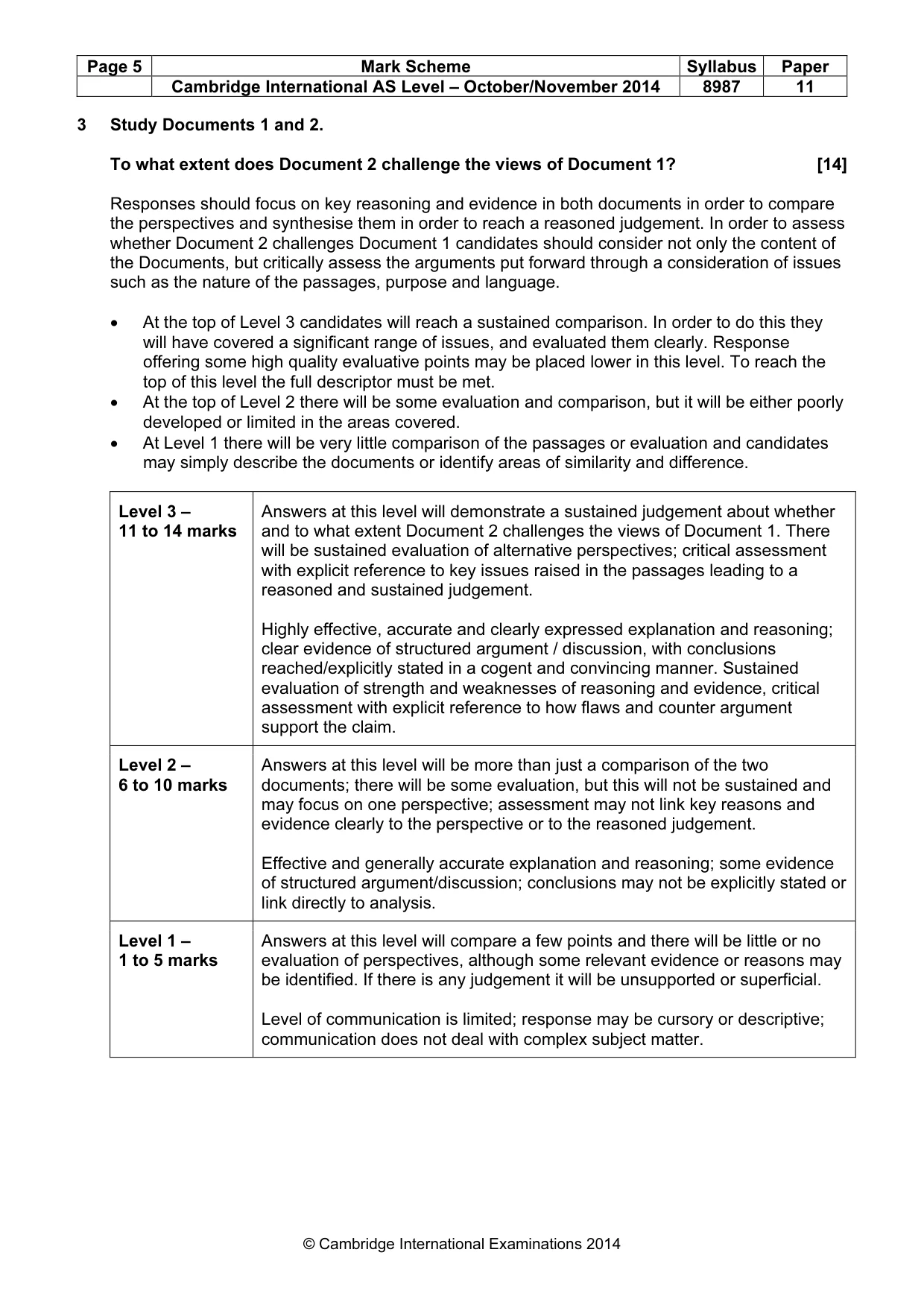
Page 5 Mark Scheme Syllabus Paper Cambridge International AS Level – October/November 2014 8987 11 © Cambridge International Examinations 2014 3 Study Documents 1 and 2. To what extent does Document 2 challenge the views of Document 1? [14] Responses should focus on key reasoning and evidence in both documents in order to compare the perspectives and synthesise them in order to reach a reasoned judgement. In order to assess whether Document 2 challenges Document 1 candidates should consider not only the content of the Documents, but critically assess the arguments put forward through a consideration of issues such as the nature of the passages, purpose and language. • At the top of Level 3 candidates will reach a sustained comparison. In order to do this they will have covered a significant range of issues, and evaluated them clearly. Response offering some high quality evaluative points may be placed lower in this level. To reach the top of this level the full descriptor must be met. • At the top of Level 2 there will be some evaluation and comparison, but it will be either poorly developed or limited in the areas covered. • At Level 1 there will be very little comparison of the passages or evaluation and candidates may simply describe the documents or identify areas of similarity and difference. Level 3 – 11 to 14 marks Answers at this level will demonstrate a sustained judgement about whether and to what extent Document 2 challenges the views of Document 1. There will be sustained evaluation of alternative perspectives; critical assessment with explicit reference to key issues raised in the passages leading to a reasoned and sustained judgement. Highly effective, accurate and clearly expressed explanation and reasoning; clear evidence of structured argument / discussion, with conclusions reached/explicitly stated in a cogent and convincing manner. Sustained evaluation of strength and weaknesses of reasoning and evidence, critical assessment with explicit reference to how flaws and counter argument support the claim. Level 2 – 6 to 10 marks Answers at this level will be more than just a comparison of the two documents; there will be some evaluation, but this will not be sustained and may focus on one perspective; assessment may not link key reasons and evidence clearly to the perspective or to the reasoned judgement. Effective and generally accurate explanation and reasoning; some evidence of structured argument/discussion; conclusions may not be explicitly stated or link directly to analysis. Level 1 – 1 to 5 marks Answers at this level will compare a few points and there will be little or no evaluation of perspectives, although some relevant evidence or reasons may be identified. If there is any judgement it will be unsupported or superficial. Level of communication is limited; response may be cursory or descriptive; communication does not deal with complex subject matter.
Mark scheme, page 6
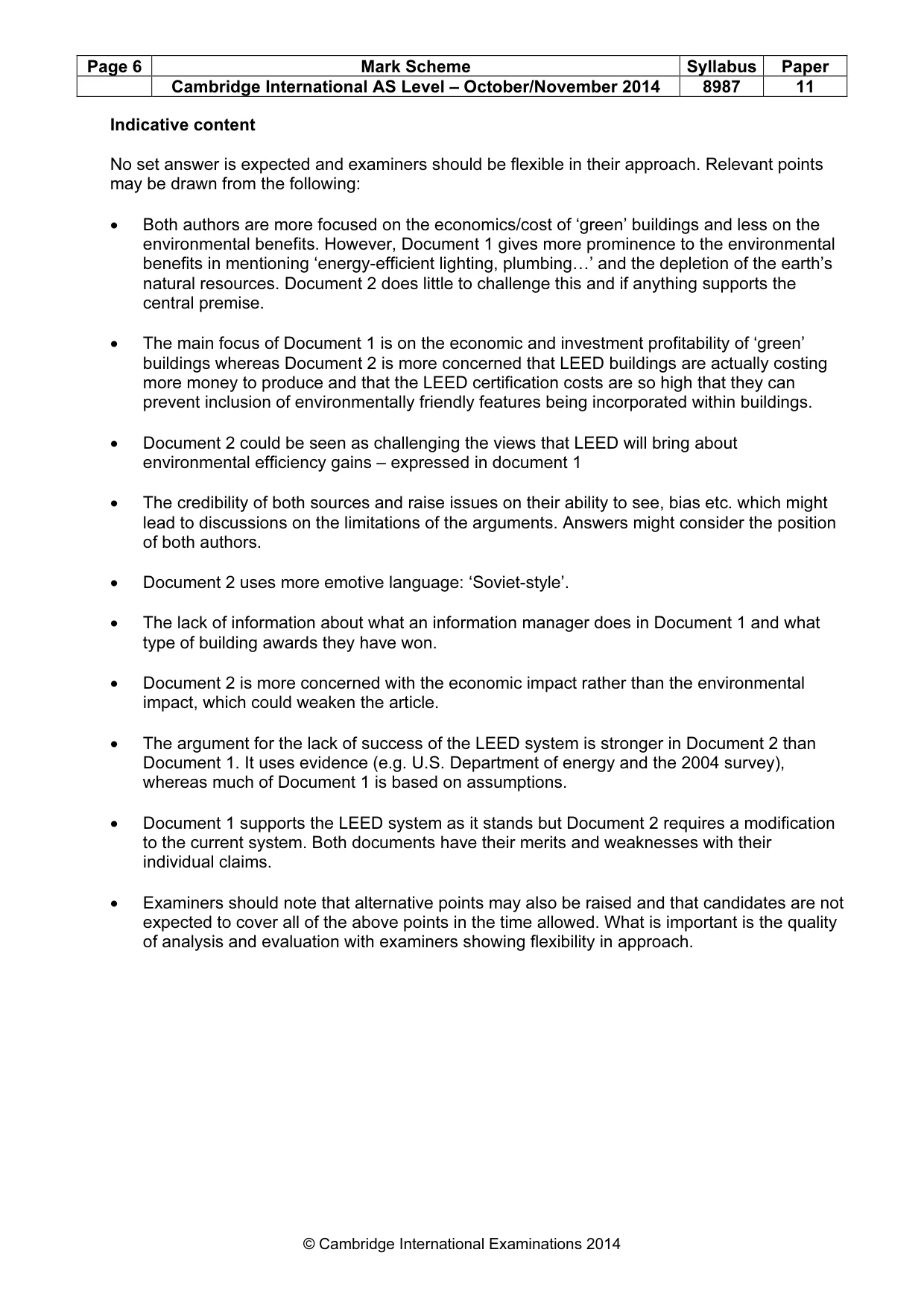
Page 6 Mark Scheme Syllabus Paper Cambridge International AS Level – October/November 2014 8987 11 © Cambridge International Examinations 2014 Indicative content No set answer is expected and examiners should be flexible in their approach. Relevant points may be drawn from the following: • Both authors are more focused on the economics/cost of ‘green’ buildings and less on the environmental benefits. However, Document 1 gives more prominence to the environmental benefits in mentioning ‘energy-efficient lighting, plumbing…’ and the depletion of the earth’s natural resources. Document 2 does little to challenge this and if anything supports the central premise. • The main focus of Document 1 is on the economic and investment profitability of ‘green’ buildings whereas Document 2 is more concerned that LEED buildings are actually costing more money to produce and that the LEED certification costs are so high that they can prevent inclusion of environmentally friendly features being incorporated within buildings. • Document 2 could be seen as challenging the views that LEED will bring about environmental efficiency gains – expressed in document 1 • The credibility of both sources and raise issues on their ability to see, bias etc. which might lead to discussions on the limitations of the arguments. Answers might consider the position of both authors. • Document 2 uses more emotive language: ‘Soviet-style’. • The lack of information about what an information manager does in Document 1 and what type of building awards they have won. • Document 2 is more concerned with the economic impact rather than the environmental impact, which could weaken the article. • The argument for the lack of success of the LEED system is stronger in Document 2 than Document 1. It uses evidence (e.g. U.S. Department of energy and the 2004 survey), whereas much of Document 1 is based on assumptions. • Document 1 supports the LEED system as it stands but Document 2 requires a modification to the current system. Both documents have their merits and weaknesses with their individual claims. • Examiners should note that alternative points may also be raised and that candidates are not expected to cover all of the above points in the time allowed. What is important is the quality of analysis and evaluation with examiners showing flexibility in approach.