Cambridge A Level Global Perspectives (AS Level only, until Nov 2015) 8987 — 2015 May/June Paper 1 · Variant 3
8987/13/M/J/15
The question paper and its mark scheme, free to read here and free to download. This is Cambridge’s own paper, exactly as it was sat.
Question paper4 pages

Mark scheme7 pages
Answers below. Sit the paper first if you are practising.
Paper as text
Question paper, page 1
This document consists of 3 printed pages and 1 blank page. DC (ST) 107841 © UCLES 2015 [Turn over Cambridge International Examinations Cambridge International Advanced Subsidiary Level * 5 8 1 1 0 3 9 8 9 4 * GLOBAL PERSPECTIVES 8987/13 Paper 1 Written paper May/June 2015 1 hour 30 minutes RESOURCE BOOKLET READ THESE INSTRUCTIONS FIRST This Resource Booklet contains Documents 1 and 2 which you should use to answer the questions. You should spend approximately 10 minutes reading the documents before attempting to answer the questions. This is allowed for within the time set for the examination.
Question paper, page 2
2 8987/13/RB/M/J/15 © UCLES 2015 The documents below consider the issue of Artificial Intelligence. Read them both in order to answer all the questions on the question paper. Document 1: adapted from Artificial Intelligence (AI) Means More Than Just Neat Gadgets – It Will Mean a Greener Future for Everyone by Dr. Alex Rogers. The author is a lecturer in a UK university. This article was published online in 2013. Despite a number of early disappointments, Artificial Intelligence (AI) is finally beginning to deliver on some of its early promise. In the 1950s, predictions of thinking machines with human level intelligence within the next twenty years were common. Unfortunately, it’s taken a lot longer than that, and such human level intelligence is still some way off. However, the growth of computer power over the same period has meant that the devices and services that we use every day are now routinely tackling many of the early challenges of AI. Our cameras and smart phones locate faces in images and focus accordingly. Social networking websites recognize our friends in these same images and automatically tag them. Our cars can already park themselves and automatically brake when they recognize pedestrians stepping into the road, and self-driving cars are clocking up miles on real roads. Meanwhile, closer to that original vision of human level intelligence, last year ‘Watson’, a supercomputer built by IBM, famously beat human players on the quiz show ‘Jeopardy!’, and is now being re-tasked to train medical doctors. Despite this progress, one area where there has been very little deployment of AI technologies is in our homes. Like AI itself, the vision of a smart home, full of devices that learn what we want and automatically take care of household chores still seems to many like science fiction. However, new concerns about ever rising energy costs, and the impact of carbon emissions from domestic energy use on climate change, are beginning to change this. Last year, a Learning Thermostat was introduced, with smart technology that learns the householders’ preferences, and automatically recognizes when the home is unoccupied, and adjusts the heating or cooling system appropriately. The Electronics and Computer Science department where I work, one of the world’s largest and most successful electronics and computer science departments, can tackle Artificial Intelligence challenges. Our system, named MyJoulo, aims to reduce your heating bill by providing personalised advice on your home’s energy consumption. It uses a small, simple to use, Joulo logger which measures the temperature at the thermostat every two minutes for a week. When this data is uploaded to the MyJoulo website, smart AI programs are used to build a mathematical model of how the home responds to heat and how the home’s occupants are using the heating system. Using temperature data from the internet, we can then calculate the energy savings that will be achieved by turning down the thermostat or changing timer settings, and can spot homes which leak heat most rapidly. By creating a representative map of building stock, the MyJoulo project will ultimately be able to identify particularly leaky homes, and prioritise interventions such as the installation of better insulation. Such smart technologies applied within the home are likely to be essential in reducing carbon emissions by 80% by 2050. MyJoulo represents a first step along this path, potentially reducing the millions of Kilowatt hours of energy wasted per year, and saving households money at the same time. Such smart technologies applied within the home are likely to be an essential step in creating a greener future.
Question paper, page 3
3 8987/13/RB/M/J/15 © UCLES 2015 Document 2: adapted from Why Can’t My Computer Understand Me? by Gary Marcus. The author is a Professor of Psychology and a specialist in child linguistics. This article was written for the New Yorker Magazine in 2013. The voice searches of search engines like Siri and Google may be able to understand sentences like “What movies are showing near me at seven o’clock?”; but what about questions – “Can an alligator run the hundred-metre hurdles?” – that nobody has heard before? Any ordinary adult can figure that one out. (No. Alligators can’t hurdle.) But if you type the question into Google, you get information about Florida Gators athletics team. ‘Watson’, the computer system that won ‘Jeopardy!’ likely wouldn’t do much better. Hector Levesque of the University of Toronto argues that too much research has forgotten about the “intelligence” part of Artificial Intelligence (AI). Levesque and his colleagues have developed a set of problems, designed to be easy for an intelligent person but hard for a machine merely running Google searches. For example: ‘Joan made sure that she thanked Susan for all the help she had given.’ Question: Who had given the help? a) Joan or b) Susan The computer can’t work out who the ‘she’ refers to. It can simply count the number of Web pages in which people named Joan or Susan gave other people help. Answering this question demands a fairly deep understanding of the subtleties of human language, sentence construction and the nature of social interaction, which the computer doesn’t have the intelligence to work out. This type of example, which hinges on the linguistic phenomenon known as anaphora*, is hard both because it requires common sense – which machines still don’t have – and because it gets at things people don’t bother to mention on Web pages. Most AI programs are in trouble if what they’re looking for is not spelled out explicitly on a Web page. The same problem comes up in image search. Take the phrase “right-handed man”. The Web is filled with pictures of right-handed men engaged in unmistakably right-handed actions (like throwing a baseball), which any human working in a photo archive could rapidly sort out. But very few of those pictures are labelled as such. A search for “right-handed-man” instead returns a mixture of sports stars, guitars, golf clubs, key chains, and coffee mugs. Some are relevant, but most are not. It’s not just that contemporary AI hasn’t solved these kinds of problems yet; it’s that contemporary AI has not understood them, and therefore its application and development will be limited. It has never closely analysed all of the subtle and deep knowledge and language that ordinary human beings have and use. Trying to rival human intelligence by programming computers will never work because computers cannot cope with the complexities of the human mind. *Anaphora, in this sense, means ‘referring back’, and making reference to a word used earlier to avoid repetition.
Question paper, page 4
4 8987/13/RB/M/J/15 © UCLES 2015 BLANK PAGE Permission to reproduce items where third-party owned material protected by copyright is included has been sought and cleared where possible. Every reasonable effort has been made by the publisher (UCLES) to trace copyright holders, but if any items requiring clearance have unwittingly been included, the publisher will be pleased to make amends at the earliest possible opportunity. To avoid the issue of disclosure of answer-related information to candidates, all copyright acknowledgements are reproduced online in the Cambridge International Examinations Copyright Acknowledgements Booklet. This is produced for each series of examinations and is freely available to download at www.cie.org.uk after the live examination series. Cambridge International Examinations is part of the Cambridge Assessment Group. Cambridge Assessment is the brand name of University of Cambridge Local Examinations Syndicate (UCLES), which is itself a department of the University of Cambridge.
Mark scheme, page 1
® IGCSE is the registered trademark of Cambridge International Examinations. CAMBRIDGE INTERNATIONAL EXAMINATIONS Cambridge International Advanced Subsidiary Level MARK SCHEME for the May/June 2015 series 8987 GLOBAL PERSPECTIVES 8987/13 Paper 1 (Written Paper), maximum raw mark 30 This mark scheme is published as an aid to teachers and candidates, to indicate the requirements of the examination. It shows the basis on which Examiners were instructed to award marks. It does not indicate the details of the discussions that took place at an Examiners’ meeting before marking began, which would have considered the acceptability of alternative answers. Mark schemes should be read in conjunction with the question paper and the Principal Examiner Report for Teachers. Cambridge will not enter into discussions about these mark schemes. Cambridge is publishing the mark schemes for the May/June 2015 series for most Cambridge IGCSE®, Cambridge International A and AS Level components and some Cambridge O Level components.
Mark scheme, page 2
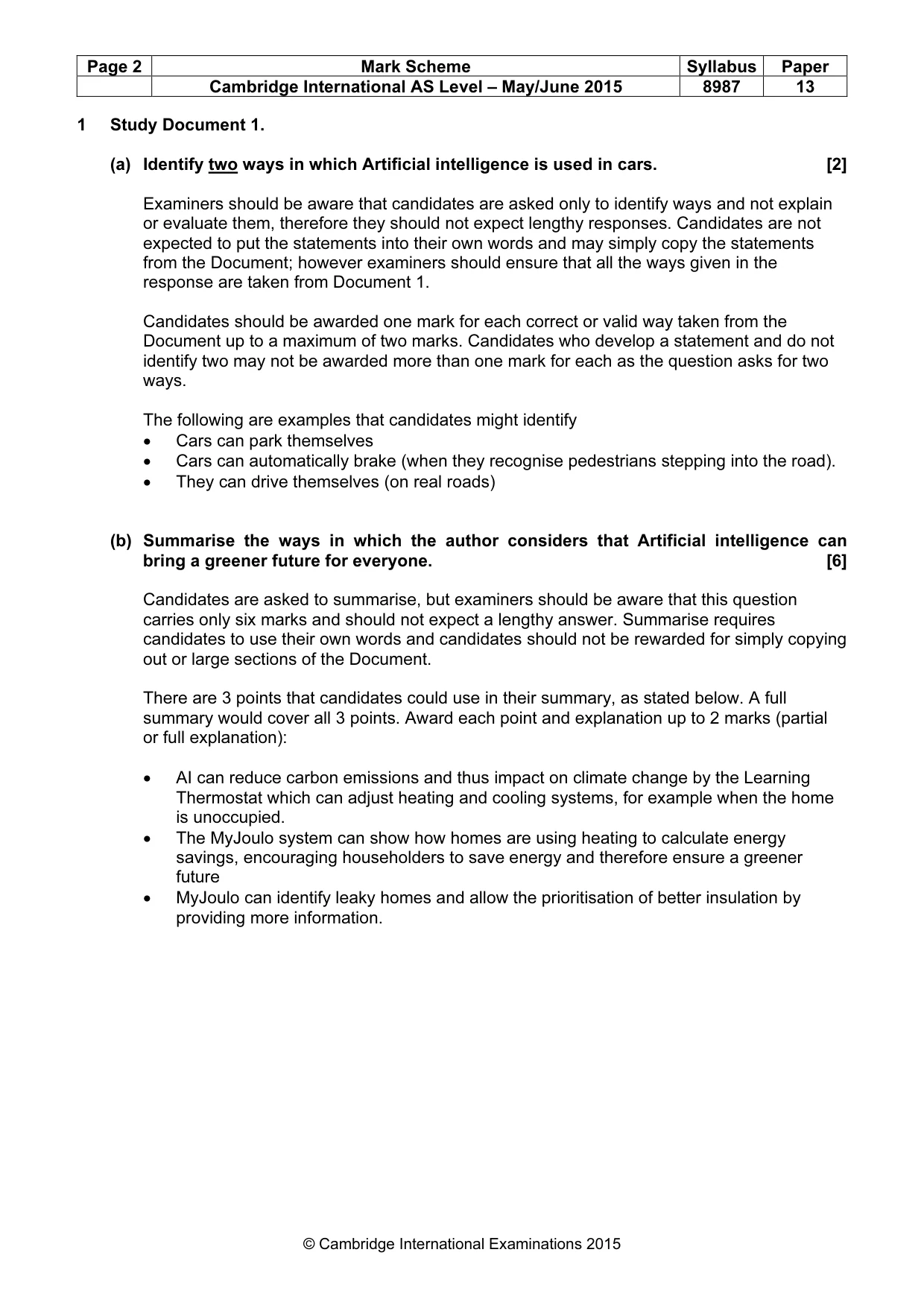
Page 2 Mark Scheme Syllabus Paper Cambridge International AS Level – May/June 2015 8987 13 © Cambridge International Examinations 2015 1 Study Document 1. (a) Identify two ways in which Artificial intelligence is used in cars. [2] Examiners should be aware that candidates are asked only to identify ways and not explain or evaluate them, therefore they should not expect lengthy responses. Candidates are not expected to put the statements into their own words and may simply copy the statements from the Document; however examiners should ensure that all the ways given in the response are taken from Document 1. Candidates should be awarded one mark for each correct or valid way taken from the Document up to a maximum of two marks. Candidates who develop a statement and do not identify two may not be awarded more than one mark for each as the question asks for two ways. The following are examples that candidates might identify • Cars can park themselves • Cars can automatically brake (when they recognise pedestrians stepping into the road). • They can drive themselves (on real roads) (b) Summarise the ways in which the author considers that Artificial intelligence can bring a greener future for everyone. [6] Candidates are asked to summarise, but examiners should be aware that this question carries only six marks and should not expect a lengthy answer. Summarise requires candidates to use their own words and candidates should not be rewarded for simply copying out or large sections of the Document. There are 3 points that candidates could use in their summary, as stated below. A full summary would cover all 3 points. Award each point and explanation up to 2 marks (partial or full explanation): • AI can reduce carbon emissions and thus impact on climate change by the Learning Thermostat which can adjust heating and cooling systems, for example when the home is unoccupied. • The MyJoulo system can show how homes are using heating to calculate energy savings, encouraging householders to save energy and therefore ensure a greener future • MyJoulo can identify leaky homes and allow the prioritisation of better insulation by providing more information.
Mark scheme, page 3
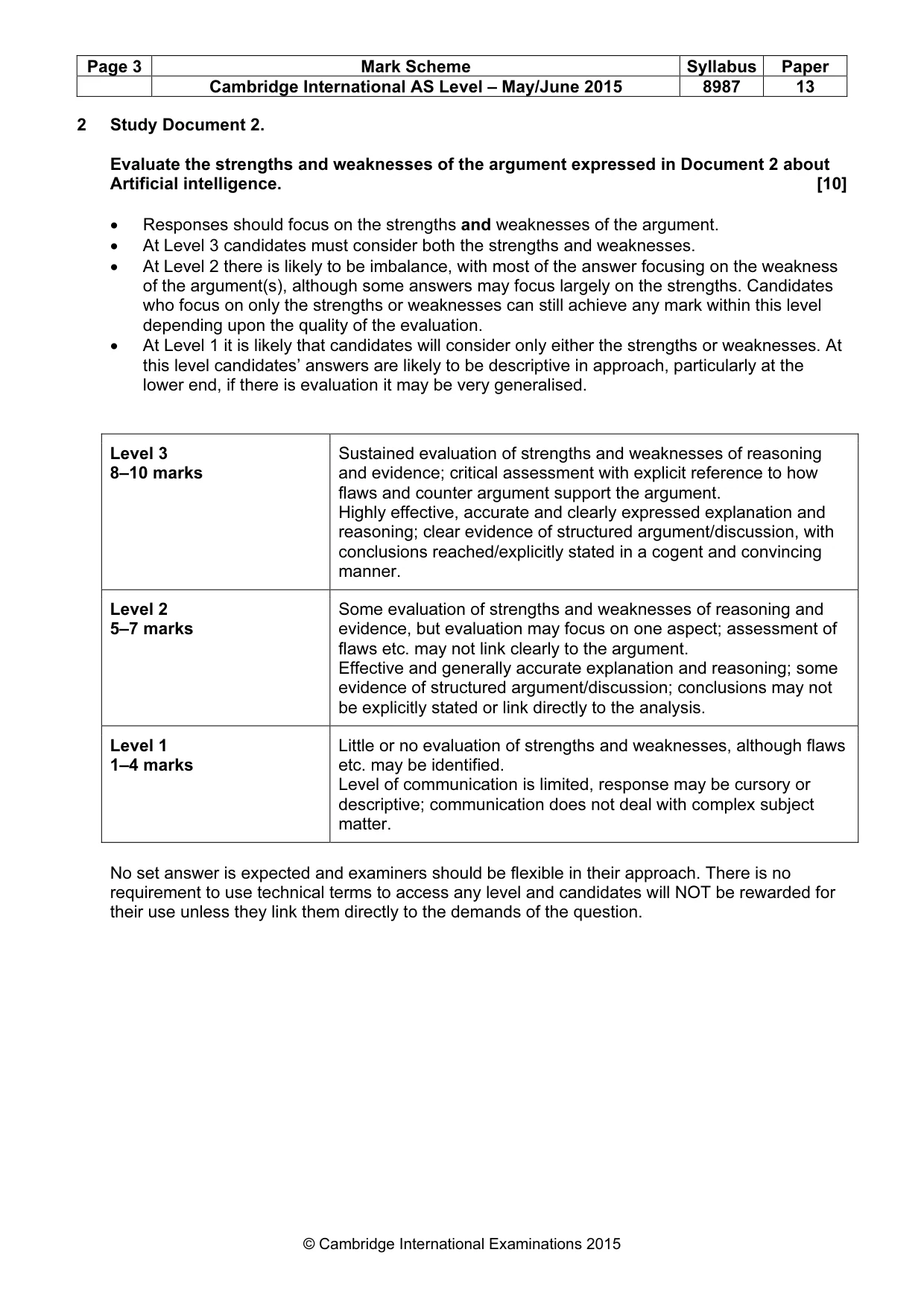
Page 3 Mark Scheme Syllabus Paper Cambridge International AS Level – May/June 2015 8987 13 © Cambridge International Examinations 2015 2 Study Document 2. Evaluate the strengths and weaknesses of the argument expressed in Document 2 about Artificial intelligence. [10] • Responses should focus on the strengths and weaknesses of the argument. • At Level 3 candidates must consider both the strengths and weaknesses. • At Level 2 there is likely to be imbalance, with most of the answer focusing on the weakness of the argument(s), although some answers may focus largely on the strengths. Candidates who focus on only the strengths or weaknesses can still achieve any mark within this level depending upon the quality of the evaluation. • At Level 1 it is likely that candidates will consider only either the strengths or weaknesses. At this level candidates’ answers are likely to be descriptive in approach, particularly at the lower end, if there is evaluation it may be very generalised. Level 3 8–10 marks Sustained evaluation of strengths and weaknesses of reasoning and evidence; critical assessment with explicit reference to how flaws and counter argument support the argument. Highly effective, accurate and clearly expressed explanation and reasoning; clear evidence of structured argument/discussion, with conclusions reached/explicitly stated in a cogent and convincing manner. Level 2 5–7 marks Some evaluation of strengths and weaknesses of reasoning and evidence, but evaluation may focus on one aspect; assessment of flaws etc. may not link clearly to the argument. Effective and generally accurate explanation and reasoning; some evidence of structured argument/discussion; conclusions may not be explicitly stated or link directly to the analysis. Level 1 1–4 marks Little or no evaluation of strengths and weaknesses, although flaws etc. may be identified. Level of communication is limited, response may be cursory or descriptive; communication does not deal with complex subject matter. No set answer is expected and examiners should be flexible in their approach. There is no requirement to use technical terms to access any level and candidates will NOT be rewarded for their use unless they link them directly to the demands of the question.
Mark scheme, page 4
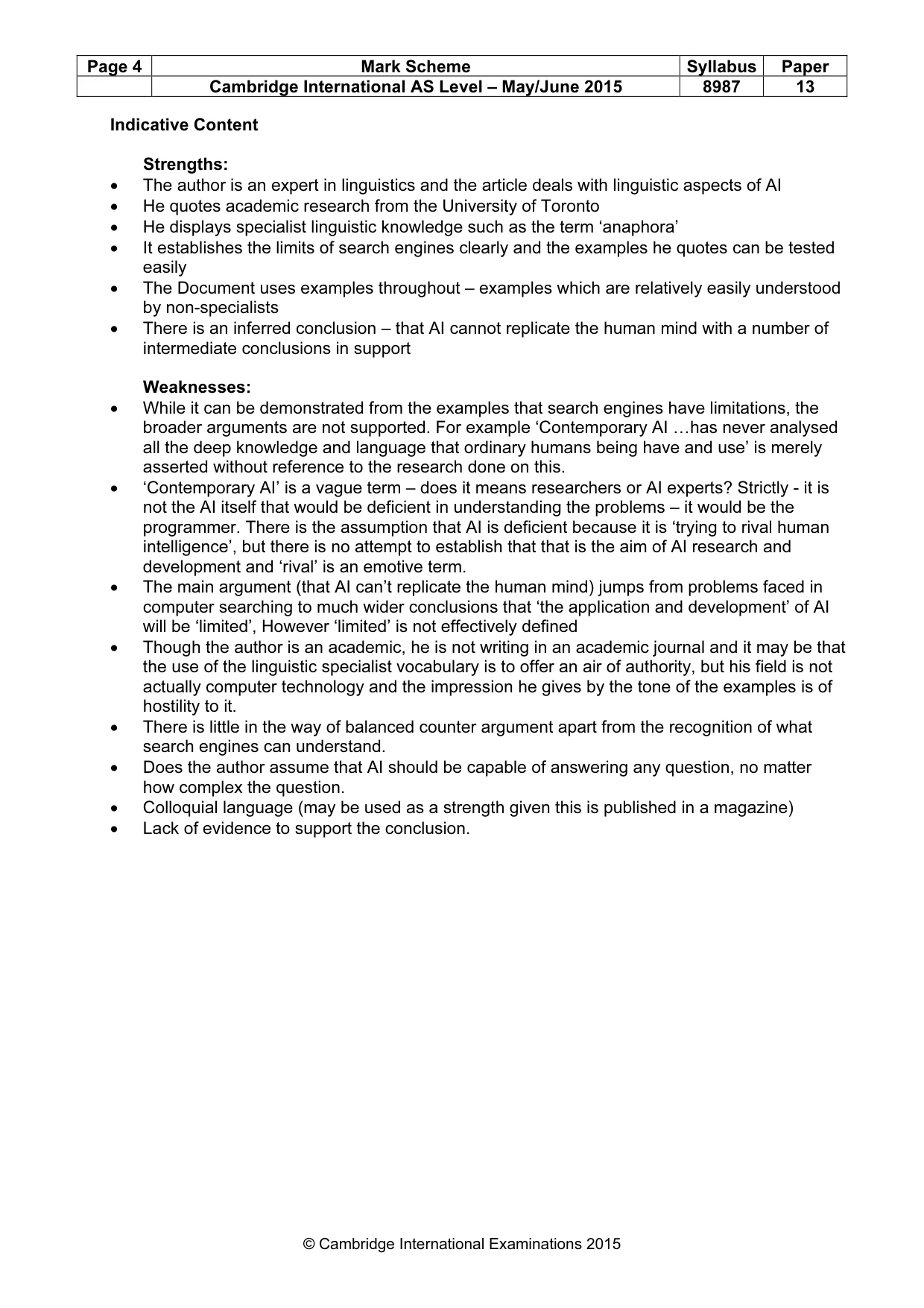
Page 4 Mark Scheme Syllabus Paper Cambridge International AS Level – May/June 2015 8987 13 © Cambridge International Examinations 2015 Indicative Content Strengths: • The author is an expert in linguistics and the article deals with linguistic aspects of AI • He quotes academic research from the University of Toronto • He displays specialist linguistic knowledge such as the term ‘anaphora’ • It establishes the limits of search engines clearly and the examples he quotes can be tested easily • The Document uses examples throughout – examples which are relatively easily understood by non-specialists • There is an inferred conclusion – that AI cannot replicate the human mind with a number of intermediate conclusions in support Weaknesses: • While it can be demonstrated from the examples that search engines have limitations, the broader arguments are not supported. For example ‘Contemporary AI …has never analysed all the deep knowledge and language that ordinary humans being have and use’ is merely asserted without reference to the research done on this. • ‘Contemporary AI’ is a vague term – does it means researchers or AI experts? Strictly - it is not the AI itself that would be deficient in understanding the problems – it would be the programmer. There is the assumption that AI is deficient because it is ‘trying to rival human intelligence’, but there is no attempt to establish that that is the aim of AI research and development and ‘rival’ is an emotive term. • The main argument (that AI can’t replicate the human mind) jumps from problems faced in computer searching to much wider conclusions that ‘the application and development’ of AI will be ‘limited’, However ‘limited’ is not effectively defined • Though the author is an academic, he is not writing in an academic journal and it may be that the use of the linguistic specialist vocabulary is to offer an air of authority, but his field is not actually computer technology and the impression he gives by the tone of the examples is of hostility to it. • There is little in the way of balanced counter argument apart from the recognition of what search engines can understand. • Does the author assume that AI should be capable of answering any question, no matter how complex the question. • Colloquial language (may be used as a strength given this is published in a magazine) • Lack of evidence to support the conclusion.
Mark scheme, page 5
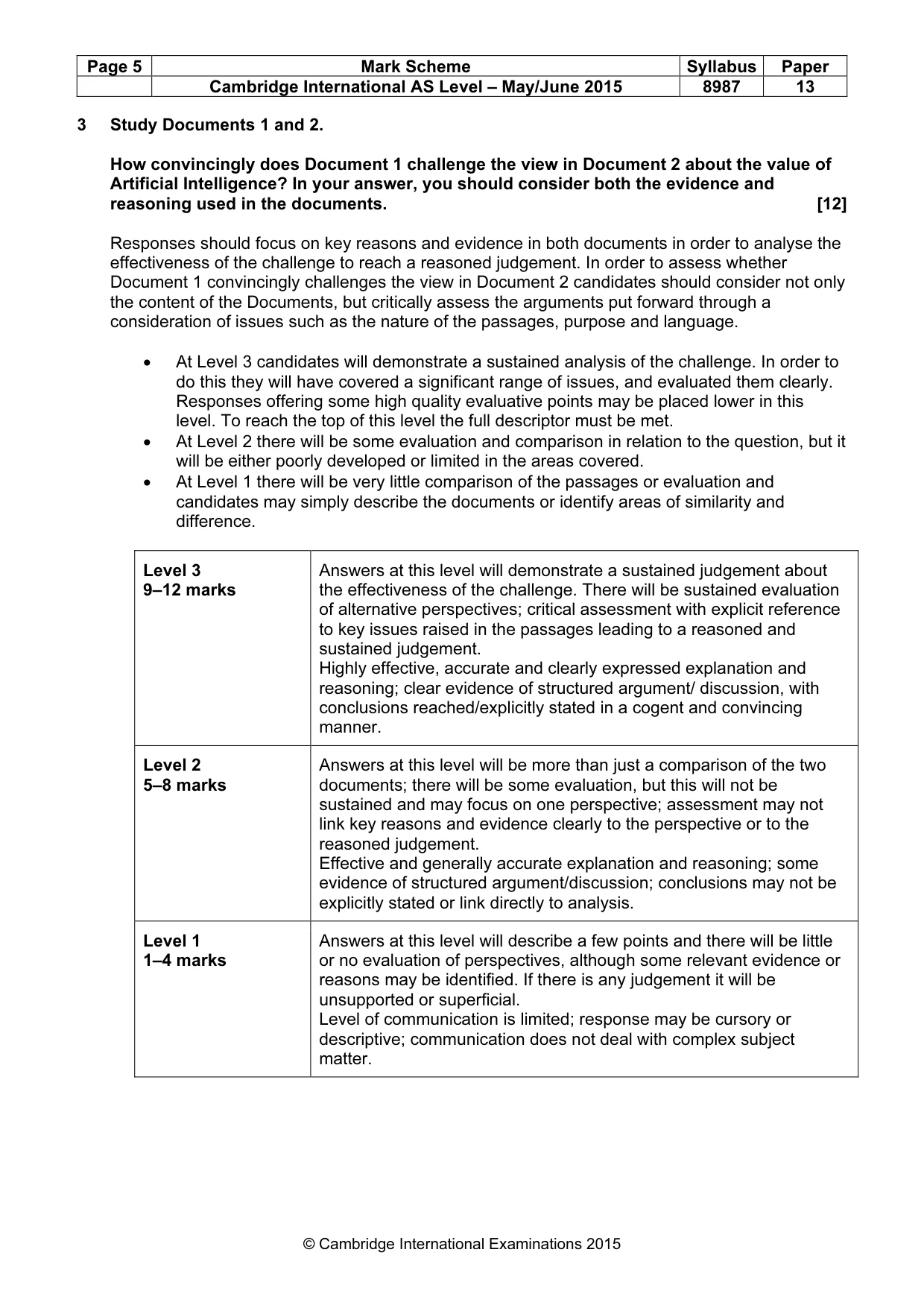
Page 5 Mark Scheme Syllabus Paper Cambridge International AS Level – May/June 2015 8987 13 © Cambridge International Examinations 2015 3 Study Documents 1 and 2. How convincingly does Document 1 challenge the view in Document 2 about the value of Artificial Intelligence? In your answer, you should consider both the evidence and reasoning used in the documents. [12] Responses should focus on key reasons and evidence in both documents in order to analyse the effectiveness of the challenge to reach a reasoned judgement. In order to assess whether Document 1 convincingly challenges the view in Document 2 candidates should consider not only the content of the Documents, but critically assess the arguments put forward through a consideration of issues such as the nature of the passages, purpose and language. • At Level 3 candidates will demonstrate a sustained analysis of the challenge. In order to do this they will have covered a significant range of issues, and evaluated them clearly. Responses offering some high quality evaluative points may be placed lower in this level. To reach the top of this level the full descriptor must be met. • At Level 2 there will be some evaluation and comparison in relation to the question, but it will be either poorly developed or limited in the areas covered. • At Level 1 there will be very little comparison of the passages or evaluation and candidates may simply describe the documents or identify areas of similarity and difference. Level 3 9–12 marks Answers at this level will demonstrate a sustained judgement about the effectiveness of the challenge. There will be sustained evaluation of alternative perspectives; critical assessment with explicit reference to key issues raised in the passages leading to a reasoned and sustained judgement. Highly effective, accurate and clearly expressed explanation and reasoning; clear evidence of structured argument/ discussion, with conclusions reached/explicitly stated in a cogent and convincing manner. Level 2 5–8 marks Answers at this level will be more than just a comparison of the two documents; there will be some evaluation, but this will not be sustained and may focus on one perspective; assessment may not link key reasons and evidence clearly to the perspective or to the reasoned judgement. Effective and generally accurate explanation and reasoning; some evidence of structured argument/discussion; conclusions may not be explicitly stated or link directly to analysis. Level 1 1–4 marks Answers at this level will describe a few points and there will be little or no evaluation of perspectives, although some relevant evidence or reasons may be identified. If there is any judgement it will be unsupported or superficial. Level of communication is limited; response may be cursory or descriptive; communication does not deal with complex subject matter.
Mark scheme, page 6
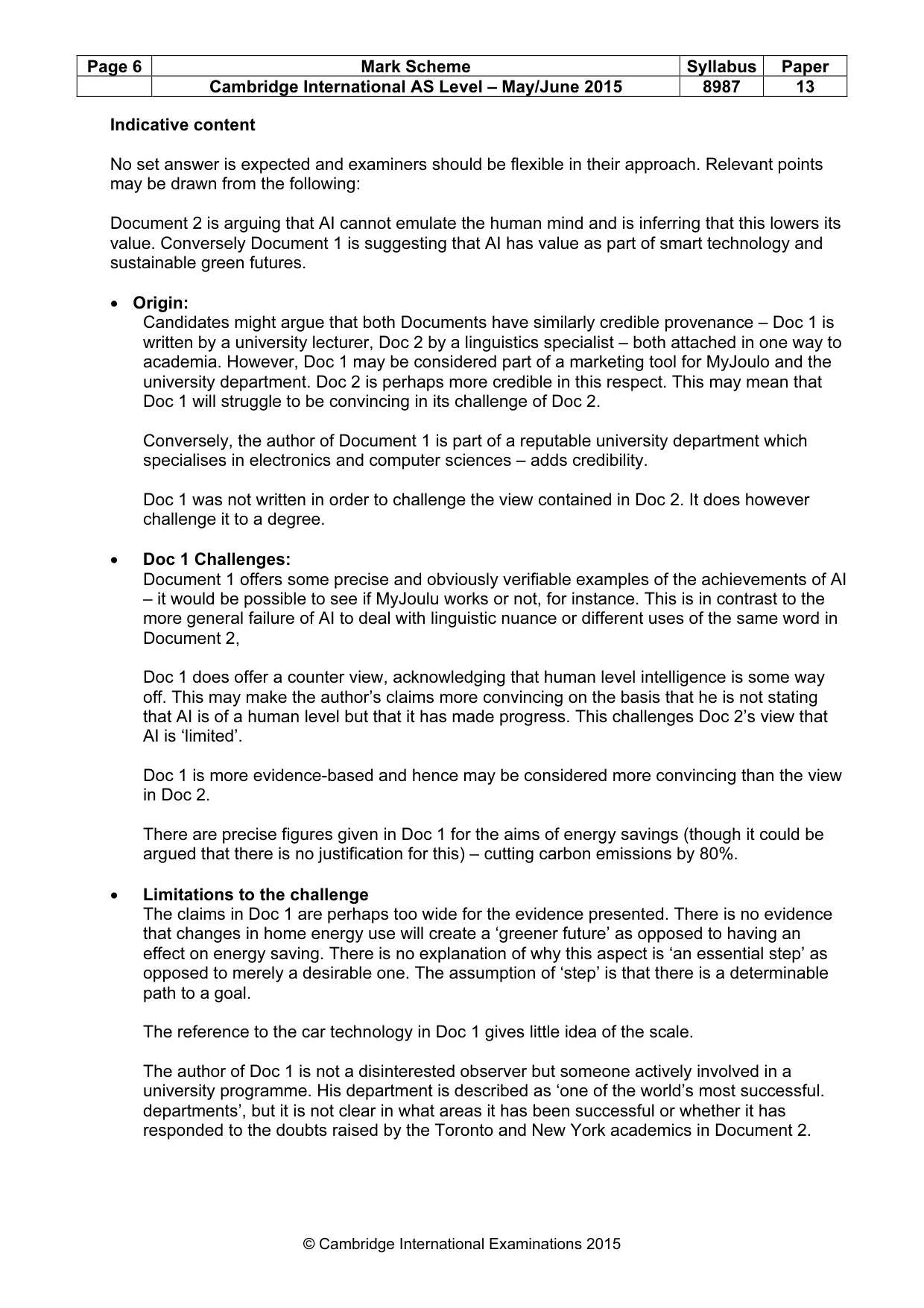
Page 6 Mark Scheme Syllabus Paper Cambridge International AS Level – May/June 2015 8987 13 © Cambridge International Examinations 2015 Indicative content No set answer is expected and examiners should be flexible in their approach. Relevant points may be drawn from the following: Document 2 is arguing that AI cannot emulate the human mind and is inferring that this lowers its value. Conversely Document 1 is suggesting that AI has value as part of smart technology and sustainable green futures. • Origin: Candidates might argue that both Documents have similarly credible provenance – Doc 1 is written by a university lecturer, Doc 2 by a linguistics specialist – both attached in one way to academia. However, Doc 1 may be considered part of a marketing tool for MyJoulo and the university department. Doc 2 is perhaps more credible in this respect. This may mean that Doc 1 will struggle to be convincing in its challenge of Doc 2. Conversely, the author of Document 1 is part of a reputable university department which specialises in electronics and computer sciences – adds credibility. Doc 1 was not written in order to challenge the view contained in Doc 2. It does however challenge it to a degree. • Doc 1 Challenges: Document 1 offers some precise and obviously verifiable examples of the achievements of AI – it would be possible to see if MyJoulu works or not, for instance. This is in contrast to the more general failure of AI to deal with linguistic nuance or different uses of the same word in Document 2, Doc 1 does offer a counter view, acknowledging that human level intelligence is some way off. This may make the author’s claims more convincing on the basis that he is not stating that AI is of a human level but that it has made progress. This challenges Doc 2’s view that AI is ‘limited’. Doc 1 is more evidence-based and hence may be considered more convincing than the view in Doc 2. There are precise figures given in Doc 1 for the aims of energy savings (though it could be argued that there is no justification for this) – cutting carbon emissions by 80%. • Limitations to the challenge The claims in Doc 1 are perhaps too wide for the evidence presented. There is no evidence that changes in home energy use will create a ‘greener future’ as opposed to having an effect on energy saving. There is no explanation of why this aspect is ‘an essential step’ as opposed to merely a desirable one. The assumption of ‘step’ is that there is a determinable path to a goal. The reference to the car technology in Doc 1 gives little idea of the scale. The author of Doc 1 is not a disinterested observer but someone actively involved in a university programme. His department is described as ‘one of the world’s most successful. departments’, but it is not clear in what areas it has been successful or whether it has responded to the doubts raised by the Toronto and New York academics in Document 2.
Mark scheme, page 7
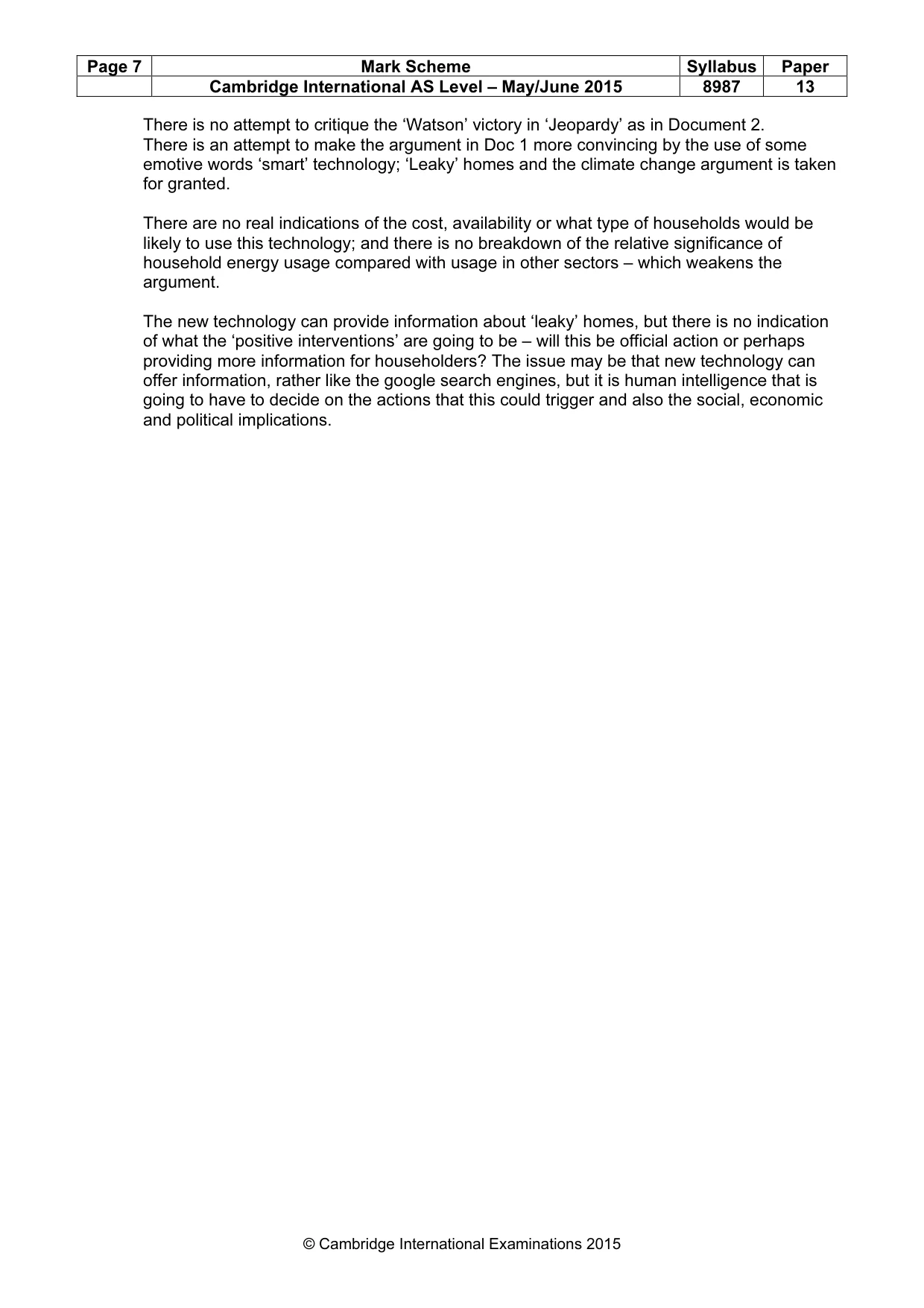
Page 7 Mark Scheme Syllabus Paper Cambridge International AS Level – May/June 2015 8987 13 © Cambridge International Examinations 2015 There is no attempt to critique the ‘Watson’ victory in ‘Jeopardy’ as in Document 2. There is an attempt to make the argument in Doc 1 more convincing by the use of some emotive words ‘smart’ technology; ‘Leaky’ homes and the climate change argument is taken for granted. There are no real indications of the cost, availability or what type of households would be likely to use this technology; and there is no breakdown of the relative significance of household energy usage compared with usage in other sectors – which weakens the argument. The new technology can provide information about ‘leaky’ homes, but there is no indication of what the ‘positive interventions’ are going to be – will this be official action or perhaps providing more information for householders? The issue may be that new technology can offer information, rather like the google search engines, but it is human intelligence that is going to have to decide on the actions that this could trigger and also the social, economic and political implications.