Cambridge A Level Global Perspectives (AS Level only, until Nov 2015) 8987 — 2014 Oct/Nov Paper 1 · Variant 2
8987/12/O/N/14
The question paper and its mark scheme, free to read here and free to download. This is Cambridge’s own paper, exactly as it was sat.
Question paper4 pages

Mark scheme5 pages
Answers below. Sit the paper first if you are practising.
Paper as text
Question paper, page 1
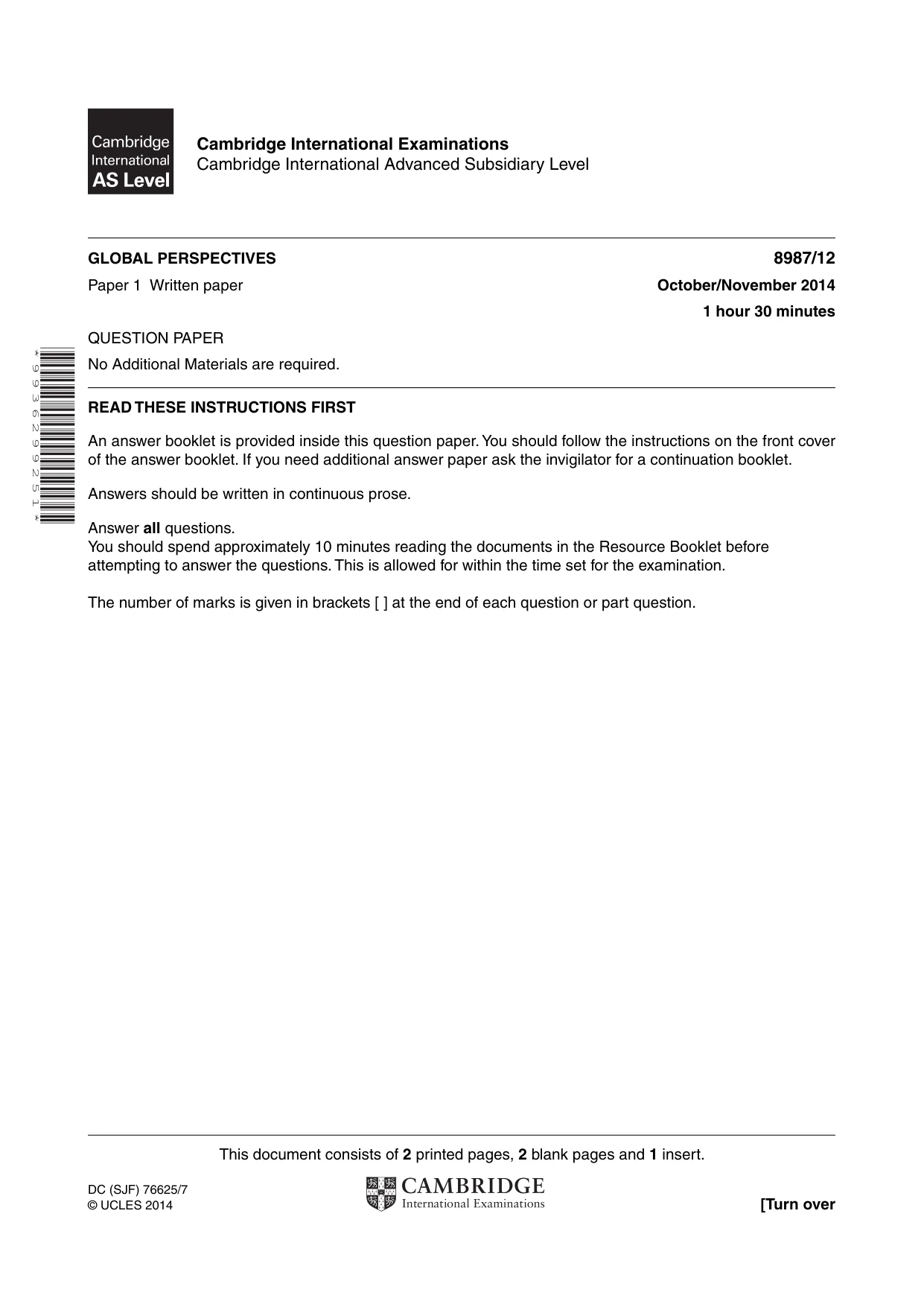
This document consists of 2 printed pages, 2 blank pages and 1 insert. DC (SJF) 76625/7 © UCLES 2014 [Turn over Cambridge International Examinations Cambridge International Advanced Subsidiary Level * 9 9 3 6 2 9 9 2 5 1 * GLOBAL PERSPECTIVES 8987/12 Paper 1 Written paper October/November 2014 1 hour 30 minutes QUESTION PAPER No Additional Materials are required. READ THESE INSTRUCTIONS FIRST An answer booklet is provided inside this question paper. You should follow the instructions on the front cover of the answer booklet. If you need additional answer paper ask the invigilator for a continuation booklet. Answers should be written in continuous prose. Answer all questions. You should spend approximately 10 minutes reading the documents in the Resource Booklet before attempting to answer the questions. This is allowed for within the time set for the examination. The number of marks is given in brackets [ ] at the end of each question or part question.
Question paper, page 2
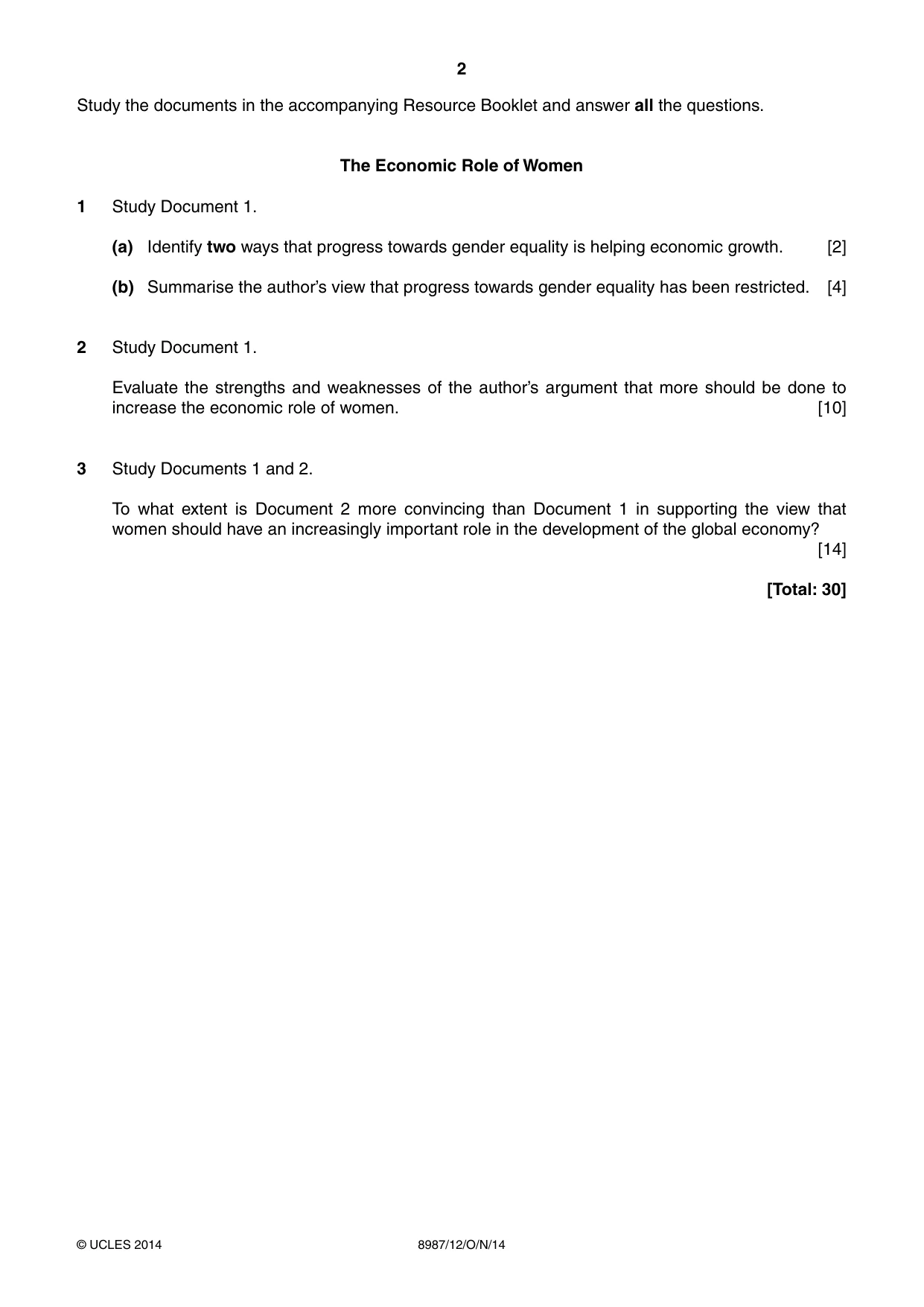
2 8987/12/O/N/14 © UCLES 2014 Study the documents in the accompanying Resource Booklet and answer all the questions. The Economic Role of Women 1 Study Document 1. (a) Identify two ways that progress towards gender equality is helping economic growth. [2] (b) Summarise the author’s view that progress towards gender equality has been restricted. [4] 2 Study Document 1. Evaluate the strengths and weaknesses of the author’s argument that more should be done to increase the economic role of women. [10] 3 Study Documents 1 and 2. To what extent is Document 2 more convincing than Document 1 in supporting the view that women should have an increasingly important role in the development of the global economy? [14] [Total: 30]
Question paper, page 3
3 8987/12/O/N/14 © UCLES 2014 BLANK PAGE
Question paper, page 4
4 8987/12/O/N/14 © UCLES 2014 Copyright Acknowledgements: Document 1 © adapted: Hillary Clinton; Remarks at the Asia Pacific Economic Cooperation, Women and the Economy Summit ; www.state.gov/secretary/ rm/2011/09/172605.html; 11 Sept 2011. Document 2 © adapted: Reid Hamel; Women at Work: Good for the Economy, the Family and the Future; www.asiafoundation.org/in-asia/2012/03/07/women- at-work-good-for-the-economy-the-family-and-the-future/; March 2012. Permission to reproduce items where third-party owned material protected by copyright is included has been sought and cleared where possible. Every reasonable effort has been made by the publisher (UCLES) to trace copyright holders, but if any items requiring clearance have unwittingly been included, the publisher will be pleased to make amends at the earliest possible opportunity. Cambridge International Examinations is part of the Cambridge Assessment Group. Cambridge Assessment is the brand name of University of Cambridge Local Examinations Syndicate (UCLES), which is itself a department of the University of Cambridge. BLANK PAGE
Mark scheme, page 1
® IGCSE is the registered trademark of Cambridge International Examinations. CAMBRIDGE INTERNATIONAL EXAMINATIONS Cambridge International Advanced Subsidiary and Advanced Level MARK SCHEME for the October/November 2014 series 8987 GLOBAL PERSPECTIVES 8987/12 Paper 1 (Written Paper), maximum raw mark 30 This mark scheme is published as an aid to teachers and candidates, to indicate the requirements of the examination. It shows the basis on which Examiners were instructed to award marks. It does not indicate the details of the discussions that took place at an Examiners’ meeting before marking began, which would have considered the acceptability of alternative answers. Mark schemes should be read in conjunction with the question paper and the Principal Examiner Report for Teachers. Cambridge will not enter into discussions about these mark schemes. Cambridge is publishing the mark schemes for the October/November 2014 series for most Cambridge IGCSE®, Cambridge International A and AS Level components and some Cambridge O Level components.
Mark scheme, page 2
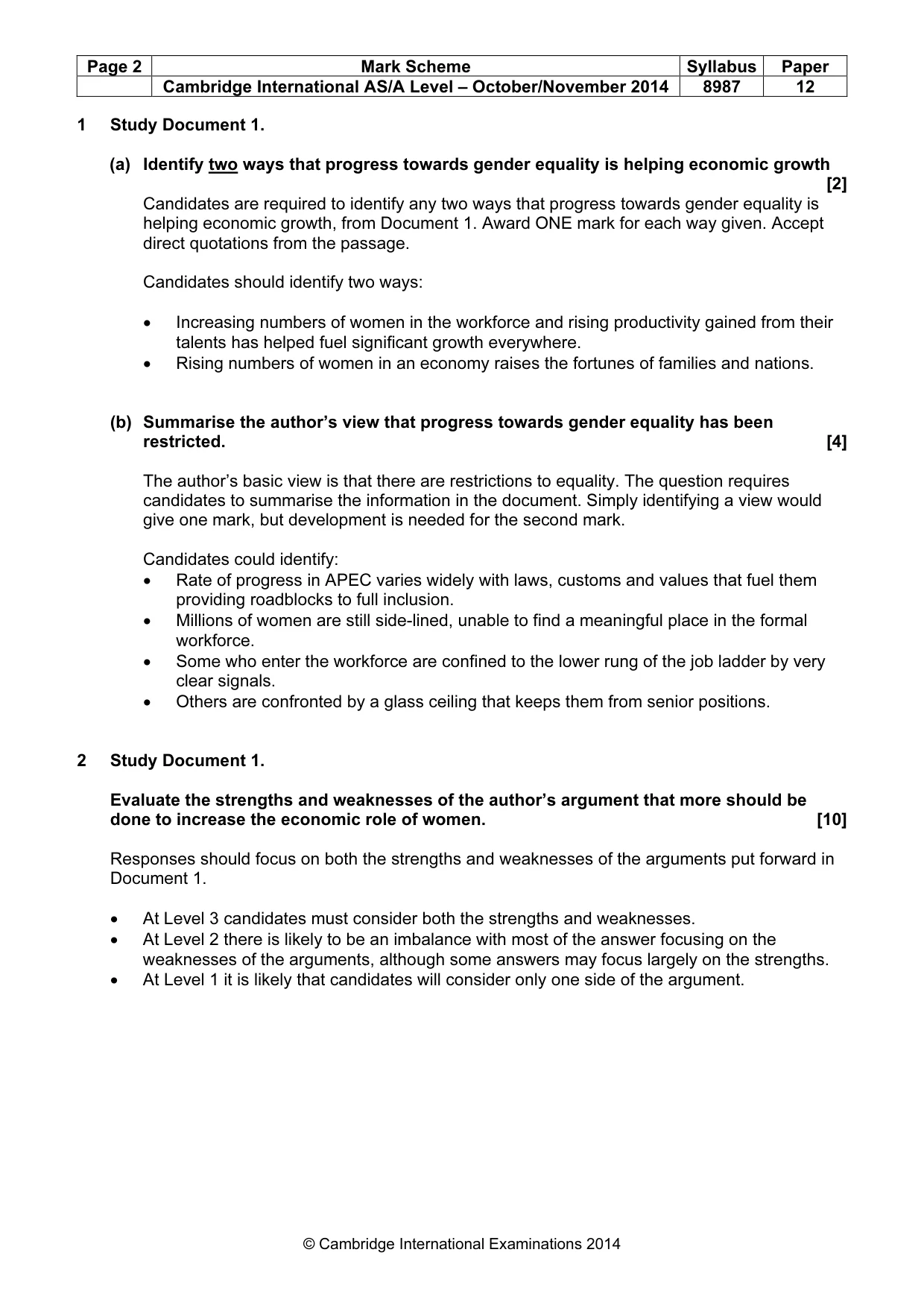
Page 2 Mark Scheme Syllabus Paper Cambridge International AS/A Level – October/November 2014 8987 12 © Cambridge International Examinations 2014 1 Study Document 1. (a) Identify two ways that progress towards gender equality is helping economic growth [2] Candidates are required to identify any two ways that progress towards gender equality is helping economic growth, from Document 1. Award ONE mark for each way given. Accept direct quotations from the passage. Candidates should identify two ways: • Increasing numbers of women in the workforce and rising productivity gained from their talents has helped fuel significant growth everywhere. • Rising numbers of women in an economy raises the fortunes of families and nations. (b) Summarise the author’s view that progress towards gender equality has been restricted. [4] The author’s basic view is that there are restrictions to equality. The question requires candidates to summarise the information in the document. Simply identifying a view would give one mark, but development is needed for the second mark. Candidates could identify: • Rate of progress in APEC varies widely with laws, customs and values that fuel them providing roadblocks to full inclusion. • Millions of women are still side-lined, unable to find a meaningful place in the formal workforce. • Some who enter the workforce are confined to the lower rung of the job ladder by very clear signals. • Others are confronted by a glass ceiling that keeps them from senior positions. 2 Study Document 1. Evaluate the strengths and weaknesses of the author’s argument that more should be done to increase the economic role of women. [10] Responses should focus on both the strengths and weaknesses of the arguments put forward in Document 1. • At Level 3 candidates must consider both the strengths and weaknesses. • At Level 2 there is likely to be an imbalance with most of the answer focusing on the weaknesses of the arguments, although some answers may focus largely on the strengths. • At Level 1 it is likely that candidates will consider only one side of the argument.
Mark scheme, page 3
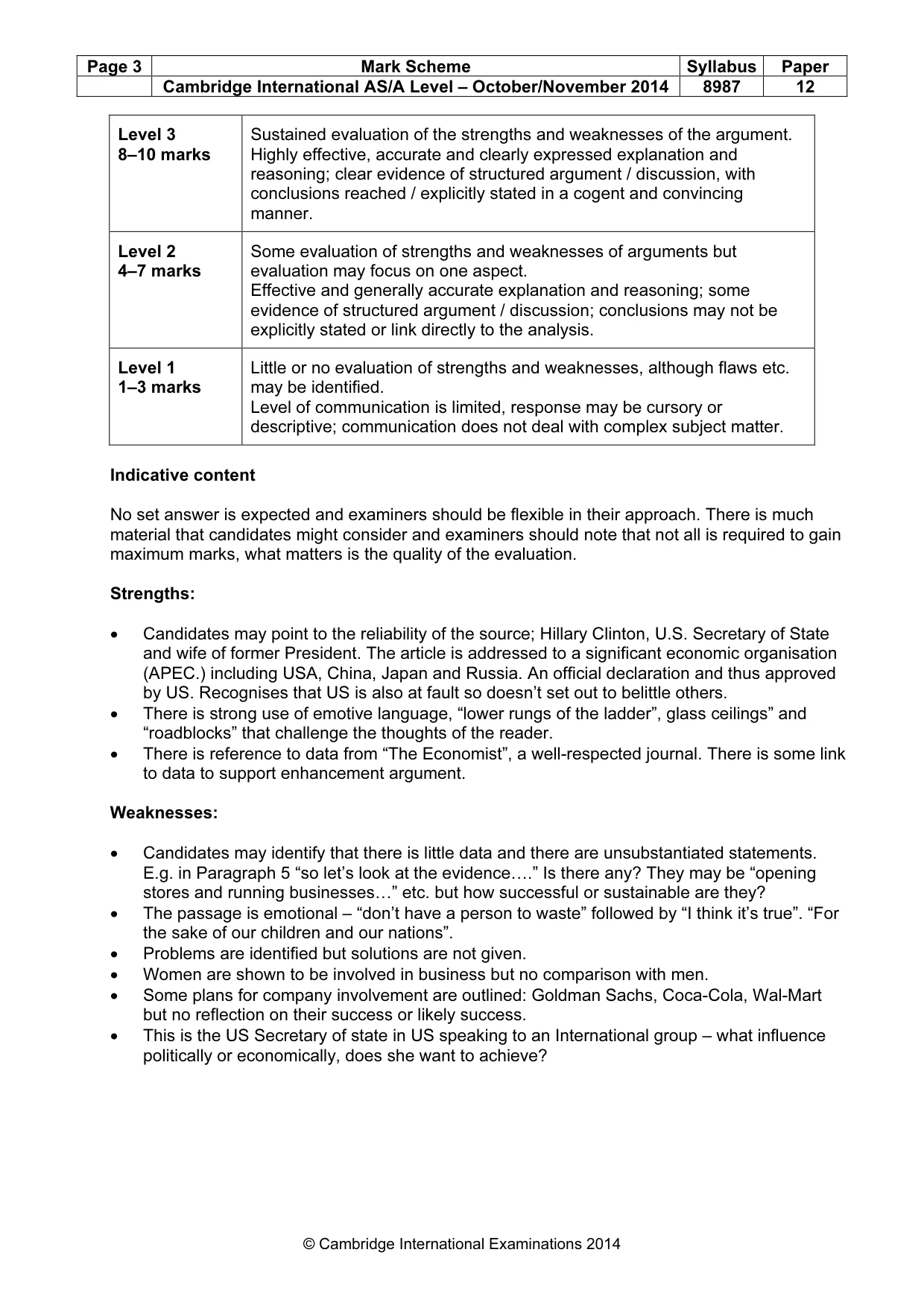
Page 3 Mark Scheme Syllabus Paper Cambridge International AS/A Level – October/November 2014 8987 12 © Cambridge International Examinations 2014 Level 3 8–10 marks Sustained evaluation of the strengths and weaknesses of the argument. Highly effective, accurate and clearly expressed explanation and reasoning; clear evidence of structured argument / discussion, with conclusions reached / explicitly stated in a cogent and convincing manner. Level 2 4–7 marks Some evaluation of strengths and weaknesses of arguments but evaluation may focus on one aspect. Effective and generally accurate explanation and reasoning; some evidence of structured argument / discussion; conclusions may not be explicitly stated or link directly to the analysis. Level 1 1–3 marks Little or no evaluation of strengths and weaknesses, although flaws etc. may be identified. Level of communication is limited, response may be cursory or descriptive; communication does not deal with complex subject matter. Indicative content No set answer is expected and examiners should be flexible in their approach. There is much material that candidates might consider and examiners should note that not all is required to gain maximum marks, what matters is the quality of the evaluation. Strengths: • Candidates may point to the reliability of the source; Hillary Clinton, U.S. Secretary of State and wife of former President. The article is addressed to a significant economic organisation (APEC.) including USA, China, Japan and Russia. An official declaration and thus approved by US. Recognises that US is also at fault so doesn’t set out to belittle others. • There is strong use of emotive language, “lower rungs of the ladder”, glass ceilings” and “roadblocks” that challenge the thoughts of the reader. • There is reference to data from “The Economist”, a well-respected journal. There is some link to data to support enhancement argument. Weaknesses: • Candidates may identify that there is little data and there are unsubstantiated statements. E.g. in Paragraph 5 “so let’s look at the evidence….” Is there any? They may be “opening stores and running businesses…” etc. but how successful or sustainable are they? • The passage is emotional – “don’t have a person to waste” followed by “I think it’s true”. “For the sake of our children and our nations”. • Problems are identified but solutions are not given. • Women are shown to be involved in business but no comparison with men. • Some plans for company involvement are outlined: Goldman Sachs, Coca-Cola, Wal-Mart but no reflection on their success or likely success. • This is the US Secretary of state in US speaking to an International group – what influence politically or economically, does she want to achieve?
Mark scheme, page 4
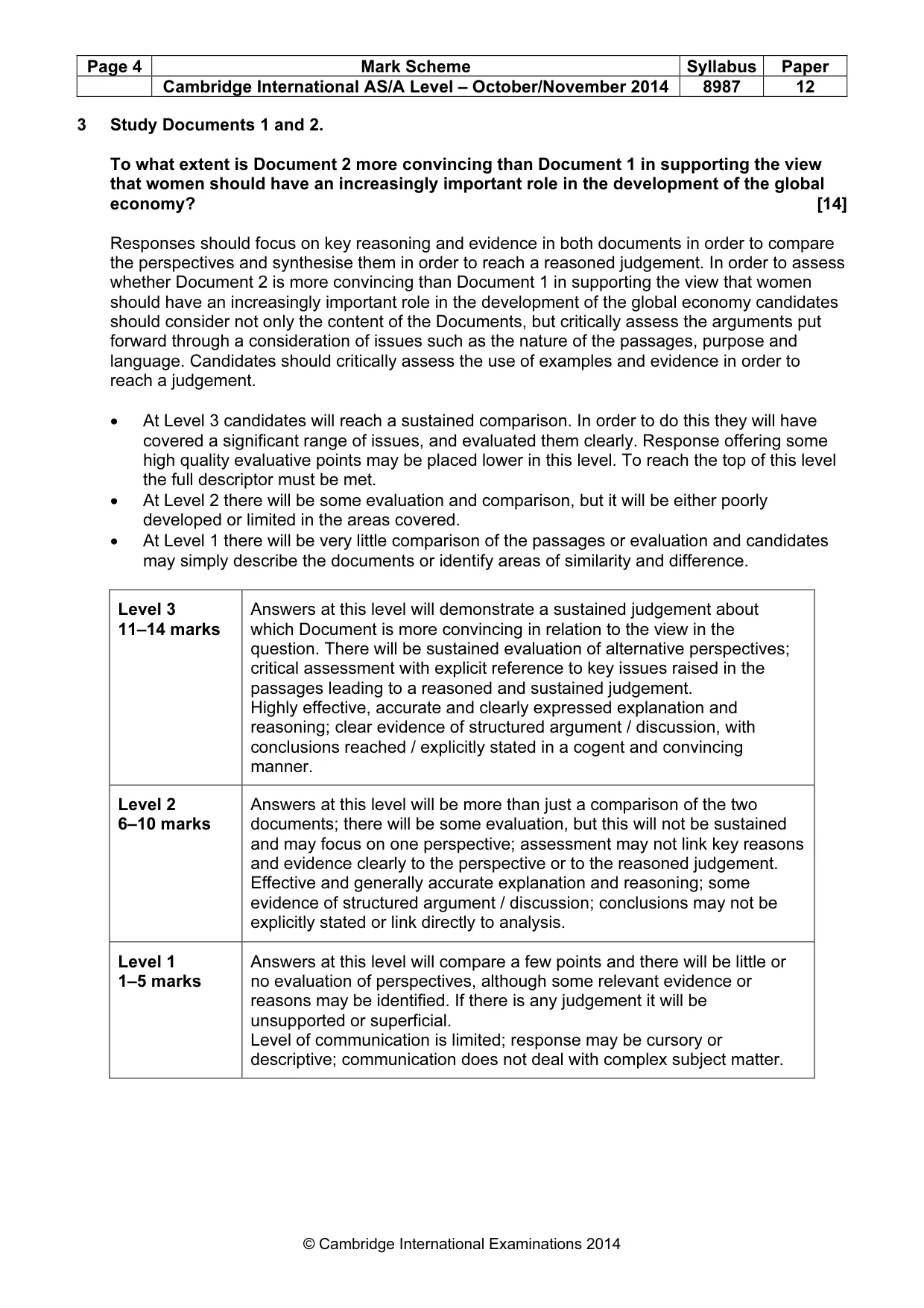
Page 4 Mark Scheme Syllabus Paper Cambridge International AS/A Level – October/November 2014 8987 12 © Cambridge International Examinations 2014 3 Study Documents 1 and 2. To what extent is Document 2 more convincing than Document 1 in supporting the view that women should have an increasingly important role in the development of the global economy? [14] Responses should focus on key reasoning and evidence in both documents in order to compare the perspectives and synthesise them in order to reach a reasoned judgement. In order to assess whether Document 2 is more convincing than Document 1 in supporting the view that women should have an increasingly important role in the development of the global economy candidates should consider not only the content of the Documents, but critically assess the arguments put forward through a consideration of issues such as the nature of the passages, purpose and language. Candidates should critically assess the use of examples and evidence in order to reach a judgement. • At Level 3 candidates will reach a sustained comparison. In order to do this they will have covered a significant range of issues, and evaluated them clearly. Response offering some high quality evaluative points may be placed lower in this level. To reach the top of this level the full descriptor must be met. • At Level 2 there will be some evaluation and comparison, but it will be either poorly developed or limited in the areas covered. • At Level 1 there will be very little comparison of the passages or evaluation and candidates may simply describe the documents or identify areas of similarity and difference. Level 3 11–14 marks Answers at this level will demonstrate a sustained judgement about which Document is more convincing in relation to the view in the question. There will be sustained evaluation of alternative perspectives; critical assessment with explicit reference to key issues raised in the passages leading to a reasoned and sustained judgement. Highly effective, accurate and clearly expressed explanation and reasoning; clear evidence of structured argument / discussion, with conclusions reached / explicitly stated in a cogent and convincing manner. Level 2 6–10 marks Answers at this level will be more than just a comparison of the two documents; there will be some evaluation, but this will not be sustained and may focus on one perspective; assessment may not link key reasons and evidence clearly to the perspective or to the reasoned judgement. Effective and generally accurate explanation and reasoning; some evidence of structured argument / discussion; conclusions may not be explicitly stated or link directly to analysis. Level 1 1–5 marks Answers at this level will compare a few points and there will be little or no evaluation of perspectives, although some relevant evidence or reasons may be identified. If there is any judgement it will be unsupported or superficial. Level of communication is limited; response may be cursory or descriptive; communication does not deal with complex subject matter.
Mark scheme, page 5
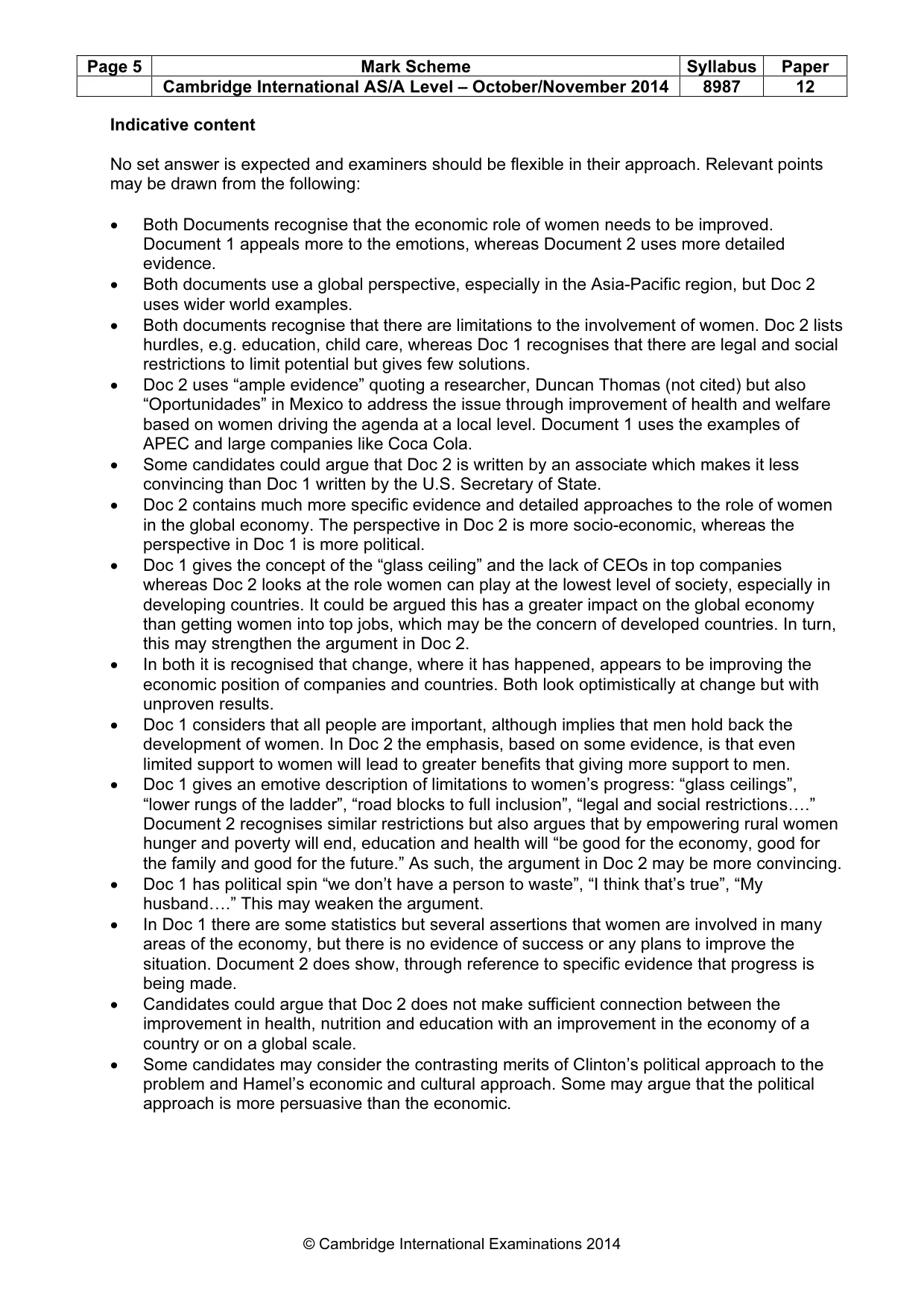
Page 5 Mark Scheme Syllabus Paper Cambridge International AS/A Level – October/November 2014 8987 12 © Cambridge International Examinations 2014 Indicative content No set answer is expected and examiners should be flexible in their approach. Relevant points may be drawn from the following: • Both Documents recognise that the economic role of women needs to be improved. Document 1 appeals more to the emotions, whereas Document 2 uses more detailed evidence. • Both documents use a global perspective, especially in the Asia-Pacific region, but Doc 2 uses wider world examples. • Both documents recognise that there are limitations to the involvement of women. Doc 2 lists hurdles, e.g. education, child care, whereas Doc 1 recognises that there are legal and social restrictions to limit potential but gives few solutions. • Doc 2 uses “ample evidence” quoting a researcher, Duncan Thomas (not cited) but also “Oportunidades” in Mexico to address the issue through improvement of health and welfare based on women driving the agenda at a local level. Document 1 uses the examples of APEC and large companies like Coca Cola. • Some candidates could argue that Doc 2 is written by an associate which makes it less convincing than Doc 1 written by the U.S. Secretary of State. • Doc 2 contains much more specific evidence and detailed approaches to the role of women in the global economy. The perspective in Doc 2 is more socio-economic, whereas the perspective in Doc 1 is more political. • Doc 1 gives the concept of the “glass ceiling” and the lack of CEOs in top companies whereas Doc 2 looks at the role women can play at the lowest level of society, especially in developing countries. It could be argued this has a greater impact on the global economy than getting women into top jobs, which may be the concern of developed countries. In turn, this may strengthen the argument in Doc 2. • In both it is recognised that change, where it has happened, appears to be improving the economic position of companies and countries. Both look optimistically at change but with unproven results. • Doc 1 considers that all people are important, although implies that men hold back the development of women. In Doc 2 the emphasis, based on some evidence, is that even limited support to women will lead to greater benefits that giving more support to men. • Doc 1 gives an emotive description of limitations to women’s progress: “glass ceilings”, “lower rungs of the ladder”, “road blocks to full inclusion”, “legal and social restrictions….” Document 2 recognises similar restrictions but also argues that by empowering rural women hunger and poverty will end, education and health will “be good for the economy, good for the family and good for the future.” As such, the argument in Doc 2 may be more convincing. • Doc 1 has political spin “we don’t have a person to waste”, “I think that’s true”, “My husband….” This may weaken the argument. • In Doc 1 there are some statistics but several assertions that women are involved in many areas of the economy, but there is no evidence of success or any plans to improve the situation. Document 2 does show, through reference to specific evidence that progress is being made. • Candidates could argue that Doc 2 does not make sufficient connection between the improvement in health, nutrition and education with an improvement in the economy of a country or on a global scale. • Some candidates may consider the contrasting merits of Clinton’s political approach to the problem and Hamel’s economic and cultural approach. Some may argue that the political approach is more persuasive than the economic.