Cambridge A Level Global Perspectives and Research 9239 — 2019 Oct/Nov Paper 1 · Variant 1
9239/11/O/N/19 · 30 marks · ≈34 min
The question paper and its mark scheme, free to read here and free to download. This is Cambridge’s own paper, exactly as it was sat.
Question paper4 pages


Mark scheme15 pages
Answers below. Sit the paper first if you are practising.
Paper as text
Question paper, page 1
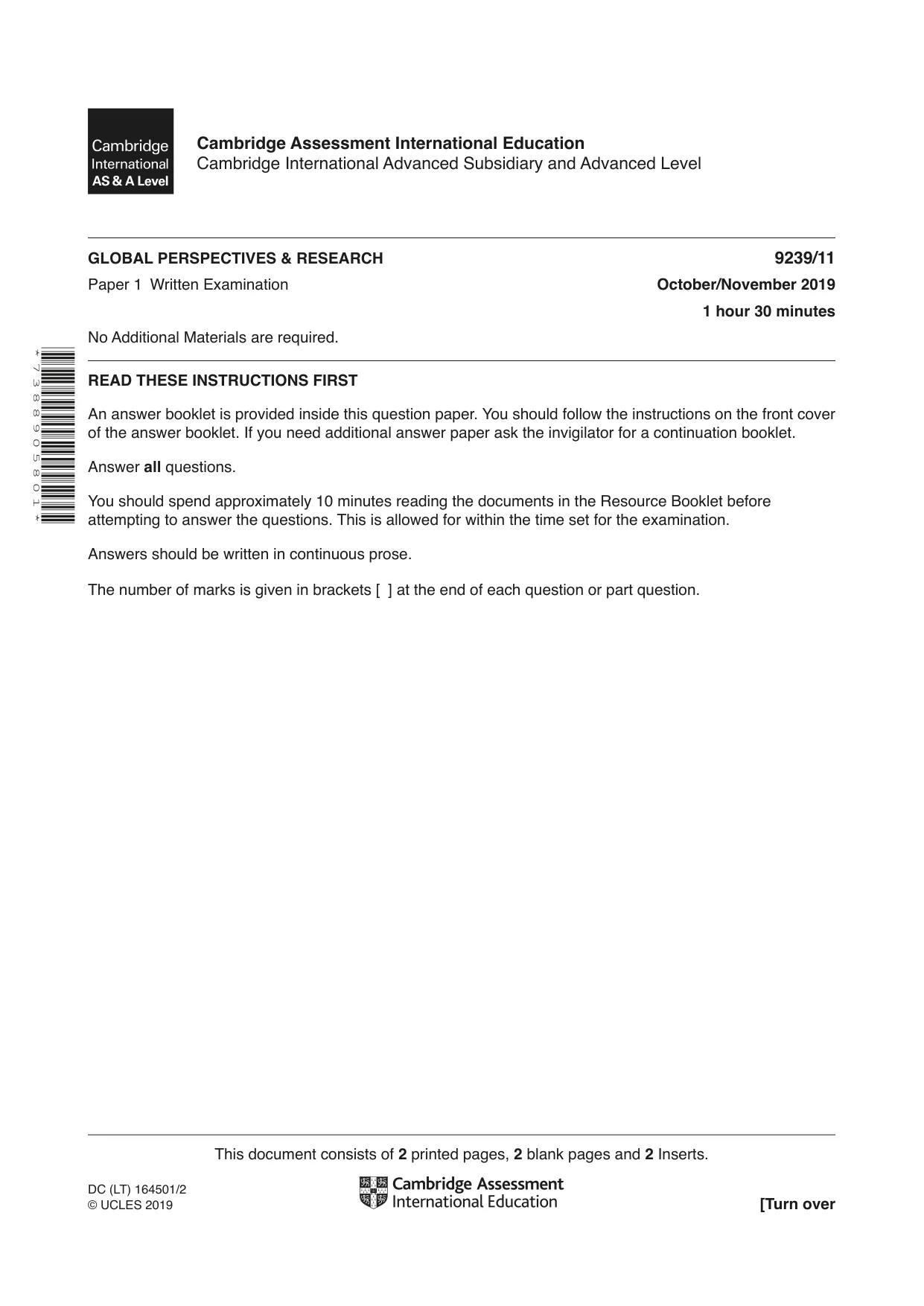
This document consists of 2 printed pages, 2 blank pages and 2 Inserts. DC (LT) 164501/2 © UCLES 2019 [Turn over Cambridge Assessment International Education Cambridge International Advanced Subsidiary and Advanced Level * 7 3 8 8 9 0 5 8 0 1 * GLOBAL PERSPECTIVES & RESEARCH 9239/11 Paper 1 Written Examination October/November 2019 1 hour 30 minutes No Additional Materials are required. READ THESE INSTRUCTIONS FIRST An answer booklet is provided inside this question paper. You should follow the instructions on the front cover of the answer booklet. If you need additional answer paper ask the invigilator for a continuation booklet. Answer all questions. You should spend approximately 10 minutes reading the documents in the Resource Booklet before attempting to answer the questions. This is allowed for within the time set for the examination. Answers should be written in continuous prose. The number of marks is given in brackets [ ] at the end of each question or part question.
Question paper, page 2
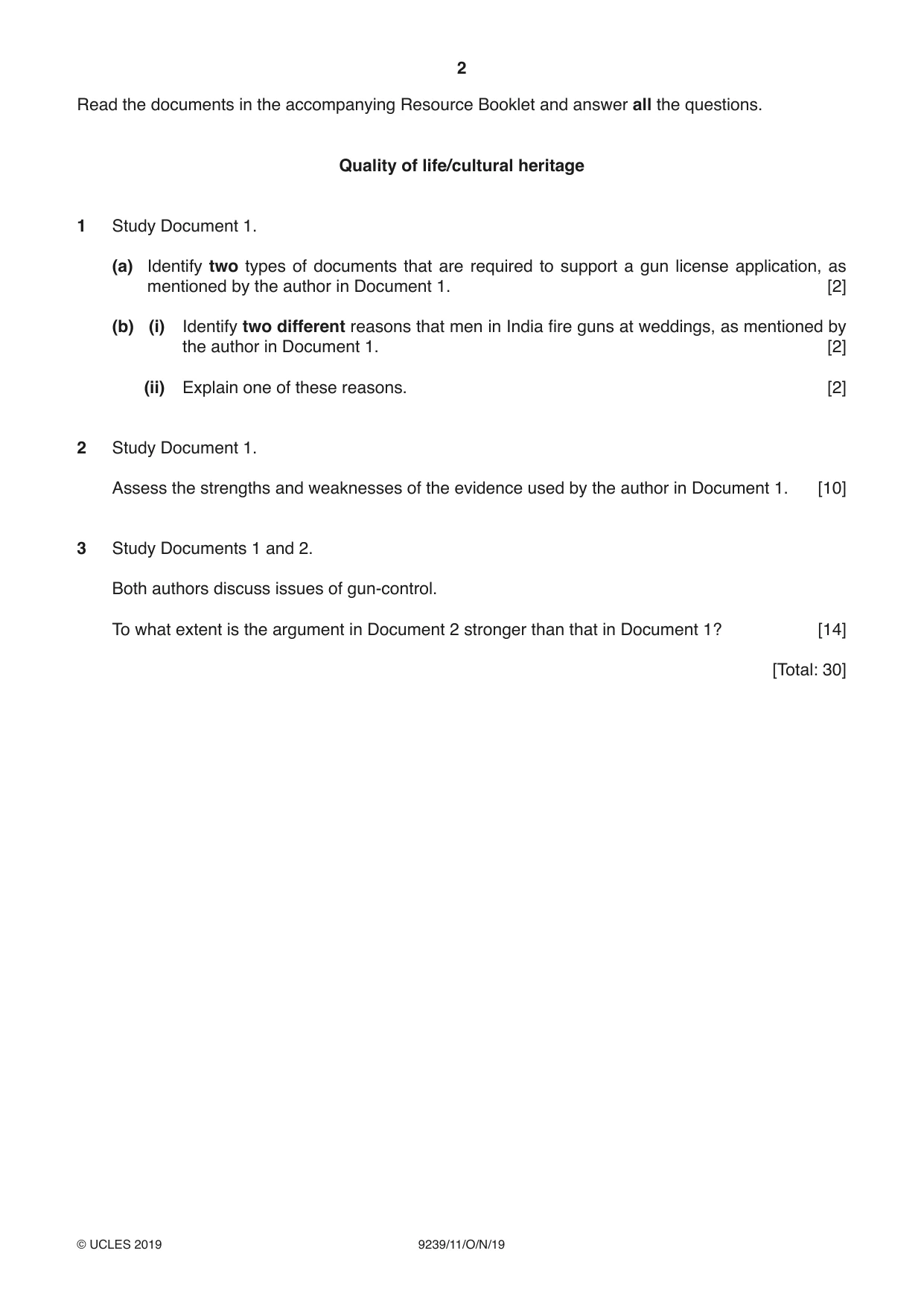
2 9239/11/O/N/19 © UCLES 2019 Read the documents in the accompanying Resource Booklet and answer all the questions. Quality of life/cultural heritage 1 Study Document 1. (a) Identify two types of documents that are required to support a gun license application, as mentioned by the author in Document 1. [2] (b) (i) Identify two different reasons that men in India fire guns at weddings, as mentioned by the author in Document 1. [2] (ii) Explain one of these reasons. [2] 2 Study Document 1. Assess the strengths and weaknesses of the evidence used by the author in Document 1. [10] 3 Study Documents 1 and 2. Both authors discuss issues of gun-control. To what extent is the argument in Document 2 stronger than that in Document 1? [14] [Total: 30]
Question paper, page 3
3 9239/11/O/N/19 © UCLES 2019 BLANK PAGE
Question paper, page 4
4 9239/11/O/N/19 © UCLES 2019 Permission to reproduce items where third-party owned material protected by copyright is included has been sought and cleared where possible. Every reasonable effort has been made by the publisher (UCLES) to trace copyright holders, but if any items requiring clearance have unwittingly been included, the publisher will be pleased to make amends at the earliest possible opportunity. To avoid the issue of disclosure of answer-related information to candidates, all copyright acknowledgements are reproduced online in the Cambridge Assessment International Education Copyright Acknowledgements Booklet. This is produced for each series of examinations and is freely available to download at www.cambridgeinternational.org after the live examination series. Cambridge Assessment International Education is part of the Cambridge Assessment Group. Cambridge Assessment is the brand name of the University of Cambridge Local Examinations Syndicate (UCLES), which itself is a department of the University of Cambridge. BLANK PAGE
Mark scheme, page 1
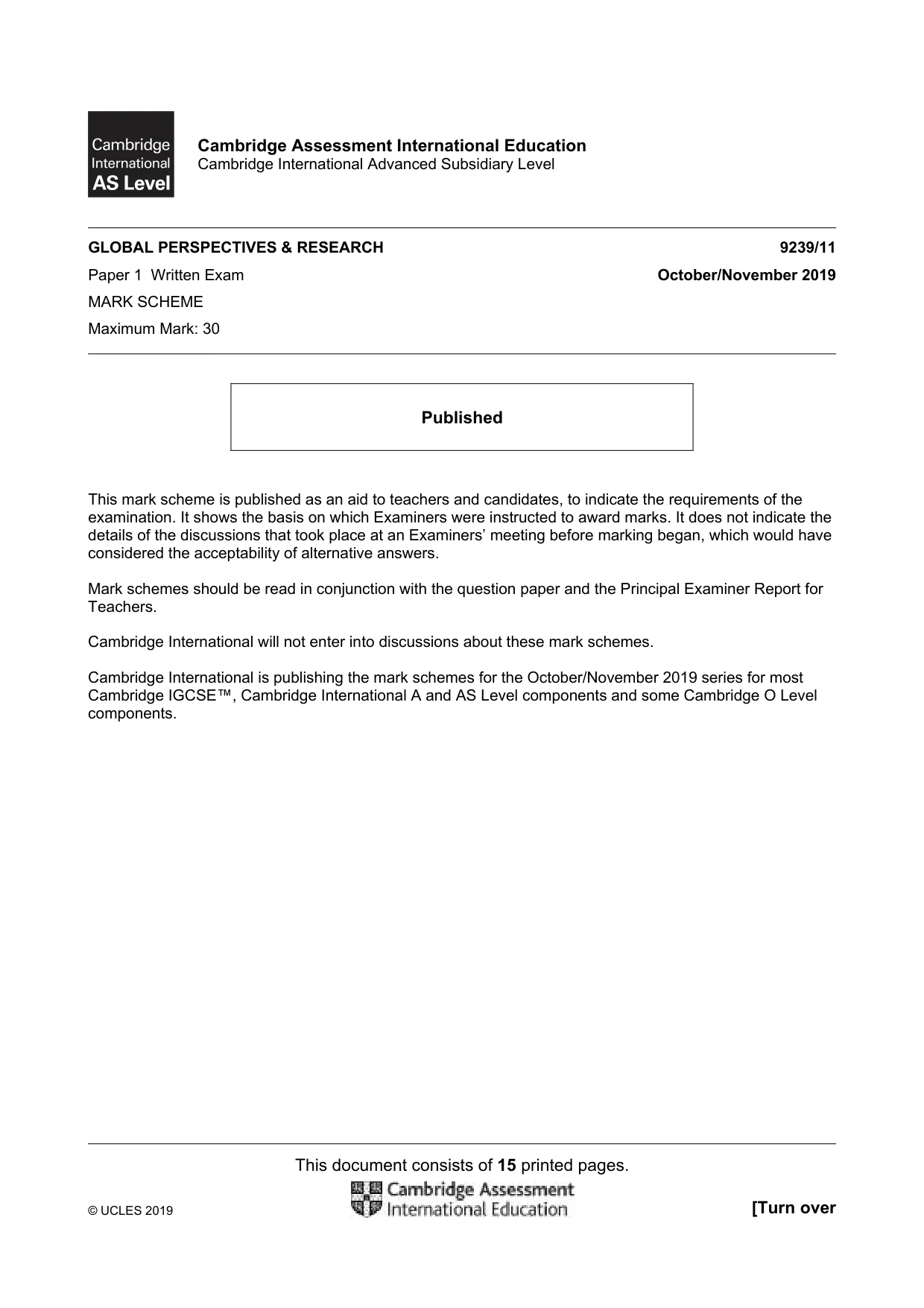
This document consists of 15 printed pages. © UCLES 2019 [Turn over Cambridge Assessment International Education Cambridge International Advanced Subsidiary Level GLOBAL PERSPECTIVES & RESEARCH 9239/11 Paper 1 Written Exam October/November 2019 MARK SCHEME Maximum Mark: 30 Published This mark scheme is published as an aid to teachers and candidates, to indicate the requirements of the examination. It shows the basis on which Examiners were instructed to award marks. It does not indicate the details of the discussions that took place at an Examiners’ meeting before marking began, which would have considered the acceptability of alternative answers. Mark schemes should be read in conjunction with the question paper and the Principal Examiner Report for Teachers. Cambridge International will not enter into discussions about these mark schemes. Cambridge International is publishing the mark schemes for the October/November 2019 series for most Cambridge IGCSE™, Cambridge International A and AS Level components and some Cambridge O Level components.
Mark scheme, page 2
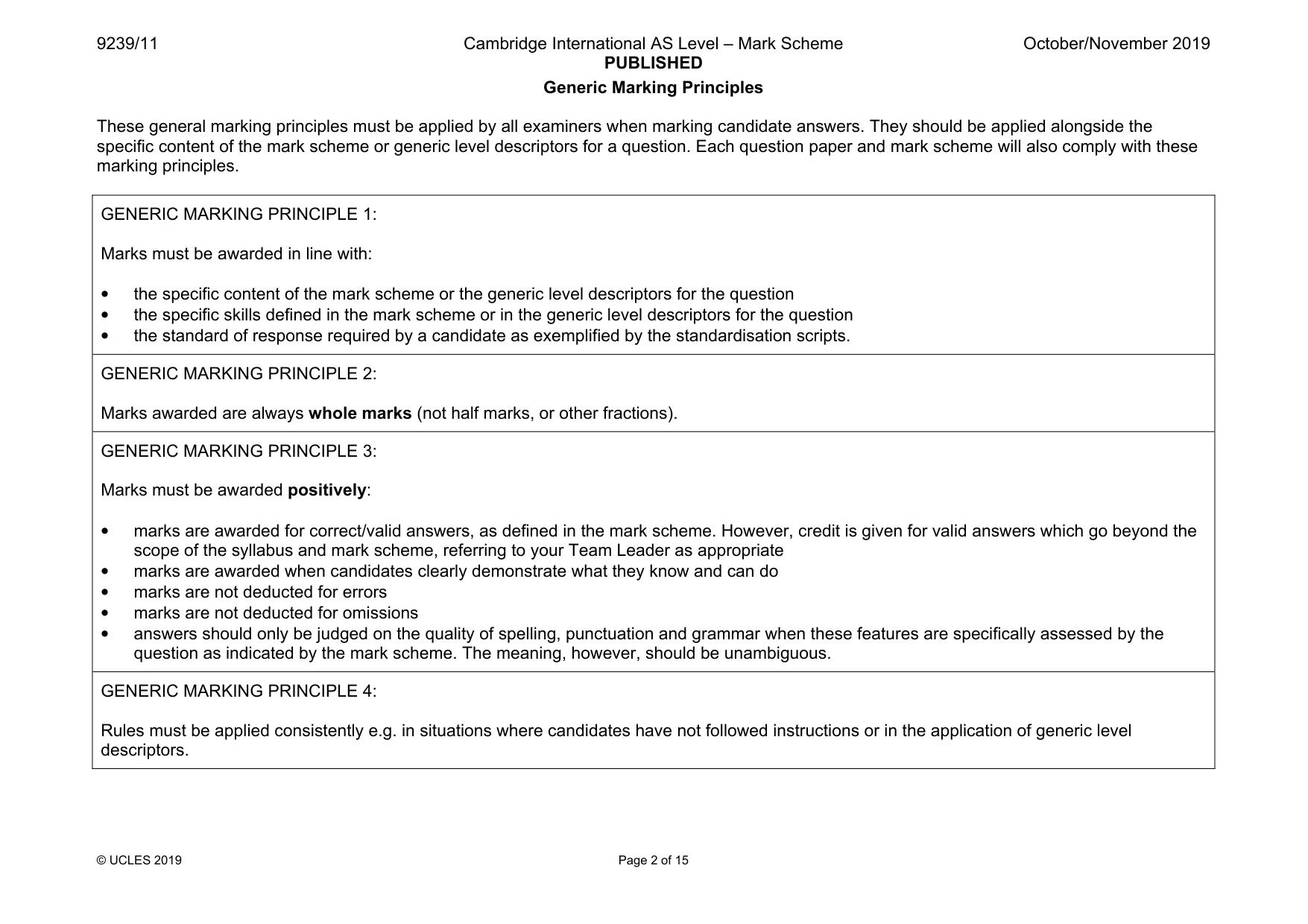
9239/11 Cambridge International AS Level – Mark Scheme PUBLISHED October/November 2019 © UCLES 2019 Page 2 of 15 Generic Marking Principles These general marking principles must be applied by all examiners when marking candidate answers. They should be applied alongside the specific content of the mark scheme or generic level descriptors for a question. Each question paper and mark scheme will also comply with these marking principles. GENERIC MARKING PRINCIPLE 1: Marks must be awarded in line with: • the specific content of the mark scheme or the generic level descriptors for the question • the specific skills defined in the mark scheme or in the generic level descriptors for the question • the standard of response required by a candidate as exemplified by the standardisation scripts. GENERIC MARKING PRINCIPLE 2: Marks awarded are always whole marks (not half marks, or other fractions). GENERIC MARKING PRINCIPLE 3: Marks must be awarded positively: • marks are awarded for correct/valid answers, as defined in the mark scheme. However, credit is given for valid answers which go beyond the scope of the syllabus and mark scheme, referring to your Team Leader as appropriate • marks are awarded when candidates clearly demonstrate what they know and can do • marks are not deducted for errors • marks are not deducted for omissions • answers should only be judged on the quality of spelling, punctuation and grammar when these features are specifically assessed by the question as indicated by the mark scheme. The meaning, however, should be unambiguous. GENERIC MARKING PRINCIPLE 4: Rules must be applied consistently e.g. in situations where candidates have not followed instructions or in the application of generic level descriptors.
Mark scheme, page 3
9239/11 Cambridge International AS Level – Mark Scheme PUBLISHED October/November 2019 © UCLES 2019 Page 3 of 15 GENERIC MARKING PRINCIPLE 5: Marks should be awarded using the full range of marks defined in the mark scheme for the question (however; the use of the full mark range may be limited according to the quality of the candidate responses seen). GENERIC MARKING PRINCIPLE 6: Marks awarded are based solely on the requirements as defined in the mark scheme. Marks should not be awarded with grade thresholds or grade descriptors in mind.
Mark scheme, page 4
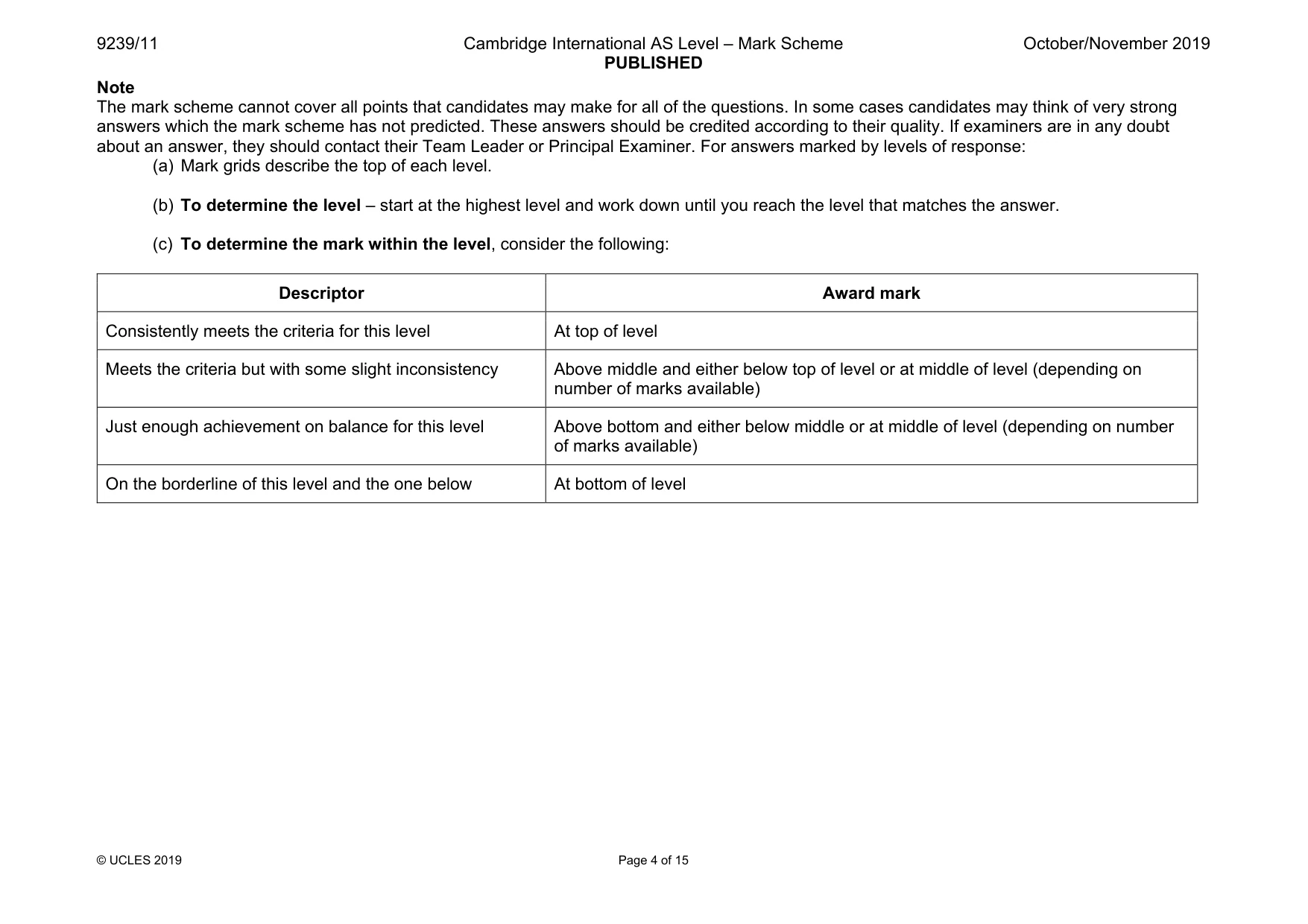
9239/11 Cambridge International AS Level – Mark Scheme PUBLISHED October/November 2019 © UCLES 2019 Page 4 of 15 Note The mark scheme cannot cover all points that candidates may make for all of the questions. In some cases candidates may think of very strong answers which the mark scheme has not predicted. These answers should be credited according to their quality. If examiners are in any doubt about an answer, they should contact their Team Leader or Principal Examiner. For answers marked by levels of response: (a) Mark grids describe the top of each level. (b) To determine the level – start at the highest level and work down until you reach the level that matches the answer. (c) To determine the mark within the level, consider the following: Descriptor Award mark Consistently meets the criteria for this level At top of level Meets the criteria but with some slight inconsistency Above middle and either below top of level or at middle of level (depending on number of marks available) Just enough achievement on balance for this level Above bottom and either below middle or at middle of level (depending on number of marks available) On the borderline of this level and the one below At bottom of level
Mark scheme, page 5
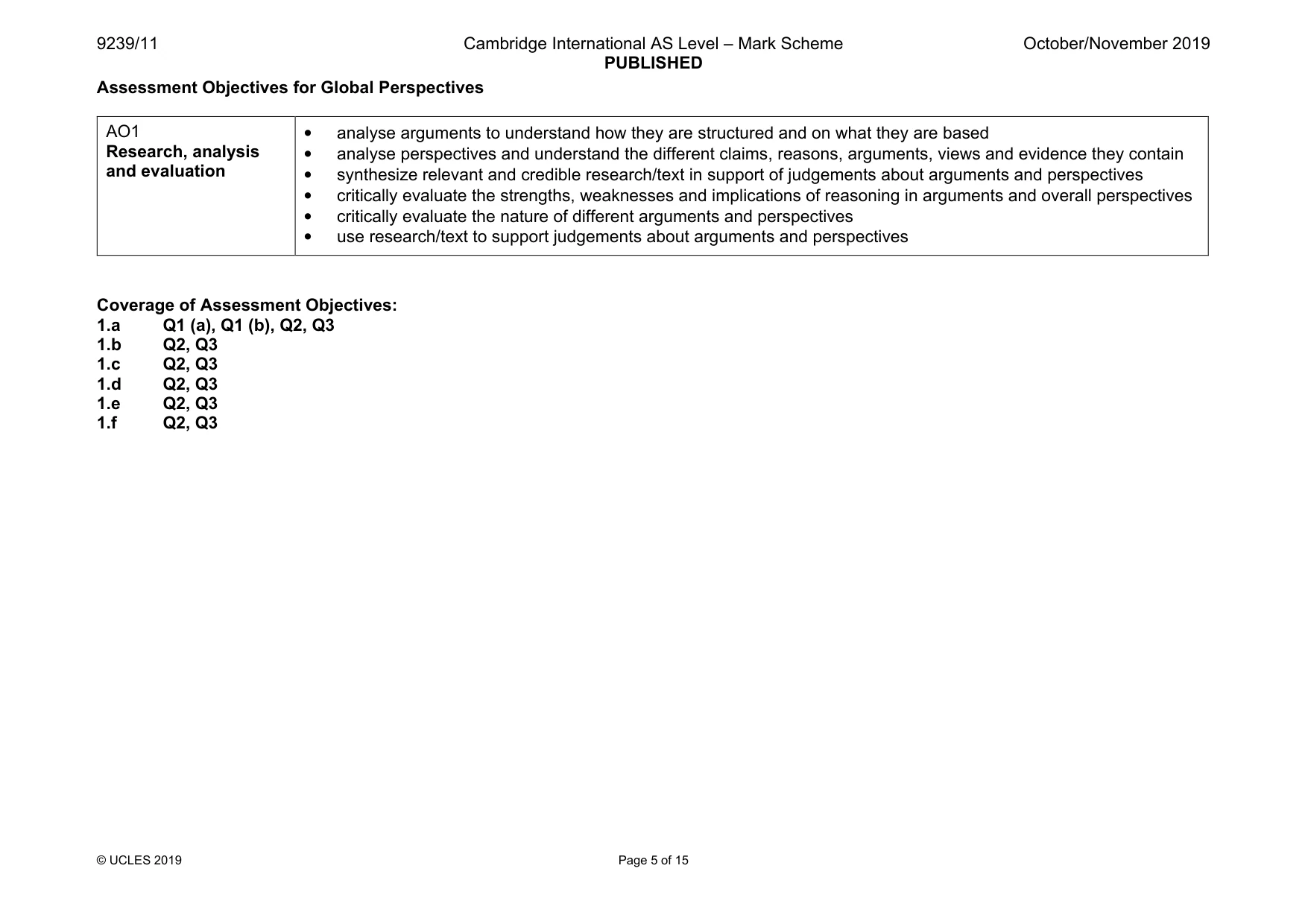
9239/11 Cambridge International AS Level – Mark Scheme PUBLISHED October/November 2019 © UCLES 2019 Page 5 of 15 Assessment Objectives for Global Perspectives AO1 Research, analysis and evaluation • analyse arguments to understand how they are structured and on what they are based • analyse perspectives and understand the different claims, reasons, arguments, views and evidence they contain • synthesize relevant and credible research/text in support of judgements about arguments and perspectives • critically evaluate the strengths, weaknesses and implications of reasoning in arguments and overall perspectives • critically evaluate the nature of different arguments and perspectives • use research/text to support judgements about arguments and perspectives Coverage of Assessment Objectives: 1.a Q1 (a), Q1 (b), Q2, Q3 1.b Q2, Q3 1.c Q2, Q3 1.d Q2, Q3 1.e Q2, Q3 1.f Q2, Q3
Mark scheme, page 6
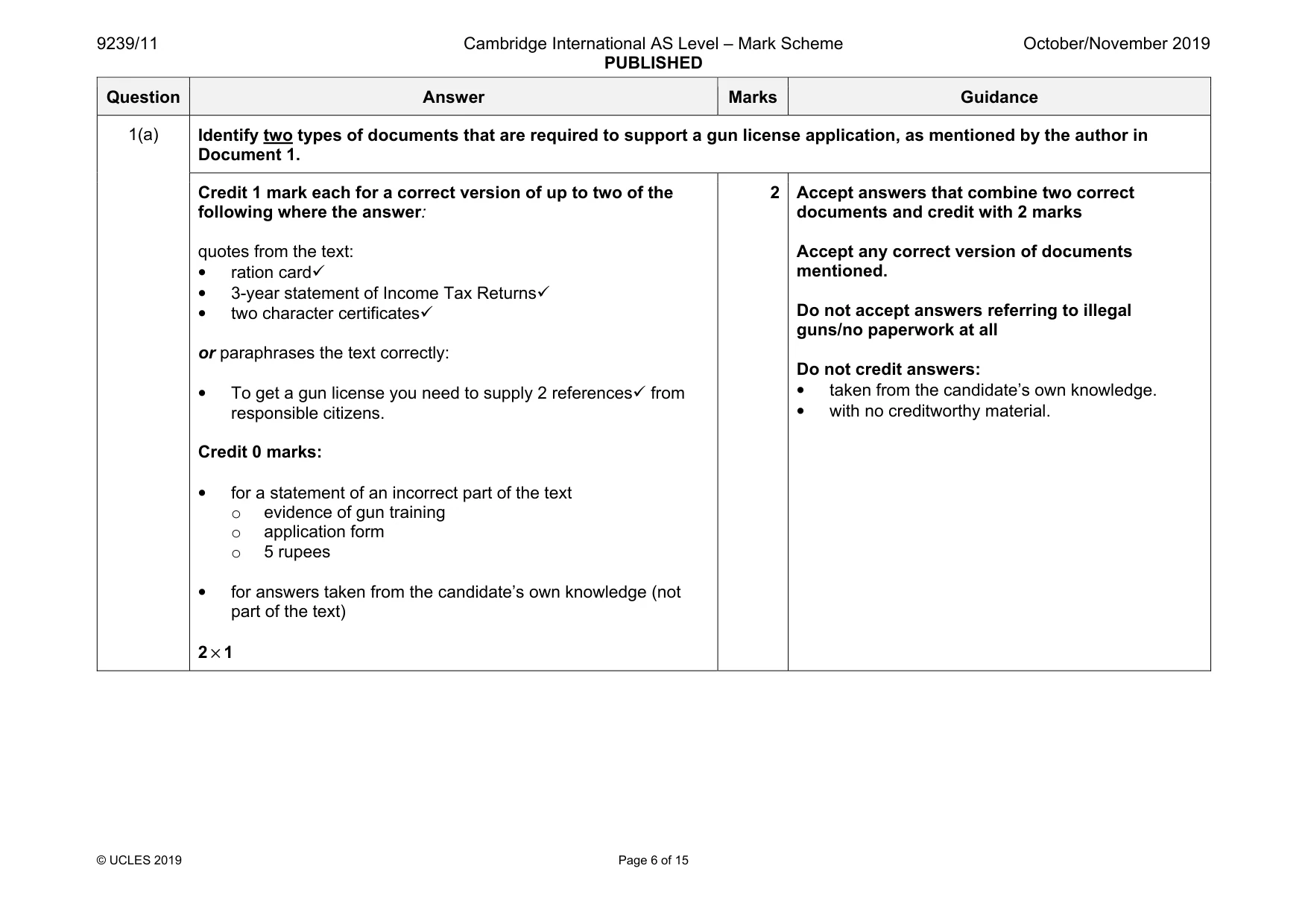
9239/11 Cambridge International AS Level – Mark Scheme PUBLISHED October/November 2019 © UCLES 2019 Page 6 of 15 Question Answer Marks Guidance 1(a) Identify two types of documents that are required to support a gun license application, as mentioned by the author in Document 1. Credit 1 mark each for a correct version of up to two of the following where the answer: quotes from the text: • ration card9 • 3-year statement of Income Tax Returns9 • two character certificates9 or paraphrases the text correctly: • To get a gun license you need to supply 2 references9 from responsible citizens. Credit 0 marks: • for a statement of an incorrect part of the text o evidence of gun training o application form o 5 rupees • for answers taken from the candidate’s own knowledge (not part of the text) 2 × 1 2 Accept answers that combine two correct documents and credit with 2 marks Accept any correct version of documents mentioned. Do not accept answers referring to illegal guns/no paperwork at all Do not credit answers: • taken from the candidate’s own knowledge. • with no creditworthy material.
Mark scheme, page 7
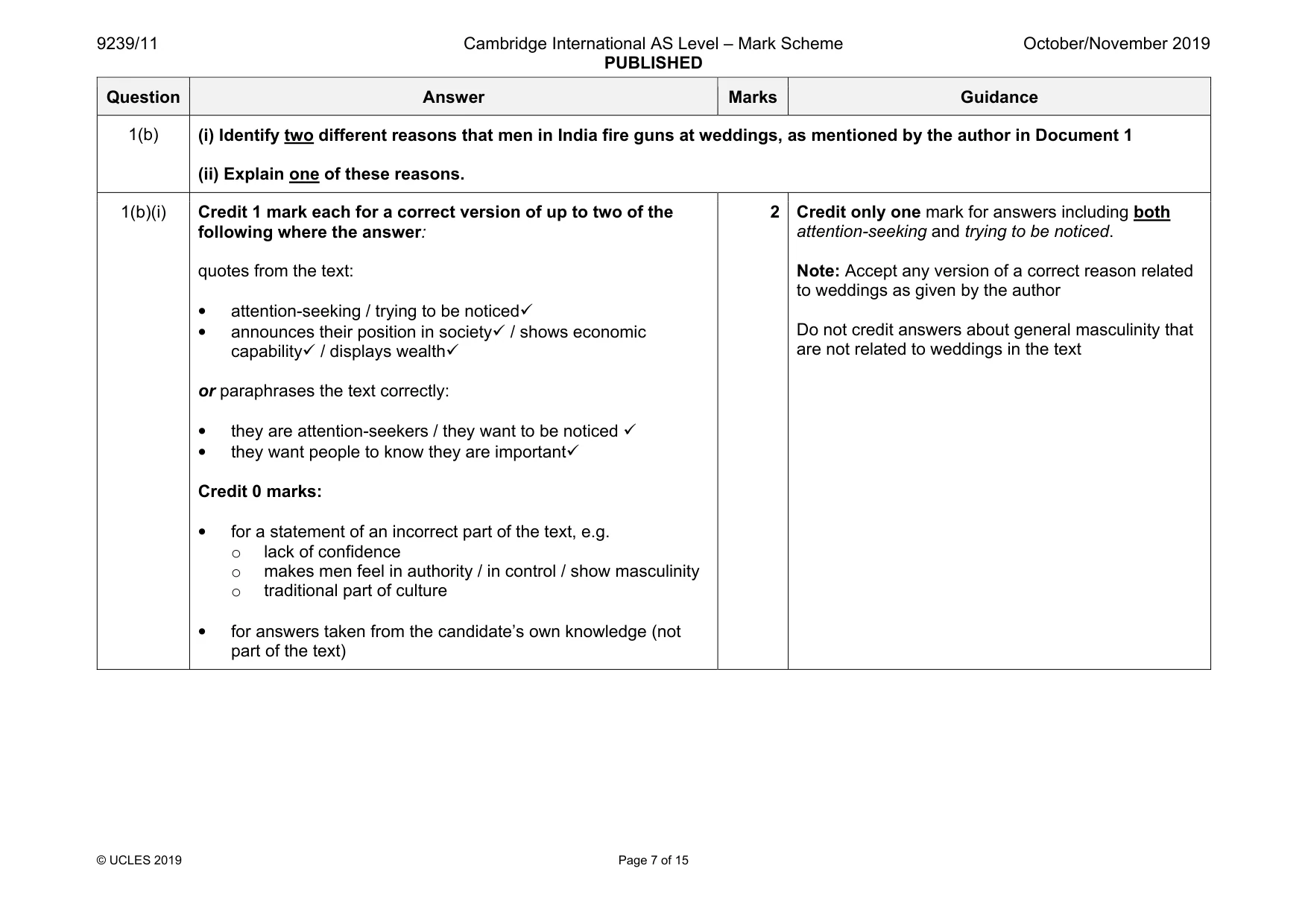
9239/11 Cambridge International AS Level – Mark Scheme PUBLISHED October/November 2019 © UCLES 2019 Page 7 of 15 Question Answer Marks Guidance 1(b) (i) Identify two different reasons that men in India fire guns at weddings, as mentioned by the author in Document 1 (ii) Explain one of these reasons. 1(b)(i) Credit 1 mark each for a correct version of up to two of the following where the answer: quotes from the text: • attention-seeking / trying to be noticed9 • announces their position in society9 / shows economic capability9 / displays wealth9 or paraphrases the text correctly: • they are attention-seekers / they want to be noticed 9 • they want people to know they are important9 Credit 0 marks: • for a statement of an incorrect part of the text, e.g. o lack of confidence o makes men feel in authority / in control / show masculinity o traditional part of culture • for answers taken from the candidate’s own knowledge (not part of the text) 2 Credit only one mark for answers including both attention-seeking and trying to be noticed. Note: Accept any version of a correct reason related to weddings as given by the author Do not credit answers about general masculinity that are not related to weddings in the text
Mark scheme, page 8
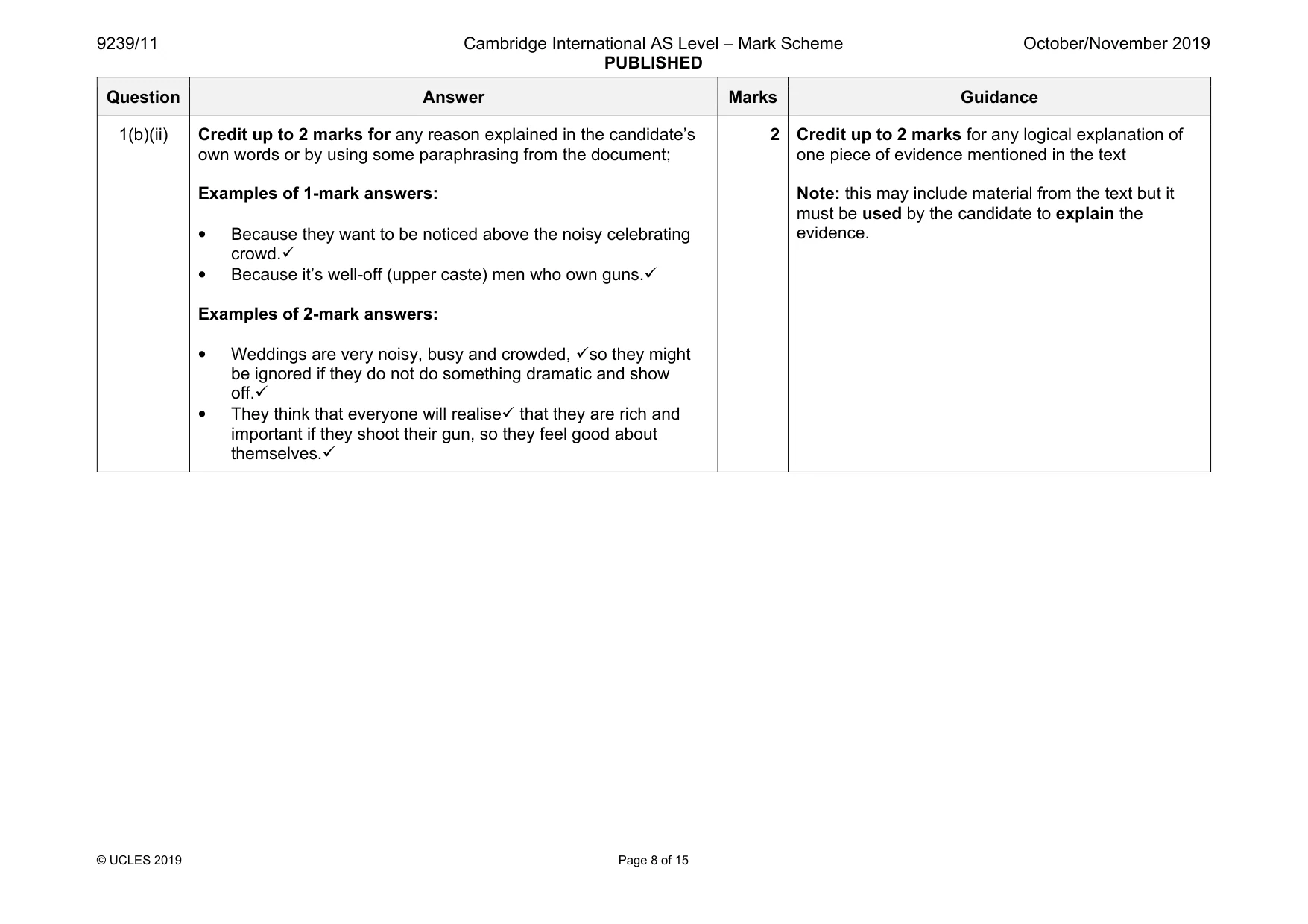
9239/11 Cambridge International AS Level – Mark Scheme PUBLISHED October/November 2019 © UCLES 2019 Page 8 of 15 Question Answer Marks Guidance 1(b)(ii) Credit up to 2 marks for any reason explained in the candidate’s own words or by using some paraphrasing from the document; Examples of 1-mark answers: • Because they want to be noticed above the noisy celebrating crowd.9 • Because it’s well-off (upper caste) men who own guns.9 Examples of 2-mark answers: • Weddings are very noisy, busy and crowded, 9so they might be ignored if they do not do something dramatic and show off.9 • They think that everyone will realise9 that they are rich and important if they shoot their gun, so they feel good about themselves.9 2 Credit up to 2 marks for any logical explanation of one piece of evidence mentioned in the text Note: this may include material from the text but it must be used by the candidate to explain the evidence.
Mark scheme, page 9
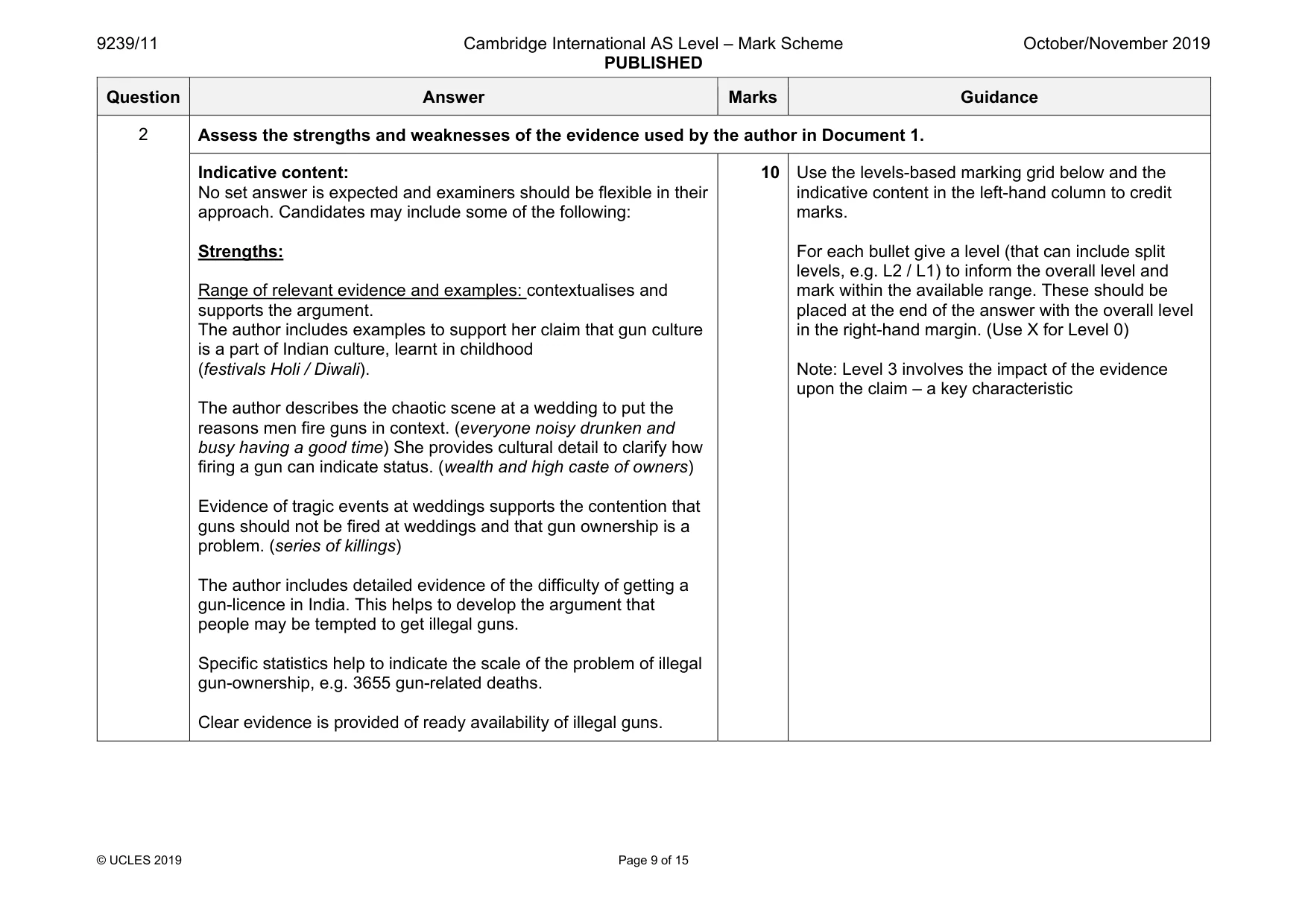
9239/11 Cambridge International AS Level – Mark Scheme PUBLISHED October/November 2019 © UCLES 2019 Page 9 of 15 Question Answer Marks Guidance 2 Assess the strengths and weaknesses of the evidence used by the author in Document 1. Indicative content: No set answer is expected and examiners should be flexible in their approach. Candidates may include some of the following: Strengths: Range of relevant evidence and examples: contextualises and supports the argument. The author includes examples to support her claim that gun culture is a part of Indian culture, learnt in childhood (festivals Holi / Diwali). The author describes the chaotic scene at a wedding to put the reasons men fire guns in context. (everyone noisy drunken and busy having a good time) She provides cultural detail to clarify how firing a gun can indicate status. (wealth and high caste of owners) Evidence of tragic events at weddings supports the contention that guns should not be fired at weddings and that gun ownership is a problem. (series of killings) The author includes detailed evidence of the difficulty of getting a gun-licence in India. This helps to develop the argument that people may be tempted to get illegal guns. Specific statistics help to indicate the scale of the problem of illegal gun-ownership, e.g. 3655 gun-related deaths. Clear evidence is provided of ready availability of illegal guns. 10 Use the levels-based marking grid below and the indicative content in the left-hand column to credit marks. For each bullet give a level (that can include split levels, e.g. L2 / L1) to inform the overall level and mark within the available range. These should be placed at the end of the answer with the overall level in the right-hand margin. (Use X for Level 0) Note: Level 3 involves the impact of the evidence upon the claim – a key characteristic
Mark scheme, page 10
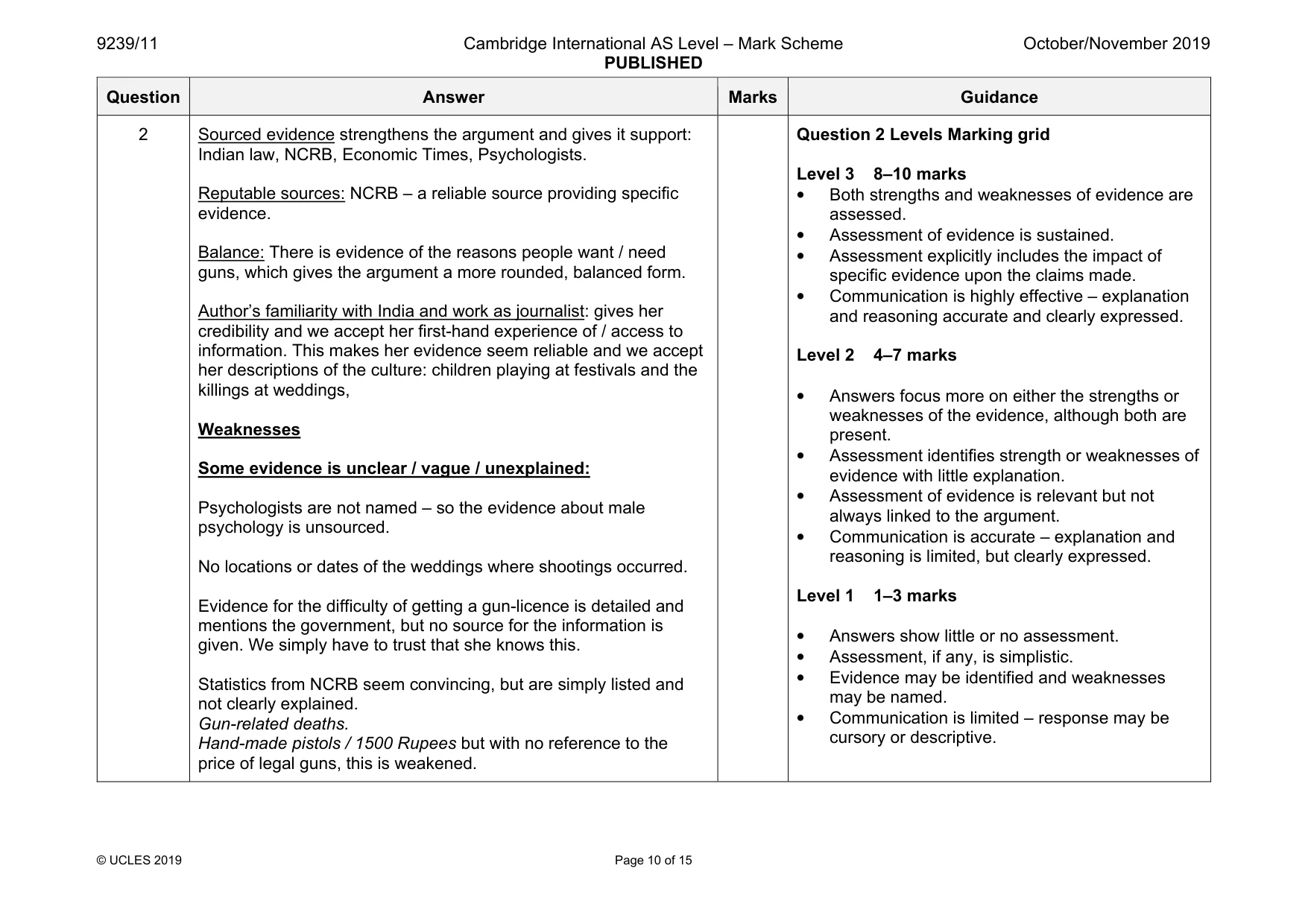
9239/11 Cambridge International AS Level – Mark Scheme PUBLISHED October/November 2019 © UCLES 2019 Page 10 of 15 Question Answer Marks Guidance 2 Sourced evidence strengthens the argument and gives it support: Indian law, NCRB, Economic Times, Psychologists. Reputable sources: NCRB – a reliable source providing specific evidence. Balance: There is evidence of the reasons people want / need guns, which gives the argument a more rounded, balanced form. Author’s familiarity with India and work as journalist: gives her credibility and we accept her first-hand experience of / access to information. This makes her evidence seem reliable and we accept her descriptions of the culture: children playing at festivals and the killings at weddings, Weaknesses Some evidence is unclear / vague / unexplained: Psychologists are not named – so the evidence about male psychology is unsourced. No locations or dates of the weddings where shootings occurred. Evidence for the difficulty of getting a gun-licence is detailed and mentions the government, but no source for the information is given. We simply have to trust that she knows this. Statistics from NCRB seem convincing, but are simply listed and not clearly explained. Gun-related deaths. Hand-made pistols / 1500 Rupees but with no reference to the price of legal guns, this is weakened. Question 2 Levels Marking grid Level 3 8–10 marks • Both strengths and weaknesses of evidence are assessed. • Assessment of evidence is sustained. • Assessment explicitly includes the impact of specific evidence upon the claims made. • Communication is highly effective – explanation and reasoning accurate and clearly expressed. Level 2 4–7 marks • Answers focus more on either the strengths or weaknesses of the evidence, although both are present. • Assessment identifies strength or weaknesses of evidence with little explanation. • Assessment of evidence is relevant but not always linked to the argument. • Communication is accurate – explanation and reasoning is limited, but clearly expressed. Level 1 1–3 marks • Answers show little or no assessment. • Assessment, if any, is simplistic. • Evidence may be identified and weaknesses may be named. • Communication is limited – response may be cursory or descriptive.
Mark scheme, page 11
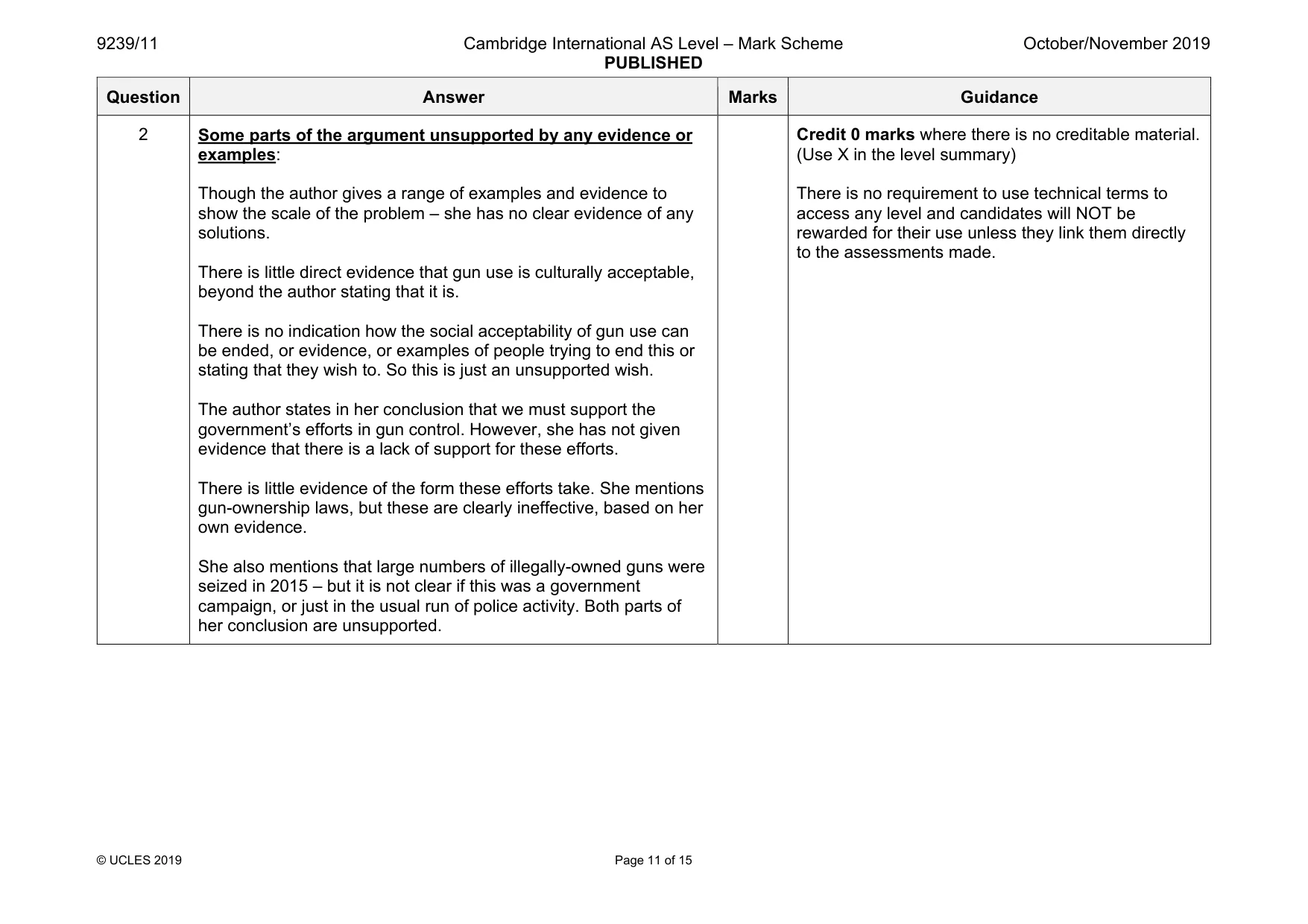
9239/11 Cambridge International AS Level – Mark Scheme PUBLISHED October/November 2019 © UCLES 2019 Page 11 of 15 Question Answer Marks Guidance 2 Some parts of the argument unsupported by any evidence or examples: Though the author gives a range of examples and evidence to show the scale of the problem – she has no clear evidence of any solutions. There is little direct evidence that gun use is culturally acceptable, beyond the author stating that it is. There is no indication how the social acceptability of gun use can be ended, or evidence, or examples of people trying to end this or stating that they wish to. So this is just an unsupported wish. The author states in her conclusion that we must support the government’s efforts in gun control. However, she has not given evidence that there is a lack of support for these efforts. There is little evidence of the form these efforts take. She mentions gun-ownership laws, but these are clearly ineffective, based on her own evidence. She also mentions that large numbers of illegally-owned guns were seized in 2015 – but it is not clear if this was a government campaign, or just in the usual run of police activity. Both parts of her conclusion are unsupported. Credit 0 marks where there is no creditable material. (Use X in the level summary) There is no requirement to use technical terms to access any level and candidates will NOT be rewarded for their use unless they link them directly to the assessments made.
Mark scheme, page 12
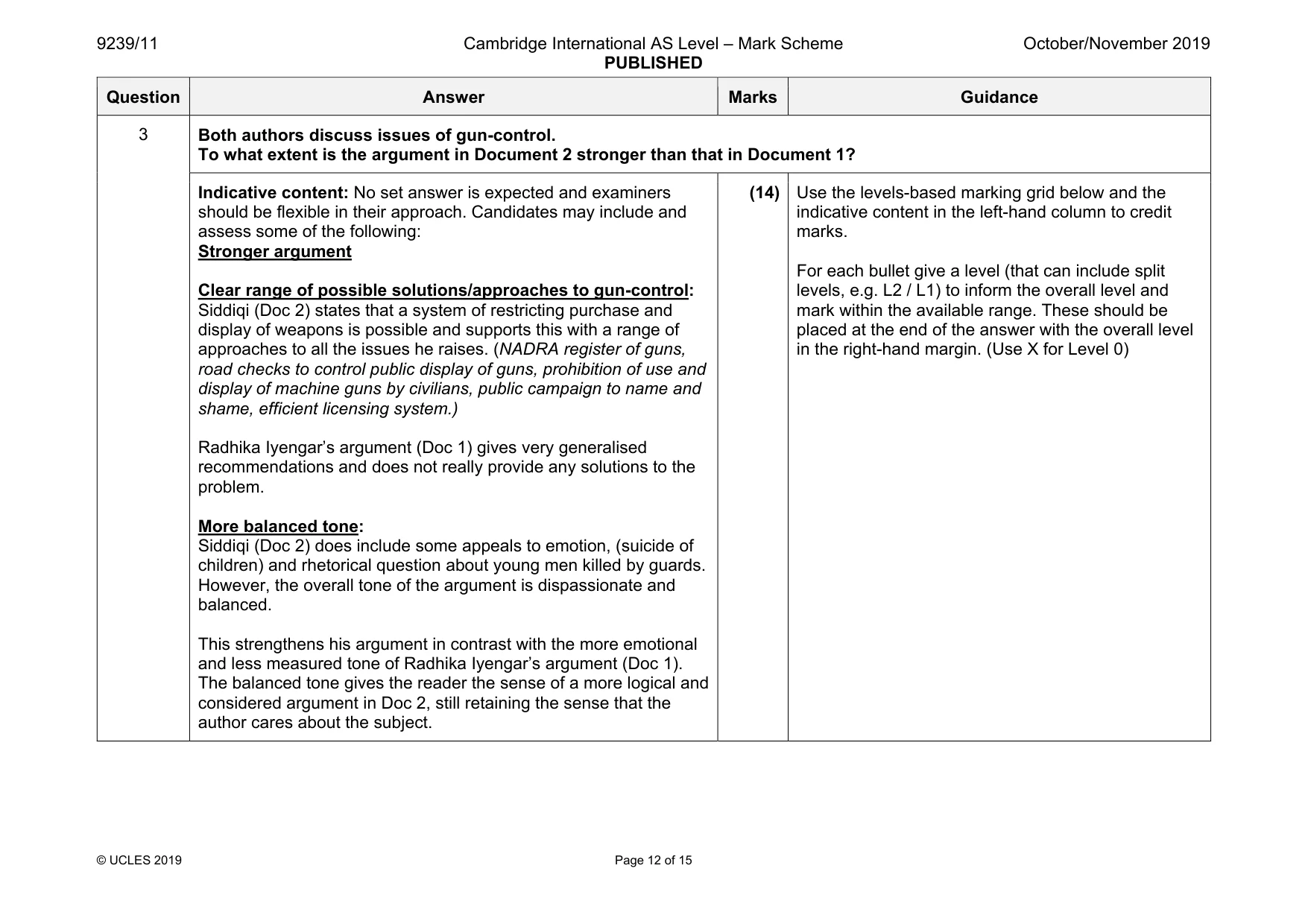
9239/11 Cambridge International AS Level – Mark Scheme PUBLISHED October/November 2019 © UCLES 2019 Page 12 of 15 Question Answer Marks Guidance 3 Both authors discuss issues of gun-control. To what extent is the argument in Document 2 stronger than that in Document 1? Indicative content: No set answer is expected and examiners should be flexible in their approach. Candidates may include and assess some of the following: Stronger argument Clear range of possible solutions/approaches to gun-control: Siddiqi (Doc 2) states that a system of restricting purchase and display of weapons is possible and supports this with a range of approaches to all the issues he raises. (NADRA register of guns, road checks to control public display of guns, prohibition of use and display of machine guns by civilians, public campaign to name and shame, efficient licensing system.) Radhika Iyengar’s argument (Doc 1) gives very generalised recommendations and does not really provide any solutions to the problem. More balanced tone: Siddiqi (Doc 2) does include some appeals to emotion, (suicide of children) and rhetorical question about young men killed by guards. However, the overall tone of the argument is dispassionate and balanced. This strengthens his argument in contrast with the more emotional and less measured tone of Radhika Iyengar’s argument (Doc 1). The balanced tone gives the reader the sense of a more logical and considered argument in Doc 2, still retaining the sense that the author cares about the subject. (14) Use the levels-based marking grid below and the indicative content in the left-hand column to credit marks. For each bullet give a level (that can include split levels, e.g. L2 / L1) to inform the overall level and mark within the available range. These should be placed at the end of the answer with the overall level in the right-hand margin. (Use X for Level 0)
Mark scheme, page 13
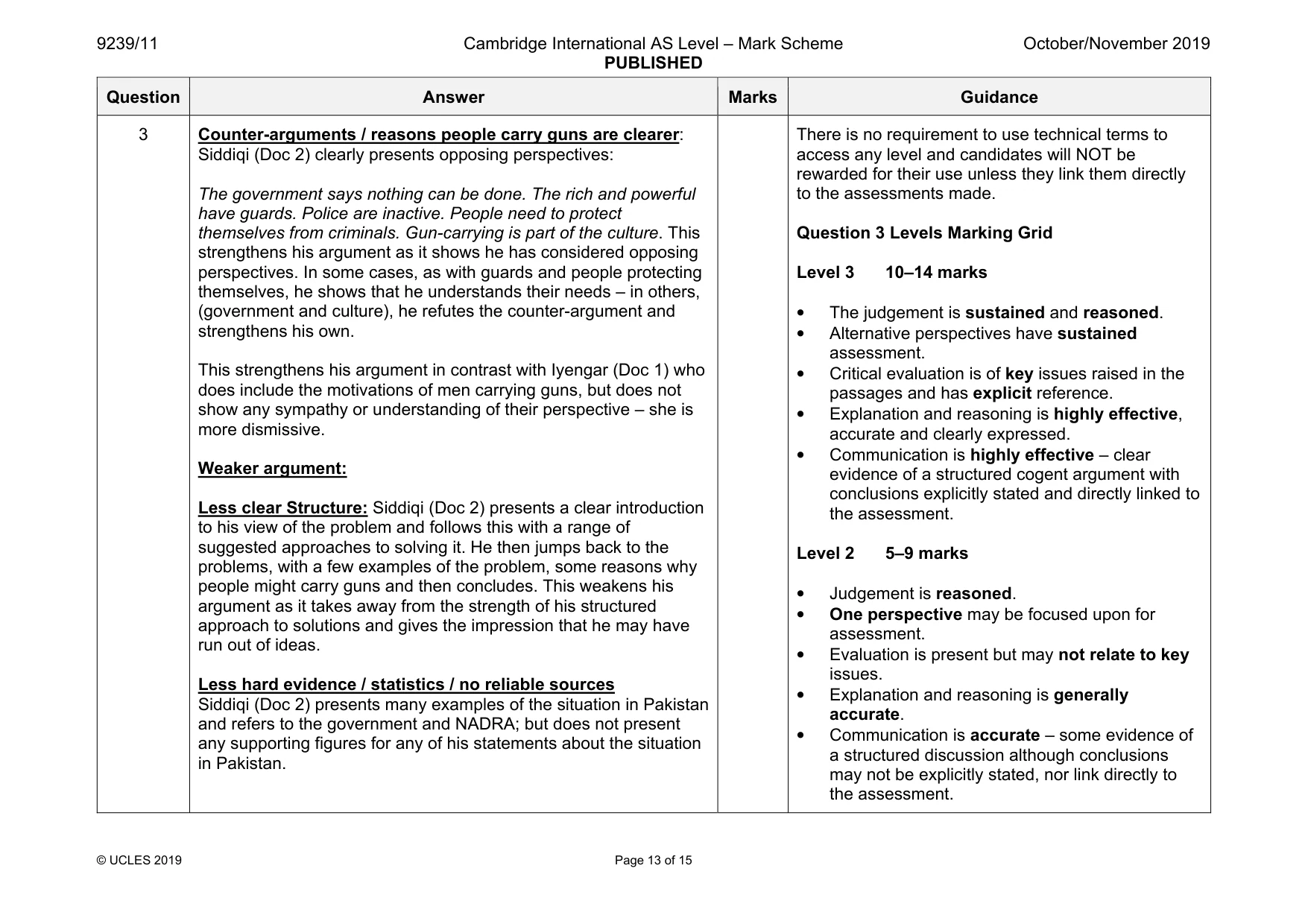
9239/11 Cambridge International AS Level – Mark Scheme PUBLISHED October/November 2019 © UCLES 2019 Page 13 of 15 Question Answer Marks Guidance 3 Counter-arguments / reasons people carry guns are clearer: Siddiqi (Doc 2) clearly presents opposing perspectives: The government says nothing can be done. The rich and powerful have guards. Police are inactive. People need to protect themselves from criminals. Gun-carrying is part of the culture. This strengthens his argument as it shows he has considered opposing perspectives. In some cases, as with guards and people protecting themselves, he shows that he understands their needs – in others, (government and culture), he refutes the counter-argument and strengthens his own. This strengthens his argument in contrast with Iyengar (Doc 1) who does include the motivations of men carrying guns, but does not show any sympathy or understanding of their perspective – she is more dismissive. Weaker argument: Less clear Structure: Siddiqi (Doc 2) presents a clear introduction to his view of the problem and follows this with a range of suggested approaches to solving it. He then jumps back to the problems, with a few examples of the problem, some reasons why people might carry guns and then concludes. This weakens his argument as it takes away from the strength of his structured approach to solutions and gives the impression that he may have run out of ideas. Less hard evidence / statistics / no reliable sources Siddiqi (Doc 2) presents many examples of the situation in Pakistan and refers to the government and NADRA; but does not present any supporting figures for any of his statements about the situation in Pakistan. There is no requirement to use technical terms to access any level and candidates will NOT be rewarded for their use unless they link them directly to the assessments made. Question 3 Levels Marking Grid Level 3 10–14 marks • The judgement is sustained and reasoned. • Alternative perspectives have sustained assessment. • Critical evaluation is of key issues raised in the passages and has explicit reference. • Explanation and reasoning is highly effective, accurate and clearly expressed. • Communication is highly effective – clear evidence of a structured cogent argument with conclusions explicitly stated and directly linked to the assessment. Level 2 5–9 marks • Judgement is reasoned. • One perspective may be focused upon for assessment. • Evaluation is present but may not relate to key issues. • Explanation and reasoning is generally accurate. • Communication is accurate – some evidence of a structured discussion although conclusions may not be explicitly stated, nor link directly to the assessment.
Mark scheme, page 14
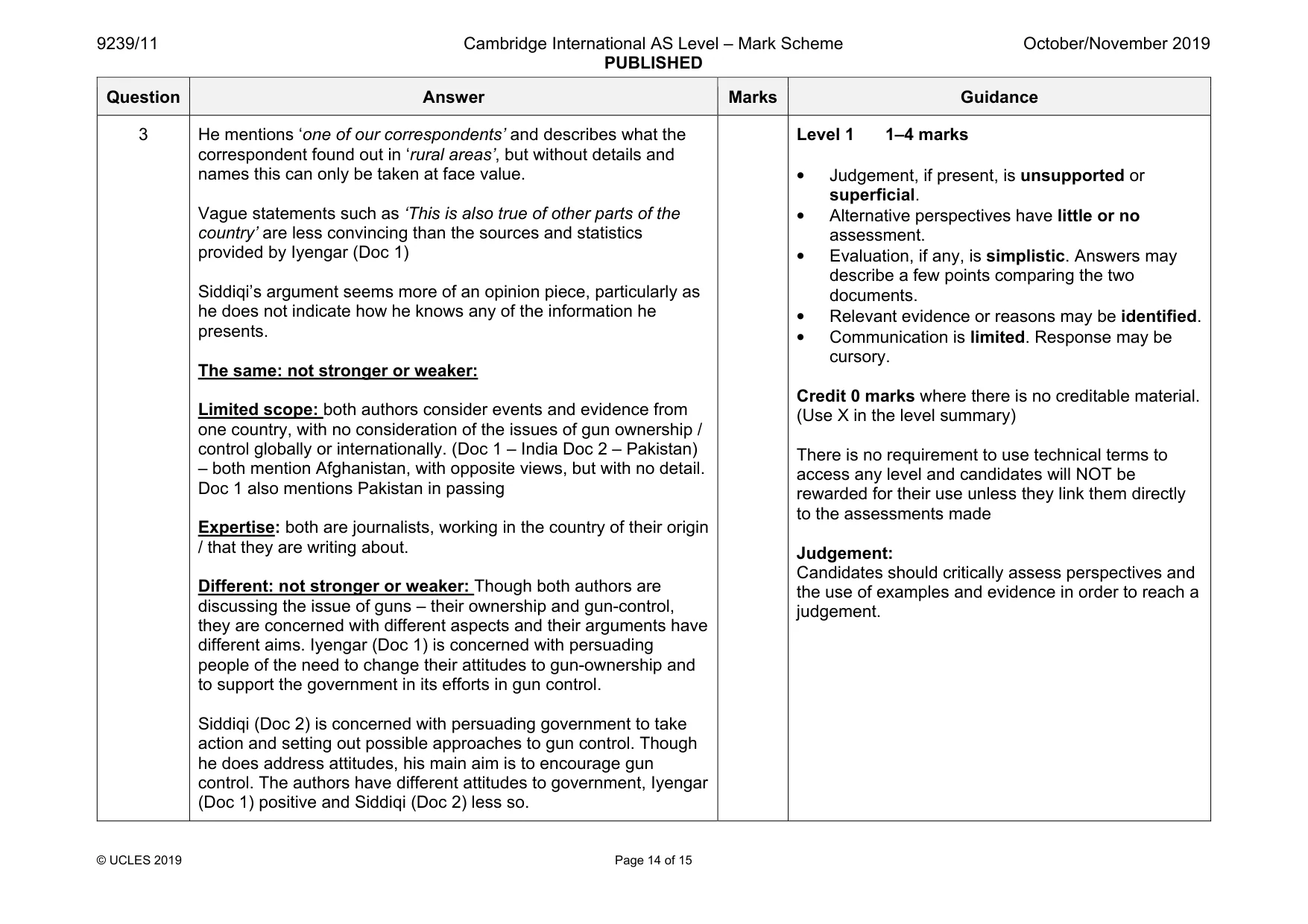
9239/11 Cambridge International AS Level – Mark Scheme PUBLISHED October/November 2019 © UCLES 2019 Page 14 of 15 Question Answer Marks Guidance 3 He mentions ‘one of our correspondents’ and describes what the correspondent found out in ‘rural areas’, but without details and names this can only be taken at face value. Vague statements such as ‘This is also true of other parts of the country’ are less convincing than the sources and statistics provided by Iyengar (Doc 1) Siddiqi’s argument seems more of an opinion piece, particularly as he does not indicate how he knows any of the information he presents. The same: not stronger or weaker: Limited scope: both authors consider events and evidence from one country, with no consideration of the issues of gun ownership / control globally or internationally. (Doc 1 – India Doc 2 – Pakistan) – both mention Afghanistan, with opposite views, but with no detail. Doc 1 also mentions Pakistan in passing Expertise: both are journalists, working in the country of their origin / that they are writing about. Different: not stronger or weaker: Though both authors are discussing the issue of guns – their ownership and gun-control, they are concerned with different aspects and their arguments have different aims. Iyengar (Doc 1) is concerned with persuading people of the need to change their attitudes to gun-ownership and to support the government in its efforts in gun control. Siddiqi (Doc 2) is concerned with persuading government to take action and setting out possible approaches to gun control. Though he does address attitudes, his main aim is to encourage gun control. The authors have different attitudes to government, Iyengar (Doc 1) positive and Siddiqi (Doc 2) less so. Level 1 1–4 marks • Judgement, if present, is unsupported or superficial. • Alternative perspectives have little or no assessment. • Evaluation, if any, is simplistic. Answers may describe a few points comparing the two documents. • Relevant evidence or reasons may be identified. • Communication is limited. Response may be cursory. Credit 0 marks where there is no creditable material. (Use X in the level summary) There is no requirement to use technical terms to access any level and candidates will NOT be rewarded for their use unless they link them directly to the assessments made Judgement: Candidates should critically assess perspectives and the use of examples and evidence in order to reach a judgement.
Mark scheme, page 15
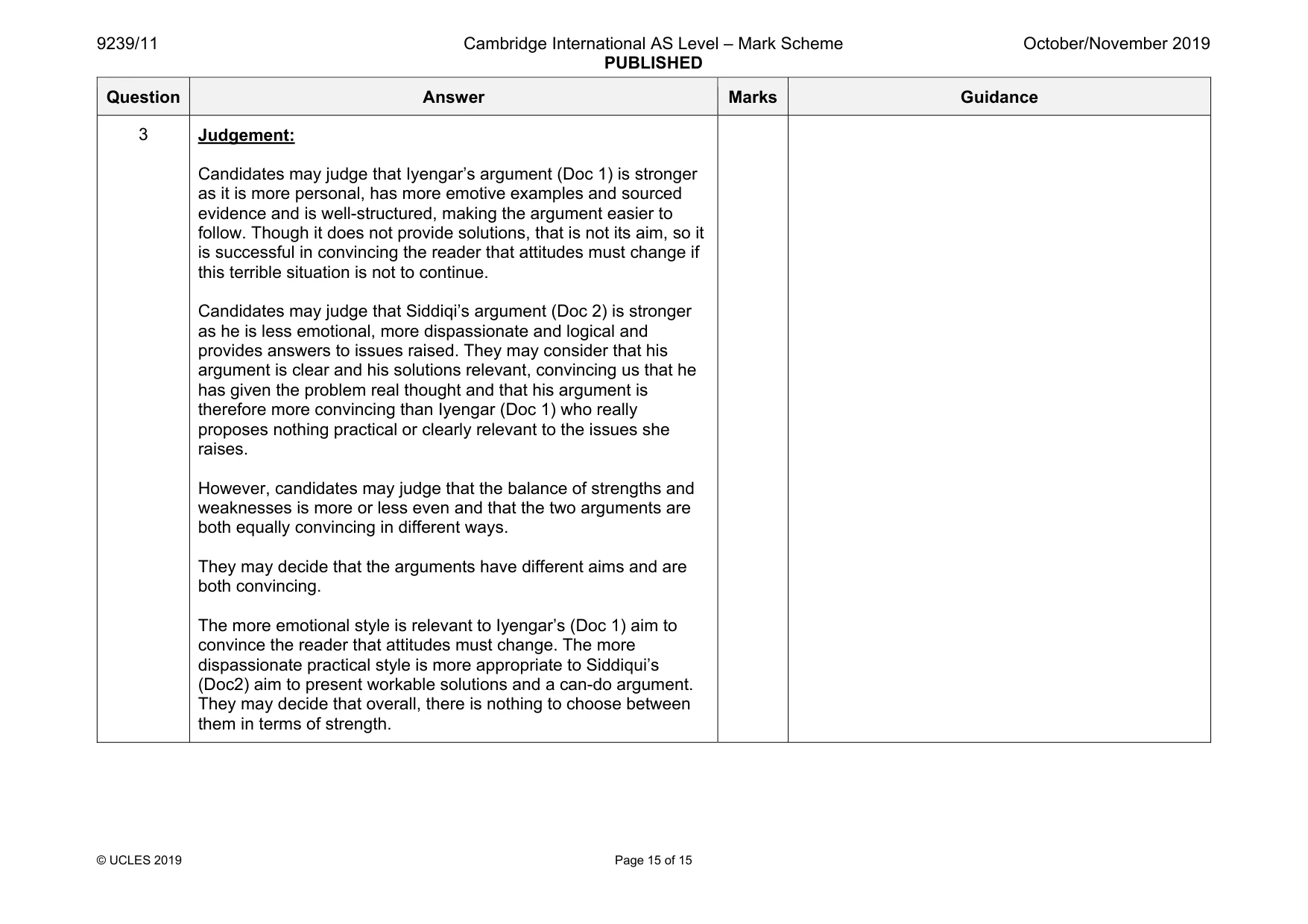
9239/11 Cambridge International AS Level – Mark Scheme PUBLISHED October/November 2019 © UCLES 2019 Page 15 of 15 Question Answer Marks Guidance 3 Judgement: Candidates may judge that Iyengar’s argument (Doc 1) is stronger as it is more personal, has more emotive examples and sourced evidence and is well-structured, making the argument easier to follow. Though it does not provide solutions, that is not its aim, so it is successful in convincing the reader that attitudes must change if this terrible situation is not to continue. Candidates may judge that Siddiqi’s argument (Doc 2) is stronger as he is less emotional, more dispassionate and logical and provides answers to issues raised. They may consider that his argument is clear and his solutions relevant, convincing us that he has given the problem real thought and that his argument is therefore more convincing than Iyengar (Doc 1) who really proposes nothing practical or clearly relevant to the issues she raises. However, candidates may judge that the balance of strengths and weaknesses is more or less even and that the two arguments are both equally convincing in different ways. They may decide that the arguments have different aims and are both convincing. The more emotional style is relevant to Iyengar’s (Doc 1) aim to convince the reader that attitudes must change. The more dispassionate practical style is more appropriate to Siddiqui’s (Doc2) aim to present workable solutions and a can-do argument. They may decide that overall, there is nothing to choose between them in terms of strength.
What you needed in this session
Cambridge’s own grade thresholds for 2019 Oct/Nov, Paper 1 · Variant 1. A higher threshold means an easier paper — the bar moves with how the cohort did.