Cambridge A Level Global Perspectives and Research 9239 — 2015 May/June Paper 1 · Variant 1
9239/11/M/J/15 · 30 marks · ≈34 min
The question paper and its mark scheme, free to read here and free to download. This is Cambridge’s own paper, exactly as it was sat.
Question paper4 pages


Mark scheme9 pages
Answers below. Sit the paper first if you are practising.
Paper as text
Question paper, page 1
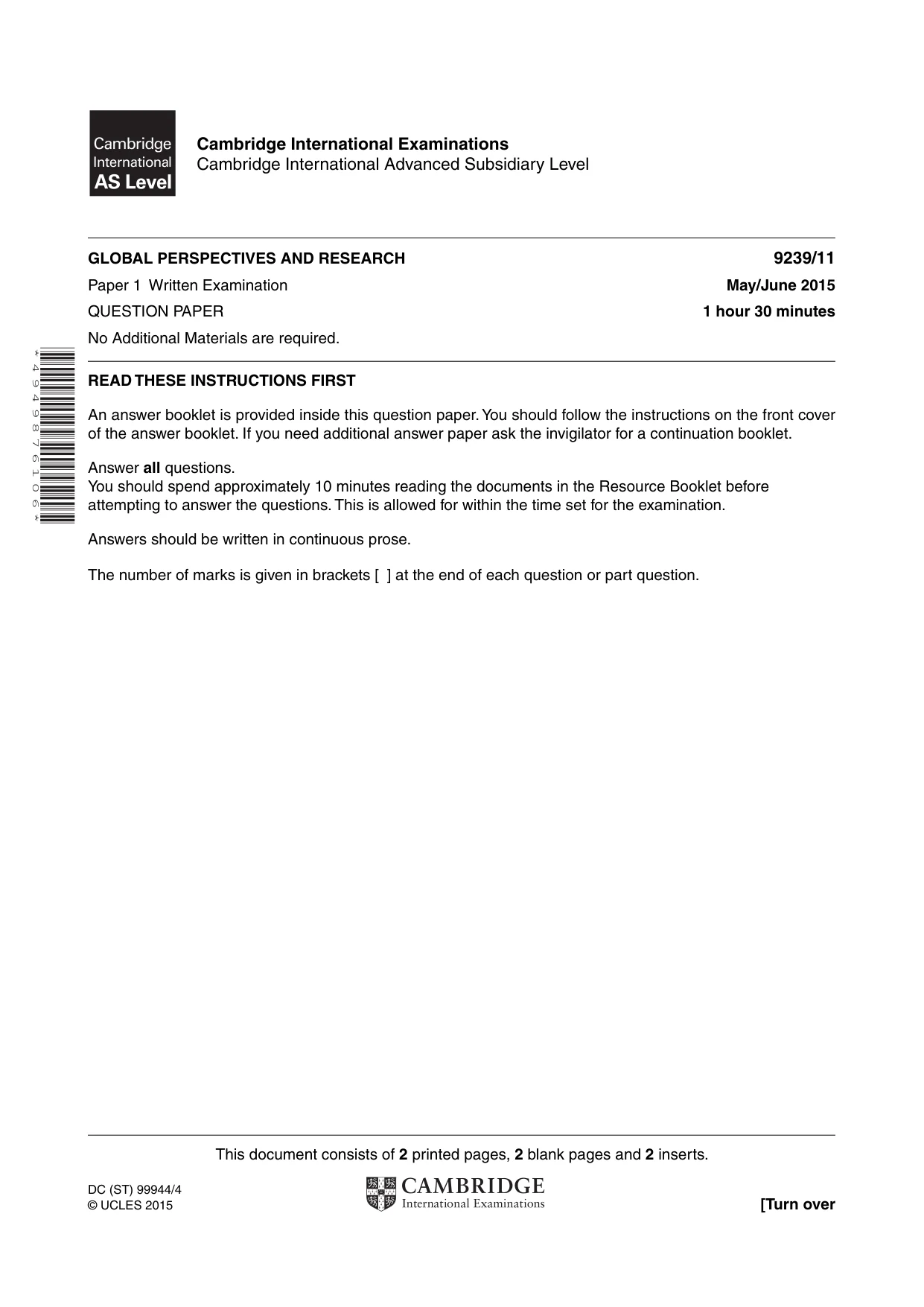
This document consists of 2 printed pages, 2 blank pages and 2 inserts. DC (ST) 99944/4 © UCLES 2015 [Turn over Cambridge International Examinations Cambridge International Advanced Subsidiary Level GLOBAL PERSPECTIVES AND RESEARCH 9239/11 Paper 1 Written Examination May/June 2015 QUESTION PAPER 1 hour 30 minutes No Additional Materials are required. READ THESE INSTRUCTIONS FIRST An answer booklet is provided inside this question paper. You should follow the instructions on the front cover of the answer booklet. If you need additional answer paper ask the invigilator for a continuation booklet. Answer all questions. You should spend approximately 10 minutes reading the documents in the Resource Booklet before attempting to answer the questions. This is allowed for within the time set for the examination. Answers should be written in continuous prose. The number of marks is given in brackets [ ] at the end of each question or part question. * 4 9 4 9 8 7 6 1 0 6 *
Question paper, page 2
2 9239/11/M/J/15 © UCLES 2015 Read the documents in the accompanying Resource Booklet and answer all the questions. Ethics and Economics of Food 1 Study Document 1. (a) Identify two ways from Document 1 in which the food and diet industry suggests that people can control their own weight. [2] (b) Explain why, according to the author, each of these two ways will not work. [4] 2 Study Document 1. How convincing is the evidence used in Document 1 against the claims made by the food and diet industry? In your answer you should consider the strengths and weaknesses of the evidence. [10] 3 Study Documents 1 and 2. To what extent is the author’s argument in Document 2 stronger than the author’s argument in Document 1? [14] [Total: 30]
Question paper, page 3
3 9239/11/M/J/15 © UCLES 2015 BLANK PAGE
Question paper, page 4
4 9239/11/M/J/15 © UCLES 2015 Permission to reproduce items where third-party owned material protected by copyright is included has been sought and cleared where possible. Every reasonable effort has been made by the publisher (UCLES) to trace copyright holders, but if any items requiring clearance have unwittingly been included, the publisher will be pleased to make amends at the earliest possible opportunity. To avoid the issue of disclosure of answer-related information to candidates, all copyright acknowledgements are reproduced online in the Cambridge International Examinations Copyright Acknowledgements Booklet. This is produced for each series of examinations and is freely available to download at www.cie.org.uk after the live examination series. Cambridge International Examinations is part of the Cambridge Assessment Group. Cambridge Assessment is the brand name of University of Cambridge Local Examinations Syndicate (UCLES), which is itself a department of the University of Cambridge. BLANK PAGE
Mark scheme, page 1
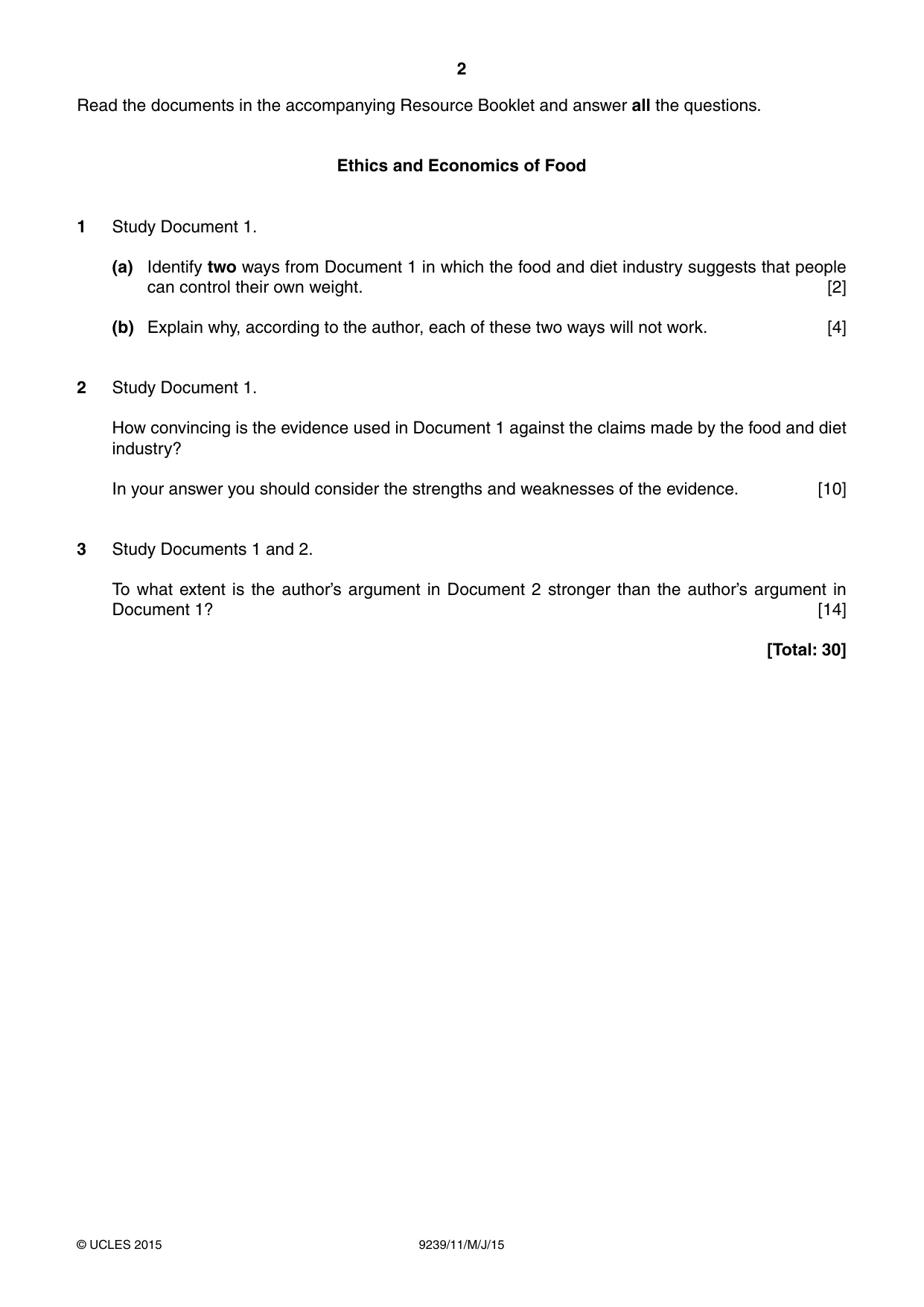
[Turn over Cambridge International Examinations Cambridge International Advanced Subsidiary Level GLOBAL PERSPECTIVES AND RESEARCH 9239/11 Paper 1 Written Examination May/June 2015 MARK SCHEME Maximum Mark: 30 IMPORTANT NOTICE Mark Schemes have been issued on the basis of one copy per Assistant examiner and two copies per Team Leader.
Mark scheme, page 2
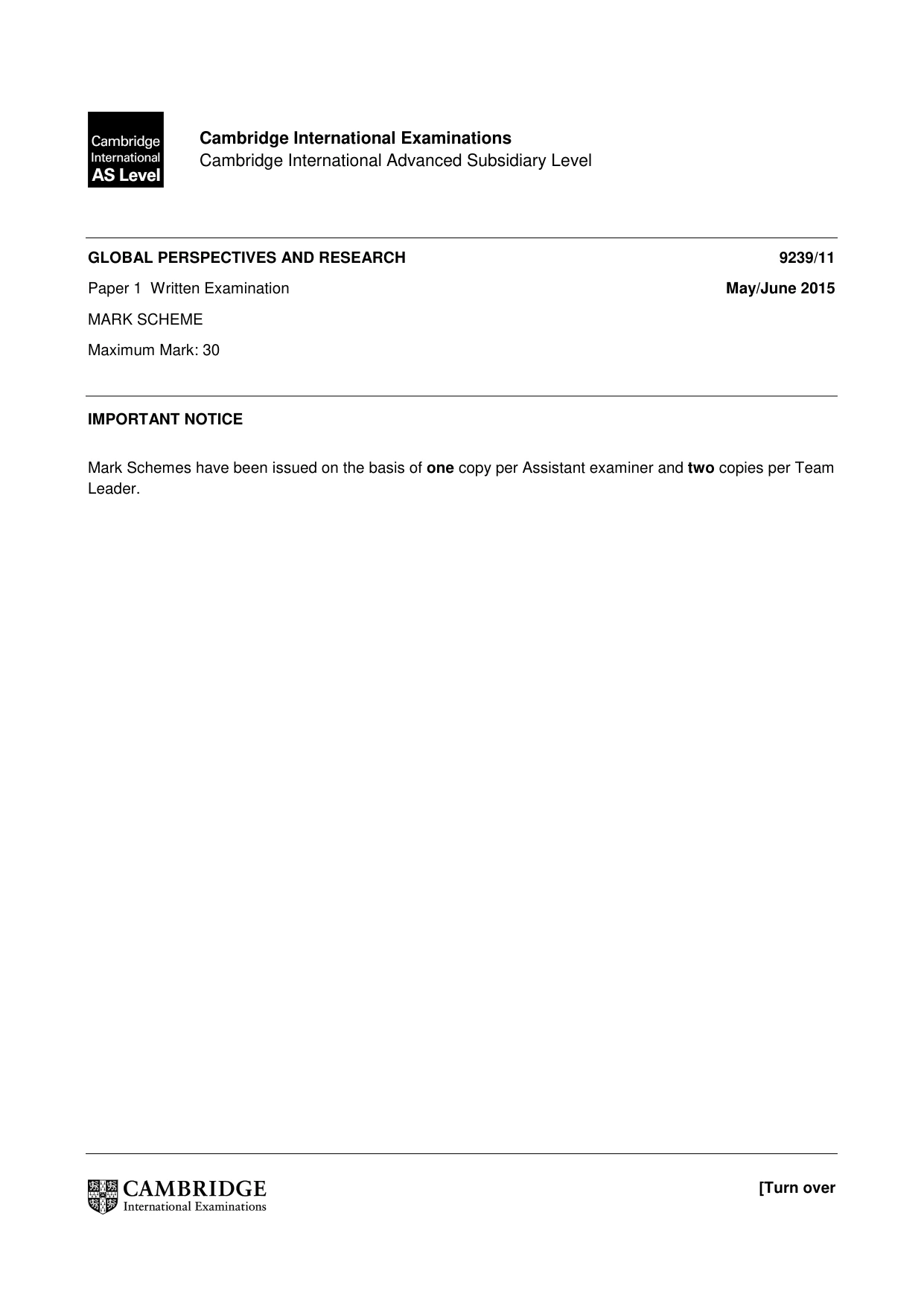
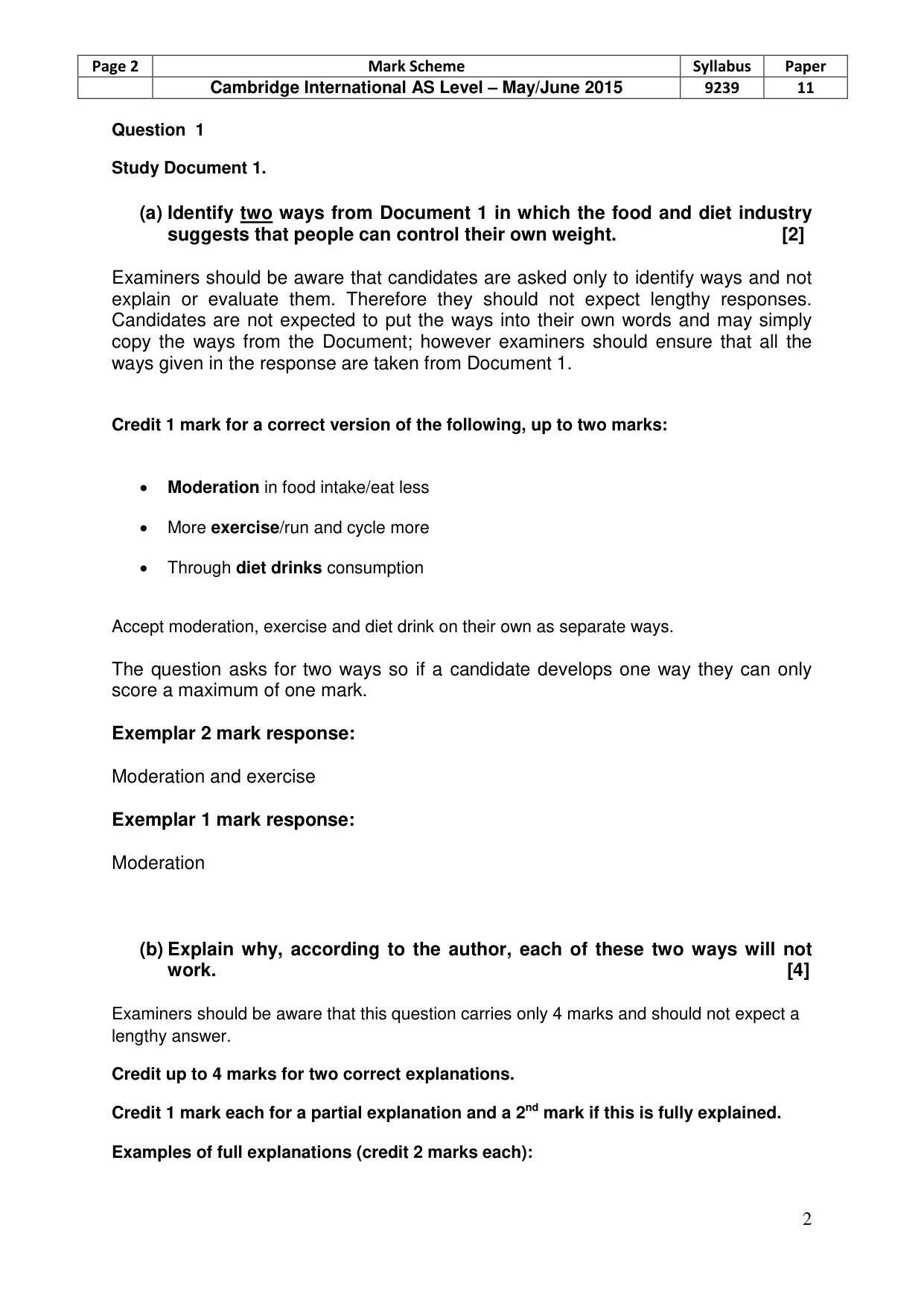
Page 2 Mark Scheme Syllabus Paper Cambridge International AS Level – May/June 2015 9239 11 2 Question 1 Study Document 1. (a) Identify two ways from Document 1 in which the food and diet industry suggests that people can control their own weight. [2] Examiners should be aware that candidates are asked only to identify ways and not explain or evaluate them. Therefore they should not expect lengthy responses. Candidates are not expected to put the ways into their own words and may simply copy the ways from the Document; however examiners should ensure that all the ways given in the response are taken from Document 1. Credit 1 mark for a correct version of the following, up to two marks: • Moderation in food intake/eat less • More exercise/run and cycle more • Through diet drinks consumption Accept moderation, exercise and diet drink on their own as separate ways. The question asks for two ways so if a candidate develops one way they can only score a maximum of one mark. Exemplar 2 mark response: Moderation and exercise Exemplar 1 mark response: Moderation (b) Explain why, according to the author, each of these two ways will not work. [4] Examiners should be aware that this question carries only 4 marks and should not expect a lengthy answer. Credit up to 4 marks for two correct explanations. Credit 1 mark each for a partial explanation and a 2nd mark if this is fully explained. Examples of full explanations (credit 2 marks each):
Mark scheme, page 3
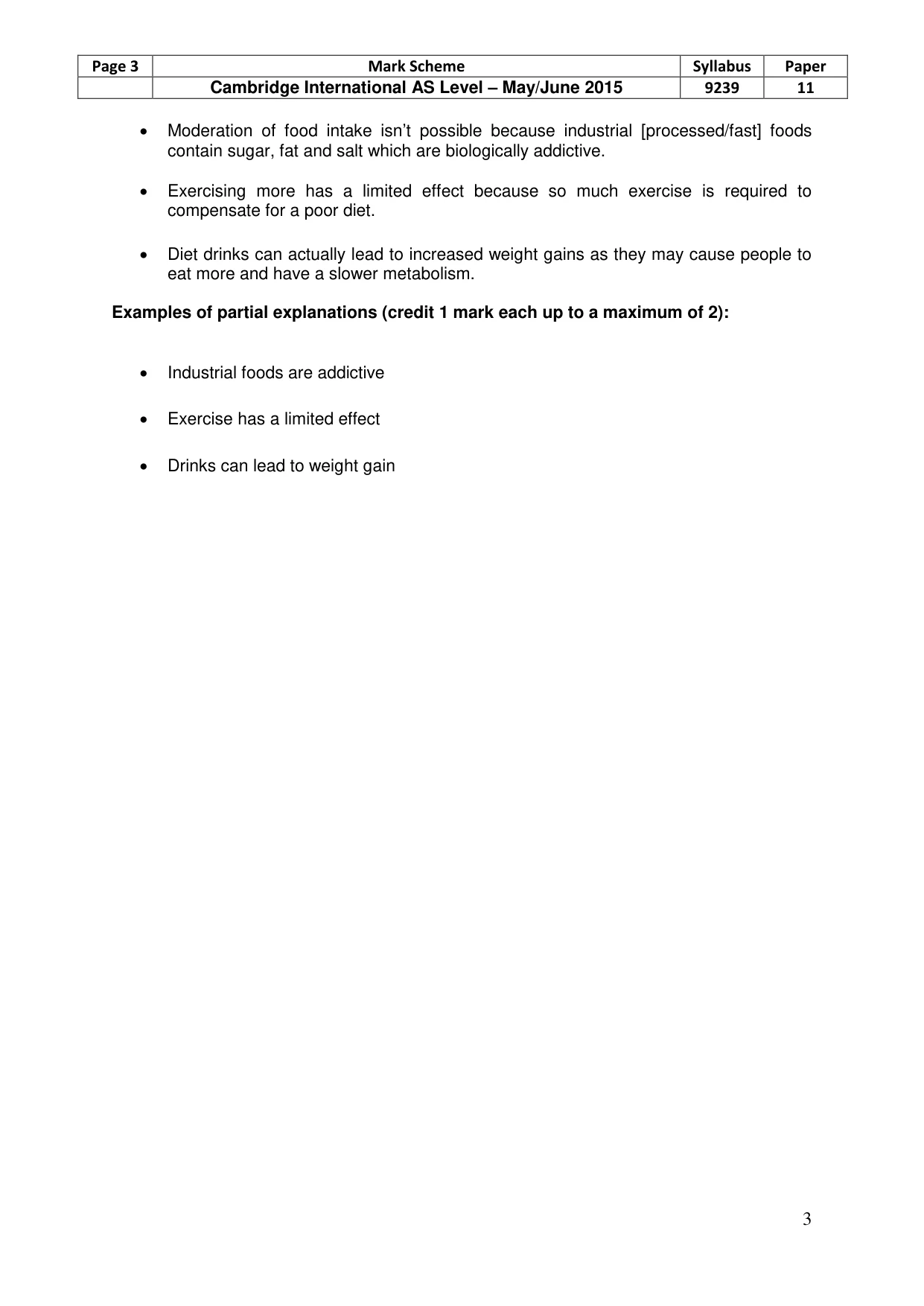
Page 3 Mark Scheme Syllabus Paper Cambridge International AS Level – May/June 2015 9239 11 3 • Moderation of food intake isn’t possible because industrial [processed/fast] foods contain sugar, fat and salt which are biologically addictive. • Exercising more has a limited effect because so much exercise is required to compensate for a poor diet. • Diet drinks can actually lead to increased weight gains as they may cause people to eat more and have a slower metabolism. Examples of partial explanations (credit 1 mark each up to a maximum of 2): • Industrial foods are addictive • Exercise has a limited effect • Drinks can lead to weight gain
Mark scheme, page 4
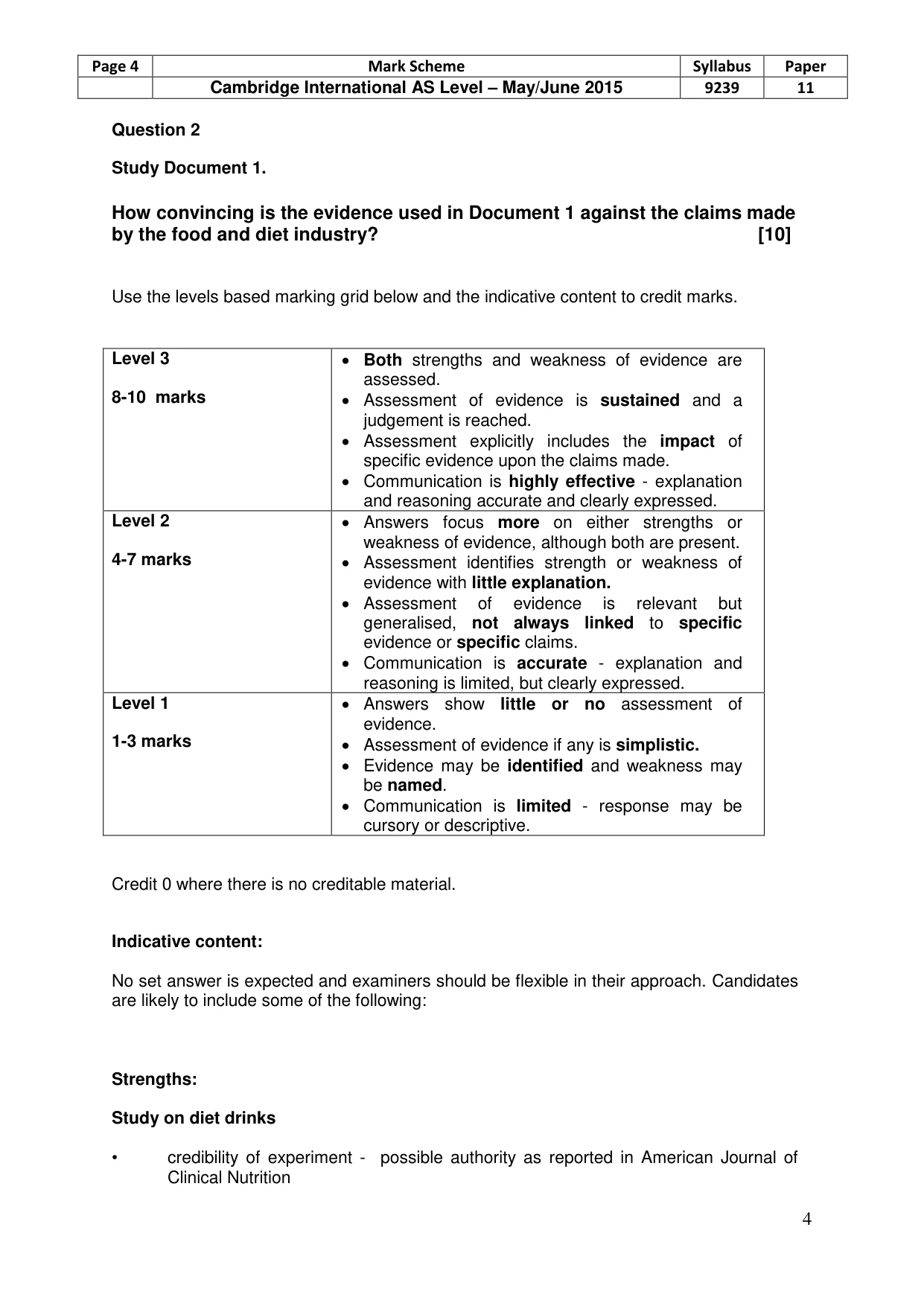
Page 4 Mark Scheme Syllabus Paper Cambridge International AS Level – May/June 2015 9239 11 4 Question 2 Study Document 1. How convincing is the evidence used in Document 1 against the claims made by the food and diet industry? [10] Use the levels based marking grid below and the indicative content to credit marks. Level 3 8-10 marks • Both strengths and weakness of evidence are assessed. • Assessment of evidence is sustained and a judgement is reached. • Assessment explicitly includes the impact of specific evidence upon the claims made. • Communication is highly effective - explanation and reasoning accurate and clearly expressed. Level 2 4-7 marks • Answers focus more on either strengths or weakness of evidence, although both are present. • Assessment identifies strength or weakness of evidence with little explanation. • Assessment of evidence is relevant but generalised, not always linked to specific evidence or specific claims. • Communication is accurate - explanation and reasoning is limited, but clearly expressed. Level 1 1-3 marks • Answers show little or no assessment of evidence. • Assessment of evidence if any is simplistic. • Evidence may be identified and weakness may be named. • Communication is limited - response may be cursory or descriptive. Credit 0 where there is no creditable material. Indicative content: No set answer is expected and examiners should be flexible in their approach. Candidates are likely to include some of the following: Strengths: Study on diet drinks • credibility of experiment - possible authority as reported in American Journal of Clinical Nutrition
Mark scheme, page 5
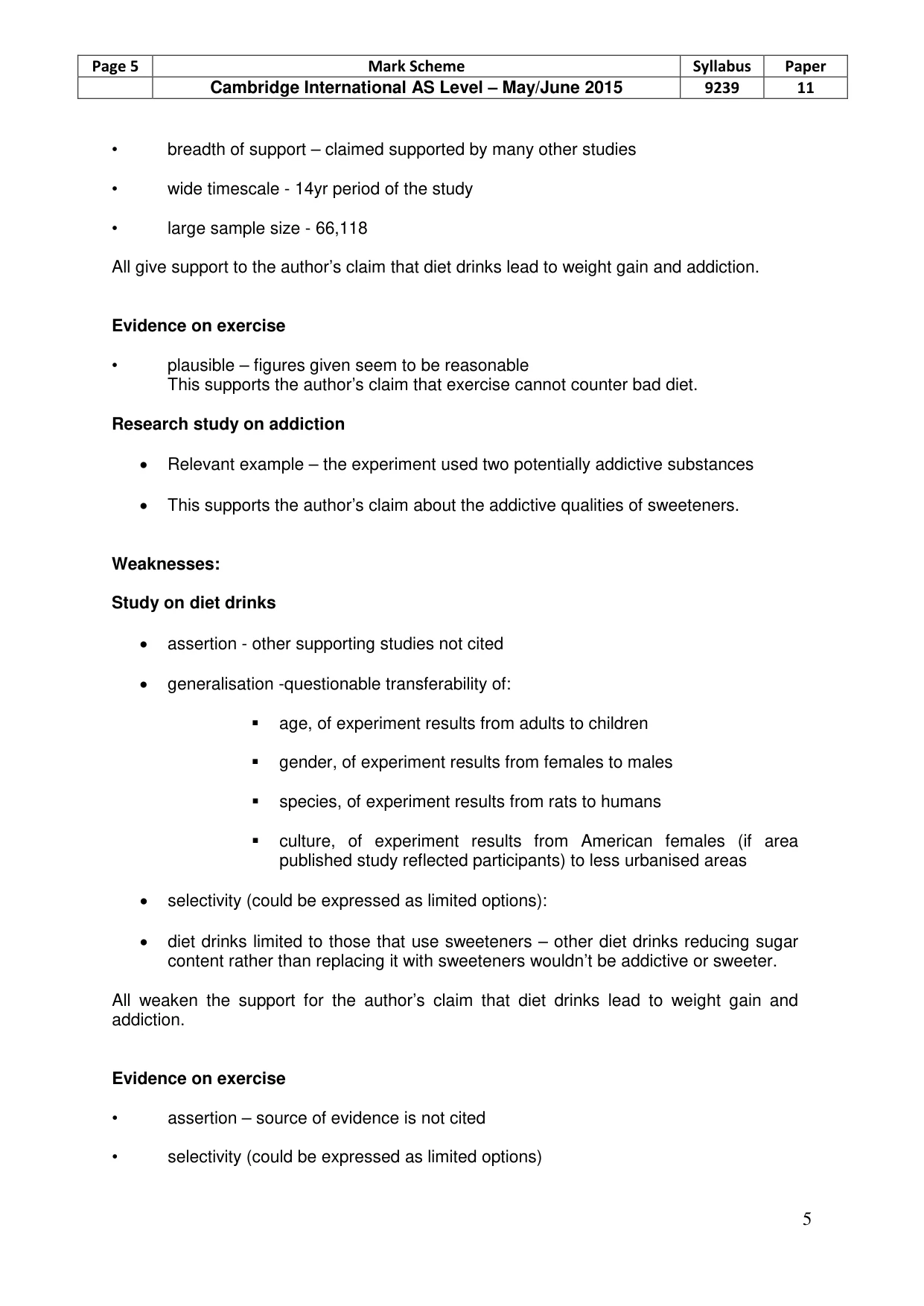
Page 5 Mark Scheme Syllabus Paper Cambridge International AS Level – May/June 2015 9239 11 5 • breadth of support – claimed supported by many other studies • wide timescale - 14yr period of the study • large sample size - 66,118 All give support to the author’s claim that diet drinks lead to weight gain and addiction. Evidence on exercise • plausible – figures given seem to be reasonable This supports the author’s claim that exercise cannot counter bad diet. Research study on addiction • Relevant example – the experiment used two potentially addictive substances • This supports the author’s claim about the addictive qualities of sweeteners. Weaknesses: Study on diet drinks • assertion - other supporting studies not cited • generalisation -questionable transferability of: age, of experiment results from adults to children gender, of experiment results from females to males species, of experiment results from rats to humans culture, of experiment results from American females (if area published study reflected participants) to less urbanised areas • selectivity (could be expressed as limited options): • diet drinks limited to those that use sweeteners – other diet drinks reducing sugar content rather than replacing it with sweeteners wouldn’t be addictive or sweeter. All weaken the support for the author’s claim that diet drinks lead to weight gain and addiction. Evidence on exercise • assertion – source of evidence is not cited • selectivity (could be expressed as limited options)
Mark scheme, page 6
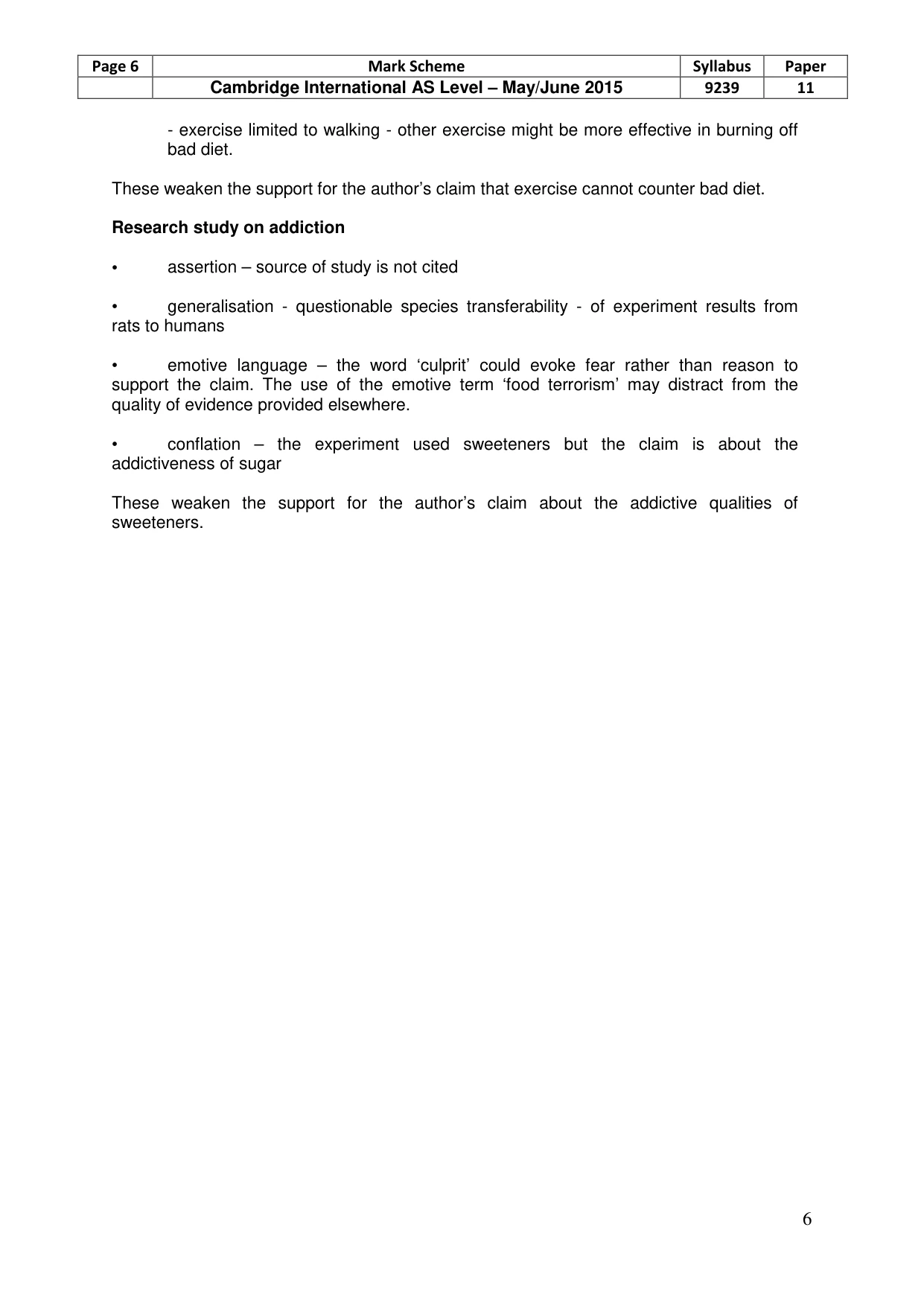
Page 6 Mark Scheme Syllabus Paper Cambridge International AS Level – May/June 2015 9239 11 6 - exercise limited to walking - other exercise might be more effective in burning off bad diet. These weaken the support for the author’s claim that exercise cannot counter bad diet. Research study on addiction • assertion – source of study is not cited • generalisation - questionable species transferability - of experiment results from rats to humans • emotive language – the word ‘culprit’ could evoke fear rather than reason to support the claim. The use of the emotive term ‘food terrorism’ may distract from the quality of evidence provided elsewhere. • conflation – the experiment used sweeteners but the claim is about the addictiveness of sugar These weaken the support for the author’s claim about the addictive qualities of sweeteners.
Mark scheme, page 7
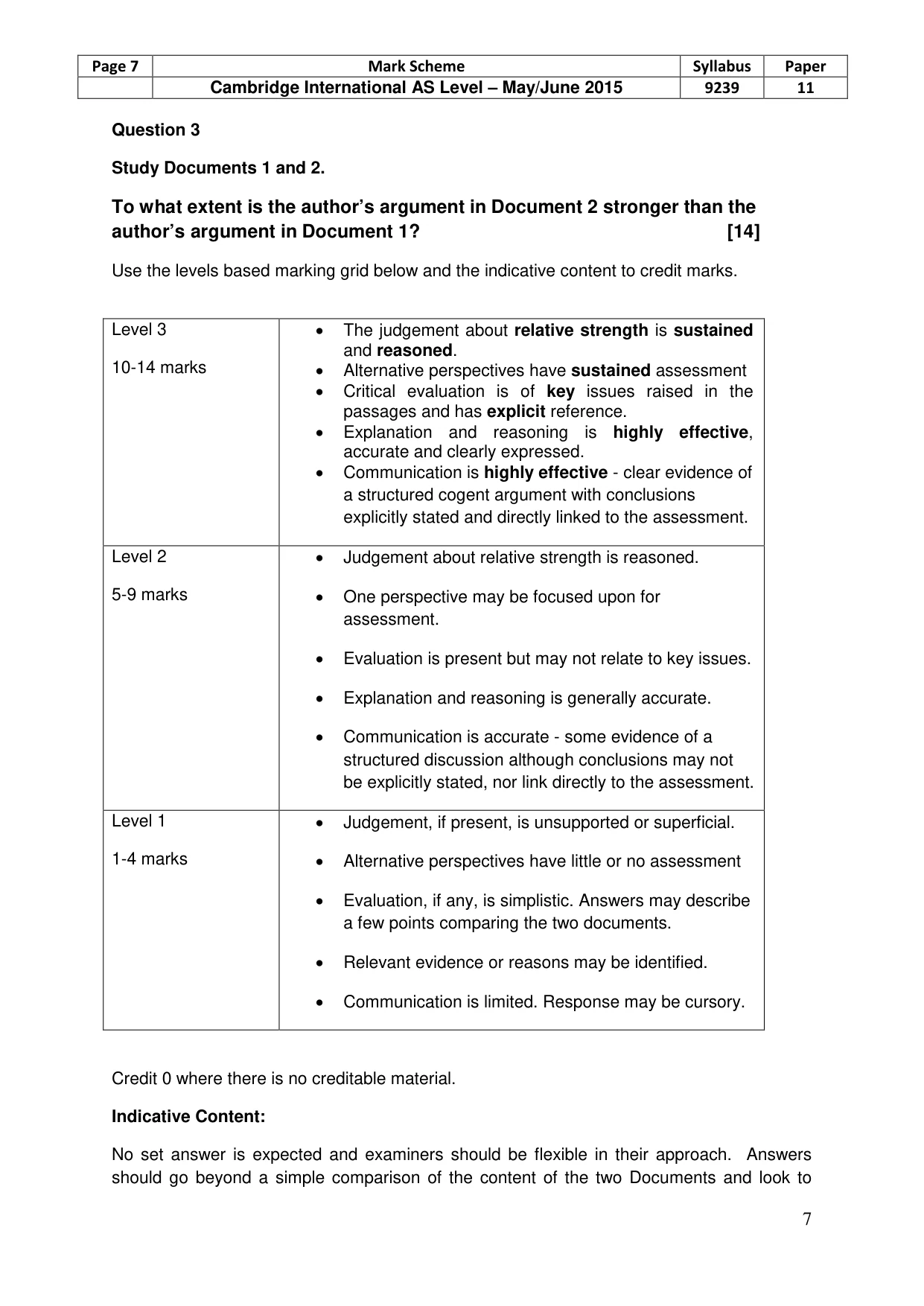
Page 7 Mark Scheme Syllabus Paper Cambridge International AS Level – May/June 2015 9239 11 7 Question 3 Study Documents 1 and 2. To what extent is the author’s argument in Document 2 stronger than the author’s argument in Document 1? [14] Use the levels based marking grid below and the indicative content to credit marks. Level 3 10-14 marks • The judgement about relative strength is sustained and reasoned. • Alternative perspectives have sustained assessment • Critical evaluation is of key issues raised in the passages and has explicit reference. • Explanation and reasoning is highly effective, accurate and clearly expressed. • Communication is highly effective - clear evidence of a structured cogent argument with conclusions explicitly stated and directly linked to the assessment. Level 2 5-9 marks • Judgement about relative strength is reasoned. • One perspective may be focused upon for assessment. • Evaluation is present but may not relate to key issues. • Explanation and reasoning is generally accurate. • Communication is accurate - some evidence of a structured discussion although conclusions may not be explicitly stated, nor link directly to the assessment. Level 1 1-4 marks • Judgement, if present, is unsupported or superficial. • Alternative perspectives have little or no assessment • Evaluation, if any, is simplistic. Answers may describe a few points comparing the two documents. • Relevant evidence or reasons may be identified. • Communication is limited. Response may be cursory. Credit 0 where there is no creditable material. Indicative Content: No set answer is expected and examiners should be flexible in their approach. Answers should go beyond a simple comparison of the content of the two Documents and look to
Mark scheme, page 8
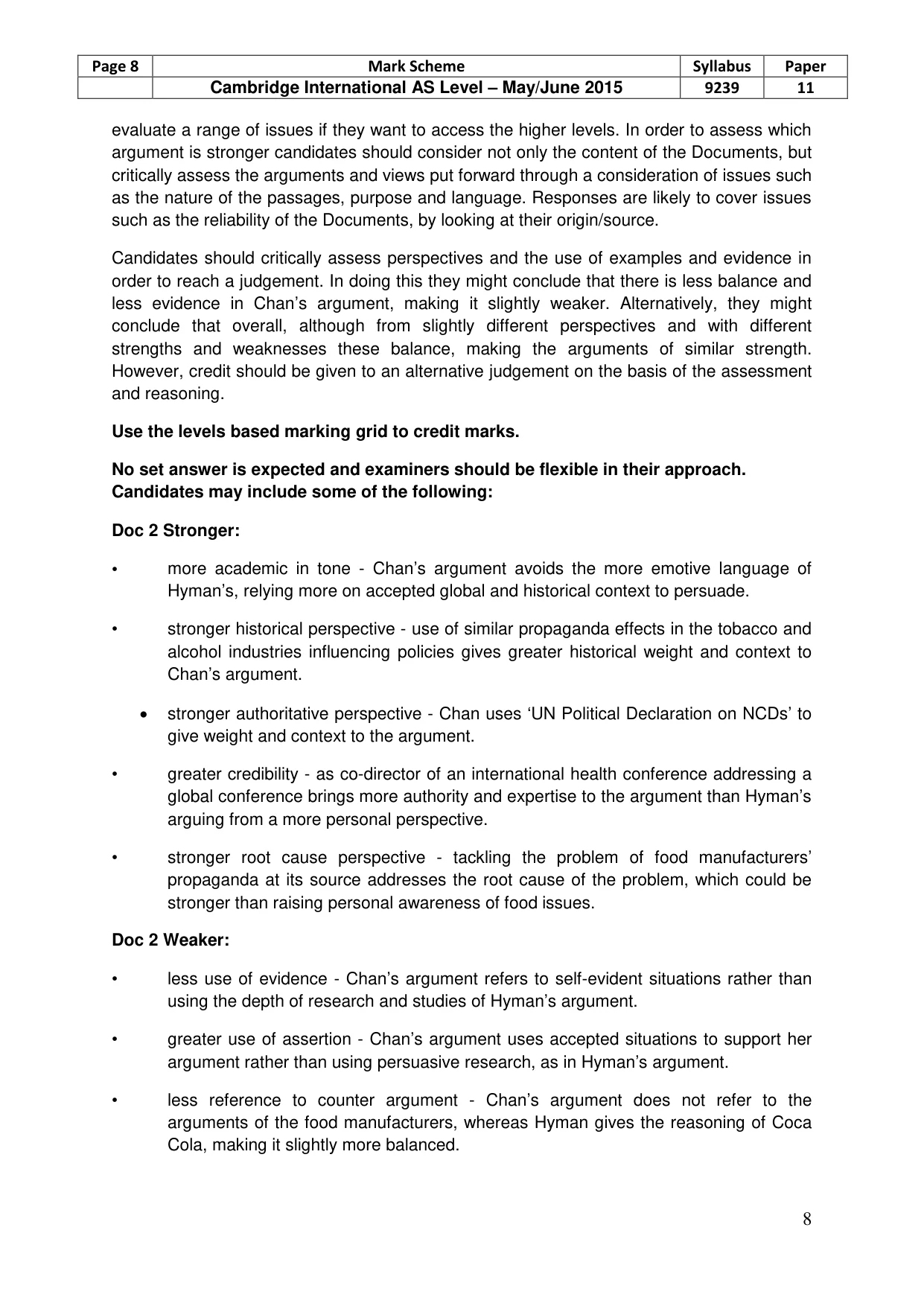
Page 8 Mark Scheme Syllabus Paper Cambridge International AS Level – May/June 2015 9239 11 8 evaluate a range of issues if they want to access the higher levels. In order to assess which argument is stronger candidates should consider not only the content of the Documents, but critically assess the arguments and views put forward through a consideration of issues such as the nature of the passages, purpose and language. Responses are likely to cover issues such as the reliability of the Documents, by looking at their origin/source. Candidates should critically assess perspectives and the use of examples and evidence in order to reach a judgement. In doing this they might conclude that there is less balance and less evidence in Chan’s argument, making it slightly weaker. Alternatively, they might conclude that overall, although from slightly different perspectives and with different strengths and weaknesses these balance, making the arguments of similar strength. However, credit should be given to an alternative judgement on the basis of the assessment and reasoning. Use the levels based marking grid to credit marks. No set answer is expected and examiners should be flexible in their approach. Candidates may include some of the following: Doc 2 Stronger: • more academic in tone - Chan’s argument avoids the more emotive language of Hyman’s, relying more on accepted global and historical context to persuade. • stronger historical perspective - use of similar propaganda effects in the tobacco and alcohol industries influencing policies gives greater historical weight and context to Chan’s argument. • stronger authoritative perspective - Chan uses ‘UN Political Declaration on NCDs’ to give weight and context to the argument. • greater credibility - as co-director of an international health conference addressing a global conference brings more authority and expertise to the argument than Hyman’s arguing from a more personal perspective. • stronger root cause perspective - tackling the problem of food manufacturers’ propaganda at its source addresses the root cause of the problem, which could be stronger than raising personal awareness of food issues. Doc 2 Weaker: • less use of evidence - Chan’s argument refers to self-evident situations rather than using the depth of research and studies of Hyman’s argument. • greater use of assertion - Chan’s argument uses accepted situations to support her argument rather than using persuasive research, as in Hyman’s argument. • less reference to counter argument - Chan’s argument does not refer to the arguments of the food manufacturers, whereas Hyman gives the reasoning of Coca Cola, making it slightly more balanced.
Mark scheme, page 9
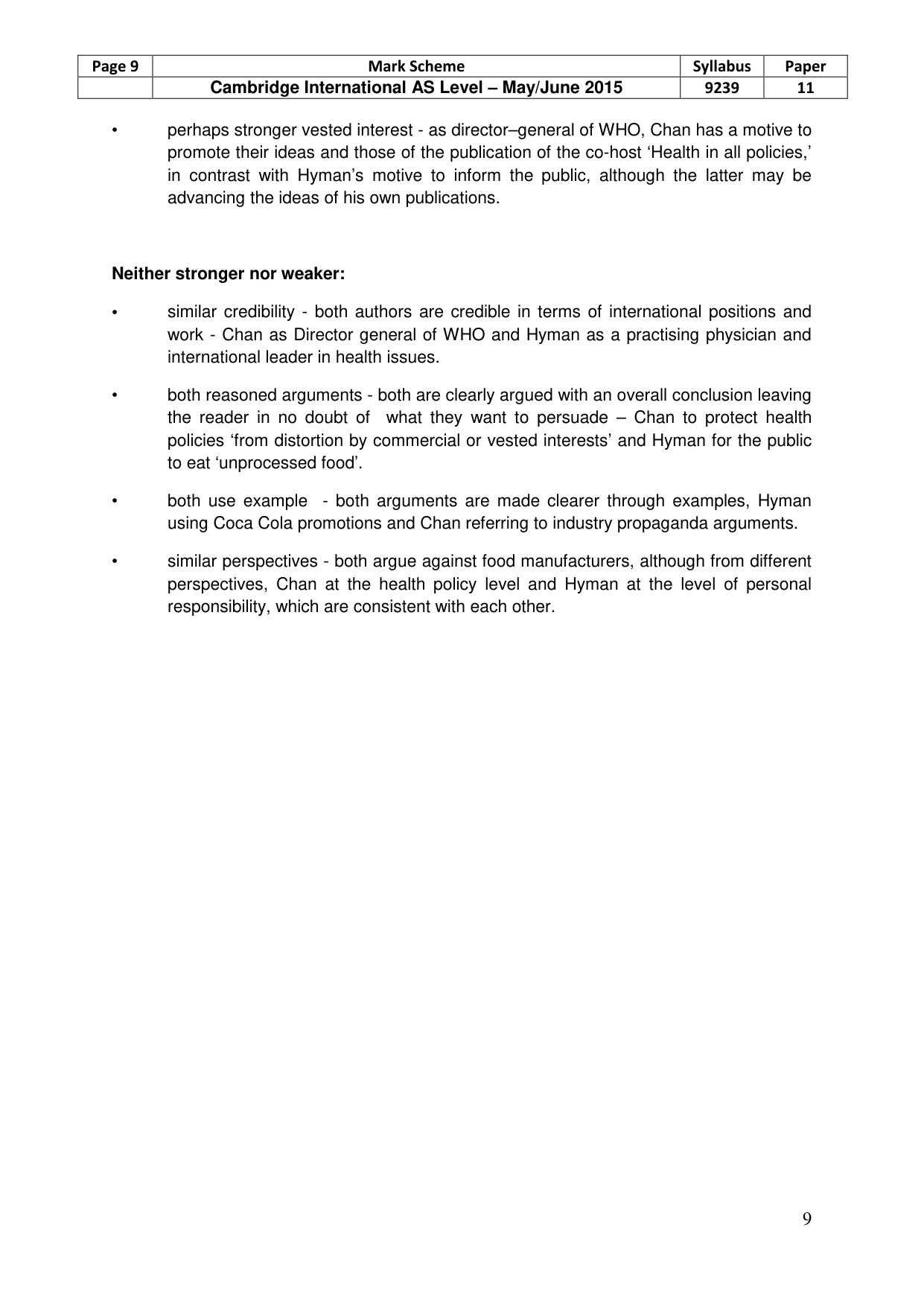
Page 9 Mark Scheme Syllabus Paper Cambridge International AS Level – May/June 2015 9239 11 9 • perhaps stronger vested interest - as director–general of WHO, Chan has a motive to promote their ideas and those of the publication of the co-host ‘Health in all policies,’ in contrast with Hyman’s motive to inform the public, although the latter may be advancing the ideas of his own publications. Neither stronger nor weaker: • similar credibility - both authors are credible in terms of international positions and work - Chan as Director general of WHO and Hyman as a practising physician and international leader in health issues. • both reasoned arguments - both are clearly argued with an overall conclusion leaving the reader in no doubt of what they want to persuade – Chan to protect health policies ‘from distortion by commercial or vested interests’ and Hyman for the public to eat ‘unprocessed food’. • both use example - both arguments are made clearer through examples, Hyman using Coca Cola promotions and Chan referring to industry propaganda arguments. • similar perspectives - both argue against food manufacturers, although from different perspectives, Chan at the health policy level and Hyman at the level of personal responsibility, which are consistent with each other.
What you needed in this session
Cambridge’s own grade thresholds for 2015 May/June, Paper 1 · Variant 1. A higher threshold means an easier paper — the bar moves with how the cohort did.