Cambridge A Level German (A Level only) 9717 — 2024 Oct/Nov Paper 4 · Variant 3
9717/43/O/N/24 · 75 marks · ≈84 min
The question paper and its mark scheme, free to read here and free to download. This is Cambridge’s own paper, exactly as it was sat.
Question paper8 pages


Mark scheme4 pages
Answers below. Sit the paper first if you are practising.
Paper as text
Question paper, page 1
[Turn over Cambridge International A Level This document has 8 pages. Any blank pages are indicated. * 0 0 2 7 5 1 7 3 9 0 * DC (EV) 347460 © UCLES 2024 GERMAN 9717/43 Paper 4 Texts October/November 2024 2 hours 30 minutes You must answer on the enclosed answer booklet. You will need: Answer booklet (enclosed) Invigilators must refer to the Additional Materials List for instructions on the use of set texts in the examination. INSTRUCTIONS ● Answer three questions in total in German, each on a different text: Answer at least one question from Section 1. Answer at least one question from Section 2. Answer one other question from either Section 1 or Section 2. ● Follow the instructions on the front cover of the answer booklet. If you need additional answer paper, ask the invigilator for a continuation booklet. ● Dictionaries are not allowed. INFORMATION ● The total mark for this paper is 75. ● Each question is worth 25 marks. ANWEISUNGEN ● Beantworten Sie insgesamt drei Fragen auf Deutsch, jede Frage zu einem anderen Text: Beantworten Sie mindestens eine Frage aus Teil 1. Beantworten Sie mindestens eine Frage aus Teil 2. Beantworten Sie eine weitere Frage, entweder aus Teil 1 oder Teil 2. ● Folgen Sie den Anweisungen auf der Titelseite des Antwortbogens. Die Anweisungen sind umseitig auch auf Deutsch zu finden. Falls Sie zusӓtzliches Papier benӧtigen, bitten Sie die Aufsichtsperson um einen Fortsetzungsbogen. ● Der Gebrauch von Wӧrterbüchern ist nicht erlaubt. INFORMATION ● Die erreichbare Gesamtpunktzahl betrӓgt 75. ● Jede Frage wird aus einer Gesamtpunktzahl von 25 Punkten bewertet.
Question paper, page 2
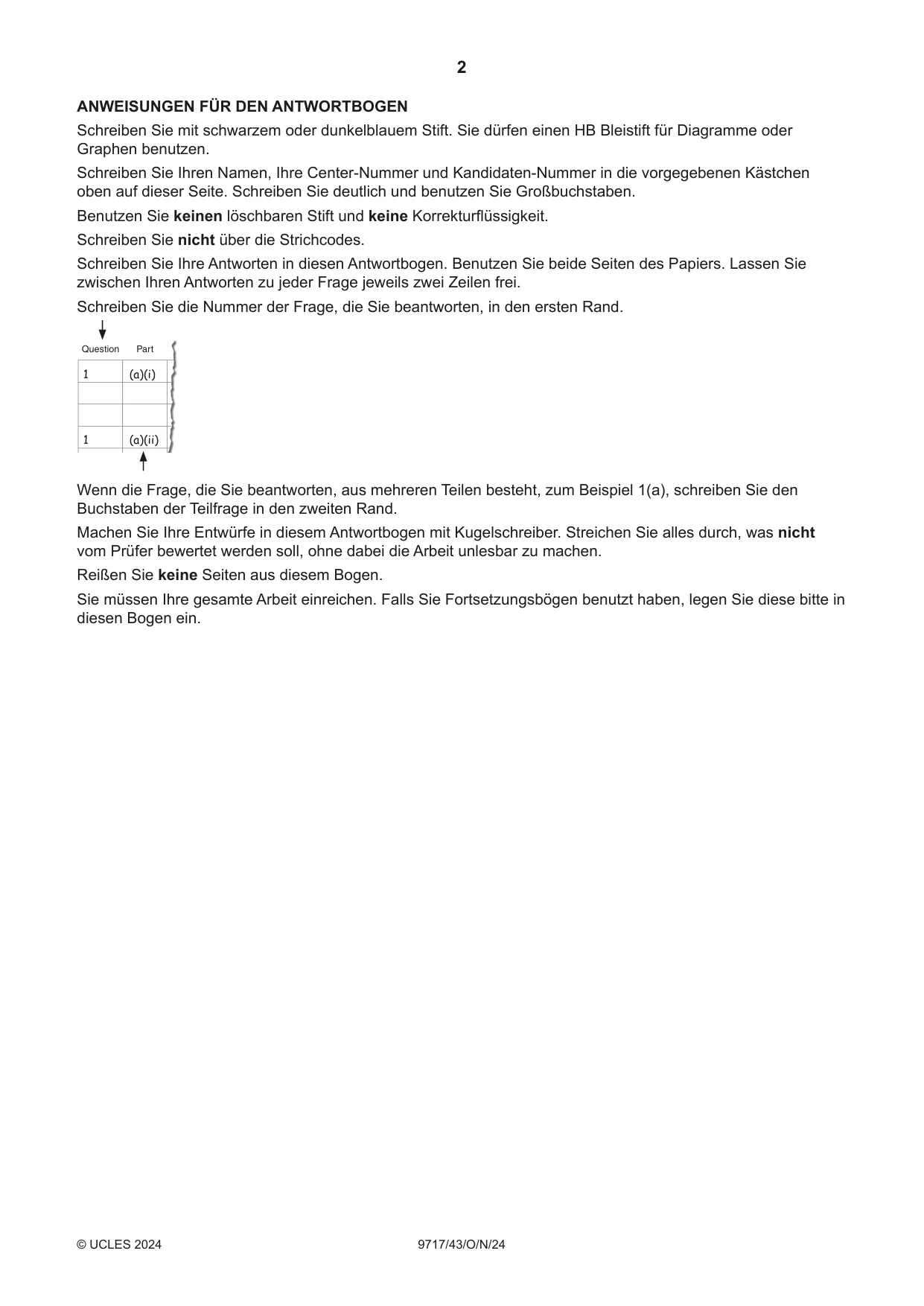
2 9717/43/ O/N/24 © UCLES 2024 ANWEISUNGEN FÜR DEN ANTWORTBOGEN Schreiben Sie mit schwarzem oder dunkelblauem Stift. Sie dürfen einen HB Bleistift für Diagramme oder Graphen benutzen. Schreiben Sie Ihren Namen, Ihre Center-Nummer und Kandidaten-Nummer in die vorgegebenen Kӓstchen oben auf dieser Seite. Schreiben Sie deutlich und benutzen Sie Großbuchstaben. Benutzen Sie keinen lӧschbaren Stift und keine Korrekturflüssigkeit. Schreiben Sie nicht über die Strichcodes. Schreiben Sie Ihre Antworten in diesen Antwortbogen. Benutzen Sie beide Seiten des Papiers. Lassen Sie zwischen Ihren Antworten zu jeder Frage jeweils zwei Zeilen frei. Schreiben Sie die Nummer der Frage, die Sie beantworten, in den ersten Rand. Question Part 1 1 (a)(i) (a)(ii) Wenn die Frage, die Sie beantworten, aus mehreren Teilen besteht, zum Beispiel 1(a), schreiben Sie den Buchstaben der Teilfrage in den zweiten Rand. Machen Sie Ihre Entwürfe in diesem Antwortbogen mit Kugelschreiber. Streichen Sie alles durch, was nicht vom Prüfer bewertet werden soll, ohne dabei die Arbeit unlesbar zu machen. Reißen Sie keine Seiten aus diesem Bogen. Sie müssen Ihre gesamte Arbeit einreichen. Falls Sie Fortsetzungsbӧgen benutzt haben, legen Sie diese bitte in diesen Bogen ein.
Question paper, page 3
3 9717/43/O/N/24 © UCLES 2024 [Turn over BLANK PAGE
Question paper, page 4
4 9717/43/O/N/24 © UCLES 2024 Beantworten Sie insgesamt drei Fragen, jede Frage zu einem anderen Werk. Wählen Sie eine Frage aus dem ersten Teil, eine Frage aus dem zweiten Teil und eine weitere Frage entweder aus dem ersten oder zweiten Teil. Teil 1 1 Professor Unrat, Heinrich Mann Wählen Sie entweder (a) oder (b). Schreiben Sie einen Aufsatz auf Deutsch von 500 bis 600 Wörtern. ENTWEDER (a) Lesen Sie diesen Auszug und beantworten Sie dann die Fragen: Lohmann und Graf Ertzum gaben die Tat zu. „Ich bin es nich gewesen“, quäkte Kieselack dazwischen. „Aber wir!“ entschied Lohmann, peinlich berührt durch diese Kameradschaft. „Pardon“, bemerkte Ertzum. „Ich hab es alleine getan.“ „Bitte sehr“, und Lohmann machte ein Gesicht von müder Strenge. „Meinen Anteil an dieser Beschädigung eines öffentlichen Besitztums oder wie man das nennt, muß ich mit aller Entschiedenheit in Anspruch nehmen.“ Von Ertzum wiederholte: „Ich hab es ganz alleine kaputtgemacht. Das ist wahr.“ „Mein Lieber, rede keinen Kohl“, bat Lohmann. Und der andere: „Zum – noch mal. Du warst ja ein ganzes Stück davon weg. Du saßest ja mit – “ „Mit wem?“ fragte der Vorsitzende. „Mit niemand – glaube ich“; und von Ertzum war sehr rot. „Mit Kieselack, wahrscheinlich“, meinte Lohmann. Der Staatsanwaltssubstitut fand es angezeigt, die Schuld auf möglichst viele Köpfe zu verteilen, damit für den Sohn des Konsuls Lohmann und das Mündel des Konsuls Breetpoot wenig davon übrigbleibe. Er machte von Ertzum auf die Schwierigkeit seiner vorgeblichen Tat aufmerksam. „So viel Unfug, wie Sie alleine verübt haben wollen, bringt ja der stärkste Mann nicht fertig.“ „Doch“, entgegnete Ertzum, stolz und bescheiden. Der Vorsitzende forderte ihn und Lohmann zur Nennung der übrigen auf. „Sie müssen wohl eine größere vergnügte Gesellschaft gewesen sein“, vermutete er wohlwollend. „Sagen Sie uns nur die Teilnehmer, Sie tun sich und uns einen Gefallen damit.“ Die Angeklagten schwiegen. Die Verteidigung gab zu bedenken, welche vornehme Gesinnung hieraus spreche. Schon während der ganzen Voruntersuchung seien die zwei jungen Leute standhaft geblieben in ihrem Vorhaben, niemand weiter zu kompromittieren. Auch Kieselack war standhaft geblieben; aber ihm ward es nicht angerechnet. (i) Wann und warum findet diese Szene statt? Erklären Sie kurz, was hier geschieht. (ii) Diese Szene spiegelt die Gesellschaft des kaiserlichen Deutschlands und deren Einstellungen wider. Begründen Sie die Richtigkeit dieser Aussage, indem Sie das Verhalten der verschiedenen Charaktere in der Szene analysieren. ODER (b) Wie werden Schule und Bildung in Professor Unrat dargestellt? Beziehen Sie sich bei Ihrer Antwort auf den ganzen Roman.
Question paper, page 5
5 9717/43/O/N/24 © UCLES 2024 [Turn over 2 Ansichten eines Clowns, Heinrich Böll Wählen Sie entweder (a) oder (b). Schreiben Sie einen Aufsatz auf Deutsch von 500 bis 600 Wörtern. ENTWEDER (a) Lesen Sie diesen Auszug und beantworten Sie dann die Fragen: Ich winkte noch einmal hinter der Straßenbahn her, in der Henriette davonfuhr, ging durch unseren Park nach Hause, wo meine Eltern mit Leo schon bei Tisch saßen. Ich hatte Angst, wußte sogar, warum, hätte es aber nicht ausdrücken können, und ich wurde rasend, als ich an die verfluchten Apfelschalen dachte. (i) Wann im Buch findet diese Szene statt? Welche Gefühle sind für Hans Schnier mit dem Verlust von Henriette verbunden? (ii) Wie reflektiert diese Szene das Verhältnis zwischen Hans und seinen Eltern? ODER (b) Heinrich Böll übt in Ansichten eines Clowns Kritik an der Gesellschaft der Bundesrepublik Deutschland in der Nachkriegszeit. Belegen Sie diese Aussage mit Beispielen aus dem gesamten Roman. Content removed due to copyright restrictions.
Question paper, page 6
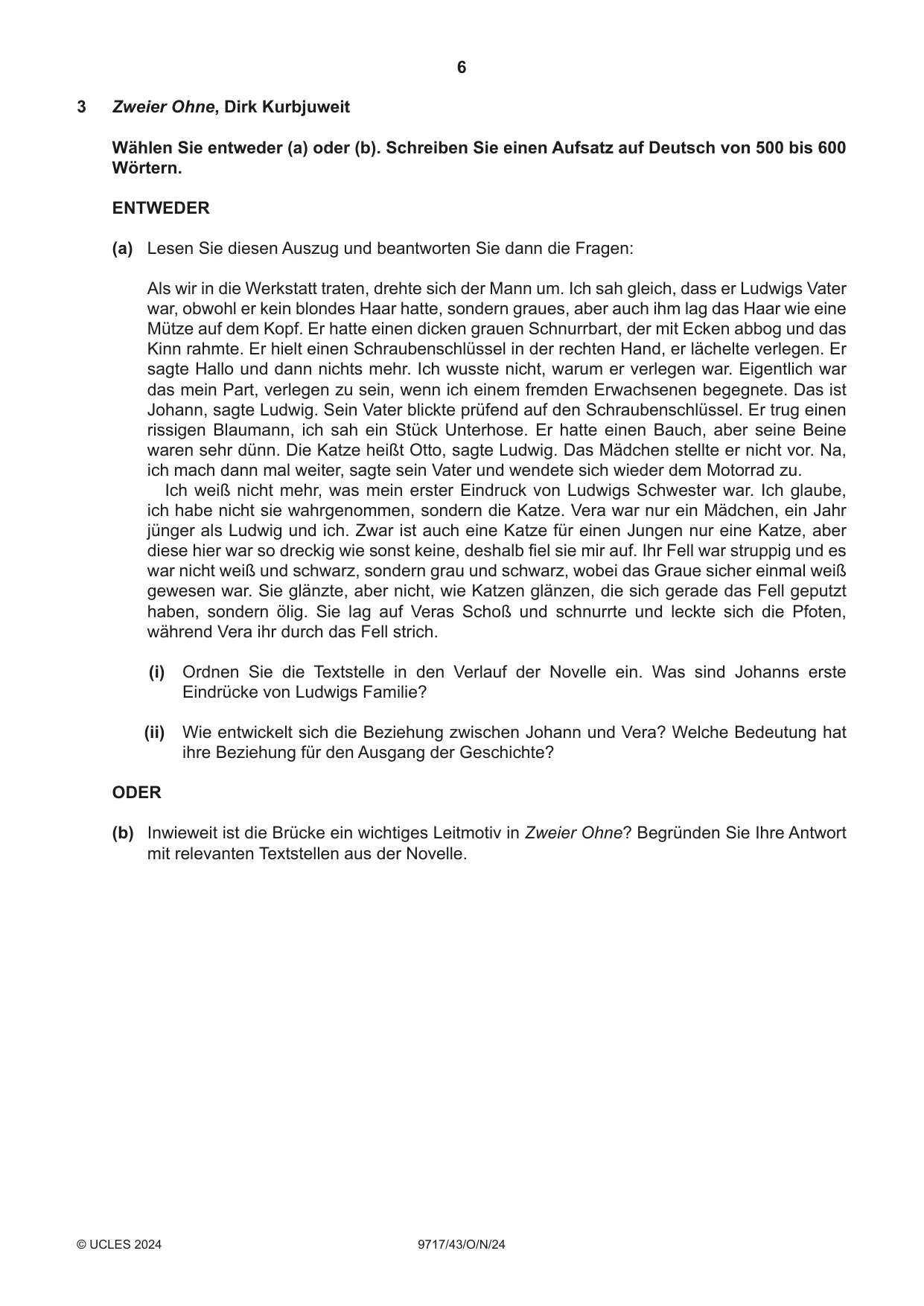
6 9717/43/O/N/24 © UCLES 2024 3 Zweier Ohne, Dirk Kurbjuweit Wählen Sie entweder (a) oder (b). Schreiben Sie einen Aufsatz auf Deutsch von 500 bis 600 Wörtern. ENTWEDER (a) Lesen Sie diesen Auszug und beantworten Sie dann die Fragen: Als wir in die Werkstatt traten, drehte sich der Mann um. Ich sah gleich, dass er Ludwigs Vater war, obwohl er kein blondes Haar hatte, sondern graues, aber auch ihm lag das Haar wie eine Mütze auf dem Kopf. Er hatte einen dicken grauen Schnurrbart, der mit Ecken abbog und das Kinn rahmte. Er hielt einen Schraubenschlüssel in der rechten Hand, er lächelte verlegen. Er sagte Hallo und dann nichts mehr. Ich wusste nicht, warum er verlegen war. Eigentlich war das mein Part, verlegen zu sein, wenn ich einem fremden Erwachsenen begegnete. Das ist Johann, sagte Ludwig. Sein Vater blickte prüfend auf den Schraubenschlüssel. Er trug einen rissigen Blaumann, ich sah ein Stück Unterhose. Er hatte einen Bauch, aber seine Beine waren sehr dünn. Die Katze heißt Otto, sagte Ludwig. Das Mädchen stellte er nicht vor. Na, ich mach dann mal weiter, sagte sein Vater und wendete sich wieder dem Motorrad zu. Ich weiß nicht mehr, was mein erster Eindruck von Ludwigs Schwester war. Ich glaube, ich habe nicht sie wahrgenommen, sondern die Katze. Vera war nur ein Mädchen, ein Jahr jünger als Ludwig und ich. Zwar ist auch eine Katze für einen Jungen nur eine Katze, aber diese hier war so dreckig wie sonst keine, deshalb fiel sie mir auf. Ihr Fell war struppig und es war nicht weiß und schwarz, sondern grau und schwarz, wobei das Graue sicher einmal weiß gewesen war. Sie glänzte, aber nicht, wie Katzen glänzen, die sich gerade das Fell geputzt haben, sondern ölig. Sie lag auf Veras Schoß und schnurrte und leckte sich die Pfoten, während Vera ihr durch das Fell strich. (i) Ordnen Sie die Textstelle in den Verlauf der Novelle ein. Was sind Johanns erste Eindrücke von Ludwigs Familie? (ii) Wie entwickelt sich die Beziehung zwischen Johann und Vera? Welche Bedeutung hat ihre Beziehung für den Ausgang der Geschichte? ODER (b) Inwieweit ist die Brücke ein wichtiges Leitmotiv in Zweier Ohne? Begründen Sie Ihre Antwort mit relevanten Textstellen aus der Novelle.
Question paper, page 7
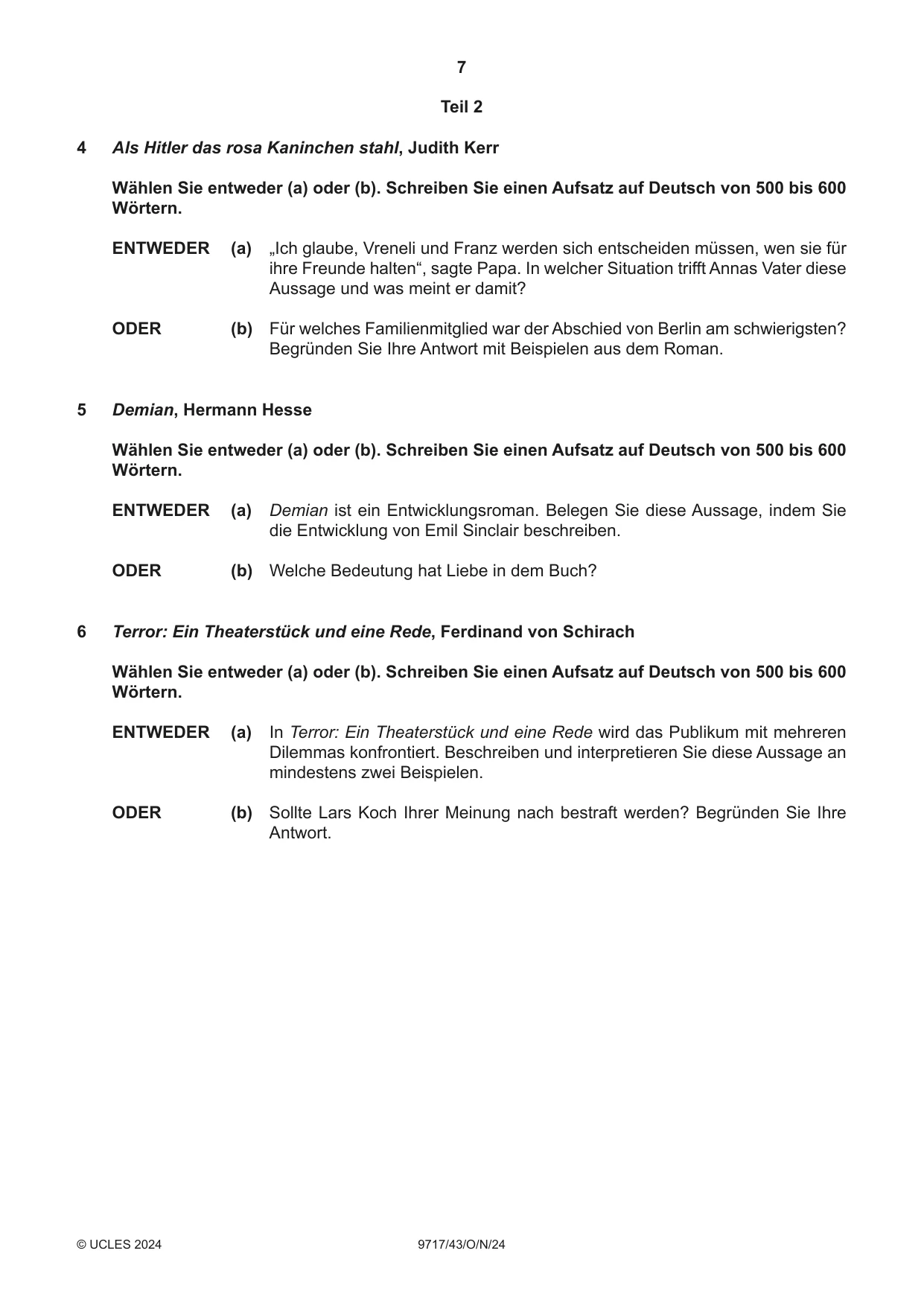
7 9717/43/O/N/24 © UCLES 2024 Teil 2 4 Als Hitler das rosa Kaninchen stahl, Judith Kerr Wählen Sie entweder (a) oder (b). Schreiben Sie einen Aufsatz auf Deutsch von 500 bis 600 Wörtern. ENTWEDER (a) „Ich glaube, Vreneli und Franz werden sich entscheiden müssen, wen sie für ihre Freunde halten“, sagte Papa. In welcher Situation trifft Annas Vater diese Aussage und was meint er damit? ODER (b) Für welches Familienmitglied war der Abschied von Berlin am schwierigsten? Begründen Sie Ihre Antwort mit Beispielen aus dem Roman. 5 Demian, Hermann Hesse Wählen Sie entweder (a) oder (b). Schreiben Sie einen Aufsatz auf Deutsch von 500 bis 600 Wörtern. ENTWEDER (a) Demian ist ein Entwicklungsroman. Belegen Sie diese Aussage, indem Sie die Entwicklung von Emil Sinclair beschreiben. ODER (b) Welche Bedeutung hat Liebe in dem Buch? 6 Terror: Ein Theaterstück und eine Rede, Ferdinand von Schirach Wählen Sie entweder (a) oder (b). Schreiben Sie einen Aufsatz auf Deutsch von 500 bis 600 Wörtern. ENTWEDER (a) In Terror: Ein Theaterstück und eine Rede wird das Publikum mit mehreren Dilemmas konfrontiert. Beschreiben und interpretieren Sie diese Aussage an mindestens zwei Beispielen. ODER (b) Sollte Lars Koch Ihrer Meinung nach bestraft werden? Begründen Sie Ihre Antwort.
Question paper, page 8
8 9717/43/O/N/24 © UCLES 2024 Permission to reproduce items where third-party owned material protected by copyright is included has been sought and cleared where possible. Every reasonable effort has been made by the publisher (UCLES) to trace copyright holders, but if any items requiring clearance have unwittingly been included, the publisher will be pleased to make amends at the earliest possible opportunity. To avoid the issue of disclosure of answer-related information to candidates, all copyright acknowledgements are reproduced online in the Cambridge Assessment International Education Copyright Acknowledgements Booklet. This is produced for each series of examinations and is freely available to download at www.cambridgeinternational.org after the live examination series. Cambridge Assessment International Education is part of Cambridge Assessment. Cambridge Assessment is the brand name of the University of Cambridge Local Examinations Syndicate (UCLES), which is a department of the University of Cambridge. BLANK PAGE
Mark scheme, page 1
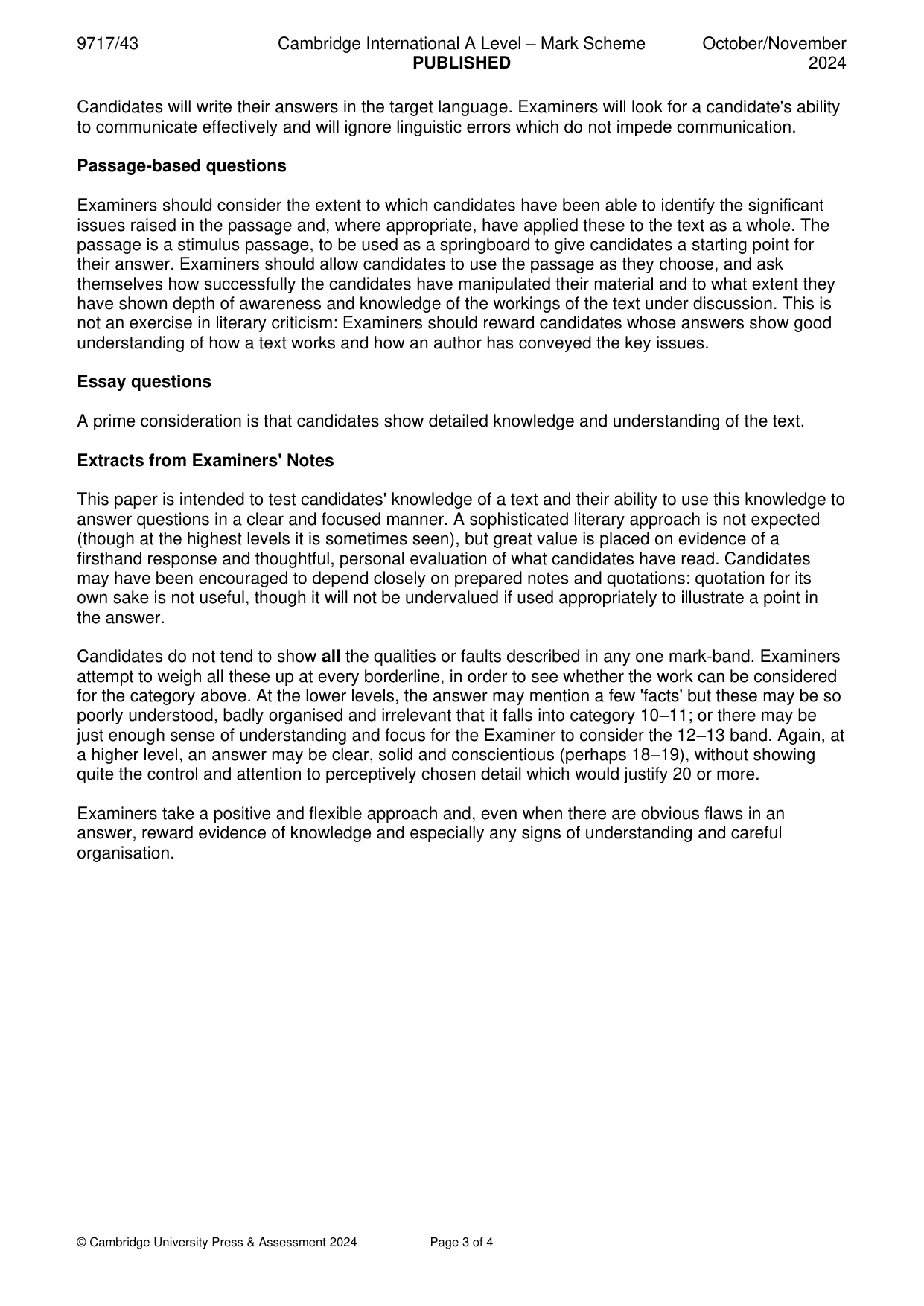
This document consists of 4 printed pages. © Cambridge University Press & Assessment 2024 [Turn over Cambridge International A Level GERMAN 9717/43 Paper 4 Texts October/November 2024 MARK SCHEME Maximum Mark: 75 Published This mark scheme is published as an aid to teachers and candidates, to indicate the requirements of the examination. It shows the basis on which Examiners were instructed to award marks. It does not indicate the details of the discussions that took place at an Examiners’ meeting before marking began, which would have considered the acceptability of alternative answers. Mark schemes should be read in conjunction with the question paper and the Principal Examiner Report for Teachers. Cambridge International will not enter into discussions about these mark schemes. Cambridge International is publishing the mark schemes for the October/November 2024 series for most Cambridge IGCSE, Cambridge International A and AS Level components, and some Cambridge O Level components.
Mark scheme, page 2
9717/43 Cambridge International A Level – Mark Scheme PUBLISHED October/November 2024 © Cambridge University Press & Assessment 2024 Page 2 of 4 Generic Marking Principles These general marking principles must be applied by all examiners when marking candidate answers. They should be applied alongside the specific content of the mark scheme or generic level descriptions for a question. Each question paper and mark scheme will also comply with these marking principles. GENERIC MARKING PRINCIPLE 1: Marks must be awarded in line with: • the specific content of the mark scheme or the generic level descriptors for the question • the specific skills defined in the mark scheme or in the generic level descriptors for the question • the standard of response required by a candidate as exemplified by the standardisation scripts. GENERIC MARKING PRINCIPLE 2: Marks awarded are always whole marks (not half marks, or other fractions). GENERIC MARKING PRINCIPLE 3: Marks must be awarded positively: • marks are awarded for correct/valid answers, as defined in the mark scheme. However, credit is given for valid answers which go beyond the scope of the syllabus and mark scheme, referring to your Team Leader as appropriate • marks are awarded when candidates clearly demonstrate what they know and can do • marks are not deducted for errors • marks are not deducted for omissions • answers should only be judged on the quality of spelling, punctuation and grammar when these features are specifically assessed by the question as indicated by the mark scheme. The meaning, however, should be unambiguous. GENERIC MARKING PRINCIPLE 4: Rules must be applied consistently, e.g. in situations where candidates have not followed instructions or in the application of generic level descriptors. GENERIC MARKING PRINCIPLE 5: Marks should be awarded using the full range of marks defined in the mark scheme for the question (however; the use of the full mark range may be limited according to the quality of the candidate responses seen). GENERIC MARKING PRINCIPLE 6: Marks awarded are based solely on the requirements as defined in the mark scheme. Marks should not be awarded with grade thresholds or grade descriptors in mind.
Mark scheme, page 3
9717/43 Cambridge International A Level – Mark Scheme PUBLISHED October/November 2024 © Cambridge University Press & Assessment 2024 Page 3 of 4 Candidates will write their answers in the target language. Examiners will look for a candidate's ability to communicate effectively and will ignore linguistic errors which do not impede communication. Passage-based questions Examiners should consider the extent to which candidates have been able to identify the significant issues raised in the passage and, where appropriate, have applied these to the text as a whole. The passage is a stimulus passage, to be used as a springboard to give candidates a starting point for their answer. Examiners should allow candidates to use the passage as they choose, and ask themselves how successfully the candidates have manipulated their material and to what extent they have shown depth of awareness and knowledge of the workings of the text under discussion. This is not an exercise in literary criticism: Examiners should reward candidates whose answers show good understanding of how a text works and how an author has conveyed the key issues. Essay questions A prime consideration is that candidates show detailed knowledge and understanding of the text. Extracts from Examiners' Notes This paper is intended to test candidates' knowledge of a text and their ability to use this knowledge to answer questions in a clear and focused manner. A sophisticated literary approach is not expected (though at the highest levels it is sometimes seen), but great value is placed on evidence of a firsthand response and thoughtful, personal evaluation of what candidates have read. Candidates may have been encouraged to depend closely on prepared notes and quotations: quotation for its own sake is not useful, though it will not be undervalued if used appropriately to illustrate a point in the answer. Candidates do not tend to show all the qualities or faults described in any one mark-band. Examiners attempt to weigh all these up at every borderline, in order to see whether the work can be considered for the category above. At the lower levels, the answer may mention a few 'facts' but these may be so poorly understood, badly organised and irrelevant that it falls into category 10–11; or there may be just enough sense of understanding and focus for the Examiner to consider the 12–13 band. Again, at a higher level, an answer may be clear, solid and conscientious (perhaps 18–19), without showing quite the control and attention to perceptively chosen detail which would justify 20 or more. Examiners take a positive and flexible approach and, even when there are obvious flaws in an answer, reward evidence of knowledge and especially any signs of understanding and careful organisation.
Mark scheme, page 4
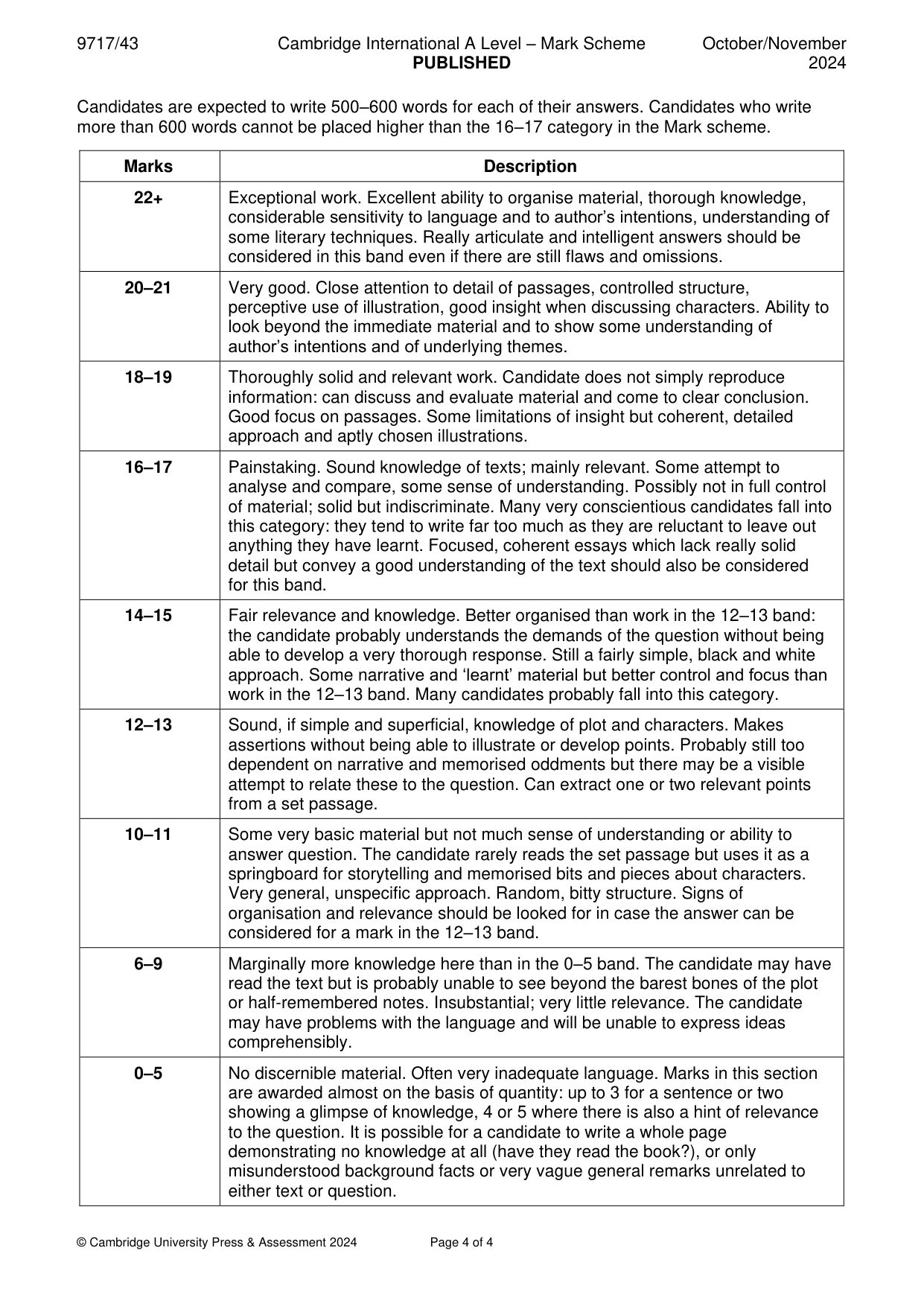
9717/43 Cambridge International A Level – Mark Scheme PUBLISHED October/November 2024 © Cambridge University Press & Assessment 2024 Page 4 of 4 Candidates are expected to write 500–600 words for each of their answers. Candidates who write more than 600 words cannot be placed higher than the 16–17 category in the Mark scheme. Marks Description 22+ Exceptional work. Excellent ability to organise material, thorough knowledge, considerable sensitivity to language and to author’s intentions, understanding of some literary techniques. Really articulate and intelligent answers should be considered in this band even if there are still flaws and omissions. 20–21 Very good. Close attention to detail of passages, controlled structure, perceptive use of illustration, good insight when discussing characters. Ability to look beyond the immediate material and to show some understanding of author’s intentions and of underlying themes. 18–19 Thoroughly solid and relevant work. Candidate does not simply reproduce information: can discuss and evaluate material and come to clear conclusion. Good focus on passages. Some limitations of insight but coherent, detailed approach and aptly chosen illustrations. 16–17 Painstaking. Sound knowledge of texts; mainly relevant. Some attempt to analyse and compare, some sense of understanding. Possibly not in full control of material; solid but indiscriminate. Many very conscientious candidates fall into this category: they tend to write far too much as they are reluctant to leave out anything they have learnt. Focused, coherent essays which lack really solid detail but convey a good understanding of the text should also be considered for this band. 14–15 Fair relevance and knowledge. Better organised than work in the 12–13 band: the candidate probably understands the demands of the question without being able to develop a very thorough response. Still a fairly simple, black and white approach. Some narrative and ‘learnt’ material but better control and focus than work in the 12–13 band. Many candidates probably fall into this category. 12–13 Sound, if simple and superficial, knowledge of plot and characters. Makes assertions without being able to illustrate or develop points. Probably still too dependent on narrative and memorised oddments but there may be a visible attempt to relate these to the question. Can extract one or two relevant points from a set passage. 10–11 Some very basic material but not much sense of understanding or ability to answer question. The candidate rarely reads the set passage but uses it as a springboard for storytelling and memorised bits and pieces about characters. Very general, unspecific approach. Random, bitty structure. Signs of organisation and relevance should be looked for in case the answer can be considered for a mark in the 12–13 band. 6–9 Marginally more knowledge here than in the 0–5 band. The candidate may have read the text but is probably unable to see beyond the barest bones of the plot or half-remembered notes. Insubstantial; very little relevance. The candidate may have problems with the language and will be unable to express ideas comprehensibly. 0–5 No discernible material. Often very inadequate language. Marks in this section are awarded almost on the basis of quantity: up to 3 for a sentence or two showing a glimpse of knowledge, 4 or 5 where there is also a hint of relevance to the question. It is possible for a candidate to write a whole page demonstrating no knowledge at all (have they read the book?), or only misunderstood background facts or very vague general remarks unrelated to either text or question.
What you needed in this session
Cambridge’s own grade thresholds for 2024 Oct/Nov, Paper 4 · Variant 3. A higher threshold means an easier paper — the bar moves with how the cohort did.