Cambridge A Level German (A Level only) 9717 — 2017 Oct/Nov Paper 4 · Variant 3
9717/43/O/N/17 · 75 marks · ≈84 min
The question paper and its mark scheme, free to read here and free to download. This is Cambridge’s own paper, exactly as it was sat.
Question paper8 pages


Mark scheme3 pages
Answers below. Sit the paper first if you are practising.

Paper as text
Question paper, page 1
* 1 5 0 6 4 1 4 1 3 8 * This document consists of 5 printed pages, 3 blank pages and 1 insert. DC (ST) 153384 © UCLES 2017 [Turn over Cambridge International Examinations Cambridge International Advanced Level GERMAN 9717/43 Paper 4 Texts October/November 2017 2 hours 30 minutes No Additional Materials are required. Invigilators must refer to the Additional Materials List for instructions on the use of set texts in the examination. READ THESE INSTRUCTIONS FIRST An answer booklet is provided inside this question paper. You should follow the instructions on the front cover of the answer booklet. If you need additional paper ask the invigilator for a continuation booklet. Answer three questions, each on a different text. You must choose one question from Section 1, one from Section 2 and one other. Write your answers in German. Dictionaries are not permitted. You should write between 500 and 600 words for each answer. All questions in this paper carry equal marks. LESEN SIE ZUERST DIESE ANWEISUNGEN Diesem Prüfungsbogen ist ein Antwortbogen beigefügt. Folgen Sie den Anweisungen auf der Titelseite des Anwortbogens. Sie finden diese Anweisungen auch unten auf Deutsch. Falls Sie zusätzliches Papier benötigen, bitten Sie die Aufsichtsperson um einen Fortsetzungsbogen. Beantworten Sie insgesamt drei Fragen, jede Frage zu einem anderen Text. Wählen Sie eine Frage aus dem ersten Teil, eine Frage aus dem zweiten Teil und eine weitere Frage. Schreiben Sie Ihre Antworten auf Deutsch. Der Gebrauch von Wörterbüchern ist nicht erlaubt. Schreiben Sie 500 bis 600 Wörter zu jeder Frage. Alle Fragen in diesem Prüfungsbogen haben die gleiche Punktzahl. ANWEISUNGEN FÜR DEN ANTWORTBOGEN Füllen Sie die Kästchen auf der Titelseite des Antwortbogens in Großbuchstaben aus. Schreiben Sie mit dunkelblauem oder schwarzem Füller/Kugelschreiber. SCHREIBEN SIE NICHT ÜBER DIE STRICHCODES. Schreiben Sie all Ihre Antworten auf den Antwortbogen. Nutzen Sie die Vorder- und Rückseite jedes Blattes. Bitte lassen Sie einen Abstand von zwei Zeilen bevor Sie die nächste Frage beantworten. Schreiben Sie die Nummer der Frage, die Sie beantworten, in die linke Spalte. Question Part 1 1 ai aii Falls die Frage, die Sie beantworten, verschiedene Teile enthält, wie z.B. 1 a), schreiben Sie den jeweiligen Teil der Frage, z.B. a) in die zweite Spalte. Falls Sie einen Fortsetzungsbogen benutzt haben, legen Sie diesen bitte am Ende der Prüfung in den Antwortbogen hinein.
Question paper, page 2
2 9717/43/O/N/17 © UCLES 2017 Teil 1 1 UWE TIMM, Die Entdeckung der Currywurst Entweder (a) Lesen Sie den folgenden Auszug und beantworten Sie dann die Fragen. Ihm wurde ein Quartier in der Turnhalle einer Schule zugewiesen, in der ein Divisionsstab untergebracht war. Frühmorgens war er von Gebrüll wach geworden, Kommandos, genagelte Stiefel marschierten über den Korridor. Er hatte sein Rasierzeug genommen und war auf den Korridor gegangen. Dieser Schulgeruch war ihm widerwӓrtig, ein Geruch nach Bohnerwachs, Schweiβ und Schülerangst. Auf dem Korridor kamen ihm drei Soldaten entgegen, zwei trugen Gewehre, der in der Mitte, ein noch junger Mann, vielleicht achtzehn oder neunzehn, hielt die Hӓnde auf dem Rücken, und – das fiel Bremer sogleich auf – der Mann hatte die Uniform nicht richtig zugeknöpft, und er hatte einen Strohhalm im ungekӓmmten Haar. Die drei kamen auf ihn zu, keiner der drei, alles einfache Soldaten, machte Anstalten, vor ihm, dem Bootsmann, immerhin der Rang eines Feldwebels, beiseite zu treten, so daβ er gezwungen war, sich an die Wand zu drücken, um sie vorbeigehen zu lassen. Der Mann, nein, der Junge in der Mitte blickte beim Gehen vor sich auf den Boden, als suche er etwas, auf der Höhe Bremers hob er den Kopf und blickte zu ihm, ein Blick nur, nicht ӓngstlich, nicht entsetzt, nein, ein Blick, der ihn, Bremer, regelrecht einzusaugen schien, dann senkte der Junge seine Augen wieder, als müsse er darauf achten, nicht zu stolpern. Die Hӓnde waren auf dem Rücken mit Handschellen gefesselt. Wӓhrend Bremer sich unter einem für ihn viel zu niedrigen, weil für Kinder bestimmten Wasserhahn wusch, dachte er, das wird jetzt ausgelöscht, was der Blick festgehalten hat – also auch ich. Spӓter, auf dem Abtritt hockend, hörte er die Salve. (i) An was erinnert sich Bremer in dieser Episode? (ii) Beeinflusst die Erinnerung an diese (und andere) Episode(n) Bremers Entscheidung, bei Frau Brücker zu bleiben? Was denken Sie? Oder (b) Kann man „Die Entdeckung der Currywurst“ als eine Geschichte gegen den Krieg verstehen? Begründen Sie Ihre Entscheidung anhand des Buches.
Question paper, page 3
3 9717/43/O/N/17 © UCLES 2017 [Turn over 2 SIEGFRIED LENZ, Fundbüro Entweder (a) Lesen Sie den folgenden Auszug und beantworten Sie dann die Fragen. Fedor Lagutin hatte ihn bemerkt, hatte auch seine Zeichen verstanden, doch sie versperrten ihm den Weg, und im Vorbeifahren versetzten sie ihm einen Schlag in den Rücken und einen Schlag gegen die Schulter. Aber auf einmal schleuderte er einem Motorradfahrer einen der Plastikbeutel entgegen, der Fahrer wurde getroffen, scherte aus und gab eine Lücke frei, und jetzt begann Lagutin zu laufen. Henry hörte einen der Fahrer rufen: „Ein Kosak, das ist ein Kosak“, und einen anderen: „Laβt ihn nicht ins Haus, schnappt ihn.“ Sie jagten ihn über den Platz und am Rand des Platzes entlang, Henry verlieβ eilig seinen Platz am Fenster und hastete zur Haustür und hatte sie fast erreicht, sah sich schon die Tür aufreiβen und Fedor zu sich hineinziehen, als er es krachen hörte und das Splittern von Glas. Auβer Atem stand Fedor auf einer Stufe des kurzen Niedergangs zur Tür, neben seinen Füβen lag ein schwerer Brocken Waschbeton – Henry wuβte sogleich, daβ der von dem Stapel neben dem Eingang stammte –, und dort lag auch die zweite Plastiktüte. Glassplitter waren über den Boden verstreut: Ein System von Strahlen und funkelnden Kreisen umschloβ die Bruchstelle, an deren Rand scharfkantige Splitter steckten. Jetzt sah Henry, wie von Fedors Hand Blut herabtropfte, sah, wie sich der Ärmel der hellen Windjacke eindunkelte, und er sagte nur: „Komm, los komm“, und zog ihn die wenigen Stufen hoch und bugsierte ihn in seine Wohnung. (i) Was passiert hier und welche Einstellung gegenüber Lagutin wird hier deutlich? (ii) Warum hebt Henry spӓter eine Scherbe aus der Haustür auf? Oder (b) Was sind für Sie Wendepunkte in der Geschichte? Erklӓren Sie anhand des Textes.
Question paper, page 4
4 9717/43/O/N/17 © UCLES 2017 3 MAX FRISCH, Homo Faber Entweder (a) Lesen Sie den folgenden Auszug und beantworten Sie dann die Fragen. Ich habe mich schon oft gefragt, was die Leute eigentlich meinen, wenn sie von Erlebnis reden. Ich bin Techniker und gewohnt, die Dinge zu sehen, wie sie sind. Ich sehe alles, wovon sie reden, sehr genau; ich bin ja nicht blind. Ich sehe den Mond über der Wüste von Tamaulipas – klarer als je, mag sein, aber eine errechenbare Masse, die um unseren Planeten kreist, eine Sache der Gravitation, interessant, aber wieso ein Erlebnis? Ich sehe die gezackten Felsen, schwarz vor dem Schein des Mondes; sie sehen aus, mag sein, wie die gezackten Rücken von urweltlichen Tieren, aber ich weiβ: Es sind Felsen, Gestein, wahrscheinlich vulkanisch, das müβte man nachsehen und feststellen. Wozu soll ich mich fürchten? Es gibt keine urweltlichen Tiere mehr. Wozu sollte ich sie mir einbilden? Ich sehe auch keine versteinerten Engel, es tut mir leid; auch keine Dӓmonen, ich sehe, was ich sehe: die üblichen Formen der Erosion, dazu meinen langen Schatten auf dem Sand, aber keine Gespenster. Wozu weibisch werden? Ich sehe auch keine Sintflut, sondern Sand, vom Mond beschienen, vom Wind gewellt wie Wasser, was mich nicht überrascht; ich finde es nicht fantastisch, sondern erklӓrlich. Ich weiβ nicht, wie verdammte Seelen aussehen; vielleicht wie schwarze Agaven in der nӓchtlichen Wüste. Was ich sehe, das sind Agaven, eine Pflanze, die ein einziges Mal blüht und dann abstirbt. Ferner weiβ ich, daβ ich nicht (wenn es im Augenblick auch so aussieht) der erste oder letzte Mensch auf der Erde bin; und ich kann mich von der bloβen Vorstellung, der letzte Mensch zu sein, nicht erschüttern lassen, denn es ist nicht so. Wozu hysterisch sein? (i) In welcher Situation befindet sich Faber in diesem Ausschnitt und wie reagiert er darauf? (ii) Wie sieht er die Welt um sich herum im Kontrast zu seinen Mitmenschen? Oder (b) Wie würden Sie Faber am Anfang des Buches charakterisieren? Gibt es Motive, die ihn begleiten?
Question paper, page 5
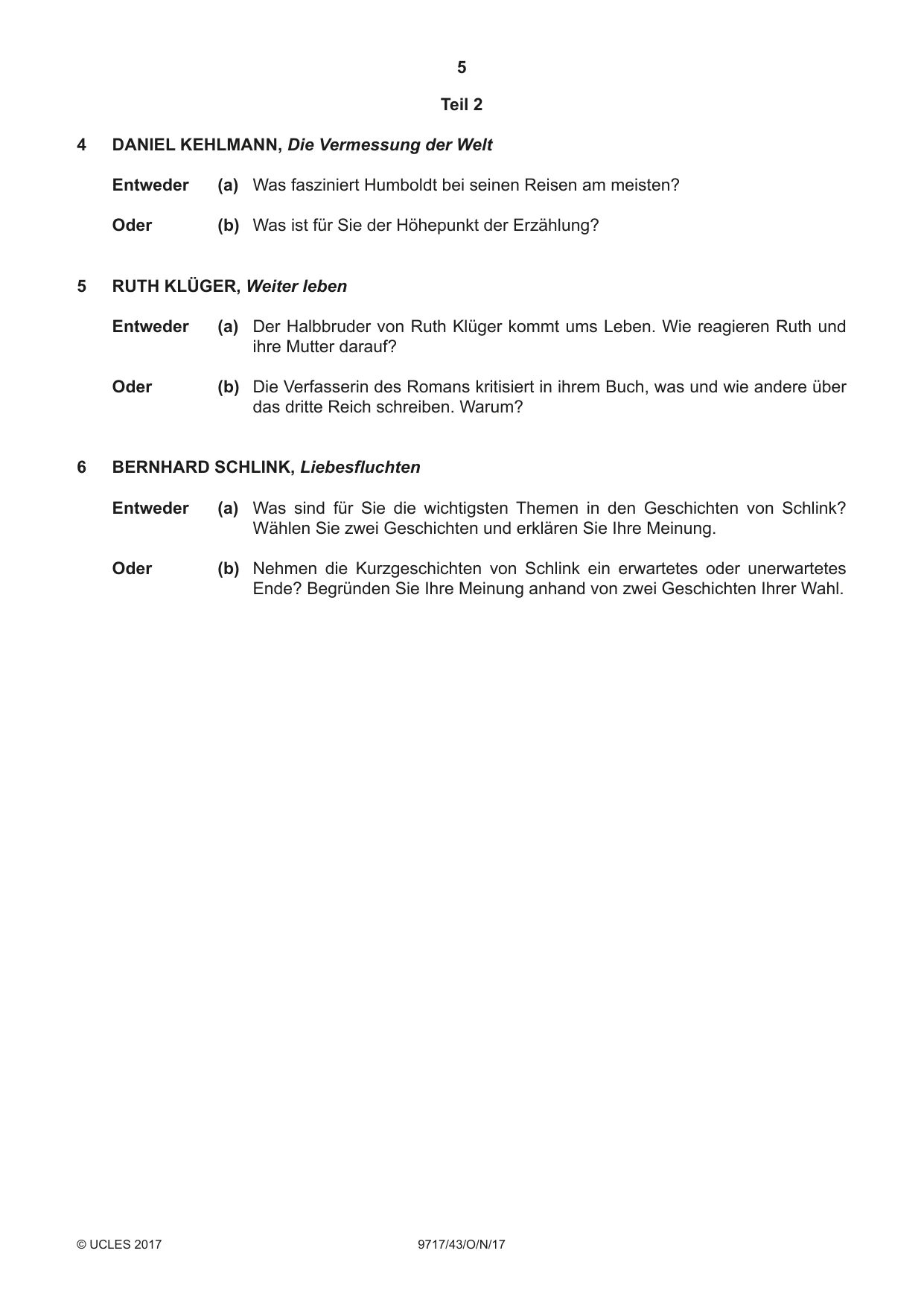
5 9717/43/O/N/17 © UCLES 2017 Teil 2 4 DANIEL KEHLMANN, Die Vermessung der Welt Entweder (a) Was fasziniert Humboldt bei seinen Reisen am meisten? Oder (b) Was ist für Sie der Höhepunkt der Erzӓhlung? 5 RUTH KLÜGER, Weiter leben Entweder (a) Der Halbbruder von Ruth Klüger kommt ums Leben. Wie reagieren Ruth und ihre Mutter darauf? Oder (b) Die Verfasserin des Romans kritisiert in ihrem Buch, was und wie andere über das dritte Reich schreiben. Warum? 6 BERNHARD SCHLINK, Liebesfluchten Entweder (a) Was sind für Sie die wichtigsten Themen in den Geschichten von Schlink? Wӓhlen Sie zwei Geschichten und erklӓren Sie Ihre Meinung. Oder (b) Nehmen die Kurzgeschichten von Schlink ein erwartetes oder unerwartetes Ende? Begründen Sie Ihre Meinung anhand von zwei Geschichten Ihrer Wahl.
Question paper, page 6
6 9717/43/O/N/17 © UCLES 2017 BLANK PAGE
Question paper, page 7
7 9717/43/O/N/17 © UCLES 2017 BLANK PAGE
Question paper, page 8
8 9717/43/O/N/17 © UCLES 2017 Permission to reproduce items where third-party owned material protected by copyright is included has been sought and cleared where possible. Every reasonable effort has been made by the publisher (UCLES) to trace copyright holders, but if any items requiring clearance have unwittingly been included, the publisher will be pleased to make amends at the earliest possible opportunity. To avoid the issue of disclosure of answer-related information to candidates, all copyright acknowledgements are reproduced online in the Cambridge International Examinations Copyright Acknowledgements Booklet. This is produced for each series of examinations and is freely available to download at www.cie.org.uk after the live examination series. Cambridge International Examinations is part of the Cambridge Assessment Group. Cambridge Assessment is the brand name of University of Cambridge Local Examinations Syndicate (UCLES), which is itself a department of the University of Cambridge. BLANK PAGE
Mark scheme, page 1
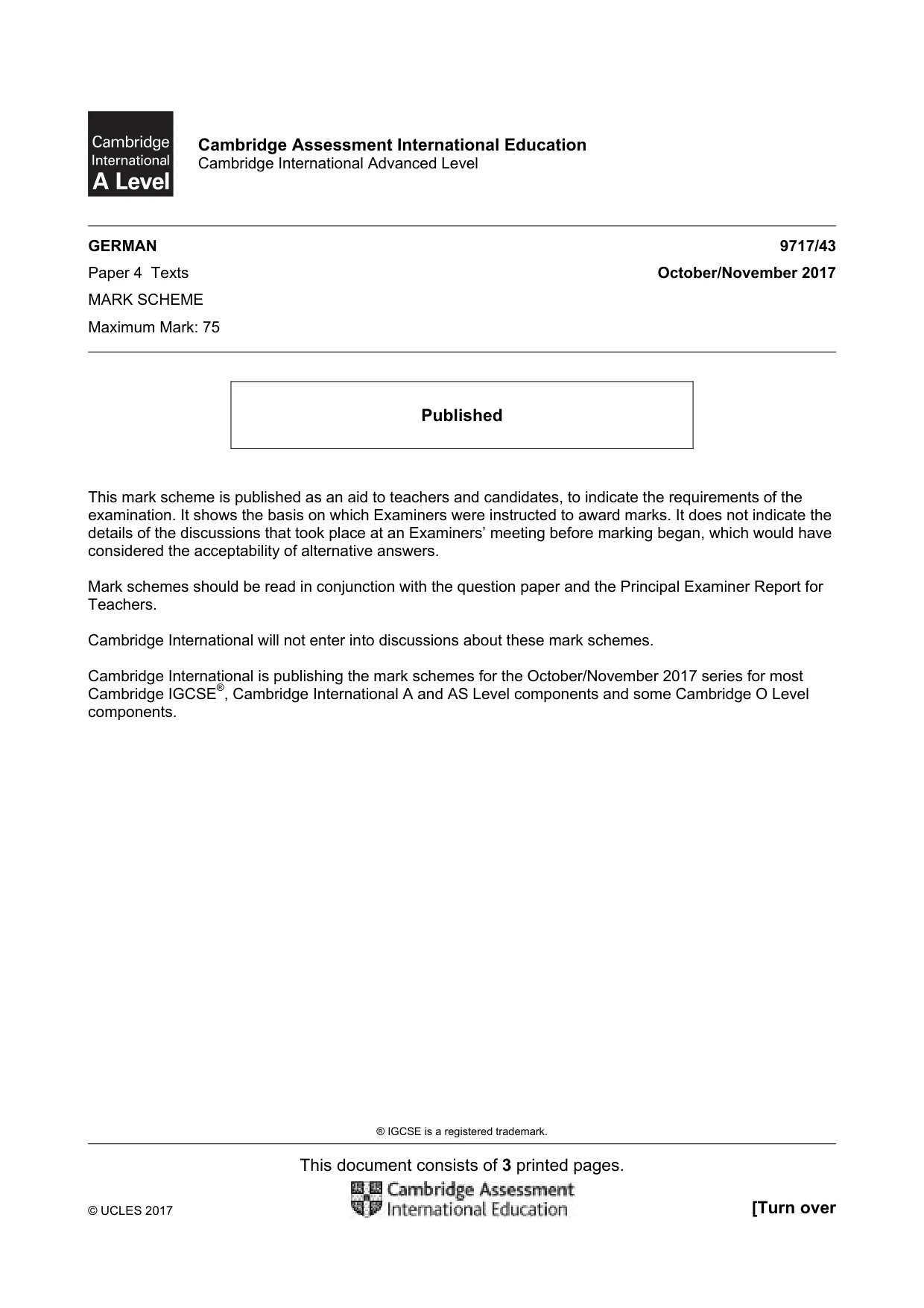
® IGCSE is a registered trademark. This document consists of 3 printed pages. © UCLES 2017 [Turn over Cambridge Assessment International Education Cambridge International Advanced Level GERMAN 9717/43 Paper 4 Texts October/November 2017 MARK SCHEME Maximum Mark: 75 Published This mark scheme is published as an aid to teachers and candidates, to indicate the requirements of the examination. It shows the basis on which Examiners were instructed to award marks. It does not indicate the details of the discussions that took place at an Examiners’ meeting before marking began, which would have considered the acceptability of alternative answers. Mark schemes should be read in conjunction with the question paper and the Principal Examiner Report for Teachers. Cambridge International will not enter into discussions about these mark schemes. Cambridge International is publishing the mark schemes for the October/November 2017 series for most Cambridge IGCSE®, Cambridge International A and AS Level components and some Cambridge O Level components.
Mark scheme, page 2
9717/43 Cambridge International A Level – Mark Scheme PUBLISHED October/November 2017 © UCLES 2017 Page 2 of 3 Candidates will write their answers in the target language. Examiners will look for a candidate's ability to communicate effectively and will ignore linguistic errors which do not impede communication. Passage-based questions Examiners should consider the extent to which candidates have been able to identify the significant issues raised in the passage and, where appropriate, have applied these to the text as a whole. The passage is a stimulus passage, to be used as a springboard to give candidates a starting point for their answer. Examiners should allow candidates to use the passage as they choose, and ask themselves how successfully the candidates have manipulated their material and to what extent they have shown depth of awareness and knowledge of the workings of the text under discussion. This is not an exercise in literary criticism: Examiners should reward candidates whose answers show good understanding of how a text works and how an author has conveyed the key issues. Essay questions A prime consideration is that candidates show detailed knowledge and understanding of the text. Extracts from Examiners' Notes This paper is intended to test candidates' knowledge of a text and their ability to use this knowledge to answer questions in a clear and focused manner. A sophisticated literary approach is not expected (though at the highest levels it is sometimes seen), but great value is placed on evidence of a firsthand response and thoughtful, personal evaluation of what candidates have read. Candidates may have been encouraged to depend closely on prepared notes and quotations: quotation for its own sake is not useful, though it will not be undervalued if used appropriately to illustrate a point in the answer. Candidates do not tend to show all the qualities or faults described in any one mark-band. Examiners attempt to weigh all these up at every borderline, in order to see whether the work can be considered for the category above. At the lower levels, the answer may mention a few 'facts' but these may be so poorly understood, badly organised and irrelevant that it falls into category 10–11; or there may be just enough sense of understanding and focus for the Examiner to consider the 12–13 band. Again, at a higher level, an answer may be clear, solid and conscientious (perhaps 18–19), without showing quite the control and attention to perceptively chosen detail which would justify 20 or more. Examiners take a positive and flexible approach and, even when there are obvious flaws in an answer, reward evidence of knowledge and especially any signs of understanding and careful organisation.
Mark scheme, page 3
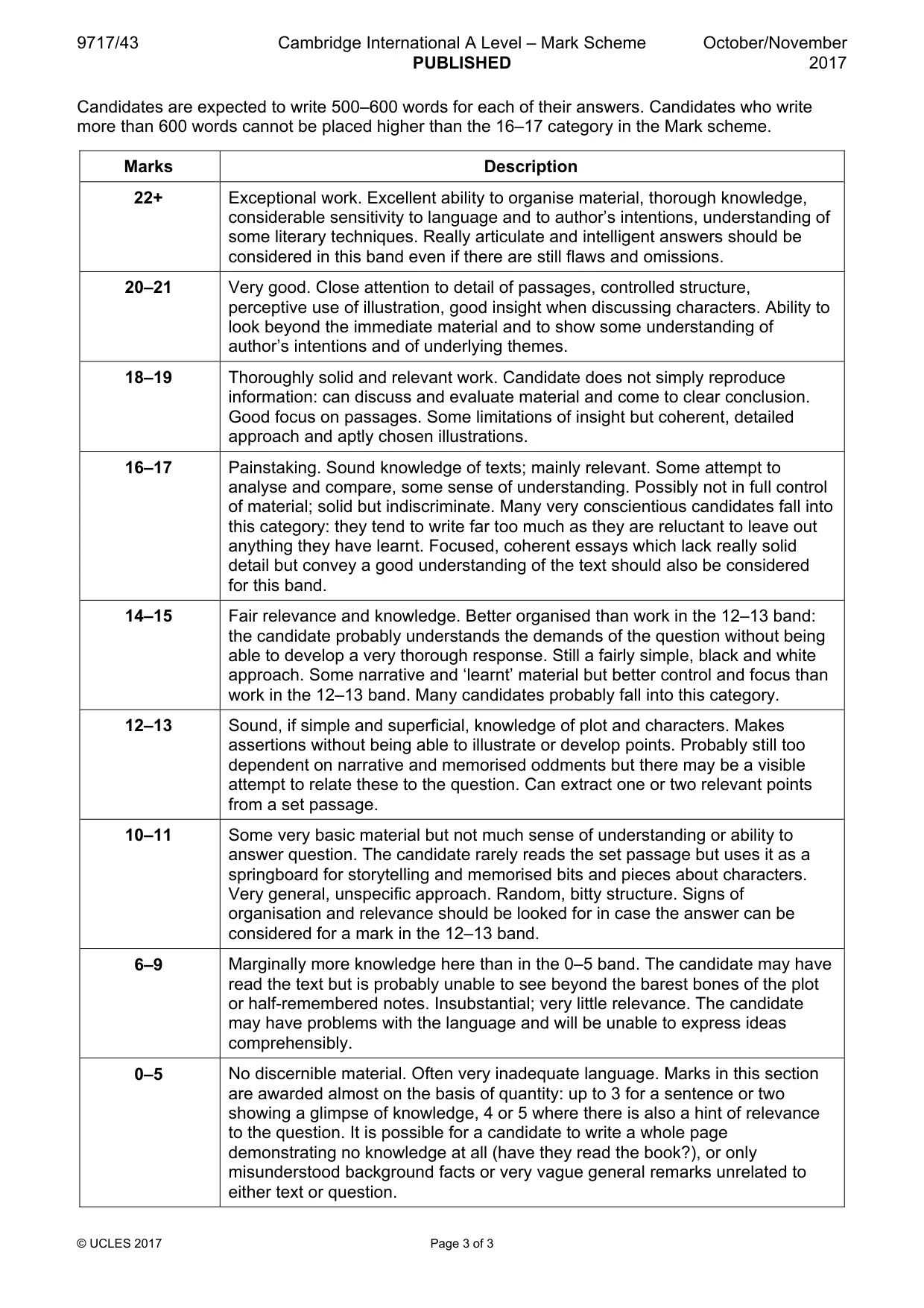
9717/43 Cambridge International A Level – Mark Scheme PUBLISHED October/November 2017 © UCLES 2017 Page 3 of 3 Candidates are expected to write 500–600 words for each of their answers. Candidates who write more than 600 words cannot be placed higher than the 16–17 category in the Mark scheme. Marks Description 22+ Exceptional work. Excellent ability to organise material, thorough knowledge, considerable sensitivity to language and to author’s intentions, understanding of some literary techniques. Really articulate and intelligent answers should be considered in this band even if there are still flaws and omissions. 20–21 Very good. Close attention to detail of passages, controlled structure, perceptive use of illustration, good insight when discussing characters. Ability to look beyond the immediate material and to show some understanding of author’s intentions and of underlying themes. 18–19 Thoroughly solid and relevant work. Candidate does not simply reproduce information: can discuss and evaluate material and come to clear conclusion. Good focus on passages. Some limitations of insight but coherent, detailed approach and aptly chosen illustrations. 16–17 Painstaking. Sound knowledge of texts; mainly relevant. Some attempt to analyse and compare, some sense of understanding. Possibly not in full control of material; solid but indiscriminate. Many very conscientious candidates fall into this category: they tend to write far too much as they are reluctant to leave out anything they have learnt. Focused, coherent essays which lack really solid detail but convey a good understanding of the text should also be considered for this band. 14–15 Fair relevance and knowledge. Better organised than work in the 12–13 band: the candidate probably understands the demands of the question without being able to develop a very thorough response. Still a fairly simple, black and white approach. Some narrative and ‘learnt’ material but better control and focus than work in the 12–13 band. Many candidates probably fall into this category. 12–13 Sound, if simple and superficial, knowledge of plot and characters. Makes assertions without being able to illustrate or develop points. Probably still too dependent on narrative and memorised oddments but there may be a visible attempt to relate these to the question. Can extract one or two relevant points from a set passage. 10–11 Some very basic material but not much sense of understanding or ability to answer question. The candidate rarely reads the set passage but uses it as a springboard for storytelling and memorised bits and pieces about characters. Very general, unspecific approach. Random, bitty structure. Signs of organisation and relevance should be looked for in case the answer can be considered for a mark in the 12–13 band. 6–9 Marginally more knowledge here than in the 0–5 band. The candidate may have read the text but is probably unable to see beyond the barest bones of the plot or half-remembered notes. Insubstantial; very little relevance. The candidate may have problems with the language and will be unable to express ideas comprehensibly. 0–5 No discernible material. Often very inadequate language. Marks in this section are awarded almost on the basis of quantity: up to 3 for a sentence or two showing a glimpse of knowledge, 4 or 5 where there is also a hint of relevance to the question. It is possible for a candidate to write a whole page demonstrating no knowledge at all (have they read the book?), or only misunderstood background facts or very vague general remarks unrelated to either text or question.
What you needed in this session
Cambridge’s own grade thresholds for 2017 Oct/Nov, Paper 4 · Variant 3. A higher threshold means an easier paper — the bar moves with how the cohort did.