Cambridge A Level German (A Level only) 9717 — 2019 May/June Paper 4 · Variant 1
9717/41/M/J/19 · 75 marks · ≈84 min
The question paper and its mark scheme, free to read here and free to download. This is Cambridge’s own paper, exactly as it was sat.
Question paper8 pages



Mark scheme4 pages
Answers below. Sit the paper first if you are practising.
Paper as text
Question paper, page 1
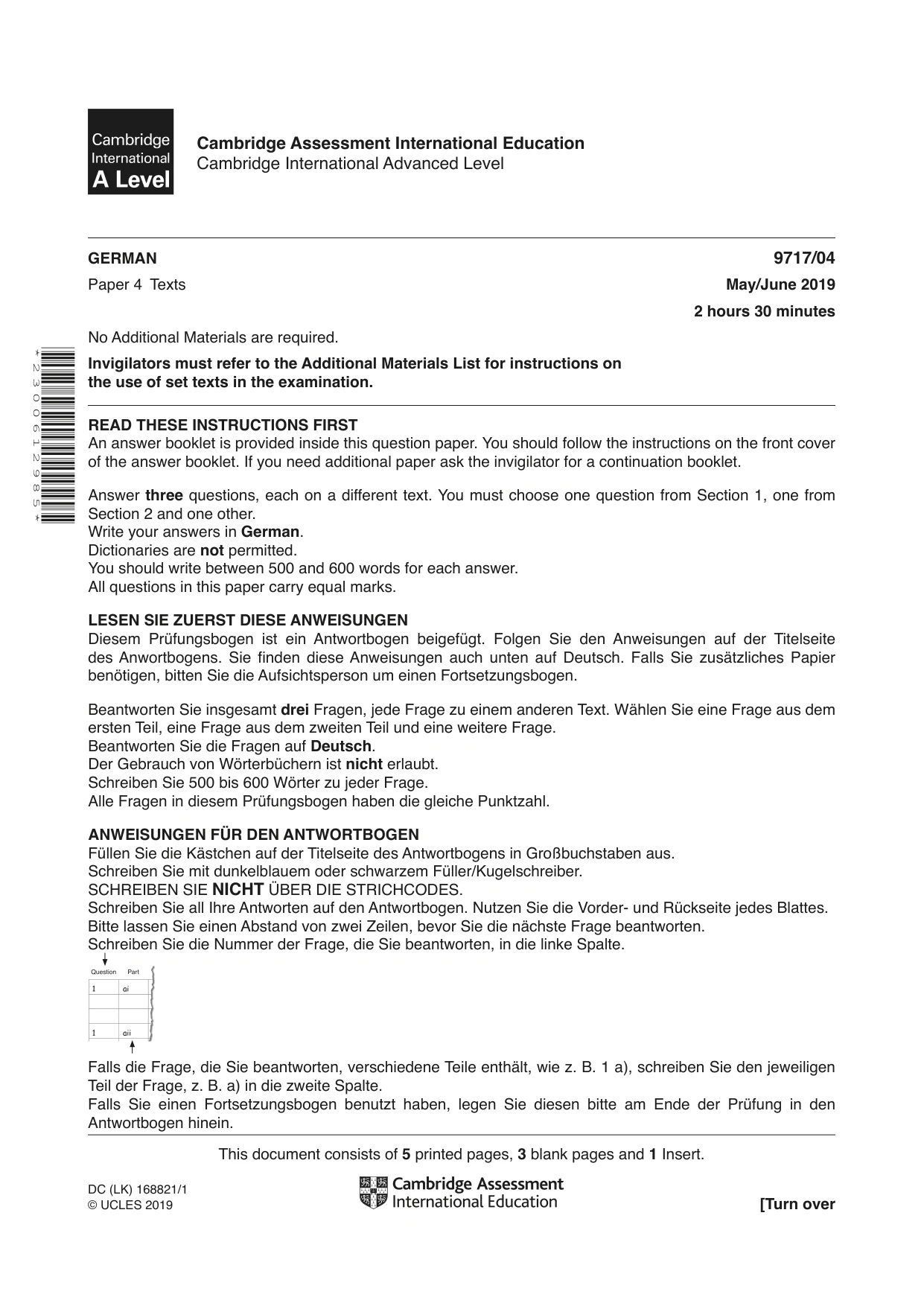
This document consists of 5 printed pages, 3 blank pages and 1 Insert. DC (LK) 168821/1 © UCLES 2019 [Turn over Cambridge Assessment International Education Cambridge International Advanced Level * 2 3 0 0 6 1 2 9 8 5 * GERMAN 9717/04 Paper 4 Texts May/June 2019 2 hours 30 minutes No Additional Materials are required. Invigilators must refer to the Additional Materials List for instructions on the use of set texts in the examination. READ THESE INSTRUCTIONS FIRST An answer booklet is provided inside this question paper. You should follow the instructions on the front cover of the answer booklet. If you need additional paper ask the invigilator for a continuation booklet. Answer three questions, each on a different text. You must choose one question from Section 1, one from Section 2 and one other. Write your answers in German. Dictionaries are not permitted. You should write between 500 and 600 words for each answer. All questions in this paper carry equal marks. LESEN SIE ZUERST DIESE ANWEISUNGEN Diesem Prüfungsbogen ist ein Antwortbogen beigefügt. Folgen Sie den Anweisungen auf der Titelseite des Anwortbogens. Sie finden diese Anweisungen auch unten auf Deutsch. Falls Sie zusätzliches Papier benötigen, bitten Sie die Aufsichtsperson um einen Fortsetzungsbogen. Beantworten Sie insgesamt drei Fragen, jede Frage zu einem anderen Text. Wählen Sie eine Frage aus dem ersten Teil, eine Frage aus dem zweiten Teil und eine weitere Frage. Beantworten Sie die Fragen auf Deutsch. Der Gebrauch von Wörterbüchern ist nicht erlaubt. Schreiben Sie 500 bis 600 Wörter zu jeder Frage. Alle Fragen in diesem Prüfungsbogen haben die gleiche Punktzahl. ANWEISUNGEN FÜR DEN ANTWORTBOGEN Füllen Sie die Kästchen auf der Titelseite des Antwortbogens in Großbuchstaben aus. Schreiben Sie mit dunkelblauem oder schwarzem Füller/Kugelschreiber. SCHREIBEN SIE NICHT ÜBER DIE STRICHCODES. Schreiben Sie all Ihre Antworten auf den Antwortbogen. Nutzen Sie die Vorder- und Rückseite jedes Blattes. Bitte lassen Sie einen Abstand von zwei Zeilen, bevor Sie die nächste Frage beantworten. Schreiben Sie die Nummer der Frage, die Sie beantworten, in die linke Spalte. Falls die Frage, die Sie beantworten, verschiedene Teile enthält, wie z. B. 1 a), schreiben Sie den jeweiligen Teil der Frage, z. B. a) in die zweite Spalte. Falls Sie einen Fortsetzungsbogen benutzt haben, legen Sie diesen bitte am Ende der Prüfung in den Antwortbogen hinein.
Question paper, page 2
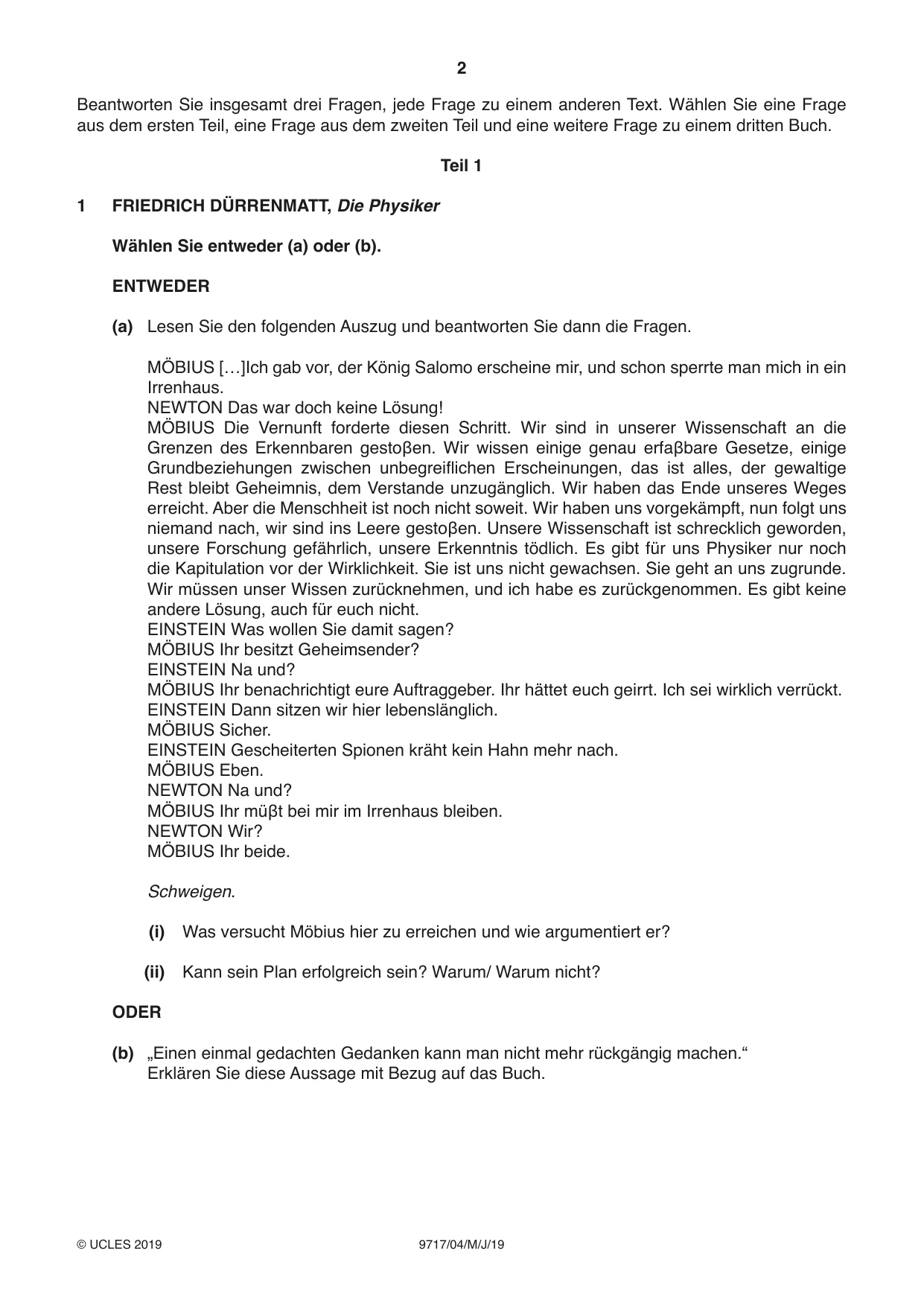
2 9717/04/M/J/19 © UCLES 2019 Beantworten Sie insgesamt drei Fragen, jede Frage zu einem anderen Text. Wählen Sie eine Frage aus dem ersten Teil, eine Frage aus dem zweiten Teil und eine weitere Frage zu einem dritten Buch. Teil 1 1 FRIEDRICH DÜRRENMATT, Die Physiker Wählen Sie entweder (a) oder (b). ENTWEDER (a) Lesen Sie den folgenden Auszug und beantworten Sie dann die Fragen. MÖBIUS […]Ich gab vor, der König Salomo erscheine mir, und schon sperrte man mich in ein Irrenhaus. NEWTON Das war doch keine Lösung! MÖBIUS Die Vernunft forderte diesen Schritt. Wir sind in unserer Wissenschaft an die Grenzen des Erkennbaren gestoβen. Wir wissen einige genau erfaβbare Gesetze, einige Grundbeziehungen zwischen unbegreiflichen Erscheinungen, das ist alles, der gewaltige Rest bleibt Geheimnis, dem Verstande unzugänglich. Wir haben das Ende unseres Weges erreicht. Aber die Menschheit ist noch nicht soweit. Wir haben uns vorgekämpft, nun folgt uns niemand nach, wir sind ins Leere gestoβen. Unsere Wissenschaft ist schrecklich geworden, unsere Forschung gefährlich, unsere Erkenntnis tödlich. Es gibt für uns Physiker nur noch die Kapitulation vor der Wirklichkeit. Sie ist uns nicht gewachsen. Sie geht an uns zugrunde. Wir müssen unser Wissen zurücknehmen, und ich habe es zurückgenommen. Es gibt keine andere Lösung, auch für euch nicht. EINSTEIN Was wollen Sie damit sagen? MÖBIUS Ihr besitzt Geheimsender? EINSTEIN Na und? MÖBIUS Ihr benachrichtigt eure Auftraggeber. Ihr hättet euch geirrt. Ich sei wirklich verrückt. EINSTEIN Dann sitzen wir hier lebenslänglich. MÖBIUS Sicher. EINSTEIN Gescheiterten Spionen kräht kein Hahn mehr nach. MÖBIUS Eben. NEWTON Na und? MÖBIUS Ihr müβt bei mir im Irrenhaus bleiben. NEWTON Wir? MÖBIUS Ihr beide. Schweigen. (i) Was versucht Möbius hier zu erreichen und wie argumentiert er? (ii) Kann sein Plan erfolgreich sein? Warum/ Warum nicht? ODER (b) „Einen einmal gedachten Gedanken kann man nicht mehr rückgängig machen.“ Erklären Sie diese Aussage mit Bezug auf das Buch.
Question paper, page 3
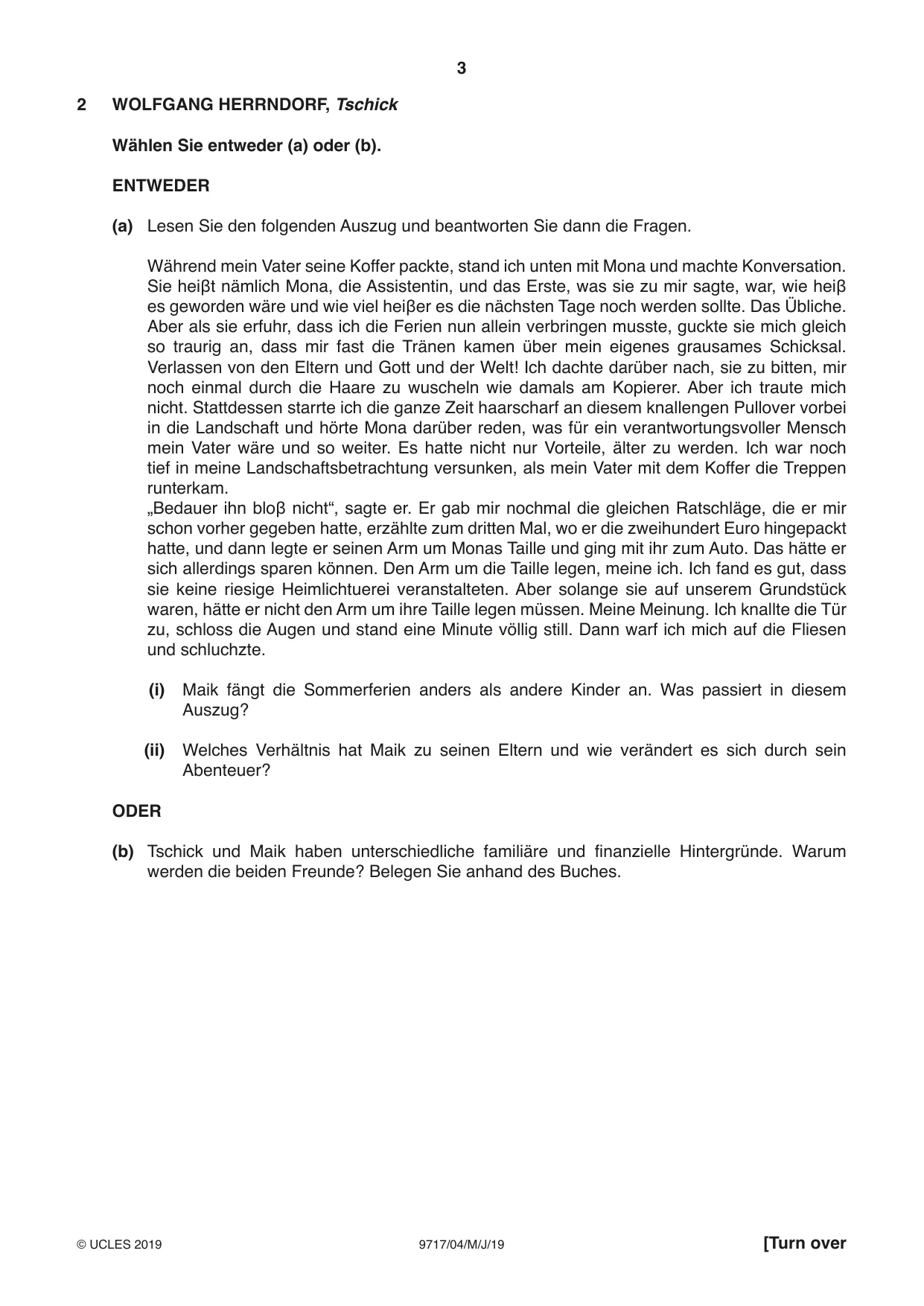
3 9717/04/M/J/19 © UCLES 2019 [Turn over 2 WOLFGANG HERRNDORF, Tschick Wählen Sie entweder (a) oder (b). ENTWEDER (a) Lesen Sie den folgenden Auszug und beantworten Sie dann die Fragen. Während mein Vater seine Koffer packte, stand ich unten mit Mona und machte Konversation. Sie heiβt nämlich Mona, die Assistentin, und das Erste, was sie zu mir sagte, war, wie heiβ es geworden wäre und wie viel heiβer es die nächsten Tage noch werden sollte. Das Übliche. Aber als sie erfuhr, dass ich die Ferien nun allein verbringen musste, guckte sie mich gleich so traurig an, dass mir fast die Tränen kamen über mein eigenes grausames Schicksal. Verlassen von den Eltern und Gott und der Welt! Ich dachte darüber nach, sie zu bitten, mir noch einmal durch die Haare zu wuscheln wie damals am Kopierer. Aber ich traute mich nicht. Stattdessen starrte ich die ganze Zeit haarscharf an diesem knallengen Pullover vorbei in die Landschaft und hörte Mona darüber reden, was für ein verantwortungsvoller Mensch mein Vater wäre und so weiter. Es hatte nicht nur Vorteile, älter zu werden. Ich war noch tief in meine Landschaftsbetrachtung versunken, als mein Vater mit dem Koffer die Treppen runterkam. „Bedauer ihn bloβ nicht“, sagte er. Er gab mir nochmal die gleichen Ratschläge, die er mir schon vorher gegeben hatte, erzählte zum dritten Mal, wo er die zweihundert Euro hingepackt hatte, und dann legte er seinen Arm um Monas Taille und ging mit ihr zum Auto. Das hätte er sich allerdings sparen können. Den Arm um die Taille legen, meine ich. Ich fand es gut, dass sie keine riesige Heimlichtuerei veranstalteten. Aber solange sie auf unserem Grundstück waren, hätte er nicht den Arm um ihre Taille legen müssen. Meine Meinung. Ich knallte die Tür zu, schloss die Augen und stand eine Minute völlig still. Dann warf ich mich auf die Fliesen und schluchzte. (i) Maik fängt die Sommerferien anders als andere Kinder an. Was passiert in diesem Auszug? (ii) Welches Verhältnis hat Maik zu seinen Eltern und wie verändert es sich durch sein Abenteuer? ODER (b) Tschick und Maik haben unterschiedliche familiäre und finanzielle Hintergründe. Warum werden die beiden Freunde? Belegen Sie anhand des Buches.
Question paper, page 4
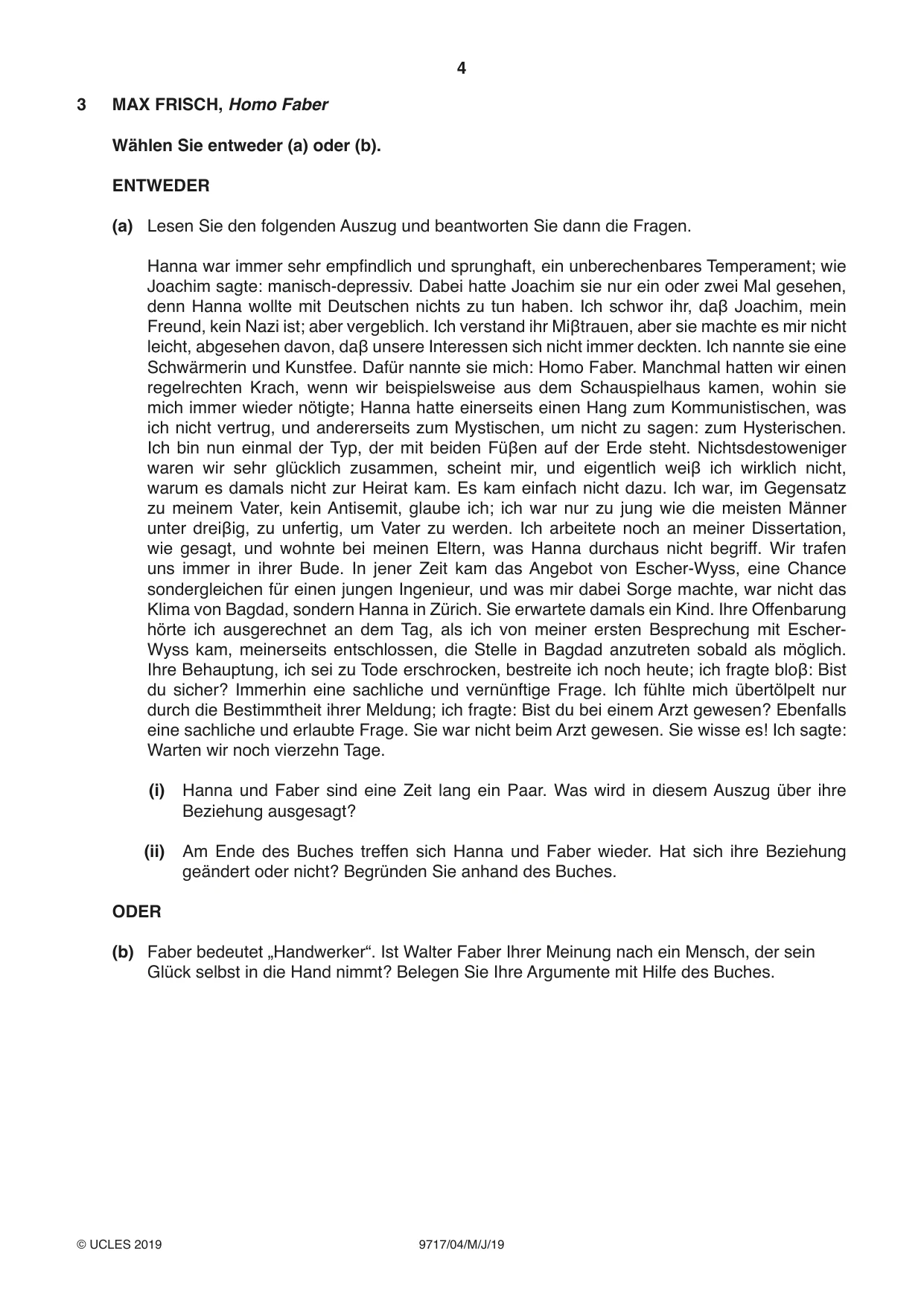
4 9717/04/M/J/19 © UCLES 2019 3 MAX FRISCH, Homo Faber Wählen Sie entweder (a) oder (b). ENTWEDER (a) Lesen Sie den folgenden Auszug und beantworten Sie dann die Fragen. Hanna war immer sehr empfindlich und sprunghaft, ein unberechenbares Temperament; wie Joachim sagte: manisch-depressiv. Dabei hatte Joachim sie nur ein oder zwei Mal gesehen, denn Hanna wollte mit Deutschen nichts zu tun haben. Ich schwor ihr, daβ Joachim, mein Freund, kein Nazi ist; aber vergeblich. Ich verstand ihr Miβtrauen, aber sie machte es mir nicht leicht, abgesehen davon, daβ unsere Interessen sich nicht immer deckten. Ich nannte sie eine Schwärmerin und Kunstfee. Dafür nannte sie mich: Homo Faber. Manchmal hatten wir einen regelrechten Krach, wenn wir beispielsweise aus dem Schauspielhaus kamen, wohin sie mich immer wieder nötigte; Hanna hatte einerseits einen Hang zum Kommunistischen, was ich nicht vertrug, und andererseits zum Mystischen, um nicht zu sagen: zum Hysterischen. Ich bin nun einmal der Typ, der mit beiden Füβen auf der Erde steht. Nichtsdestoweniger waren wir sehr glücklich zusammen, scheint mir, und eigentlich weiβ ich wirklich nicht, warum es damals nicht zur Heirat kam. Es kam einfach nicht dazu. Ich war, im Gegensatz zu meinem Vater, kein Antisemit, glaube ich; ich war nur zu jung wie die meisten Männer unter dreiβig, zu unfertig, um Vater zu werden. Ich arbeitete noch an meiner Dissertation, wie gesagt, und wohnte bei meinen Eltern, was Hanna durchaus nicht begriff. Wir trafen uns immer in ihrer Bude. In jener Zeit kam das Angebot von Escher-Wyss, eine Chance sondergleichen für einen jungen Ingenieur, und was mir dabei Sorge machte, war nicht das Klima von Bagdad, sondern Hanna in Zürich. Sie erwartete damals ein Kind. Ihre Offenbarung hörte ich ausgerechnet an dem Tag, als ich von meiner ersten Besprechung mit Escher- Wyss kam, meinerseits entschlossen, die Stelle in Bagdad anzutreten sobald als möglich. Ihre Behauptung, ich sei zu Tode erschrocken, bestreite ich noch heute; ich fragte bloβ: Bist du sicher? Immerhin eine sachliche und vernünftige Frage. Ich fühlte mich übertölpelt nur durch die Bestimmtheit ihrer Meldung; ich fragte: Bist du bei einem Arzt gewesen? Ebenfalls eine sachliche und erlaubte Frage. Sie war nicht beim Arzt gewesen. Sie wisse es! Ich sagte: Warten wir noch vierzehn Tage. (i) Hanna und Faber sind eine Zeit lang ein Paar. Was wird in diesem Auszug über ihre Beziehung ausgesagt? (ii) Am Ende des Buches treffen sich Hanna und Faber wieder. Hat sich ihre Beziehung geändert oder nicht? Begründen Sie anhand des Buches. ODER (b) Faber bedeutet „Handwerker“. Ist Walter Faber Ihrer Meinung nach ein Mensch, der sein Glück selbst in die Hand nimmt? Belegen Sie Ihre Argumente mit Hilfe des Buches.
Question paper, page 5
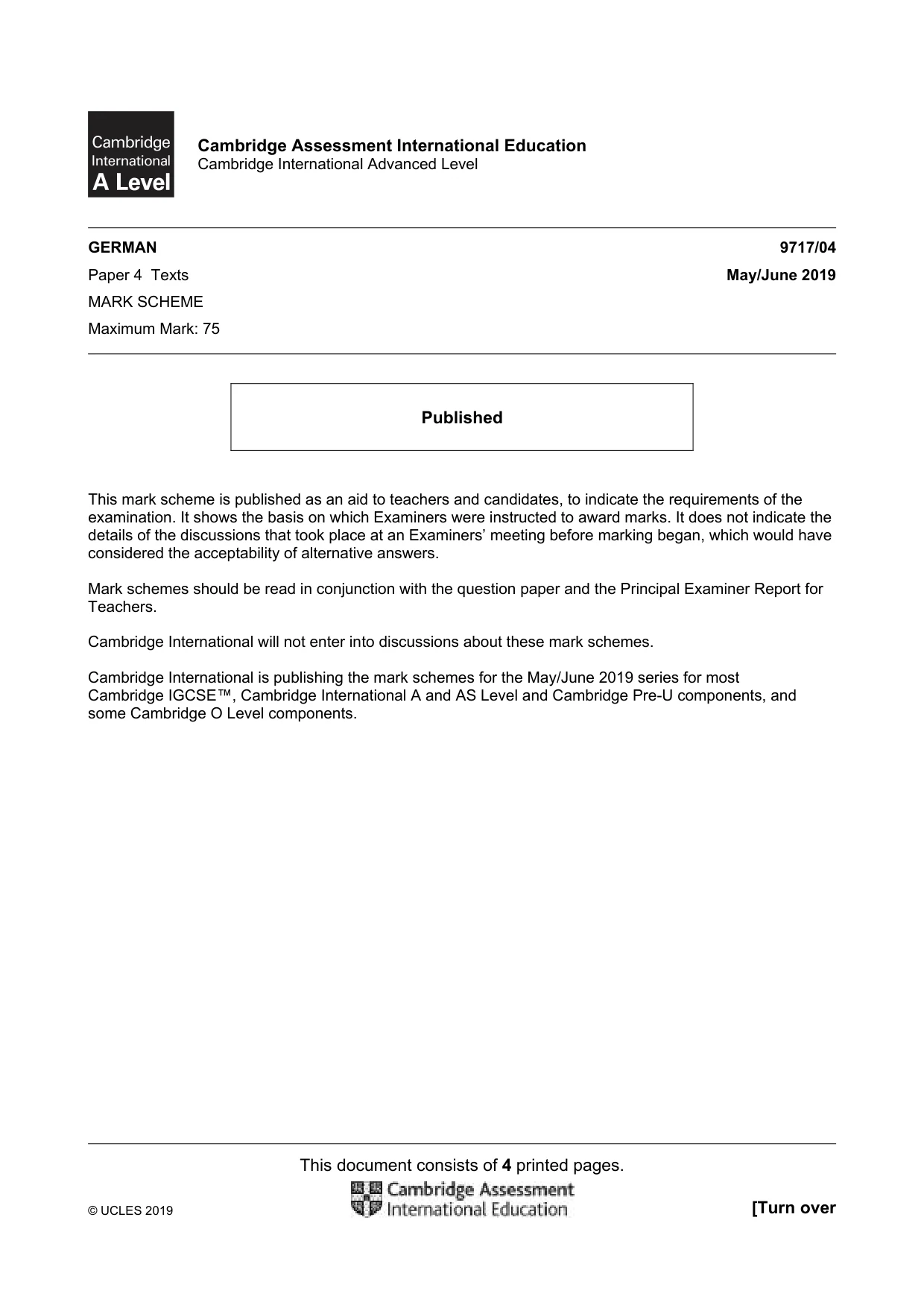
5 9717/04/M/J/19 © UCLES 2019 Teil 2 4 DANIEL KEHLMANN, Die Vermessung der Welt Wählen Sie entweder (a) oder (b). ENTWEDER (a) Gauβ versteht nicht, wie sich die politischen Verhältnisse ändern und wie er mit Menschen in Machtpositionen umgehen muss. Nennen Sie Beispiele und erklären Sie, was dies über Gauβ aussagt. ODER (b) Was sind Ihrer Meinung nach die Hauptthemen in diesem Buch und welches ist Ihrer Meinung nach am wichtigsten? Begründen Sie anhand des Buches. 5 RUTH KLÜGER, Weiter leben Wählen Sie entweder (a) oder (b). ENTWEDER (a) Kann man das einfache Weiterleben als Happy End bezeichnen? Nehmen Sie Stellung zu dieser Frage der Autorin. Beziehen Sie sich dabei auf das Buch. ODER (b) Auf der Flucht aus dem KZ gibt es immer wieder Dinge, die missglücken. Welche Dinge sind das und warum verraten sie Ruth, ihre Mutter und ihre Schwester fast? 6 BERNHARD SCHLINK, Liebesfluchten Wählen Sie entweder (a) oder (b). ENTWEDER (a) Welche Rolle spielen Paare in den Geschichten von Schlink? Beziehen Sie sich auf mindestens zwei Geschichten. ODER (b) Denken Sie, dass die Geschichten von Schlink für die Protagonisten ein Happy End haben oder nicht? Begründen Sie anhand von drei Geschichten Ihrer Wahl.
Question paper, page 6
6 9717/04/M/J/19 © UCLES 2019 BLANK PAGE
Question paper, page 7
7 9717/04/M/J/19 © UCLES 2019 BLANK PAGE
Question paper, page 8
8 9717/04/M/J/19 © UCLES 2019 Permission to reproduce items where third-party owned material protected by copyright is included has been sought and cleared where possible. Every reasonable effort has been made by the publisher (UCLES) to trace copyright holders, but if any items requiring clearance have unwittingly been included, the publisher will be pleased to make amends at the earliest possible opportunity. To avoid the issue of disclosure of answer-related information to candidates, all copyright acknowledgements are reproduced online in the Cambridge Assessment International Education Copyright Acknowledgements Booklet. This is produced for each series of examinations and is freely available to download at www.cambridgeinternational.org after the live examination series. Cambridge Assessment International Education is part of the Cambridge Assessment Group. Cambridge Assessment is the brand name of the University of Cambridge Local Examinations Syndicate (UCLES), which itself is a department of the University of Cambridge. BLANK PAGE
Mark scheme, page 1
This document consists of 4 printed pages. © UCLES 2019 [Turn over Cambridge Assessment International Education Cambridge International Advanced Level GERMAN 9717/04 Paper 4 Texts May/June 2019 MARK SCHEME Maximum Mark: 75 Published This mark scheme is published as an aid to teachers and candidates, to indicate the requirements of the examination. It shows the basis on which Examiners were instructed to award marks. It does not indicate the details of the discussions that took place at an Examiners’ meeting before marking began, which would have considered the acceptability of alternative answers. Mark schemes should be read in conjunction with the question paper and the Principal Examiner Report for Teachers. Cambridge International will not enter into discussions about these mark schemes. Cambridge International is publishing the mark schemes for the May/June 2019 series for most Cambridge IGCSE™, Cambridge International A and AS Level and Cambridge Pre-U components, and some Cambridge O Level components.
Mark scheme, page 2
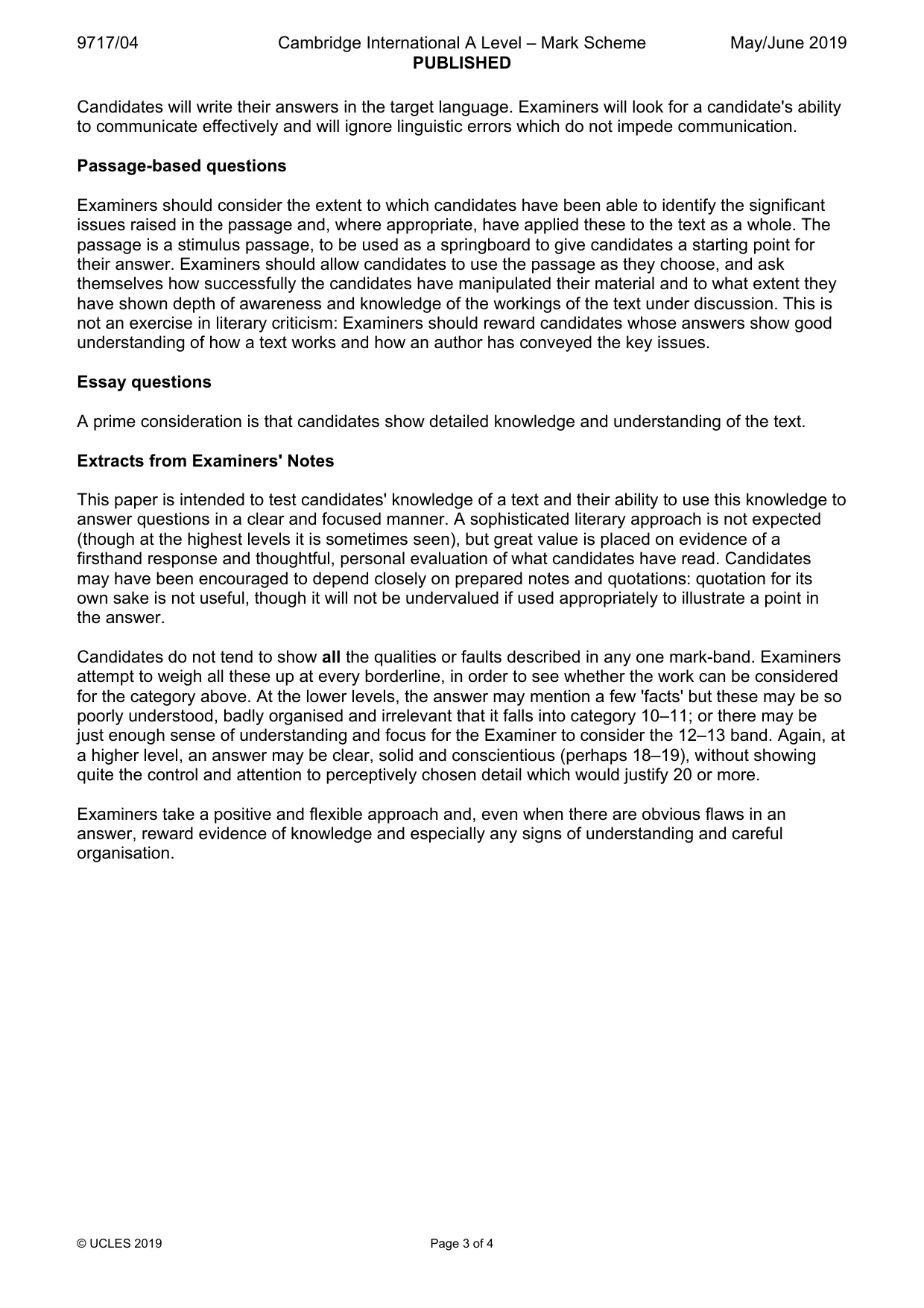
9717/04 Cambridge International A Level – Mark Scheme PUBLISHED May/June 2019 © UCLES 2019 Page 2 of 4 Generic Marking Principles These general marking principles must be applied by all examiners when marking candidate answers. They should be applied alongside the specific content of the mark scheme or generic level descriptors for a question. Each question paper and mark scheme will also comply with these marking principles. GENERIC MARKING PRINCIPLE 1: Marks must be awarded in line with: • the specific content of the mark scheme or the generic level descriptors for the question • the specific skills defined in the mark scheme or in the generic level descriptors for the question • the standard of response required by a candidate as exemplified by the standardisation scripts. GENERIC MARKING PRINCIPLE 2: Marks awarded are always whole marks (not half marks, or other fractions). GENERIC MARKING PRINCIPLE 3: Marks must be awarded positively: • marks are awarded for correct/valid answers, as defined in the mark scheme. However, credit is given for valid answers which go beyond the scope of the syllabus and mark scheme, referring to your Team Leader as appropriate • marks are awarded when candidates clearly demonstrate what they know and can do • marks are not deducted for errors • marks are not deducted for omissions • answers should only be judged on the quality of spelling, punctuation and grammar when these features are specifically assessed by the question as indicated by the mark scheme. The meaning, however, should be unambiguous. GENERIC MARKING PRINCIPLE 4: Rules must be applied consistently e.g. in situations where candidates have not followed instructions or in the application of generic level descriptors. GENERIC MARKING PRINCIPLE 5: Marks should be awarded using the full range of marks defined in the mark scheme for the question (however; the use of the full mark range may be limited according to the quality of the candidate responses seen). GENERIC MARKING PRINCIPLE 6: Marks awarded are based solely on the requirements as defined in the mark scheme. Marks should not be awarded with grade thresholds or grade descriptors in mind.
Mark scheme, page 3
9717/04 Cambridge International A Level – Mark Scheme PUBLISHED May/June 2019 © UCLES 2019 Page 3 of 4 Candidates will write their answers in the target language. Examiners will look for a candidate's ability to communicate effectively and will ignore linguistic errors which do not impede communication. Passage-based questions Examiners should consider the extent to which candidates have been able to identify the significant issues raised in the passage and, where appropriate, have applied these to the text as a whole. The passage is a stimulus passage, to be used as a springboard to give candidates a starting point for their answer. Examiners should allow candidates to use the passage as they choose, and ask themselves how successfully the candidates have manipulated their material and to what extent they have shown depth of awareness and knowledge of the workings of the text under discussion. This is not an exercise in literary criticism: Examiners should reward candidates whose answers show good understanding of how a text works and how an author has conveyed the key issues. Essay questions A prime consideration is that candidates show detailed knowledge and understanding of the text. Extracts from Examiners' Notes This paper is intended to test candidates' knowledge of a text and their ability to use this knowledge to answer questions in a clear and focused manner. A sophisticated literary approach is not expected (though at the highest levels it is sometimes seen), but great value is placed on evidence of a firsthand response and thoughtful, personal evaluation of what candidates have read. Candidates may have been encouraged to depend closely on prepared notes and quotations: quotation for its own sake is not useful, though it will not be undervalued if used appropriately to illustrate a point in the answer. Candidates do not tend to show all the qualities or faults described in any one mark-band. Examiners attempt to weigh all these up at every borderline, in order to see whether the work can be considered for the category above. At the lower levels, the answer may mention a few 'facts' but these may be so poorly understood, badly organised and irrelevant that it falls into category 10–11; or there may be just enough sense of understanding and focus for the Examiner to consider the 12–13 band. Again, at a higher level, an answer may be clear, solid and conscientious (perhaps 18–19), without showing quite the control and attention to perceptively chosen detail which would justify 20 or more. Examiners take a positive and flexible approach and, even when there are obvious flaws in an answer, reward evidence of knowledge and especially any signs of understanding and careful organisation.
Mark scheme, page 4
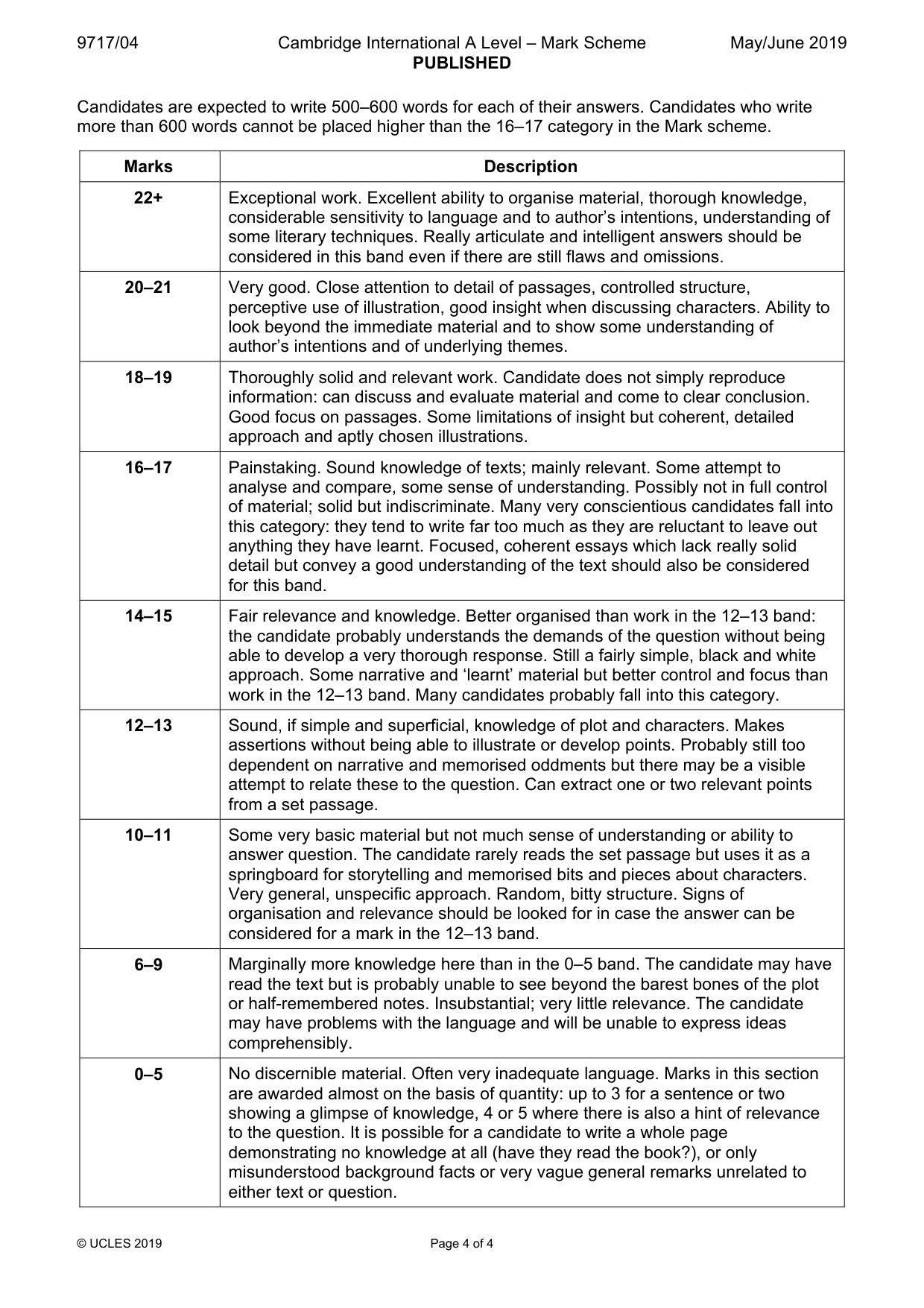
9717/04 Cambridge International A Level – Mark Scheme PUBLISHED May/June 2019 © UCLES 2019 Page 4 of 4 Candidates are expected to write 500–600 words for each of their answers. Candidates who write more than 600 words cannot be placed higher than the 16–17 category in the Mark scheme. Marks Description 22+ Exceptional work. Excellent ability to organise material, thorough knowledge, considerable sensitivity to language and to author’s intentions, understanding of some literary techniques. Really articulate and intelligent answers should be considered in this band even if there are still flaws and omissions. 20–21 Very good. Close attention to detail of passages, controlled structure, perceptive use of illustration, good insight when discussing characters. Ability to look beyond the immediate material and to show some understanding of author’s intentions and of underlying themes. 18–19 Thoroughly solid and relevant work. Candidate does not simply reproduce information: can discuss and evaluate material and come to clear conclusion. Good focus on passages. Some limitations of insight but coherent, detailed approach and aptly chosen illustrations. 16–17 Painstaking. Sound knowledge of texts; mainly relevant. Some attempt to analyse and compare, some sense of understanding. Possibly not in full control of material; solid but indiscriminate. Many very conscientious candidates fall into this category: they tend to write far too much as they are reluctant to leave out anything they have learnt. Focused, coherent essays which lack really solid detail but convey a good understanding of the text should also be considered for this band. 14–15 Fair relevance and knowledge. Better organised than work in the 12–13 band: the candidate probably understands the demands of the question without being able to develop a very thorough response. Still a fairly simple, black and white approach. Some narrative and ‘learnt’ material but better control and focus than work in the 12–13 band. Many candidates probably fall into this category. 12–13 Sound, if simple and superficial, knowledge of plot and characters. Makes assertions without being able to illustrate or develop points. Probably still too dependent on narrative and memorised oddments but there may be a visible attempt to relate these to the question. Can extract one or two relevant points from a set passage. 10–11 Some very basic material but not much sense of understanding or ability to answer question. The candidate rarely reads the set passage but uses it as a springboard for storytelling and memorised bits and pieces about characters. Very general, unspecific approach. Random, bitty structure. Signs of organisation and relevance should be looked for in case the answer can be considered for a mark in the 12–13 band. 6–9 Marginally more knowledge here than in the 0–5 band. The candidate may have read the text but is probably unable to see beyond the barest bones of the plot or half-remembered notes. Insubstantial; very little relevance. The candidate may have problems with the language and will be unable to express ideas comprehensibly. 0–5 No discernible material. Often very inadequate language. Marks in this section are awarded almost on the basis of quantity: up to 3 for a sentence or two showing a glimpse of knowledge, 4 or 5 where there is also a hint of relevance to the question. It is possible for a candidate to write a whole page demonstrating no knowledge at all (have they read the book?), or only misunderstood background facts or very vague general remarks unrelated to either text or question.
What you needed in this session
Cambridge’s own grade thresholds for 2019 May/June, Paper 4 · Variant 1. A higher threshold means an easier paper — the bar moves with how the cohort did.