Cambridge A Level German (A Level only) 9717 — 2011 Oct/Nov Paper 4 · Variant 1
9717/41/O/N/11 · 75 marks · ≈84 min
The question paper and its mark scheme, free to read here and free to download. This is Cambridge’s own paper, exactly as it was sat.
Question paper8 pages



Mark scheme3 pages
Answers below. Sit the paper first if you are practising.
Paper as text
Question paper, page 1
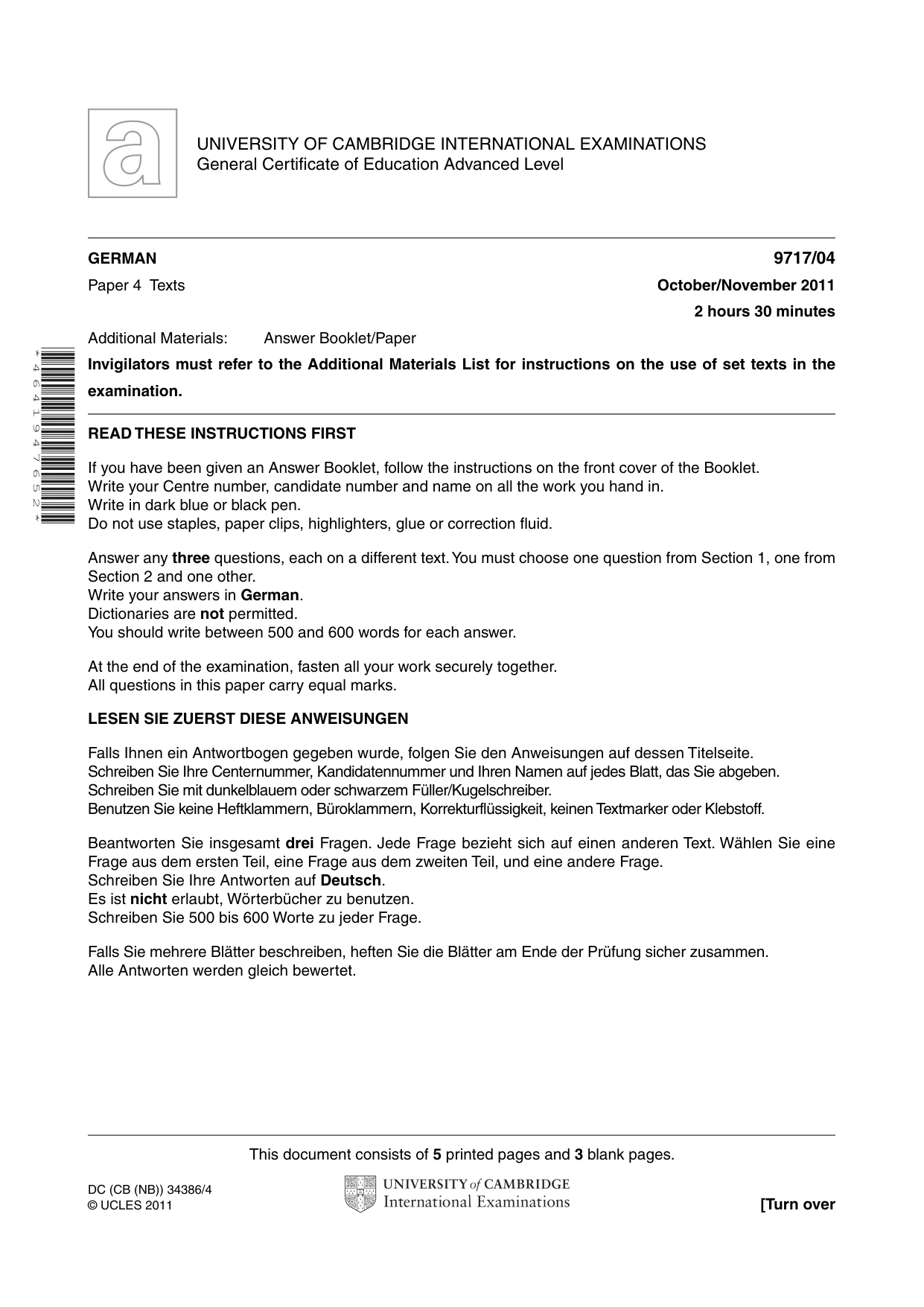
This document consists of 5 printed pages and 3 blank pages. DC (CB (NB)) 34386/4 © UCLES 2011 [Turn over * 4 6 4 1 9 4 7 6 5 2 * GERMAN 9717/04 Paper 4 Texts October/November 2011 2 hours 30 minutes Additional Materials: Answer Booklet/Paper Invigilators must refer to the Additional Materials List for instructions on the use of set texts in the examination. READ THESE INSTRUCTIONS FIRST If you have been given an Answer Booklet, follow the instructions on the front cover of the Booklet. Write your Centre number, candidate number and name on all the work you hand in. Write in dark blue or black pen. Do not use staples, paper clips, highlighters, glue or correction fluid. Answer any three questions, each on a different text. You must choose one question from Section 1, one from Section 2 and one other. Write your answers in German. Dictionaries are not permitted. You should write between 500 and 600 words for each answer. At the end of the examination, fasten all your work securely together. All questions in this paper carry equal marks. LESEN SIE ZUERST DIESE ANWEISUNGEN Falls Ihnen ein Antwortbogen gegeben wurde, folgen Sie den Anweisungen auf dessen Titelseite. Schreiben Sie Ihre Centernummer, Kandidatennummer und Ihren Namen auf jedes Blatt, das Sie abgeben. Schreiben Sie mit dunkelblauem oder schwarzem Füller/Kugelschreiber. Benutzen Sie keine Heftklammern, Büroklammern, Korrekturflüssigkeit, keinen Textmarker oder Klebstoff. Beantworten Sie insgesamt drei Fragen. Jede Frage bezieht sich auf einen anderen Text. Wählen Sie eine Frage aus dem ersten Teil, eine Frage aus dem zweiten Teil, und eine andere Frage. Schreiben Sie Ihre Antworten auf Deutsch. Es ist nicht erlaubt, Wörterbücher zu benutzen. Schreiben Sie 500 bis 600 Worte zu jeder Frage. Falls Sie mehrere Blätter beschreiben, heften Sie die Blätter am Ende der Prüfung sicher zusammen. Alle Antworten werden gleich bewertet. UNIVERSITY OF CAMBRIDGE INTERNATIONAL EXAMINATIONS General Certificate of Education Advanced Level
Question paper, page 2
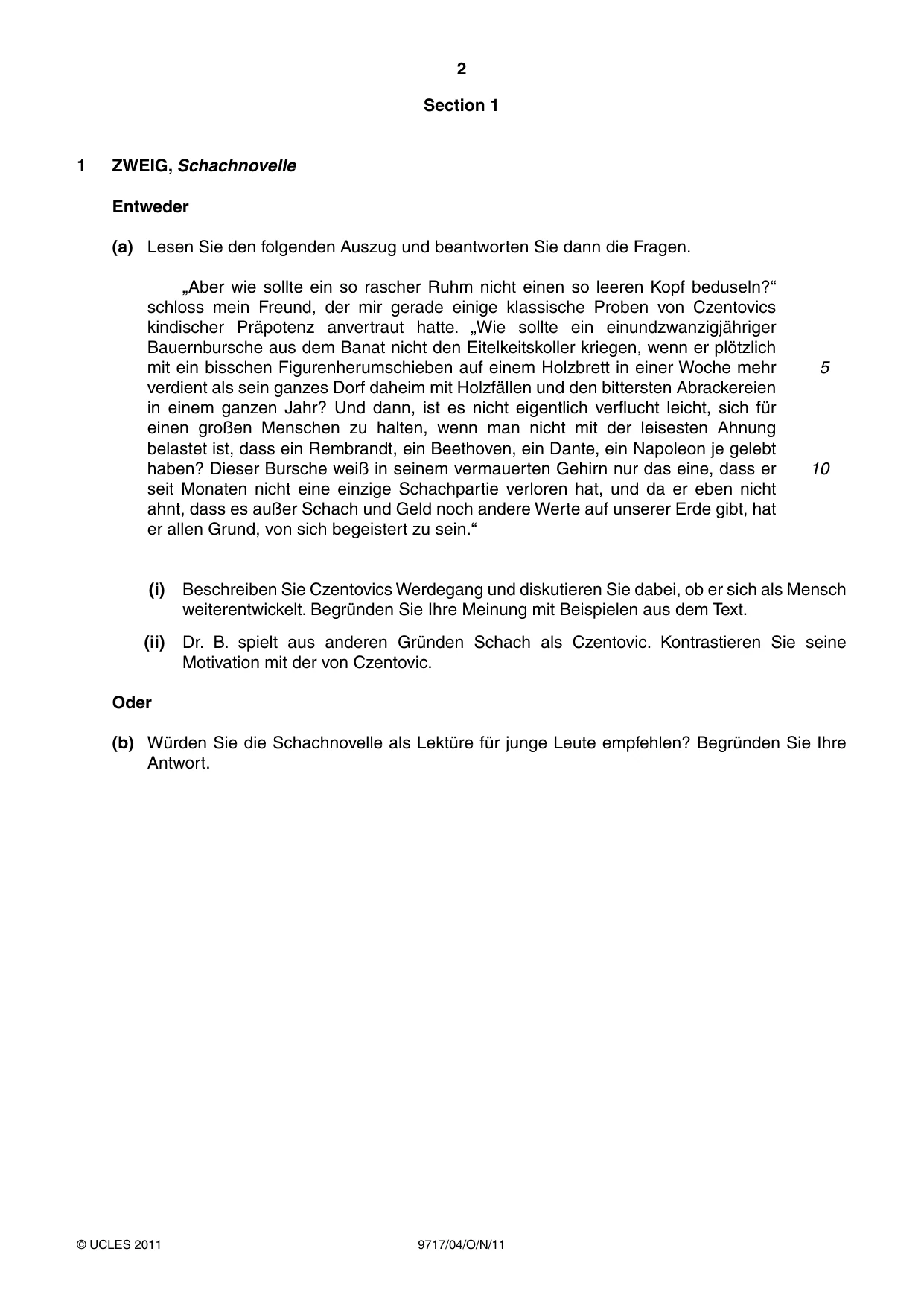
2 9717/04/O/N/11 © UCLES 2011 Section 1 1 ZWEIG, Schachnovelle Entweder (a) Lesen Sie den folgenden Auszug und beantworten Sie dann die Fragen. „Aber wie sollte ein so rascher Ruhm nicht einen so leeren Kopf beduseln?“ schloss mein Freund, der mir gerade einige klassische Proben von Czentovics kindischer Präpotenz anvertraut hatte. „Wie sollte ein einundzwanzigjähriger Bauernbursche aus dem Banat nicht den Eitelkeitskoller kriegen, wenn er plötzlich mit ein bisschen Figurenherumschieben auf einem Holzbrett in einer Woche mehr verdient als sein ganzes Dorf daheim mit Holzfällen und den bittersten Abrackereien in einem ganzen Jahr? Und dann, ist es nicht eigentlich verflucht leicht, sich für einen großen Menschen zu halten, wenn man nicht mit der leisesten Ahnung belastet ist, dass ein Rembrandt, ein Beethoven, ein Dante, ein Napoleon je gelebt haben? Dieser Bursche weiß in seinem vermauerten Gehirn nur das eine, dass er seit Monaten nicht eine einzige Schachpartie verloren hat, und da er eben nicht ahnt, dass es außer Schach und Geld noch andere Werte auf unserer Erde gibt, hat er allen Grund, von sich begeistert zu sein.“ (i) Beschreiben Sie Czentovics Werdegang und diskutieren Sie dabei, ob er sich als Mensch weiterentwickelt. Begründen Sie Ihre Meinung mit Beispielen aus dem Text. (ii) Dr. B. spielt aus anderen Gründen Schach als Czentovic. Kontrastieren Sie seine Motivation mit der von Czentovic. Oder (b) Würden Sie die Schachnovelle als Lektüre für junge Leute empfehlen? Begründen Sie Ihre Antwort. 5 10
Question paper, page 3
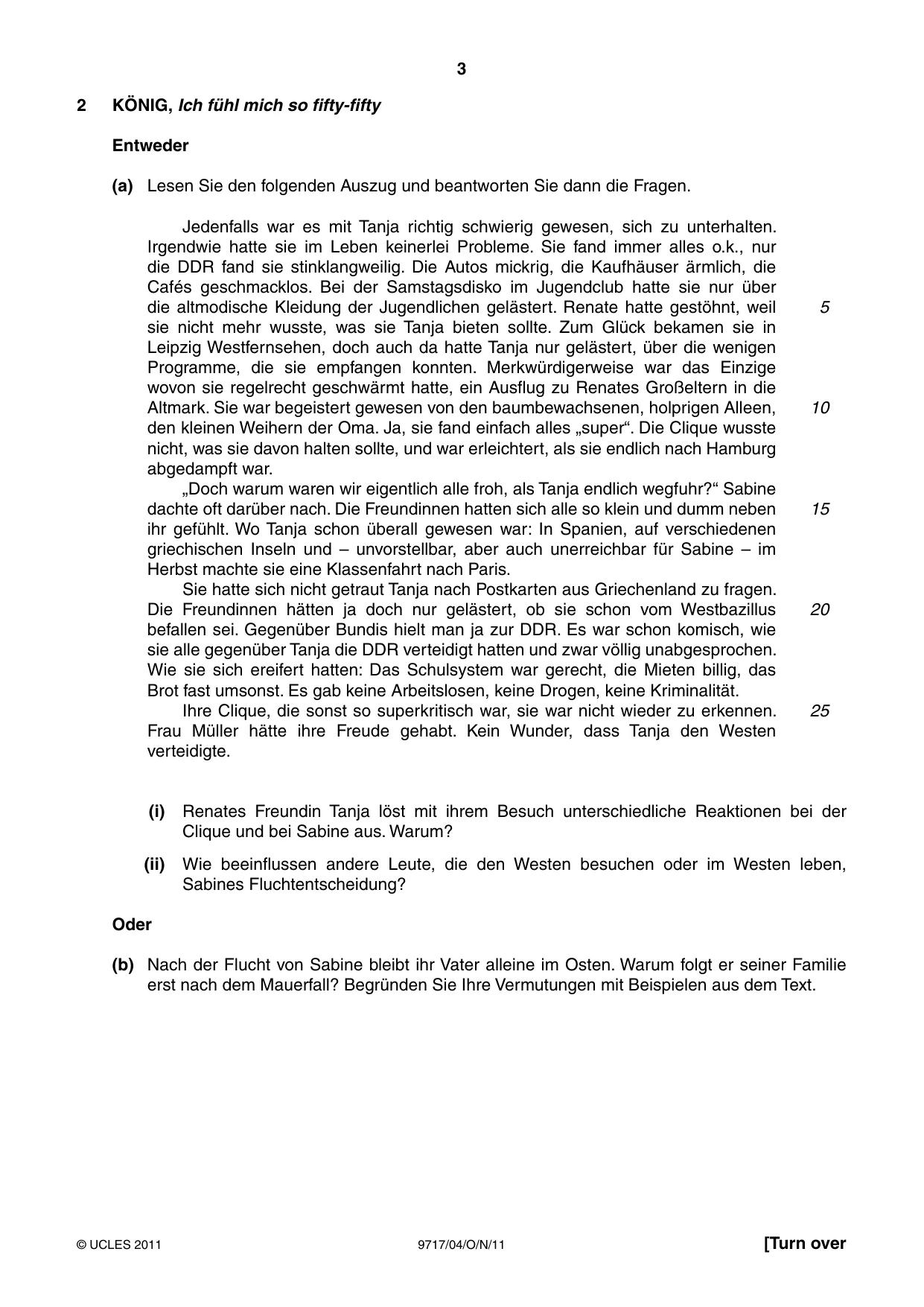
3 9717/04/O/N/11 © UCLES 2011 [Turn over 2 KÖNIG, Ich fühl mich so fifty-fifty Entweder (a) Lesen Sie den folgenden Auszug und beantworten Sie dann die Fragen. Jedenfalls war es mit Tanja richtig schwierig gewesen, sich zu unterhalten. Irgendwie hatte sie im Leben keinerlei Probleme. Sie fand immer alles o.k., nur die DDR fand sie stinklangweilig. Die Autos mickrig, die Kaufhäuser ärmlich, die Cafés geschmacklos. Bei der Samstagsdisko im Jugendclub hatte sie nur über die altmodische Kleidung der Jugendlichen gelästert. Renate hatte gestöhnt, weil sie nicht mehr wusste, was sie Tanja bieten sollte. Zum Glück bekamen sie in Leipzig Westfernsehen, doch auch da hatte Tanja nur gelästert, über die wenigen Programme, die sie empfangen konnten. Merkwürdigerweise war das Einzige wovon sie regelrecht geschwärmt hatte, ein Ausflug zu Renates Großeltern in die Altmark. Sie war begeistert gewesen von den baumbewachsenen, holprigen Alleen, den kleinen Weihern der Oma. Ja, sie fand einfach alles „super“. Die Clique wusste nicht, was sie davon halten sollte, und war erleichtert, als sie endlich nach Hamburg abgedampft war. „Doch warum waren wir eigentlich alle froh, als Tanja endlich wegfuhr?“ Sabine dachte oft darüber nach. Die Freundinnen hatten sich alle so klein und dumm neben ihr gefühlt. Wo Tanja schon überall gewesen war: In Spanien, auf verschiedenen griechischen Inseln und – unvorstellbar, aber auch unerreichbar für Sabine – im Herbst machte sie eine Klassenfahrt nach Paris. Sie hatte sich nicht getraut Tanja nach Postkarten aus Griechenland zu fragen. Die Freundinnen hätten ja doch nur gelästert, ob sie schon vom Westbazillus befallen sei. Gegenüber Bundis hielt man ja zur DDR. Es war schon komisch, wie sie alle gegenüber Tanja die DDR verteidigt hatten und zwar völlig unabgesprochen. Wie sie sich ereifert hatten: Das Schulsystem war gerecht, die Mieten billig, das Brot fast umsonst. Es gab keine Arbeitslosen, keine Drogen, keine Kriminalität. Ihre Clique, die sonst so superkritisch war, sie war nicht wieder zu erkennen. Frau Müller hätte ihre Freude gehabt. Kein Wunder, dass Tanja den Westen verteidigte. (i) Renates Freundin Tanja löst mit ihrem Besuch unterschiedliche Reaktionen bei der Clique und bei Sabine aus. Warum? (ii) Wie beeinflussen andere Leute, die den Westen besuchen oder im Westen leben, Sabines Fluchtentscheidung? Oder (b) Nach der Flucht von Sabine bleibt ihr Vater alleine im Osten. Warum folgt er seiner Familie erst nach dem Mauerfall? Begründen Sie Ihre Vermutungen mit Beispielen aus dem Text. 5 10 15 20 25
Question paper, page 4
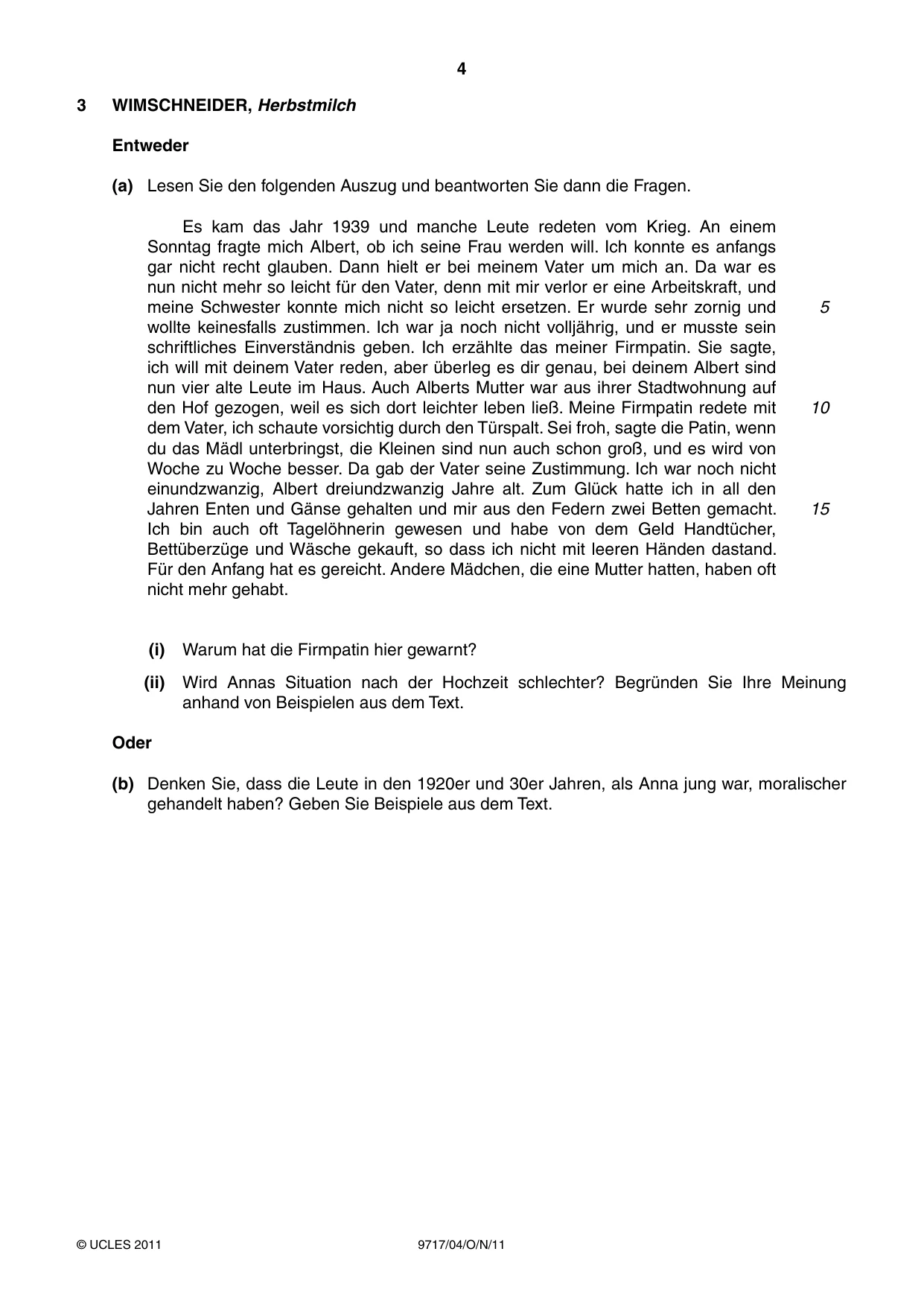
4 9717/04/O/N/11 © UCLES 2011 3 WIMSCHNEIDER, Herbstmilch Entweder (a) Lesen Sie den folgenden Auszug und beantworten Sie dann die Fragen. Es kam das Jahr 1939 und manche Leute redeten vom Krieg. An einem Sonntag fragte mich Albert, ob ich seine Frau werden will. Ich konnte es anfangs gar nicht recht glauben. Dann hielt er bei meinem Vater um mich an. Da war es nun nicht mehr so leicht für den Vater, denn mit mir verlor er eine Arbeitskraft, und meine Schwester konnte mich nicht so leicht ersetzen. Er wurde sehr zornig und wollte keinesfalls zustimmen. Ich war ja noch nicht volljährig, und er musste sein schriftliches Einverständnis geben. Ich erzählte das meiner Firmpatin. Sie sagte, ich will mit deinem Vater reden, aber überleg es dir genau, bei deinem Albert sind nun vier alte Leute im Haus. Auch Alberts Mutter war aus ihrer Stadtwohnung auf den Hof gezogen, weil es sich dort leichter leben ließ. Meine Firmpatin redete mit dem Vater, ich schaute vorsichtig durch den Türspalt. Sei froh, sagte die Patin, wenn du das Mädl unterbringst, die Kleinen sind nun auch schon groß, und es wird von Woche zu Woche besser. Da gab der Vater seine Zustimmung. Ich war noch nicht einundzwanzig, Albert dreiundzwanzig Jahre alt. Zum Glück hatte ich in all den Jahren Enten und Gänse gehalten und mir aus den Federn zwei Betten gemacht. Ich bin auch oft Tagelöhnerin gewesen und habe von dem Geld Handtücher, Bettüberzüge und Wäsche gekauft, so dass ich nicht mit leeren Händen dastand. Für den Anfang hat es gereicht. Andere Mädchen, die eine Mutter hatten, haben oft nicht mehr gehabt. (i) Warum hat die Firmpatin hier gewarnt? (ii) Wird Annas Situation nach der Hochzeit schlechter? Begründen Sie Ihre Meinung anhand von Beispielen aus dem Text. Oder (b) Denken Sie, dass die Leute in den 1920er und 30er Jahren, als Anna jung war, moralischer gehandelt haben? Geben Sie Beispiele aus dem Text. 5 10 15
Question paper, page 5
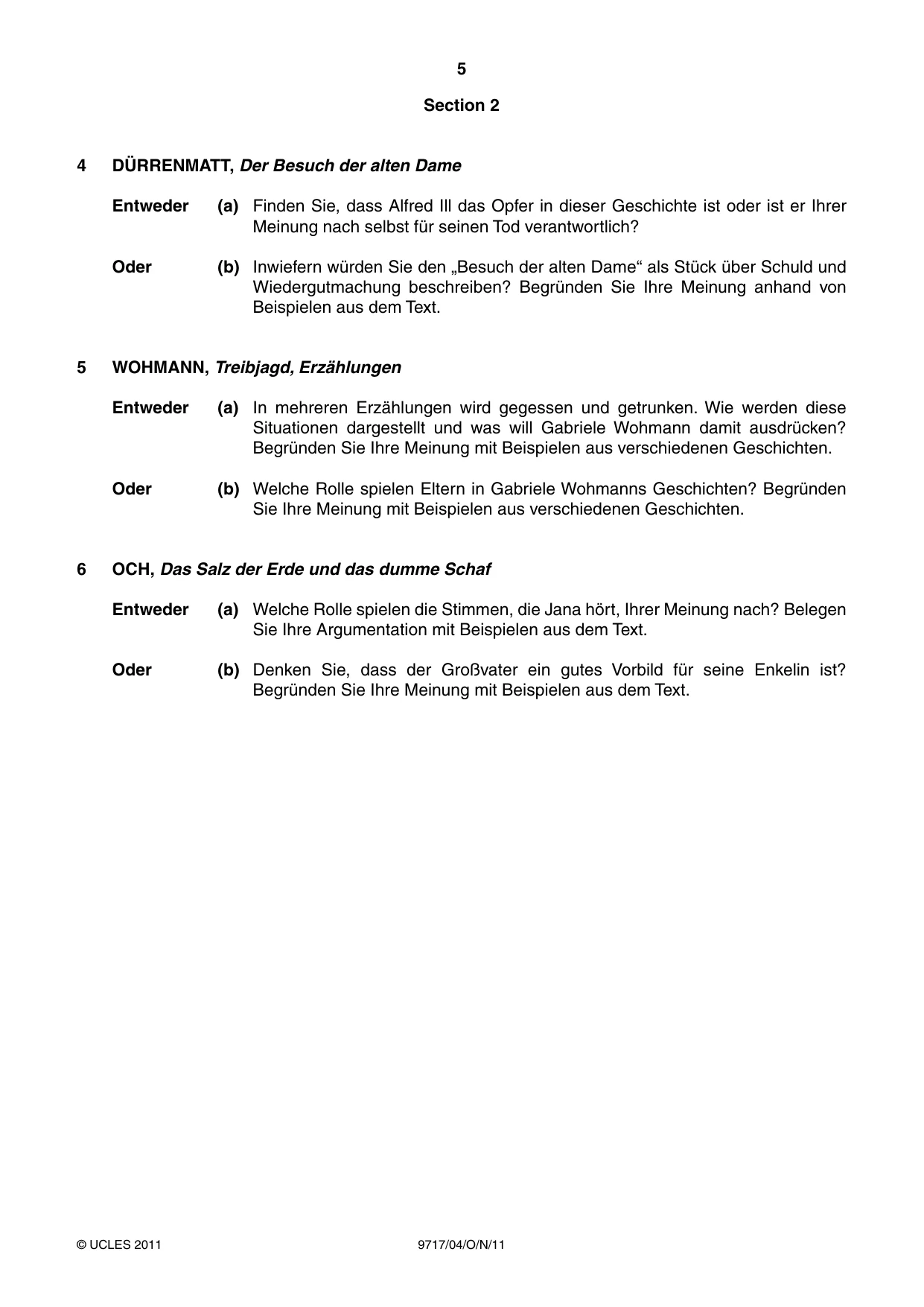
5 9717/04/O/N/11 © UCLES 2011 Section 2 4 DÜRRENMATT, Der Besuch der alten Dame Entweder (a) Finden Sie, dass Alfred Ill das Opfer in dieser Geschichte ist oder ist er Ihrer Meinung nach selbst für seinen Tod verantwortlich? Oder (b) Inwiefern würden Sie den „Besuch der alten Dame“ als Stück über Schuld und Wiedergutmachung beschreiben? Begründen Sie Ihre Meinung anhand von Beispielen aus dem Text. 5 WOHMANN, Treibjagd, Erzählungen Entweder (a) In mehreren Erzählungen wird gegessen und getrunken. Wie werden diese Situationen dargestellt und was will Gabriele Wohmann damit ausdrücken? Begründen Sie Ihre Meinung mit Beispielen aus verschiedenen Geschichten. Oder (b) Welche Rolle spielen Eltern in Gabriele Wohmanns Geschichten? Begründen Sie Ihre Meinung mit Beispielen aus verschiedenen Geschichten. 6 OCH, Das Salz der Erde und das dumme Schaf Entweder (a) Welche Rolle spielen die Stimmen, die Jana hört, Ihrer Meinung nach? Belegen Sie Ihre Argumentation mit Beispielen aus dem Text. Oder (b) Denken Sie, dass der Großvater ein gutes Vorbild für seine Enkelin ist? Begründen Sie Ihre Meinung mit Beispielen aus dem Text.
Question paper, page 6
6 9717/04/O/N/11 © UCLES 2011 BLANK PAGE
Question paper, page 7
7 9717/04/O/N/11 © UCLES 2011 BLANK PAGE
Question paper, page 8
8 9717/04/O/N/11 © UCLES 2011 Copyright Acknowledgements: Question 1 (a) (b) © Stefan Zweig; Schachnovelle; S Fischer Verlag. Question 1 (a) (b) © Ich fühl mich so fifty-fifty; dtv junior. Question 1 (a) (b) © Anna Wimschneider; Herbstmilch; Piper Verlag. Permission to reproduce items where third-party owned material protected by copyright is included has been sought and cleared where possible. Every reasonable effort has been made by the publisher (UCLES) to trace copyright holders, but if any items requiring clearance have unwittingly been included, the publisher will be pleased to make amends at the earliest possible opportunity. University of Cambridge International Examinations is part of the Cambridge Assessment Group. Cambridge Assessment is the brand name of University of Cambridge Local Examinations Syndicate (UCLES), which is itself a department of the University of Cambridge. BLANK PAGE
Mark scheme, page 1
UNIVERSITY OF CAMBRIDGE INTERNATIONAL EXAMINATIONS GCE Advanced Level MARK SCHEME for the October/November 2011 question paper for the guidance of teachers 9717 GERMAN 9717/04 Paper 4 (Texts), maximum raw mark 75 This mark scheme is published as an aid to teachers and candidates, to indicate the requirements of the examination. It shows the basis on which Examiners were instructed to award marks. It does not indicate the details of the discussions that took place at an Examiners’ meeting before marking began, which would have considered the acceptability of alternative answers. Mark schemes must be read in conjunction with the question papers and the report on the examination. • Cambridge will not enter into discussions or correspondence in connection with these mark schemes. Cambridge is publishing the mark schemes for the October/November 2011 question papers for most IGCSE, GCE Advanced Level and Advanced Subsidiary Level syllabuses and some Ordinary Level syllabuses.
Mark scheme, page 2
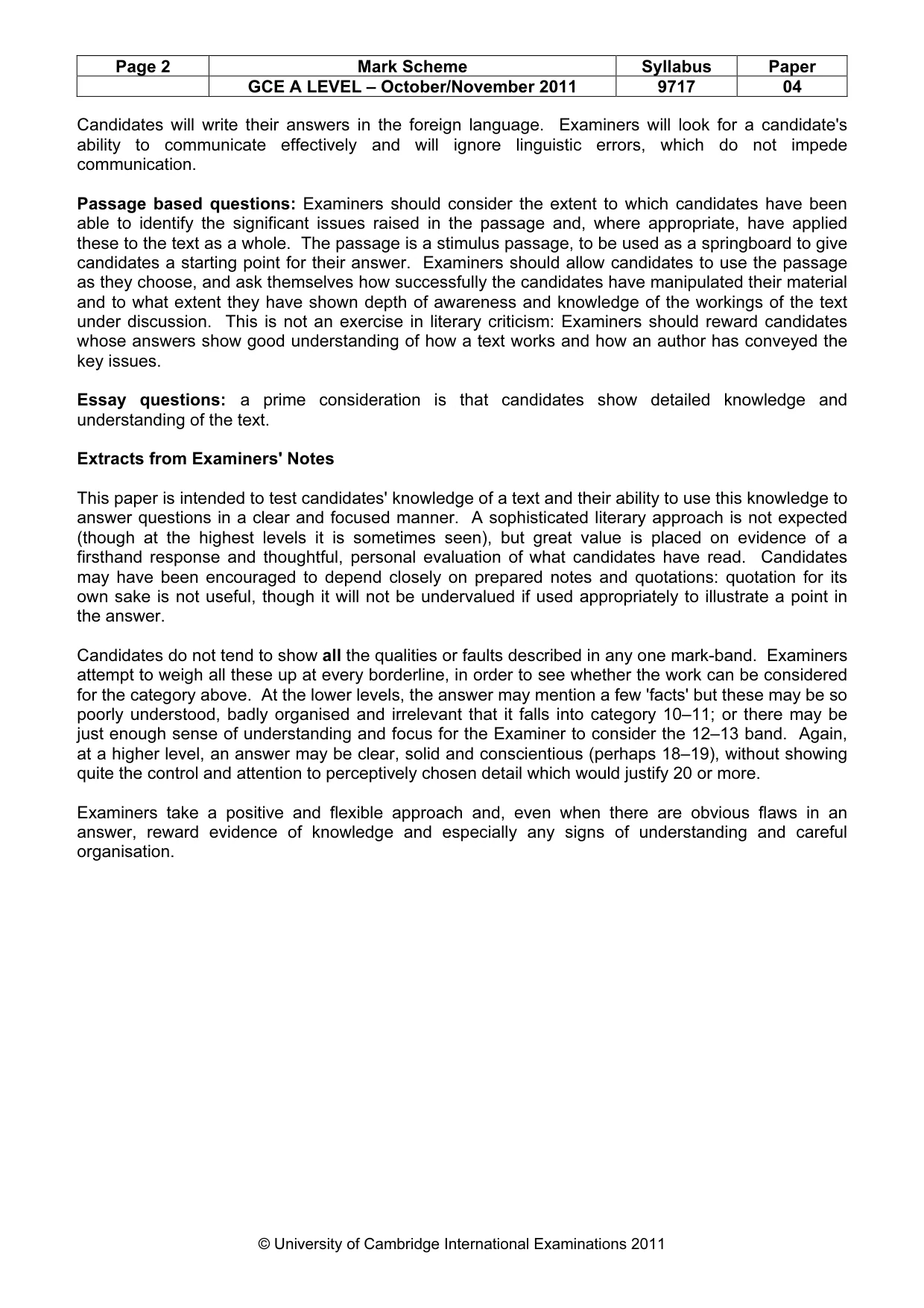
Page 2 Mark Scheme Syllabus Paper GCE A LEVEL – October/November 2011 9717 04 © University of Cambridge International Examinations 2011 Candidates will write their answers in the foreign language. Examiners will look for a candidate's ability to communicate effectively and will ignore linguistic errors, which do not impede communication. Passage based questions: Examiners should consider the extent to which candidates have been able to identify the significant issues raised in the passage and, where appropriate, have applied these to the text as a whole. The passage is a stimulus passage, to be used as a springboard to give candidates a starting point for their answer. Examiners should allow candidates to use the passage as they choose, and ask themselves how successfully the candidates have manipulated their material and to what extent they have shown depth of awareness and knowledge of the workings of the text under discussion. This is not an exercise in literary criticism: Examiners should reward candidates whose answers show good understanding of how a text works and how an author has conveyed the key issues. Essay questions: a prime consideration is that candidates show detailed knowledge and understanding of the text. Extracts from Examiners' Notes This paper is intended to test candidates' knowledge of a text and their ability to use this knowledge to answer questions in a clear and focused manner. A sophisticated literary approach is not expected (though at the highest levels it is sometimes seen), but great value is placed on evidence of a firsthand response and thoughtful, personal evaluation of what candidates have read. Candidates may have been encouraged to depend closely on prepared notes and quotations: quotation for its own sake is not useful, though it will not be undervalued if used appropriately to illustrate a point in the answer. Candidates do not tend to show all the qualities or faults described in any one mark-band. Examiners attempt to weigh all these up at every borderline, in order to see whether the work can be considered for the category above. At the lower levels, the answer may mention a few 'facts' but these may be so poorly understood, badly organised and irrelevant that it falls into category 10–11; or there may be just enough sense of understanding and focus for the Examiner to consider the 12–13 band. Again, at a higher level, an answer may be clear, solid and conscientious (perhaps 18–19), without showing quite the control and attention to perceptively chosen detail which would justify 20 or more. Examiners take a positive and flexible approach and, even when there are obvious flaws in an answer, reward evidence of knowledge and especially any signs of understanding and careful organisation.
Mark scheme, page 3
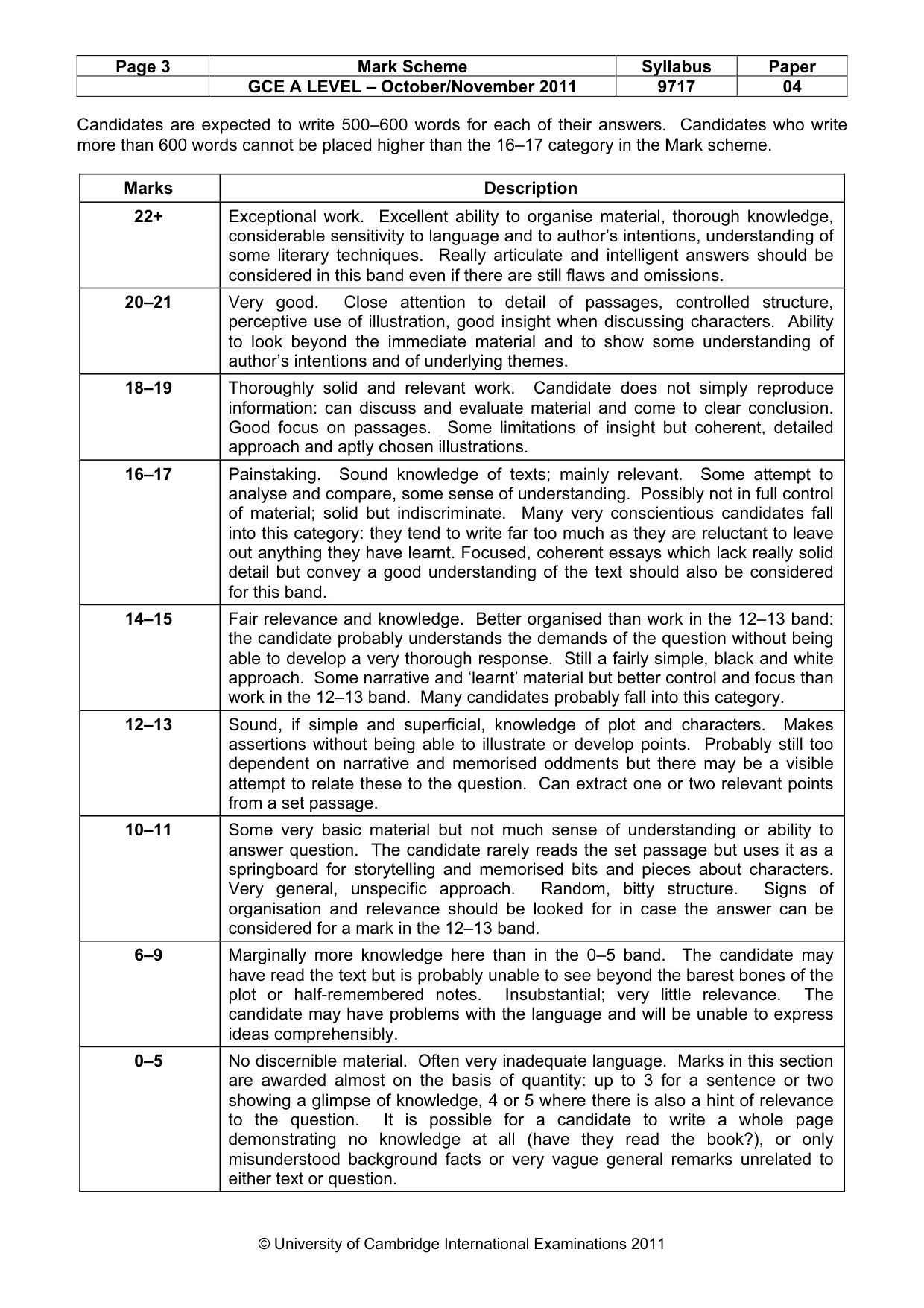
Page 3 Mark Scheme Syllabus Paper GCE A LEVEL – October/November 2011 9717 04 © University of Cambridge International Examinations 2011 Candidates are expected to write 500–600 words for each of their answers. Candidates who write more than 600 words cannot be placed higher than the 16–17 category in the Mark scheme. Marks Description 22+ Exceptional work. Excellent ability to organise material, thorough knowledge, considerable sensitivity to language and to author’s intentions, understanding of some literary techniques. Really articulate and intelligent answers should be considered in this band even if there are still flaws and omissions. 20–21 Very good. Close attention to detail of passages, controlled structure, perceptive use of illustration, good insight when discussing characters. Ability to look beyond the immediate material and to show some understanding of author’s intentions and of underlying themes. 18–19 Thoroughly solid and relevant work. Candidate does not simply reproduce information: can discuss and evaluate material and come to clear conclusion. Good focus on passages. Some limitations of insight but coherent, detailed approach and aptly chosen illustrations. 16–17 Painstaking. Sound knowledge of texts; mainly relevant. Some attempt to analyse and compare, some sense of understanding. Possibly not in full control of material; solid but indiscriminate. Many very conscientious candidates fall into this category: they tend to write far too much as they are reluctant to leave out anything they have learnt. Focused, coherent essays which lack really solid detail but convey a good understanding of the text should also be considered for this band. 14–15 Fair relevance and knowledge. Better organised than work in the 12–13 band: the candidate probably understands the demands of the question without being able to develop a very thorough response. Still a fairly simple, black and white approach. Some narrative and ‘learnt’ material but better control and focus than work in the 12–13 band. Many candidates probably fall into this category. 12–13 Sound, if simple and superficial, knowledge of plot and characters. Makes assertions without being able to illustrate or develop points. Probably still too dependent on narrative and memorised oddments but there may be a visible attempt to relate these to the question. Can extract one or two relevant points from a set passage. 10–11 Some very basic material but not much sense of understanding or ability to answer question. The candidate rarely reads the set passage but uses it as a springboard for storytelling and memorised bits and pieces about characters. Very general, unspecific approach. Random, bitty structure. Signs of organisation and relevance should be looked for in case the answer can be considered for a mark in the 12–13 band. 6–9 Marginally more knowledge here than in the 0–5 band. The candidate may have read the text but is probably unable to see beyond the barest bones of the plot or half-remembered notes. Insubstantial; very little relevance. The candidate may have problems with the language and will be unable to express ideas comprehensibly. 0–5 No discernible material. Often very inadequate language. Marks in this section are awarded almost on the basis of quantity: up to 3 for a sentence or two showing a glimpse of knowledge, 4 or 5 where there is also a hint of relevance to the question. It is possible for a candidate to write a whole page demonstrating no knowledge at all (have they read the book?), or only misunderstood background facts or very vague general remarks unrelated to either text or question.
What you needed in this session
Cambridge’s own grade thresholds for 2011 Oct/Nov, Paper 4 · Variant 1. A higher threshold means an easier paper — the bar moves with how the cohort did.