Cambridge A Level German (A Level only) 9717 — 2017 Oct/Nov Paper 2 · Variant 2
9717/22/O/N/17 · 70 marks · ≈79 min
The question paper and its mark scheme, free to read here and free to download. This is Cambridge’s own paper, exactly as it was sat.
Question paper12 pages
Mark scheme14 pages
Answers below. Sit the paper first if you are practising.
Paper as text
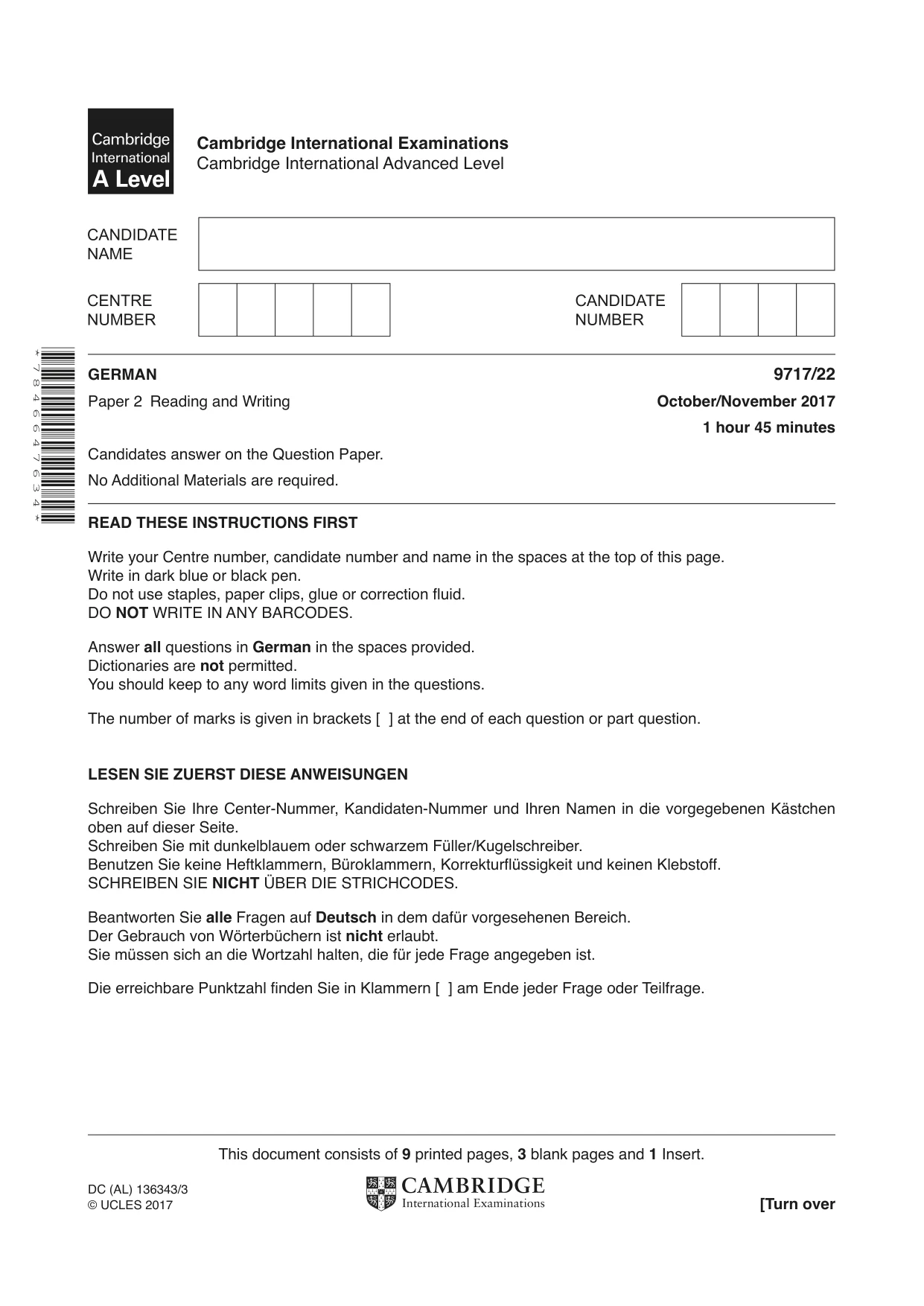
Question paper, page 1
* 7 8 4 6 6 4 7 6 3 4 * This document consists of 9 printed pages, 3 blank pages and 1 Insert. DC (AL) 136343/3 © UCLES 2017 [Turn over Cambridge International Examinations Cambridge International Advanced Level GERMAN 9717/22 Paper 2 Reading and Writing October/November 2017 1 hour 45 minutes Candidates answer on the Question Paper. No Additional Materials are required. READ THESE INSTRUCTIONS FIRST Write your Centre number, candidate number and name in the spaces at the top of this page. Write in dark blue or black pen. Do not use staples, paper clips, glue or correction fluid. DO NOT WRITE IN ANY BARCODES. Answer all questions in German in the spaces provided. Dictionaries are not permitted. You should keep to any word limits given in the questions. The number of marks is given in brackets [ ] at the end of each question or part question. LESEN SIE ZUERST DIESE ANWEISUNGEN Schreiben Sie Ihre Center-Nummer, Kandidaten-Nummer und Ihren Namen in die vorgegebenen Kästchen oben auf dieser Seite. Schreiben Sie mit dunkelblauem oder schwarzem Füller/Kugelschreiber. Benutzen Sie keine Heftklammern, Büroklammern, Korrekturflüssigkeit und keinen Klebstoff. SCHREIBEN SIE NICHT ÜBER DIE STRICHCODES. Beantworten Sie alle Fragen auf Deutsch in dem dafür vorgesehenen Bereich. Der Gebrauch von Wörterbüchern ist nicht erlaubt. Sie müssen sich an die Wortzahl halten, die für jede Frage angegeben ist. Die erreichbare Punktzahl finden Sie in Klammern [ ] am Ende jeder Frage oder Teilfrage.
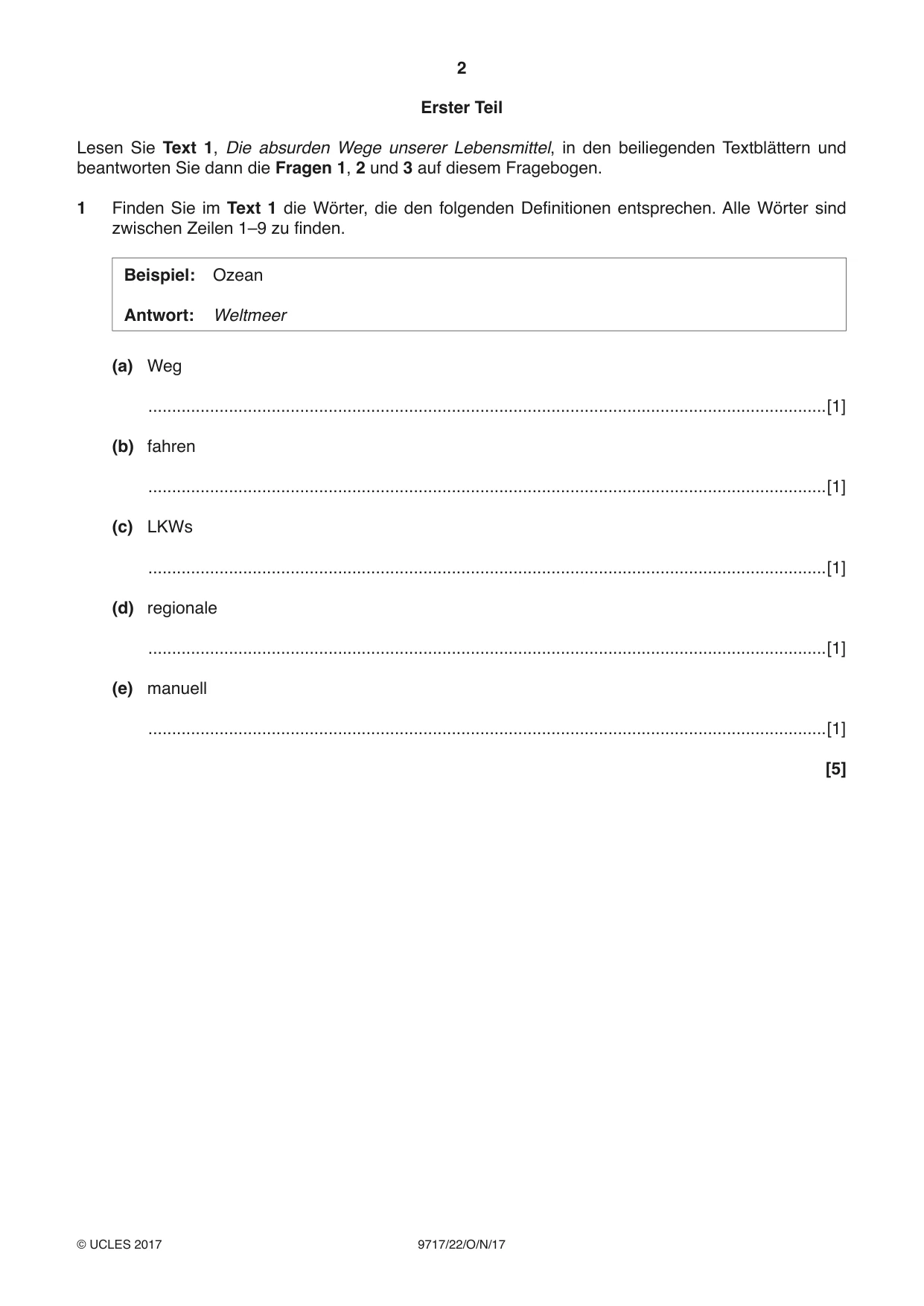
Question paper, page 2
2 9717/22/O/N/17 © UCLES 2017 Erster Teil Lesen Sie Text 1, Die absurden Wege unserer Lebensmittel, in den beiliegenden Textblättern und beantworten Sie dann die Fragen 1, 2 und 3 auf diesem Fragebogen. 1 Finden Sie im Text 1 die Wörter, die den folgenden Definitionen entsprechen. Alle Wörter sind zwischen Zeilen 1–9 zu finden. Beispiel: Ozean Antwort: Weltmeer (a) Weg …[1] (b) fahren …[1] (c) LKWs …[1] (d) regionale …[1] (e) manuell …[1] [5]
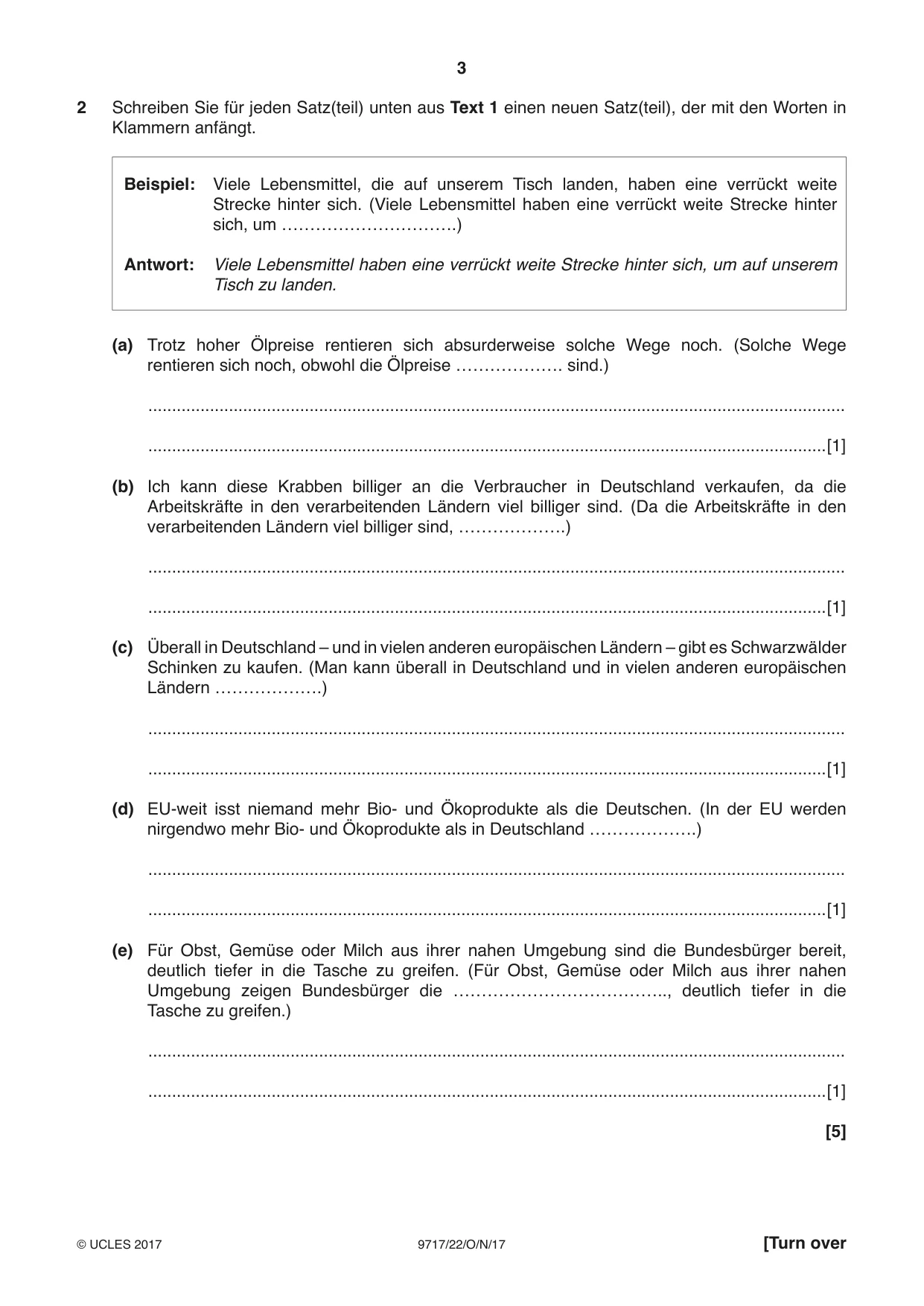
Question paper, page 3
3 9717/22/O/N/17 © UCLES 2017 [Turn over 2 Schreiben Sie für jeden Satz(teil) unten aus Text 1 einen neuen Satz(teil), der mit den Worten in Klammern anfängt. Beispiel: Viele Lebensmittel, die auf unserem Tisch landen, haben eine verrückt weite Strecke hinter sich. (Viele Lebensmittel haben eine verrückt weite Strecke hinter sich, um ………………………….) Antwort: Viele Lebensmittel haben eine verrückt weite Strecke hinter sich, um auf unserem Tisch zu landen. (a) Trotz hoher Ölpreise rentieren sich absurderweise solche Wege noch. (Solche Wege rentieren sich noch, obwohl die Ölpreise ………………. sind.) … …[1] (b) Ich kann diese Krabben billiger an die Verbraucher in Deutschland verkaufen, da die Arbeitskräfte in den verarbeitenden Ländern viel billiger sind. (Da die Arbeitskräfte in den verarbeitenden Ländern viel billiger sind, ……………….) … …[1] (c) Überall in Deutschland – und in vielen anderen europäischen Ländern – gibt es Schwarzwӓlder Schinken zu kaufen. (Man kann überall in Deutschland und in vielen anderen europäischen Ländern ……………….) … …[1] (d) EU-weit isst niemand mehr Bio- und Ökoprodukte als die Deutschen. (In der EU werden nirgendwo mehr Bio- und Ökoprodukte als in Deutschland ……………….) … …[1] (e) Für Obst, Gemüse oder Milch aus ihrer nahen Umgebung sind die Bundesbürger bereit, deutlich tiefer in die Tasche zu greifen. (Für Obst, Gemüse oder Milch aus ihrer nahen Umgebung zeigen Bundesbürger die ……………………………….., deutlich tiefer in die Tasche zu greifen.) … …[1] [5]
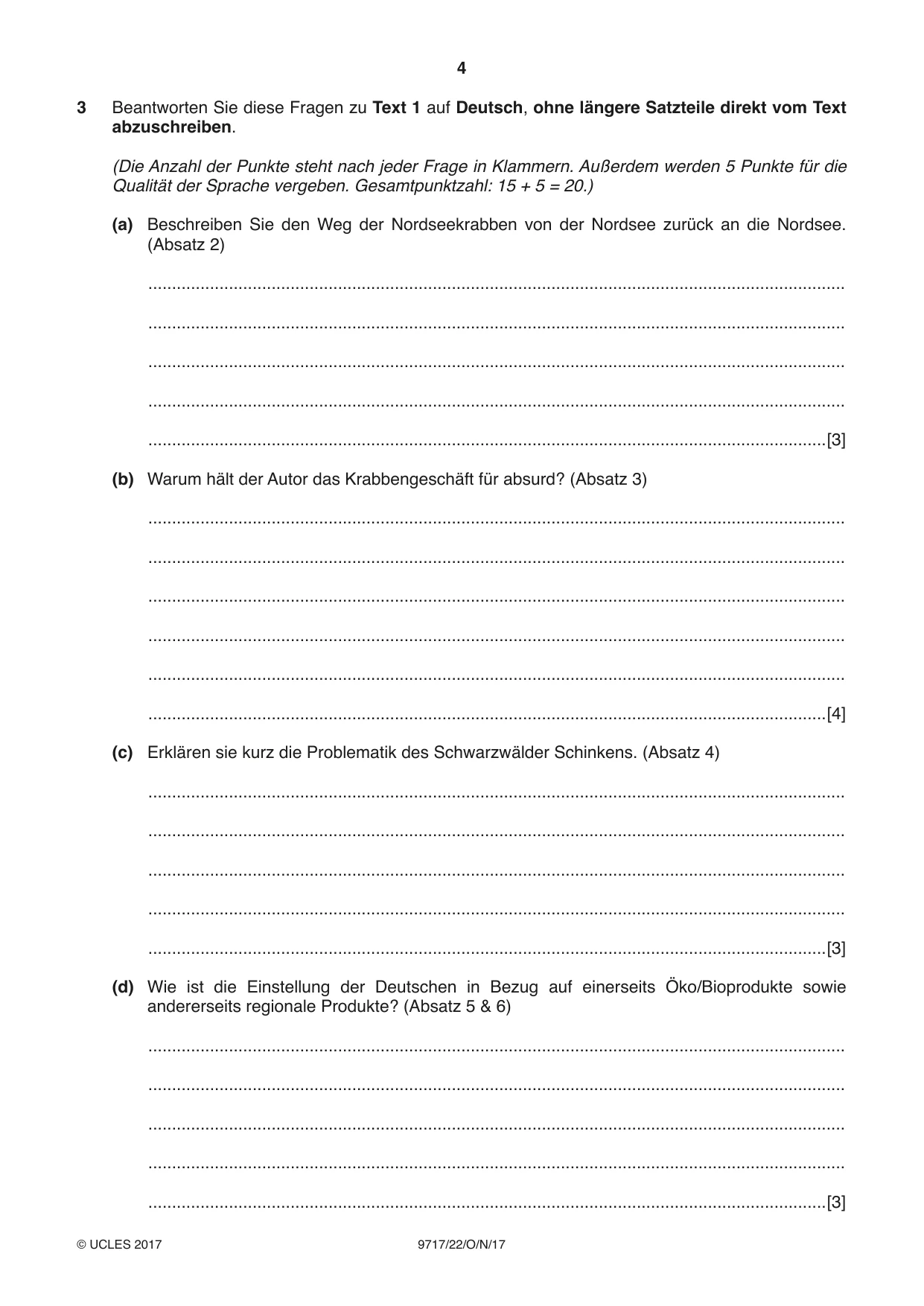
Question paper, page 4
4 9717/22/O/N/17 © UCLES 2017 3 Beantworten Sie diese Fragen zu Text 1 auf Deutsch, ohne längere Satzteile direkt vom Text abzuschreiben. (Die Anzahl der Punkte steht nach jeder Frage in Klammern. Außerdem werden 5 Punkte für die Qualität der Sprache vergeben. Gesamtpunktzahl: 15 + 5 = 20.) (a) Beschreiben Sie den Weg der Nordseekrabben von der Nordsee zurück an die Nordsee. (Absatz 2) … … … … …[3] (b) Warum hält der Autor das Krabbengeschäft für absurd? (Absatz 3) … … … … … …[4] (c) Erklären sie kurz die Problematik des Schwarzwälder Schinkens. (Absatz 4) … … … … …[3] (d) Wie ist die Einstellung der Deutschen in Bezug auf einerseits Öko/Bioprodukte sowie andererseits regionale Produkte? (Absatz 5 & 6) … … … … …[3]
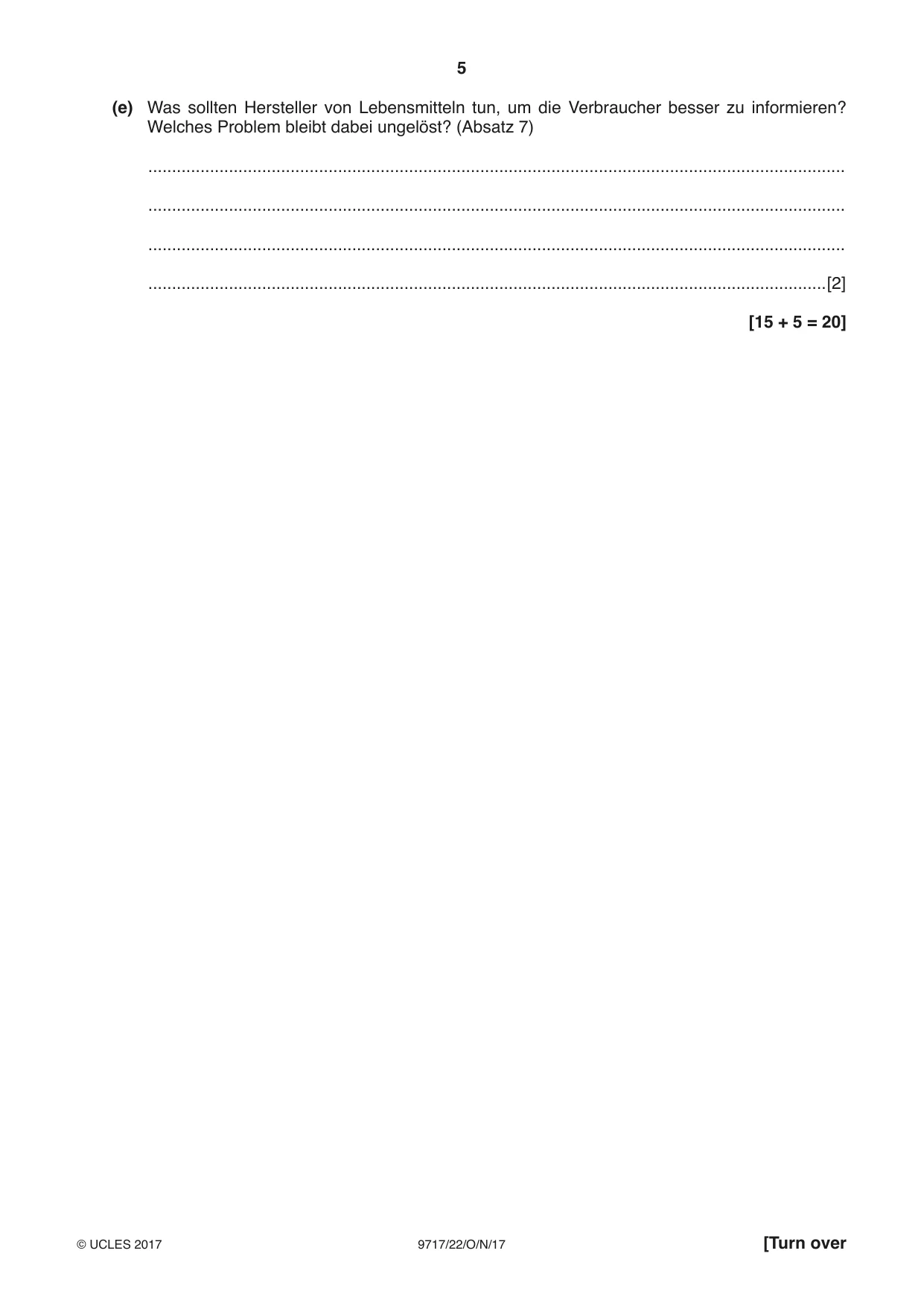
Question paper, page 5
5 9717/22/O/N/17 © UCLES 2017 [Turn over (e) Was sollten Hersteller von Lebensmitteln tun, um die Verbraucher besser zu informieren? Welches Problem bleibt dabei ungelöst? (Absatz 7) … … … …[2] [15 + 5 = 20]
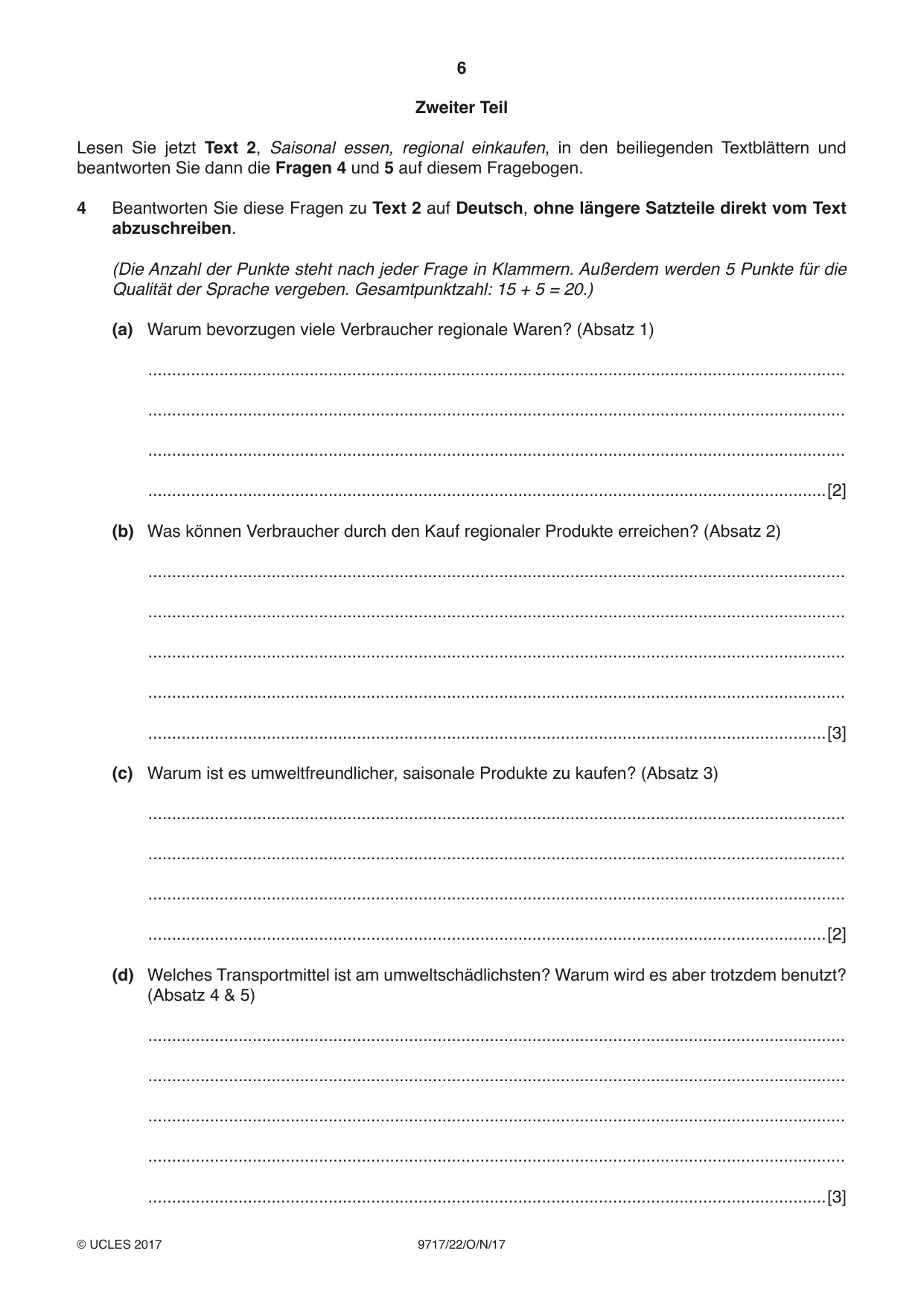
Question paper, page 6
6 9717/22/O/N/17 © UCLES 2017 Zweiter Teil Lesen Sie jetzt Text 2, Saisonal essen, regional einkaufen, in den beiliegenden Textblättern und beantworten Sie dann die Fragen 4 und 5 auf diesem Fragebogen. 4 Beantworten Sie diese Fragen zu Text 2 auf Deutsch, ohne längere Satzteile direkt vom Text abzuschreiben. (Die Anzahl der Punkte steht nach jeder Frage in Klammern. Außerdem werden 5 Punkte für die Qualität der Sprache vergeben. Gesamtpunktzahl: 15 + 5 = 20.) (a) Warum bevorzugen viele Verbraucher regionale Waren? (Absatz 1) … … … …[2] (b) Was können Verbraucher durch den Kauf regionaler Produkte erreichen? (Absatz 2) … … … … …[3] (c) Warum ist es umweltfreundlicher, saisonale Produkte zu kaufen? (Absatz 3) … … … …[2] (d) Welches Transportmittel ist am umweltschädlichsten? Warum wird es aber trotzdem benutzt? (Absatz 4 & 5) … … … … …[3]
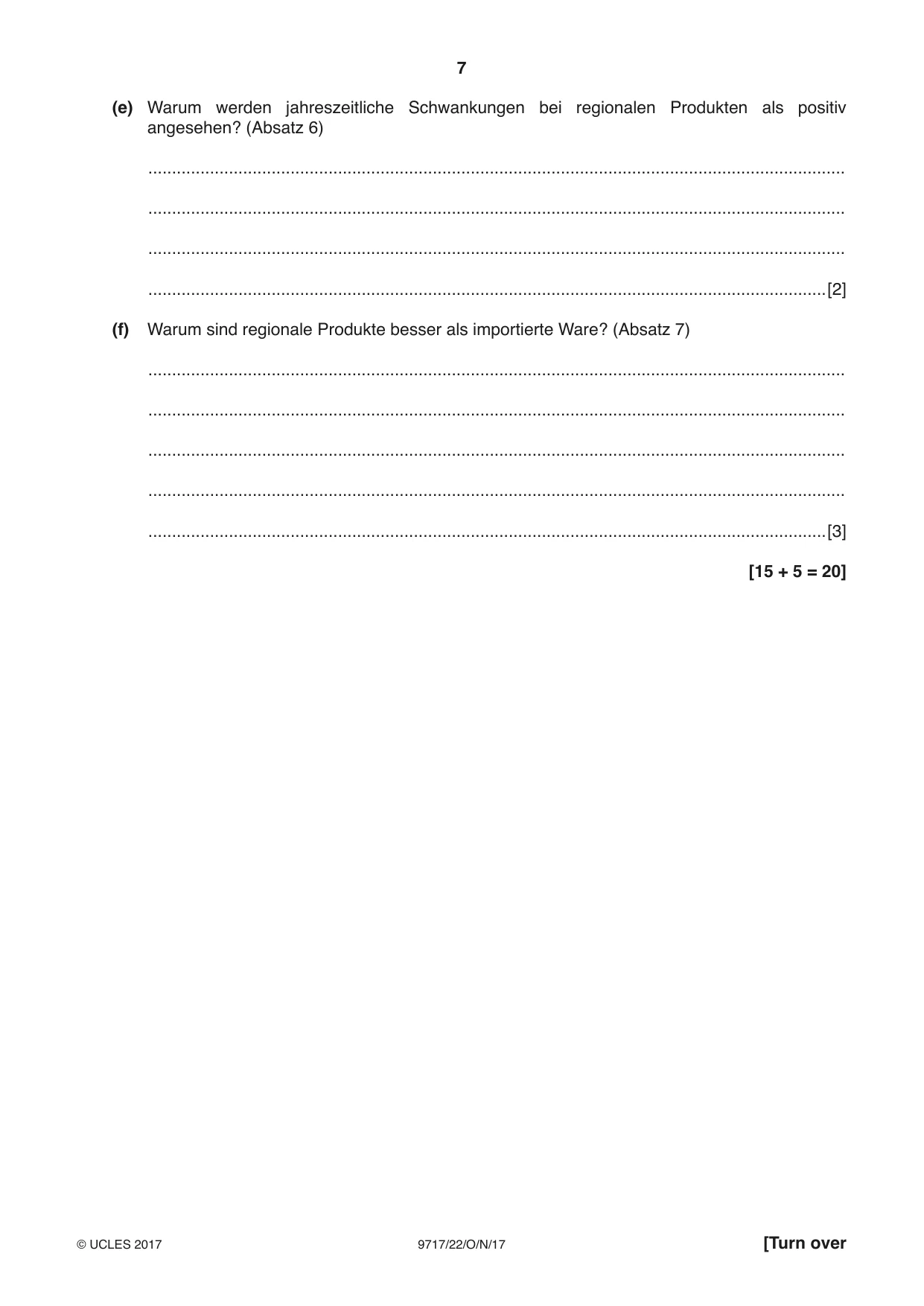
Question paper, page 7
7 9717/22/O/N/17 © UCLES 2017 [Turn over (e) Warum werden jahreszeitliche Schwankungen bei regionalen Produkten als positiv angesehen? (Absatz 6) … … … …[2] (f) Warum sind regionale Produkte besser als importierte Ware? (Absatz 7) … … … … …[3] [15 + 5 = 20]
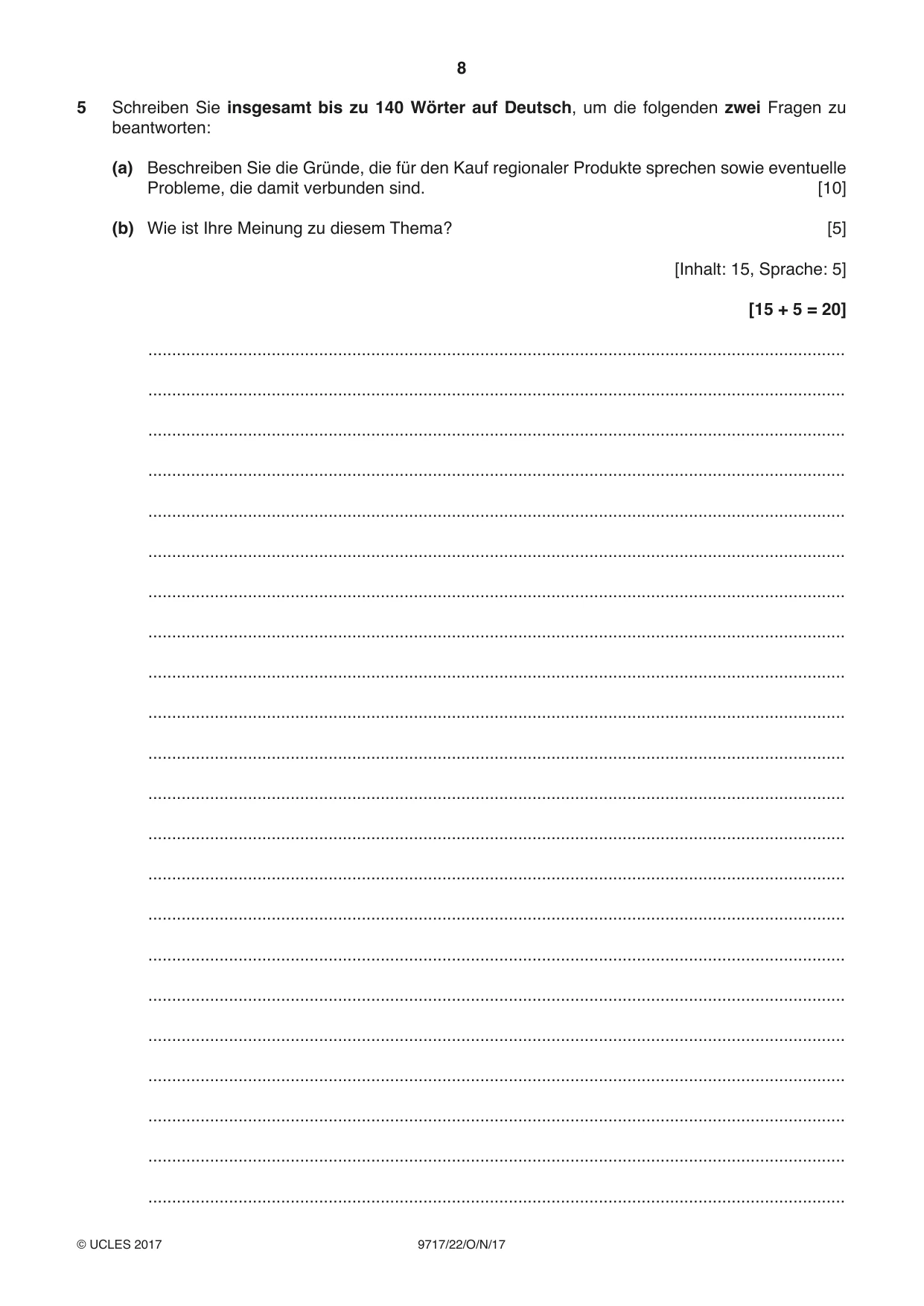
Question paper, page 8
8 9717/22/O/N/17 © UCLES 2017 5 Schreiben Sie insgesamt bis zu 140 Wörter auf Deutsch, um die folgenden zwei Fragen zu beantworten: (a) Beschreiben Sie die Gründe, die für den Kauf regionaler Produkte sprechen sowie eventuelle Probleme, die damit verbunden sind. [10] (b) Wie ist Ihre Meinung zu diesem Thema? [5] [Inhalt: 15, Sprache: 5] [15 + 5 = 20] … … … … … … … … … … … … … … … … … … … … … …
Question paper, page 9
9 9717/22/O/N/17 © UCLES 2017 … … … … … … … … … … … … … … … …
Question paper, page 10
10 9717/22/O/N/17 © UCLES 2017 BLANK PAGE
Question paper, page 11
11 9717/22/O/N/17 © UCLES 2017 BLANK PAGE
Question paper, page 12
12 9717/22/O/N/17 © UCLES 2017 Permission to reproduce items where third-party owned material protected by copyright is included has been sought and cleared where possible. Every reasonable effort has been made by the publisher (UCLES) to trace copyright holders, but if any items requiring clearance have unwittingly been included, the publisher will be pleased to make amends at the earliest possible opportunity. To avoid the issue of disclosure of answer-related information to candidates, all copyright acknowledgements are reproduced online in the Cambridge International Examinations Copyright Acknowledgements Booklet. This is produced for each series of examinations and is freely available to download at www.cie.org.uk after the live examination series. Cambridge International Examinations is part of the Cambridge Assessment Group. Cambridge Assessment is the brand name of University of Cambridge Local Examinations Syndicate (UCLES), which is itself a department of the University of Cambridge. BLANK PAGE
Mark scheme, page 1
® IGCSE is a registered trademark. This document consists of 14 printed pages. © UCLES 2017 [Turn over Cambridge Assessment International Education Cambridge International Advanced Level GERMAN 9717/22 Paper 2 Reading and Writing October/November 2017 MARK SCHEME Maximum Mark: 70 Published This mark scheme is published as an aid to teachers and candidates, to indicate the requirements of the examination. It shows the basis on which Examiners were instructed to award marks. It does not indicate the details of the discussions that took place at an Examiners’ meeting before marking began, which would have considered the acceptability of alternative answers. Mark schemes should be read in conjunction with the question paper and the Principal Examiner Report for Teachers. Cambridge International will not enter into discussions about these mark schemes. Cambridge International is publishing the mark schemes for the October/November 2017 series for most Cambridge IGCSE®, Cambridge International A and AS Level components and some Cambridge O Level components.
Mark scheme, page 2
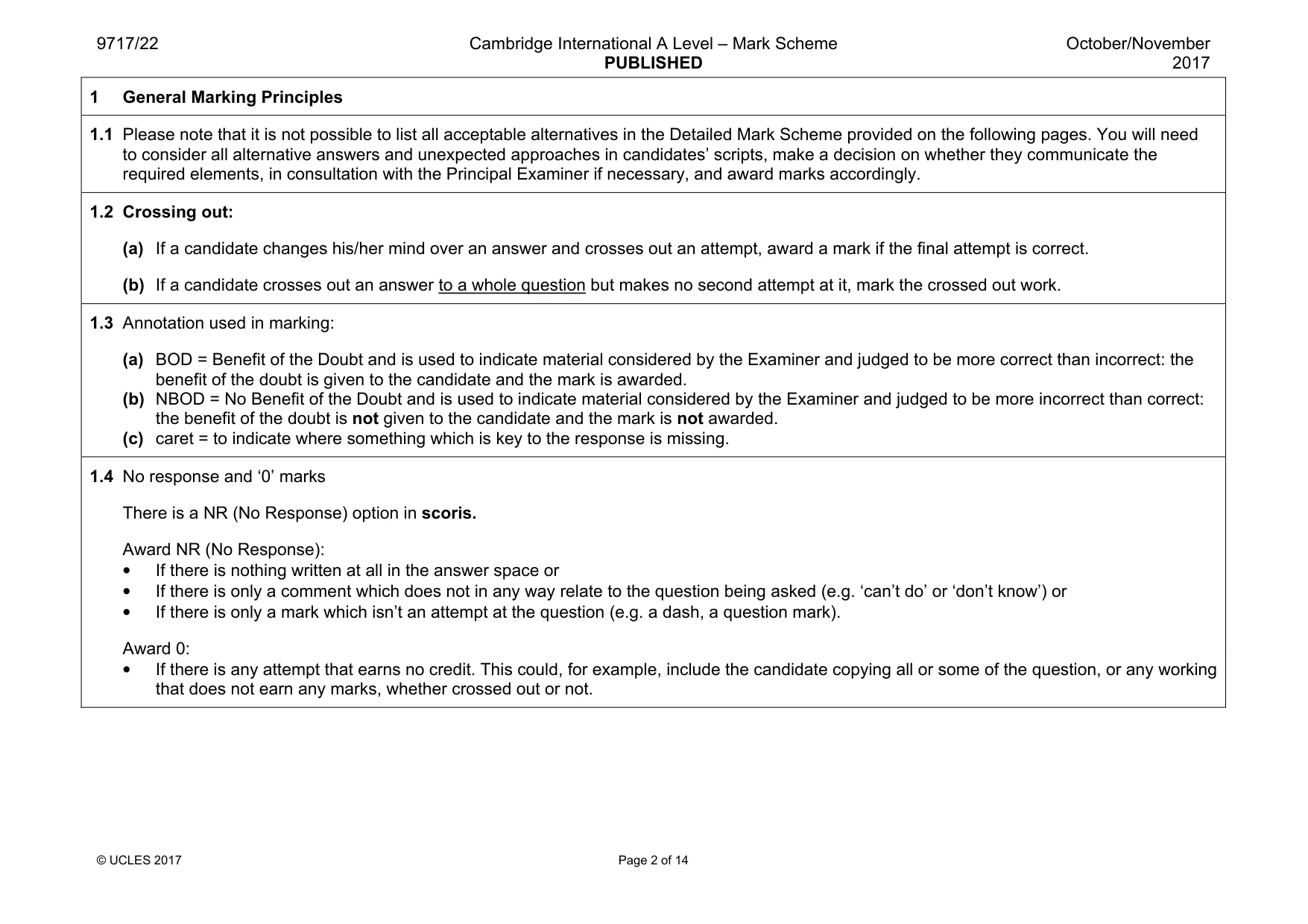
9717/22 Cambridge International A Level – Mark Scheme PUBLISHED October/November 2017 © UCLES 2017 Page 2 of 14 1 General Marking Principles 1.1 Please note that it is not possible to list all acceptable alternatives in the Detailed Mark Scheme provided on the following pages. You will need to consider all alternative answers and unexpected approaches in candidates’ scripts, make a decision on whether they communicate the required elements, in consultation with the Principal Examiner if necessary, and award marks accordingly. 1.2 Crossing out: (a) If a candidate changes his/her mind over an answer and crosses out an attempt, award a mark if the final attempt is correct. (b) If a candidate crosses out an answer to a whole question but makes no second attempt at it, mark the crossed out work. 1.3 Annotation used in marking: (a) BOD = Benefit of the Doubt and is used to indicate material considered by the Examiner and judged to be more correct than incorrect: the benefit of the doubt is given to the candidate and the mark is awarded. (b) NBOD = No Benefit of the Doubt and is used to indicate material considered by the Examiner and judged to be more incorrect than correct: the benefit of the doubt is not given to the candidate and the mark is not awarded. (c) caret = to indicate where something which is key to the response is missing. 1.4 No response and ‘0’ marks There is a NR (No Response) option in scoris. Award NR (No Response): • If there is nothing written at all in the answer space or • If there is only a comment which does not in any way relate to the question being asked (e.g. ‘can’t do’ or ‘don’t know’) or • If there is only a mark which isn’t an attempt at the question (e.g. a dash, a question mark). Award 0: • If there is any attempt that earns no credit. This could, for example, include the candidate copying all or some of the question, or any working that does not earn any marks, whether crossed out or not.
Mark scheme, page 3
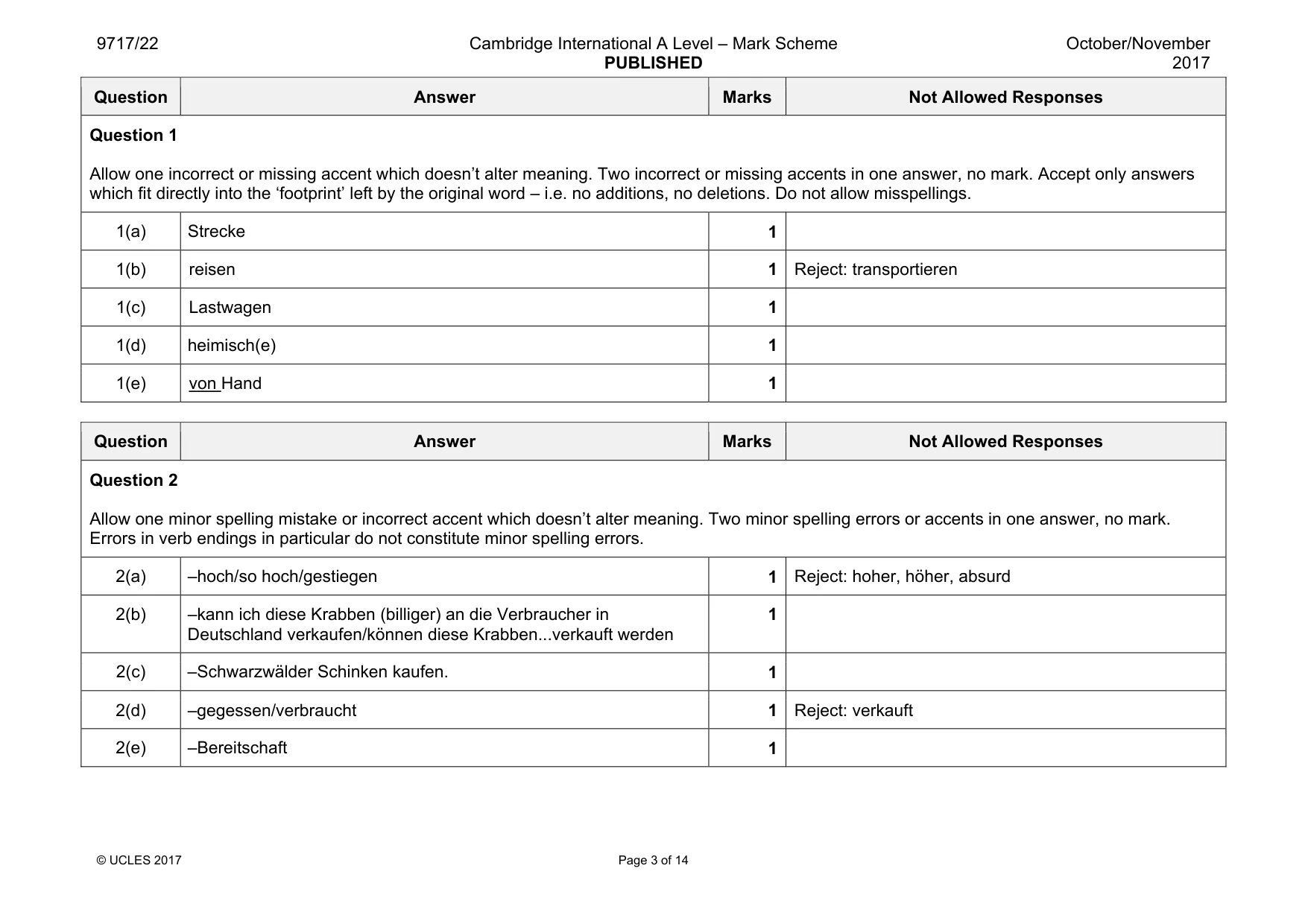
9717/22 Cambridge International A Level – Mark Scheme PUBLISHED October/November 2017 © UCLES 2017 Page 3 of 14 Question Answer Marks Not Allowed Responses Question 1 Allow one incorrect or missing accent which doesn’t alter meaning. Two incorrect or missing accents in one answer, no mark. Accept only answers which fit directly into the ‘footprint’ left by the original word – i.e. no additions, no deletions. Do not allow misspellings. 1(a) Strecke 1 1(b) reisen 1 Reject: transportieren 1(c) Lastwagen 1 1(d) heimisch(e) 1 1(e) von Hand 1 Question Answer Marks Not Allowed Responses Question 2 Allow one minor spelling mistake or incorrect accent which doesn’t alter meaning. Two minor spelling errors or accents in one answer, no mark. Errors in verb endings in particular do not constitute minor spelling errors. 2(a) –hoch/so hoch/gestiegen 1 Reject: hoher, hӧher, absurd 2(b) –kann ich diese Krabben (billiger) an die Verbraucher in Deutschland verkaufen/kӧnnen diese Krabben...verkauft werden 1 2(c) –Schwarzwälder Schinken kaufen. 1 2(d) –gegessen/verbraucht 1 Reject: verkauft 2(e) –Bereitschaft 1
Mark scheme, page 4
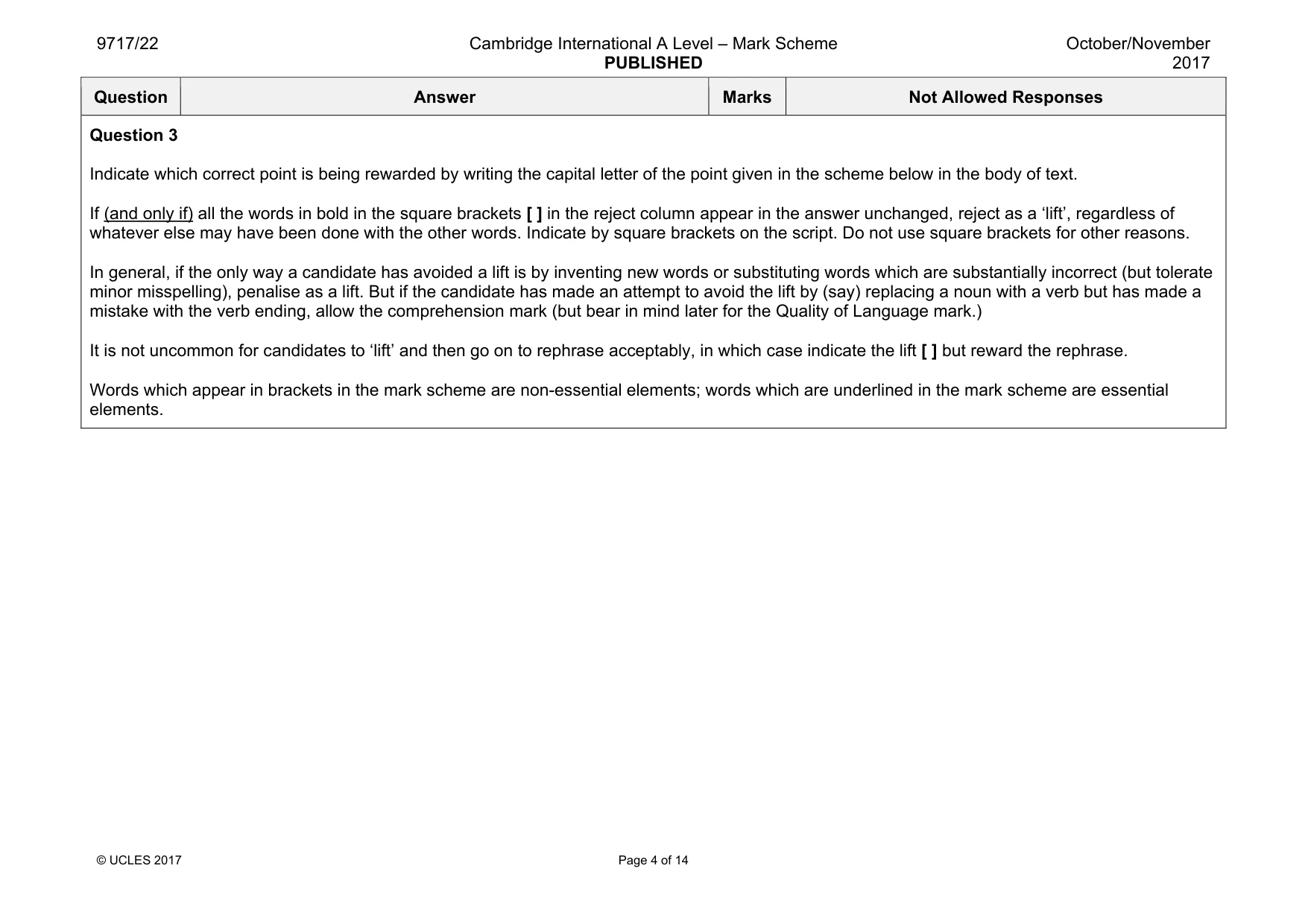
9717/22 Cambridge International A Level – Mark Scheme PUBLISHED October/November 2017 © UCLES 2017 Page 4 of 14 Question Answer Marks Not Allowed Responses Question 3 Indicate which correct point is being rewarded by writing the capital letter of the point given in the scheme below in the body of text. If (and only if) all the words in bold in the square brackets [ ] in the reject column appear in the answer unchanged, reject as a ‘lift’, regardless of whatever else may have been done with the other words. Indicate by square brackets on the script. Do not use square brackets for other reasons. In general, if the only way a candidate has avoided a lift is by inventing new words or substituting words which are substantially incorrect (but tolerate minor misspelling), penalise as a lift. But if the candidate has made an attempt to avoid the lift by (say) replacing a noun with a verb but has made a mistake with the verb ending, allow the comprehension mark (but bear in mind later for the Quality of Language mark.) It is not uncommon for candidates to ‘lift’ and then go on to rephrase acceptably, in which case indicate the lift [ ] but reward the rephrase. Words which appear in brackets in the mark scheme are non-essential elements; words which are underlined in the mark scheme are essential elements.
Mark scheme, page 5
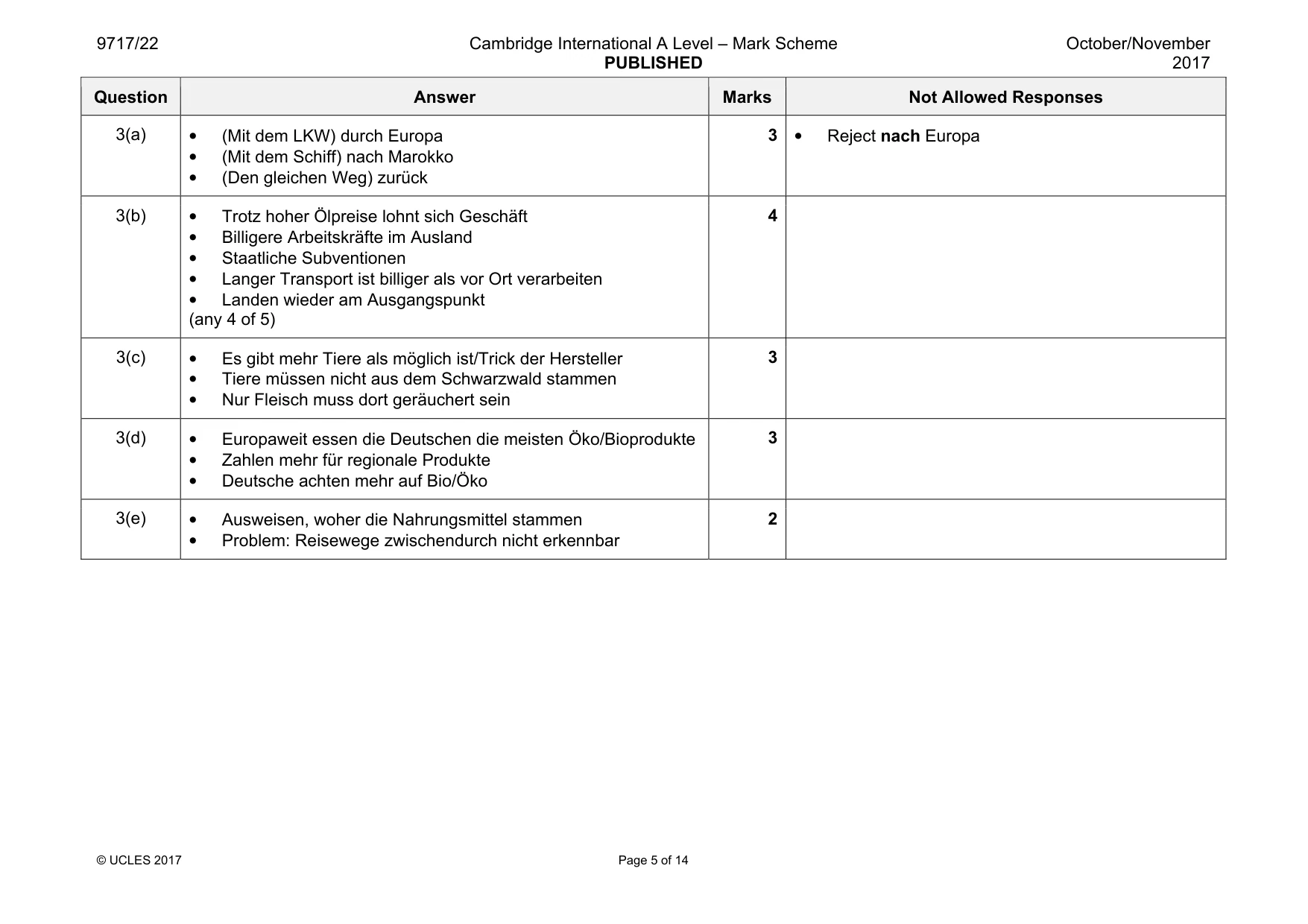
9717/22 Cambridge International A Level – Mark Scheme PUBLISHED October/November 2017 © UCLES 2017 Page 5 of 14 Question Answer Marks Not Allowed Responses 3(a) • (Mit dem LKW) durch Europa • (Mit dem Schiff) nach Marokko • (Den gleichen Weg) zurück 3 • Reject nach Europa 3(b) • Trotz hoher Ölpreise lohnt sich Geschäft • Billigere Arbeitskräfte im Ausland • Staatliche Subventionen • Langer Transport ist billiger als vor Ort verarbeiten • Landen wieder am Ausgangspunkt (any 4 of 5) 4 3(c) • Es gibt mehr Tiere als möglich ist/Trick der Hersteller • Tiere müssen nicht aus dem Schwarzwald stammen • Nur Fleisch muss dort geräuchert sein 3 3(d) • Europaweit essen die Deutschen die meisten Öko/Bioprodukte • Zahlen mehr für regionale Produkte • Deutsche achten mehr auf Bio/Öko 3 3(e) • Ausweisen, woher die Nahrungsmittel stammen • Problem: Reisewege zwischendurch nicht erkennbar 2
Mark scheme, page 6
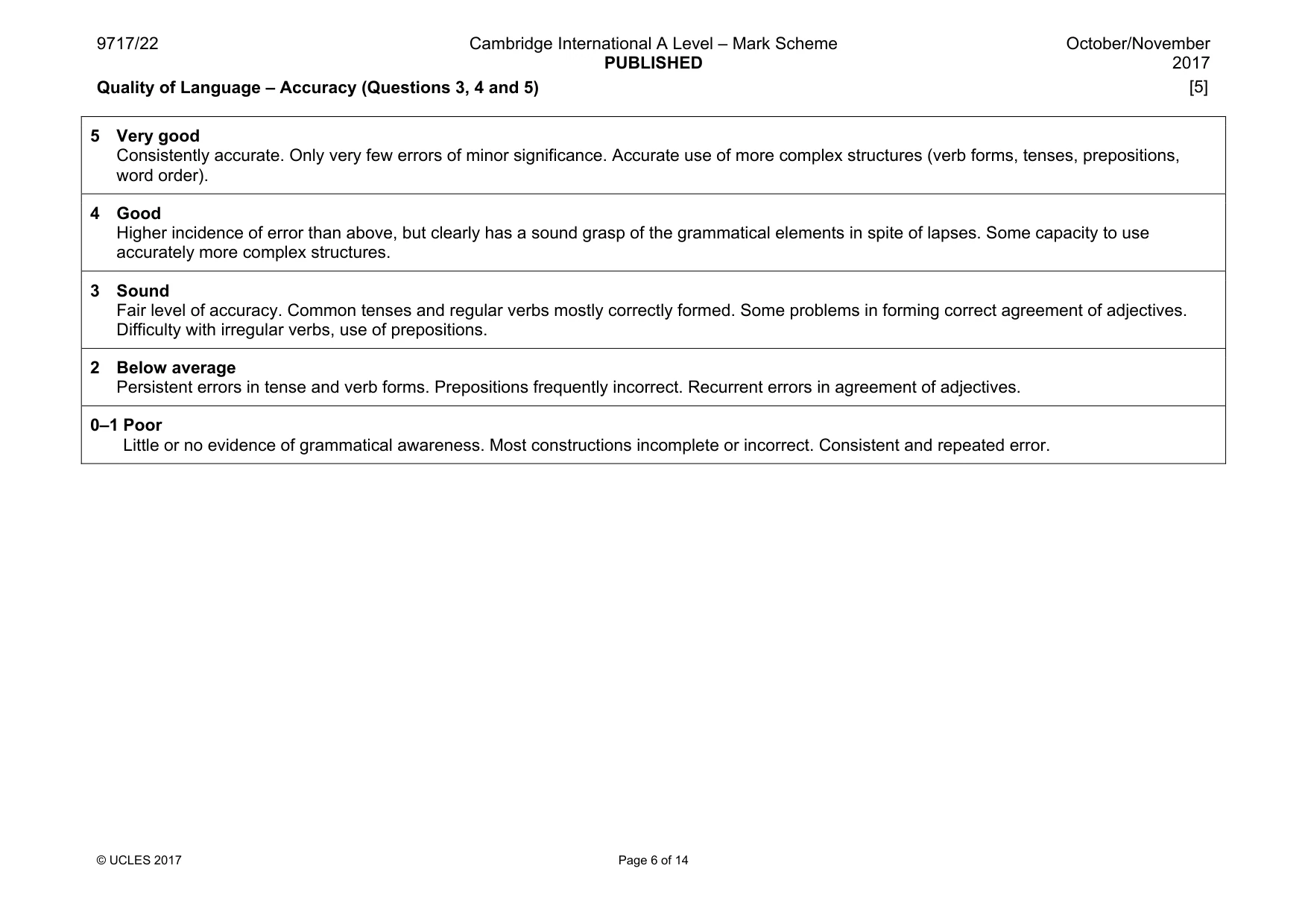
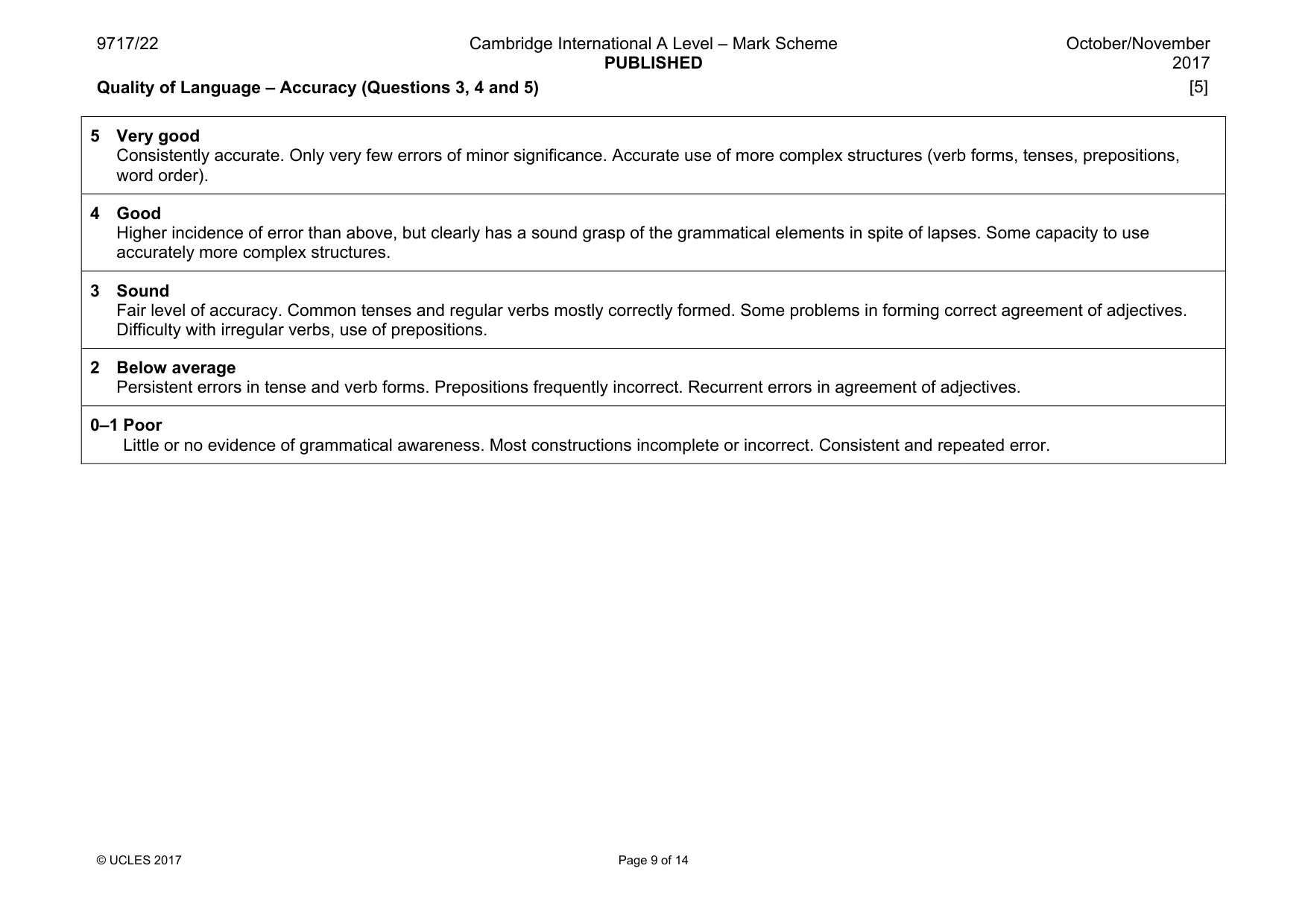
9717/22 Cambridge International A Level – Mark Scheme PUBLISHED October/November 2017 © UCLES 2017 Page 6 of 14 Quality of Language – Accuracy (Questions 3, 4 and 5) [5] 5 Very good Consistently accurate. Only very few errors of minor significance. Accurate use of more complex structures (verb forms, tenses, prepositions, word order). 4 Good Higher incidence of error than above, but clearly has a sound grasp of the grammatical elements in spite of lapses. Some capacity to use accurately more complex structures. 3 Sound Fair level of accuracy. Common tenses and regular verbs mostly correctly formed. Some problems in forming correct agreement of adjectives. Difficulty with irregular verbs, use of prepositions. 2 Below average Persistent errors in tense and verb forms. Prepositions frequently incorrect. Recurrent errors in agreement of adjectives. 0–1 Poor Little or no evidence of grammatical awareness. Most constructions incomplete or incorrect. Consistent and repeated error.
Mark scheme, page 7
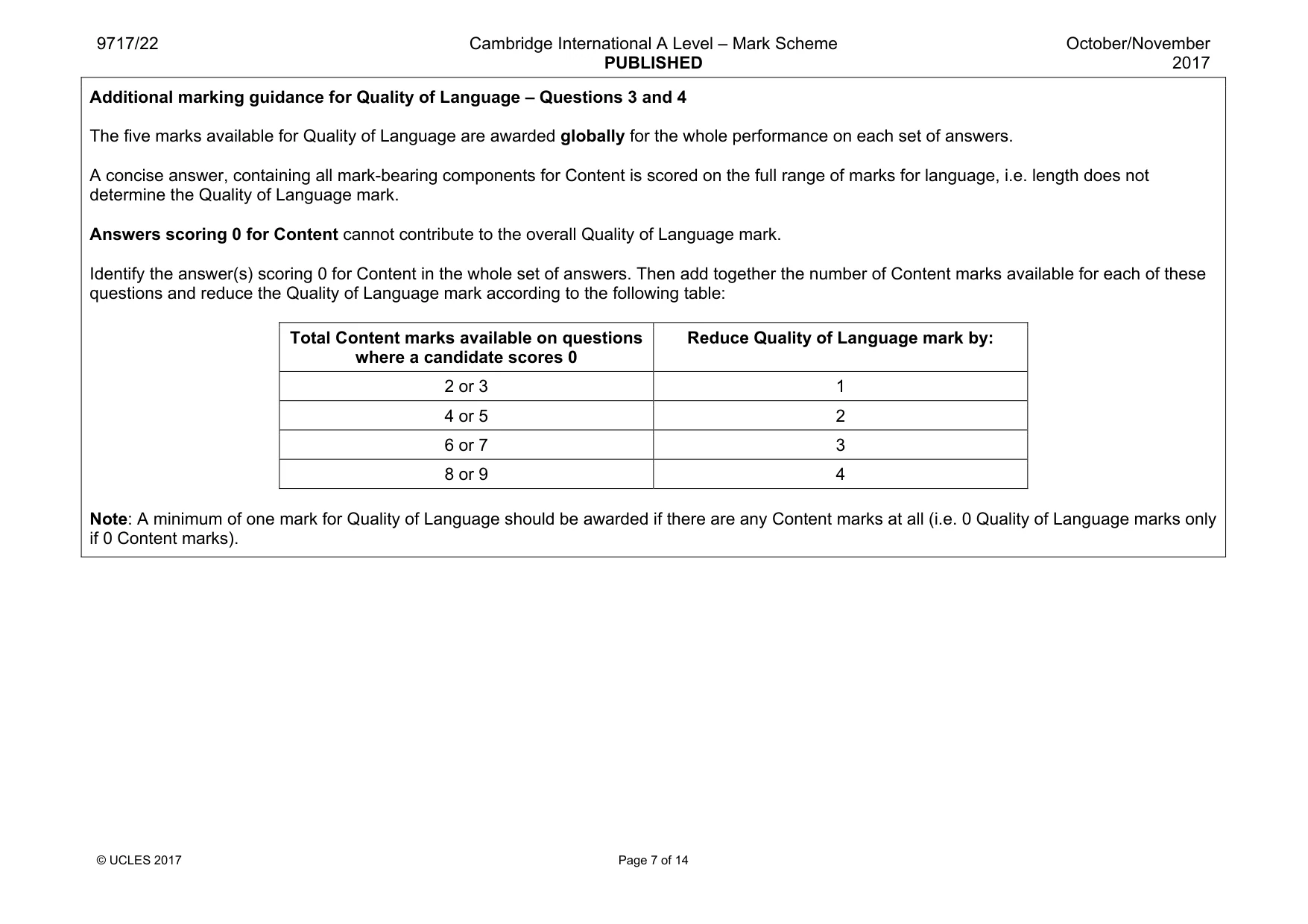
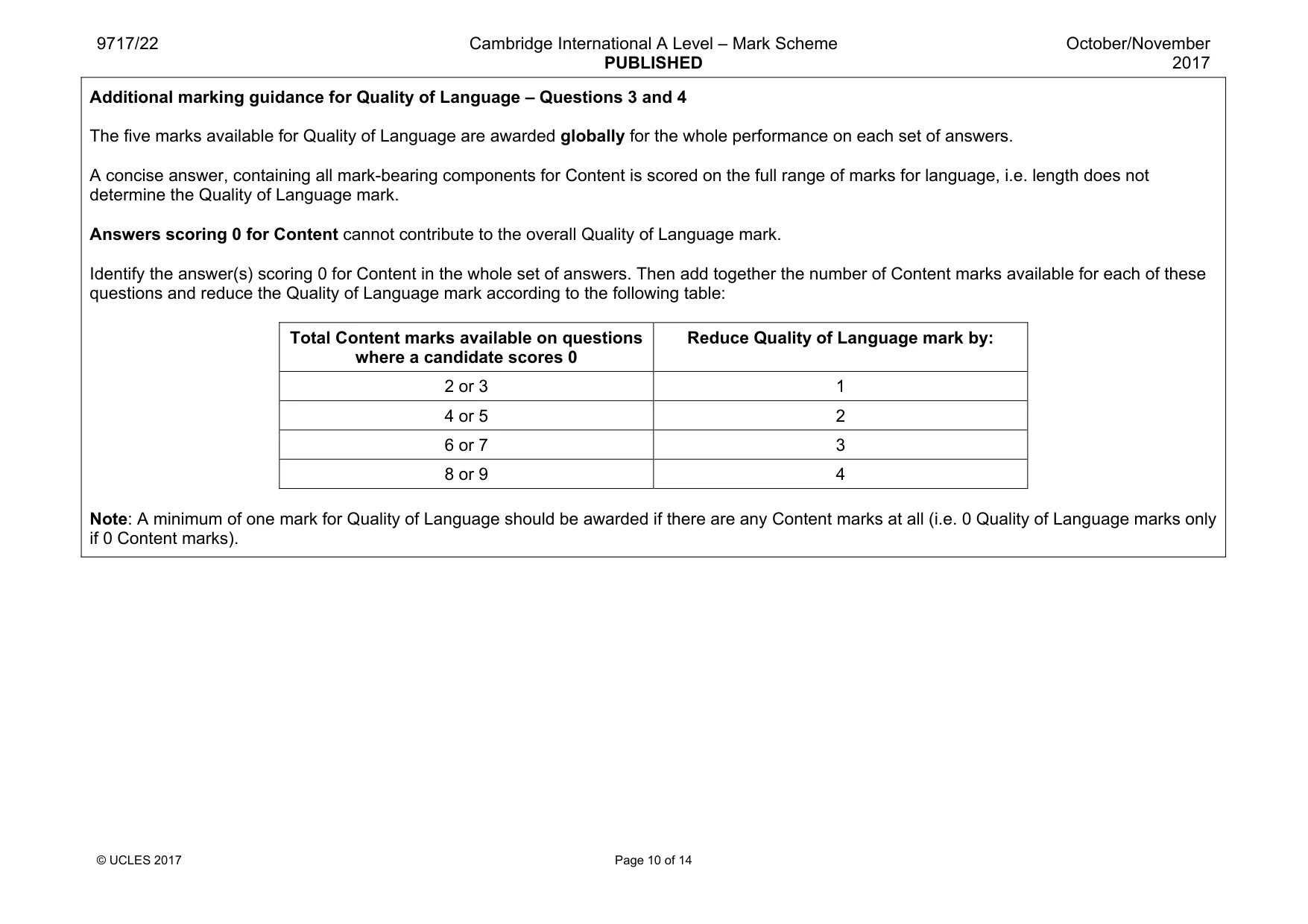
9717/22 Cambridge International A Level – Mark Scheme PUBLISHED October/November 2017 © UCLES 2017 Page 7 of 14 Additional marking guidance for Quality of Language – Questions 3 and 4 The five marks available for Quality of Language are awarded globally for the whole performance on each set of answers. A concise answer, containing all mark-bearing components for Content is scored on the full range of marks for language, i.e. length does not determine the Quality of Language mark. Answers scoring 0 for Content cannot contribute to the overall Quality of Language mark. Identify the answer(s) scoring 0 for Content in the whole set of answers. Then add together the number of Content marks available for each of these questions and reduce the Quality of Language mark according to the following table: Total Content marks available on questions where a candidate scores 0 Reduce Quality of Language mark by: 2 or 3 1 4 or 5 2 6 or 7 3 8 or 9 4 Note: A minimum of one mark for Quality of Language should be awarded if there are any Content marks at all (i.e. 0 Quality of Language marks only if 0 Content marks).
Mark scheme, page 8
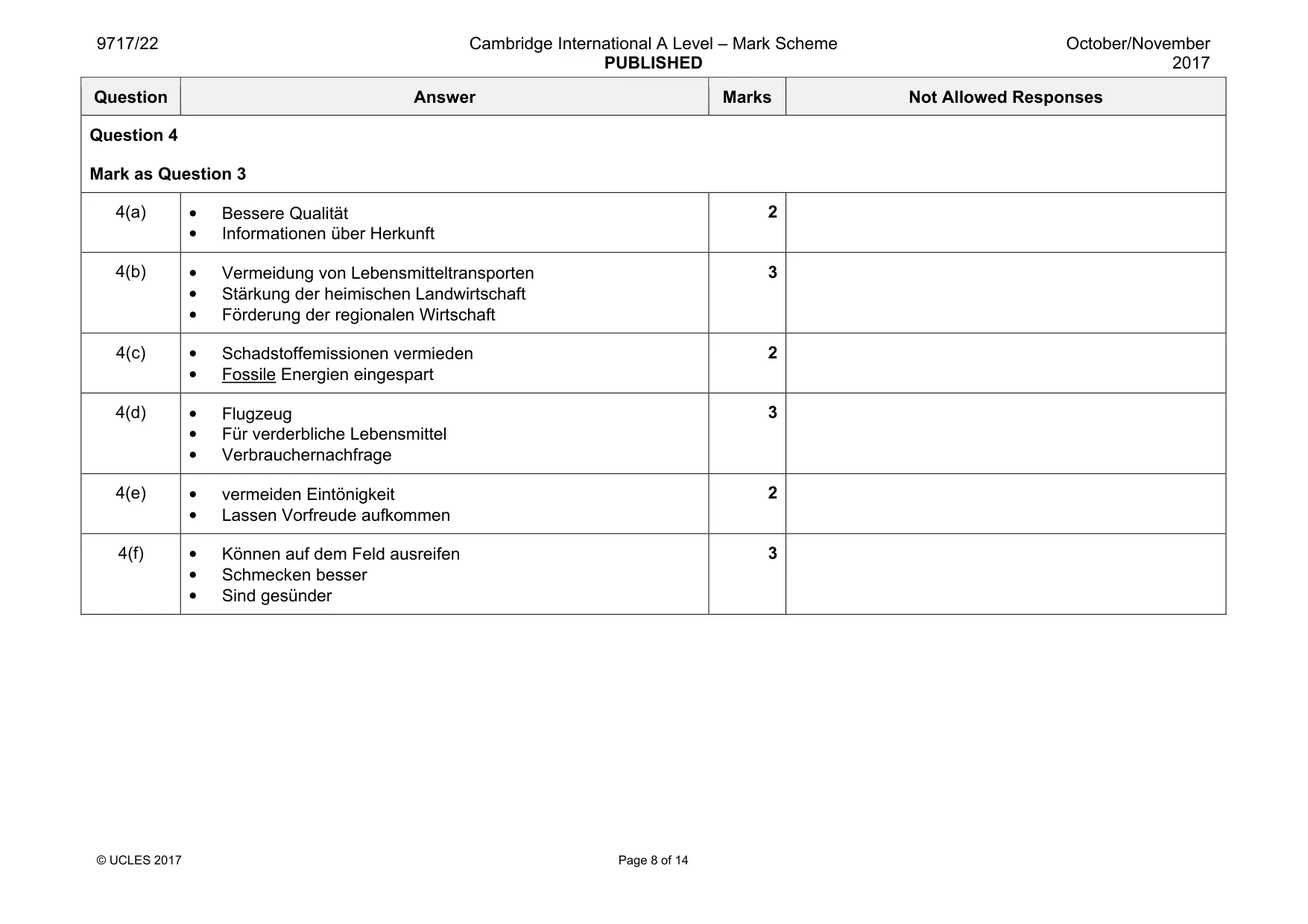
9717/22 Cambridge International A Level – Mark Scheme PUBLISHED October/November 2017 © UCLES 2017 Page 8 of 14 Question Answer Marks Not Allowed Responses Question 4 Mark as Question 3 4(a) • Bessere Qualität • Informationen über Herkunft 2 4(b) • Vermeidung von Lebensmitteltransporten • Stärkung der heimischen Landwirtschaft • Förderung der regionalen Wirtschaft 3 4(c) • Schadstoffemissionen vermieden • Fossile Energien eingespart 2 4(d) • Flugzeug • Für verderbliche Lebensmittel • Verbrauchernachfrage 3 4(e) • vermeiden Eintönigkeit • Lassen Vorfreude aufkommen 2 4(f) • Kӧnnen auf dem Feld ausreifen • Schmecken besser • Sind gesünder 3
Mark scheme, page 9
9717/22 Cambridge International A Level – Mark Scheme PUBLISHED October/November 2017 © UCLES 2017 Page 9 of 14 Quality of Language – Accuracy (Questions 3, 4 and 5) [5] 5 Very good Consistently accurate. Only very few errors of minor significance. Accurate use of more complex structures (verb forms, tenses, prepositions, word order). 4 Good Higher incidence of error than above, but clearly has a sound grasp of the grammatical elements in spite of lapses. Some capacity to use accurately more complex structures. 3 Sound Fair level of accuracy. Common tenses and regular verbs mostly correctly formed. Some problems in forming correct agreement of adjectives. Difficulty with irregular verbs, use of prepositions. 2 Below average Persistent errors in tense and verb forms. Prepositions frequently incorrect. Recurrent errors in agreement of adjectives. 0–1 Poor Little or no evidence of grammatical awareness. Most constructions incomplete or incorrect. Consistent and repeated error.
Mark scheme, page 10
9717/22 Cambridge International A Level – Mark Scheme PUBLISHED October/November 2017 © UCLES 2017 Page 10 of 14 Additional marking guidance for Quality of Language – Questions 3 and 4 The five marks available for Quality of Language are awarded globally for the whole performance on each set of answers. A concise answer, containing all mark-bearing components for Content is scored on the full range of marks for language, i.e. length does not determine the Quality of Language mark. Answers scoring 0 for Content cannot contribute to the overall Quality of Language mark. Identify the answer(s) scoring 0 for Content in the whole set of answers. Then add together the number of Content marks available for each of these questions and reduce the Quality of Language mark according to the following table: Total Content marks available on questions where a candidate scores 0 Reduce Quality of Language mark by: 2 or 3 1 4 or 5 2 6 or 7 3 8 or 9 4 Note: A minimum of one mark for Quality of Language should be awarded if there are any Content marks at all (i.e. 0 Quality of Language marks only if 0 Content marks).
Mark scheme, page 11
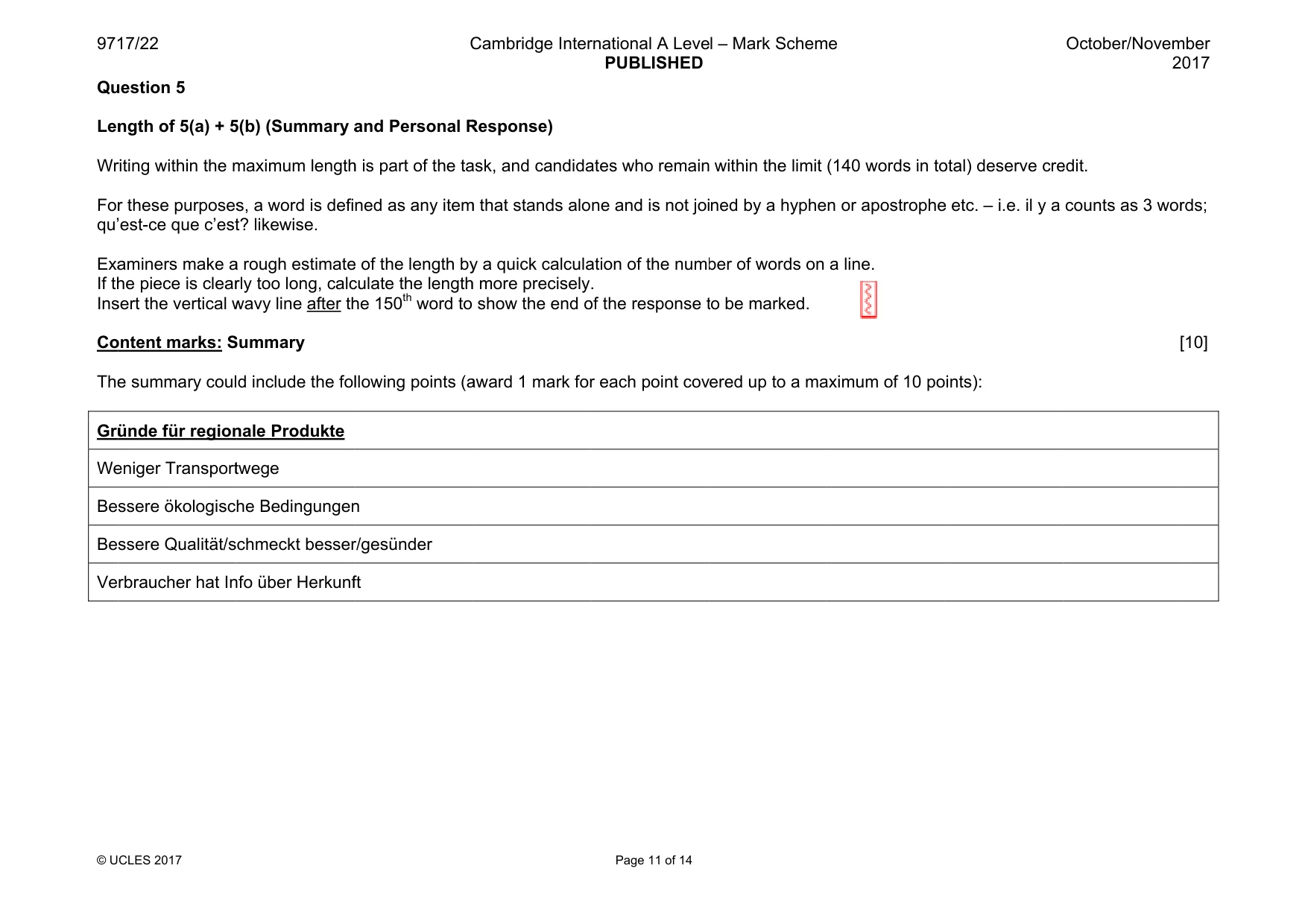
971 © U Qu Len Wr For qu’ Exa If th Ins Co The Grü We Bes Bes Ve 17/22 CLES 2017 uestion 5 ngth of 5(a) + 5 riting within the m r these purposes ’est-ce que c’est aminers make a he piece is clear sert the vertical w ontent marks: S e summary coul ünde für region eniger Transport ssere ökologisc ssere Qualität/s rbraucher hat In 5(b) (Summary a maximum length s, a word is defi t? likewise. a rough estimate rly too long, calc wavy line after th Summary d include the fol nale Produkte twege he Bedingungen chmeckt besser nfo über Herkunf C and Personal R h is part of the ta ned as any item e of the length by culate the length he 150th word to llowing points (a n r/gesünder ft Cambridge Inter Response) ask, and candida m that stands alo y a quick calcula h more precisely show the end o award 1 mark for rnational A Leve PUBLISHED Page 11 of 14 ates who remain ne and is not joi ation of the numb . of the response t r each point cov l – Mark Schem within the limit ned by a hyphe ber of words on to be marked. ered up to a ma me (140 words in to n or apostrophe a line. aximum of 10 po otal) deserve cre e etc. – i.e. il y a ints): October/Novem 2 edit. counts as 3 wor [ mber 017 rds; [10]
Mark scheme, page 12
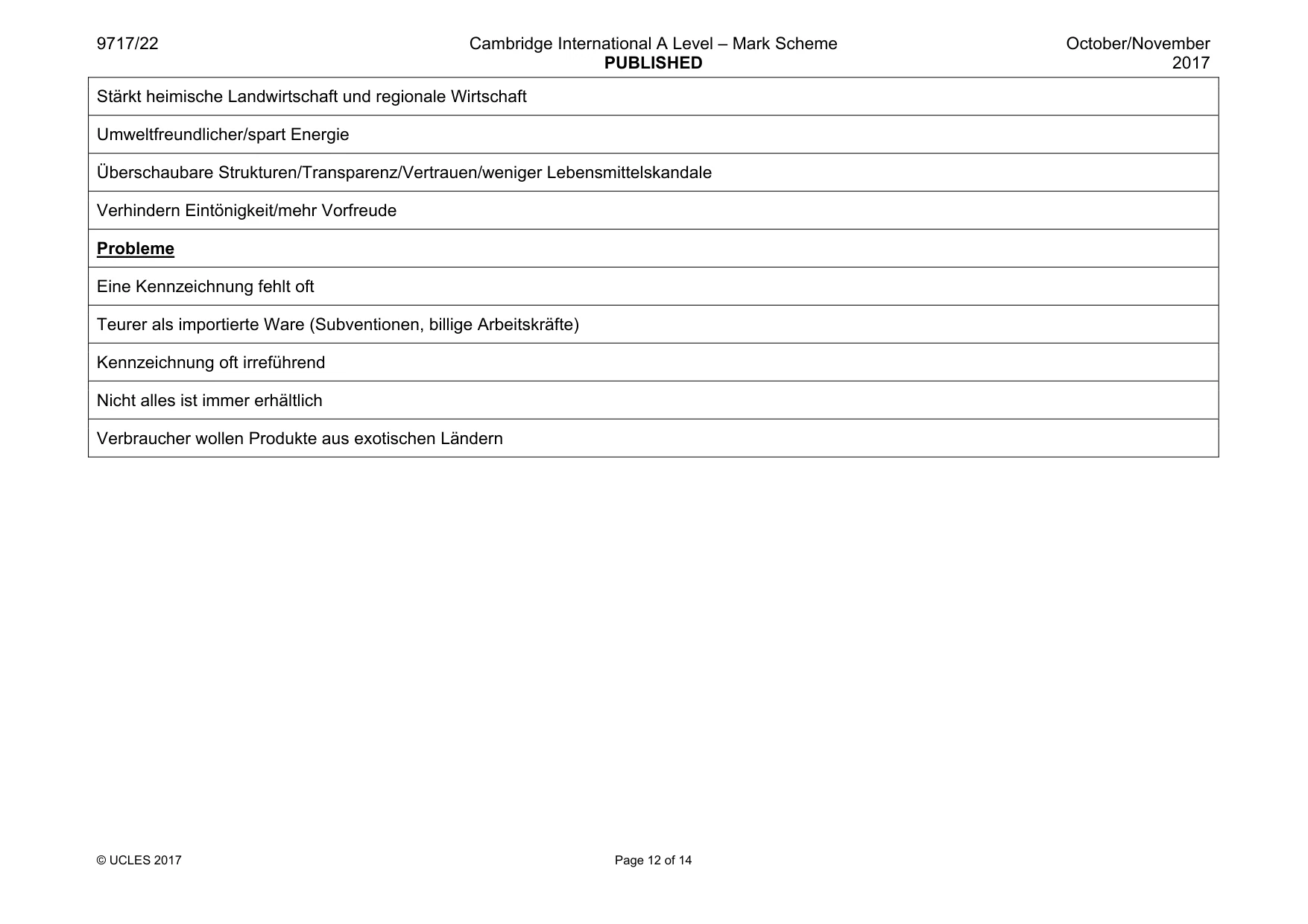
9717/22 Cambridge International A Level – Mark Scheme PUBLISHED October/November 2017 © UCLES 2017 Page 12 of 14 Stärkt heimische Landwirtschaft und regionale Wirtschaft Umweltfreundlicher/spart Energie Überschaubare Strukturen/Transparenz/Vertrauen/weniger Lebensmittelskandale Verhindern Eintönigkeit/mehr Vorfreude Probleme Eine Kennzeichnung fehlt oft Teurer als importierte Ware (Subventionen, billige Arbeitskräfte) Kennzeichnung oft irreführend Nicht alles ist immer erhältlich Verbraucher wollen Produkte aus exotischen Ländern
Mark scheme, page 13
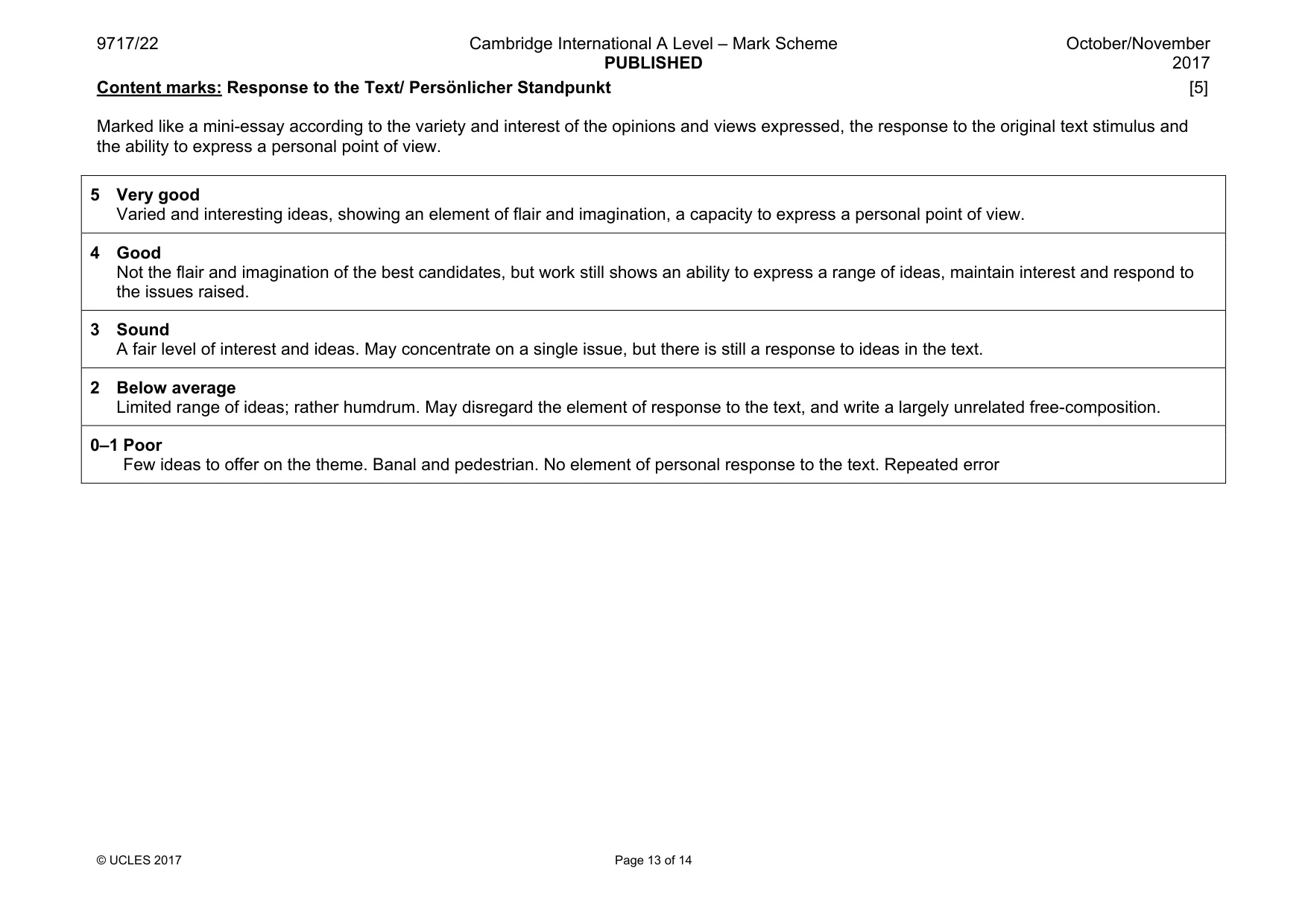
9717/22 Cambridge International A Level – Mark Scheme PUBLISHED October/November 2017 © UCLES 2017 Page 13 of 14 Content marks: Response to the Text/ Persönlicher Standpunkt [5] Marked like a mini-essay according to the variety and interest of the opinions and views expressed, the response to the original text stimulus and the ability to express a personal point of view. 5 Very good Varied and interesting ideas, showing an element of flair and imagination, a capacity to express a personal point of view. 4 Good Not the flair and imagination of the best candidates, but work still shows an ability to express a range of ideas, maintain interest and respond to the issues raised. 3 Sound A fair level of interest and ideas. May concentrate on a single issue, but there is still a response to ideas in the text. 2 Below average Limited range of ideas; rather humdrum. May disregard the element of response to the text, and write a largely unrelated free-composition. 0–1 Poor Few ideas to offer on the theme. Banal and pedestrian. No element of personal response to the text. Repeated error
Mark scheme, page 14
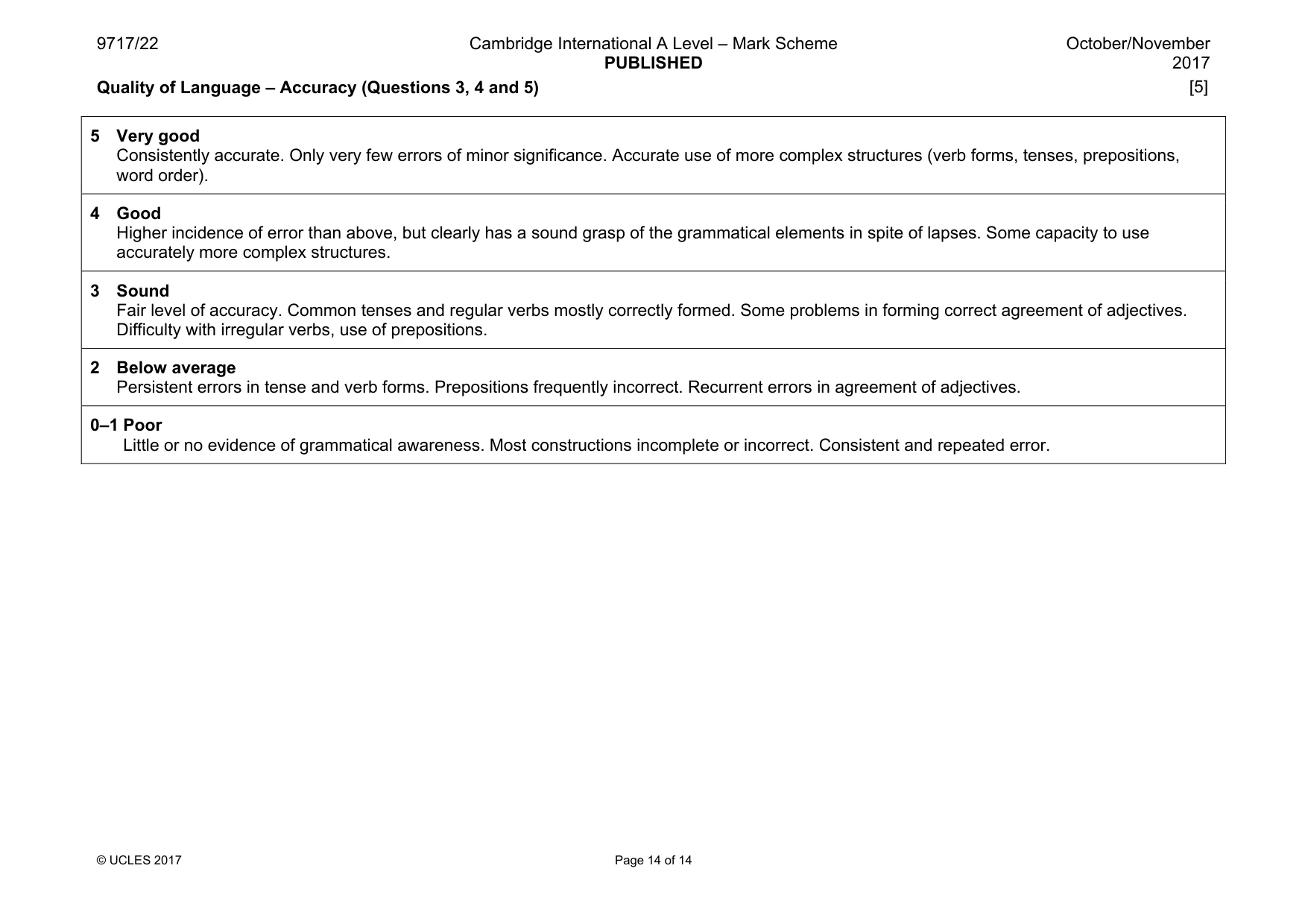
9717/22 Cambridge International A Level – Mark Scheme PUBLISHED October/November 2017 © UCLES 2017 Page 14 of 14 Quality of Language – Accuracy (Questions 3, 4 and 5) [5] 5 Very good Consistently accurate. Only very few errors of minor significance. Accurate use of more complex structures (verb forms, tenses, prepositions, word order). 4 Good Higher incidence of error than above, but clearly has a sound grasp of the grammatical elements in spite of lapses. Some capacity to use accurately more complex structures. 3 Sound Fair level of accuracy. Common tenses and regular verbs mostly correctly formed. Some problems in forming correct agreement of adjectives. Difficulty with irregular verbs, use of prepositions. 2 Below average Persistent errors in tense and verb forms. Prepositions frequently incorrect. Recurrent errors in agreement of adjectives. 0–1 Poor Little or no evidence of grammatical awareness. Most constructions incomplete or incorrect. Consistent and repeated error.
What you needed in this session
Cambridge’s own grade thresholds for 2017 Oct/Nov, Paper 2 · Variant 2. A higher threshold means an easier paper — the bar moves with how the cohort did.