Cambridge A Level German (A Level only) 9717 — 2017 Oct/Nov Paper 2 · Variant 3
9717/23/O/N/17 · 70 marks · ≈79 min
The question paper and its mark scheme, free to read here and free to download. This is Cambridge’s own paper, exactly as it was sat.
Question paper12 pages

Mark scheme13 pages
Answers below. Sit the paper first if you are practising.
Paper as text
Question paper, page 1
* 3 0 1 8 4 2 3 9 1 9 * This document consists of 9 printed pages, 3 blank pages and 1 Insert. DC (LK) 136394/2 © UCLES 2017 [Turn over Cambridge International Examinations Cambridge International Advanced Level GERMAN 9717/23 Paper 2 Reading and Writing October/November 2017 1 hour 45 minutes Candidates answer on the Question Paper. No Additional Materials are required. READ THESE INSTRUCTIONS FIRST Write your Centre number, candidate number and name in the spaces at the top of this page. Write in dark blue or black pen. Do not use staples, paper clips, glue or correction fluid. DO NOT WRITE IN ANY BARCODES. Answer all questions in German in the spaces provided. Dictionaries are not permitted. You should keep to any word limits given in the questions. The number of marks is given in brackets [ ] at the end of each question or part question. LESEN SIE ZUERST DIESE ANWEISUNGEN Schreiben Sie Ihre Center-Nummer, Kandidaten-Nummer und Ihren Namen in die vorgegebenen Kästchen oben auf dieser Seite. Schreiben Sie mit dunkelblauem oder schwarzem Füller/Kugelschreiber. Benutzen Sie keine Heftklammern, Büroklammern, Korrekturflüssigkeit und keinen Klebstoff. SCHREIBEN SIE NICHT ÜBER DIE STRICHCODES. Beantworten Sie alle Fragen auf Deutsch in dem dafür vorgesehenen Bereich. Der Gebrauch von Wörterbüchern ist nicht erlaubt. Sie müssen sich an die Wortzahl halten, die für jede Frage angegeben ist. Die erreichbare Punktzahl finden Sie in Klammern [ ] am Ende jeder Frage oder Teilfrage.
Question paper, page 2
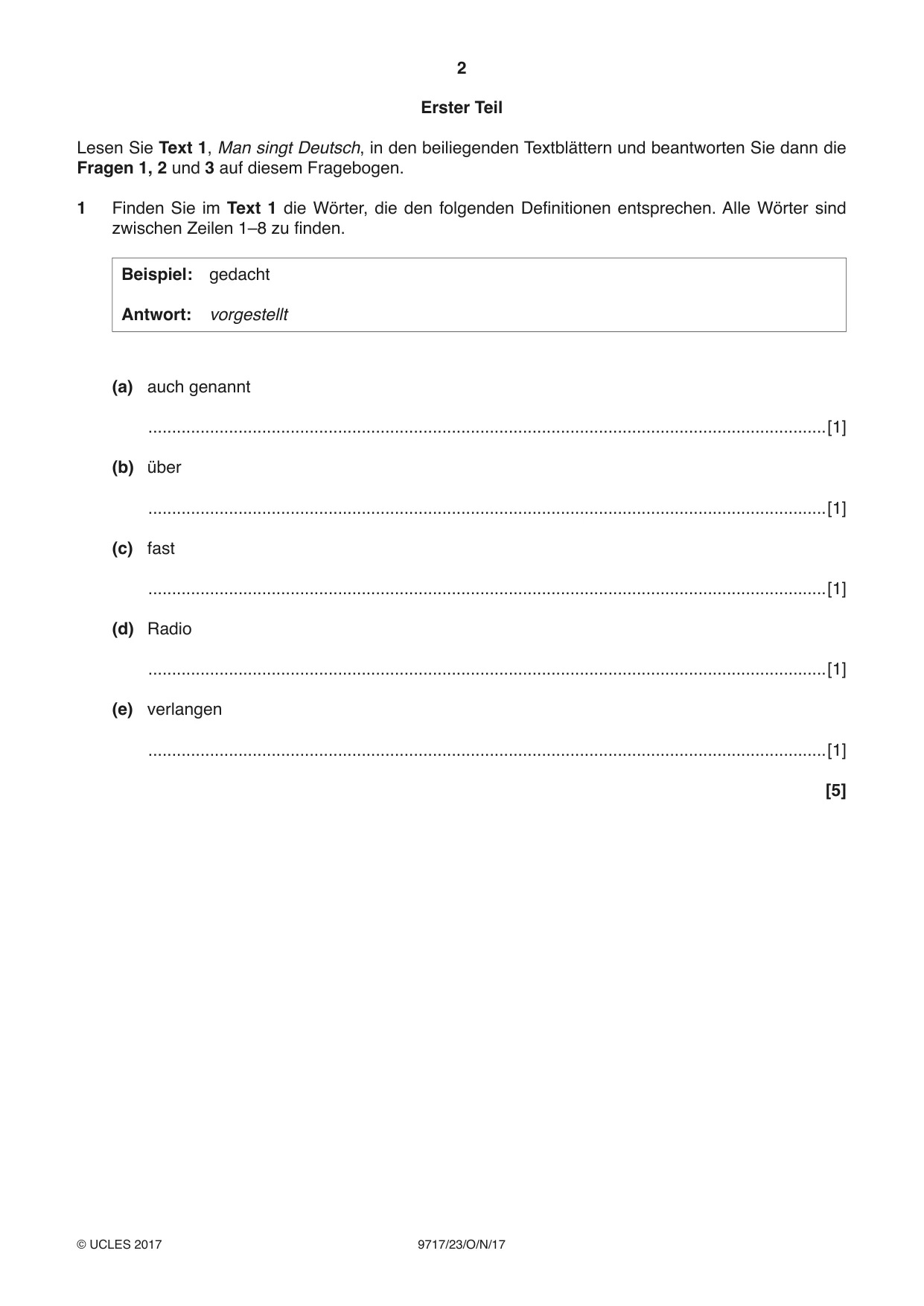
2 9717/23/O/N/17 © UCLES 2017 Erster Teil Lesen Sie Text 1, Man singt Deutsch, in den beiliegenden Textblättern und beantworten Sie dann die Fragen 1, 2 und 3 auf diesem Fragebogen. 1 Finden Sie im Text 1 die Wörter, die den folgenden Definitionen entsprechen. Alle Wörter sind zwischen Zeilen 1–8 zu finden. Beispiel: gedacht Antwort: vorgestellt (a) auch genannt …[1] (b) über …[1] (c) fast …[1] (d) Radio …[1] (e) verlangen …[1] [5]
Question paper, page 3
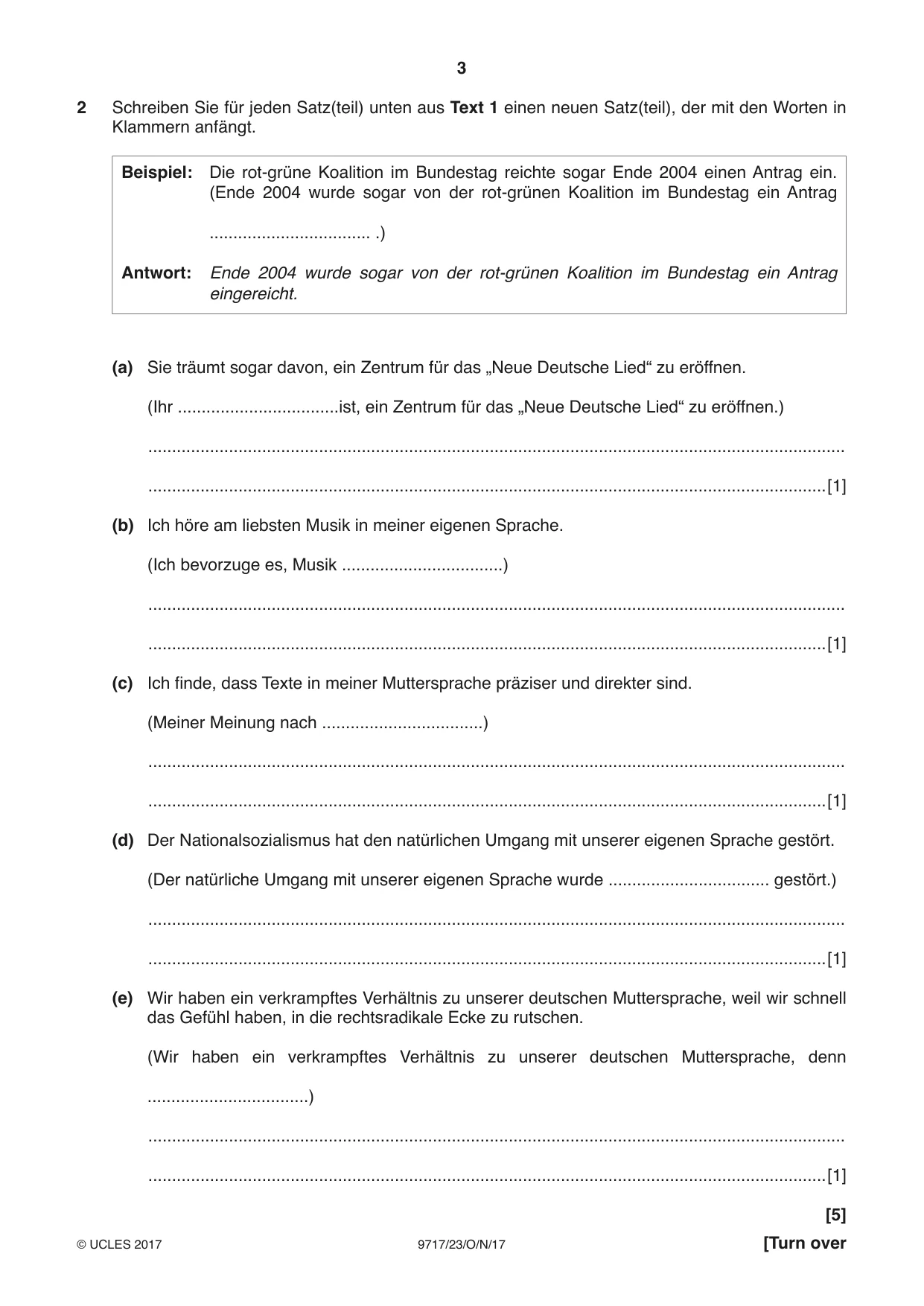
3 9717/23/O/N/17 © UCLES 2017 [Turn over 2 Schreiben Sie für jeden Satz(teil) unten aus Text 1 einen neuen Satz(teil), der mit den Worten in Klammern anfängt. Beispiel: Die rot-grüne Koalition im Bundestag reichte sogar Ende 2004 einen Antrag ein. (Ende 2004 wurde sogar von der rot-grünen Koalition im Bundestag ein Antrag … .) Antwort: Ende 2004 wurde sogar von der rot-grünen Koalition im Bundestag ein Antrag eingereicht. (a) Sie träumt sogar davon, ein Zentrum für das „Neue Deutsche Lied“ zu eröffnen. (Ihr …ist, ein Zentrum für das „Neue Deutsche Lied“ zu eröffnen.) … …[1] (b) Ich höre am liebsten Musik in meiner eigenen Sprache. (Ich bevorzuge es, Musik …) … …[1] (c) Ich finde, dass Texte in meiner Muttersprache präziser und direkter sind. (Meiner Meinung nach …) … …[1] (d) Der Nationalsozialismus hat den natürlichen Umgang mit unserer eigenen Sprache gestört. (Der natürliche Umgang mit unserer eigenen Sprache wurde … gestört.) … …[1] (e) Wir haben ein verkrampftes Verhältnis zu unserer deutschen Muttersprache, weil wir schnell das Gefühl haben, in die rechtsradikale Ecke zu rutschen. (Wir haben ein verkrampftes Verhältnis zu unserer deutschen Muttersprache, denn …) … …[1] [5]
Question paper, page 4
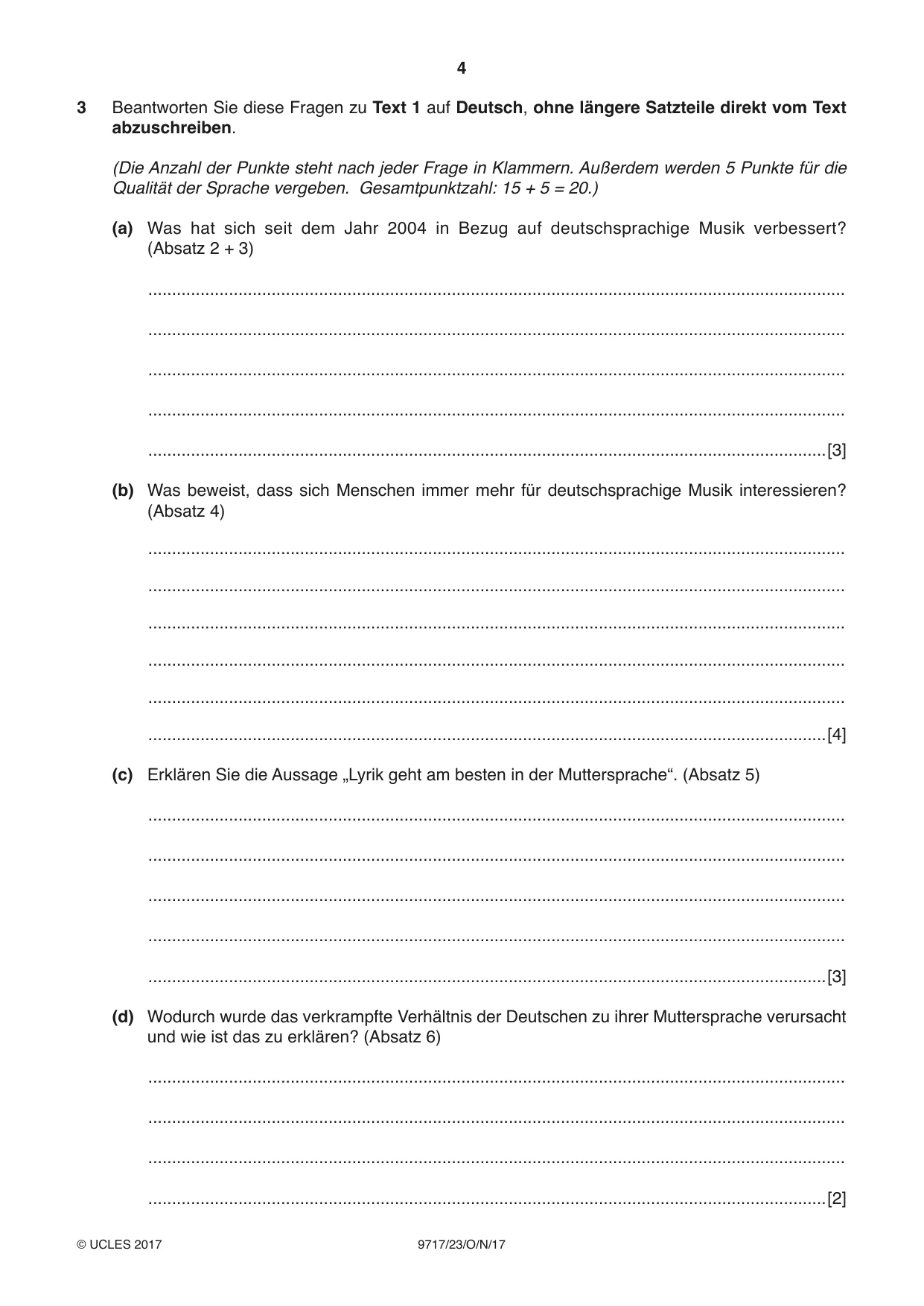
4 9717/23/O/N/17 © UCLES 2017 3 Beantworten Sie diese Fragen zu Text 1 auf Deutsch, ohne längere Satzteile direkt vom Text abzuschreiben. (Die Anzahl der Punkte steht nach jeder Frage in Klammern. Außerdem werden 5 Punkte für die Qualität der Sprache vergeben. Gesamtpunktzahl: 15 + 5 = 20.) (a) Was hat sich seit dem Jahr 2004 in Bezug auf deutschsprachige Musik verbessert? (Absatz 2 + 3) … … … … …[3] (b) Was beweist, dass sich Menschen immer mehr für deutschsprachige Musik interessieren? (Absatz 4) … … … … … …[4] (c) Erklären Sie die Aussage „Lyrik geht am besten in der Muttersprache“. (Absatz 5) … … … … …[3] (d) Wodurch wurde das verkrampfte Verhältnis der Deutschen zu ihrer Muttersprache verursacht und wie ist das zu erklären? (Absatz 6) … … … …[2]
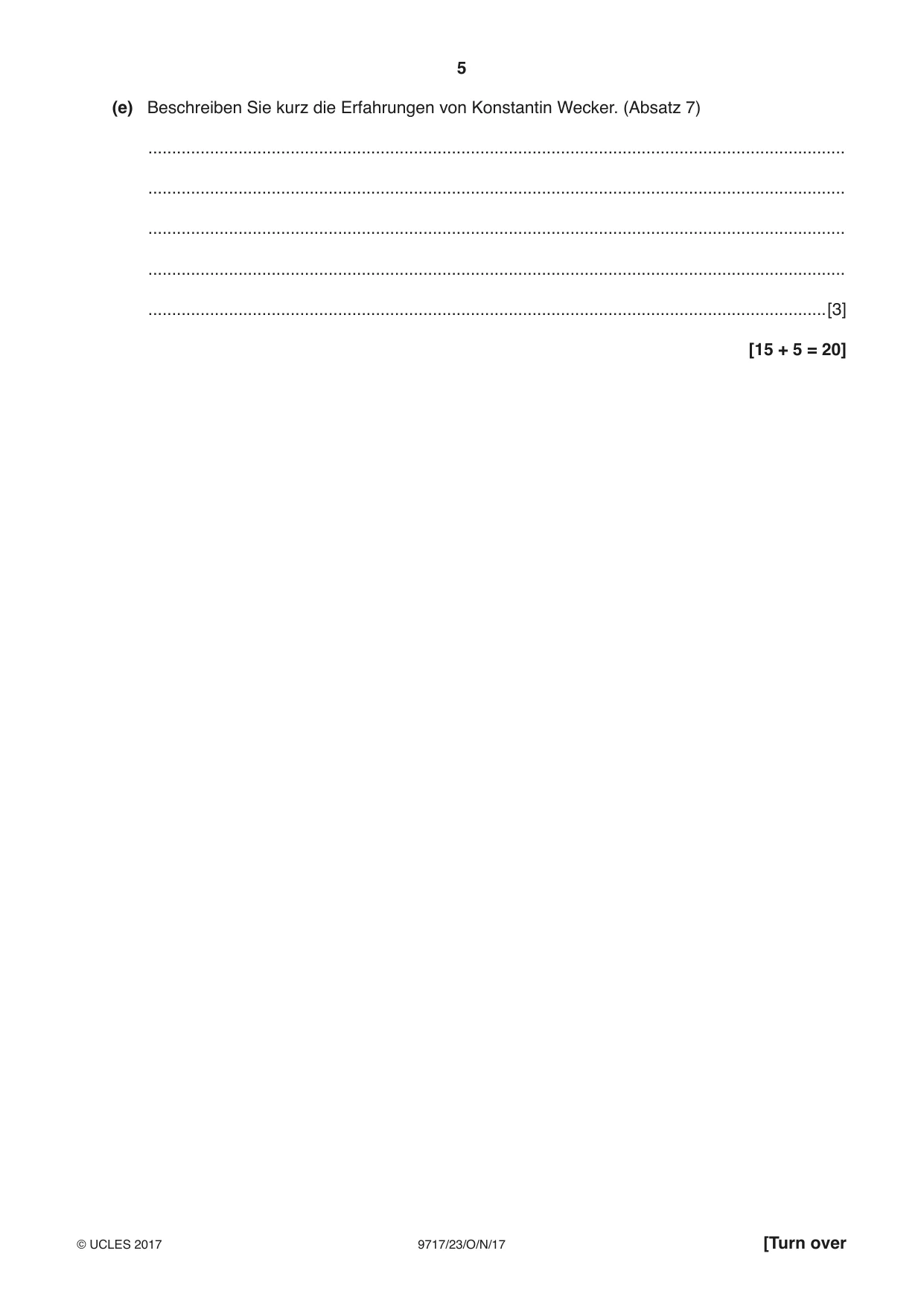
Question paper, page 5
5 9717/23/O/N/17 © UCLES 2017 [Turn over (e) Beschreiben Sie kurz die Erfahrungen von Konstantin Wecker. (Absatz 7) … … … … …[3] [15 + 5 = 20]
Question paper, page 6
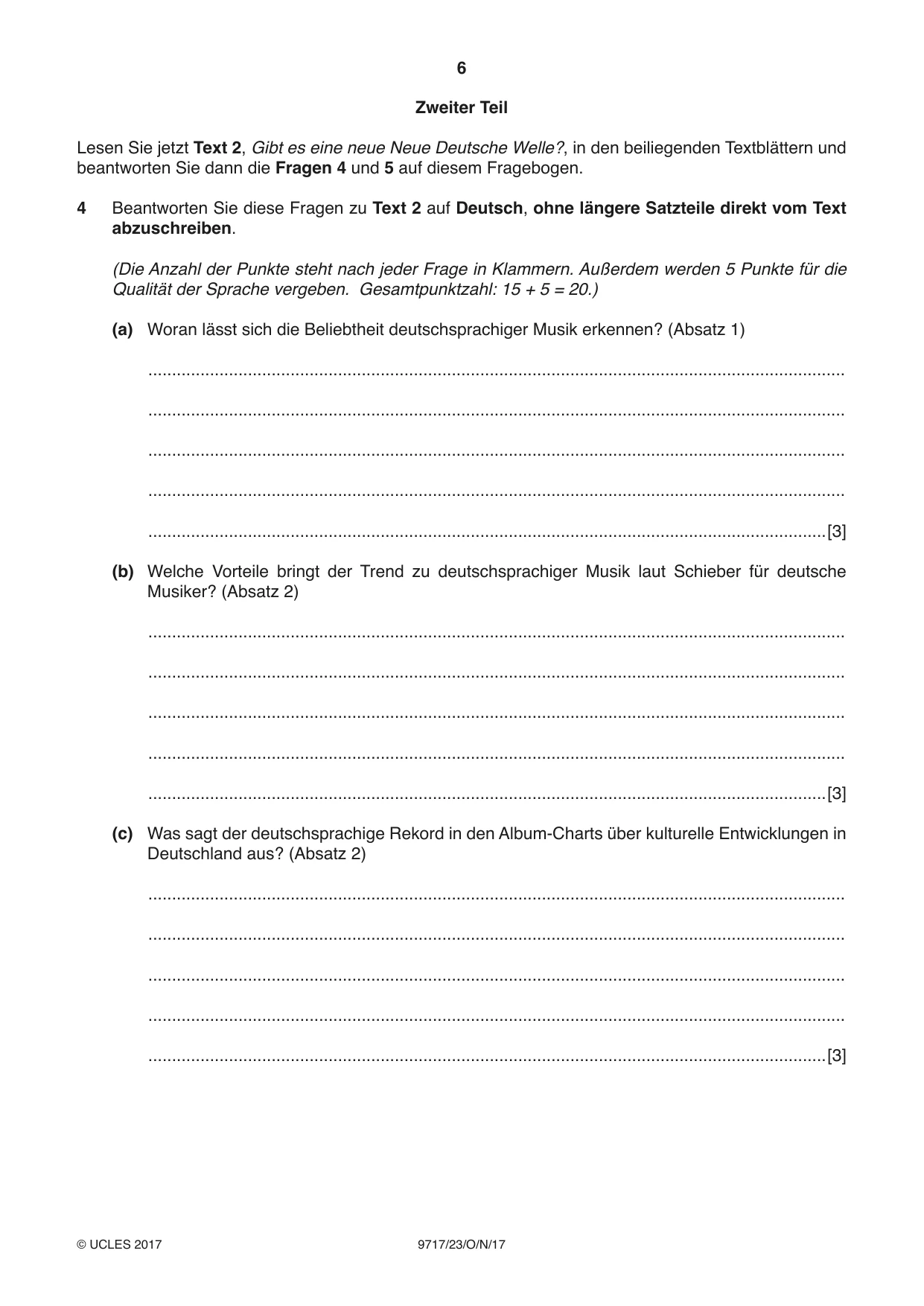
6 9717/23/O/N/17 © UCLES 2017 Zweiter Teil Lesen Sie jetzt Text 2, Gibt es eine neue Neue Deutsche Welle?, in den beiliegenden Textblättern und beantworten Sie dann die Fragen 4 und 5 auf diesem Fragebogen. 4 Beantworten Sie diese Fragen zu Text 2 auf Deutsch, ohne längere Satzteile direkt vom Text abzuschreiben. (Die Anzahl der Punkte steht nach jeder Frage in Klammern. Außerdem werden 5 Punkte für die Qualität der Sprache vergeben. Gesamtpunktzahl: 15 + 5 = 20.) (a) Woran lässt sich die Beliebtheit deutschsprachiger Musik erkennen? (Absatz 1) … … … … …[3] (b) Welche Vorteile bringt der Trend zu deutschsprachiger Musik laut Schieber für deutsche Musiker? (Absatz 2) … … … … …[3] (c) Was sagt der deutschsprachige Rekord in den Album-Charts über kulturelle Entwicklungen in Deutschland aus? (Absatz 2) … … … … …[3]
Question paper, page 7
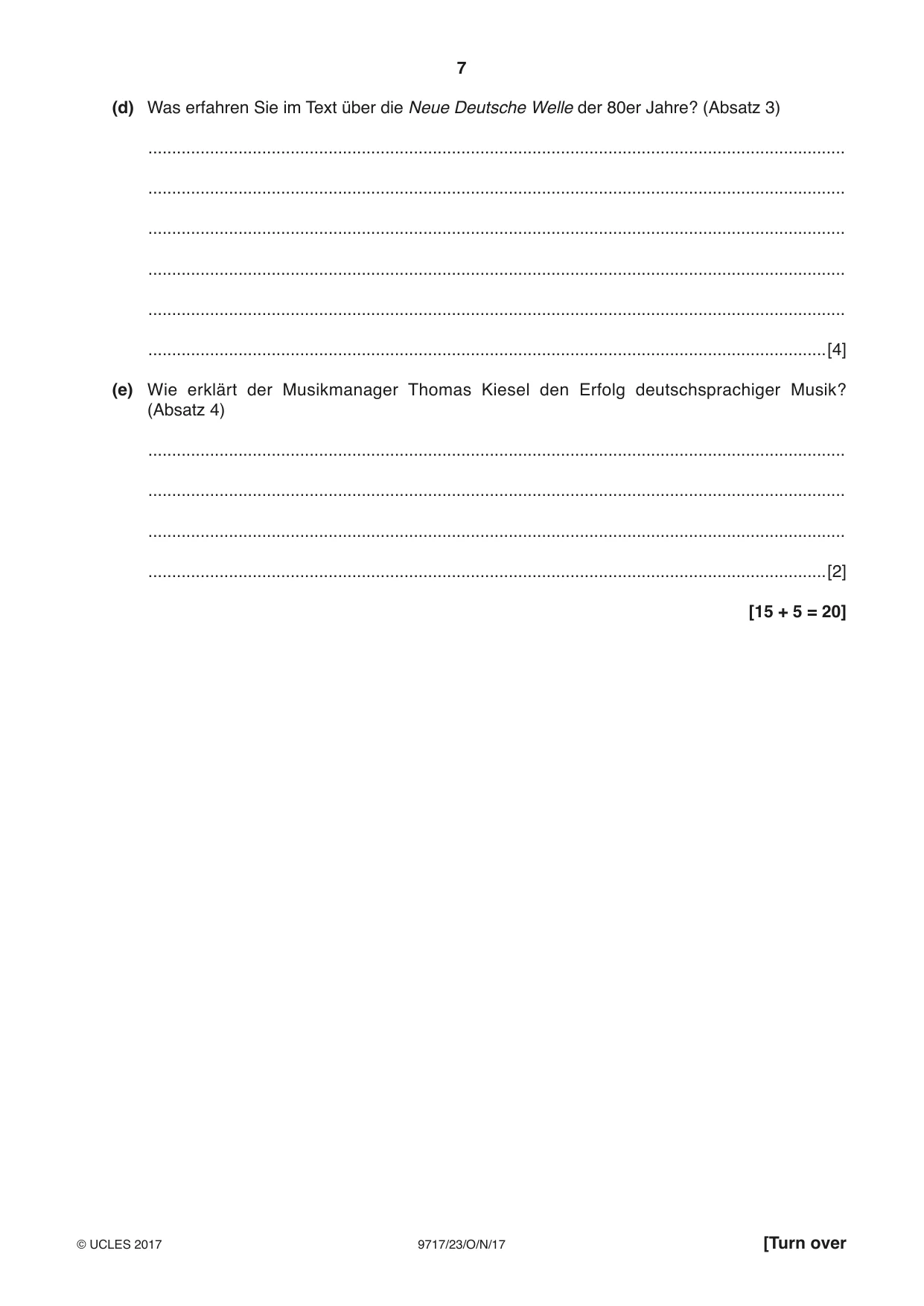
7 9717/23/O/N/17 © UCLES 2017 [Turn over (d) Was erfahren Sie im Text über die Neue Deutsche Welle der 80er Jahre? (Absatz 3) … … … … … …[4] (e) Wie erklärt der Musikmanager Thomas Kiesel den Erfolg deutschsprachiger Musik? (Absatz 4) … … … …[2] [15 + 5 = 20]
Question paper, page 8
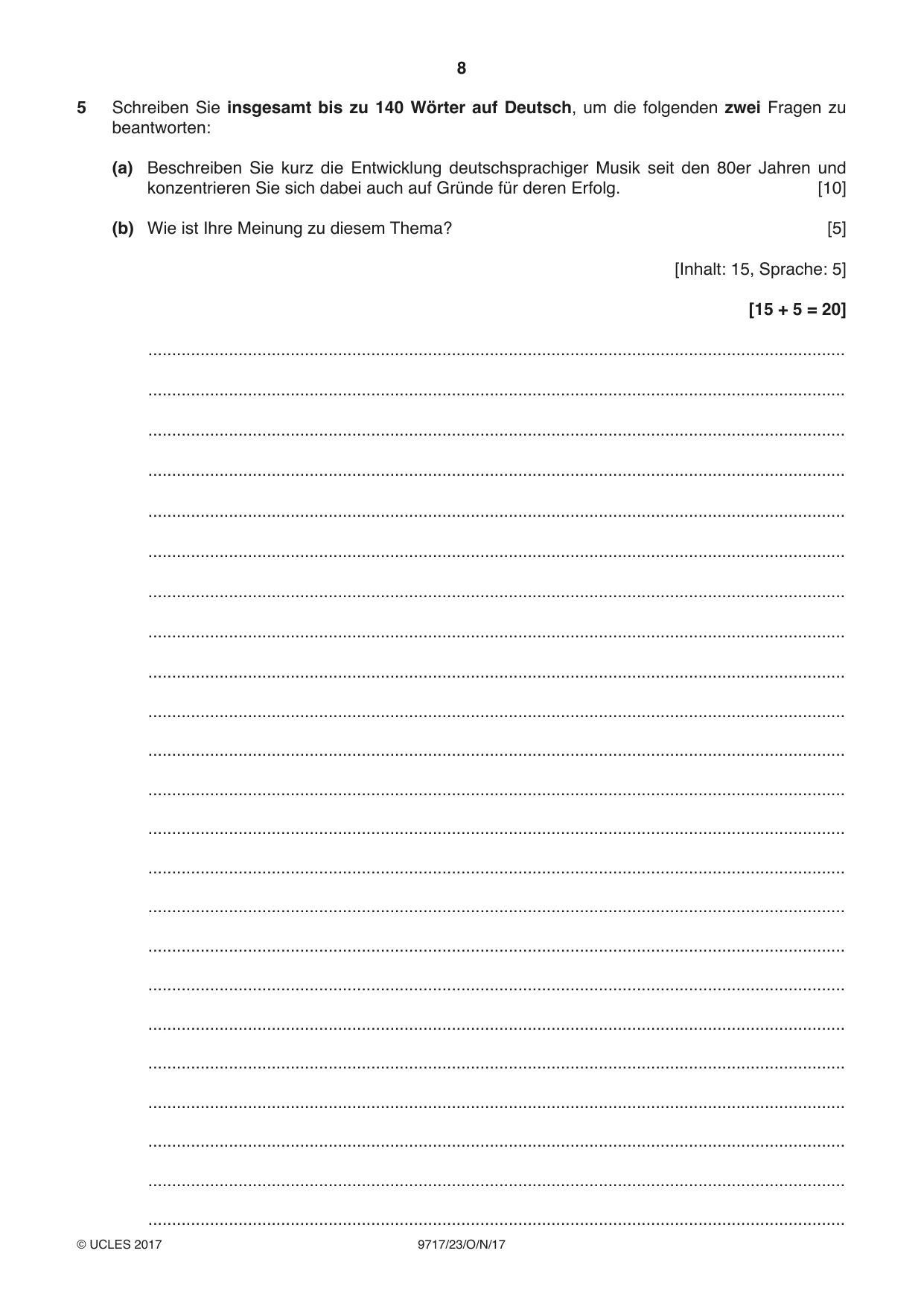
8 9717/23/O/N/17 © UCLES 2017 5 Schreiben Sie insgesamt bis zu 140 Wörter auf Deutsch, um die folgenden zwei Fragen zu beantworten: (a) Beschreiben Sie kurz die Entwicklung deutschsprachiger Musik seit den 80er Jahren und konzentrieren Sie sich dabei auch auf Gründe für deren Erfolg. [10] (b) Wie ist Ihre Meinung zu diesem Thema? [5] [Inhalt: 15, Sprache: 5] [15 + 5 = 20] … … … … … … … … … … … … … … … … … … … … … … …
Question paper, page 9
9 9717/23/O/N/17 © UCLES 2017 … … … … … … … … … … … … … … …
Question paper, page 10
10 9717/23/O/N/17 © UCLES 2017 BLANK PAGE
Question paper, page 11
11 9717/23/O/N/17 © UCLES 2017 BLANK PAGE
Question paper, page 12
12 9717/23/O/N/17 © UCLES 2017 Permission to reproduce items where third-party owned material protected by copyright is included has been sought and cleared where possible. Every reasonable effort has been made by the publisher (UCLES) to trace copyright holders, but if any items requiring clearance have unwittingly been included, the publisher will be pleased to make amends at the earliest possible opportunity. To avoid the issue of disclosure of answer-related information to candidates, all copyright acknowledgements are reproduced online in the Cambridge International Examinations Copyright Acknowledgements Booklet. This is produced for each series of examinations and is freely available to download at www.cie.org.uk after the live examination series. Cambridge International Examinations is part of the Cambridge Assessment Group. Cambridge Assessment is the brand name of University of Cambridge Local Examinations Syndicate (UCLES), which is itself a department of the University of Cambridge. BLANK PAGE
Mark scheme, page 1
® IGCSE is a registered trademark. This document consists of 13 printed pages. © UCLES 2017 [Turn over Cambridge Assessment International Education Cambridge International Advanced Level GERMAN 9717/23 Paper 2 Reading and Writing October/November 2017 MARK SCHEME Maximum Mark: 75 Published This mark scheme is published as an aid to teachers and candidates, to indicate the requirements of the examination. It shows the basis on which Examiners were instructed to award marks. It does not indicate the details of the discussions that took place at an Examiners’ meeting before marking began, which would have considered the acceptability of alternative answers. Mark schemes should be read in conjunction with the question paper and the Principal Examiner Report for Teachers. Cambridge International will not enter into discussions about these mark schemes. Cambridge International is publishing the mark schemes for the October/November 2017 series for most Cambridge IGCSE®, Cambridge International A and AS Level components and some Cambridge O Level components.
Mark scheme, page 2
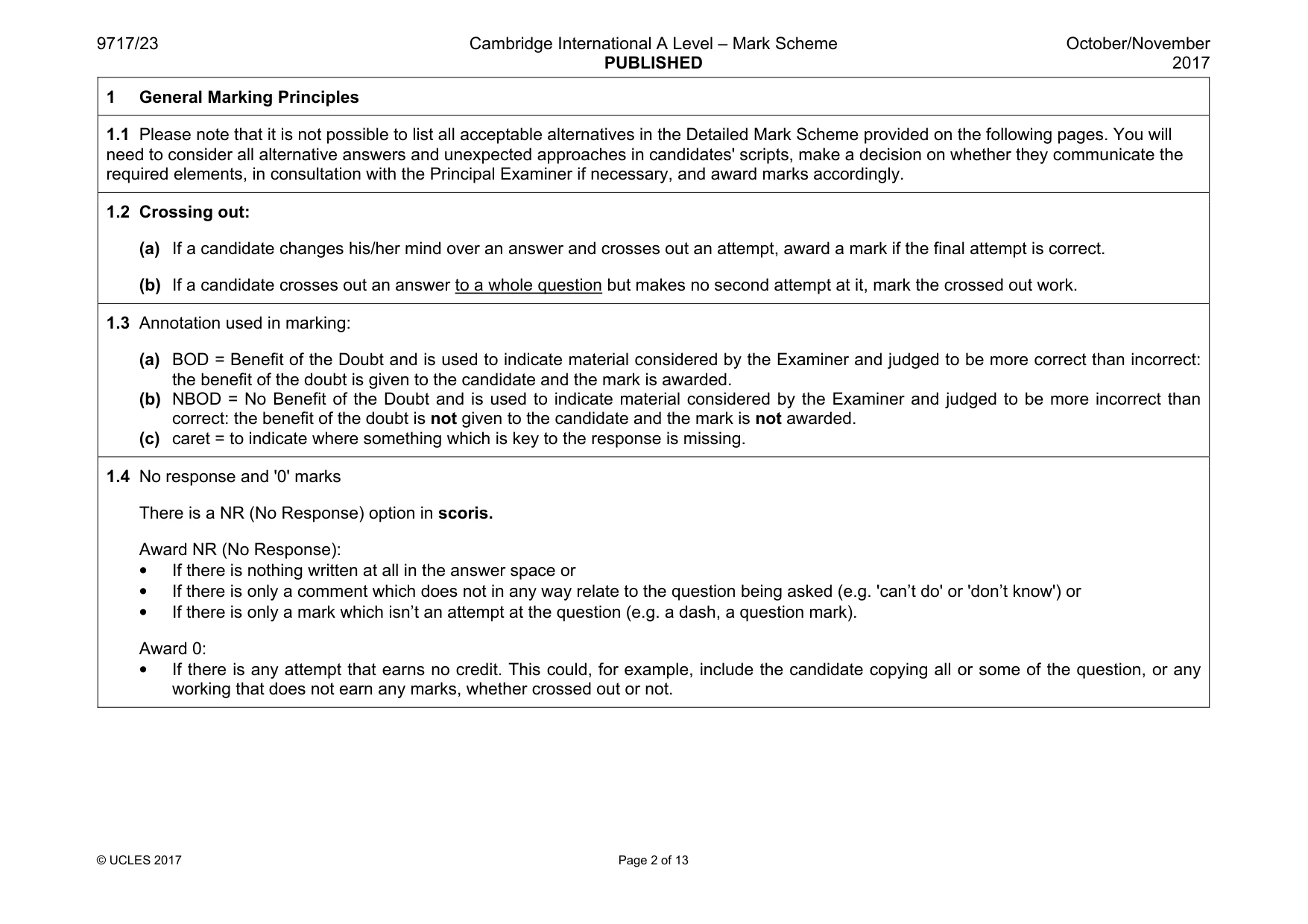
9717/23 Cambridge International A Level – Mark Scheme PUBLISHED October/November 2017 © UCLES 2017 Page 2 of 13 1 General Marking Principles 1.1 Please note that it is not possible to list all acceptable alternatives in the Detailed Mark Scheme provided on the following pages. You will need to consider all alternative answers and unexpected approaches in candidates' scripts, make a decision on whether they communicate the required elements, in consultation with the Principal Examiner if necessary, and award marks accordingly. 1.2 Crossing out: (a) If a candidate changes his/her mind over an answer and crosses out an attempt, award a mark if the final attempt is correct. (b) If a candidate crosses out an answer to a whole question but makes no second attempt at it, mark the crossed out work. 1.3 Annotation used in marking: (a) BOD = Benefit of the Doubt and is used to indicate material considered by the Examiner and judged to be more correct than incorrect: the benefit of the doubt is given to the candidate and the mark is awarded. (b) NBOD = No Benefit of the Doubt and is used to indicate material considered by the Examiner and judged to be more incorrect than correct: the benefit of the doubt is not given to the candidate and the mark is not awarded. (c) caret = to indicate where something which is key to the response is missing. 1.4 No response and '0' marks There is a NR (No Response) option in scoris. Award NR (No Response): • If there is nothing written at all in the answer space or • If there is only a comment which does not in any way relate to the question being asked (e.g. 'can’t do' or 'don’t know') or • If there is only a mark which isn’t an attempt at the question (e.g. a dash, a question mark). Award 0: • If there is any attempt that earns no credit. This could, for example, include the candidate copying all or some of the question, or any working that does not earn any marks, whether crossed out or not.
Mark scheme, page 3
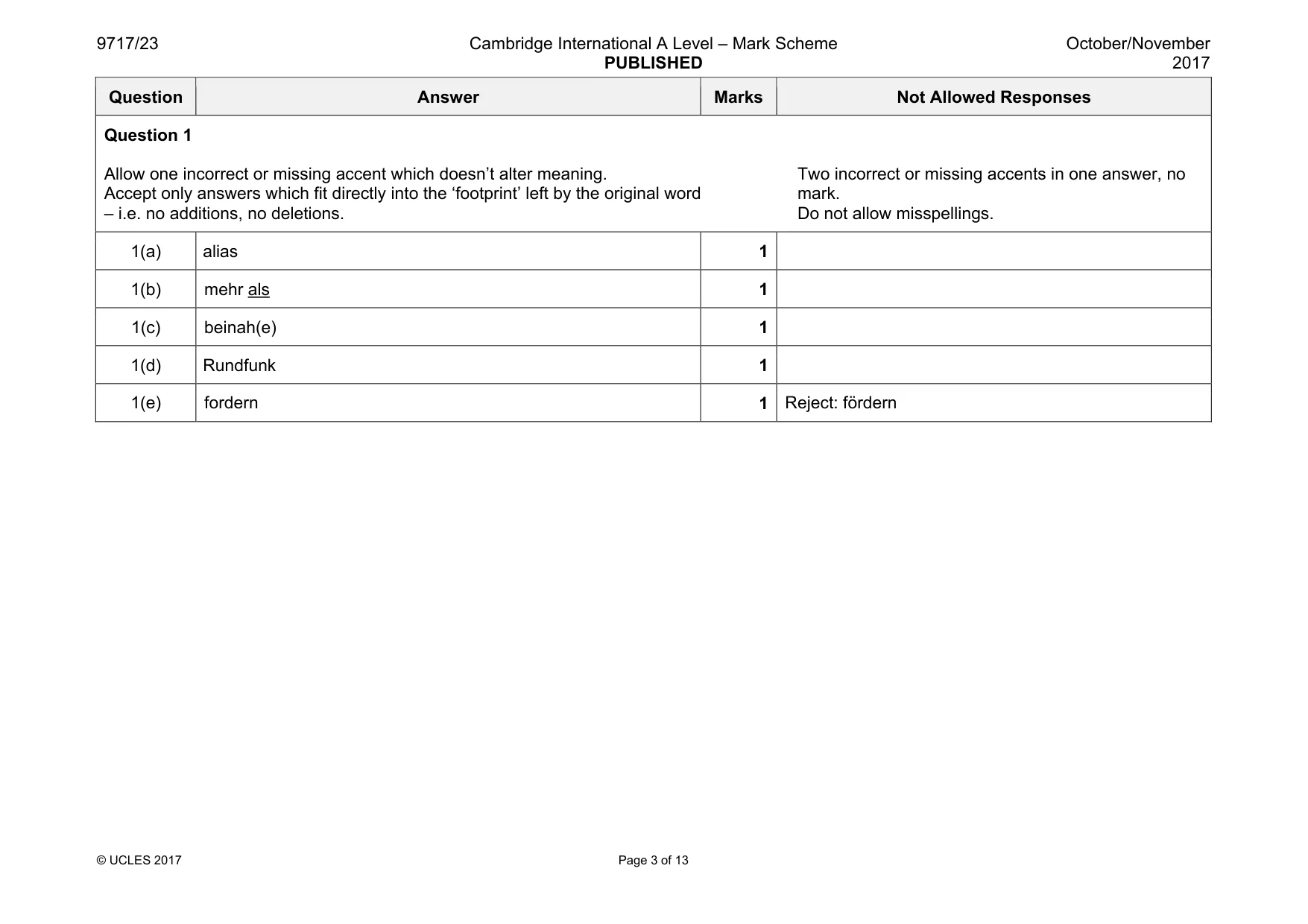
9717/23 Cambridge International A Level – Mark Scheme PUBLISHED October/November 2017 © UCLES 2017 Page 3 of 13 Question Answer Marks Not Allowed Responses Question 1 Allow one incorrect or missing accent which doesn’t alter meaning. Two incorrect or missing accents in one answer, no Accept only answers which fit directly into the ‘footprint’ left by the original word mark. – i.e. no additions, no deletions. Do not allow misspellings. 1(a) alias 1 1(b) mehr als 1 1(c) beinah(e) 1 1(d) Rundfunk 1 1(e) fordern 1 Reject: fӧrdern
Mark scheme, page 4
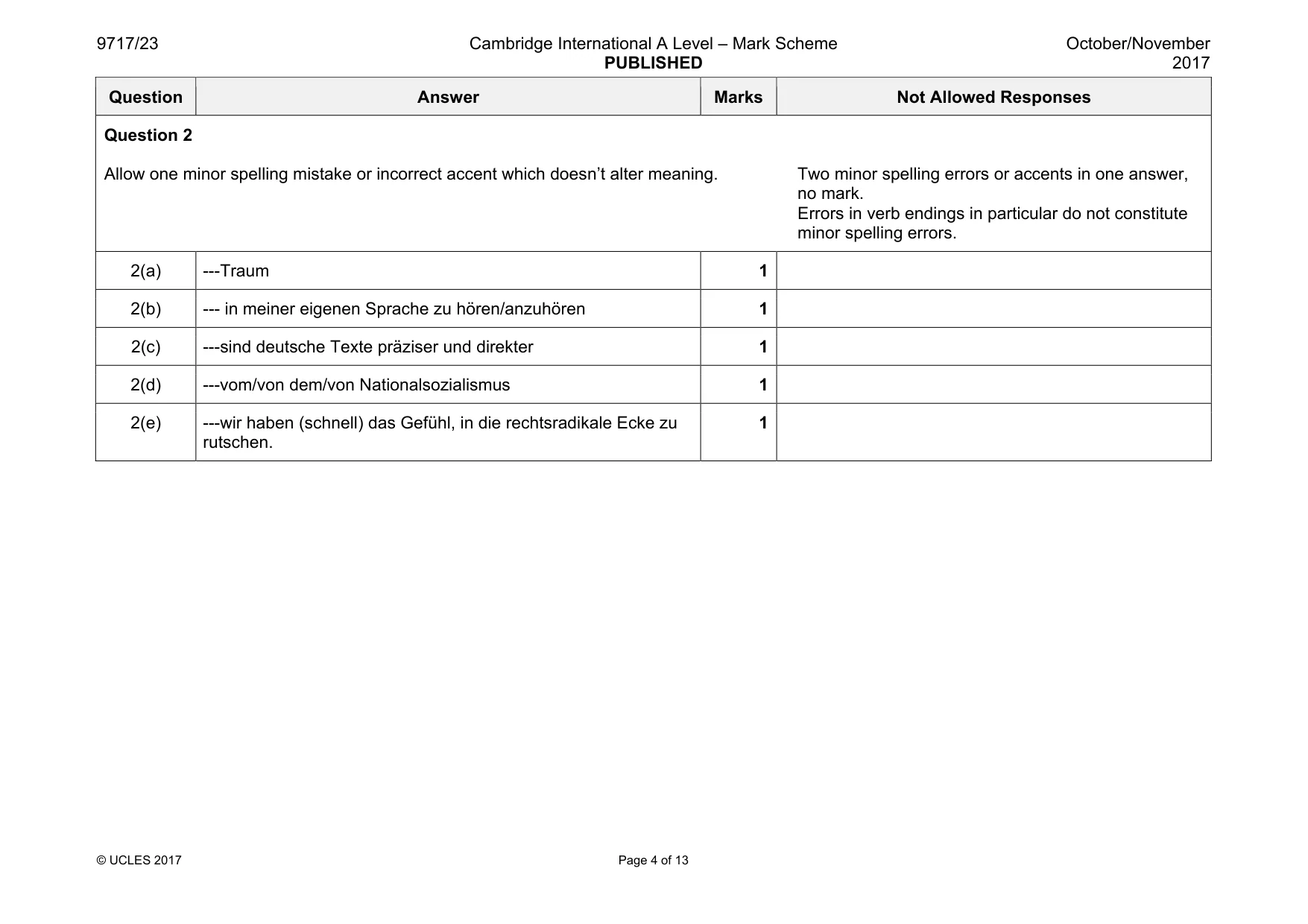
9717/23 Cambridge International A Level – Mark Scheme PUBLISHED October/November 2017 © UCLES 2017 Page 4 of 13 Question Answer Marks Not Allowed Responses Question 2 Allow one minor spelling mistake or incorrect accent which doesn’t alter meaning. Two minor spelling errors or accents in one answer, no mark. Errors in verb endings in particular do not constitute minor spelling errors. 2(a) ---Traum 1 2(b) --- in meiner eigenen Sprache zu hӧren/anzuhӧren 1 2(c) ---sind deutsche Texte präziser und direkter 1 2(d) ---vom/von dem/von Nationalsozialismus 1 2(e) ---wir haben (schnell) das Gefühl, in die rechtsradikale Ecke zu rutschen. 1
Mark scheme, page 5
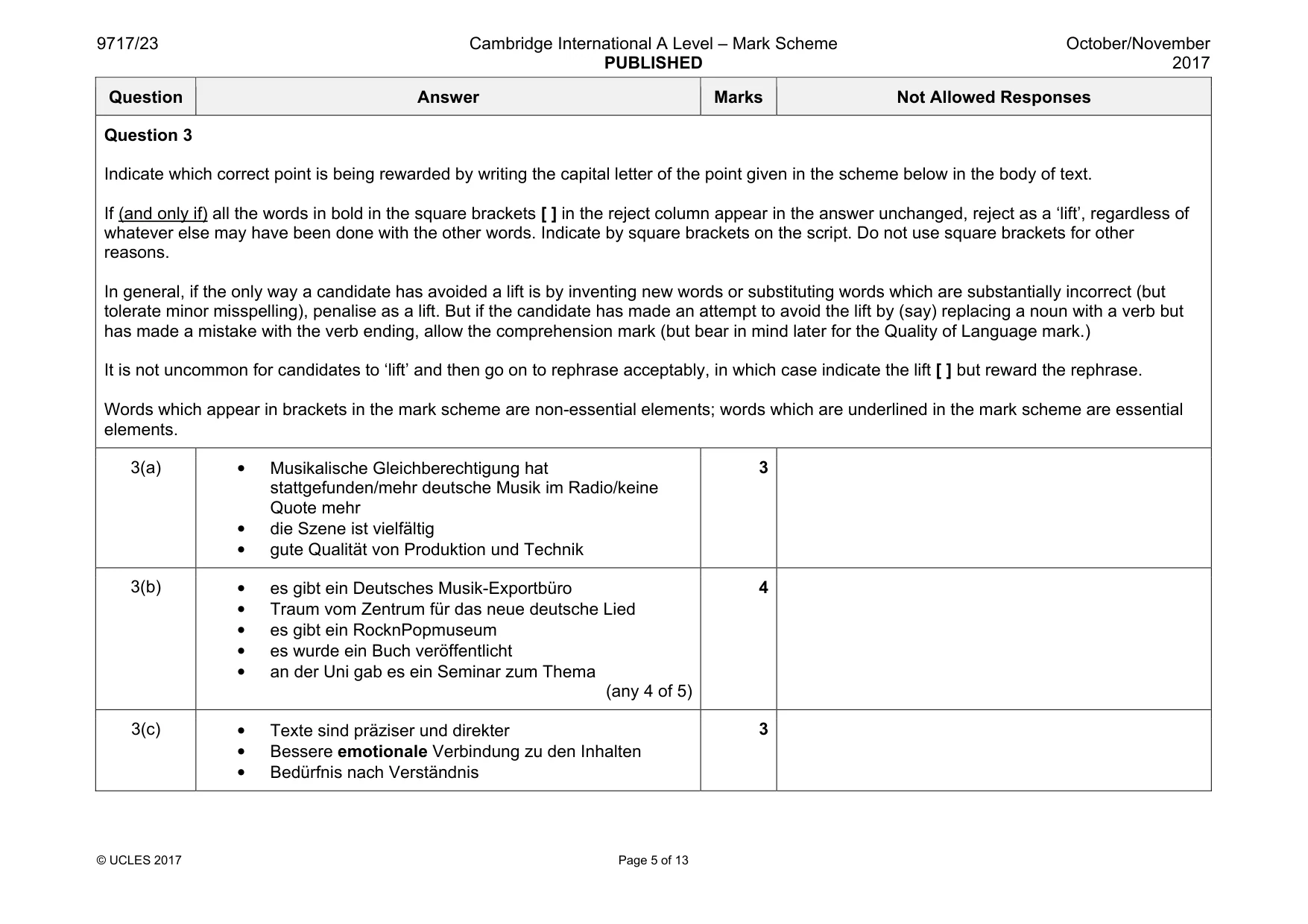
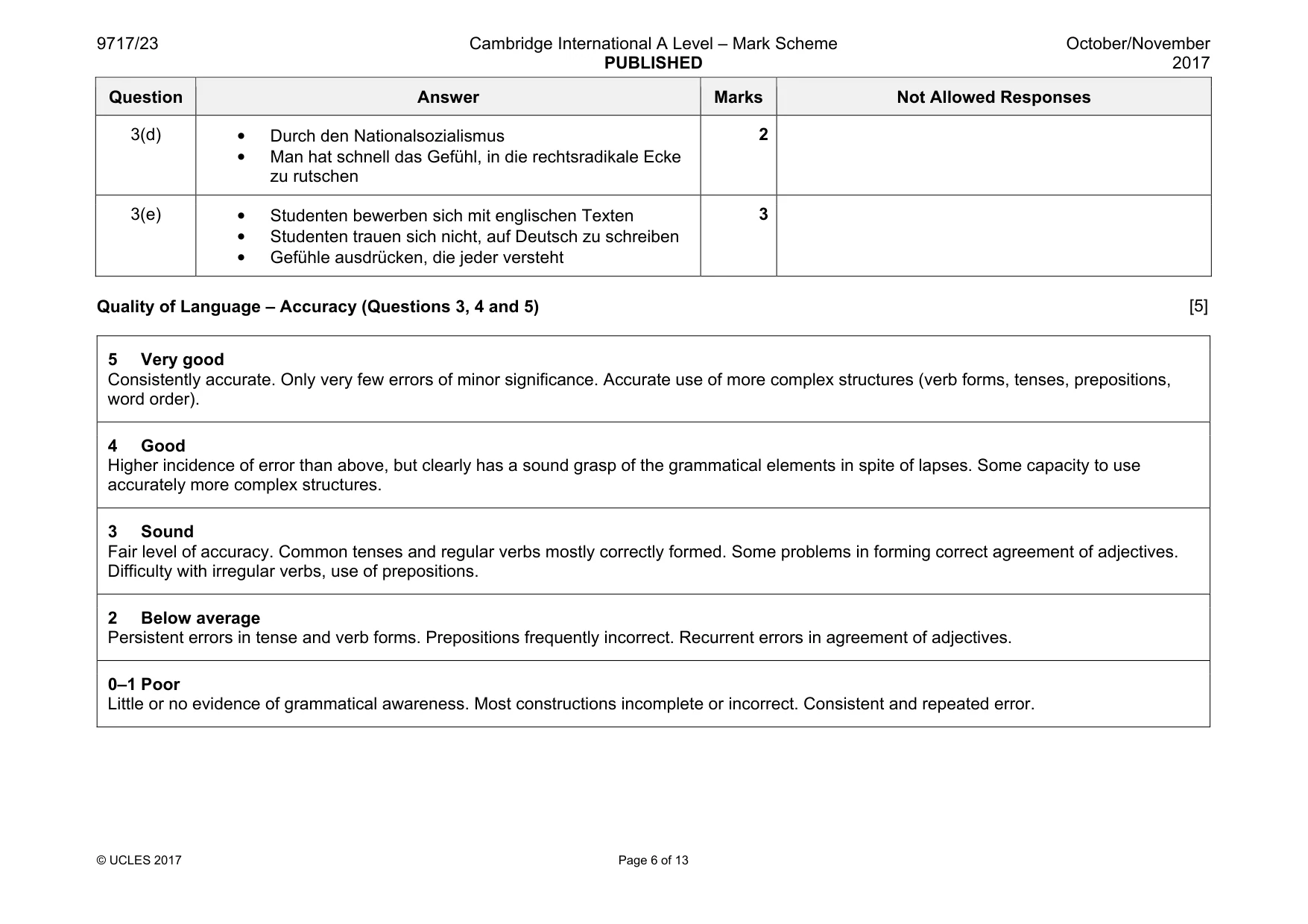
9717/23 Cambridge International A Level – Mark Scheme PUBLISHED October/November 2017 © UCLES 2017 Page 5 of 13 Question Answer Marks Not Allowed Responses Question 3 Indicate which correct point is being rewarded by writing the capital letter of the point given in the scheme below in the body of text. If (and only if) all the words in bold in the square brackets [ ] in the reject column appear in the answer unchanged, reject as a ‘lift’, regardless of whatever else may have been done with the other words. Indicate by square brackets on the script. Do not use square brackets for other reasons. In general, if the only way a candidate has avoided a lift is by inventing new words or substituting words which are substantially incorrect (but tolerate minor misspelling), penalise as a lift. But if the candidate has made an attempt to avoid the lift by (say) replacing a noun with a verb but has made a mistake with the verb ending, allow the comprehension mark (but bear in mind later for the Quality of Language mark.) It is not uncommon for candidates to ‘lift’ and then go on to rephrase acceptably, in which case indicate the lift [ ] but reward the rephrase. Words which appear in brackets in the mark scheme are non-essential elements; words which are underlined in the mark scheme are essential elements. 3(a) • Musikalische Gleichberechtigung hat stattgefunden/mehr deutsche Musik im Radio/keine Quote mehr • die Szene ist vielfältig • gute Qualität von Produktion und Technik 3 3(b) • es gibt ein Deutsches Musik-Exportbüro • Traum vom Zentrum für das neue deutsche Lied • es gibt ein RocknPopmuseum • es wurde ein Buch veröffentlicht • an der Uni gab es ein Seminar zum Thema (any 4 of 5) 4 3(c) • Texte sind präziser und direkter • Bessere emotionale Verbindung zu den Inhalten • Bedürfnis nach Verständnis 3
Mark scheme, page 6
9717/23 Cambridge International A Level – Mark Scheme PUBLISHED October/November 2017 © UCLES 2017 Page 6 of 13 Question Answer Marks Not Allowed Responses 3(d) • Durch den Nationalsozialismus • Man hat schnell das Gefühl, in die rechtsradikale Ecke zu rutschen 2 3(e) • Studenten bewerben sich mit englischen Texten • Studenten trauen sich nicht, auf Deutsch zu schreiben • Gefühle ausdrücken, die jeder versteht 3 Quality of Language – Accuracy (Questions 3, 4 and 5) [5] 5 Very good Consistently accurate. Only very few errors of minor significance. Accurate use of more complex structures (verb forms, tenses, prepositions, word order). 4 Good Higher incidence of error than above, but clearly has a sound grasp of the grammatical elements in spite of lapses. Some capacity to use accurately more complex structures. 3 Sound Fair level of accuracy. Common tenses and regular verbs mostly correctly formed. Some problems in forming correct agreement of adjectives. Difficulty with irregular verbs, use of prepositions. 2 Below average Persistent errors in tense and verb forms. Prepositions frequently incorrect. Recurrent errors in agreement of adjectives. 0–1 Poor Little or no evidence of grammatical awareness. Most constructions incomplete or incorrect. Consistent and repeated error.
Mark scheme, page 7
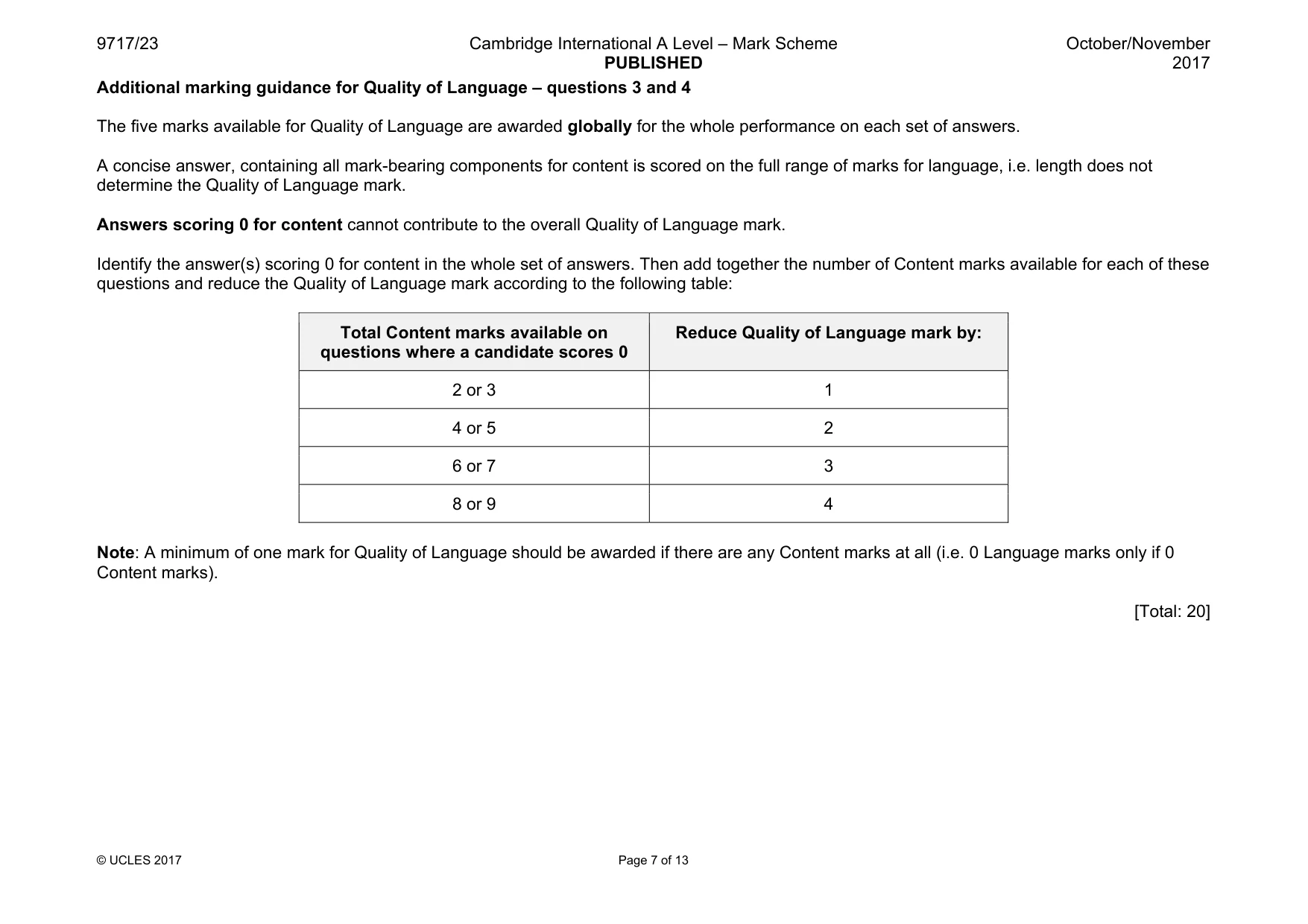
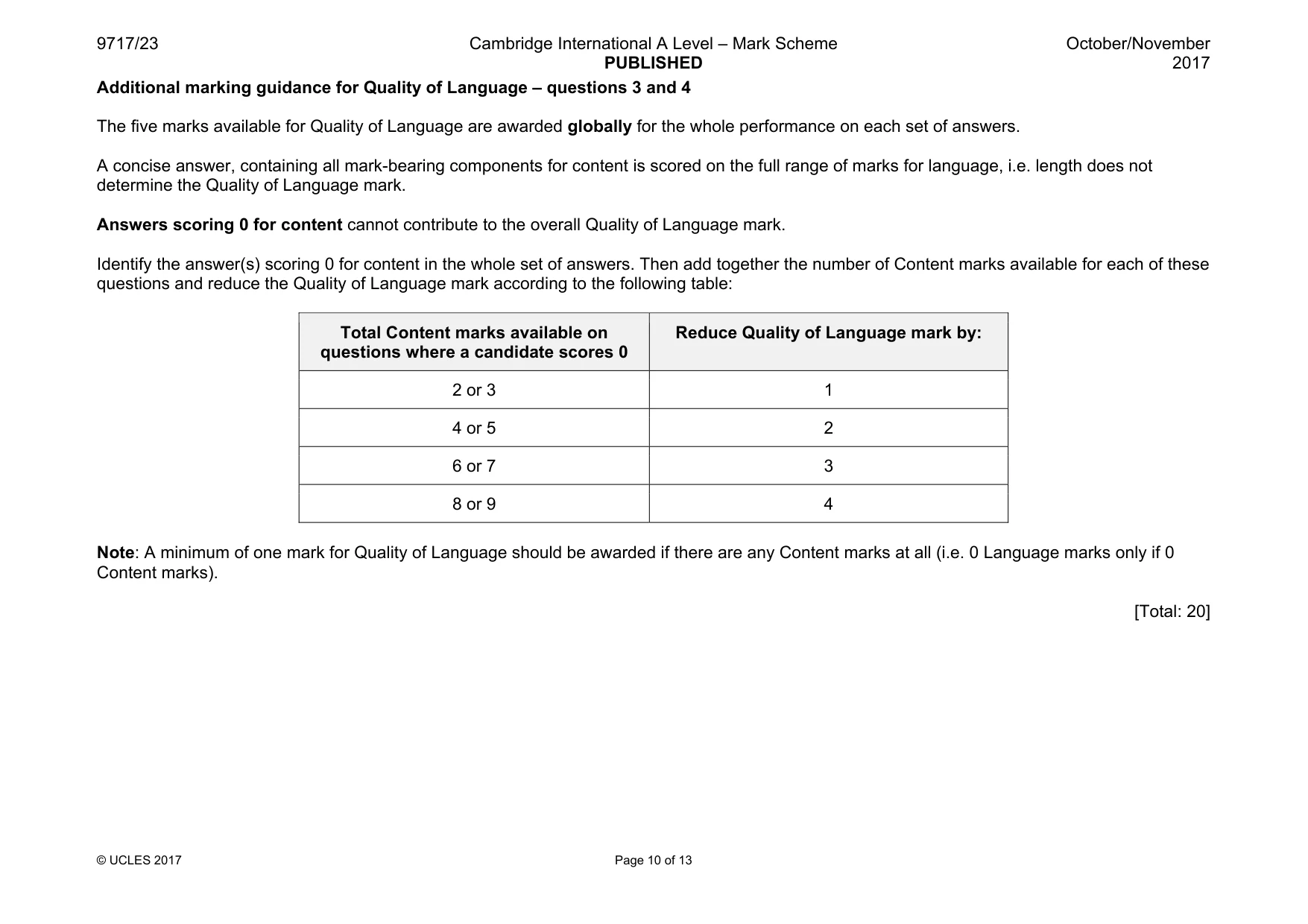
9717/23 Cambridge International A Level – Mark Scheme PUBLISHED October/November 2017 © UCLES 2017 Page 7 of 13 Additional marking guidance for Quality of Language – questions 3 and 4 The five marks available for Quality of Language are awarded globally for the whole performance on each set of answers. A concise answer, containing all mark-bearing components for content is scored on the full range of marks for language, i.e. length does not determine the Quality of Language mark. Answers scoring 0 for content cannot contribute to the overall Quality of Language mark. Identify the answer(s) scoring 0 for content in the whole set of answers. Then add together the number of Content marks available for each of these questions and reduce the Quality of Language mark according to the following table: Total Content marks available on questions where a candidate scores 0 Reduce Quality of Language mark by: 2 or 3 1 4 or 5 2 6 or 7 3 8 or 9 4 Note: A minimum of one mark for Quality of Language should be awarded if there are any Content marks at all (i.e. 0 Language marks only if 0 Content marks). [Total: 20]
Mark scheme, page 8
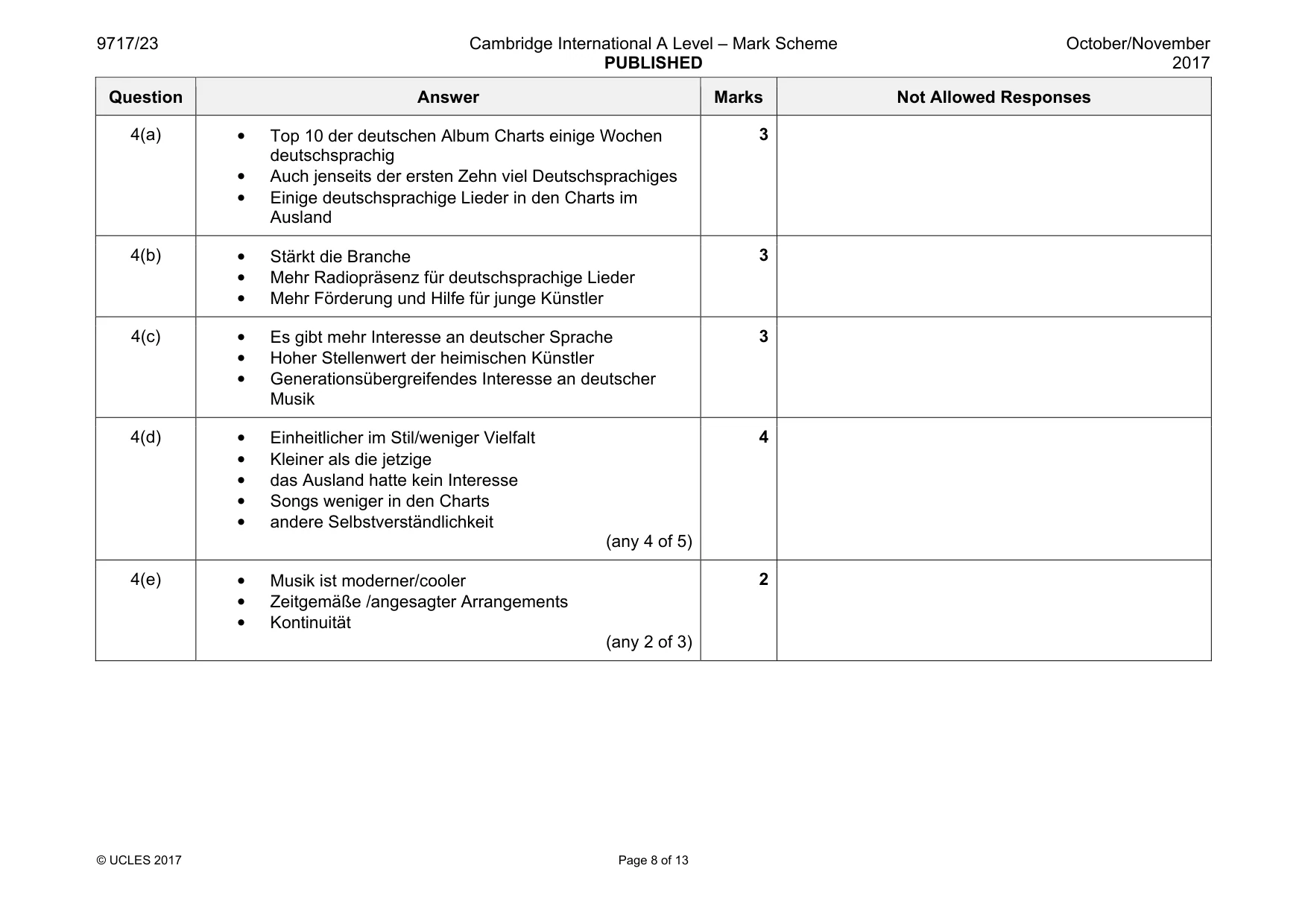
9717/23 Cambridge International A Level – Mark Scheme PUBLISHED October/November 2017 © UCLES 2017 Page 8 of 13 Question Answer Marks Not Allowed Responses 4(a) • Top 10 der deutschen Album Charts einige Wochen deutschsprachig • Auch jenseits der ersten Zehn viel Deutschsprachiges • Einige deutschsprachige Lieder in den Charts im Ausland 3 4(b) • Stärkt die Branche • Mehr Radioprӓsenz für deutschsprachige Lieder • Mehr Förderung und Hilfe für junge Künstler 3 4(c) • Es gibt mehr Interesse an deutscher Sprache • Hoher Stellenwert der heimischen Künstler • Generationsübergreifendes Interesse an deutscher Musik 3 4(d) • Einheitlicher im Stil/weniger Vielfalt • Kleiner als die jetzige • das Ausland hatte kein Interesse • Songs weniger in den Charts • andere Selbstverständlichkeit (any 4 of 5) 4 4(e) • Musik ist moderner/cooler • Zeitgemäße /angesagter Arrangements • Kontinuität (any 2 of 3) 2
Mark scheme, page 9
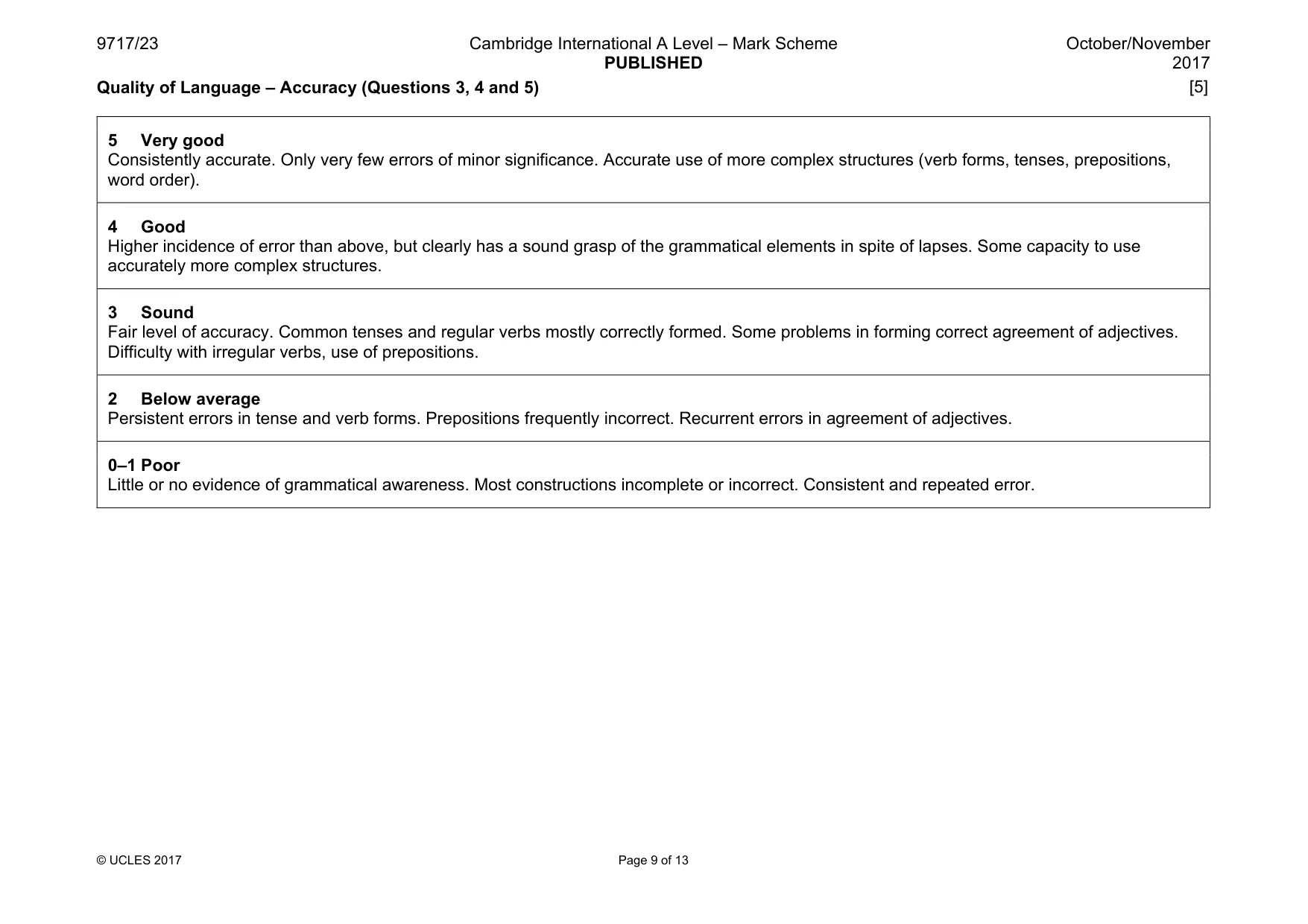
9717/23 Cambridge International A Level – Mark Scheme PUBLISHED October/November 2017 © UCLES 2017 Page 9 of 13 Quality of Language – Accuracy (Questions 3, 4 and 5) [5] 5 Very good Consistently accurate. Only very few errors of minor significance. Accurate use of more complex structures (verb forms, tenses, prepositions, word order). 4 Good Higher incidence of error than above, but clearly has a sound grasp of the grammatical elements in spite of lapses. Some capacity to use accurately more complex structures. 3 Sound Fair level of accuracy. Common tenses and regular verbs mostly correctly formed. Some problems in forming correct agreement of adjectives. Difficulty with irregular verbs, use of prepositions. 2 Below average Persistent errors in tense and verb forms. Prepositions frequently incorrect. Recurrent errors in agreement of adjectives. 0–1 Poor Little or no evidence of grammatical awareness. Most constructions incomplete or incorrect. Consistent and repeated error.
Mark scheme, page 10
9717/23 Cambridge International A Level – Mark Scheme PUBLISHED October/November 2017 © UCLES 2017 Page 10 of 13 Additional marking guidance for Quality of Language – questions 3 and 4 The five marks available for Quality of Language are awarded globally for the whole performance on each set of answers. A concise answer, containing all mark-bearing components for content is scored on the full range of marks for language, i.e. length does not determine the Quality of Language mark. Answers scoring 0 for content cannot contribute to the overall Quality of Language mark. Identify the answer(s) scoring 0 for content in the whole set of answers. Then add together the number of Content marks available for each of these questions and reduce the Quality of Language mark according to the following table: Total Content marks available on questions where a candidate scores 0 Reduce Quality of Language mark by: 2 or 3 1 4 or 5 2 6 or 7 3 8 or 9 4 Note: A minimum of one mark for Quality of Language should be awarded if there are any Content marks at all (i.e. 0 Language marks only if 0 Content marks). [Total: 20]
Mark scheme, page 11
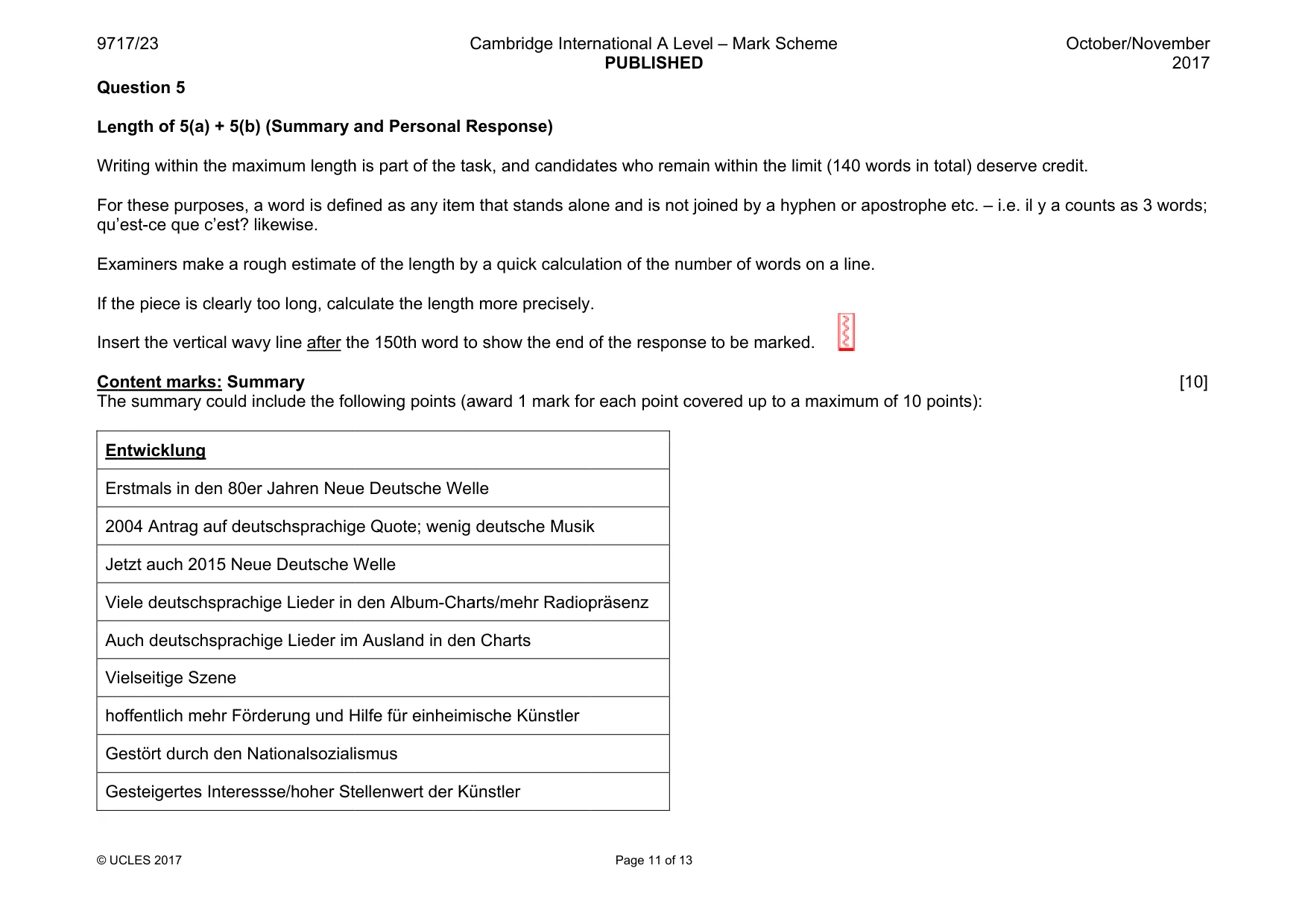
971 © U Qu Len Wr For qu’ Exa If th Ins Co The En Er 20 Je Vi Au Vi ho G G 17/23 CLES 2017 uestion 5 ngth of 5(a) + 5 riting within the m r these purposes ’est-ce que c’est aminers make a he piece is clear sert the vertical w ontent marks: S e summary coul ntwicklung rstmals in den 8 004 Antrag auf d etzt auch 2015 N iele deutschspra uch deutschspra ielseitige Szene offentlich mehr F estӧrt durch den esteigertes Inte 5(b) (Summary a maximum length s, a word is defi t? likewise. a rough estimate rly too long, calc wavy line after th Summary d include the fol 80er Jahren Neu deutschsprachig Neue Deutsche W achige Lieder in achige Lieder im Förderung und H n Nationalsoziali ressse/hoher St C and Personal R h is part of the ta ned as any item e of the length by culate the length he 150th word to llowing points (a e Deutsche We ge Quote; wenig Welle den Album-Cha m Ausland in den Hilfe für einheim ismus tellenwert der Kü Cambridge Inter Response) ask, and candida m that stands alo y a quick calcula h more precisely o show the end o award 1 mark for lle deutsche Musik arts/mehr Radiop n Charts ische Künstler ünstler rnational A Leve PUBLISHED Page 11 of 13 ates who remain ne and is not joi ation of the numb . of the response r each point cov k prӓsenz l – Mark Schem within the limit ned by a hyphe ber of words on to be marked. ered up to a ma me (140 words in to n or apostrophe a line. aximum of 10 po otal) deserve cre e etc. – i.e. il y a ints): October/Novem 2 edit. counts as 3 wor [ mber 017 rds; [10]
Mark scheme, page 12
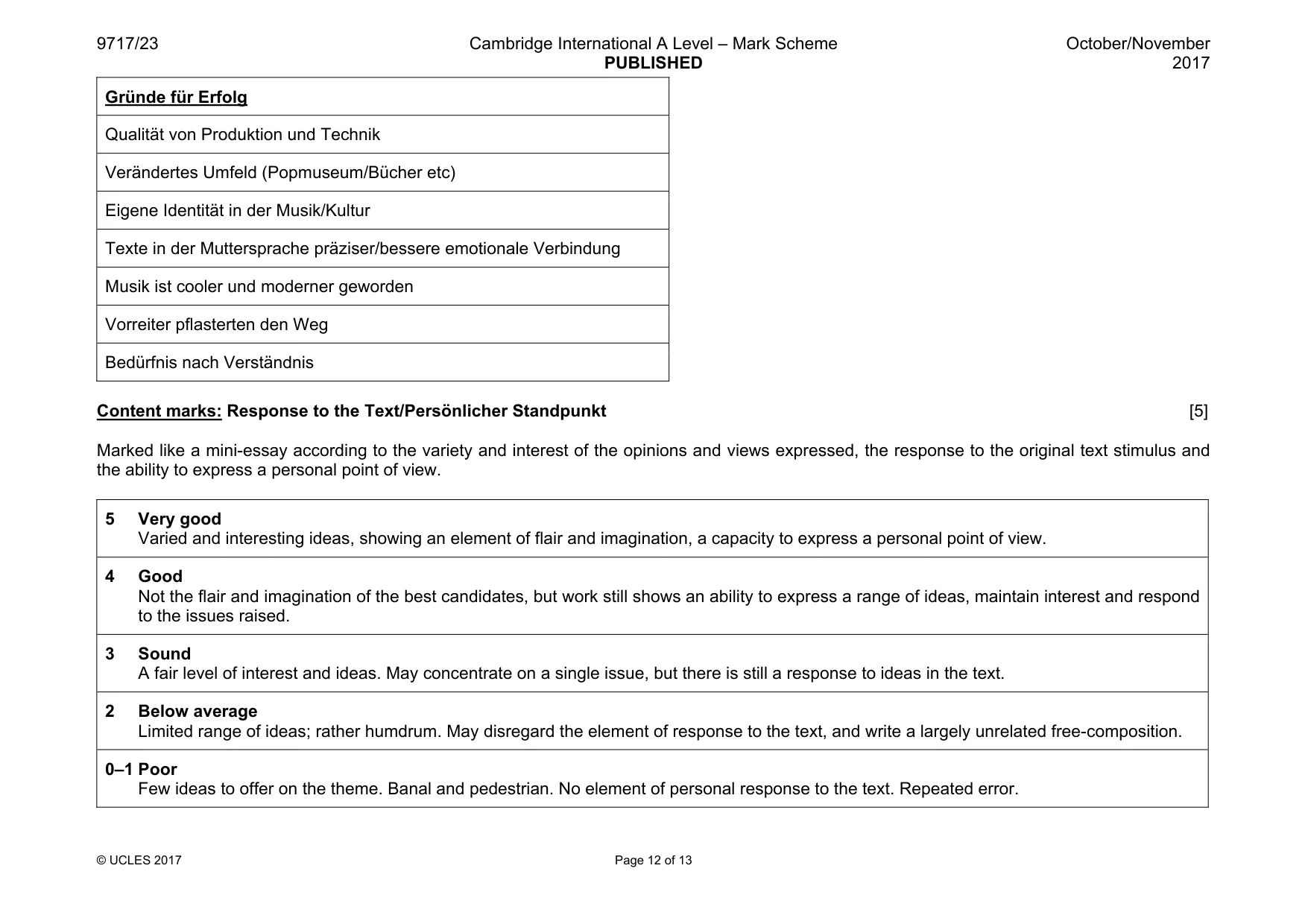
9717/23 Cambridge International A Level – Mark Scheme PUBLISHED October/November 2017 © UCLES 2017 Page 12 of 13 Gründe für Erfolg Qualitӓt von Produktion und Technik Verӓndertes Umfeld (Popmuseum/Bücher etc) Eigene Identitӓt in der Musik/Kultur Texte in der Muttersprache präziser/bessere emotionale Verbindung Musik ist cooler und moderner geworden Vorreiter pflasterten den Weg Bedürfnis nach Verstӓndnis Content marks: Response to the Text/Persönlicher Standpunkt [5] Marked like a mini-essay according to the variety and interest of the opinions and views expressed, the response to the original text stimulus and the ability to express a personal point of view. 5 Very good Varied and interesting ideas, showing an element of flair and imagination, a capacity to express a personal point of view. 4 Good Not the flair and imagination of the best candidates, but work still shows an ability to express a range of ideas, maintain interest and respond to the issues raised. 3 Sound A fair level of interest and ideas. May concentrate on a single issue, but there is still a response to ideas in the text. 2 Below average Limited range of ideas; rather humdrum. May disregard the element of response to the text, and write a largely unrelated free-composition. 0–1 Poor Few ideas to offer on the theme. Banal and pedestrian. No element of personal response to the text. Repeated error.
Mark scheme, page 13
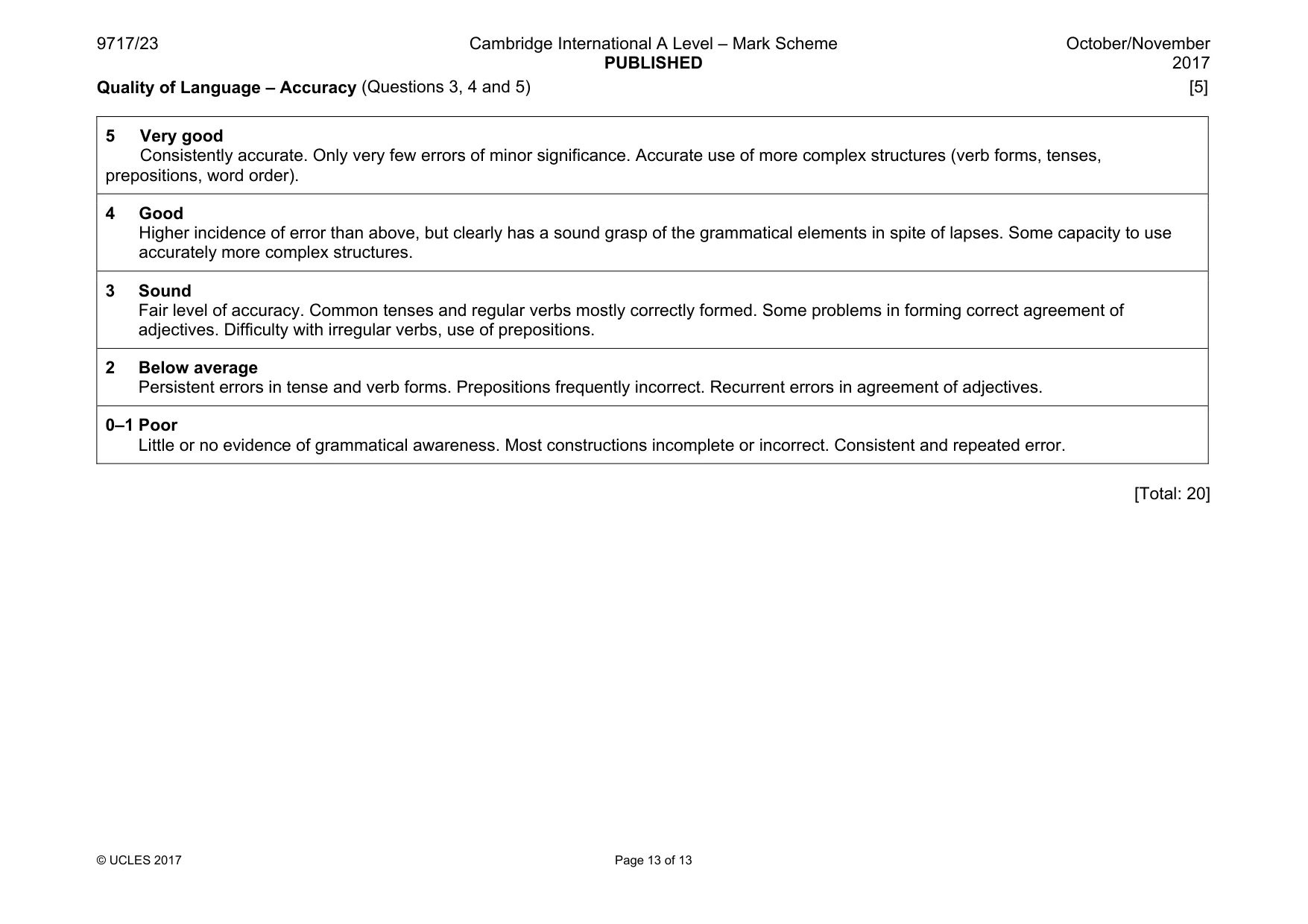
9717/23 Cambridge International A Level – Mark Scheme PUBLISHED October/November 2017 © UCLES 2017 Page 13 of 13 Quality of Language – Accuracy (Questions 3, 4 and 5) [5] 5 Very good Consistently accurate. Only very few errors of minor significance. Accurate use of more complex structures (verb forms, tenses, prepositions, word order). 4 Good Higher incidence of error than above, but clearly has a sound grasp of the grammatical elements in spite of lapses. Some capacity to use accurately more complex structures. 3 Sound Fair level of accuracy. Common tenses and regular verbs mostly correctly formed. Some problems in forming correct agreement of adjectives. Difficulty with irregular verbs, use of prepositions. 2 Below average Persistent errors in tense and verb forms. Prepositions frequently incorrect. Recurrent errors in agreement of adjectives. 0–1 Poor Little or no evidence of grammatical awareness. Most constructions incomplete or incorrect. Consistent and repeated error. [Total: 20]
What you needed in this session
Cambridge’s own grade thresholds for 2017 Oct/Nov, Paper 2 · Variant 3. A higher threshold means an easier paper — the bar moves with how the cohort did.