Cambridge A Level German (A Level only) 9717 — 2014 Oct/Nov Paper 4 · Variant 3
9717/43/O/N/14
The question paper and its mark scheme, free to read here and free to download. This is Cambridge’s own paper, exactly as it was sat.
Question paper8 pages



Mark scheme3 pages
Answers below. Sit the paper first if you are practising.
Paper as text
Question paper, page 1
This document consists of 5 printed pages and 3 blank pages. DC (HB (RJ)) 82307/3 © UCLES 2014 [Turn over Cambridge International Examinations Cambridge International Advanced Level * 5 6 9 0 1 1 4 1 3 6 * GERMAN 9717/43 Paper 4 Texts October/November 2014 2 hours 30 minutes Additional Materials: Answer Booklet/Paper Invigilators must refer to the Additional Materials List for instructions on the use of set texts in the examination. READ THESE INSTRUCTIONS FIRST If you have been given an Answer Booklet, follow the instructions on the front cover of the Booklet. Write your Centre number, candidate number and name on all the work you hand in. Write in dark blue or black pen. Do not use staples, paper clips, glue or correction fluid. Answer any three questions, each on a different text. You must choose one question from Section 1, one from Section 2 and one other. Write your answers in German. Dictionaries are not permitted. You should write between 500 and 600 words for each answer. At the end of the examination, fasten all your work securely together. All questions in this paper carry equal marks. LESEN SIE ZUERST DIESE ANWEISUNGEN Falls Ihnen ein Antwortbogen gegeben wurde, folgen Sie den Anweisungen auf dessen Titelseite. Schreiben Sie Ihre Centernummer, Kandidatennummer und Ihren Namen auf jedes Blatt, das Sie abgeben. Schreiben Sie mit dunkelblauem oder schwarzem Füller/Kugelschreiber. Benutzen Sie keine Heftklammern, Büroklammern, Korrekturflüssigkeit und keinen Klebstoff. Beantworten Sie insgesamt drei Fragen. Jede Frage bezieht sich auf einen anderen Text. Wählen Sie eine Frage aus dem ersten Teil, eine Frage aus dem zweiten Teil, und eine andere Frage. Schreiben Sie Ihre Antworten auf Deutsch. Es ist nicht erlaubt, Wörterbücher zu benutzen. Schreiben Sie 500 bis 600 Wörter zu jeder Frage. Falls Sie mehrere Blätter beschreiben, heften Sie die Blätter am Ende der Prüfung sicher zusammen. Alle Antworten werden gleich bewertet.
Question paper, page 2
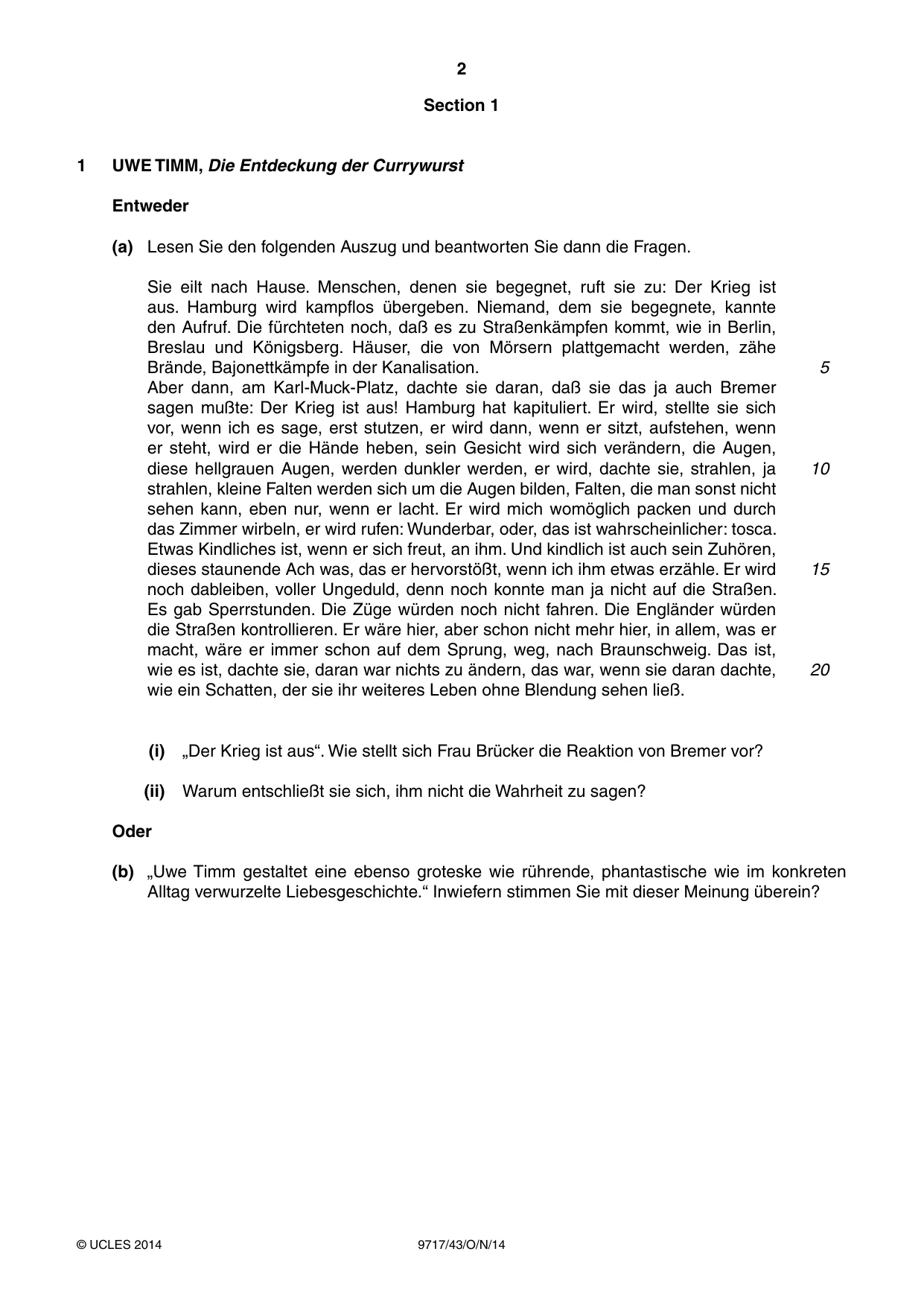
2 9717/43/O/N/14 © UCLES 2014 Section 1 1 UWE TIMM, Die Entdeckung der Currywurst Entweder (a) Lesen Sie den folgenden Auszug und beantworten Sie dann die Fragen. Sie eilt nach Hause. Menschen, denen sie begegnet, ruft sie zu: Der Krieg ist aus. Hamburg wird kampflos übergeben. Niemand, dem sie begegnete, kannte den Aufruf. Die fürchteten noch, daß es zu Straßenkämpfen kommt, wie in Berlin, Breslau und Königsberg. Häuser, die von Mörsern plattgemacht werden, zähe Brände, Bajonettkämpfe in der Kanalisation. Aber dann, am Karl-Muck-Platz, dachte sie daran, daß sie das ja auch Bremer sagen mußte: Der Krieg ist aus! Hamburg hat kapituliert. Er wird, stellte sie sich vor, wenn ich es sage, erst stutzen, er wird dann, wenn er sitzt, aufstehen, wenn er steht, wird er die Hände heben, sein Gesicht wird sich verändern, die Augen, diese hellgrauen Augen, werden dunkler werden, er wird, dachte sie, strahlen, ja strahlen, kleine Falten werden sich um die Augen bilden, Falten, die man sonst nicht sehen kann, eben nur, wenn er lacht. Er wird mich womöglich packen und durch das Zimmer wirbeln, er wird rufen: Wunderbar, oder, das ist wahrscheinlicher: tosca. Etwas Kindliches ist, wenn er sich freut, an ihm. Und kindlich ist auch sein Zuhören, dieses staunende Ach was, das er hervorstößt, wenn ich ihm etwas erzähle. Er wird noch dableiben, voller Ungeduld, denn noch konnte man ja nicht auf die Straßen. Es gab Sperrstunden. Die Züge würden noch nicht fahren. Die Engländer würden die Straßen kontrollieren. Er wäre hier, aber schon nicht mehr hier, in allem, was er macht, wäre er immer schon auf dem Sprung, weg, nach Braunschweig. Das ist, wie es ist, dachte sie, daran war nichts zu ändern, das war, wenn sie daran dachte, wie ein Schatten, der sie ihr weiteres Leben ohne Blendung sehen ließ. (i) „Der Krieg ist aus“. Wie stellt sich Frau Brücker die Reaktion von Bremer vor? (ii) Warum entschließt sie sich, ihm nicht die Wahrheit zu sagen? Oder (b) „Uwe Timm gestaltet eine ebenso groteske wie rührende, phantastische wie im konkreten Alltag verwurzelte Liebesgeschichte.“ Inwiefern stimmen Sie mit dieser Meinung überein? 5 10 15 20
Question paper, page 3
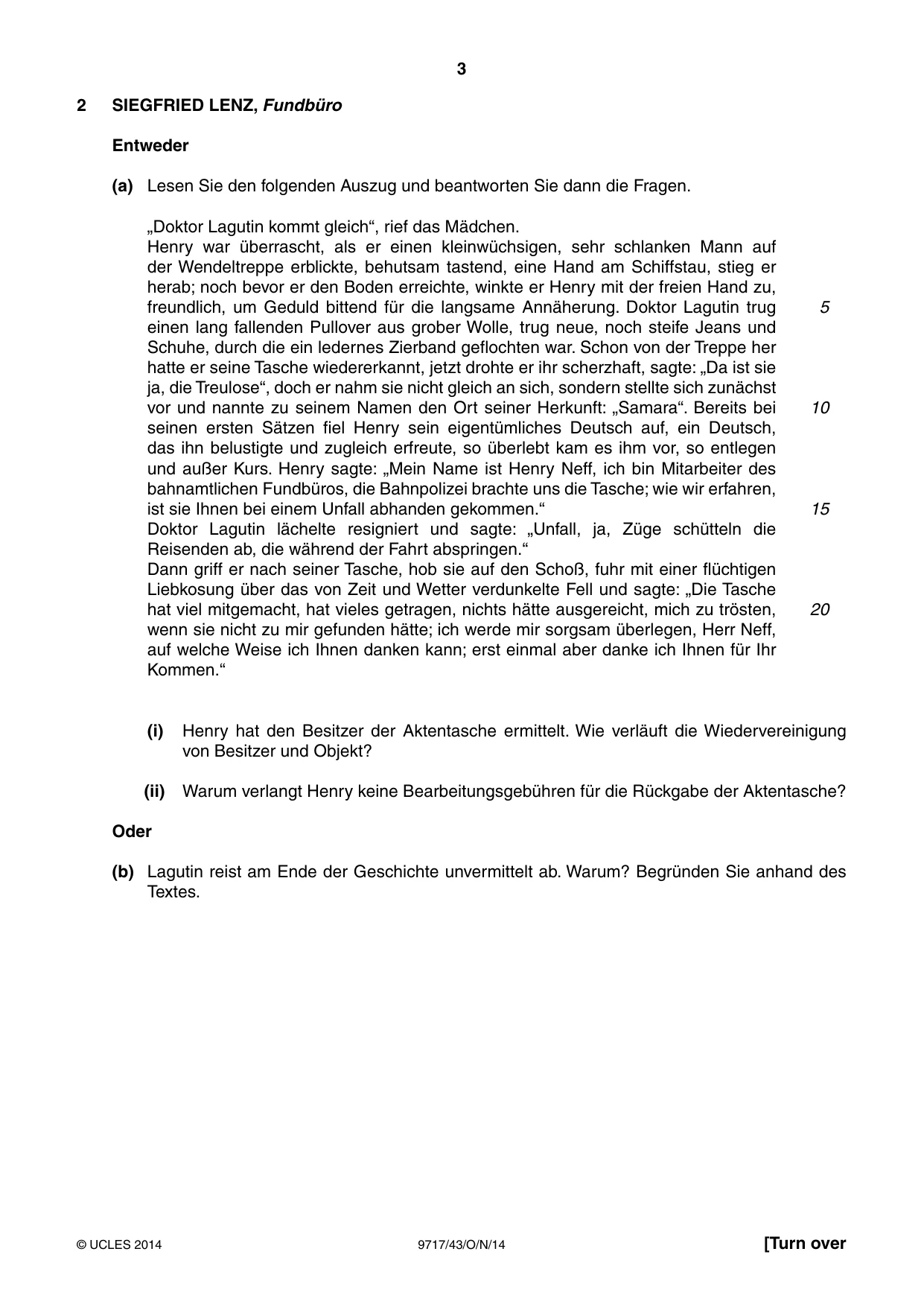
3 9717/43/O/N/14 © UCLES 2014 [Turn over 2 SIEGFRIED LENZ, Fundbüro Entweder (a) Lesen Sie den folgenden Auszug und beantworten Sie dann die Fragen. „Doktor Lagutin kommt gleich“, rief das Mädchen. Henry war überrascht, als er einen kleinwüchsigen, sehr schlanken Mann auf der Wendeltreppe erblickte, behutsam tastend, eine Hand am Schiffstau, stieg er herab; noch bevor er den Boden erreichte, winkte er Henry mit der freien Hand zu, freundlich, um Geduld bittend für die langsame Annäherung. Doktor Lagutin trug einen lang fallenden Pullover aus grober Wolle, trug neue, noch steife Jeans und Schuhe, durch die ein ledernes Zierband geflochten war. Schon von der Treppe her hatte er seine Tasche wiedererkannt, jetzt drohte er ihr scherzhaft, sagte: „Da ist sie ja, die Treulose“, doch er nahm sie nicht gleich an sich, sondern stellte sich zunächst vor und nannte zu seinem Namen den Ort seiner Herkunft: „Samara“. Bereits bei seinen ersten Sätzen fiel Henry sein eigentümliches Deutsch auf, ein Deutsch, das ihn belustigte und zugleich erfreute, so überlebt kam es ihm vor, so entlegen und außer Kurs. Henry sagte: „Mein Name ist Henry Neff, ich bin Mitarbeiter des bahnamtlichen Fundbüros, die Bahnpolizei brachte uns die Tasche; wie wir erfahren, ist sie Ihnen bei einem Unfall abhanden gekommen.“ Doktor Lagutin lächelte resigniert und sagte: „Unfall, ja, Züge schütteln die Reisenden ab, die während der Fahrt abspringen.“ Dann griff er nach seiner Tasche, hob sie auf den Schoß, fuhr mit einer flüchtigen Liebkosung über das von Zeit und Wetter verdunkelte Fell und sagte: „Die Tasche hat viel mitgemacht, hat vieles getragen, nichts hätte ausgereicht, mich zu trösten, wenn sie nicht zu mir gefunden hätte; ich werde mir sorgsam überlegen, Herr Neff, auf welche Weise ich Ihnen danken kann; erst einmal aber danke ich Ihnen für Ihr Kommen.“ (i) Henry hat den Besitzer der Aktentasche ermittelt. Wie verläuft die Wiedervereinigung von Besitzer und Objekt? (ii) Warum verlangt Henry keine Bearbeitungsgebühren für die Rückgabe der Aktentasche? Oder (b) Lagutin reist am Ende der Geschichte unvermittelt ab. Warum? Begründen Sie anhand des Textes. 5 10 15 20
Question paper, page 4
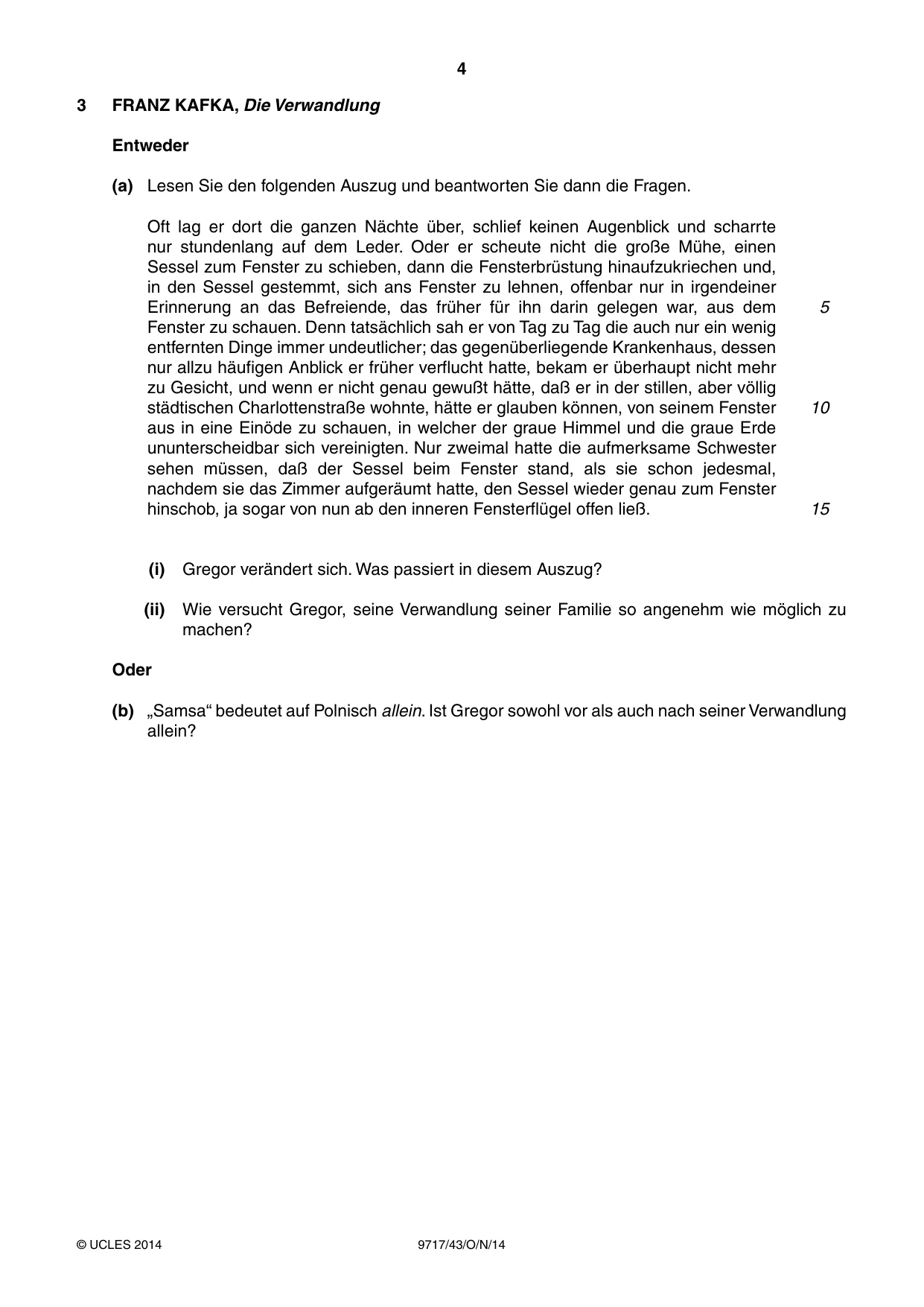
4 9717/43/O/N/14 © UCLES 2014 3 FRANZ KAFKA, Die Verwandlung Entweder (a) Lesen Sie den folgenden Auszug und beantworten Sie dann die Fragen. Oft lag er dort die ganzen Nächte über, schlief keinen Augenblick und scharrte nur stundenlang auf dem Leder. Oder er scheute nicht die große Mühe, einen Sessel zum Fenster zu schieben, dann die Fensterbrüstung hinaufzukriechen und, in den Sessel gestemmt, sich ans Fenster zu lehnen, offenbar nur in irgendeiner Erinnerung an das Befreiende, das früher für ihn darin gelegen war, aus dem Fenster zu schauen. Denn tatsächlich sah er von Tag zu Tag die auch nur ein wenig entfernten Dinge immer undeutlicher; das gegenüberliegende Krankenhaus, dessen nur allzu häufigen Anblick er früher verflucht hatte, bekam er überhaupt nicht mehr zu Gesicht, und wenn er nicht genau gewußt hätte, daß er in der stillen, aber völlig städtischen Charlottenstraße wohnte, hätte er glauben können, von seinem Fenster aus in eine Einöde zu schauen, in welcher der graue Himmel und die graue Erde ununterscheidbar sich vereinigten. Nur zweimal hatte die aufmerksame Schwester sehen müssen, daß der Sessel beim Fenster stand, als sie schon jedesmal, nachdem sie das Zimmer aufgeräumt hatte, den Sessel wieder genau zum Fenster hinschob, ja sogar von nun ab den inneren Fensterflügel offen ließ. (i) Gregor verändert sich. Was passiert in diesem Auszug? (ii) Wie versucht Gregor, seine Verwandlung seiner Familie so angenehm wie möglich zu machen? Oder (b) „Samsa“ bedeutet auf Polnisch allein. Ist Gregor sowohl vor als auch nach seiner Verwandlung allein? 5 10 15
Question paper, page 5
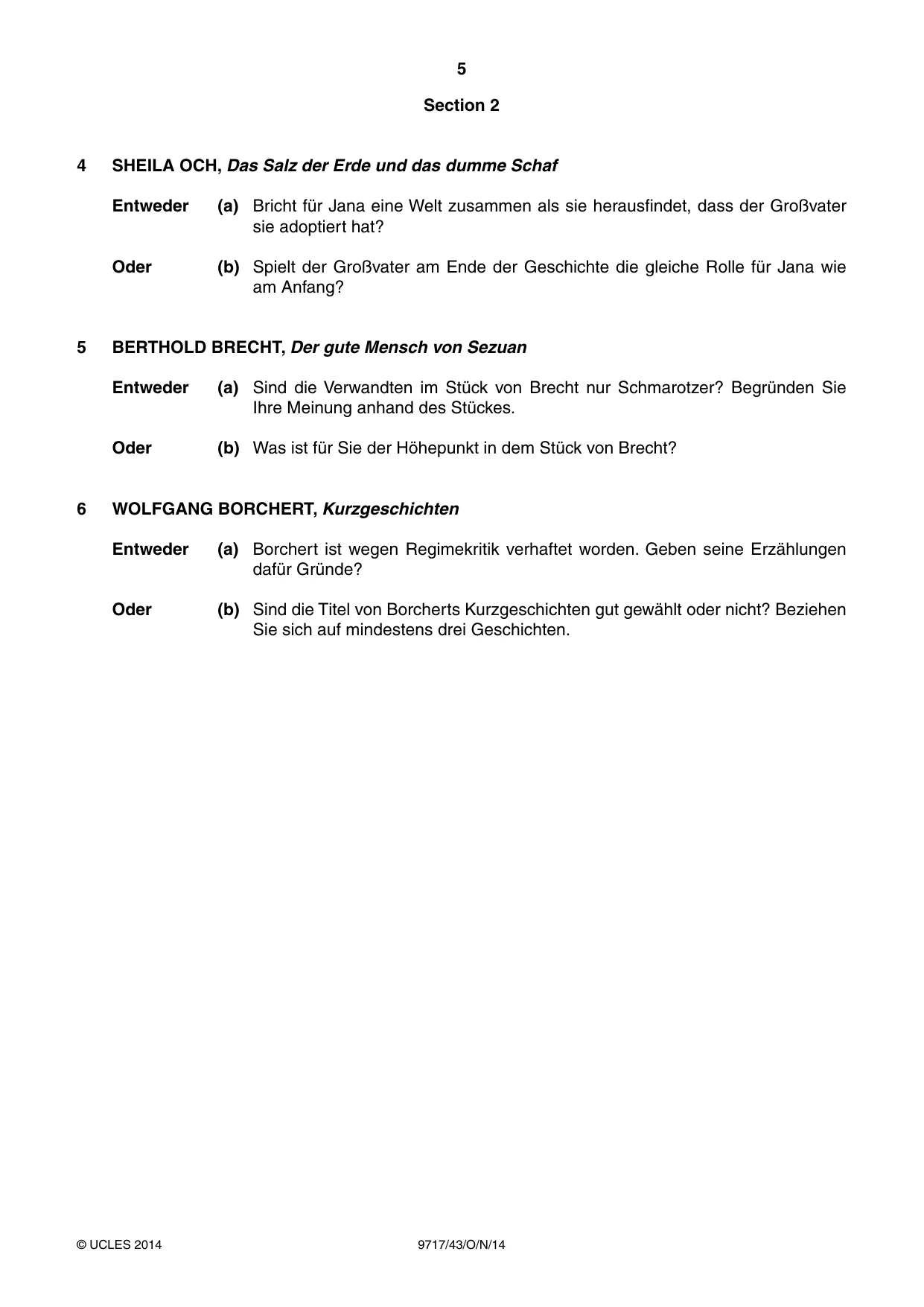
5 9717/43/O/N/14 © UCLES 2014 Section 2 4 SHEILA OCH, Das Salz der Erde und das dumme Schaf Entweder (a) Bricht für Jana eine Welt zusammen als sie herausfindet, dass der Großvater sie adoptiert hat? Oder (b) Spielt der Großvater am Ende der Geschichte die gleiche Rolle für Jana wie am Anfang? 5 BERTHOLD BRECHT, Der gute Mensch von Sezuan Entweder (a) Sind die Verwandten im Stück von Brecht nur Schmarotzer? Begründen Sie Ihre Meinung anhand des Stückes. Oder (b) Was ist für Sie der Höhepunkt in dem Stück von Brecht? 6 WOLFGANG BORCHERT, Kurzgeschichten Entweder (a) Borchert ist wegen Regimekritik verhaftet worden. Geben seine Erzählungen dafür Gründe? Oder (b) Sind die Titel von Borcherts Kurzgeschichten gut gewählt oder nicht? Beziehen Sie sich auf mindestens drei Geschichten.
Question paper, page 6
6 9717/43/O/N/14 © UCLES 2014 BLANK PAGE
Question paper, page 7
7 9717/43/O/N/14 © UCLES 2014 BLANK PAGE
Question paper, page 8
8 9717/43/O/N/14 © UCLES 2014 Copyright Acknowledgements: Question 1 © Uwe Timm; Die Entdeckung der Currywurst; dtv; 2007. Question 2 © Siegfried Lenz; Fundbüro; dtv; 2007. Permission to reproduce items where third-party owned material protected by copyright is included has been sought and cleared where possible. Every reasonable effort has been made by the publisher (UCLES) to trace copyright holders, but if any items requiring clearance have unwittingly been included, the publisher will be pleased to make amends at the earliest possible opportunity. Cambridge International Examinations is part of the Cambridge Assessment Group. Cambridge Assessment is the brand name of University of Cambridge Local Examinations Syndicate (UCLES), which is itself a department of the University of Cambridge. BLANK PAGE
Mark scheme, page 1
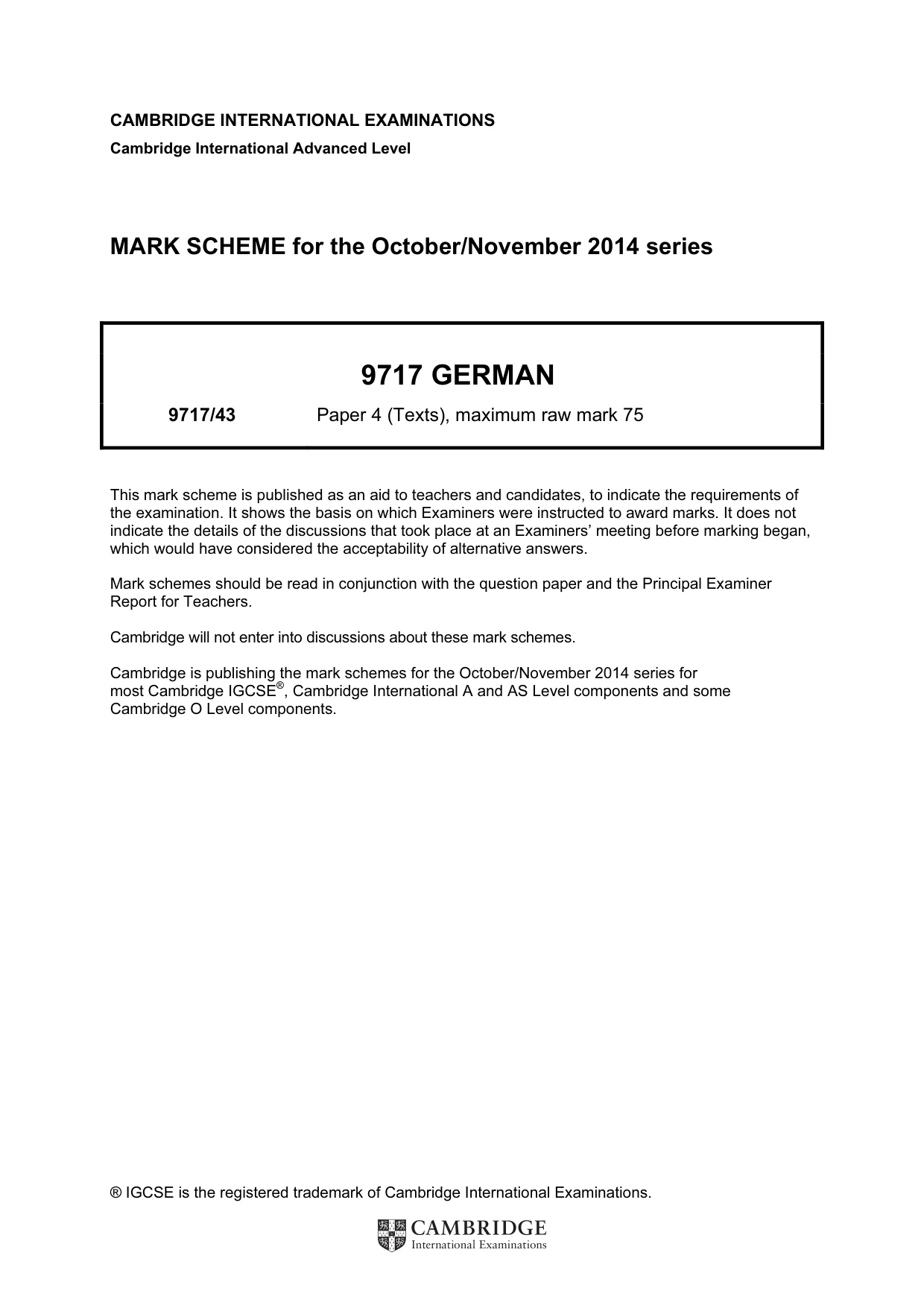
® IGCSE is the registered trademark of Cambridge International Examinations. CAMBRIDGE INTERNATIONAL EXAMINATIONS Cambridge International Advanced Level MARK SCHEME for the October/November 2014 series 9717 GERMAN 9717/43 Paper 4 (Texts), maximum raw mark 75 This mark scheme is published as an aid to teachers and candidates, to indicate the requirements of the examination. It shows the basis on which Examiners were instructed to award marks. It does not indicate the details of the discussions that took place at an Examiners’ meeting before marking began, which would have considered the acceptability of alternative answers. Mark schemes should be read in conjunction with the question paper and the Principal Examiner Report for Teachers. Cambridge will not enter into discussions about these mark schemes. Cambridge is publishing the mark schemes for the October/November 2014 series for most Cambridge IGCSE®, Cambridge International A and AS Level components and some Cambridge O Level components.
Mark scheme, page 2
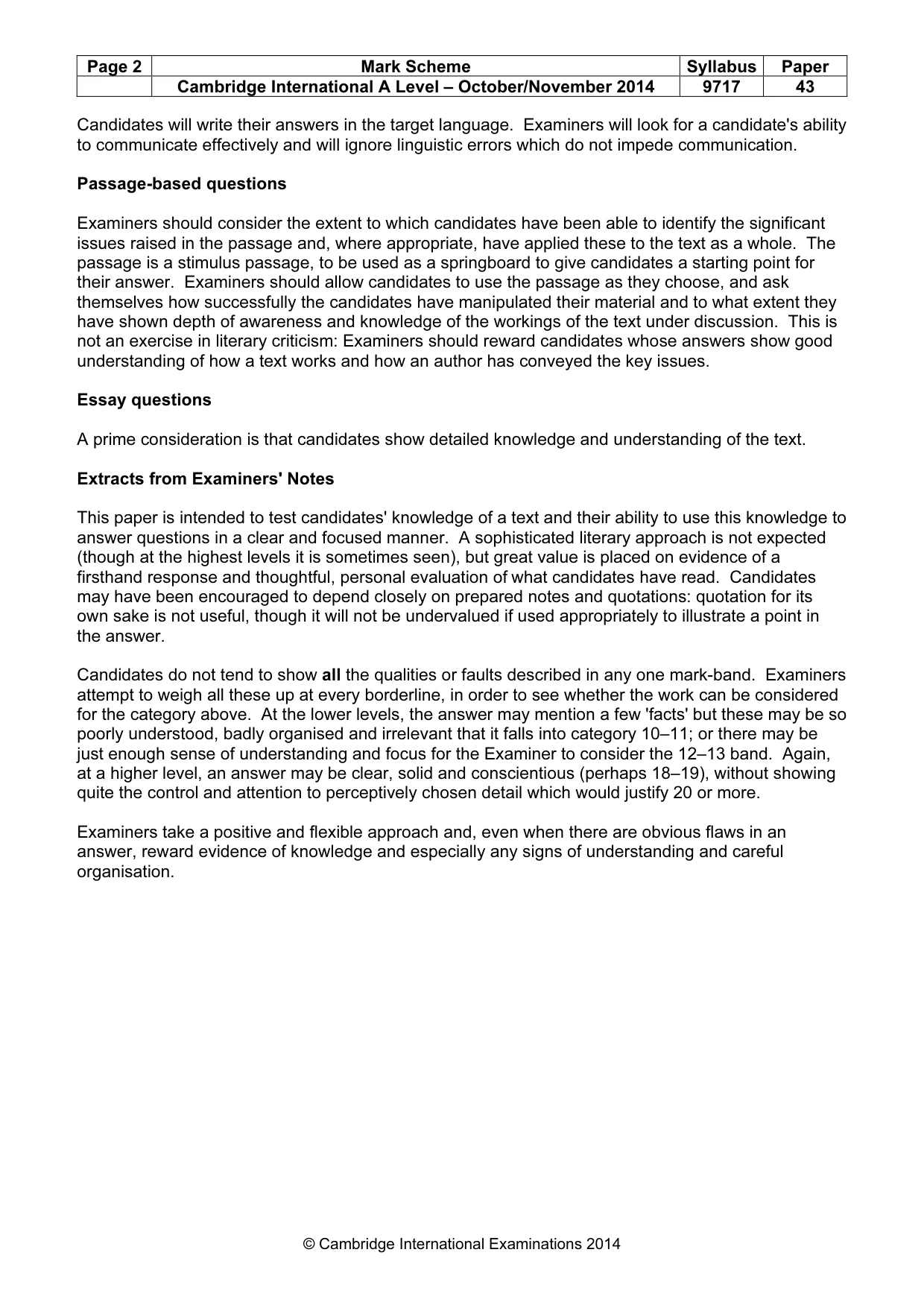
Page 2 Mark Scheme Syllabus Paper Cambridge International A Level – October/November 2014 9717 43 © Cambridge International Examinations 2014 Candidates will write their answers in the target language. Examiners will look for a candidate's ability to communicate effectively and will ignore linguistic errors which do not impede communication. Passage-based questions Examiners should consider the extent to which candidates have been able to identify the significant issues raised in the passage and, where appropriate, have applied these to the text as a whole. The passage is a stimulus passage, to be used as a springboard to give candidates a starting point for their answer. Examiners should allow candidates to use the passage as they choose, and ask themselves how successfully the candidates have manipulated their material and to what extent they have shown depth of awareness and knowledge of the workings of the text under discussion. This is not an exercise in literary criticism: Examiners should reward candidates whose answers show good understanding of how a text works and how an author has conveyed the key issues. Essay questions A prime consideration is that candidates show detailed knowledge and understanding of the text. Extracts from Examiners' Notes This paper is intended to test candidates' knowledge of a text and their ability to use this knowledge to answer questions in a clear and focused manner. A sophisticated literary approach is not expected (though at the highest levels it is sometimes seen), but great value is placed on evidence of a firsthand response and thoughtful, personal evaluation of what candidates have read. Candidates may have been encouraged to depend closely on prepared notes and quotations: quotation for its own sake is not useful, though it will not be undervalued if used appropriately to illustrate a point in the answer. Candidates do not tend to show all the qualities or faults described in any one mark-band. Examiners attempt to weigh all these up at every borderline, in order to see whether the work can be considered for the category above. At the lower levels, the answer may mention a few 'facts' but these may be so poorly understood, badly organised and irrelevant that it falls into category 10–11; or there may be just enough sense of understanding and focus for the Examiner to consider the 12–13 band. Again, at a higher level, an answer may be clear, solid and conscientious (perhaps 18–19), without showing quite the control and attention to perceptively chosen detail which would justify 20 or more. Examiners take a positive and flexible approach and, even when there are obvious flaws in an answer, reward evidence of knowledge and especially any signs of understanding and careful organisation.
Mark scheme, page 3
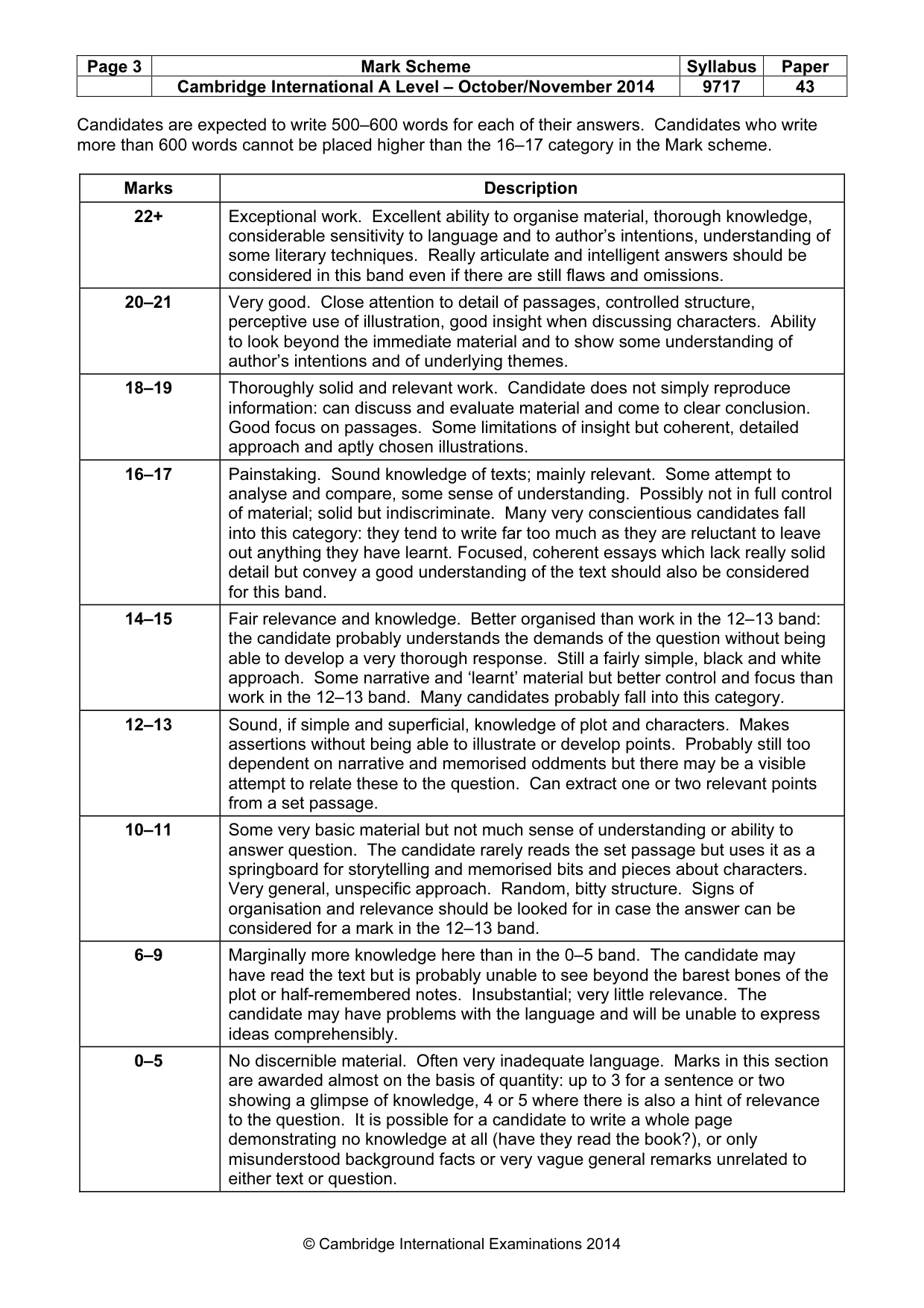
Page 3 Mark Scheme Syllabus Paper Cambridge International A Level – October/November 2014 9717 43 © Cambridge International Examinations 2014 Candidates are expected to write 500–600 words for each of their answers. Candidates who write more than 600 words cannot be placed higher than the 16–17 category in the Mark scheme. Marks Description 22+ Exceptional work. Excellent ability to organise material, thorough knowledge, considerable sensitivity to language and to author’s intentions, understanding of some literary techniques. Really articulate and intelligent answers should be considered in this band even if there are still flaws and omissions. 20–21 Very good. Close attention to detail of passages, controlled structure, perceptive use of illustration, good insight when discussing characters. Ability to look beyond the immediate material and to show some understanding of author’s intentions and of underlying themes. 18–19 Thoroughly solid and relevant work. Candidate does not simply reproduce information: can discuss and evaluate material and come to clear conclusion. Good focus on passages. Some limitations of insight but coherent, detailed approach and aptly chosen illustrations. 16–17 Painstaking. Sound knowledge of texts; mainly relevant. Some attempt to analyse and compare, some sense of understanding. Possibly not in full control of material; solid but indiscriminate. Many very conscientious candidates fall into this category: they tend to write far too much as they are reluctant to leave out anything they have learnt. Focused, coherent essays which lack really solid detail but convey a good understanding of the text should also be considered for this band. 14–15 Fair relevance and knowledge. Better organised than work in the 12–13 band: the candidate probably understands the demands of the question without being able to develop a very thorough response. Still a fairly simple, black and white approach. Some narrative and ‘learnt’ material but better control and focus than work in the 12–13 band. Many candidates probably fall into this category. 12–13 Sound, if simple and superficial, knowledge of plot and characters. Makes assertions without being able to illustrate or develop points. Probably still too dependent on narrative and memorised oddments but there may be a visible attempt to relate these to the question. Can extract one or two relevant points from a set passage. 10–11 Some very basic material but not much sense of understanding or ability to answer question. The candidate rarely reads the set passage but uses it as a springboard for storytelling and memorised bits and pieces about characters. Very general, unspecific approach. Random, bitty structure. Signs of organisation and relevance should be looked for in case the answer can be considered for a mark in the 12–13 band. 6–9 Marginally more knowledge here than in the 0–5 band. The candidate may have read the text but is probably unable to see beyond the barest bones of the plot or half-remembered notes. Insubstantial; very little relevance. The candidate may have problems with the language and will be unable to express ideas comprehensibly. 0–5 No discernible material. Often very inadequate language. Marks in this section are awarded almost on the basis of quantity: up to 3 for a sentence or two showing a glimpse of knowledge, 4 or 5 where there is also a hint of relevance to the question. It is possible for a candidate to write a whole page demonstrating no knowledge at all (have they read the book?), or only misunderstood background facts or very vague general remarks unrelated to either text or question.