Cambridge A Level General Paper (AS Level only) 8001 — 2012 Oct/Nov Paper 2 · Variant 1
8001/21/O/N/12 · 50 marks · ≈56 min
The question paper and its mark scheme, free to read here and free to download. This is Cambridge’s own paper, exactly as it was sat.
Question paper12 pages

Mark scheme7 pages
Answers below. Sit the paper first if you are practising.
Paper as text
Question paper, page 1
This document consists of 10 printed pages and 2 blank pages and 1 Insert. DC (RCL (KM)) 48538/4 © UCLES 2012 [Turn over UNIVERSITY OF CAMBRIDGE INTERNATIONAL EXAMINATIONS General Certificate of Education Advanced Subsidiary Level * 1 5 2 6 7 8 7 3 4 0 * CANDIDATE NAME CENTRE NUMBER CANDIDATE NUMBER GENERAL PAPER 8001/21 Paper 2 October/November 2012 1 hour 30 minutes Candidates answer on the Question Paper. Additional Materials: Insert READ THESE INSTRUCTIONS FIRST Write your Centre number, candidate number and name in the boxes above. Write in dark blue or black pen. Do not use staples, paper clips, highlighters, glue or correction fluid. DO NOT WRITE IN ANY BARCODES. Answer one question. The total time of 1 hour 30 minutes includes time for you to study the questions before you begin your answer. You may make notes during this time if you wish. Up to 15 marks will be given for the quality and accuracy of your English throughout this paper. Dictionaries are not permitted. The number of marks is given in brackets [ ] at the end of each question or part question. For Examiner’s Use 1 2 3 Total
Question paper, page 2
2 8001/21/O/N/12 © UCLES 2012 For Examiner’s Use 1 Study Passage 1 in the Insert to answer the following questions (a)–(d). (a) In the light of the initial responses of the teenagers (TABLE 1) and your own experience, explain four objections to the reactions of Speaker A. Answer in about 120 words. Begin each objection on a new line. … … … … … … … … … … … … … … … … … … … … [12]
Question paper, page 3
3 8001/21/O/N/12 © UCLES 2012 [Turn over For Examiner’s Use (b) In the light of the initial responses of the teenagers (TABLE 1) and your own experience, explain four objections to the reactions of Speaker B. Answer in about 120 words. Begin each objection on a new line. … … … … … … … … … … … … … … … … … … … … [12]
Question paper, page 4
4 8001/21/O/N/12 © UCLES 2012 For Examiner’s Use (c) Suggest three reasons why some of the figures in TABLE 2 are different from those in TABLE 1. Answer in about 60 words. … … … … … … … … … [6] (d) In about 50 words, make a case for any one ‘concern’ that may have featured as ‘Another concern’ in TABLES 1 and 2. … … … … … … … … [5] Note: Up to an additional 15 marks will be available for use of English.
Question paper, page 5
5 8001/21/O/N/12 © UCLES 2012 [Turn over For Examiner’s Use 2 Study Passage 2 in the Insert to answer the following questions (a)–(d). (a) In about 120 words, suggest why Ganna should rent this particular room. … … … … … … … … … … … … … … … … … … … … [12]
Question paper, page 6
6 8001/21/O/N/12 © UCLES 2012 For Examiner’s Use (b) In about 120 words, suggest why Ganna should not rent this particular room. … … … … … … … … … … … … … … … … … … … … [12]
Question paper, page 7
7 8001/21/O/N/12 © UCLES 2012 [Turn over For Examiner’s Use (c) Choose four places in the dialogue and in each case explain exactly how the cunning House Agent copes with an awkward remark or comment from Ganna. Each explanation should start on a new line. … … … … … … … … … … … … … … … … [8] (d) Select one fact referred to in the exchange between Ganna and the House Agent and briefly show why it has no significance in the decision to be reached by Ganna. … … … … … … [3] Note: Up to an additional 15 marks will be available for use of English.
Question paper, page 8
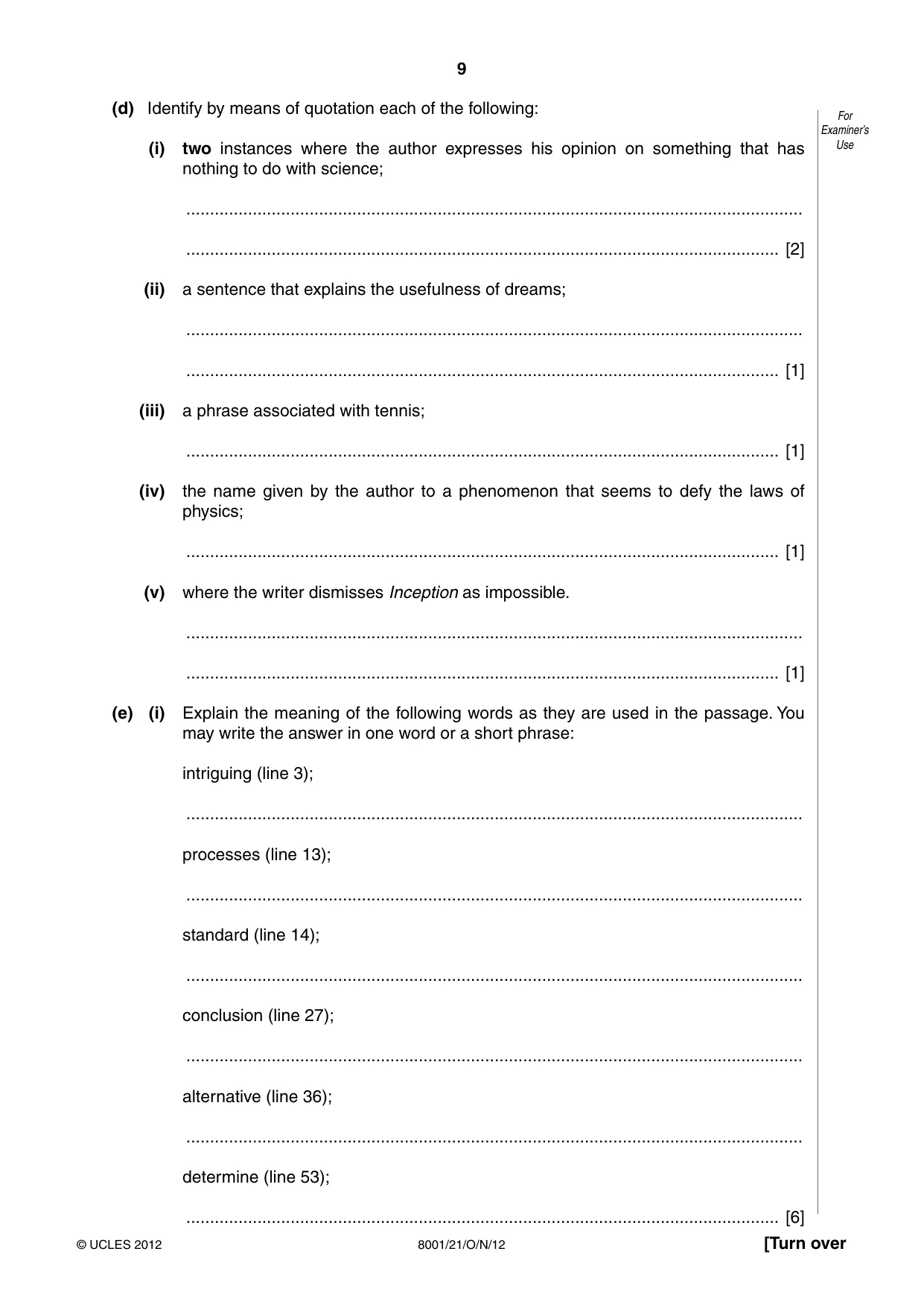
8 8001/21/O/N/12 © UCLES 2012 For Examiner’s Use 3 Study Passage 3 in the Insert to answer the following questions (a)–(e). Note: When a question asks for an answer IN YOUR OWN WORDS and you select the appropriate material from the passage for your answer, you must still use your own words to express it. Little credit can be given to answers which only copy words or phrases from the original. (a) Briefly explain how Inception goes beyond what has already been established by science concerning what can be done to the human brain. Use your own words. … … … [3] (b) What experiences of consciousness or lack of it are discussed on a scientific basis during the course of the article? Answer in no more than 100 of your own words. … … … … … … … … … … … … … [10] (c) Why, after thinking about what you have read, could you find the reactions of the ‘brain-damaged 29-year-old’ referred to in the sixth paragraph both ‘heartening’ and ‘disturbing’? Answer in about 40 words. … … … … … [4]
Question paper, page 9
9 8001/21/O/N/12 © UCLES 2012 [Turn over For Examiner’s Use (d) Identify by means of quotation each of the following: (i) two instances where the author expresses his opinion on something that has nothing to do with science; … … [2] (ii) a sentence that explains the usefulness of dreams; … … [1] (iii) a phrase associated with tennis; … [1] (iv) the name given by the author to a phenomenon that seems to defy the laws of physics; … [1] (v) where the writer dismisses Inception as impossible. … … [1] (e) (i) Explain the meaning of the following words as they are used in the passage. You may write the answer in one word or a short phrase: intriguing (line 3); … processes (line 13); … standard (line 14); … conclusion (line 27); … alternative (line 36); … determine (line 53); … [6]
Question paper, page 10
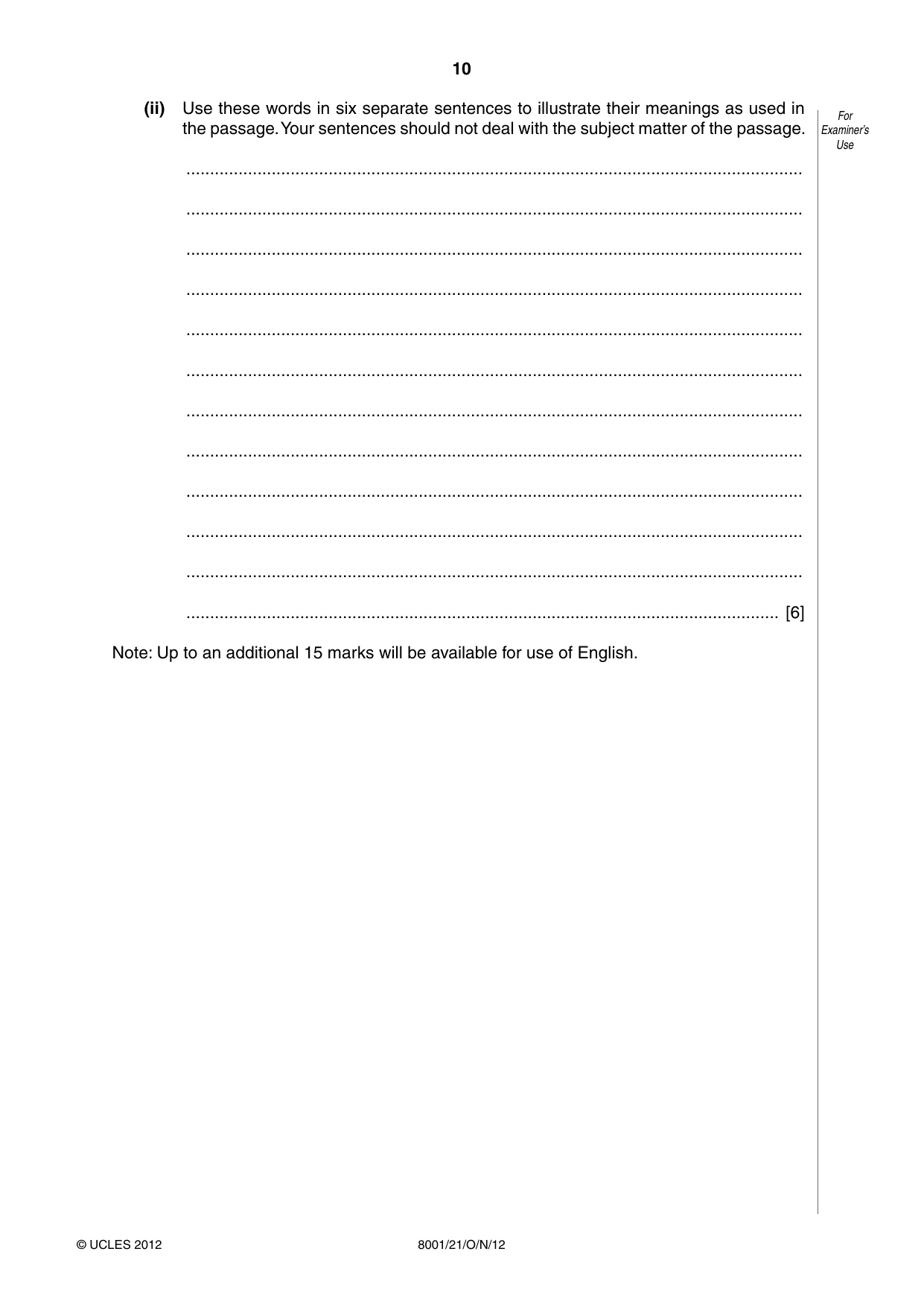
10 8001/21/O/N/12 © UCLES 2012 For Examiner’s Use (ii) Use these words in six separate sentences to illustrate their meanings as used in the passage. Your sentences should not deal with the subject matter of the passage. … … … … … … … … … … … … [6] Note: Up to an additional 15 marks will be available for use of English.
Question paper, page 11
11 8001/21/O/N/12 © UCLES 2012 BLANK PAGE
Question paper, page 12
12 8001/21/O/N/12 © UCLES 2012 BLANK PAGE Copyright Acknowledgements: Question 3 © Roger Highfield; Inception: The Most Resilient Parasite is an Idea Planted in the Unconscious Mind ; http://www.telegraph.co.uk/science/roger-highfield. Permission to reproduce items where third-party owned material protected by copyright is included has been sought and cleared where possible. Every reasonable effort has been made by the publisher (UCLES) to trace copyright holders, but if any items requiring clearance have unwittingly been included, the publisher will be pleased to make amends at the earliest possible opportunity. University of Cambridge International Examinations is part of the Cambridge Assessment Group. Cambridge Assessment is the brand name of University of Cambridge Local Examinations Syndicate (UCLES), which is itself a department of the University of Cambridge.
Mark scheme, page 1
CAMBRIDGE INTERNATIONAL EXAMINATIONS GCE Advanced Subsidiary Level MARK SCHEME for the October/November 2012 series 8001 GENERAL PAPER 8001/21 Paper 2, maximum raw mark 50 This mark scheme is published as an aid to teachers and candidates, to indicate the requirements of the examination. It shows the basis on which Examiners were instructed to award marks. It does not indicate the details of the discussions that took place at an Examiners’ meeting before marking began, which would have considered the acceptability of alternative answers. Mark schemes should be read in conjunction with the question paper and the Principal Examiner Report for Teachers. Cambridge will not enter into discussions about these mark schemes. Cambridge is publishing the mark schemes for the October/November 2012 series for most IGCSE, GCE Advanced Level and Advanced Subsidiary Level components and some Ordinary Level components.
Mark scheme, page 2
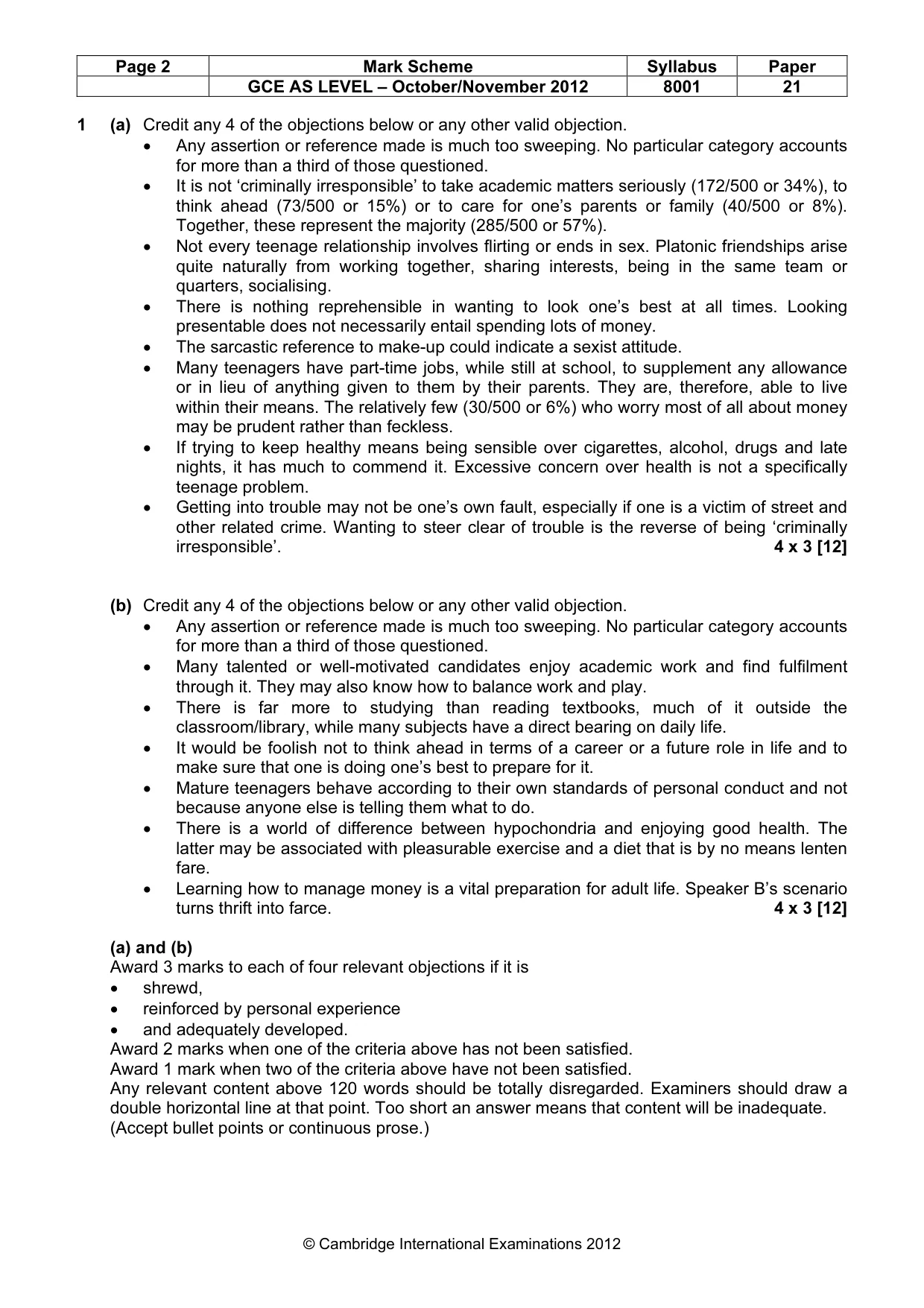
Page 2 Mark Scheme Syllabus Paper GCE AS LEVEL – October/November 2012 8001 21 © Cambridge International Examinations 2012 1 (a) Credit any 4 of the objections below or any other valid objection. • Any assertion or reference made is much too sweeping. No particular category accounts for more than a third of those questioned. • It is not ‘criminally irresponsible’ to take academic matters seriously (172/500 or 34%), to think ahead (73/500 or 15%) or to care for one’s parents or family (40/500 or 8%). Together, these represent the majority (285/500 or 57%). • Not every teenage relationship involves flirting or ends in sex. Platonic friendships arise quite naturally from working together, sharing interests, being in the same team or quarters, socialising. • There is nothing reprehensible in wanting to look one’s best at all times. Looking presentable does not necessarily entail spending lots of money. • The sarcastic reference to make-up could indicate a sexist attitude. • Many teenagers have part-time jobs, while still at school, to supplement any allowance or in lieu of anything given to them by their parents. They are, therefore, able to live within their means. The relatively few (30/500 or 6%) who worry most of all about money may be prudent rather than feckless. • If trying to keep healthy means being sensible over cigarettes, alcohol, drugs and late nights, it has much to commend it. Excessive concern over health is not a specifically teenage problem. • Getting into trouble may not be one’s own fault, especially if one is a victim of street and other related crime. Wanting to steer clear of trouble is the reverse of being ‘criminally irresponsible’. 4 x 3 [12] (b) Credit any 4 of the objections below or any other valid objection. • Any assertion or reference made is much too sweeping. No particular category accounts for more than a third of those questioned. • Many talented or well-motivated candidates enjoy academic work and find fulfilment through it. They may also know how to balance work and play. • There is far more to studying than reading textbooks, much of it outside the classroom/library, while many subjects have a direct bearing on daily life. • It would be foolish not to think ahead in terms of a career or a future role in life and to make sure that one is doing one’s best to prepare for it. • Mature teenagers behave according to their own standards of personal conduct and not because anyone else is telling them what to do. • There is a world of difference between hypochondria and enjoying good health. The latter may be associated with pleasurable exercise and a diet that is by no means lenten fare. • Learning how to manage money is a vital preparation for adult life. Speaker B’s scenario turns thrift into farce. 4 x 3 [12] (a) and (b) Award 3 marks to each of four relevant objections if it is • shrewd, • reinforced by personal experience • and adequately developed. Award 2 marks when one of the criteria above has not been satisfied. Award 1 mark when two of the criteria above have not been satisfied. Any relevant content above 120 words should be totally disregarded. Examiners should draw a double horizontal line at that point. Too short an answer means that content will be inadequate. (Accept bullet points or continuous prose.)
Mark scheme, page 3
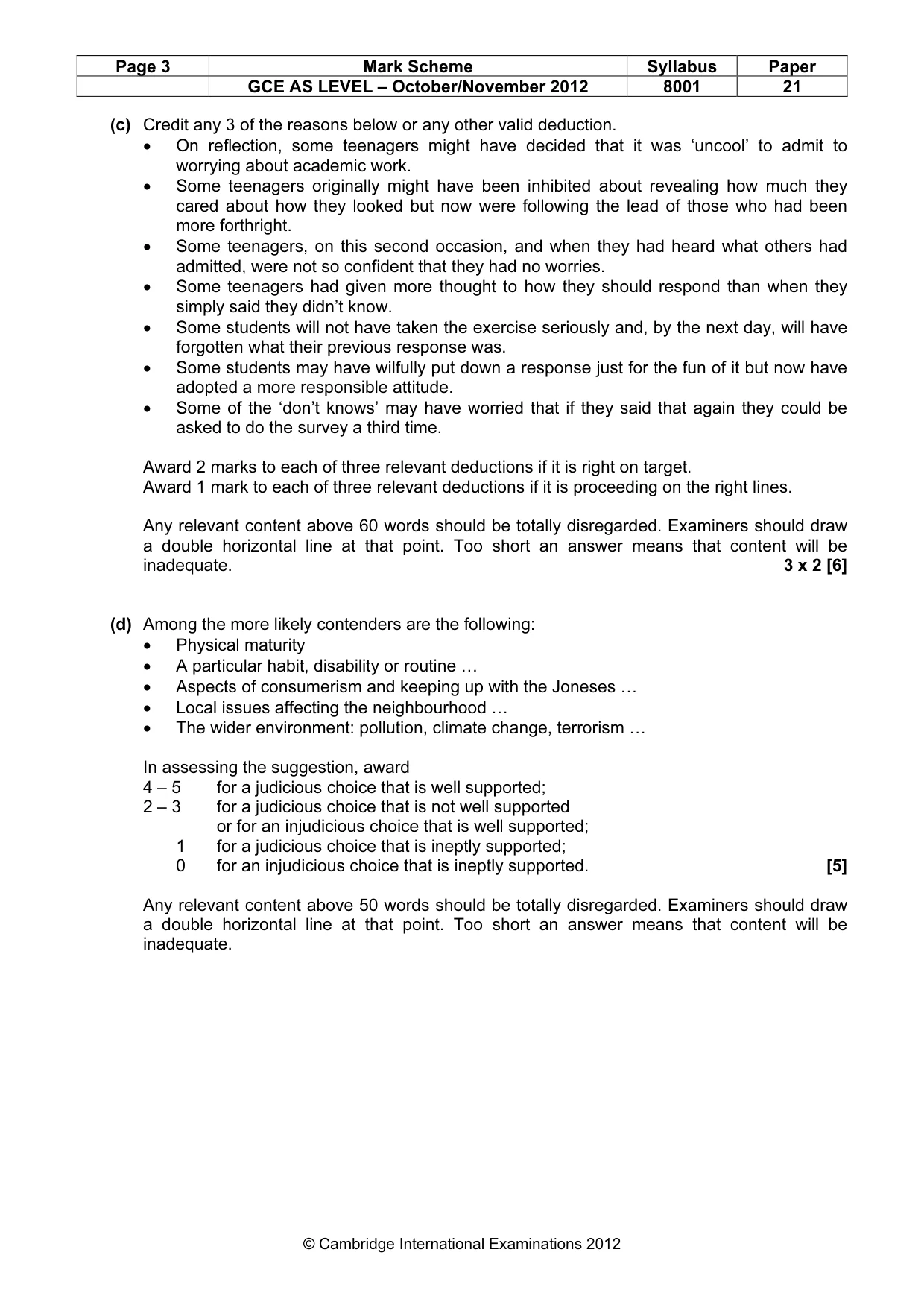
Page 3 Mark Scheme Syllabus Paper GCE AS LEVEL – October/November 2012 8001 21 © Cambridge International Examinations 2012 (c) Credit any 3 of the reasons below or any other valid deduction. • On reflection, some teenagers might have decided that it was ‘uncool’ to admit to worrying about academic work. • Some teenagers originally might have been inhibited about revealing how much they cared about how they looked but now were following the lead of those who had been more forthright. • Some teenagers, on this second occasion, and when they had heard what others had admitted, were not so confident that they had no worries. • Some teenagers had given more thought to how they should respond than when they simply said they didn’t know. • Some students will not have taken the exercise seriously and, by the next day, will have forgotten what their previous response was. • Some students may have wilfully put down a response just for the fun of it but now have adopted a more responsible attitude. • Some of the ‘don’t knows’ may have worried that if they said that again they could be asked to do the survey a third time. Award 2 marks to each of three relevant deductions if it is right on target. Award 1 mark to each of three relevant deductions if it is proceeding on the right lines. Any relevant content above 60 words should be totally disregarded. Examiners should draw a double horizontal line at that point. Too short an answer means that content will be inadequate. 3 x 2 [6] (d) Among the more likely contenders are the following: • Physical maturity • A particular habit, disability or routine … • Aspects of consumerism and keeping up with the Joneses … • Local issues affecting the neighbourhood … • The wider environment: pollution, climate change, terrorism … In assessing the suggestion, award 4 – 5 for a judicious choice that is well supported; 2 – 3 for a judicious choice that is not well supported or for an injudicious choice that is well supported; 1 for a judicious choice that is ineptly supported; 0 for an injudicious choice that is ineptly supported. [5] Any relevant content above 50 words should be totally disregarded. Examiners should draw a double horizontal line at that point. Too short an answer means that content will be inadequate.
Mark scheme, page 4
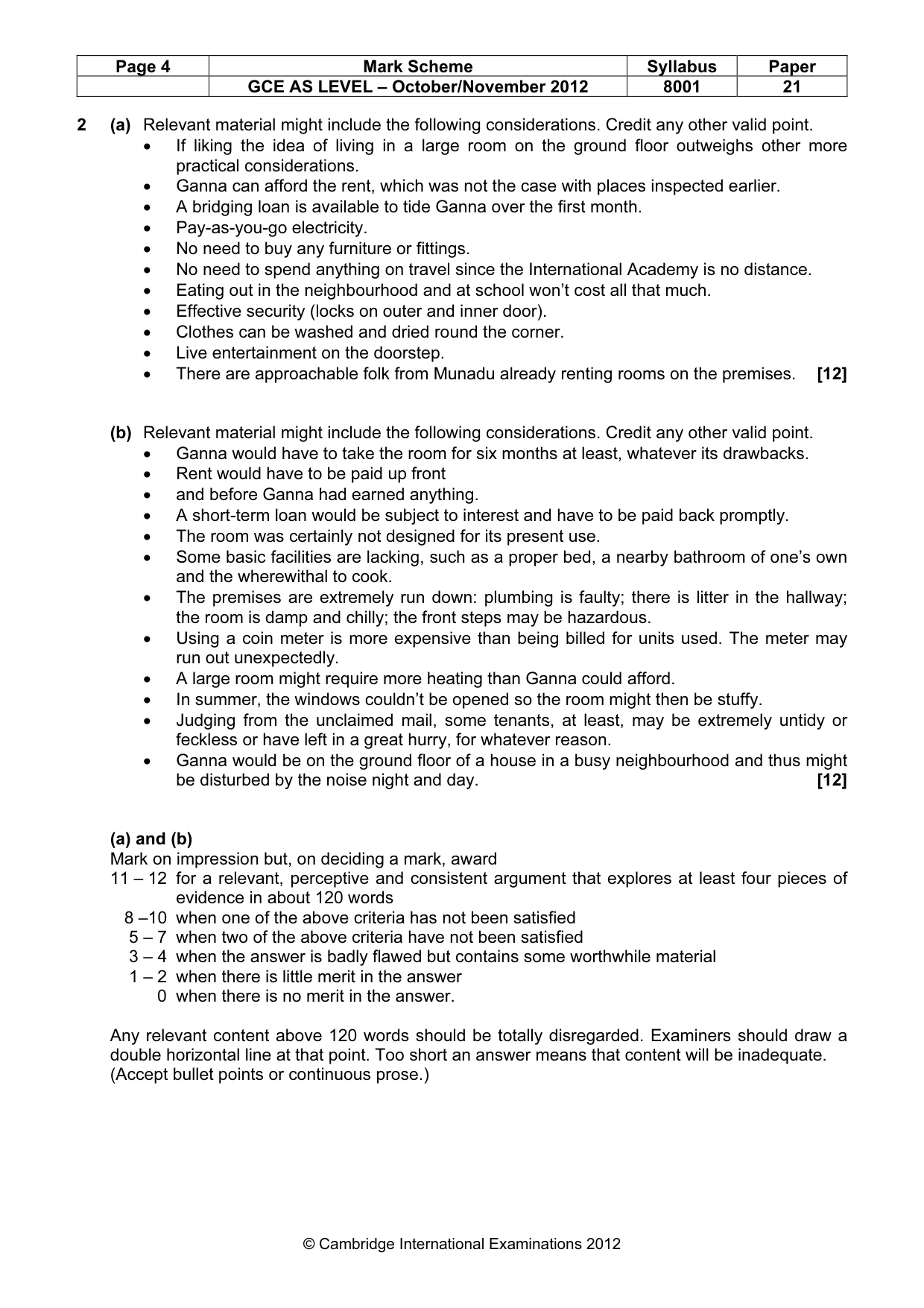
Page 4 Mark Scheme Syllabus Paper GCE AS LEVEL – October/November 2012 8001 21 © Cambridge International Examinations 2012 2 (a) Relevant material might include the following considerations. Credit any other valid point. • If liking the idea of living in a large room on the ground floor outweighs other more practical considerations. • Ganna can afford the rent, which was not the case with places inspected earlier. • A bridging loan is available to tide Ganna over the first month. • Pay-as-you-go electricity. • No need to buy any furniture or fittings. • No need to spend anything on travel since the International Academy is no distance. • Eating out in the neighbourhood and at school won’t cost all that much. • Effective security (locks on outer and inner door). • Clothes can be washed and dried round the corner. • Live entertainment on the doorstep. • There are approachable folk from Munadu already renting rooms on the premises. [12] (b) Relevant material might include the following considerations. Credit any other valid point. • Ganna would have to take the room for six months at least, whatever its drawbacks. • Rent would have to be paid up front • and before Ganna had earned anything. • A short-term loan would be subject to interest and have to be paid back promptly. • The room was certainly not designed for its present use. • Some basic facilities are lacking, such as a proper bed, a nearby bathroom of one’s own and the wherewithal to cook. • The premises are extremely run down: plumbing is faulty; there is litter in the hallway; the room is damp and chilly; the front steps may be hazardous. • Using a coin meter is more expensive than being billed for units used. The meter may run out unexpectedly. • A large room might require more heating than Ganna could afford. • In summer, the windows couldn’t be opened so the room might then be stuffy. • Judging from the unclaimed mail, some tenants, at least, may be extremely untidy or feckless or have left in a great hurry, for whatever reason. • Ganna would be on the ground floor of a house in a busy neighbourhood and thus might be disturbed by the noise night and day. [12] (a) and (b) Mark on impression but, on deciding a mark, award 11 – 12 for a relevant, perceptive and consistent argument that explores at least four pieces of evidence in about 120 words 8 –10 when one of the above criteria has not been satisfied 5 – 7 when two of the above criteria have not been satisfied 3 – 4 when the answer is badly flawed but contains some worthwhile material 1 – 2 when there is little merit in the answer 0 when there is no merit in the answer. Any relevant content above 120 words should be totally disregarded. Examiners should draw a double horizontal line at that point. Too short an answer means that content will be inadequate. (Accept bullet points or continuous prose.)
Mark scheme, page 5
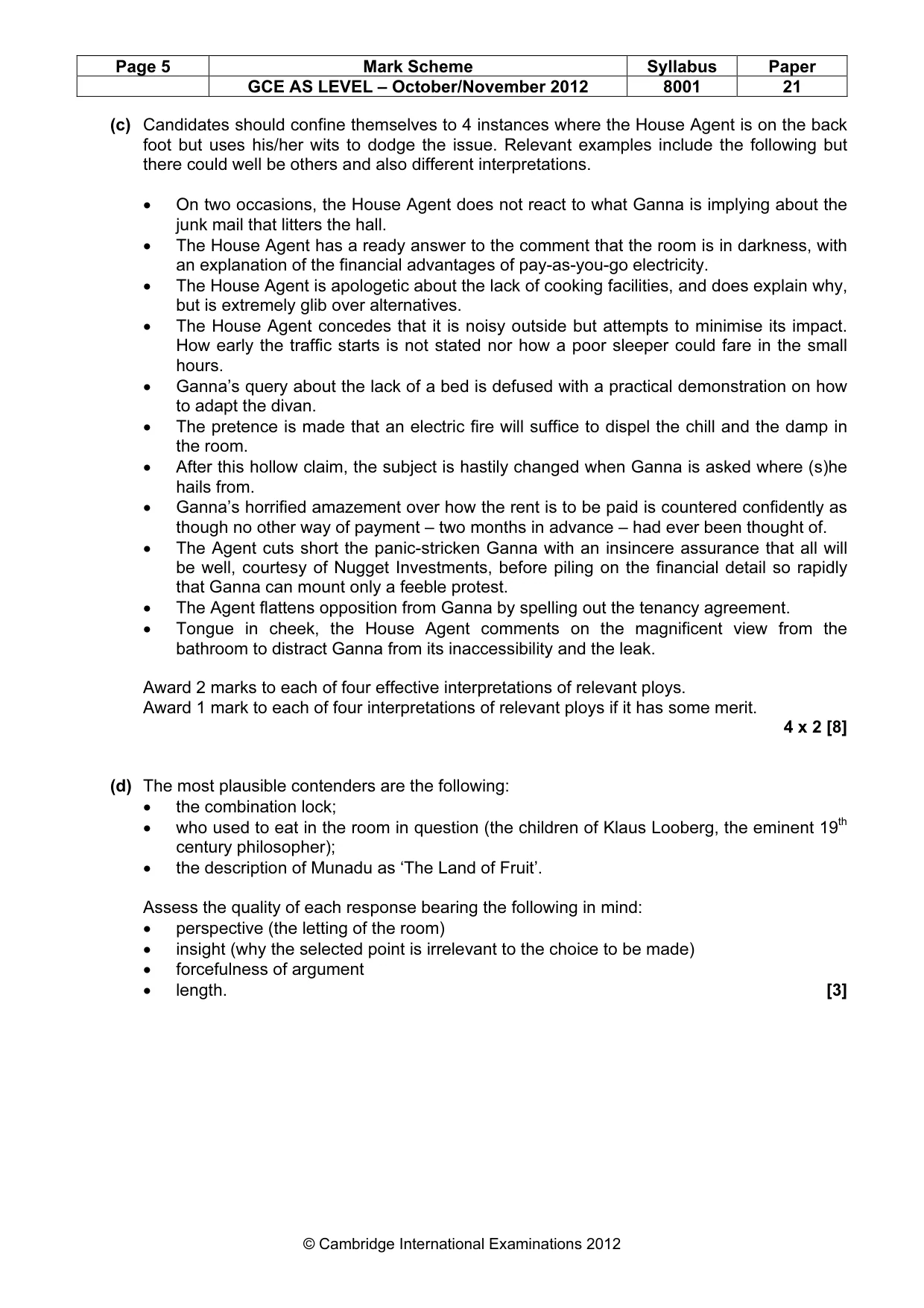
Page 5 Mark Scheme Syllabus Paper GCE AS LEVEL – October/November 2012 8001 21 © Cambridge International Examinations 2012 (c) Candidates should confine themselves to 4 instances where the House Agent is on the back foot but uses his/her wits to dodge the issue. Relevant examples include the following but there could well be others and also different interpretations. • On two occasions, the House Agent does not react to what Ganna is implying about the junk mail that litters the hall. • The House Agent has a ready answer to the comment that the room is in darkness, with an explanation of the financial advantages of pay-as-you-go electricity. • The House Agent is apologetic about the lack of cooking facilities, and does explain why, but is extremely glib over alternatives. • The House Agent concedes that it is noisy outside but attempts to minimise its impact. How early the traffic starts is not stated nor how a poor sleeper could fare in the small hours. • Ganna’s query about the lack of a bed is defused with a practical demonstration on how to adapt the divan. • The pretence is made that an electric fire will suffice to dispel the chill and the damp in the room. • After this hollow claim, the subject is hastily changed when Ganna is asked where (s)he hails from. • Ganna’s horrified amazement over how the rent is to be paid is countered confidently as though no other way of payment – two months in advance – had ever been thought of. • The Agent cuts short the panic-stricken Ganna with an insincere assurance that all will be well, courtesy of Nugget Investments, before piling on the financial detail so rapidly that Ganna can mount only a feeble protest. • The Agent flattens opposition from Ganna by spelling out the tenancy agreement. • Tongue in cheek, the House Agent comments on the magnificent view from the bathroom to distract Ganna from its inaccessibility and the leak. Award 2 marks to each of four effective interpretations of relevant ploys. Award 1 mark to each of four interpretations of relevant ploys if it has some merit. 4 x 2 [8] (d) The most plausible contenders are the following: • the combination lock; • who used to eat in the room in question (the children of Klaus Looberg, the eminent 19th century philosopher); • the description of Munadu as ‘The Land of Fruit’. Assess the quality of each response bearing the following in mind: • perspective (the letting of the room) • insight (why the selected point is irrelevant to the choice to be made) • forcefulness of argument • length. [3]
Mark scheme, page 6
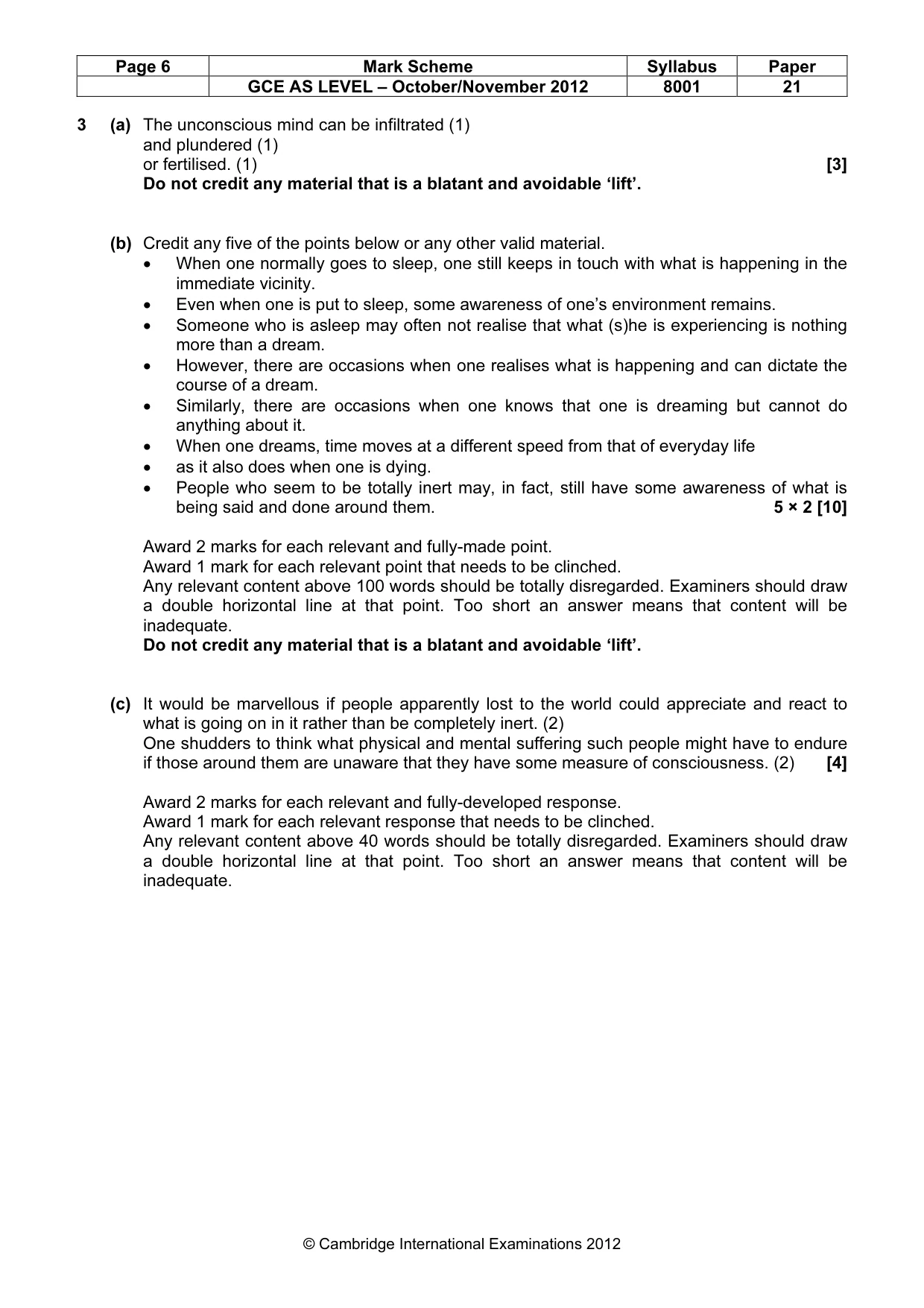
Page 6 Mark Scheme Syllabus Paper GCE AS LEVEL – October/November 2012 8001 21 © Cambridge International Examinations 2012 3 (a) The unconscious mind can be infiltrated (1) and plundered (1) or fertilised. (1) [3] Do not credit any material that is a blatant and avoidable ‘lift’. (b) Credit any five of the points below or any other valid material. • When one normally goes to sleep, one still keeps in touch with what is happening in the immediate vicinity. • Even when one is put to sleep, some awareness of one’s environment remains. • Someone who is asleep may often not realise that what (s)he is experiencing is nothing more than a dream. • However, there are occasions when one realises what is happening and can dictate the course of a dream. • Similarly, there are occasions when one knows that one is dreaming but cannot do anything about it. • When one dreams, time moves at a different speed from that of everyday life • as it also does when one is dying. • People who seem to be totally inert may, in fact, still have some awareness of what is being said and done around them. 5 × 2 [10] Award 2 marks for each relevant and fully-made point. Award 1 mark for each relevant point that needs to be clinched. Any relevant content above 100 words should be totally disregarded. Examiners should draw a double horizontal line at that point. Too short an answer means that content will be inadequate. Do not credit any material that is a blatant and avoidable ‘lift’. (c) It would be marvellous if people apparently lost to the world could appreciate and react to what is going on in it rather than be completely inert. (2) One shudders to think what physical and mental suffering such people might have to endure if those around them are unaware that they have some measure of consciousness. (2) [4] Award 2 marks for each relevant and fully-developed response. Award 1 mark for each relevant response that needs to be clinched. Any relevant content above 40 words should be totally disregarded. Examiners should draw a double horizontal line at that point. Too short an answer means that content will be inadequate.
Mark scheme, page 7
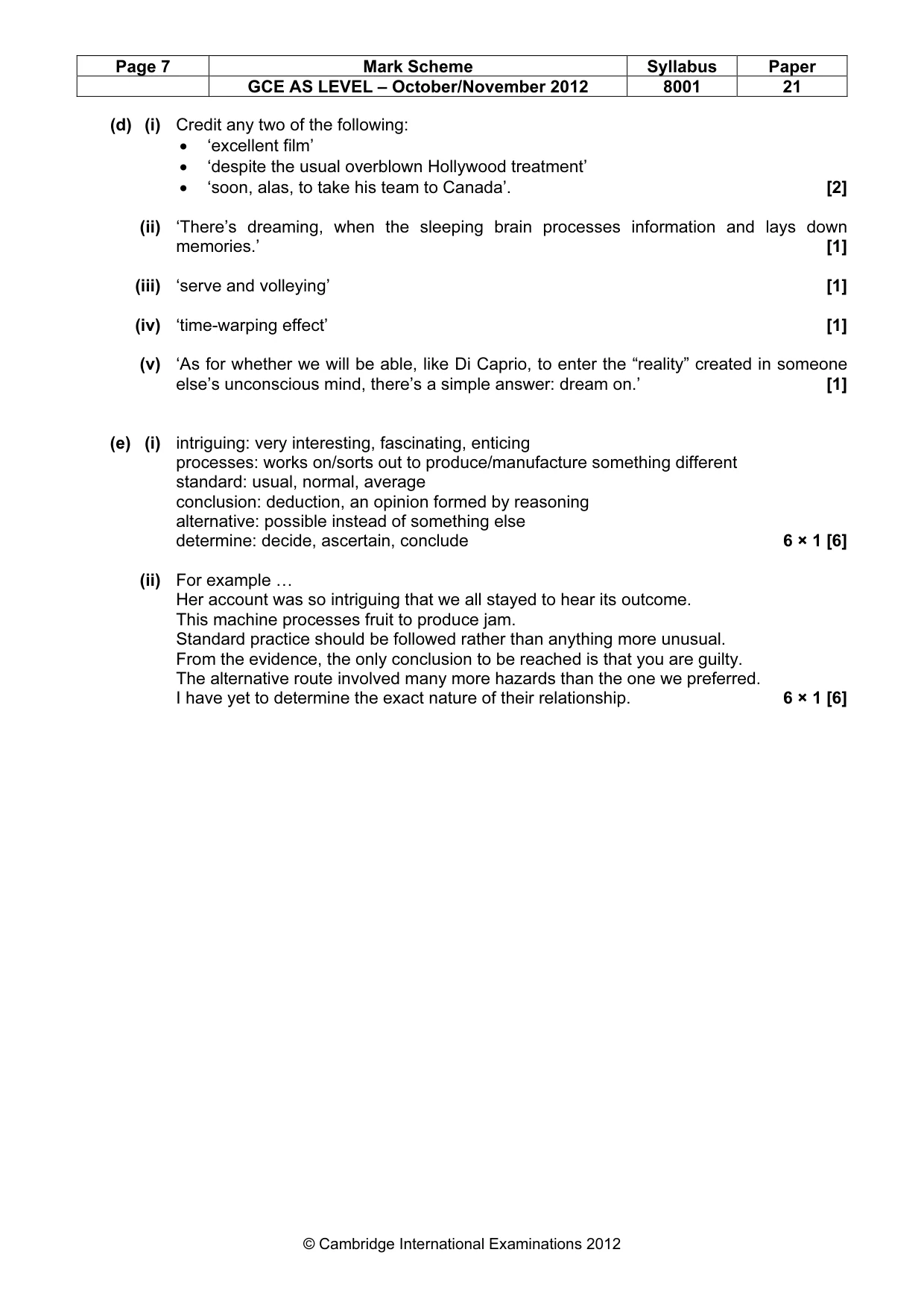
Page 7 Mark Scheme Syllabus Paper GCE AS LEVEL – October/November 2012 8001 21 © Cambridge International Examinations 2012 (d) (i) Credit any two of the following: • ‘excellent film’ • ‘despite the usual overblown Hollywood treatment’ • ‘soon, alas, to take his team to Canada’. [2] (ii) ‘There’s dreaming, when the sleeping brain processes information and lays down memories.’ [1] (iii) ‘serve and volleying’ [1] (iv) ‘time-warping effect’ [1] (v) ‘As for whether we will be able, like Di Caprio, to enter the “reality” created in someone else’s unconscious mind, there’s a simple answer: dream on.’ [1] (e) (i) intriguing: very interesting, fascinating, enticing processes: works on/sorts out to produce/manufacture something different standard: usual, normal, average conclusion: deduction, an opinion formed by reasoning alternative: possible instead of something else determine: decide, ascertain, conclude 6 × 1 [6] (ii) For example … Her account was so intriguing that we all stayed to hear its outcome. This machine processes fruit to produce jam. Standard practice should be followed rather than anything more unusual. From the evidence, the only conclusion to be reached is that you are guilty. The alternative route involved many more hazards than the one we preferred. I have yet to determine the exact nature of their relationship. 6 × 1 [6]
What you needed in this session
Cambridge’s own grade thresholds for 2012 Oct/Nov, Paper 2 · Variant 1. A higher threshold means an easier paper — the bar moves with how the cohort did.