Cambridge A Level French - Literature (AS Level only) 8670 — 2010 Oct/Nov Paper 4 · Variant 3
8670/43/O/N/10 · 75 marks · ≈84 min
The question paper and its mark scheme, free to read here and free to download. This is Cambridge’s own paper, exactly as it was sat.
Question paper8 pages
Mark scheme3 pages
Answers below. Sit the paper first if you are practising.
Paper as text
Question paper, page 1
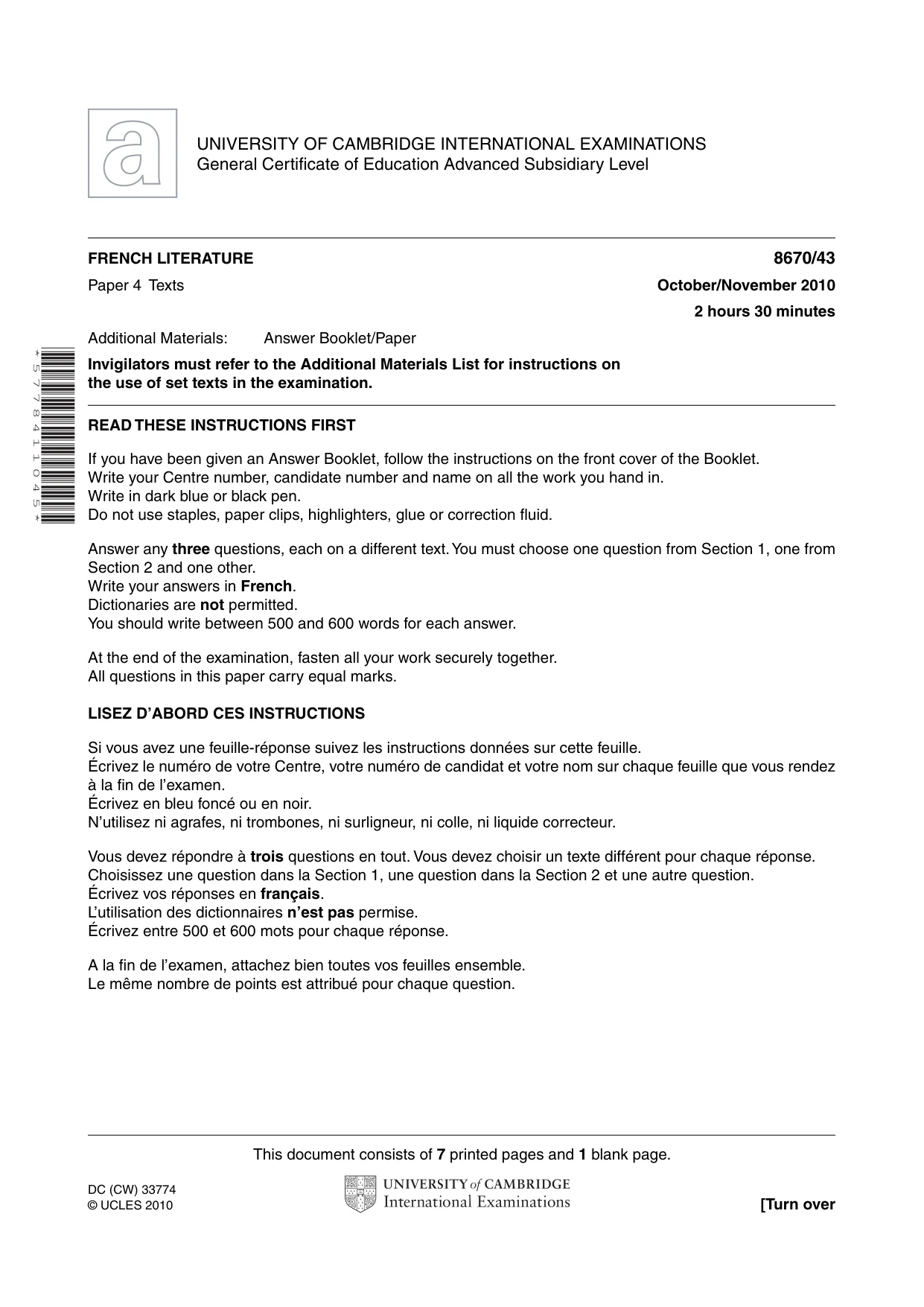
This document consists of 7 printed pages and 1 blank page. DC (CW) 33774 © UCLES 2010 [Turn over UNIVERSITY OF CAMBRIDGE INTERNATIONAL EXAMINATIONS General Certificate of Education Advanced Subsidiary Level READ THESE INSTRUCTIONS FIRST If you have been given an Answer Booklet, follow the instructions on the front cover of the Booklet. Write your Centre number, candidate number and name on all the work you hand in. Write in dark blue or black pen. Do not use staples, paper clips, highlighters, glue or correction fluid. Answer any three questions, each on a different text. You must choose one question from Section 1, one from Section 2 and one other. Write your answers in French. Dictionaries are not permitted. You should write between 500 and 600 words for each answer. At the end of the examination, fasten all your work securely together. All questions in this paper carry equal marks. LISEZ D’ABORD CES INSTRUCTIONS Si vous avez une feuille-réponse suivez les instructions données sur cette feuille. Écrivez le numéro de votre Centre, votre numéro de candidat et votre nom sur chaque feuille que vous rendez à la fin de l’examen. Écrivez en bleu foncé ou en noir. N’utilisez ni agrafes, ni trombones, ni surligneur, ni colle, ni liquide correcteur. Vous devez répondre à trois questions en tout. Vous devez choisir un texte différent pour chaque réponse. Choisissez une question dans la Section 1, une question dans la Section 2 et une autre question. Écrivez vos réponses en français. L’utilisation des dictionnaires n’est pas permise. Écrivez entre 500 et 600 mots pour chaque réponse. A la fin de l’examen, attachez bien toutes vos feuilles ensemble. Le même nombre de points est attribué pour chaque question. * 5 7 7 8 4 1 1 0 4 5 * FRENCH LITERATURE 8670/43 Paper 4 Texts October/November 2010 2 hours 30 minutes Additional Materials: Answer Booklet/Paper Invigilators must refer to the Additional Materials List for instructions on the use of set texts in the examination.
Question paper, page 2
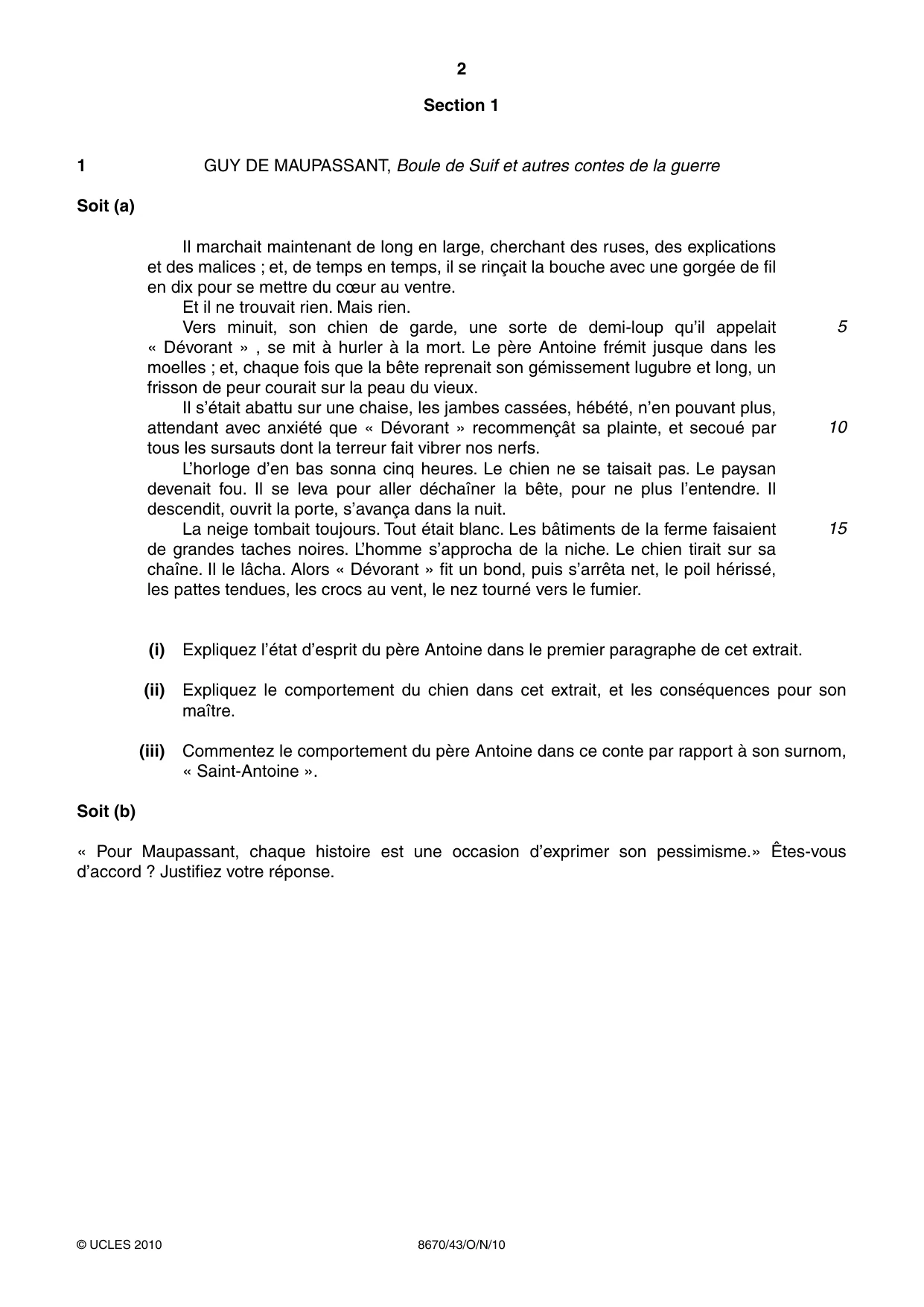
2 8670/43/O/N/10 © UCLES 2010 Section 1 1 GUY DE MAUPASSANT, Boule de Suif et autres contes de la guerre Soit (a) Il marchait maintenant de long en large, cherchant des ruses, des explications et des malices ; et, de temps en temps, il se rinçait la bouche avec une gorgée de fil en dix pour se mettre du cœur au ventre. Et il ne trouvait rien. Mais rien. Vers minuit, son chien de garde, une sorte de demi-loup qu’il appelait « Dévorant » , se mit à hurler à la mort. Le père Antoine frémit jusque dans les moelles ; et, chaque fois que la bête reprenait son gémissement lugubre et long, un frisson de peur courait sur la peau du vieux. Il s’était abattu sur une chaise, les jambes cassées, hébété, n’en pouvant plus, attendant avec anxiété que « Dévorant » recommençât sa plainte, et secoué par tous les sursauts dont la terreur fait vibrer nos nerfs. L’horloge d’en bas sonna cinq heures. Le chien ne se taisait pas. Le paysan devenait fou. Il se leva pour aller déchaîner la bête, pour ne plus l’entendre. Il descendit, ouvrit la porte, s’avança dans la nuit. La neige tombait toujours. Tout était blanc. Les bâtiments de la ferme faisaient de grandes taches noires. L’homme s’approcha de la niche. Le chien tirait sur sa chaîne. Il le lâcha. Alors « Dévorant » fit un bond, puis s’arrêta net, le poil hérissé, les pattes tendues, les crocs au vent, le nez tourné vers le fumier. (i) Expliquez l’état d’esprit du père Antoine dans le premier paragraphe de cet extrait. (ii) Expliquez le comportement du chien dans cet extrait, et les conséquences pour son maître. (iii) Commentez le comportement du père Antoine dans ce conte par rapport à son surnom, « Saint-Antoine ». Soit (b) « Pour Maupassant, chaque histoire est une occasion d’exprimer son pessimisme.» Êtes-vous d’accord ? Justifiez votre réponse. 5 10 15
Question paper, page 3
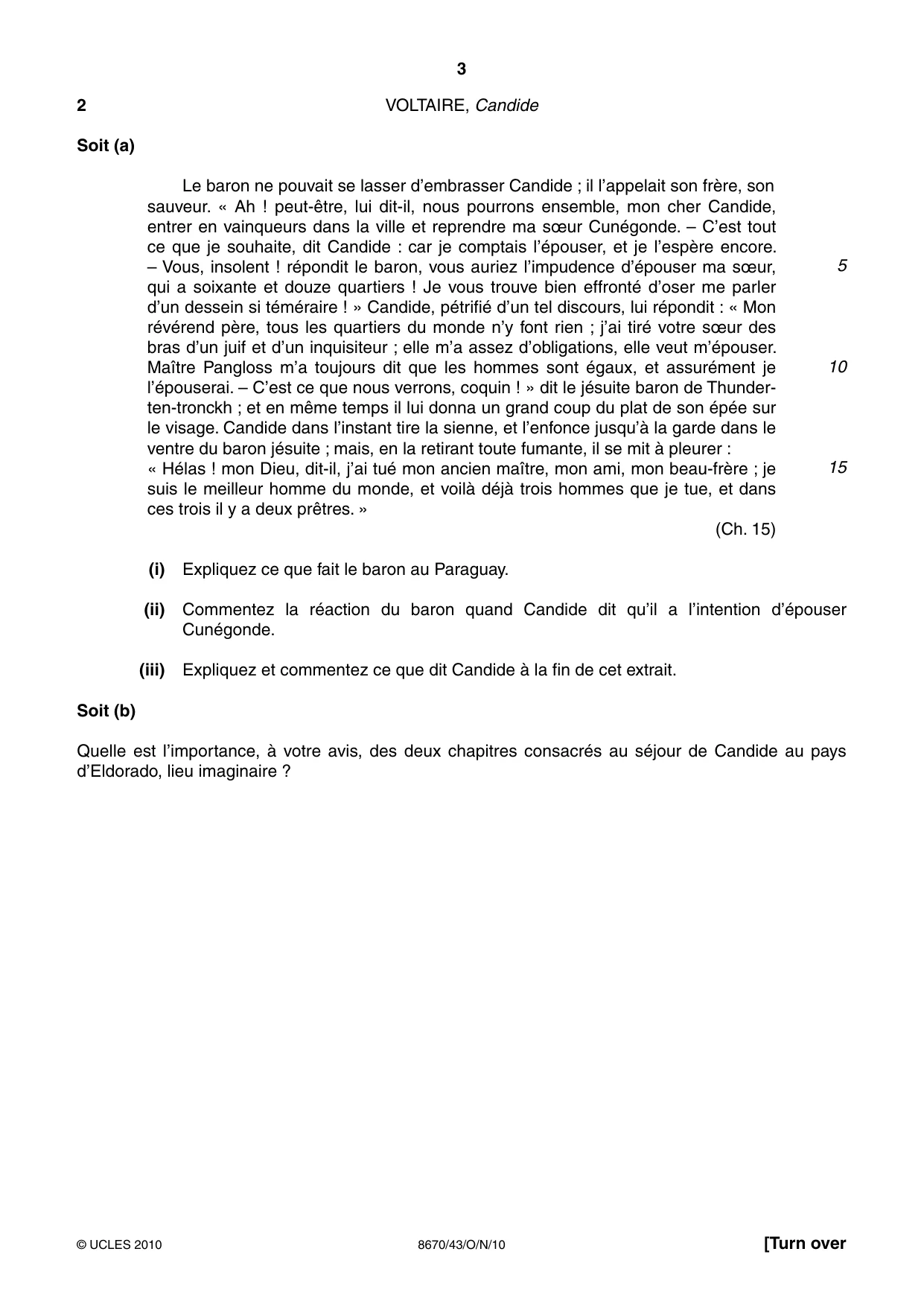
3 8670/43/O/N/10 © UCLES 2010 [Turn over 2 VOLTAIRE, Candide Soit (a) Le baron ne pouvait se lasser d’embrasser Candide ; il l’appelait son frère, son sauveur. « Ah ! peut-être, lui dit-il, nous pourrons ensemble, mon cher Candide, entrer en vainqueurs dans la ville et reprendre ma sœur Cunégonde. – C’est tout ce que je souhaite, dit Candide : car je comptais l’épouser, et je l’espère encore. – Vous, insolent ! répondit le baron, vous auriez l’impudence d’épouser ma sœur, qui a soixante et douze quartiers ! Je vous trouve bien effronté d’oser me parler d’un dessein si téméraire ! » Candide, pétrifié d’un tel discours, lui répondit : « Mon révérend père, tous les quartiers du monde n’y font rien ; j’ai tiré votre sœur des bras d’un juif et d’un inquisiteur ; elle m’a assez d’obligations, elle veut m’épouser. Maître Pangloss m’a toujours dit que les hommes sont égaux, et assurément je l’épouserai. – C’est ce que nous verrons, coquin ! » dit le jésuite baron de Thunder- ten-tronckh ; et en même temps il lui donna un grand coup du plat de son épée sur le visage. Candide dans l’instant tire la sienne, et l’enfonce jusqu’à la garde dans le ventre du baron jésuite ; mais, en la retirant toute fumante, il se mit à pleurer : « Hélas ! mon Dieu, dit-il, j’ai tué mon ancien maître, mon ami, mon beau-frère ; je suis le meilleur homme du monde, et voilà déjà trois hommes que je tue, et dans ces trois il y a deux prêtres. » (Ch. 15) (i) Expliquez ce que fait le baron au Paraguay. (ii) Commentez la réaction du baron quand Candide dit qu’il a l’intention d’épouser Cunégonde. (iii) Expliquez et commentez ce que dit Candide à la fin de cet extrait. Soit (b) Quelle est l’importance, à votre avis, des deux chapitres consacrés au séjour de Candide au pays d’Eldorado, lieu imaginaire ? 5 10 15
Question paper, page 4
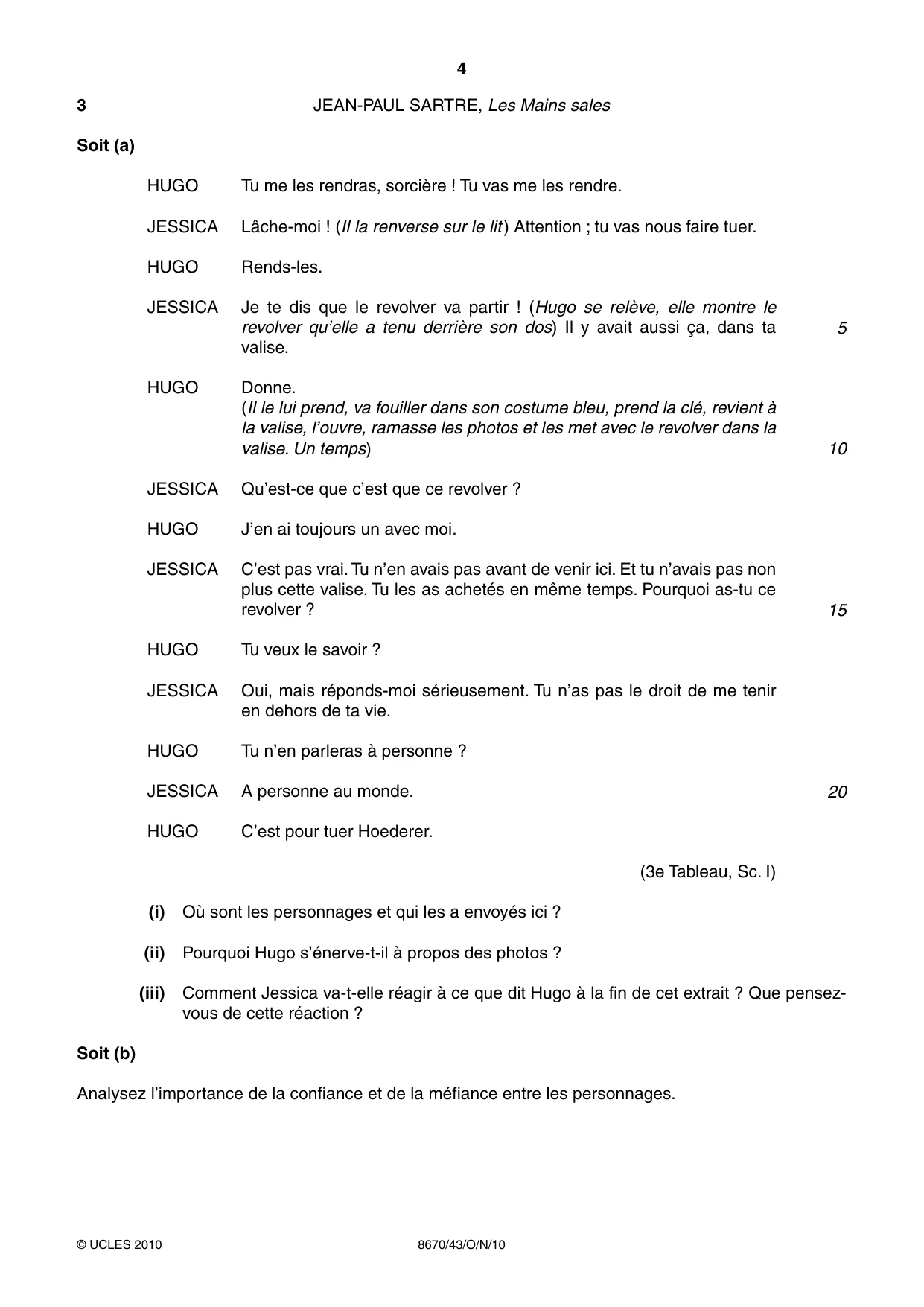
4 8670/43/O/N/10 © UCLES 2010 3 JEAN-PAUL SARTRE, Les Mains sales Soit (a) HUGO Tu me les rendras, sorcière ! Tu vas me les rendre. JESSICA Lâche-moi ! (Il la renverse sur le lit ) Attention ; tu vas nous faire tuer. HUGO Rends-les. JESSICA Je te dis que le revolver va partir ! (Hugo se relève, elle montre le revolver qu’elle a tenu derrière son dos) Il y avait aussi ça, dans ta valise. HUGO Donne. (Il le lui prend, va fouiller dans son costume bleu, prend la clé, revient à la valise, l’ouvre, ramasse les photos et les met avec le revolver dans la valise. Un temps) JESSICA Qu’est-ce que c’est que ce revolver ? HUGO J’en ai toujours un avec moi. JESSICA C’est pas vrai. Tu n’en avais pas avant de venir ici. Et tu n’avais pas non plus cette valise. Tu les as achetés en même temps. Pourquoi as-tu ce revolver ? HUGO Tu veux le savoir ? JESSICA Oui, mais réponds-moi sérieusement. Tu n’as pas le droit de me tenir en dehors de ta vie. HUGO Tu n’en parleras à personne ? JESSICA A personne au monde. HUGO C’est pour tuer Hoederer. (3e Tableau, Sc. I) (i) Où sont les personnages et qui les a envoyés ici ? (ii) Pourquoi Hugo s’énerve-t-il à propos des photos ? (iii) Comment Jessica va-t-elle réagir à ce que dit Hugo à la fin de cet extrait ? Que pensez- vous de cette réaction ? Soit (b) Analysez l’importance de la confiance et de la méfiance entre les personnages. 5 10 15 20
Question paper, page 5
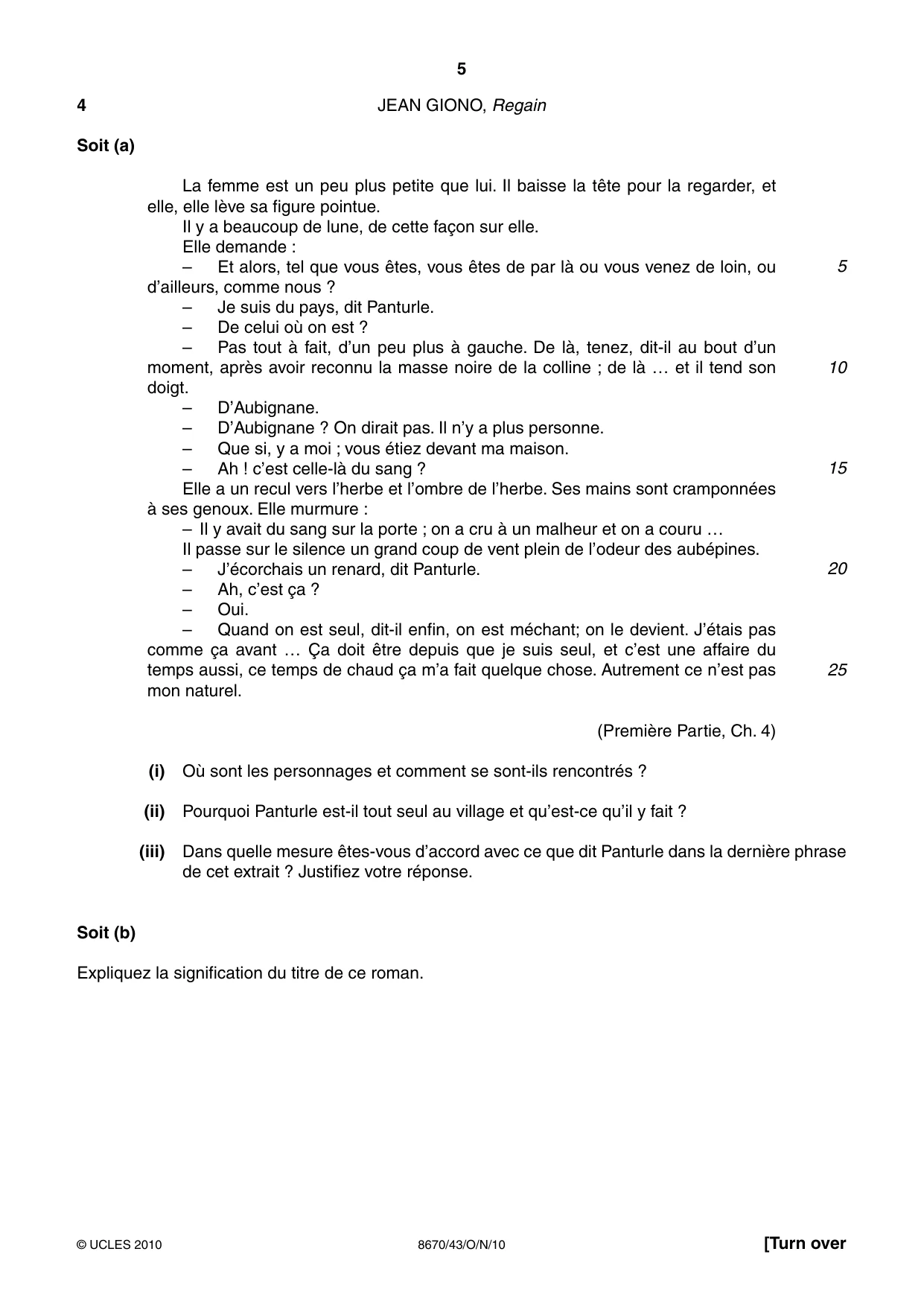
5 8670/43/O/N/10 © UCLES 2010 [Turn over 4 JEAN GIONO, Regain Soit (a) La femme est un peu plus petite que lui. Il baisse la tête pour la regarder, et elle, elle lève sa figure pointue. Il y a beaucoup de lune, de cette façon sur elle. Elle demande : – Et alors, tel que vous êtes, vous êtes de par là ou vous venez de loin, ou d’ailleurs, comme nous ? – Je suis du pays, dit Panturle. – De celui où on est ? – Pas tout à fait, d’un peu plus à gauche. De là, tenez, dit-il au bout d’un moment, après avoir reconnu la masse noire de la colline ; de là … et il tend son doigt. – D’Aubignane. – D’Aubignane ? On dirait pas. Il n’y a plus personne. – Que si, y a moi ; vous étiez devant ma maison. – Ah ! c’est celle-là du sang ? Elle a un recul vers l’herbe et l’ombre de l’herbe. Ses mains sont cramponnées à ses genoux. Elle murmure : – Il y avait du sang sur la porte ; on a cru à un malheur et on a couru … Il passe sur le silence un grand coup de vent plein de l’odeur des aubépines. – J’écorchais un renard, dit Panturle. – Ah, c’est ça ? – Oui. – Quand on est seul, dit-il enfin, on est méchant; on le devient. J’étais pas comme ça avant … Ça doit être depuis que je suis seul, et c’est une affaire du temps aussi, ce temps de chaud ça m’a fait quelque chose. Autrement ce n’est pas mon naturel. (Première Partie, Ch. 4) (i) Où sont les personnages et comment se sont-ils rencontrés ? (ii) Pourquoi Panturle est-il tout seul au village et qu’est-ce qu’il y fait ? (iii) Dans quelle mesure êtes-vous d’accord avec ce que dit Panturle dans la dernière phrase de cet extrait ? Justifiez votre réponse. Soit (b) Expliquez la signification du titre de ce roman. 5 10 15 20 25
Question paper, page 6
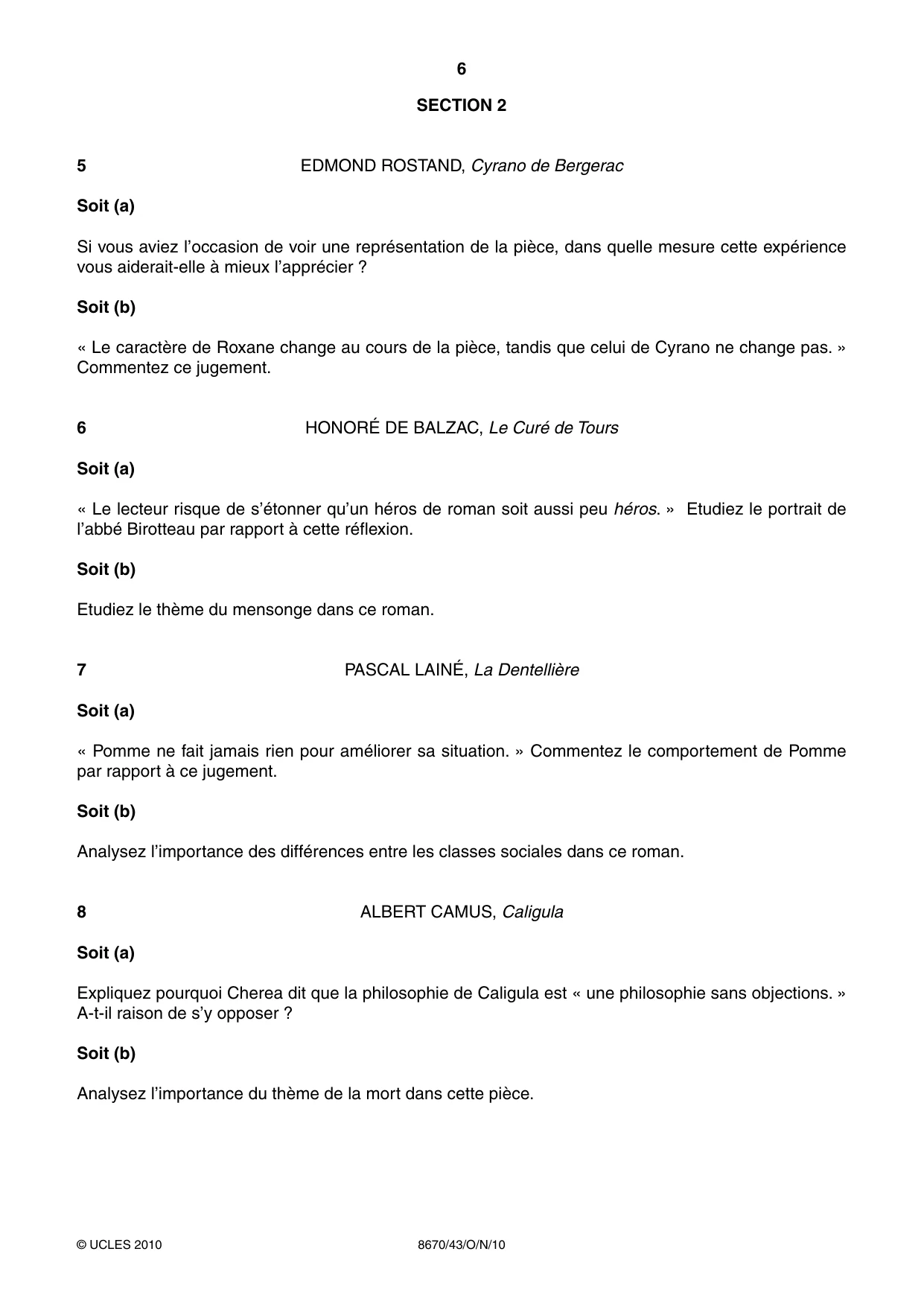
6 8670/43/O/N/10 © UCLES 2010 SECTION 2 5 EDMOND ROSTAND, Cyrano de Bergerac Soit (a) Si vous aviez l’occasion de voir une représentation de la pièce, dans quelle mesure cette expérience vous aiderait-elle à mieux l’apprécier ? Soit (b) « Le caractère de Roxane change au cours de la pièce, tandis que celui de Cyrano ne change pas. » Commentez ce jugement. 6 HONORÉ DE BALZAC, Le Curé de Tours Soit (a) « Le lecteur risque de s’étonner qu’un héros de roman soit aussi peu héros. » Etudiez le portrait de l’abbé Birotteau par rapport à cette réflexion. Soit (b) Etudiez le thème du mensonge dans ce roman. 7 PASCAL LAINÉ, La Dentellière Soit (a) « Pomme ne fait jamais rien pour améliorer sa situation. » Commentez le comportement de Pomme par rapport à ce jugement. Soit (b) Analysez l’importance des différences entre les classes sociales dans ce roman. 8 ALBERT CAMUS, Caligula Soit (a) Expliquez pourquoi Cherea dit que la philosophie de Caligula est « une philosophie sans objections. » A-t-il raison de s’y opposer ? Soit (b) Analysez l’importance du thème de la mort dans cette pièce.
Question paper, page 7
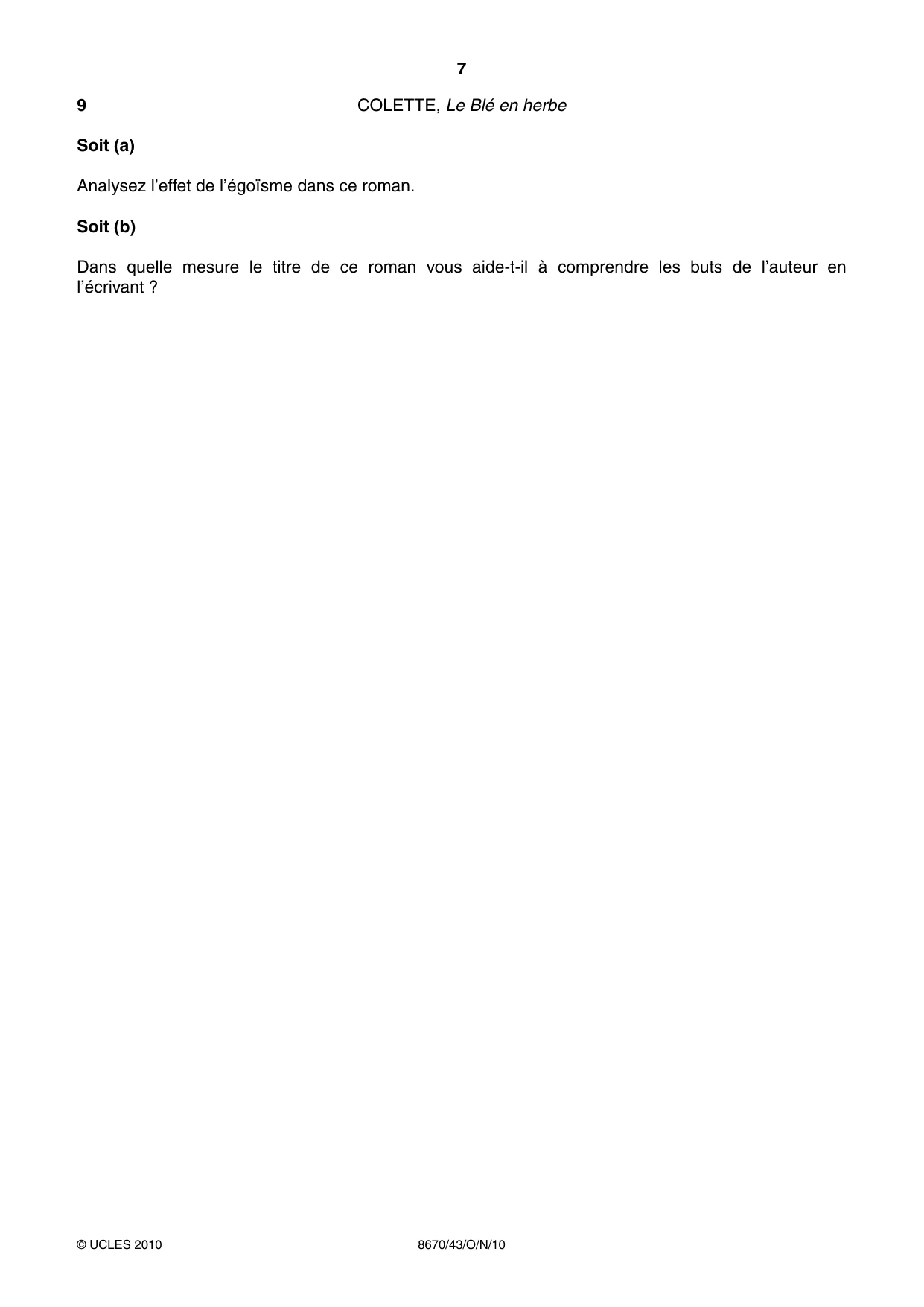
7 8670/43/O/N/10 © UCLES 2010 9 COLETTE, Le Blé en herbe Soit (a) Analysez l’effet de l’égoïsme dans ce roman. Soit (b) Dans quelle mesure le titre de ce roman vous aide-t-il à comprendre les buts de l’auteur en l’écrivant ?
Question paper, page 8
8 8670/43/O/N/10 © UCLES 2010 BLANK PAGE Copyright Acknowledgements: Question 3 © Sarte; Les Mains sales ; Librairie Gallimard; 1963. Question 4 © Giono; Regain ; Editions Bernard Grasset; 1967. Permission to reproduce items where third-party owned material protected by copyright is included has been sought and cleared where possible. Every reasonable effort has been made by the publisher (UCLES) to trace copyright holders, but if any items requiring clearance have unwittingly been included, the publisher will be pleased to make amends at the earliest possible opportunity. University of Cambridge International Examinations is part of the Cambridge Assessment Group. Cambridge Assessment is the brand name of University of Cambridge Local Examinations Syndicate (UCLES), which is itself a department of the University of Cambridge.
Mark scheme, page 1
UNIVERSITY OF CAMBRIDGE INTERNATIONAL EXAMINATIONS GCE Advanced Subsidiary Level MARK SCHEME for the October/November 2010 question paper for the guidance of teachers 8670 FRENCH LITERATURE 8670/43 Paper 4 (Texts), maximum raw mark 75 This mark scheme is published as an aid to teachers and candidates, to indicate the requirements of the examination. It shows the basis on which Examiners were instructed to award marks. It does not indicate the details of the discussions that took place at an Examiners’ meeting before marking began, which would have considered the acceptability of alternative answers. Mark schemes must be read in conjunction with the question papers and the report on the examination. • CIE will not enter into discussions or correspondence in connection with these mark schemes. CIE is publishing the mark schemes for the October/November 2010 question papers for most IGCSE, GCE Advanced Level and Advanced Subsidiary Level syllabuses and some Ordinary Level syllabuses.
Mark scheme, page 2
Page 2 Mark Scheme: Teachers’ version Syllabus Paper GCE AS LEVEL – October/November 2010 8670 43 © UCLES 2010 Candidates will write their answers in the target language. Examiners will look for a candidate’s ability to communicate effectively and will ignore those linguistic errors which do not impede communication. Passage based questions: Examiners should consider the extent to which candidates have been able to identify the significant issues raised in the passage and, where appropriate, have applied these to the text as a whole. The passage is a stimulus passage, to be used as a springboard to give candidates a starting point for their answer. Examiners should allow candidates to use the passage as they choose, and ask themselves how successfully the candidates have manipulated their material and to what extent they have shown depth of awareness and knowledge of the workings of the text under discussion. This is not an exercise in literary criticism: Examiners should reward candidates whose answers show good understanding of how a text works and how an author has conveyed the key issues. Essay questions: a prime consideration is that candidates show detailed knowledge and understanding of the text. Extracts from Examiners’ Notes This paper is intended to test candidates’ knowledge of a text and their ability to use this knowledge to answer questions in a clear and focused manner. A sophisticated literary approach is not expected (though at the highest levels it is sometimes seen), but great value is placed on evidence of a firsthand response and thoughtful, personal evaluation of what candidates have read. Candidates may have been encouraged to depend closely on prepared notes and quotations: quotation for its own sake is not useful, though it will not be undervalued if used appropriately to illustrate a point in the answer. Candidates do not tend to show all the qualities or faults described in any one mark-band. Examiners attempt to weigh all these up at every borderline, in order to see whether the work can be considered for the category above. At the lower levels, the answer may mention a few ‘facts’ but these may be so poorly understood, badly organised and irrelevant that it falls into category 10–11; or there may be just enough sense of understanding and focus for the Examiner to consider the 12–13 band. Again, at a higher level, an answer may be clear, solid and conscientious (perhaps 18–19), without showing quite the control and attention to perceptively chosen detail which would justify 20 or more. Examiners take a positive and flexible approach and, even when there are obvious flaws in an answer, reward evidence of knowledge and especially any signs of understanding and careful organisation.
Mark scheme, page 3
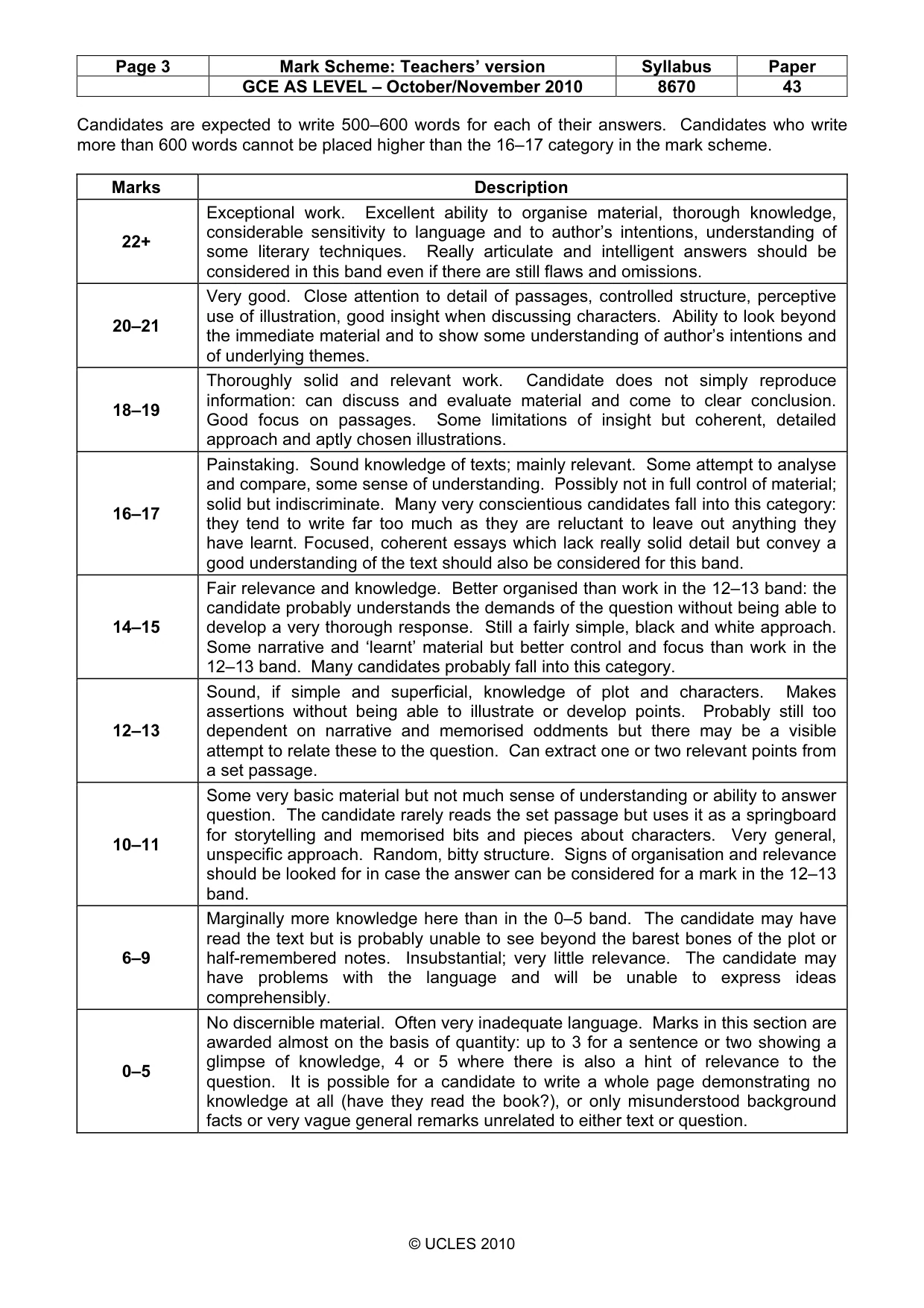
Page 3 Mark Scheme: Teachers’ version Syllabus Paper GCE AS LEVEL – October/November 2010 8670 43 © UCLES 2010 Candidates are expected to write 500–600 words for each of their answers. Candidates who write more than 600 words cannot be placed higher than the 16–17 category in the mark scheme. Marks Description 22+ Exceptional work. Excellent ability to organise material, thorough knowledge, considerable sensitivity to language and to author’s intentions, understanding of some literary techniques. Really articulate and intelligent answers should be considered in this band even if there are still flaws and omissions. 20–21 Very good. Close attention to detail of passages, controlled structure, perceptive use of illustration, good insight when discussing characters. Ability to look beyond the immediate material and to show some understanding of author’s intentions and of underlying themes. 18–19 Thoroughly solid and relevant work. Candidate does not simply reproduce information: can discuss and evaluate material and come to clear conclusion. Good focus on passages. Some limitations of insight but coherent, detailed approach and aptly chosen illustrations. 16–17 Painstaking. Sound knowledge of texts; mainly relevant. Some attempt to analyse and compare, some sense of understanding. Possibly not in full control of material; solid but indiscriminate. Many very conscientious candidates fall into this category: they tend to write far too much as they are reluctant to leave out anything they have learnt. Focused, coherent essays which lack really solid detail but convey a good understanding of the text should also be considered for this band. 14–15 Fair relevance and knowledge. Better organised than work in the 12–13 band: the candidate probably understands the demands of the question without being able to develop a very thorough response. Still a fairly simple, black and white approach. Some narrative and ‘learnt’ material but better control and focus than work in the 12–13 band. Many candidates probably fall into this category. 12–13 Sound, if simple and superficial, knowledge of plot and characters. Makes assertions without being able to illustrate or develop points. Probably still too dependent on narrative and memorised oddments but there may be a visible attempt to relate these to the question. Can extract one or two relevant points from a set passage. 10–11 Some very basic material but not much sense of understanding or ability to answer question. The candidate rarely reads the set passage but uses it as a springboard for storytelling and memorised bits and pieces about characters. Very general, unspecific approach. Random, bitty structure. Signs of organisation and relevance should be looked for in case the answer can be considered for a mark in the 12–13 band. 6–9 Marginally more knowledge here than in the 0–5 band. The candidate may have read the text but is probably unable to see beyond the barest bones of the plot or half-remembered notes. Insubstantial; very little relevance. The candidate may have problems with the language and will be unable to express ideas comprehensibly. 0–5 No discernible material. Often very inadequate language. Marks in this section are awarded almost on the basis of quantity: up to 3 for a sentence or two showing a glimpse of knowledge, 4 or 5 where there is also a hint of relevance to the question. It is possible for a candidate to write a whole page demonstrating no knowledge at all (have they read the book?), or only misunderstood background facts or very vague general remarks unrelated to either text or question.
What you needed in this session
Cambridge’s own grade thresholds for 2010 Oct/Nov, Paper 4 · Variant 3. A higher threshold means an easier paper — the bar moves with how the cohort did.