Cambridge A Level French - Literature (AS Level only) 8670 — 2015 Oct/Nov Paper 4 · Variant 3
8670/43/O/N/15 · 75 marks · ≈84 min
The question paper and its mark scheme, free to read here and free to download. This is Cambridge’s own paper, exactly as it was sat.
Question paper8 pages


Mark scheme3 pages
Answers below. Sit the paper first if you are practising.
Paper as text
Question paper, page 1
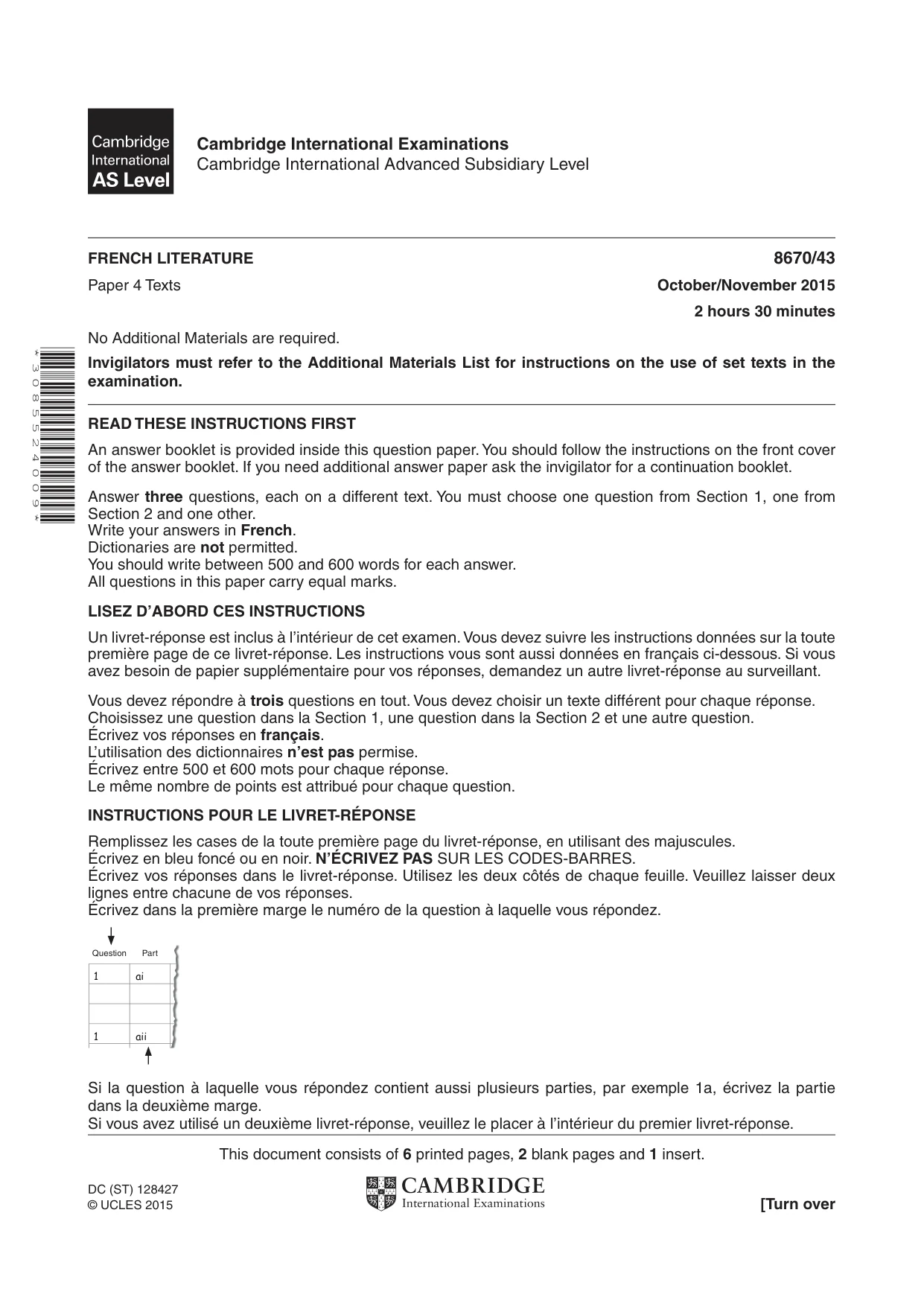
This document consists of 6 printed pages, 2 blank pages and 1 insert. DC (ST) 128427 © UCLES 2015 [Turn over * 3 0 8 5 5 2 4 0 0 9 * FRENCH LITERATURE 8670/43 Paper 4 Texts October/November 2015 2 hours 30 minutes No Additional Materials are required. Invigilators must refer to the Additional Materials List for instructions on the use of set texts in the examination. READ THESE INSTRUCTIONS FIRST An answer booklet is provided inside this question paper. You should follow the instructions on the front cover of the answer booklet. If you need additional answer paper ask the invigilator for a continuation booklet. Answer three questions, each on a different text. You must choose one question from Section 1, one from Section 2 and one other. Write your answers in French. Dictionaries are not permitted. You should write between 500 and 600 words for each answer. All questions in this paper carry equal marks. LISEZ D’ABORD CES INSTRUCTIONS Un livret-réponse est inclus à l’intérieur de cet examen. Vous devez suivre les instructions données sur la toute première page de ce livret-réponse. Les instructions vous sont aussi données en français ci-dessous. Si vous avez besoin de papier supplémentaire pour vos réponses, demandez un autre livret-réponse au surveillant. Vous devez répondre à trois questions en tout. Vous devez choisir un texte différent pour chaque réponse. Choisissez une question dans la Section 1, une question dans la Section 2 et une autre question. Écrivez vos réponses en français. L’utilisation des dictionnaires n’est pas permise. Écrivez entre 500 et 600 mots pour chaque réponse. Le même nombre de points est attribué pour chaque question. INSTRUCTIONS POUR LE LIVRET-RÉPONSE Remplissez les cases de la toute première page du livret-réponse, en utilisant des majuscules. Écrivez en bleu foncé ou en noir. N’ÉCRIVEZ PAS SUR LES CODES-BARRES. Écrivez vos réponses dans le livret-réponse. Utilisez les deux côtés de chaque feuille. Veuillez laisser deux lignes entre chacune de vos réponses. Écrivez dans la première marge le numéro de la question à laquelle vous répondez. Si la question à laquelle vous répondez contient aussi plusieurs parties, par exemple 1a, écrivez la partie dans la deuxième marge. Si vous avez utilisé un deuxième livret-réponse, veuillez le placer à l’intérieur du premier livret-réponse. Question Part 1 1 ai aii Cambridge International Examinations Cambridge International Advanced Subsidiary Level
Question paper, page 2
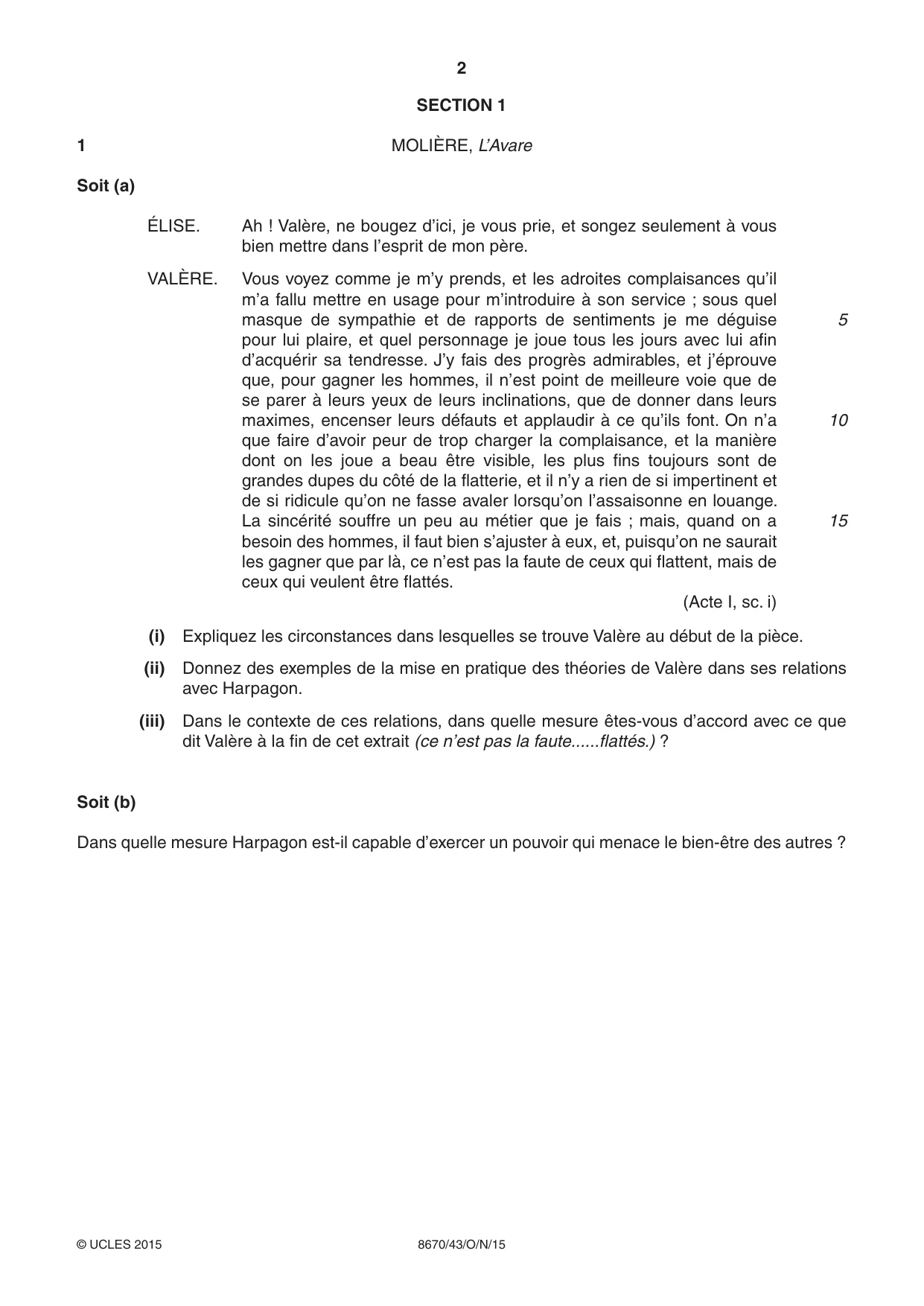
2 8670/43/O/N/15 © UCLES 2015 SECTION 1 1 MOLIÈRE, L’Avare Soit (a) ÉLISE. Ah ! Valère, ne bougez d’ici, je vous prie, et songez seulement à vous bien mettre dans l’esprit de mon père. VALÈRE. Vous voyez comme je m’y prends, et les adroites complaisances qu’il m’a fallu mettre en usage pour m’introduire à son service ; sous quel masque de sympathie et de rapports de sentiments je me déguise pour lui plaire, et quel personnage je joue tous les jours avec lui afin d’acquérir sa tendresse. J’y fais des progrès admirables, et j’éprouve que, pour gagner les hommes, il n’est point de meilleure voie que de se parer à leurs yeux de leurs inclinations, que de donner dans leurs maximes, encenser leurs défauts et applaudir à ce qu’ils font. On n’a que faire d’avoir peur de trop charger la complaisance, et la manière dont on les joue a beau être visible, les plus fins toujours sont de grandes dupes du côté de la flatterie, et il n’y a rien de si impertinent et de si ridicule qu’on ne fasse avaler lorsqu’on l’assaisonne en louange. La sincérité souffre un peu au métier que je fais ; mais, quand on a besoin des hommes, il faut bien s’ajuster à eux, et, puisqu’on ne saurait les gagner que par là, ce n’est pas la faute de ceux qui flattent, mais de ceux qui veulent être flattés. (Acte I, sc. i) 5 10 15 (i) Expliquez les circonstances dans lesquelles se trouve Valère au début de la pièce. (ii) Donnez des exemples de la mise en pratique des théories de Valère dans ses relations avec Harpagon. (iii) Dans le contexte de ces relations, dans quelle mesure êtes-vous d’accord avec ce que dit Valère à la fin de cet extrait (ce n’est pas la faute…flattés.) ? Soit (b) Dans quelle mesure Harpagon est-il capable d’exercer un pouvoir qui menace le bien-être des autres ?
Question paper, page 3
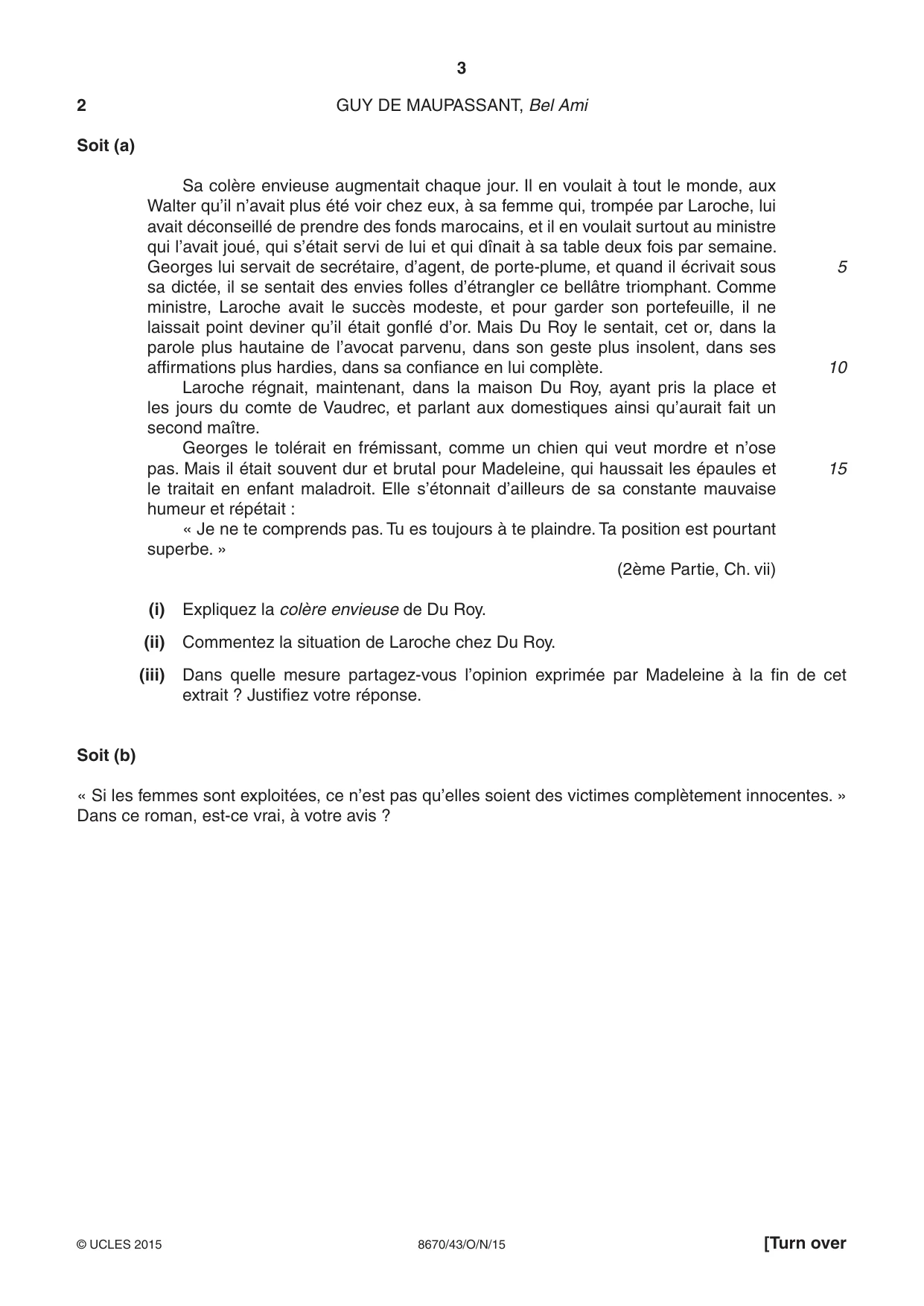
3 8670/43/O/N/15 © UCLES 2015 [Turn over 2 GUY DE MAUPASSANT, Bel Ami Soit (a) Sa colère envieuse augmentait chaque jour. Il en voulait à tout le monde, aux Walter qu’il n’avait plus été voir chez eux, à sa femme qui, trompée par Laroche, lui avait déconseillé de prendre des fonds marocains, et il en voulait surtout au ministre qui l’avait joué, qui s’était servi de lui et qui dînait à sa table deux fois par semaine. Georges lui servait de secrétaire, d’agent, de porte-plume, et quand il écrivait sous sa dictée, il se sentait des envies folles d’étrangler ce bellâtre triomphant. Comme ministre, Laroche avait le succès modeste, et pour garder son portefeuille, il ne laissait point deviner qu’il était gonflé d’or. Mais Du Roy le sentait, cet or, dans la parole plus hautaine de l’avocat parvenu, dans son geste plus insolent, dans ses affirmations plus hardies, dans sa confiance en lui complète. Laroche régnait, maintenant, dans la maison Du Roy, ayant pris la place et les jours du comte de Vaudrec, et parlant aux domestiques ainsi qu’aurait fait un second maître. Georges le tolérait en frémissant, comme un chien qui veut mordre et n’ose pas. Mais il était souvent dur et brutal pour Madeleine, qui haussait les épaules et le traitait en enfant maladroit. Elle s’étonnait d’ailleurs de sa constante mauvaise humeur et répétait : « Je ne te comprends pas. Tu es toujours à te plaindre. Ta position est pourtant superbe. » (2ème Partie, Ch. vii) (i) Expliquez la colère envieuse de Du Roy. (ii) Commentez la situation de Laroche chez Du Roy. (iii) Dans quelle mesure partagez-vous l’opinion exprimée par Madeleine à la fin de cet extrait ? Justifiez votre réponse. Soit (b) « Si les femmes sont exploitées, ce n’est pas qu’elles soient des victimes complètement innocentes. » Dans ce roman, est-ce vrai, à votre avis ? 5 10 15
Question paper, page 4
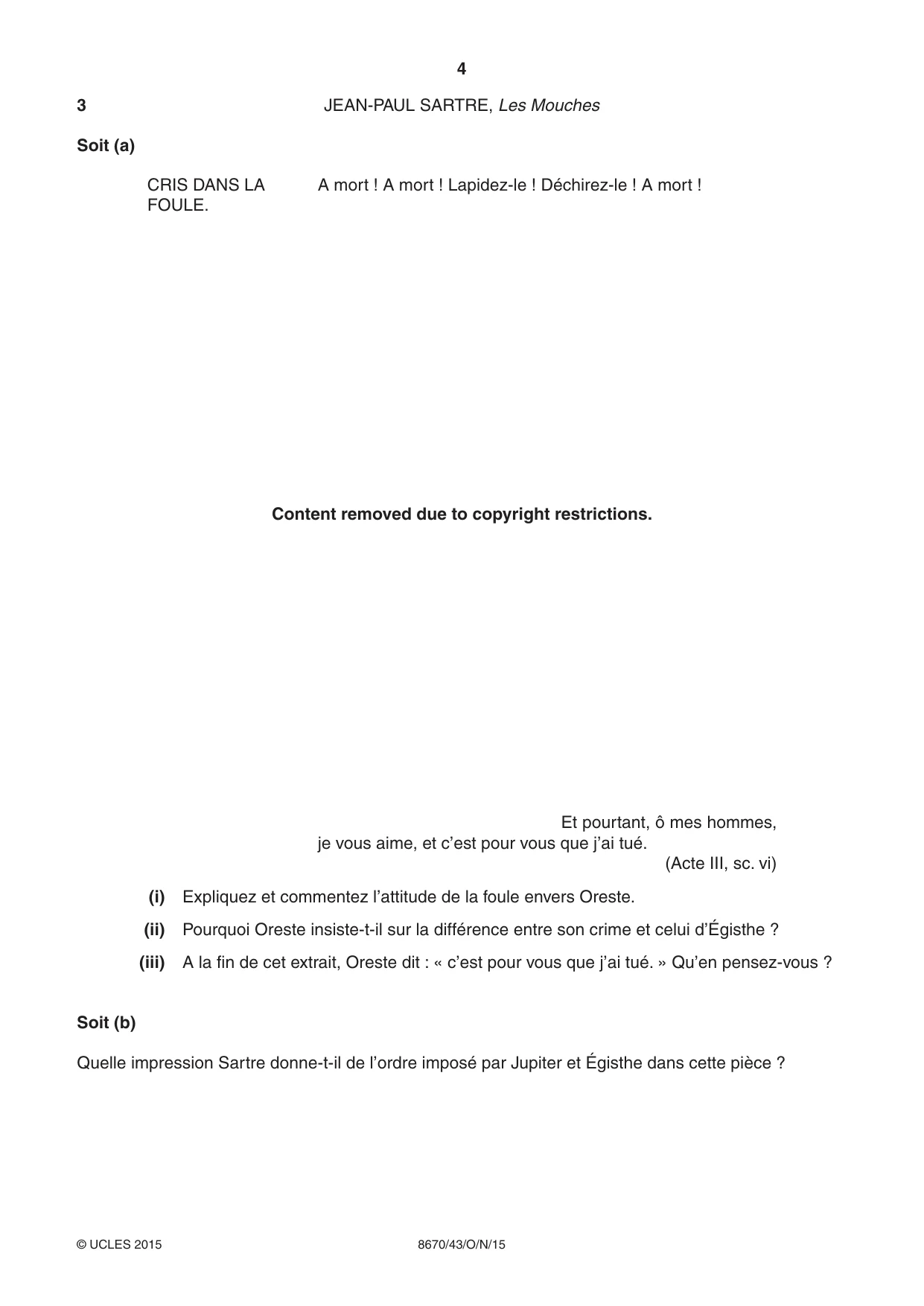
4 8670/43/O/N/15 © UCLES 2015 3 JEAN-PAUL SARTRE, Les Mouches Soit (a) CRIS DANS LA FOULE. A mort ! A mort ! Lapidez-le ! Déchirez-le ! A mort ! Et pourtant, ô mes hommes, je vous aime, et c’est pour vous que j’ai tué. (Acte III, sc. vi) (i) Expliquez et commentez l’attitude de la foule envers Oreste. (ii) Pourquoi Oreste insiste-t-il sur la différence entre son crime et celui d’Égisthe ? (iii) A la fin de cet extrait, Oreste dit : « c’est pour vous que j’ai tué. » Qu’en pensez-vous ? Soit (b) Quelle impression Sartre donne-t-il de l’ordre imposé par Jupiter et Égisthe dans cette pièce ? Content removed due to copyright restrictions.
Question paper, page 5
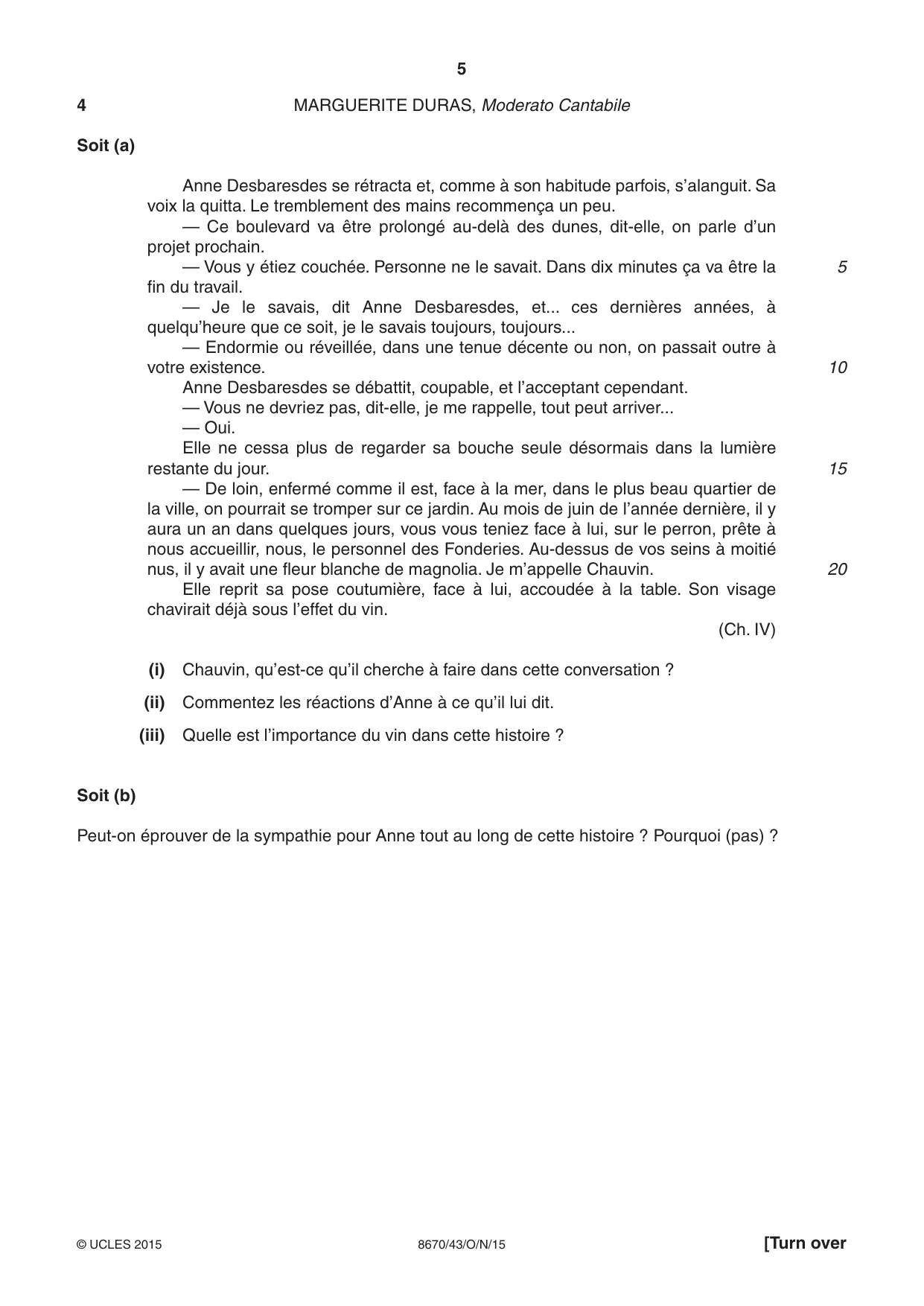
5 8670/43/O/N/15 © UCLES 2015 [Turn over 4 MARGUERITE DURAS, Moderato Cantabile Soit (a) Anne Desbaresdes se rétracta et, comme à son habitude parfois, s’alanguit. Sa voix la quitta. Le tremblement des mains recommença un peu. — Ce boulevard va être prolongé au-delà des dunes, dit-elle, on parle d’un projet prochain. — Vous y étiez couchée. Personne ne le savait. Dans dix minutes ça va être la fin du travail. — Je le savais, dit Anne Desbaresdes, et... ces dernières années, à quelqu’heure que ce soit, je le savais toujours, toujours... — Endormie ou réveillée, dans une tenue décente ou non, on passait outre à votre existence. Anne Desbaresdes se débattit, coupable, et l’acceptant cependant. — Vous ne devriez pas, dit-elle, je me rappelle, tout peut arriver... — Oui. Elle ne cessa plus de regarder sa bouche seule désormais dans la lumière restante du jour. — De loin, enfermé comme il est, face à la mer, dans le plus beau quartier de la ville, on pourrait se tromper sur ce jardin. Au mois de juin de l’année dernière, il y aura un an dans quelques jours, vous vous teniez face à lui, sur le perron, prête à nous accueillir, nous, le personnel des Fonderies. Au-dessus de vos seins à moitié nus, il y avait une fleur blanche de magnolia. Je m’appelle Chauvin. Elle reprit sa pose coutumière, face à lui, accoudée à la table. Son visage chavirait déjà sous l’effet du vin. (Ch. IV) (i) Chauvin, qu’est-ce qu’il cherche à faire dans cette conversation ? (ii) Commentez les réactions d’Anne à ce qu’il lui dit. (iii) Quelle est l’importance du vin dans cette histoire ? Soit (b) Peut-on éprouver de la sympathie pour Anne tout au long de cette histoire ? Pourquoi (pas) ? 5 10 15 20
Question paper, page 6
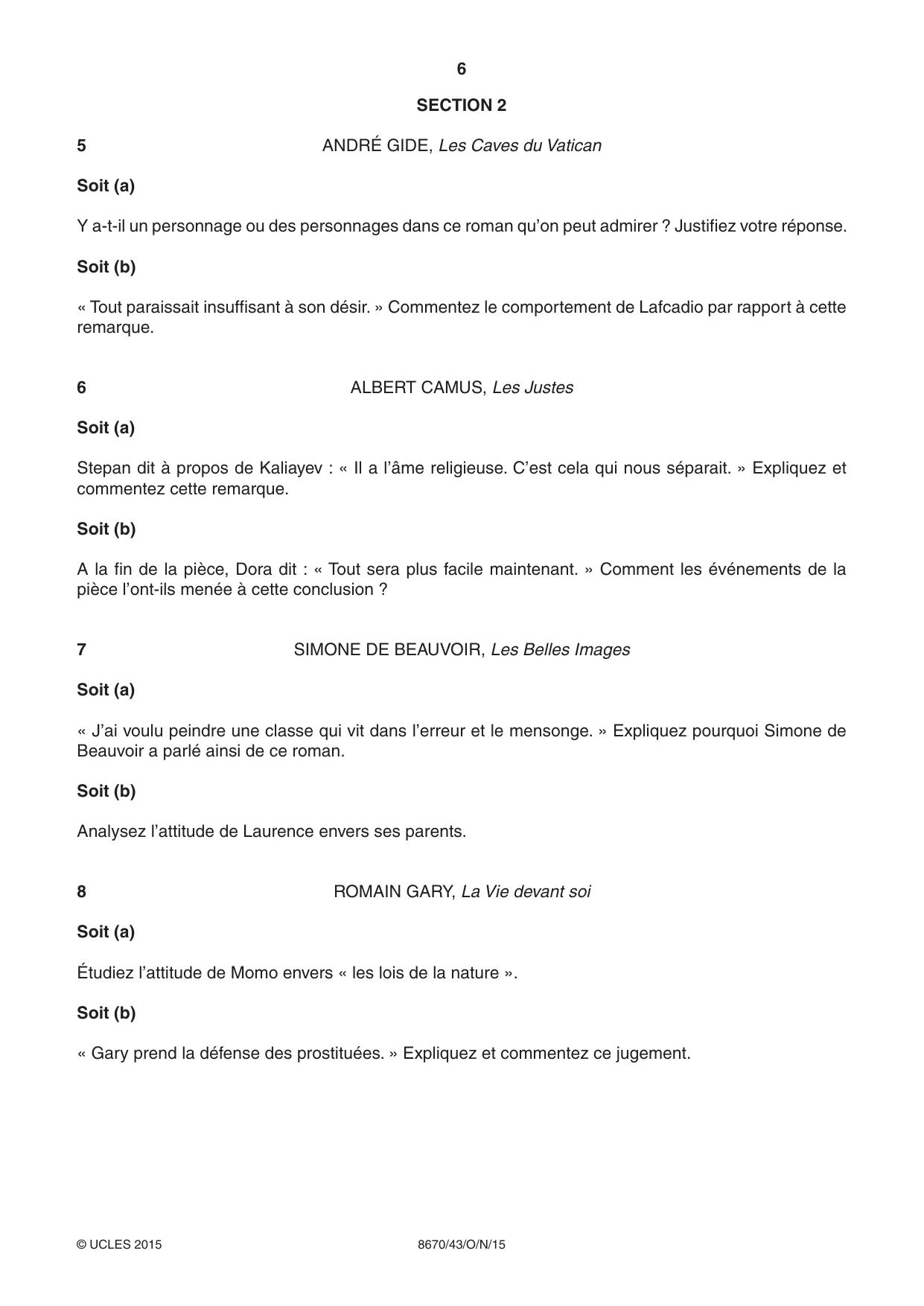
6 8670/43/O/N/15 © UCLES 2015 SECTION 2 5 ANDRÉ GIDE, Les Caves du Vatican Soit (a) Y a-t-il un personnage ou des personnages dans ce roman qu’on peut admirer ? Justifiez votre réponse. Soit (b) « Tout paraissait insuffisant à son désir. » Commentez le comportement de Lafcadio par rapport à cette remarque. 6 ALBERT CAMUS, Les Justes Soit (a) Stepan dit à propos de Kaliayev : « Il a l’âme religieuse. C’est cela qui nous séparait. » Expliquez et commentez cette remarque. Soit (b) A la fin de la pièce, Dora dit : « Tout sera plus facile maintenant. » Comment les événements de la pièce l’ont-ils menée à cette conclusion ? 7 SIMONE DE BEAUVOIR, Les Belles Images Soit (a) « J’ai voulu peindre une classe qui vit dans l’erreur et le mensonge. » Expliquez pourquoi Simone de Beauvoir a parlé ainsi de ce roman. Soit (b) Analysez l’attitude de Laurence envers ses parents. 8 ROMAIN GARY, La Vie devant soi Soit (a) Étudiez l’attitude de Momo envers « les lois de la nature ». Soit (b) « Gary prend la défense des prostituées. » Expliquez et commentez ce jugement.
Question paper, page 7
7 8670/43/O/N/15 © UCLES 2015 BLANK PAGE
Question paper, page 8
8 8670/43/O/N/15 © UCLES 2015 BLANK PAGE Permission to reproduce items where third-party owned material protected by copyright is included has been sought and cleared where possible. Every reasonable effort has been made by the publisher (UCLES) to trace copyright holders, but if any items requiring clearance have unwittingly been included, the publisher will be pleased to make amends at the earliest possible opportunity. To avoid the issue of disclosure of answer-related information to candidates, all copyright acknowledgements are reproduced online in the Cambridge International Examinations Copyright Acknowledgements Booklet. This is produced for each series of examinations and is freely available to download at www.cie.org.uk after the live examination series. Cambridge International Examinations is part of the Cambridge Assessment Group. Cambridge Assessment is the brand name of University of Cambridge Local Examinations Syndicate (UCLES), which is itself a department of the University of Cambridge.
Mark scheme, page 1
® IGCSE is the registered trademark of Cambridge International Examinations. CAMBRIDGE INTERNATIONAL EXAMINATIONS Cambridge International Advanced Subsidiary Level MARK SCHEME for the October/November 2015 series 8670 FRENCH LITERATURE 8670/43 Paper 4 (Texts), maximum raw mark 75 This mark scheme is published as an aid to teachers and candidates, to indicate the requirements of the examination. It shows the basis on which Examiners were instructed to award marks. It does not indicate the details of the discussions that took place at an Examiners’ meeting before marking began, which would have considered the acceptability of alternative answers. Mark schemes should be read in conjunction with the question paper and the Principal Examiner Report for Teachers. Cambridge will not enter into discussions about these mark schemes. Cambridge is publishing the mark schemes for the October/November 2015 series for most Cambridge IGCSE®, Cambridge International A and AS Level components and some Cambridge O Level components.
Mark scheme, page 2
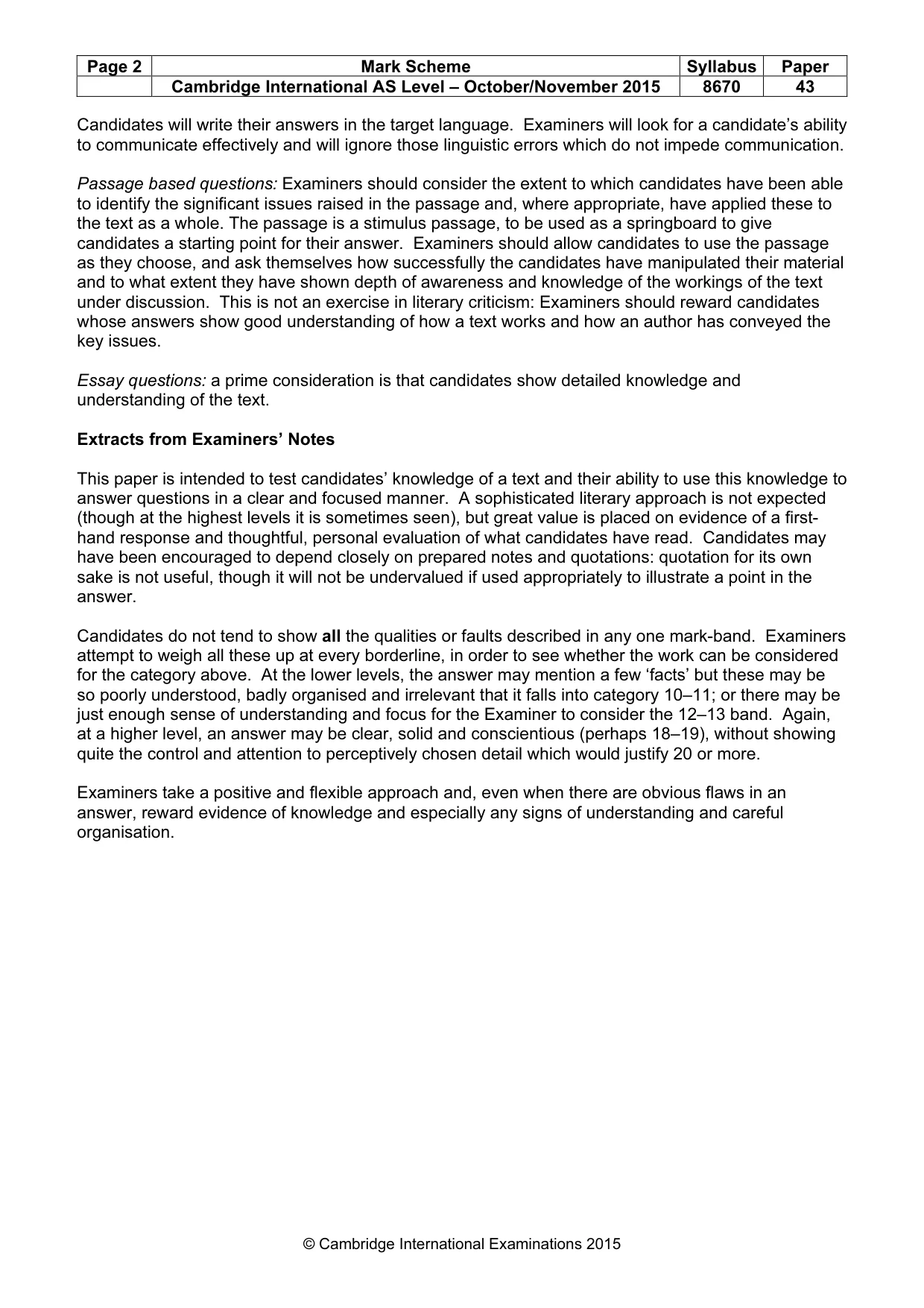
Page 2 Mark Scheme Syllabus Paper Cambridge International AS Level – October/November 2015 8670 43 © Cambridge International Examinations 2015 Candidates will write their answers in the target language. Examiners will look for a candidate’s ability to communicate effectively and will ignore those linguistic errors which do not impede communication. Passage based questions: Examiners should consider the extent to which candidates have been able to identify the significant issues raised in the passage and, where appropriate, have applied these to the text as a whole. The passage is a stimulus passage, to be used as a springboard to give candidates a starting point for their answer. Examiners should allow candidates to use the passage as they choose, and ask themselves how successfully the candidates have manipulated their material and to what extent they have shown depth of awareness and knowledge of the workings of the text under discussion. This is not an exercise in literary criticism: Examiners should reward candidates whose answers show good understanding of how a text works and how an author has conveyed the key issues. Essay questions: a prime consideration is that candidates show detailed knowledge and understanding of the text. Extracts from Examiners’ Notes This paper is intended to test candidates’ knowledge of a text and their ability to use this knowledge to answer questions in a clear and focused manner. A sophisticated literary approach is not expected (though at the highest levels it is sometimes seen), but great value is placed on evidence of a first- hand response and thoughtful, personal evaluation of what candidates have read. Candidates may have been encouraged to depend closely on prepared notes and quotations: quotation for its own sake is not useful, though it will not be undervalued if used appropriately to illustrate a point in the answer. Candidates do not tend to show all the qualities or faults described in any one mark-band. Examiners attempt to weigh all these up at every borderline, in order to see whether the work can be considered for the category above. At the lower levels, the answer may mention a few ‘facts’ but these may be so poorly understood, badly organised and irrelevant that it falls into category 10–11; or there may be just enough sense of understanding and focus for the Examiner to consider the 12–13 band. Again, at a higher level, an answer may be clear, solid and conscientious (perhaps 18–19), without showing quite the control and attention to perceptively chosen detail which would justify 20 or more. Examiners take a positive and flexible approach and, even when there are obvious flaws in an answer, reward evidence of knowledge and especially any signs of understanding and careful organisation.
Mark scheme, page 3
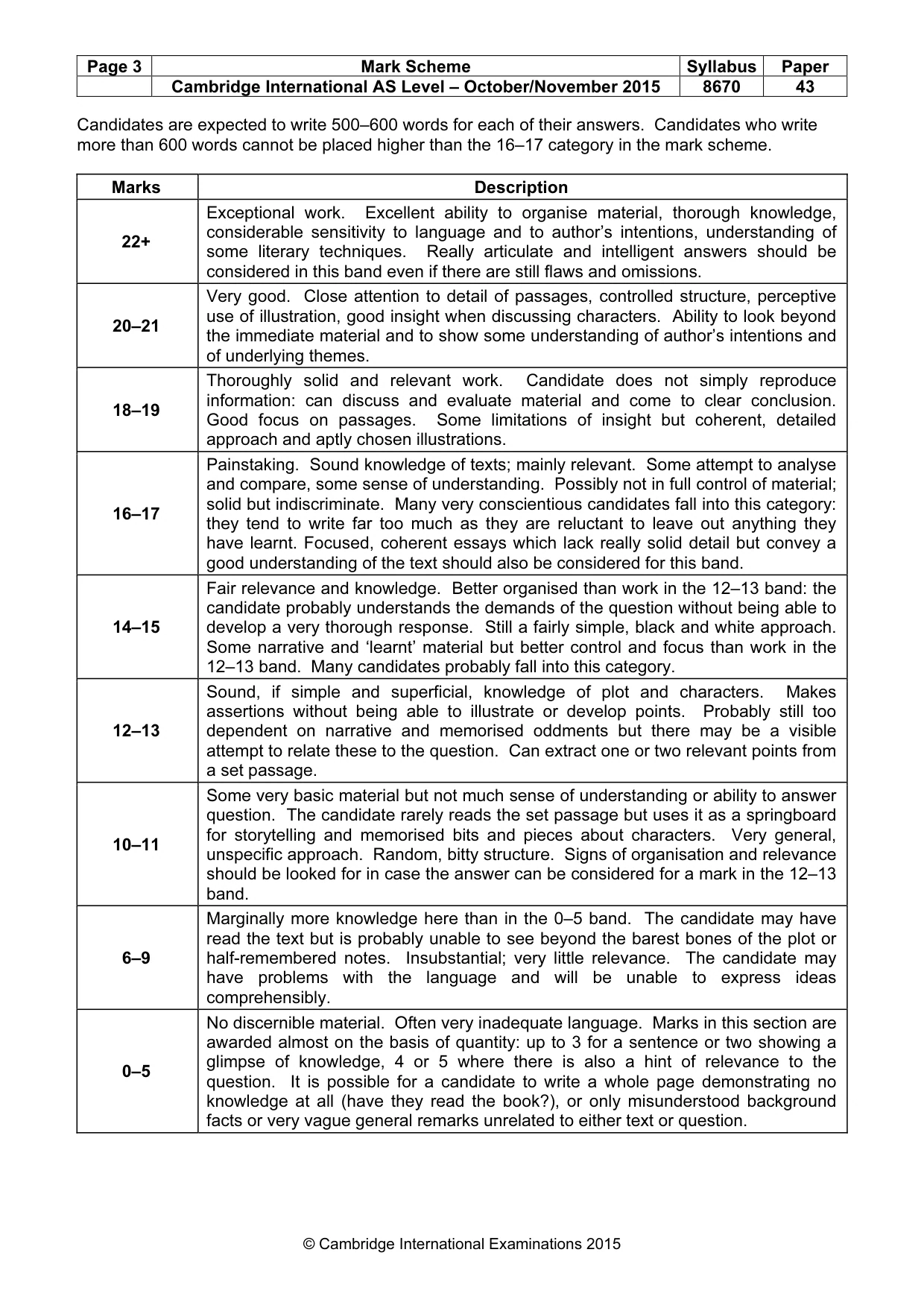
Page 3 Mark Scheme Syllabus Paper Cambridge International AS Level – October/November 2015 8670 43 © Cambridge International Examinations 2015 Candidates are expected to write 500–600 words for each of their answers. Candidates who write more than 600 words cannot be placed higher than the 16–17 category in the mark scheme. Marks Description 22+ Exceptional work. Excellent ability to organise material, thorough knowledge, considerable sensitivity to language and to author’s intentions, understanding of some literary techniques. Really articulate and intelligent answers should be considered in this band even if there are still flaws and omissions. 20–21 Very good. Close attention to detail of passages, controlled structure, perceptive use of illustration, good insight when discussing characters. Ability to look beyond the immediate material and to show some understanding of author’s intentions and of underlying themes. 18–19 Thoroughly solid and relevant work. Candidate does not simply reproduce information: can discuss and evaluate material and come to clear conclusion. Good focus on passages. Some limitations of insight but coherent, detailed approach and aptly chosen illustrations. 16–17 Painstaking. Sound knowledge of texts; mainly relevant. Some attempt to analyse and compare, some sense of understanding. Possibly not in full control of material; solid but indiscriminate. Many very conscientious candidates fall into this category: they tend to write far too much as they are reluctant to leave out anything they have learnt. Focused, coherent essays which lack really solid detail but convey a good understanding of the text should also be considered for this band. 14–15 Fair relevance and knowledge. Better organised than work in the 12–13 band: the candidate probably understands the demands of the question without being able to develop a very thorough response. Still a fairly simple, black and white approach. Some narrative and ‘learnt’ material but better control and focus than work in the 12–13 band. Many candidates probably fall into this category. 12–13 Sound, if simple and superficial, knowledge of plot and characters. Makes assertions without being able to illustrate or develop points. Probably still too dependent on narrative and memorised oddments but there may be a visible attempt to relate these to the question. Can extract one or two relevant points from a set passage. 10–11 Some very basic material but not much sense of understanding or ability to answer question. The candidate rarely reads the set passage but uses it as a springboard for storytelling and memorised bits and pieces about characters. Very general, unspecific approach. Random, bitty structure. Signs of organisation and relevance should be looked for in case the answer can be considered for a mark in the 12–13 band. 6–9 Marginally more knowledge here than in the 0–5 band. The candidate may have read the text but is probably unable to see beyond the barest bones of the plot or half-remembered notes. Insubstantial; very little relevance. The candidate may have problems with the language and will be unable to express ideas comprehensibly. 0–5 No discernible material. Often very inadequate language. Marks in this section are awarded almost on the basis of quantity: up to 3 for a sentence or two showing a glimpse of knowledge, 4 or 5 where there is also a hint of relevance to the question. It is possible for a candidate to write a whole page demonstrating no knowledge at all (have they read the book?), or only misunderstood background facts or very vague general remarks unrelated to either text or question.
What you needed in this session
Cambridge’s own grade thresholds for 2015 Oct/Nov, Paper 4 · Variant 3. A higher threshold means an easier paper — the bar moves with how the cohort did.