Cambridge A Level French (A Level only) 9716 — 2018 May/June Paper 2 · Variant 3
9716/23/M/J/18 · 70 marks · ≈79 min
The question paper and its mark scheme, free to read here and free to download. This is Cambridge’s own paper, exactly as it was sat.
Question paper8 pages
Mark scheme16 pages
Answers below. Sit the paper first if you are practising.
Paper as text
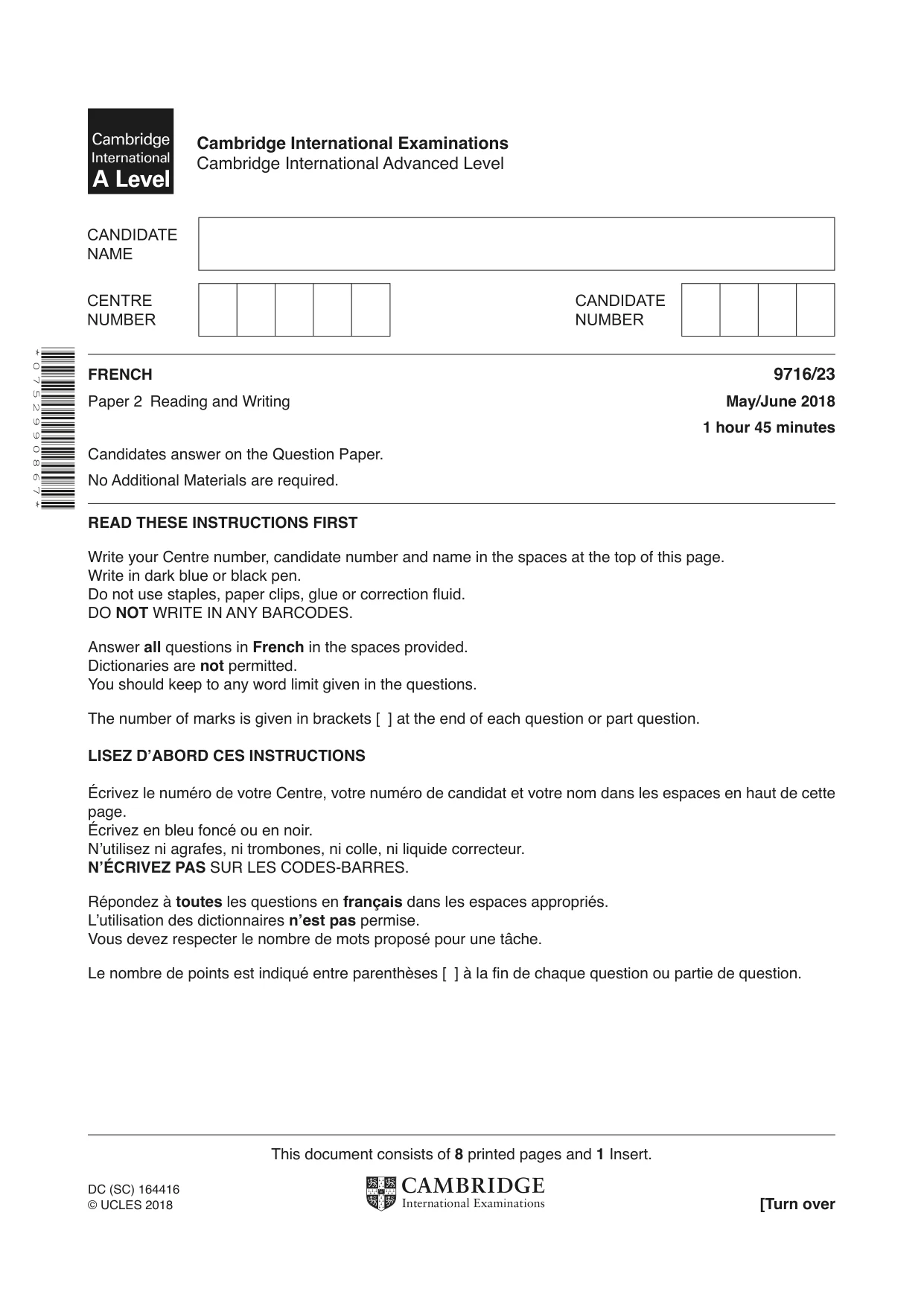
Question paper, page 1
* 0 7 5 2 9 9 0 8 6 7 * This document consists of 8 printed pages and 1 Insert. DC (SC) 164416 © UCLES 2018 [Turn over Cambridge International Examinations Cambridge International Advanced Level FRENCH 9716/23 Paper 2 Reading and Writing May/June 2018 1 hour 45 minutes Candidates answer on the Question Paper. No Additional Materials are required. READ THESE INSTRUCTIONS FIRST Write your Centre number, candidate number and name in the spaces at the top of this page. Write in dark blue or black pen. Do not use staples, paper clips, glue or correction fluid. DO NOT WRITE IN ANY BARCODES. Answer all questions in French in the spaces provided. Dictionaries are not permitted. You should keep to any word limit given in the questions. The number of marks is given in brackets [ ] at the end of each question or part question. LISEZ D’ABORD CES INSTRUCTIONS Écrivez le numéro de votre Centre, votre numéro de candidat et votre nom dans les espaces en haut de cette page. Écrivez en bleu foncé ou en noir. N’utilisez ni agrafes, ni trombones, ni colle, ni liquide correcteur. N’ÉCRIVEZ PAS SUR LES CODES-BARRES. Répondez à toutes les questions en français dans les espaces appropriés. L’utilisation des dictionnaires n’est pas permise. Vous devez respecter le nombre de mots proposé pour une tâche. Le nombre de points est indiqué entre parenthèses [ ] à la fin de chaque question ou partie de question.
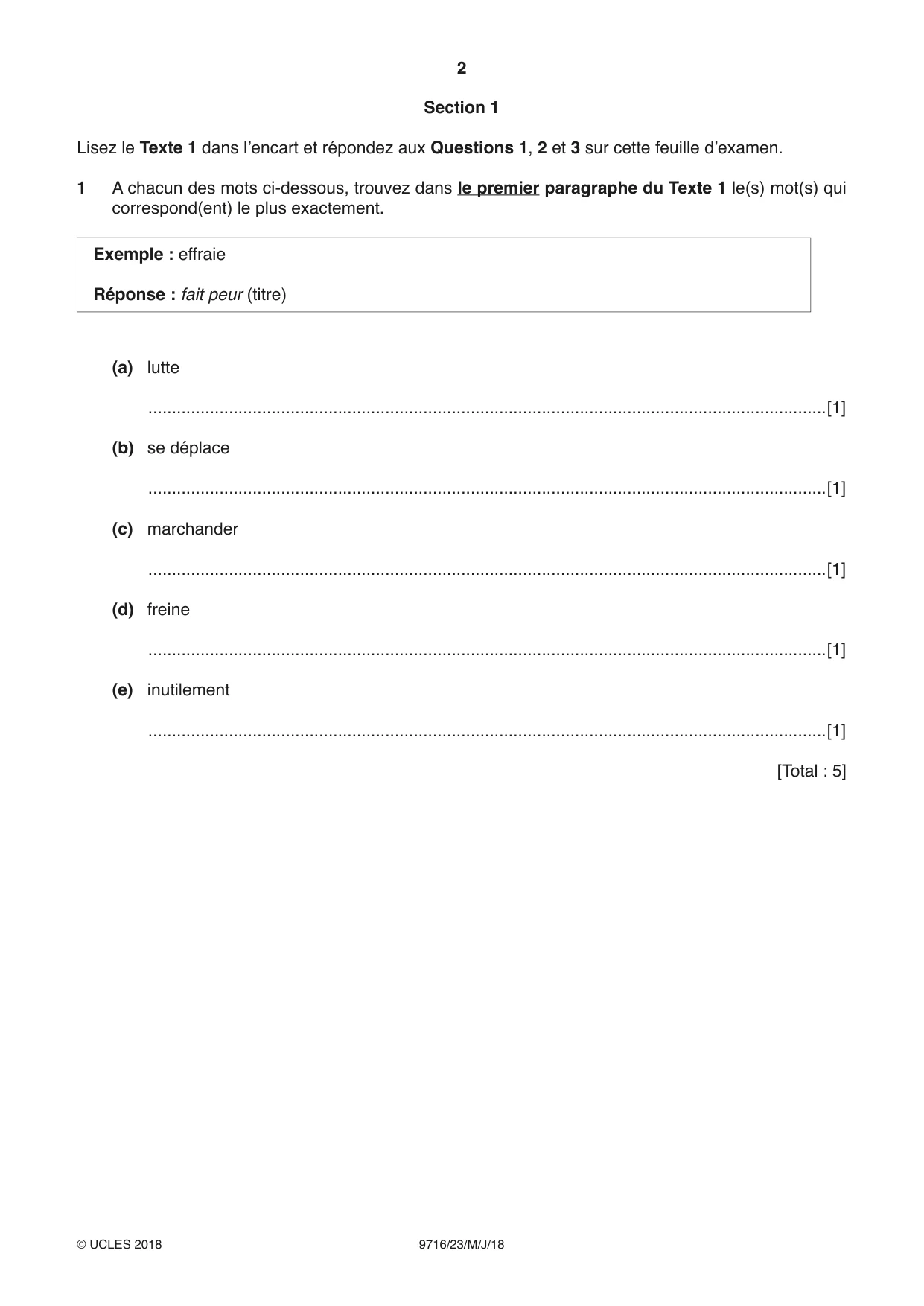
Question paper, page 2
2 9716/23/M/J/18 © UCLES 2018 Section 1 Lisez le Texte 1 dans l’encart et répondez aux Questions 1, 2 et 3 sur cette feuille d’examen. 1 A chacun des mots ci-dessous, trouvez dans le premier paragraphe du Texte 1 le(s) mot(s) qui correspond(ent) le plus exactement. Exemple : effraie Réponse : fait peur (titre) (a) lutte …[1] (b) se déplace …[1] (c) marchander …[1] (d) freine …[1] (e) inutilement …[1] [Total : 5]
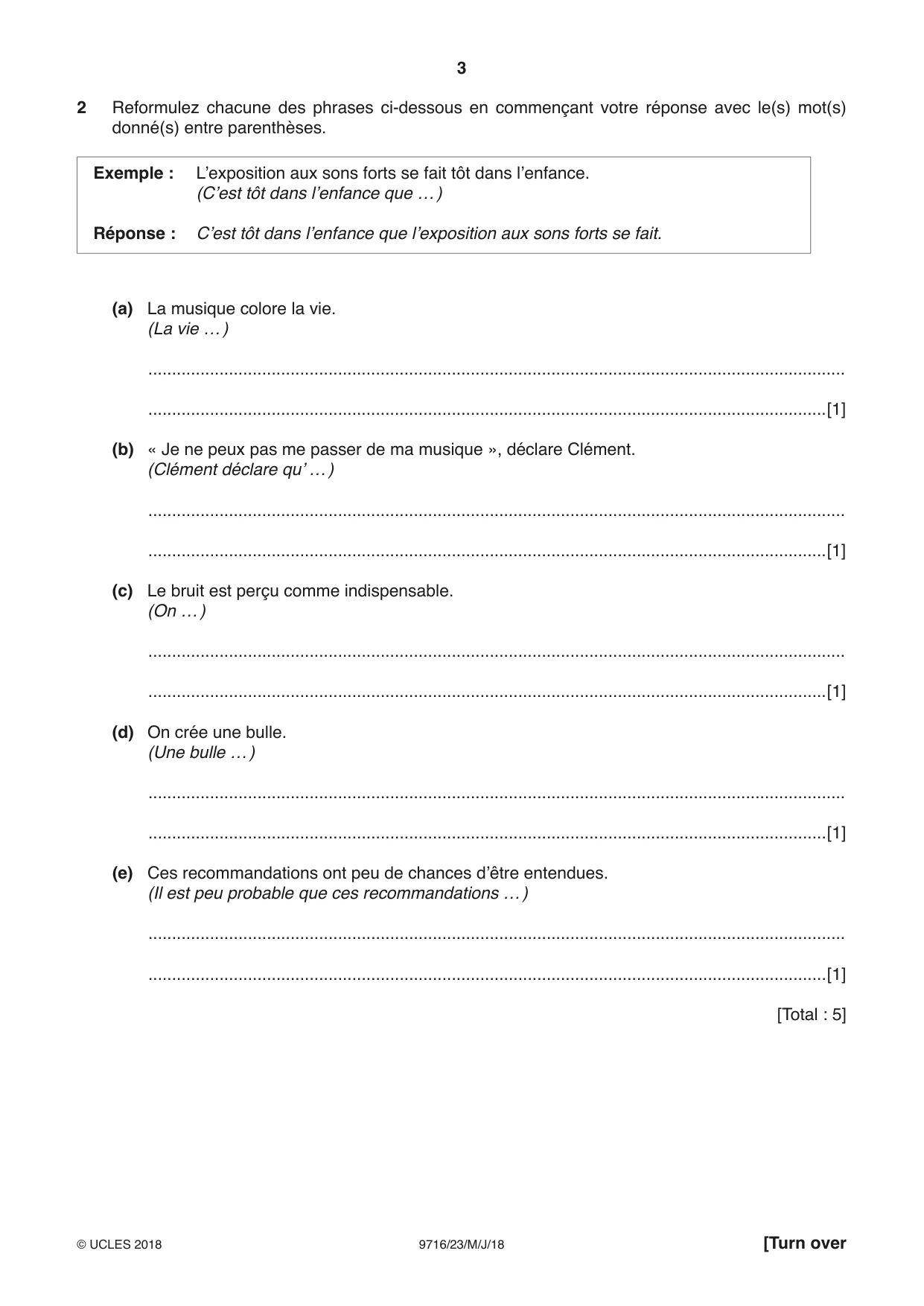
Question paper, page 3
3 9716/23/M/J/18 © UCLES 2018 [Turn over 2 Reformulez chacune des phrases ci-dessous en commençant votre réponse avec le(s) mot(s) donné(s) entre parenthèses. Exemple : L’exposition aux sons forts se fait tôt dans l’enfance. (C’est tôt dans l’enfance que … ) Réponse : C’est tôt dans l’enfance que l’exposition aux sons forts se fait. (a) La musique colore la vie. (La vie … ) … …[1] (b) « Je ne peux pas me passer de ma musique », déclare Clément. (Clément déclare qu’ … ) … …[1] (c) Le bruit est perçu comme indispensable. (On … ) … …[1] (d) On crée une bulle. (Une bulle … ) … …[1] (e) Ces recommandations ont peu de chances d’être entendues. (Il est peu probable que ces recommandations … ) … …[1] [Total : 5]
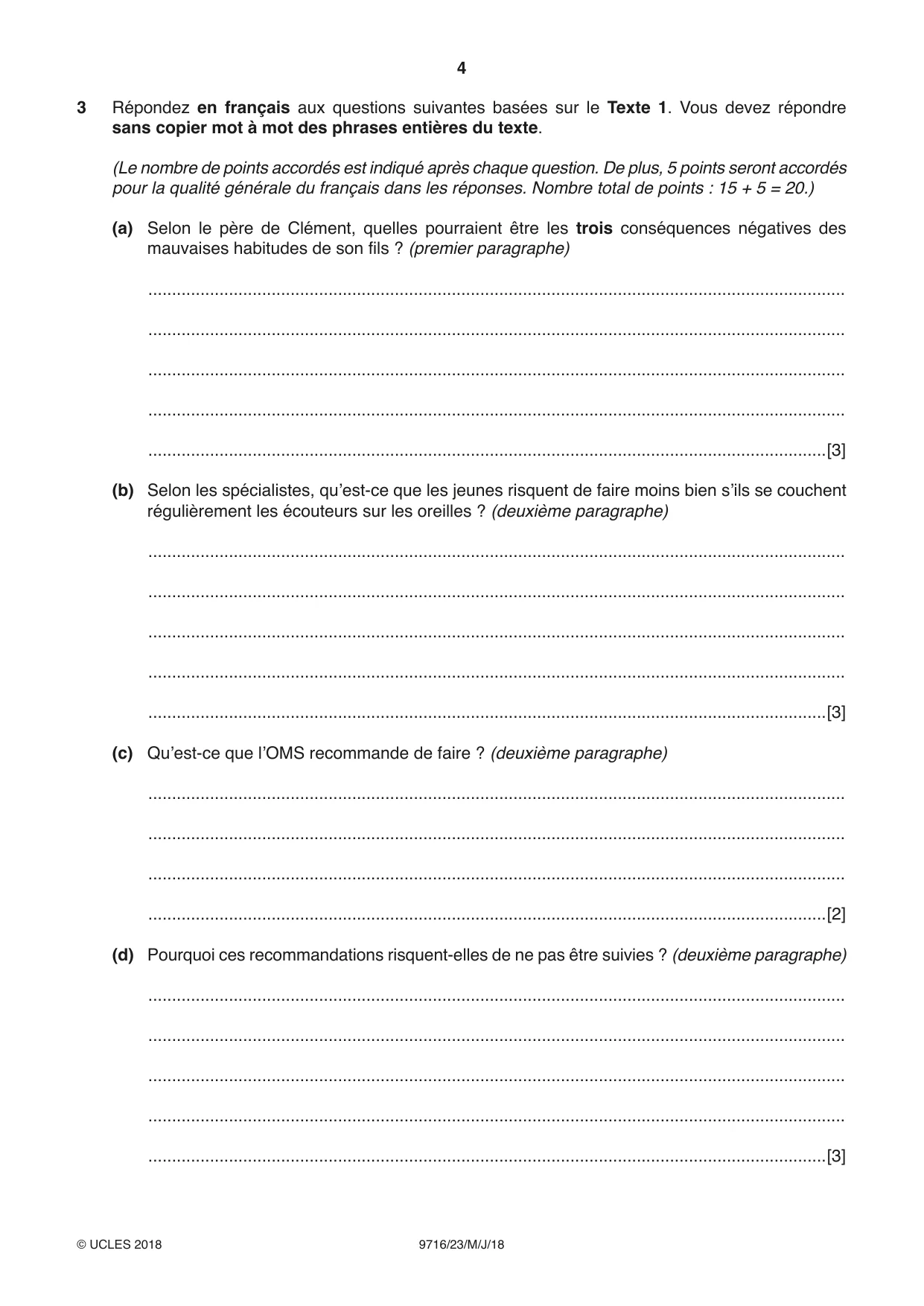
Question paper, page 4
4 9716/23/M/J/18 © UCLES 2018 3 Répondez en français aux questions suivantes basées sur le Texte 1. Vous devez répondre sans copier mot à mot des phrases entières du texte. (Le nombre de points accordés est indiqué après chaque question. De plus, 5 points seront accordés pour la qualité générale du français dans les réponses. Nombre total de points : 15 + 5 = 20.) (a) Selon le père de Clément, quelles pourraient être les trois conséquences négatives des mauvaises habitudes de son fils ? (premier paragraphe) … … … … …[3] (b) Selon les spécialistes, qu’est-ce que les jeunes risquent de faire moins bien s’ils se couchent régulièrement les écouteurs sur les oreilles ? (deuxième paragraphe) … … … … …[3] (c) Qu’est-ce que l’OMS recommande de faire ? (deuxième paragraphe) … … … …[2] (d) Pourquoi ces recommandations risquent-elles de ne pas être suivies ? (deuxième paragraphe) … … … … …[3]
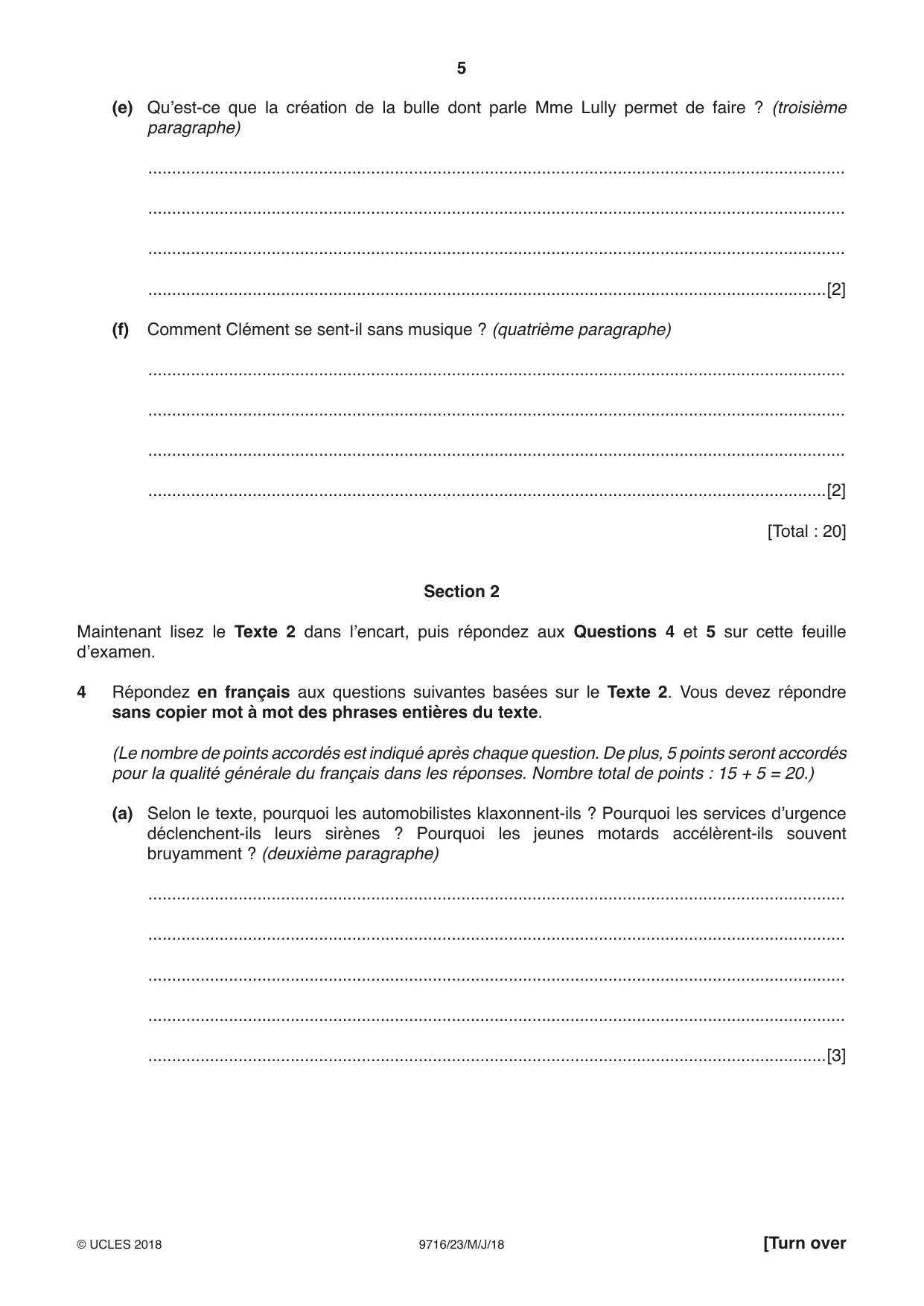
Question paper, page 5
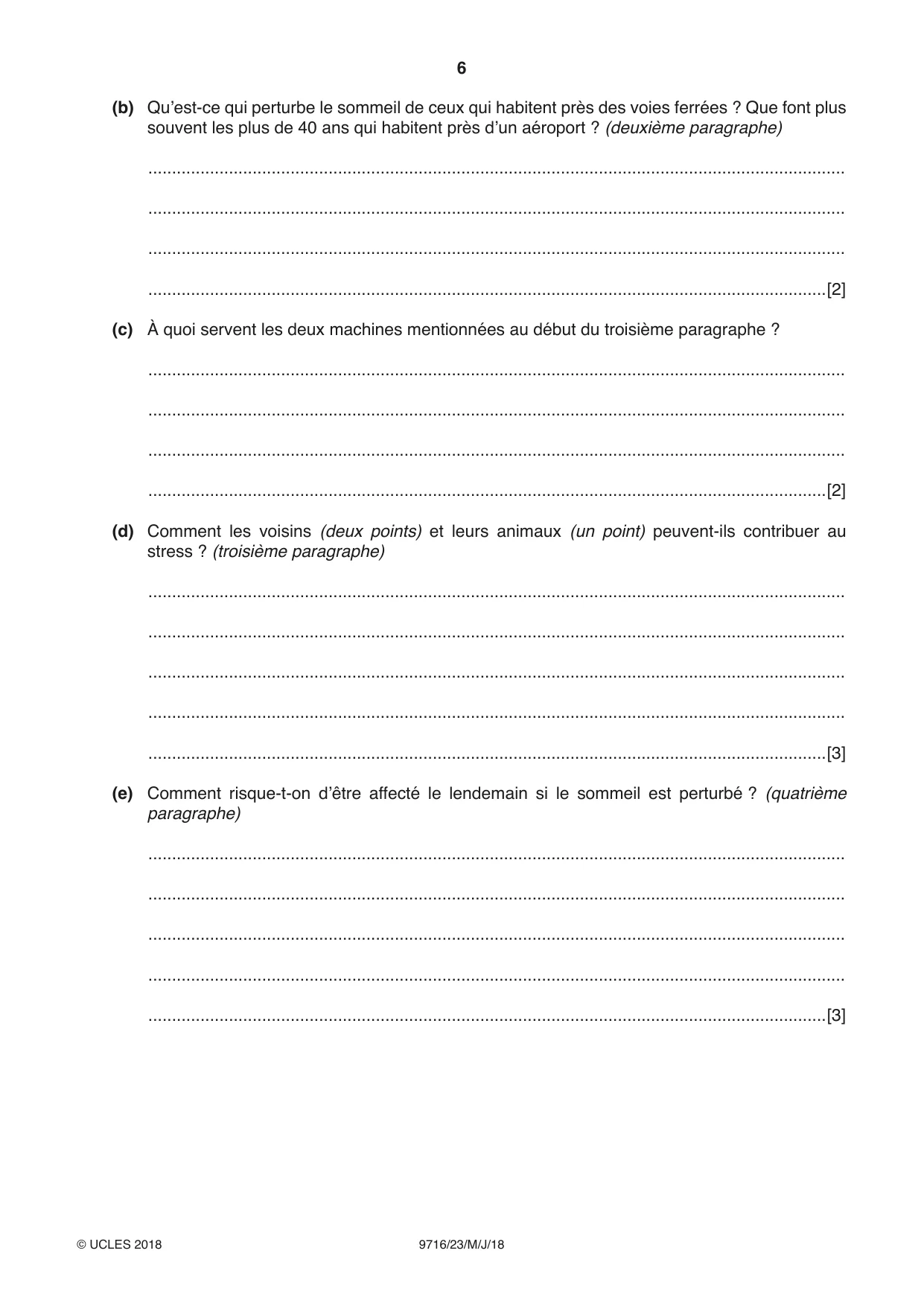
5 9716/23/M/J/18 © UCLES 2018 [Turn over (e) Qu’est-ce que la création de la bulle dont parle Mme Lully permet de faire ? (troisième paragraphe) … … … …[2] (f) Comment Clément se sent-il sans musique ? (quatrième paragraphe) … … … …[2] [Total : 20] Section 2 Maintenant lisez le Texte 2 dans l’encart, puis répondez aux Questions 4 et 5 sur cette feuille d’examen. 4 Répondez en français aux questions suivantes basées sur le Texte 2. Vous devez répondre sans copier mot à mot des phrases entières du texte. (Le nombre de points accordés est indiqué après chaque question. De plus, 5 points seront accordés pour la qualité générale du français dans les réponses. Nombre total de points : 15 + 5 = 20.) (a) Selon le texte, pourquoi les automobilistes klaxonnent-ils ? Pourquoi les services d’urgence déclenchent-ils leurs sirènes ? Pourquoi les jeunes motards accélèrent-ils souvent bruyamment ? (deuxième paragraphe) … … … … …[3]
Question paper, page 6
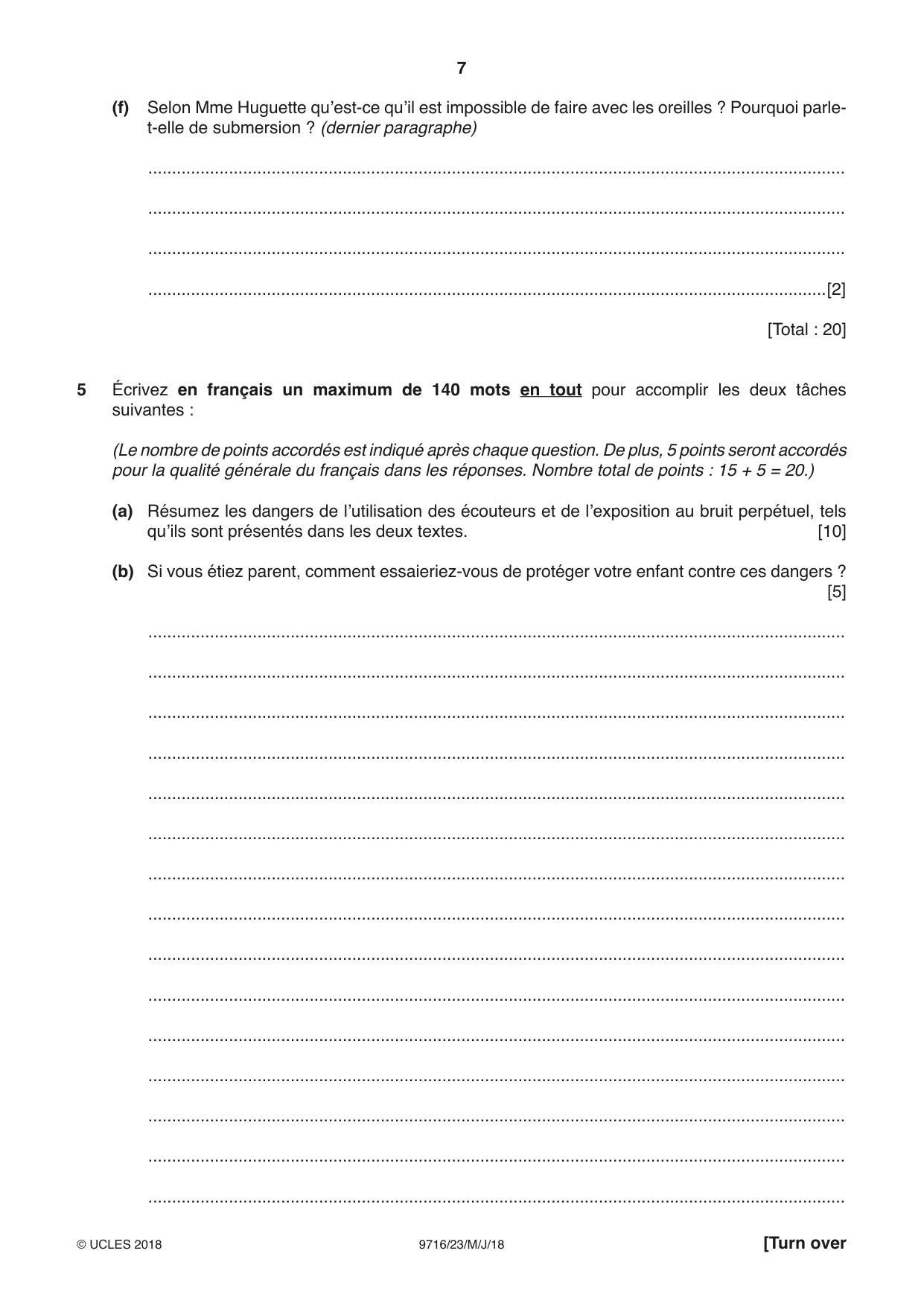
6 9716/23/M/J/18 © UCLES 2018 (b) Qu’est-ce qui perturbe le sommeil de ceux qui habitent près des voies ferrées ? Que font plus souvent les plus de 40 ans qui habitent près d’un aéroport ? (deuxième paragraphe) … … … …[2] (c) À quoi servent les deux machines mentionnées au début du troisième paragraphe ? … … … …[2] (d) Comment les voisins (deux points) et leurs animaux (un point) peuvent-ils contribuer au stress ? (troisième paragraphe) … … … … …[3] (e) Comment risque-t-on d’être affecté le lendemain si le sommeil est perturbé ? (quatrième paragraphe) … … … … …[3]
Question paper, page 7
7 9716/23/M/J/18 © UCLES 2018 [Turn over (f) Selon Mme Huguette qu’est-ce qu’il est impossible de faire avec les oreilles ? Pourquoi parle- t-elle de submersion ? (dernier paragraphe) … … … …[2] [Total : 20] 5 Écrivez en français un maximum de 140 mots en tout pour accomplir les deux tâches suivantes : (Le nombre de points accordés est indiqué après chaque question. De plus, 5 points seront accordés pour la qualité générale du français dans les réponses. Nombre total de points : 15 + 5 = 20.) (a) Résumez les dangers de l’utilisation des écouteurs et de l’exposition au bruit perpétuel, tels qu’ils sont présentés dans les deux textes. [10] (b) Si vous étiez parent, comment essaieriez-vous de protéger votre enfant contre ces dangers ? [5] … … … … … … … … … … … … … … …
Question paper, page 8
8 9716/23/M/J/18 © UCLES 2018 Permission to reproduce items where third-party owned material protected by copyright is included has been sought and cleared where possible. Every reasonable effort has been made by the publisher (UCLES) to trace copyright holders, but if any items requiring clearance have unwittingly been included, the publisher will be pleased to make amends at the earliest possible opportunity. To avoid the issue of disclosure of answer-related information to candidates, all copyright acknowledgements are reproduced online in the Cambridge International Examinations Copyright Acknowledgements Booklet. This is produced for each series of examinations and is freely available to download at www.cie.org.uk after the live examination series. Cambridge International Examinations is part of the Cambridge Assessment Group. Cambridge Assessment is the brand name of University of Cambridge Local Examinations Syndicate (UCLES), which is itself a department of the University of Cambridge. … … … … … … … … … … … … … … … … [Total : 20]
Mark scheme, page 1
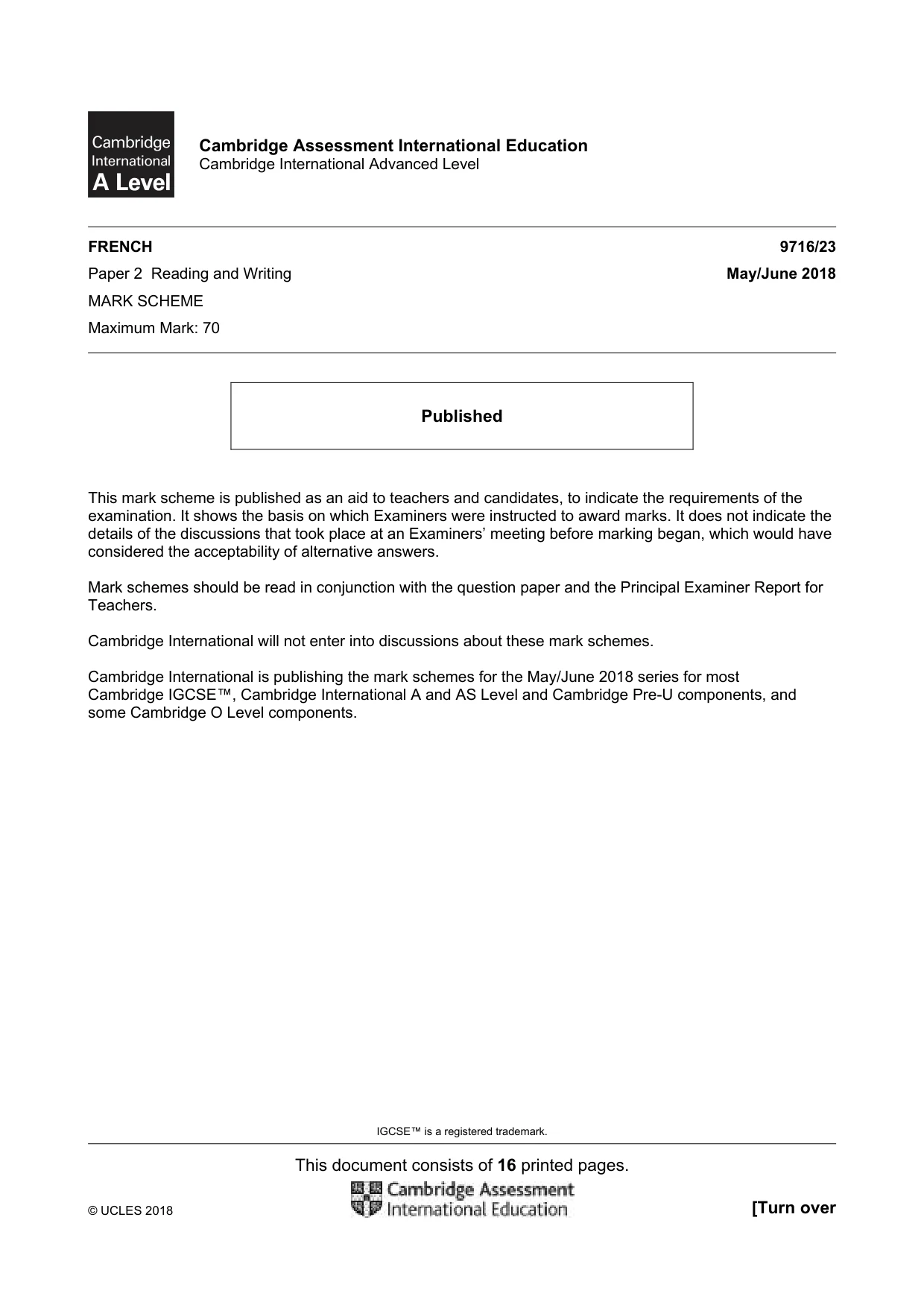
IGCSE™ is a registered trademark. This document consists of 16 printed pages. © UCLES 2018 [Turn over Cambridge Assessment International Education Cambridge International Advanced Level FRENCH 9716/23 Paper 2 Reading and Writing May/June 2018 MARK SCHEME Maximum Mark: 70 Published This mark scheme is published as an aid to teachers and candidates, to indicate the requirements of the examination. It shows the basis on which Examiners were instructed to award marks. It does not indicate the details of the discussions that took place at an Examiners’ meeting before marking began, which would have considered the acceptability of alternative answers. Mark schemes should be read in conjunction with the question paper and the Principal Examiner Report for Teachers. Cambridge International will not enter into discussions about these mark schemes. Cambridge International is publishing the mark schemes for the May/June 2018 series for most Cambridge IGCSE™, Cambridge International A and AS Level and Cambridge Pre-U components, and some Cambridge O Level components.
Mark scheme, page 2
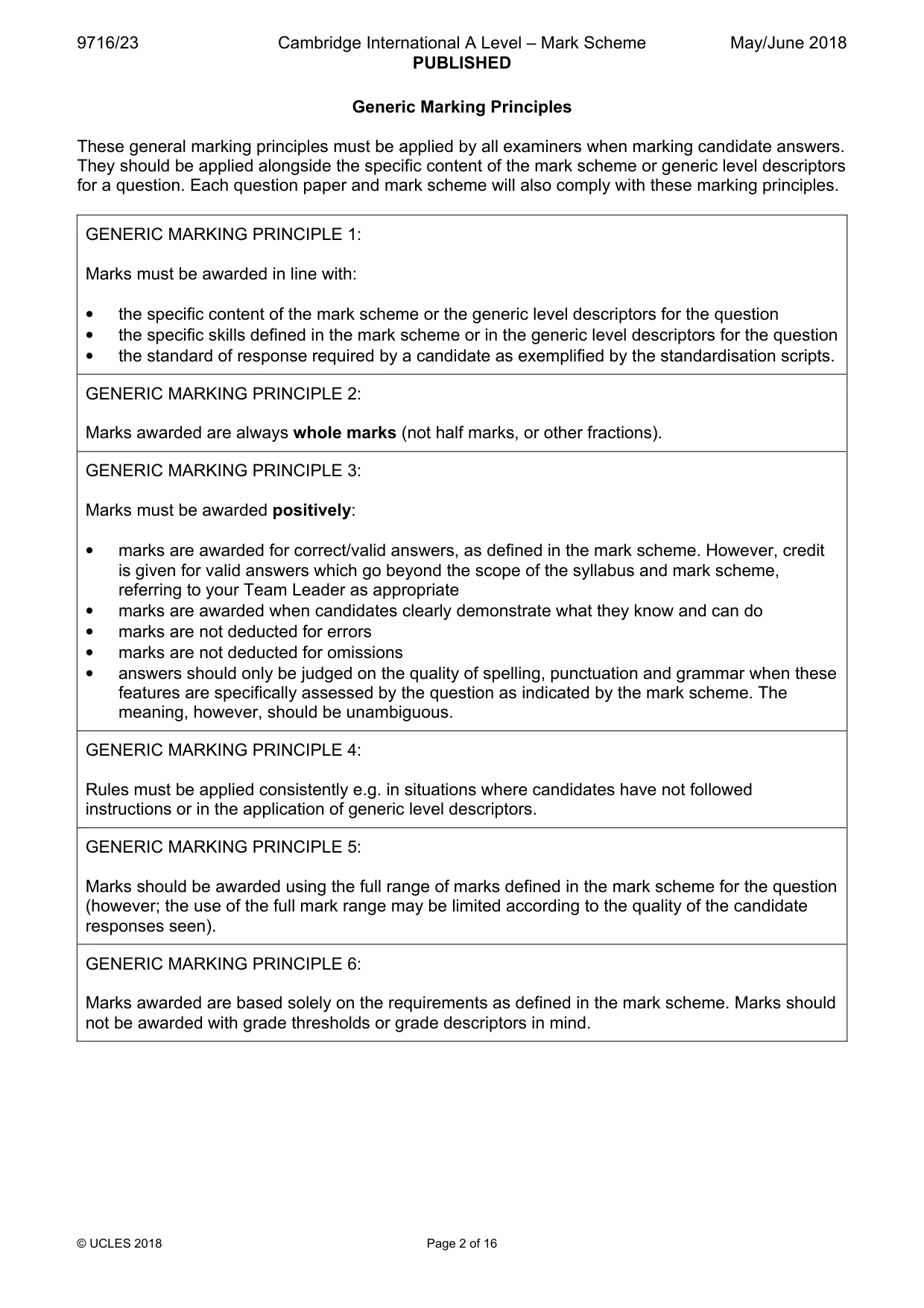
9716/23 Cambridge International A Level – Mark Scheme PUBLISHED May/June 2018 © UCLES 2018 Page 2 of 16 Generic Marking Principles These general marking principles must be applied by all examiners when marking candidate answers. They should be applied alongside the specific content of the mark scheme or generic level descriptors for a question. Each question paper and mark scheme will also comply with these marking principles. GENERIC MARKING PRINCIPLE 1: Marks must be awarded in line with: • the specific content of the mark scheme or the generic level descriptors for the question • the specific skills defined in the mark scheme or in the generic level descriptors for the question • the standard of response required by a candidate as exemplified by the standardisation scripts. GENERIC MARKING PRINCIPLE 2: Marks awarded are always whole marks (not half marks, or other fractions). GENERIC MARKING PRINCIPLE 3: Marks must be awarded positively: • marks are awarded for correct/valid answers, as defined in the mark scheme. However, credit is given for valid answers which go beyond the scope of the syllabus and mark scheme, referring to your Team Leader as appropriate • marks are awarded when candidates clearly demonstrate what they know and can do • marks are not deducted for errors • marks are not deducted for omissions • answers should only be judged on the quality of spelling, punctuation and grammar when these features are specifically assessed by the question as indicated by the mark scheme. The meaning, however, should be unambiguous. GENERIC MARKING PRINCIPLE 4: Rules must be applied consistently e.g. in situations where candidates have not followed instructions or in the application of generic level descriptors. GENERIC MARKING PRINCIPLE 5: Marks should be awarded using the full range of marks defined in the mark scheme for the question (however; the use of the full mark range may be limited according to the quality of the candidate responses seen). GENERIC MARKING PRINCIPLE 6: Marks awarded are based solely on the requirements as defined in the mark scheme. Marks should not be awarded with grade thresholds or grade descriptors in mind.
Mark scheme, page 3
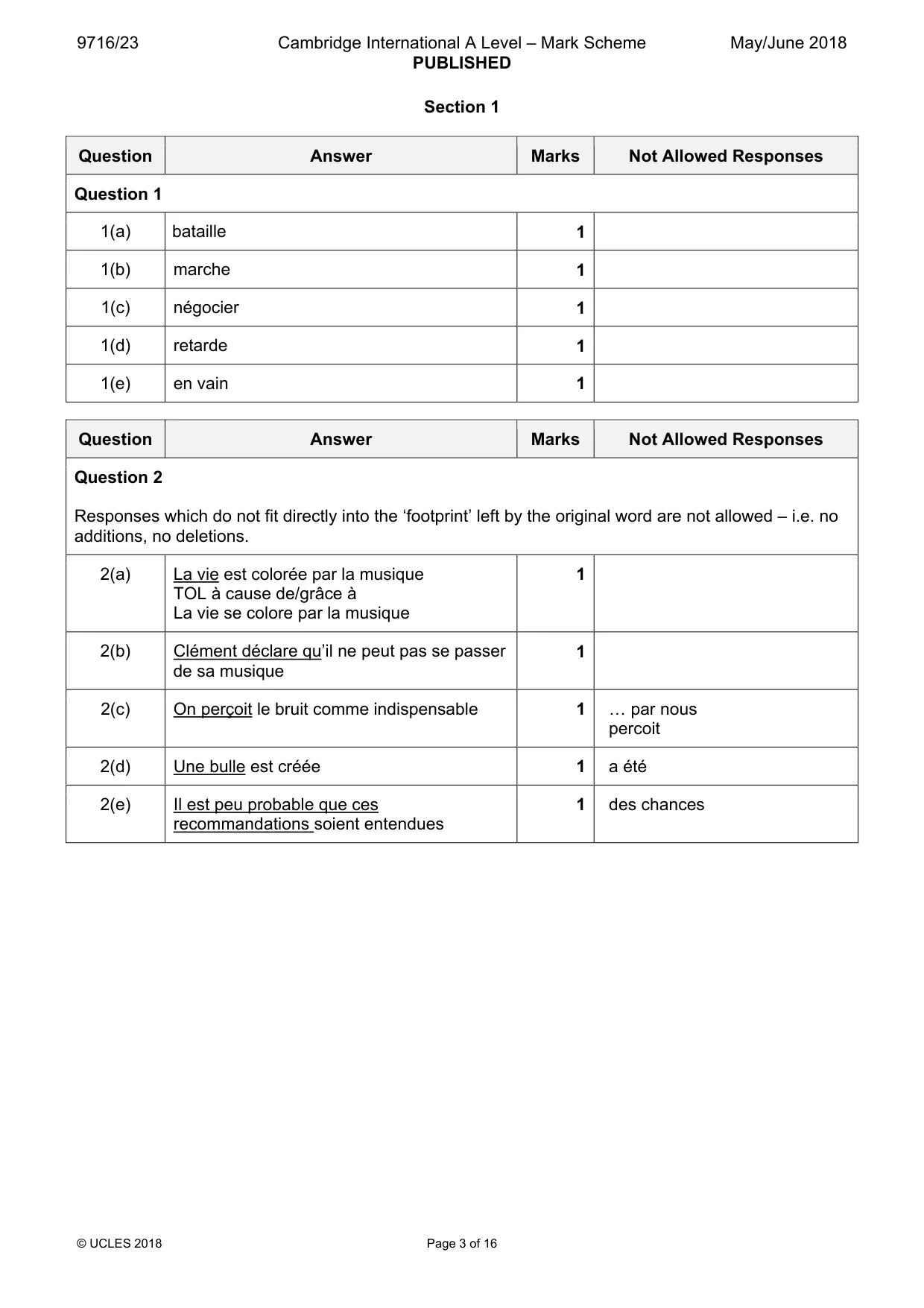
9716/23 Cambridge International A Level – Mark Scheme PUBLISHED May/June 2018 © UCLES 2018 Page 3 of 16 Section 1 Question Answer Marks Not Allowed Responses Question 1 1(a) bataille 1 1(b) marche 1 1(c) négocier 1 1(d) retarde 1 1(e) en vain 1 Question Answer Marks Not Allowed Responses Question 2 Responses which do not fit directly into the ‘footprint’ left by the original word are not allowed – i.e. no additions, no deletions. 2(a) La vie est colorée par la musique TOL à cause de/grâce à La vie se colore par la musique 1 2(b) Clément déclare qu’il ne peut pas se passer de sa musique 1 2(c) On perçoit le bruit comme indispensable 1 « par nous percoit 2(d) Une bulle est créée 1 a été 2(e) Il est peu probable que ces recommandations soient entendues 1 des chances
Mark scheme, page 4
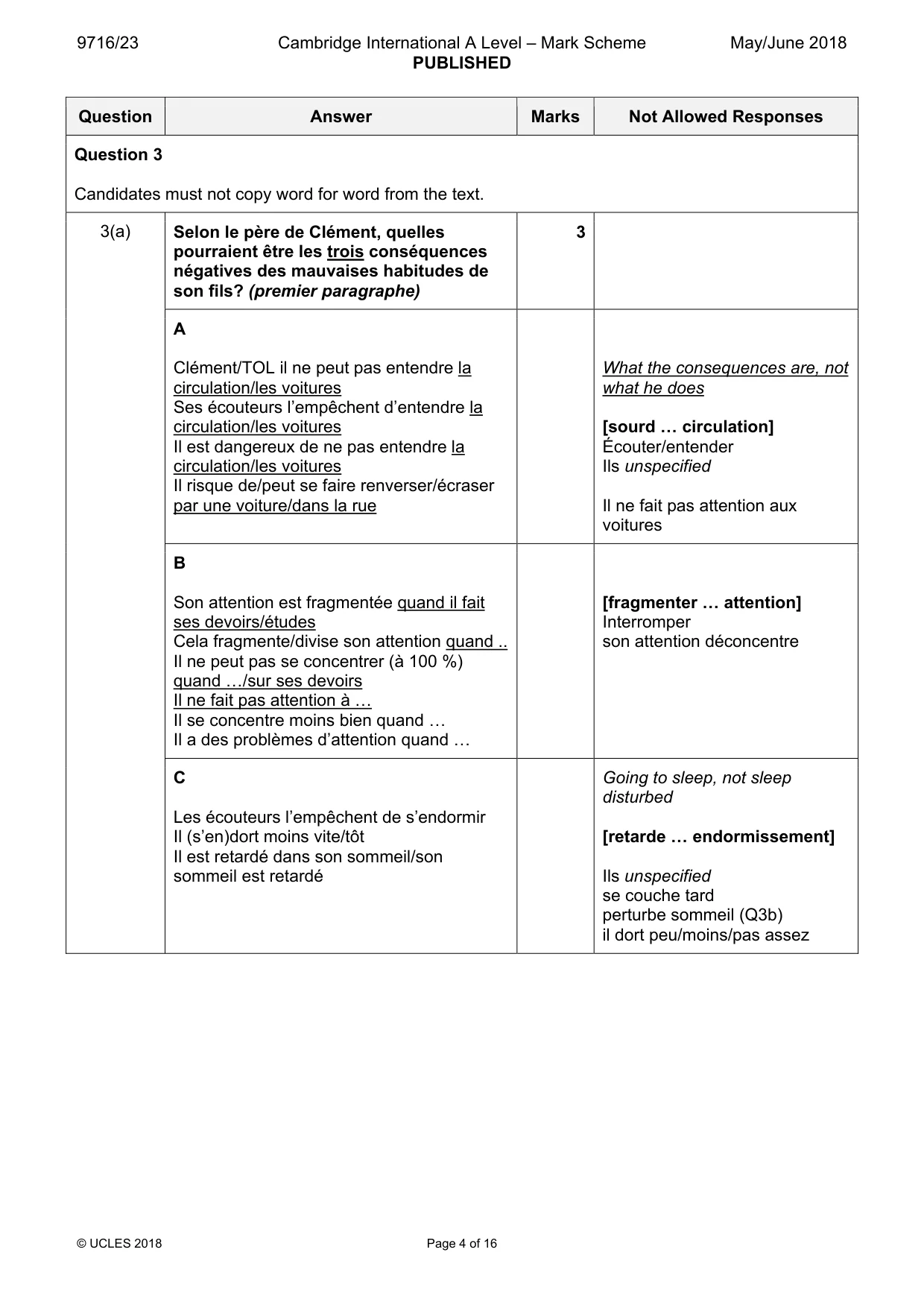
9716/23 Cambridge International A Level – Mark Scheme PUBLISHED May/June 2018 © UCLES 2018 Page 4 of 16 Question Answer Marks Not Allowed Responses Question 3 Candidates must not copy word for word from the text. 3(a) Selon le père de Clément, quelles pourraient être les trois conséquences négatives des mauvaises habitudes de son fils? (premier paragraphe) 3 A Clément/TOL il ne peut pas entendre la circulation/les voitures Ses écouteurs l’empêchent d’entendre la circulation/les voitures Il est dangereux de ne pas entendre la circulation/les voitures Il risque de/peut se faire renverser/écraser par une voiture/dans la rue What the consequences are, not what he does [sourd « circulation] Écouter/entender Ils unspecified Il ne fait pas attention aux voitures B Son attention est fragmentée quand il fait ses devoirs/études Cela fragmente/divise son attention quand .. Il ne peut pas se concentrer (à 100 %) quand «/sur ses devoirs Il ne fait pas attention à « Il se concentre moins bien quand « Il a des problèmes d’attention quand « [fragmenter « attention] Interromper son attention déconcentre C Les écouteurs l’empêchent de s’endormir Il (s’en)dort moins vite/tôt Il est retardé dans son sommeil/son sommeil est retardé Going to sleep, not sleep disturbed [retarde « endormissement] Ils unspecified se couche tard perturbe sommeil (Q3b) il dort peu/moins/pas assez
Mark scheme, page 5
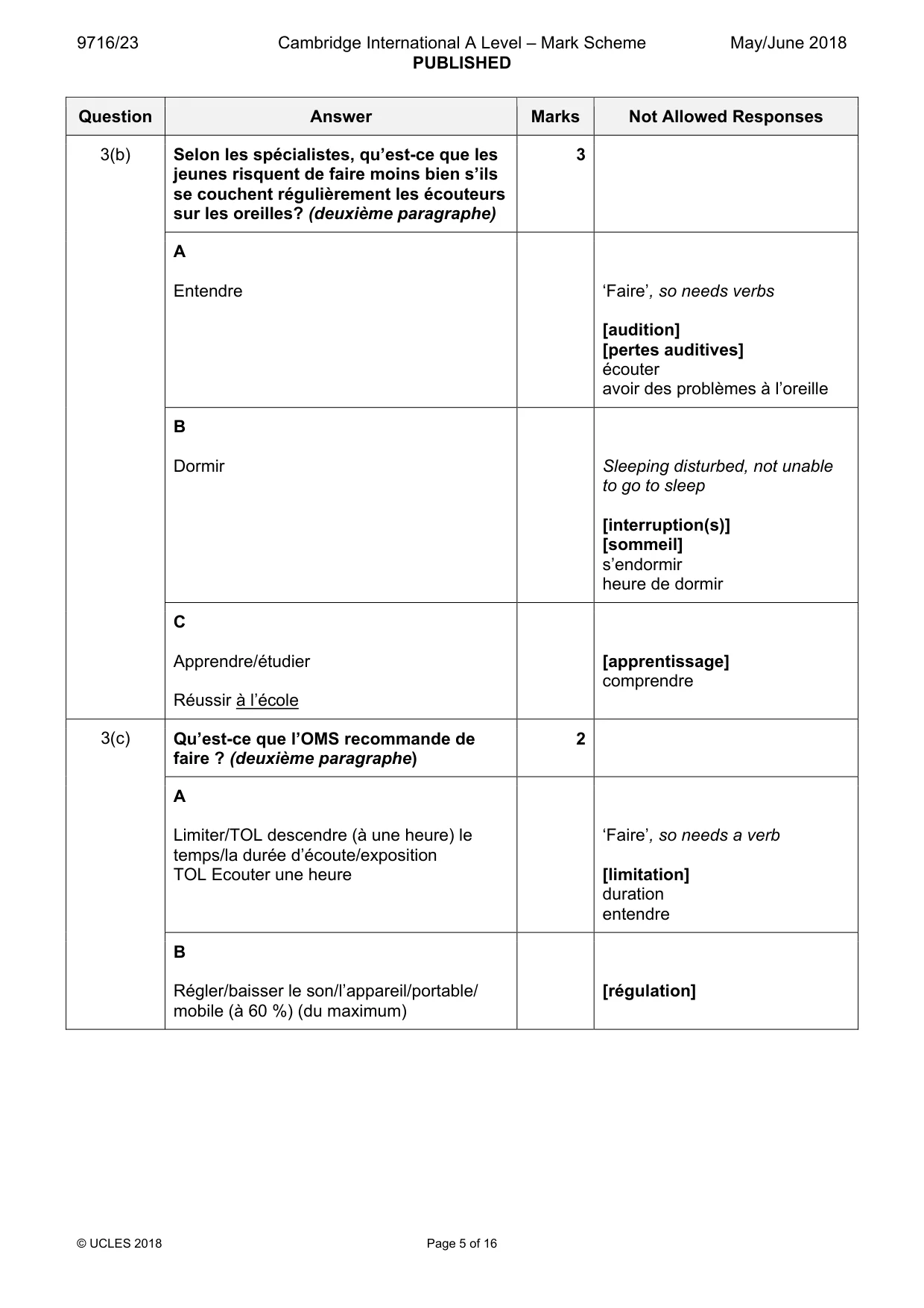
9716/23 Cambridge International A Level – Mark Scheme PUBLISHED May/June 2018 © UCLES 2018 Page 5 of 16 Question Answer Marks Not Allowed Responses 3(b) Selon les spécialistes, qu’est-ce que les jeunes risquent de faire moins bien s’ils se couchent régulièrement les écouteurs sur les oreilles? (deuxième paragraphe) 3 A Entendre ‘Faire’, so needs verbs [audition] [pertes auditives] écouter avoir des problèmes à l’oreille B Dormir Sleeping disturbed, not unable to go to sleep [interruption(s)] [sommeil] s’endormir heure de dormir C Apprendre/étudier Réussir à l’école [apprentissage] comprendre 3(c) Qu’est-ce que l’OMS recommande de faire ? (deuxième paragraphe) 2 A Limiter/TOL descendre (à une heure) le temps/la durée d’écoute/exposition TOL Ecouter une heure ‘Faire’, so needs a verb [limitation] duration entendre B Régler/baisser le son/l’appareil/portable/ mobile (à 60 %) (du maximum) [régulation]
Mark scheme, page 6
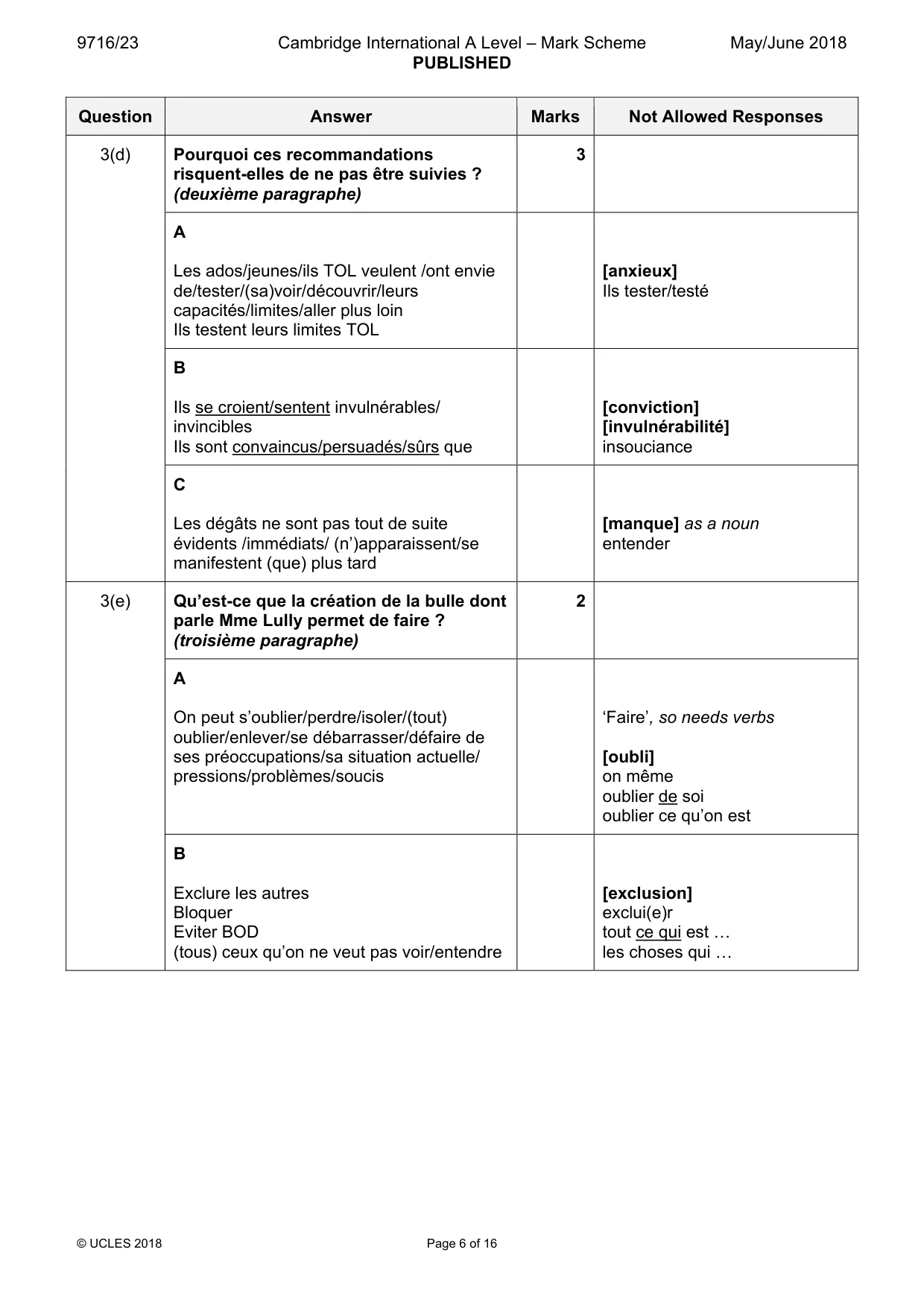
9716/23 Cambridge International A Level – Mark Scheme PUBLISHED May/June 2018 © UCLES 2018 Page 6 of 16 Question Answer Marks Not Allowed Responses 3(d) Pourquoi ces recommandations risquent-elles de ne pas être suivies ? (deuxième paragraphe) 3 A Les ados/jeunes/ils TOL veulent /ont envie de/tester/(sa)voir/découvrir/leurs capacités/limites/aller plus loin Ils testent leurs limites TOL [anxieux] Ils tester/testé B Ils se croient/sentent invulnérables/ invincibles Ils sont convaincus/persuadés/sûrs que [conviction] [invulnérabilité] insouciance C Les dégâts ne sont pas tout de suite évidents /immédiats/ (n’)apparaissent/se manifestent (que) plus tard [manque] as a noun entender 3(e) Qu’est-ce que la création de la bulle dont parle Mme Lully permet de faire ? (troisième paragraphe) 2 A On peut s’oublier/perdre/isoler/(tout) oublier/enlever/se débarrasser/défaire de ses préoccupations/sa situation actuelle/ pressions/problèmes/soucis ‘Faire’, so needs verbs [oubli] on même oublier de soi oublier ce qu’on est B Exclure les autres Bloquer Eviter BOD (tous) ceux qu’on ne veut pas voir/entendre [exclusion] exclui(e)r tout ce qui est « les choses qui «
Mark scheme, page 7
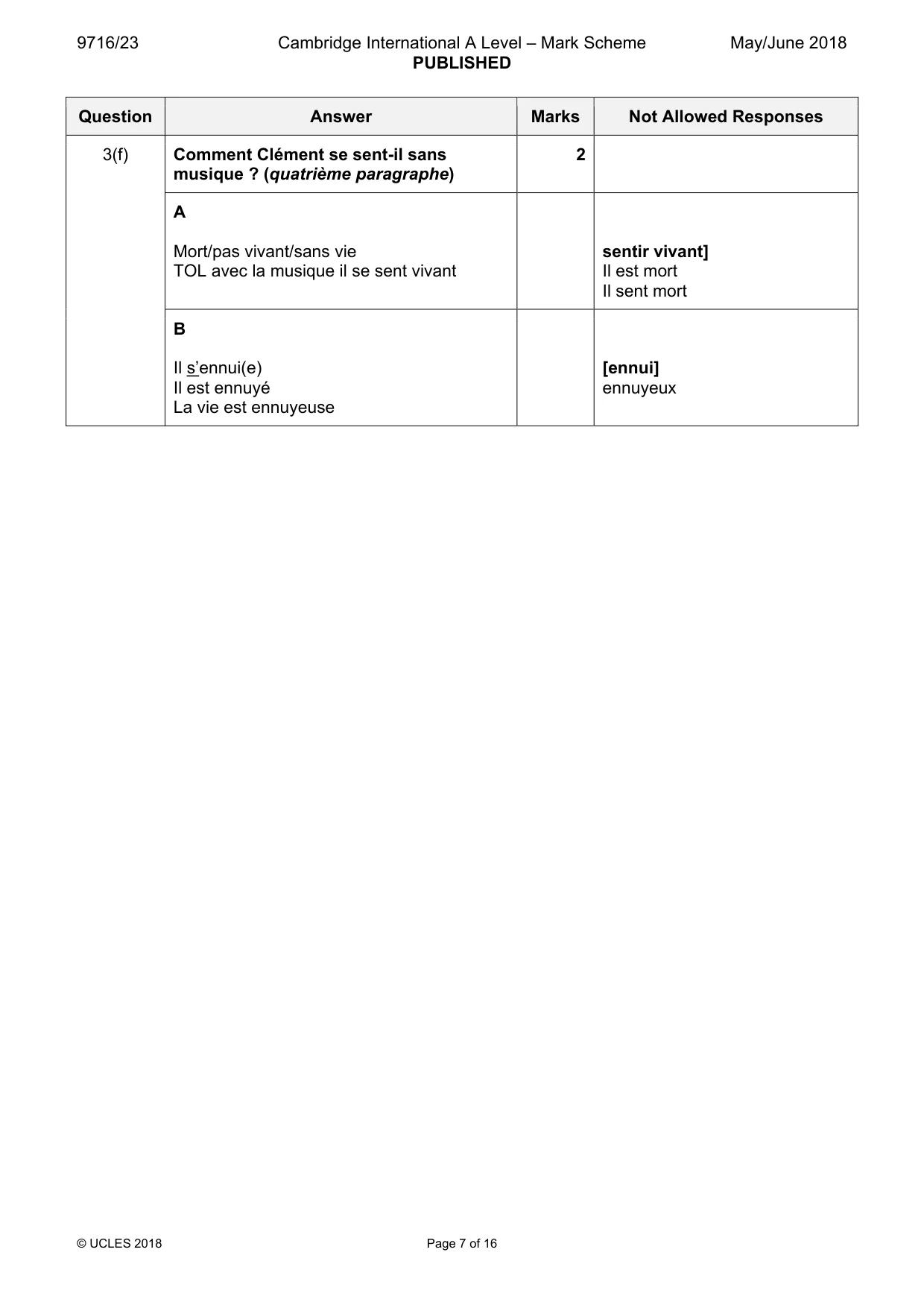
9716/23 Cambridge International A Level – Mark Scheme PUBLISHED May/June 2018 © UCLES 2018 Page 7 of 16 Question Answer Marks Not Allowed Responses 3(f) Comment Clément se sent-il sans musique ? (quatrième paragraphe) 2 A Mort/pas vivant/sans vie TOL avec la musique il se sent vivant sentir vivant] Il est mort Il sent mort B Il s’ennui(e) Il est ennuyé La vie est ennuyeuse [ennui] ennuyeux
Mark scheme, page 8
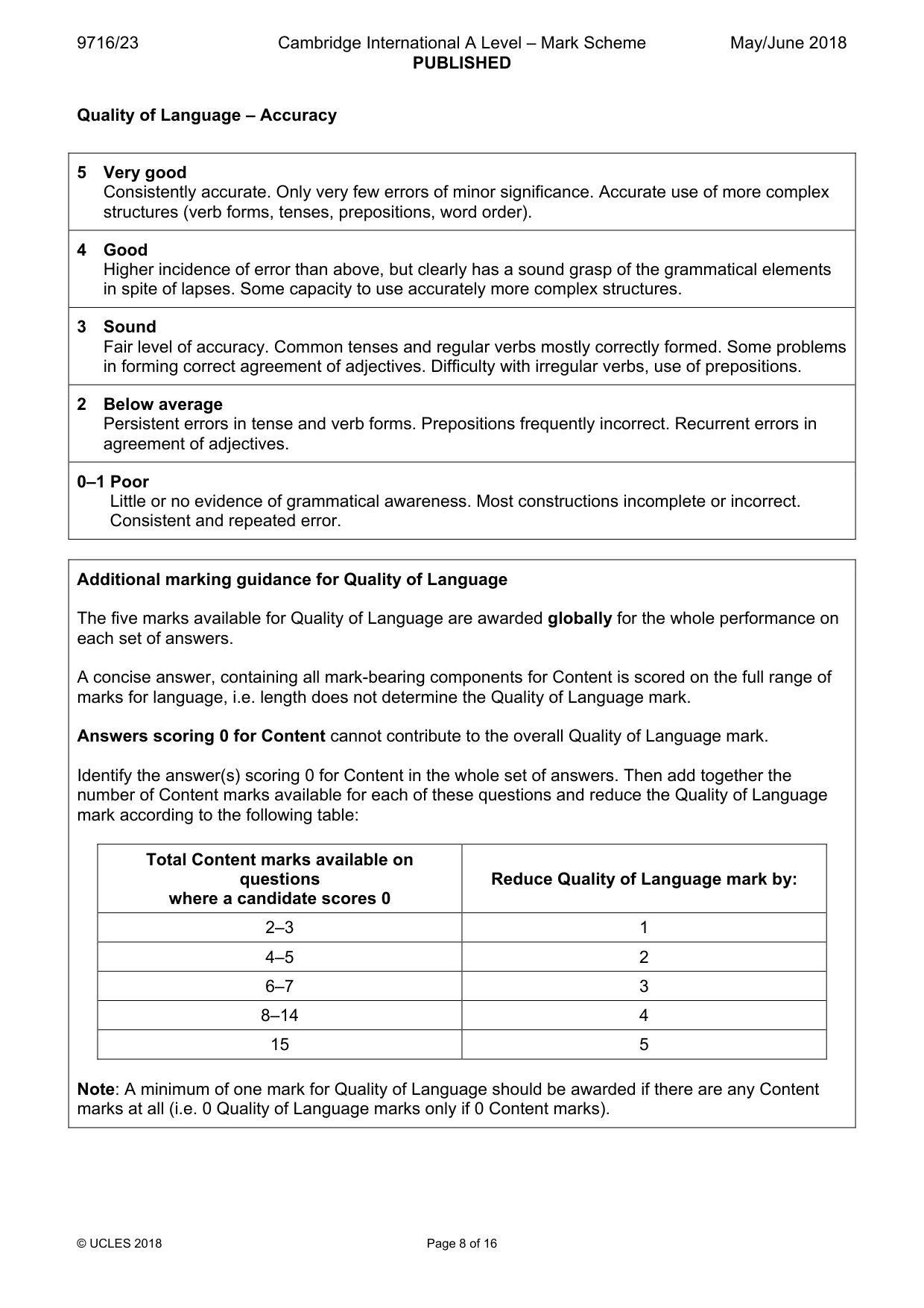
9716/23 Cambridge International A Level – Mark Scheme PUBLISHED May/June 2018 © UCLES 2018 Page 8 of 16 Quality of Language – Accuracy 5 Very good Consistently accurate. Only very few errors of minor significance. Accurate use of more complex structures (verb forms, tenses, prepositions, word order). 4 Good Higher incidence of error than above, but clearly has a sound grasp of the grammatical elements in spite of lapses. Some capacity to use accurately more complex structures. 3 Sound Fair level of accuracy. Common tenses and regular verbs mostly correctly formed. Some problems in forming correct agreement of adjectives. Difficulty with irregular verbs, use of prepositions. 2 Below average Persistent errors in tense and verb forms. Prepositions frequently incorrect. Recurrent errors in agreement of adjectives. 0–1 Poor Little or no evidence of grammatical awareness. Most constructions incomplete or incorrect. Consistent and repeated error. Additional marking guidance for Quality of Language The five marks available for Quality of Language are awarded globally for the whole performance on each set of answers. A concise answer, containing all mark-bearing components for Content is scored on the full range of marks for language, i.e. length does not determine the Quality of Language mark. Answers scoring 0 for Content cannot contribute to the overall Quality of Language mark. Identify the answer(s) scoring 0 for Content in the whole set of answers. Then add together the number of Content marks available for each of these questions and reduce the Quality of Language mark according to the following table: Total Content marks available on questions where a candidate scores 0 Reduce Quality of Language mark by: 2–3 1 4–5 2 6–7 3 8–14 4 15 5 Note: A minimum of one mark for Quality of Language should be awarded if there are any Content marks at all (i.e. 0 Quality of Language marks only if 0 Content marks).
Mark scheme, page 9
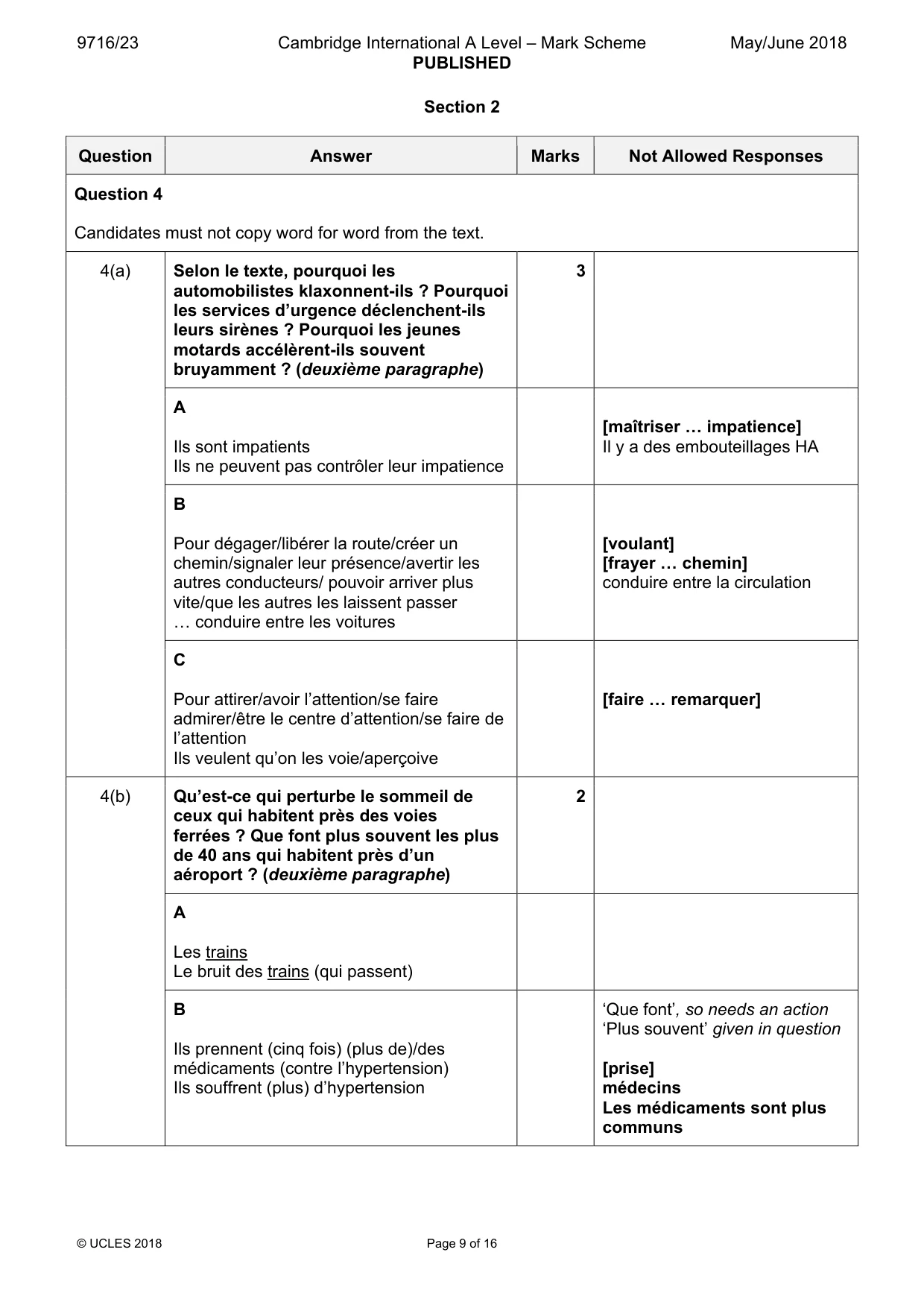
9716/23 Cambridge International A Level – Mark Scheme PUBLISHED May/June 2018 © UCLES 2018 Page 9 of 16 Section 2 Question Answer Marks Not Allowed Responses Question 4 Candidates must not copy word for word from the text. 4(a) Selon le texte, pourquoi les automobilistes klaxonnent-ils ? Pourquoi les services d’urgence déclenchent-ils leurs sirènes ? Pourquoi les jeunes motards accélèrent-ils souvent bruyamment ? (deuxième paragraphe) 3 A Ils sont impatients Ils ne peuvent pas contrôler leur impatience [maîtriser « impatience] Il y a des embouteillages HA B Pour dégager/libérer la route/créer un chemin/signaler leur présence/avertir les autres conducteurs/ pouvoir arriver plus vite/que les autres les laissent passer « conduire entre les voitures [voulant] [frayer « chemin] conduire entre la circulation C Pour attirer/avoir l’attention/se faire admirer/être le centre d’attention/se faire de l’attention Ils veulent qu’on les voie/aperçoive [faire « remarquer] 4(b) Qu’est-ce qui perturbe le sommeil de ceux qui habitent près des voies ferrées ? Que font plus souvent les plus de 40 ans qui habitent près d’un aéroport ? (deuxième paragraphe) 2 A Les trains Le bruit des trains (qui passent) B Ils prennent (cinq fois) (plus de)/des médicaments (contre l’hypertension) Ils souffrent (plus) d’hypertension ‘Que font’, so needs an action ‘Plus souvent’ given in question [prise] médecins Les médicaments sont plus communs
Mark scheme, page 10
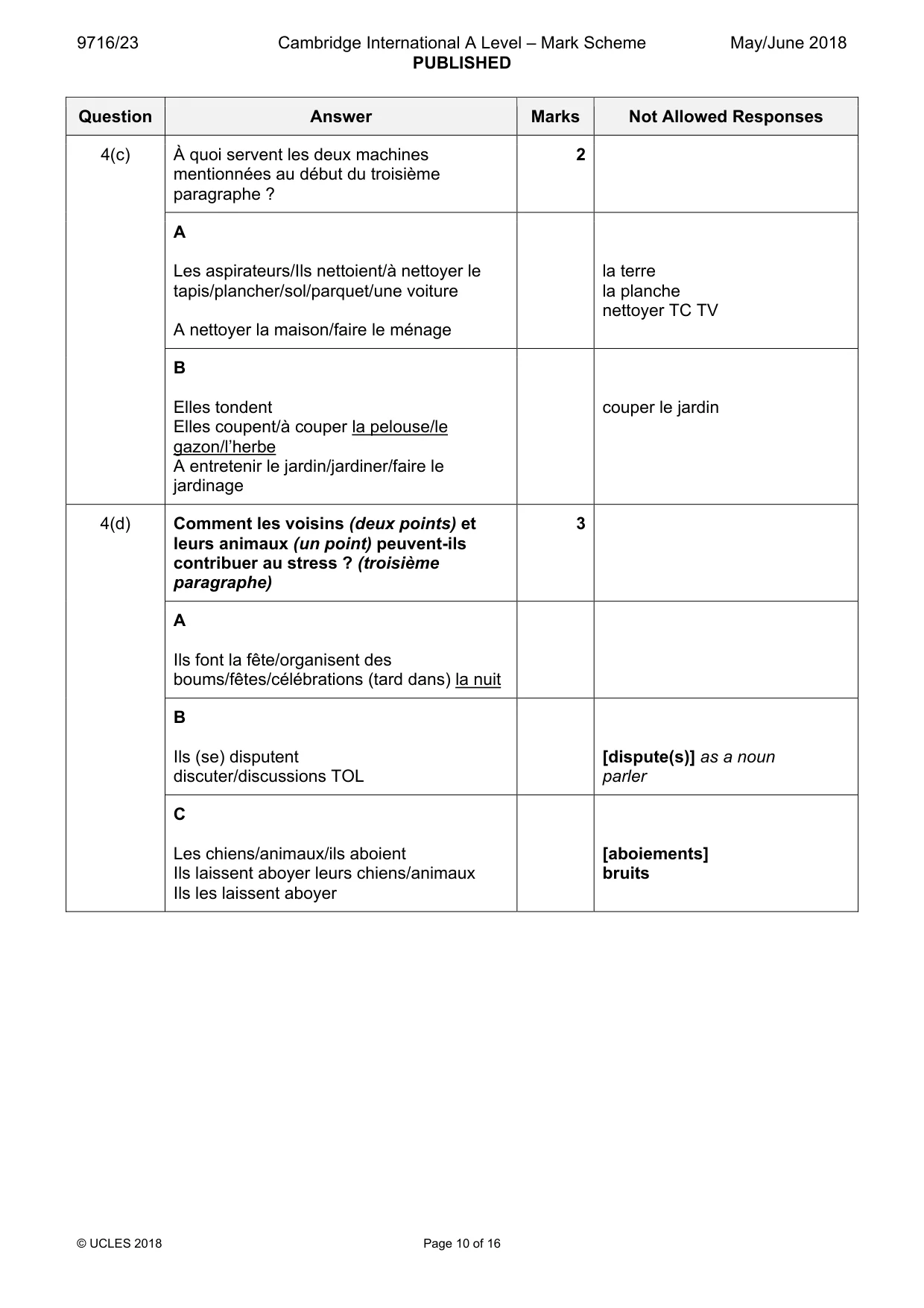
9716/23 Cambridge International A Level – Mark Scheme PUBLISHED May/June 2018 © UCLES 2018 Page 10 of 16 Question Answer Marks Not Allowed Responses 4(c) À quoi servent les deux machines mentionnées au début du troisième paragraphe ? 2 A Les aspirateurs/Ils nettoient/à nettoyer le tapis/plancher/sol/parquet/une voiture A nettoyer la maison/faire le ménage la terre la planche nettoyer TC TV B Elles tondent Elles coupent/à couper la pelouse/le gazon/l’herbe A entretenir le jardin/jardiner/faire le jardinage couper le jardin 4(d) Comment les voisins (deux points) et leurs animaux (un point) peuvent-ils contribuer au stress ? (troisième paragraphe) 3 A Ils font la fête/organisent des boums/fêtes/célébrations (tard dans) la nuit B Ils (se) disputent discuter/discussions TOL [dispute(s)] as a noun parler C Les chiens/animaux/ils aboient Ils laissent aboyer leurs chiens/animaux Ils les laissent aboyer [aboiements] bruits
Mark scheme, page 11
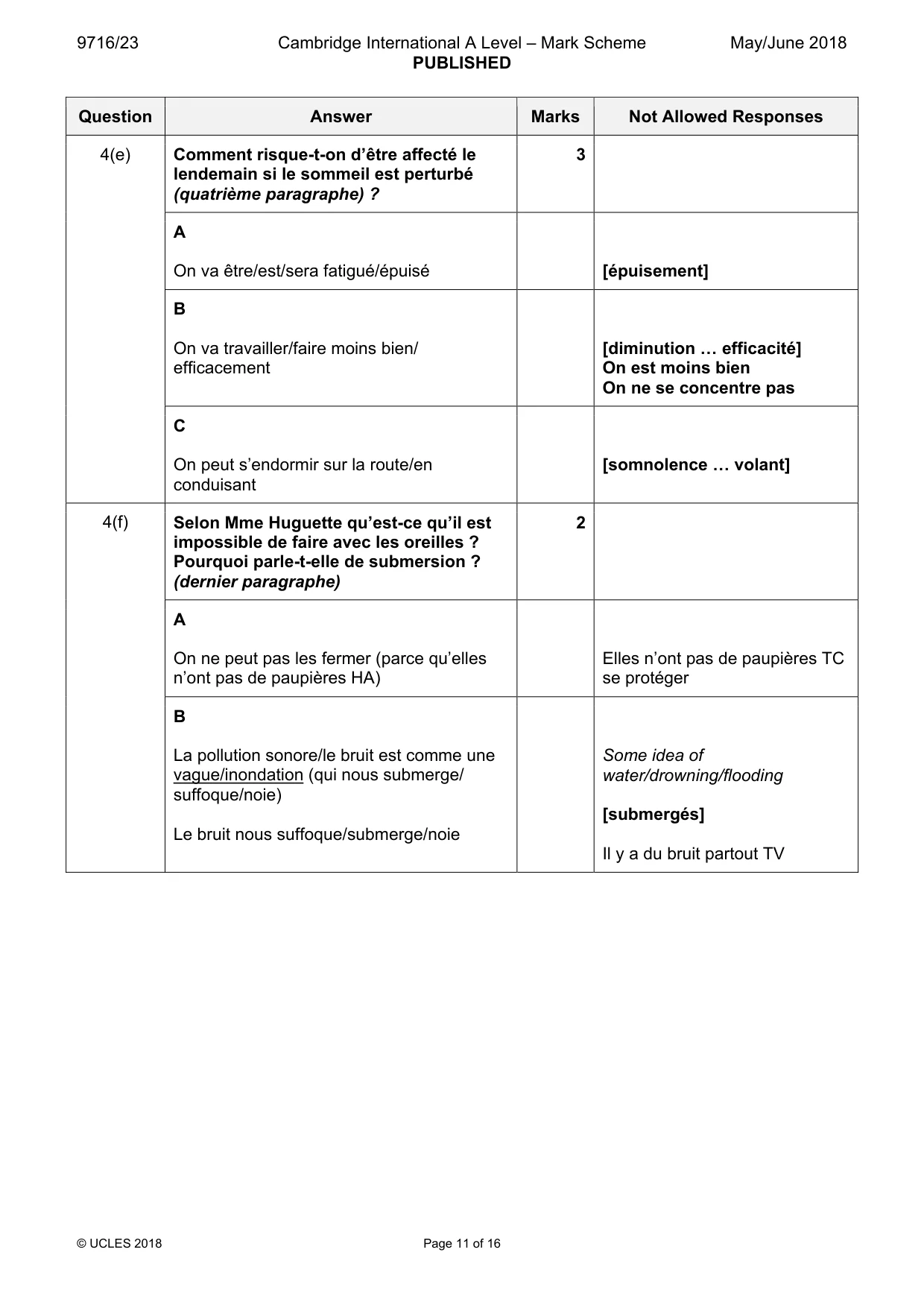
9716/23 Cambridge International A Level – Mark Scheme PUBLISHED May/June 2018 © UCLES 2018 Page 11 of 16 Question Answer Marks Not Allowed Responses 4(e) Comment risque-t-on d’être affecté le lendemain si le sommeil est perturbé (quatrième paragraphe) ? 3 A On va être/est/sera fatigué/épuisé [épuisement] B On va travailler/faire moins bien/ efficacement [diminution « efficacité] On est moins bien On ne se concentre pas C On peut s’endormir sur la route/en conduisant [somnolence « volant] 4(f) Selon Mme Huguette qu’est-ce qu’il est impossible de faire avec les oreilles ? Pourquoi parle-t-elle de submersion ? (dernier paragraphe) 2 A On ne peut pas les fermer (parce qu’elles n’ont pas de paupières HA) Elles n’ont pas de paupières TC se protéger B La pollution sonore/le bruit est comme une vague/inondation (qui nous submerge/ suffoque/noie) Le bruit nous suffoque/submerge/noie Some idea of water/drowning/flooding [submergés] Il y a du bruit partout TV
Mark scheme, page 12
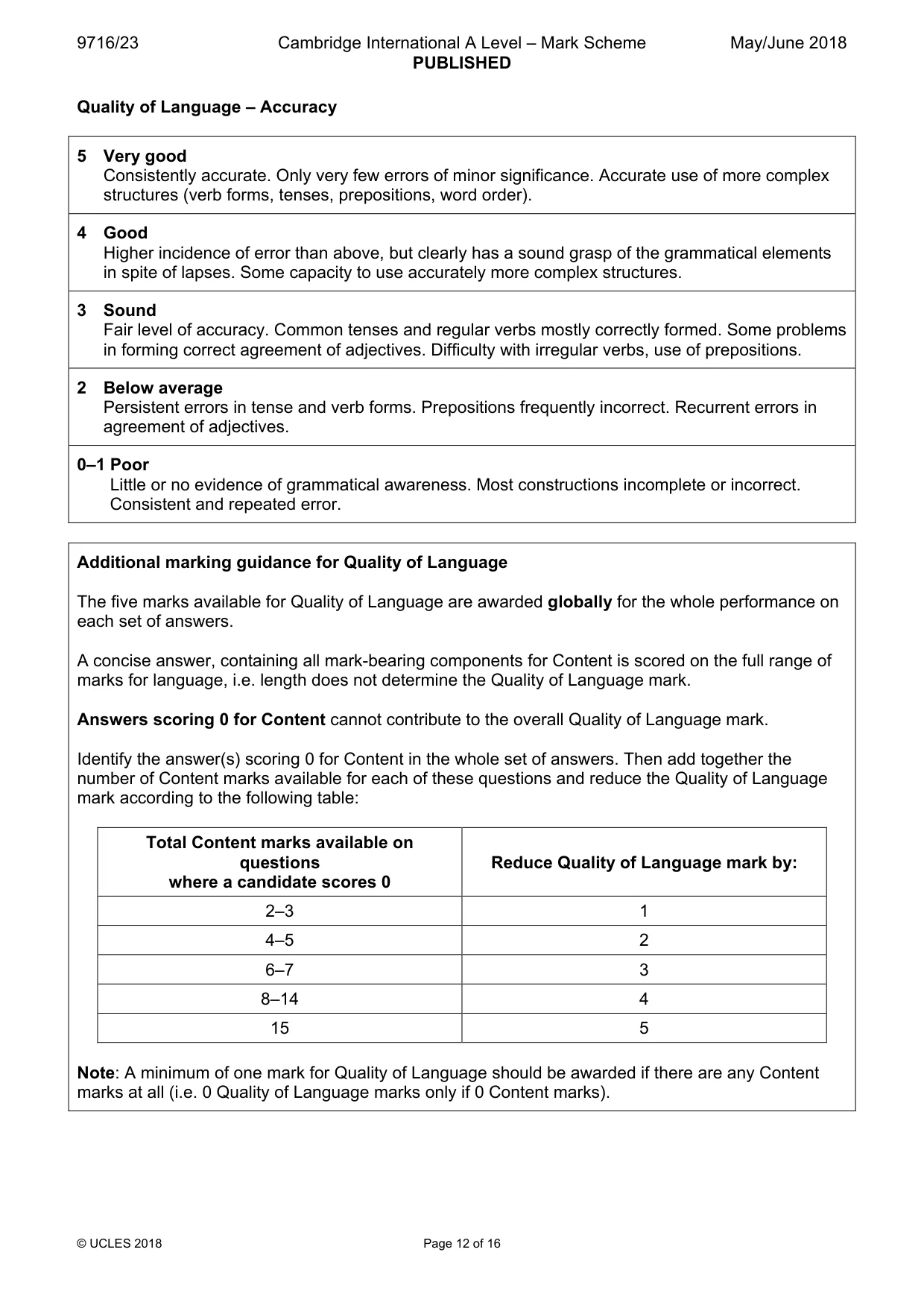
9716/23 Cambridge International A Level – Mark Scheme PUBLISHED May/June 2018 © UCLES 2018 Page 12 of 16 Quality of Language – Accuracy 5 Very good Consistently accurate. Only very few errors of minor significance. Accurate use of more complex structures (verb forms, tenses, prepositions, word order). 4 Good Higher incidence of error than above, but clearly has a sound grasp of the grammatical elements in spite of lapses. Some capacity to use accurately more complex structures. 3 Sound Fair level of accuracy. Common tenses and regular verbs mostly correctly formed. Some problems in forming correct agreement of adjectives. Difficulty with irregular verbs, use of prepositions. 2 Below average Persistent errors in tense and verb forms. Prepositions frequently incorrect. Recurrent errors in agreement of adjectives. 0–1 Poor Little or no evidence of grammatical awareness. Most constructions incomplete or incorrect. Consistent and repeated error. Additional marking guidance for Quality of Language The five marks available for Quality of Language are awarded globally for the whole performance on each set of answers. A concise answer, containing all mark-bearing components for Content is scored on the full range of marks for language, i.e. length does not determine the Quality of Language mark. Answers scoring 0 for Content cannot contribute to the overall Quality of Language mark. Identify the answer(s) scoring 0 for Content in the whole set of answers. Then add together the number of Content marks available for each of these questions and reduce the Quality of Language mark according to the following table: Total Content marks available on questions where a candidate scores 0 Reduce Quality of Language mark by: 2–3 1 4–5 2 6–7 3 8–14 4 15 5 Note: A minimum of one mark for Quality of Language should be awarded if there are any Content marks at all (i.e. 0 Quality of Language marks only if 0 Content marks).
Mark scheme, page 13
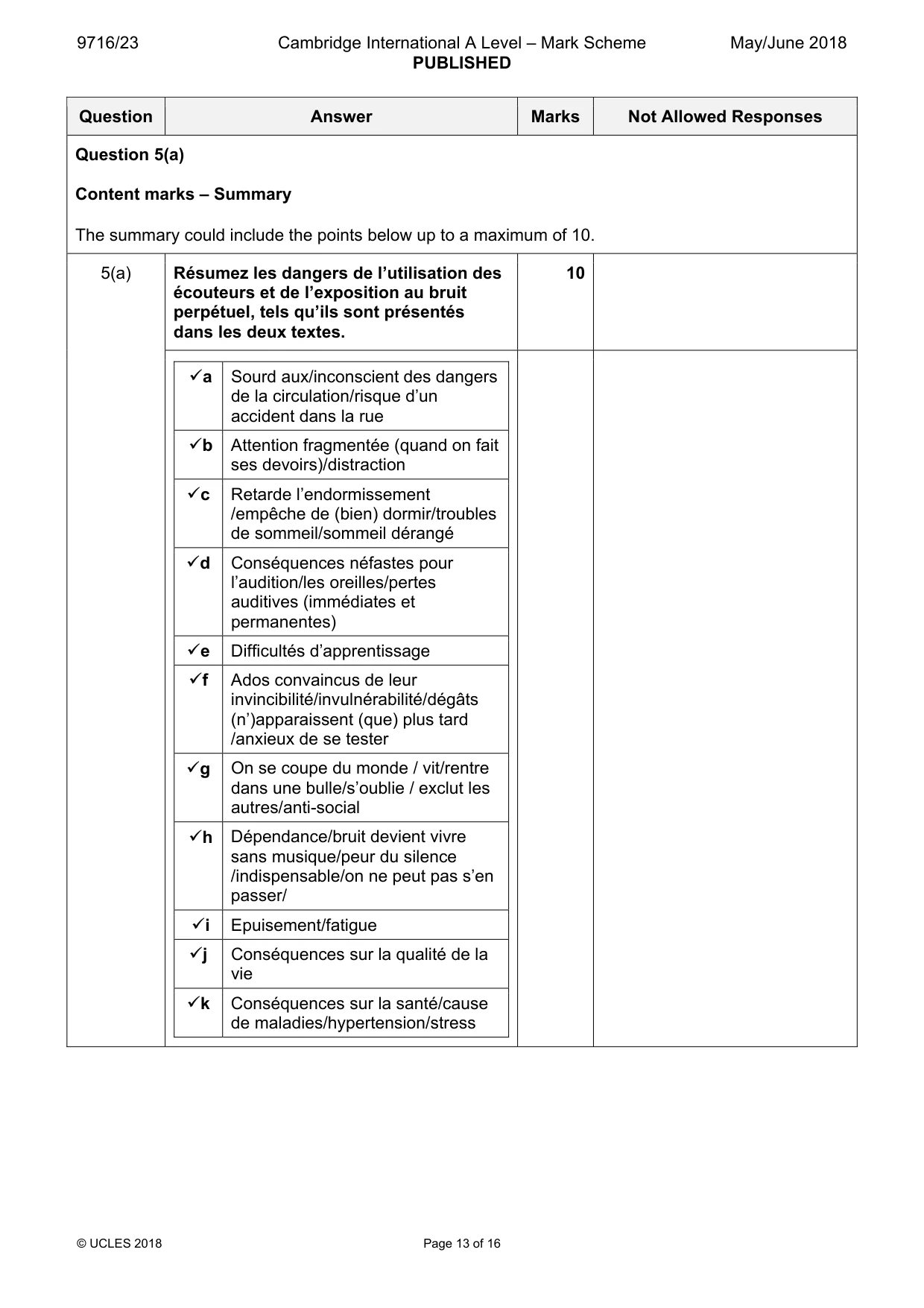
9716/23 Cambridge International A Level – Mark Scheme PUBLISHED May/June 2018 © UCLES 2018 Page 13 of 16 Question Answer Marks Not Allowed Responses Question 5(a) Content marks – Summary The summary could include the points below up to a maximum of 10. 5(a) Résumez les dangers de l’utilisation des écouteurs et de l’exposition au bruit perpétuel, tels qu’ils sont présentés dans les deux textes. 10 9a Sourd aux/inconscient des dangers de la circulation/risque d’un accident dans la rue 9b Attention fragmentée (quand on fait ses devoirs)/distraction 9c Retarde l’endormissement /empêche de (bien) dormir/troubles de sommeil/sommeil dérangé 9d Conséquences néfastes pour l’audition/les oreilles/pertes auditives (immédiates et permanentes) 9e Difficultés d’apprentissage 9f Ados convaincus de leur invincibilité/invulnérabilité/dégâts (n’)apparaissent (que) plus tard /anxieux de se tester 9g On se coupe du monde / vit/rentre dans une bulle/s’oublie / exclut les autres/anti-social 9h Dépendance/bruit devient vivre sans musique/peur du silence /indispensable/on ne peut pas s’en passer/ 9i Epuisement/fatigue 9j Conséquences sur la qualité de la vie 9k Conséquences sur la santé/cause de maladies/hypertension/stress
Mark scheme, page 14
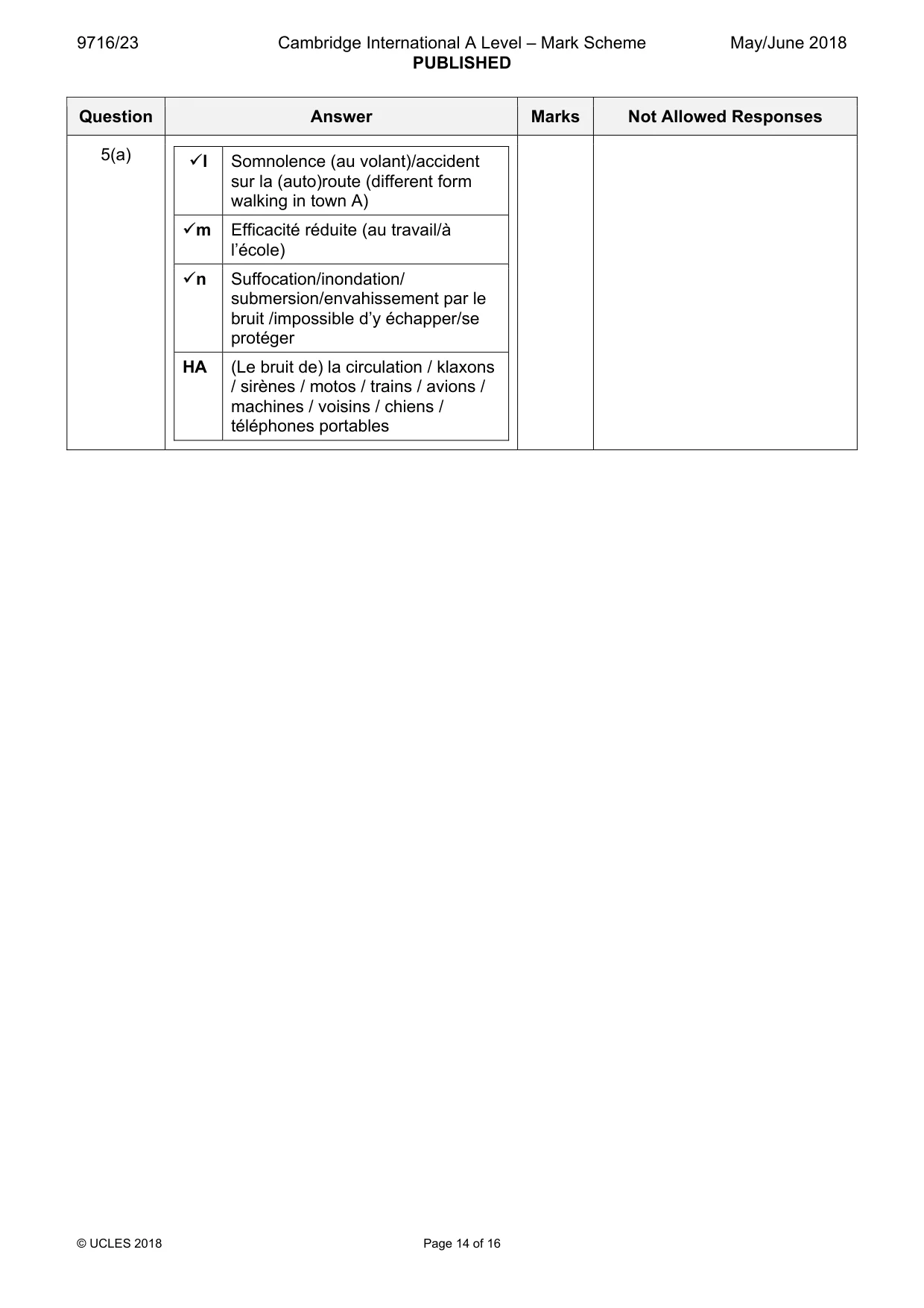
9716/23 Cambridge International A Level – Mark Scheme PUBLISHED May/June 2018 © UCLES 2018 Page 14 of 16 Question Answer Marks Not Allowed Responses 5(a) 9l Somnolence (au volant)/accident sur la (auto)route (different form walking in town A) 9m Efficacité réduite (au travail/à l’école) 9n Suffocation/inondation/ submersion/envahissement par le bruit /impossible d’y échapper/se protéger HA (Le bruit de) la circulation / klaxons / sirènes / motos / trains / avions / machines / voisins / chiens / téléphones portables
Mark scheme, page 15
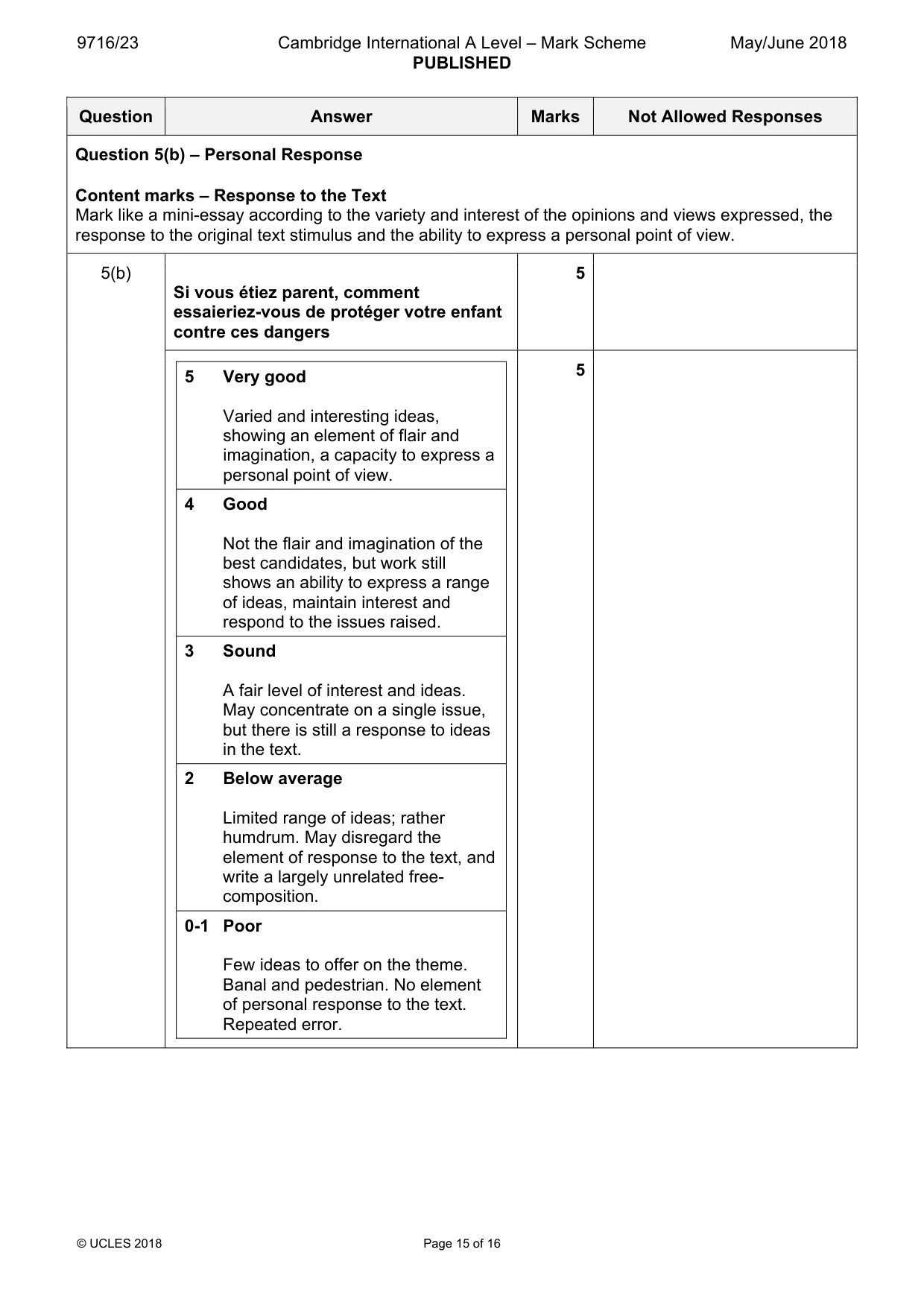
9716/23 Cambridge International A Level – Mark Scheme PUBLISHED May/June 2018 © UCLES 2018 Page 15 of 16 Question Answer Marks Not Allowed Responses Question 5(b) – Personal Response Content marks – Response to the Text Mark like a mini-essay according to the variety and interest of the opinions and views expressed, the response to the original text stimulus and the ability to express a personal point of view. 5(b) Si vous étiez parent, comment essaieriez-vous de protéger votre enfant contre ces dangers 5 5 Very good Varied and interesting ideas, showing an element of flair and imagination, a capacity to express a personal point of view. 4 Good Not the flair and imagination of the best candidates, but work still shows an ability to express a range of ideas, maintain interest and respond to the issues raised. 3 Sound A fair level of interest and ideas. May concentrate on a single issue, but there is still a response to ideas in the text. 2 Below average Limited range of ideas; rather humdrum. May disregard the element of response to the text, and write a largely unrelated free- composition. 0-1 Poor Few ideas to offer on the theme. Banal and pedestrian. No element of personal response to the text. Repeated error. 5
Mark scheme, page 16
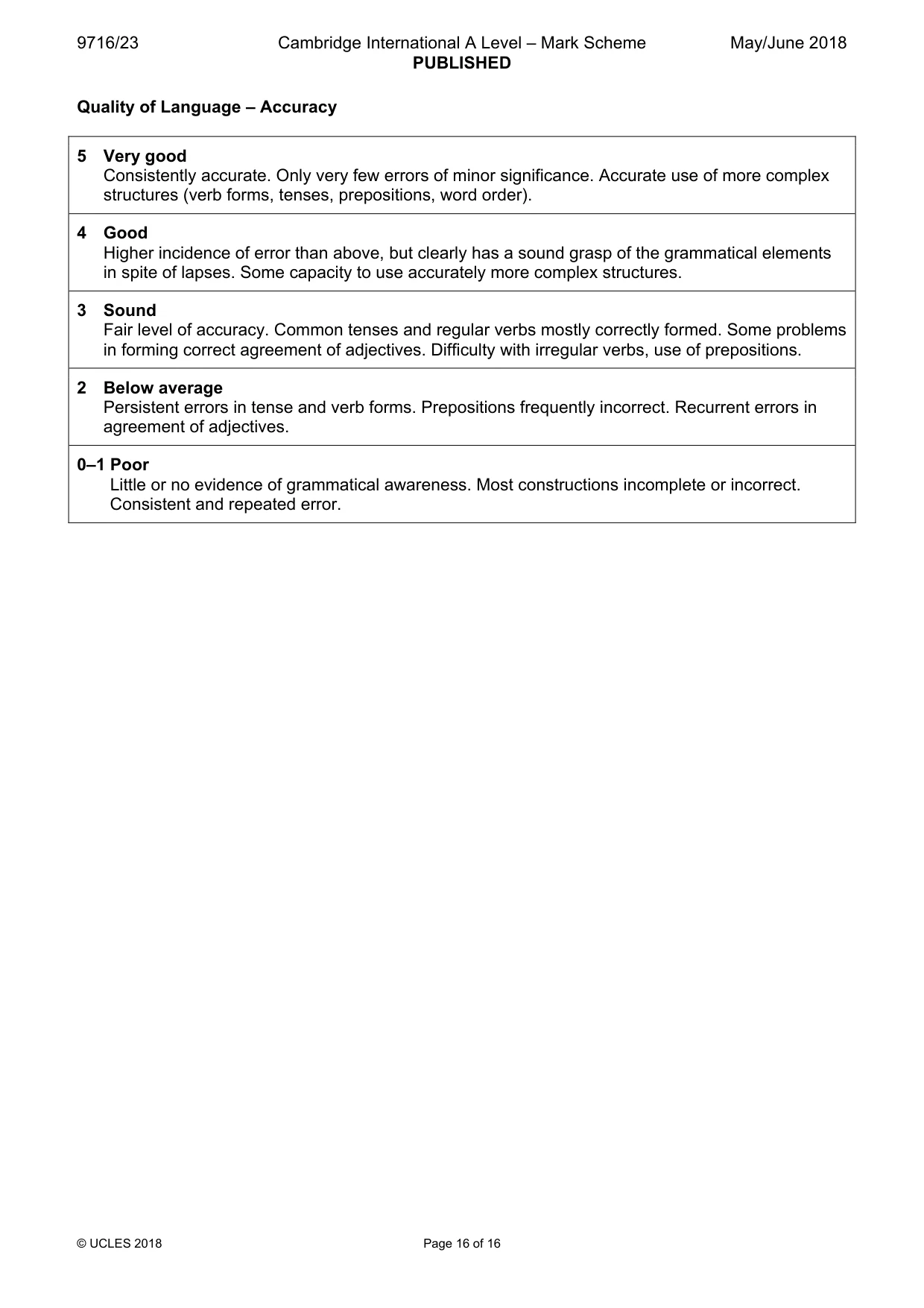
9716/23 Cambridge International A Level – Mark Scheme PUBLISHED May/June 2018 © UCLES 2018 Page 16 of 16 Quality of Language – Accuracy 5 Very good Consistently accurate. Only very few errors of minor significance. Accurate use of more complex structures (verb forms, tenses, prepositions, word order). 4 Good Higher incidence of error than above, but clearly has a sound grasp of the grammatical elements in spite of lapses. Some capacity to use accurately more complex structures. 3 Sound Fair level of accuracy. Common tenses and regular verbs mostly correctly formed. Some problems in forming correct agreement of adjectives. Difficulty with irregular verbs, use of prepositions. 2 Below average Persistent errors in tense and verb forms. Prepositions frequently incorrect. Recurrent errors in agreement of adjectives. 0–1 Poor Little or no evidence of grammatical awareness. Most constructions incomplete or incorrect. Consistent and repeated error.
What you needed in this session
Cambridge’s own grade thresholds for 2018 May/June, Paper 2 · Variant 3. A higher threshold means an easier paper — the bar moves with how the cohort did.