Cambridge A Level Environmental Management (AS only) 8291 — 2021 Oct/Nov Paper 1 · Variant 2
8291/12/O/N/21 · 80 marks · ≈90 min
The question paper and its mark scheme, free to read here and free to download. This is Cambridge’s own paper, exactly as it was sat.
Question paper12 pages

Mark scheme14 pages
Answers below. Sit the paper first if you are practising.
Paper as text
Question paper, page 1
This document has 12 pages. Cambridge International AS Level DC (ST/CT) 201623/4 © UCLES 2021 [Turn over ENVIRONMENTAL MANAGEMENT 8291/12 Paper 1 Lithosphere and Atmosphere October/November 2021 1 hour 30 minutes You must answer Section A on the question paper and Section B on the answer booklet/paper you have been given. You will need: Answer booklet/paper INSTRUCTIONS ● Section A: answer all questions. Write your answer to each question in the space provided on the question paper. ● Section B: answer one question. Write your answer on the separate answer booklet/paper provided. ● Use a black or dark blue pen. You may use an HB pencil for any diagrams or graphs. ● Write your name, centre number and candidate number in the boxes at the top of the page. ● Do not use an erasable pen or correction fluid. ● Do not write on any bar codes. ● You may use a calculator. ● You should show all your working and use appropriate units. ● At the end of the examination, fasten all your work together. Do not use staples, paper clips or glue. INFORMATION ● The total mark for this paper is 80. ● The number of marks for each question or part question is shown in brackets [ ]. * 2 8 9 2 6 5 4 0 5 0 * For Examiner’s use Section A 1 2 Section B Total
Question paper, page 2
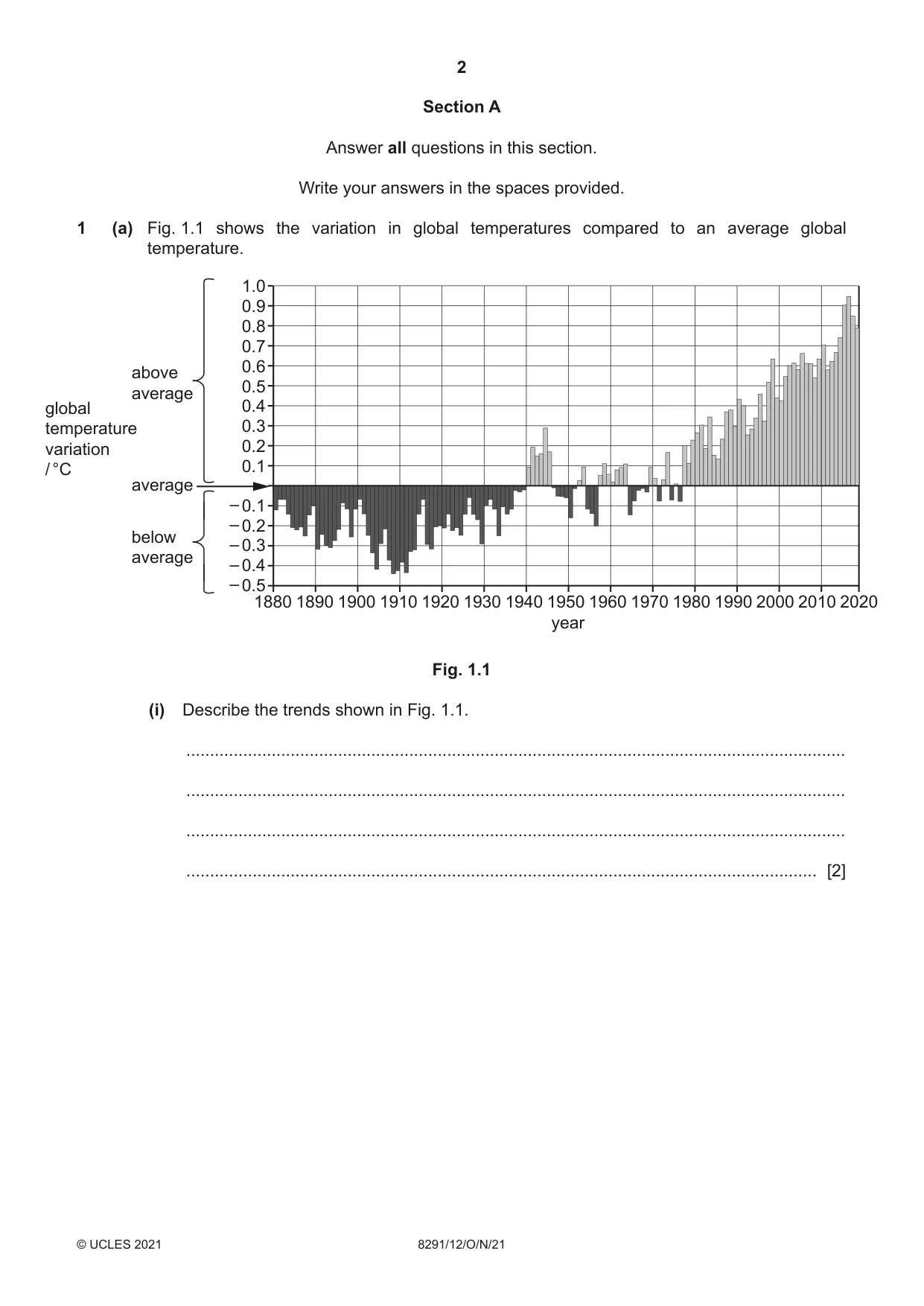
2 8291/12/O/N/21 © UCLES 2021 Section A Answer all questions in this section. Write your answers in the spaces provided. 1 (a) Fig. 1.1 shows the variation in global temperatures compared to an average global temperature. year global temperature variation / °C 1880 0.1 – 0.1 – 0.2 – 0.3 – 0.4 – 0.5 0.2 0.3 0.4 0.5 0.6 0.7 0.8 0.9 1.0 1890 1900 1910 1920 1930 1940 1950 1960 1970 1980 1990 2000 2010 2020 above average below average average Fig. 1.1 (i) Describe the trends shown in Fig. 1.1. … … … … [2]
Question paper, page 3
3 8291/12/O/N/21 © UCLES 2021 [Turn over (ii) Explain how an increase in global atmospheric carbon dioxide levels could be responsible for the trends shown in Fig. 1.1. … … … … … … … … [4] (iii) The combustion of fossil fuels produces carbon dioxide. Describe the environmental impacts of the extraction of fossil fuels. … … … … … … … … [4]
Question paper, page 4
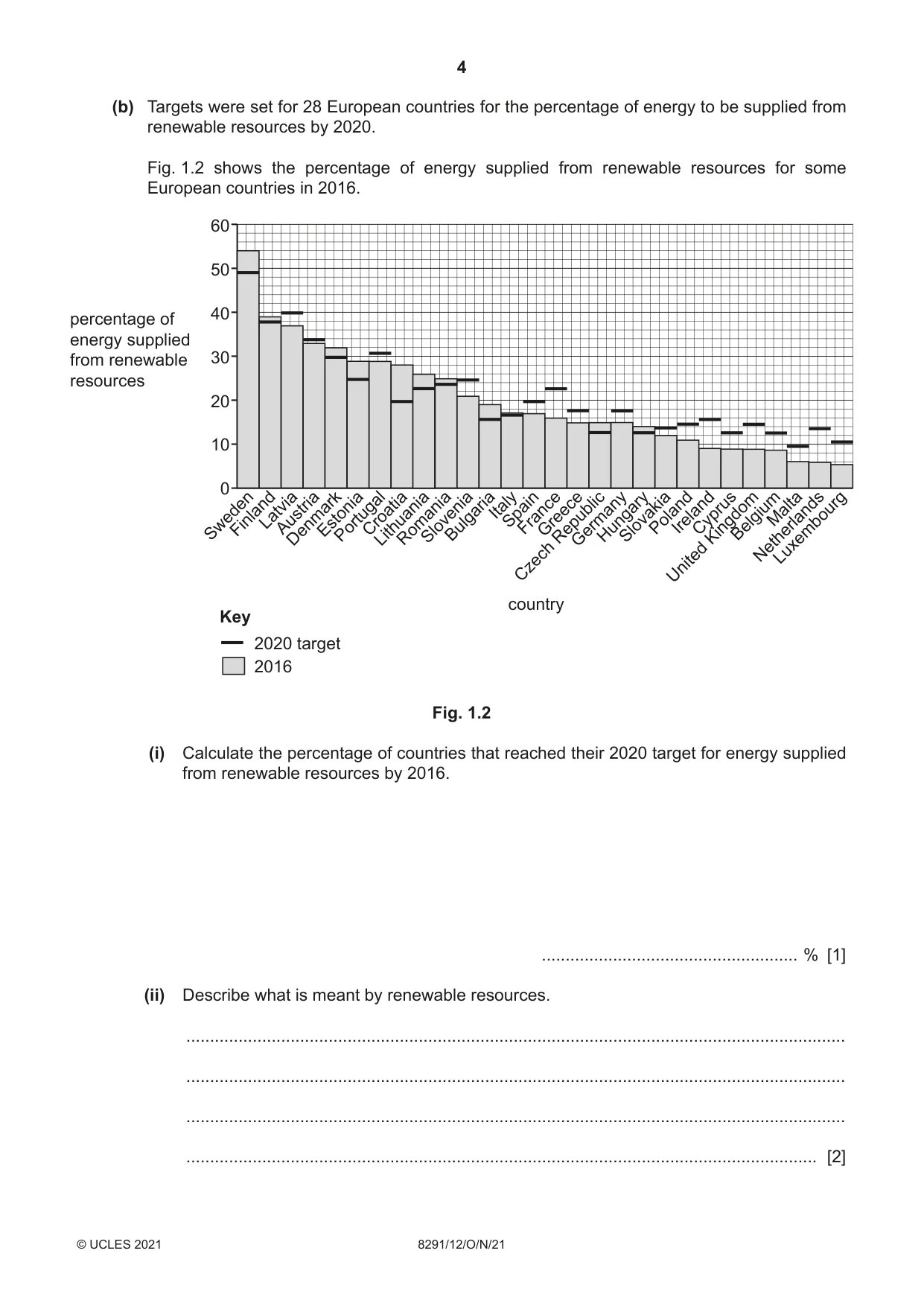
4 8291/12/O/N/21 © UCLES 2021 (b) Targets were set for 28 European countries for the percentage of energy to be supplied from renewable resources by 2020. Fig. 1.2 shows the percentage of energy supplied from renewable resources for some European countries in 2016. 0 10 20 30 40 50 60 Sweden Finland Latvia Austria Denmark Estonia Portugal Croatia Lithuania Romania Slovenia Bulgaria Italy Spain France Greece Czech Republic Germany Hungary Slovakia Poland Ireland Cyprus United Kingdom Belgium Malta Netherlands Luxembourg percentage of energy supplied from renewable resources country Key 2020 target 2016 Fig. 1.2 (i) Calculate the percentage of countries that reached their 2020 target for energy supplied from renewable resources by 2016. … % [1] (ii) Describe what is meant by renewable resources. … … … … [2]
Question paper, page 5
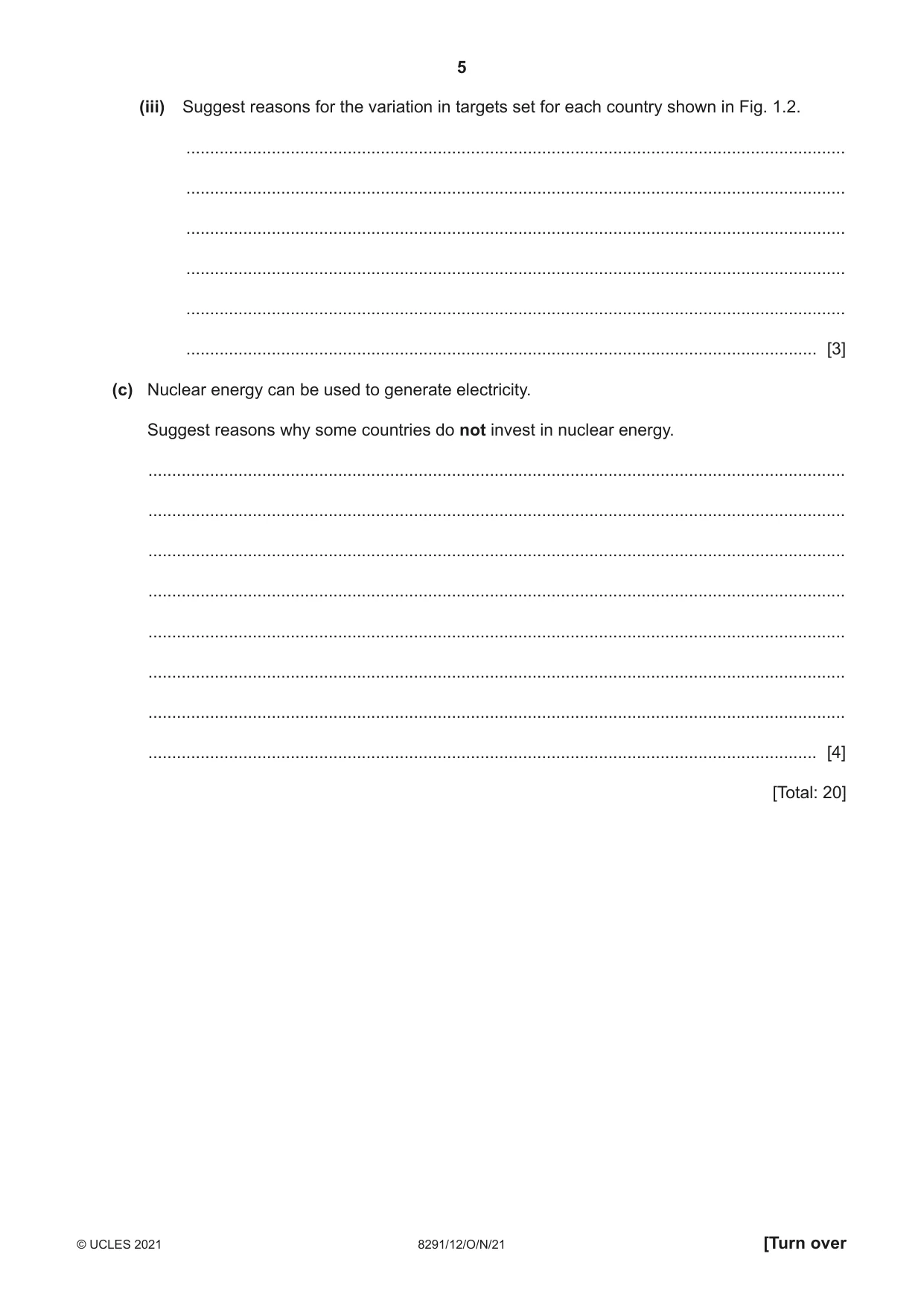
5 8291/12/O/N/21 © UCLES 2021 [Turn over (iii) Suggest reasons for the variation in targets set for each country shown in Fig. 1.2. … … … … … … [3] (c) Nuclear energy can be used to generate electricity. Suggest reasons why some countries do not invest in nuclear energy. … … … … … … … … [4] [Total: 20]
Question paper, page 6
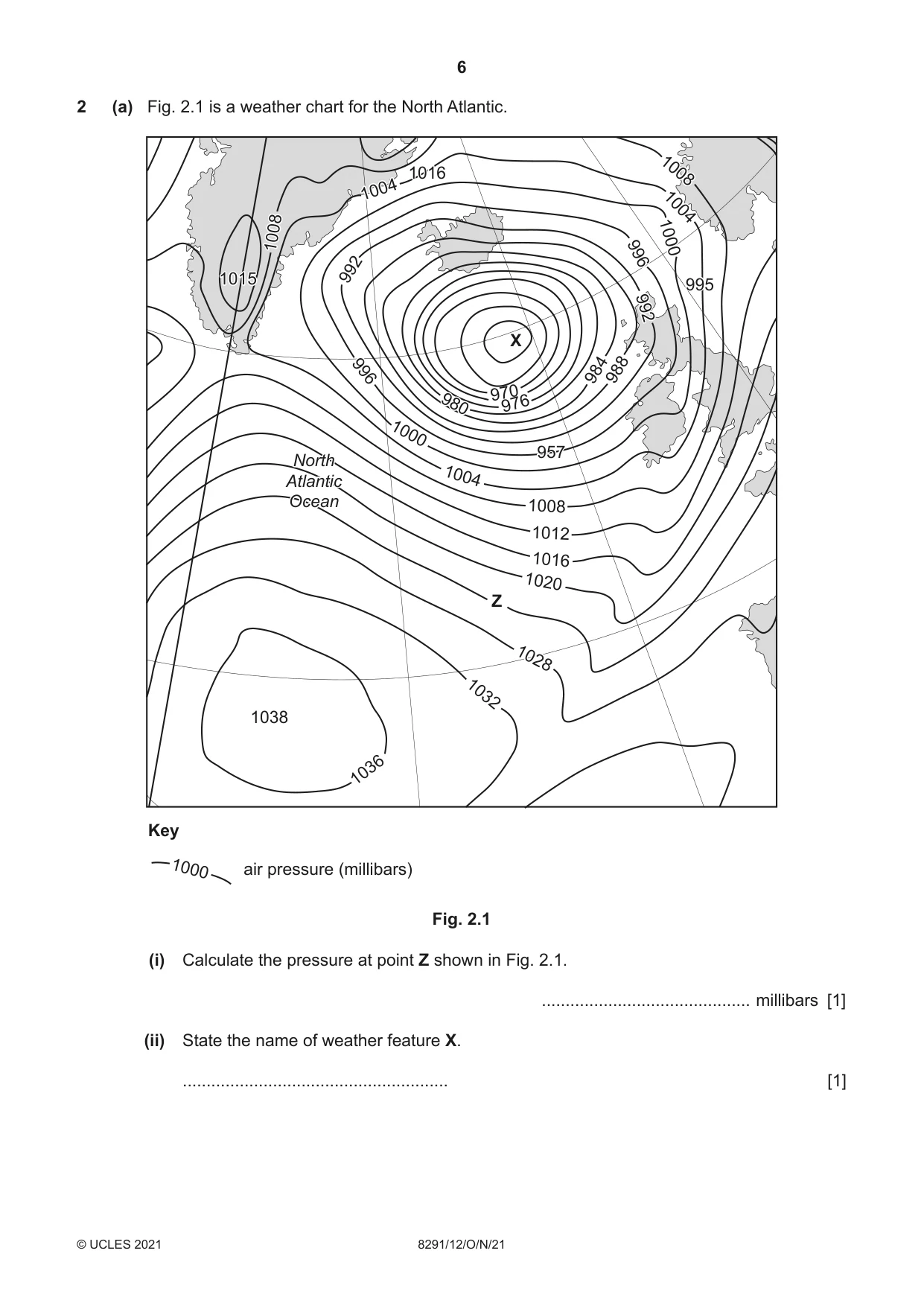
6 8291/12/O/N/21 © UCLES 2021 2 (a) Fig. 2.1 is a weather chart for the North Atlantic. Key air pressure (millibars) X Z 1036 1032 1028 1020 1016 1012 1008 1004 1000 996 992 1008 1004 988 984 980 976 970 996 992 1000 1008 1004 957 1015 1016 995 X Z 1036 1032 1028 1020 1016 1012 1008 1004 1000 1000 996 992 1008 1004 988 984 980 976 970 996 992 1000 1008 1004 1038 957 1015 1016 995 North Atlantic Ocean North Atlantic Ocean Fig. 2.1 (i) Calculate the pressure at point Z shown in Fig. 2.1. … millibars [1] (ii) State the name of weather feature X. … [1]
Question paper, page 7
7 8291/12/O/N/21 © UCLES 2021 [Turn over (iii) Describe methods used to forecast weather patterns. … … … … … … … … [4] (iv) Describe the weather conditions associated with an anticyclone. … … … … … … … … [4]
Question paper, page 8
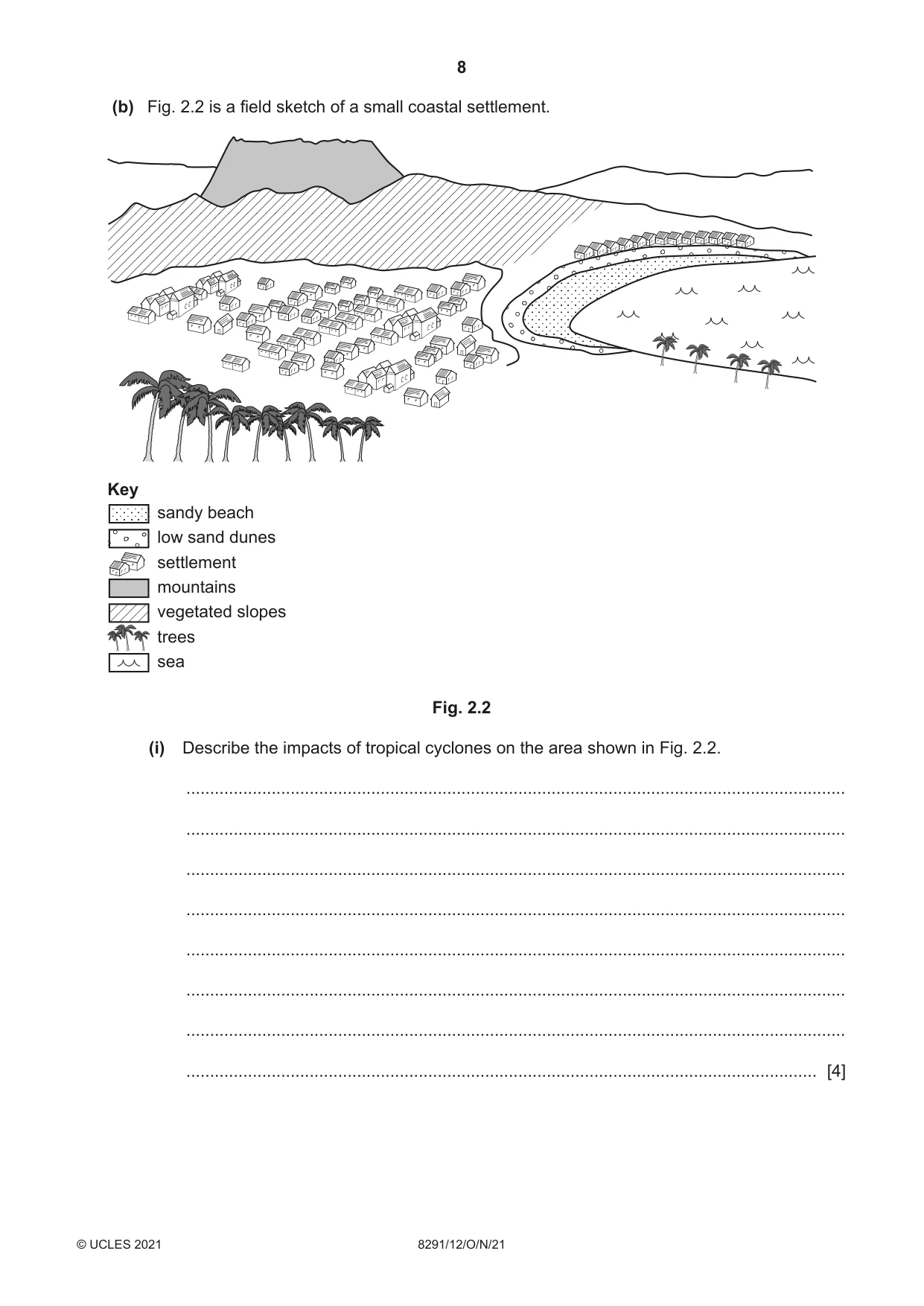
8 8291/12/O/N/21 © UCLES 2021 (b) Fig. 2.2 is a field sketch of a small coastal settlement. Key sandy beach low sand dunes settlement mountains vegetated slopes trees sea Fig. 2.2 (i) Describe the impacts of tropical cyclones on the area shown in Fig. 2.2. … … … … … … … … [4]
Question paper, page 9
9 8291/12/O/N/21 © UCLES 2021 [Turn over (ii) Explain strategies to manage the impact of tropical cyclones on the area shown in Fig. 2.2. … … … … … … … … … … … … [6] [Total: 20]
Question paper, page 10
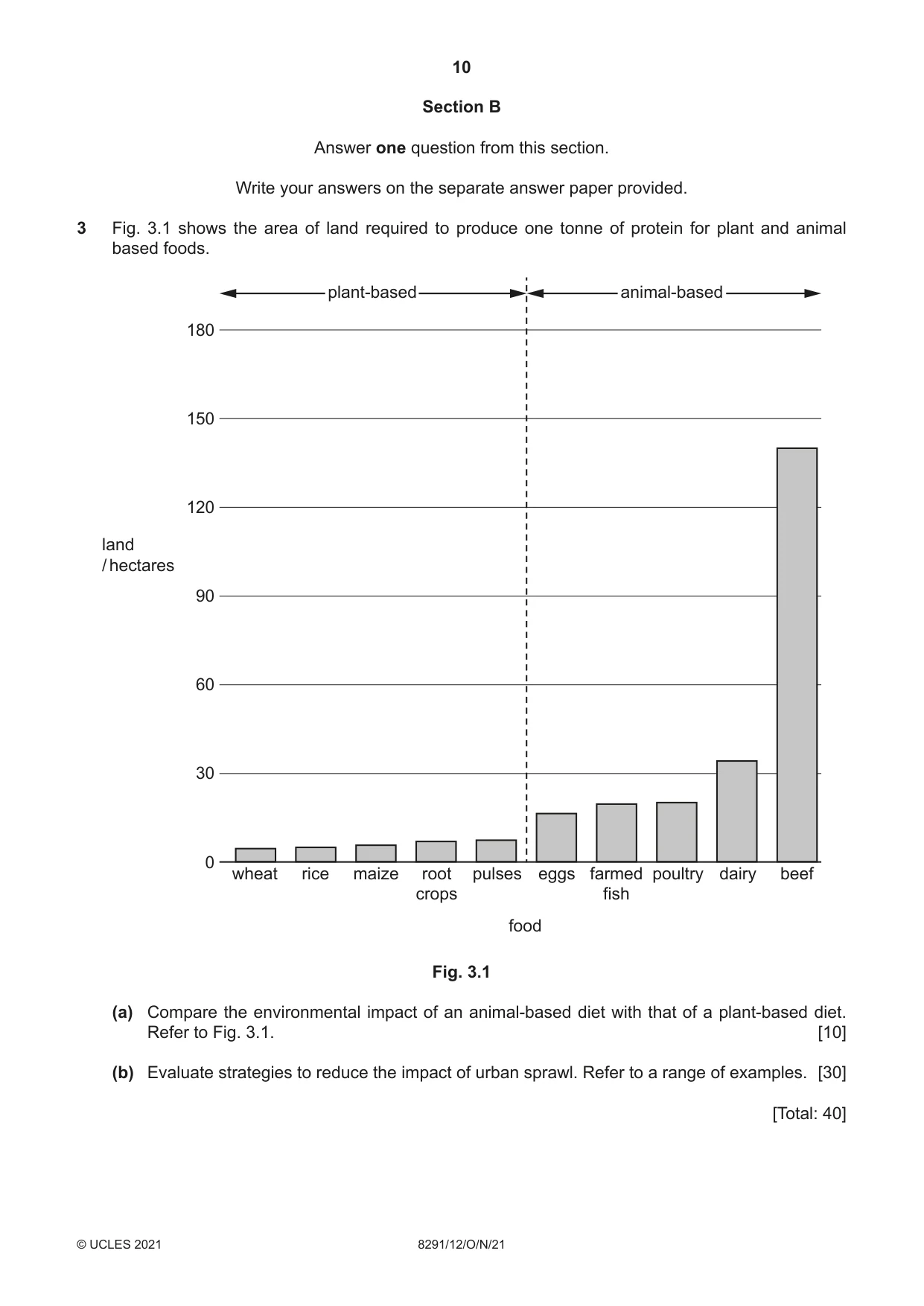
10 8291/12/O/N/21 © UCLES 2021 Section B Answer one question from this section. Write your answers on the separate answer paper provided. 3 Fig. 3.1 shows the area of land required to produce one tonne of protein for plant and animal based foods. wheat rice maize root crops pulses eggs farmed fish poultry dairy beef 0 30 60 90 120 150 180 food land / hectares plant-based animal-based Fig. 3.1 (a) Compare the environmental impact of an animal-based diet with that of a plant-based diet. Refer to Fig. 3.1. [10] (b) Evaluate strategies to reduce the impact of urban sprawl. Refer to a range of examples. [30] [Total: 40]
Question paper, page 11
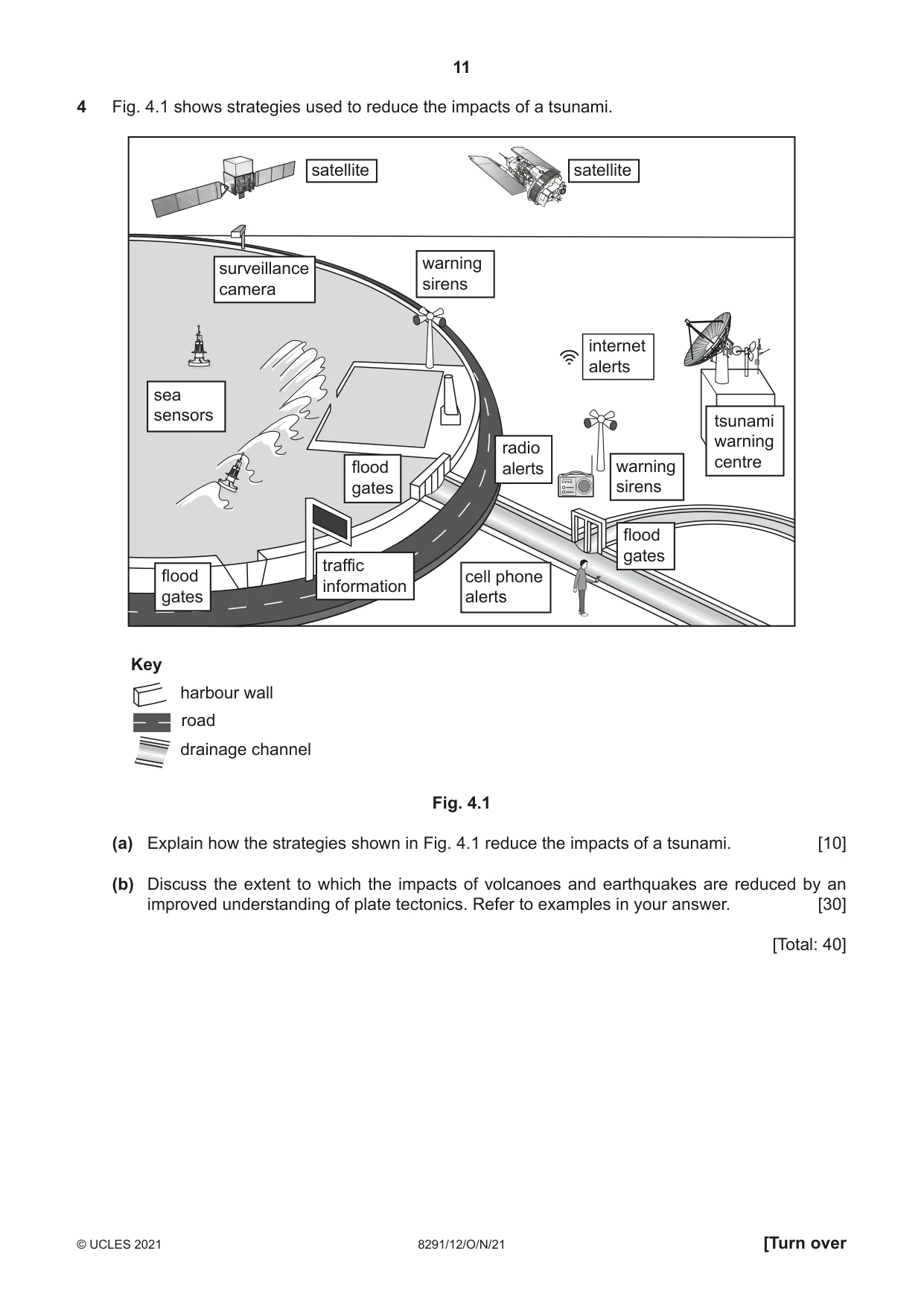
11 8291/12/ O/ N/21 © UCLES 2021 [Turn over 4 Fig. 4.1 shows strategies used to reduce the impacts of a tsunami. drainage channel road harbour wall Key flood gates flood gates flood gates satellite warning sirens tsunami warning centre satellite cell phone alerts traffic information radio alerts sea sensors surveillance camera warning sirens internet alerts Fig. 4.1 (a) Explain how the strategies shown in Fig. 4.1 reduce the impacts of a tsunami. [10] (b) Discuss the extent to which the impacts of volcanoes and earthquakes are reduced by an improved understanding of plate tectonics. Refer to examples in your answer. [30] [Total: 40]
Question paper, page 12
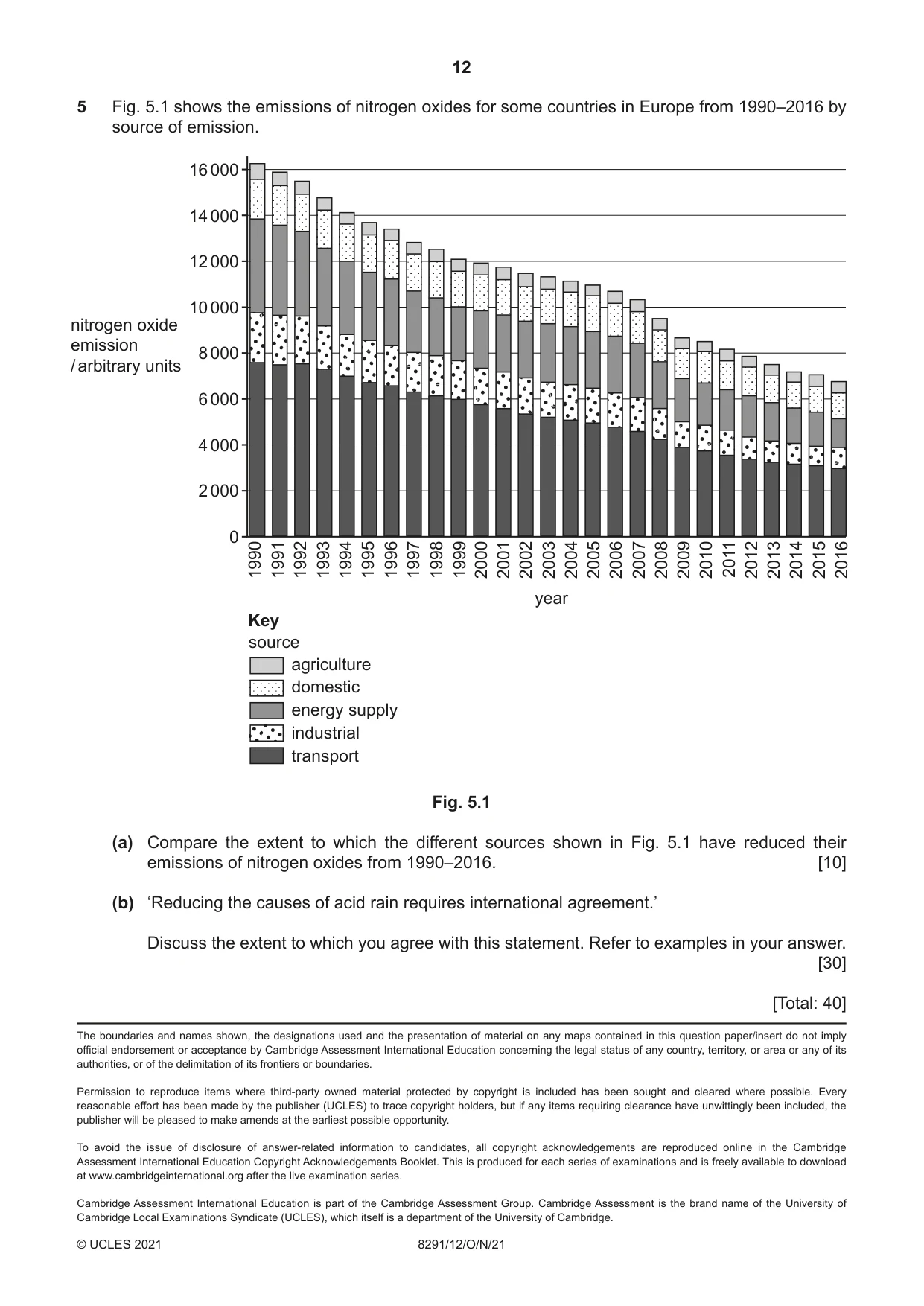
12 8291/12/O/N/21 © UCLES 2021 5 Fig. 5.1 shows the emissions of nitrogen oxides for some countries in Europe from 1990–2016 by source of emission. 1990 1991 1992 1993 1994 1995 1996 1997 1998 2000 1999 2001 2002 2003 2004 2005 2006 2007 2008 2009 2010 2011 2012 2013 2014 2015 2016 0 2 000 4 000 6 000 8 000 10 000 12 000 14 000 16 000 Key agriculture source year domestic energy supply industrial transport nitrogen oxide emission / arbitrary units Fig. 5.1 (a) Compare the extent to which the different sources shown in Fig. 5.1 have reduced their emissions of nitrogen oxides from 1990–2016. [10] (b) ‘Reducing the causes of acid rain requires international agreement.’ Discuss the extent to which you agree with this statement. Refer to examples in your answer. [30] [Total: 40] The boundaries and names shown, the designations used and the presentation of material on any maps contained in this question paper/insert do not imply official endorsement or acceptance by Cambridge Assessment International Education concerning the legal status of any country, territory, or area or any of its authorities, or of the delimitation of its frontiers or boundaries. Permission to reproduce items where third-party owned material protected by copyright is included has been sought and cleared where possible. Every reasonable effort has been made by the publisher (UCLES) to trace copyright holders, but if any items requiring clearance have unwittingly been included, the publisher will be pleased to make amends at the earliest possible opportunity. To avoid the issue of disclosure of answer-related information to candidates, all copyright acknowledgements are reproduced online in the Cambridge Assessment International Education Copyright Acknowledgements Booklet. This is produced for each series of examinations and is freely available to download at www.cambridgeinternational.org after the live examination series. Cambridge Assessment International Education is part of the Cambridge Assessment Group. Cambridge Assessment is the brand name of the University of Cambridge Local Examinations Syndicate (UCLES), which itself is a department of the University of Cambridge.
Mark scheme, page 1
This document consists of 14 printed pages. © UCLES 2021 [Turn over Cambridge International AS Level ENVIRONMENTAL MANAGEMENT 8291/12 Paper 1 October/November 2021 MARK SCHEME Maximum Mark: 80 Published This mark scheme is published as an aid to teachers and candidates, to indicate the requirements of the examination. It shows the basis on which Examiners were instructed to award marks. It does not indicate the details of the discussions that took place at an Examiners’ meeting before marking began, which would have considered the acceptability of alternative answers. Mark schemes should be read in conjunction with the question paper and the Principal Examiner Report for Teachers. Cambridge International will not enter into discussions about these mark schemes. Cambridge International is publishing the mark schemes for the October/November 2021 series for most Cambridge IGCSE™, Cambridge International A and AS Level components and some Cambridge O Level components.
Mark scheme, page 2
8291/12 Cambridge International AS Level – Mark Scheme PUBLISHED October/November 2021 © UCLES 2021 Page 2 of 14 Generic Marking Principles These general marking principles must be applied by all examiners when marking candidate answers. They should be applied alongside the specific content of the mark scheme or generic level descriptors for a question. Each question paper and mark scheme will also comply with these marking principles. GENERIC MARKING PRINCIPLE 1: Marks must be awarded in line with: • the specific content of the mark scheme or the generic level descriptors for the question • the specific skills defined in the mark scheme or in the generic level descriptors for the question • the standard of response required by a candidate as exemplified by the standardisation scripts. GENERIC MARKING PRINCIPLE 2: Marks awarded are always whole marks (not half marks, or other fractions). GENERIC MARKING PRINCIPLE 3: Marks must be awarded positively: • marks are awarded for correct/valid answers, as defined in the mark scheme. However, credit is given for valid answers which go beyond the scope of the syllabus and mark scheme, referring to your Team Leader as appropriate • marks are awarded when candidates clearly demonstrate what they know and can do • marks are not deducted for errors • marks are not deducted for omissions • answers should only be judged on the quality of spelling, punctuation and grammar when these features are specifically assessed by the question as indicated by the mark scheme. The meaning, however, should be unambiguous. GENERIC MARKING PRINCIPLE 4: Rules must be applied consistently, e.g. in situations where candidates have not followed instructions or in the application of generic level descriptors.
Mark scheme, page 3
8291/12 Cambridge International AS Level – Mark Scheme PUBLISHED October/November 2021 © UCLES 2021 Page 3 of 14 GENERIC MARKING PRINCIPLE 5: Marks should be awarded using the full range of marks defined in the mark scheme for the question (however; the use of the full mark range may be limited according to the quality of the candidate responses seen). GENERIC MARKING PRINCIPLE 6: Marks awarded are based solely on the requirements as defined in the mark scheme. Marks should not be awarded with grade thresholds or grade descriptors in mind. Science-Specific Marking Principles 1 Examiners should consider the context and scientific use of any keywords when awarding marks. Although keywords may be present, marks should not be awarded if the keywords are used incorrectly. 2 The examiner should not choose between contradictory statements given in the same question part, and credit should not be awarded for any correct statement that is contradicted within the same question part. Wrong science that is irrelevant to the question should be ignored. 3 Although spellings do not have to be correct, spellings of syllabus terms must allow for clear and unambiguous separation from other syllabus terms with which they may be confused (e.g. ethane / ethene, glucagon / glycogen, refraction / reflection). 4 The error carried forward (ecf) principle should be applied, where appropriate. If an incorrect answer is subsequently used in a scientifically correct way, the candidate should be awarded these subsequent marking points. Further guidance will be included in the mark scheme where necessary and any exceptions to this general principle will be noted. 5 ‘List rule’ guidance For questions that require n responses (e.g. State two reasons …): • The response should be read as continuous prose, even when numbered answer spaces are provided. • Any response marked ignore in the mark scheme should not count towards n. • Incorrect responses should not be awarded credit but will still count towards n. • Read the entire response to check for any responses that contradict those that would otherwise be credited. Credit should not be awarded for any responses that are contradicted within the rest of the response. Where two responses contradict one another, this should be treated as a single incorrect response. • Non-contradictory responses after the first n responses may be ignored even if they include incorrect science.
Mark scheme, page 4
8291/12 Cambridge International AS Level – Mark Scheme PUBLISHED October/November 2021 © UCLES 2021 Page 4 of 14 6 Calculation specific guidance Correct answers to calculations should be given full credit even if there is no working or incorrect working, unless the question states ‘show your working’. For questions in which the number of significant figures required is not stated, credit should be awarded for correct answers when rounded by the examiner to the number of significant figures given in the mark scheme. This may not apply to measured values. For answers given in standard form (e.g. a × 10n) in which the convention of restricting the value of the coefficient (a) to a value between 1 and 10 is not followed, credit may still be awarded if the answer can be converted to the answer given in the mark scheme. Unless a separate mark is given for a unit, a missing or incorrect unit will normally mean that the final calculation mark is not awarded. Exceptions to this general principle will be noted in the mark scheme. 7 Guidance for chemical equations Multiples / fractions of coefficients used in chemical equations are acceptable unless stated otherwise in the mark scheme. State symbols given in an equation should be ignored unless asked for in the question or stated otherwise in the mark scheme.
Mark scheme, page 5
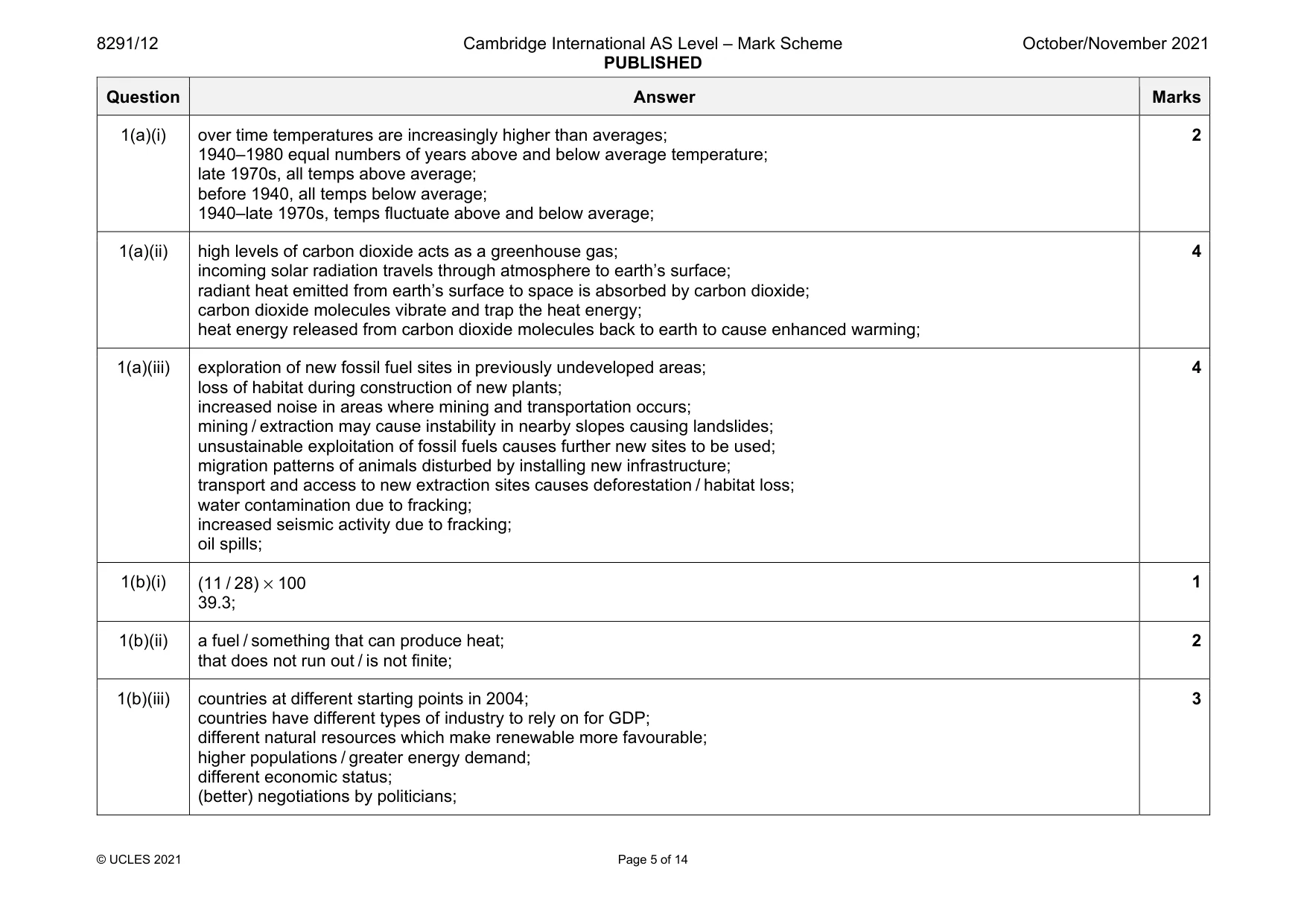
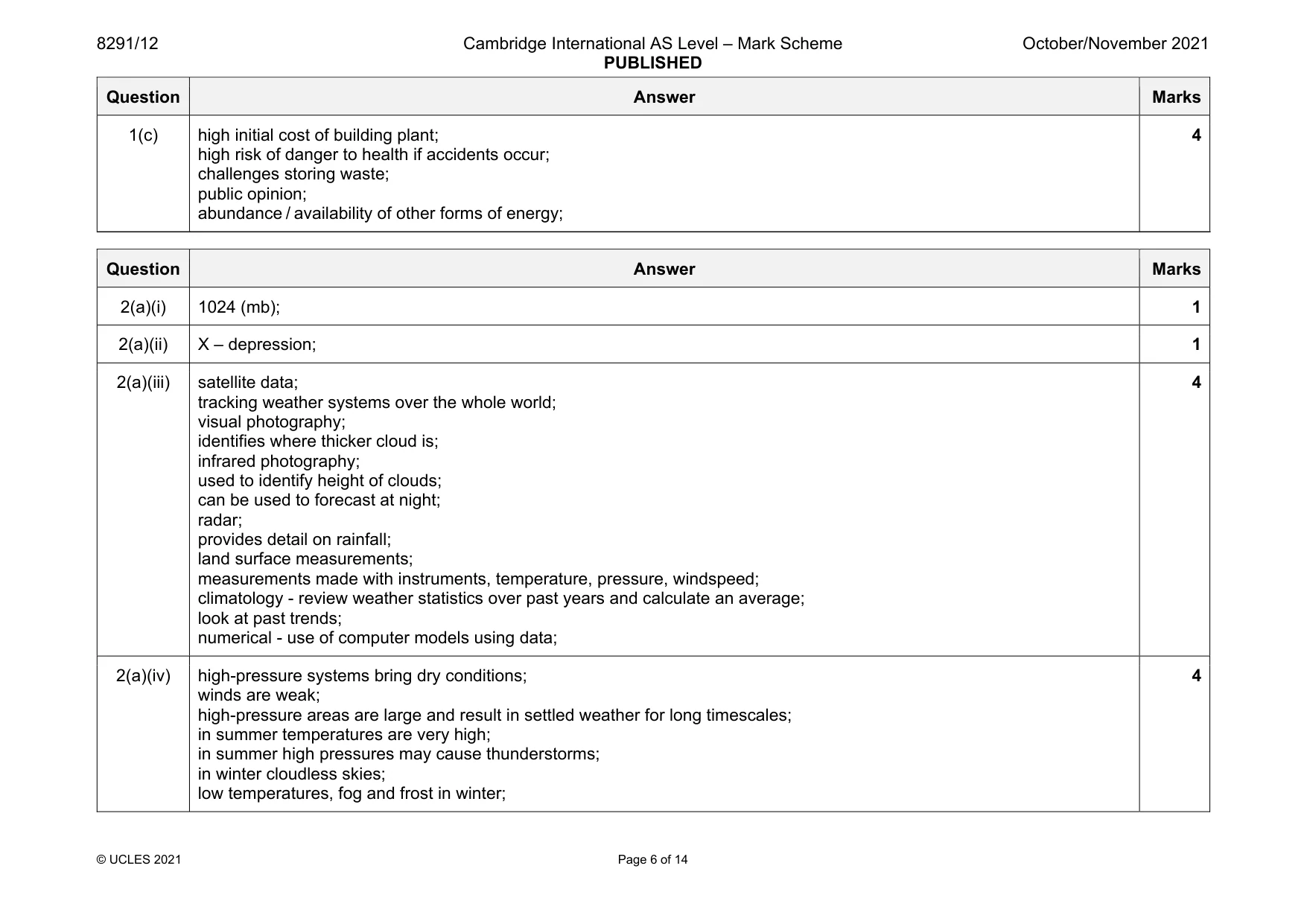
8291/12 Cambridge International AS Level – Mark Scheme PUBLISHED October/November 2021 © UCLES 2021 Page 5 of 14 Question Answer Marks 1(a)(i) over time temperatures are increasingly higher than averages; 1940–1980 equal numbers of years above and below average temperature; late 1970s, all temps above average; before 1940, all temps below average; 1940–late 1970s, temps fluctuate above and below average; 2 1(a)(ii) high levels of carbon dioxide acts as a greenhouse gas; incoming solar radiation travels through atmosphere to earth’s surface; radiant heat emitted from earth’s surface to space is absorbed by carbon dioxide; carbon dioxide molecules vibrate and trap the heat energy; heat energy released from carbon dioxide molecules back to earth to cause enhanced warming; 4 1(a)(iii) exploration of new fossil fuel sites in previously undeveloped areas; loss of habitat during construction of new plants; increased noise in areas where mining and transportation occurs; mining / extraction may cause instability in nearby slopes causing landslides; unsustainable exploitation of fossil fuels causes further new sites to be used; migration patterns of animals disturbed by installing new infrastructure; transport and access to new extraction sites causes deforestation / habitat loss; water contamination due to fracking; increased seismic activity due to fracking; oil spills; 4 1(b)(i) (11 / 28) × 100 39.3; 1 1(b)(ii) a fuel / something that can produce heat; that does not run out / is not finite; 2 1(b)(iii) countries at different starting points in 2004; countries have different types of industry to rely on for GDP; different natural resources which make renewable more favourable; higher populations / greater energy demand; different economic status; (better) negotiations by politicians; 3
Mark scheme, page 6
8291/12 Cambridge International AS Level – Mark Scheme PUBLISHED October/November 2021 © UCLES 2021 Page 6 of 14 Question Answer Marks 1(c) high initial cost of building plant; high risk of danger to health if accidents occur; challenges storing waste; public opinion; abundance / availability of other forms of energy; 4 Question Answer Marks 2(a)(i) 1024 (mb); 1 2(a)(ii) X – depression; 1 2(a)(iii) satellite data; tracking weather systems over the whole world; visual photography; identifies where thicker cloud is; infrared photography; used to identify height of clouds; can be used to forecast at night; radar; provides detail on rainfall; land surface measurements; measurements made with instruments, temperature, pressure, windspeed; climatology - review weather statistics over past years and calculate an average; look at past trends; numerical - use of computer models using data; 4 2(a)(iv) high-pressure systems bring dry conditions; winds are weak; high-pressure areas are large and result in settled weather for long timescales; in summer temperatures are very high; in summer high pressures may cause thunderstorms; in winter cloudless skies; low temperatures, fog and frost in winter; 4
Mark scheme, page 7
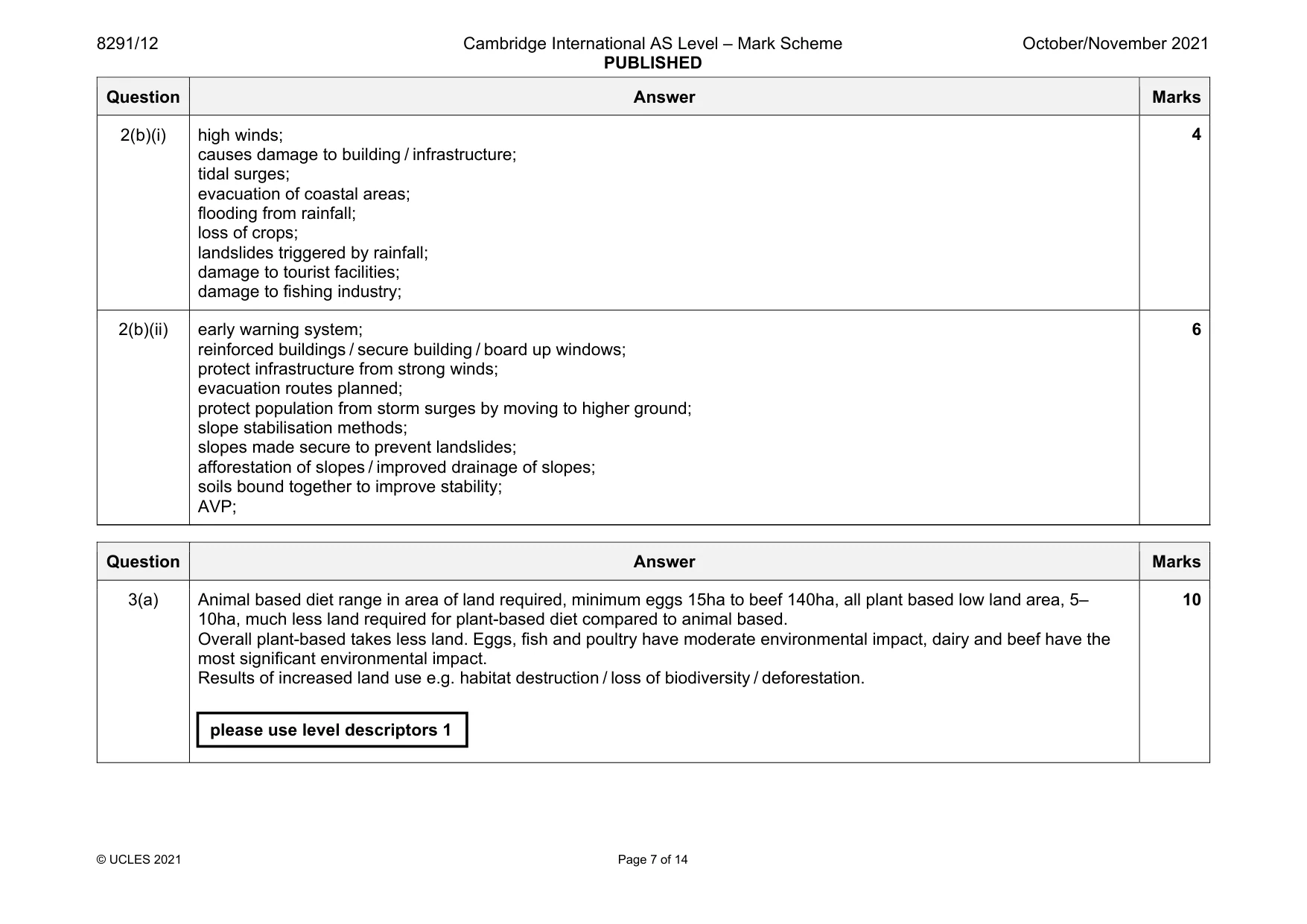
8291/12 Cambridge International AS Level – Mark Scheme PUBLISHED October/November 2021 © UCLES 2021 Page 7 of 14 Question Answer Marks 2(b)(i) high winds; causes damage to building / infrastructure; tidal surges; evacuation of coastal areas; flooding from rainfall; loss of crops; landslides triggered by rainfall; damage to tourist facilities; damage to fishing industry; 4 2(b)(ii) early warning system; reinforced buildings / secure building / board up windows; protect infrastructure from strong winds; evacuation routes planned; protect population from storm surges by moving to higher ground; slope stabilisation methods; slopes made secure to prevent landslides; afforestation of slopes / improved drainage of slopes; soils bound together to improve stability; AVP; 6 Question Answer Marks 3(a) Animal based diet range in area of land required, minimum eggs 15ha to beef 140ha, all plant based low land area, 5– 10ha, much less land required for plant-based diet compared to animal based. Overall plant-based takes less land. Eggs, fish and poultry have moderate environmental impact, dairy and beef have the most significant environmental impact. Results of increased land use e.g. habitat destruction / loss of biodiversity / deforestation. 10 please use level descriptors 1
Mark scheme, page 8
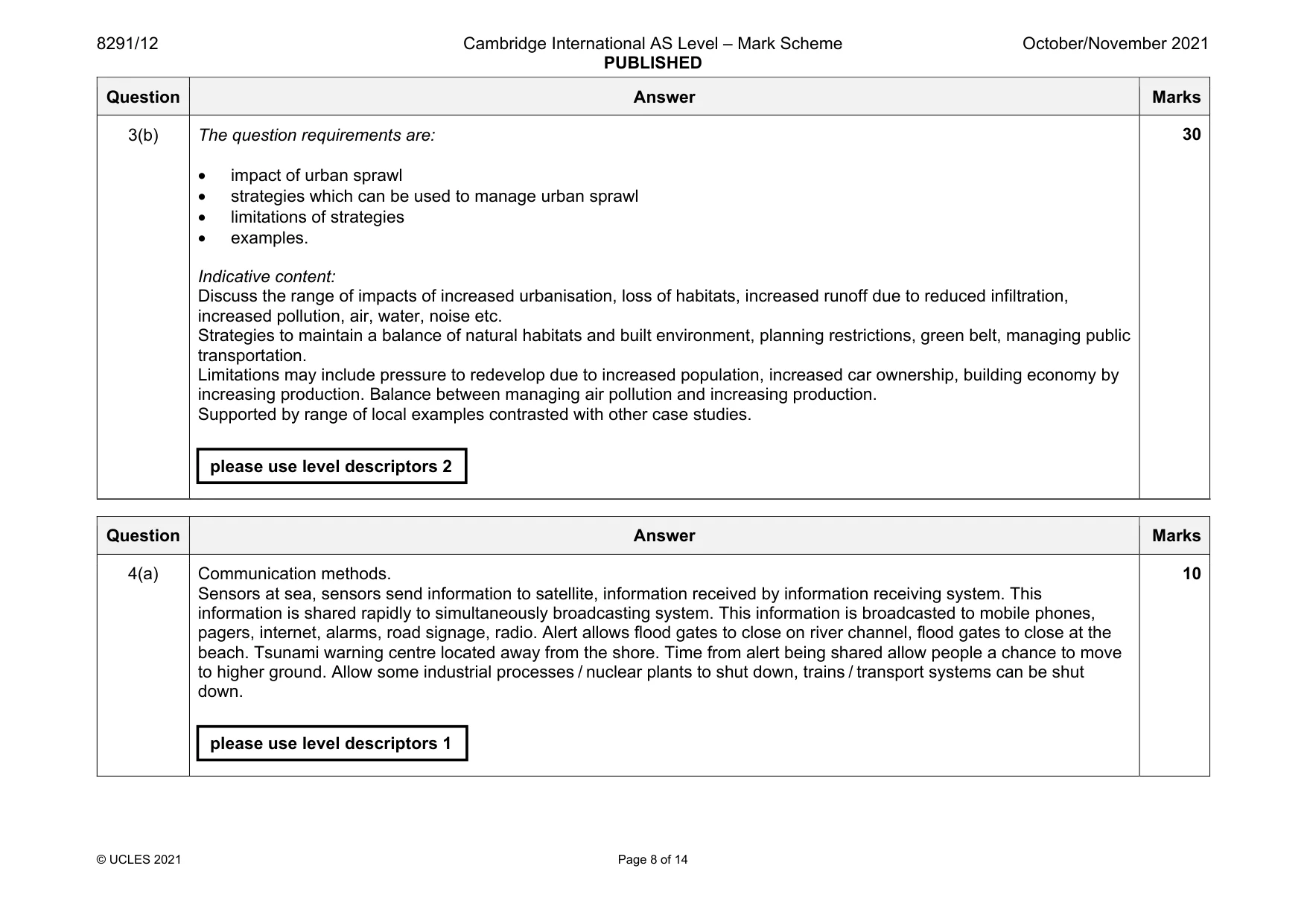
8291/12 Cambridge International AS Level – Mark Scheme PUBLISHED October/November 2021 © UCLES 2021 Page 8 of 14 Question Answer Marks 3(b) The question requirements are: • impact of urban sprawl • strategies which can be used to manage urban sprawl • limitations of strategies • examples. Indicative content: Discuss the range of impacts of increased urbanisation, loss of habitats, increased runoff due to reduced infiltration, increased pollution, air, water, noise etc. Strategies to maintain a balance of natural habitats and built environment, planning restrictions, green belt, managing public transportation. Limitations may include pressure to redevelop due to increased population, increased car ownership, building economy by increasing production. Balance between managing air pollution and increasing production. Supported by range of local examples contrasted with other case studies. 30 Question Answer Marks 4(a) Communication methods. Sensors at sea, sensors send information to satellite, information received by information receiving system. This information is shared rapidly to simultaneously broadcasting system. This information is broadcasted to mobile phones, pagers, internet, alarms, road signage, radio. Alert allows flood gates to close on river channel, flood gates to close at the beach. Tsunami warning centre located away from the shore. Time from alert being shared allow people a chance to move to higher ground. Allow some industrial processes / nuclear plants to shut down, trains / transport systems can be shut down. 10 please use level descriptors 1 please use level descriptors 2
Mark scheme, page 9
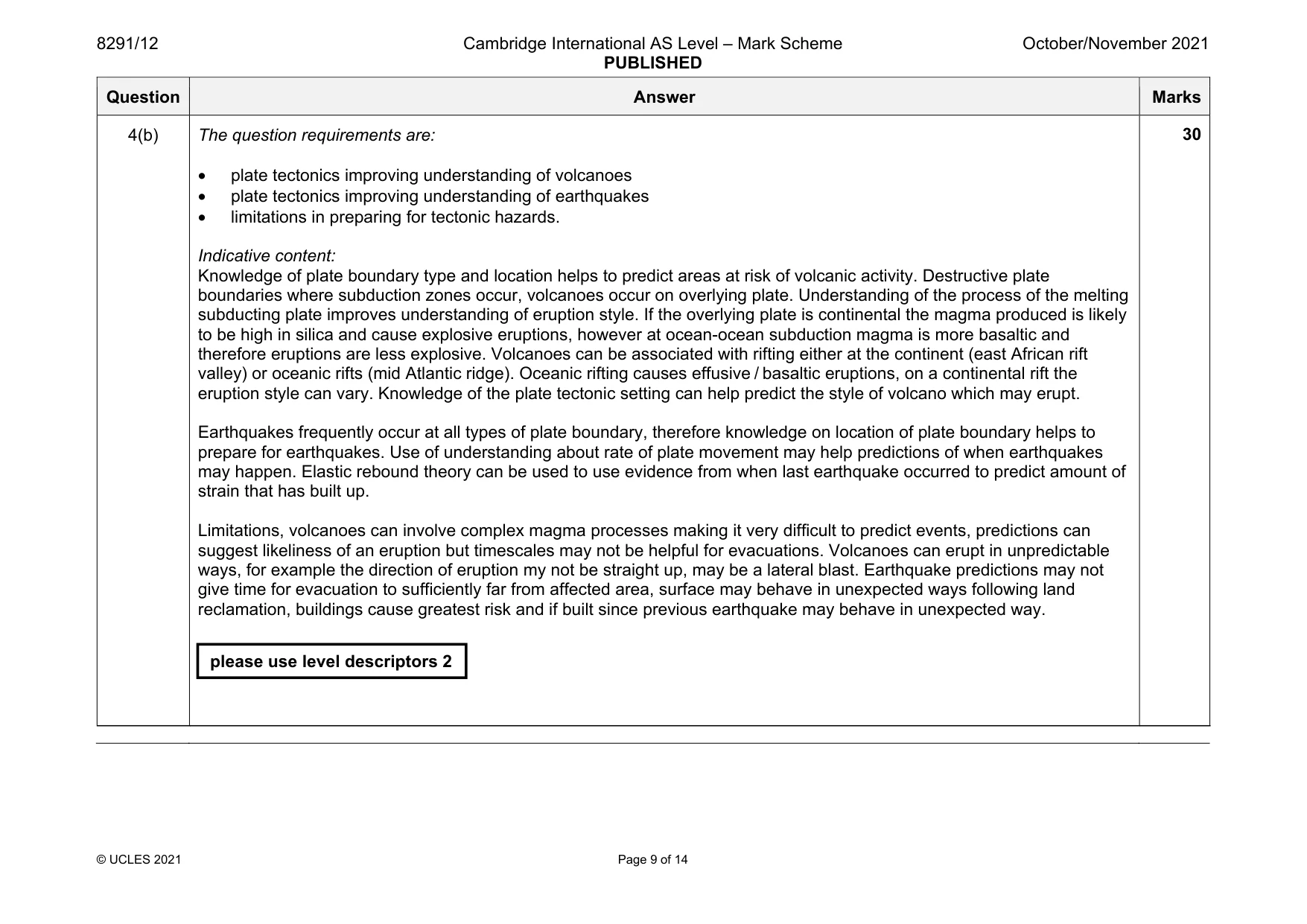
8291/12 Cambridge International AS Level – Mark Scheme PUBLISHED October/November 2021 © UCLES 2021 Page 9 of 14 Question Answer Marks 4(b) The question requirements are: • plate tectonics improving understanding of volcanoes • plate tectonics improving understanding of earthquakes • limitations in preparing for tectonic hazards. Indicative content: Knowledge of plate boundary type and location helps to predict areas at risk of volcanic activity. Destructive plate boundaries where subduction zones occur, volcanoes occur on overlying plate. Understanding of the process of the melting subducting plate improves understanding of eruption style. If the overlying plate is continental the magma produced is likely to be high in silica and cause explosive eruptions, however at ocean-ocean subduction magma is more basaltic and therefore eruptions are less explosive. Volcanoes can be associated with rifting either at the continent (east African rift valley) or oceanic rifts (mid Atlantic ridge). Oceanic rifting causes effusive / basaltic eruptions, on a continental rift the eruption style can vary. Knowledge of the plate tectonic setting can help predict the style of volcano which may erupt. Earthquakes frequently occur at all types of plate boundary, therefore knowledge on location of plate boundary helps to prepare for earthquakes. Use of understanding about rate of plate movement may help predictions of when earthquakes may happen. Elastic rebound theory can be used to use evidence from when last earthquake occurred to predict amount of strain that has built up. Limitations, volcanoes can involve complex magma processes making it very difficult to predict events, predictions can suggest likeliness of an eruption but timescales may not be helpful for evacuations. Volcanoes can erupt in unpredictable ways, for example the direction of eruption my not be straight up, may be a lateral blast. Earthquake predictions may not give time for evacuation to sufficiently far from affected area, surface may behave in unexpected ways following land reclamation, buildings cause greatest risk and if built since previous earthquake may behave in unexpected way. 30 please use level descriptors 2
Mark scheme, page 10
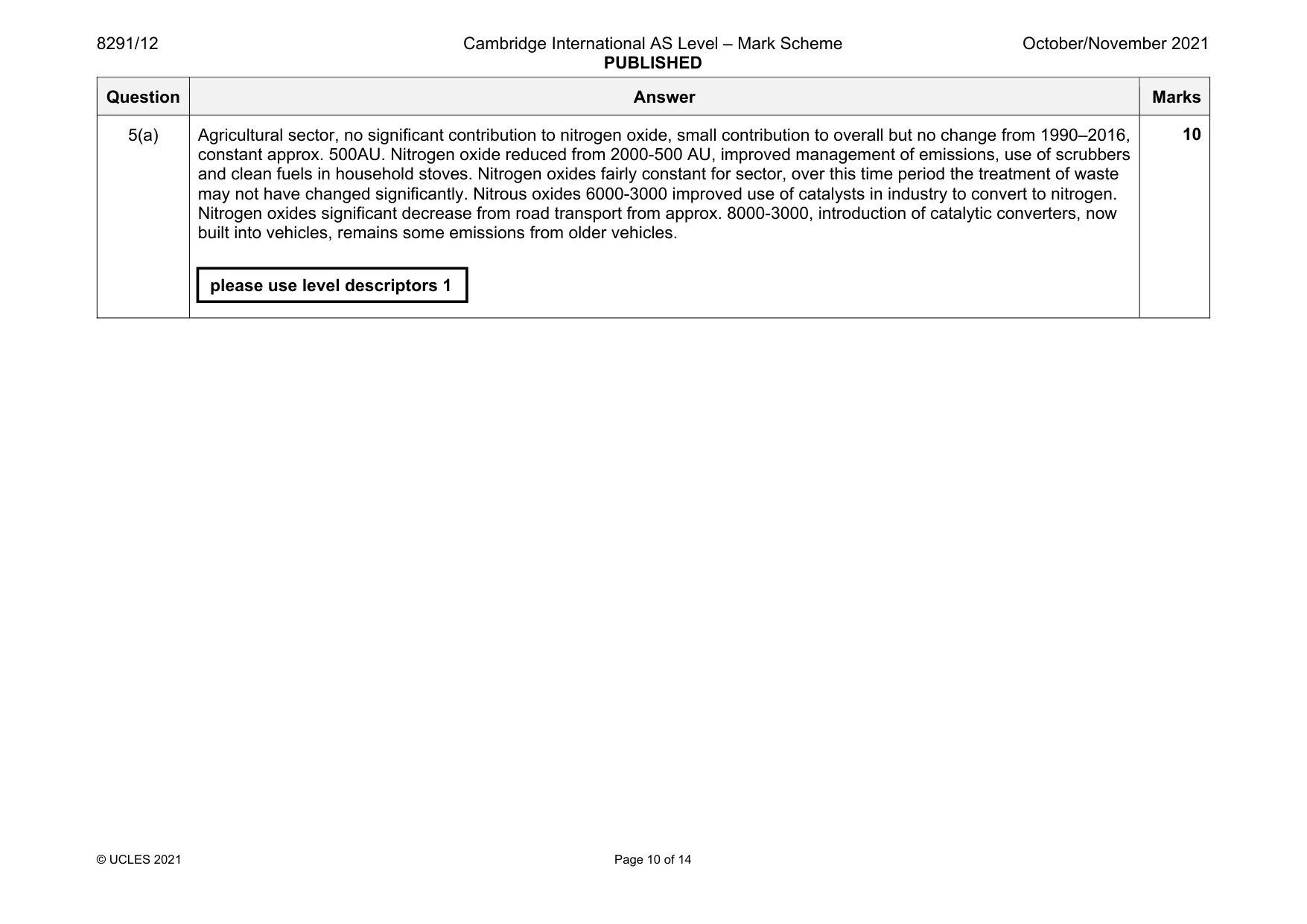
8291/12 Cambridge International AS Level – Mark Scheme PUBLISHED October/November 2021 © UCLES 2021 Page 10 of 14 Question Answer Marks 5(a) Agricultural sector, no significant contribution to nitrogen oxide, small contribution to overall but no change from 1990–2016, constant approx. 500AU. Nitrogen oxide reduced from 2000-500 AU, improved management of emissions, use of scrubbers and clean fuels in household stoves. Nitrogen oxides fairly constant for sector, over this time period the treatment of waste may not have changed significantly. Nitrous oxides 6000-3000 improved use of catalysts in industry to convert to nitrogen. Nitrogen oxides significant decrease from road transport from approx. 8000-3000, introduction of catalytic converters, now built into vehicles, remains some emissions from older vehicles. 10 please use level descriptors 1
Mark scheme, page 11
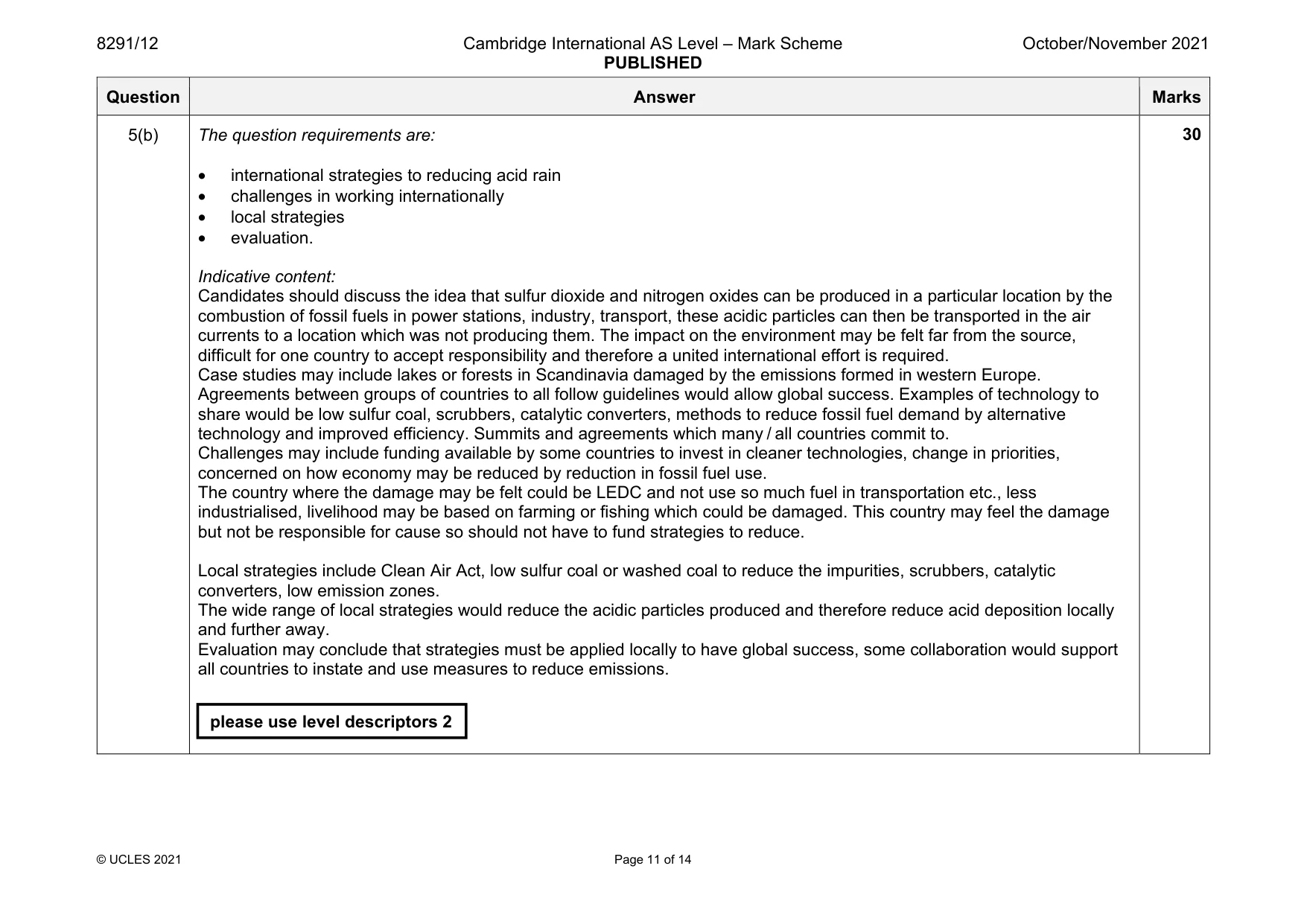
8291/12 Cambridge International AS Level – Mark Scheme PUBLISHED October/November 2021 © UCLES 2021 Page 11 of 14 Question Answer Marks 5(b) The question requirements are: • international strategies to reducing acid rain • challenges in working internationally • local strategies • evaluation. Indicative content: Candidates should discuss the idea that sulfur dioxide and nitrogen oxides can be produced in a particular location by the combustion of fossil fuels in power stations, industry, transport, these acidic particles can then be transported in the air currents to a location which was not producing them. The impact on the environment may be felt far from the source, difficult for one country to accept responsibility and therefore a united international effort is required. Case studies may include lakes or forests in Scandinavia damaged by the emissions formed in western Europe. Agreements between groups of countries to all follow guidelines would allow global success. Examples of technology to share would be low sulfur coal, scrubbers, catalytic converters, methods to reduce fossil fuel demand by alternative technology and improved efficiency. Summits and agreements which many / all countries commit to. Challenges may include funding available by some countries to invest in cleaner technologies, change in priorities, concerned on how economy may be reduced by reduction in fossil fuel use. The country where the damage may be felt could be LEDC and not use so much fuel in transportation etc., less industrialised, livelihood may be based on farming or fishing which could be damaged. This country may feel the damage but not be responsible for cause so should not have to fund strategies to reduce. Local strategies include Clean Air Act, low sulfur coal or washed coal to reduce the impurities, scrubbers, catalytic converters, low emission zones. The wide range of local strategies would reduce the acidic particles produced and therefore reduce acid deposition locally and further away. Evaluation may conclude that strategies must be applied locally to have global success, some collaboration would support all countries to instate and use measures to reduce emissions. 30 please use level descriptors 2
Mark scheme, page 12
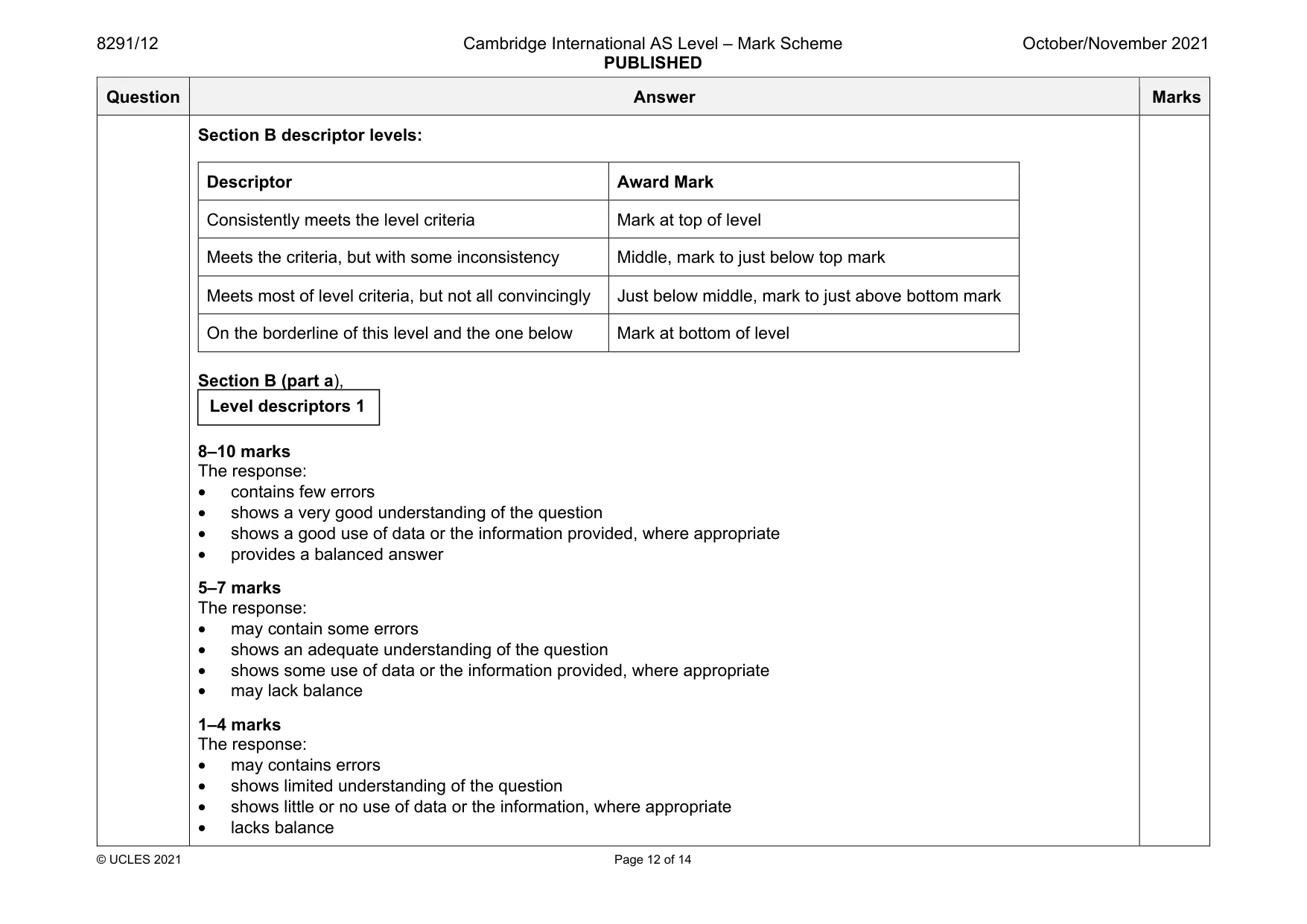
8291/12 Cambridge International AS Level – Mark Scheme PUBLISHED October/November 2021 © UCLES 2021 Page 12 of 14 Question Answer Marks Section B descriptor levels: Descriptor Award Mark Consistently meets the level criteria Mark at top of level Meets the criteria, but with some inconsistency Middle, mark to just below top mark Meets most of level criteria, but not all convincingly Just below middle, mark to just above bottom mark On the borderline of this level and the one below Mark at bottom of level Section B (part a), 8–10 marks The response: • contains few errors • shows a very good understanding of the question • shows a good use of data or the information provided, where appropriate • provides a balanced answer 5–7 marks The response: • may contain some errors • shows an adequate understanding of the question • shows some use of data or the information provided, where appropriate • may lack balance 1–4 marks The response: • may contains errors • shows limited understanding of the question • shows little or no use of data or the information, where appropriate • lacks balance Level descriptors 1
Mark scheme, page 13
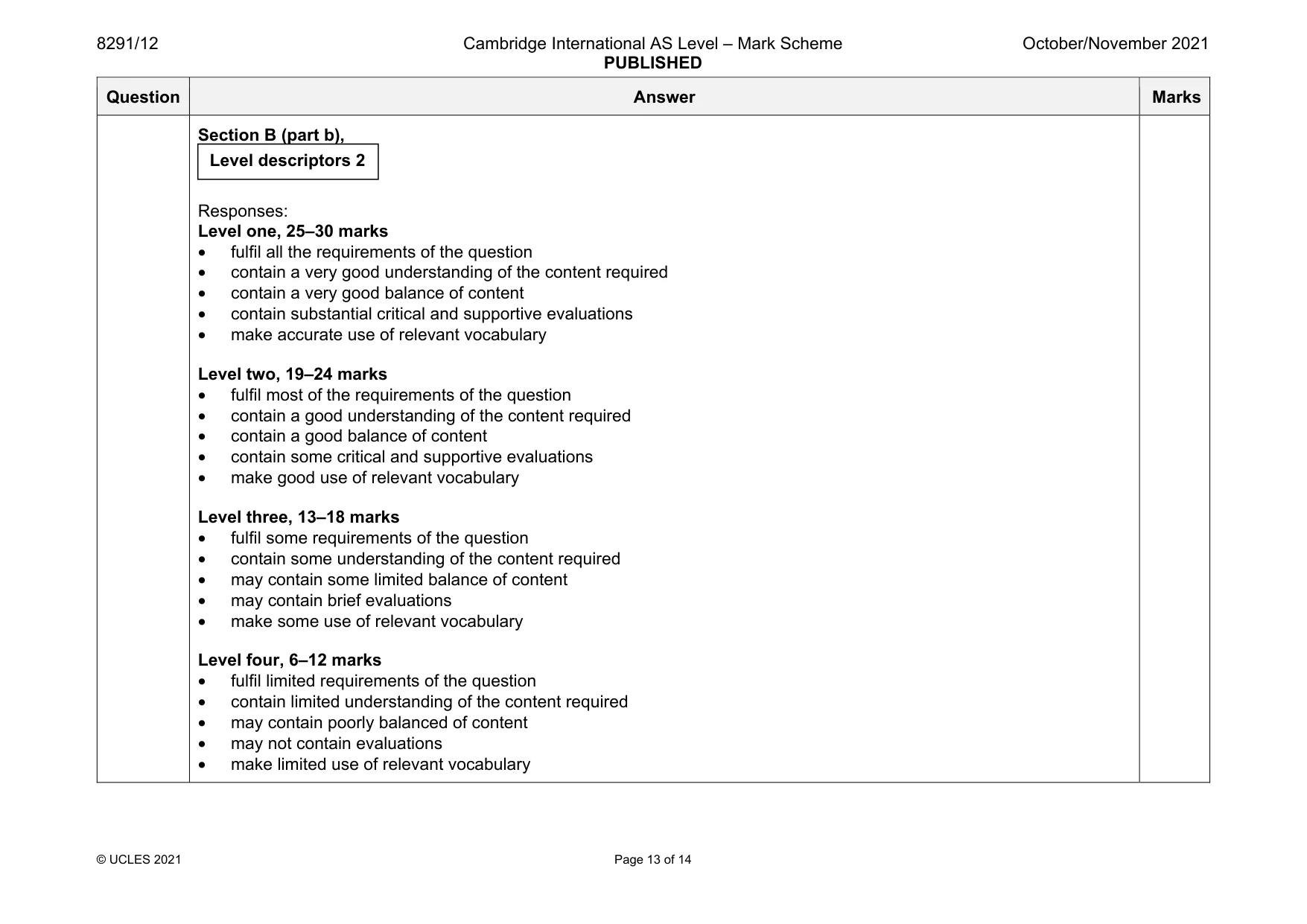
8291/12 Cambridge International AS Level – Mark Scheme PUBLISHED October/November 2021 © UCLES 2021 Page 13 of 14 Question Answer Marks Section B (part b), Responses: Level one, 25–30 marks • fulfil all the requirements of the question • contain a very good understanding of the content required • contain a very good balance of content • contain substantial critical and supportive evaluations • make accurate use of relevant vocabulary Level two, 19–24 marks • fulfil most of the requirements of the question • contain a good understanding of the content required • contain a good balance of content • contain some critical and supportive evaluations • make good use of relevant vocabulary Level three, 13–18 marks • fulfil some requirements of the question • contain some understanding of the content required • may contain some limited balance of content • may contain brief evaluations • make some use of relevant vocabulary Level four, 6–12 marks • fulfil limited requirements of the question • contain limited understanding of the content required • may contain poorly balanced of content • may not contain evaluations • make limited use of relevant vocabulary Level descriptors 2
Mark scheme, page 14
8291/12 Cambridge International AS Level – Mark Scheme PUBLISHED October/November 2021 © UCLES 2021 Page 14 of 14 Question Answer Marks Level five, 1–5 marks • fulfil a few of the requirements of the question • contain a very limited understanding of the content required • are likely to be unbalanced and undeveloped • evaluative statements are likely to be missing • make no use of relevant vocabulary
What you needed in this session
Cambridge’s own grade thresholds for 2021 Oct/Nov, Paper 1 · Variant 2. A higher threshold means an easier paper — the bar moves with how the cohort did.