Cambridge A Level Environmental Management (AS only) 8291 — 2021 May/June Paper 1 · Variant 3
8291/13/M/J/21 · 80 marks · ≈90 min
The question paper and its mark scheme, free to read here and free to download. This is Cambridge’s own paper, exactly as it was sat.
Question paper12 pages
Mark scheme17 pages
Answers below. Sit the paper first if you are practising.
Paper as text
Question paper, page 1
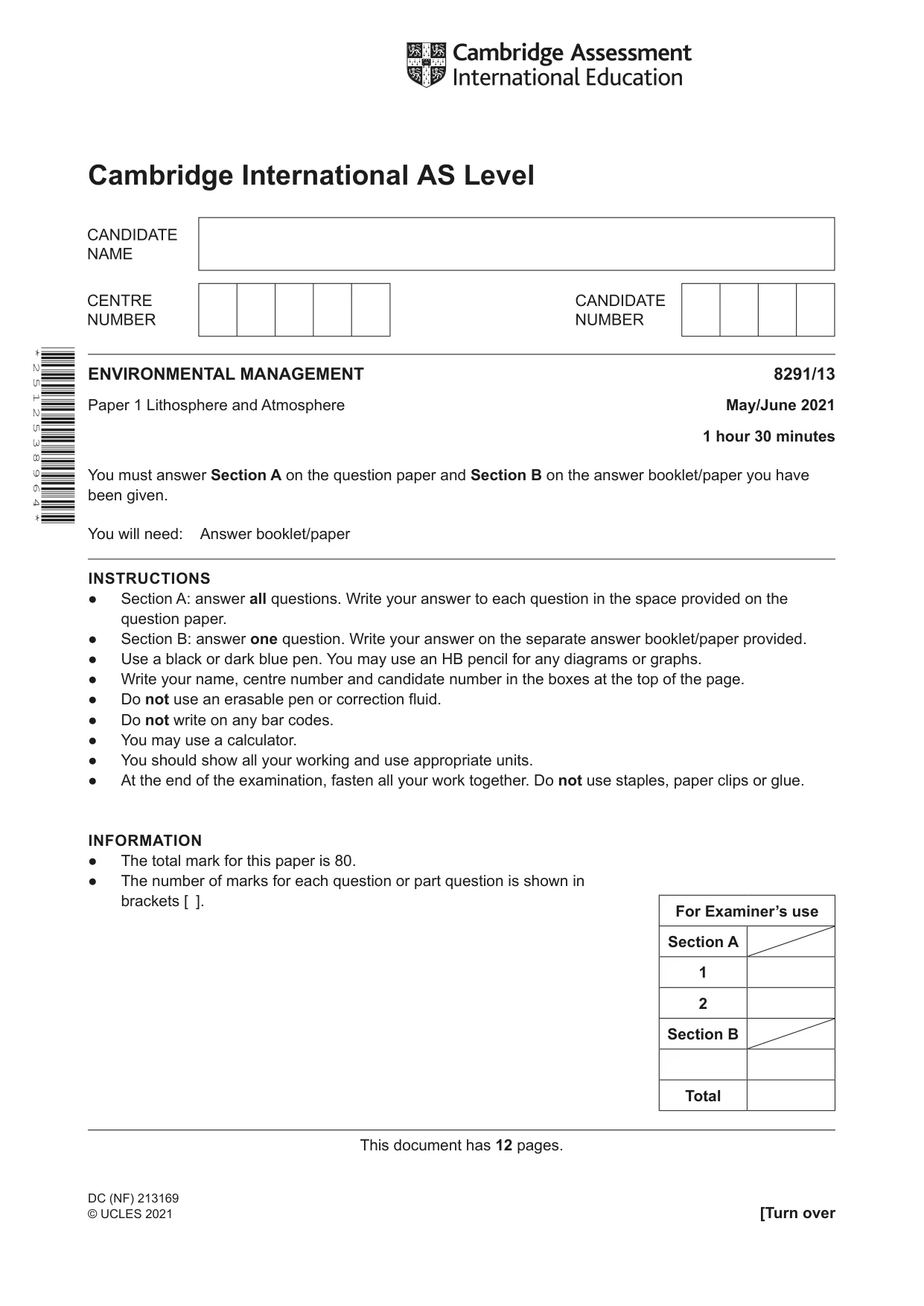
This document has 12 pages. Cambridge International AS Level DC (NF) 213169 © UCLES 2021 [Turn over * 2 5 1 2 5 3 8 9 6 4 * ENVIRONMENTAL MANAGEMENT 8291/13 Paper 1 Lithosphere and Atmosphere May/June 2021 1 hour 30 minutes You must answer Section A on the question paper and Section B on the answer booklet/paper you have been given. You will need: Answer booklet/paper INSTRUCTIONS ● Section A: answer all questions. Write your answer to each question in the space provided on the question paper. ● Section B: answer one question. Write your answer on the separate answer booklet/paper provided. ● Use a black or dark blue pen. You may use an HB pencil for any diagrams or graphs. ● Write your name, centre number and candidate number in the boxes at the top of the page. ● Do not use an erasable pen or correction fluid. ● Do not write on any bar codes. ● You may use a calculator. ● You should show all your working and use appropriate units. ● At the end of the examination, fasten all your work together. Do not use staples, paper clips or glue. INFORMATION ● The total mark for this paper is 80. ● The number of marks for each question or part question is shown in brackets [ ]. For Examiner’s use Section A 1 2 Section B Total
Question paper, page 2
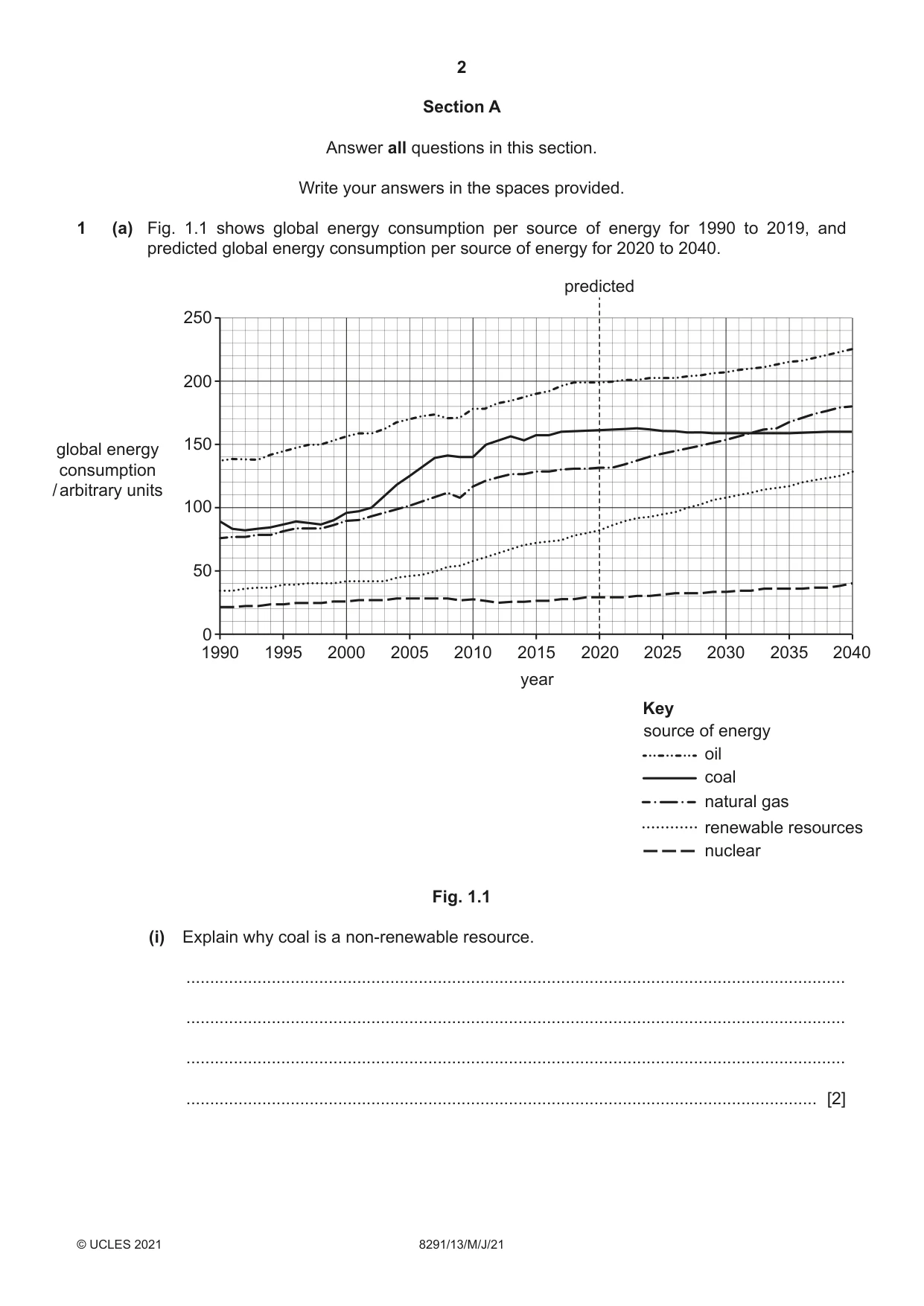
2 8291/13/M/J/21 © UCLES 2021 Section A Answer all questions in this section. Write your answers in the spaces provided. 1 (a) Fig. 1.1 shows global energy consumption per source of energy for 1990 to 2019, and predicted global energy consumption per source of energy for 2020 to 2040. 250 200 150 100 50 0 1990 1995 2000 2005 2010 2015 2020 2025 2030 2035 2040 oil source of energy natural gas coal renewable resources nuclear year global energy consumption / arbitrary units predicted Key Fig. 1.1 (i) Explain why coal is a non-renewable resource. … … … … [2]
Question paper, page 3
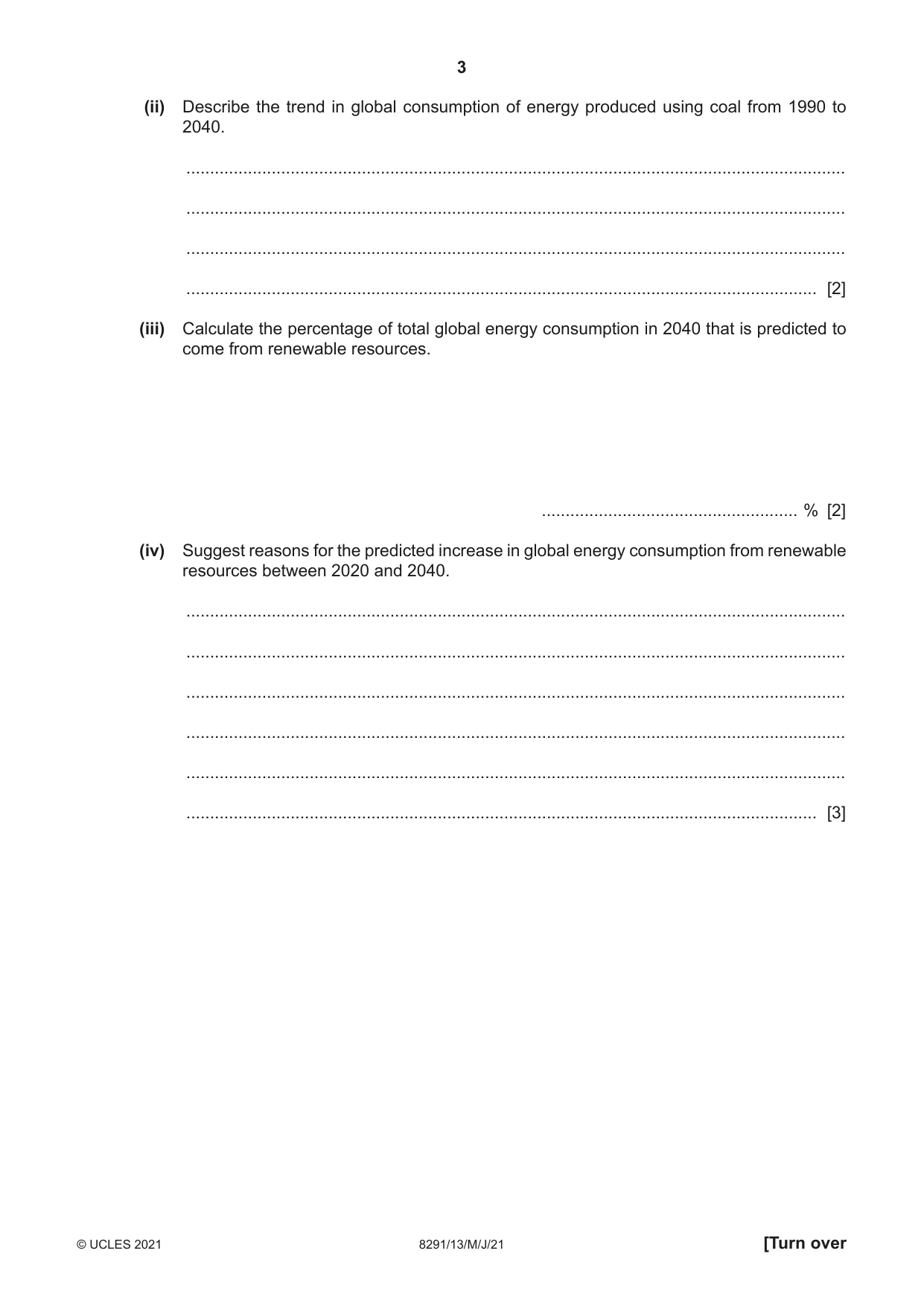
3 8291/13/M/J/21 © UCLES 2021 [Turn over (ii) Describe the trend in global consumption of energy produced using coal from 1990 to 2040. … … … … [2] (iii) Calculate the percentage of total global energy consumption in 2040 that is predicted to come from renewable resources. … % [2] (iv) Suggest reasons for the predicted increase in global energy consumption from renewable resources between 2020 and 2040. … … … … … … [3]
Question paper, page 4
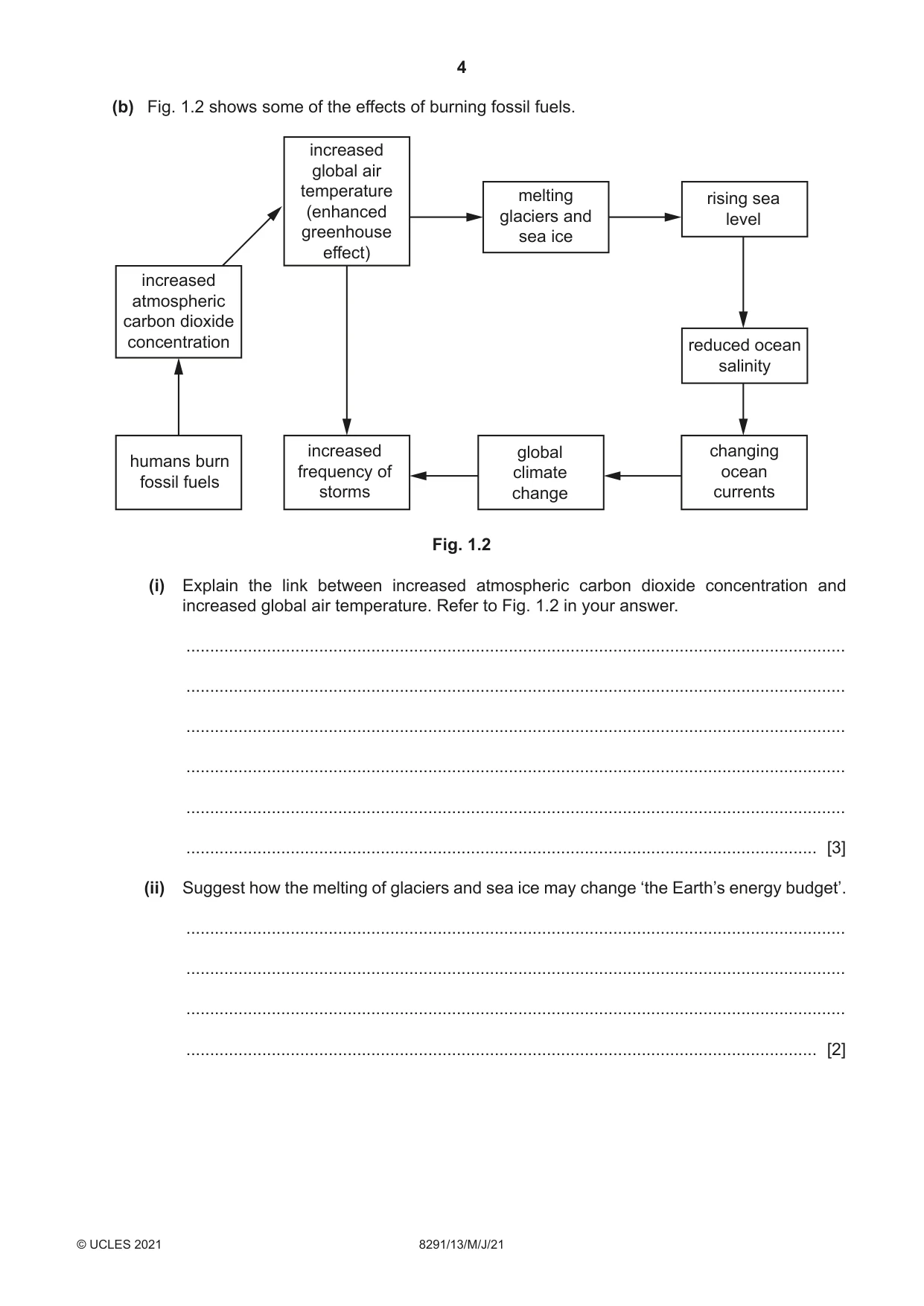
4 8291/13/M/J/21 © UCLES 2021 (b) Fig. 1.2 shows some of the effects of burning fossil fuels. increased global air temperature (enhanced greenhouse effect) increased atmospheric carbon dioxide concentration melting glaciers and sea ice rising sea level reduced ocean salinity changing ocean currents global climate change increased frequency of storms humans burn fossil fuels Fig. 1.2 (i) Explain the link between increased atmospheric carbon dioxide concentration and increased global air temperature. Refer to Fig. 1.2 in your answer. … … … … … … [3] (ii) Suggest how the melting of glaciers and sea ice may change ‘the Earth’s energy budget’. … … … … [2]
Question paper, page 5
5 8291/13/M/J/21 © UCLES 2021 [Turn over (iii) Describe the impacts that rising sea level has on low-lying coastal settlements. … … … … … … … … … … … … [6] [Total: 20]
Question paper, page 6
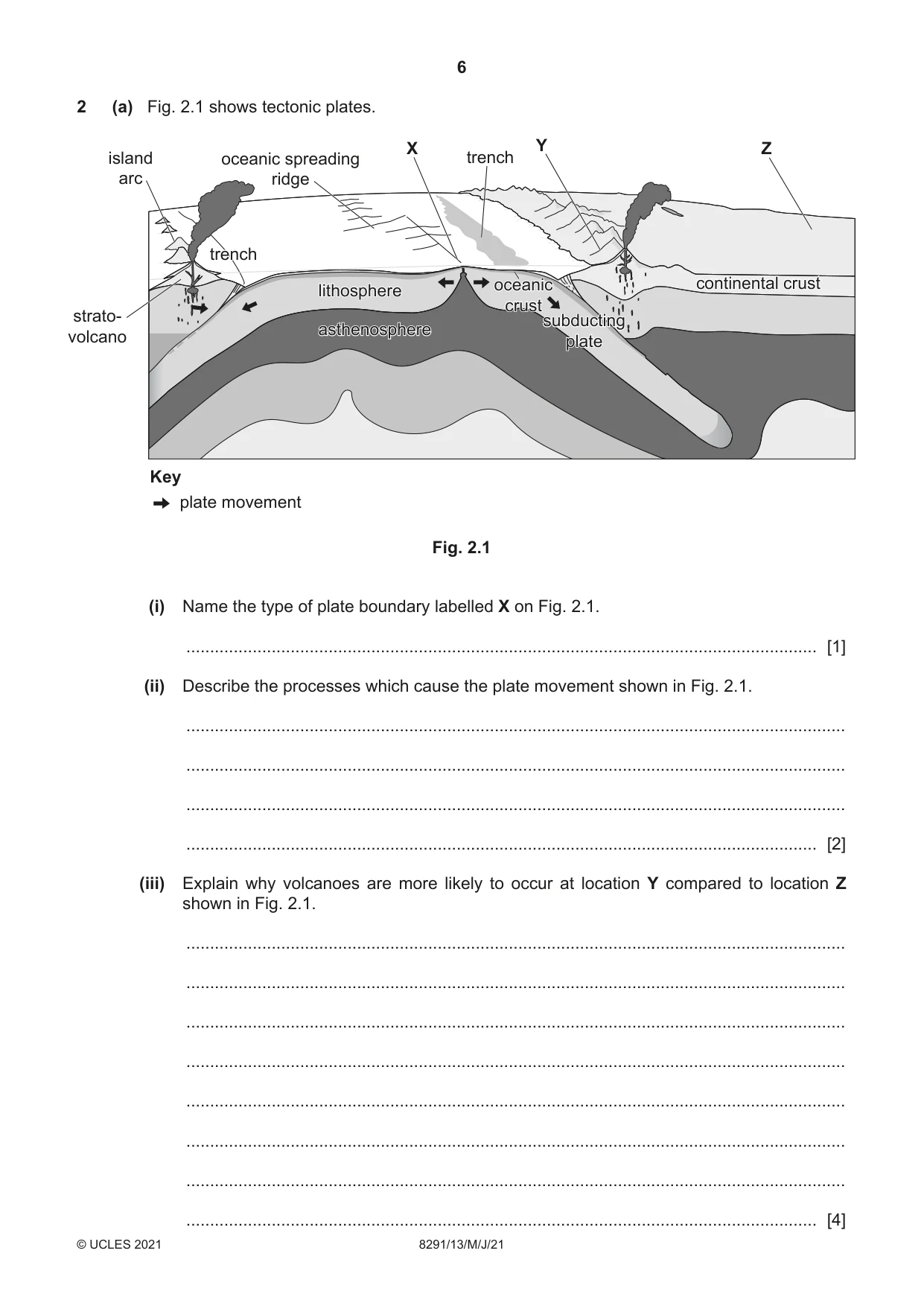
6 8291/13/M/J/21 © UCLES 2021 2 (a) Fig. 2.1 shows tectonic plates. asthenosphere lithosphere continental crust oceanic crust subducting plate trench asthenosphere plate movement lithosphere continental crust oceanic crust trench subducting plate trench strato- volcano island arc Y Z oceanic spreading ridge X Key Fig. 2.1 (i) Name the type of plate boundary labelled X on Fig. 2.1. … [1] (ii) Describe the processes which cause the plate movement shown in Fig. 2.1. … … … … [2] (iii) Explain why volcanoes are more likely to occur at location Y compared to location Z shown in Fig. 2.1. … … … … … … … … [4]
Question paper, page 7
7 8291/13/M/J/21 © UCLES 2021 [Turn over (iv) Explain the evidence which supports scientific theory on Post-Pangaea plate movement. … … … … … … … … [4]
Question paper, page 8
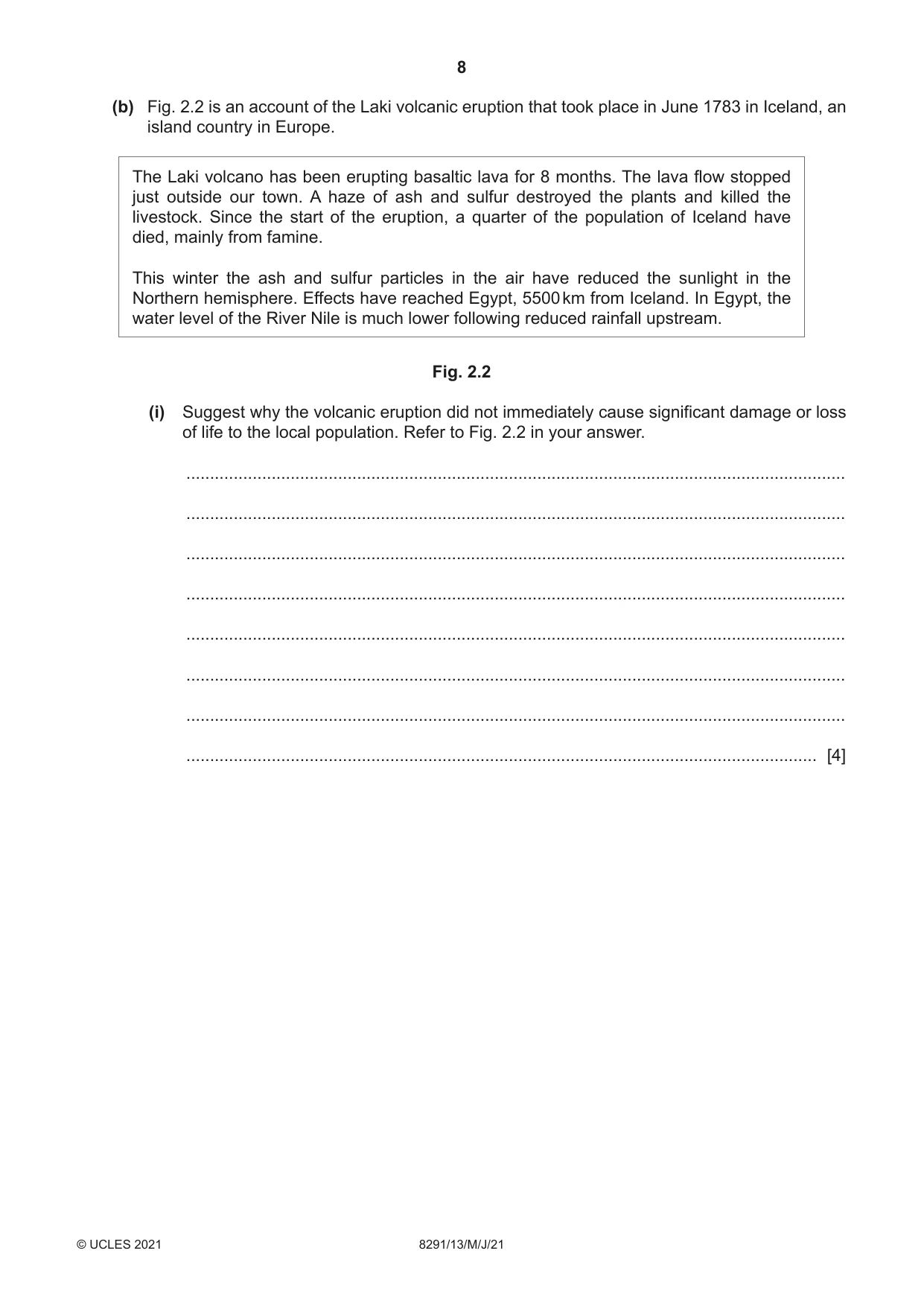
8 8291/13/M/J/21 © UCLES 2021 (b) Fig. 2.2 is an account of the Laki volcanic eruption that took place in June 1783 in Iceland, an island country in Europe. The Laki volcano has been erupting basaltic lava for 8 months. The lava flow stopped just outside our town. A haze of ash and sulfur destroyed the plants and killed the livestock. Since the start of the eruption, a quarter of the population of Iceland have died, mainly from famine. This winter the ash and sulfur particles in the air have reduced the sunlight in the Northern hemisphere. Effects have reached Egypt, 5500 km from Iceland. In Egypt, the water level of the River Nile is much lower following reduced rainfall upstream. Fig. 2.2 (i) Suggest why the volcanic eruption did not immediately cause significant damage or loss of life to the local population. Refer to Fig. 2.2 in your answer. … … … … … … … … [4]
Question paper, page 9
9 8291/13/M/J/21 © UCLES 2021 [Turn over (ii) Explain why the Laki volcanic eruption affected many countries. … … … … … … … … … … … … [5] [Total: 20]
Question paper, page 10
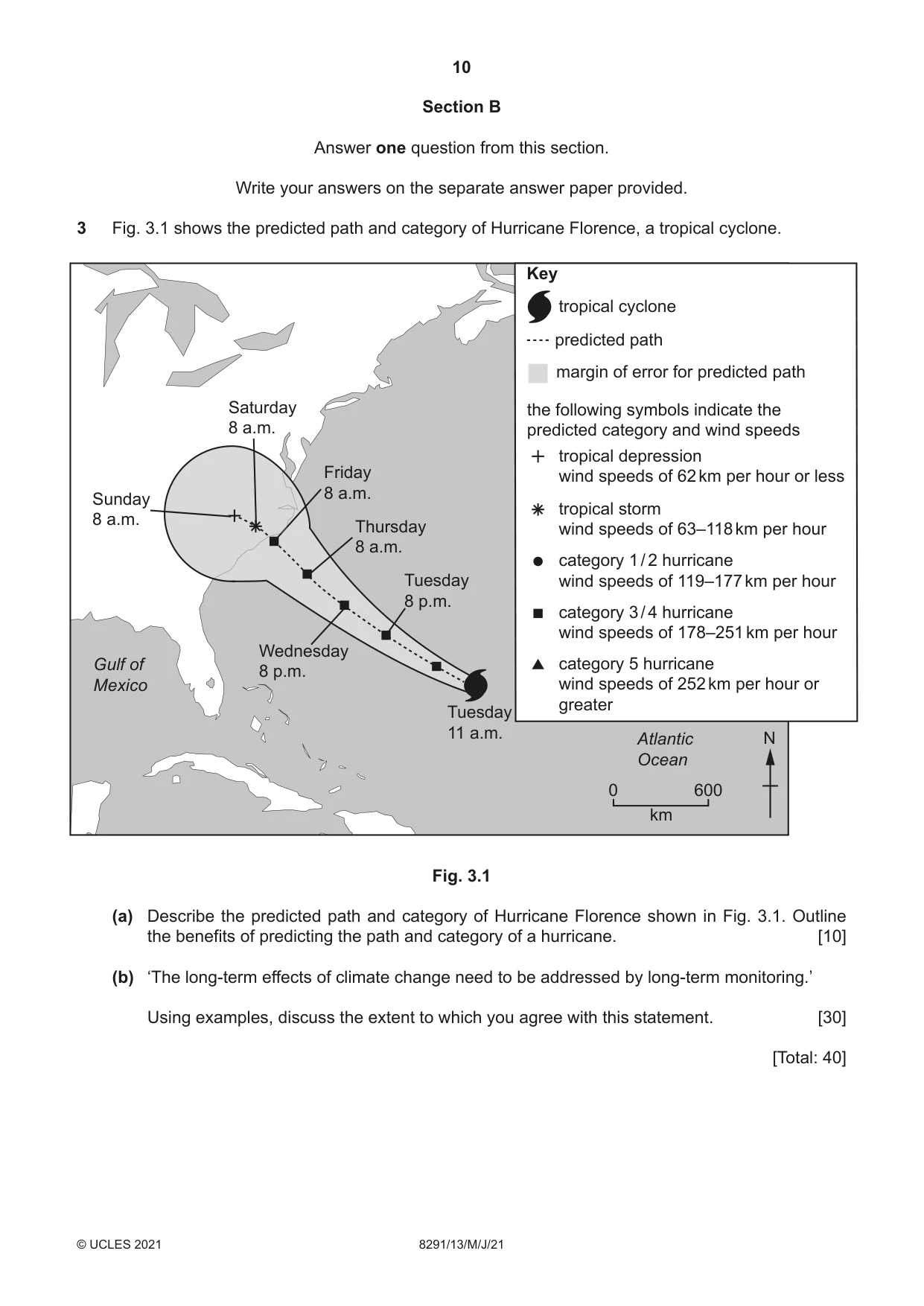
10 8291/13/M/J/21 © UCLES 2021 Section B Answer one question from this section. Write your answers on the separate answer paper provided. 3 Fig. 3.1 shows the predicted path and category of Hurricane Florence, a tropical cyclone. Tuesday 8 p.m. Wednesday 8 p.m. Thursday 8 a.m. Friday 8 a.m. Tuesday 11 a.m. Atlantic Ocean Gulf of Mexico N km 0 600 Sunday 8 a.m. Saturday 8 a.m. tropical depression wind speeds of 62 km per hour or less the following symbols indicate the predicted category and wind speeds tropical storm wind speeds of 63–118 km per hour category 1 / 2 hurricane wind speeds of 119–177 km per hour predicted path margin of error for predicted path category 3 / 4 hurricane wind speeds of 178–251 km per hour category 5 hurricane wind speeds of 252 km per hour or greater Key tropical cyclone Fig. 3.1 (a) Describe the predicted path and category of Hurricane Florence shown in Fig. 3.1. Outline the benefits of predicting the path and category of a hurricane. [10] (b) ‘The long-term effects of climate change need to be addressed by long-term monitoring.’ Using examples, discuss the extent to which you agree with this statement. [30] [Total: 40]
Question paper, page 11
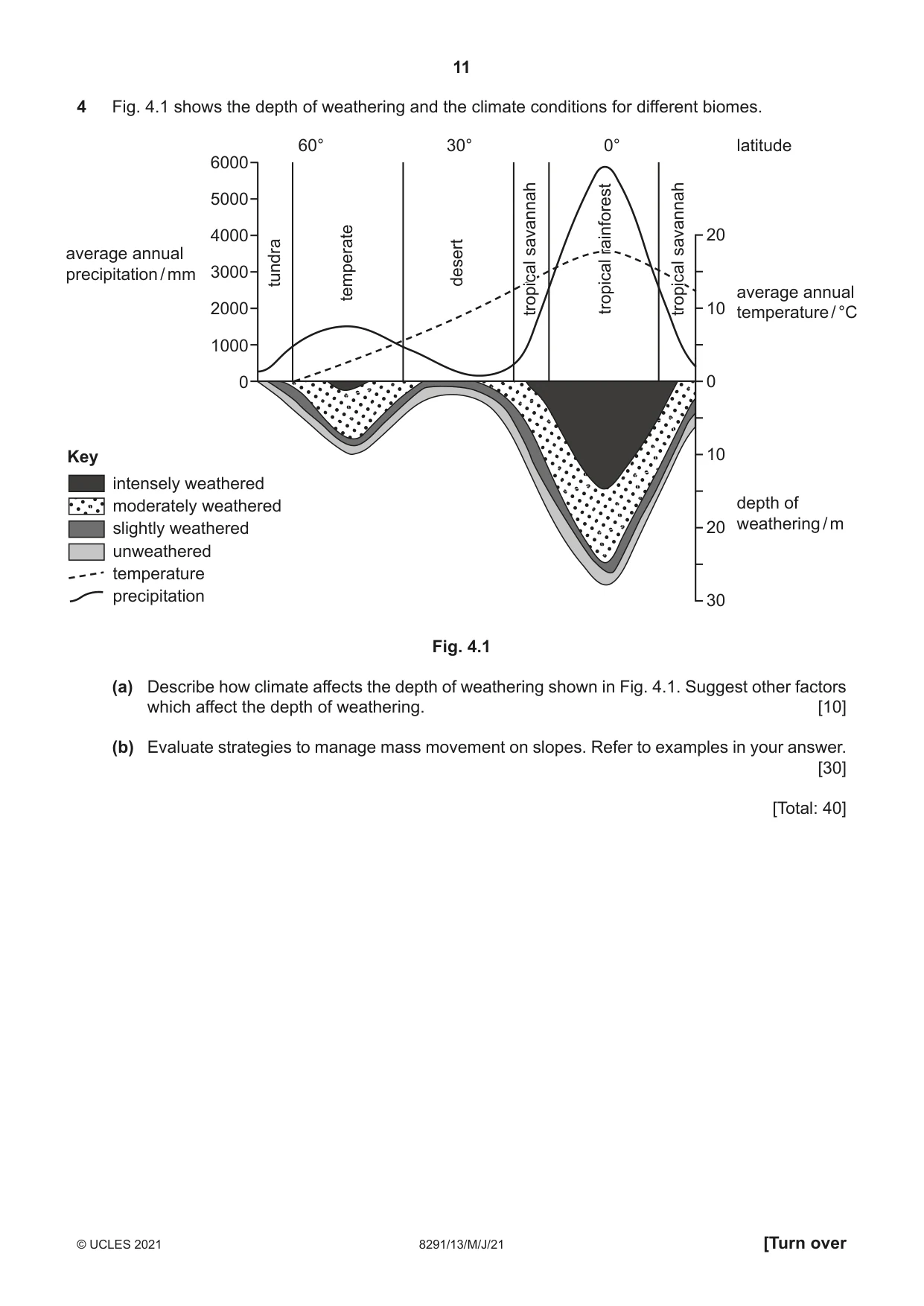
11 8291/13/M/J/21 © UCLES 2021 [Turn over 4 Fig. 4.1 shows the depth of weathering and the climate conditions for different biomes. tundra temperate desert tropical savannah tropical savannah tropical rainforest tropical savannah tropical savannah tropical rainforest 1000 0 2000 3000 4000 5000 6000 average annual precipitation / mm average annual temperature / °C 60° 30° 0° latitude depth of weathering / m Key intensely weathered moderately weathered slightly weathered unweathered temperature precipitation 20 10 0 10 20 30 Fig. 4.1 (a) Describe how climate affects the depth of weathering shown in Fig. 4.1. Suggest other factors which affect the depth of weathering. [10] (b) Evaluate strategies to manage mass movement on slopes. Refer to examples in your answer. [30] [Total: 40]
Question paper, page 12
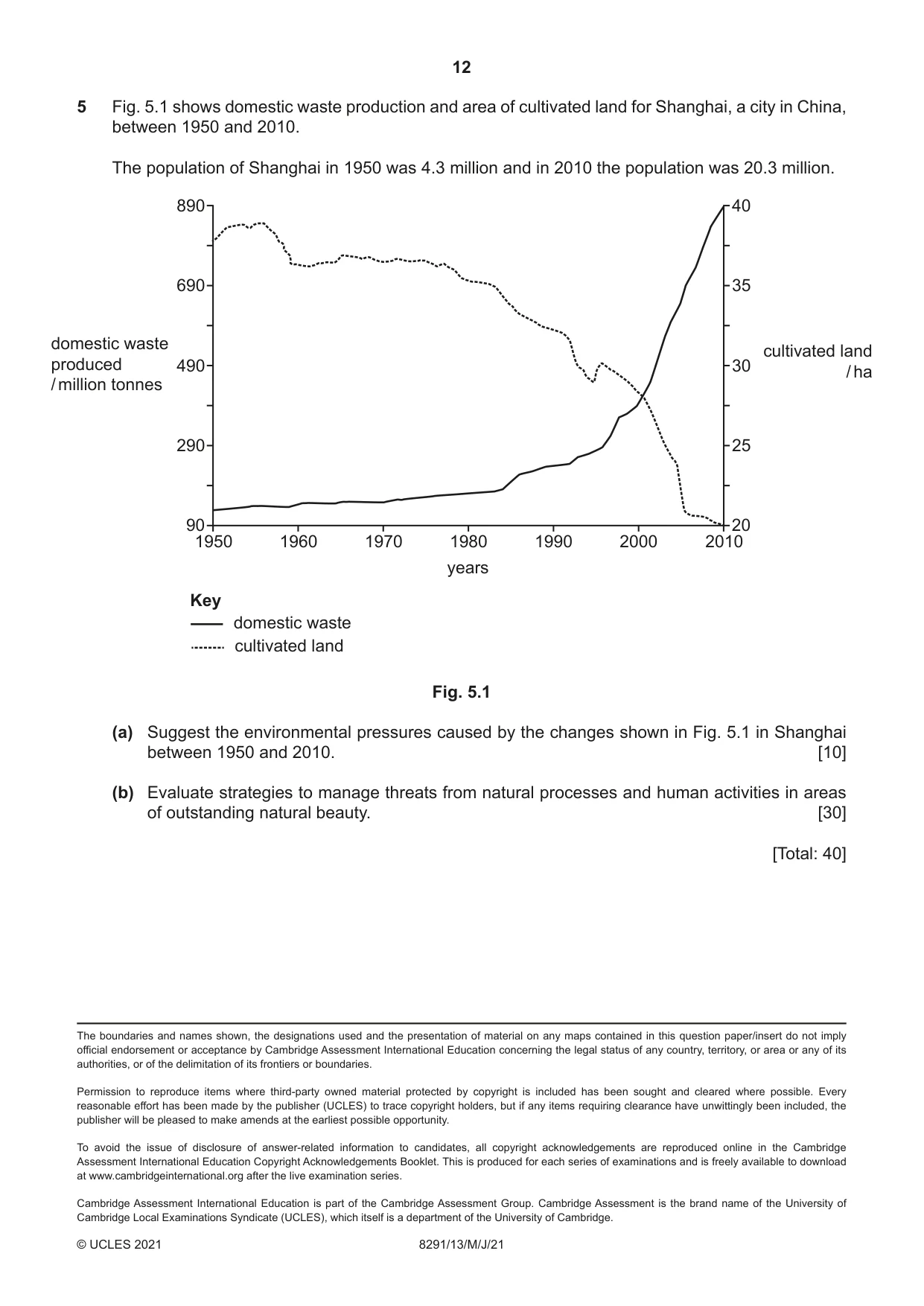
12 8291/13/M/J/21 © UCLES 2021 5 Fig. 5.1 shows domestic waste production and area of cultivated land for Shanghai, a city in China, between 1950 and 2010. The population of Shanghai in 1950 was 4.3 million and in 2010 the population was 20.3 million. 890 690 490 290 90 40 35 30 25 20 1950 1960 1970 1980 years 1990 2000 2010 domestic waste produced / million tonnes cultivated land / ha domestic waste cultivated land Key Fig. 5.1 (a) Suggest the environmental pressures caused by the changes shown in Fig. 5.1 in Shanghai between 1950 and 2010. [10] (b) Evaluate strategies to manage threats from natural processes and human activities in areas of outstanding natural beauty. [30] [Total: 40] The boundaries and names shown, the designations used and the presentation of material on any maps contained in this question paper/insert do not imply official endorsement or acceptance by Cambridge Assessment International Education concerning the legal status of any country, territory, or area or any of its authorities, or of the delimitation of its frontiers or boundaries. Permission to reproduce items where third-party owned material protected by copyright is included has been sought and cleared where possible. Every reasonable effort has been made by the publisher (UCLES) to trace copyright holders, but if any items requiring clearance have unwittingly been included, the publisher will be pleased to make amends at the earliest possible opportunity. To avoid the issue of disclosure of answer-related information to candidates, all copyright acknowledgements are reproduced online in the Cambridge Assessment International Education Copyright Acknowledgements Booklet. This is produced for each series of examinations and is freely available to download at www.cambridgeinternational.org after the live examination series. Cambridge Assessment International Education is part of the Cambridge Assessment Group. Cambridge Assessment is the brand name of the University of Cambridge Local Examinations Syndicate (UCLES), which itself is a department of the University of Cambridge.
Mark scheme, page 1
This document consists of 17 printed pages. © UCLES 2021 [Turn over Cambridge International AS Level ENVIRONMENTAL MANAGEMENT 8291/13 Paper 1 May/June 2021 MARK SCHEME Maximum Mark: 80 Published This mark scheme is published as an aid to teachers and candidates, to indicate the requirements of the examination. It shows the basis on which Examiners were instructed to award marks. It does not indicate the details of the discussions that took place at an Examiners’ meeting before marking began, which would have considered the acceptability of alternative answers. Mark schemes should be read in conjunction with the question paper and the Principal Examiner Report for Teachers. Cambridge International will not enter into discussions about these mark schemes. Cambridge International is publishing the mark schemes for the May/June 2021 series for most Cambridge IGCSE™, Cambridge International A and AS Level components and some Cambridge O Level components.
Mark scheme, page 2
8291/13 Cambridge International AS Level – Mark Scheme PUBLISHED May/June 2021 © UCLES 2021 Page 2 of 17 Generic Marking Principles These general marking principles must be applied by all examiners when marking candidate answers. They should be applied alongside the specific content of the mark scheme or generic level descriptors for a question. Each question paper and mark scheme will also comply with these marking principles. GENERIC MARKING PRINCIPLE 1: Marks must be awarded in line with: • the specific content of the mark scheme or the generic level descriptors for the question • the specific skills defined in the mark scheme or in the generic level descriptors for the question • the standard of response required by a candidate as exemplified by the standardisation scripts. GENERIC MARKING PRINCIPLE 2: Marks awarded are always whole marks (not half marks, or other fractions). GENERIC MARKING PRINCIPLE 3: Marks must be awarded positively: • marks are awarded for correct/valid answers, as defined in the mark scheme. However, credit is given for valid answers which go beyond the scope of the syllabus and mark scheme, referring to your Team Leader as appropriate • marks are awarded when candidates clearly demonstrate what they know and can do • marks are not deducted for errors • marks are not deducted for omissions • answers should only be judged on the quality of spelling, punctuation and grammar when these features are specifically assessed by the question as indicated by the mark scheme. The meaning, however, should be unambiguous. GENERIC MARKING PRINCIPLE 4: Rules must be applied consistently, e.g. in situations where candidates have not followed instructions or in the application of generic level descriptors.
Mark scheme, page 3
8291/13 Cambridge International AS Level – Mark Scheme PUBLISHED May/June 2021 © UCLES 2021 Page 3 of 17 GENERIC MARKING PRINCIPLE 5: Marks should be awarded using the full range of marks defined in the mark scheme for the question (however; the use of the full mark range may be limited according to the quality of the candidate responses seen). GENERIC MARKING PRINCIPLE 6: Marks awarded are based solely on the requirements as defined in the mark scheme. Marks should not be awarded with grade thresholds or grade descriptors in mind. Science-Specific Marking Principles 1 Examiners should consider the context and scientific use of any keywords when awarding marks. Although keywords may be present, marks should not be awarded if the keywords are used incorrectly. 2 The examiner should not choose between contradictory statements given in the same question part, and credit should not be awarded for any correct statement that is contradicted within the same question part. Wrong science that is irrelevant to the question should be ignored. 3 Although spellings do not have to be correct, spellings of syllabus terms must allow for clear and unambiguous separation from other syllabus terms with which they may be confused (e.g. ethane / ethene, glucagon / glycogen, refraction / reflection). 4 The error carried forward (ecf) principle should be applied, where appropriate. If an incorrect answer is subsequently used in a scientifically correct way, the candidate should be awarded these subsequent marking points. Further guidance will be included in the mark scheme where necessary and any exceptions to this general principle will be noted. 5 ‘List rule’ guidance For questions that require n responses (e.g. State two reasons …): • The response should be read as continuous prose, even when numbered answer spaces are provided. • Any response marked ignore in the mark scheme should not count towards n. • Incorrect responses should not be awarded credit but will still count towards n. • Read the entire response to check for any responses that contradict those that would otherwise be credited. Credit should not be awarded for any responses that are contradicted within the rest of the response. Where two responses contradict one another, this should be treated as a single incorrect response. • Non-contradictory responses after the first n responses may be ignored even if they include incorrect science.
Mark scheme, page 4
8291/13 Cambridge International AS Level – Mark Scheme PUBLISHED May/June 2021 © UCLES 2021 Page 4 of 17 6 Calculation specific guidance Correct answers to calculations should be given full credit even if there is no working or incorrect working, unless the question states ‘show your working’. For questions in which the number of significant figures required is not stated, credit should be awarded for correct answers when rounded by the examiner to the number of significant figures given in the mark scheme. This may not apply to measured values. For answers given in standard form (e.g. a × 10n) in which the convention of restricting the value of the coefficient (a) to a value between 1 and 10 is not followed, credit may still be awarded if the answer can be converted to the answer given in the mark scheme. Unless a separate mark is given for a unit, a missing or incorrect unit will normally mean that the final calculation mark is not awarded. Exceptions to this general principle will be noted in the mark scheme. 7 Guidance for chemical equations Multiples / fractions of coefficients used in chemical equations are acceptable unless stated otherwise in the mark scheme. State symbols given in an equation should be ignored unless asked for in the question or stated otherwise in the mark scheme.
Mark scheme, page 5
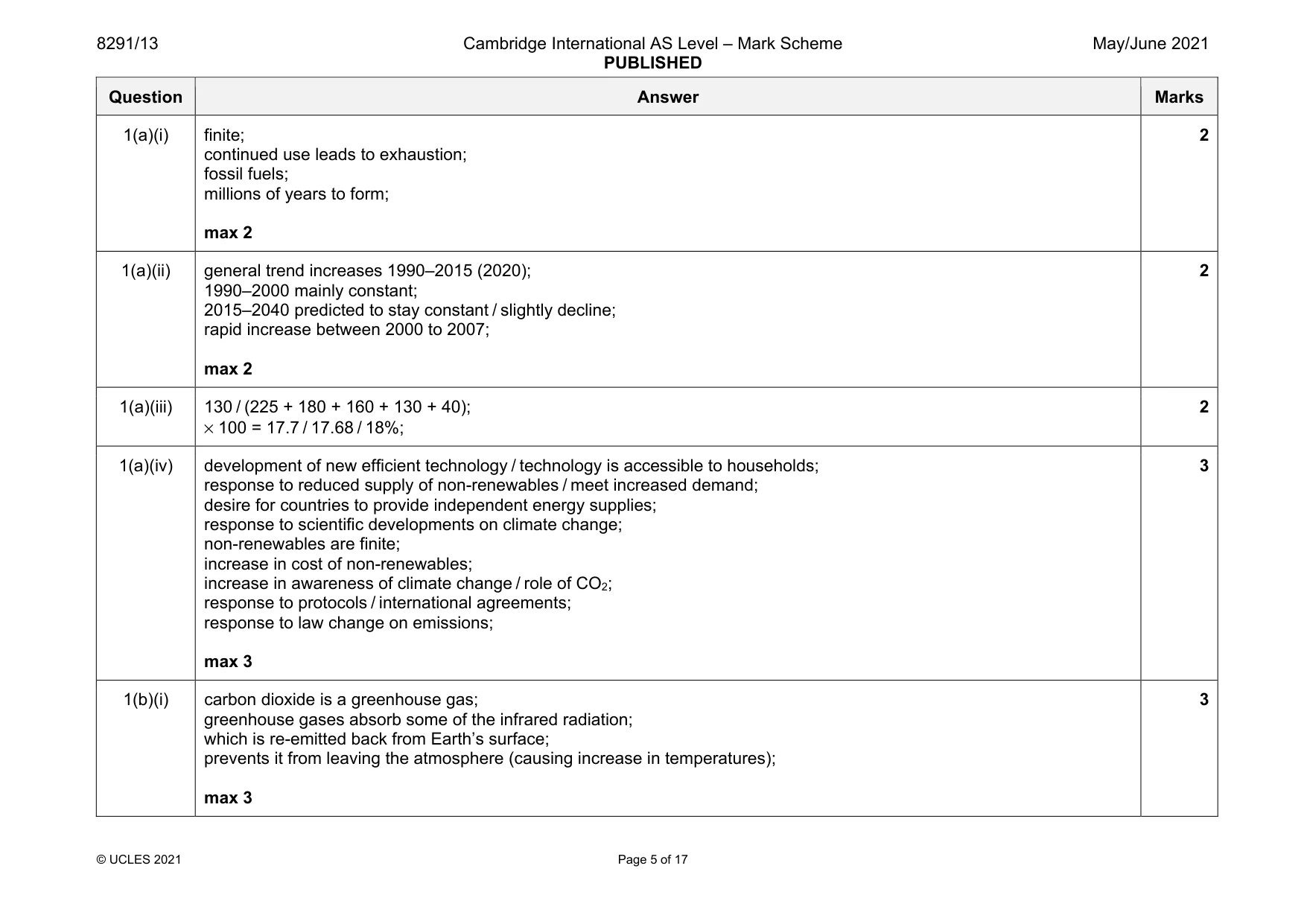
8291/13 Cambridge International AS Level – Mark Scheme PUBLISHED May/June 2021 © UCLES 2021 Page 5 of 17 Question Answer Marks 1(a)(i) finite; continued use leads to exhaustion; fossil fuels; millions of years to form; max 2 2 1(a)(ii) general trend increases 1990–2015 (2020); 1990–2000 mainly constant; 2015–2040 predicted to stay constant / slightly decline; rapid increase between 2000 to 2007; max 2 2 1(a)(iii) 130 / (225 + 180 + 160 + 130 + 40); × 100 = 17.7 / 17.68 / 18%; 2 1(a)(iv) development of new efficient technology / technology is accessible to households; response to reduced supply of non-renewables / meet increased demand; desire for countries to provide independent energy supplies; response to scientific developments on climate change; non-renewables are finite; increase in cost of non-renewables; increase in awareness of climate change / role of CO2; response to protocols / international agreements; response to law change on emissions; max 3 3 1(b)(i) carbon dioxide is a greenhouse gas; greenhouse gases absorb some of the infrared radiation; which is re-emitted back from Earth’s surface; prevents it from leaving the atmosphere (causing increase in temperatures); max 3 3
Mark scheme, page 6
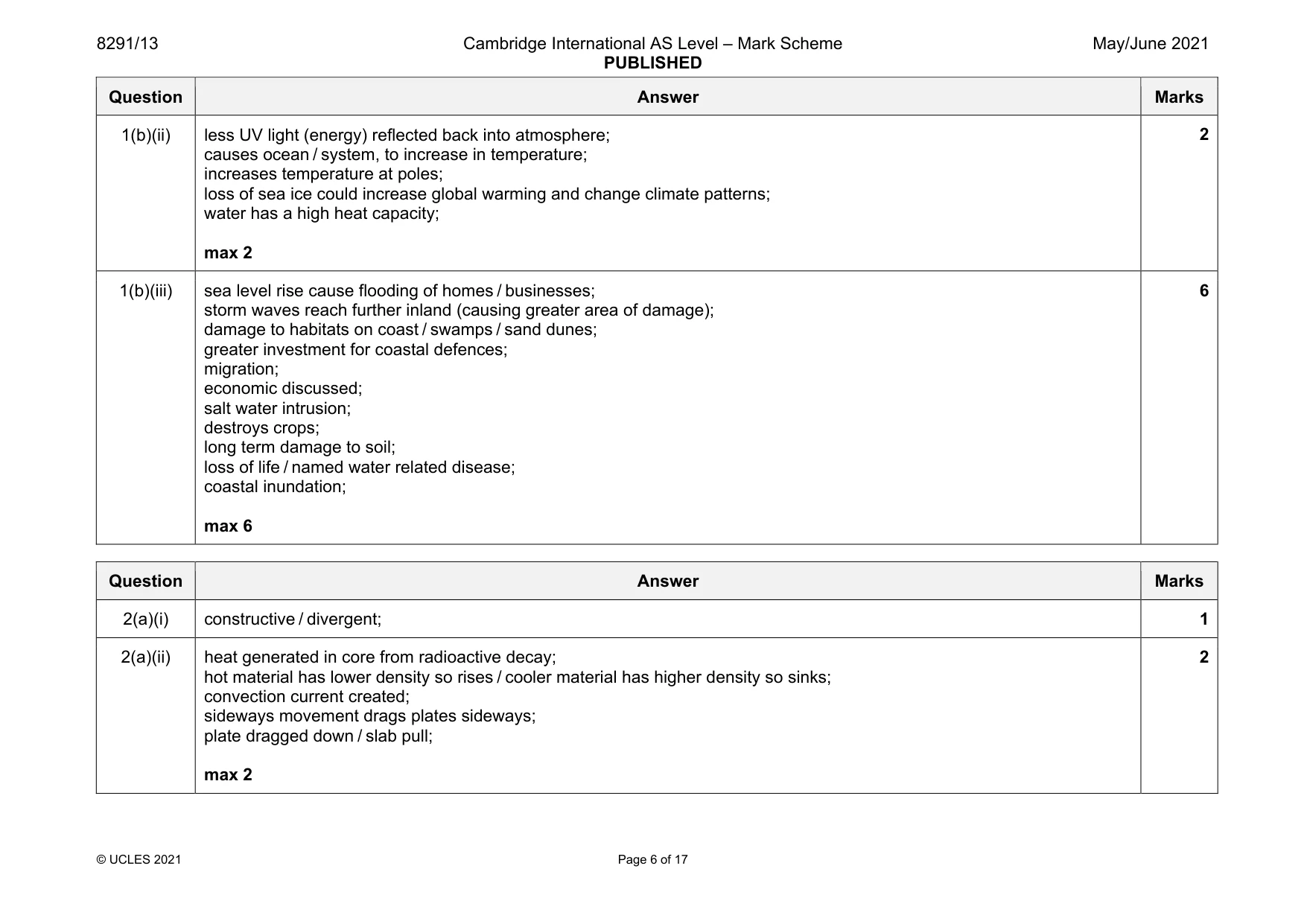
8291/13 Cambridge International AS Level – Mark Scheme PUBLISHED May/June 2021 © UCLES 2021 Page 6 of 17 Question Answer Marks 1(b)(ii) less UV light (energy) reflected back into atmosphere; causes ocean / system, to increase in temperature; increases temperature at poles; loss of sea ice could increase global warming and change climate patterns; water has a high heat capacity; max 2 2 1(b)(iii) sea level rise cause flooding of homes / businesses; storm waves reach further inland (causing greater area of damage); damage to habitats on coast / swamps / sand dunes; greater investment for coastal defences; migration; economic discussed; salt water intrusion; destroys crops; long term damage to soil; loss of life / named water related disease; coastal inundation; max 6 6 Question Answer Marks 2(a)(i) constructive / divergent; 1 2(a)(ii) heat generated in core from radioactive decay; hot material has lower density so rises / cooler material has higher density so sinks; convection current created; sideways movement drags plates sideways; plate dragged down / slab pull; max 2 2
Mark scheme, page 7
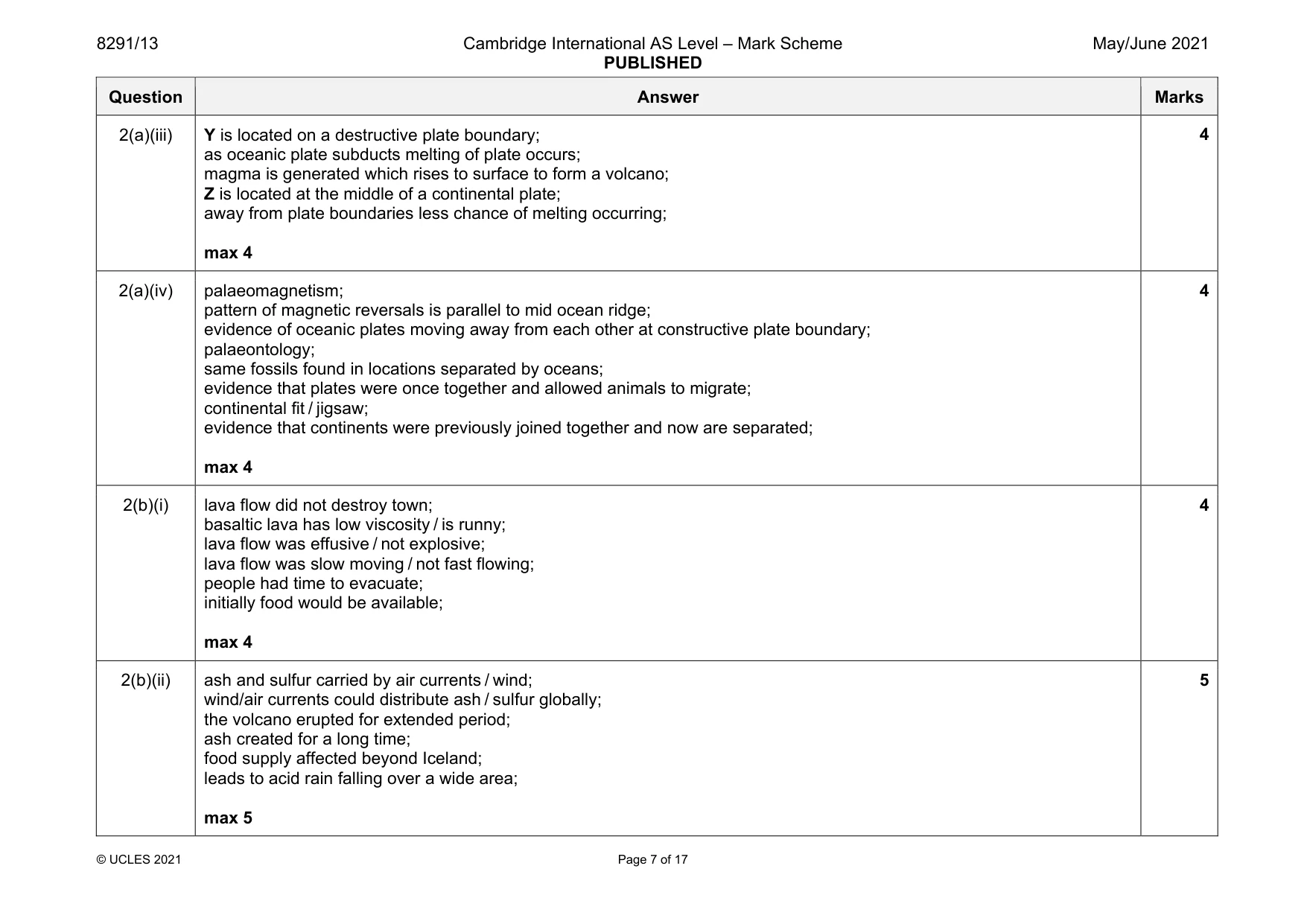
8291/13 Cambridge International AS Level – Mark Scheme PUBLISHED May/June 2021 © UCLES 2021 Page 7 of 17 Question Answer Marks 2(a)(iii) Y is located on a destructive plate boundary; as oceanic plate subducts melting of plate occurs; magma is generated which rises to surface to form a volcano; Z is located at the middle of a continental plate; away from plate boundaries less chance of melting occurring; max 4 4 2(a)(iv) palaeomagnetism; pattern of magnetic reversals is parallel to mid ocean ridge; evidence of oceanic plates moving away from each other at constructive plate boundary; palaeontology; same fossils found in locations separated by oceans; evidence that plates were once together and allowed animals to migrate; continental fit / jigsaw; evidence that continents were previously joined together and now are separated; max 4 4 2(b)(i) lava flow did not destroy town; basaltic lava has low viscosity / is runny; lava flow was effusive / not explosive; lava flow was slow moving / not fast flowing; people had time to evacuate; initially food would be available; max 4 4 2(b)(ii) ash and sulfur carried by air currents / wind; wind/air currents could distribute ash / sulfur globally; the volcano erupted for extended period; ash created for a long time; food supply affected beyond Iceland; leads to acid rain falling over a wide area; max 5 5
Mark scheme, page 8
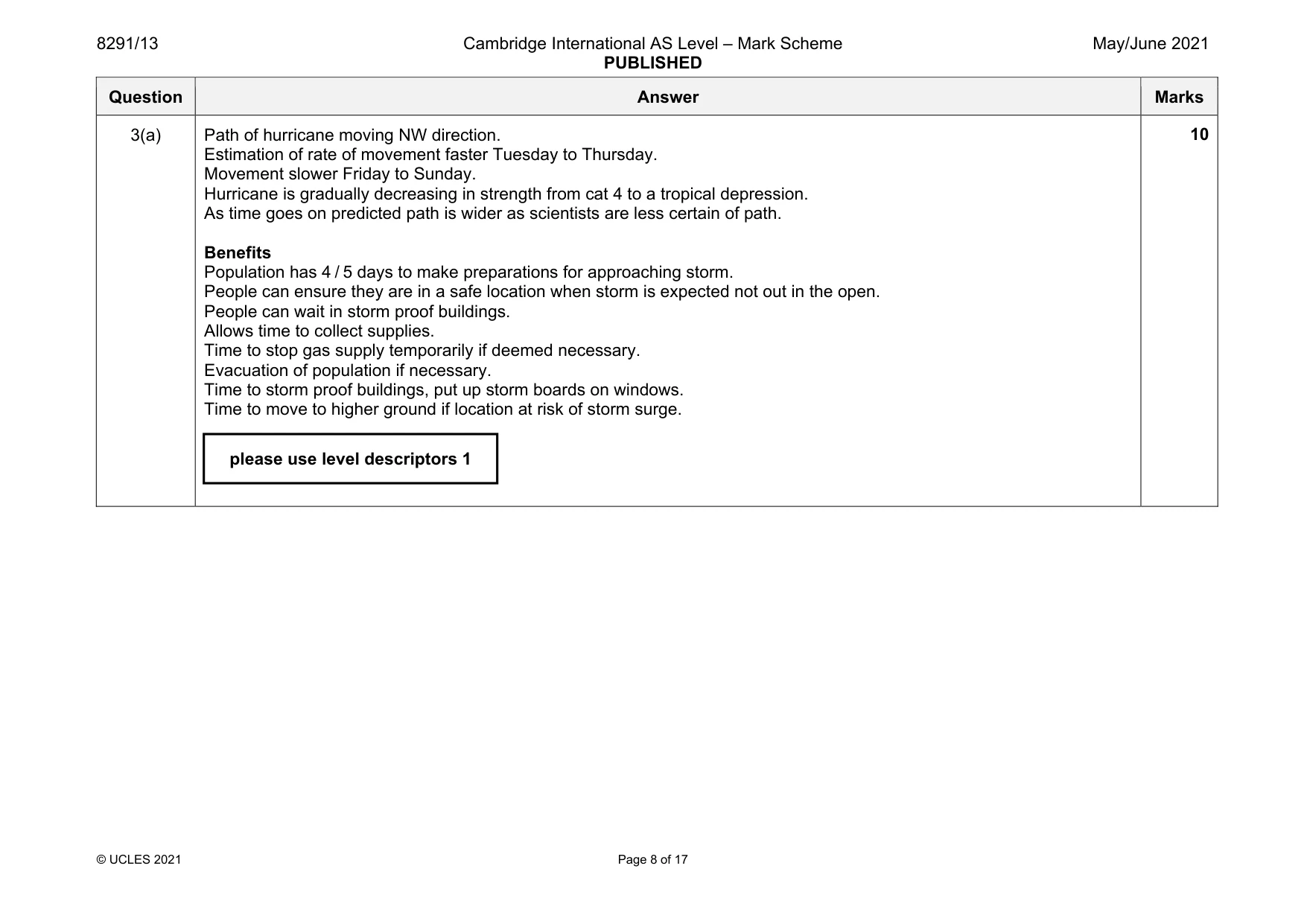
8291/13 Cambridge International AS Level – Mark Scheme PUBLISHED May/June 2021 © UCLES 2021 Page 8 of 17 Question Answer Marks 3(a) Path of hurricane moving NW direction. Estimation of rate of movement faster Tuesday to Thursday. Movement slower Friday to Sunday. Hurricane is gradually decreasing in strength from cat 4 to a tropical depression. As time goes on predicted path is wider as scientists are less certain of path. Benefits Population has 4 / 5 days to make preparations for approaching storm. People can ensure they are in a safe location when storm is expected not out in the open. People can wait in storm proof buildings. Allows time to collect supplies. Time to stop gas supply temporarily if deemed necessary. Evacuation of population if necessary. Time to storm proof buildings, put up storm boards on windows. Time to move to higher ground if location at risk of storm surge. 10 please use level descriptors 1
Mark scheme, page 9
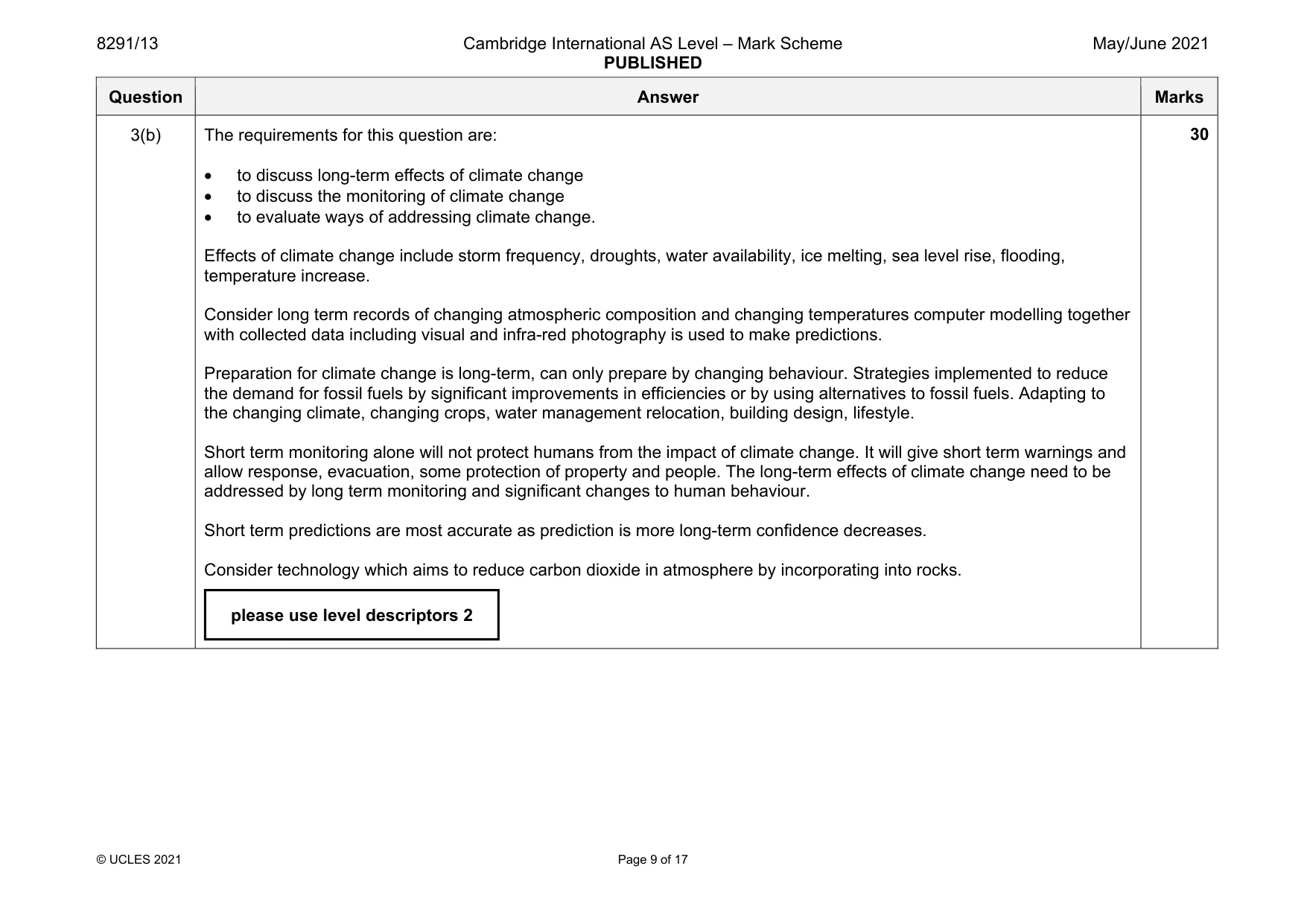
8291/13 Cambridge International AS Level – Mark Scheme PUBLISHED May/June 2021 © UCLES 2021 Page 9 of 17 Question Answer Marks 3(b) The requirements for this question are: • to discuss long-term effects of climate change • to discuss the monitoring of climate change • to evaluate ways of addressing climate change. Effects of climate change include storm frequency, droughts, water availability, ice melting, sea level rise, flooding, temperature increase. Consider long term records of changing atmospheric composition and changing temperatures computer modelling together with collected data including visual and infra-red photography is used to make predictions. Preparation for climate change is long-term, can only prepare by changing behaviour. Strategies implemented to reduce the demand for fossil fuels by significant improvements in efficiencies or by using alternatives to fossil fuels. Adapting to the changing climate, changing crops, water management relocation, building design, lifestyle. Short term monitoring alone will not protect humans from the impact of climate change. It will give short term warnings and allow response, evacuation, some protection of property and people. The long-term effects of climate change need to be addressed by long term monitoring and significant changes to human behaviour. Short term predictions are most accurate as prediction is more long-term confidence decreases. Consider technology which aims to reduce carbon dioxide in atmosphere by incorporating into rocks. 30 please use level descriptors 2
Mark scheme, page 10
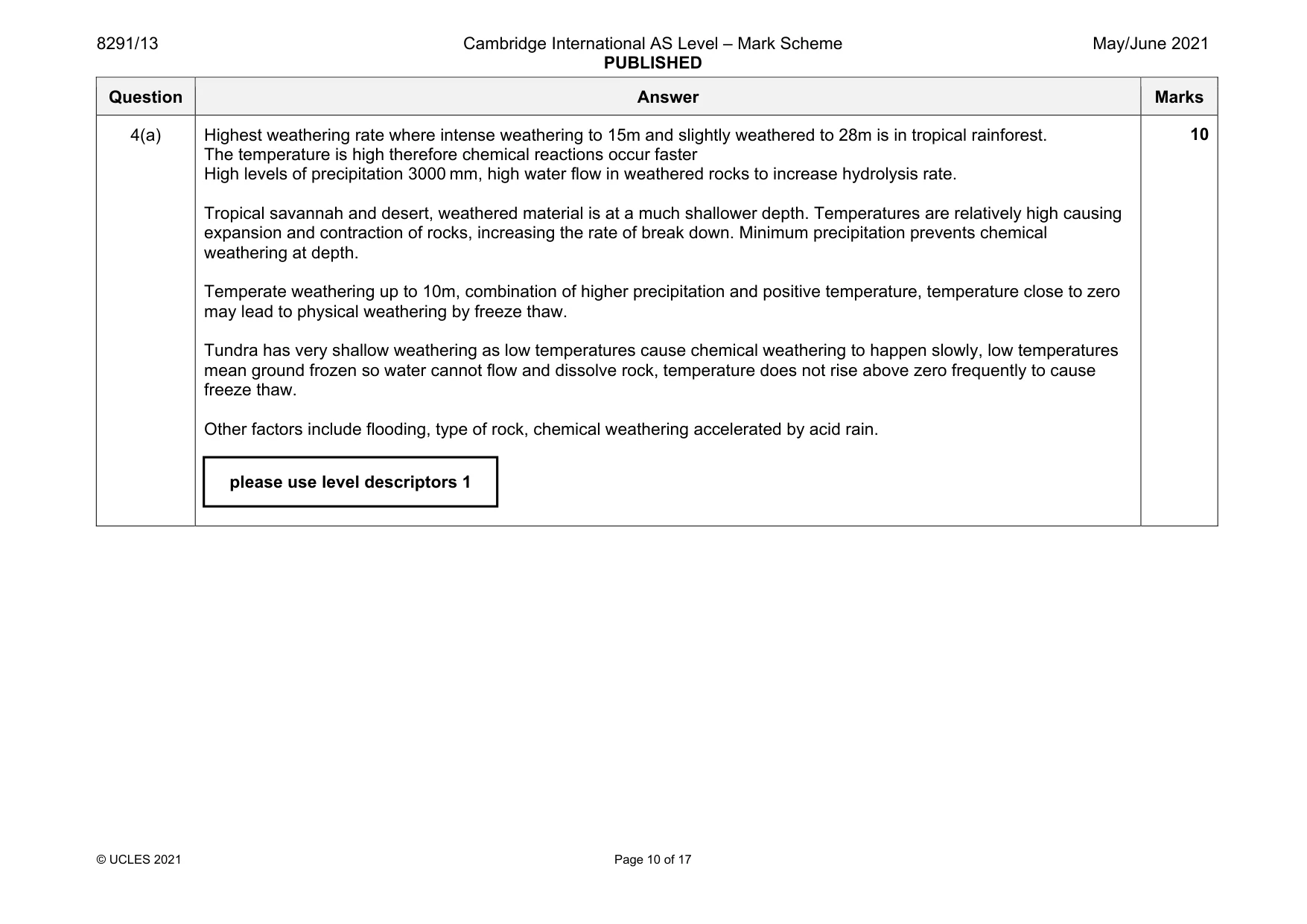
8291/13 Cambridge International AS Level – Mark Scheme PUBLISHED May/June 2021 © UCLES 2021 Page 10 of 17 Question Answer Marks 4(a) Highest weathering rate where intense weathering to 15m and slightly weathered to 28m is in tropical rainforest. The temperature is high therefore chemical reactions occur faster High levels of precipitation 3000 mm, high water flow in weathered rocks to increase hydrolysis rate. Tropical savannah and desert, weathered material is at a much shallower depth. Temperatures are relatively high causing expansion and contraction of rocks, increasing the rate of break down. Minimum precipitation prevents chemical weathering at depth. Temperate weathering up to 10m, combination of higher precipitation and positive temperature, temperature close to zero may lead to physical weathering by freeze thaw. Tundra has very shallow weathering as low temperatures cause chemical weathering to happen slowly, low temperatures mean ground frozen so water cannot flow and dissolve rock, temperature does not rise above zero frequently to cause freeze thaw. Other factors include flooding, type of rock, chemical weathering accelerated by acid rain. 10 please use level descriptors 1
Mark scheme, page 11
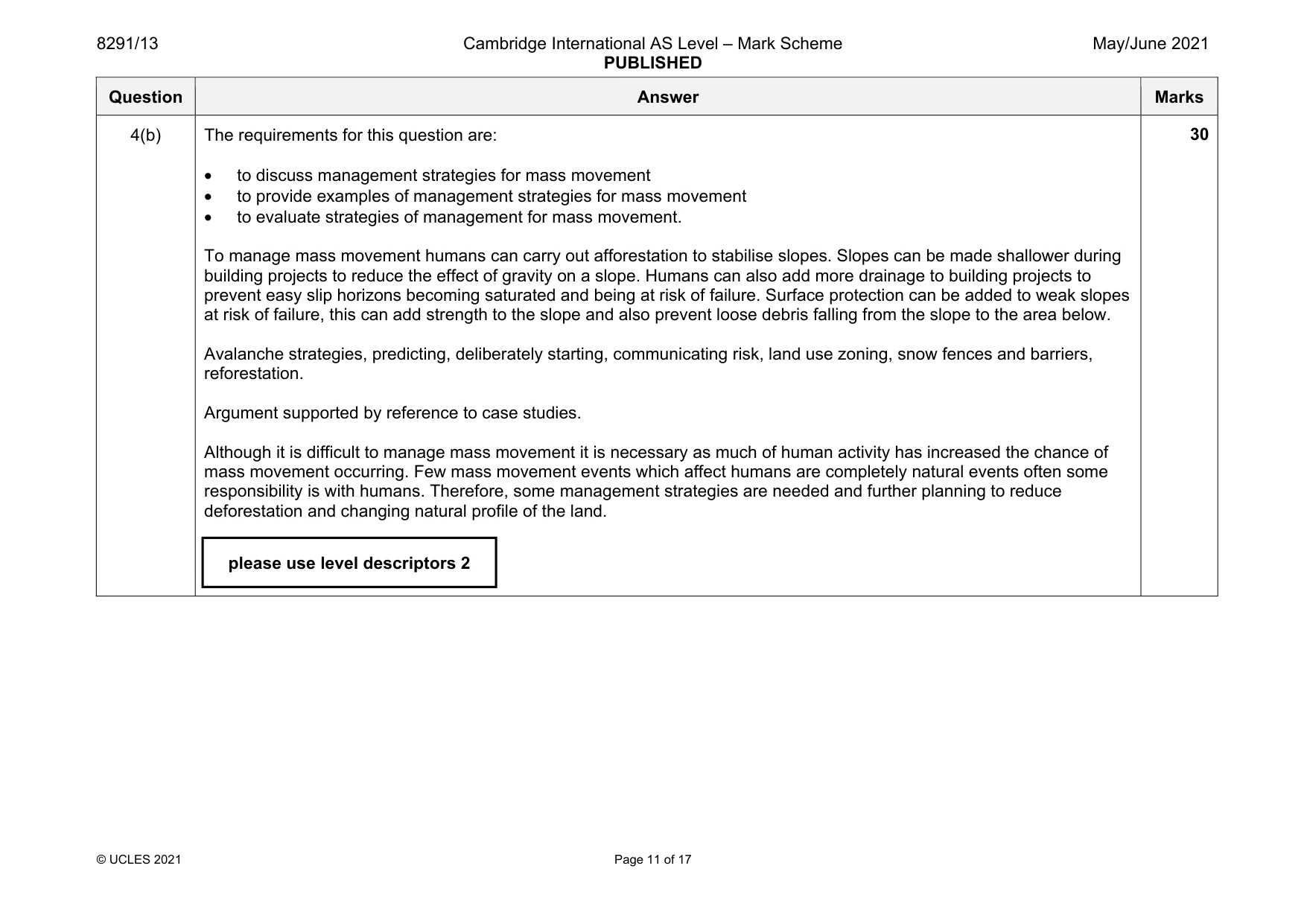
8291/13 Cambridge International AS Level – Mark Scheme PUBLISHED May/June 2021 © UCLES 2021 Page 11 of 17 Question Answer Marks 4(b) The requirements for this question are: • to discuss management strategies for mass movement • to provide examples of management strategies for mass movement • to evaluate strategies of management for mass movement. To manage mass movement humans can carry out afforestation to stabilise slopes. Slopes can be made shallower during building projects to reduce the effect of gravity on a slope. Humans can also add more drainage to building projects to prevent easy slip horizons becoming saturated and being at risk of failure. Surface protection can be added to weak slopes at risk of failure, this can add strength to the slope and also prevent loose debris falling from the slope to the area below. Avalanche strategies, predicting, deliberately starting, communicating risk, land use zoning, snow fences and barriers, reforestation. Argument supported by reference to case studies. Although it is difficult to manage mass movement it is necessary as much of human activity has increased the chance of mass movement occurring. Few mass movement events which affect humans are completely natural events often some responsibility is with humans. Therefore, some management strategies are needed and further planning to reduce deforestation and changing natural profile of the land. 30 please use level descriptors 2
Mark scheme, page 12
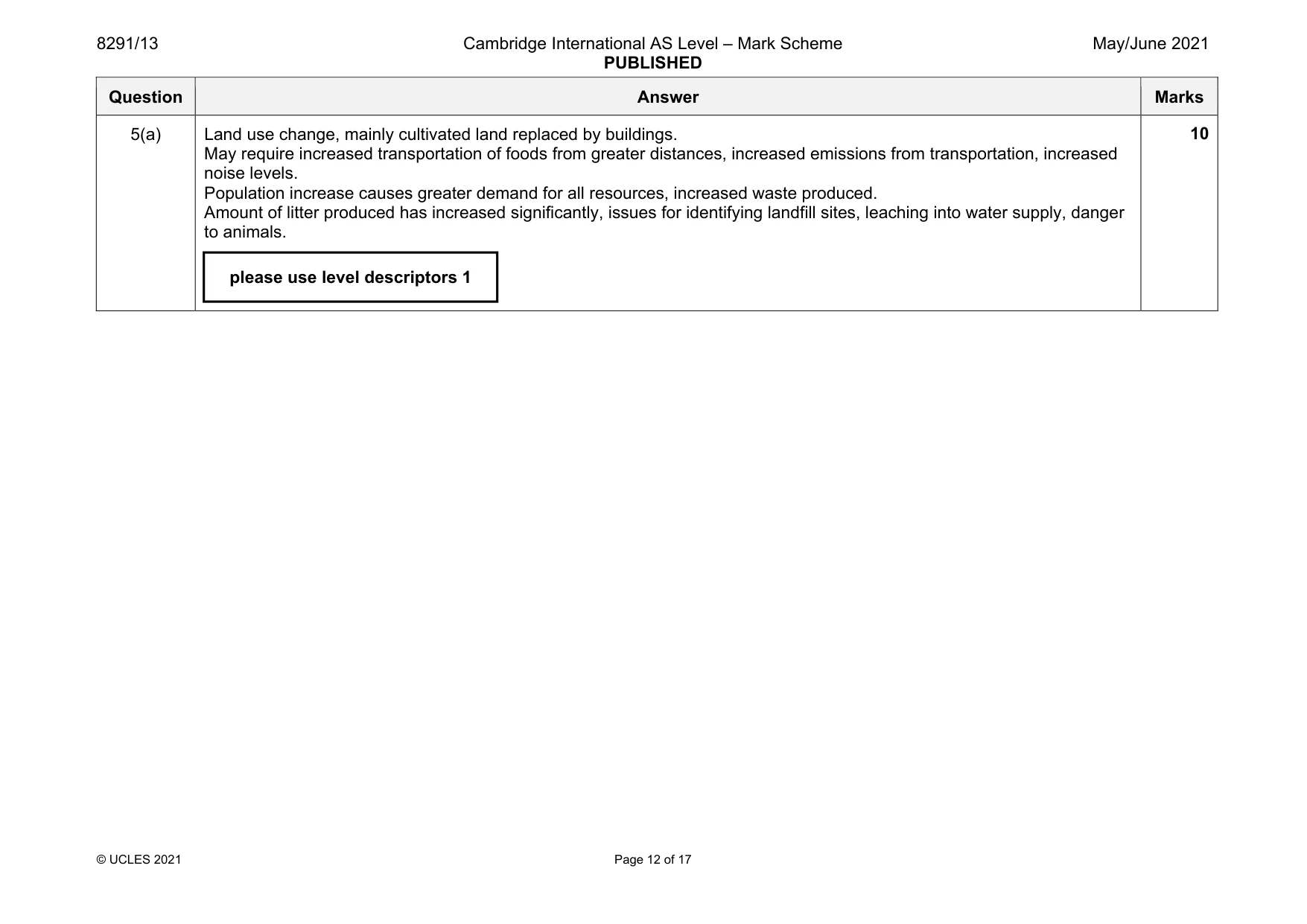
8291/13 Cambridge International AS Level – Mark Scheme PUBLISHED May/June 2021 © UCLES 2021 Page 12 of 17 Question Answer Marks 5(a) Land use change, mainly cultivated land replaced by buildings. May require increased transportation of foods from greater distances, increased emissions from transportation, increased noise levels. Population increase causes greater demand for all resources, increased waste produced. Amount of litter produced has increased significantly, issues for identifying landfill sites, leaching into water supply, danger to animals. 10 please use level descriptors 1
Mark scheme, page 13
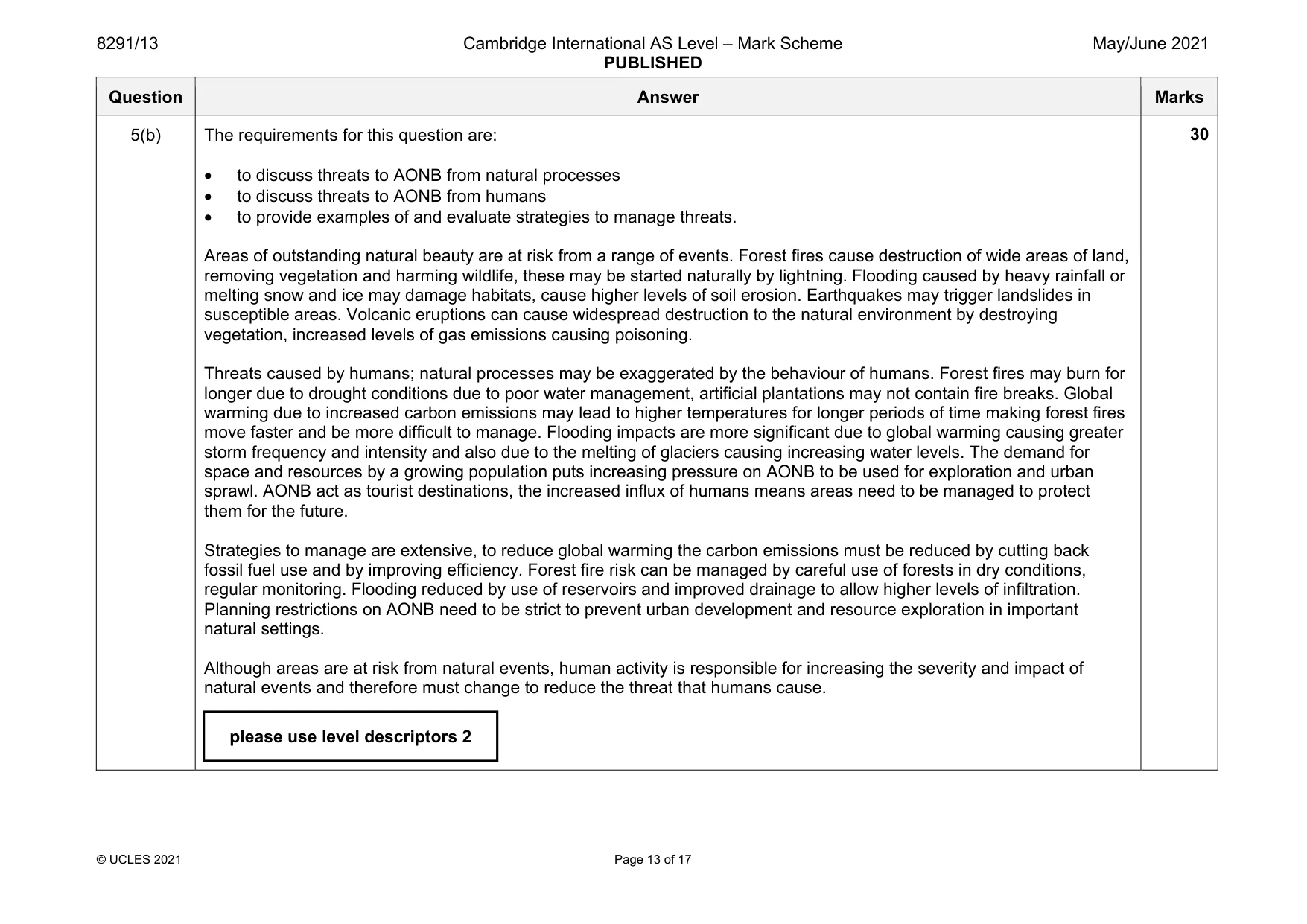
8291/13 Cambridge International AS Level – Mark Scheme PUBLISHED May/June 2021 © UCLES 2021 Page 13 of 17 Question Answer Marks 5(b) The requirements for this question are: • to discuss threats to AONB from natural processes • to discuss threats to AONB from humans • to provide examples of and evaluate strategies to manage threats. Areas of outstanding natural beauty are at risk from a range of events. Forest fires cause destruction of wide areas of land, removing vegetation and harming wildlife, these may be started naturally by lightning. Flooding caused by heavy rainfall or melting snow and ice may damage habitats, cause higher levels of soil erosion. Earthquakes may trigger landslides in susceptible areas. Volcanic eruptions can cause widespread destruction to the natural environment by destroying vegetation, increased levels of gas emissions causing poisoning. Threats caused by humans; natural processes may be exaggerated by the behaviour of humans. Forest fires may burn for longer due to drought conditions due to poor water management, artificial plantations may not contain fire breaks. Global warming due to increased carbon emissions may lead to higher temperatures for longer periods of time making forest fires move faster and be more difficult to manage. Flooding impacts are more significant due to global warming causing greater storm frequency and intensity and also due to the melting of glaciers causing increasing water levels. The demand for space and resources by a growing population puts increasing pressure on AONB to be used for exploration and urban sprawl. AONB act as tourist destinations, the increased influx of humans means areas need to be managed to protect them for the future. Strategies to manage are extensive, to reduce global warming the carbon emissions must be reduced by cutting back fossil fuel use and by improving efficiency. Forest fire risk can be managed by careful use of forests in dry conditions, regular monitoring. Flooding reduced by use of reservoirs and improved drainage to allow higher levels of infiltration. Planning restrictions on AONB need to be strict to prevent urban development and resource exploration in important natural settings. Although areas are at risk from natural events, human activity is responsible for increasing the severity and impact of natural events and therefore must change to reduce the threat that humans cause. 30 please use level descriptors 2
Mark scheme, page 14
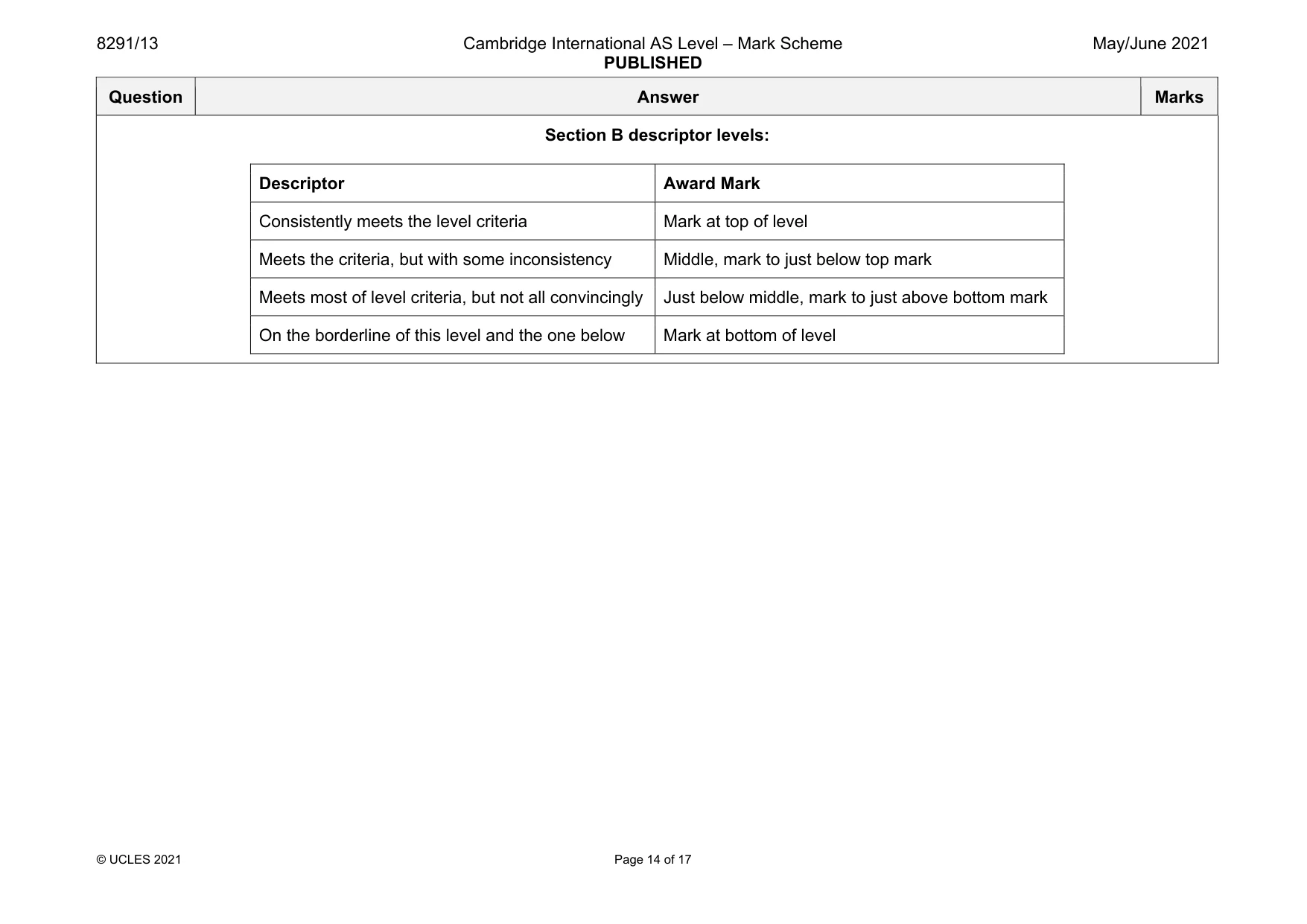
8291/13 Cambridge International AS Level – Mark Scheme PUBLISHED May/June 2021 © UCLES 2021 Page 14 of 17 Question Answer Marks Section B descriptor levels: Descriptor Award Mark Consistently meets the level criteria Mark at top of level Meets the criteria, but with some inconsistency Middle, mark to just below top mark Meets most of level criteria, but not all convincingly Just below middle, mark to just above bottom mark On the borderline of this level and the one below Mark at bottom of level
Mark scheme, page 15
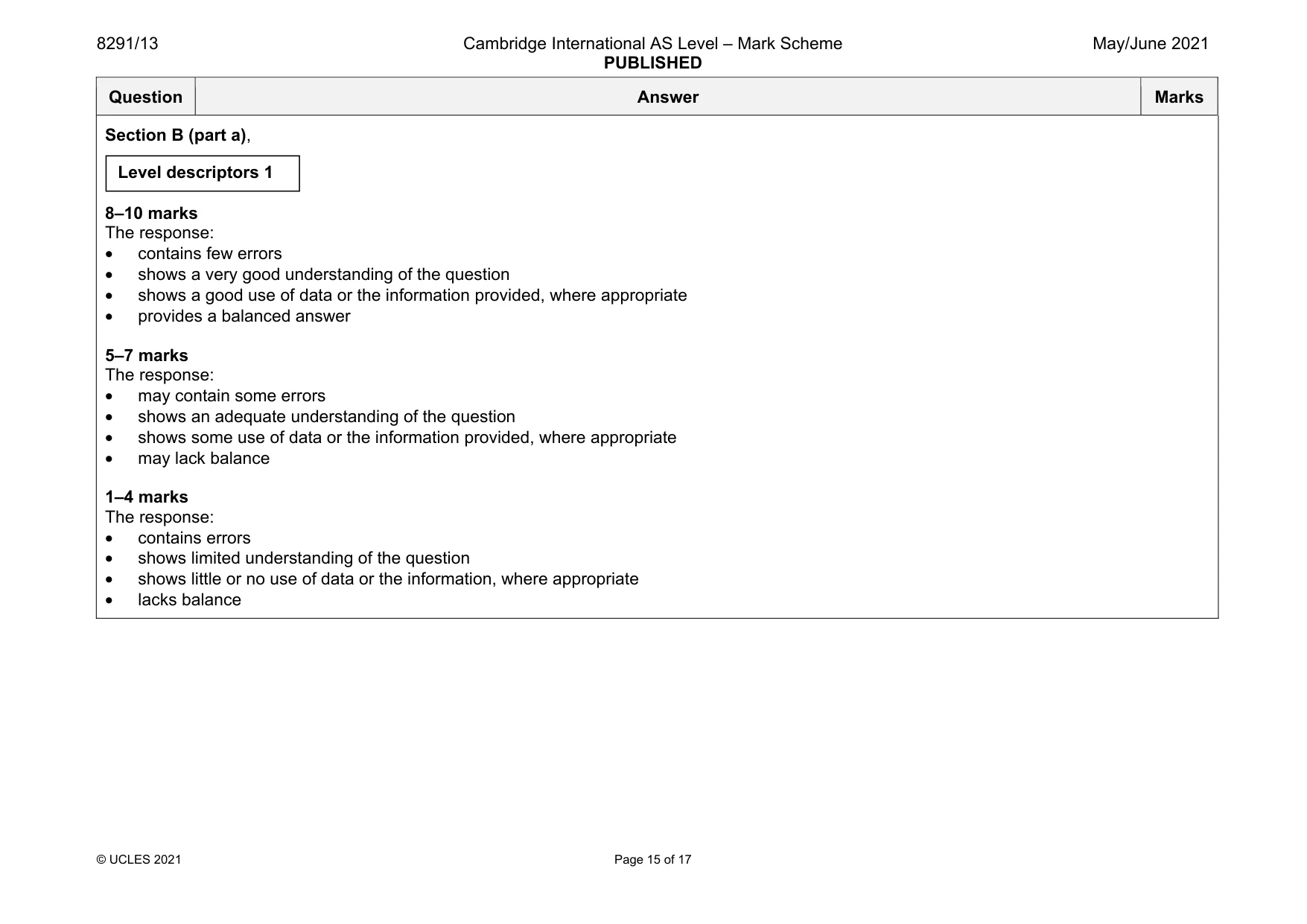
8291/13 Cambridge International AS Level – Mark Scheme PUBLISHED May/June 2021 © UCLES 2021 Page 15 of 17 Question Answer Marks Section B (part a), 8–10 marks The response: • contains few errors • shows a very good understanding of the question • shows a good use of data or the information provided, where appropriate • provides a balanced answer 5–7 marks The response: • may contain some errors • shows an adequate understanding of the question • shows some use of data or the information provided, where appropriate • may lack balance 1–4 marks The response: • contains errors • shows limited understanding of the question • shows little or no use of data or the information, where appropriate • lacks balance Level descriptors 1
Mark scheme, page 16
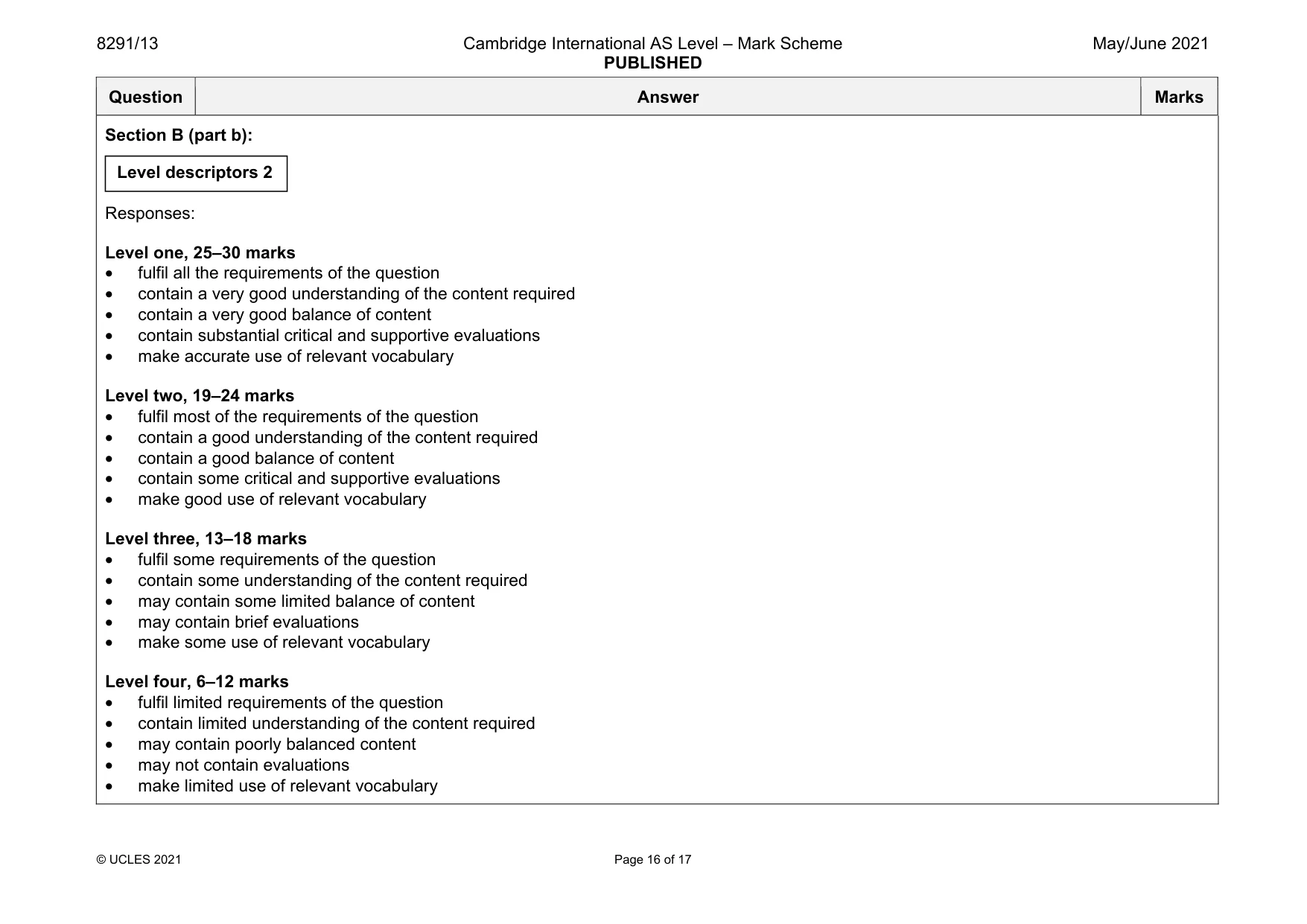
8291/13 Cambridge International AS Level – Mark Scheme PUBLISHED May/June 2021 © UCLES 2021 Page 16 of 17 Question Answer Marks Section B (part b): Responses: Level one, 25–30 marks • fulfil all the requirements of the question • contain a very good understanding of the content required • contain a very good balance of content • contain substantial critical and supportive evaluations • make accurate use of relevant vocabulary Level two, 19–24 marks • fulfil most of the requirements of the question • contain a good understanding of the content required • contain a good balance of content • contain some critical and supportive evaluations • make good use of relevant vocabulary Level three, 13–18 marks • fulfil some requirements of the question • contain some understanding of the content required • may contain some limited balance of content • may contain brief evaluations • make some use of relevant vocabulary Level four, 6–12 marks • fulfil limited requirements of the question • contain limited understanding of the content required • may contain poorly balanced content • may not contain evaluations • make limited use of relevant vocabulary Level descriptors 2
Mark scheme, page 17
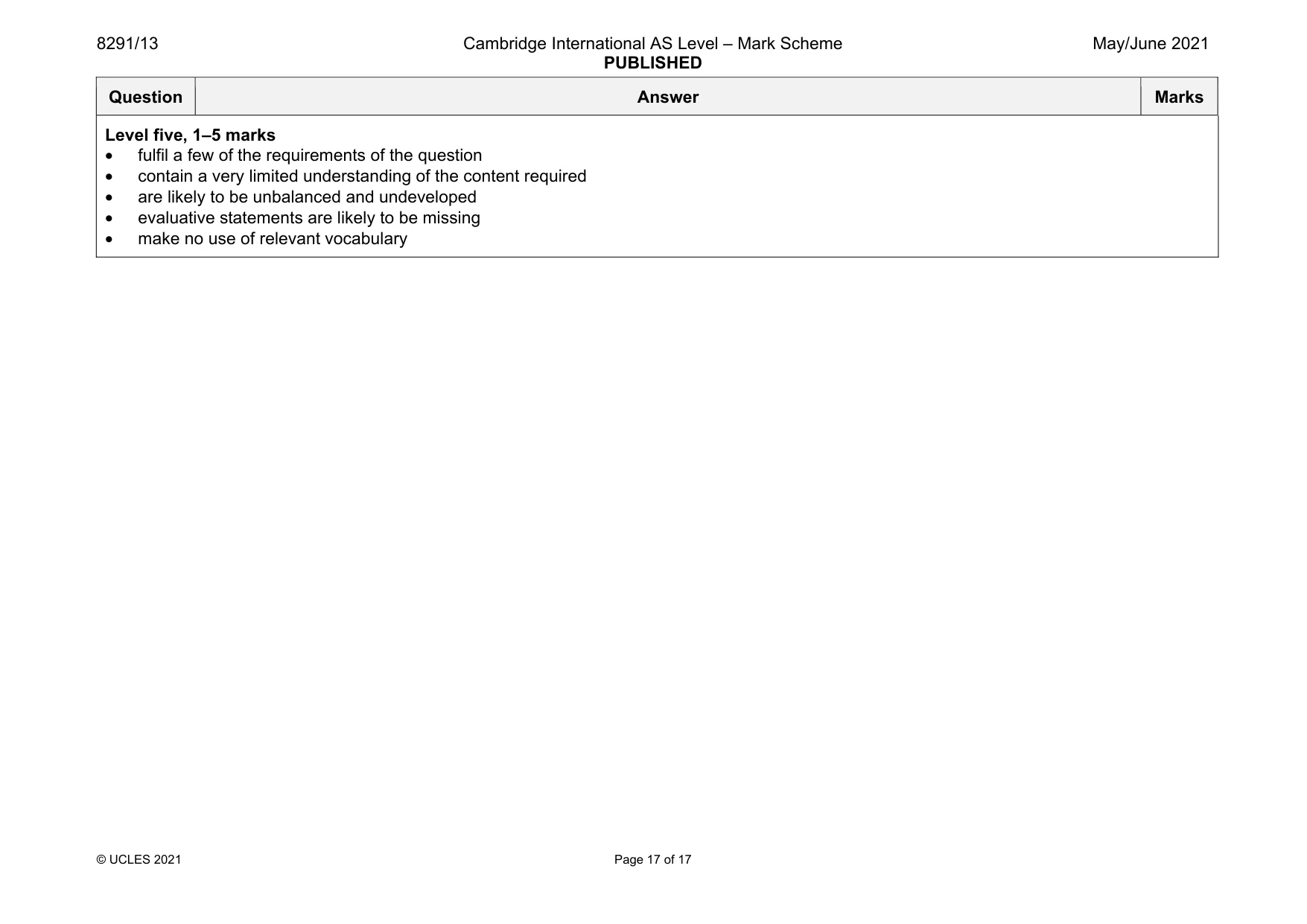
8291/13 Cambridge International AS Level – Mark Scheme PUBLISHED May/June 2021 © UCLES 2021 Page 17 of 17 Question Answer Marks Level five, 1–5 marks • fulfil a few of the requirements of the question • contain a very limited understanding of the content required • are likely to be unbalanced and undeveloped • evaluative statements are likely to be missing • make no use of relevant vocabulary
What you needed in this session
Cambridge’s own grade thresholds for 2021 May/June, Paper 1 · Variant 3. A higher threshold means an easier paper — the bar moves with how the cohort did.