Cambridge A Level Environmental Management (AS only) 8291 — 2013 May/June Paper 1 · Variant 2
8291/12/M/J/13 · 80 marks · ≈90 min
The question paper and its mark scheme, free to read here and free to download. This is Cambridge’s own paper, exactly as it was sat.
Question paper12 pages
Mark scheme10 pages
Answers below. Sit the paper first if you are practising.
Paper as text
Question paper, page 1
This document consists of 12 printed pages. DC (SJF/SW) 67955/2 © UCLES 2013 [Turn over UNIVERSITY OF CAMBRIDGE INTERNATIONAL EXAMINATIONS General Certificate of Education Advanced Subsidiary Level * 9 3 0 8 0 5 0 0 6 7 * ENVIRONMENTAL MANAGEMENT 8291/12 Paper 1 Lithosphere and Atmosphere May/June 2013 1 hour 30 minutes Additional Materials: Answer Booklet/Paper READ THESE INSTRUCTIONS FIRST Write your Centre number, candidate number and name on all the work you hand in. Write in dark blue or black pen. You may use a soft pencil for any diagrams, graphs, tables or rough working. Do not use staples, paper clips, highlighters, glue or correction fluid. DO NOT WRITE IN ANY BARCODES. Electronic calculators may be used. Section A Answer all questions. Write your answers in the spaces provided on the question paper. Section B Answer one question from this section. Answer the question on the separate answer paper provided. At the end of the examination, 1. fasten all separate answer paper securely to the question paper; 2. enter the question number from Section B in the grid opposite. For Examiner’s Use Section A 1 2 Section B Total
Question paper, page 2
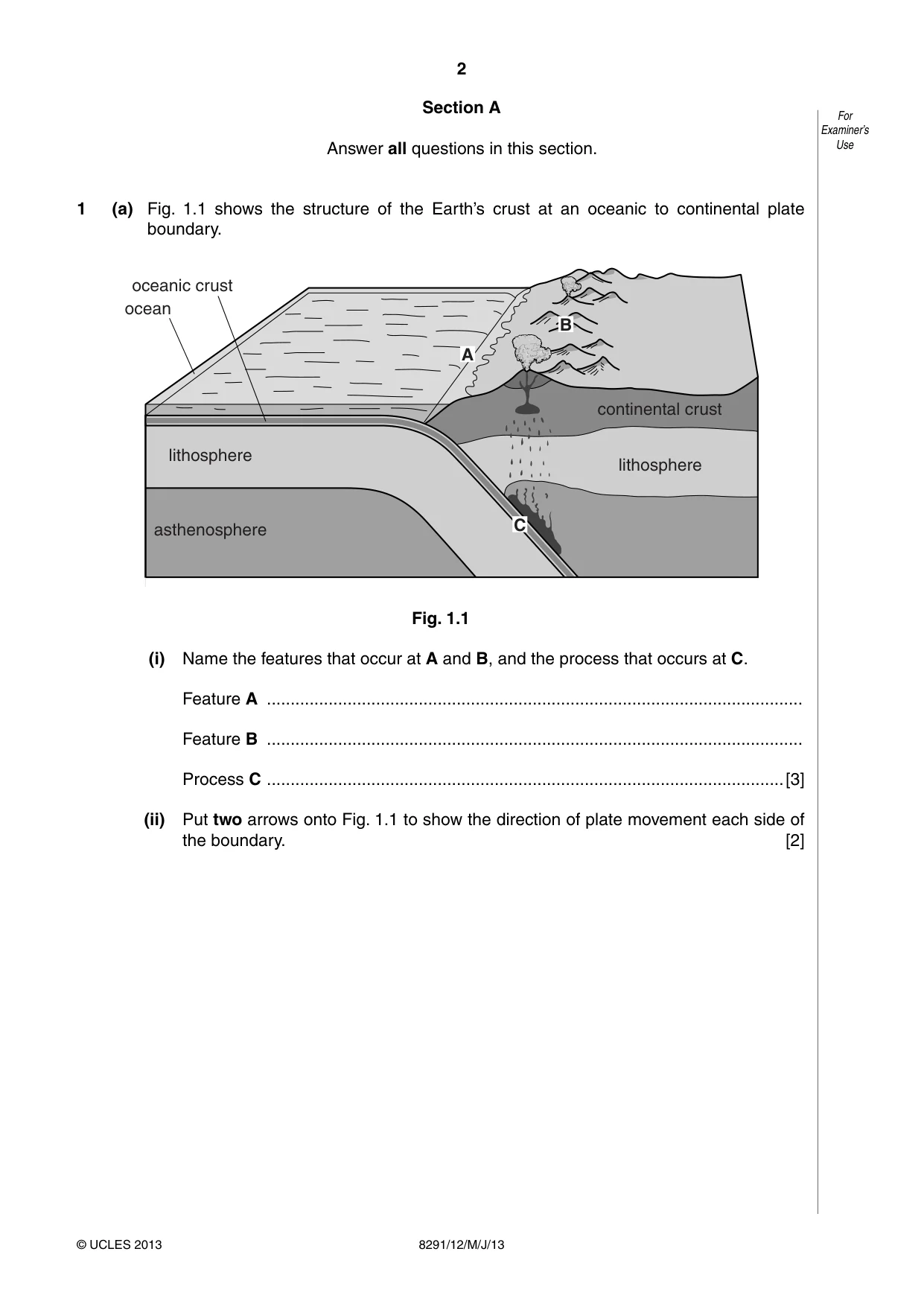
2 8291/12/M/J/13 © UCLES 2013 For Examiner’s Use Section A Answer all questions in this section. 1 (a) Fig. 1.1 shows the structure of the Earth’s crust at an oceanic to continental plate boundary. A B C lithosphere lithosphere asthenosphere ocean oceanic crust continental crust Fig. 1.1 (i) Name the features that occur at A and B, and the process that occurs at C. Feature A … Feature B … Process C …[3] (ii) Put two arrows onto Fig. 1.1 to show the direction of plate movement each side of the boundary. [2]
Question paper, page 3
3 8291/12/M/J/13 © UCLES 2013 [Turn over For Examiner’s Use (iii) Briefly explain the formation of features A and B shown in Fig. 1.1. … … … … … … … … … …[5]
Question paper, page 4
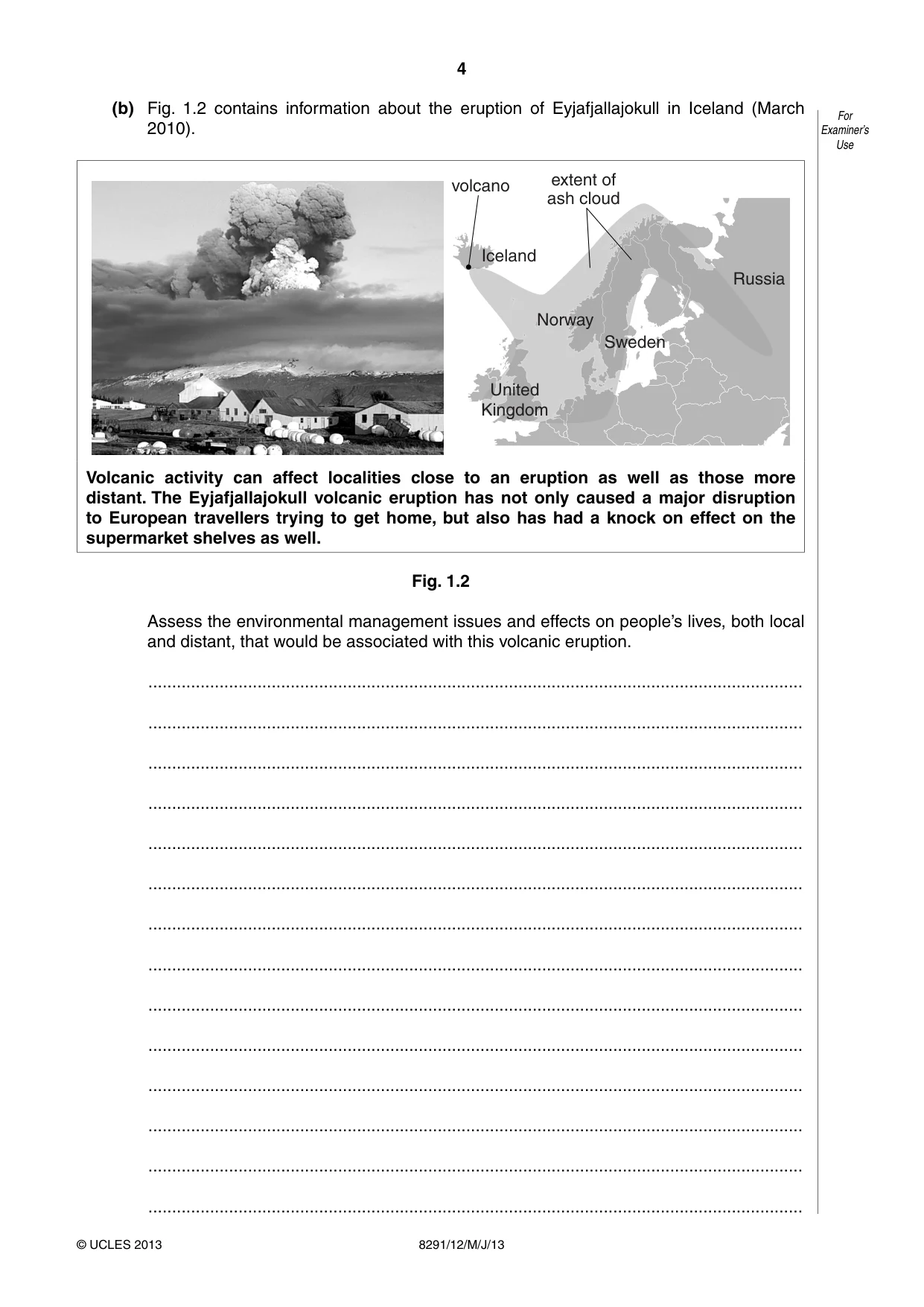
4 8291/12/M/J/13 © UCLES 2013 For Examiner’s Use (b) Fig. 1.2 contains information about the eruption of Eyjafjallajokull in Iceland (March 2010). Russia Sweden United Kingdom Iceland extent of ash cloud volcano Norway Volcanic activity can affect localities close to an eruption as well as those more distant. The Eyjafjallajokull volcanic eruption has not only caused a major disruption to European travellers trying to get home, but also has had a knock on effect on the supermarket shelves as well. Fig. 1.2 Assess the environmental management issues and effects on people’s lives, both local and distant, that would be associated with this volcanic eruption. … … … … … … … … … … … … … …
Question paper, page 5
5 8291/12/M/J/13 © UCLES 2013 [Turn over For Examiner’s Use … … … … … …[10] [Total: 20]
Question paper, page 6
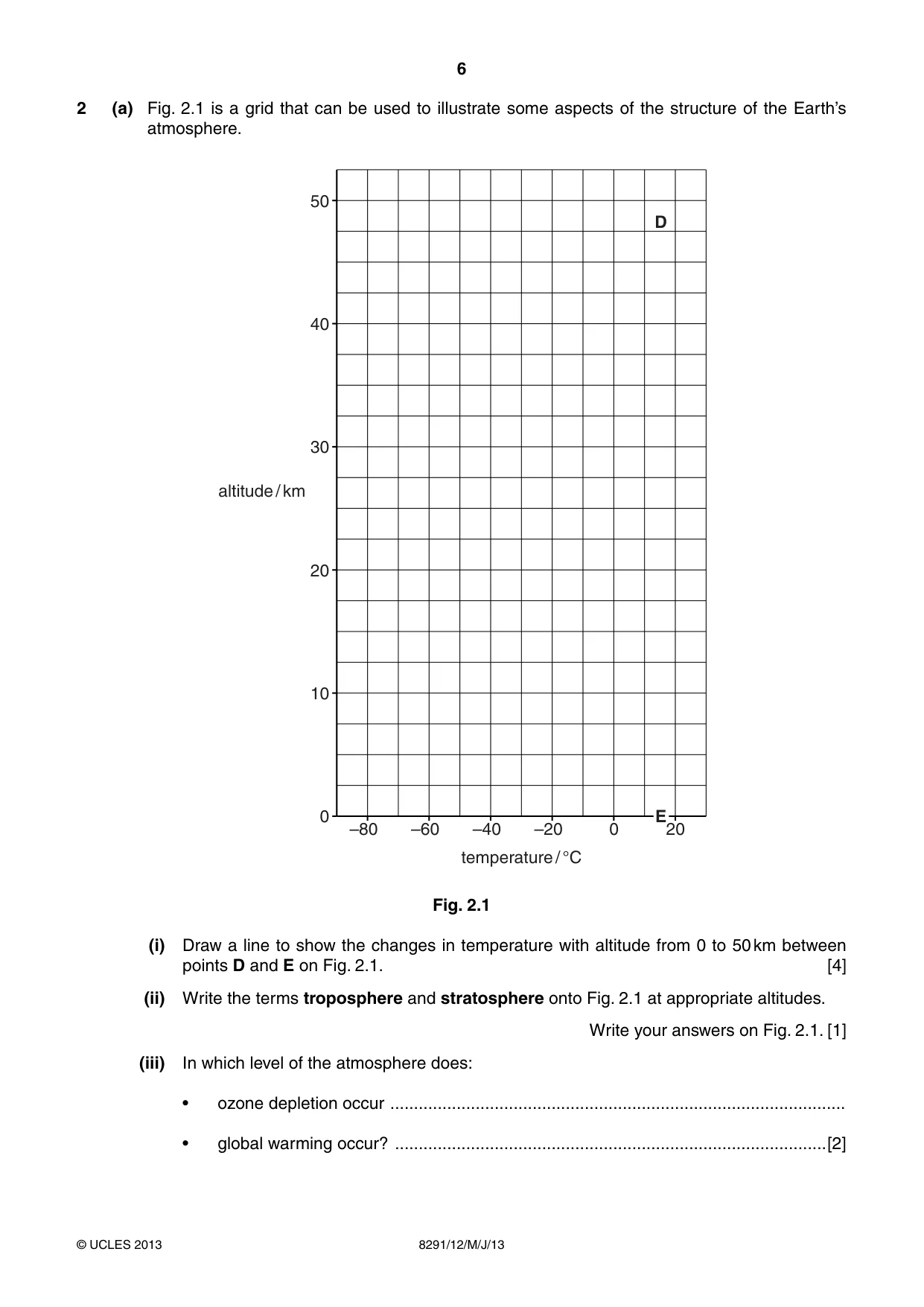
6 8291/12/M/J/13 © UCLES 2013 2 (a) Fig. 2.1 is a grid that can be used to illustrate some aspects of the structure of the Earth’s atmosphere. –80 0 10 20 30 40 50 –60 –40 –20 0 20 temperature / °C E D altitude / km Fig. 2.1 (i) Draw a line to show the changes in temperature with altitude from 0 to 50 km between points D and E on Fig. 2.1. [4] (ii) Write the terms troposphere and stratosphere onto Fig. 2.1 at appropriate altitudes. Write your answers on Fig. 2.1. [1] (iii) In which level of the atmosphere does: • ozone depletion occur … • global warming occur? …[2]
Question paper, page 7
7 8291/12/M/J/13 © UCLES 2013 [Turn over For Examiner’s Use (iv) Outline two functions of the helium-filled weather-research balloons that usually ascend to about 10 000 m. … … … … … … … …[4]
Question paper, page 8
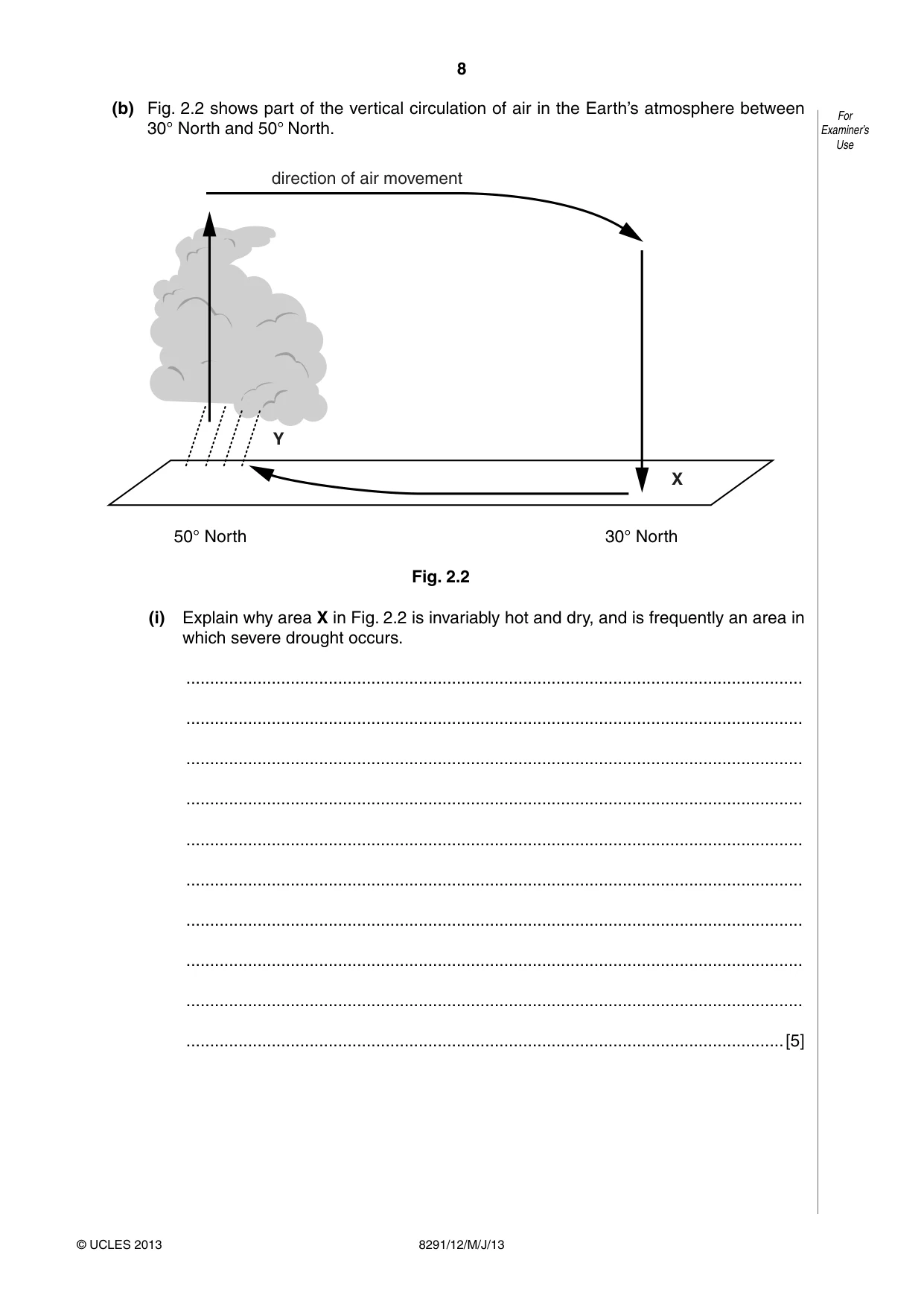
8 8291/12/M/J/13 © UCLES 2013 For Examiner’s Use (b) Fig. 2.2 shows part of the vertical circulation of air in the Earth’s atmosphere between 30° North and 50° North. Y X direction of air movement 50° North 30° North Fig. 2.2 (i) Explain why area X in Fig. 2.2 is invariably hot and dry, and is frequently an area in which severe drought occurs. … … … … … … … … … …[5]
Question paper, page 9
9 8291/12/M/J/13 © UCLES 2013 [Turn over For Examiner’s Use (ii) Explain why rainfall is frequent in area Y in Fig. 2.2. … … … … … … … …[4] [Total: 20]
Question paper, page 10
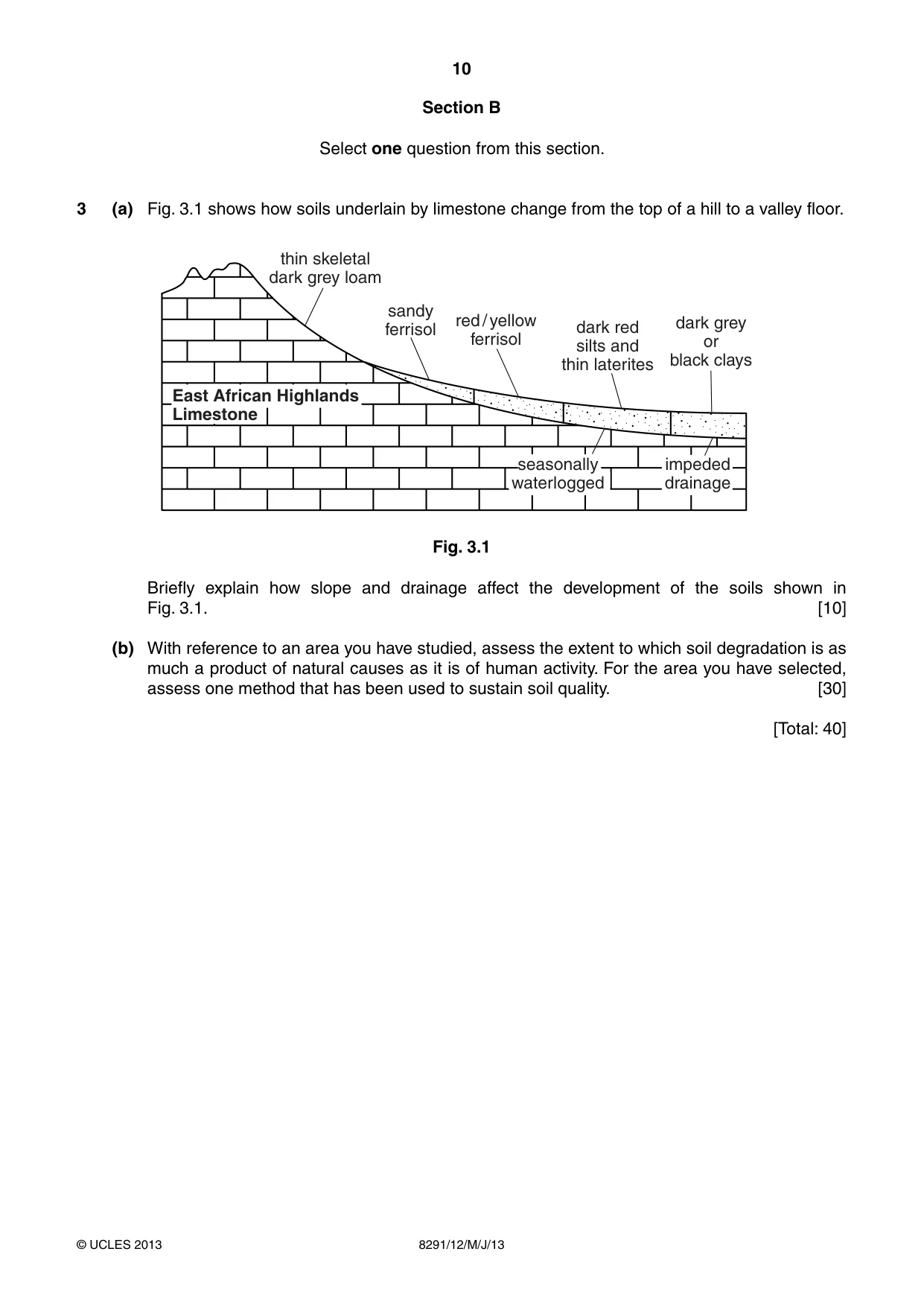
10 8291/12/M/J/13 © UCLES 2013 Section B Select one question from this section. 3 (a) Fig. 3.1 shows how soils underlain by limestone change from the top of a hill to a valley floor. thin skeletal dark grey loam sandy ferrisol red / yellow ferrisol seasonally waterlogged East African Highlands Limestone impeded drainage dark red silts and thin laterites dark grey or black clays Fig. 3.1 Briefly explain how slope and drainage affect the development of the soils shown in Fig. 3.1. [10] (b) With reference to an area you have studied, assess the extent to which soil degradation is as much a product of natural causes as it is of human activity. For the area you have selected, assess one method that has been used to sustain soil quality. [30] [Total: 40]
Question paper, page 11
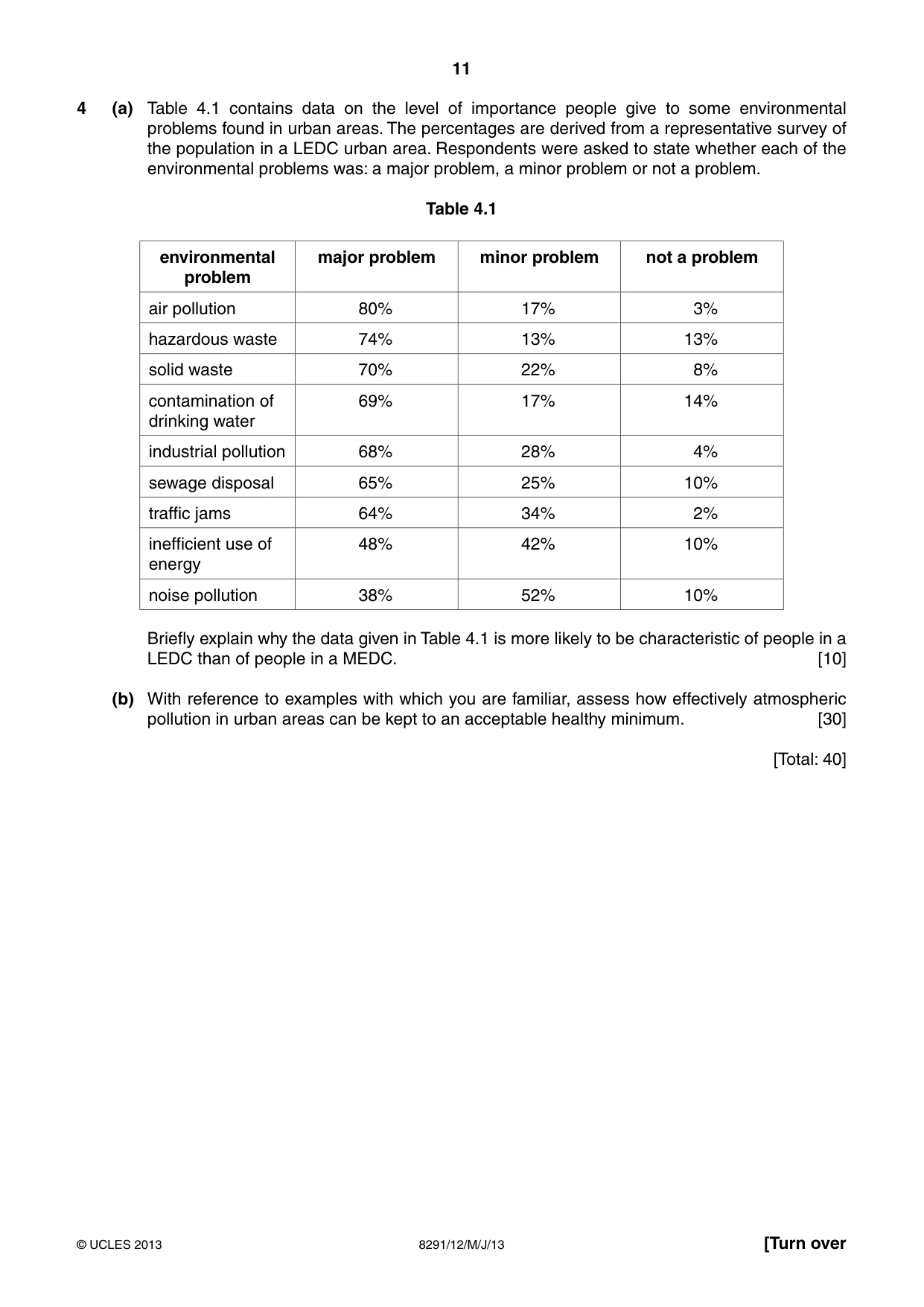
11 8291/12/M/J/13 © UCLES 2013 [Turn over 4 (a) Table 4.1 contains data on the level of importance people give to some environmental problems found in urban areas. The percentages are derived from a representative survey of the population in a LEDC urban area. Respondents were asked to state whether each of the environmental problems was: a major problem, a minor problem or not a problem. Table 4.1 environmental problem major problem minor problem not a problem air pollution 80% 17% 3% hazardous waste 74% 13% 13% solid waste 70% 22% 8% contamination of drinking water 69% 17% 14% industrial pollution 68% 28% 4% sewage disposal 65% 25% 10% traffic jams 64% 34% 2% inefficient use of energy 48% 42% 10% noise pollution 38% 52% 10% Briefly explain why the data given in Table 4.1 is more likely to be characteristic of people in a LEDC than of people in a MEDC. [10] (b) With reference to examples with which you are familiar, assess how effectively atmospheric pollution in urban areas can be kept to an acceptable healthy minimum. [30] [Total: 40]
Question paper, page 12
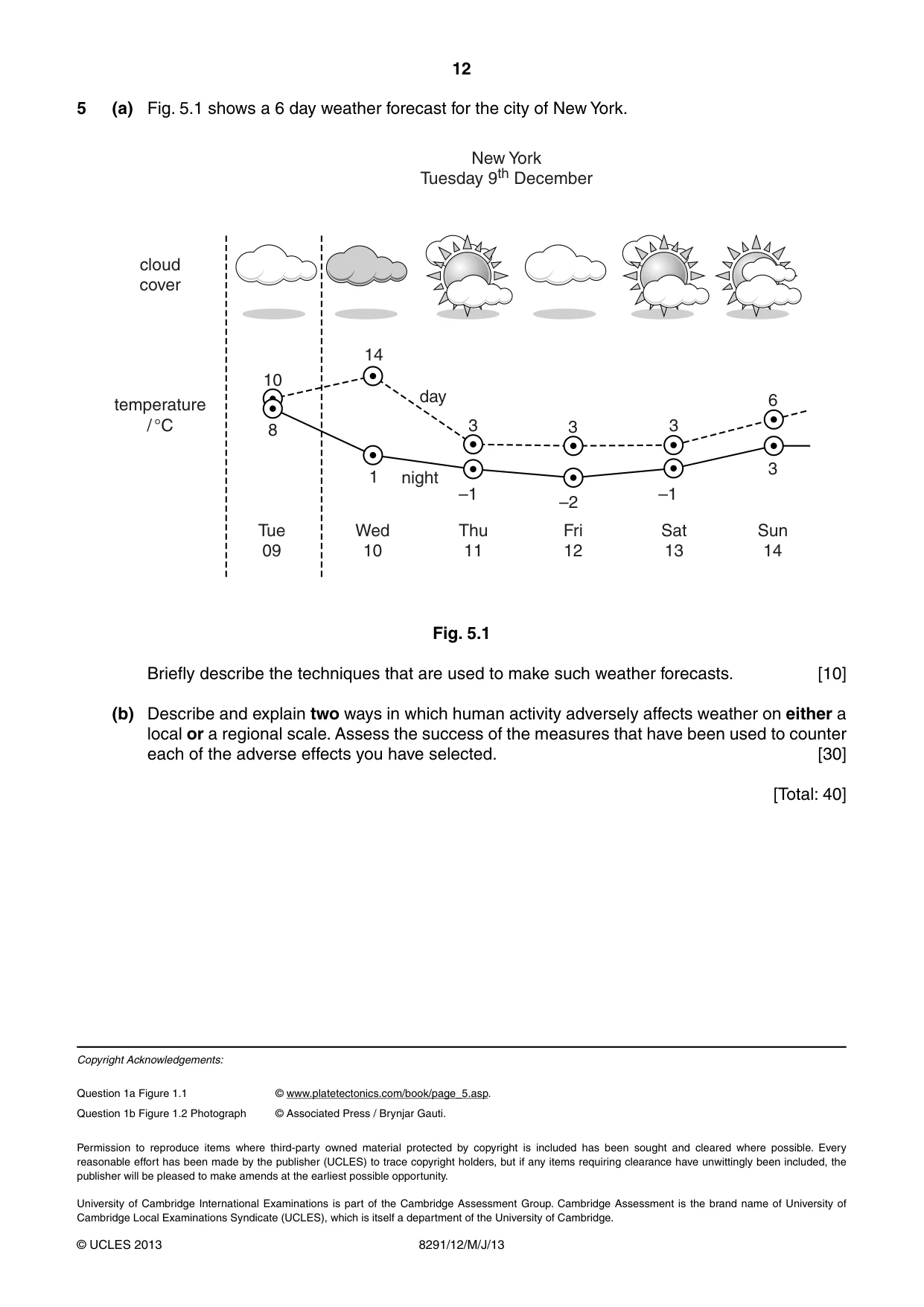
12 8291/12/M/J/13 © UCLES 2013 5 (a) Fig. 5.1 shows a 6 day weather forecast for the city of New York. 10 14 3 3 6 3 8 1 –1 –1 –2 Fri 12 New York Tuesday 9th December Sat 13 Sun 14 Thu 11 Wed 10 Tue 09 night day temperature / °C cloud cover 3 Fig. 5.1 Briefly describe the techniques that are used to make such weather forecasts. [10] (b) Describe and explain two ways in which human activity adversely affects weather on either a local or a regional scale. Assess the success of the measures that have been used to counter each of the adverse effects you have selected. [30] [Total: 40] Copyright Acknowledgements: Question 1a Figure 1.1 © www.platetectonics.com/book/page_5.asp. Question 1b Figure 1.2 Photograph © Associated Press / Brynjar Gauti. Permission to reproduce items where third-party owned material protected by copyright is included has been sought and cleared where possible. Every reasonable effort has been made by the publisher (UCLES) to trace copyright holders, but if any items requiring clearance have unwittingly been included, the publisher will be pleased to make amends at the earliest possible opportunity. University of Cambridge International Examinations is part of the Cambridge Assessment Group. Cambridge Assessment is the brand name of University of Cambridge Local Examinations Syndicate (UCLES), which is itself a department of the University of Cambridge.
Mark scheme, page 1
CAMBRIDGE INTERNATIONAL EXAMINATIONS GCE Advanced Subsidiary Level MARK SCHEME for the May/June 2013 series 8291 ENVIRONMENTAL MANAGEMENT 8291/12 Paper 1, maximum raw mark 80 This mark scheme is published as an aid to teachers and candidates, to indicate the requirements of the examination. It shows the basis on which Examiners were instructed to award marks. It does not indicate the details of the discussions that took place at an Examiners’ meeting before marking began, which would have considered the acceptability of alternative answers. Mark schemes should be read in conjunction with the question paper and the Principal Examiner Report for Teachers. Cambridge will not enter into discussions about these mark schemes. Cambridge is publishing the mark schemes for the May/June 2013 series for most IGCSE, GCE Advanced Level and Advanced Subsidiary Level components and some Ordinary Level components.
Mark scheme, page 2
Page 2 Mark Scheme Syllabus Paper GCE AS LEVEL – May/June 2013 8291 12 © Cambridge International Examinations 2013 General notes Symbols used in Environmental Management mark schemes. / separates alternatives for a marking point – other valid ways of expressing the same idea are also credited ; separates points for the award of a mark [3] indicates the number of marks available italic indicates that this is information about the marking points and is not required to gain credit italic text is also used for comments about alternatives that should be accepted, ignored or rejected ora or reverse argument – shows that an argument from an alternative viewpoint will be credited AW alternative wording, sometimes called ‘or words to that effect’ – AW is used when there are many different ways of expressing the same idea ( ) the word / phrase in brackets is not required to gain marks but sets the context of the response for credit e.g. (nuclear) waste – nuclear is not needed but if it was described as a domestic waste then no mark is awarded volcanic underlined words – the answer must contain exactly this word ecf error carried forward – if an incorrect answer is given to part of a question, and this answer is subsequently used by a candidate in later parts of the question, this indicates that the candidate’s incorrect answer will be used as a starting point for marking the later parts of the question
Mark scheme, page 3
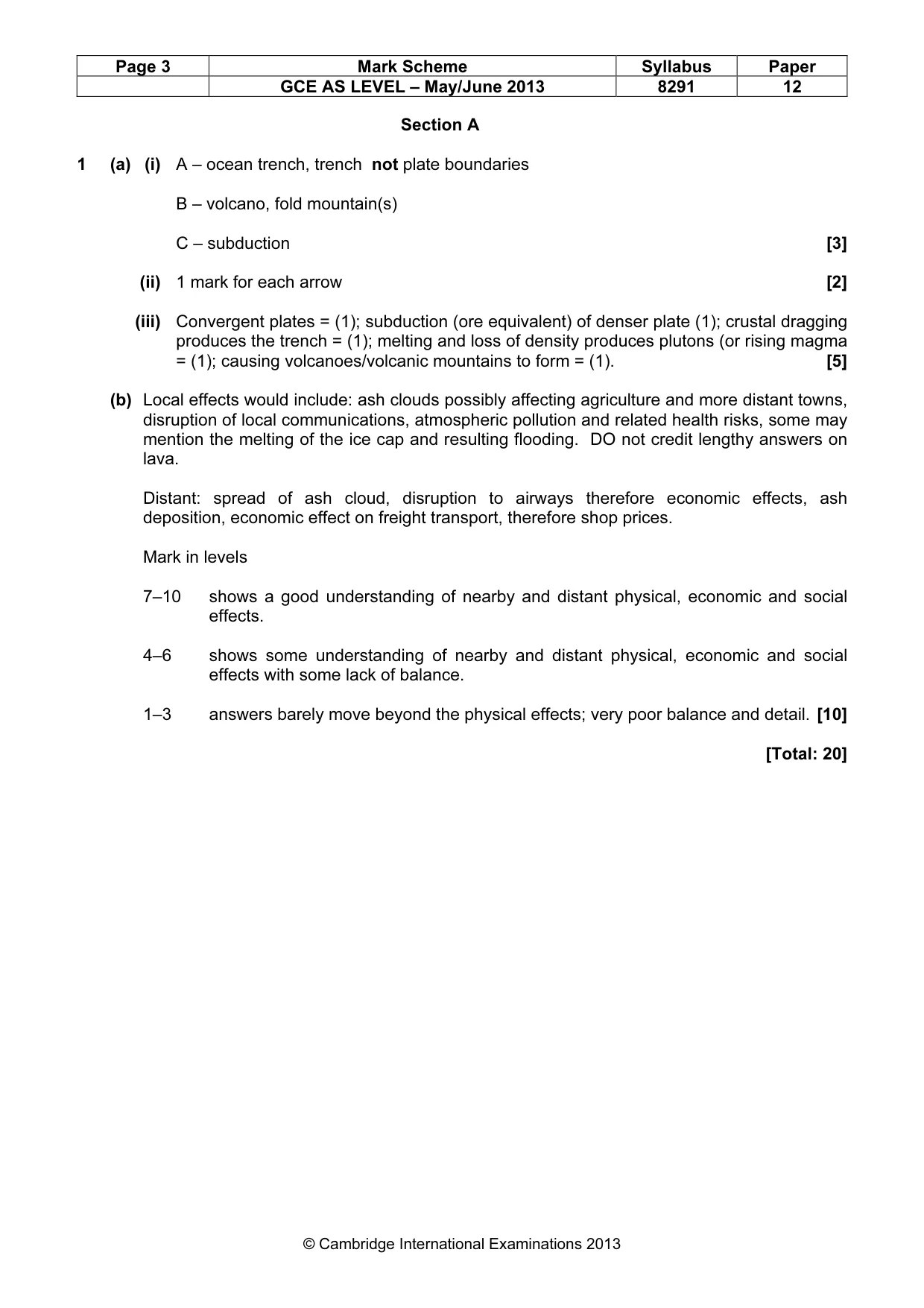
Page 3 Mark Scheme Syllabus Paper GCE AS LEVEL – May/June 2013 8291 12 © Cambridge International Examinations 2013 Section A 1 (a) (i) A – ocean trench, trench not plate boundaries B – volcano, fold mountain(s) C – subduction [3] (ii) 1 mark for each arrow [2] (iii) Convergent plates = (1); subduction (ore equivalent) of denser plate (1); crustal dragging produces the trench = (1); melting and loss of density produces plutons (or rising magma = (1); causing volcanoes/volcanic mountains to form = (1). [5] (b) Local effects would include: ash clouds possibly affecting agriculture and more distant towns, disruption of local communications, atmospheric pollution and related health risks, some may mention the melting of the ice cap and resulting flooding. DO not credit lengthy answers on lava. Distant: spread of ash cloud, disruption to airways therefore economic effects, ash deposition, economic effect on freight transport, therefore shop prices. Mark in levels 7–10 shows a good understanding of nearby and distant physical, economic and social effects. 4–6 shows some understanding of nearby and distant physical, economic and social effects with some lack of balance. 1–3 answers barely move beyond the physical effects; very poor balance and detail. [10] [Total: 20]
Mark scheme, page 4
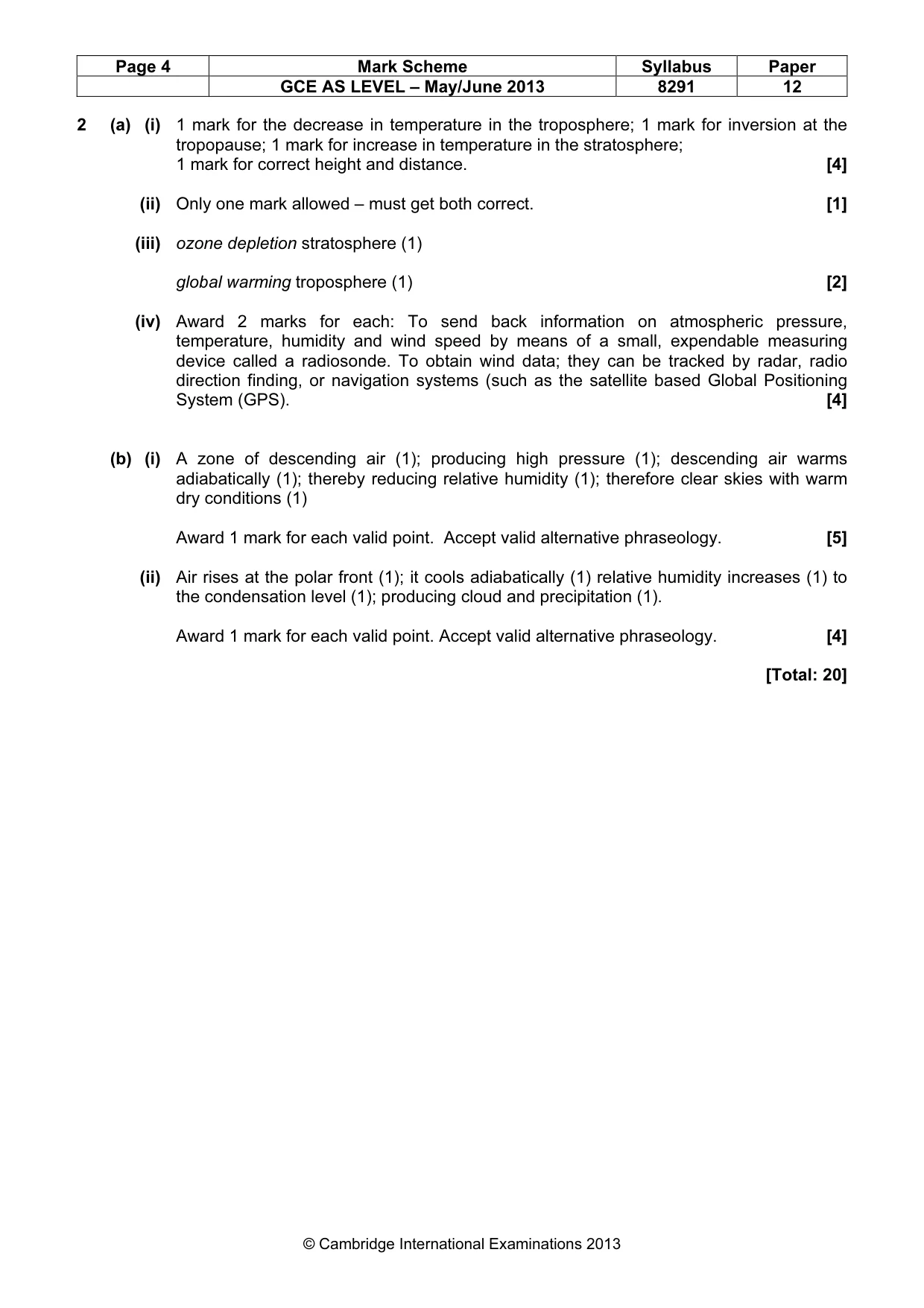
Page 4 Mark Scheme Syllabus Paper GCE AS LEVEL – May/June 2013 8291 12 © Cambridge International Examinations 2013 2 (a) (i) 1 mark for the decrease in temperature in the troposphere; 1 mark for inversion at the tropopause; 1 mark for increase in temperature in the stratosphere; 1 mark for correct height and distance. [4] (ii) Only one mark allowed – must get both correct. [1] (iii) ozone depletion stratosphere (1) global warming troposphere (1) [2] (iv) Award 2 marks for each: To send back information on atmospheric pressure, temperature, humidity and wind speed by means of a small, expendable measuring device called a radiosonde. To obtain wind data; they can be tracked by radar, radio direction finding, or navigation systems (such as the satellite based Global Positioning System (GPS). [4] (b) (i) A zone of descending air (1); producing high pressure (1); descending air warms adiabatically (1); thereby reducing relative humidity (1); therefore clear skies with warm dry conditions (1) Award 1 mark for each valid point. Accept valid alternative phraseology. [5] (ii) Air rises at the polar front (1); it cools adiabatically (1) relative humidity increases (1) to the condensation level (1); producing cloud and precipitation (1). Award 1 mark for each valid point. Accept valid alternative phraseology. [4] [Total: 20]
Mark scheme, page 5
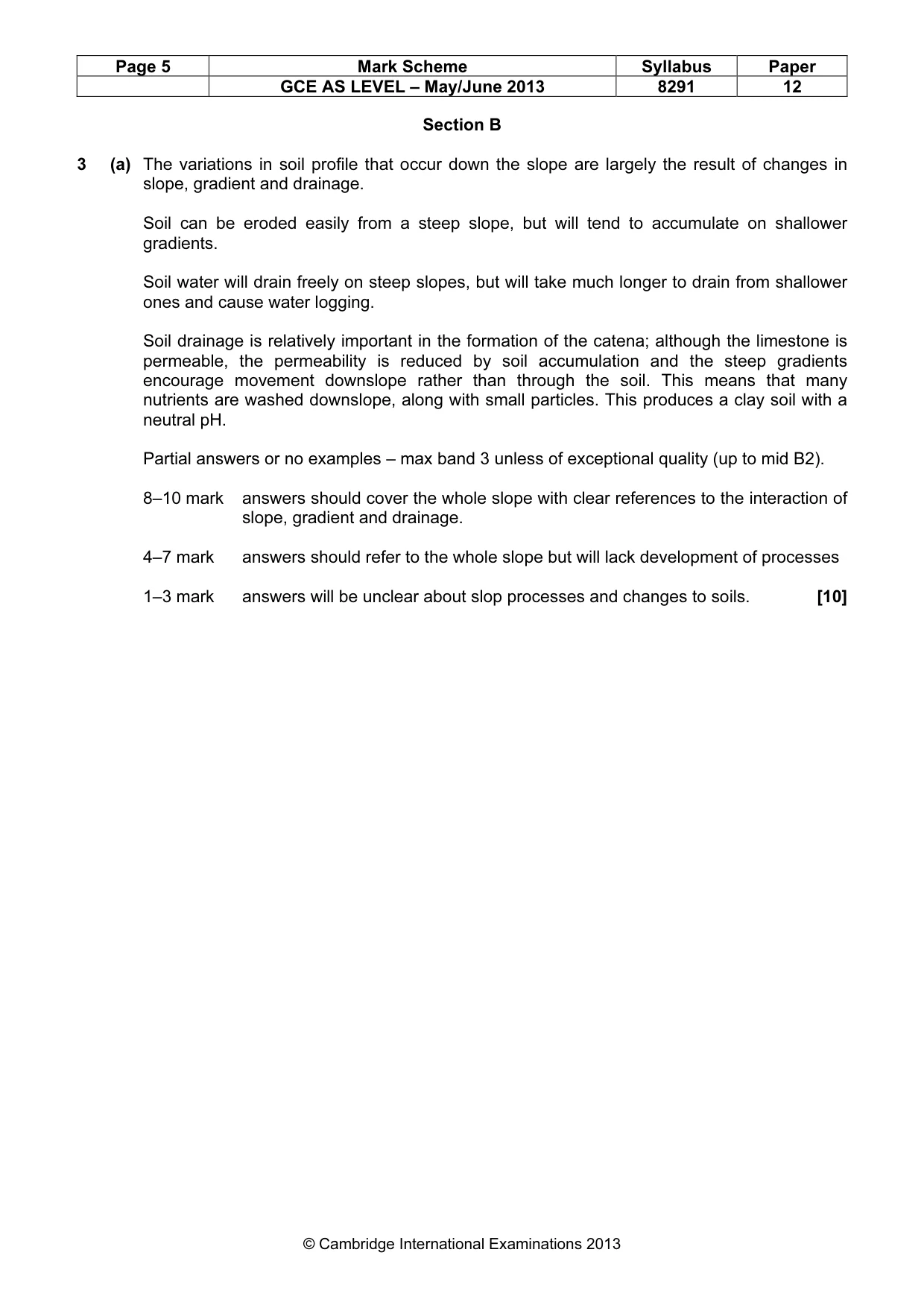
Page 5 Mark Scheme Syllabus Paper GCE AS LEVEL – May/June 2013 8291 12 © Cambridge International Examinations 2013 Section B 3 (a) The variations in soil profile that occur down the slope are largely the result of changes in slope, gradient and drainage. Soil can be eroded easily from a steep slope, but will tend to accumulate on shallower gradients. Soil water will drain freely on steep slopes, but will take much longer to drain from shallower ones and cause water logging. Soil drainage is relatively important in the formation of the catena; although the limestone is permeable, the permeability is reduced by soil accumulation and the steep gradients encourage movement downslope rather than through the soil. This means that many nutrients are washed downslope, along with small particles. This produces a clay soil with a neutral pH. Partial answers or no examples – max band 3 unless of exceptional quality (up to mid B2). 8–10 mark answers should cover the whole slope with clear references to the interaction of slope, gradient and drainage. 4–7 mark answers should refer to the whole slope but will lack development of processes 1–3 mark answers will be unclear about slop processes and changes to soils. [10]
Mark scheme, page 6
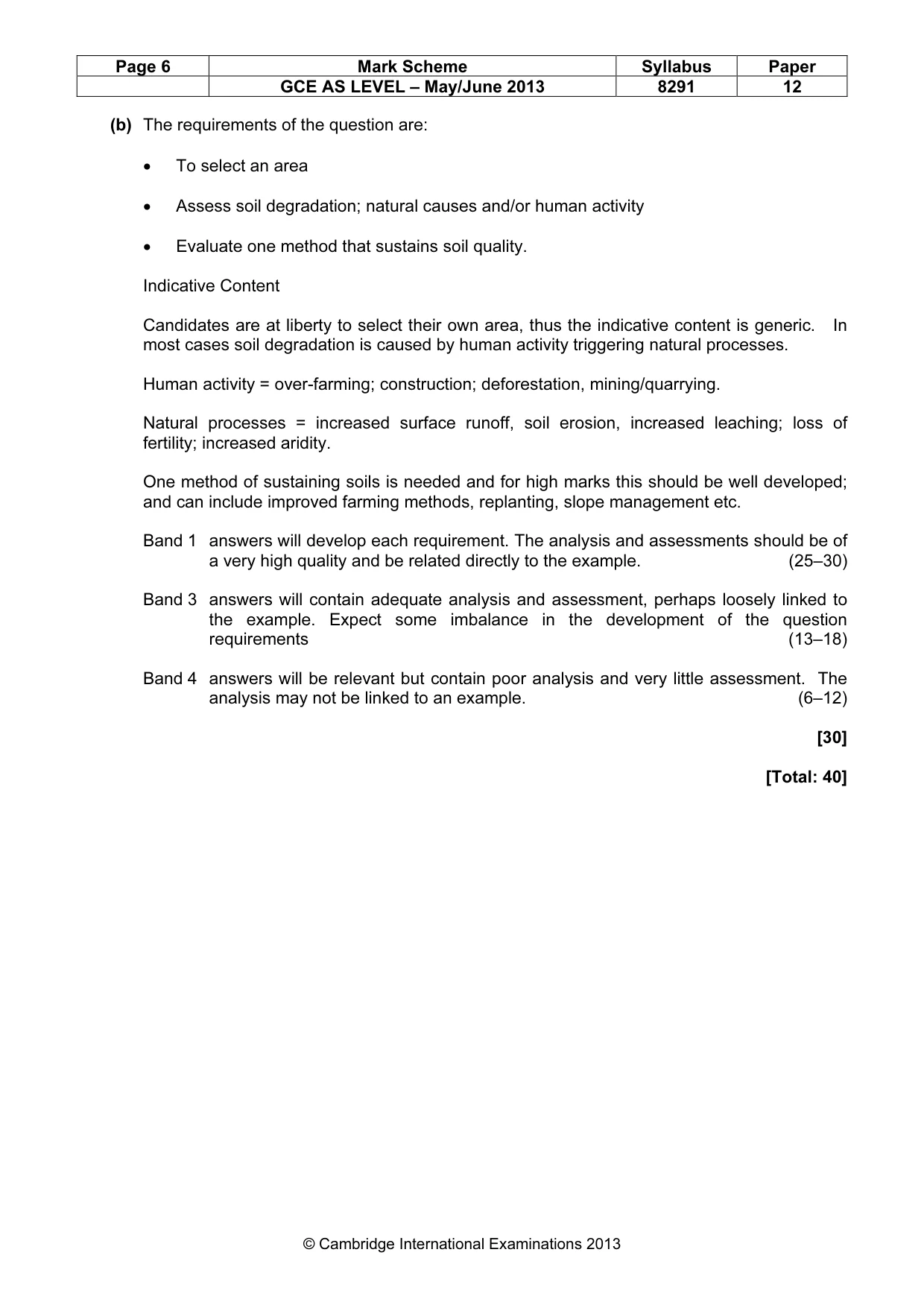
Page 6 Mark Scheme Syllabus Paper GCE AS LEVEL – May/June 2013 8291 12 © Cambridge International Examinations 2013 (b) The requirements of the question are: • To select an area • Assess soil degradation; natural causes and/or human activity • Evaluate one method that sustains soil quality. Indicative Content Candidates are at liberty to select their own area, thus the indicative content is generic. In most cases soil degradation is caused by human activity triggering natural processes. Human activity = over-farming; construction; deforestation, mining/quarrying. Natural processes = increased surface runoff, soil erosion, increased leaching; loss of fertility; increased aridity. One method of sustaining soils is needed and for high marks this should be well developed; and can include improved farming methods, replanting, slope management etc. Band 1 answers will develop each requirement. The analysis and assessments should be of a very high quality and be related directly to the example. (25–30) Band 3 answers will contain adequate analysis and assessment, perhaps loosely linked to the example. Expect some imbalance in the development of the question requirements (13–18) Band 4 answers will be relevant but contain poor analysis and very little assessment. The analysis may not be linked to an example. (6–12) [30] [Total: 40]
Mark scheme, page 7
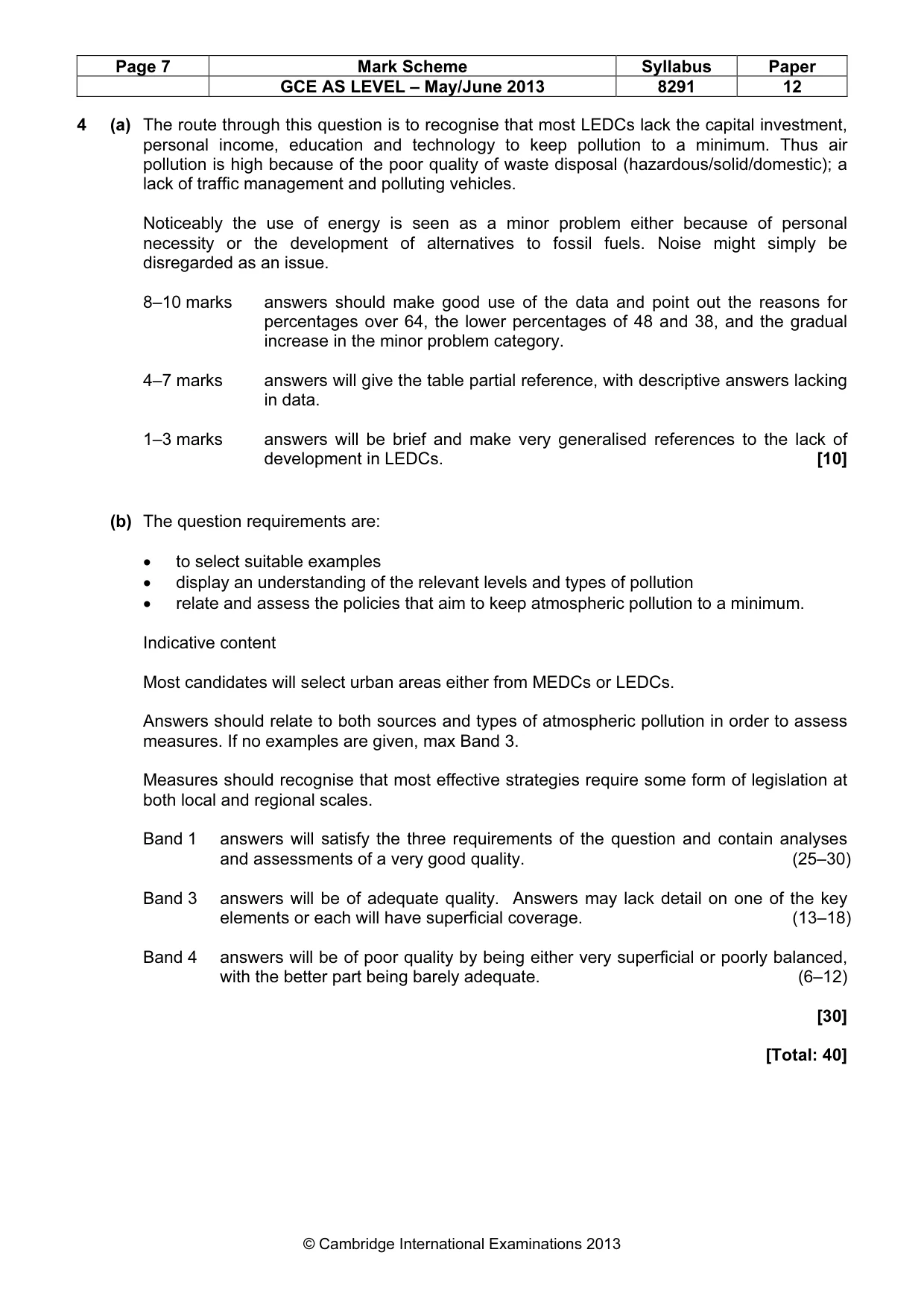
Page 7 Mark Scheme Syllabus Paper GCE AS LEVEL – May/June 2013 8291 12 © Cambridge International Examinations 2013 4 (a) The route through this question is to recognise that most LEDCs lack the capital investment, personal income, education and technology to keep pollution to a minimum. Thus air pollution is high because of the poor quality of waste disposal (hazardous/solid/domestic); a lack of traffic management and polluting vehicles. Noticeably the use of energy is seen as a minor problem either because of personal necessity or the development of alternatives to fossil fuels. Noise might simply be disregarded as an issue. 8–10 marks answers should make good use of the data and point out the reasons for percentages over 64, the lower percentages of 48 and 38, and the gradual increase in the minor problem category. 4–7 marks answers will give the table partial reference, with descriptive answers lacking in data. 1–3 marks answers will be brief and make very generalised references to the lack of development in LEDCs. [10] (b) The question requirements are: • to select suitable examples • display an understanding of the relevant levels and types of pollution • relate and assess the policies that aim to keep atmospheric pollution to a minimum. Indicative content Most candidates will select urban areas either from MEDCs or LEDCs. Answers should relate to both sources and types of atmospheric pollution in order to assess measures. If no examples are given, max Band 3. Measures should recognise that most effective strategies require some form of legislation at both local and regional scales. Band 1 answers will satisfy the three requirements of the question and contain analyses and assessments of a very good quality. (25–30) Band 3 answers will be of adequate quality. Answers may lack detail on one of the key elements or each will have superficial coverage. (13–18) Band 4 answers will be of poor quality by being either very superficial or poorly balanced, with the better part being barely adequate. (6–12) [30] [Total: 40]
Mark scheme, page 8
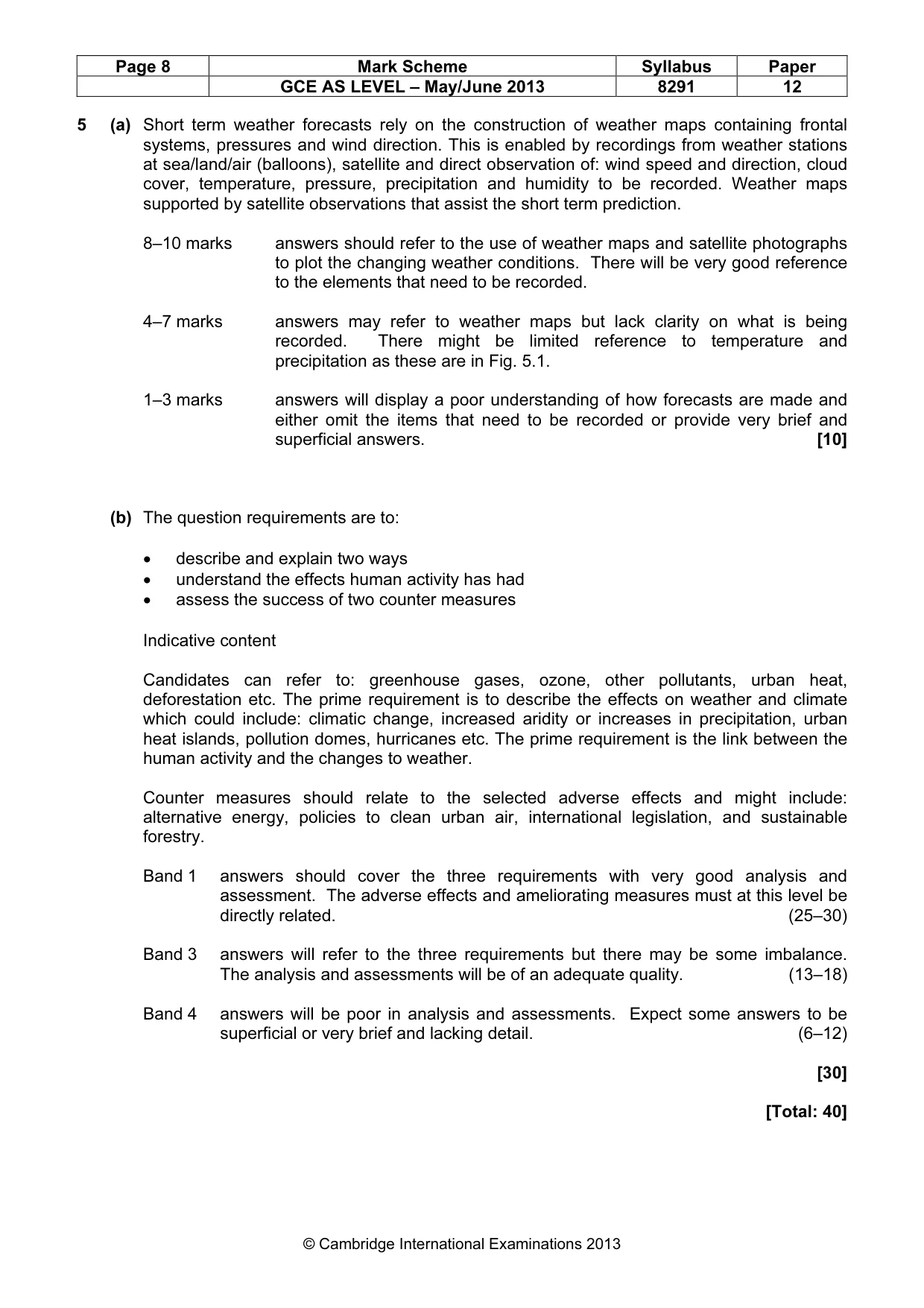
Page 8 Mark Scheme Syllabus Paper GCE AS LEVEL – May/June 2013 8291 12 © Cambridge International Examinations 2013 5 (a) Short term weather forecasts rely on the construction of weather maps containing frontal systems, pressures and wind direction. This is enabled by recordings from weather stations at sea/land/air (balloons), satellite and direct observation of: wind speed and direction, cloud cover, temperature, pressure, precipitation and humidity to be recorded. Weather maps supported by satellite observations that assist the short term prediction. 8–10 marks answers should refer to the use of weather maps and satellite photographs to plot the changing weather conditions. There will be very good reference to the elements that need to be recorded. 4–7 marks answers may refer to weather maps but lack clarity on what is being recorded. There might be limited reference to temperature and precipitation as these are in Fig. 5.1. 1–3 marks answers will display a poor understanding of how forecasts are made and either omit the items that need to be recorded or provide very brief and superficial answers. [10] (b) The question requirements are to: • describe and explain two ways • understand the effects human activity has had • assess the success of two counter measures Indicative content Candidates can refer to: greenhouse gases, ozone, other pollutants, urban heat, deforestation etc. The prime requirement is to describe the effects on weather and climate which could include: climatic change, increased aridity or increases in precipitation, urban heat islands, pollution domes, hurricanes etc. The prime requirement is the link between the human activity and the changes to weather. Counter measures should relate to the selected adverse effects and might include: alternative energy, policies to clean urban air, international legislation, and sustainable forestry. Band 1 answers should cover the three requirements with very good analysis and assessment. The adverse effects and ameliorating measures must at this level be directly related. (25–30) Band 3 answers will refer to the three requirements but there may be some imbalance. The analysis and assessments will be of an adequate quality. (13–18) Band 4 answers will be poor in analysis and assessments. Expect some answers to be superficial or very brief and lacking detail. (6–12) [30] [Total: 40]
Mark scheme, page 9
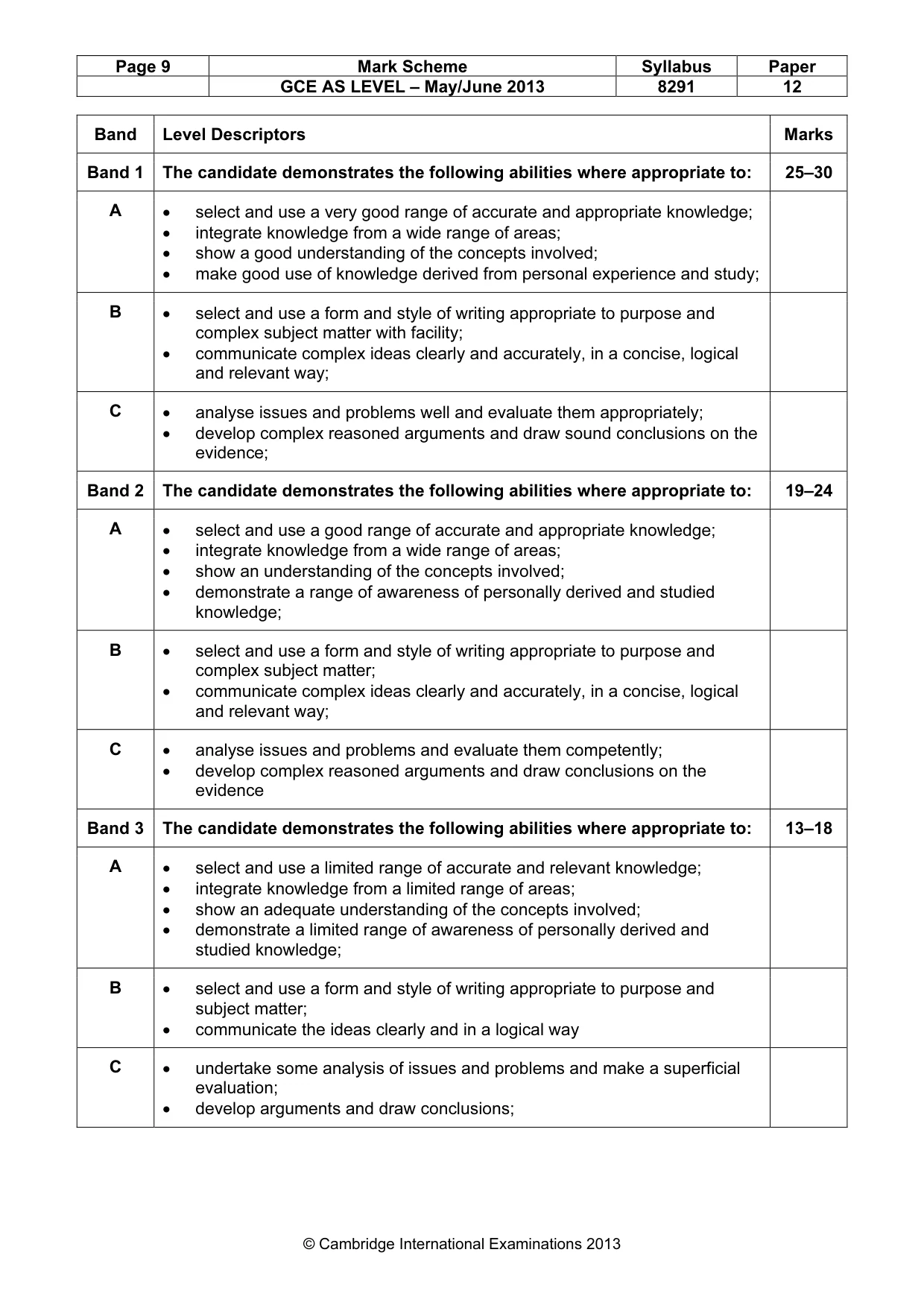
Page 9 Mark Scheme Syllabus Paper GCE AS LEVEL – May/June 2013 8291 12 © Cambridge International Examinations 2013 Band Level Descriptors Marks Band 1 The candidate demonstrates the following abilities where appropriate to: 25–30 A • select and use a very good range of accurate and appropriate knowledge; • integrate knowledge from a wide range of areas; • show a good understanding of the concepts involved; • make good use of knowledge derived from personal experience and study; B • select and use a form and style of writing appropriate to purpose and complex subject matter with facility; • communicate complex ideas clearly and accurately, in a concise, logical and relevant way; C • analyse issues and problems well and evaluate them appropriately; • develop complex reasoned arguments and draw sound conclusions on the evidence; Band 2 The candidate demonstrates the following abilities where appropriate to: 19–24 A • select and use a good range of accurate and appropriate knowledge; • integrate knowledge from a wide range of areas; • show an understanding of the concepts involved; • demonstrate a range of awareness of personally derived and studied knowledge; B • select and use a form and style of writing appropriate to purpose and complex subject matter; • communicate complex ideas clearly and accurately, in a concise, logical and relevant way; C • analyse issues and problems and evaluate them competently; • develop complex reasoned arguments and draw conclusions on the evidence Band 3 The candidate demonstrates the following abilities where appropriate to: 13–18 A • select and use a limited range of accurate and relevant knowledge; • integrate knowledge from a limited range of areas; • show an adequate understanding of the concepts involved; • demonstrate a limited range of awareness of personally derived and studied knowledge; B • select and use a form and style of writing appropriate to purpose and subject matter; • communicate the ideas clearly and in a logical way C • undertake some analysis of issues and problems and make a superficial evaluation; • develop arguments and draw conclusions;
Mark scheme, page 10
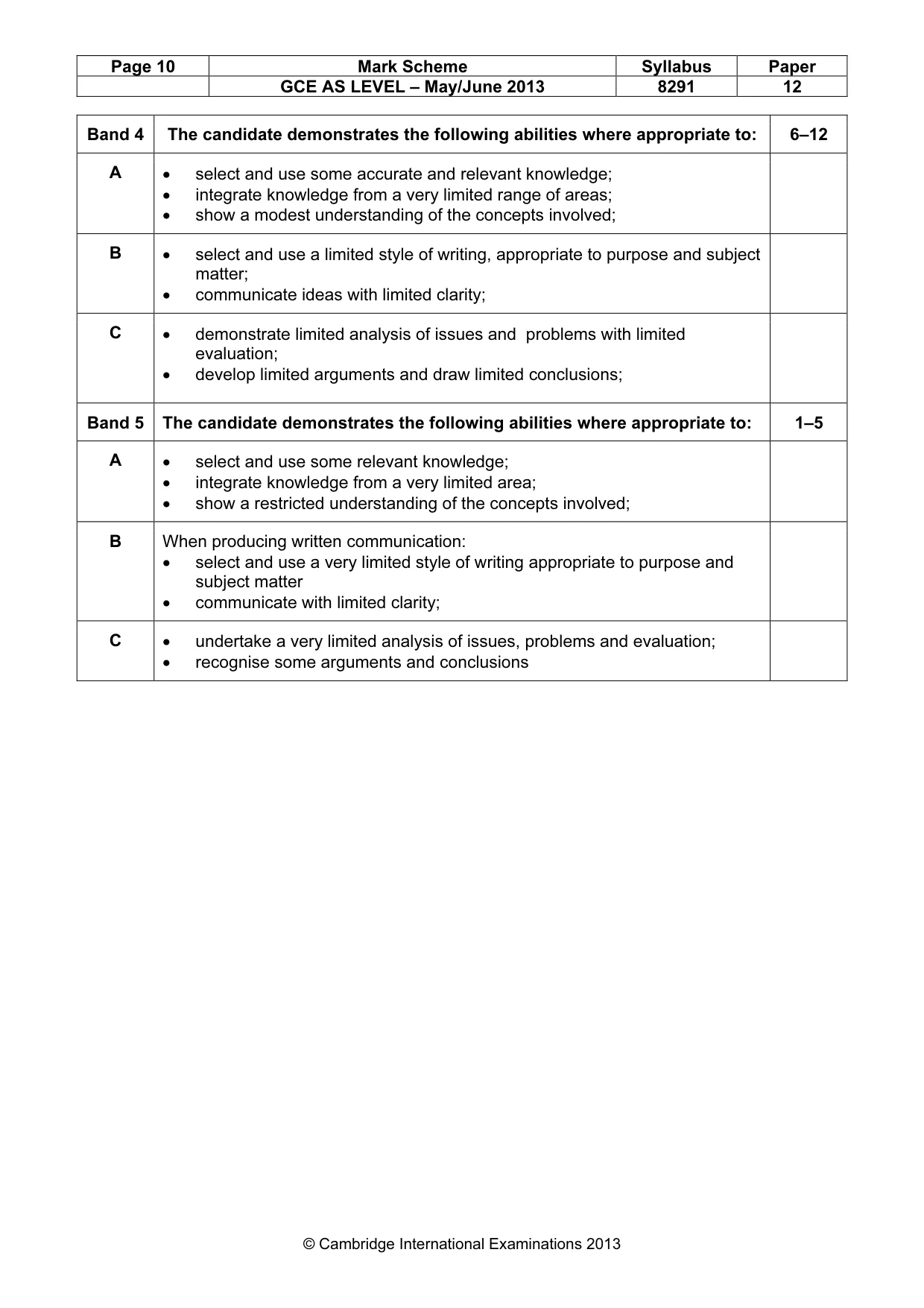
Page 10 Mark Scheme Syllabus Paper GCE AS LEVEL – May/June 2013 8291 12 © Cambridge International Examinations 2013 Band 4 The candidate demonstrates the following abilities where appropriate to: 6–12 A • select and use some accurate and relevant knowledge; • integrate knowledge from a very limited range of areas; • show a modest understanding of the concepts involved; B • select and use a limited style of writing, appropriate to purpose and subject matter; • communicate ideas with limited clarity; C • demonstrate limited analysis of issues and problems with limited evaluation; • develop limited arguments and draw limited conclusions; Band 5 The candidate demonstrates the following abilities where appropriate to: 1–5 A • select and use some relevant knowledge; • integrate knowledge from a very limited area; • show a restricted understanding of the concepts involved; B When producing written communication: • select and use a very limited style of writing appropriate to purpose and subject matter • communicate with limited clarity; C • undertake a very limited analysis of issues, problems and evaluation; • recognise some arguments and conclusions
What you needed in this session
Cambridge’s own grade thresholds for 2013 May/June, Paper 1 · Variant 2. A higher threshold means an easier paper — the bar moves with how the cohort did.