Cambridge A Level English - Language AS and A Level (from 2014) 9093 — 2021 May/June Paper 4 · Variant 1
9093/41/M/J/21 · 50 marks · ≈56 min
The question paper and its mark scheme, free to read here and free to download. This is Cambridge’s own paper, exactly as it was sat.
Question paper8 pages
Mark scheme8 pages
Answers below. Sit the paper first if you are practising.
Paper as text
Question paper, page 1
Cambridge International AS & A Level This document has 8 pages. Any blank pages are indicated. * 5 1 3 3 3 4 5 9 1 3 * DC (LEG) 201763/2 © UCLES 2021 [Turn over ENGLISH LANGUAGE 9093/41 Paper 4 Language Topics May/June 2021 2 hours 15 minutes You must answer on the enclosed answer booklet. You will need: Answer booklet (enclosed) INSTRUCTIONS ● Answer all questions. ● Follow the instructions on the front cover of the answer booklet. If you need additional answer paper, ask the invigilator for a continuation booklet. ● Dictionaries are not allowed. INFORMATION ● The total mark for this paper is 50. ● The number of marks for each question or part question is shown in brackets [ ].
Question paper, page 2
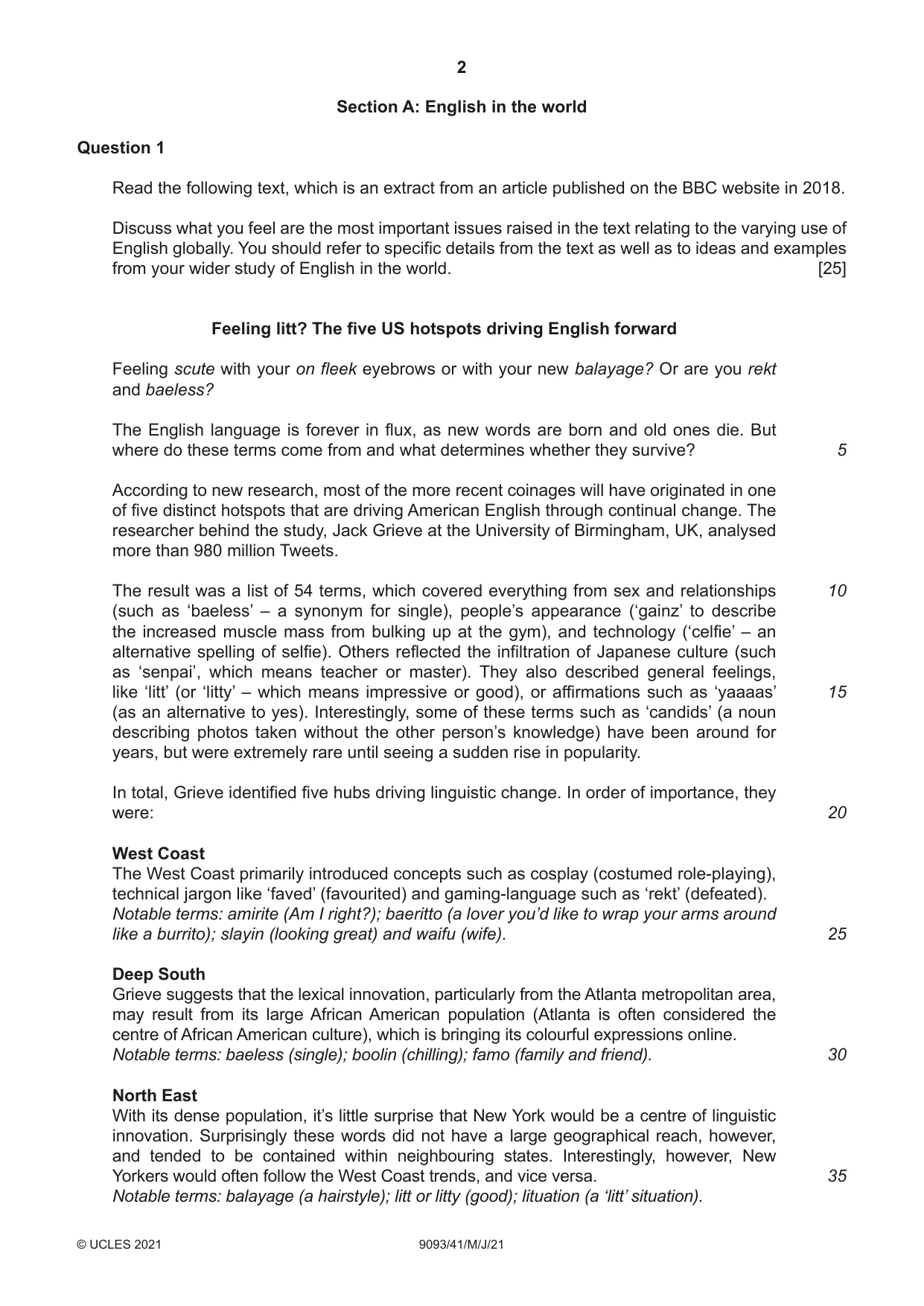
2 9093/41/M/J/21 © UCLES 2021 Section A: English in the world Question 1 Read the following text, which is an extract from an article published on the BBC website in 2018. Discuss what you feel are the most important issues raised in the text relating to the varying use of English globally. You should refer to specific details from the text as well as to ideas and examples from your wider study of English in the world. [25] Feeling litt? The five US hotspots driving English forward Feeling scute with your on fleek eyebrows or with your new balayage? Or are you rekt and baeless? The English language is forever in flux, as new words are born and old ones die. But where do these terms come from and what determines whether they survive? According to new research, most of the more recent coinages will have originated in one of five distinct hotspots that are driving American English through continual change. The researcher behind the study, Jack Grieve at the University of Birmingham, UK, analysed more than 980 million Tweets. The result was a list of 54 terms, which covered everything from sex and relationships (such as ‘baeless’ – a synonym for single), people’s appearance (‘gainz’ to describe the increased muscle mass from bulking up at the gym), and technology (‘celfie’ – an alternative spelling of selfie). Others reflected the infiltration of Japanese culture (such as ‘senpai’, which means teacher or master). They also described general feelings, like ‘litt’ (or ‘litty’ – which means impressive or good), or affirmations such as ‘yaaaas’ (as an alternative to yes). Interestingly, some of these terms such as ‘candids’ (a noun describing photos taken without the other person’s knowledge) have been around for years, but were extremely rare until seeing a sudden rise in popularity. In total, Grieve identified five hubs driving linguistic change. In order of importance, they were: West Coast The West Coast primarily introduced concepts such as cosplay (costumed role-playing), technical jargon like ‘faved’ (favourited) and gaming-language such as ‘rekt’ (defeated). Notable terms: amirite (Am I right?); baeritto (a lover you’d like to wrap your arms around like a burrito); slayin (looking great) and waifu (wife). Deep South Grieve suggests that the lexical innovation, particularly from the Atlanta metropolitan area, may result from its large African American population (Atlanta is often considered the centre of African American culture), which is bringing its colourful expressions online. Notable terms: baeless (single); boolin (chilling); famo (family and friend). North East With its dense population, it’s little surprise that New York would be a centre of linguistic innovation. Surprisingly these words did not have a large geographical reach, however, and tended to be contained within neighbouring states. Interestingly, however, New Yorkers would often follow the West Coast trends, and vice versa. Notable terms: balayage (a hairstyle); litt or litty (good); lituation (a ‘litt’ situation). 5 10 15 20 25 30 35
Question paper, page 3
3 9093/41/M/J/21 © UCLES 2021 [Turn over Mid-Atlantic Once again, the greatest creativity appeared to arise in the regions with the largest African American populations. Notable terms: on fleek (on point/flawlessly styled); shordy (short); wce (woman crush everyday). Gulf Coast One of the region’s most noteworthy contributions – ‘idgt’ (I don’t get tired) – became a catchphrase of the rapper Kevin Gates, who grew up in Baton Rouge, the state capital of Louisiana, and released a single of the same name in 2014. Notable terms: bruuh (bro’); idgt (I don’t get tired); lordt (Oh Lord!). 40 45
Question paper, page 4
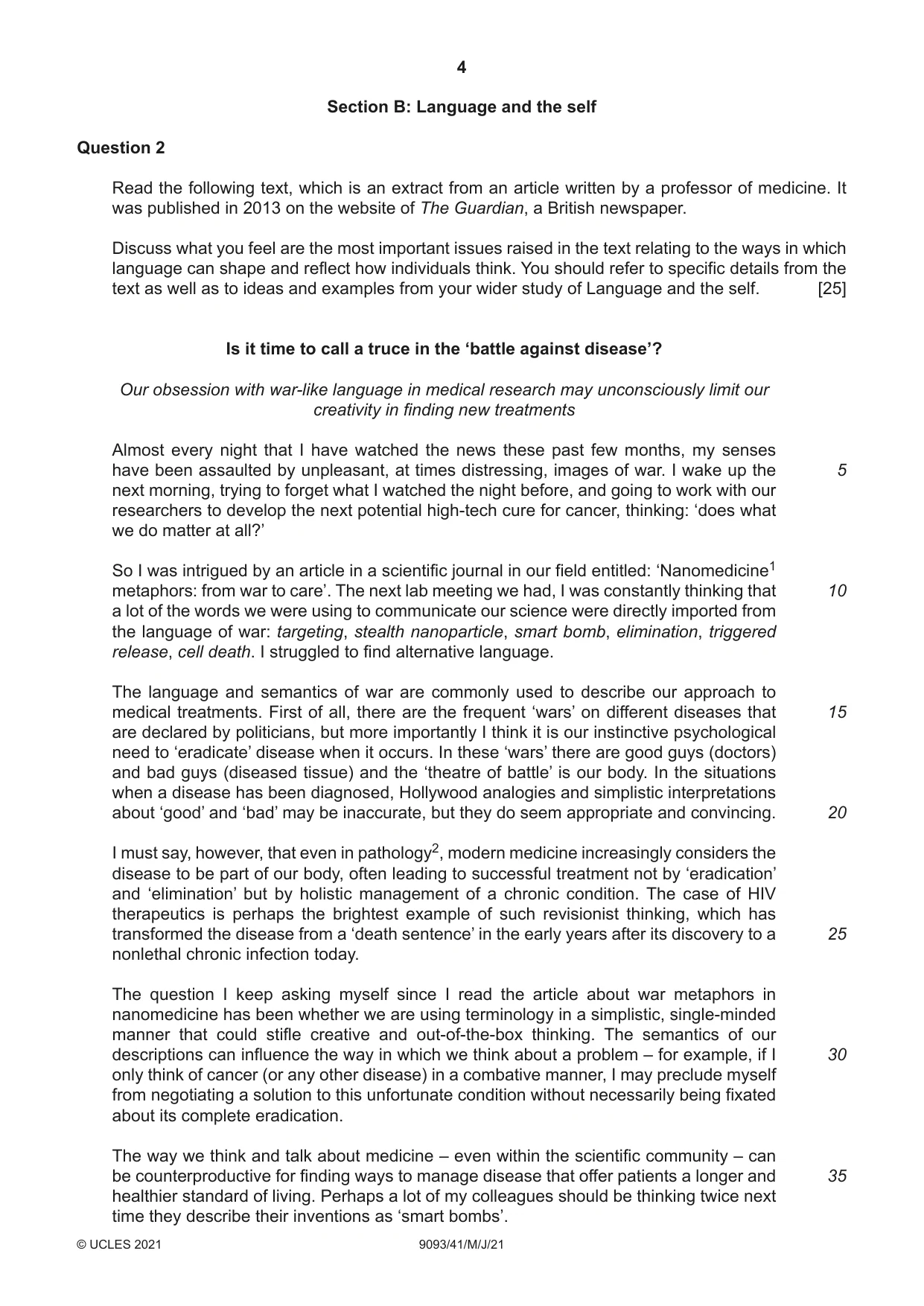
4 9093/41/M/J/21 © UCLES 2021 Section B: Language and the self Question 2 Read the following text, which is an extract from an article written by a professor of medicine. It was published in 2013 on the website of The Guardian, a British newspaper. Discuss what you feel are the most important issues raised in the text relating to the ways in which language can shape and reflect how individuals think. You should refer to specific details from the text as well as to ideas and examples from your wider study of Language and the self. [25] Is it time to call a truce in the ‘battle against disease’? Our obsession with war-like language in medical research may unconsciously limit our creativity in finding new treatments Almost every night that I have watched the news these past few months, my senses have been assaulted by unpleasant, at times distressing, images of war. I wake up the next morning, trying to forget what I watched the night before, and going to work with our researchers to develop the next potential high-tech cure for cancer, thinking: ‘does what we do matter at all?’ So I was intrigued by an article in a scientific journal in our field entitled: ‘Nanomedicine1 metaphors: from war to care’. The next lab meeting we had, I was constantly thinking that a lot of the words we were using to communicate our science were directly imported from the language of war: targeting, stealth nanoparticle, smart bomb, elimination, triggered release, cell death. I struggled to find alternative language. The language and semantics of war are commonly used to describe our approach to medical treatments. First of all, there are the frequent ‘wars’ on different diseases that are declared by politicians, but more importantly I think it is our instinctive psychological need to ‘eradicate’ disease when it occurs. In these ‘wars’ there are good guys (doctors) and bad guys (diseased tissue) and the ‘theatre of battle’ is our body. In the situations when a disease has been diagnosed, Hollywood analogies and simplistic interpretations about ‘good’ and ‘bad’ may be inaccurate, but they do seem appropriate and convincing. I must say, however, that even in pathology2, modern medicine increasingly considers the disease to be part of our body, often leading to successful treatment not by ‘eradication’ and ‘elimination’ but by holistic management of a chronic condition. The case of HIV therapeutics is perhaps the brightest example of such revisionist thinking, which has transformed the disease from a ‘death sentence’ in the early years after its discovery to a nonlethal chronic infection today. The question I keep asking myself since I read the article about war metaphors in nanomedicine has been whether we are using terminology in a simplistic, single-minded manner that could stifle creative and out-of-the-box thinking. The semantics of our descriptions can influence the way in which we think about a problem – for example, if I only think of cancer (or any other disease) in a combative manner, I may preclude myself from negotiating a solution to this unfortunate condition without necessarily being fixated about its complete eradication. The way we think and talk about medicine – even within the scientific community – can be counterproductive for finding ways to manage disease that offer patients a longer and healthier standard of living. Perhaps a lot of my colleagues should be thinking twice next time they describe their inventions as ‘smart bombs’. 5 10 15 20 25 30 35
Question paper, page 5
5 9093/41/M/J/21 © UCLES 2021 Notes: 1 nanomedicine: a specialised form of medicine using extremely small (nano) tools and machines 2 pathology: the science of the causes and effects of diseases
Question paper, page 6
6 9093/41/M/J/21 © UCLES 2021 BLANK PAGE
Question paper, page 7
7 9093/41/M/J/21 © UCLES 2021 BLANK PAGE
Question paper, page 8
8 9093/41/M/J/21 © UCLES 2021 Permission to reproduce items where third-party owned material protected by copyright is included has been sought and cleared where possible. Every reasonable effort has been made by the publisher (UCLES) to trace copyright holders, but if any items requiring clearance have unwittingly been included, the publisher will be pleased to make amends at the earliest possible opportunity. To avoid the issue of disclosure of answer-related information to candidates, all copyright acknowledgements are reproduced online in the Cambridge Assessment International Education Copyright Acknowledgements Booklet. This is produced for each series of examinations and is freely available to download at www.cambridgeinternational.org after the live examination series. Cambridge Assessment International Education is part of the Cambridge Assessment Group. Cambridge Assessment is the brand name of the University of Cambridge Local Examinations Syndicate (UCLES), which itself is a department of the University of Cambridge. BLANK PAGE
Mark scheme, page 1
This document consists of 8 printed pages. © UCLES 2021 [Turn over Cambridge International A Level ENGLISH LANGUAGE 9093/41 Paper 4 Language Topics May/June 2021 MARK SCHEME Maximum Mark: 50 Published This mark scheme is published as an aid to teachers and candidates, to indicate the requirements of the examination. It shows the basis on which Examiners were instructed to award marks. It does not indicate the details of the discussions that took place at an Examiners’ meeting before marking began, which would have considered the acceptability of alternative answers. Mark schemes should be read in conjunction with the question paper and the Principal Examiner Report for Teachers. Cambridge International will not enter into discussions about these mark schemes. Cambridge International is publishing the mark schemes for the May/June 2021 series for most Cambridge IGCSE™, Cambridge International A and AS Level components and some Cambridge O Level components.
Mark scheme, page 2
9093/41 Cambridge International A Level – Mark Scheme PUBLISHED May/June 2021 © UCLES 2021 Page 2 of 8 Generic Marking Principles These general marking principles must be applied by all examiners when marking candidate answers. They should be applied alongside the specific content of the mark scheme or generic level descriptors for a question. Each question paper and mark scheme will also comply with these marking principles. GENERIC MARKING PRINCIPLE 1: Marks must be awarded in line with: • the specific content of the mark scheme or the generic level descriptors for the question • the specific skills defined in the mark scheme or in the generic level descriptors for the question • the standard of response required by a candidate as exemplified by the standardisation scripts. GENERIC MARKING PRINCIPLE 2: Marks awarded are always whole marks (not half marks, or other fractions). GENERIC MARKING PRINCIPLE 3: Marks must be awarded positively: • marks are awarded for correct/valid answers, as defined in the mark scheme. However, credit is given for valid answers which go beyond the scope of the syllabus and mark scheme, referring to your Team Leader as appropriate • marks are awarded when candidates clearly demonstrate what they know and can do • marks are not deducted for errors • marks are not deducted for omissions • answers should only be judged on the quality of spelling, punctuation and grammar when these features are specifically assessed by the question as indicated by the mark scheme. The meaning, however, should be unambiguous. GENERIC MARKING PRINCIPLE 4: Rules must be applied consistently, e.g. in situations where candidates have not followed instructions or in the application of generic level descriptors.
Mark scheme, page 3
9093/41 Cambridge International A Level – Mark Scheme PUBLISHED May/June 2021 © UCLES 2021 Page 3 of 8 GENERIC MARKING PRINCIPLE 5: Marks should be awarded using the full range of marks defined in the mark scheme for the question (however; the use of the full mark range may be limited according to the quality of the candidate responses seen). GENERIC MARKING PRINCIPLE 6: Marks awarded are based solely on the requirements as defined in the mark scheme. Marks should not be awarded with grade thresholds or grade descriptors in mind. English & Media subject specific general marking principles (To be read in conjunction with the Generic Marking Principles (and requiring further guidance on how to place marks within levels)) Components using level descriptors: • We use level descriptors as a guide to broad understanding of the qualities normally expected of, or typical of, work in a level. • Level descriptors are a means of general guidance, and should not be interpreted as hurdle statements. • Where indicative content notes are supplied for a question, these are not a prescription of required content, and must not be treated as such. Alternative correct points and unexpected answers in candidates’ scripts must be given marks that fairly reflect the knowledge and skills demonstrated. • While we may have legitimate expectations as to the ground most answers may occupy, we must at all times be prepared to meet candidates on their chosen ground, provided it is relevant ground (e.g. clearly related to and derived from a relevant passage/text and meeting the mark scheme requirements for the question).
Mark scheme, page 4
9093/41 Cambridge International A Level – Mark Scheme PUBLISHED May/June 2021 © UCLES 2021 Page 4 of 8 English Language specific marking instructions: AO1 Read and demonstrate understanding of a wide variety of texts. (Understanding) • Marks should be awarded for the accuracy of the candidate’s understanding of the text and its features, not for any analysis of them which is recognised under AO3. • Where comparison is required, marks should be awarded for the candidate’s recognition of similarities and differences between the texts and their features, not for any consequent analysis. • When awarding a ‘best-fit’ mark within a Level for each AO, consider each bullet point equally. AO2 Write effectively, creatively, accurately and appropriately, for a range of audiences and purposes. (Writing) • Marks should be awarded equally on the basis of the level of the candidate’s written expression (range of features used and accuracy) and the development of their writing (its organisation and relevance to task and audience). • When awarding a ‘best-fit’ mark within a Level for each AO, consider each bullet point equally. AO4: Demonstrate understanding of linguistic issues, concepts, methods and approaches. (Conceptualisation) • Marks should be awarded equally on the basis of the level of the candidate’s understanding of the relevant issues, concepts, methods and approaches represented both in the text(s) and in their wider studies. • When awarding a ‘best-fit’ mark within a Level for each AO, consider each bullet point equally.
Mark scheme, page 5
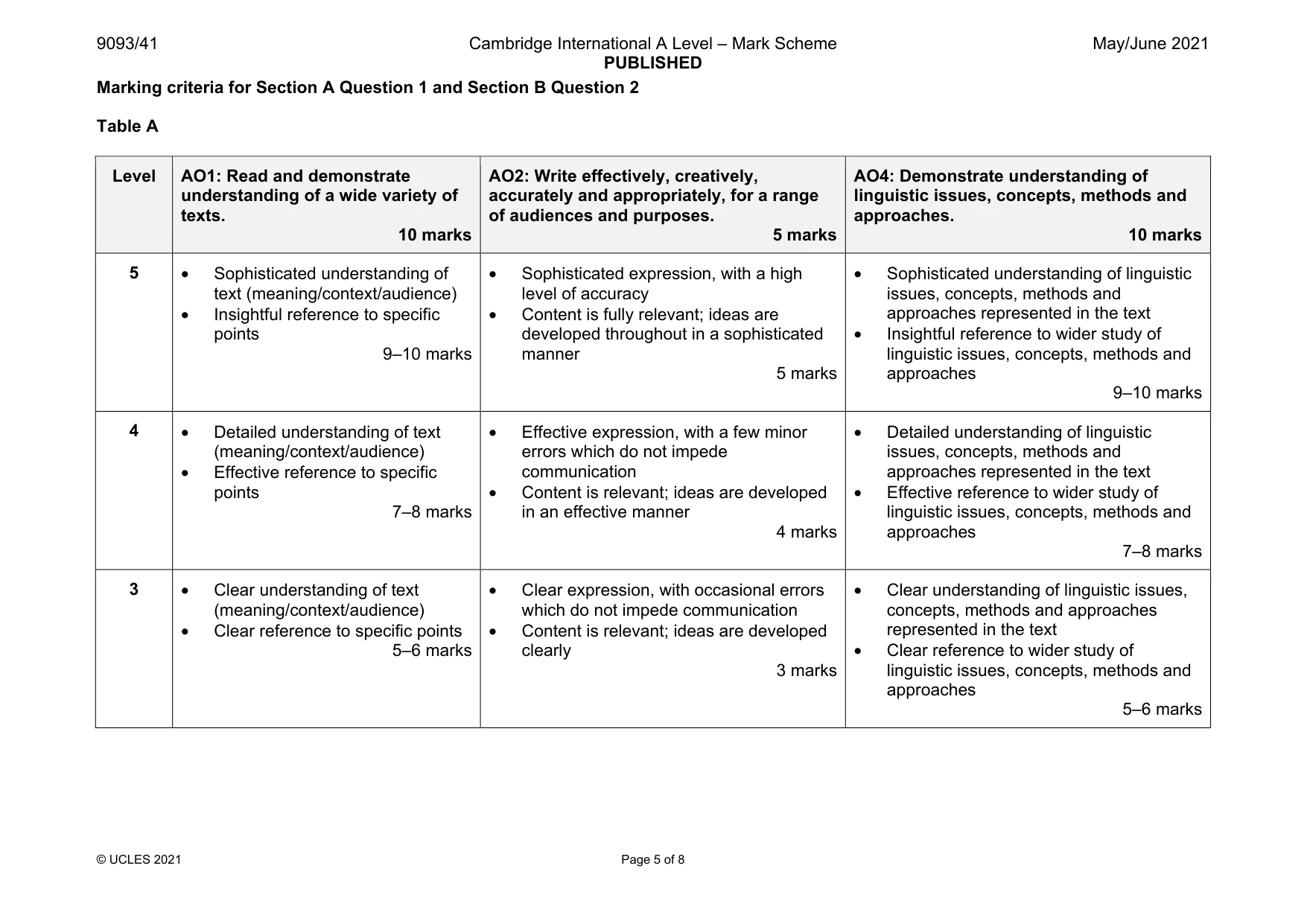
9093/41 Cambridge International A Level – Mark Scheme PUBLISHED May/June 2021 © UCLES 2021 Page 5 of 8 Marking criteria for Section A Question 1 and Section B Question 2 Table A Level AO1: Read and demonstrate understanding of a wide variety of texts. 10 marks AO2: Write effectively, creatively, accurately and appropriately, for a range of audiences and purposes. 5 marks AO4: Demonstrate understanding of linguistic issues, concepts, methods and approaches. 10 marks 5 • Sophisticated understanding of text (meaning/context/audience) • Insightful reference to specific points 9–10 marks • Sophisticated expression, with a high level of accuracy • Content is fully relevant; ideas are developed throughout in a sophisticated manner 5 marks • Sophisticated understanding of linguistic issues, concepts, methods and approaches represented in the text • Insightful reference to wider study of linguistic issues, concepts, methods and approaches 9–10 marks 4 • Detailed understanding of text (meaning/context/audience) • Effective reference to specific points 7–8 marks • Effective expression, with a few minor errors which do not impede communication • Content is relevant; ideas are developed in an effective manner 4 marks • Detailed understanding of linguistic issues, concepts, methods and approaches represented in the text • Effective reference to wider study of linguistic issues, concepts, methods and approaches 7–8 marks 3 • Clear understanding of text (meaning/context/audience) • Clear reference to specific points 5–6 marks • Clear expression, with occasional errors which do not impede communication • Content is relevant; ideas are developed clearly 3 marks • Clear understanding of linguistic issues, concepts, methods and approaches represented in the text • Clear reference to wider study of linguistic issues, concepts, methods and approaches 5–6 marks
Mark scheme, page 6
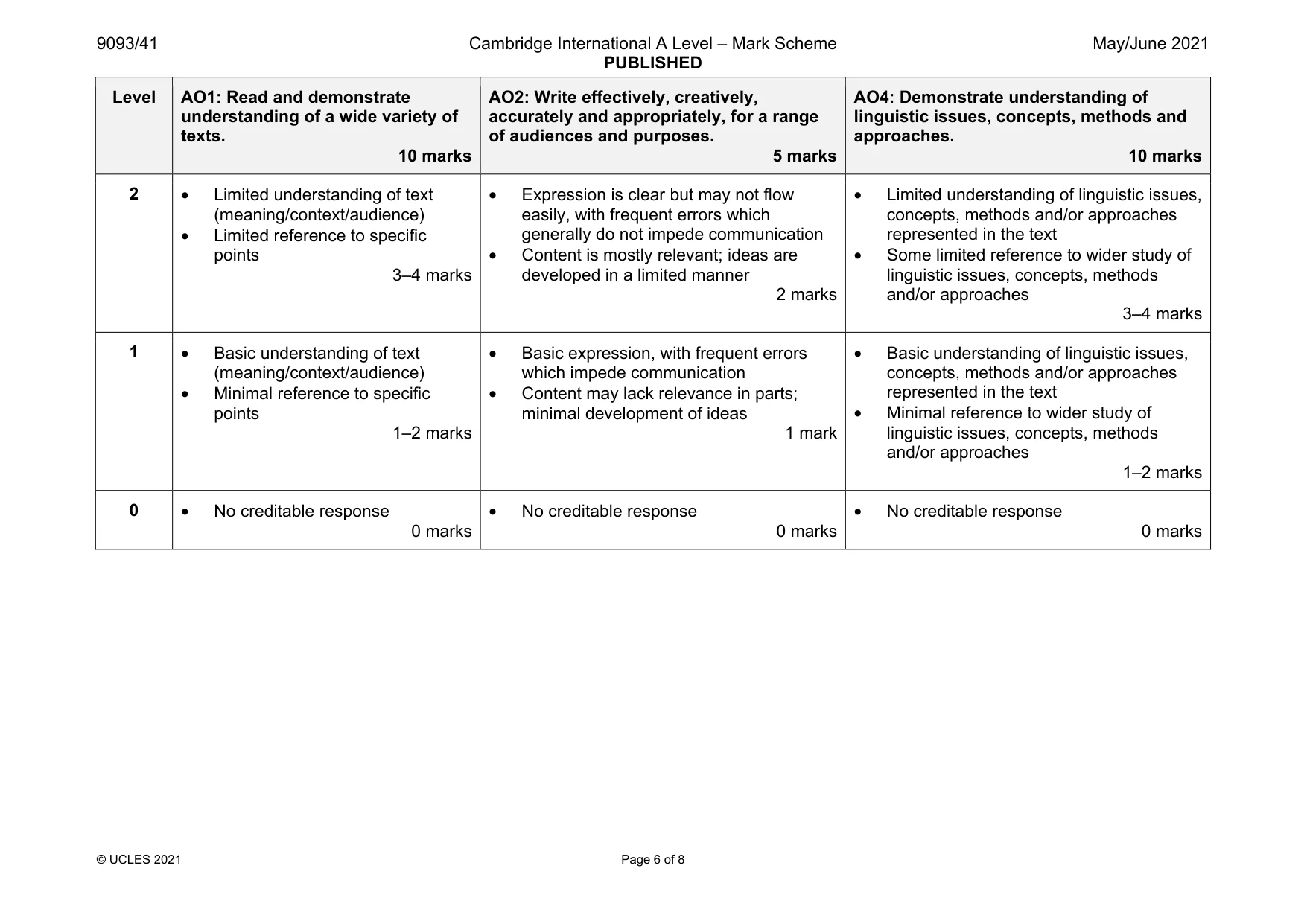
9093/41 Cambridge International A Level – Mark Scheme PUBLISHED May/June 2021 © UCLES 2021 Page 6 of 8 Level AO1: Read and demonstrate understanding of a wide variety of texts. 10 marks AO2: Write effectively, creatively, accurately and appropriately, for a range of audiences and purposes. 5 marks AO4: Demonstrate understanding of linguistic issues, concepts, methods and approaches. 10 marks 2 • Limited understanding of text (meaning/context/audience) • Limited reference to specific points 3–4 marks • Expression is clear but may not flow easily, with frequent errors which generally do not impede communication • Content is mostly relevant; ideas are developed in a limited manner 2 marks • Limited understanding of linguistic issues, concepts, methods and/or approaches represented in the text • Some limited reference to wider study of linguistic issues, concepts, methods and/or approaches 3–4 marks 1 • Basic understanding of text (meaning/context/audience) • Minimal reference to specific points 1–2 marks • Basic expression, with frequent errors which impede communication • Content may lack relevance in parts; minimal development of ideas 1 mark • Basic understanding of linguistic issues, concepts, methods and/or approaches represented in the text • Minimal reference to wider study of linguistic issues, concepts, methods and/or approaches 1–2 marks 0 • No creditable response 0 marks • No creditable response 0 marks • No creditable response 0 marks
Mark scheme, page 7
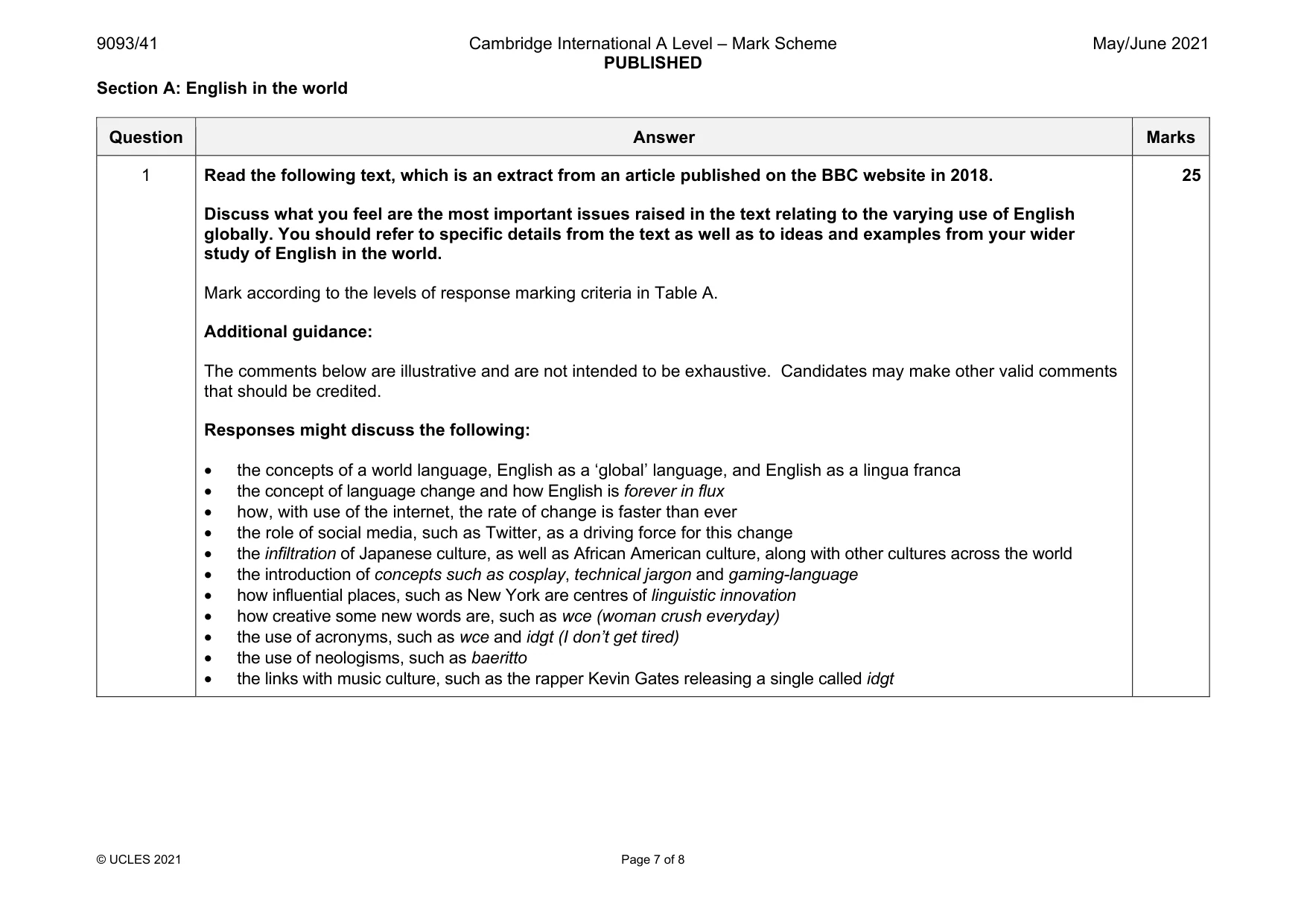
9093/41 Cambridge International A Level – Mark Scheme PUBLISHED May/June 2021 © UCLES 2021 Page 7 of 8 Section A: English in the world Question Answer Marks 1 Read the following text, which is an extract from an article published on the BBC website in 2018. Discuss what you feel are the most important issues raised in the text relating to the varying use of English globally. You should refer to specific details from the text as well as to ideas and examples from your wider study of English in the world. Mark according to the levels of response marking criteria in Table A. Additional guidance: The comments below are illustrative and are not intended to be exhaustive. Candidates may make other valid comments that should be credited. Responses might discuss the following: • the concepts of a world language, English as a ‘global’ language, and English as a lingua franca • the concept of language change and how English is forever in flux • how, with use of the internet, the rate of change is faster than ever • the role of social media, such as Twitter, as a driving force for this change • the infiltration of Japanese culture, as well as African American culture, along with other cultures across the world • the introduction of concepts such as cosplay, technical jargon and gaming-language • how influential places, such as New York are centres of linguistic innovation • how creative some new words are, such as wce (woman crush everyday) • the use of acronyms, such as wce and idgt (I don’t get tired) • the use of neologisms, such as baeritto • the links with music culture, such as the rapper Kevin Gates releasing a single called idgt 25
Mark scheme, page 8
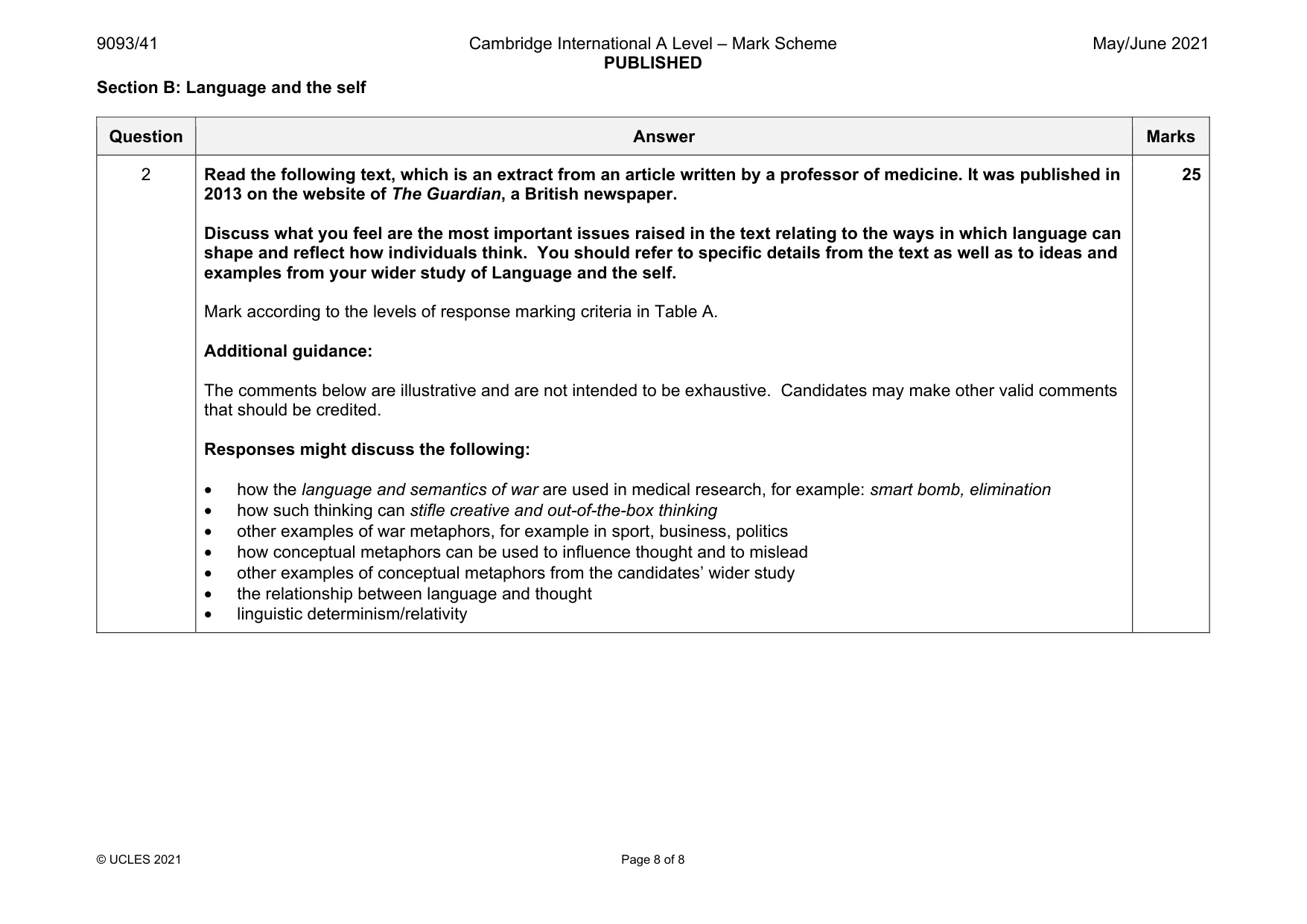
9093/41 Cambridge International A Level – Mark Scheme PUBLISHED May/June 2021 © UCLES 2021 Page 8 of 8 Section B: Language and the self Question Answer Marks 2 Read the following text, which is an extract from an article written by a professor of medicine. It was published in 2013 on the website of The Guardian, a British newspaper. Discuss what you feel are the most important issues raised in the text relating to the ways in which language can shape and reflect how individuals think. You should refer to specific details from the text as well as to ideas and examples from your wider study of Language and the self. Mark according to the levels of response marking criteria in Table A. Additional guidance: The comments below are illustrative and are not intended to be exhaustive. Candidates may make other valid comments that should be credited. Responses might discuss the following: • how the language and semantics of war are used in medical research, for example: smart bomb, elimination • how such thinking can stifle creative and out-of-the-box thinking • other examples of war metaphors, for example in sport, business, politics • how conceptual metaphors can be used to influence thought and to mislead • other examples of conceptual metaphors from the candidates’ wider study • the relationship between language and thought • linguistic determinism/relativity 25
What you needed in this session
Cambridge’s own grade thresholds for 2021 May/June, Paper 4 · Variant 1. A higher threshold means an easier paper — the bar moves with how the cohort did.