Cambridge A Level English - Language AS and A Level (from 2014) 9093 — 2018 Oct/Nov Paper 4 · Variant 1
9093/41/O/N/18 · 50 marks · ≈56 min
The question paper and its mark scheme, free to read here and free to download. This is Cambridge’s own paper, exactly as it was sat.
Question paper8 pages


Mark scheme8 pages
Answers below. Sit the paper first if you are practising.
Paper as text
Question paper, page 1
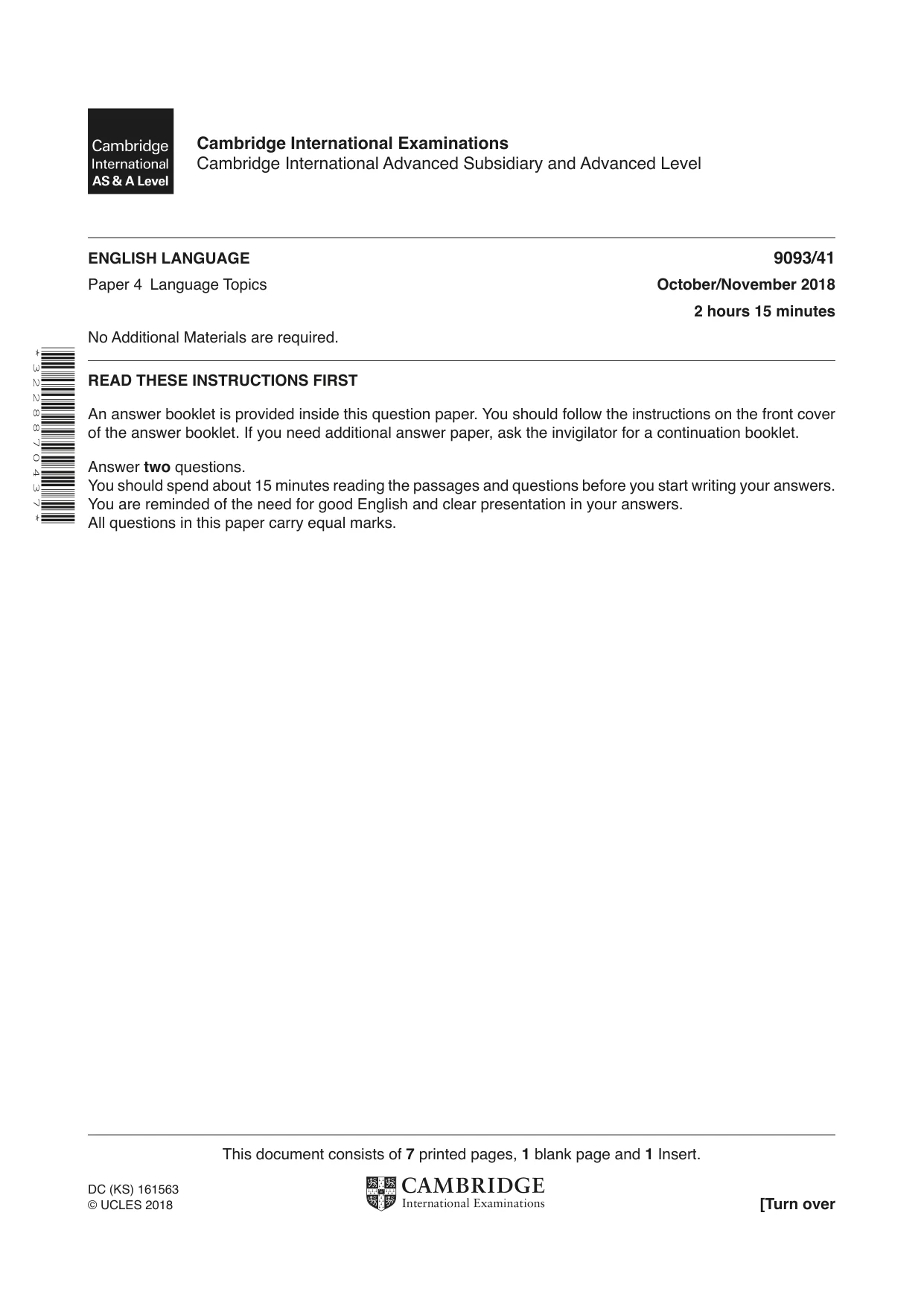
This document consists of 7 printed pages, 1 blank page and 1 Insert. DC (KS) 161563 © UCLES 2018 [Turn over Cambridge International Examinations Cambridge International Advanced Subsidiary and Advanced Level * 3 2 2 8 8 7 0 4 3 7 * ENGLISH LANGUAGE 9093/41 Paper 4 Language Topics October/November 2018 2 hours 15 minutes No Additional Materials are required. READ THESE INSTRUCTIONS FIRST An answer booklet is provided inside this question paper. You should follow the instructions on the front cover of the answer booklet. If you need additional answer paper, ask the invigilator for a continuation booklet. Answer two questions. You should spend about 15 minutes reading the passages and questions before you start writing your answers. You are reminded of the need for good English and clear presentation in your answers. All questions in this paper carry equal marks.
Question paper, page 2
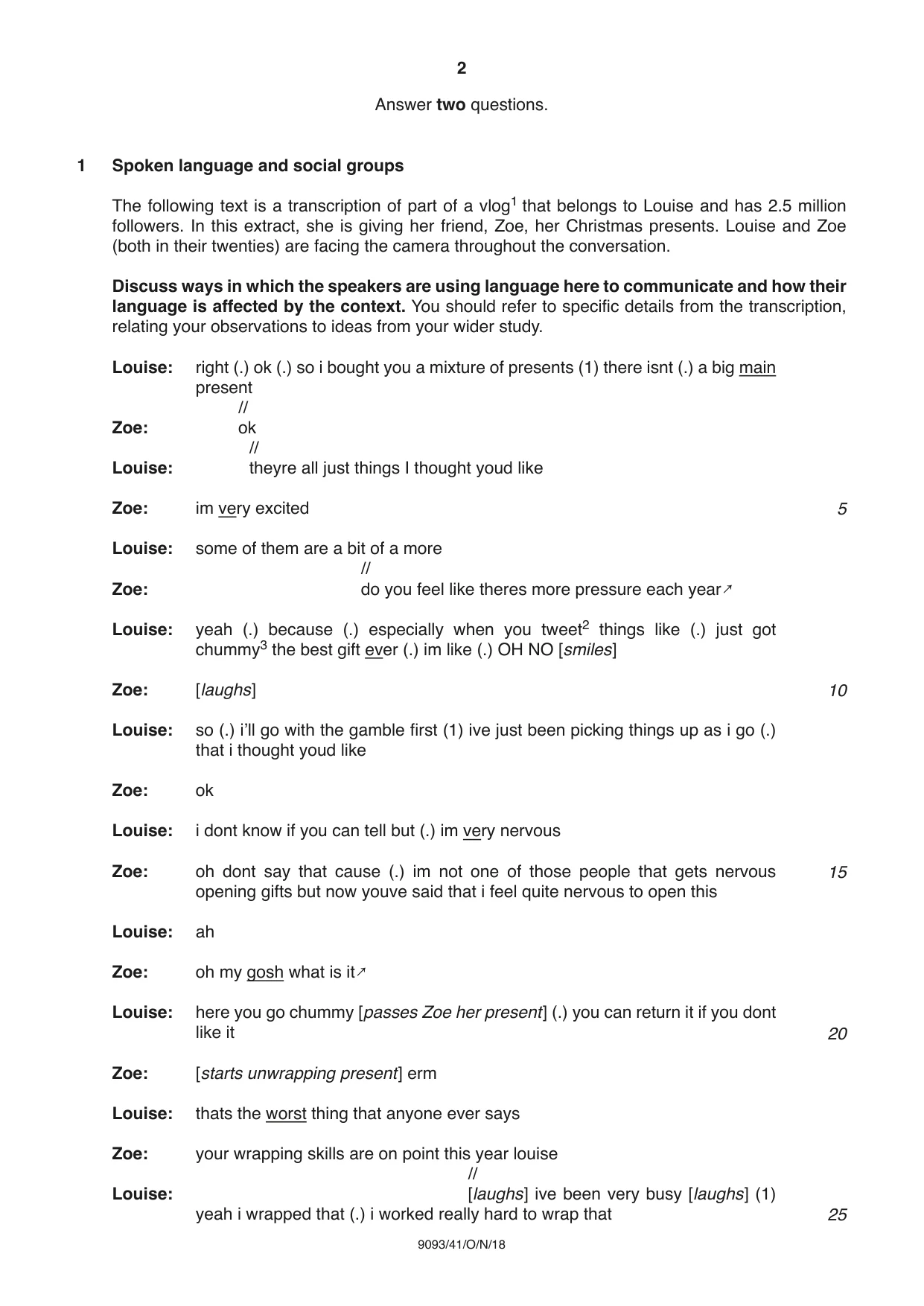
2 9093/41/O/N/18 Answer two questions. 1 Spoken language and social groups The following text is a transcription of part of a vlog1 that belongs to Louise and has 2.5 million followers. In this extract, she is giving her friend, Zoe, her Christmas presents. Louise and Zoe (both in their twenties) are facing the camera throughout the conversation. Discuss ways in which the speakers are using language here to communicate and how their language is affected by the context. You should refer to specific details from the transcription, relating your observations to ideas from your wider study. Louise: right (.) ok (.) so i bought you a mixture of presents (1) there isnt (.) a big main present // Zoe: ok // Louise: theyre all just things I thought youd like Zoe: im very excited Louise: some of them are a bit of a more // Zoe: do you feel like theres more pressure each year↗ Louise: yeah (.) because (.) especially when you tweet2 things like (.) just got chummy3 the best gift ever (.) im like (.) OH NO [smiles] Zoe: [laughs] Louise: so (.) i’ll go with the gamble first (1) ive just been picking things up as i go (.) that i thought youd like Zoe: ok Louise: i dont know if you can tell but (.) im very nervous Zoe: oh dont say that cause (.) im not one of those people that gets nervous opening gifts but now youve said that i feel quite nervous to open this Louise: ah Zoe: oh my gosh what is it↗ Louise: here you go chummy [passes Zoe her present] (.) you can return it if you dont like it Zoe: [starts unwrapping present] erm Louise: thats the worst thing that anyone ever says Zoe: your wrapping skills are on point this year louise // Louise: [laughs] ive been very busy [laughs] (1) yeah i wrapped that (.) i worked really hard to wrap that 5 10 15 20 25
Question paper, page 3
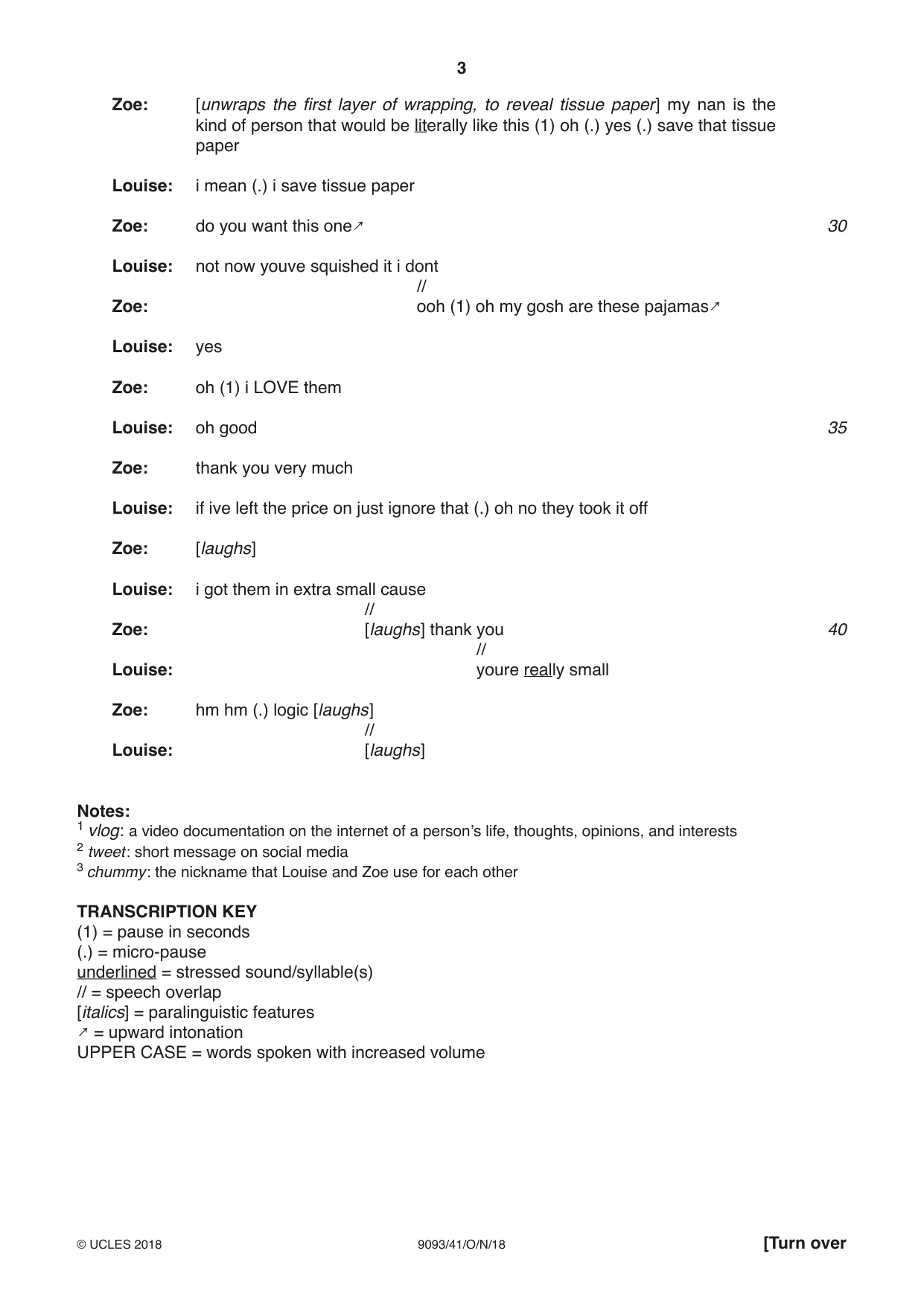
3 9093/41/O/N/18 © UCLES 2018 [Turn over Zoe: [unwraps the first layer of wrapping, to reveal tissue paper] my nan is the kind of person that would be literally like this (1) oh (.) yes (.) save that tissue paper Louise: i mean (.) i save tissue paper Zoe: do you want this one↗ Louise: not now youve squished it i dont // Zoe: ooh (1) oh my gosh are these pajamas↗ Louise: yes Zoe: oh (1) i LOVE them Louise: oh good Zoe: thank you very much Louise: if ive left the price on just ignore that (.) oh no they took it off Zoe: [laughs] Louise: i got them in extra small cause // Zoe: [laughs] thank you // Louise: youre really small Zoe: hm hm (.) logic [laughs] // Louise: [laughs] Notes: 1 vlog: a video documentation on the internet of a person’s life, thoughts, opinions, and interests 2 tweet: short message on social media 3 chummy: the nickname that Louise and Zoe use for each other TRANSCRIPTION KEY (1) = pause in seconds (.) = micro-pause underlined = stressed sound/syllable(s) // = speech overlap [italics] = paralinguistic features ↗ = upward intonation UPPER CASE = words spoken with increased volume 30 35 40
Question paper, page 4
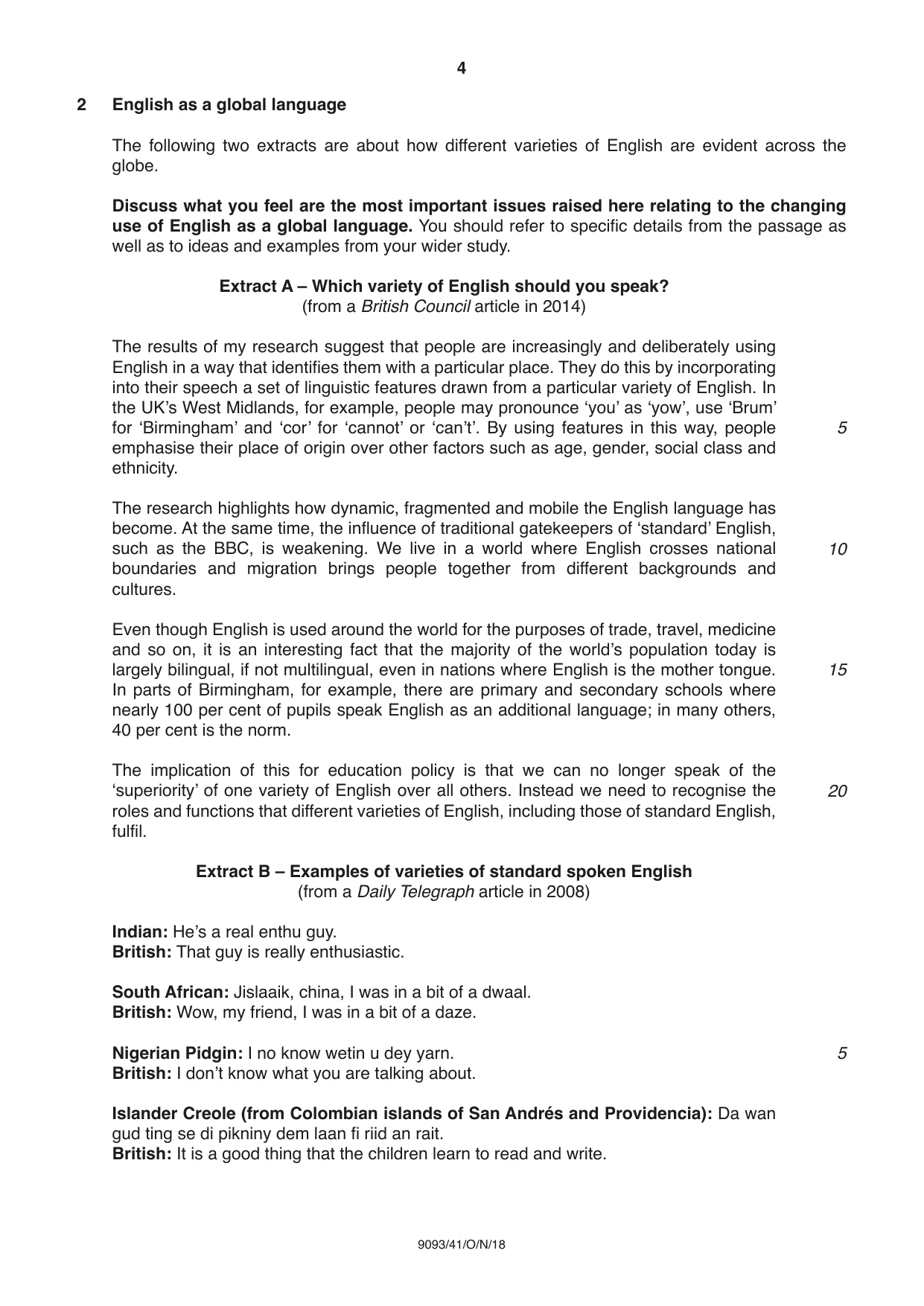
4 9093/41/O/N/18 2 English as a global language The following two extracts are about how different varieties of English are evident across the globe. Discuss what you feel are the most important issues raised here relating to the changing use of English as a global language. You should refer to specific details from the passage as well as to ideas and examples from your wider study. Extract A – Which variety of English should you speak? (from a British Council article in 2014) The results of my research suggest that people are increasingly and deliberately using English in a way that identifies them with a particular place. They do this by incorporating into their speech a set of linguistic features drawn from a particular variety of English. In the UK’s West Midlands, for example, people may pronounce ‘you’ as ‘yow’, use ‘Brum’ for ‘Birmingham’ and ‘cor’ for ‘cannot’ or ‘can’t’. By using features in this way, people emphasise their place of origin over other factors such as age, gender, social class and ethnicity. The research highlights how dynamic, fragmented and mobile the English language has become. At the same time, the influence of traditional gatekeepers of ‘standard’ English, such as the BBC, is weakening. We live in a world where English crosses national boundaries and migration brings people together from different backgrounds and cultures. Even though English is used around the world for the purposes of trade, travel, medicine and so on, it is an interesting fact that the majority of the world’s population today is largely bilingual, if not multilingual, even in nations where English is the mother tongue. In parts of Birmingham, for example, there are primary and secondary schools where nearly 100 per cent of pupils speak English as an additional language; in many others, 40 per cent is the norm. The implication of this for education policy is that we can no longer speak of the ‘superiority’ of one variety of English over all others. Instead we need to recognise the roles and functions that different varieties of English, including those of standard English, fulfil. Extract B – Examples of varieties of standard spoken English (from a Daily Telegraph article in 2008) Indian: He’s a real enthu guy. British: That guy is really enthusiastic. South African: Jislaaik, china, I was in a bit of a dwaal. British: Wow, my friend, I was in a bit of a daze. Nigerian Pidgin: I no know wetin u dey yarn. British: I don’t know what you are talking about. Islander Creole (from Colombian islands of San Andrés and Providencia): Da wan gud ting se di pikniny dem laan fi riid an rait. British: It is a good thing that the children learn to read and write. 5 10 15 20 5
Question paper, page 5
5 9093/41/O/N/18 © UCLES 2018 [Turn over TURN OVER FOR QUESTION 3.
Question paper, page 6
6 9093/41/O/N/18 3 Language acquisition by children and teenagers The following text is a transcription of two extracts from a conversation between Nathan (4 years 3 months) and his mother. She is showing him photographs of people with different occupations and asking him about them. Discuss ways in which Nathan and his mother are using language here. You should refer to specific details from the transcription, relating your observations to ideas from your studies of language acquisition. Extract A Mother: oh look at this one Content removed due to copyright restrictions
Question paper, page 7
9093/41/O/N/18 © UCLES 2018 7 Mother: just always two to help each other TRANSCRIPTION KEY (1) = pause in seconds (.) = micro-pause underlined = stressed sound/syllable(s) // = speech overlap [italics] = paralinguistic features ↗ = upward intonation Content removed due to copyright restrictions
Question paper, page 8
8 9093/41/O/N/18 BLANK PAGE Permission to reproduce items where third-party owned material protected by copyright is included has been sought and cleared where possible. Every reasonable effort has been made by the publisher (UCLES) to trace copyright holders, but if any items requiring clearance have unwittingly been included, the publisher will be pleased to make amends at the earliest possible opportunity. To avoid the issue of disclosure of answer-related information to candidates, all copyright acknowledgements are reproduced online in the Cambridge International Examinations Copyright Acknowledgements Booklet. This is produced for each series of examinations and is freely available to download at www.cie.org.uk after the live examination series. Cambridge International Examinations is part of the Cambridge Assessment Group. Cambridge Assessment is the brand name of University of Cambridge Local Examinations Syndicate (UCLES), which is itself a department of the University of Cambridge.
Mark scheme, page 1
This document consists of 8 printed pages. © UCLES 2018 [Turn over Cambridge Assessment International Education Cambridge International Advanced Level ENGLISH LANGUAGE 9093/41 Paper 4 Language Topics October/November 2018 MARK SCHEME Maximum Mark: 50 Published This mark scheme is published as an aid to teachers and candidates, to indicate the requirements of the examination. It shows the basis on which Examiners were instructed to award marks. It does not indicate the details of the discussions that took place at an Examiners’ meeting before marking began, which would have considered the acceptability of alternative answers. Mark schemes should be read in conjunction with the question paper and the Principal Examiner Report for Teachers. Cambridge International will not enter into discussions about these mark schemes. Cambridge International is publishing the mark schemes for the October/November 2018 series for most Cambridge IGCSE™, Cambridge International A and AS Level components and some Cambridge O Level components.
Mark scheme, page 2
9093/41 Cambridge International A Level – Mark Scheme PUBLISHED October/November 2018 © UCLES 2018 Page 2 of 8 Generic Marking Principles These general marking principles must be applied by all examiners when marking candidate answers. They should be applied alongside the specific content of the mark scheme or generic level descriptors for a question. Each question paper and mark scheme will also comply with these marking principles. GENERIC MARKING PRINCIPLE 1: Marks must be awarded in line with: • the specific content of the mark scheme or the generic level descriptors for the question • the specific skills defined in the mark scheme or in the generic level descriptors for the question • the standard of response required by a candidate as exemplified by the standardisation scripts. GENERIC MARKING PRINCIPLE 2: Marks awarded are always whole marks (not half marks, or other fractions). GENERIC MARKING PRINCIPLE 3: Marks must be awarded positively: • marks are awarded for correct/valid answers, as defined in the mark scheme. However, credit is given for valid answers which go beyond the scope of the syllabus and mark scheme, referring to your Team Leader as appropriate • marks are awarded when candidates clearly demonstrate what they know and can do • marks are not deducted for errors • marks are not deducted for omissions • answers should only be judged on the quality of spelling, punctuation and grammar when these features are specifically assessed by the question as indicated by the mark scheme. The meaning, however, should be unambiguous. GENERIC MARKING PRINCIPLE 4: Rules must be applied consistently e.g. in situations where candidates have not followed instructions or in the application of generic level descriptors. GENERIC MARKING PRINCIPLE 5: Marks should be awarded using the full range of marks defined in the mark scheme for the question (however; the use of the full mark range may be limited according to the quality of the candidate responses seen). GENERIC MARKING PRINCIPLE 6: Marks awarded are based solely on the requirements as defined in the mark scheme. Marks should not be awarded with grade thresholds or grade descriptors in mind.
Mark scheme, page 3
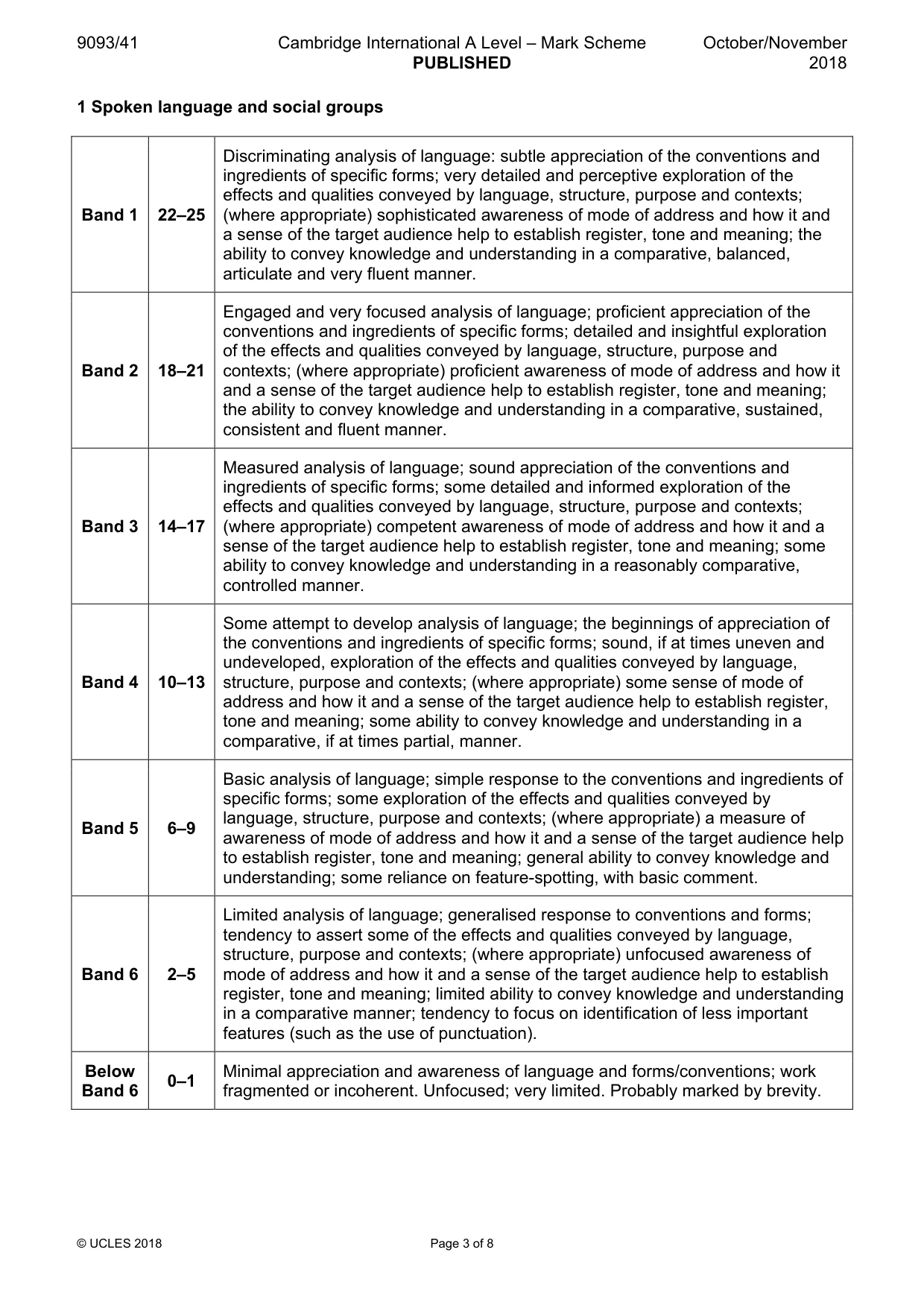
9093/41 Cambridge International A Level – Mark Scheme PUBLISHED October/November 2018 © UCLES 2018 Page 3 of 8 1 Spoken language and social groups Band 1 22–25 Discriminating analysis of language: subtle appreciation of the conventions and ingredients of specific forms; very detailed and perceptive exploration of the effects and qualities conveyed by language, structure, purpose and contexts; (where appropriate) sophisticated awareness of mode of address and how it and a sense of the target audience help to establish register, tone and meaning; the ability to convey knowledge and understanding in a comparative, balanced, articulate and very fluent manner. Band 2 18–21 Engaged and very focused analysis of language; proficient appreciation of the conventions and ingredients of specific forms; detailed and insightful exploration of the effects and qualities conveyed by language, structure, purpose and contexts; (where appropriate) proficient awareness of mode of address and how it and a sense of the target audience help to establish register, tone and meaning; the ability to convey knowledge and understanding in a comparative, sustained, consistent and fluent manner. Band 3 14–17 Measured analysis of language; sound appreciation of the conventions and ingredients of specific forms; some detailed and informed exploration of the effects and qualities conveyed by language, structure, purpose and contexts; (where appropriate) competent awareness of mode of address and how it and a sense of the target audience help to establish register, tone and meaning; some ability to convey knowledge and understanding in a reasonably comparative, controlled manner. Band 4 10–13 Some attempt to develop analysis of language; the beginnings of appreciation of the conventions and ingredients of specific forms; sound, if at times uneven and undeveloped, exploration of the effects and qualities conveyed by language, structure, purpose and contexts; (where appropriate) some sense of mode of address and how it and a sense of the target audience help to establish register, tone and meaning; some ability to convey knowledge and understanding in a comparative, if at times partial, manner. Band 5 6–9 Basic analysis of language; simple response to the conventions and ingredients of specific forms; some exploration of the effects and qualities conveyed by language, structure, purpose and contexts; (where appropriate) a measure of awareness of mode of address and how it and a sense of the target audience help to establish register, tone and meaning; general ability to convey knowledge and understanding; some reliance on feature-spotting, with basic comment. Band 6 2–5 Limited analysis of language; generalised response to conventions and forms; tendency to assert some of the effects and qualities conveyed by language, structure, purpose and contexts; (where appropriate) unfocused awareness of mode of address and how it and a sense of the target audience help to establish register, tone and meaning; limited ability to convey knowledge and understanding in a comparative manner; tendency to focus on identification of less important features (such as the use of punctuation). Below Band 6 0–1 Minimal appreciation and awareness of language and forms/conventions; work fragmented or incoherent. Unfocused; very limited. Probably marked by brevity.
Mark scheme, page 4
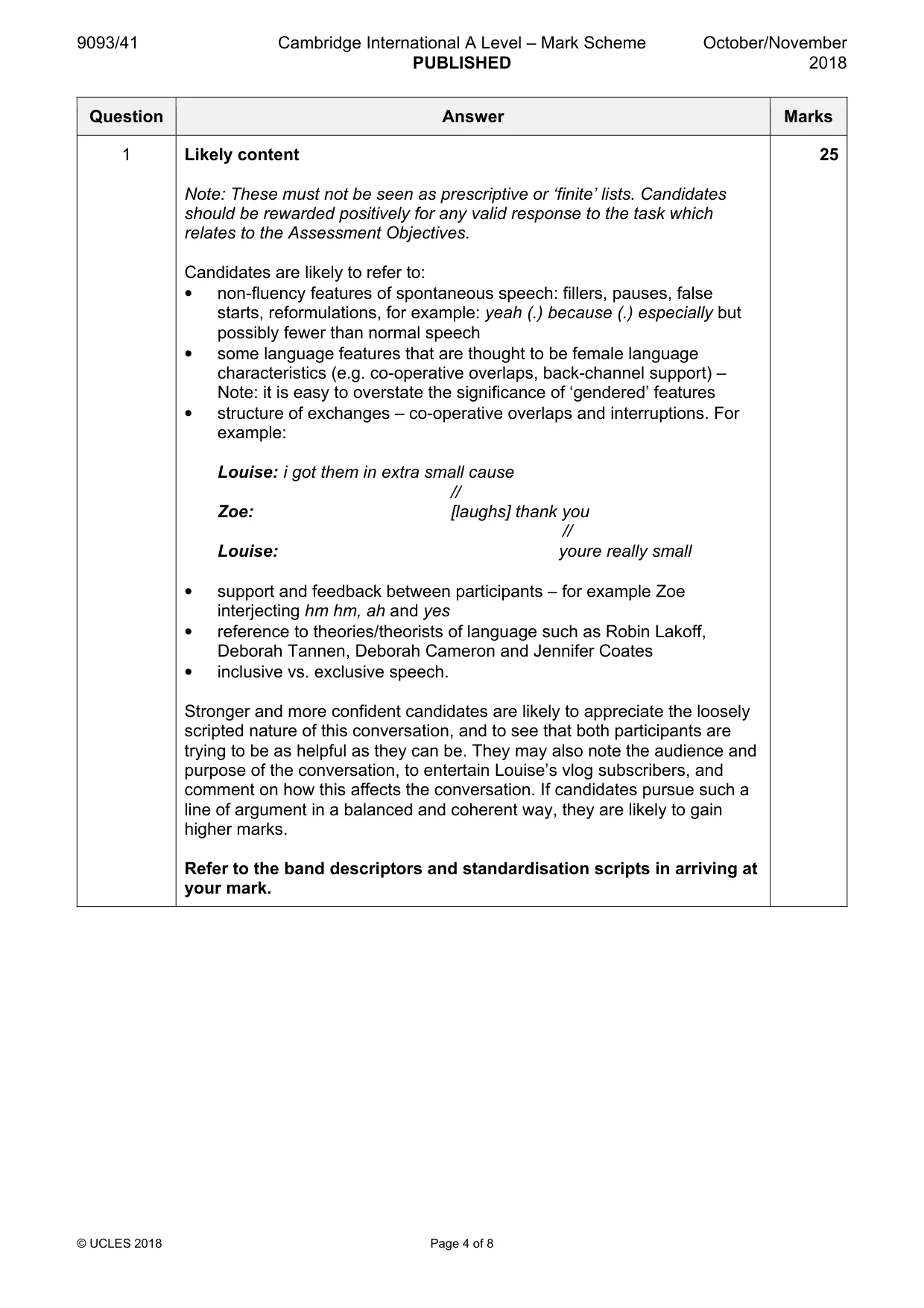
9093/41 Cambridge International A Level – Mark Scheme PUBLISHED October/November 2018 © UCLES 2018 Page 4 of 8 Question Answer Marks 1 Likely content Note: These must not be seen as prescriptive or ‘finite’ lists. Candidates should be rewarded positively for any valid response to the task which relates to the Assessment Objectives. Candidates are likely to refer to: • non-fluency features of spontaneous speech: fillers, pauses, false starts, reformulations, for example: yeah (.) because (.) especially but possibly fewer than normal speech • some language features that are thought to be female language characteristics (e.g. co-operative overlaps, back-channel support) – Note: it is easy to overstate the significance of ‘gendered’ features • structure of exchanges – co-operative overlaps and interruptions. For example: Louise: i got them in extra small cause // Zoe: [laughs] thank you // Louise: youre really small • support and feedback between participants – for example Zoe interjecting hm hm, ah and yes • reference to theories/theorists of language such as Robin Lakoff, Deborah Tannen, Deborah Cameron and Jennifer Coates • inclusive vs. exclusive speech. Stronger and more confident candidates are likely to appreciate the loosely scripted nature of this conversation, and to see that both participants are trying to be as helpful as they can be. They may also note the audience and purpose of the conversation, to entertain Louise’s vlog subscribers, and comment on how this affects the conversation. If candidates pursue such a line of argument in a balanced and coherent way, they are likely to gain higher marks. Refer to the band descriptors and standardisation scripts in arriving at your mark. 25
Mark scheme, page 5
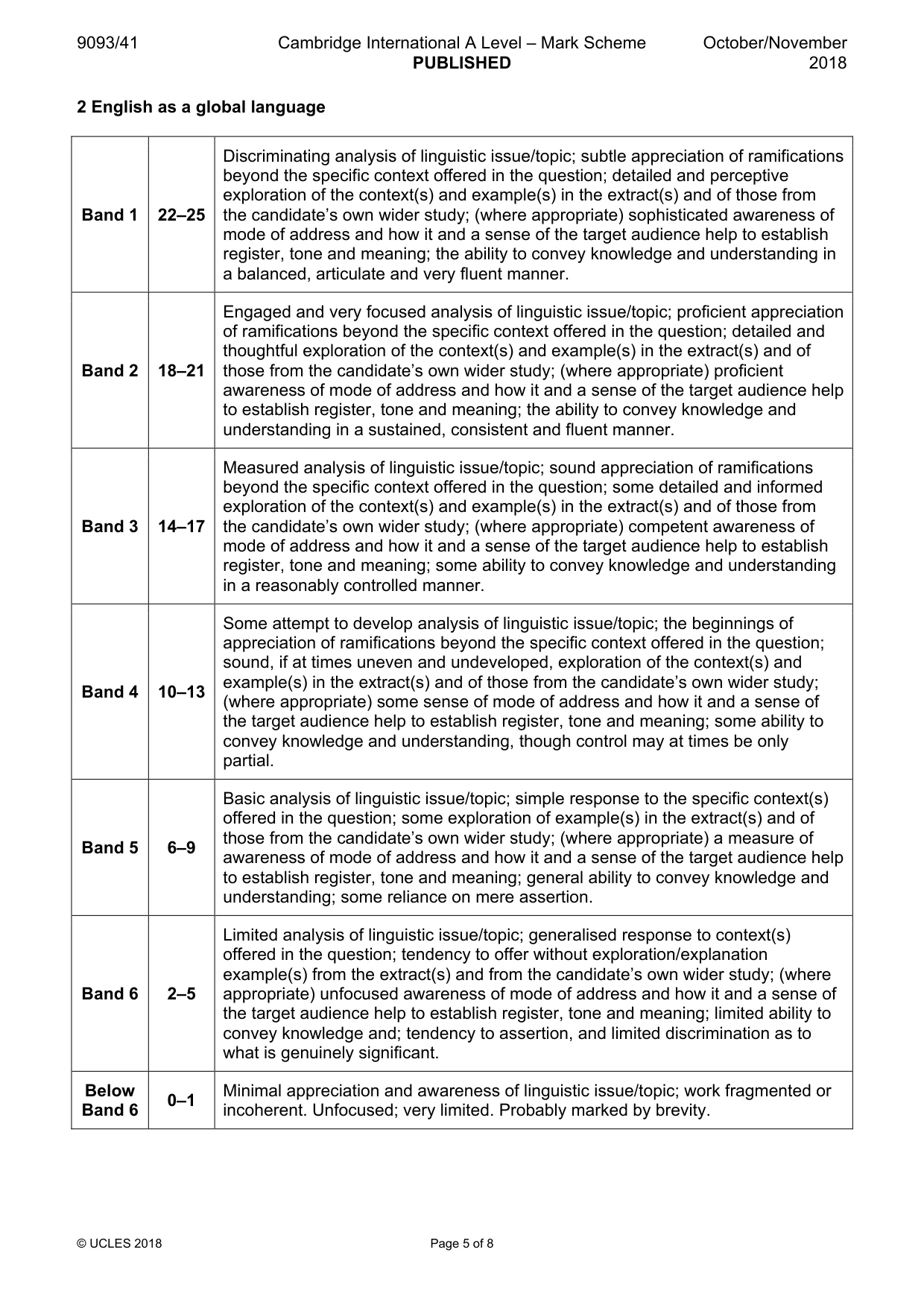
9093/41 Cambridge International A Level – Mark Scheme PUBLISHED October/November 2018 © UCLES 2018 Page 5 of 8 2 English as a global language Band 1 22–25 Discriminating analysis of linguistic issue/topic; subtle appreciation of ramifications beyond the specific context offered in the question; detailed and perceptive exploration of the context(s) and example(s) in the extract(s) and of those from the candidate’s own wider study; (where appropriate) sophisticated awareness of mode of address and how it and a sense of the target audience help to establish register, tone and meaning; the ability to convey knowledge and understanding in a balanced, articulate and very fluent manner. Band 2 18–21 Engaged and very focused analysis of linguistic issue/topic; proficient appreciation of ramifications beyond the specific context offered in the question; detailed and thoughtful exploration of the context(s) and example(s) in the extract(s) and of those from the candidate’s own wider study; (where appropriate) proficient awareness of mode of address and how it and a sense of the target audience help to establish register, tone and meaning; the ability to convey knowledge and understanding in a sustained, consistent and fluent manner. Band 3 14–17 Measured analysis of linguistic issue/topic; sound appreciation of ramifications beyond the specific context offered in the question; some detailed and informed exploration of the context(s) and example(s) in the extract(s) and of those from the candidate’s own wider study; (where appropriate) competent awareness of mode of address and how it and a sense of the target audience help to establish register, tone and meaning; some ability to convey knowledge and understanding in a reasonably controlled manner. Band 4 10–13 Some attempt to develop analysis of linguistic issue/topic; the beginnings of appreciation of ramifications beyond the specific context offered in the question; sound, if at times uneven and undeveloped, exploration of the context(s) and example(s) in the extract(s) and of those from the candidate’s own wider study; (where appropriate) some sense of mode of address and how it and a sense of the target audience help to establish register, tone and meaning; some ability to convey knowledge and understanding, though control may at times be only partial. Band 5 6–9 Basic analysis of linguistic issue/topic; simple response to the specific context(s) offered in the question; some exploration of example(s) in the extract(s) and of those from the candidate’s own wider study; (where appropriate) a measure of awareness of mode of address and how it and a sense of the target audience help to establish register, tone and meaning; general ability to convey knowledge and understanding; some reliance on mere assertion. Band 6 2–5 Limited analysis of linguistic issue/topic; generalised response to context(s) offered in the question; tendency to offer without exploration/explanation example(s) from the extract(s) and from the candidate’s own wider study; (where appropriate) unfocused awareness of mode of address and how it and a sense of the target audience help to establish register, tone and meaning; limited ability to convey knowledge and; tendency to assertion, and limited discrimination as to what is genuinely significant. Below Band 6 0–1 Minimal appreciation and awareness of linguistic issue/topic; work fragmented or incoherent. Unfocused; very limited. Probably marked by brevity.
Mark scheme, page 6
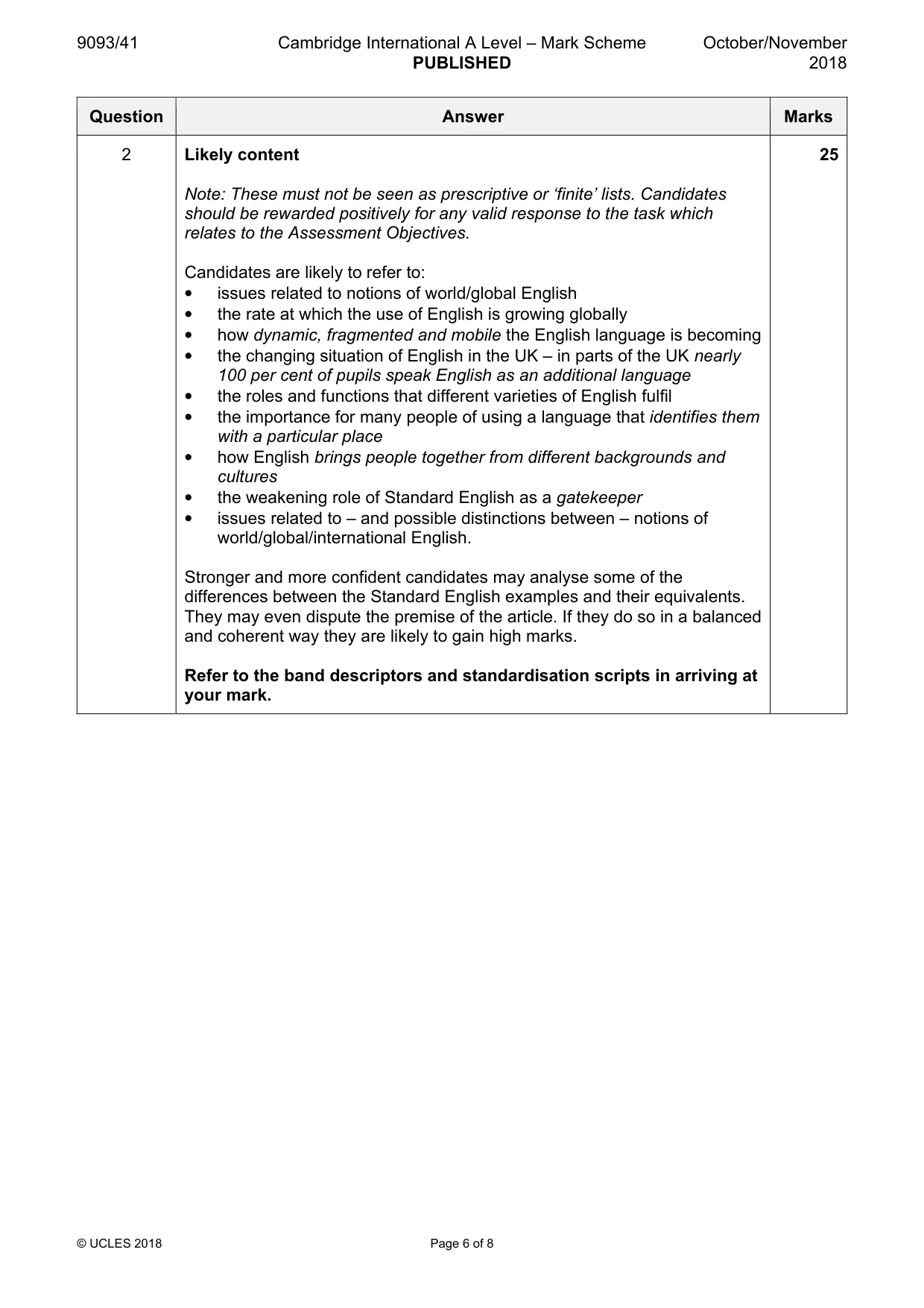
9093/41 Cambridge International A Level – Mark Scheme PUBLISHED October/November 2018 © UCLES 2018 Page 6 of 8 Question Answer Marks 2 Likely content Note: These must not be seen as prescriptive or ‘finite’ lists. Candidates should be rewarded positively for any valid response to the task which relates to the Assessment Objectives. Candidates are likely to refer to: • issues related to notions of world/global English • the rate at which the use of English is growing globally • how dynamic, fragmented and mobile the English language is becoming • the changing situation of English in the UK – in parts of the UK nearly 100 per cent of pupils speak English as an additional language • the roles and functions that different varieties of English fulfil • the importance for many people of using a language that identifies them with a particular place • how English brings people together from different backgrounds and cultures • the weakening role of Standard English as a gatekeeper • issues related to – and possible distinctions between – notions of world/global/international English. Stronger and more confident candidates may analyse some of the differences between the Standard English examples and their equivalents. They may even dispute the premise of the article. If they do so in a balanced and coherent way they are likely to gain high marks. Refer to the band descriptors and standardisation scripts in arriving at your mark. 25
Mark scheme, page 7
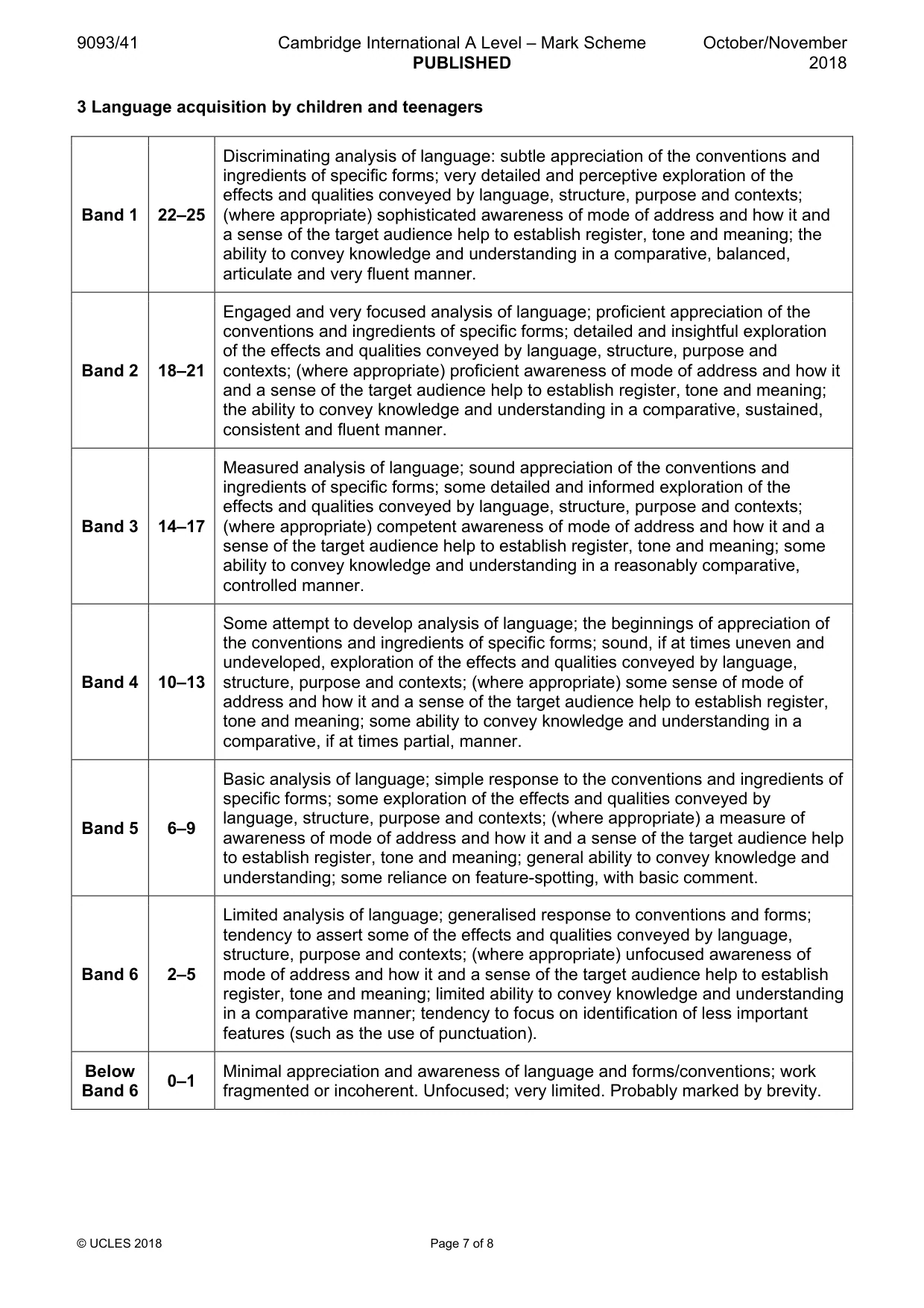
9093/41 Cambridge International A Level – Mark Scheme PUBLISHED October/November 2018 © UCLES 2018 Page 7 of 8 3 Language acquisition by children and teenagers Band 1 22–25 Discriminating analysis of language: subtle appreciation of the conventions and ingredients of specific forms; very detailed and perceptive exploration of the effects and qualities conveyed by language, structure, purpose and contexts; (where appropriate) sophisticated awareness of mode of address and how it and a sense of the target audience help to establish register, tone and meaning; the ability to convey knowledge and understanding in a comparative, balanced, articulate and very fluent manner. Band 2 18–21 Engaged and very focused analysis of language; proficient appreciation of the conventions and ingredients of specific forms; detailed and insightful exploration of the effects and qualities conveyed by language, structure, purpose and contexts; (where appropriate) proficient awareness of mode of address and how it and a sense of the target audience help to establish register, tone and meaning; the ability to convey knowledge and understanding in a comparative, sustained, consistent and fluent manner. Band 3 14–17 Measured analysis of language; sound appreciation of the conventions and ingredients of specific forms; some detailed and informed exploration of the effects and qualities conveyed by language, structure, purpose and contexts; (where appropriate) competent awareness of mode of address and how it and a sense of the target audience help to establish register, tone and meaning; some ability to convey knowledge and understanding in a reasonably comparative, controlled manner. Band 4 10–13 Some attempt to develop analysis of language; the beginnings of appreciation of the conventions and ingredients of specific forms; sound, if at times uneven and undeveloped, exploration of the effects and qualities conveyed by language, structure, purpose and contexts; (where appropriate) some sense of mode of address and how it and a sense of the target audience help to establish register, tone and meaning; some ability to convey knowledge and understanding in a comparative, if at times partial, manner. Band 5 6–9 Basic analysis of language; simple response to the conventions and ingredients of specific forms; some exploration of the effects and qualities conveyed by language, structure, purpose and contexts; (where appropriate) a measure of awareness of mode of address and how it and a sense of the target audience help to establish register, tone and meaning; general ability to convey knowledge and understanding; some reliance on feature-spotting, with basic comment. Band 6 2–5 Limited analysis of language; generalised response to conventions and forms; tendency to assert some of the effects and qualities conveyed by language, structure, purpose and contexts; (where appropriate) unfocused awareness of mode of address and how it and a sense of the target audience help to establish register, tone and meaning; limited ability to convey knowledge and understanding in a comparative manner; tendency to focus on identification of less important features (such as the use of punctuation). Below Band 6 0–1 Minimal appreciation and awareness of language and forms/conventions; work fragmented or incoherent. Unfocused; very limited. Probably marked by brevity.
Mark scheme, page 8
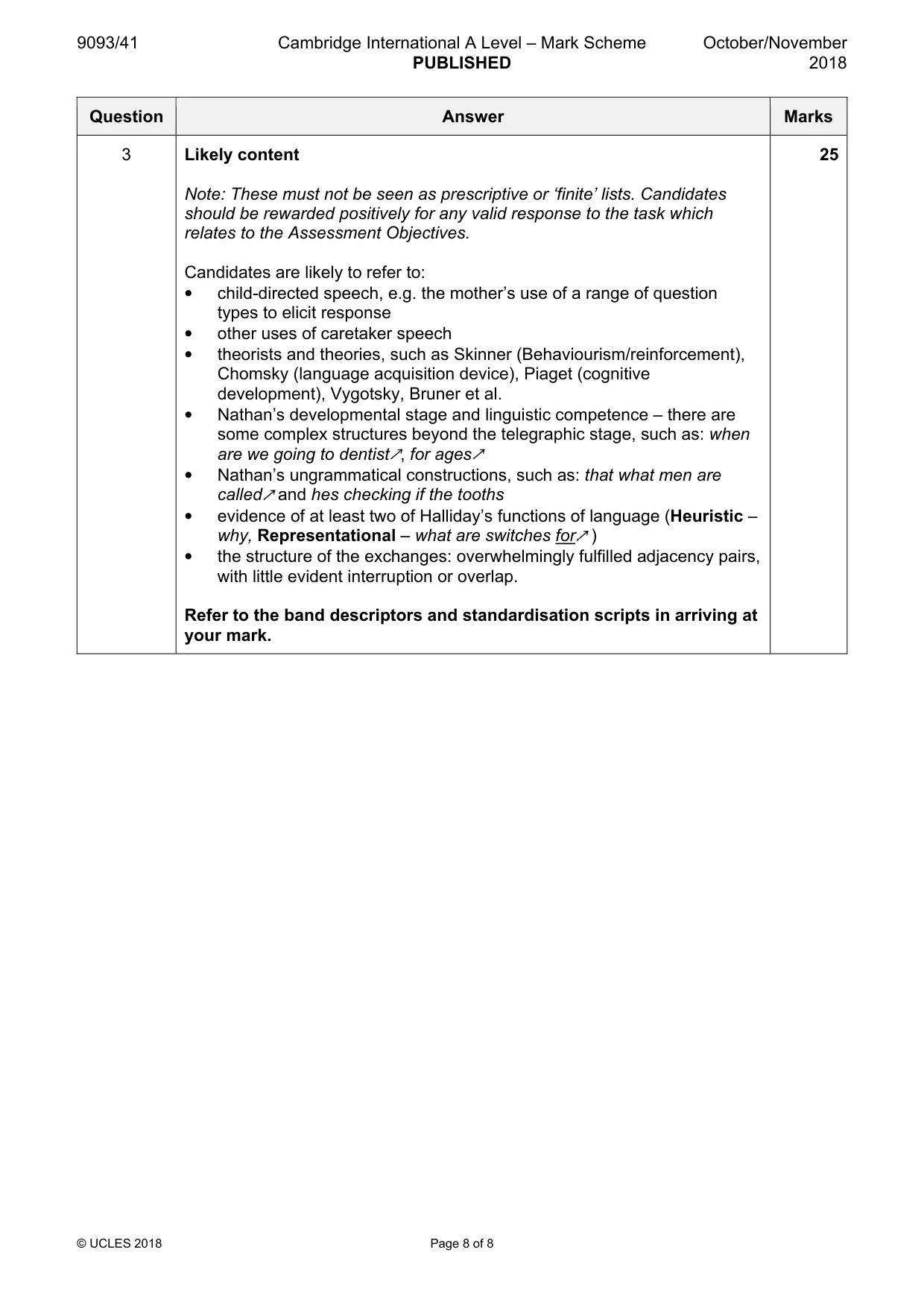
9093/41 Cambridge International A Level – Mark Scheme PUBLISHED October/November 2018 © UCLES 2018 Page 8 of 8 Question Answer Marks 3 Likely content Note: These must not be seen as prescriptive or ‘finite’ lists. Candidates should be rewarded positively for any valid response to the task which relates to the Assessment Objectives. Candidates are likely to refer to: • child-directed speech, e.g. the mother’s use of a range of question types to elicit response • other uses of caretaker speech • theorists and theories, such as Skinner (Behaviourism/reinforcement), Chomsky (language acquisition device), Piaget (cognitive development), Vygotsky, Bruner et al. • Nathan’s developmental stage and linguistic competence – there are some complex structures beyond the telegraphic stage, such as: when are we going to dentist↗, for ages↗ • Nathan’s ungrammatical constructions, such as: that what men are called↗ and hes checking if the tooths • evidence of at least two of Halliday’s functions of language (Heuristic – why, Representational – what are switches for↗ ) • the structure of the exchanges: overwhelmingly fulfilled adjacency pairs, with little evident interruption or overlap. Refer to the band descriptors and standardisation scripts in arriving at your mark. 25
What you needed in this session
Cambridge’s own grade thresholds for 2018 Oct/Nov, Paper 4 · Variant 1. A higher threshold means an easier paper — the bar moves with how the cohort did.