Cambridge A Level English - Language AS and A Level (from 2014) 9093 — 2016 May/June Paper 4 · Variant 1
9093/41/M/J/16 · 50 marks · ≈56 min
The question paper and its mark scheme, free to read here and free to download. This is Cambridge’s own paper, exactly as it was sat.
Question paper8 pages


Mark scheme7 pages
Answers below. Sit the paper first if you are practising.
Paper as text
Question paper, page 1
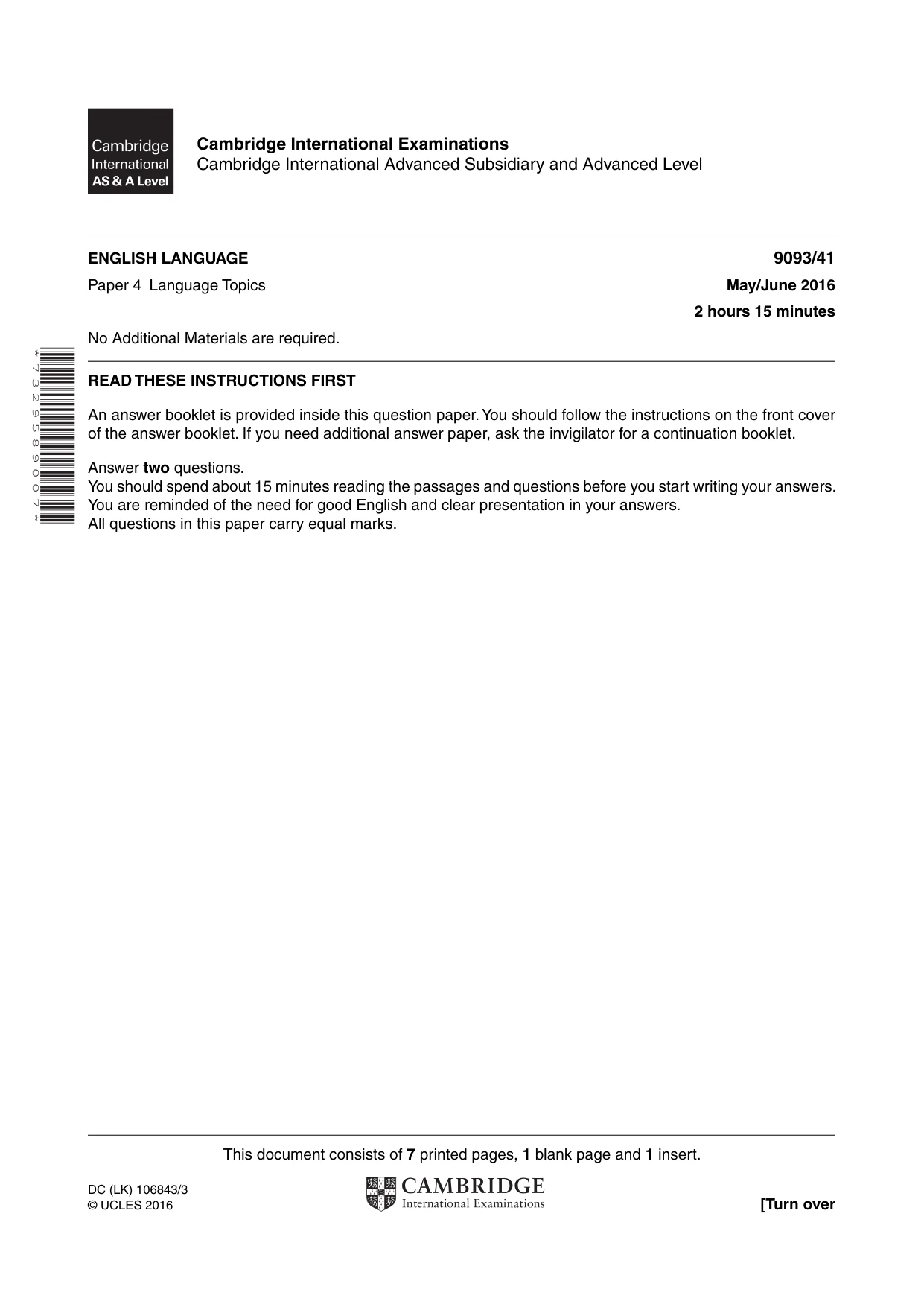
This document consists of 7 printed pages, 1 blank page and 1 insert. DC (LK) 106843/3 © UCLES 2016 [Turn over Cambridge International Examinations Cambridge International Advanced Subsidiary and Advanced Level * 7 3 2 9 5 8 9 0 0 7 * ENGLISH LANGUAGE 9093/41 Paper 4 Language Topics May/June 2016 2 hours 15 minutes No Additional Materials are required. READ THESE INSTRUCTIONS FIRST An answer booklet is provided inside this question paper. You should follow the instructions on the front cover of the answer booklet. If you need additional answer paper, ask the invigilator for a continuation booklet. Answer two questions. You should spend about 15 minutes reading the passages and questions before you start writing your answers. You are reminded of the need for good English and clear presentation in your answers. All questions in this paper carry equal marks.
Question paper, page 2
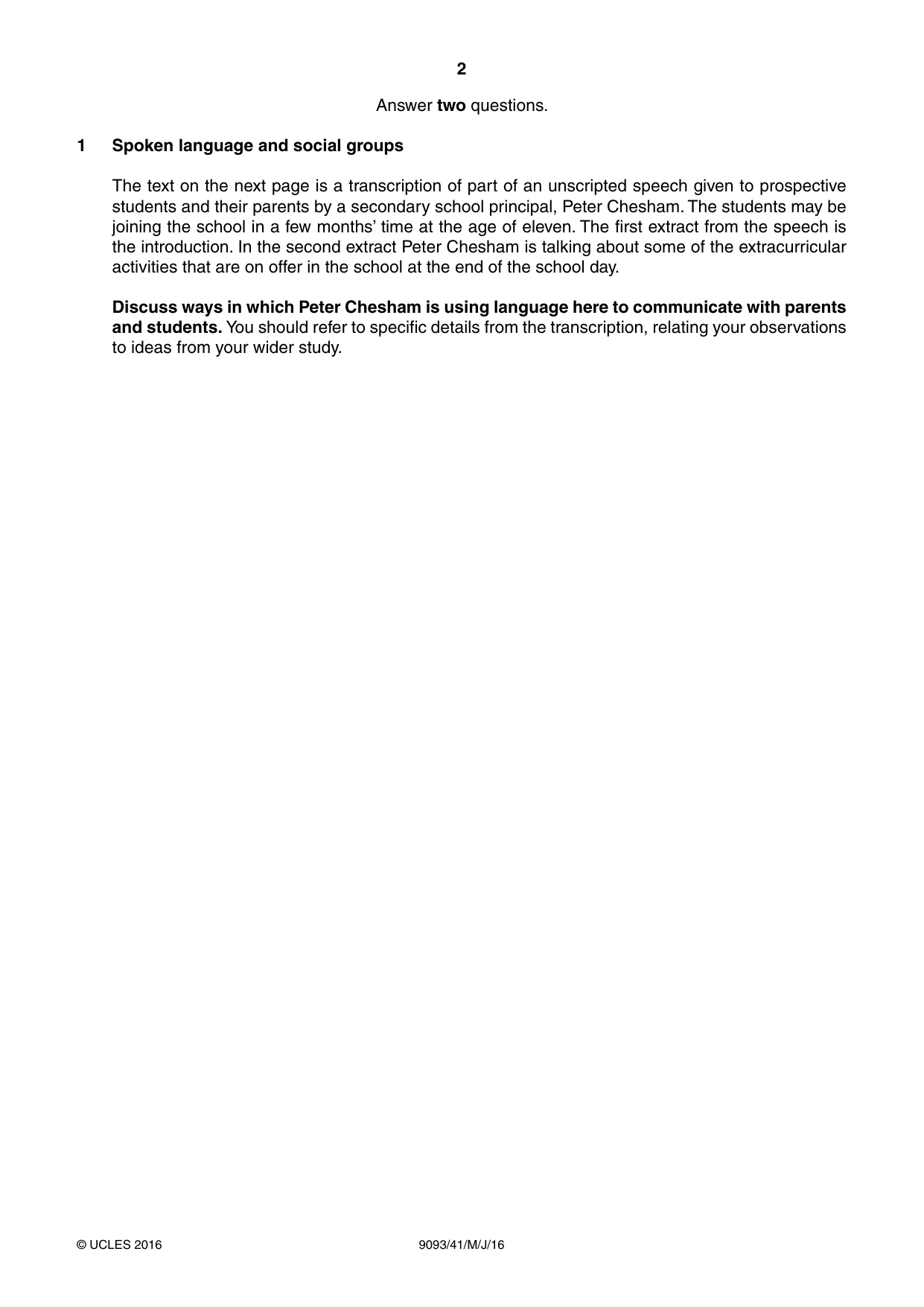
2 9093/41/M/J/16 © UCLES 2016 Answer two questions. 1 Spoken language and social groups The text on the next page is a transcription of part of an unscripted speech given to prospective students and their parents by a secondary school principal, Peter Chesham. The students may be joining the school in a few months’ time at the age of eleven. The first extract from the speech is the introduction. In the second extract Peter Chesham is talking about some of the extracurricular activities that are on offer in the school at the end of the school day. Discuss ways in which Peter Chesham is using language here to communicate with parents and students. You should refer to specific details from the transcription, relating your observations to ideas from your wider study.
Question paper, page 3
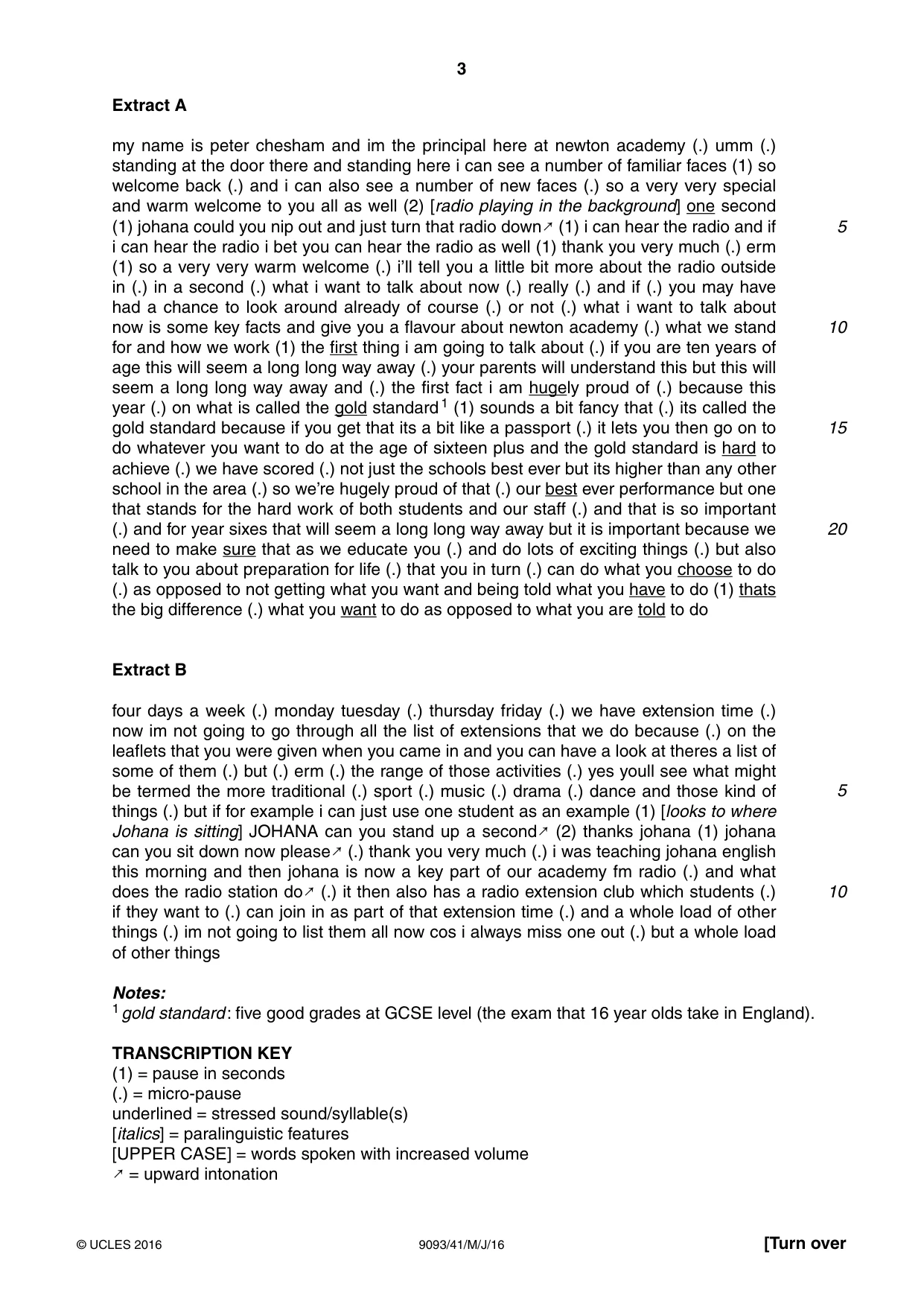
3 9093/41/M/J/16 © UCLES 2016 [Turn over Extract A my name is peter chesham and im the principal here at newton academy (.) umm (.) standing at the door there and standing here i can see a number of familiar faces (1) so welcome back (.) and i can also see a number of new faces (.) so a very very special and warm welcome to you all as well (2) [radio playing in the background] one second (1) johana could you nip out and just turn that radio down↗ (1) i can hear the radio and if i can hear the radio i bet you can hear the radio as well (1) thank you very much (.) erm (1) so a very very warm welcome (.) i’ll tell you a little bit more about the radio outside in (.) in a second (.) what i want to talk about now (.) really (.) and if (.) you may have had a chance to look around already of course (.) or not (.) what i want to talk about now is some key facts and give you a flavour about newton academy (.) what we stand for and how we work (1) the first thing i am going to talk about (.) if you are ten years of age this will seem a long long way away (.) your parents will understand this but this will seem a long long way away and (.) the first fact i am hugely proud of (.) because this year (.) on what is called the gold standard 1 (1) sounds a bit fancy that (.) its called the gold standard because if you get that its a bit like a passport (.) it lets you then go on to do whatever you want to do at the age of sixteen plus and the gold standard is hard to achieve (.) we have scored (.) not just the schools best ever but its higher than any other school in the area (.) so we’re hugely proud of that (.) our best ever performance but one that stands for the hard work of both students and our staff (.) and that is so important (.) and for year sixes that will seem a long long way away but it is important because we need to make sure that as we educate you (.) and do lots of exciting things (.) but also talk to you about preparation for life (.) that you in turn (.) can do what you choose to do (.) as opposed to not getting what you want and being told what you have to do (1) thats the big difference (.) what you want to do as opposed to what you are told to do Extract B four days a week (.) monday tuesday (.) thursday friday (.) we have extension time (.) now im not going to go through all the list of extensions that we do because (.) on the leaflets that you were given when you came in and you can have a look at theres a list of some of them (.) but (.) erm (.) the range of those activities (.) yes youll see what might be termed the more traditional (.) sport (.) music (.) drama (.) dance and those kind of things (.) but if for example i can just use one student as an example (1) [looks to where Johana is sitting] JOHANA can you stand up a second↗ (2) thanks johana (1) johana can you sit down now please↗ (.) thank you very much (.) i was teaching johana english this morning and then johana is now a key part of our academy fm radio (.) and what does the radio station do↗ (.) it then also has a radio extension club which students (.) if they want to (.) can join in as part of that extension time (.) and a whole load of other things (.) im not going to list them all now cos i always miss one out (.) but a whole load of other things Notes: 1 gold standard : five good grades at GCSE level (the exam that 16 year olds take in England). TRANSCRIPTION KEY (1) = pause in seconds (.) = micro-pause underlined = stressed sound/syllable(s) [italics] = paralinguistic features [UPPER CASE] = words spoken with increased volume ↗ = upward intonation 5 10 15 20 5 10
Question paper, page 4
4 9093/41/M/J/16 © UCLES 2016 2 English as a global language The two passages on the next page deal with the increasingly widespread use of English as a global language and the disappearance of other languages. Discuss what you feel are the most important issues raised here relating to the emergence of English as a global language and the disappearance of other languages. You should refer to specific details from the passages as well as to ideas and examples from your wider study.
Question paper, page 5
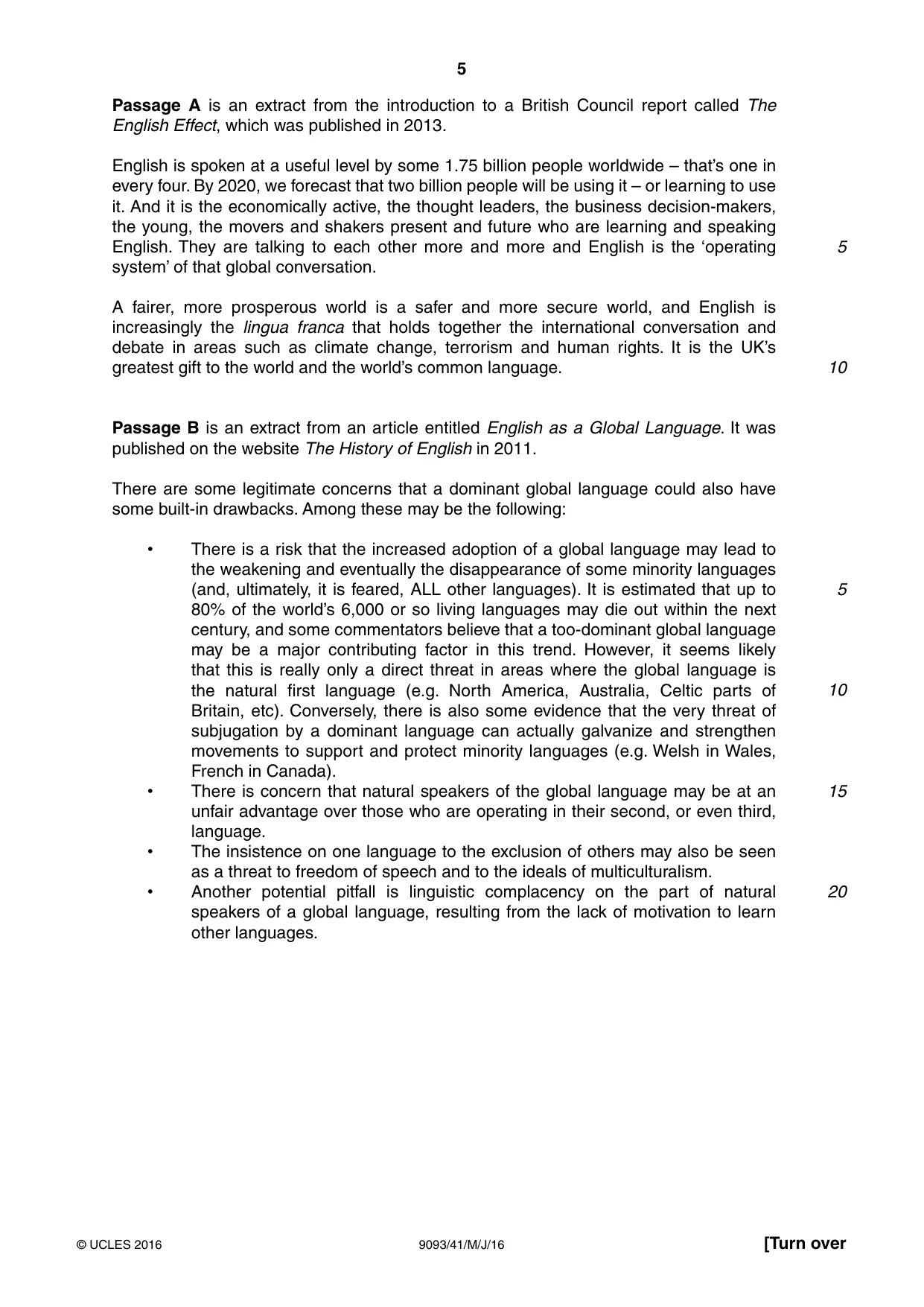
5 9093/41/M/J/16 © UCLES 2016 [Turn over Passage A is an extract from the introduction to a British Council report called The English Effect, which was published in 2013. English is spoken at a useful level by some 1.75 billion people worldwide – that’s one in every four. By 2020, we forecast that two billion people will be using it – or learning to use it. And it is the economically active, the thought leaders, the business decision-makers, the young, the movers and shakers present and future who are learning and speaking English. They are talking to each other more and more and English is the ‘operating system’ of that global conversation. A fairer, more prosperous world is a safer and more secure world, and English is increasingly the lingua franca that holds together the international conversation and debate in areas such as climate change, terrorism and human rights. It is the UK’s greatest gift to the world and the world’s common language. Passage B is an extract from an article entitled English as a Global Language. It was published on the website The History of English in 2011. There are some legitimate concerns that a dominant global language could also have some built-in drawbacks. Among these may be the following: • There is a risk that the increased adoption of a global language may lead to the weakening and eventually the disappearance of some minority languages (and, ultimately, it is feared, ALL other languages). It is estimated that up to 80% of the world’s 6,000 or so living languages may die out within the next century, and some commentators believe that a too-dominant global language may be a major contributing factor in this trend. However, it seems likely that this is really only a direct threat in areas where the global language is the natural first language (e.g. North America, Australia, Celtic parts of Britain, etc). Conversely, there is also some evidence that the very threat of subjugation by a dominant language can actually galvanize and strengthen movements to support and protect minority languages (e.g. Welsh in Wales, French in Canada). • There is concern that natural speakers of the global language may be at an unfair advantage over those who are operating in their second, or even third, language. • The insistence on one language to the exclusion of others may also be seen as a threat to freedom of speech and to the ideals of multiculturalism. • Another potential pitfall is linguistic complacency on the part of natural speakers of a global language, resulting from the lack of motivation to learn other languages. 5 10 5 10 15 20
Question paper, page 6
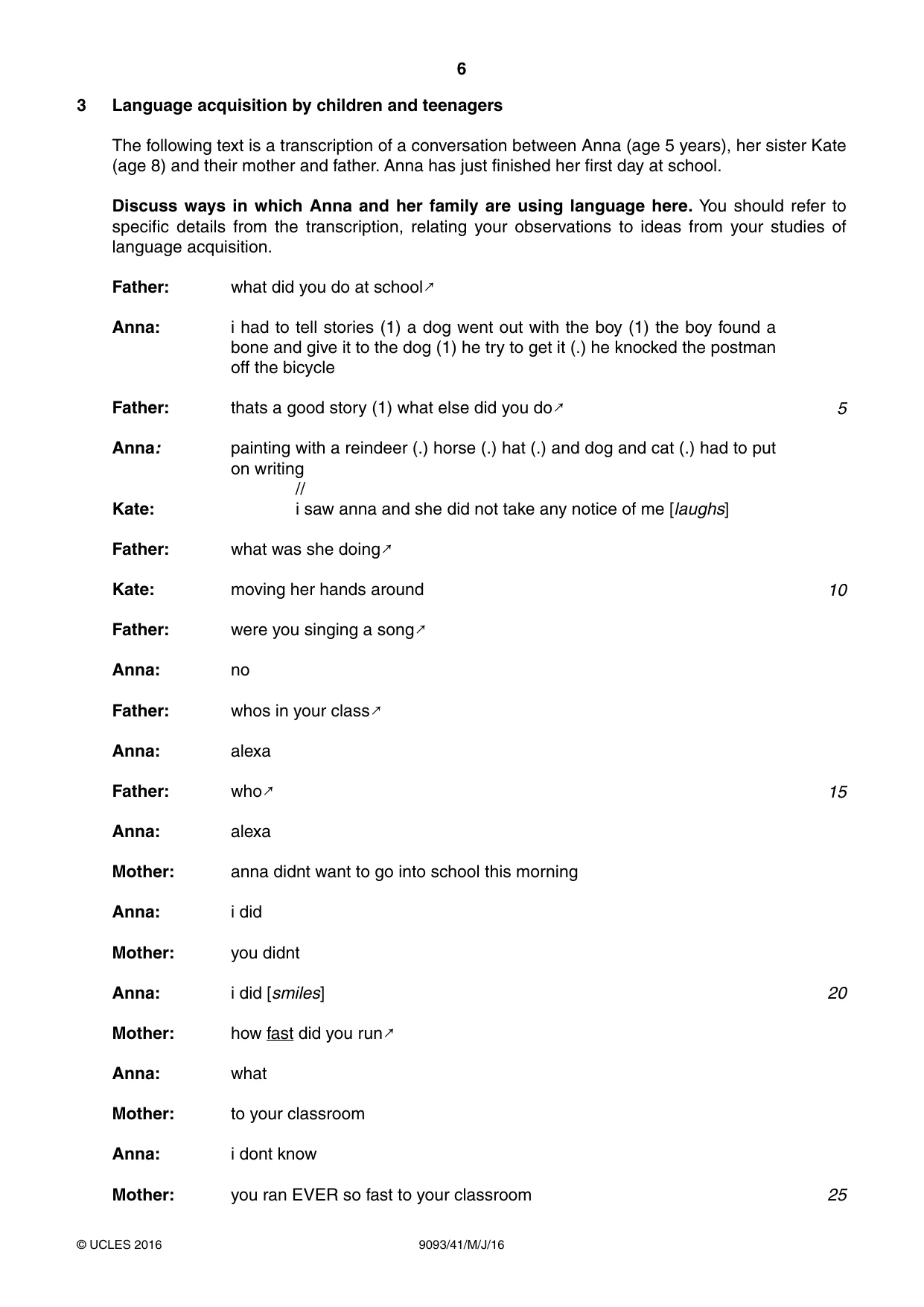
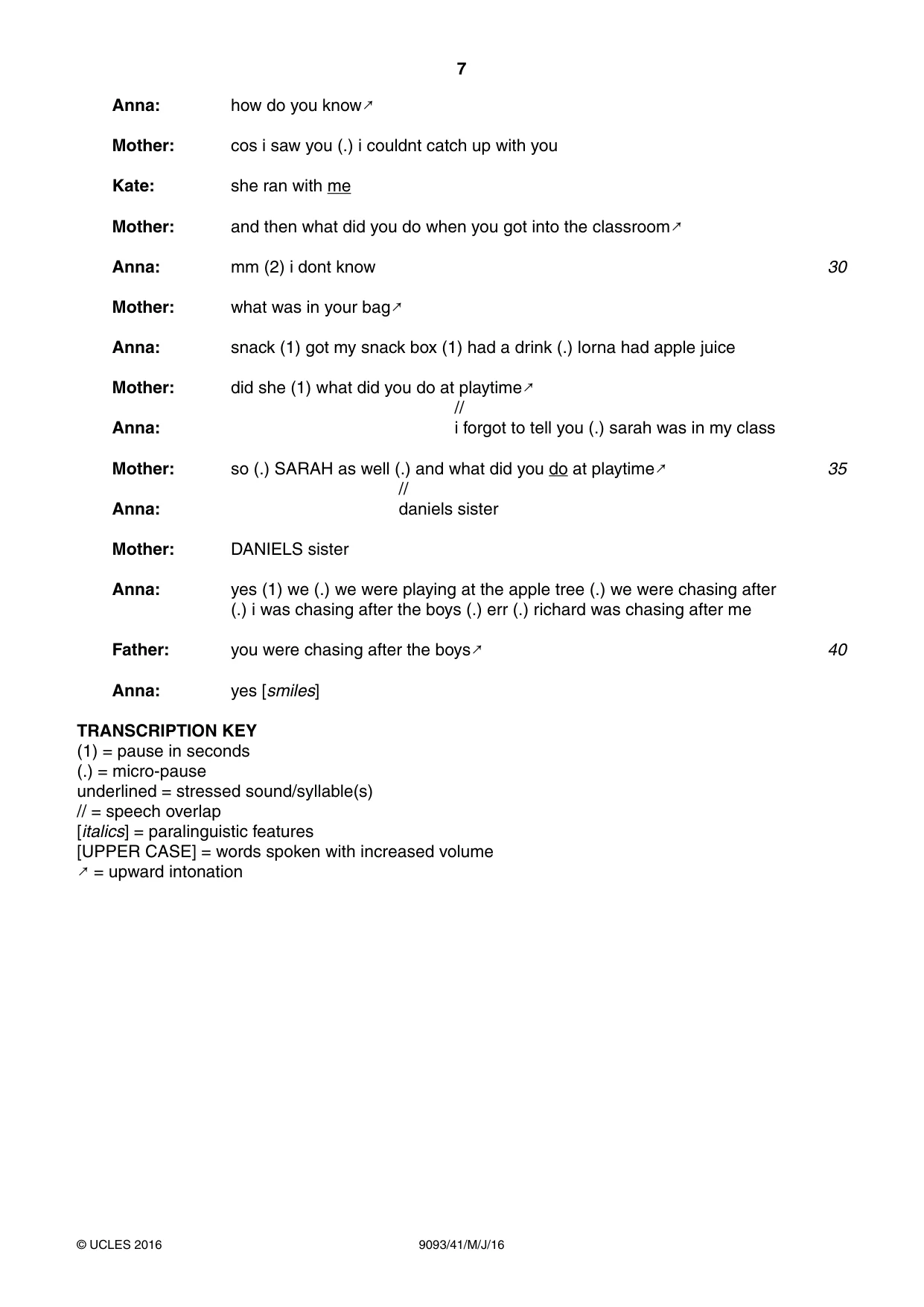
6 9093/41/M/J/16 © UCLES 2016 3 Language acquisition by children and teenagers The following text is a transcription of a conversation between Anna (age 5 years), her sister Kate (age 8) and their mother and father. Anna has just finished her first day at school. Discuss ways in which Anna and her family are using language here. You should refer to specific details from the transcription, relating your observations to ideas from your studies of language acquisition. Father: what did you do at school↗ Anna: i had to tell stories (1) a dog went out with the boy (1) the boy found a bone and give it to the dog (1) he try to get it (.) he knocked the postman off the bicycle Father: thats a good story (1) what else did you do↗ Anna: painting with a reindeer (.) horse (.) hat (.) and dog and cat (.) had to put on writing // Kate: i saw anna and she did not take any notice of me [laughs] Father: what was she doing↗ Kate: moving her hands around Father: were you singing a song↗ Anna: no Father: whos in your class↗ Anna: alexa Father: who↗ Anna: alexa Mother: anna didnt want to go into school this morning Anna: i did Mother: you didnt Anna: i did [smiles] Mother: how fast did you run↗ Anna: what Mother: to your classroom Anna: i dont know Mother: you ran EVER so fast to your classroom 5 10 15 20 25
Question paper, page 7
7 9093/41/M/J/16 © UCLES 2016 Anna: how do you know↗ Mother: cos i saw you (.) i couldnt catch up with you Kate: she ran with me Mother: and then what did you do when you got into the classroom↗ Anna: mm (2) i dont know Mother: what was in your bag↗ Anna: snack (1) got my snack box (1) had a drink (.) lorna had apple juice Mother: did she (1) what did you do at playtime↗ // Anna: i forgot to tell you (.) sarah was in my class Mother: so (.) SARAH as well (.) and what did you do at playtime↗ // Anna: daniels sister Mother: DANIELS sister Anna: yes (1) we (.) we were playing at the apple tree (.) we were chasing after (.) i was chasing after the boys (.) err (.) richard was chasing after me Father: you were chasing after the boys↗ Anna: yes [smiles] TRANSCRIPTION KEY (1) = pause in seconds (.) = micro-pause underlined = stressed sound/syllable(s) // = speech overlap [italics] = paralinguistic features [UPPER CASE] = words spoken with increased volume ↗ = upward intonation 30 35 40
Question paper, page 8
8 9093/41/M/J/16 © UCLES 2016 BLANK PAGE Permission to reproduce items where third-party owned material protected by copyright is included has been sought and cleared where possible. Every reasonable effort has been made by the publisher (UCLES) to trace copyright holders, but if any items requiring clearance have unwittingly been included, the publisher will be pleased to make amends at the earliest possible opportunity. To avoid the issue of disclosure of answer-related information to candidates, all copyright acknowledgements are reproduced online in the Cambridge International Examinations Copyright Acknowledgements Booklet. This is produced for each series of examinations and is freely available to download at www.cie.org.uk after the live examination series. Cambridge International Examinations is part of the Cambridge Assessment Group. Cambridge Assessment is the brand name of University of Cambridge Local Examinations Syndicate (UCLES), which is itself a department of the University of Cambridge.
Mark scheme, page 1
® IGCSE is the registered trademark of Cambridge International Examinations. This document consists of 7 printed pages. © UCLES 2016 [Turn over Cambridge International Examinations Cambridge International Advanced Level ENGLISH LANGUAGE 9093/41 Paper 4 Language Topics May/June 2016 MARK SCHEME Maximum Mark: 50 Published This mark scheme is published as an aid to teachers and candidates, to indicate the requirements of the examination. It shows the basis on which Examiners were instructed to award marks. It does not indicate the details of the discussions that took place at an Examiners’ meeting before marking began, which would have considered the acceptability of alternative answers. Mark schemes should be read in conjunction with the question paper and the Principal Examiner Report for Teachers. Cambridge will not enter into discussions about these mark schemes. Cambridge is publishing the mark schemes for the May/June 2016 series for most Cambridge IGCSE®, Cambridge International A and AS Level components and some Cambridge O Level components.
Mark scheme, page 2
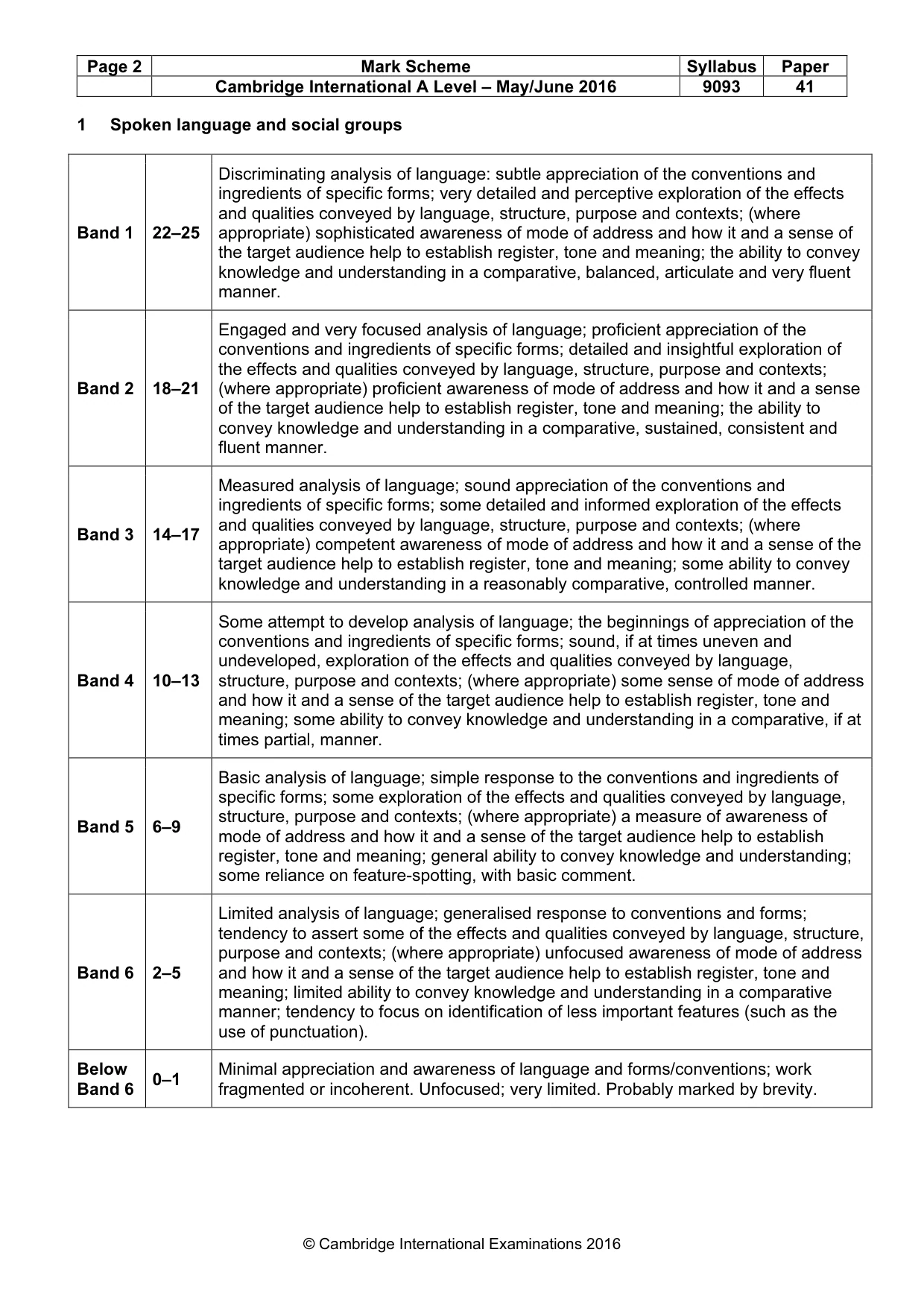
Page 2 Mark Scheme Syllabus Paper Cambridge International A Level – May/June 2016 9093 41 © Cambridge International Examinations 2016 1 Spoken language and social groups Band 1 22–25 Discriminating analysis of language: subtle appreciation of the conventions and ingredients of specific forms; very detailed and perceptive exploration of the effects and qualities conveyed by language, structure, purpose and contexts; (where appropriate) sophisticated awareness of mode of address and how it and a sense of the target audience help to establish register, tone and meaning; the ability to convey knowledge and understanding in a comparative, balanced, articulate and very fluent manner. Band 2 18–21 Engaged and very focused analysis of language; proficient appreciation of the conventions and ingredients of specific forms; detailed and insightful exploration of the effects and qualities conveyed by language, structure, purpose and contexts; (where appropriate) proficient awareness of mode of address and how it and a sense of the target audience help to establish register, tone and meaning; the ability to convey knowledge and understanding in a comparative, sustained, consistent and fluent manner. Band 3 14–17 Measured analysis of language; sound appreciation of the conventions and ingredients of specific forms; some detailed and informed exploration of the effects and qualities conveyed by language, structure, purpose and contexts; (where appropriate) competent awareness of mode of address and how it and a sense of the target audience help to establish register, tone and meaning; some ability to convey knowledge and understanding in a reasonably comparative, controlled manner. Band 4 10–13 Some attempt to develop analysis of language; the beginnings of appreciation of the conventions and ingredients of specific forms; sound, if at times uneven and undeveloped, exploration of the effects and qualities conveyed by language, structure, purpose and contexts; (where appropriate) some sense of mode of address and how it and a sense of the target audience help to establish register, tone and meaning; some ability to convey knowledge and understanding in a comparative, if at times partial, manner. Band 5 6–9 Basic analysis of language; simple response to the conventions and ingredients of specific forms; some exploration of the effects and qualities conveyed by language, structure, purpose and contexts; (where appropriate) a measure of awareness of mode of address and how it and a sense of the target audience help to establish register, tone and meaning; general ability to convey knowledge and understanding; some reliance on feature-spotting, with basic comment. Band 6 2–5 Limited analysis of language; generalised response to conventions and forms; tendency to assert some of the effects and qualities conveyed by language, structure, purpose and contexts; (where appropriate) unfocused awareness of mode of address and how it and a sense of the target audience help to establish register, tone and meaning; limited ability to convey knowledge and understanding in a comparative manner; tendency to focus on identification of less important features (such as the use of punctuation). Below Band 6 0–1 Minimal appreciation and awareness of language and forms/conventions; work fragmented or incoherent. Unfocused; very limited. Probably marked by brevity.
Mark scheme, page 3
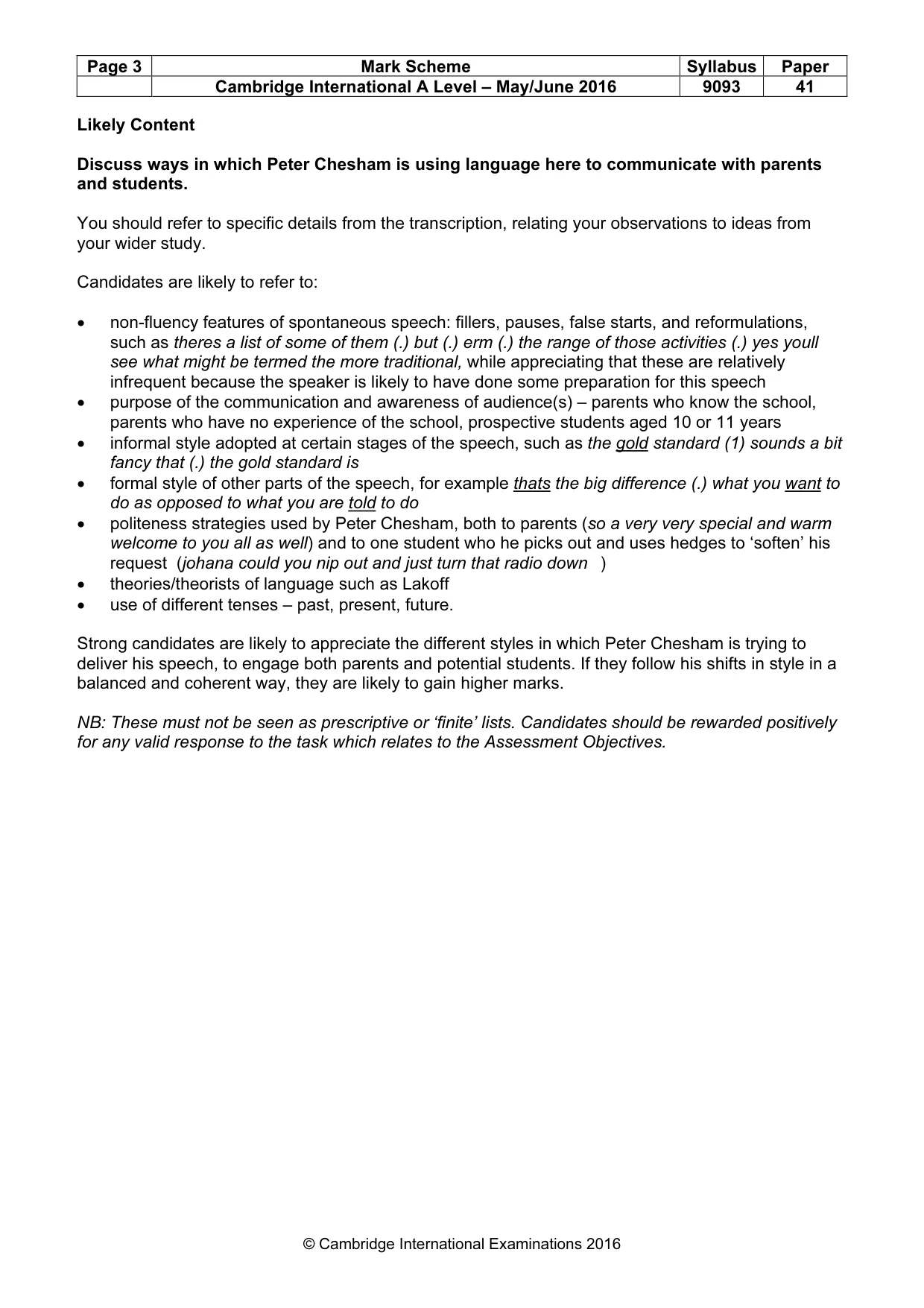
Page 3 Mark Scheme Syllabus Paper Cambridge International A Level – May/June 2016 9093 41 © Cambridge International Examinations 2016 Likely Content Discuss ways in which Peter Chesham is using language here to communicate with parents and students. You should refer to specific details from the transcription, relating your observations to ideas from your wider study. Candidates are likely to refer to: • non-fluency features of spontaneous speech: fillers, pauses, false starts, and reformulations, such as theres a list of some of them (.) but (.) erm (.) the range of those activities (.) yes youll see what might be termed the more traditional, while appreciating that these are relatively infrequent because the speaker is likely to have done some preparation for this speech • purpose of the communication and awareness of audience(s) – parents who know the school, parents who have no experience of the school, prospective students aged 10 or 11 years • informal style adopted at certain stages of the speech, such as the gold standard (1) sounds a bit fancy that (.) the gold standard is • formal style of other parts of the speech, for example thats the big difference (.) what you want to do as opposed to what you are told to do • politeness strategies used by Peter Chesham, both to parents (so a very very special and warm welcome to you all as well) and to one student who he picks out and uses hedges to ‘soften’ his request (johana could you nip out and just turn that radio down ) • theories/theorists of language such as Lakoff • use of different tenses – past, present, future. Strong candidates are likely to appreciate the different styles in which Peter Chesham is trying to deliver his speech, to engage both parents and potential students. If they follow his shifts in style in a balanced and coherent way, they are likely to gain higher marks. NB: These must not be seen as prescriptive or ‘finite’ lists. Candidates should be rewarded positively for any valid response to the task which relates to the Assessment Objectives.
Mark scheme, page 4
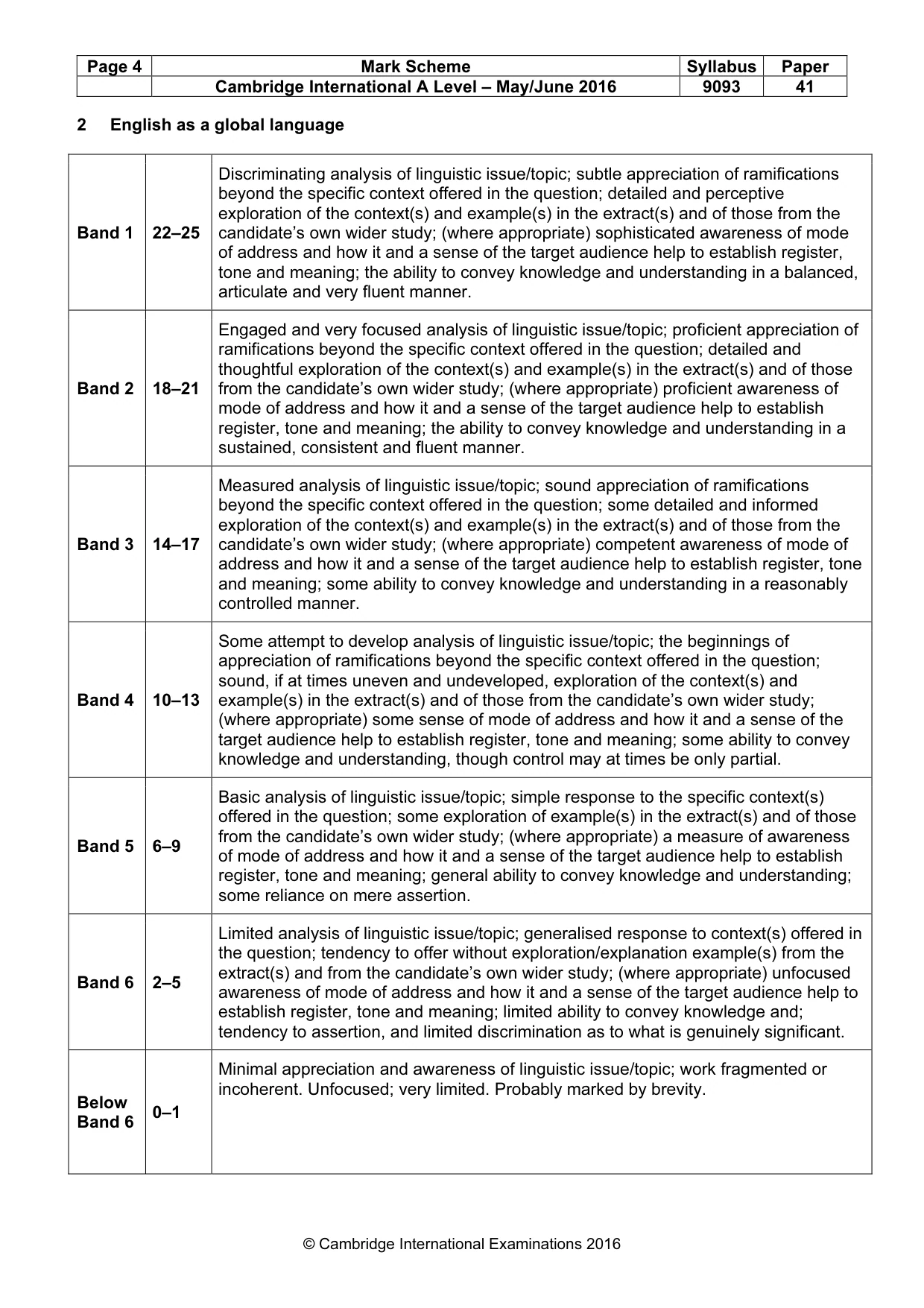
Page 4 Mark Scheme Syllabus Paper Cambridge International A Level – May/June 2016 9093 41 © Cambridge International Examinations 2016 2 English as a global language Band 1 22–25 Discriminating analysis of linguistic issue/topic; subtle appreciation of ramifications beyond the specific context offered in the question; detailed and perceptive exploration of the context(s) and example(s) in the extract(s) and of those from the candidate’s own wider study; (where appropriate) sophisticated awareness of mode of address and how it and a sense of the target audience help to establish register, tone and meaning; the ability to convey knowledge and understanding in a balanced, articulate and very fluent manner. Band 2 18–21 Engaged and very focused analysis of linguistic issue/topic; proficient appreciation of ramifications beyond the specific context offered in the question; detailed and thoughtful exploration of the context(s) and example(s) in the extract(s) and of those from the candidate’s own wider study; (where appropriate) proficient awareness of mode of address and how it and a sense of the target audience help to establish register, tone and meaning; the ability to convey knowledge and understanding in a sustained, consistent and fluent manner. Band 3 14–17 Measured analysis of linguistic issue/topic; sound appreciation of ramifications beyond the specific context offered in the question; some detailed and informed exploration of the context(s) and example(s) in the extract(s) and of those from the candidate’s own wider study; (where appropriate) competent awareness of mode of address and how it and a sense of the target audience help to establish register, tone and meaning; some ability to convey knowledge and understanding in a reasonably controlled manner. Band 4 10–13 Some attempt to develop analysis of linguistic issue/topic; the beginnings of appreciation of ramifications beyond the specific context offered in the question; sound, if at times uneven and undeveloped, exploration of the context(s) and example(s) in the extract(s) and of those from the candidate’s own wider study; (where appropriate) some sense of mode of address and how it and a sense of the target audience help to establish register, tone and meaning; some ability to convey knowledge and understanding, though control may at times be only partial. Band 5 6–9 Basic analysis of linguistic issue/topic; simple response to the specific context(s) offered in the question; some exploration of example(s) in the extract(s) and of those from the candidate’s own wider study; (where appropriate) a measure of awareness of mode of address and how it and a sense of the target audience help to establish register, tone and meaning; general ability to convey knowledge and understanding; some reliance on mere assertion. Band 6 2–5 Limited analysis of linguistic issue/topic; generalised response to context(s) offered in the question; tendency to offer without exploration/explanation example(s) from the extract(s) and from the candidate’s own wider study; (where appropriate) unfocused awareness of mode of address and how it and a sense of the target audience help to establish register, tone and meaning; limited ability to convey knowledge and; tendency to assertion, and limited discrimination as to what is genuinely significant. Below Band 6 0–1 Minimal appreciation and awareness of linguistic issue/topic; work fragmented or incoherent. Unfocused; very limited. Probably marked by brevity.
Mark scheme, page 5
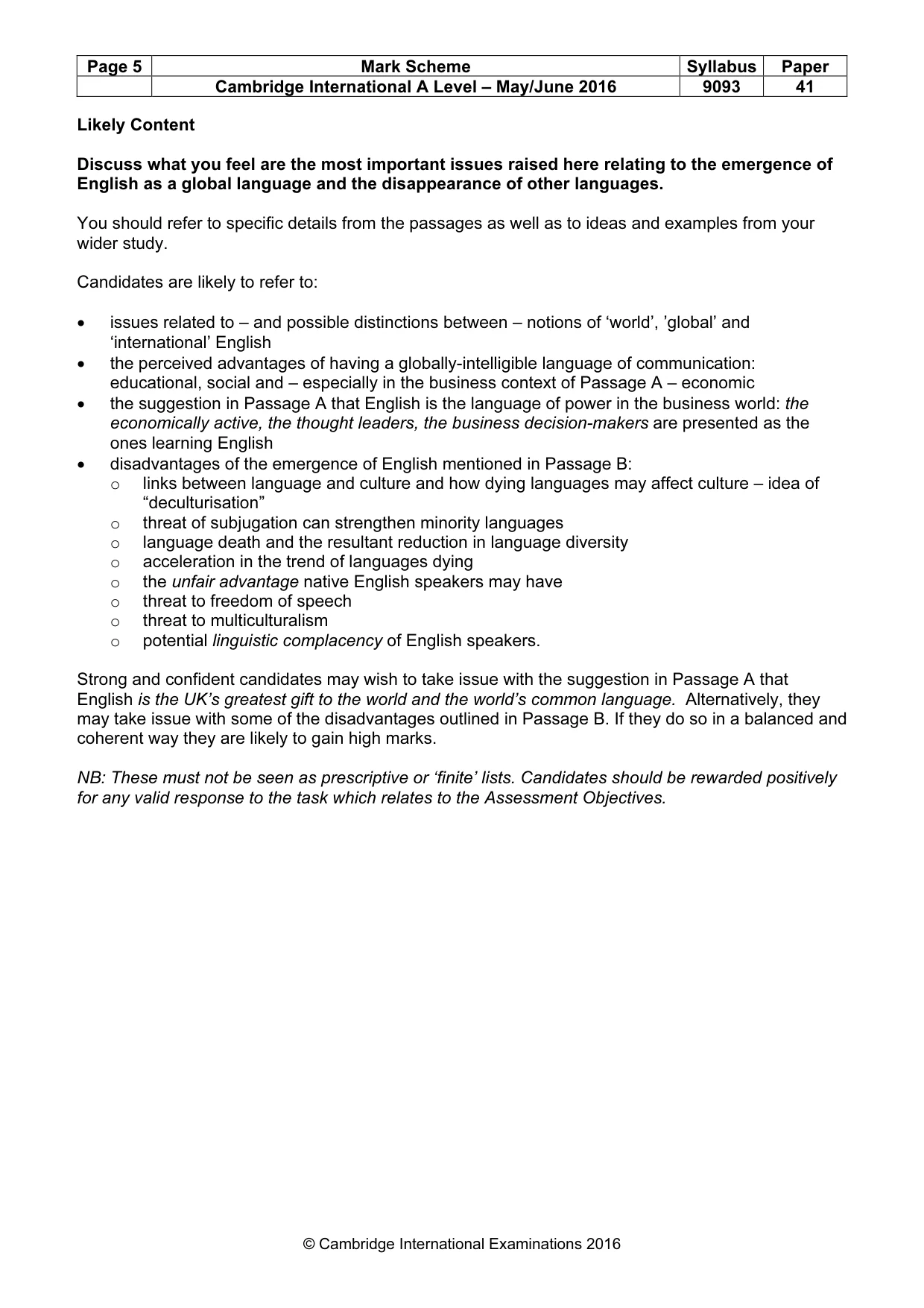
Page 5 Mark Scheme Syllabus Paper Cambridge International A Level – May/June 2016 9093 41 © Cambridge International Examinations 2016 Likely Content Discuss what you feel are the most important issues raised here relating to the emergence of English as a global language and the disappearance of other languages. You should refer to specific details from the passages as well as to ideas and examples from your wider study. Candidates are likely to refer to: • issues related to – and possible distinctions between – notions of ‘world’, ’global’ and ‘international’ English • the perceived advantages of having a globally-intelligible language of communication: educational, social and – especially in the business context of Passage A – economic • the suggestion in Passage A that English is the language of power in the business world: the economically active, the thought leaders, the business decision-makers are presented as the ones learning English • disadvantages of the emergence of English mentioned in Passage B: o links between language and culture and how dying languages may affect culture – idea of “deculturisation” o threat of subjugation can strengthen minority languages o language death and the resultant reduction in language diversity o acceleration in the trend of languages dying o the unfair advantage native English speakers may have o threat to freedom of speech o threat to multiculturalism o potential linguistic complacency of English speakers. Strong and confident candidates may wish to take issue with the suggestion in Passage A that English is the UK’s greatest gift to the world and the world’s common language. Alternatively, they may take issue with some of the disadvantages outlined in Passage B. If they do so in a balanced and coherent way they are likely to gain high marks. NB: These must not be seen as prescriptive or ‘finite’ lists. Candidates should be rewarded positively for any valid response to the task which relates to the Assessment Objectives.
Mark scheme, page 6
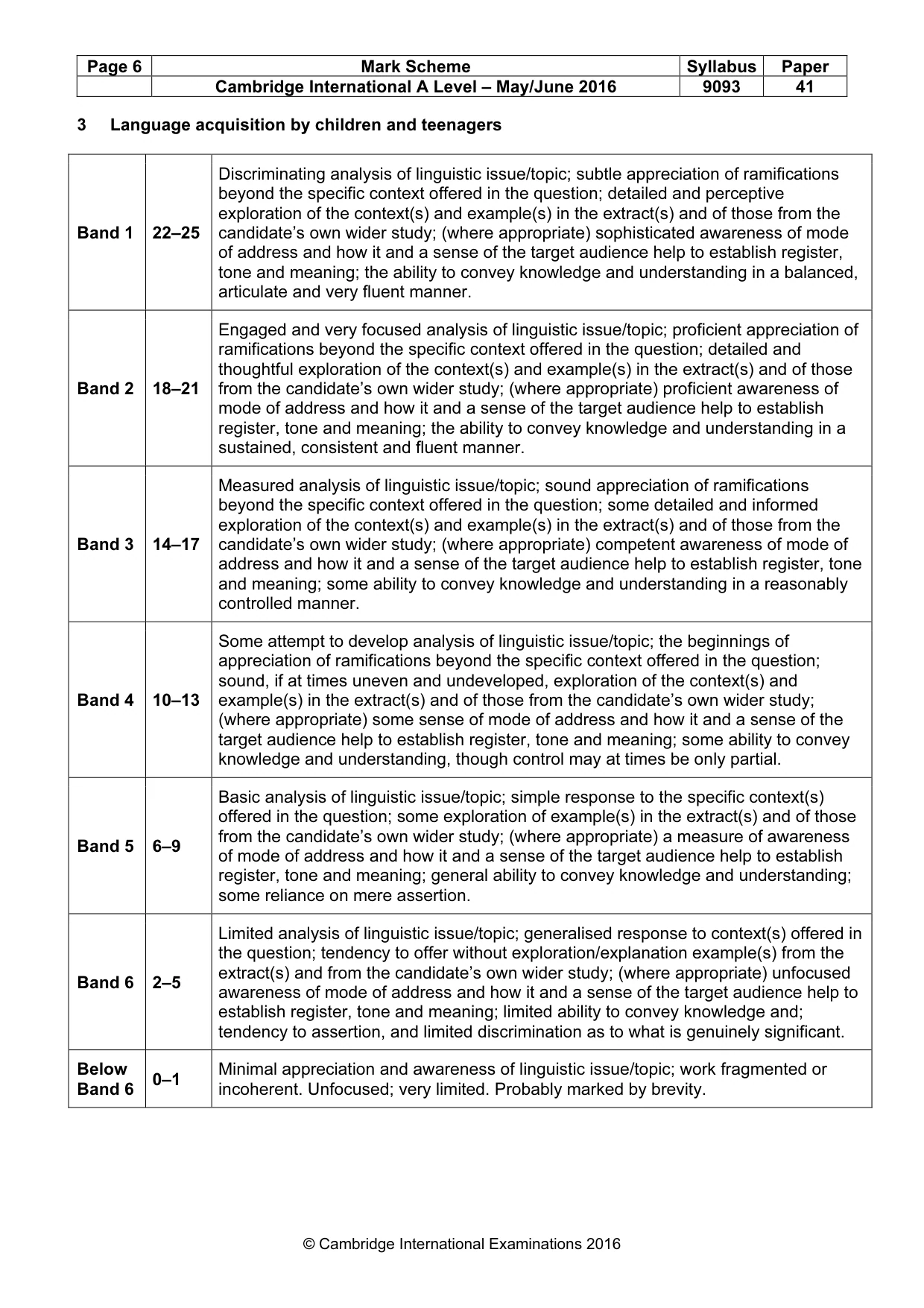
Page 6 Mark Scheme Syllabus Paper Cambridge International A Level – May/June 2016 9093 41 © Cambridge International Examinations 2016 3 Language acquisition by children and teenagers Band 1 22–25 Discriminating analysis of linguistic issue/topic; subtle appreciation of ramifications beyond the specific context offered in the question; detailed and perceptive exploration of the context(s) and example(s) in the extract(s) and of those from the candidate’s own wider study; (where appropriate) sophisticated awareness of mode of address and how it and a sense of the target audience help to establish register, tone and meaning; the ability to convey knowledge and understanding in a balanced, articulate and very fluent manner. Band 2 18–21 Engaged and very focused analysis of linguistic issue/topic; proficient appreciation of ramifications beyond the specific context offered in the question; detailed and thoughtful exploration of the context(s) and example(s) in the extract(s) and of those from the candidate’s own wider study; (where appropriate) proficient awareness of mode of address and how it and a sense of the target audience help to establish register, tone and meaning; the ability to convey knowledge and understanding in a sustained, consistent and fluent manner. Band 3 14–17 Measured analysis of linguistic issue/topic; sound appreciation of ramifications beyond the specific context offered in the question; some detailed and informed exploration of the context(s) and example(s) in the extract(s) and of those from the candidate’s own wider study; (where appropriate) competent awareness of mode of address and how it and a sense of the target audience help to establish register, tone and meaning; some ability to convey knowledge and understanding in a reasonably controlled manner. Band 4 10–13 Some attempt to develop analysis of linguistic issue/topic; the beginnings of appreciation of ramifications beyond the specific context offered in the question; sound, if at times uneven and undeveloped, exploration of the context(s) and example(s) in the extract(s) and of those from the candidate’s own wider study; (where appropriate) some sense of mode of address and how it and a sense of the target audience help to establish register, tone and meaning; some ability to convey knowledge and understanding, though control may at times be only partial. Band 5 6–9 Basic analysis of linguistic issue/topic; simple response to the specific context(s) offered in the question; some exploration of example(s) in the extract(s) and of those from the candidate’s own wider study; (where appropriate) a measure of awareness of mode of address and how it and a sense of the target audience help to establish register, tone and meaning; general ability to convey knowledge and understanding; some reliance on mere assertion. Band 6 2–5 Limited analysis of linguistic issue/topic; generalised response to context(s) offered in the question; tendency to offer without exploration/explanation example(s) from the extract(s) and from the candidate’s own wider study; (where appropriate) unfocused awareness of mode of address and how it and a sense of the target audience help to establish register, tone and meaning; limited ability to convey knowledge and; tendency to assertion, and limited discrimination as to what is genuinely significant. Below Band 6 0–1 Minimal appreciation and awareness of linguistic issue/topic; work fragmented or incoherent. Unfocused; very limited. Probably marked by brevity.
Mark scheme, page 7
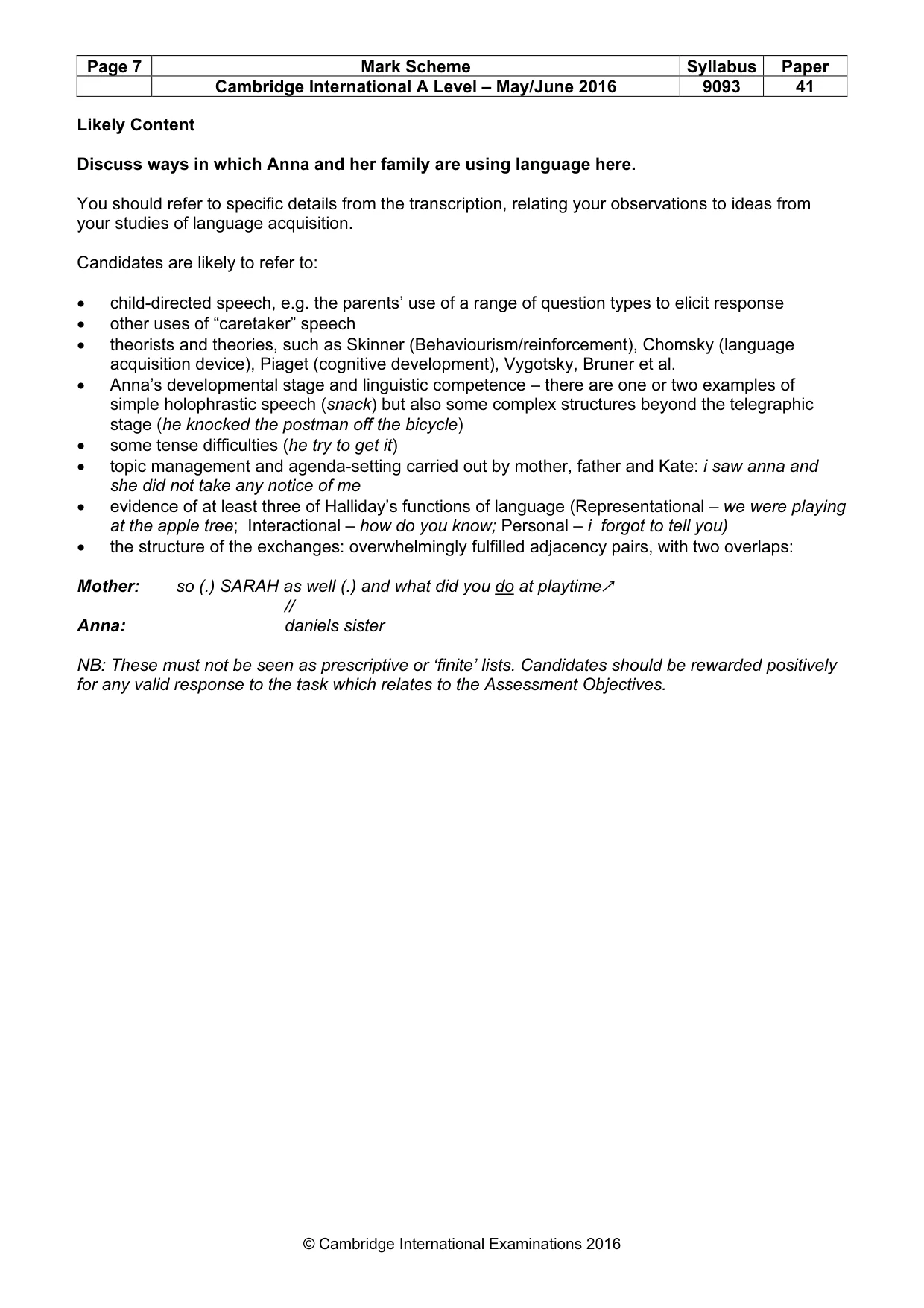
Page 7 Mark Scheme Syllabus Paper Cambridge International A Level – May/June 2016 9093 41 © Cambridge International Examinations 2016 Likely Content Discuss ways in which Anna and her family are using language here. You should refer to specific details from the transcription, relating your observations to ideas from your studies of language acquisition. Candidates are likely to refer to: • child-directed speech, e.g. the parents’ use of a range of question types to elicit response • other uses of “caretaker” speech • theorists and theories, such as Skinner (Behaviourism/reinforcement), Chomsky (language acquisition device), Piaget (cognitive development), Vygotsky, Bruner et al. • Anna’s developmental stage and linguistic competence – there are one or two examples of simple holophrastic speech (snack) but also some complex structures beyond the telegraphic stage (he knocked the postman off the bicycle) • some tense difficulties (he try to get it) • topic management and agenda-setting carried out by mother, father and Kate: i saw anna and she did not take any notice of me • evidence of at least three of Halliday’s functions of language (Representational – we were playing at the apple tree; Interactional – how do you know; Personal – i forgot to tell you) • the structure of the exchanges: overwhelmingly fulfilled adjacency pairs, with two overlaps: Mother: so (.) SARAH as well (.) and what did you do at playtime↗ // Anna: daniels sister NB: These must not be seen as prescriptive or ‘finite’ lists. Candidates should be rewarded positively for any valid response to the task which relates to the Assessment Objectives.
What you needed in this session
Cambridge’s own grade thresholds for 2016 May/June, Paper 4 · Variant 1. A higher threshold means an easier paper — the bar moves with how the cohort did.