Cambridge A Level English - Language AS and A Level (from 2014) 9093 — 2014 Oct/Nov Paper 4 · Variant 1
9093/41/O/N/14 · 50 marks · ≈56 min
The question paper and its mark scheme, free to read here and free to download. This is Cambridge’s own paper, exactly as it was sat.
Question paper8 pages


Mark scheme2 pages
Answers below. Sit the paper first if you are practising.
Paper as text
Question paper, page 1
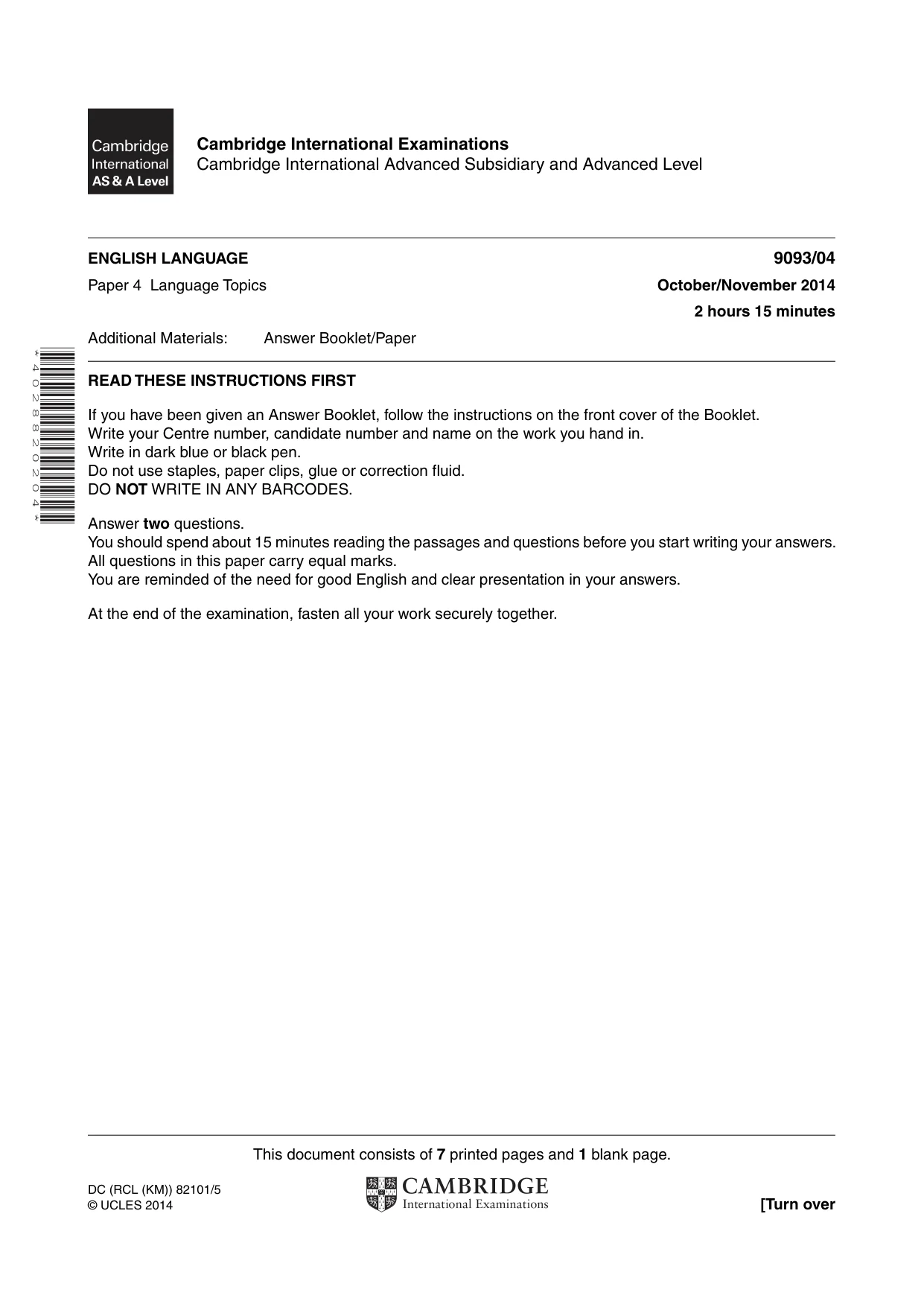
This document consists of 7 printed pages and 1 blank page. DC (RCL (KM)) 82101/5 © UCLES 2014 [Turn over Cambridge International Examinations Cambridge International Advanced Subsidiary and Advanced Level * 4 0 2 8 8 2 0 2 0 4 * ENGLISH LANGUAGE 9093/04 Paper 4 Language Topics October/November 2014 2 hours 15 minutes Additional Materials: Answer Booklet/Paper READ THESE INSTRUCTIONS FIRST If you have been given an Answer Booklet, follow the instructions on the front cover of the Booklet. Write your Centre number, candidate number and name on the work you hand in. Write in dark blue or black pen. Do not use staples, paper clips, glue or correction fluid. DO NOT WRITE IN ANY BARCODES. Answer two questions. You should spend about 15 minutes reading the passages and questions before you start writing your answers. All questions in this paper carry equal marks. You are reminded of the need for good English and clear presentation in your answers. At the end of the examination, fasten all your work securely together.
Question paper, page 2
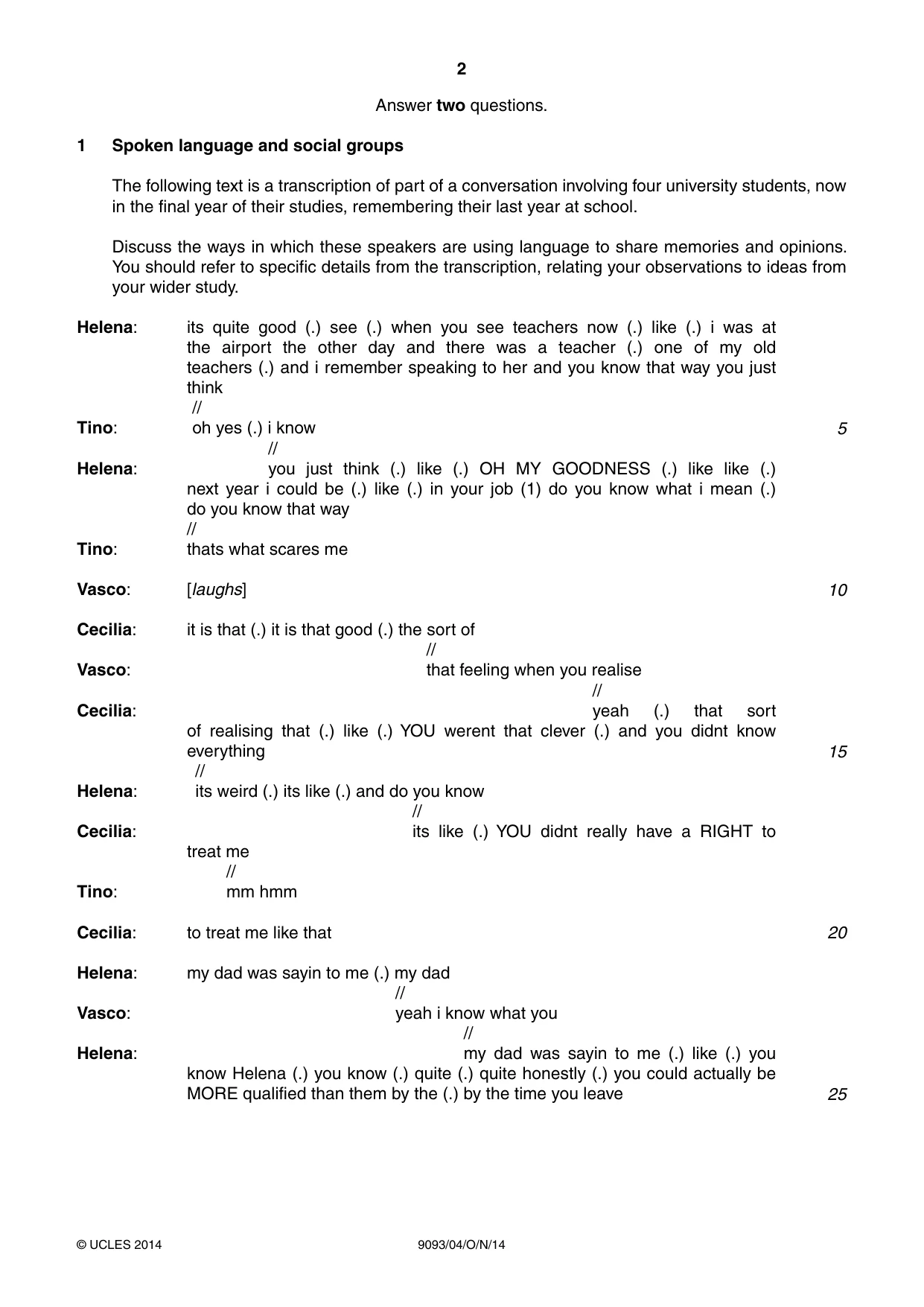
2 9093/04/O/N/14 © UCLES 2014 Answer two questions. 1 Spoken language and social groups The following text is a transcription of part of a conversation involving four university students, now in the final year of their studies, remembering their last year at school. Discuss the ways in which these speakers are using language to share memories and opinions. You should refer to specific details from the transcription, relating your observations to ideas from your wider study. Helena: its quite good (.) see (.) when you see teachers now (.) like (.) i was at the airport the other day and there was a teacher (.) one of my old teachers (.) and i remember speaking to her and you know that way you just think // Tino: oh yes (.) i know // Helena: you just think (.) like (.) OH MY GOODNESS (.) like like (.) next year i could be (.) like (.) in your job (1) do you know what i mean (.) do you know that way // Tino: thats what scares me Vasco: [laughs] Cecilia: it is that (.) it is that good (.) the sort of // Vasco: that feeling when you realise // Cecilia: yeah (.) that sort of realising that (.) like (.) YOU werent that clever (.) and you didnt know everything // Helena: its weird (.) its like (.) and do you know // Cecilia: its like (.) YOU didnt really have a RIGHT to treat me // Tino: mm hmm Cecilia: to treat me like that Helena: my dad was sayin to me (.) my dad // Vasco: yeah i know what you // Helena: my dad was sayin to me (.) like (.) you know Helena (.) you know (.) quite (.) quite honestly (.) you could actually be MORE qualified than them by the (.) by the time you leave 5 10 15 20 25
Question paper, page 3
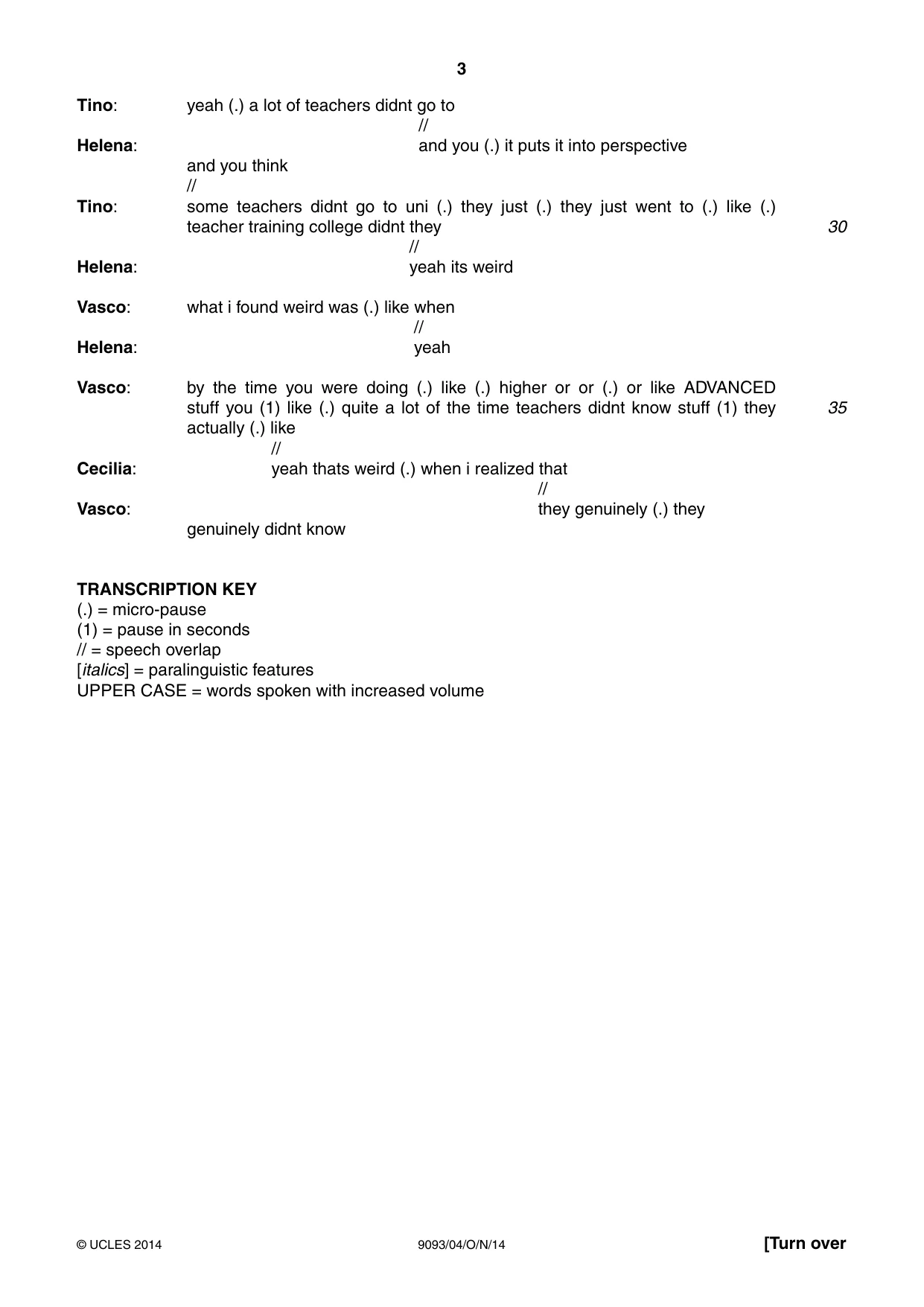
3 9093/04/O/N/14 © UCLES 2014 [Turn over Tino: yeah (.) a lot of teachers didnt go to // Helena: and you (.) it puts it into perspective and you think // Tino: some teachers didnt go to uni (.) they just (.) they just went to (.) like (.) teacher training college didnt they // Helena: yeah its weird Vasco: what i found weird was (.) like when // Helena: yeah Vasco: by the time you were doing (.) like (.) higher or or (.) or like ADVANCED stuff you (1) like (.) quite a lot of the time teachers didnt know stuff (1) they actually (.) like // Cecilia: yeah thats weird (.) when i realized that // Vasco: they genuinely (.) they genuinely didnt know TRANSCRIPTION KEY (.) = micro-pause (1) = pause in seconds // = speech overlap [italics] = paralinguistic features UPPER CASE = words spoken with increased volume 30 35
Question paper, page 4
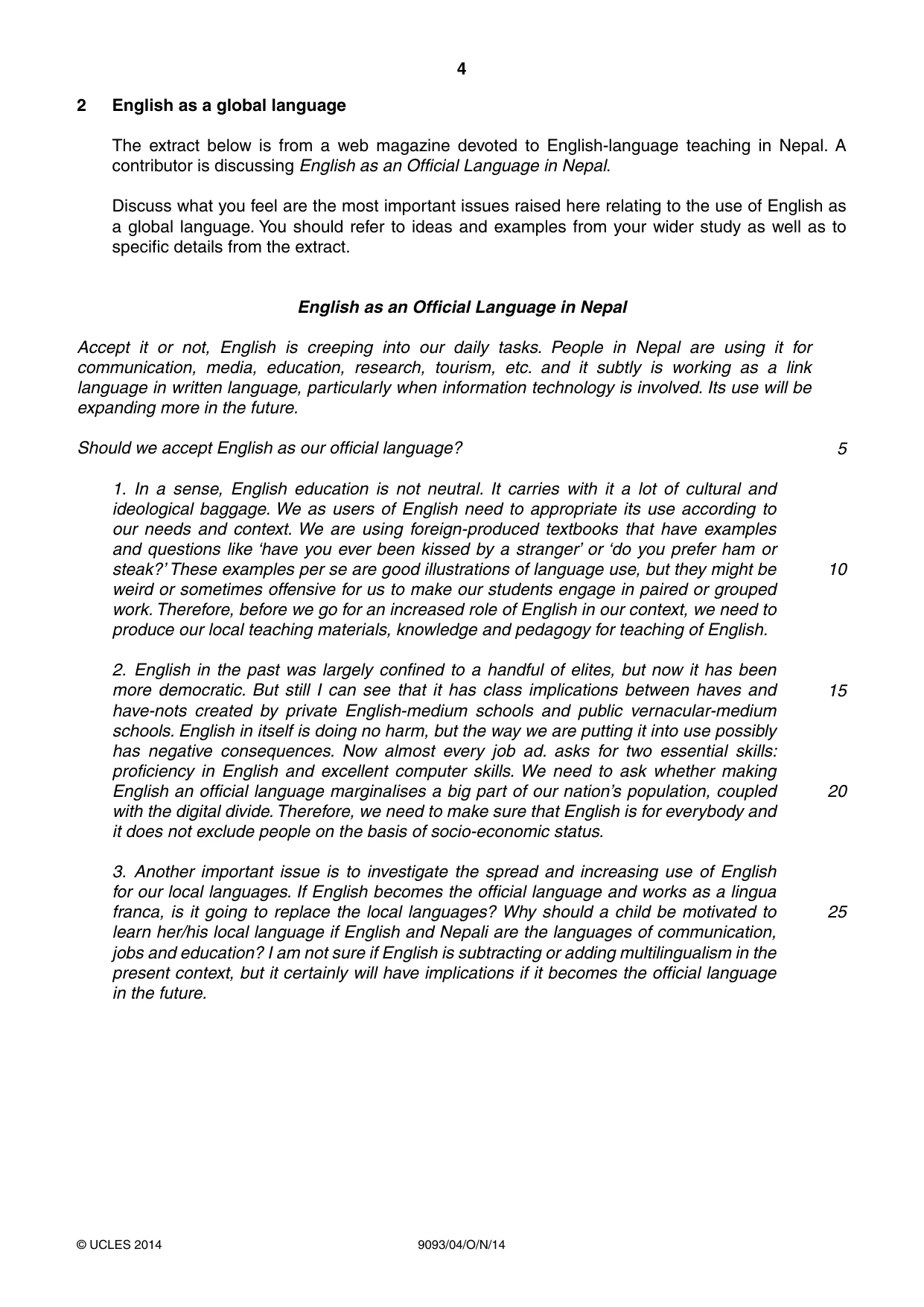
4 9093/04/O/N/14 © UCLES 2014 2 English as a global language The extract below is from a web magazine devoted to English-language teaching in Nepal. A contributor is discussing English as an Official Language in Nepal. Discuss what you feel are the most important issues raised here relating to the use of English as a global language. You should refer to ideas and examples from your wider study as well as to specific details from the extract. English as an Official Language in Nepal Accept it or not, English is creeping into our daily tasks. People in Nepal are using it for communication, media, education, research, tourism, etc. and it subtly is working as a link language in written language, particularly when information technology is involved. Its use will be expanding more in the future. Should we accept English as our official language? 1. In a sense, English education is not neutral. It carries with it a lot of cultural and ideological baggage. We as users of English need to appropriate its use according to our needs and context. We are using foreign-produced textbooks that have examples and questions like ‘have you ever been kissed by a stranger’ or ‘do you prefer ham or steak?’ These examples per se are good illustrations of language use, but they might be weird or sometimes offensive for us to make our students engage in paired or grouped work. Therefore, before we go for an increased role of English in our context, we need to produce our local teaching materials, knowledge and pedagogy for teaching of English. 2. English in the past was largely confined to a handful of elites, but now it has been more democratic. But still I can see that it has class implications between haves and have-nots created by private English-medium schools and public vernacular-medium schools. English in itself is doing no harm, but the way we are putting it into use possibly has negative consequences. Now almost every job ad. asks for two essential skills: proficiency in English and excellent computer skills. We need to ask whether making English an official language marginalises a big part of our nation’s population, coupled with the digital divide. Therefore, we need to make sure that English is for everybody and it does not exclude people on the basis of socio-economic status. 3. Another important issue is to investigate the spread and increasing use of English for our local languages. If English becomes the official language and works as a lingua franca, is it going to replace the local languages? Why should a child be motivated to learn her/his local language if English and Nepali are the languages of communication, jobs and education? I am not sure if English is subtracting or adding multilingualism in the present context, but it certainly will have implications if it becomes the official language in the future. 5 10 15 20 25
Question paper, page 5
5 9093/04/O/N/14 © UCLES 2014 [Turn over TURN OVER FOR QUESTION 3 .
Question paper, page 6
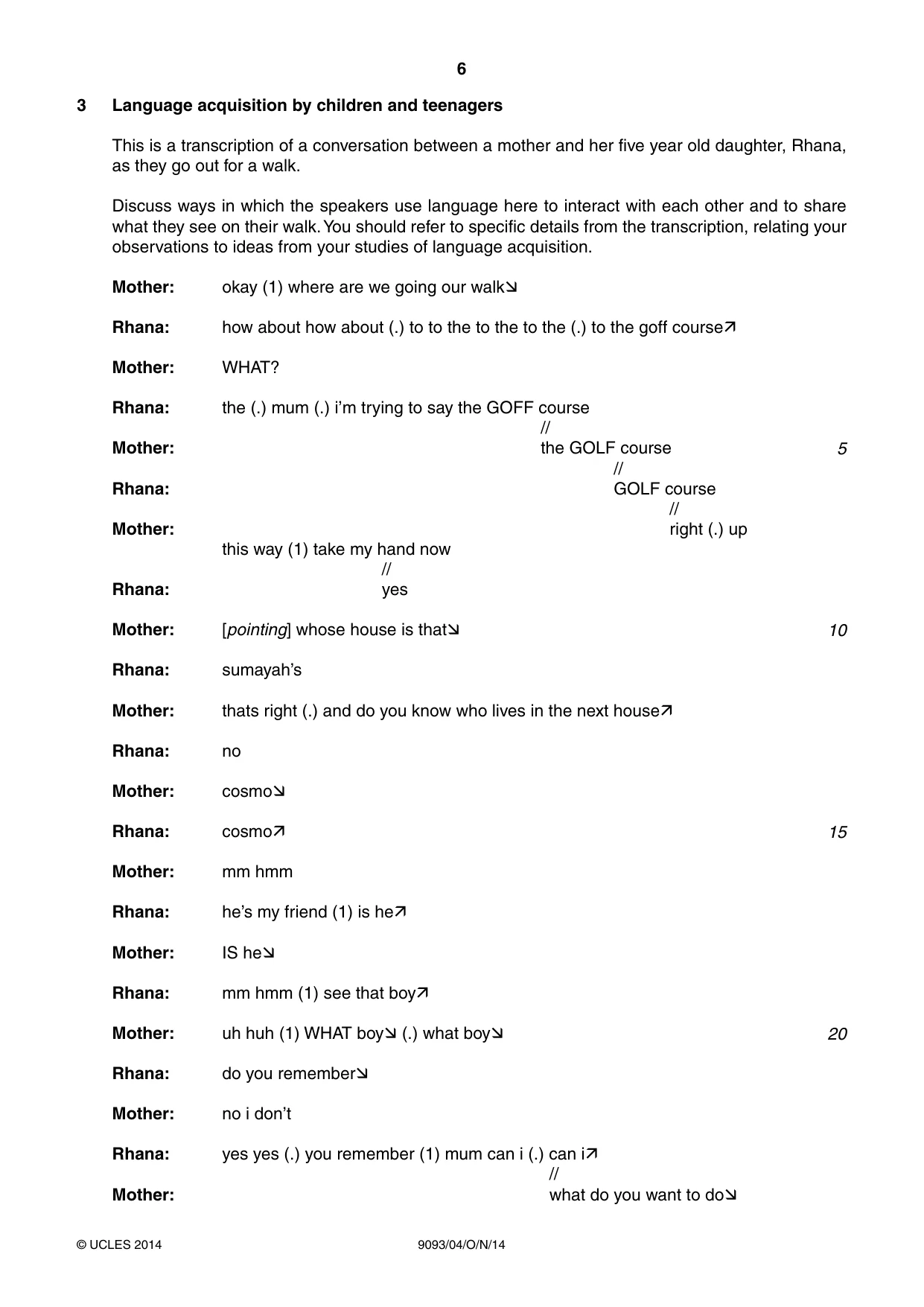
6 9093/04/O/N/14 © UCLES 2014 3 Language acquisition by children and teenagers This is a transcription of a conversation between a mother and her five year old daughter, Rhana, as they go out for a walk. Discuss ways in which the speakers use language here to interact with each other and to share what they see on their walk. You should refer to specific details from the transcription, relating your observations to ideas from your studies of language acquisition. Mother: okay (1) where are we going our walk Rhana: how about how about (.) to to the to the to the (.) to the goff course Mother: WHAT? Rhana: the (.) mum (.) i’m trying to say the GOFF course // Mother: the GOLF course // Rhana: GOLF course // Mother: right (.) up this way (1) take my hand now // Rhana: yes Mother: [pointing] whose house is that Rhana: sumayah’s Mother: thats right (.) and do you know who lives in the next house Rhana: no Mother: cosmo Rhana: cosmo Mother: mm hmm Rhana: he’s my friend (1) is he Mother: IS he Rhana: mm hmm (1) see that boy Mother: uh huh (1) WHAT boy (.) what boy Rhana: do you remember Mother: no i don’t Rhana: yes yes (.) you remember (1) mum can i (.) can i // Mother: what do you want to do 5 10 15 20
Question paper, page 7
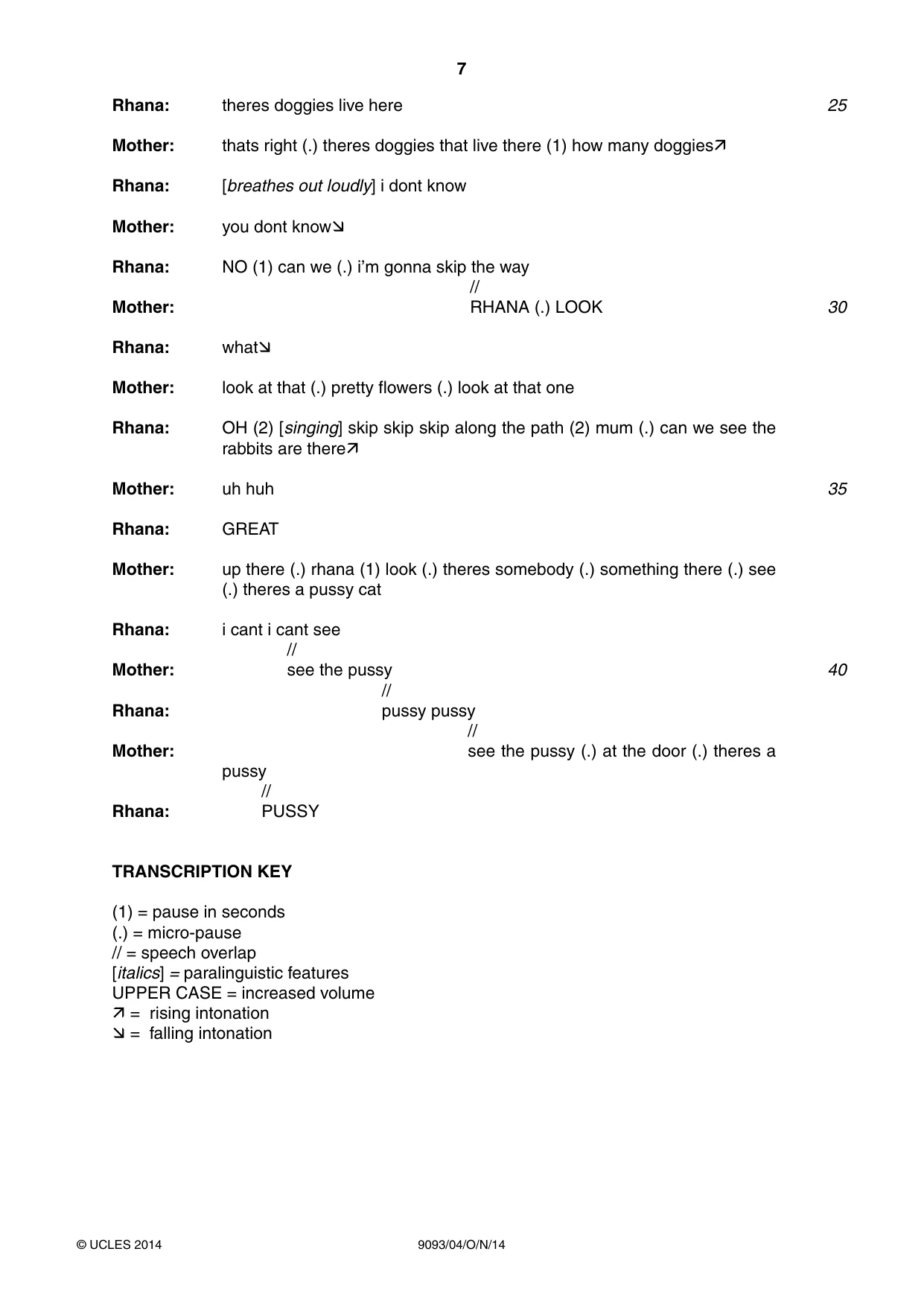
7 9093/04/O/N/14 © UCLES 2014 Rhana: theres doggies live here Mother: thats right (.) theres doggies that live there (1) how many doggies Rhana: [breathes out loudly] i dont know Mother: you dont know Rhana: NO (1) can we (.) i’m gonna skip the way // Mother: RHANA (.) LOOK Rhana: what Mother: look at that (.) pretty flowers (.) look at that one Rhana: OH (2) [singing] skip skip skip along the path (2) mum (.) can we see the rabbits are there Mother: uh huh Rhana: GREAT Mother: up there (.) rhana (1) look (.) theres somebody (.) something there (.) see (.) theres a pussy cat Rhana: i cant i cant see // Mother: see the pussy // Rhana: pussy pussy // Mother: see the pussy (.) at the door (.) theres a pussy // Rhana: PUSSY TRANSCRIPTION KEY (1) = pause in seconds (.) = micro-pause // = speech overlap [italics] = paralinguistic features UPPER CASE = increased volume = rising intonation = falling intonation 25 30 35 40
Question paper, page 8
8 9093/04/O/N/14 © UCLES 2014 Copyright Acknowledgements: Question 1 © Transcription of conversation involving four university students in the last year of their studies; http://www.scottishcorpus.ac.uk/corpus/search/document.php?documentid=804. Question 2 © Extracts from a web magazine devoted to English-language teaching in Nepal; http://ewresearch.wordpress.com/2012/09/28/english-as-an-official-language-in-nepal/. Question 3 © Transcription of conversation involving mother and five-year-old-child; http://www.scottishcorpus.ac.uk/corpus/search/document.php?documentid=1583. Permission to reproduce items where third-party owned material protected by copyright is included has been sought and cleared where possible. Every reasonable effort has been made by the publisher (UCLES) to trace copyright holders, but if any items requiring clearance have unwittingly been included, the publisher will be pleased to make amends at the earliest possible opportunity. Cambridge International Examinations is part of the Cambridge Assessment Group. Cambridge Assessment is the brand name of University of Cambridge Local Examinations Syndicate (UCLES), which is itself a department of the University of Cambridge. BLANK PAGE
Mark scheme, page 1
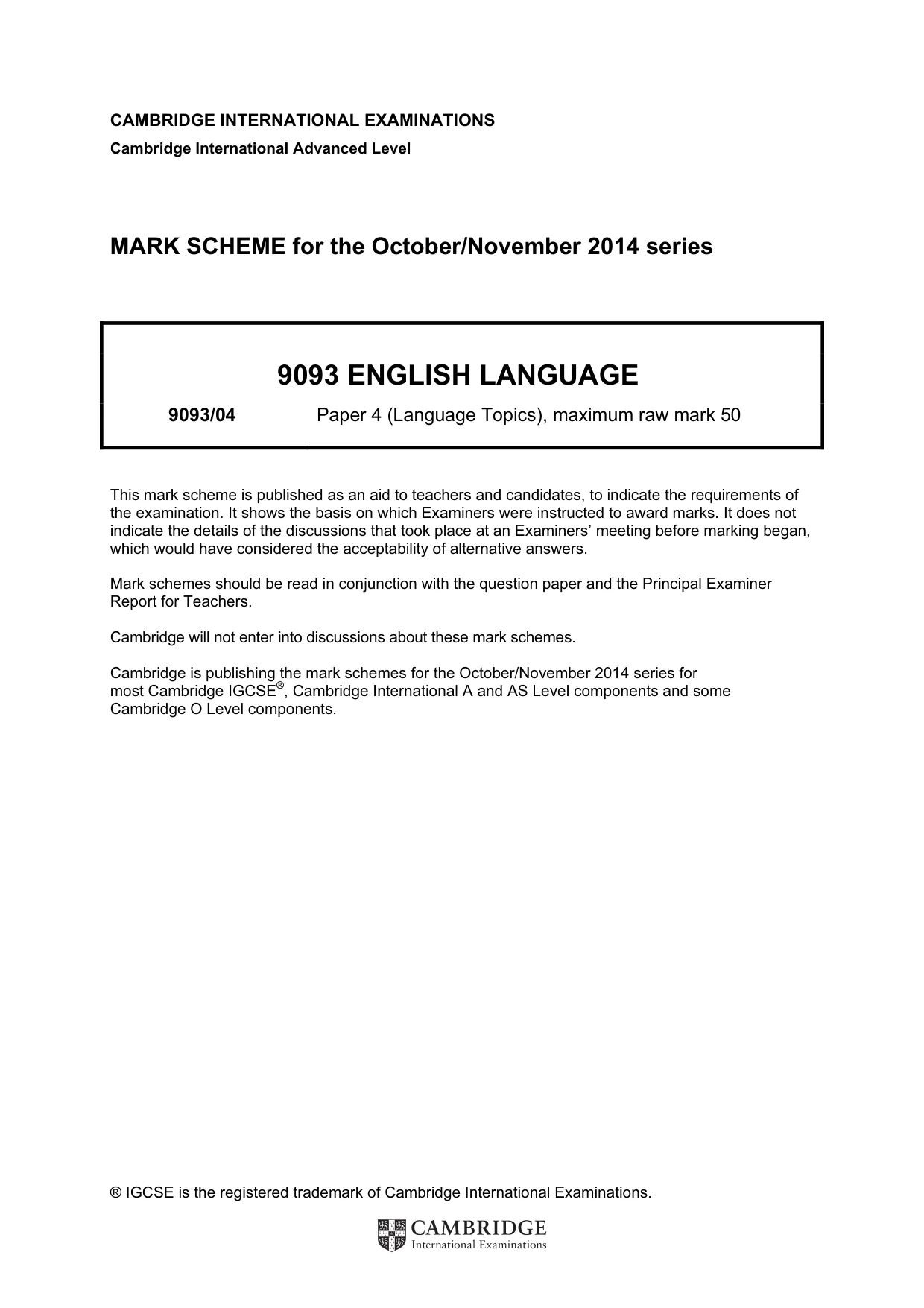
® IGCSE is the registered trademark of Cambridge International Examinations. CAMBRIDGE INTERNATIONAL EXAMINATIONS Cambridge International Advanced Level MARK SCHEME for the October/November 2014 series 9093 ENGLISH LANGUAGE 9093/04 Paper 4 (Language Topics), maximum raw mark 50 This mark scheme is published as an aid to teachers and candidates, to indicate the requirements of the examination. It shows the basis on which Examiners were instructed to award marks. It does not indicate the details of the discussions that took place at an Examiners’ meeting before marking began, which would have considered the acceptability of alternative answers. Mark schemes should be read in conjunction with the question paper and the Principal Examiner Report for Teachers. Cambridge will not enter into discussions about these mark schemes. Cambridge is publishing the mark schemes for the October/November 2014 series for most Cambridge IGCSE®, Cambridge International A and AS Level components and some Cambridge O Level components.
Mark scheme, page 2
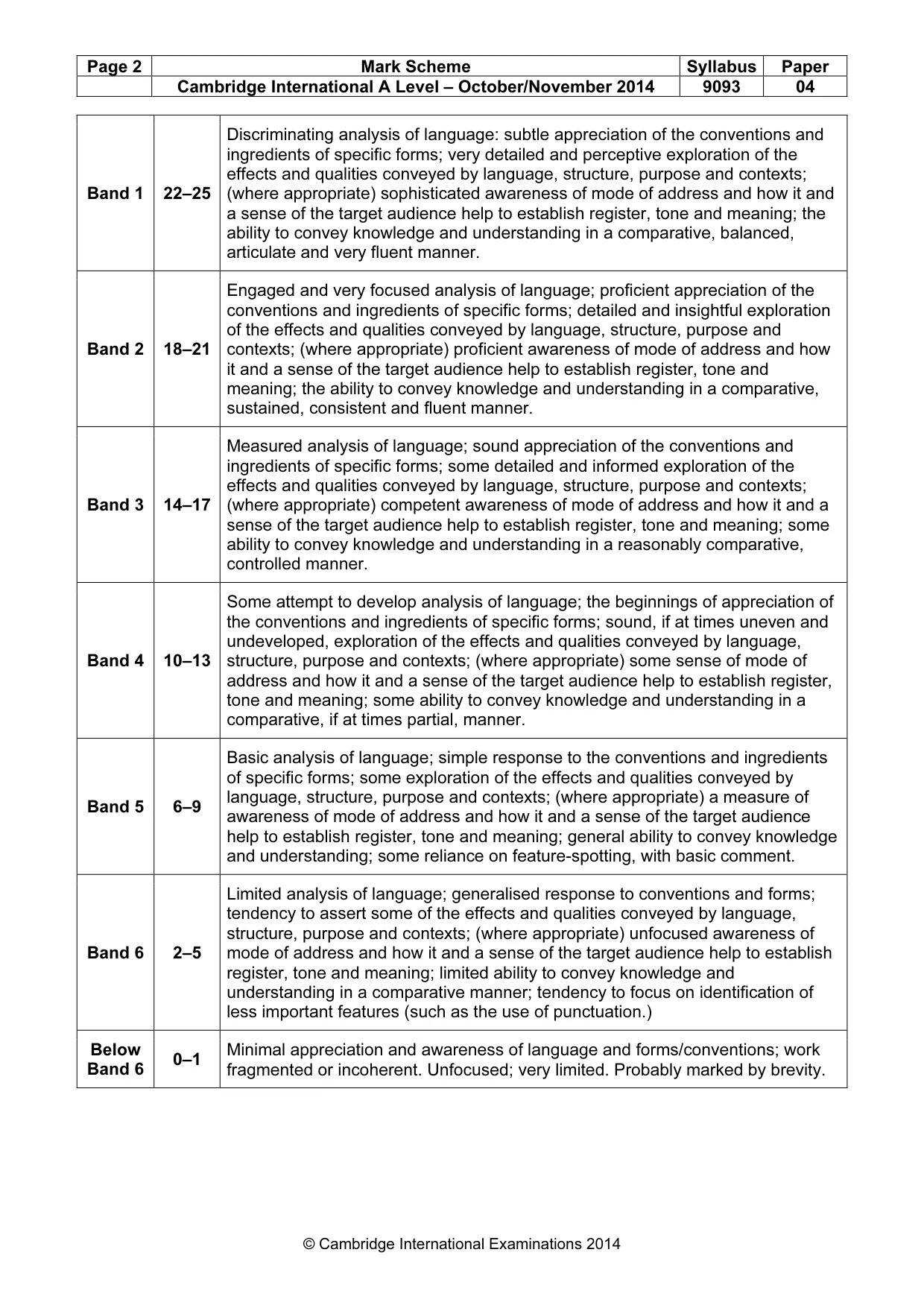
Page 2 Mark Scheme Syllabus Paper Cambridge International A Level – October/November 2014 9093 04 © Cambridge International Examinations 2014 Band 1 22–25 Discriminating analysis of language: subtle appreciation of the conventions and ingredients of specific forms; very detailed and perceptive exploration of the effects and qualities conveyed by language, structure, purpose and contexts; (where appropriate) sophisticated awareness of mode of address and how it and a sense of the target audience help to establish register, tone and meaning; the ability to convey knowledge and understanding in a comparative, balanced, articulate and very fluent manner. Band 2 18–21 Engaged and very focused analysis of language; proficient appreciation of the conventions and ingredients of specific forms; detailed and insightful exploration of the effects and qualities conveyed by language, structure, purpose and contexts; (where appropriate) proficient awareness of mode of address and how it and a sense of the target audience help to establish register, tone and meaning; the ability to convey knowledge and understanding in a comparative, sustained, consistent and fluent manner. Band 3 14–17 Measured analysis of language; sound appreciation of the conventions and ingredients of specific forms; some detailed and informed exploration of the effects and qualities conveyed by language, structure, purpose and contexts; (where appropriate) competent awareness of mode of address and how it and a sense of the target audience help to establish register, tone and meaning; some ability to convey knowledge and understanding in a reasonably comparative, controlled manner. Band 4 10–13 Some attempt to develop analysis of language; the beginnings of appreciation of the conventions and ingredients of specific forms; sound, if at times uneven and undeveloped, exploration of the effects and qualities conveyed by language, structure, purpose and contexts; (where appropriate) some sense of mode of address and how it and a sense of the target audience help to establish register, tone and meaning; some ability to convey knowledge and understanding in a comparative, if at times partial, manner. Band 5 6–9 Basic analysis of language; simple response to the conventions and ingredients of specific forms; some exploration of the effects and qualities conveyed by language, structure, purpose and contexts; (where appropriate) a measure of awareness of mode of address and how it and a sense of the target audience help to establish register, tone and meaning; general ability to convey knowledge and understanding; some reliance on feature-spotting, with basic comment. Band 6 2–5 Limited analysis of language; generalised response to conventions and forms; tendency to assert some of the effects and qualities conveyed by language, structure, purpose and contexts; (where appropriate) unfocused awareness of mode of address and how it and a sense of the target audience help to establish register, tone and meaning; limited ability to convey knowledge and understanding in a comparative manner; tendency to focus on identification of less important features (such as the use of punctuation.) Below Band 6 0–1 Minimal appreciation and awareness of language and forms/conventions; work fragmented or incoherent. Unfocused; very limited. Probably marked by brevity.
What you needed in this session
Cambridge’s own grade thresholds for 2014 Oct/Nov, Paper 4 · Variant 1. A higher threshold means an easier paper — the bar moves with how the cohort did.