Cambridge A Level Economics 9708 — 2020 Oct/Nov Paper 4 · Variant 1
9708/41/O/N/20 · 70 marks · ≈79 min
The question paper and its mark scheme, free to read here and free to download. This is Cambridge’s own paper, exactly as it was sat.
Question paper4 pages

Mark scheme10 pages
Answers below. Sit the paper first if you are practising.


Paper as text
Question paper, page 1
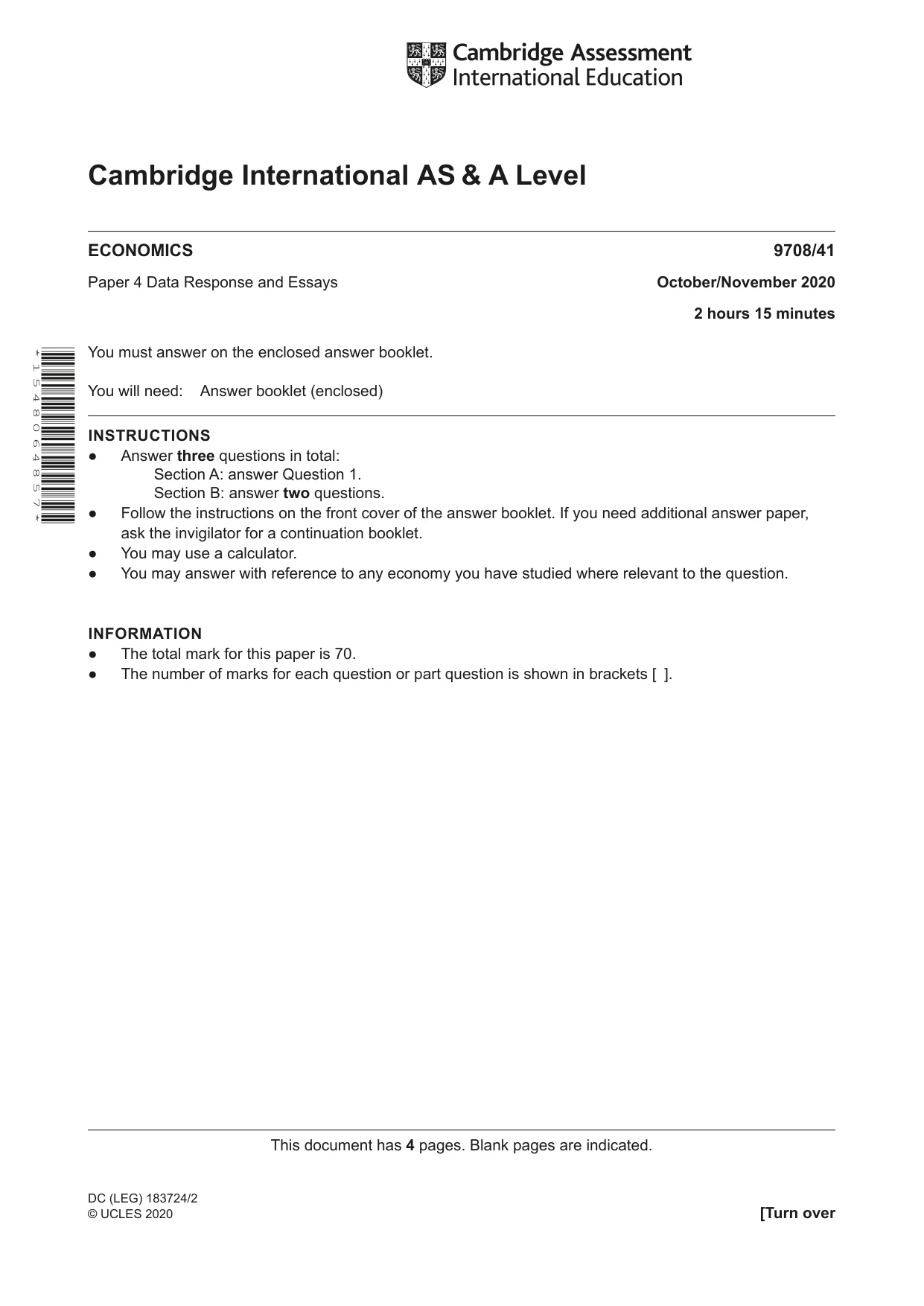
Cambridge International AS & A Level * 1 5 4 8 0 6 4 8 5 7 * DC (LEG) 183724/2 © UCLES 2020 [Turn over This document has 4 pages. Blank pages are indicated. ECONOMICS 9708/41 Paper 4 Data Response and Essays October/November 2020 2 hours 15 minutes You must answer on the enclosed answer booklet. You will need: Answer booklet (enclosed) INSTRUCTIONS ● Answer three questions in total: Section A: answer Question 1. Section B: answer two questions. ● Follow the instructions on the front cover of the answer booklet. If you need additional answer paper, ask the invigilator for a continuation booklet. ● You may use a calculator. ● You may answer with reference to any economy you have studied where relevant to the question. INFORMATION ● The total mark for this paper is 70. ● The number of marks for each question or part question is shown in brackets [ ].
Question paper, page 2
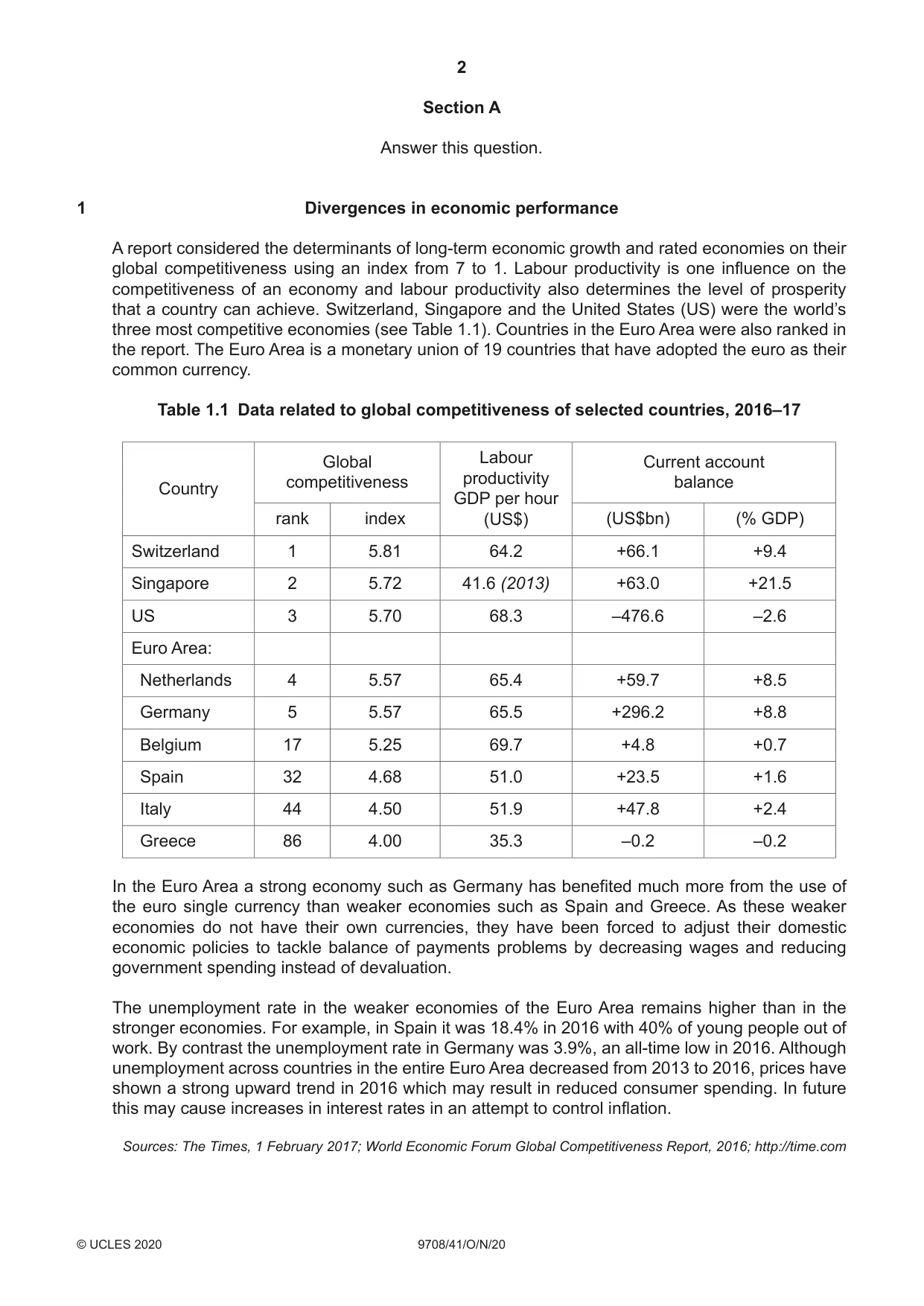
2 9708/41/O/N/20 © UCLES 2020 Section A Answer this question. 1 Divergences in economic performance A report considered the determinants of long-term economic growth and rated economies on their global competitiveness using an index from 7 to 1. Labour productivity is one influence on the competitiveness of an economy and labour productivity also determines the level of prosperity that a country can achieve. Switzerland, Singapore and the United States (US) were the world’s three most competitive economies (see Table 1.1). Countries in the Euro Area were also ranked in the report. The Euro Area is a monetary union of 19 countries that have adopted the euro as their common currency. Table 1.1 Data related to global competitiveness of selected countries, 2016–17 Country Global competitiveness Labour productivity GDP per hour (US$) Current account balance rank index (US$bn) (% GDP) Switzerland 1 5.81 64.2 +66.1 +9.4 Singapore 2 5.72 41.6 (2013) +63.0 +21.5 US 3 5.70 68.3 –476.6 –2.6 Euro Area: Netherlands 4 5.57 65.4 +59.7 +8.5 Germany 5 5.57 65.5 +296.2 +8.8 Belgium 17 5.25 69.7 +4.8 +0.7 Spain 32 4.68 51.0 +23.5 +1.6 Italy 44 4.50 51.9 +47.8 +2.4 Greece 86 4.00 35.3 –0.2 –0.2 In the Euro Area a strong economy such as Germany has benefited much more from the use of the euro single currency than weaker economies such as Spain and Greece. As these weaker economies do not have their own currencies, they have been forced to adjust their domestic economic policies to tackle balance of payments problems by decreasing wages and reducing government spending instead of devaluation. The unemployment rate in the weaker economies of the Euro Area remains higher than in the stronger economies. For example, in Spain it was 18.4% in 2016 with 40% of young people out of work. By contrast the unemployment rate in Germany was 3.9%, an all-time low in 2016. Although unemployment across countries in the entire Euro Area decreased from 2013 to 2016, prices have shown a strong upward trend in 2016 which may result in reduced consumer spending. In future this may cause increases in interest rates in an attempt to control inflation. Sources: The Times, 1 February 2017; World Economic Forum Global Competitiveness Report, 2016; http://time.com
Question paper, page 3
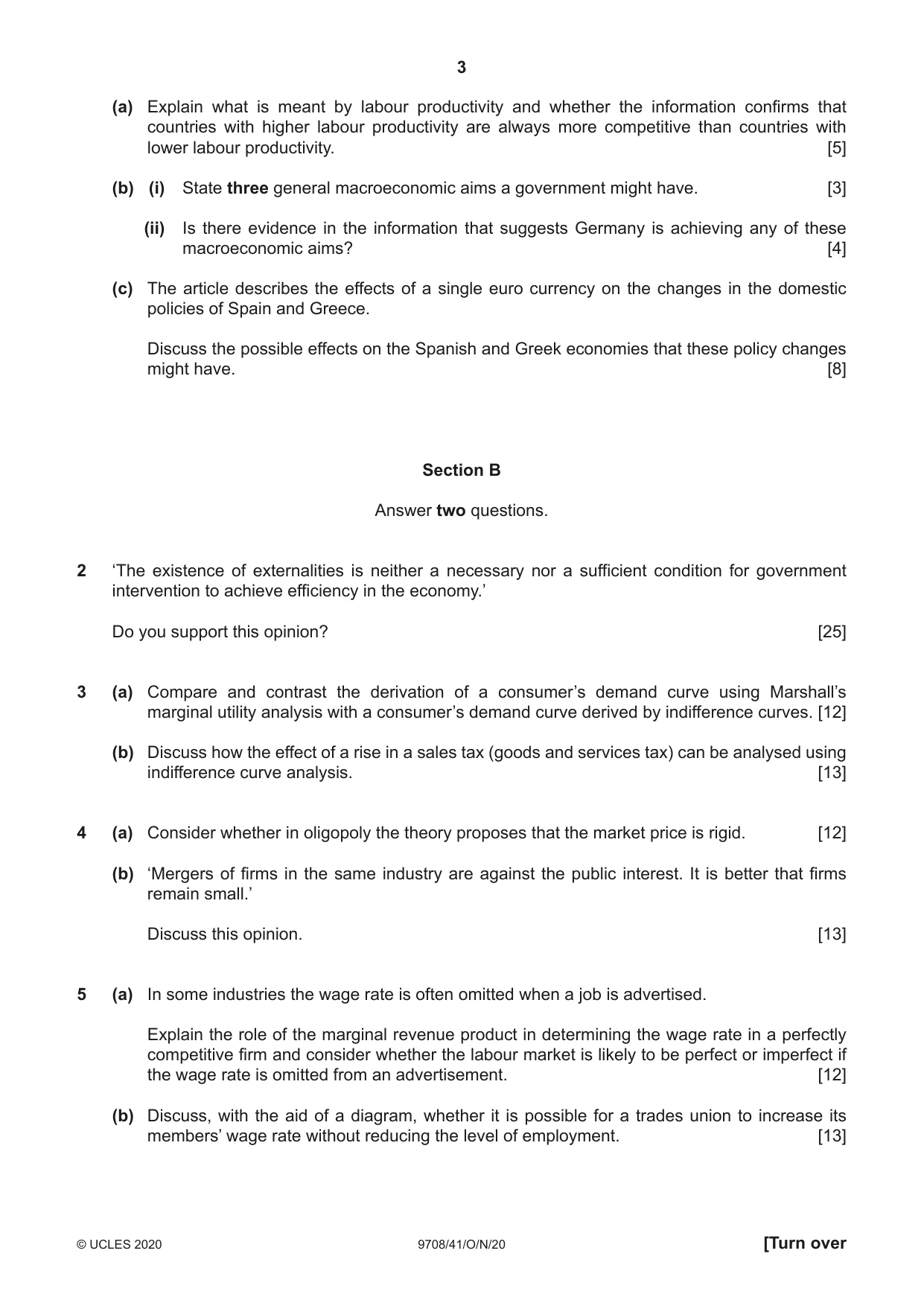
3 9708/41/O/N/20 © UCLES 2020 [Turn over (a) Explain what is meant by labour productivity and whether the information confirms that countries with higher labour productivity are always more competitive than countries with lower labour productivity. [5] (b) (i) State three general macroeconomic aims a government might have. [3] (ii) Is there evidence in the information that suggests Germany is achieving any of these macroeconomic aims? [4] (c) The article describes the effects of a single euro currency on the changes in the domestic policies of Spain and Greece. Discuss the possible effects on the Spanish and Greek economies that these policy changes might have. [8] Section B Answer two questions. 2 ‘The existence of externalities is neither a necessary nor a sufficient condition for government intervention to achieve efficiency in the economy.’ Do you support this opinion? [25] 3 (a) Compare and contrast the derivation of a consumer’s demand curve using Marshall’s marginal utility analysis with a consumer’s demand curve derived by indifference curves. [12] (b) Discuss how the effect of a rise in a sales tax (goods and services tax) can be analysed using indifference curve analysis. [13] 4 (a) Consider whether in oligopoly the theory proposes that the market price is rigid. [12] (b) ‘Mergers of firms in the same industry are against the public interest. It is better that firms remain small.’ Discuss this opinion. [13] 5 (a) In some industries the wage rate is often omitted when a job is advertised. Explain the role of the marginal revenue product in determining the wage rate in a perfectly competitive firm and consider whether the labour market is likely to be perfect or imperfect if the wage rate is omitted from an advertisement. [12] (b) Discuss, with the aid of a diagram, whether it is possible for a trades union to increase its members’ wage rate without reducing the level of employment. [13]
Question paper, page 4
4 9708/41/O/N/20 © UCLES 2020 Permission to reproduce items where third-party owned material protected by copyright is included has been sought and cleared where possible. Every reasonable effort has been made by the publisher (UCLES) to trace copyright holders, but if any items requiring clearance have unwittingly been included, the publisher will be pleased to make amends at the earliest possible opportunity. To avoid the issue of disclosure of answer-related information to candidates, all copyright acknowledgements are reproduced online in the Cambridge Assessment International Education Copyright Acknowledgements Booklet. This is produced for each series of examinations and is freely available to download at www.cambridgeinternational.org after the live examination series. Cambridge Assessment International Education is part of the Cambridge Assessment Group. Cambridge Assessment is the brand name of the University of Cambridge Local Examinations Syndicate (UCLES), which itself is a department of the University of Cambridge. 6 ‘The use of quantitative easing (QE) has the same effect on the economy as the use of Keynesian fiscal demand management policy. Both policies create employment in the short run at the expense of inflation in the long run.’ How far would you support this view? [25] 7 (a) Explain the economic costs of unemployment and consider which is the most important. [12] (b) ‘Government intervention in supply-side policies will not have a significant impact on unemployment whereas supply-side policies that increase aggregate demand because of a freer market will significantly reduce the level of unemployment.’ Discuss this statement. [13]
Mark scheme, page 1
This document consists of 10 printed pages. © UCLES 2020 [Turn over Cambridge International AS & A Level ECONOMICS 9708/41 Paper 4 Data Response and Essays October/November 2020 MARK SCHEME Maximum Mark: 70 Published This mark scheme is published as an aid to teachers and candidates, to indicate the requirements of the examination. It shows the basis on which Examiners were instructed to award marks. It does not indicate the details of the discussions that took place at an Examiners’ meeting before marking began, which would have considered the acceptability of alternative answers. Mark schemes should be read in conjunction with the question paper and the Principal Examiner Report for Teachers. Cambridge International will not enter into discussions about these mark schemes. Cambridge International is publishing the mark schemes for the October/November 2020 series for most Cambridge IGCSE™, Cambridge International A and AS Level and Cambridge Pre-U components, and some Cambridge O Level components.
Mark scheme, page 2
9708/41 Cambridge International AS & A Level – Mark Scheme PUBLISHED October/November 2020 © UCLES 2020 Page 2 of 10 Generic Marking Principles These general marking principles must be applied by all examiners when marking candidate answers. They should be applied alongside the specific content of the mark scheme or generic level descriptors for a question. Each question paper and mark scheme will also comply with these marking principles. GENERIC MARKING PRINCIPLE 1: Marks must be awarded in line with: • the specific content of the mark scheme or the generic level descriptors for the question • the specific skills defined in the mark scheme or in the generic level descriptors for the question • the standard of response required by a candidate as exemplified by the standardisation scripts. GENERIC MARKING PRINCIPLE 2: Marks awarded are always whole marks (not half marks, or other fractions). GENERIC MARKING PRINCIPLE 3: Marks must be awarded positively: • marks are awarded for correct/valid answers, as defined in the mark scheme. However, credit is given for valid answers which go beyond the scope of the syllabus and mark scheme, referring to your Team Leader as appropriate • marks are awarded when candidates clearly demonstrate what they know and can do • marks are not deducted for errors • marks are not deducted for omissions • answers should only be judged on the quality of spelling, punctuation and grammar when these features are specifically assessed by the question as indicated by the mark scheme. The meaning, however, should be unambiguous. GENERIC MARKING PRINCIPLE 4: Rules must be applied consistently, e.g. in situations where candidates have not followed instructions or in the application of generic level descriptors. GENERIC MARKING PRINCIPLE 5: Marks should be awarded using the full range of marks defined in the mark scheme for the question (however; the use of the full mark range may be limited according to the quality of the candidate responses seen). GENERIC MARKING PRINCIPLE 6: Marks awarded are based solely on the requirements as defined in the mark scheme. Marks should not be awarded with grade thresholds or grade descriptors in mind.
Mark scheme, page 3
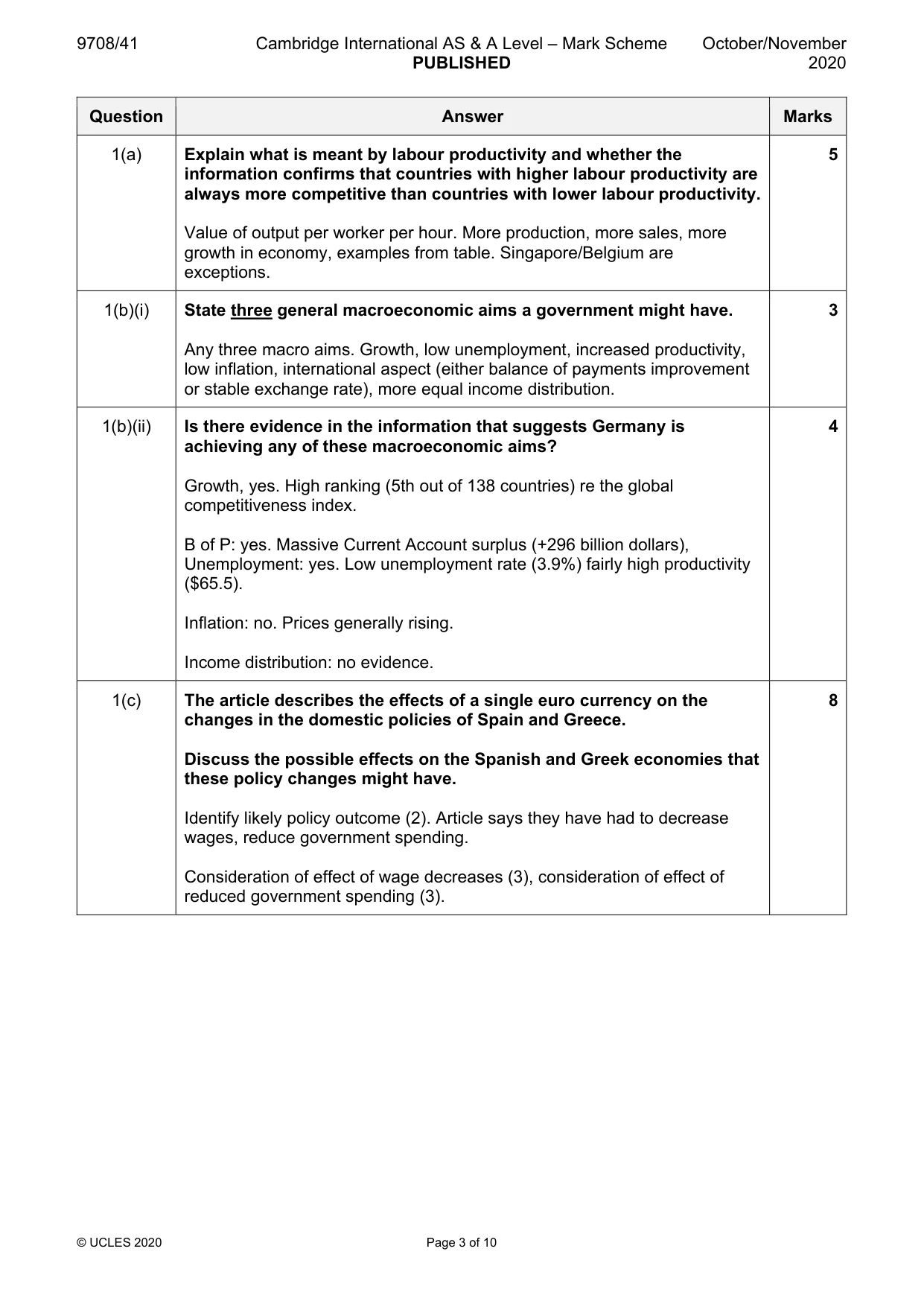
9708/41 Cambridge International AS & A Level – Mark Scheme PUBLISHED October/November 2020 © UCLES 2020 Page 3 of 10 Question Answer Marks 1(a) Explain what is meant by labour productivity and whether the information confirms that countries with higher labour productivity are always more competitive than countries with lower labour productivity. Value of output per worker per hour. More production, more sales, more growth in economy, examples from table. Singapore/Belgium are exceptions. 5 1(b)(i) State three general macroeconomic aims a government might have. Any three macro aims. Growth, low unemployment, increased productivity, low inflation, international aspect (either balance of payments improvement or stable exchange rate), more equal income distribution. 3 1(b)(ii) Is there evidence in the information that suggests Germany is achieving any of these macroeconomic aims? Growth, yes. High ranking (5th out of 138 countries) re the global competitiveness index. B of P: yes. Massive Current Account surplus (+296 billion dollars), Unemployment: yes. Low unemployment rate (3.9%) fairly high productivity ($65.5). Inflation: no. Prices generally rising. Income distribution: no evidence. 4 1(c) The article describes the effects of a single euro currency on the changes in the domestic policies of Spain and Greece. Discuss the possible effects on the Spanish and Greek economies that these policy changes might have. Identify likely policy outcome (2). Article says they have had to decrease wages, reduce government spending. Consideration of effect of wage decreases (3), consideration of effect of reduced government spending (3). 8
Mark scheme, page 4
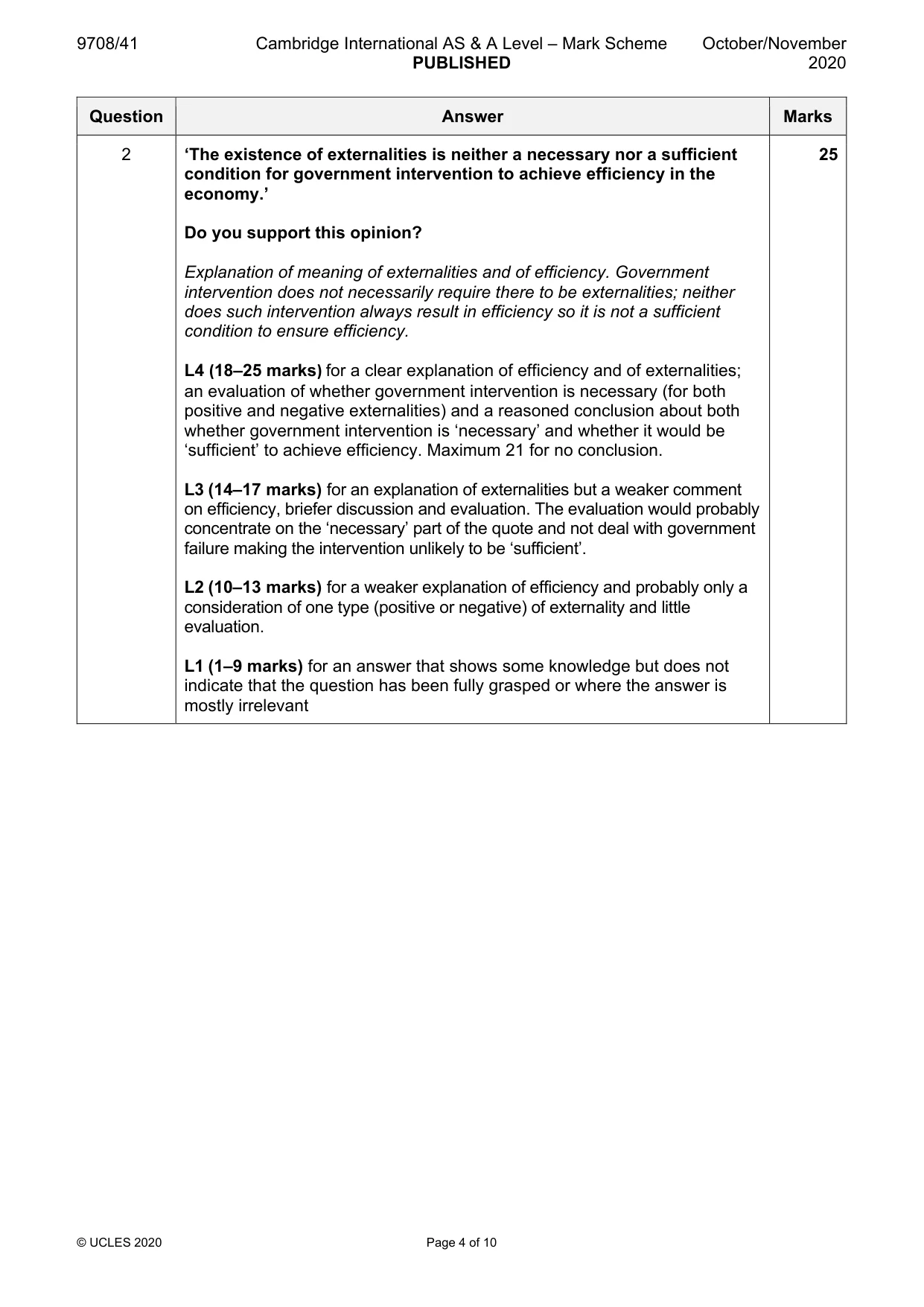
9708/41 Cambridge International AS & A Level – Mark Scheme PUBLISHED October/November 2020 © UCLES 2020 Page 4 of 10 Question Answer Marks 2 ‘The existence of externalities is neither a necessary nor a sufficient condition for government intervention to achieve efficiency in the economy.’ Do you support this opinion? Explanation of meaning of externalities and of efficiency. Government intervention does not necessarily require there to be externalities; neither does such intervention always result in efficiency so it is not a sufficient condition to ensure efficiency. L4 (18–25 marks) for a clear explanation of efficiency and of externalities; an evaluation of whether government intervention is necessary (for both positive and negative externalities) and a reasoned conclusion about both whether government intervention is ‘necessary’ and whether it would be ‘sufficient’ to achieve efficiency. Maximum 21 for no conclusion. L3 (14–17 marks) for an explanation of externalities but a weaker comment on efficiency, briefer discussion and evaluation. The evaluation would probably concentrate on the ‘necessary’ part of the quote and not deal with government failure making the intervention unlikely to be ‘sufficient’. L2 (10–13 marks) for a weaker explanation of efficiency and probably only a consideration of one type (positive or negative) of externality and little evaluation. L1 (1–9 marks) for an answer that shows some knowledge but does not indicate that the question has been fully grasped or where the answer is mostly irrelevant 25
Mark scheme, page 5
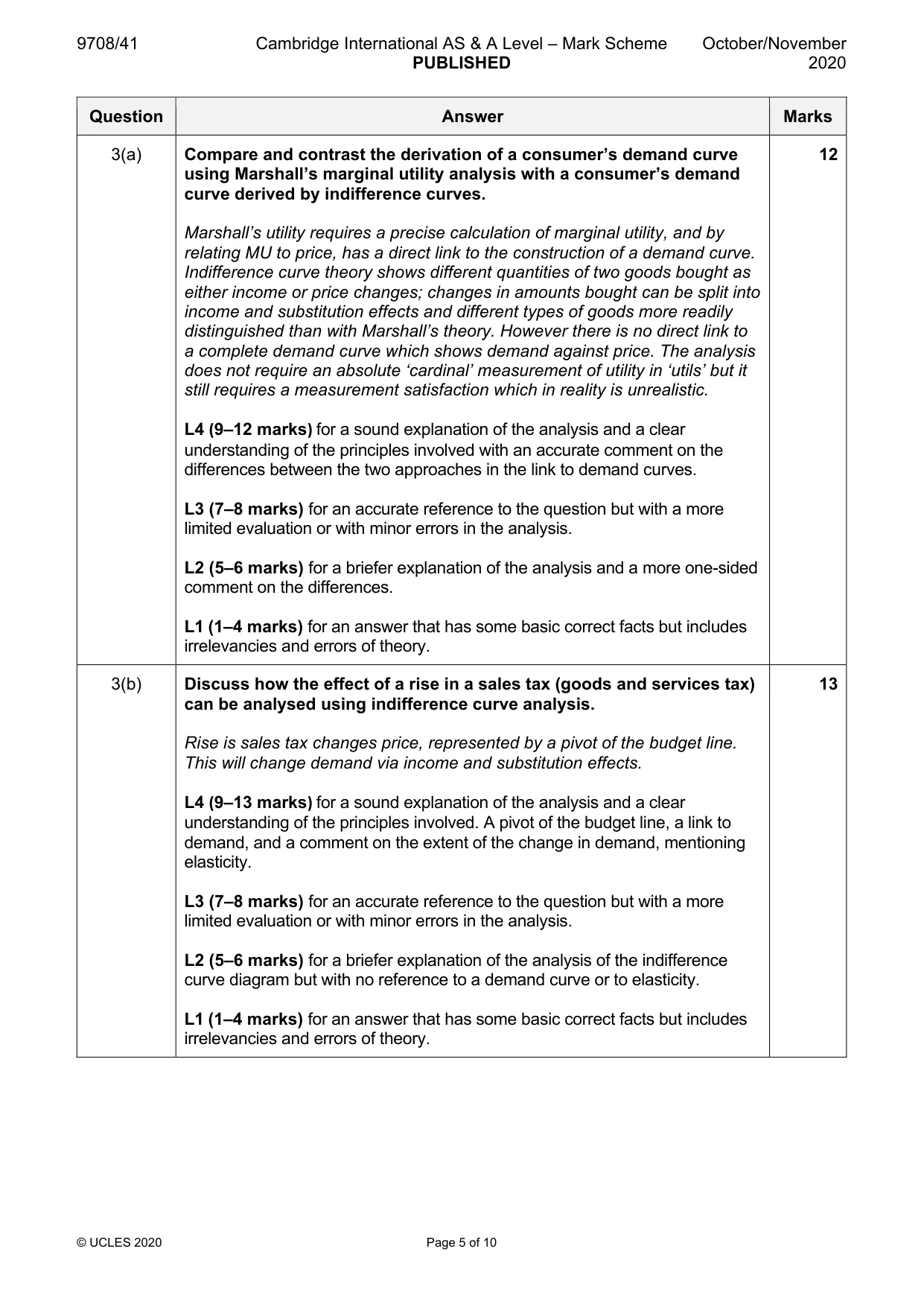
9708/41 Cambridge International AS & A Level – Mark Scheme PUBLISHED October/November 2020 © UCLES 2020 Page 5 of 10 Question Answer Marks 3(a) Compare and contrast the derivation of a consumer’s demand curve using Marshall’s marginal utility analysis with a consumer’s demand curve derived by indifference curves. Marshall’s utility requires a precise calculation of marginal utility, and by relating MU to price, has a direct link to the construction of a demand curve. Indifference curve theory shows different quantities of two goods bought as either income or price changes; changes in amounts bought can be split into income and substitution effects and different types of goods more readily distinguished than with Marshall’s theory. However there is no direct link to a complete demand curve which shows demand against price. The analysis does not require an absolute ‘cardinal’ measurement of utility in ‘utils’ but it still requires a measurement satisfaction which in reality is unrealistic. L4 (9–12 marks) for a sound explanation of the analysis and a clear understanding of the principles involved with an accurate comment on the differences between the two approaches in the link to demand curves. L3 (7–8 marks) for an accurate reference to the question but with a more limited evaluation or with minor errors in the analysis. L2 (5–6 marks) for a briefer explanation of the analysis and a more one-sided comment on the differences. L1 (1–4 marks) for an answer that has some basic correct facts but includes irrelevancies and errors of theory. 12 3(b) Discuss how the effect of a rise in a sales tax (goods and services tax) can be analysed using indifference curve analysis. Rise is sales tax changes price, represented by a pivot of the budget line. This will change demand via income and substitution effects. L4 (9–13 marks) for a sound explanation of the analysis and a clear understanding of the principles involved. A pivot of the budget line, a link to demand, and a comment on the extent of the change in demand, mentioning elasticity. L3 (7–8 marks) for an accurate reference to the question but with a more limited evaluation or with minor errors in the analysis. L2 (5–6 marks) for a briefer explanation of the analysis of the indifference curve diagram but with no reference to a demand curve or to elasticity. L1 (1–4 marks) for an answer that has some basic correct facts but includes irrelevancies and errors of theory. 13
Mark scheme, page 6
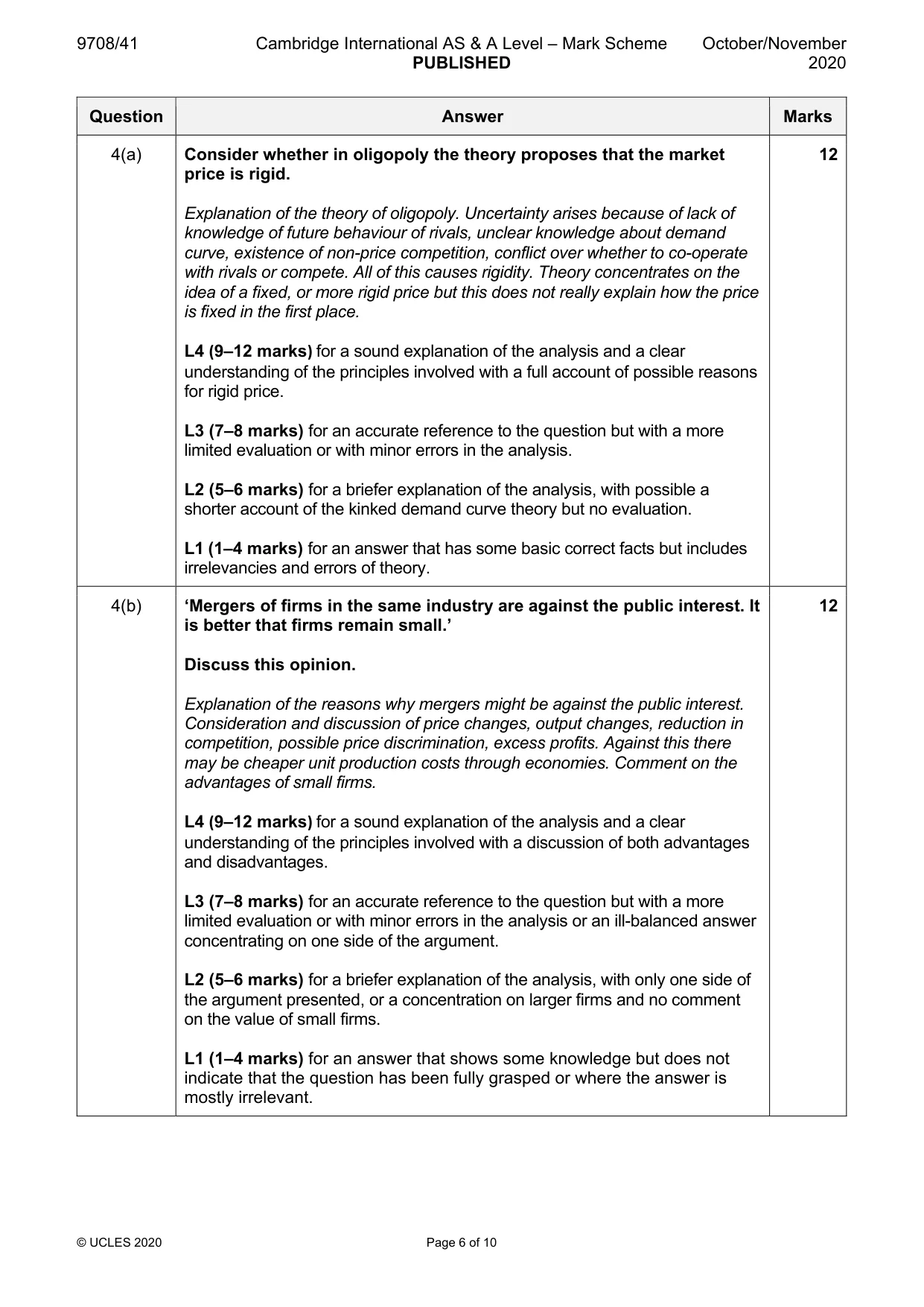
9708/41 Cambridge International AS & A Level – Mark Scheme PUBLISHED October/November 2020 © UCLES 2020 Page 6 of 10 Question Answer Marks 4(a) Consider whether in oligopoly the theory proposes that the market price is rigid. Explanation of the theory of oligopoly. Uncertainty arises because of lack of knowledge of future behaviour of rivals, unclear knowledge about demand curve, existence of non-price competition, conflict over whether to co-operate with rivals or compete. All of this causes rigidity. Theory concentrates on the idea of a fixed, or more rigid price but this does not really explain how the price is fixed in the first place. L4 (9–12 marks) for a sound explanation of the analysis and a clear understanding of the principles involved with a full account of possible reasons for rigid price. L3 (7–8 marks) for an accurate reference to the question but with a more limited evaluation or with minor errors in the analysis. L2 (5–6 marks) for a briefer explanation of the analysis, with possible a shorter account of the kinked demand curve theory but no evaluation. L1 (1–4 marks) for an answer that has some basic correct facts but includes irrelevancies and errors of theory. 12 4(b) ‘Mergers of firms in the same industry are against the public interest. It is better that firms remain small.’ Discuss this opinion. Explanation of the reasons why mergers might be against the public interest. Consideration and discussion of price changes, output changes, reduction in competition, possible price discrimination, excess profits. Against this there may be cheaper unit production costs through economies. Comment on the advantages of small firms. L4 (9–12 marks) for a sound explanation of the analysis and a clear understanding of the principles involved with a discussion of both advantages and disadvantages. L3 (7–8 marks) for an accurate reference to the question but with a more limited evaluation or with minor errors in the analysis or an ill-balanced answer concentrating on one side of the argument. L2 (5–6 marks) for a briefer explanation of the analysis, with only one side of the argument presented, or a concentration on larger firms and no comment on the value of small firms. L1 (1–4 marks) for an answer that shows some knowledge but does not indicate that the question has been fully grasped or where the answer is mostly irrelevant. 12
Mark scheme, page 7
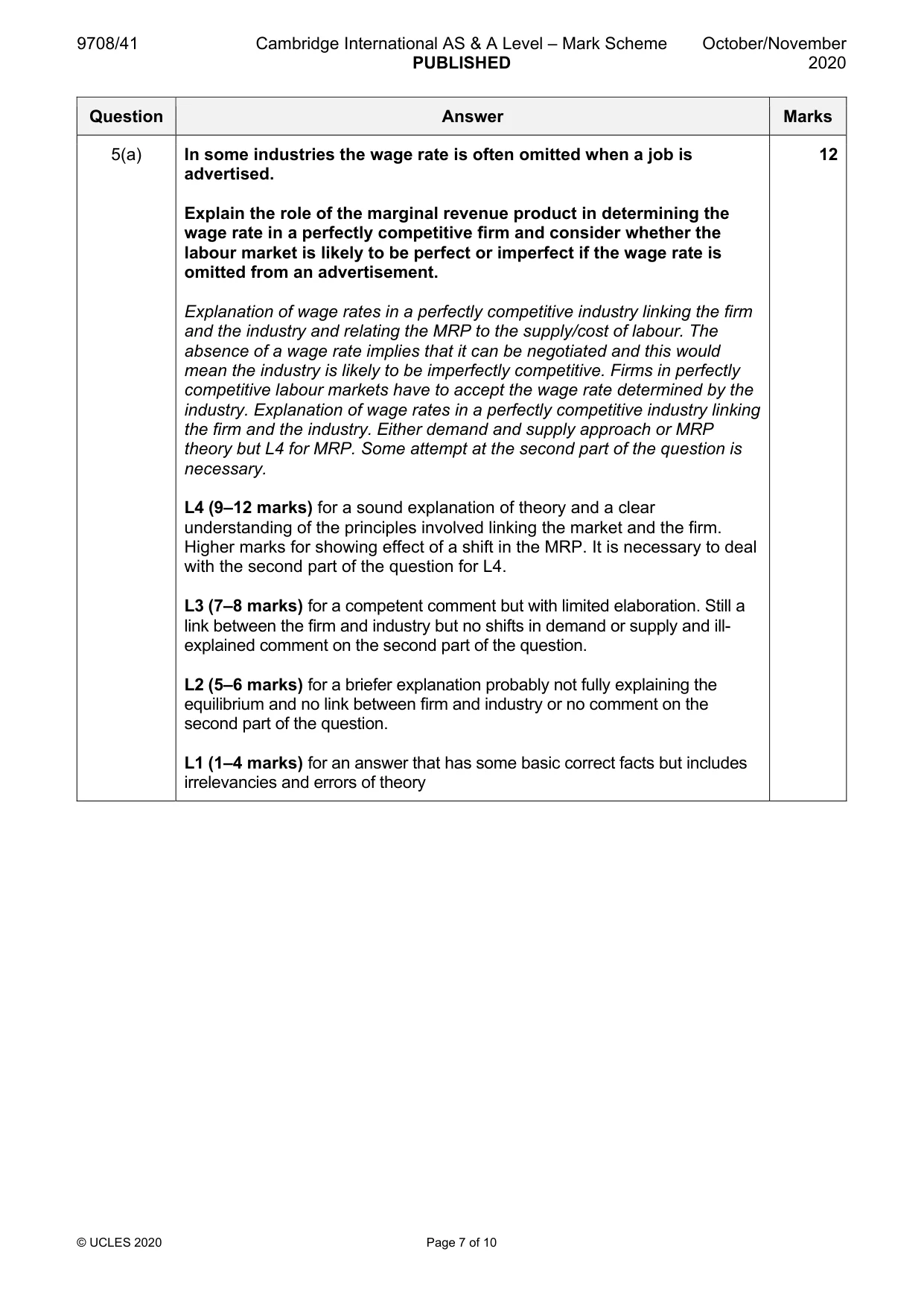
9708/41 Cambridge International AS & A Level – Mark Scheme PUBLISHED October/November 2020 © UCLES 2020 Page 7 of 10 Question Answer Marks 5(a) In some industries the wage rate is often omitted when a job is advertised. Explain the role of the marginal revenue product in determining the wage rate in a perfectly competitive firm and consider whether the labour market is likely to be perfect or imperfect if the wage rate is omitted from an advertisement. Explanation of wage rates in a perfectly competitive industry linking the firm and the industry and relating the MRP to the supply/cost of labour. The absence of a wage rate implies that it can be negotiated and this would mean the industry is likely to be imperfectly competitive. Firms in perfectly competitive labour markets have to accept the wage rate determined by the industry. Explanation of wage rates in a perfectly competitive industry linking the firm and the industry. Either demand and supply approach or MRP theory but L4 for MRP. Some attempt at the second part of the question is necessary. L4 (9–12 marks) for a sound explanation of theory and a clear understanding of the principles involved linking the market and the firm. Higher marks for showing effect of a shift in the MRP. It is necessary to deal with the second part of the question for L4. L3 (7–8 marks) for a competent comment but with limited elaboration. Still a link between the firm and industry but no shifts in demand or supply and ill- explained comment on the second part of the question. L2 (5–6 marks) for a briefer explanation probably not fully explaining the equilibrium and no link between firm and industry or no comment on the second part of the question. L1 (1–4 marks) for an answer that has some basic correct facts but includes irrelevancies and errors of theory 12
Mark scheme, page 8
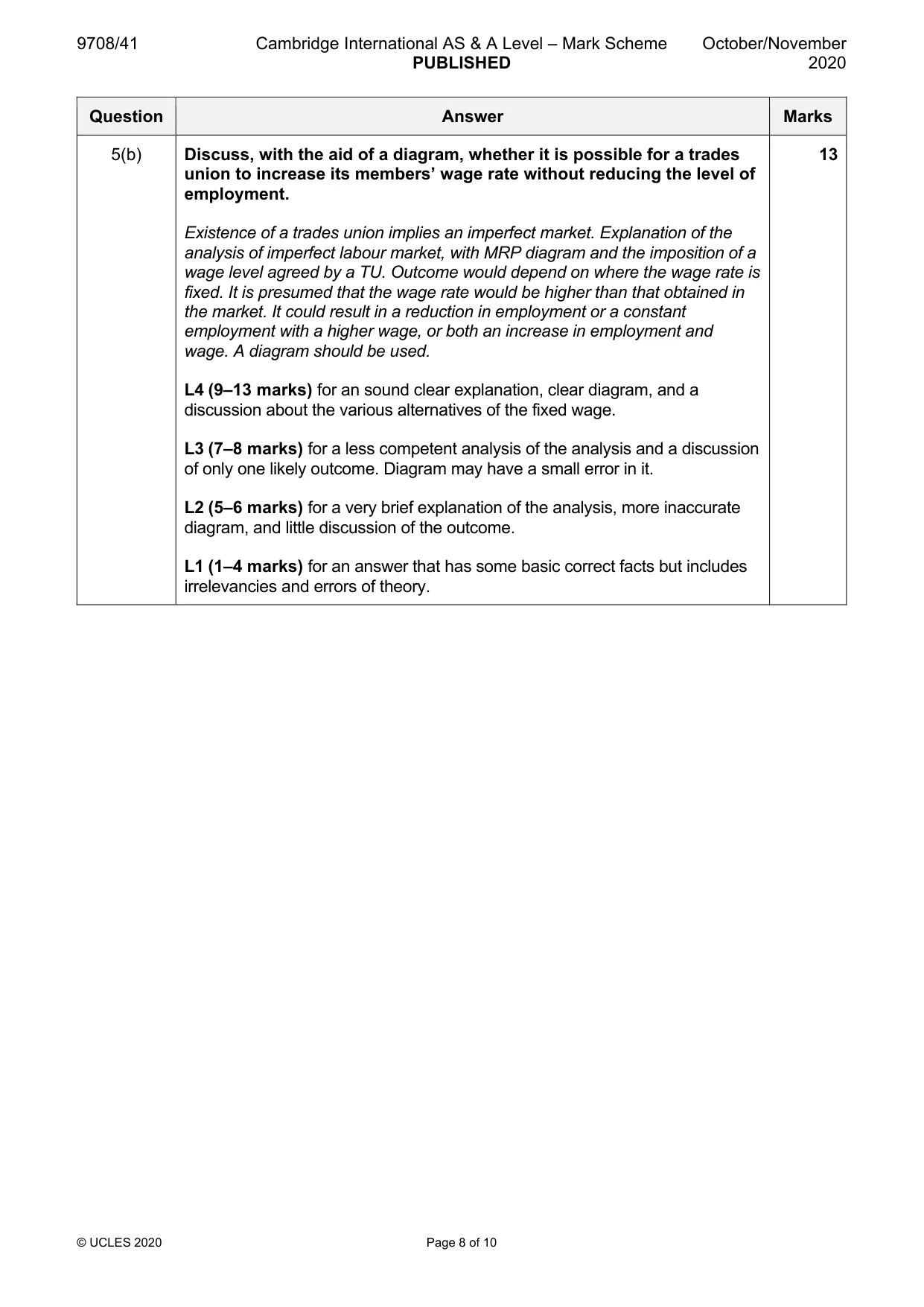
9708/41 Cambridge International AS & A Level – Mark Scheme PUBLISHED October/November 2020 © UCLES 2020 Page 8 of 10 Question Answer Marks 5(b) Discuss, with the aid of a diagram, whether it is possible for a trades union to increase its members’ wage rate without reducing the level of employment. Existence of a trades union implies an imperfect market. Explanation of the analysis of imperfect labour market, with MRP diagram and the imposition of a wage level agreed by a TU. Outcome would depend on where the wage rate is fixed. It is presumed that the wage rate would be higher than that obtained in the market. It could result in a reduction in employment or a constant employment with a higher wage, or both an increase in employment and wage. A diagram should be used. L4 (9–13 marks) for an sound clear explanation, clear diagram, and a discussion about the various alternatives of the fixed wage. L3 (7–8 marks) for a less competent analysis of the analysis and a discussion of only one likely outcome. Diagram may have a small error in it. L2 (5–6 marks) for a very brief explanation of the analysis, more inaccurate diagram, and little discussion of the outcome. L1 (1–4 marks) for an answer that has some basic correct facts but includes irrelevancies and errors of theory. 13
Mark scheme, page 9
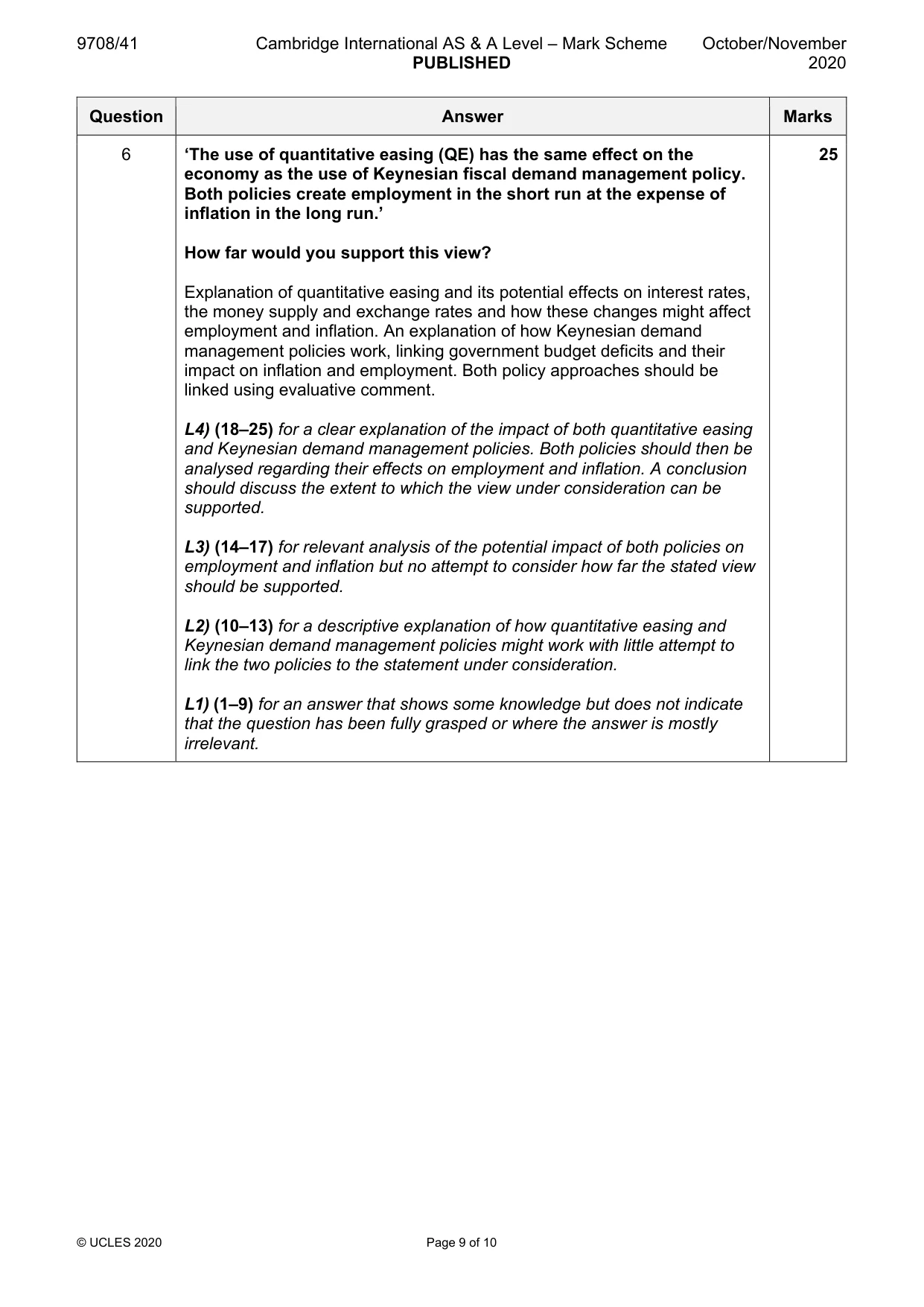
9708/41 Cambridge International AS & A Level – Mark Scheme PUBLISHED October/November 2020 © UCLES 2020 Page 9 of 10 Question Answer Marks 6 ‘The use of quantitative easing (QE) has the same effect on the economy as the use of Keynesian fiscal demand management policy. Both policies create employment in the short run at the expense of inflation in the long run.’ How far would you support this view? Explanation of quantitative easing and its potential effects on interest rates, the money supply and exchange rates and how these changes might affect employment and inflation. An explanation of how Keynesian demand management policies work, linking government budget deficits and their impact on inflation and employment. Both policy approaches should be linked using evaluative comment. L4) (18–25) for a clear explanation of the impact of both quantitative easing and Keynesian demand management policies. Both policies should then be analysed regarding their effects on employment and inflation. A conclusion should discuss the extent to which the view under consideration can be supported. L3) (14–17) for relevant analysis of the potential impact of both policies on employment and inflation but no attempt to consider how far the stated view should be supported. L2) (10–13) for a descriptive explanation of how quantitative easing and Keynesian demand management policies might work with little attempt to link the two policies to the statement under consideration. L1) (1–9) for an answer that shows some knowledge but does not indicate that the question has been fully grasped or where the answer is mostly irrelevant. 25
Mark scheme, page 10
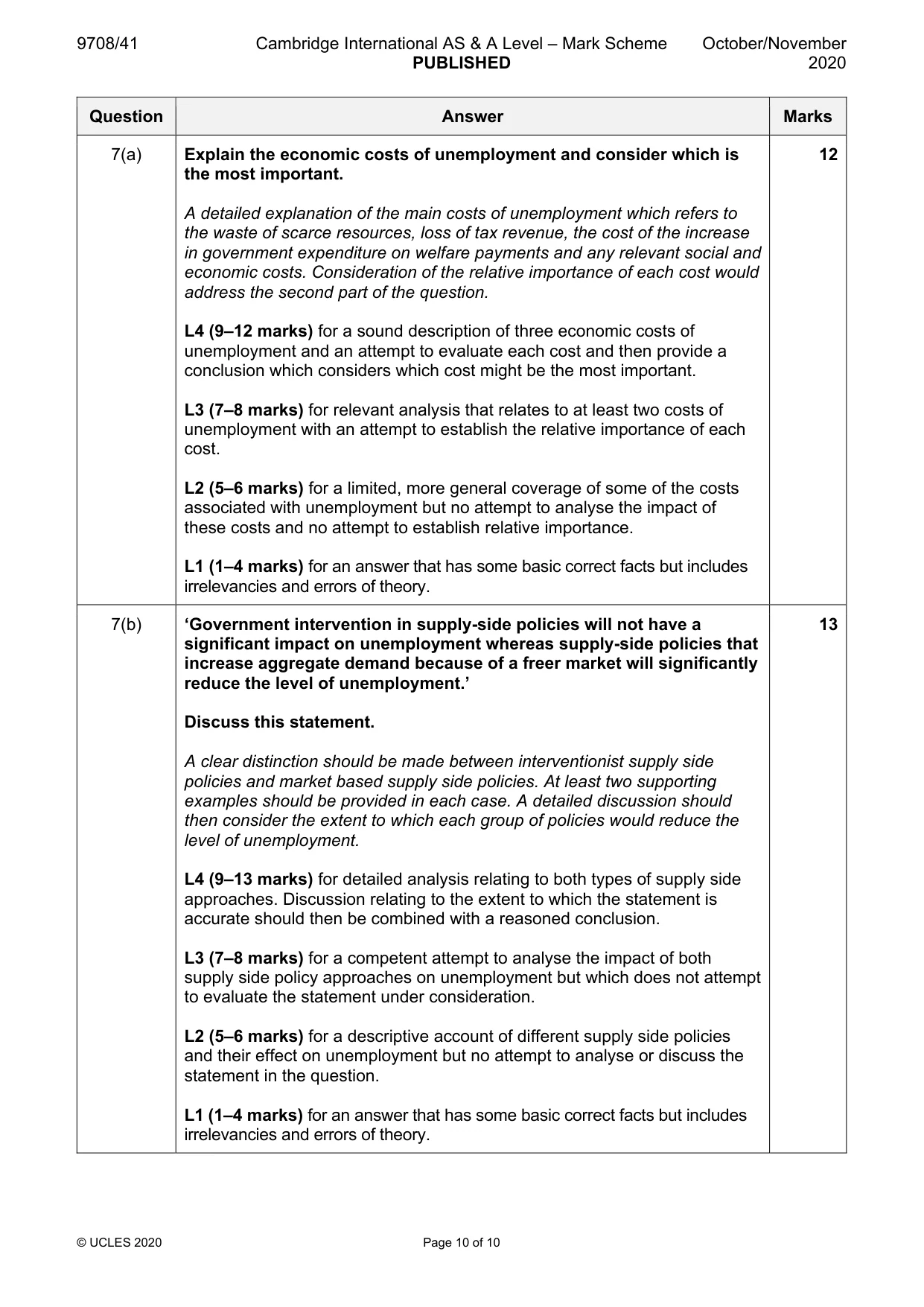
9708/41 Cambridge International AS & A Level – Mark Scheme PUBLISHED October/November 2020 © UCLES 2020 Page 10 of 10 Question Answer Marks 7(a) Explain the economic costs of unemployment and consider which is the most important. A detailed explanation of the main costs of unemployment which refers to the waste of scarce resources, loss of tax revenue, the cost of the increase in government expenditure on welfare payments and any relevant social and economic costs. Consideration of the relative importance of each cost would address the second part of the question. L4 (9–12 marks) for a sound description of three economic costs of unemployment and an attempt to evaluate each cost and then provide a conclusion which considers which cost might be the most important. L3 (7–8 marks) for relevant analysis that relates to at least two costs of unemployment with an attempt to establish the relative importance of each cost. L2 (5–6 marks) for a limited, more general coverage of some of the costs associated with unemployment but no attempt to analyse the impact of these costs and no attempt to establish relative importance. L1 (1–4 marks) for an answer that has some basic correct facts but includes irrelevancies and errors of theory. 12 7(b) ‘Government intervention in supply-side policies will not have a significant impact on unemployment whereas supply-side policies that increase aggregate demand because of a freer market will significantly reduce the level of unemployment.’ Discuss this statement. A clear distinction should be made between interventionist supply side policies and market based supply side policies. At least two supporting examples should be provided in each case. A detailed discussion should then consider the extent to which each group of policies would reduce the level of unemployment. L4 (9–13 marks) for detailed analysis relating to both types of supply side approaches. Discussion relating to the extent to which the statement is accurate should then be combined with a reasoned conclusion. L3 (7–8 marks) for a competent attempt to analyse the impact of both supply side policy approaches on unemployment but which does not attempt to evaluate the statement under consideration. L2 (5–6 marks) for a descriptive account of different supply side policies and their effect on unemployment but no attempt to analyse or discuss the statement in the question. L1 (1–4 marks) for an answer that has some basic correct facts but includes irrelevancies and errors of theory. 13
What you needed in this session
Cambridge’s own grade thresholds for 2020 Oct/Nov, Paper 4 · Variant 1. A higher threshold means an easier paper — the bar moves with how the cohort did.