Cambridge A Level Economics 9708 — 2019 Oct/Nov Paper 4 · Variant 1
9708/41/O/N/19 · 7 questions · 70 marks · ≈79 min
The question paper and its mark scheme, free to read here and free to download. This is Cambridge’s own paper, exactly as it was sat.
Question paper4 pages


Mark scheme13 pages
Answers below. Sit the paper first if you are practising.





Questions as text
Q1 · Growth and the uncertain economic system Competition and a market economy support…
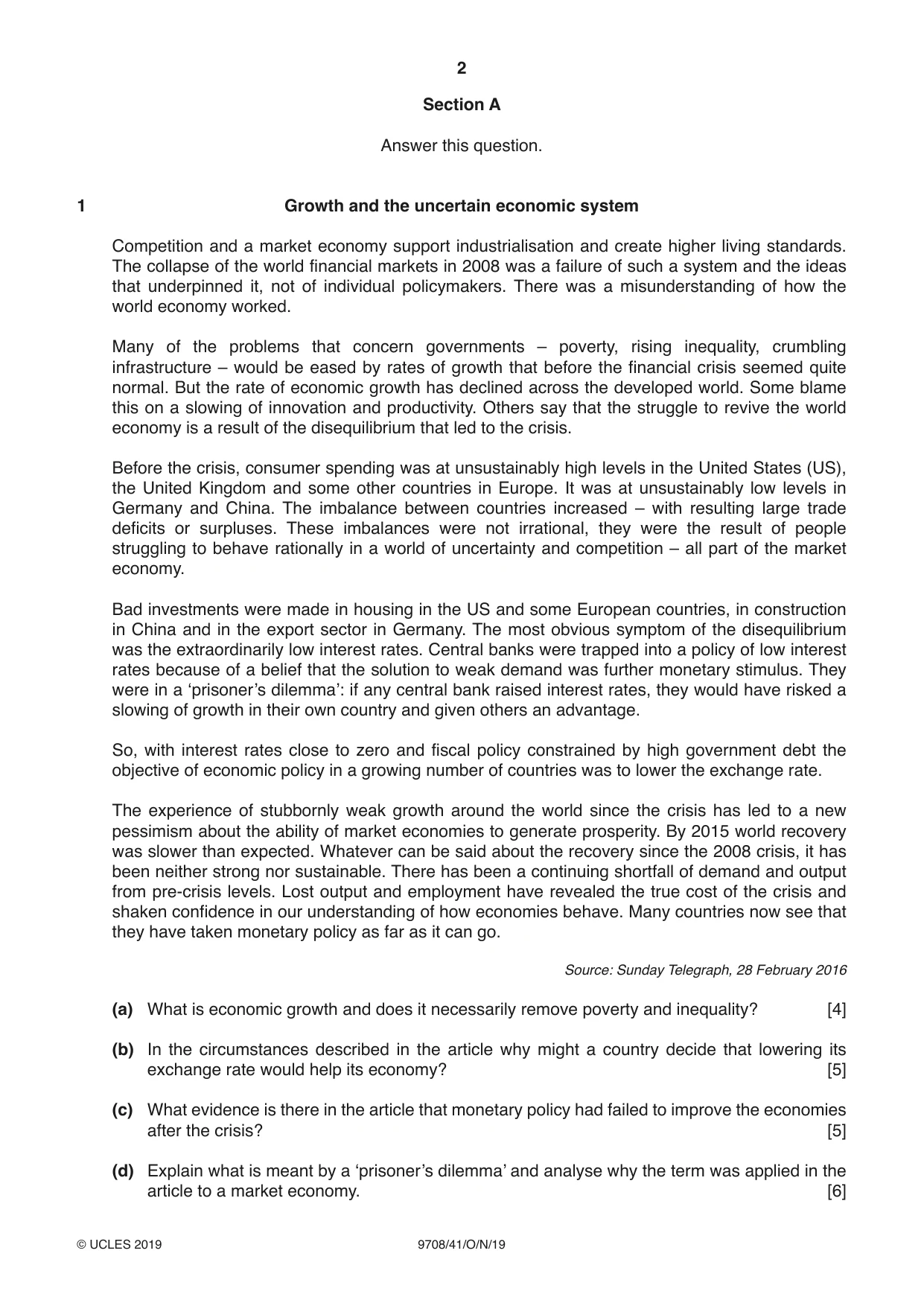
1 Growth and the uncertain economic system Competition and a market economy support industrialisation and create higher living standards. The collapse of the world financial markets in 2008 was a failure of such a system and the ideas that underpinned it, not of individual policymakers. There was a misunderstanding of how the world economy worked. Many of the problems that concern governments – poverty, rising inequality, crumbling infrastructure – would be eased by rates of growth that before the financial crisis seemed quite normal. But the rate of economic growth has declined across the developed world. Some blame this on a slowing of innovation and productivity. Others say that the struggle to revive the world economy is a result of the disequilibrium that led to the crisis. Before the crisis, consumer spending was at unsustainably high levels in the United States (US), the United Kingdom and some other countries in Europe. It was at unsustainably low levels in Germany and China. The imbalance between countries increased – with resulting large trade deficits or surpluses. These imbalances were not irrational, they were the result of people struggling to behave rationally in a world of uncertainty and competition – all part of the market economy. Bad investments were made in housing in the US and some European countries, in construction in China and in the export sector in Germany. The most obvious symptom of the disequilibrium was the extraordinarily low interest rates. Central banks were trapped into a policy of low interest rates because of a belief that the solution to weak demand was further monetary stimulus. They were in a ‘prisoner’s dilemma’: if any central bank raised interest rates, they would have risked a slowing of growth in their own country and given others an advantage. So, with interest rates close to zero and fiscal policy constrained by high government debt the objective of economic policy in a growing number of countries was to lower the exchange rate. The experience of stubbornly weak growth around the world since the crisis has led to a new pessimism about the ability of market economies to generate prosperity. By 2015 world recovery was slower than expected. Whatever can be said about the recovery since the 2008 crisis, it has been neither strong nor sustainable. There has been a continuing shortfall of demand and output from pre-crisis levels. Lost output and employment have revealed the true cost of the crisis and shaken confidence in our understanding of how economies behave. Many countries now see that they have taken monetary policy as far as it can go. Source: Sunday Telegraph, 28 February 2016 (a) What is economic growth and does it necessarily remove poverty and inequality? [4] (b) In the circumstances described in the article why might a country decide that lowering its exchange rate would help its economy? [5] (c) What evidence is there in the article that monetary policy had failed to improve the economies after the crisis? [5] (d) Explain what is meant by a ‘prisoner’s dilemma’ and analyse why the term was applied in the article to a market economy. [6]
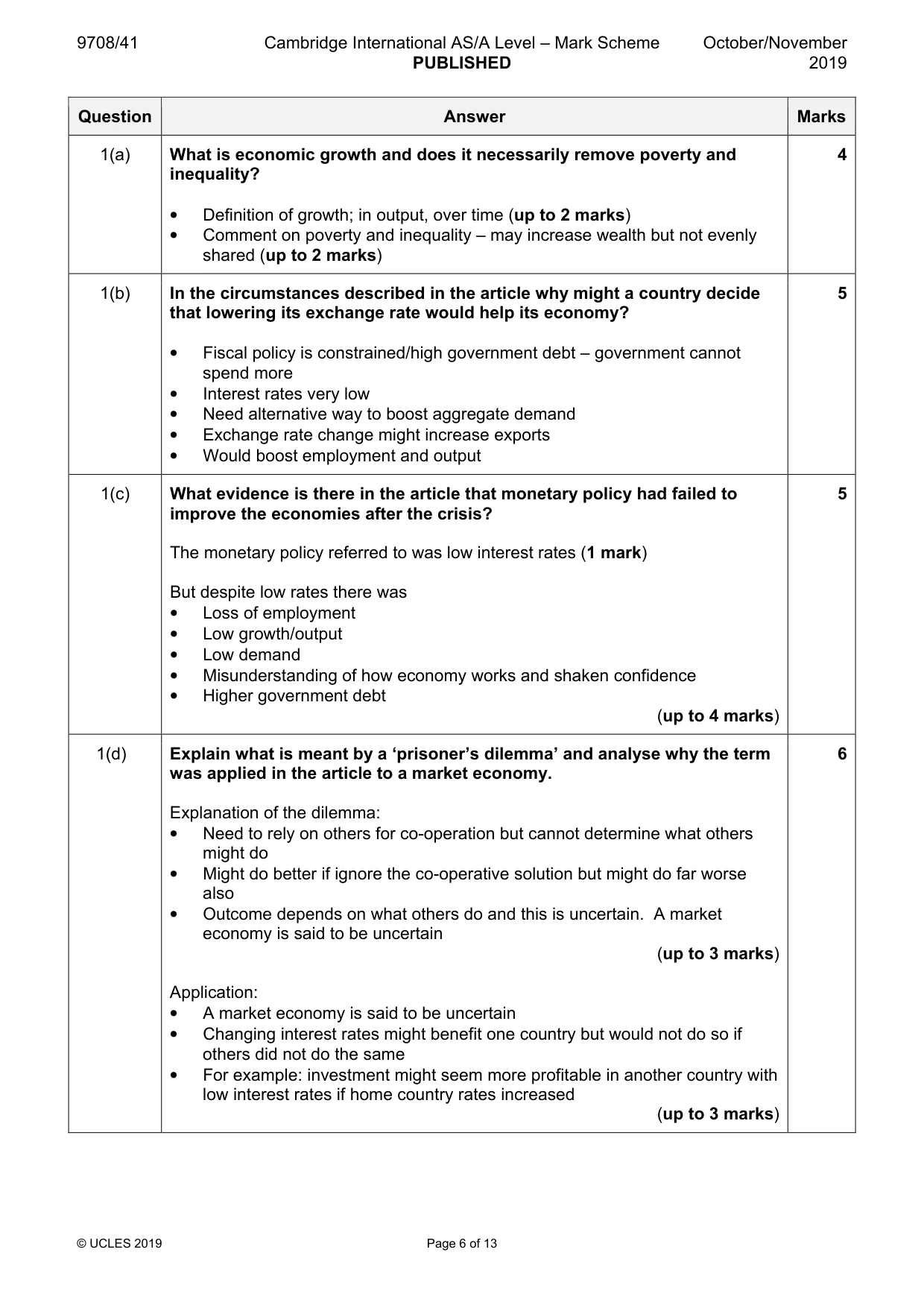
Mark scheme: Question Answer Marks 1(a) What is economic growth and does it necessarily remove poverty and 4 inequality? • Definition of growth; in output, over time (up to 2 marks) • Comment on poverty and inequality – may increase wealth but not evenly shared (up to 2 marks) 1(b) In the circumstances described in the article why might a country decide 5 that lowering its exchange rate would help its economy? • Fiscal policy is constrained/high government debt – government cannot spend more • Interest rates very low • Need alternative way to boost aggregate demand • Exchange rate change might increase exports • Would boost employment and output 1(c) What evidence is there in the article that monetary policy had failed to 5 improve the economies after the crisis? The monetary policy referred to was low interest rates (1 mark) But despite low rates there was • Loss of employment • Low growth/output • Low demand • Misunderstanding of how economy works and shaken confidence • Higher government debt (up to 4 marks) 1(d) Explain what is meant by a ‘prisoner’s dilemma’ and analyse why the term 6 was applied in the article to a market economy. Explanation of the dilemma: • Need to rely on others for co-operation but cannot determine what others might do • Might do better if ignore the co-operative solution but might do far worse also • Outcome depends on what others do and this is uncertain. A market economy is said to be uncertain (up to 3 marks) Application: • A market economy is said to be uncertain • Changing interest rates might benefit one country but would not do so if others did not do the same • For example: investment might seem more profitable in another country with low interest rates if home country rates increased (up to 3 marks)
Q2 · ‘Competition is an essential element of an efficient market economy
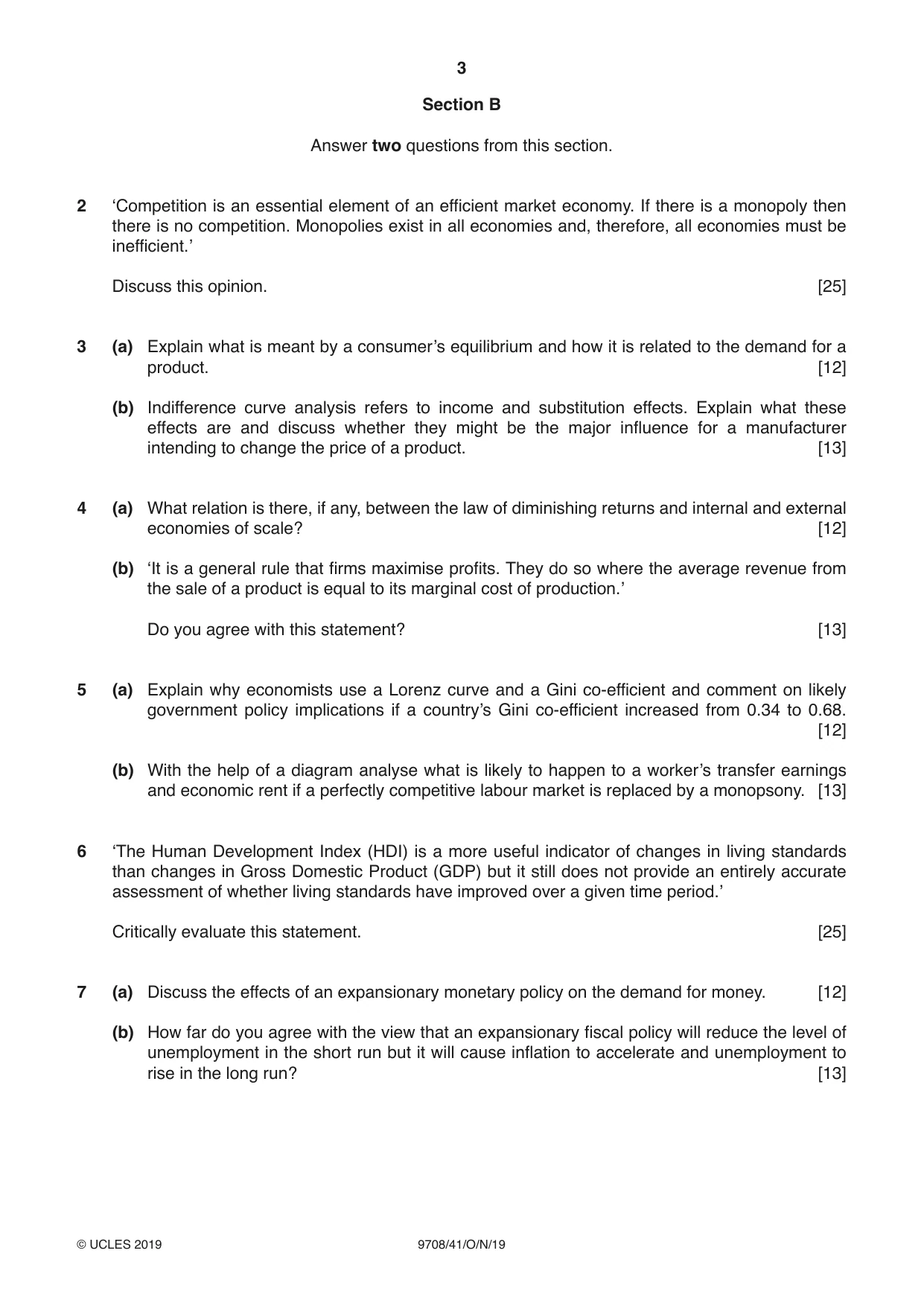
2 ‘Competition is an essential element of an efficient market economy. If there is a monopoly then there is no competition. Monopolies exist in all economies and, therefore, all economies must be inefficient.’ Discuss this opinion. [25]
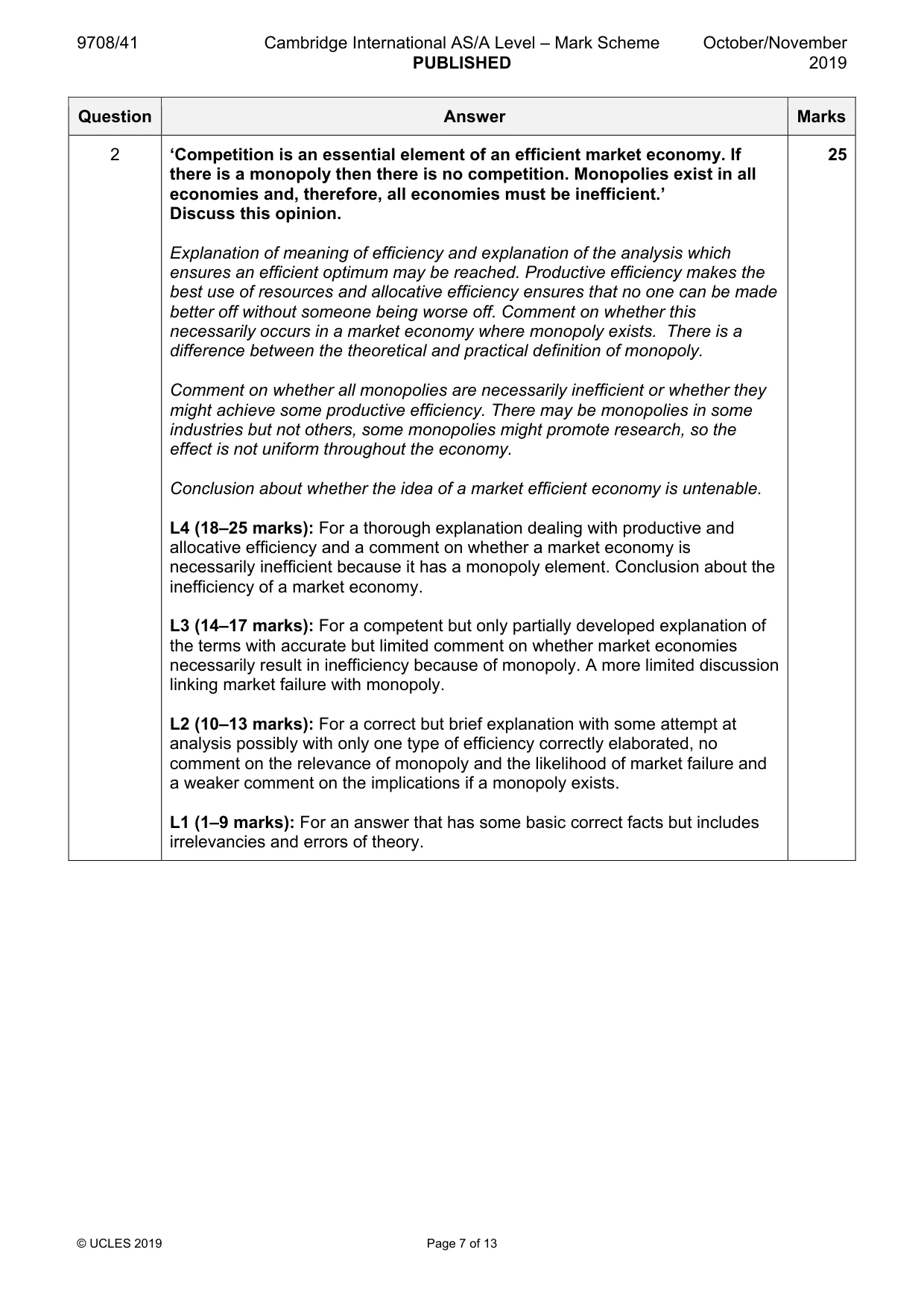
Mark scheme: 2 ‘Competition is an essential element of an efficient market economy. If 25 there is a monopoly then there is no competition. Monopolies exist in all economies and, therefore, all economies must be inefficient.’ Discuss this opinion. Explanation of meaning of efficiency and explanation of the analysis which ensures an efficient optimum may be reached. Productive efficiency makes the best use of resources and allocative efficiency ensures that no one can be made better off without someone being worse off. Comment on whether this necessarily occurs in a market economy where monopoly exists. There is a difference between the theoretical and practical definition of monopoly. Comment on whether all monopolies are necessarily inefficient or whether they might achieve some productive efficiency. There may be monopolies in some industries but not others, some monopolies might promote research, so the effect is not uniform throughout the economy. Conclusion about whether the idea of a market efficient economy is untenable. L4 (18–25 marks): For a thorough explanation dealing with productive and allocative efficiency and a comment on whether a market economy is necessarily inefficient because it has a monopoly element. Conclusion about the inefficiency of a market economy. L3 (14–17 marks): For a competent but only partially developed explanation of the terms with accurate but limited comment on whether market economies necessarily result in inefficiency because of monopoly. A more limited discussion linking market failure with monopoly. L2 (10–13 marks): For a correct but brief explanation with some attempt at analysis possibly with only one type of efficiency correctly elaborated, no comment on the relevance of monopoly and the likelihood of market failure and a weaker comment on the implications if a monopoly exists. L1 (1–9 marks): For an answer that has some basic correct facts but includes irrelevancies and errors of theory.
Q3 · Explain what is meant by a consumer’s equilibrium and how it is related to the demand for…
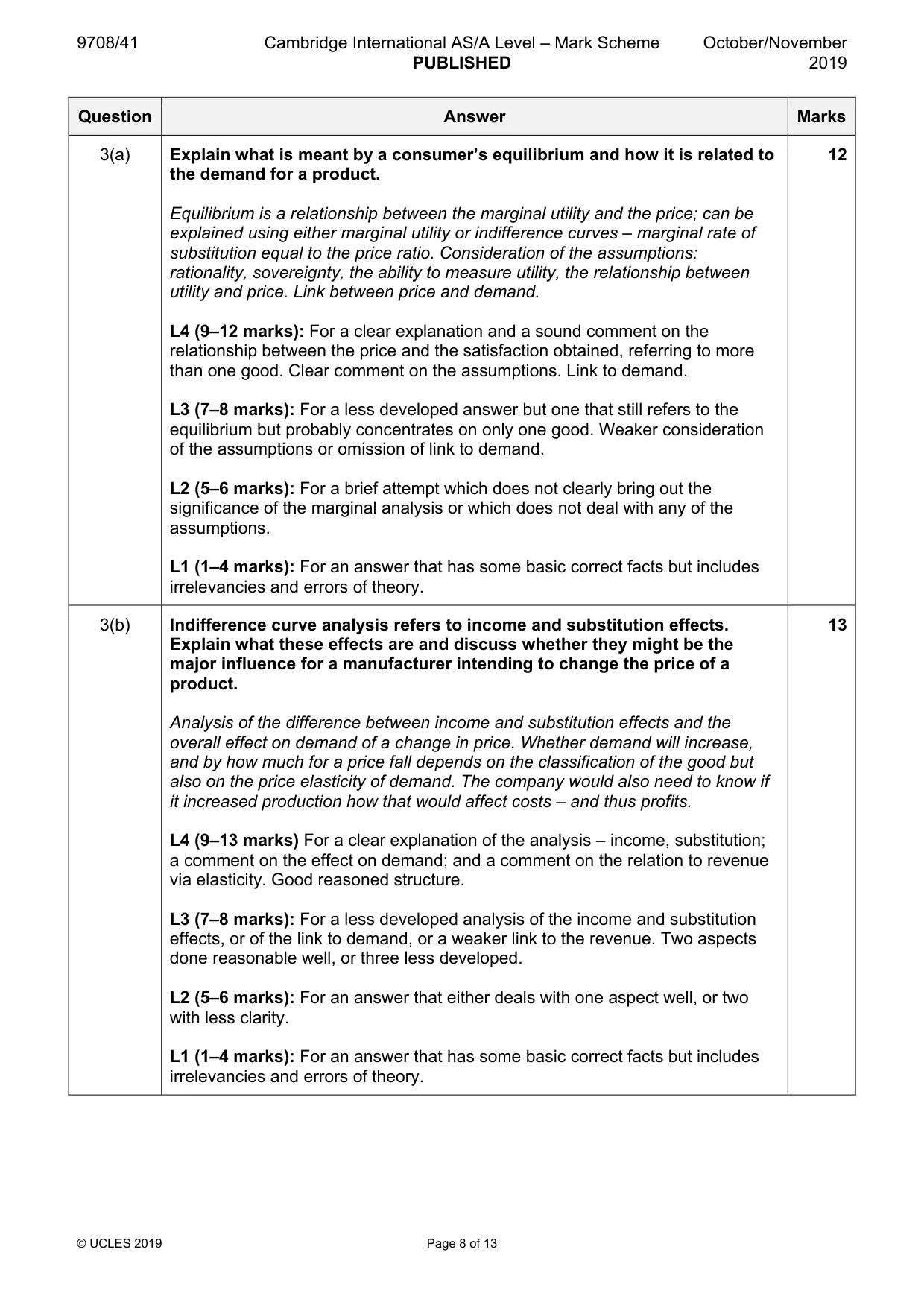
3 (a) Explain what is meant by a consumer’s equilibrium and how it is related to the demand for a product. [12] (b) Indifference curve analysis refers to income and substitution effects. Explain what these effects are and discuss whether they might be the major influence for a manufacturer intending to change the price of a product. [13]
Mark scheme: 3(a) Explain what is meant by a consumer’s equilibrium and how it is related to 12 the demand for a product. Equilibrium is a relationship between the marginal utility and the price; can be explained using either marginal utility or indifference curves – marginal rate of substitution equal to the price ratio. Consideration of the assumptions: rationality, sovereignty, the ability to measure utility, the relationship between utility and price. Link between price and demand. L4 (9–12 marks): For a clear explanation and a sound comment on the relationship between the price and the satisfaction obtained, referring to more than one good. Clear comment on the assumptions. Link to demand. L3 (7–8 marks): For a less developed answer but one that still refers to the equilibrium but probably concentrates on only one good. Weaker consideration of the assumptions or omission of link to demand. L2 (5–6 marks): For a brief attempt which does not clearly bring out the significance of the marginal analysis or which does not deal with any of the assumptions. L1 (1–4 marks): For an answer that has some basic correct facts but includes irrelevancies and errors of theory. 3(b) Indifference curve analysis refers to income and substitution effects. 13 Explain what these effects are and discuss whether they might be the major influence for a manufacturer intending to change the price of a product. Analysis of the difference between income and substitution effects and the overall effect on demand of a change in price. Whether demand will increase, and by how much for a price fall depends on the classification of the good but also on the price elasticity of demand. The company would also need to know if it increased production how that would affect costs – and thus profits. L4 (9–13 marks) For a clear explanation of the analysis – income, substitution; a comment on the effect on demand; and a comment on the relation to revenue via elasticity. Good reasoned structure. L3 (7–8 marks): For a less developed analysis of the income and substitution effects, or of the link to demand, or a weaker link to the revenue. Two aspects done reasonable well, or three less developed. L2 (5–6 marks): For an answer that either deals with one aspect well, or two with less clarity. L1 (1–4 marks): For an answer that has some basic correct facts but includes irrelevancies and errors of theory.
Q4 · What relation is there, if any, between the law of diminishing returns and internal and…
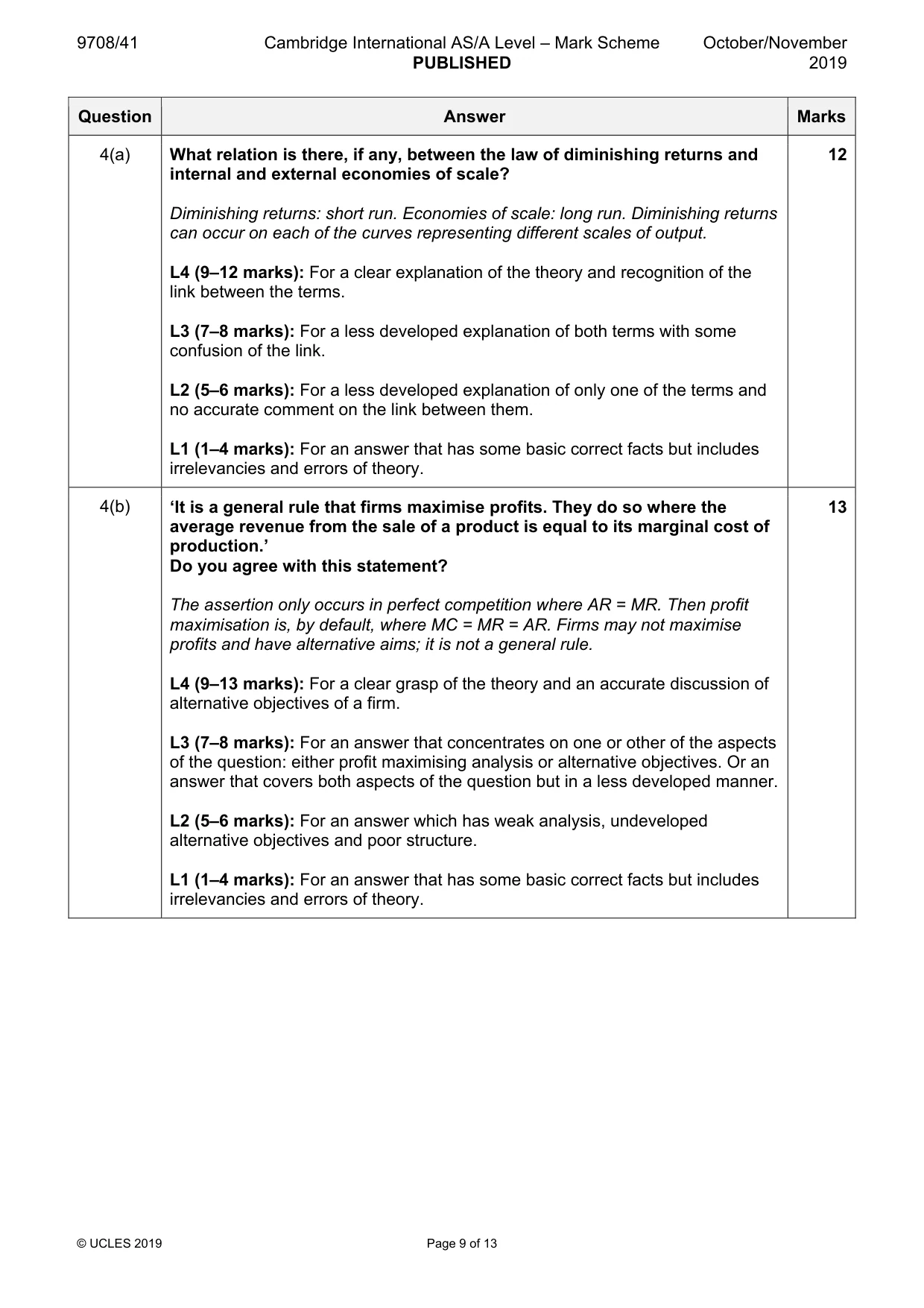
4 (a) What relation is there, if any, between the law of diminishing returns and internal and external economies of scale? [12] (b) ‘It is a general rule that firms maximise profits. They do so where the average revenue from the sale of a product is equal to its marginal cost of production.’ Do you agree with this statement? [13]
Mark scheme: 4(a) What relation is there, if any, between the law of diminishing returns and 12 internal and external economies of scale? Diminishing returns: short run. Economies of scale: long run. Diminishing returns can occur on each of the curves representing different scales of output. L4 (9–12 marks): For a clear explanation of the theory and recognition of the link between the terms. L3 (7–8 marks): For a less developed explanation of both terms with some confusion of the link. L2 (5–6 marks): For a less developed explanation of only one of the terms and no accurate comment on the link between them. L1 (1–4 marks): For an answer that has some basic correct facts but includes irrelevancies and errors of theory. 4(b) ‘It is a general rule that firms maximise profits. They do so where the 13 average revenue from the sale of a product is equal to its marginal cost of production.’ Do you agree with this statement? The assertion only occurs in perfect competition where AR = MR. Then profit maximisation is, by default, where MC = MR = AR. Firms may not maximise profits and have alternative aims; it is not a general rule. L4 (9–13 marks): For a clear grasp of the theory and an accurate discussion of alternative objectives of a firm. L3 (7–8 marks): For an answer that concentrates on one or other of the aspects of the question: either profit maximising analysis or alternative objectives. Or an answer that covers both aspects of the question but in a less developed manner. L2 (5–6 marks): For an answer which has weak analysis, undeveloped alternative objectives and poor structure. L1 (1–4 marks): For an answer that has some basic correct facts but includes irrelevancies and errors of theory.
More questions on Differing objectives and policies of firms
Q5 · Explain why economists use a Lorenz curve and a Gini co-efficient and comment on likely…
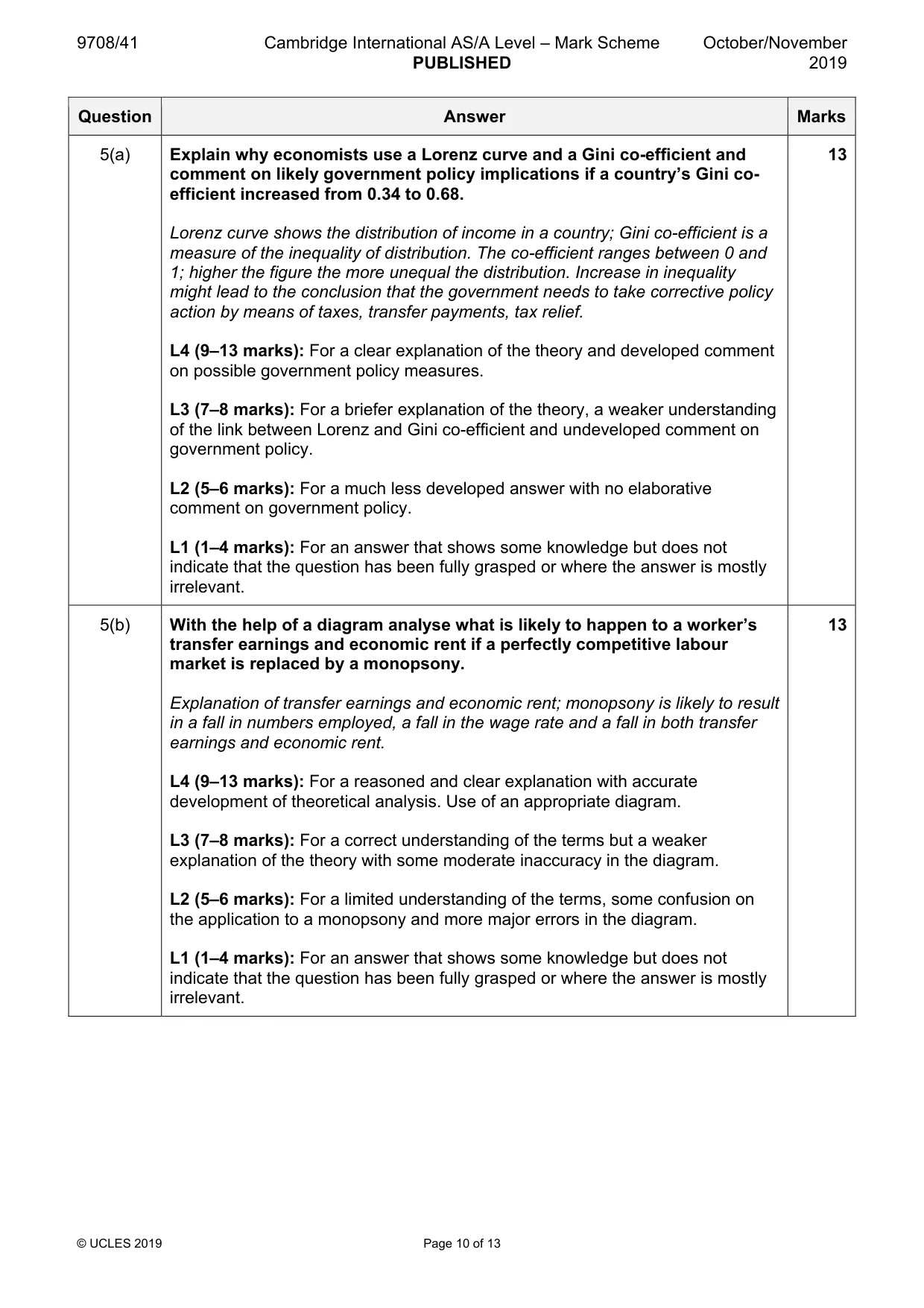
5 (a) Explain why economists use a Lorenz curve and a Gini co-efficient and comment on likely government policy implications if a country’s Gini co-efficient increased from 0.34 to 0.68. [12] (b) With the help of a diagram analyse what is likely to happen to a worker’s transfer earnings and economic rent if a perfectly competitive labour market is replaced by a monopsony. [13]
Mark scheme: 5(a) Explain why economists use a Lorenz curve and a Gini co-efficient and 13 comment on likely government policy implications if a country’s Gini co- efficient increased from 0.34 to 0.68. Lorenz curve shows the distribution of income in a country; Gini co-efficient is a measure of the inequality of distribution. The co-efficient ranges between 0 and 1; higher the figure the more unequal the distribution. Increase in inequality might lead to the conclusion that the government needs to take corrective policy action by means of taxes, transfer payments, tax relief. L4 (9–13 marks): For a clear explanation of the theory and developed comment on possible government policy measures. L3 (7–8 marks): For a briefer explanation of the theory, a weaker understanding of the link between Lorenz and Gini co-efficient and undeveloped comment on government policy. L2 (5–6 marks): For a much less developed answer with no elaborative comment on government policy. L1 (1–4 marks): For an answer that shows some knowledge but does not indicate that the question has been fully grasped or where the answer is mostly irrelevant. 5(b) With the help of a diagram analyse what is likely to happen to a worker’s 13 transfer earnings and economic rent if a perfectly competitive labour market is replaced by a monopsony. Explanation of transfer earnings and economic rent; monopsony is likely to result in a fall in numbers employed, a fall in the wage rate and a fall in both transfer earnings and economic rent. L4 (9–13 marks): For a reasoned and clear explanation with accurate development of theoretical analysis. Use of an appropriate diagram. L3 (7–8 marks): For a correct understanding of the terms but a weaker explanation of the theory with some moderate inaccuracy in the diagram. L2 (5–6 marks): For a limited understanding of the terms, some confusion on the application to a monopsony and more major errors in the diagram. L1 (1–4 marks): For an answer that shows some knowledge but does not indicate that the question has been fully grasped or where the answer is mostly irrelevant.
More questions on Labour market forces and government intervention
Q6 · ‘The Human Development Index (HDI) is a more useful indicator of changes in living…
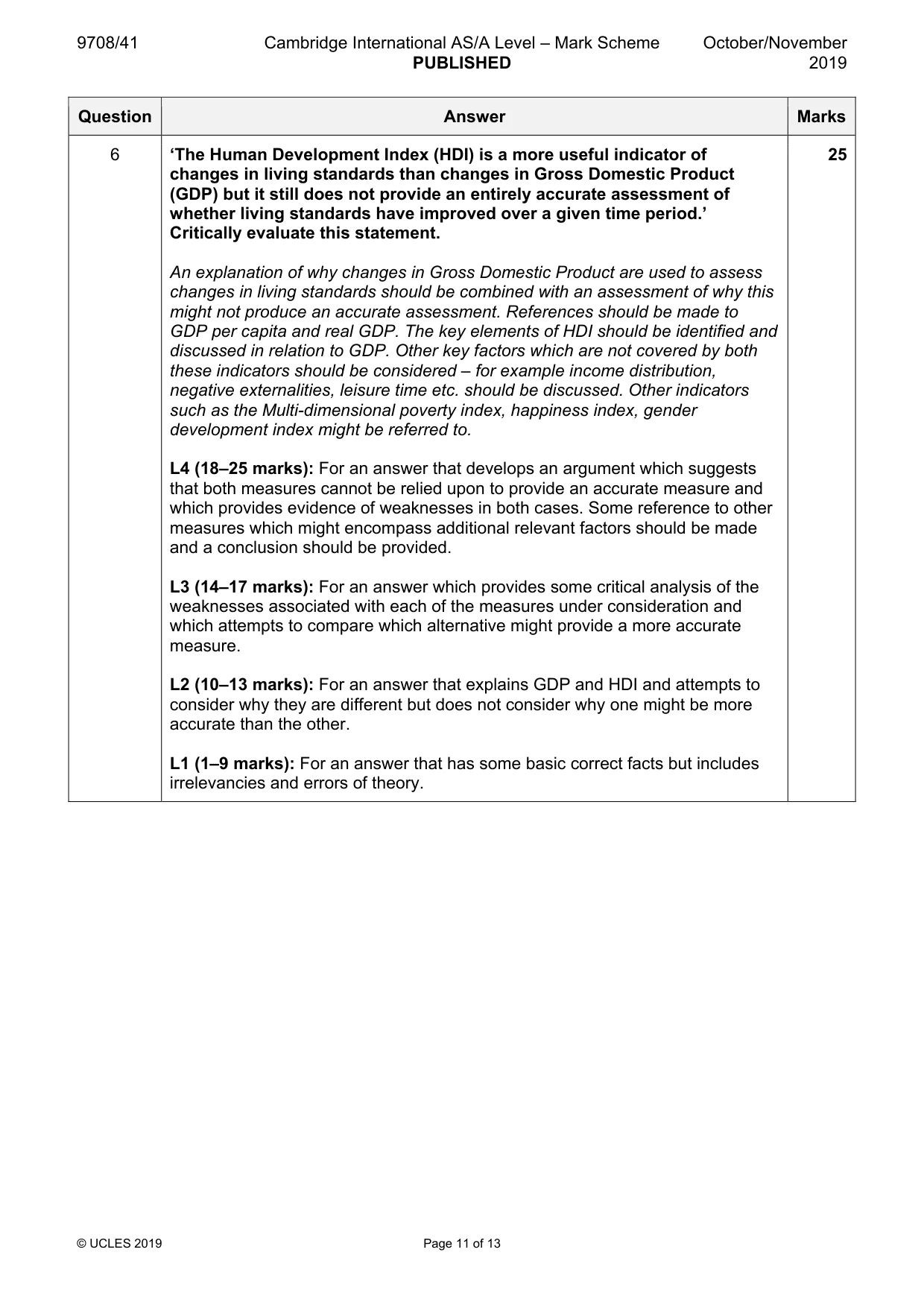
6 ‘The Human Development Index (HDI) is a more useful indicator of changes in living standards than changes in Gross Domestic Product (GDP) but it still does not provide an entirely accurate assessment of whether living standards have improved over a given time period.’ Critically evaluate this statement. [25]
Mark scheme: 6 ‘The Human Development Index (HDI) is a more useful indicator of 25 changes in living standards than changes in Gross Domestic Product (GDP) but it still does not provide an entirely accurate assessment of whether living standards have improved over a given time period.’ Critically evaluate this statement. An explanation of why changes in Gross Domestic Product are used to assess changes in living standards should be combined with an assessment of why this might not produce an accurate assessment. References should be made to GDP per capita and real GDP. The key elements of HDI should be identified and discussed in relation to GDP. Other key factors which are not covered by both these indicators should be considered – for example income distribution, negative externalities, leisure time etc. should be discussed. Other indicators such as the Multi-dimensional poverty index, happiness index, gender development index might be referred to. L4 (18–25 marks): For an answer that develops an argument which suggests that both measures cannot be relied upon to provide an accurate measure and which provides evidence of weaknesses in both cases. Some reference to other measures which might encompass additional relevant factors should be made and a conclusion should be provided. L3 (14–17 marks): For an answer which provides some critical analysis of the weaknesses associated with each of the measures under consideration and which attempts to compare which alternative might provide a more accurate measure. L2 (10–13 marks): For an answer that explains GDP and HDI and attempts to consider why they are different but does not consider why one might be more accurate than the other. L1 (1–9 marks): For an answer that has some basic correct facts but includes irrelevancies and errors of theory.
Q7 · Discuss the effects of an expansionary monetary policy on the demand for money
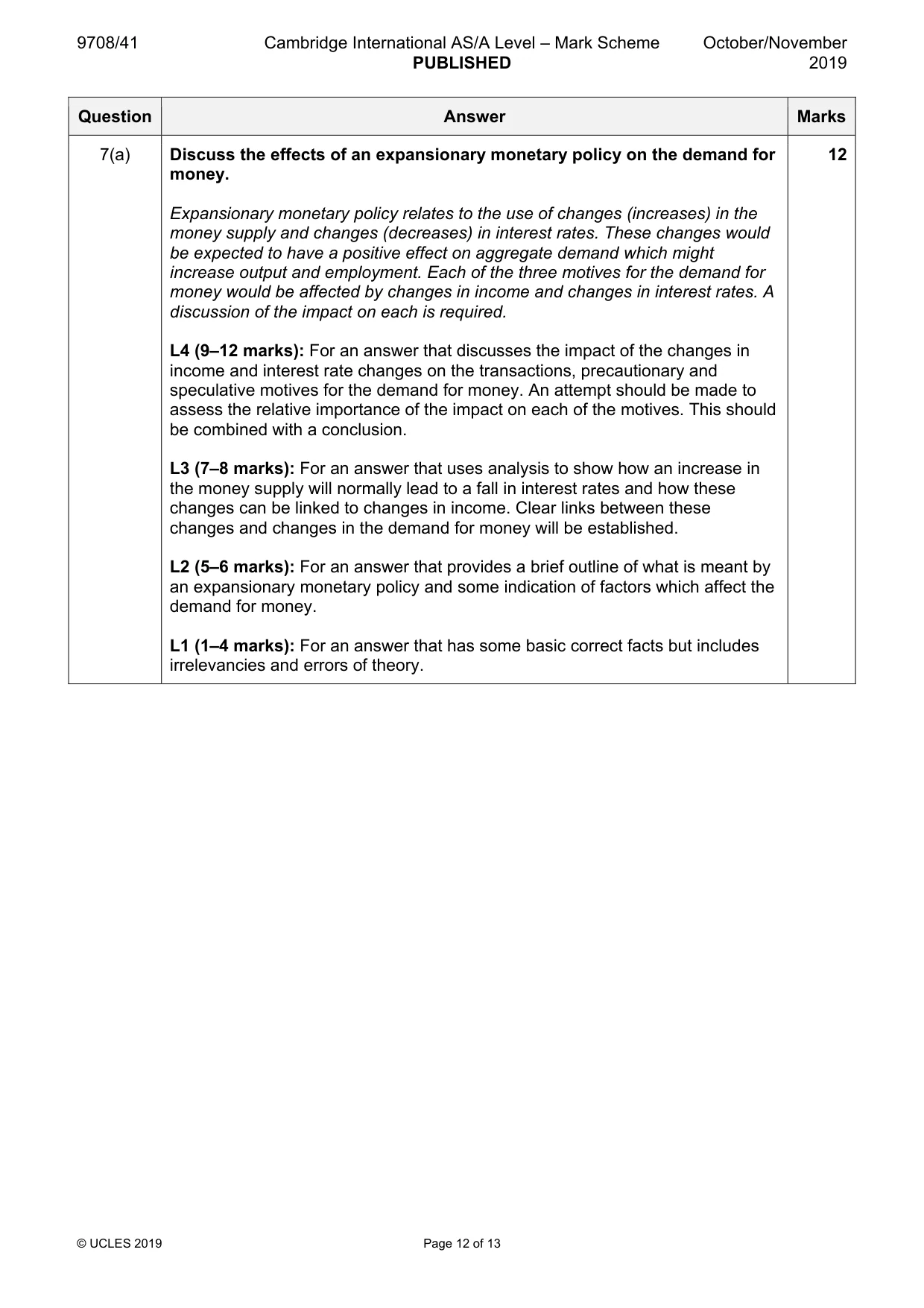
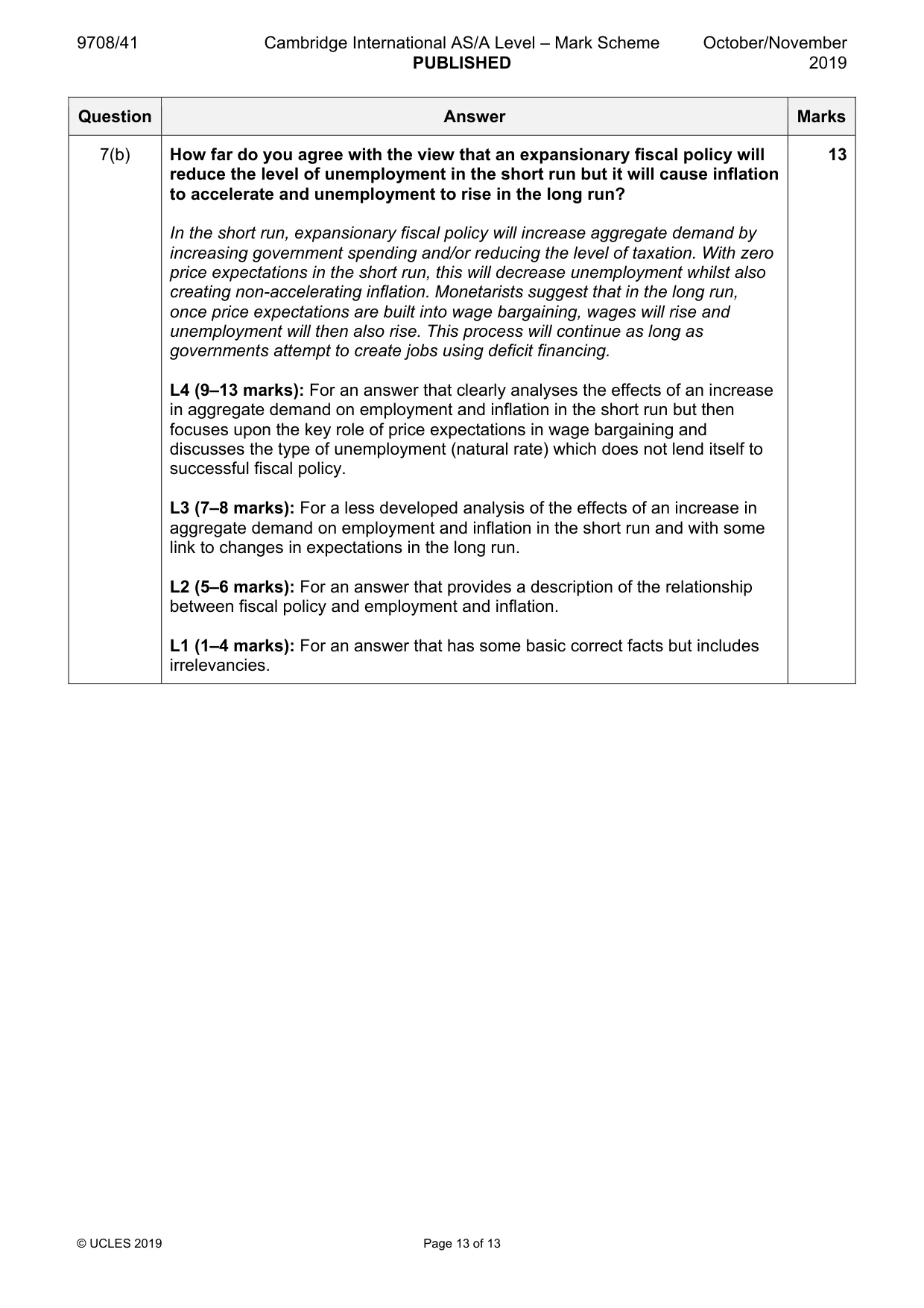
7 (a) Discuss the effects of an expansionary monetary policy on the demand for money. [12] (b) How far do you agree with the view that an expansionary fiscal policy will reduce the level of unemployment in the short run but it will cause inflation to accelerate and unemployment to rise in the long run? [13]
Mark scheme: 7(a) Discuss the effects of an expansionary monetary policy on the demand for 12 money. Expansionary monetary policy relates to the use of changes (increases) in the money supply and changes (decreases) in interest rates. These changes would be expected to have a positive effect on aggregate demand which might increase output and employment. Each of the three motives for the demand for money would be affected by changes in income and changes in interest rates. A discussion of the impact on each is required. L4 (9–12 marks): For an answer that discusses the impact of the changes in income and interest rate changes on the transactions, precautionary and speculative motives for the demand for money. An attempt should be made to assess the relative importance of the impact on each of the motives. This should be combined with a conclusion. L3 (7–8 marks): For an answer that uses analysis to show how an increase in the money supply will normally lead to a fall in interest rates and how these changes can be linked to changes in income. Clear links between these changes and changes in the demand for money will be established. L2 (5–6 marks): For an answer that provides a brief outline of what is meant by an expansionary monetary policy and some indication of factors which affect the demand for money. L1 (1–4 marks): For an answer that has some basic correct facts but includes irrelevancies and errors of theory. 7(b) How far do you agree with the view that an expansionary fiscal policy will 13 reduce the level of unemployment in the short run but it will cause inflation to accelerate and unemployment to rise in the long run? In the short run, expansionary fiscal policy will increase aggregate demand by increasing government spending and/or reducing the level of taxation. With zero price expectations in the short run, this will decrease unemployment whilst also creating non-accelerating inflation. Monetarists suggest that in the long run, once price expectations are built into wage bargaining, wages will rise and unemployment will then also rise. This process will continue as long as governments attempt to create jobs using deficit financing. L4 (9–13 marks): For an answer that clearly analyses the effects of an increase in aggregate demand on employment and inflation in the short run but then focuses upon the key role of price expectations in wage bargaining and discusses the type of unemployment (natural rate) which does not lend itself to successful fiscal policy. L3 (7–8 marks): For a less developed analysis of the effects of an increase in aggregate demand on employment and inflation in the short run and with some link to changes in expectations in the long run. L2 (5–6 marks): For an answer that provides a description of the relationship between fiscal policy and employment and inflation. L1 (1–4 marks): For an answer that has some basic correct facts but includes irrelevancies.
What was in this paper
The subtopics covered by these 7 questions, and how many questions each got. Open one in a new tab to see every Cambridge question on it.
What you needed in this session
Cambridge’s own grade thresholds for 2019 Oct/Nov, Paper 4 · Variant 1. A higher threshold means an easier paper — the bar moves with how the cohort did.