Cambridge A Level Design and Textiles 9631 — 2019 Oct/Nov Paper 3 · Variant 1
9631/31/O/N/19 · 5 questions · 100 marks · ≈113 min
The question paper and its mark scheme, free to read here and free to download. This is Cambridge’s own paper, exactly as it was sat.
Question paper4 pages
Mark scheme15 pages
Answers below. Sit the paper first if you are practising.
Questions as text
Q1 · There is a wide variety of sportswear available
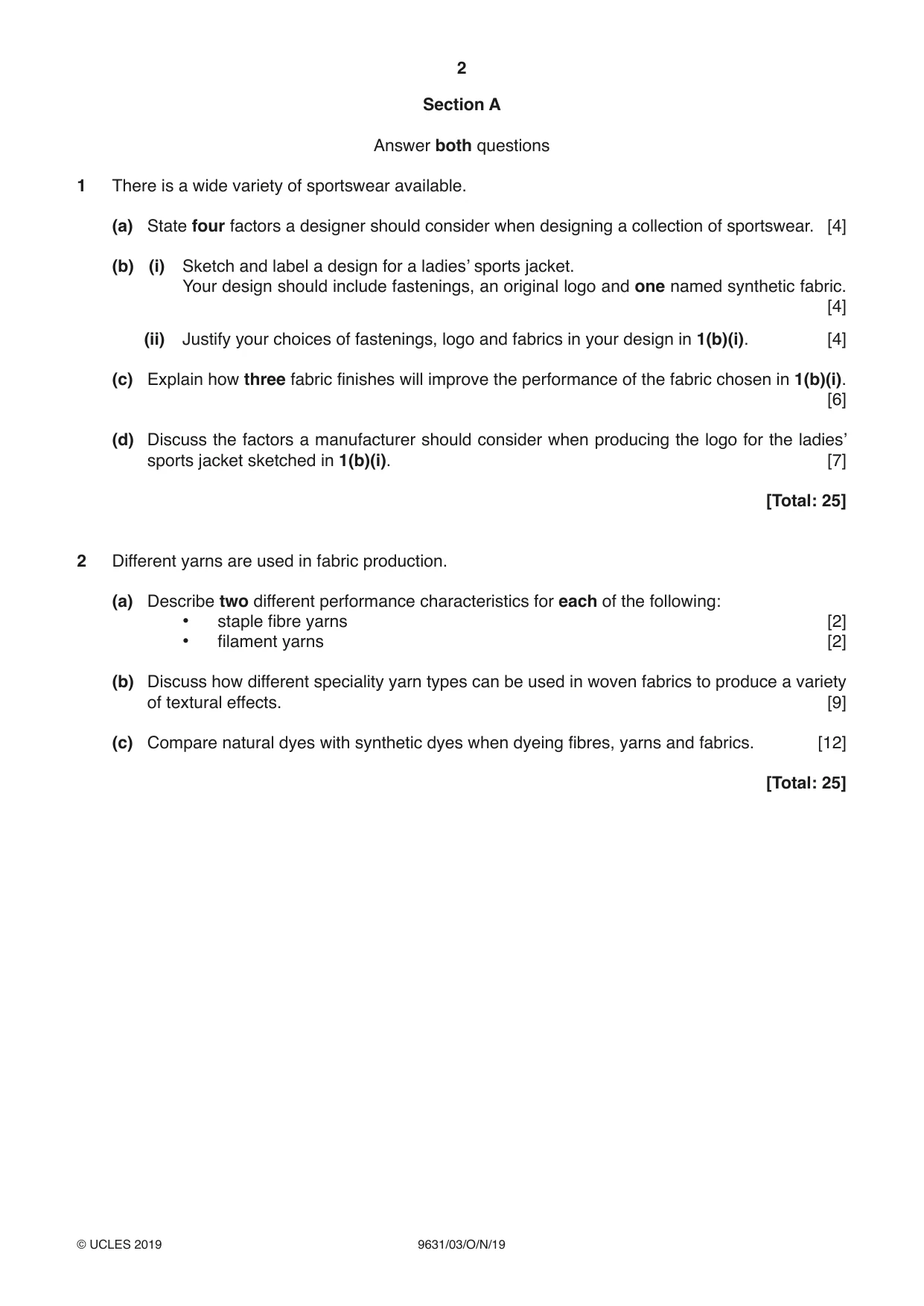
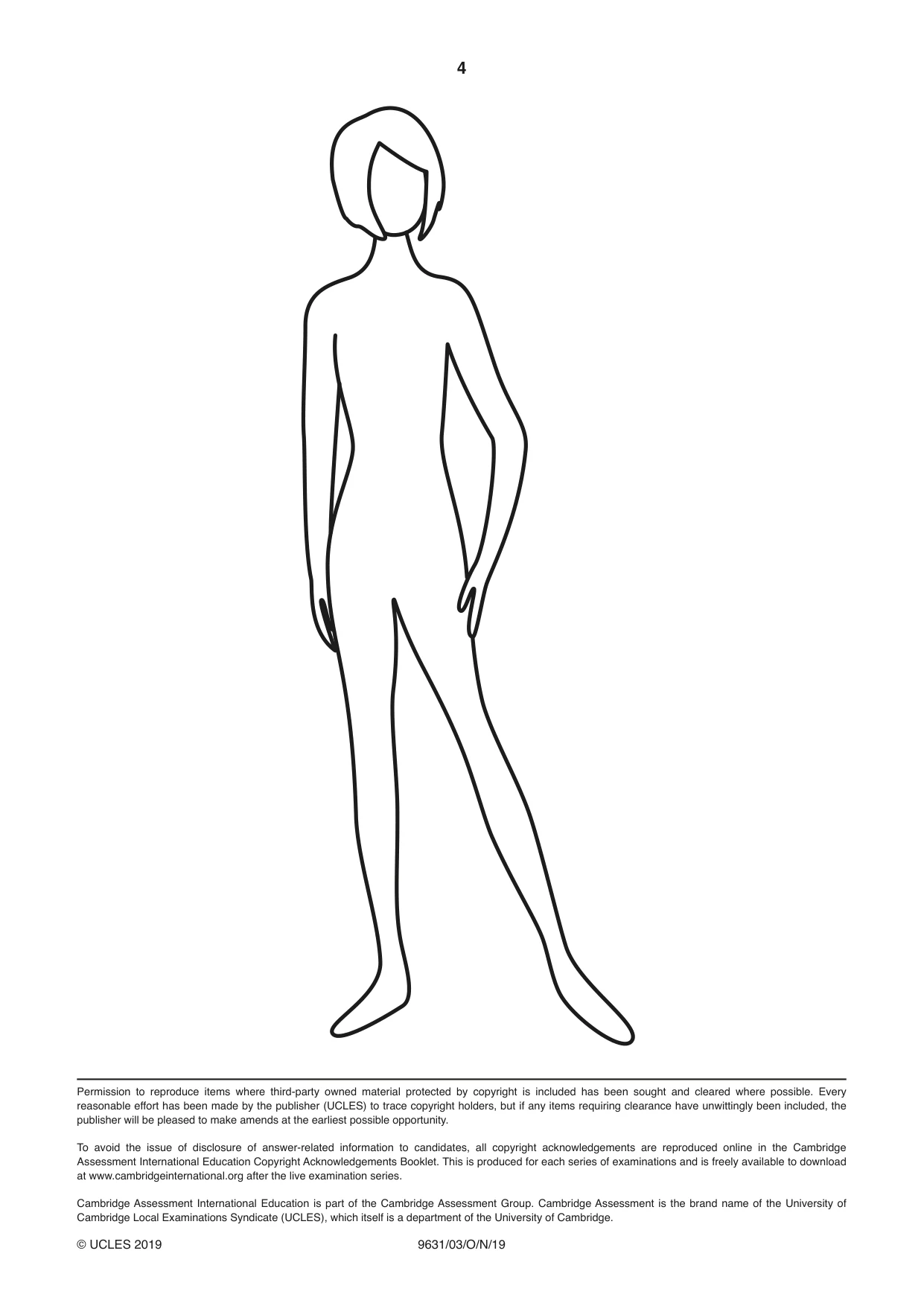
1 There is a wide variety of sportswear available. (a) State four factors a designer should consider when designing a collection of sportswear. [4] (b) (i) Sketch and label a design for a ladies’ sports jacket. Your design should include fastenings, an original logo and one named synthetic fabric. [4] (ii) Justify your choices of fastenings, logo and fabrics in your design in 1(b)(i). [4] (c) Explain how three fabric finishes will improve the performance of the fabric chosen in 1(b)(i). [6] (d) Discuss the factors a manufacturer should consider when producing the logo for the ladies’ sports jacket sketched in 1(b)(i). [7] [Total: 25]
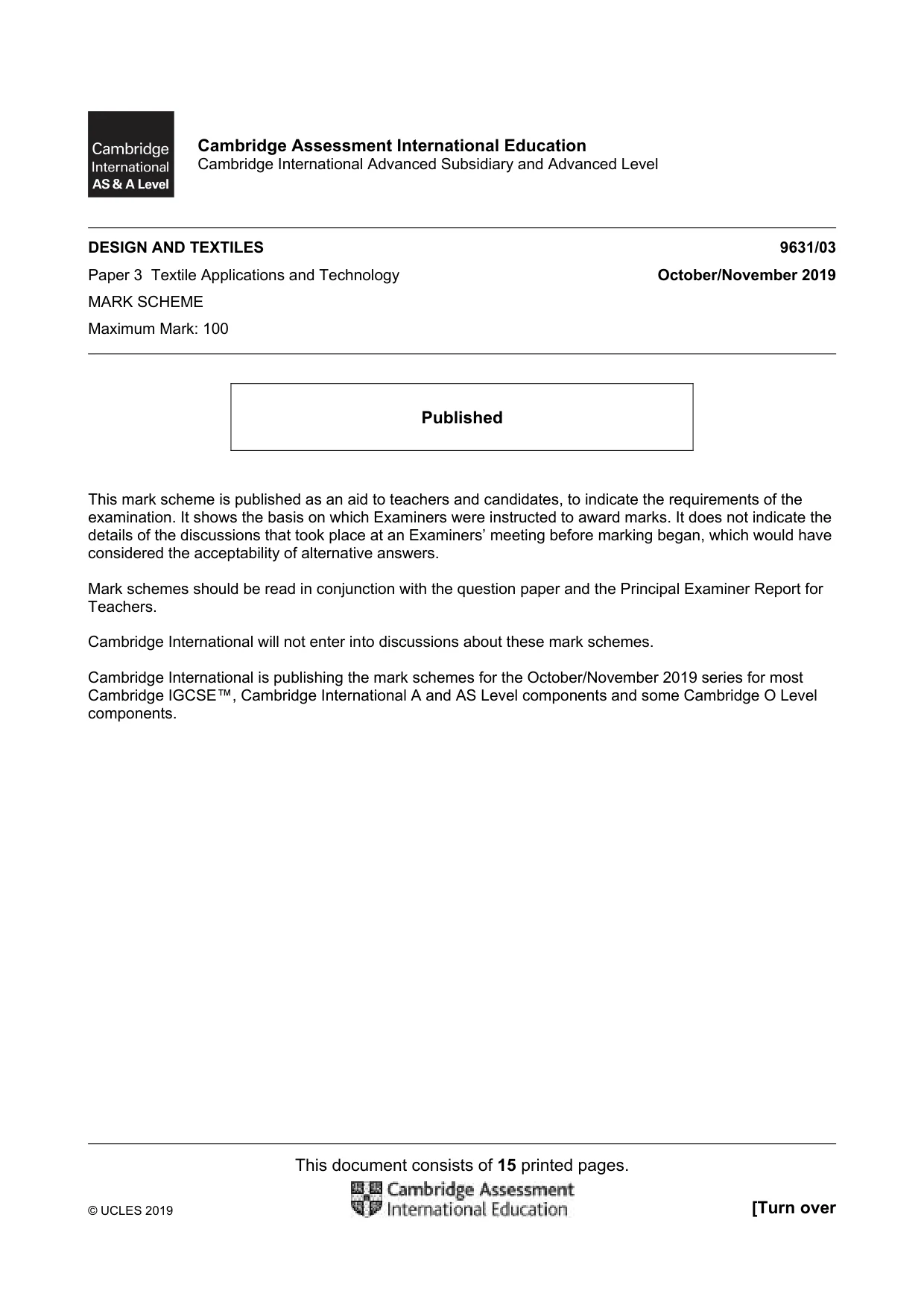
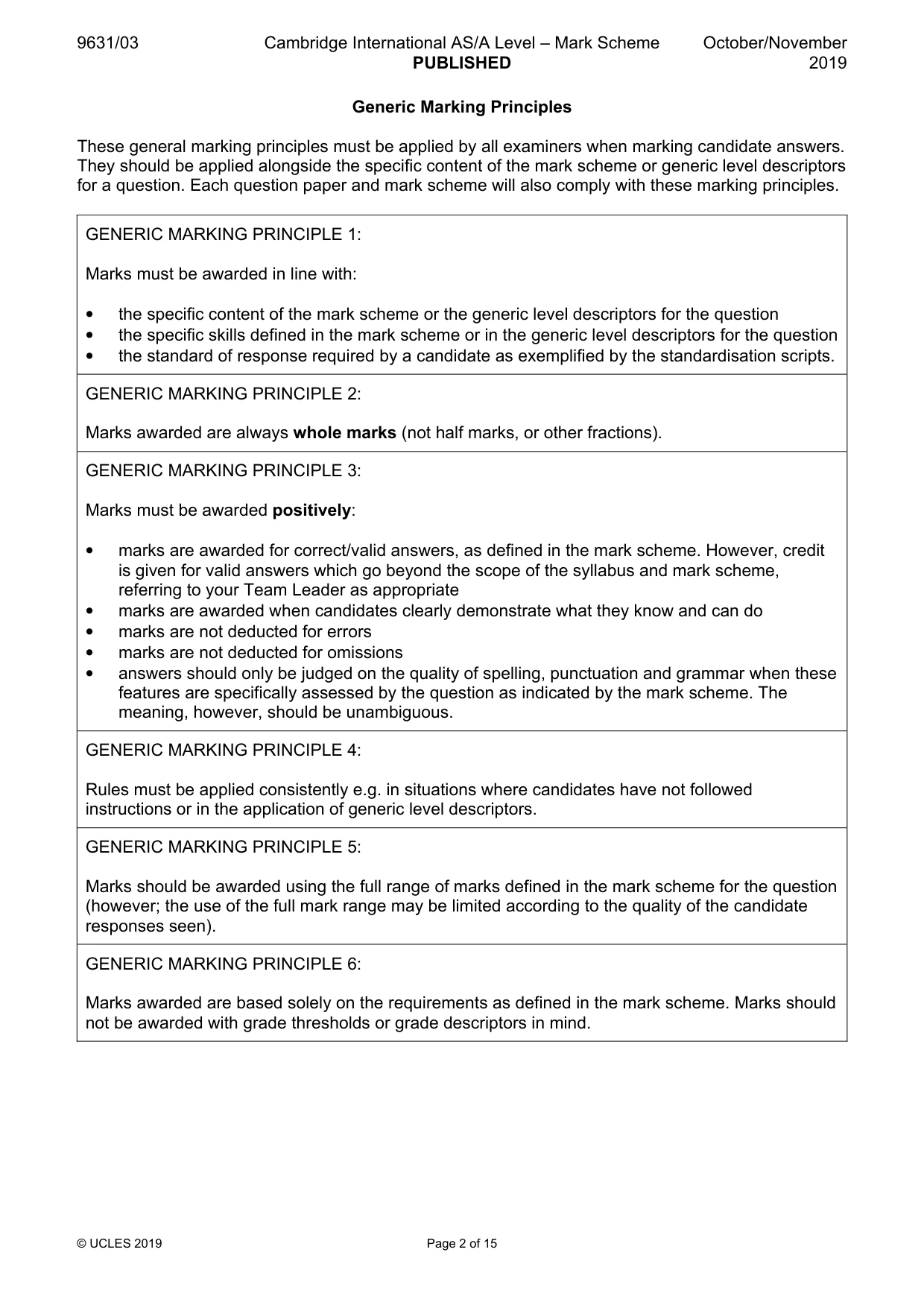
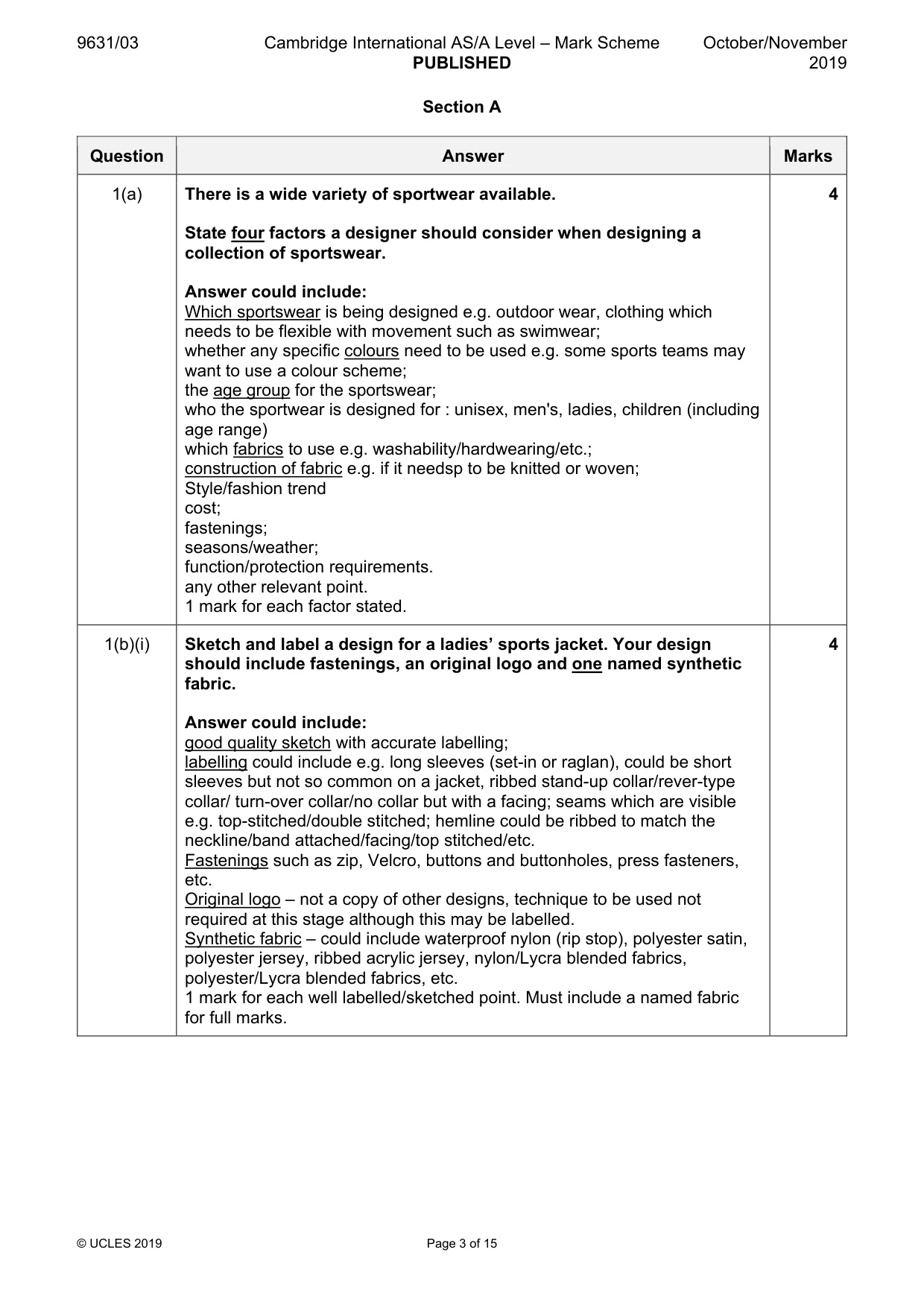
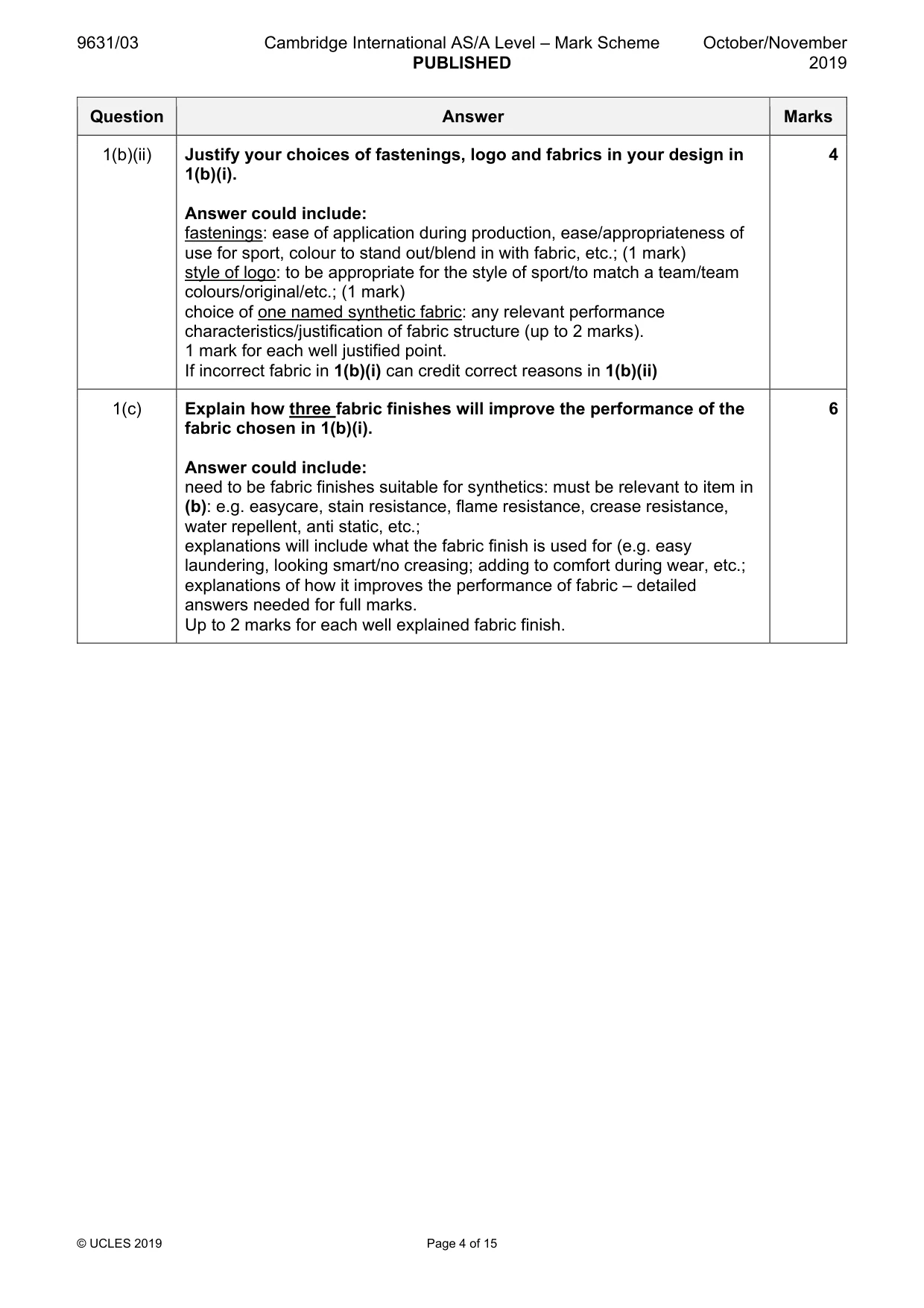
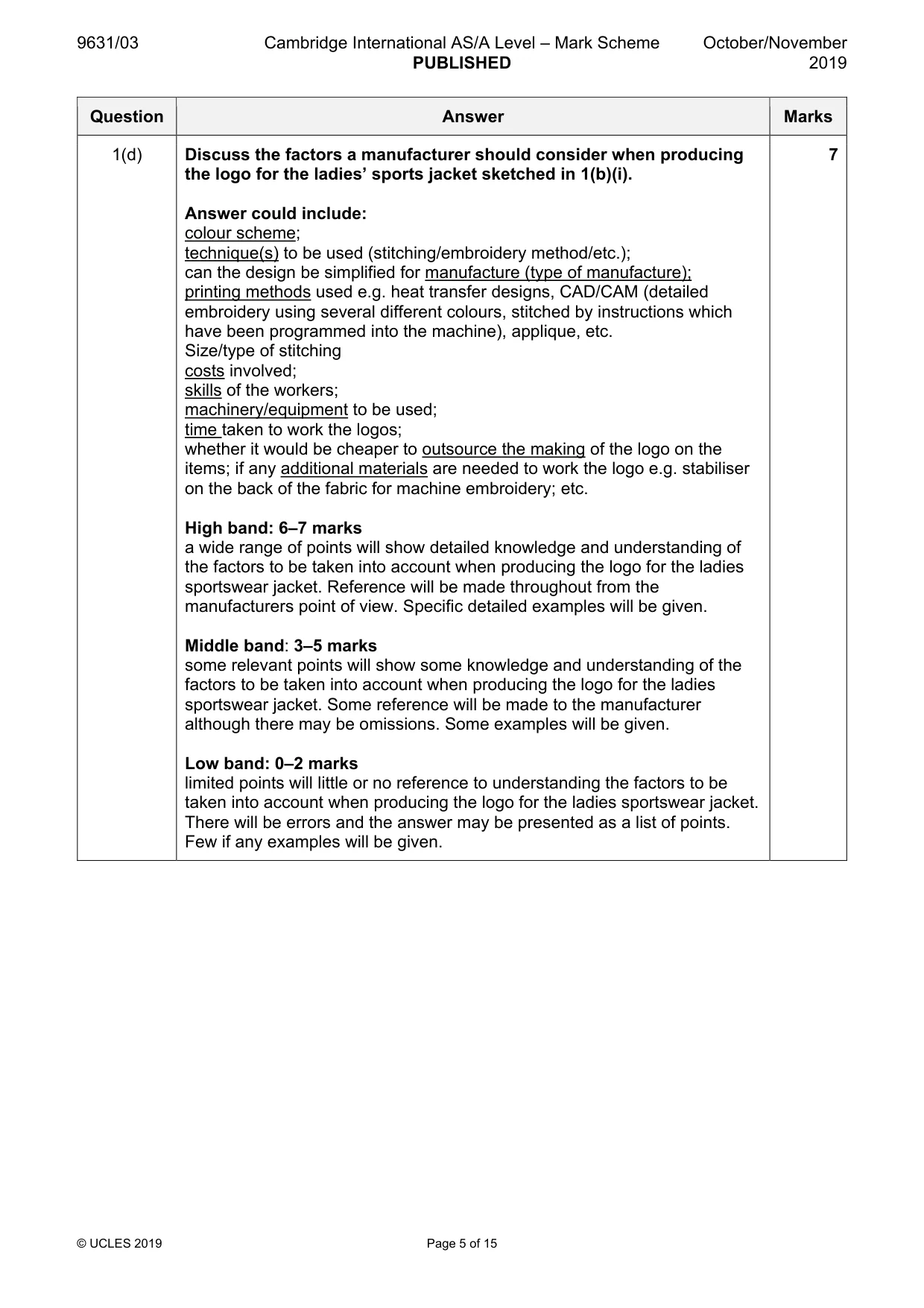
Mark scheme: Question Answer Marks 1(a) There is a wide variety of sportwear available. 4 State four factors a designer should consider when designing a collection of sportswear. Answer could include: Which sportswear is being designed e.g. outdoor wear, clothing which needs to be flexible with movement such as swimwear; whether any specific colours need to be used e.g. some sports teams may want to use a colour scheme; the age group for the sportswear; who the sportwear is designed for : unisex, men's, ladies, children (including age range) which fabrics to use e.g. washability/hardwearing/etc.; construction of fabric e.g. if it needsp to be knitted or woven; Style/fashion trend cost; fastenings; seasons/weather; function/protection requirements. any other relevant point. 1 mark for each factor stated. 1(b)(i) Sketch and label a design for a ladies’ sports jacket. Your design 4 should include fastenings, an original logo and one named synthetic fabric. Answer could include: good quality sketch with accurate labelling; labelling could include e.g. long sleeves (set-in or raglan), could be short sleeves but not so common on a jacket, ribbed stand-up collar/rever-type collar/ turn-over collar/no collar but with a facing; seams which are visible e.g. top-stitched/double stitched; hemline could be ribbed to match the neckline/band attached/facing/top stitched/etc. Fastenings such as zip, Velcro, buttons and buttonholes, press fasteners, etc. Original logo – not a copy of other designs, technique to be used not required at this stage although this may be labelled. Synthetic fabric – could include waterproof nylon (rip stop), polyester satin, polyester jersey, ribbed acrylic jersey, nylon/Lycra blended fabrics, polyester/Lycra blended fabrics, etc. 1 mark for each well labelled/sketched point. Must include a named fabric for full marks. 1(b)(ii) Justify your choices of fastenings, logo and fabrics in your design in 4 1(b)(i). Answer could include: fastenings: ease of application during production, ease/appropriateness of use for sport, colour to stand out/blend in with fabric, etc.; (1 mark) style of logo: to be appropriate for the style of sport/to match a team/team colours/original/etc.; (1 mark) choice of one named synthetic fabric: any relevant performance characteristics/justification of fabric structure (up to 2 marks). 1 mark for each well justified point. If incorrect fabric in 1(b)(i) can credit correct reasons in 1(b)(ii) 1(c) Explain how three fabric finishes will improve the performance of the 6 fabric chosen in 1(b)(i). Answer could include: need to be fabric finishes suitable for synthetics: must be relevant to item in (b): e.g. easycare, stain resistance, flame resistance, crease resistance, water repellent, anti static, etc.; explanations will include what the fabric finish is used for (e.g. easy laundering, looking smart/no creasing; adding to comfort during wear, etc.; explanations of how it improves the performance of fabric – detailed answers needed for full marks. Up to 2 marks for each well explained fabric finish. 1(d) Discuss the factors a manufacturer should consider when producing 7 the logo for the ladies’ sports jacket sketched in 1(b)(i). Answer could include: colour scheme; technique(s) to be used (stitching/embroidery method/etc.); can the design be simplified for manufacture (type of manufacture); printing methods used e.g. heat transfer designs, CAD/CAM (detailed embroidery using several different colours, stitched by instructions which have been programmed into the machine), applique, etc. Size/type of stitching costs involved; skills of the workers; machinery/equipment to be used; time taken to work the logos; whether it would be cheaper to outsource the making of the logo on the items; if any additional materials are needed to work the logo e.g. stabiliser on the back of the fabric for machine embroidery; etc. High band: 6–7 marks a wide range of points will show detailed knowledge and understanding of the factors to be taken into account when producing the logo for the ladies sportswear jacket. Reference will be made throughout from the manufacturers point of view. Specific detailed examples will be given. Middle band: 3–5 marks some relevant points will show some knowledge and understanding of the factors to be taken into account when producing the logo for the ladies sportswear jacket. Some reference will be made to the manufacturer although there may be omissions. Some examples will be given. Low band: 0–2 marks limited points will little or no reference to understanding the factors to be taken into account when producing the logo for the ladies sportswear jacket. There will be errors and the answer may be presented as a list of points. Few if any examples will be given.
Q2 · Different yarns are used in fabric production
2 Different yarns are used in fabric production. (a) Describe two different performance characteristics for each of the following: • staple fibre yarns [2] • filament yarns [2] (b) Discuss how different speciality yarn types can be used in woven fabrics to produce a variety of textural effects. [9] (c) Compare natural dyes with synthetic dyes when dyeing fibres, yarns and fabrics. [12] [Total: 25]
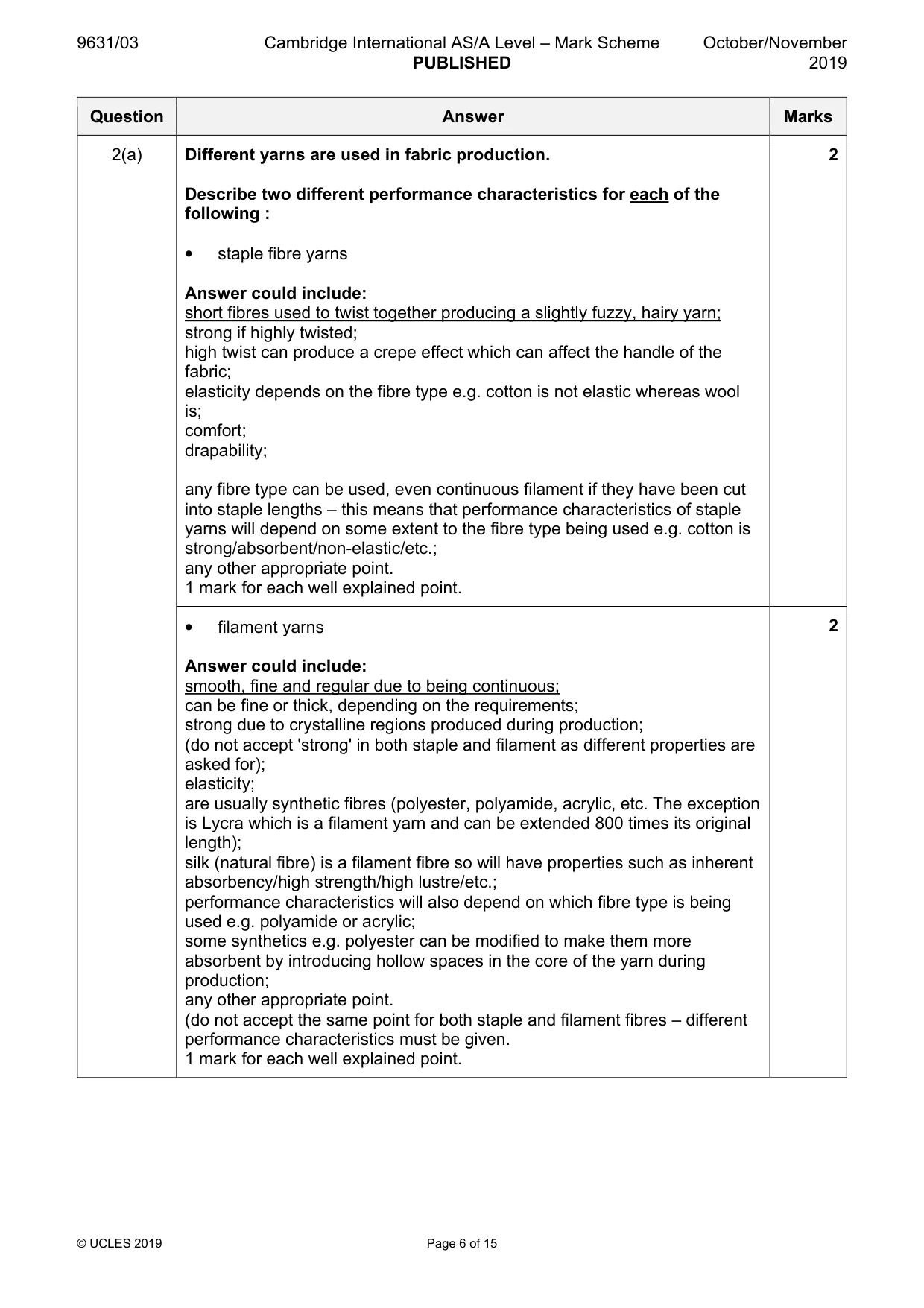
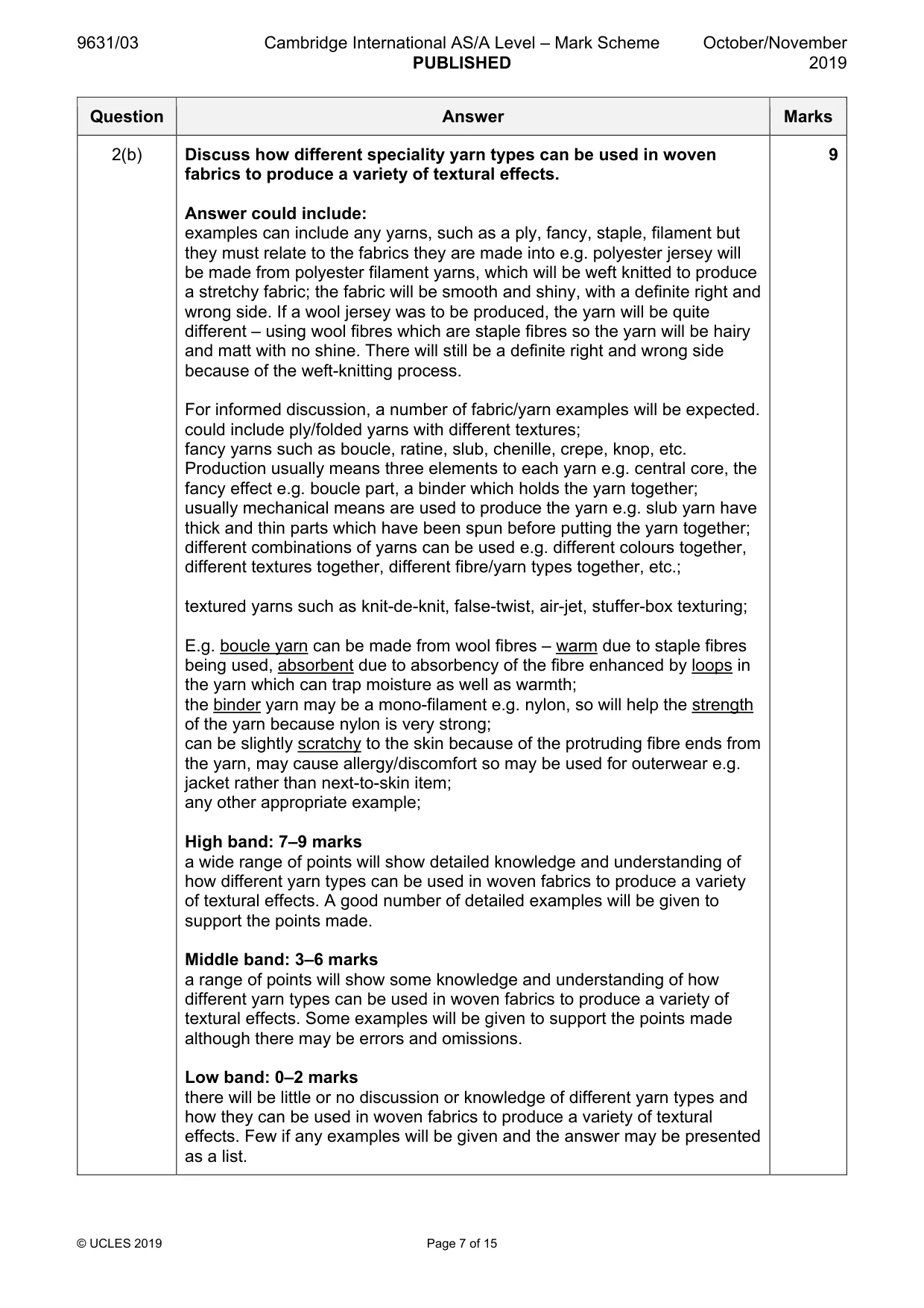
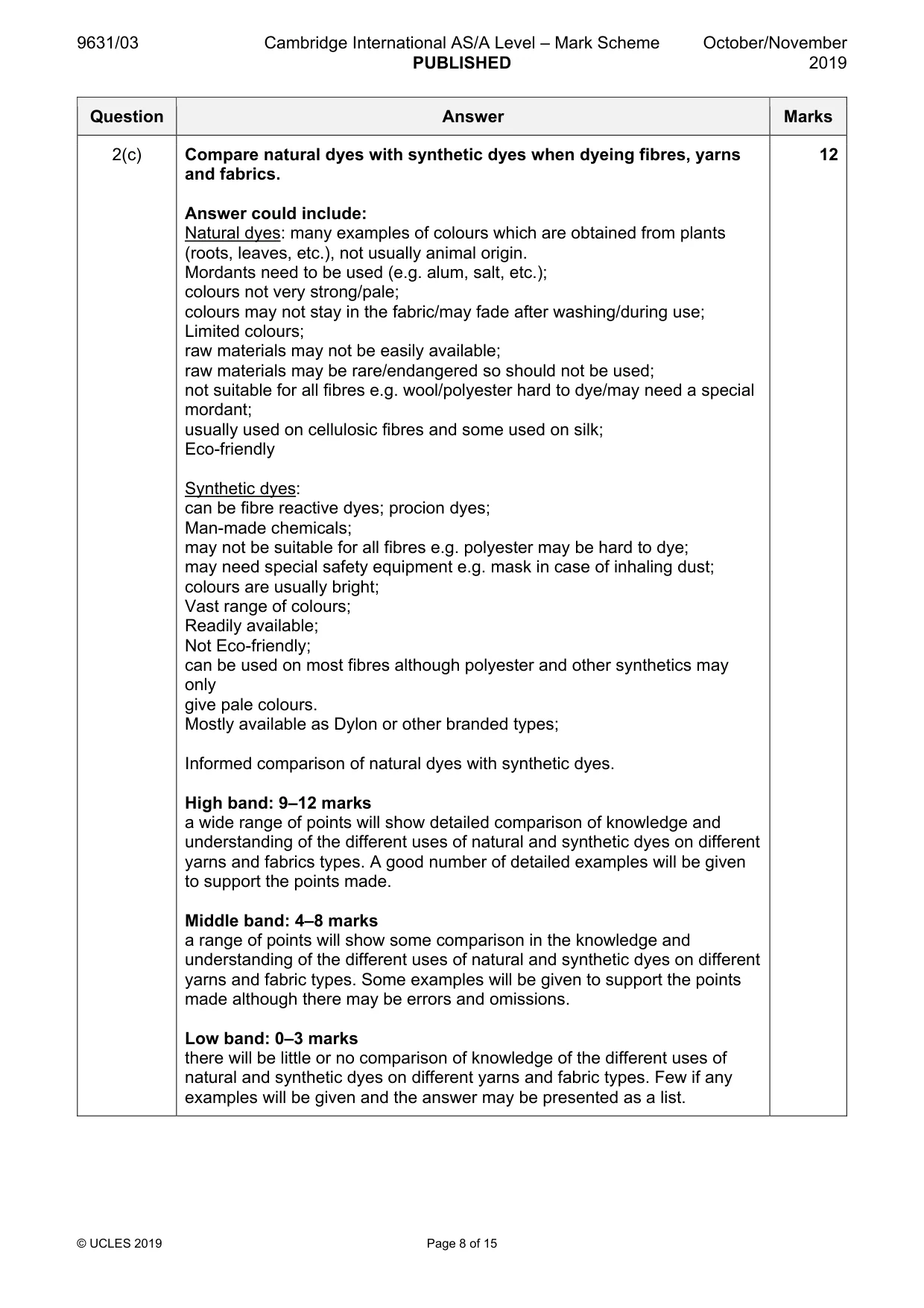
Mark scheme: 2(a) Different yarns are used in fabric production. 2 Describe two different performance characteristics for each of the following : • staple fibre yarns Answer could include: short fibres used to twist together producing a slightly fuzzy, hairy yarn; strong if highly twisted; high twist can produce a crepe effect which can affect the handle of the fabric; elasticity depends on the fibre type e.g. cotton is not elastic whereas wool is; comfort; drapability; any fibre type can be used, even continuous filament if they have been cut into staple lengths – this means that performance characteristics of staple yarns will depend on some extent to the fibre type being used e.g. cotton is strong/absorbent/non-elastic/etc.; any other appropriate point. 1 mark for each well explained point. • filament yarns 2 Answer could include: smooth, fine and regular due to being continuous; can be fine or thick, depending on the requirements; strong due to crystalline regions produced during production; (do not accept 'strong' in both staple and filament as different properties are asked for); elasticity; are usually synthetic fibres (polyester, polyamide, acrylic, etc. The exception is Lycra which is a filament yarn and can be extended 800 times its original length); silk (natural fibre) is a filament fibre so will have properties such as inherent absorbency/high strength/high lustre/etc.; performance characteristics will also depend on which fibre type is being used e.g. polyamide or acrylic; some synthetics e.g. polyester can be modified to make them more absorbent by introducing hollow spaces in the core of the yarn during production; any other appropriate point. (do not accept the same point for both staple and filament fibres – different performance characteristics must be given. 1 mark for each well explained point. 2(b) Discuss how different speciality yarn types can be used in woven 9 fabrics to produce a variety of textural effects. Answer could include: examples can include any yarns, such as a ply, fancy, staple, filament but they must relate to the fabrics they are made into e.g. polyester jersey will be made from polyester filament yarns, which will be weft knitted to produce a stretchy fabric; the fabric will be smooth and shiny, with a definite right and wrong side. If a wool jersey was to be produced, the yarn will be quite different – using wool fibres which are staple fibres so the yarn will be hairy and matt with no shine. There will still be a definite right and wrong side because of the weft-knitting process. For informed discussion, a number of fabric/yarn examples will be expected. could include ply/folded yarns with different textures; fancy yarns such as boucle, ratine, slub, chenille, crepe, knop, etc. Production usually means three elements to each yarn e.g. central core, the fancy effect e.g. boucle part, a binder which holds the yarn together; usually mechanical means are used to produce the yarn e.g. slub yarn have thick and thin parts which have been spun before putting the yarn together; different combinations of yarns can be used e.g. different colours together, different textures together, different fibre/yarn types together, etc.; textured yarns such as knit-de-knit, false-twist, air-jet, stuffer-box texturing; E.g. boucle yarn can be made from wool fibres – warm due to staple fibres being used, absorbent due to absorbency of the fibre enhanced by loops in the yarn which can trap moisture as well as warmth; the binder yarn may be a mono-filament e.g. nylon, so will help the strength of the yarn because nylon is very strong; can be slightly scratchy to the skin because of the protruding fibre ends from the yarn, may cause allergy/discomfort so may be used for outerwear e.g. jacket rather than next-to-skin item; any other appropriate example; High band: 7–9 marks a wide range of points will show detailed knowledge and understanding of how different yarn types can be used in woven fabrics to produce a variety of textural effects. A good number of detailed examples will be given to support the points made. Middle band: 3–6 marks a range of points will show some knowledge and understanding of how different yarn types can be used in woven fabrics to produce a variety of textural effects. Some examples will be given to support the points made although there may be errors and omissions. Low band: 0–2 marks there will be little or no discussion or knowledge of different yarn types and how they can be used in woven fabrics to produce a variety of textural effects. Few if any examples will be given and the answer may be presented as a list. 2(c) Compare natural dyes with synthetic dyes when dyeing fibres, yarns 12 and fabrics. Answer could include: Natural dyes: many examples of colours which are obtained from plants (roots, leaves, etc.), not usually animal origin. Mordants need to be used (e.g. alum, salt, etc.); colours not very strong/pale; colours may not stay in the fabric/may fade after washing/during use; Limited colours; raw materials may not be easily available; raw materials may be rare/endangered so should not be used; not suitable for all fibres e.g. wool/polyester hard to dye/may need a special mordant; usually used on cellulosic fibres and some used on silk; Eco-friendly Synthetic dyes: can be fibre reactive dyes; procion dyes; Man-made chemicals; may not be suitable for all fibres e.g. polyester may be hard to dye; may need special safety equipment e.g. mask in case of inhaling dust; colours are usually bright; Vast range of colours; Readily available; Not Eco-friendly; can be used on most fibres although polyester and other synthetics may only give pale colours. Mostly available as Dylon or other branded types; Informed comparison of natural dyes with synthetic dyes. High band: 9–12 marks a wide range of points will show detailed comparison of knowledge and understanding of the different uses of natural and synthetic dyes on different yarns and fabrics types. A good number of detailed examples will be given to support the points made. Middle band: 4–8 marks a range of points will show some comparison in the knowledge and understanding of the different uses of natural and synthetic dyes on different yarns and fabric types. Some examples will be given to support the points made although there may be errors and omissions. Low band: 0–3 marks there will be little or no comparison of knowledge of the different uses of natural and synthetic dyes on different yarns and fabric types. Few if any examples will be given and the answer may be presented as a list. Section B Answer two questions
Q3 · Discuss how creative techniques can be used on trousers or jeans for teenagers
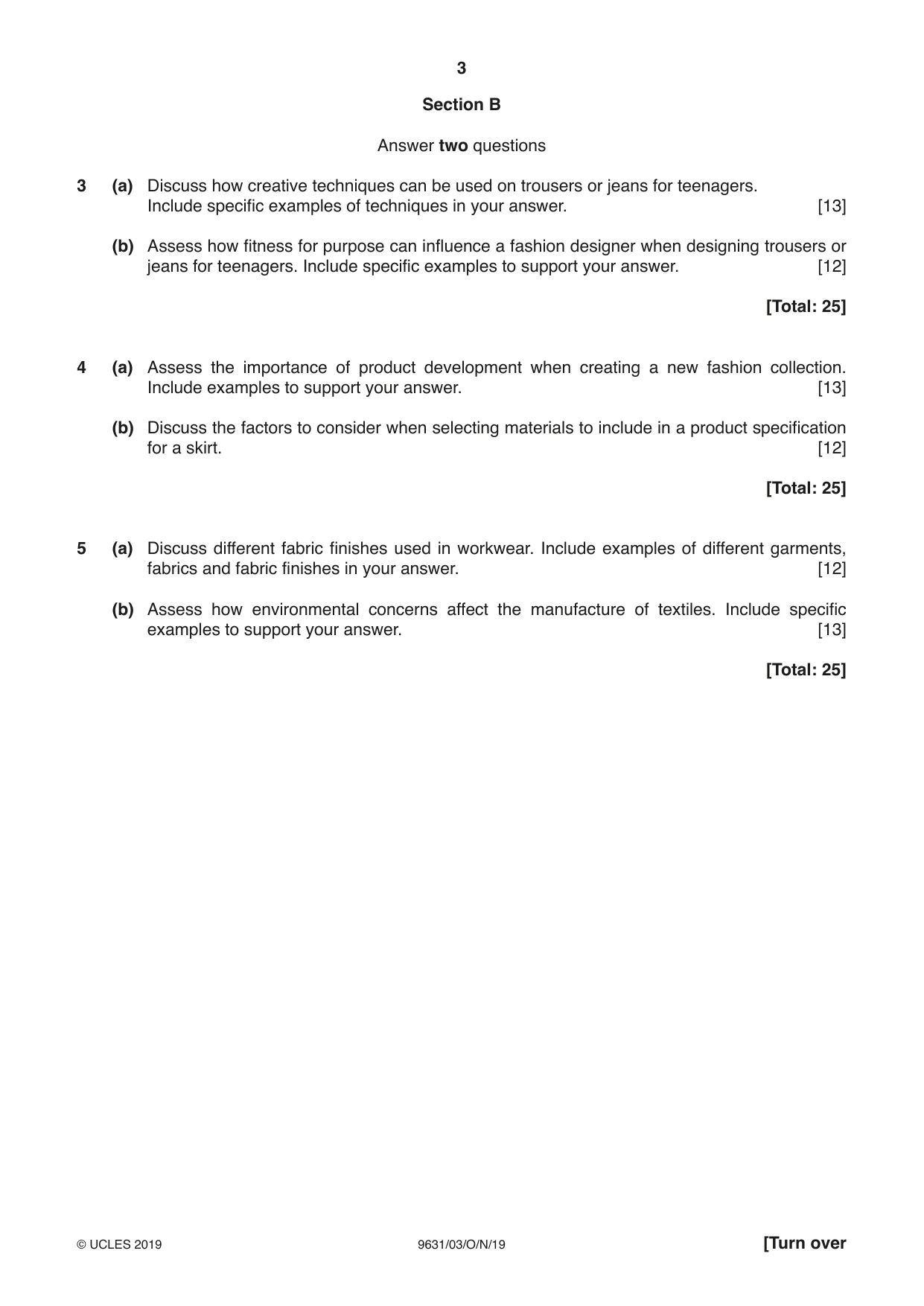
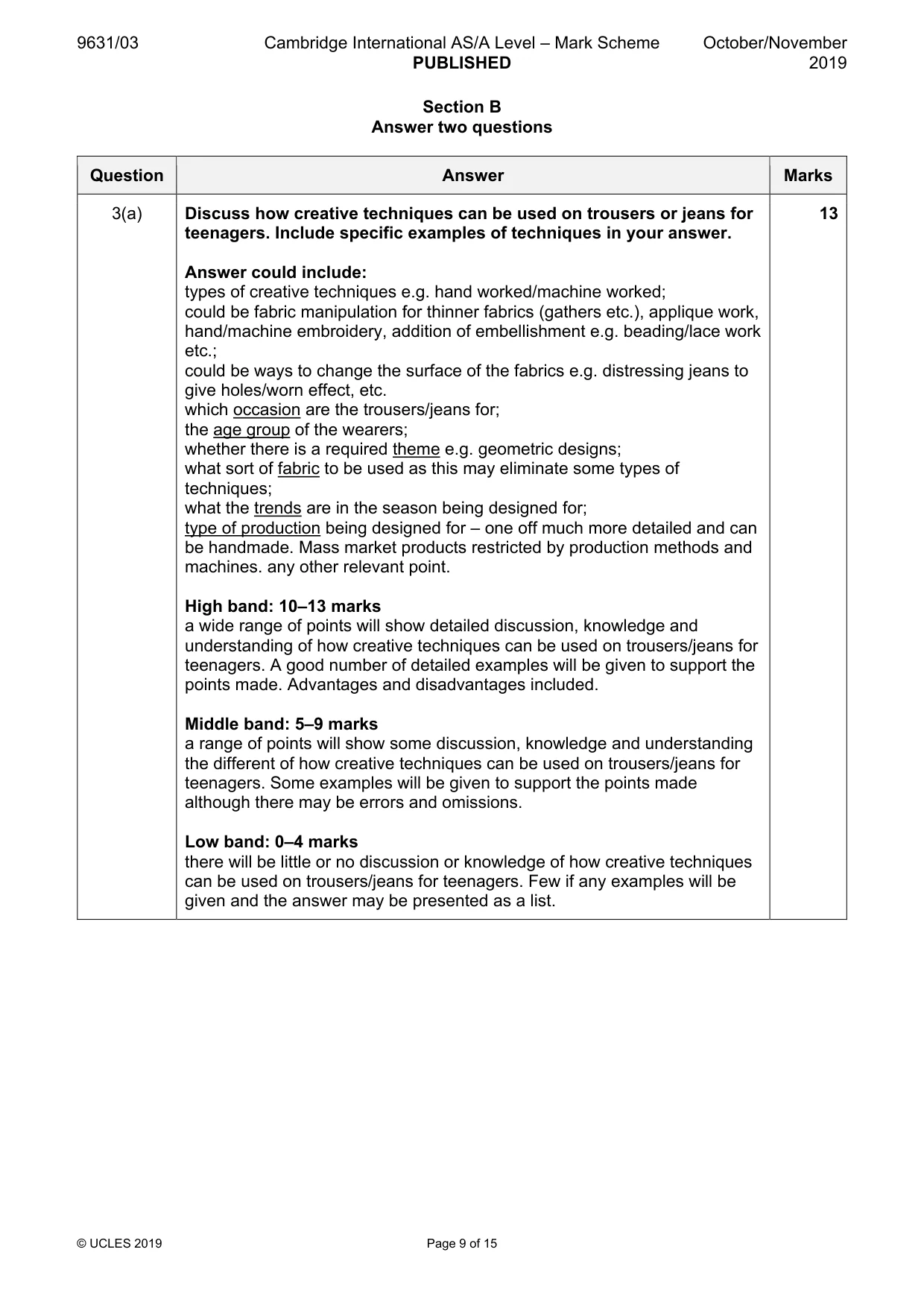
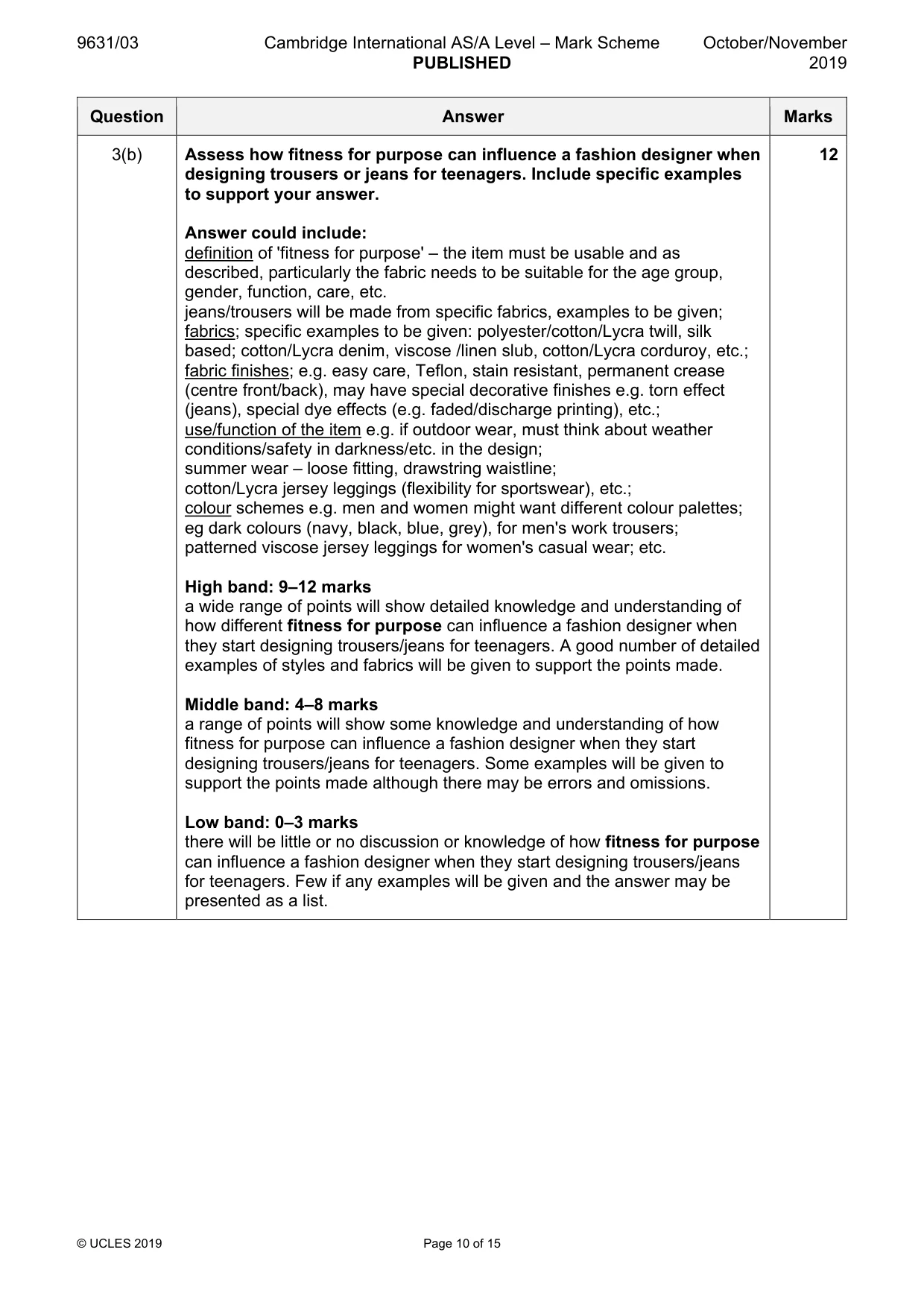
3 (a) Discuss how creative techniques can be used on trousers or jeans for teenagers. Include specific examples of techniques in your answer. [13] (b) Assess how fitness for purpose can influence a fashion designer when designing trousers or jeans for teenagers. Include specific examples to support your answer. [12] [Total: 25]
Mark scheme: 3(a) Discuss how creative techniques can be used on trousers or jeans for 13 teenagers. Include specific examples of techniques in your answer. Answer could include: types of creative techniques e.g. hand worked/machine worked; could be fabric manipulation for thinner fabrics (gathers etc.), applique work, hand/machine embroidery, addition of embellishment e.g. beading/lace work etc.; could be ways to change the surface of the fabrics e.g. distressing jeans to give holes/worn effect, etc. which occasion are the trousers/jeans for; the age group of the wearers; whether there is a required theme e.g. geometric designs; what sort of fabric to be used as this may eliminate some types of techniques; what the trends are in the season being designed for; type of production being designed for – one off much more detailed and can be handmade. Mass market products restricted by production methods and machines. any other relevant point. High band: 10–13 marks a wide range of points will show detailed discussion, knowledge and understanding of how creative techniques can be used on trousers/jeans for teenagers. A good number of detailed examples will be given to support the points made. Advantages and disadvantages included. Middle band: 5–9 marks a range of points will show some discussion, knowledge and understanding the different of how creative techniques can be used on trousers/jeans for teenagers. Some examples will be given to support the points made although there may be errors and omissions. Low band: 0–4 marks there will be little or no discussion or knowledge of how creative techniques can be used on trousers/jeans for teenagers. Few if any examples will be given and the answer may be presented as a list. 3(b) Assess how fitness for purpose can influence a fashion designer when 12 designing trousers or jeans for teenagers. Include specific examples to support your answer. Answer could include: definition of 'fitness for purpose' – the item must be usable and as described, particularly the fabric needs to be suitable for the age group, gender, function, care, etc. jeans/trousers will be made from specific fabrics, examples to be given; fabrics; specific examples to be given: polyester/cotton/Lycra twill, silk based; cotton/Lycra denim, viscose /linen slub, cotton/Lycra corduroy, etc.; fabric finishes; e.g. easy care, Teflon, stain resistant, permanent crease (centre front/back), may have special decorative finishes e.g. torn effect (jeans), special dye effects (e.g. faded/discharge printing), etc.; use/function of the item e.g. if outdoor wear, must think about weather conditions/safety in darkness/etc. in the design; summer wear – loose fitting, drawstring waistline; cotton/Lycra jersey leggings (flexibility for sportswear), etc.; colour schemes e.g. men and women might want different colour palettes; eg dark colours (navy, black, blue, grey), for men's work trousers; patterned viscose jersey leggings for women's casual wear; etc. High band: 9–12 marks a wide range of points will show detailed knowledge and understanding of how different fitness for purpose can influence a fashion designer when they start designing trousers/jeans for teenagers. A good number of detailed examples of styles and fabrics will be given to support the points made. Middle band: 4–8 marks a range of points will show some knowledge and understanding of how fitness for purpose can influence a fashion designer when they start designing trousers/jeans for teenagers. Some examples will be given to support the points made although there may be errors and omissions. Low band: 0–3 marks there will be little or no discussion or knowledge of how fitness for purpose can influence a fashion designer when they start designing trousers/jeans for teenagers. Few if any examples will be given and the answer may be presented as a list.
Q4 · Assess the importance of product development when creating a new fashion collection
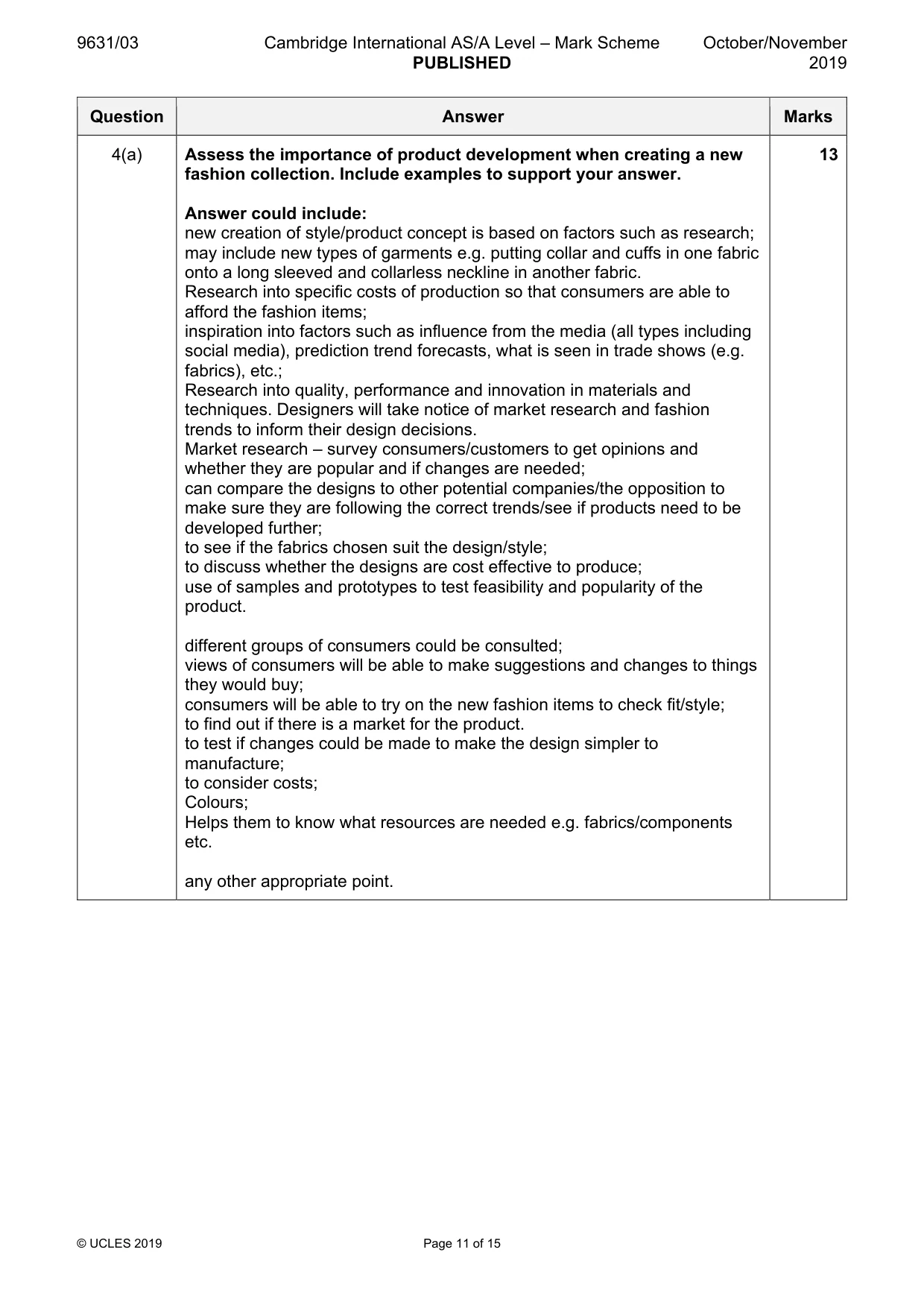
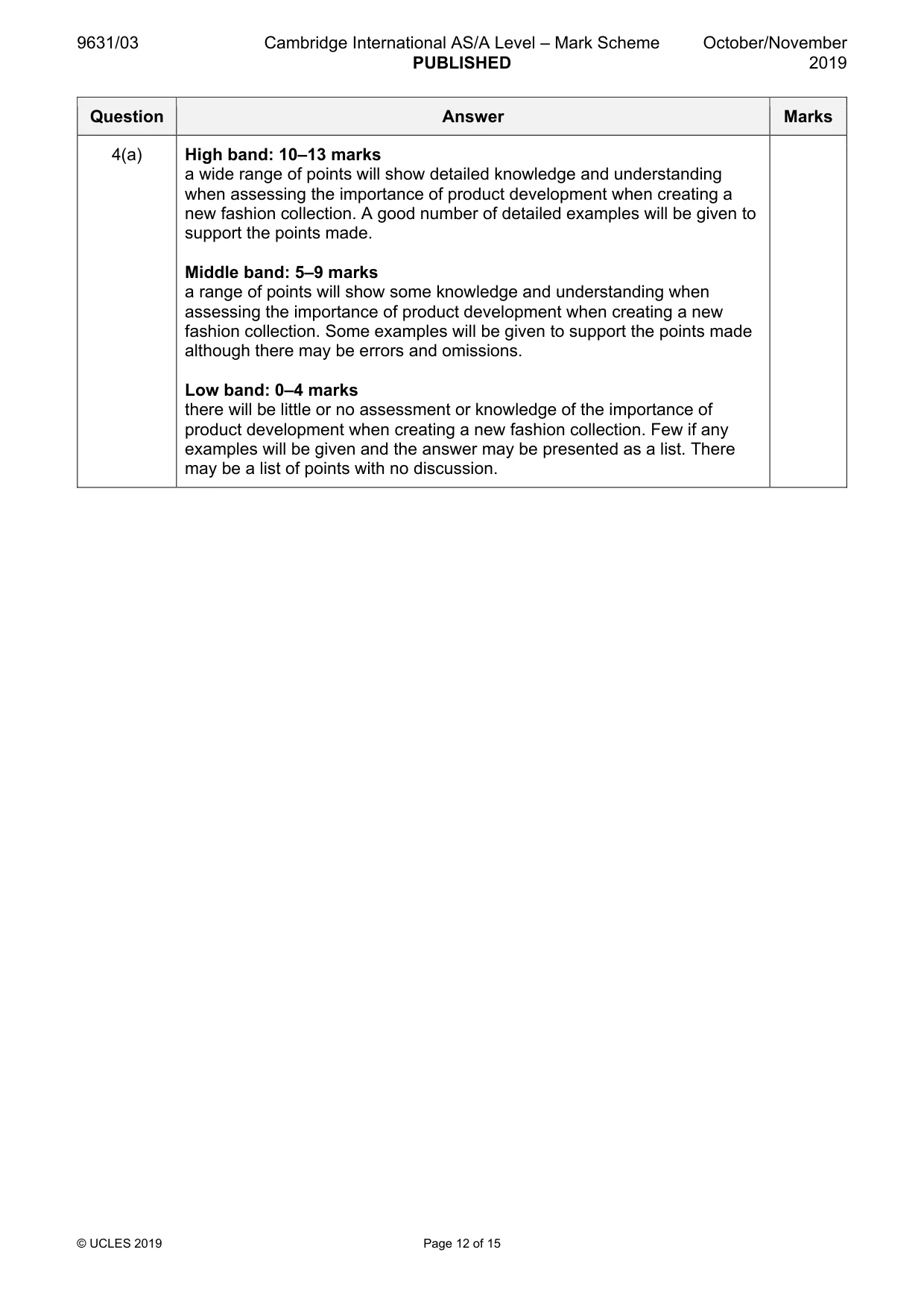
4 (a) Assess the importance of product development when creating a new fashion collection. Include examples to support your answer. [13] (b) Discuss the factors to consider when selecting materials to include in a product specification for a skirt. [12] [Total: 25]
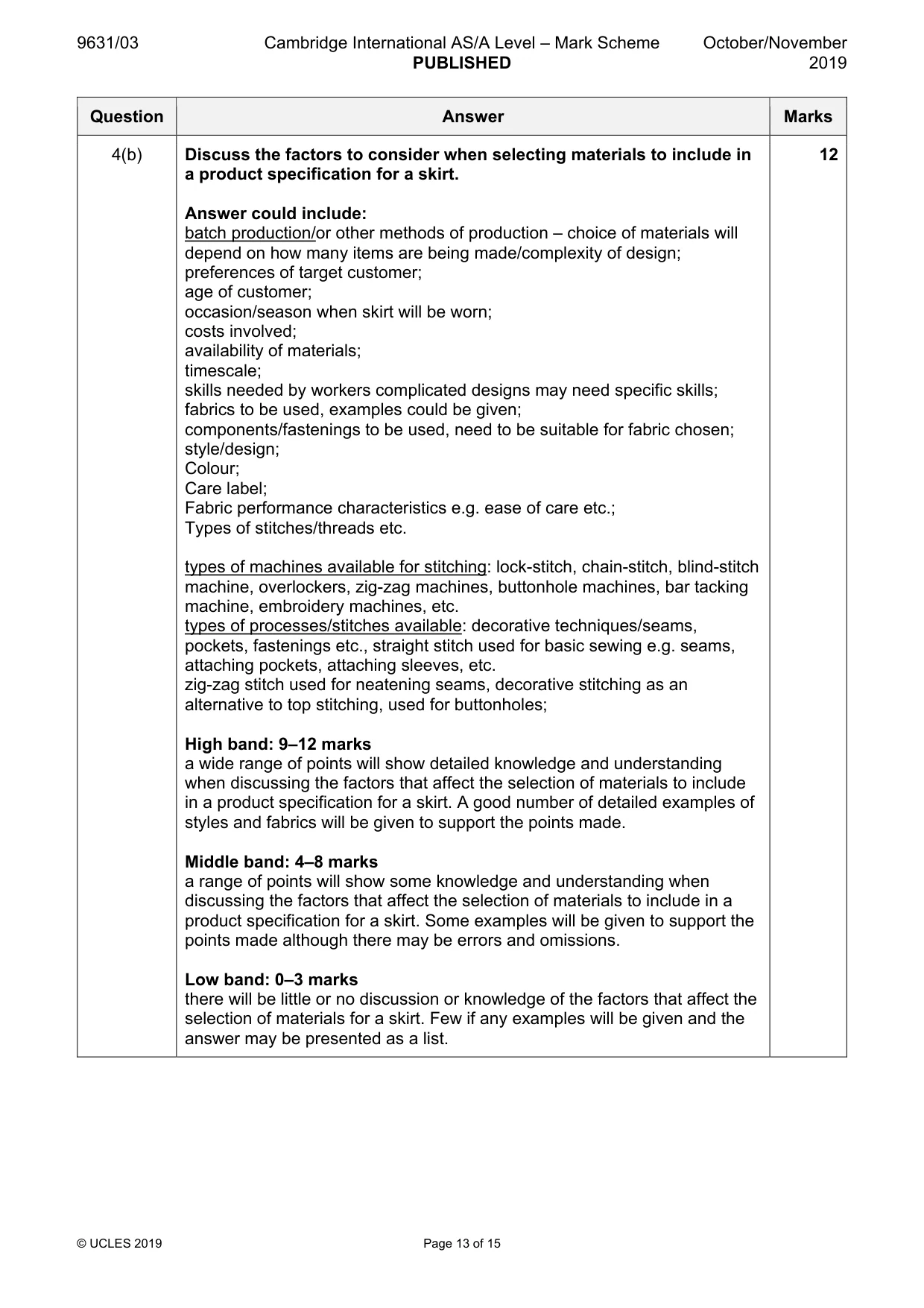
Mark scheme: 4(a) Assess the importance of product development when creating a new 13 fashion collection. Include examples to support your answer. Answer could include: new creation of style/product concept is based on factors such as research; may include new types of garments e.g. putting collar and cuffs in one fabric onto a long sleeved and collarless neckline in another fabric. Research into specific costs of production so that consumers are able to afford the fashion items; inspiration into factors such as influence from the media (all types including social media), prediction trend forecasts, what is seen in trade shows (e.g. fabrics), etc.; Research into quality, performance and innovation in materials and techniques. Designers will take notice of market research and fashion trends to inform their design decisions. Market research – survey consumers/customers to get opinions and whether they are popular and if changes are needed; can compare the designs to other potential companies/the opposition to make sure they are following the correct trends/see if products need to be developed further; to see if the fabrics chosen suit the design/style; to discuss whether the designs are cost effective to produce; use of samples and prototypes to test feasibility and popularity of the product. different groups of consumers could be consulted; views of consumers will be able to make suggestions and changes to things they would buy; consumers will be able to try on the new fashion items to check fit/style; to find out if there is a market for the product. to test if changes could be made to make the design simpler to manufacture; to consider costs; Colours; Helps them to know what resources are needed e.g. fabrics/components etc. any other appropriate point. 4(a) High band: 10–13 marks a wide range of points will show detailed knowledge and understanding when assessing the importance of product development when creating a new fashion collection. A good number of detailed examples will be given to support the points made. Middle band: 5–9 marks a range of points will show some knowledge and understanding when assessing the importance of product development when creating a new fashion collection. Some examples will be given to support the points made although there may be errors and omissions. Low band: 0–4 marks there will be little or no assessment or knowledge of the importance of product development when creating a new fashion collection. Few if any examples will be given and the answer may be presented as a list. There may be a list of points with no discussion. 4(b) Discuss the factors to consider when selecting materials to include in 12 a product specification for a skirt. Answer could include: batch production/or other methods of production – choice of materials will depend on how many items are being made/complexity of design; preferences of target customer; age of customer; occasion/season when skirt will be worn; costs involved; availability of materials; timescale; skills needed by workers complicated designs may need specific skills; fabrics to be used, examples could be given; components/fastenings to be used, need to be suitable for fabric chosen; style/design; Colour; Care label; Fabric performance characteristics e.g. ease of care etc.; Types of stitches/threads etc. types of machines available for stitching: lock-stitch, chain-stitch, blind-stitch machine, overlockers, zig-zag machines, buttonhole machines, bar tacking machine, embroidery machines, etc. types of processes/stitches available: decorative techniques/seams, pockets, fastenings etc., straight stitch used for basic sewing e.g. seams, attaching pockets, attaching sleeves, etc. zig-zag stitch used for neatening seams, decorative stitching as an alternative to top stitching, used for buttonholes; High band: 9–12 marks a wide range of points will show detailed knowledge and understanding when discussing the factors that affect the selection of materials to include in a product specification for a skirt. A good number of detailed examples of styles and fabrics will be given to support the points made. Middle band: 4–8 marks a range of points will show some knowledge and understanding when discussing the factors that affect the selection of materials to include in a product specification for a skirt. Some examples will be given to support the points made although there may be errors and omissions. Low band: 0–3 marks there will be little or no discussion or knowledge of the factors that affect the selection of materials for a skirt. Few if any examples will be given and the answer may be presented as a list.
Q5 · Discuss different fabric finishes used in workwear
5 (a) Discuss different fabric finishes used in workwear. Include examples of different garments, fabrics and fabric finishes in your answer. [12] (b) Assess how environmental concerns affect the manufacture of textiles. Include specific examples to support your answer. [13] [Total: 25]
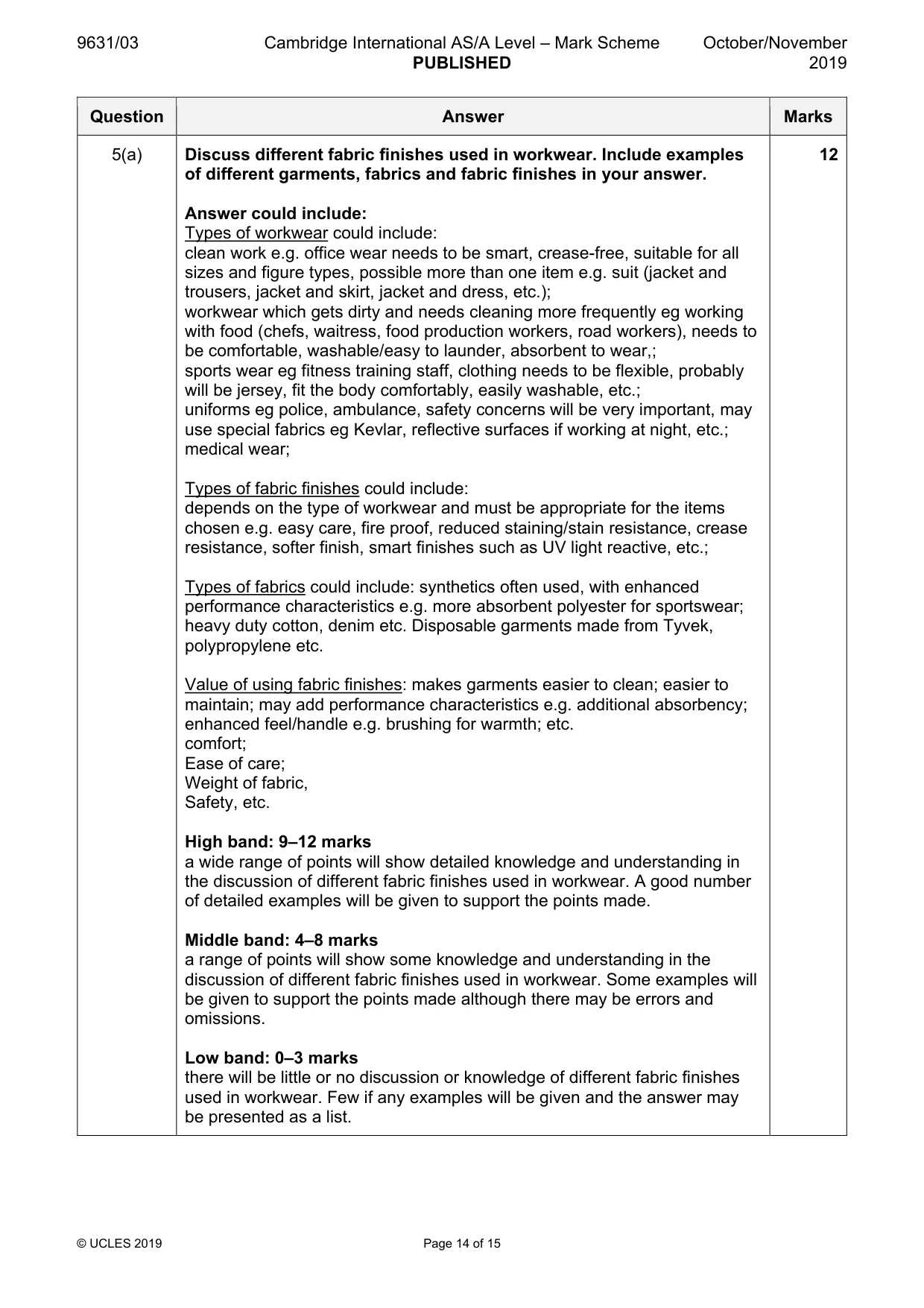
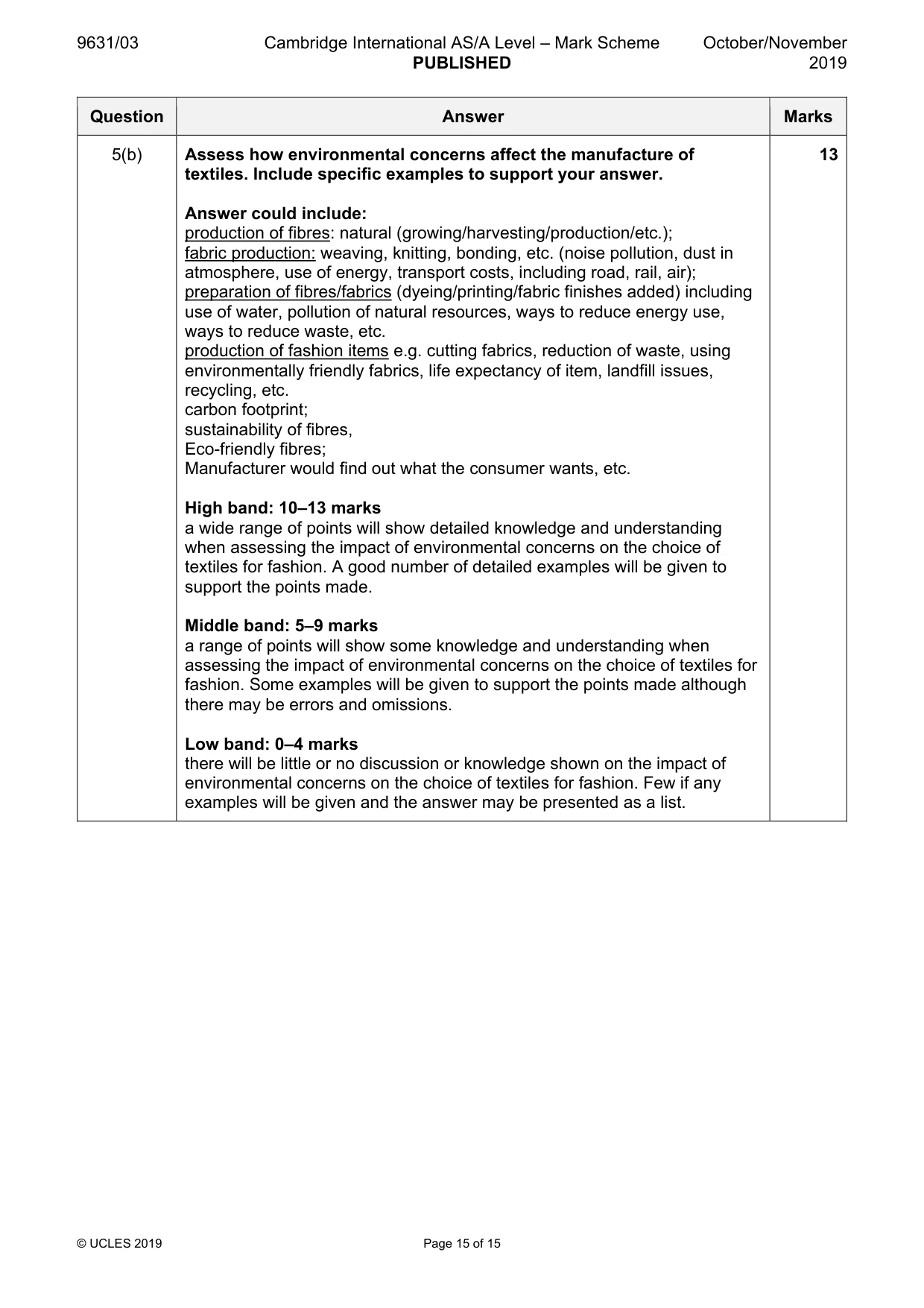
Mark scheme: 5(a) Discuss different fabric finishes used in workwear. Include examples 12 of different garments, fabrics and fabric finishes in your answer. Answer could include: Types of workwear could include: clean work e.g. office wear needs to be smart, crease-free, suitable for all sizes and figure types, possible more than one item e.g. suit (jacket and trousers, jacket and skirt, jacket and dress, etc.); workwear which gets dirty and needs cleaning more frequently eg working with food (chefs, waitress, food production workers, road workers), needs to be comfortable, washable/easy to launder, absorbent to wear,; sports wear eg fitness training staff, clothing needs to be flexible, probably will be jersey, fit the body comfortably, easily washable, etc.; uniforms eg police, ambulance, safety concerns will be very important, may use special fabrics eg Kevlar, reflective surfaces if working at night, etc.; medical wear; Types of fabric finishes could include: depends on the type of workwear and must be appropriate for the items chosen e.g. easy care, fire proof, reduced staining/stain resistance, crease resistance, softer finish, smart finishes such as UV light reactive, etc.; Types of fabrics could include: synthetics often used, with enhanced performance characteristics e.g. more absorbent polyester for sportswear; heavy duty cotton, denim etc. Disposable garments made from Tyvek, polypropylene etc. Value of using fabric finishes: makes garments easier to clean; easier to maintain; may add performance characteristics e.g. additional absorbency; enhanced feel/handle e.g. brushing for warmth; etc. comfort; Ease of care; Weight of fabric, Safety, etc. High band: 9–12 marks a wide range of points will show detailed knowledge and understanding in the discussion of different fabric finishes used in workwear. A good number of detailed examples will be given to support the points made. Middle band: 4–8 marks a range of points will show some knowledge and understanding in the discussion of different fabric finishes used in workwear. Some examples will be given to support the points made although there may be errors and omissions. Low band: 0–3 marks there will be little or no discussion or knowledge of different fabric finishes used in workwear. Few if any examples will be given and the answer may be presented as a list. 5(b) Assess how environmental concerns affect the manufacture of 13 textiles. Include specific examples to support your answer. Answer could include: production of fibres: natural (growing/harvesting/production/etc.); fabric production: weaving, knitting, bonding, etc. (noise pollution, dust in atmosphere, use of energy, transport costs, including road, rail, air); preparation of fibres/fabrics (dyeing/printing/fabric finishes added) including use of water, pollution of natural resources, ways to reduce energy use, ways to reduce waste, etc. production of fashion items e.g. cutting fabrics, reduction of waste, using environmentally friendly fabrics, life expectancy of item, landfill issues, recycling, etc. carbon footprint; sustainability of fibres, Eco-friendly fibres; Manufacturer would find out what the consumer wants, etc. High band: 10–13 marks a wide range of points will show detailed knowledge and understanding when assessing the impact of environmental concerns on the choice of textiles for fashion. A good number of detailed examples will be given to support the points made. Middle band: 5–9 marks a range of points will show some knowledge and understanding when assessing the impact of environmental concerns on the choice of textiles for fashion. Some examples will be given to support the points made although there may be errors and omissions. Low band: 0–4 marks there will be little or no discussion or knowledge shown on the impact of environmental concerns on the choice of textiles for fashion. Few if any examples will be given and the answer may be presented as a list.
What you needed in this session
Cambridge’s own grade thresholds for 2019 Oct/Nov, Paper 3 · Variant 1. A higher threshold means an easier paper — the bar moves with how the cohort did.