Cambridge A Level Design and Textiles 9631 — 2016 Oct/Nov Paper 3 · Variant 1
9631/31/O/N/16 · 5 questions · 100 marks · ≈113 min
The question paper and its mark scheme, free to read here and free to download. This is Cambridge’s own paper, exactly as it was sat.
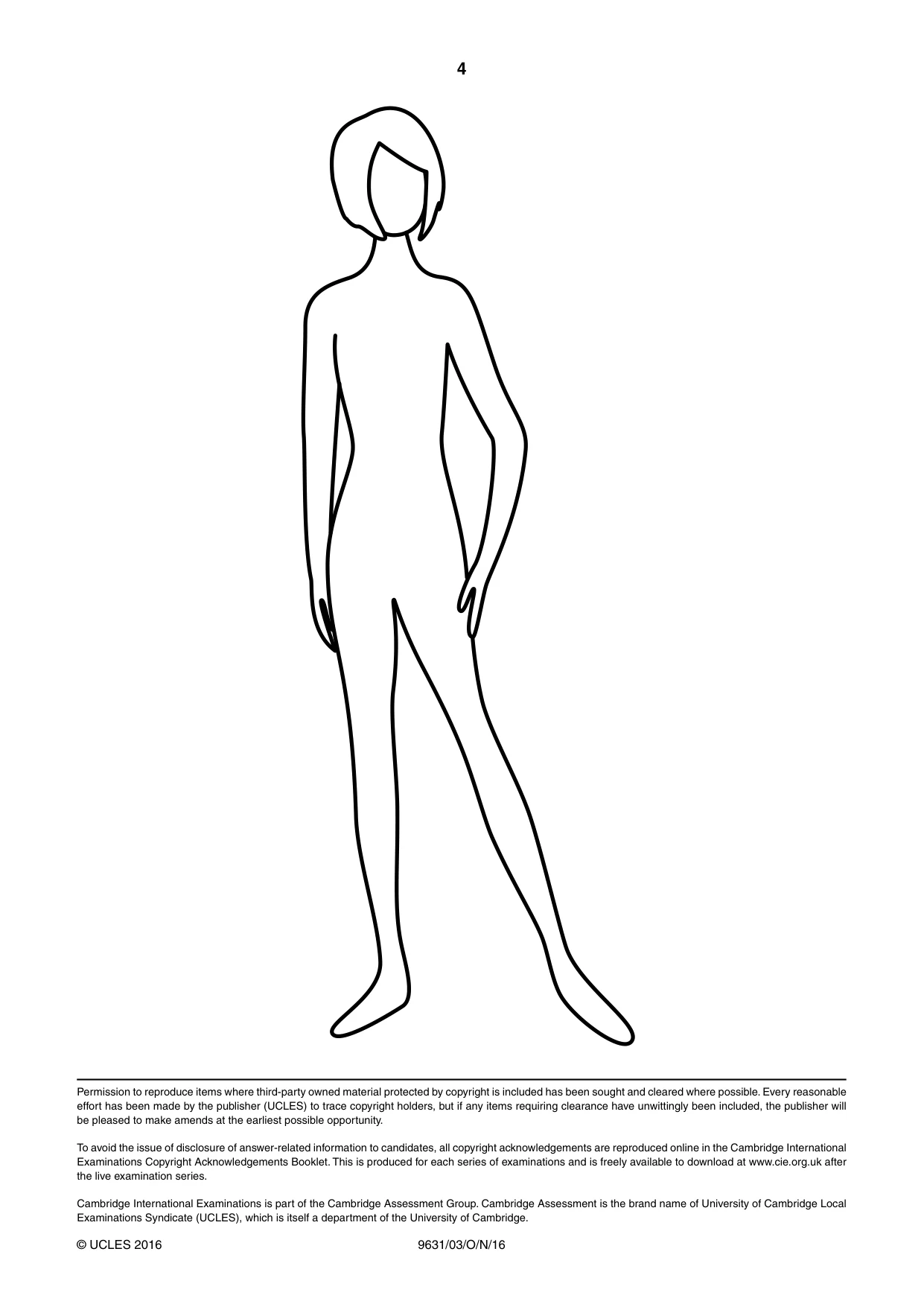
Question paper4 pages
Mark scheme11 pages
Answers below. Sit the paper first if you are practising.
Questions as text
Q1 · Designing to a specification is important
1 Designing to a specification is important. (a) (i) State three factors that a fashion designer would need to consider when designing fashion items which will be manufactured in large quantities. [3] (ii) Choose two of the factors stated in (a)(i) and explain why they are important to a manufacturer. [4] (b) Explain with the use of examples what is meant by the following terms in relation to designing fashion items: (i) fitness for purpose; [3] (ii) safety of textiles; [3] (iii) environmental issues. [3] (c) Explain how a designer would choose which fabric finishes to include when designing fashion items. Include examples to support your answer. [9] [Total: 25]
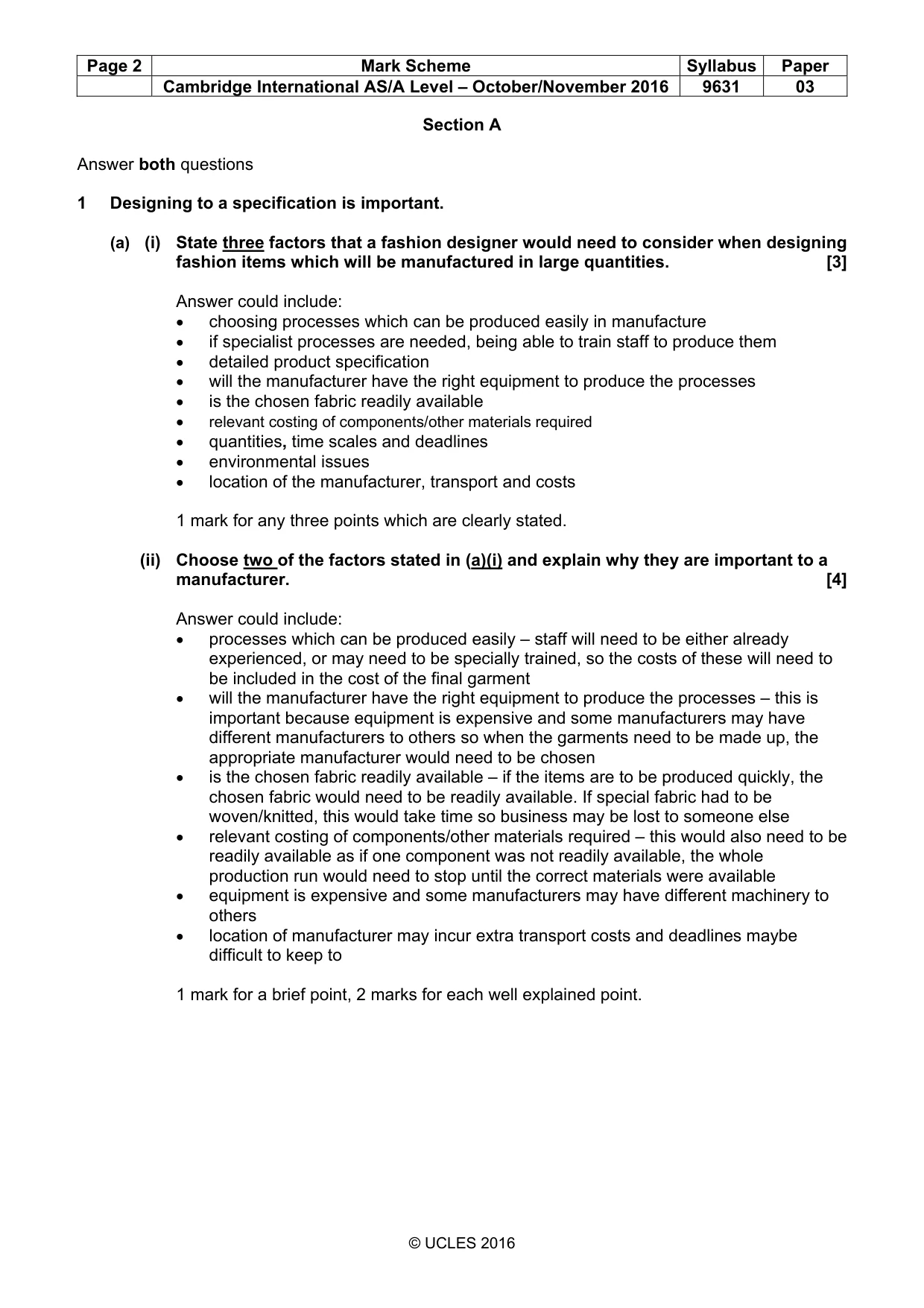
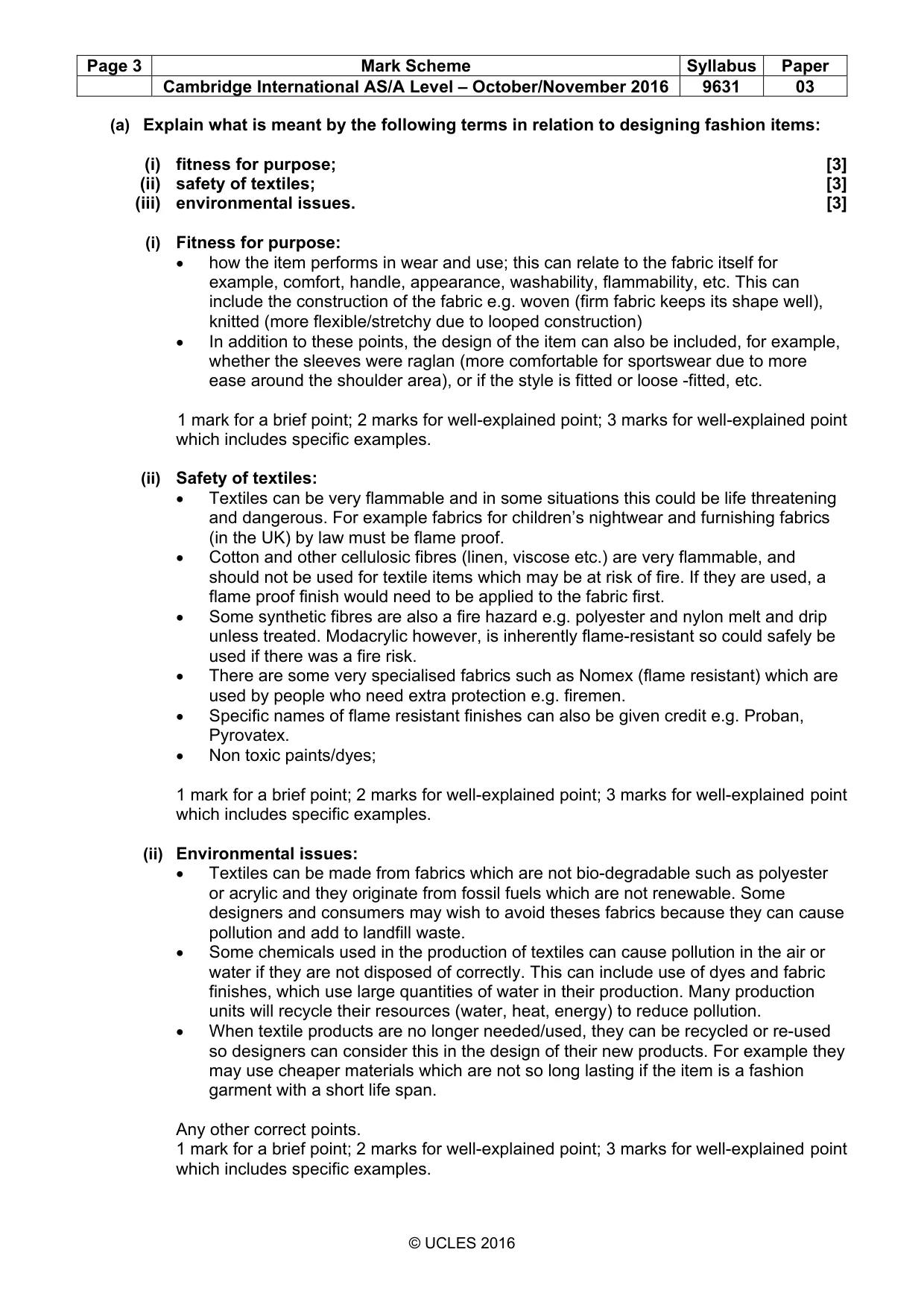
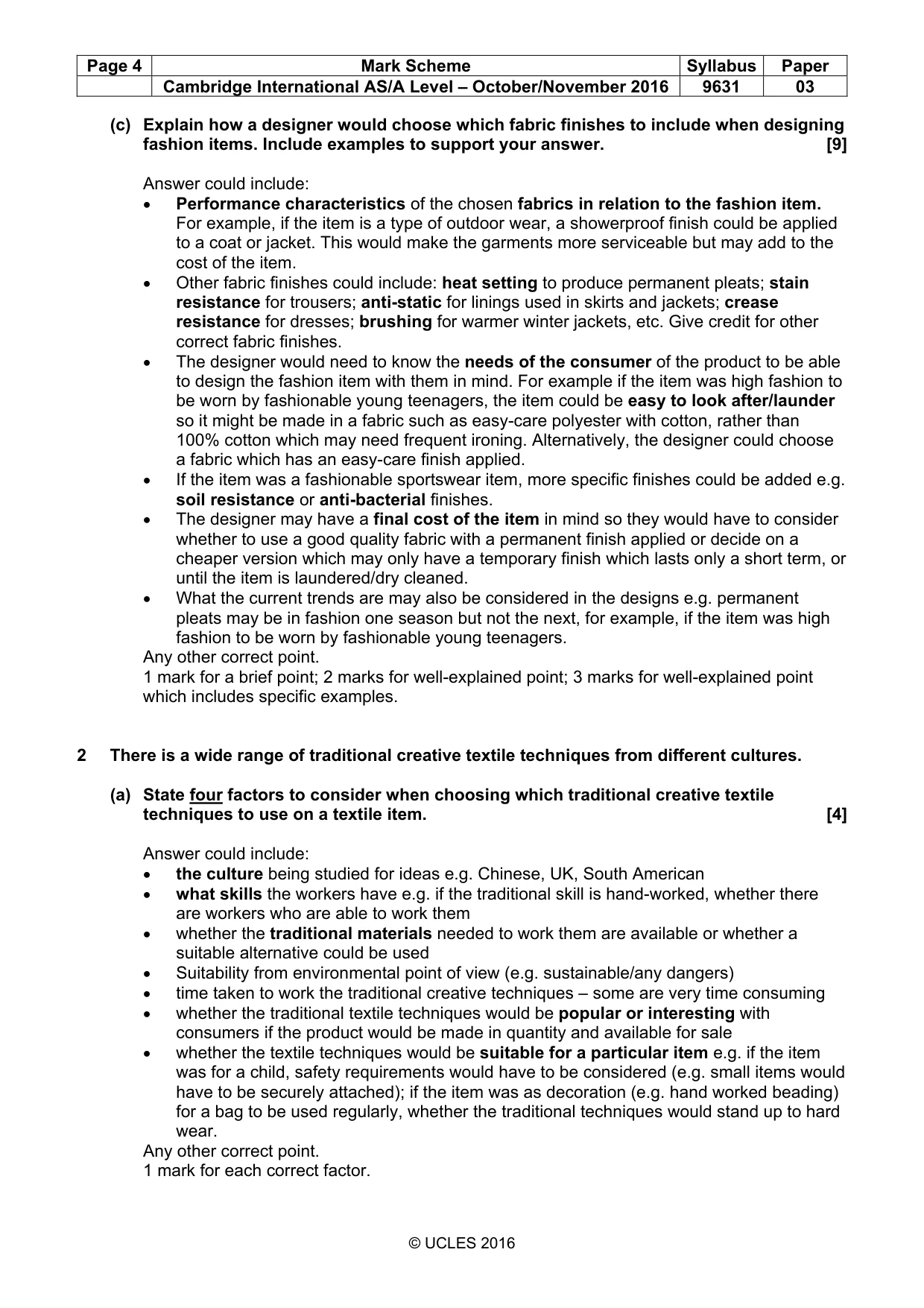
Mark scheme: 1 Designing to a specification is important. (a) (i) State three factors that a fashion designer would need to consider when designing fashion items which will be manufactured in large quantities. [3] Answer could include: • choosing processes which can be produced easily in manufacture • if specialist processes are needed, being able to train staff to produce them • detailed product specification • will the manufacturer have the right equipment to produce the processes • is the chosen fabric readily available • relevant costing of components/other materials required • quantities, time scales and deadlines • environmental issues • location of the manufacturer, transport and costs 1 mark for any three points which are clearly stated. (ii) Choose two of the factors stated in (a)(i) and explain why they are important to a manufacturer. [4] Answer could include: • processes which can be produced easily – staff will need to be either already experienced, or may need to be specially trained, so the costs of these will need to be included in the cost of the final garment • will the manufacturer have the right equipment to produce the processes – this is important because equipment is expensive and some manufacturers may have different manufacturers to others so when the garments need to be made up, the appropriate manufacturer would need to be chosen • is the chosen fabric readily available – if the items are to be produced quickly, the chosen fabric would need to be readily available. If special fabric had to be woven/knitted, this would take time so business may be lost to someone else • relevant costing of components/other materials required – this would also need to be readily available as if one component was not readily available, the whole production run would need to stop until the correct materials were available • equipment is expensive and some manufacturers may have different machinery to others • location of manufacturer may incur extra transport costs and deadlines maybe difficult to keep to 1 mark for a brief point, 2 marks for each well explained point. (a) Explain what is meant by the following terms in relation to designing fashion items: (i) fitness for purpose; [3] (ii) safety of textiles; [3] (iii) environmental issues. [3] (i) Fitness for purpose: • how the item performs in wear and use; this can relate to the fabric itself for example, comfort, handle, appearance, washability, flammability, etc. This can include the construction of the fabric e.g. woven (firm fabric keeps its shape well), knitted (more flexible/stretchy due to looped construction) • In addition to these points, the design of the item can also be included, for example, whether the sleeves were raglan (more comfortable for sportswear due to more ease around the shoulder area), or if the style is fitted or loose -fitted, etc. 1 mark for a brief point; 2 marks for well-explained point; 3 marks for well-explained point which includes specific examples. (ii) Safety of textiles: • Textiles can be very flammable and in some situations this could be life threatening and dangerous. For example fabrics for children’s nightwear and furnishing fabrics (in the UK) by law must be flame proof. • Cotton and other cellulosic fibres (linen, viscose etc.) are very flammable, and should not be used for textile items which may be at risk of fire. If they are used, a flame proof finish would need to be applied to the fabric first. • Some synthetic fibres are also a fire hazard e.g. polyester and nylon melt and drip unless treated. Modacrylic however, is inherently flame-resistant so could safely be used if there was a fire risk. • There are some very specialised fabrics such as Nomex (flame resistant) which are used by people who need extra protection e.g. firemen. • Specific names of flame resistant finishes can also be given credit e.g. Proban, Pyrovatex. • Non toxic paints/dyes; 1 mark for a brief point; 2 marks for well-explained point; 3 marks for well-explained point which includes specific examples. (ii) Environmental issues: • Textiles can be made from fabrics which are not bio-degradable such as polyester or acrylic and they originate from fossil fuels which are not renewable. Some designers and consumers may wish to avoid theses fabrics because they can cause pollution and add to landfill waste. • Some chemicals used in the production of textiles can cause pollution in the air or water if they are not disposed of correctly. This can include use of dyes and fabric finishes, which use large quantities of water in their production. Many production units will recycle their resources (water, heat, energy) to reduce pollution. • When textile products are no longer needed/used, they can be recycled or re-used so designers can consider this in the design of their new products. For example they may use cheaper materials which are not so long lasting if the item is a fashion garment with a short life span. Any other correct points. 1 mark for a brief point; 2 marks for well-explained point; 3 marks for well-explained point which includes specific examples. (c) Explain how a designer would choose which fabric finishes to include when designing fashion items. Include examples to support your answer. [9] Answer could include: • Performance characteristics of the chosen fabrics in relation to the fashion item. For example, if the item is a type of outdoor wear, a showerproof finish could be applied to a coat or jacket. This would make the garments more serviceable but may add to the cost of the item. • Other fabric finishes could include: heat setting to produce permanent pleats; stain resistance for trousers; anti-static for linings used in skirts and jackets; crease resistance for dresses; brushing for warmer winter jackets, etc. Give credit for other correct fabric finishes. • The designer would need to know the needs of the consumer of the product to be able to design the fashion item with them in mind. For example if the item was high fashion to be worn by fashionable young teenagers, the item could be easy to look after/launder so it might be made in a fabric such as easy-care polyester with cotton, rather than 100% cotton which may need frequent ironing. Alternatively, the designer could choose a fabric which has an easy-care finish applied. • If the item was a fashionable sportswear item, more specific finishes could be added e.g. soil resistance or anti-bacterial finishes. • The designer may have a final cost of the item in mind so they would have to consider whether to use a good quality fabric with a permanent finish applied or decide on a cheaper version which may only have a temporary finish which lasts only a short term, or until the item is laundered/dry cleaned. • What the current trends are may also be considered in the designs e.g. permanent pleats may be in fashion one season but not the next, for example, if the item was high fashion to be worn by fashionable young teenagers. Any other correct point. 1 mark for a brief point; 2 marks for well-explained point; 3 marks for well-explained point which includes specific examples.
Q2 · There is a wide range of traditional creative textile techniques from different cultures
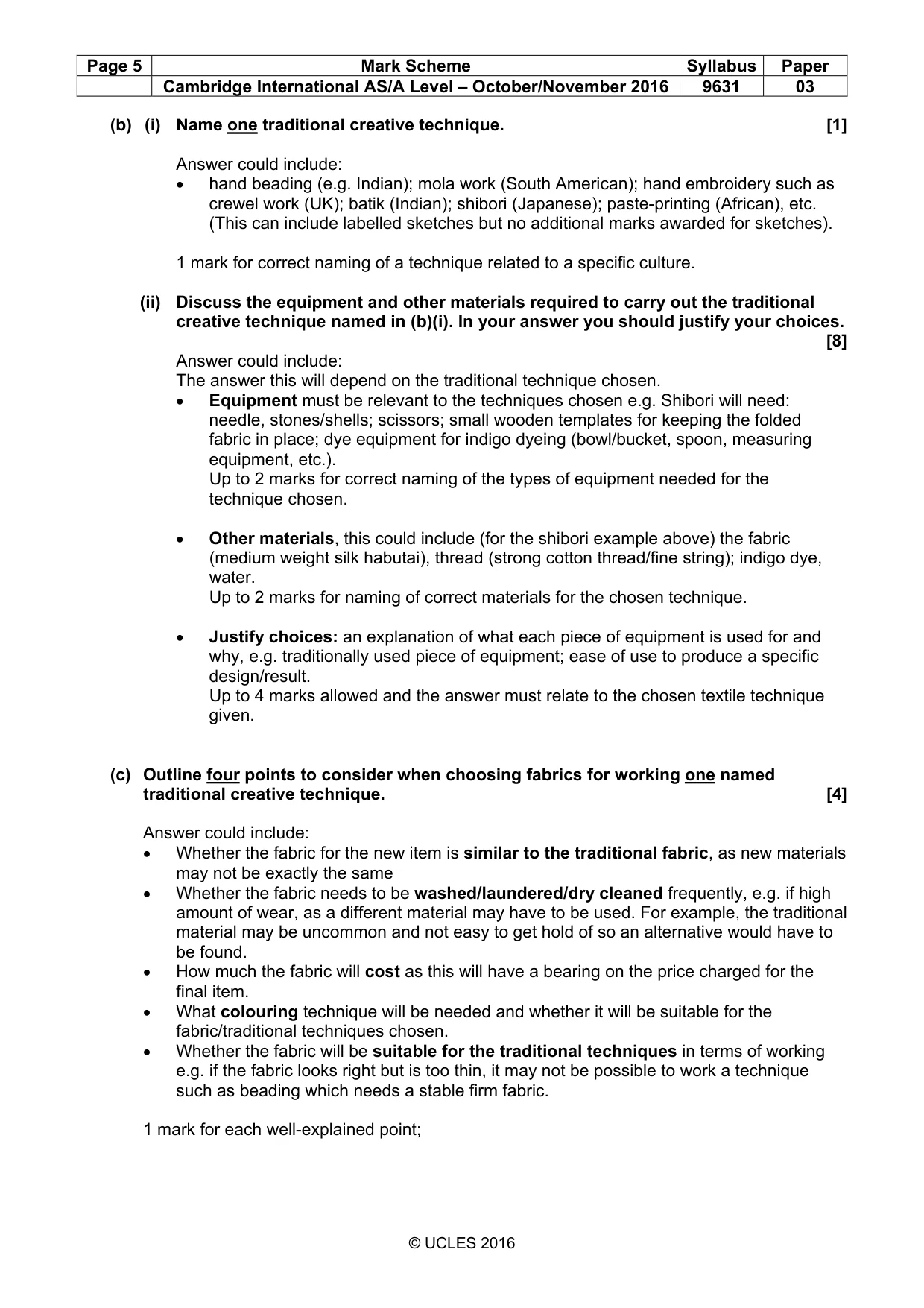
2 There is a wide range of traditional creative textile techniques from different cultures. (a) State four factors to consider when choosing which traditional creative textile techniques to use on a textile item. [4] (b) (i) Name one traditional creative technique. [1] (ii) Discuss the equipment and other materials required to carry out the traditional creative technique named in (b)(i). In your answer you should justify your choices. [8] (c) State four points to consider when choosing fabrics for working one named traditional creative technique. [4] (d) Explain how to care for textiles that have creative techniques and processes worked on them. Include examples to support your answer. [8] [Total: 25]
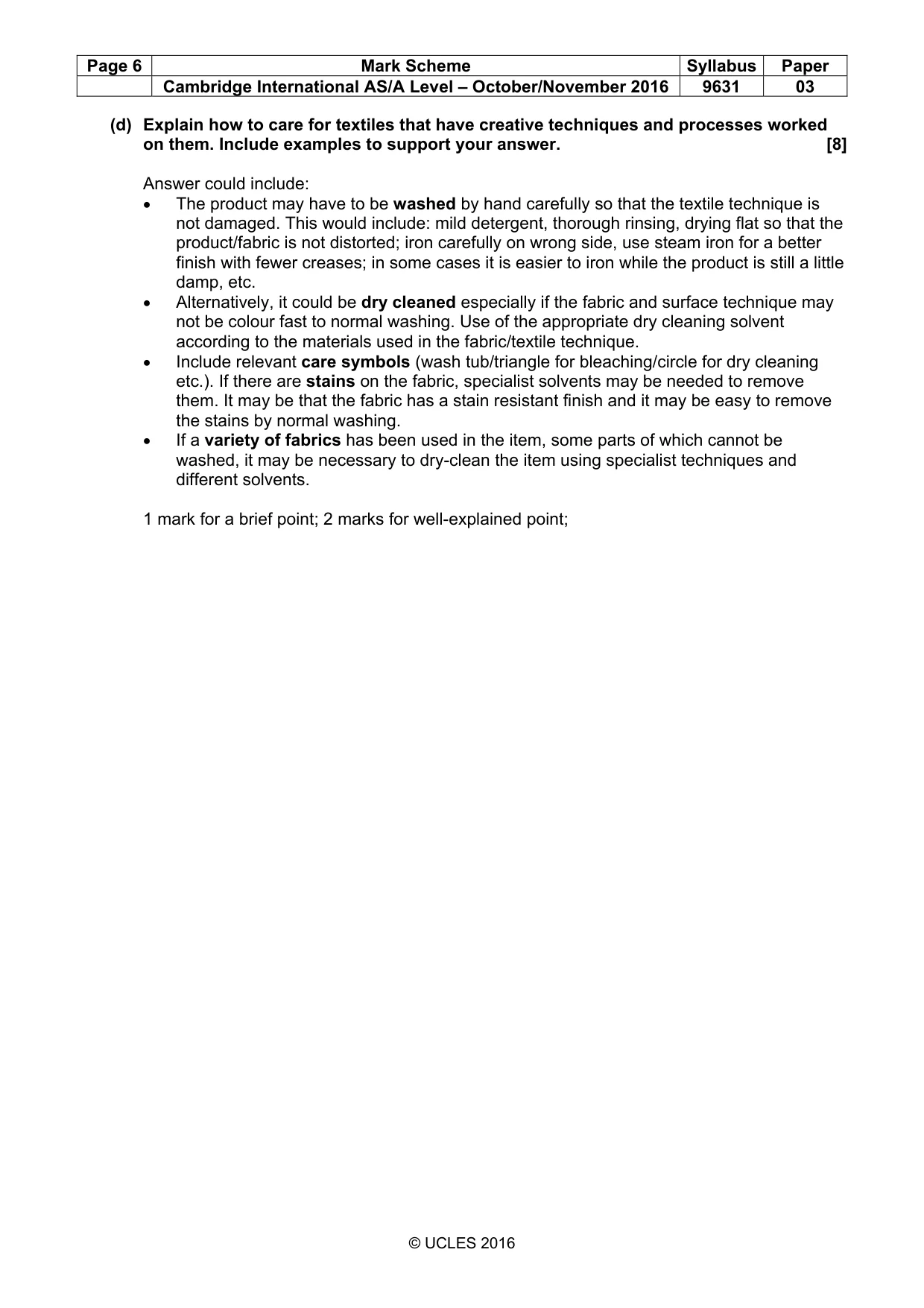
Mark scheme: 2 There is a wide range of traditional creative textile techniques from different cultures. (a) State four factors to consider when choosing which traditional creative textile techniques to use on a textile item. [4] Answer could include: • the culture being studied for ideas e.g. Chinese, UK, South American • what skills the workers have e.g. if the traditional skill is hand-worked, whether there are workers who are able to work them • whether the traditional materials needed to work them are available or whether a suitable alternative could be used • Suitability from environmental point of view (e.g. sustainable/any dangers) • time taken to work the traditional creative techniques – some are very time consuming • whether the traditional textile techniques would be popular or interesting with consumers if the product would be made in quantity and available for sale • whether the textile techniques would be suitable for a particular item e.g. if the item was for a child, safety requirements would have to be considered (e.g. small items would have to be securely attached); if the item was as decoration (e.g. hand worked beading) for a bag to be used regularly, whether the traditional techniques would stand up to hard wear. Any other correct point. 1 mark for each correct factor. (b) (i) Name one traditional creative technique. [1] Answer could include: • hand beading (e.g. Indian); mola work (South American); hand embroidery such as crewel work (UK); batik (Indian); shibori (Japanese); paste-printing (African), etc. (This can include labelled sketches but no additional marks awarded for sketches). 1 mark for correct naming of a technique related to a specific culture. (ii) Discuss the equipment and other materials required to carry out the traditional creative technique named in (b)(i). In your answer you should justify your choices. [8] Answer could include: The answer this will depend on the traditional technique chosen. • Equipment must be relevant to the techniques chosen e.g. Shibori will need: needle, stones/shells; scissors; small wooden templates for keeping the folded fabric in place; dye equipment for indigo dyeing (bowl/bucket, spoon, measuring equipment, etc.). Up to 2 marks for correct naming of the types of equipment needed for the technique chosen. • Other materials, this could include (for the shibori example above) the fabric (medium weight silk habutai), thread (strong cotton thread/fine string); indigo dye, water. Up to 2 marks for naming of correct materials for the chosen technique. • Justify choices: an explanation of what each piece of equipment is used for and why, e.g. traditionally used piece of equipment; ease of use to produce a specific design/result. Up to 4 marks allowed and the answer must relate to the chosen textile technique given. (c) Outline four points to consider when choosing fabrics for working one named traditional creative technique. [4] Answer could include: • Whether the fabric for the new item is similar to the traditional fabric, as new materials may not be exactly the same • Whether the fabric needs to be washed/laundered/dry cleaned frequently, e.g. if high amount of wear, as a different material may have to be used. For example, the traditional material may be uncommon and not easy to get hold of so an alternative would have to be found. • How much the fabric will cost as this will have a bearing on the price charged for the final item. • What colouring technique will be needed and whether it will be suitable for the fabric/traditional techniques chosen. • Whether the fabric will be suitable for the traditional techniques in terms of working e.g. if the fabric looks right but is too thin, it may not be possible to work a technique such as beading which needs a stable firm fabric. 1 mark for each well-explained point; (d) Explain how to care for textiles that have creative techniques and processes worked on them. Include examples to support your answer. [8] Answer could include: • The product may have to be washed by hand carefully so that the textile technique is not damaged. This would include: mild detergent, thorough rinsing, drying flat so that the product/fabric is not distorted; iron carefully on wrong side, use steam iron for a better finish with fewer creases; in some cases it is easier to iron while the product is still a little damp, etc. • Alternatively, it could be dry cleaned especially if the fabric and surface technique may not be colour fast to normal washing. Use of the appropriate dry cleaning solvent according to the materials used in the fabric/textile technique. • Include relevant care symbols (wash tub/triangle for bleaching/circle for dry cleaning etc.). If there are stains on the fabric, specialist solvents may be needed to remove them. It may be that the fabric has a stain resistant finish and it may be easy to remove the stains by normal washing. • If a variety of fabrics has been used in the item, some parts of which cannot be washed, it may be necessary to dry-clean the item using specialist techniques and different solvents. 1 mark for a brief point; 2 marks for well-explained point; Section B Answer any two questions
Q3 · There are many ways of constructing textile products
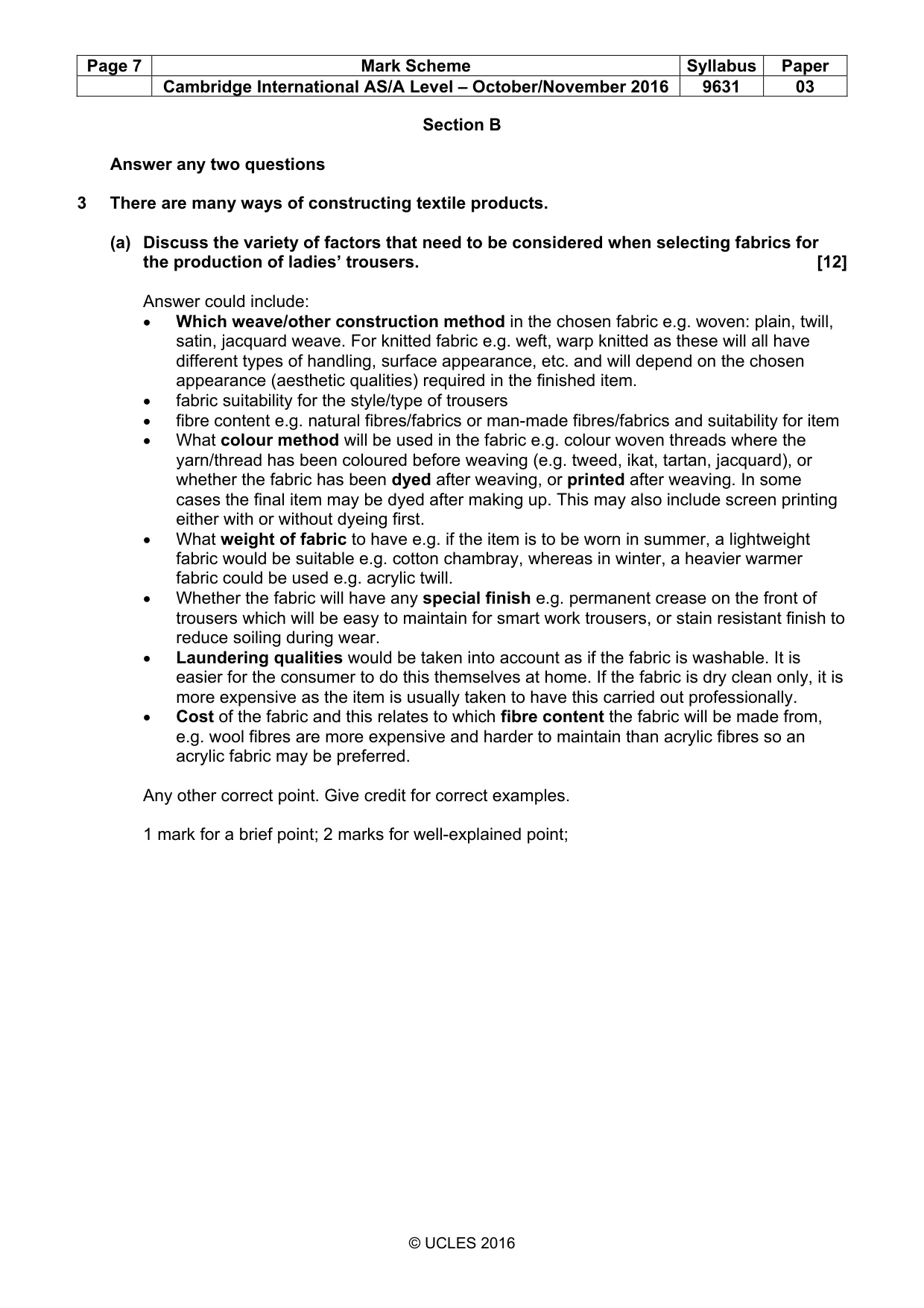
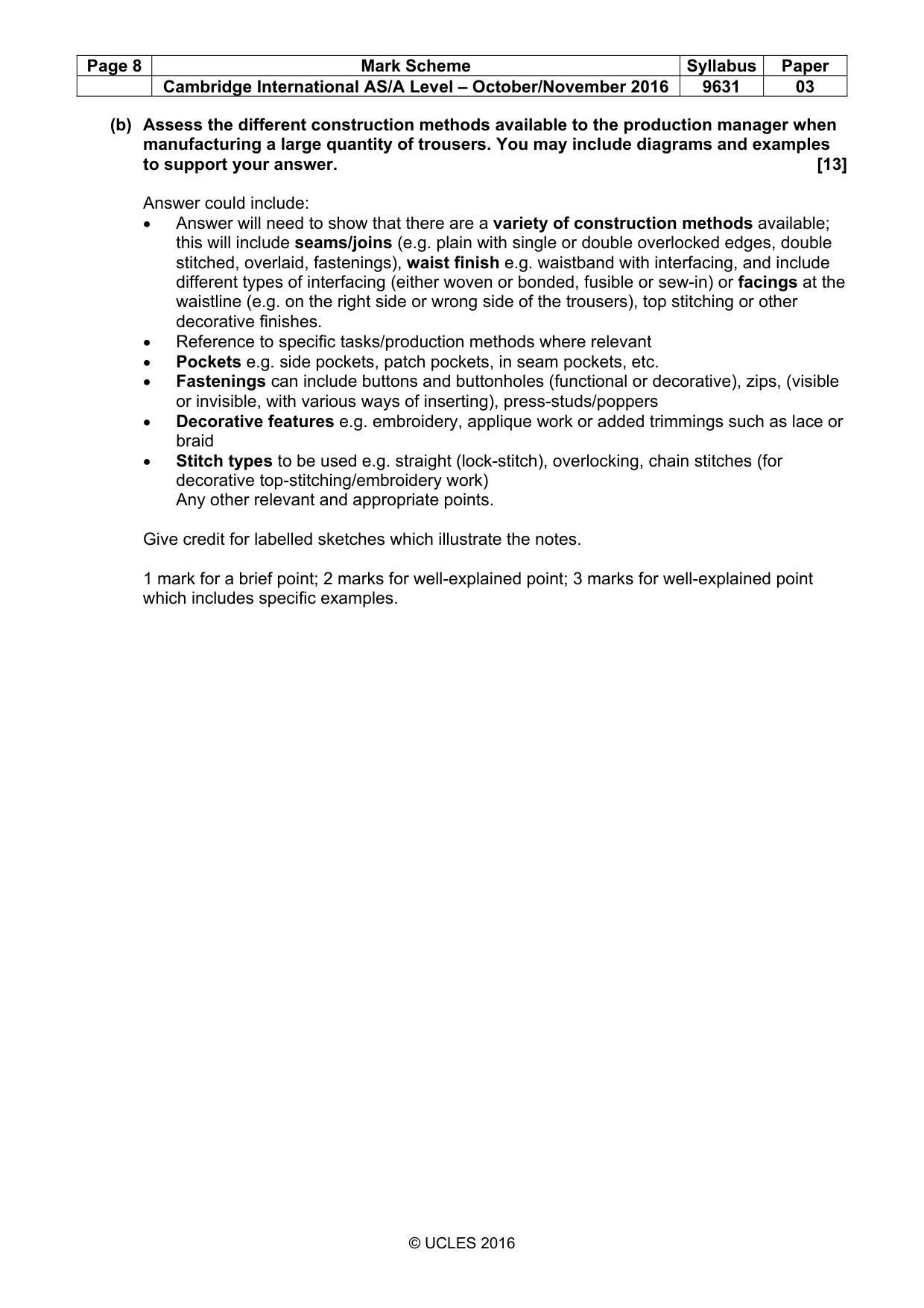
3 There are many ways of constructing textile products. (a) Discuss the variety of factors that need to be considered when selecting fabrics for the production of ladies’ trousers. [12] (b) Assess different construction methods available to the production manager when manufacturing a large quantity of trousers. You may include diagrams and examples to support your answer. [13] [Total: 25]
Mark scheme: 3 There are many ways of constructing textile products. (a) Discuss the variety of factors that need to be considered when selecting fabrics for the production of ladies’ trousers. [12] Answer could include: • Which weave/other construction method in the chosen fabric e.g. woven: plain, twill, satin, jacquard weave. For knitted fabric e.g. weft, warp knitted as these will all have different types of handling, surface appearance, etc. and will depend on the chosen appearance (aesthetic qualities) required in the finished item. • fabric suitability for the style/type of trousers • fibre content e.g. natural fibres/fabrics or man-made fibres/fabrics and suitability for item • What colour method will be used in the fabric e.g. colour woven threads where the yarn/thread has been coloured before weaving (e.g. tweed, ikat, tartan, jacquard), or whether the fabric has been dyed after weaving, or printed after weaving. In some cases the final item may be dyed after making up. This may also include screen printing either with or without dyeing first. • What weight of fabric to have e.g. if the item is to be worn in summer, a lightweight fabric would be suitable e.g. cotton chambray, whereas in winter, a heavier warmer fabric could be used e.g. acrylic twill. • Whether the fabric will have any special finish e.g. permanent crease on the front of trousers which will be easy to maintain for smart work trousers, or stain resistant finish to reduce soiling during wear. • Laundering qualities would be taken into account as if the fabric is washable. It is easier for the consumer to do this themselves at home. If the fabric is dry clean only, it is more expensive as the item is usually taken to have this carried out professionally. • Cost of the fabric and this relates to which fibre content the fabric will be made from, e.g. wool fibres are more expensive and harder to maintain than acrylic fibres so an acrylic fabric may be preferred. Any other correct point. Give credit for correct examples. 1 mark for a brief point; 2 marks for well-explained point; (b) Assess the different construction methods available to the production manager when manufacturing a large quantity of trousers. You may include diagrams and examples to support your answer. [13] Answer could include: • Answer will need to show that there are a variety of construction methods available; this will include seams/joins (e.g. plain with single or double overlocked edges, double stitched, overlaid, fastenings), waist finish e.g. waistband with interfacing, and include different types of interfacing (either woven or bonded, fusible or sew-in) or facings at the waistline (e.g. on the right side or wrong side of the trousers), top stitching or other decorative finishes. • Reference to specific tasks/production methods where relevant • Pockets e.g. side pockets, patch pockets, in seam pockets, etc. • Fastenings can include buttons and buttonholes (functional or decorative), zips, (visible or invisible, with various ways of inserting), press-studs/poppers • Decorative features e.g. embroidery, applique work or added trimmings such as lace or braid • Stitch types to be used e.g. straight (lock-stitch), overlocking, chain stitches (for decorative top-stitching/embroidery work) Any other relevant and appropriate points. Give credit for labelled sketches which illustrate the notes. 1 mark for a brief point; 2 marks for well-explained point; 3 marks for well-explained point which includes specific examples.
Q4 · Product design is an important part of the development of new fashion items
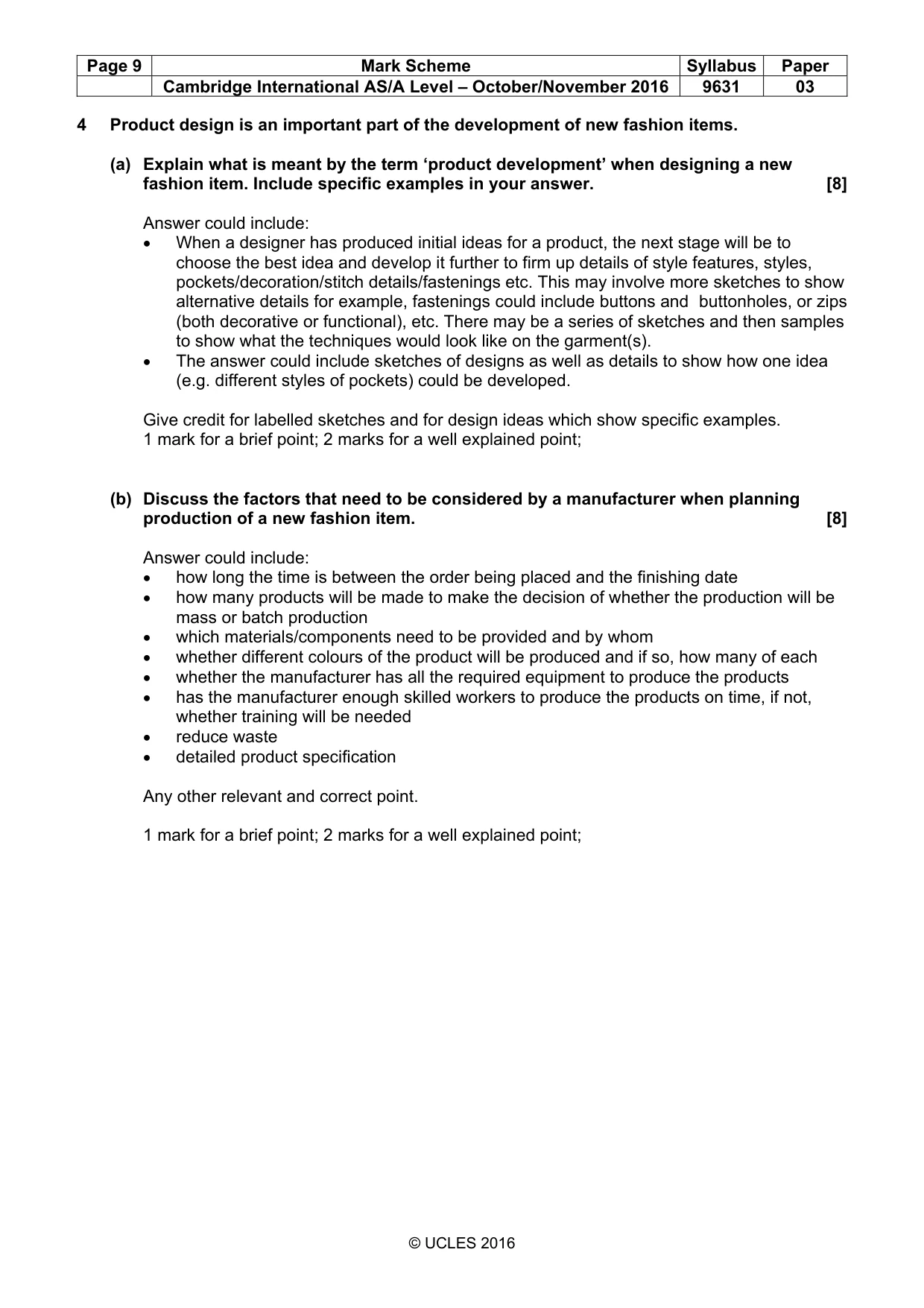
4 Product design is an important part of the development of new fashion items. (a) Explain what is meant by the term ‘product development’ when designing a new fashion item. Include specific examples in your answer. [8] (b) Discuss the factors that need to be considered by a manufacturer when planning production of a new fashion item. [8] (c) Discuss how a manufacturer can ensure that machinery is used safely when producing fashion items. Include examples to support your answer. [9] [Total: 25]
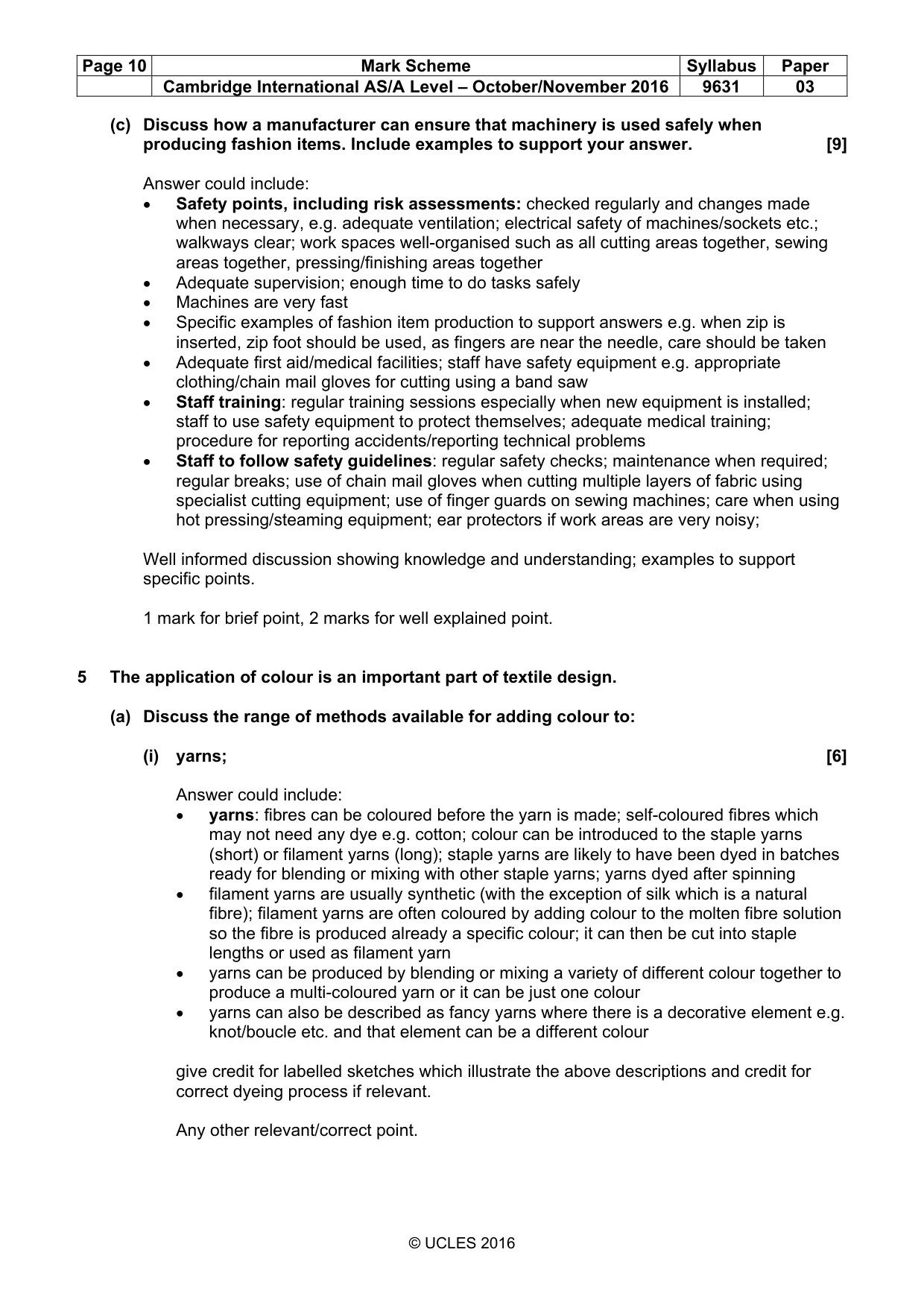
Mark scheme: 4 Product design is an important part of the development of new fashion items. (a) Explain what is meant by the term ‘product development’ when designing a new fashion item. Include specific examples in your answer. [8] Answer could include: • When a designer has produced initial ideas for a product, the next stage will be to choose the best idea and develop it further to firm up details of style features, styles, pockets/decoration/stitch details/fastenings etc. This may involve more sketches to show alternative details for example, fastenings could include buttons and buttonholes, or zips (both decorative or functional), etc. There may be a series of sketches and then samples to show what the techniques would look like on the garment(s). • The answer could include sketches of designs as well as details to show how one idea (e.g. different styles of pockets) could be developed. Give credit for labelled sketches and for design ideas which show specific examples. 1 mark for a brief point; 2 marks for a well explained point; (b) Discuss the factors that need to be considered by a manufacturer when planning production of a new fashion item. [8] Answer could include: • how long the time is between the order being placed and the finishing date • how many products will be made to make the decision of whether the production will be mass or batch production • which materials/components need to be provided and by whom • whether different colours of the product will be produced and if so, how many of each • whether the manufacturer has all the required equipment to produce the products • has the manufacturer enough skilled workers to produce the products on time, if not, whether training will be needed • reduce waste • detailed product specification Any other relevant and correct point. 1 mark for a brief point; 2 marks for a well explained point; (c) Discuss how a manufacturer can ensure that machinery is used safely when producing fashion items. Include examples to support your answer. [9] Answer could include: • Safety points, including risk assessments: checked regularly and changes made when necessary, e.g. adequate ventilation; electrical safety of machines/sockets etc.; walkways clear; work spaces well-organised such as all cutting areas together, sewing areas together, pressing/finishing areas together • Adequate supervision; enough time to do tasks safely • Machines are very fast • Specific examples of fashion item production to support answers e.g. when zip is inserted, zip foot should be used, as fingers are near the needle, care should be taken • Adequate first aid/medical facilities; staff have safety equipment e.g. appropriate clothing/chain mail gloves for cutting using a band saw • Staff training: regular training sessions especially when new equipment is installed; staff to use safety equipment to protect themselves; adequate medical training; procedure for reporting accidents/reporting technical problems • Staff to follow safety guidelines: regular safety checks; maintenance when required; regular breaks; use of chain mail gloves when cutting multiple layers of fabric using specialist cutting equipment; use of finger guards on sewing machines; care when using hot pressing/steaming equipment; ear protectors if work areas are very noisy; Well informed discussion showing knowledge and understanding; examples to support specific points. 1 mark for brief point, 2 marks for well explained point.
Q5 · The application of colour is an important part of textile design
5 The application of colour is an important part of textile design. (a) Discuss the range of methods available for adding colour to: (i) yarns; [6] (ii) fabrics. [6] (b) Assess the range of surface decorative effects which can add both colour and texture to textiles. Include specific examples in your answer. You may use labelled sketches to support your answer. [13] [Total: 25]
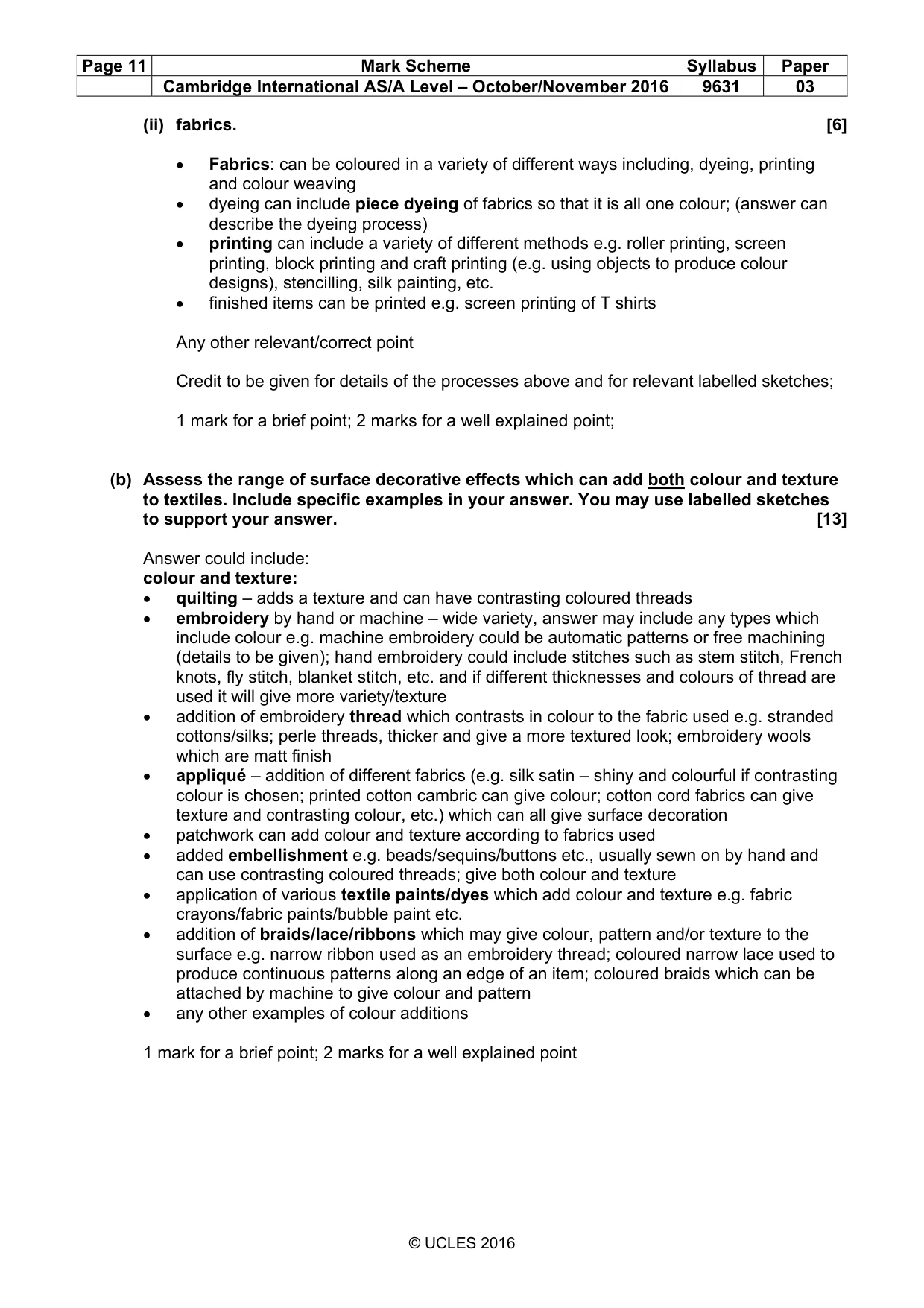
Mark scheme: 5 The application of colour is an important part of textile design. (a) Discuss the range of methods available for adding colour to: (i) yarns; [6] Answer could include: • yarns: fibres can be coloured before the yarn is made; self-coloured fibres which may not need any dye e.g. cotton; colour can be introduced to the staple yarns (short) or filament yarns (long); staple yarns are likely to have been dyed in batches ready for blending or mixing with other staple yarns; yarns dyed after spinning • filament yarns are usually synthetic (with the exception of silk which is a natural fibre); filament yarns are often coloured by adding colour to the molten fibre solution so the fibre is produced already a specific colour; it can then be cut into staple lengths or used as filament yarn • yarns can be produced by blending or mixing a variety of different colour together to produce a multi-coloured yarn or it can be just one colour • yarns can also be described as fancy yarns where there is a decorative element e.g. knot/boucle etc. and that element can be a different colour give credit for labelled sketches which illustrate the above descriptions and credit for correct dyeing process if relevant. Any other relevant/correct point. (ii) fabrics. [6] • Fabrics: can be coloured in a variety of different ways including, dyeing, printing and colour weaving • dyeing can include piece dyeing of fabrics so that it is all one colour; (answer can describe the dyeing process) • printing can include a variety of different methods e.g. roller printing, screen printing, block printing and craft printing (e.g. using objects to produce colour designs), stencilling, silk painting, etc. • finished items can be printed e.g. screen printing of T shirts Any other relevant/correct point Credit to be given for details of the processes above and for relevant labelled sketches; 1 mark for a brief point; 2 marks for a well explained point; (b) Assess the range of surface decorative effects which can add both colour and texture to textiles. Include specific examples in your answer. You may use labelled sketches to support your answer. [13] Answer could include: colour and texture: • quilting – adds a texture and can have contrasting coloured threads • embroidery by hand or machine – wide variety, answer may include any types which include colour e.g. machine embroidery could be automatic patterns or free machining (details to be given); hand embroidery could include stitches such as stem stitch, French knots, fly stitch, blanket stitch, etc. and if different thicknesses and colours of thread are used it will give more variety/texture • addition of embroidery thread which contrasts in colour to the fabric used e.g. stranded cottons/silks; perle threads, thicker and give a more textured look; embroidery wools which are matt finish • appliqué – addition of different fabrics (e.g. silk satin – shiny and colourful if contrasting colour is chosen; printed cotton cambric can give colour; cotton cord fabrics can give texture and contrasting colour, etc.) which can all give surface decoration • patchwork can add colour and texture according to fabrics used • added embellishment e.g. beads/sequins/buttons etc., usually sewn on by hand and can use contrasting coloured threads; give both colour and texture • application of various textile paints/dyes which add colour and texture e.g. fabric crayons/fabric paints/bubble paint etc. • addition of braids/lace/ribbons which may give colour, pattern and/or texture to the surface e.g. narrow ribbon used as an embroidery thread; coloured narrow lace used to produce continuous patterns along an edge of an item; coloured braids which can be attached by machine to give colour and pattern • any other examples of colour additions 1 mark for a brief point; 2 marks for a well explained point
What you needed in this session
Cambridge’s own grade thresholds for 2016 Oct/Nov, Paper 3 · Variant 1. A higher threshold means an easier paper — the bar moves with how the cohort did.