Cambridge A Level Design and Technology 9705 — 2021 Oct/Nov Paper 1 · Variant 2
9705/12/O/N/21 · 120 marks · ≈135 min
The question paper and its mark scheme, free to read here and free to download. This is Cambridge’s own paper, exactly as it was sat.
Question paper12 pages

Mark scheme17 pages
Answers below. Sit the paper first if you are practising.
Paper as text
Question paper, page 1
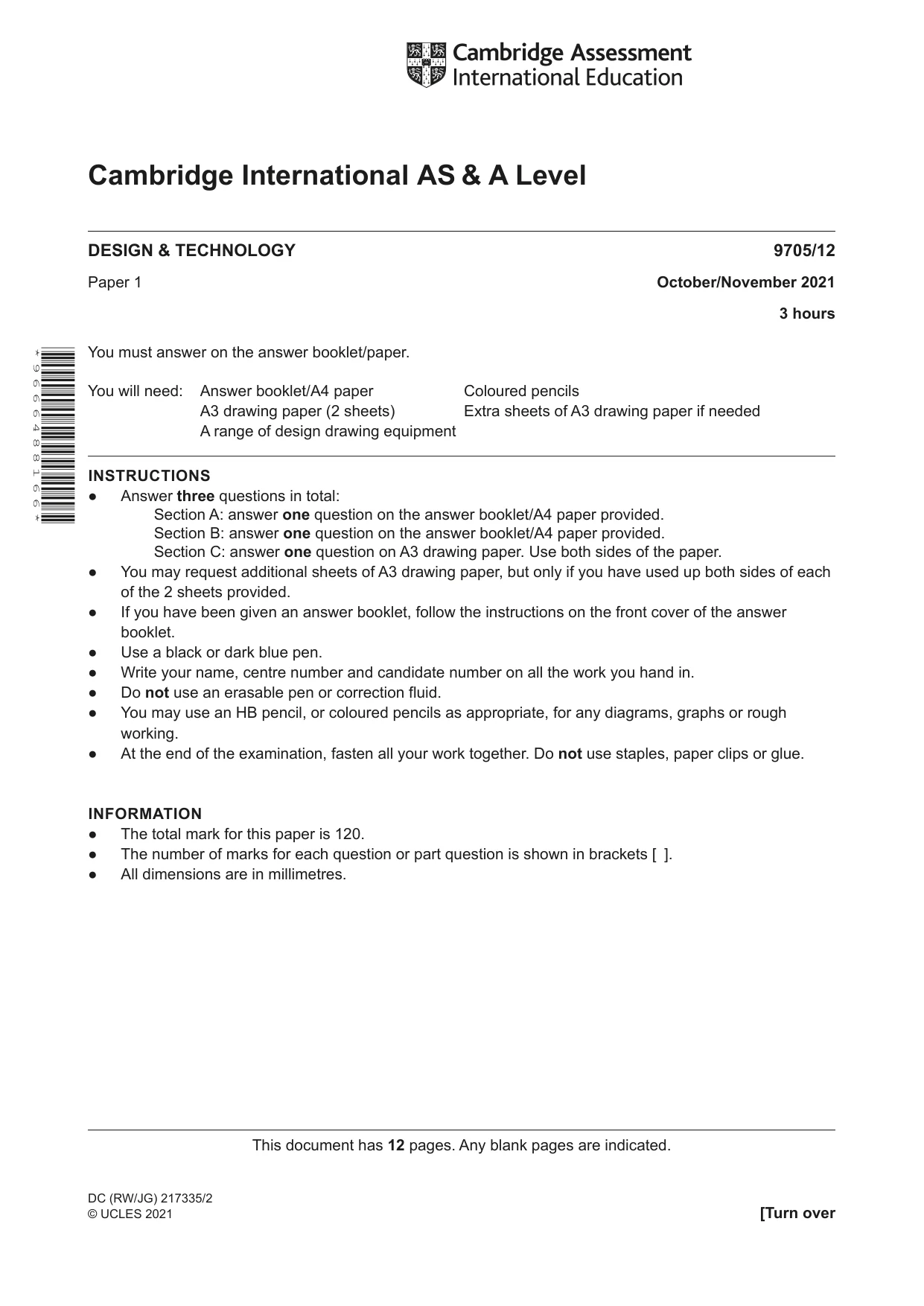
This document has 12 pages. Any blank pages are indicated. DC (RW/JG) 217335/2 © UCLES 2021 [Turn over * 9 6 6 6 4 8 8 1 6 6 * Cambridge International AS & A Level DESIGN & TECHNOLOGY 9705/12 Paper 1 October/November 2021 3 hours You must answer on the answer booklet/paper. You will need: Answer booklet/A4 paper Coloured pencils A3 drawing paper (2 sheets) Extra sheets of A3 drawing paper if needed A range of design drawing equipment INSTRUCTIONS ● Answer three questions in total: Section A: answer one question on the answer booklet/A4 paper provided. Section B: answer one question on the answer booklet/A4 paper provided. Section C: answer one question on A3 drawing paper. Use both sides of the paper. ● You may request additional sheets of A3 drawing paper, but only if you have used up both sides of each of the 2 sheets provided. ● If you have been given an answer booklet, follow the instructions on the front cover of the answer booklet. ● Use a black or dark blue pen. ● Write your name, centre number and candidate number on all the work you hand in. ● Do not use an erasable pen or correction fluid. ● You may use an HB pencil, or coloured pencils as appropriate, for any diagrams, graphs or rough working. ● At the end of the examination, fasten all your work together. Do not use staples, paper clips or glue. INFORMATION ● The total mark for this paper is 120. ● The number of marks for each question or part question is shown in brackets [ ]. ● All dimensions are in millimetres.
Question paper, page 2
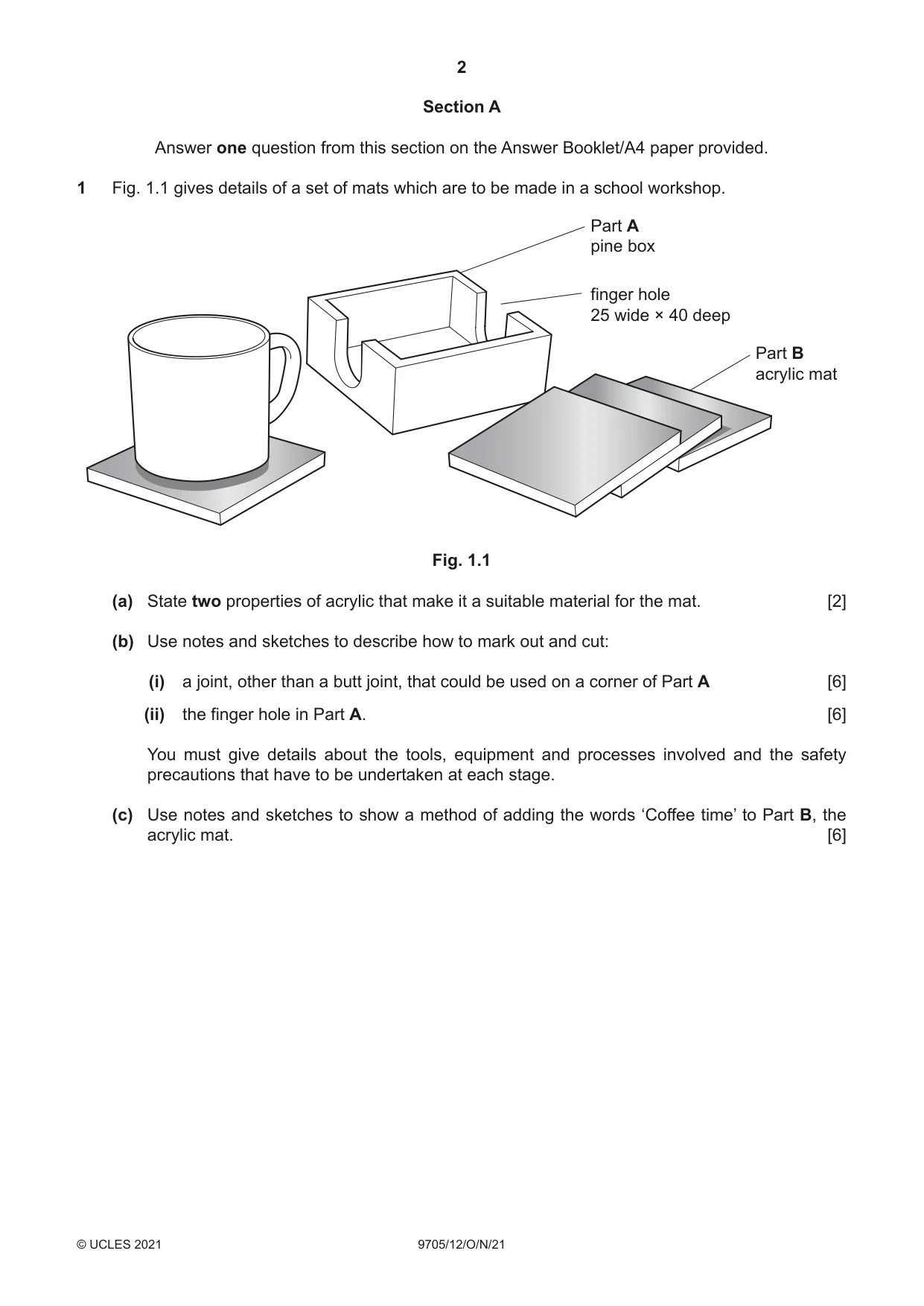
2 9705/12/O/N/21 © UCLES 2021 Section A Answer one question from this section on the Answer Booklet/A4 paper provided. 1 Fig. 1.1 gives details of a set of mats which are to be made in a school workshop. Part A pine box Part B acrylic mat finger hole 25 wide × 40 deep Fig. 1.1 (a) State two properties of acrylic that make it a suitable material for the mat. [2] (b) Use notes and sketches to describe how to mark out and cut: (i) a joint, other than a butt joint, that could be used on a corner of Part A [6] (ii) the finger hole in Part A. [6] You must give details about the tools, equipment and processes involved and the safety precautions that have to be undertaken at each stage. (c) Use notes and sketches to show a method of adding the words ‘Coffee time’ to Part B, the acrylic mat. [6]
Question paper, page 3
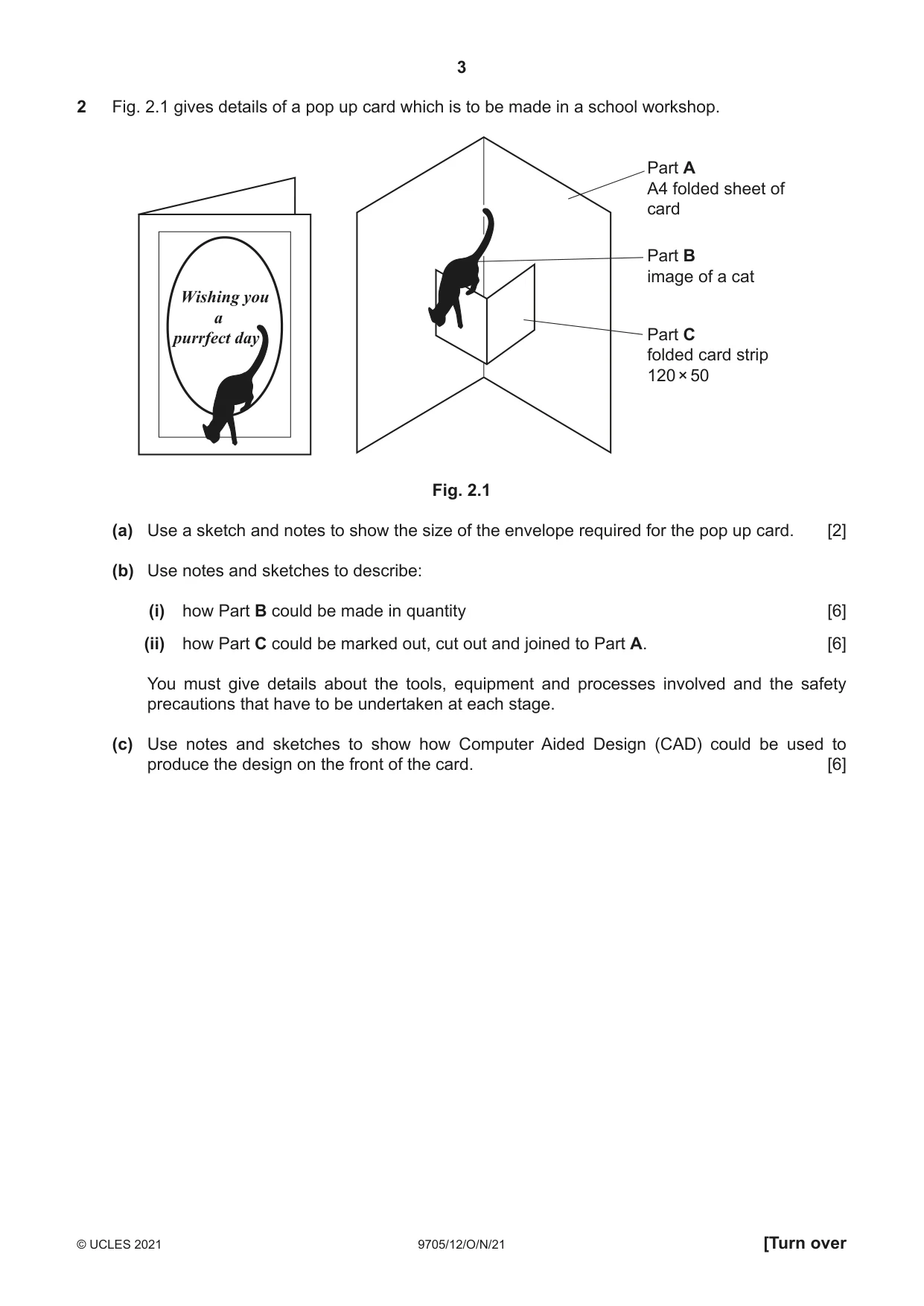
3 9705/12/O/N/21 © UCLES 2021 [Turn over 2 Fig. 2.1 gives details of a pop up card which is to be made in a school workshop. Wishing you a purrfect day Part A A4 folded sheet of card Part B image of a cat Part C folded card strip 120 × 50 Fig. 2.1 (a) Use a sketch and notes to show the size of the envelope required for the pop up card. [2] (b) Use notes and sketches to describe: (i) how Part B could be made in quantity [6] (ii) how Part C could be marked out, cut out and joined to Part A. [6] You must give details about the tools, equipment and processes involved and the safety precautions that have to be undertaken at each stage. (c) Use notes and sketches to show how Computer Aided Design (CAD) could be used to produce the design on the front of the card. [6]
Question paper, page 4
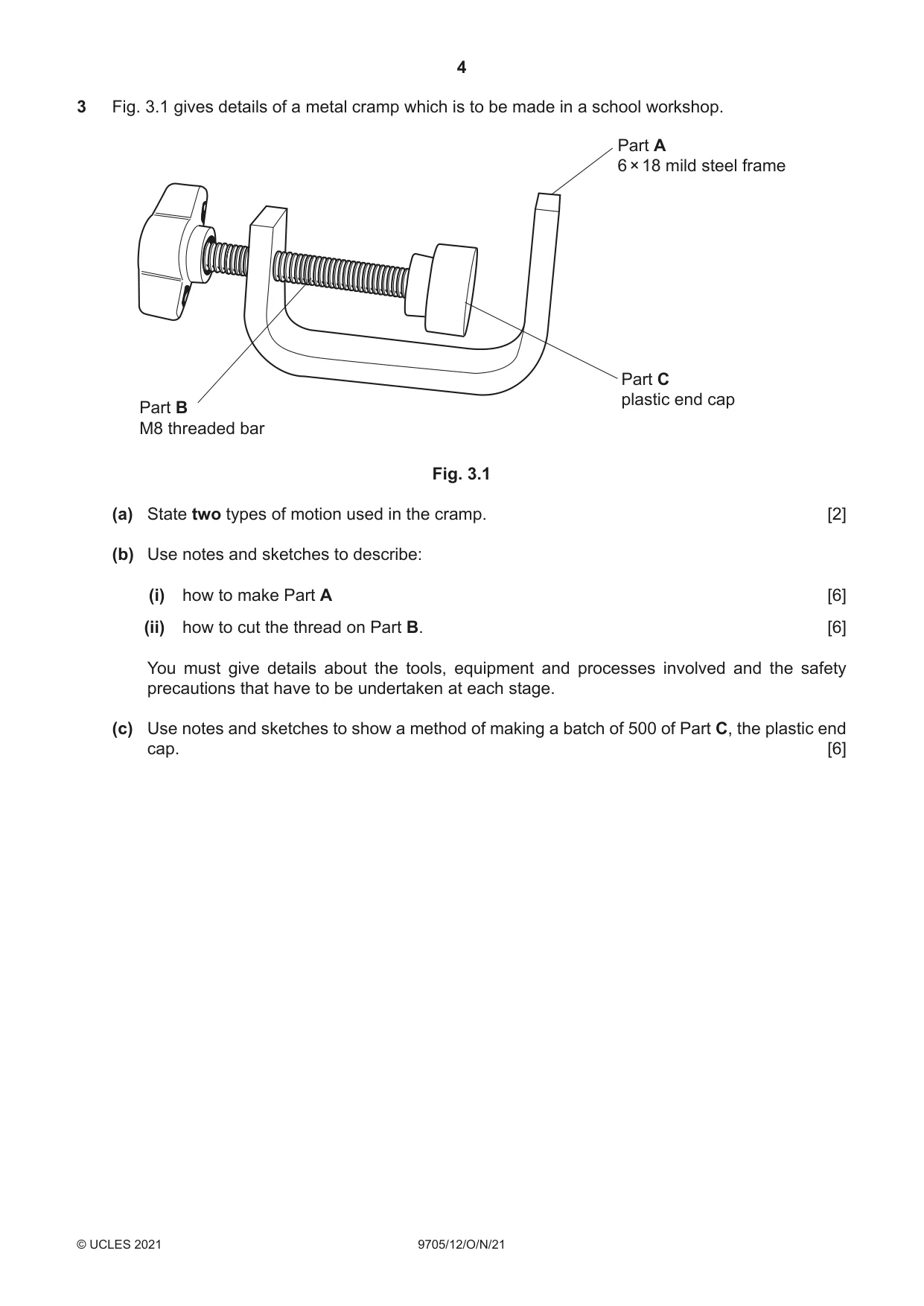
4 9705/12/O/N/21 © UCLES 2021 3 Fig. 3.1 gives details of a metal cramp which is to be made in a school workshop. Part A 6 × 18 mild steel frame Part C plastic end cap Part B M8 threaded bar Fig. 3.1 (a) State two types of motion used in the cramp. [2] (b) Use notes and sketches to describe: (i) how to make Part A [6] (ii) how to cut the thread on Part B. [6] You must give details about the tools, equipment and processes involved and the safety precautions that have to be undertaken at each stage. (c) Use notes and sketches to show a method of making a batch of 500 of Part C, the plastic end cap. [6]
Question paper, page 5
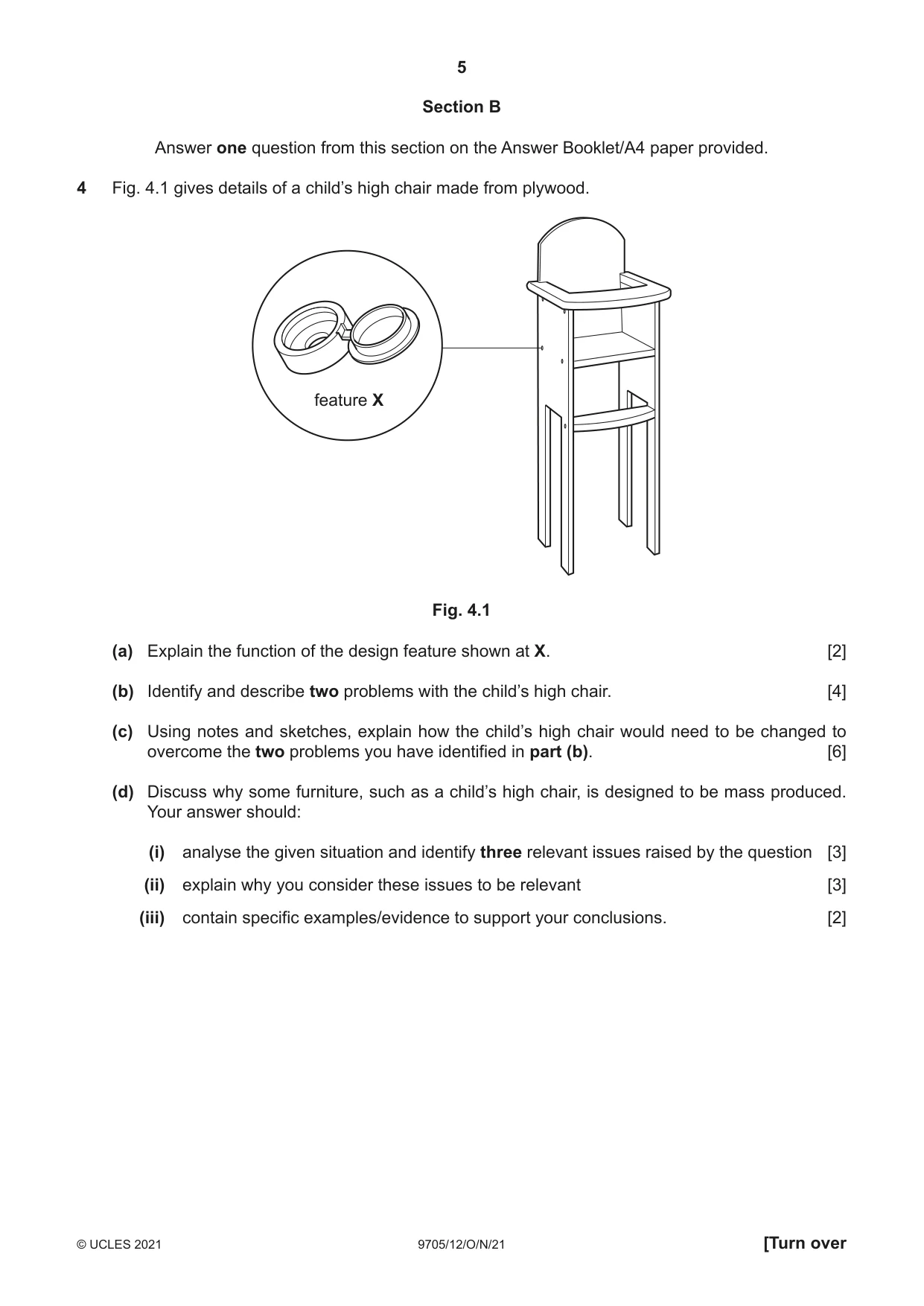
5 9705/12/O/N/21 © UCLES 2021 [Turn over Section B Answer one question from this section on the Answer Booklet/A4 paper provided. 4 Fig. 4.1 gives details of a child’s high chair made from plywood. feature X Fig. 4.1 (a) Explain the function of the design feature shown at X. [2] (b) Identify and describe two problems with the child’s high chair. [4] (c) Using notes and sketches, explain how the child’s high chair would need to be changed to overcome the two problems you have identified in part (b). [6] (d) Discuss why some furniture, such as a child’s high chair, is designed to be mass produced. Your answer should: (i) analyse the given situation and identify three relevant issues raised by the question [3] (ii) explain why you consider these issues to be relevant [3] (iii) contain specific examples/evidence to support your conclusions. [2]
Question paper, page 6
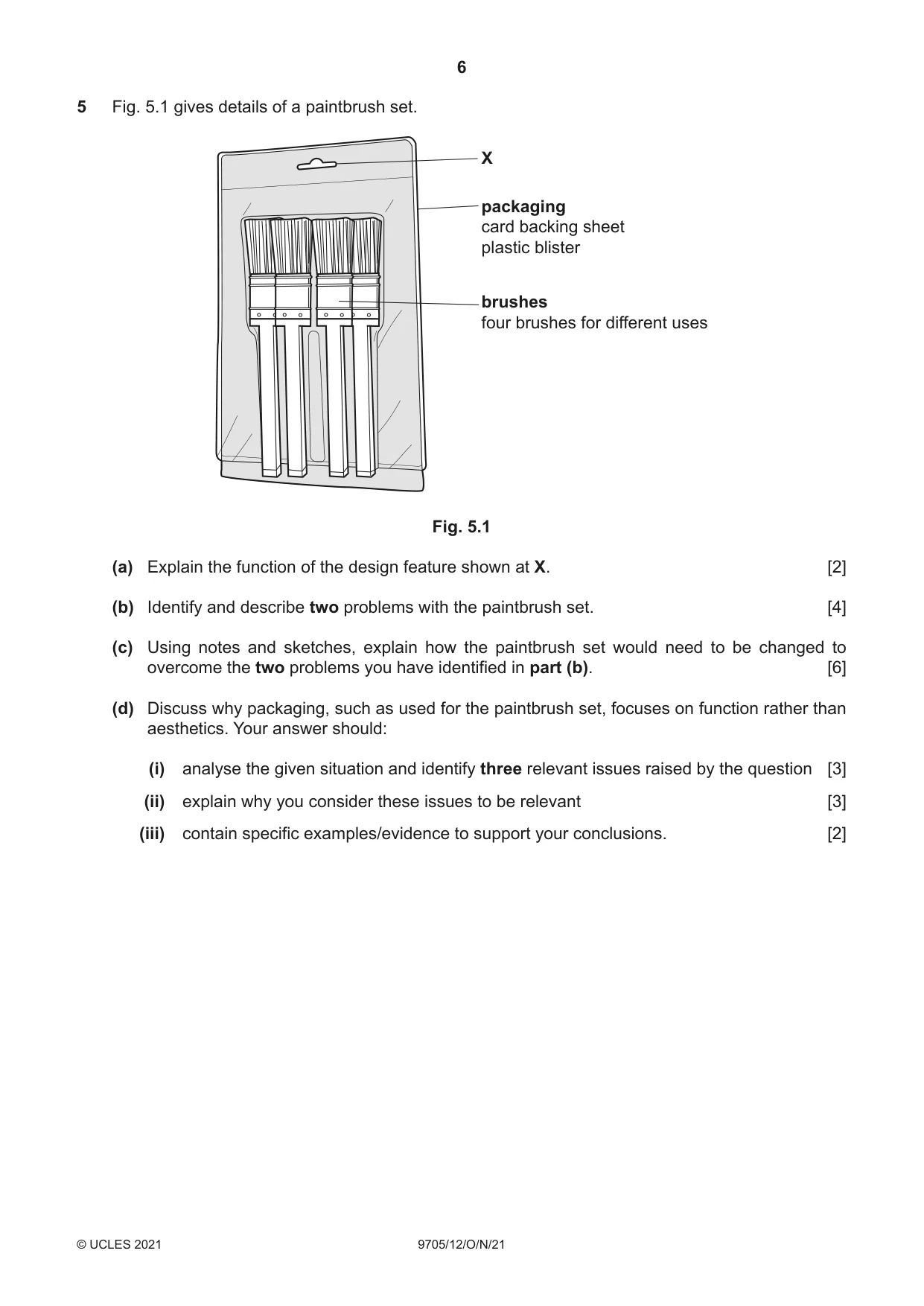
6 9705/12/O/N/21 © UCLES 2021 5 Fig. 5.1 gives details of a paintbrush set. packaging card backing sheet plastic blister brushes four brushes for different uses X Fig. 5.1 (a) Explain the function of the design feature shown at X. [2] (b) Identify and describe two problems with the paintbrush set. [4] (c) Using notes and sketches, explain how the paintbrush set would need to be changed to overcome the two problems you have identified in part (b). [6] (d) Discuss why packaging, such as used for the paintbrush set, focuses on function rather than aesthetics. Your answer should: (i) analyse the given situation and identify three relevant issues raised by the question [3] (ii) explain why you consider these issues to be relevant [3] (iii) contain specific examples/evidence to support your conclusions. [2]
Question paper, page 7
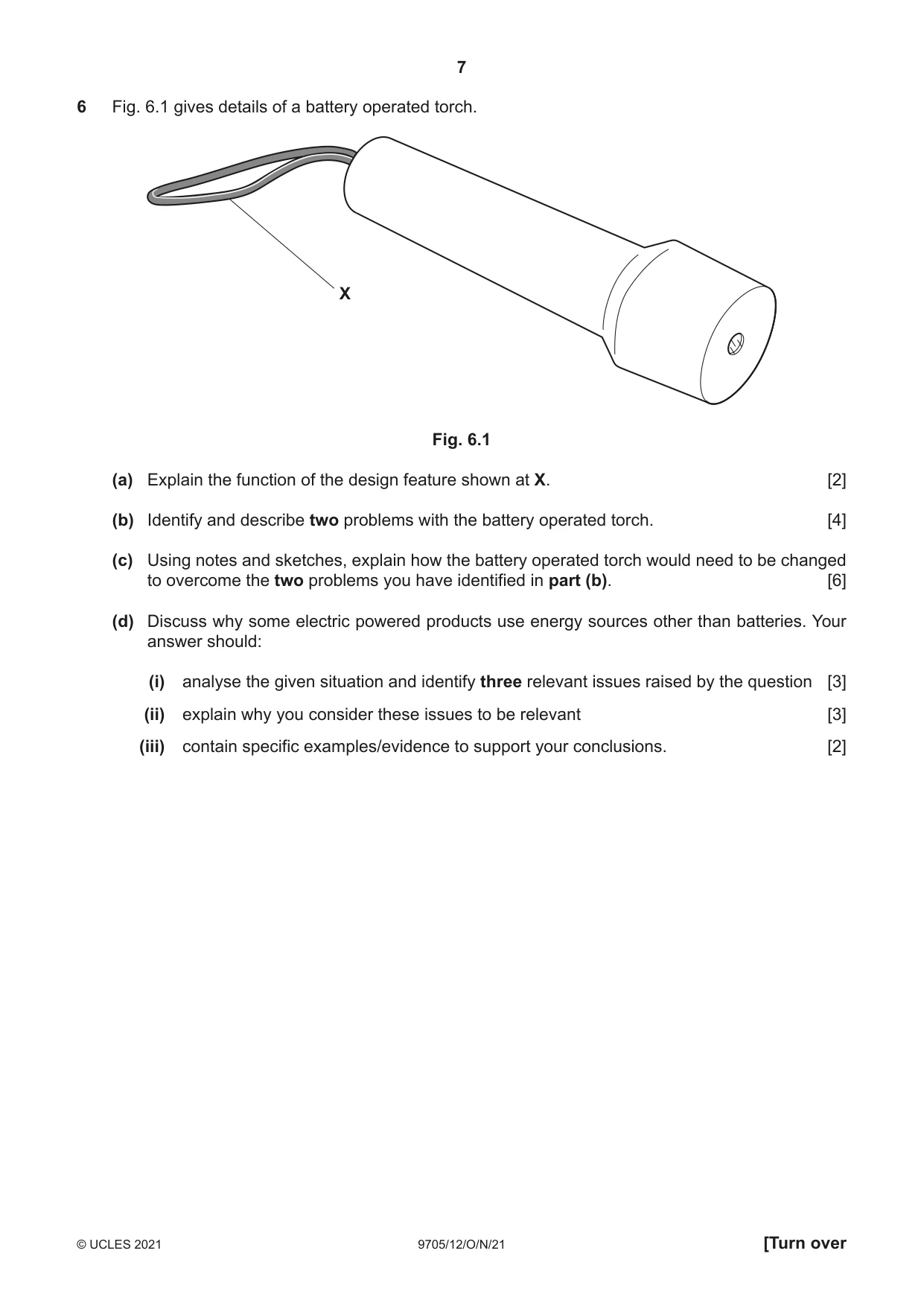
7 9705/12/O/N/21 © UCLES 2021 [Turn over 6 Fig. 6.1 gives details of a battery operated torch. X Fig. 6.1 (a) Explain the function of the design feature shown at X. [2] (b) Identify and describe two problems with the battery operated torch. [4] (c) Using notes and sketches, explain how the battery operated torch would need to be changed to overcome the two problems you have identified in part (b). [6] (d) Discuss why some electric powered products use energy sources other than batteries. Your answer should: (i) analyse the given situation and identify three relevant issues raised by the question [3] (ii) explain why you consider these issues to be relevant [3] (iii) contain specific examples/evidence to support your conclusions. [2]
Question paper, page 8
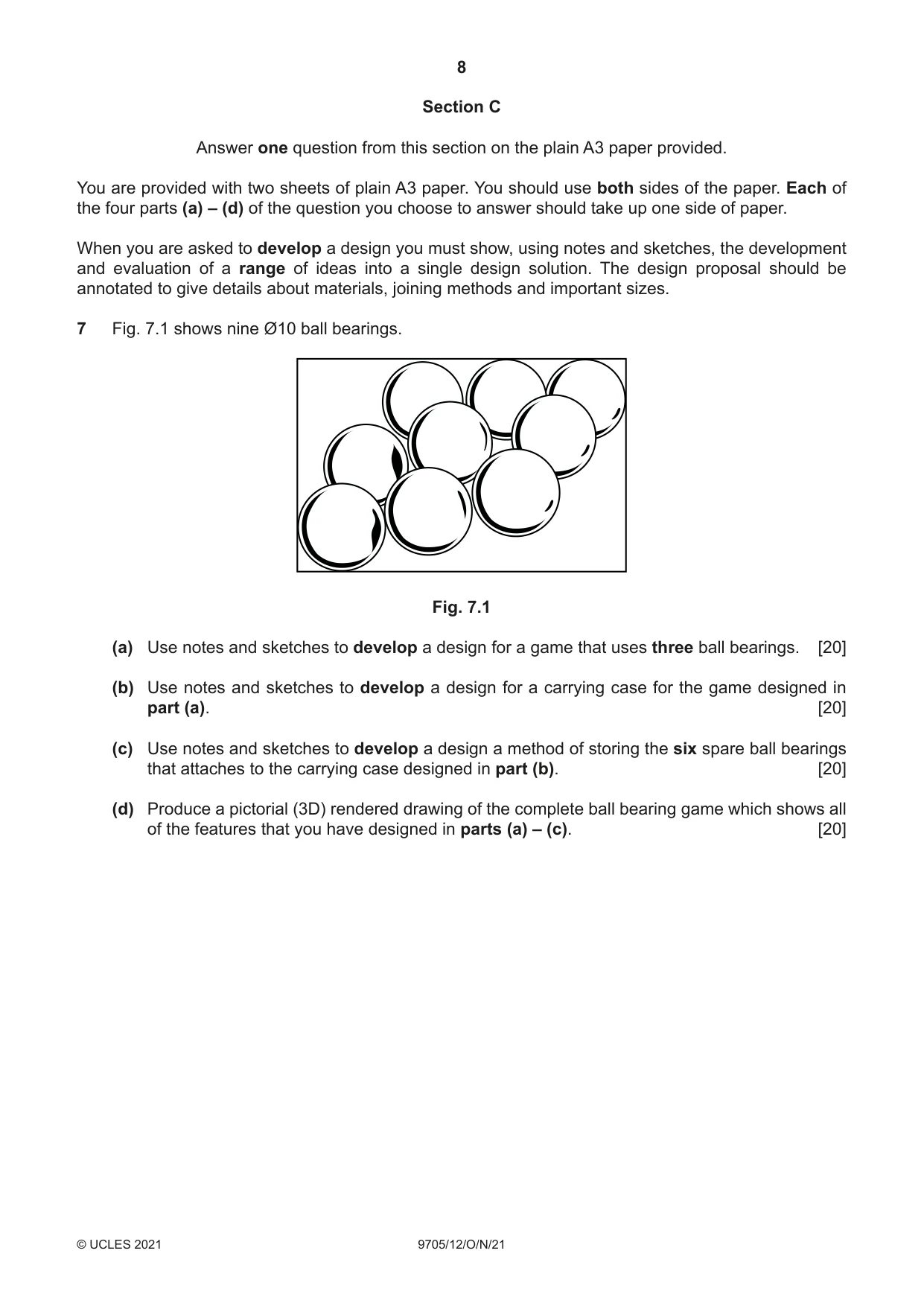
8 9705/12/O/N/21 © UCLES 2021 Section C Answer one question from this section on the plain A3 paper provided. You are provided with two sheets of plain A3 paper. You should use both sides of the paper. Each of the four parts (a) – (d) of the question you choose to answer should take up one side of paper. When you are asked to develop a design you must show, using notes and sketches, the development and evaluation of a range of ideas into a single design solution. The design proposal should be annotated to give details about materials, joining methods and important sizes. 7 Fig. 7.1 shows nine Ø10 ball bearings. Fig. 7.1 (a) Use notes and sketches to develop a design for a game that uses three ball bearings. [20] (b) Use notes and sketches to develop a design for a carrying case for the game designed in part (a). [20] (c) Use notes and sketches to develop a design a method of storing the six spare ball bearings that attaches to the carrying case designed in part (b). [20] (d) Produce a pictorial (3D) rendered drawing of the complete ball bearing game which shows all of the features that you have designed in parts (a) – (c). [20]
Question paper, page 9
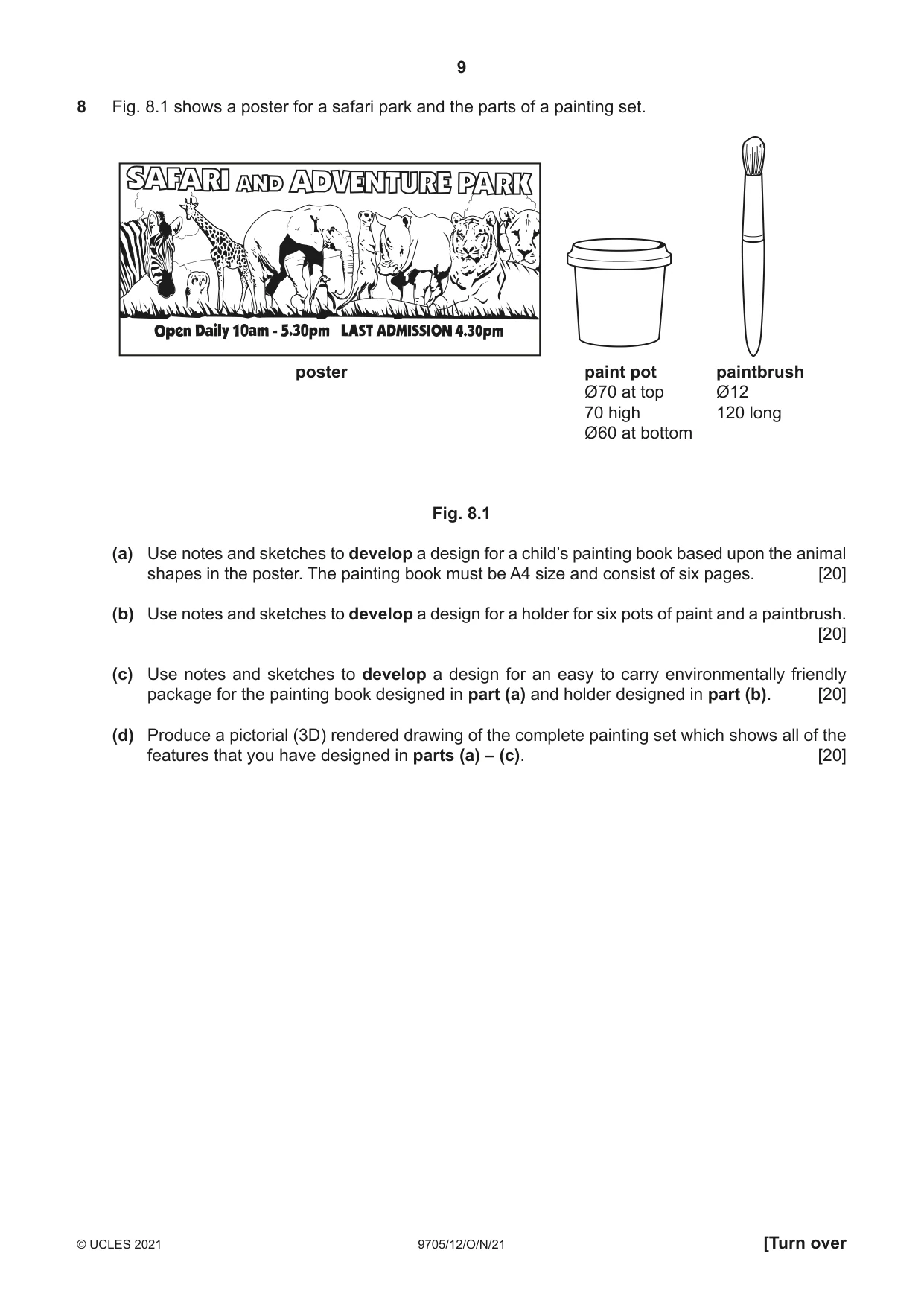
9 9705/12/O/N/21 © UCLES 2021 [Turn over 8 Fig. 8.1 shows a poster for a safari park and the parts of a painting set. poster paint pot Ø70 at top 70 high Ø60 at bottom paintbrush Ø12 120 long Fig. 8.1 (a) Use notes and sketches to develop a design for a child’s painting book based upon the animal shapes in the poster. The painting book must be A4 size and consist of six pages. [20] (b) Use notes and sketches to develop a design for a holder for six pots of paint and a paintbrush. [20] (c) Use notes and sketches to develop a design for an easy to carry environmentally friendly package for the painting book designed in part (a) and holder designed in part (b). [20] (d) Produce a pictorial (3D) rendered drawing of the complete painting set which shows all of the features that you have designed in parts (a) – (c). [20]
Question paper, page 10
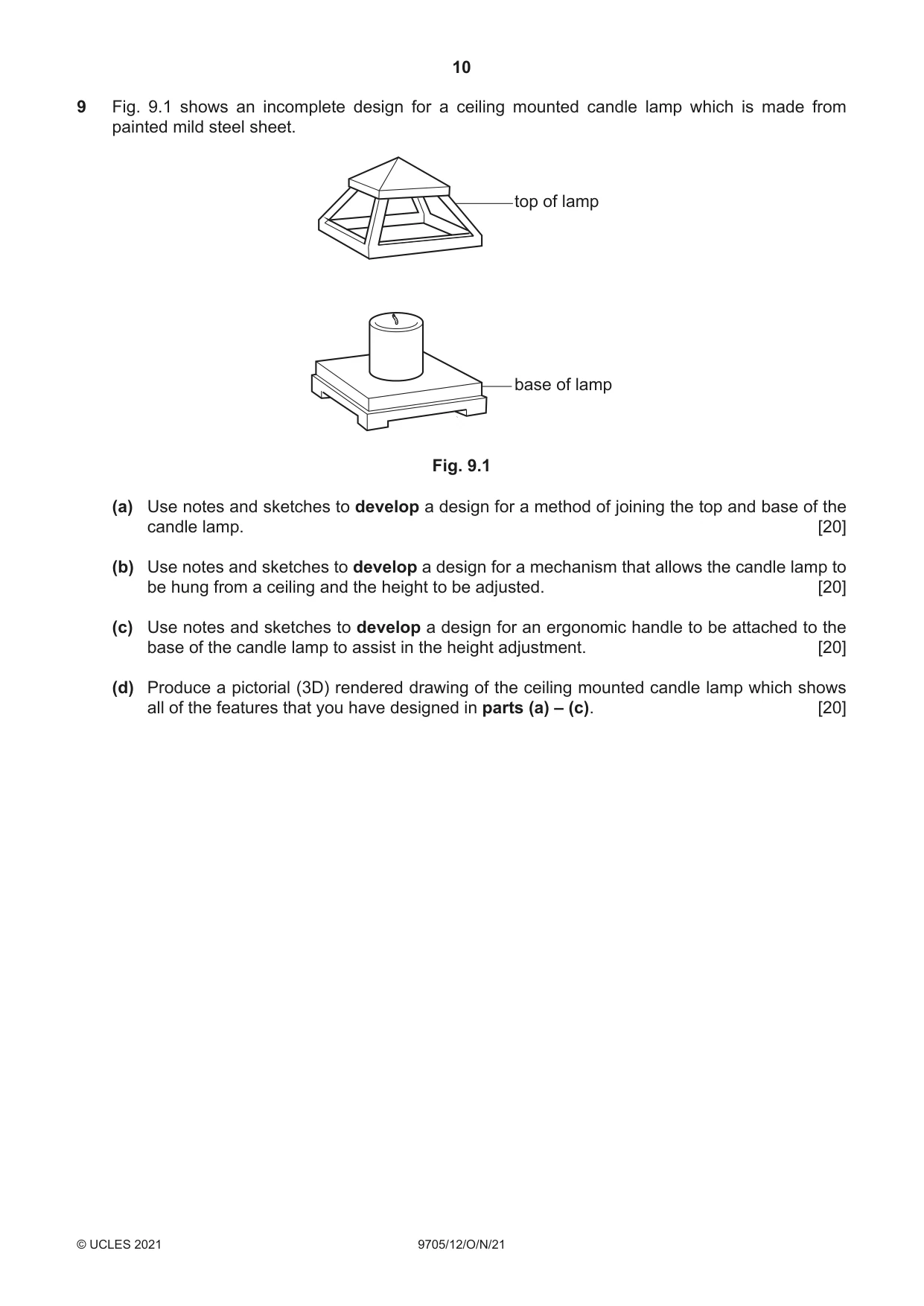
10 9705/12/O/N/21 © UCLES 2021 9 Fig. 9.1 shows an incomplete design for a ceiling mounted candle lamp which is made from painted mild steel sheet. top of lamp base of lamp Fig. 9.1 (a) Use notes and sketches to develop a design for a method of joining the top and base of the candle lamp. [20] (b) Use notes and sketches to develop a design for a mechanism that allows the candle lamp to be hung from a ceiling and the height to be adjusted. [20] (c) Use notes and sketches to develop a design for an ergonomic handle to be attached to the base of the candle lamp to assist in the height adjustment. [20] (d) Produce a pictorial (3D) rendered drawing of the ceiling mounted candle lamp which shows all of the features that you have designed in parts (a) – (c). [20]
Question paper, page 11
11 9705/12/O/N/21 © UCLES 2021 BLANK PAGE
Question paper, page 12
12 9705/12/O/N/21 © UCLES 2021 Permission to reproduce items where third-party owned material protected by copyright is included has been sought and cleared where possible. Every reasonable effort has been made by the publisher (UCLES) to trace copyright holders, but if any items requiring clearance have unwittingly been included, the publisher will be pleased to make amends at the earliest possible opportunity. To avoid the issue of disclosure of answer-related information to candidates, all copyright acknowledgements are reproduced online in the Cambridge Assessment International Education Copyright Acknowledgements Booklet. This is produced for each series of examinations and is freely available to download at www.cambridgeinternational.org after the live examination series. Cambridge Assessment International Education is part of the Cambridge Assessment Group. Cambridge Assessment is the brand name of the University of Cambridge Local Examinations Syndicate (UCLES), which itself is a department of the University of Cambridge. BLANK PAGE
Mark scheme, page 1
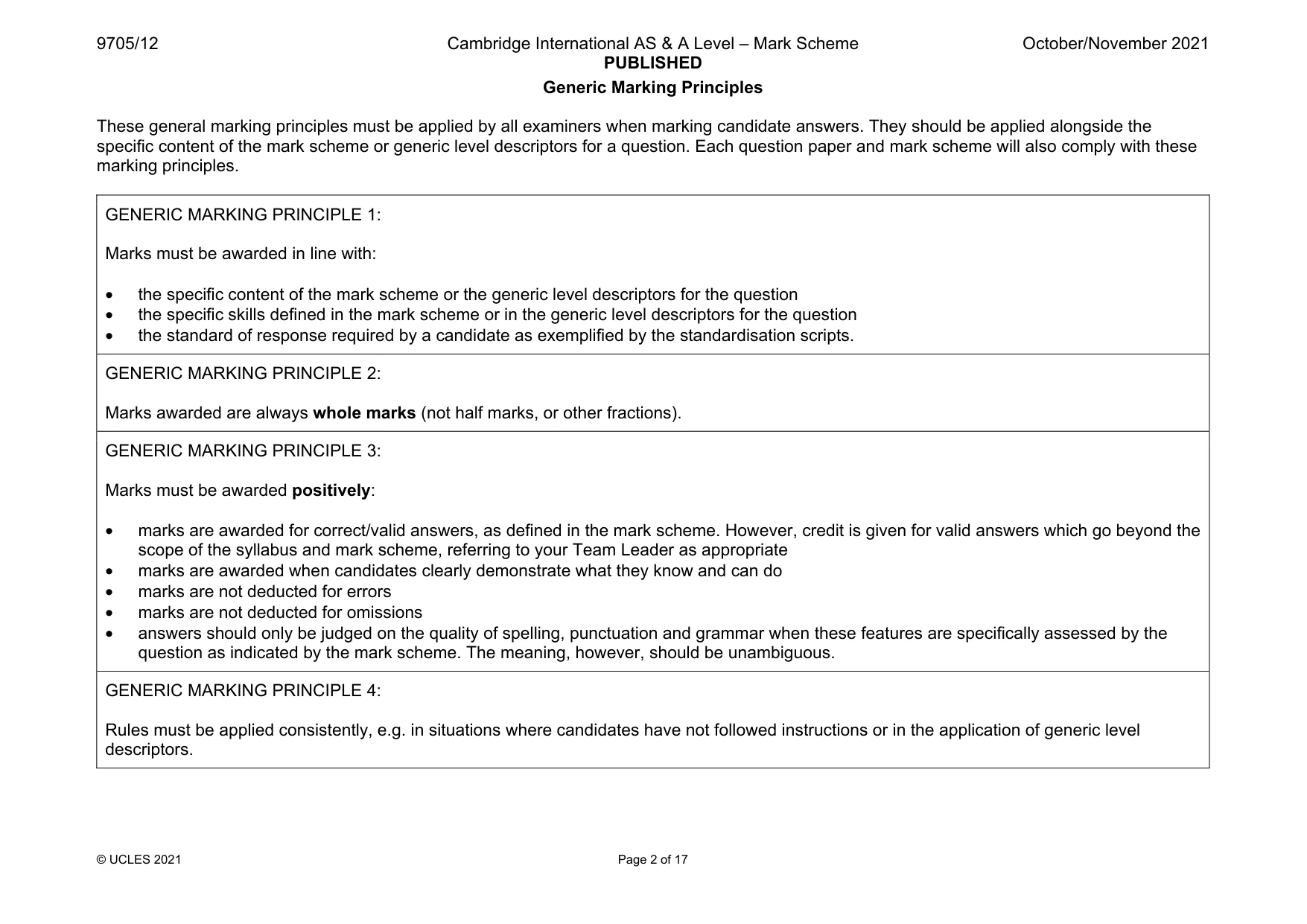
This document consists of 17 printed pages. © UCLES 2021 [Turn over Cambridge International AS & A Level DESIGN & TECHNOLOGY 9705/12 Paper 1 October/November 2021 MARK SCHEME Maximum Mark: 120 Published This mark scheme is published as an aid to teachers and candidates, to indicate the requirements of the examination. It shows the basis on which Examiners were instructed to award marks. It does not indicate the details of the discussions that took place at an Examiners’ meeting before marking began, which would have considered the acceptability of alternative answers. Mark schemes should be read in conjunction with the question paper and the Principal Examiner Report for Teachers. Cambridge International will not enter into discussions about these mark schemes. Cambridge International is publishing the mark schemes for the October/November 2021 series for most Cambridge IGCSE™, Cambridge International A and AS Level components and some Cambridge O Level components.
Mark scheme, page 2
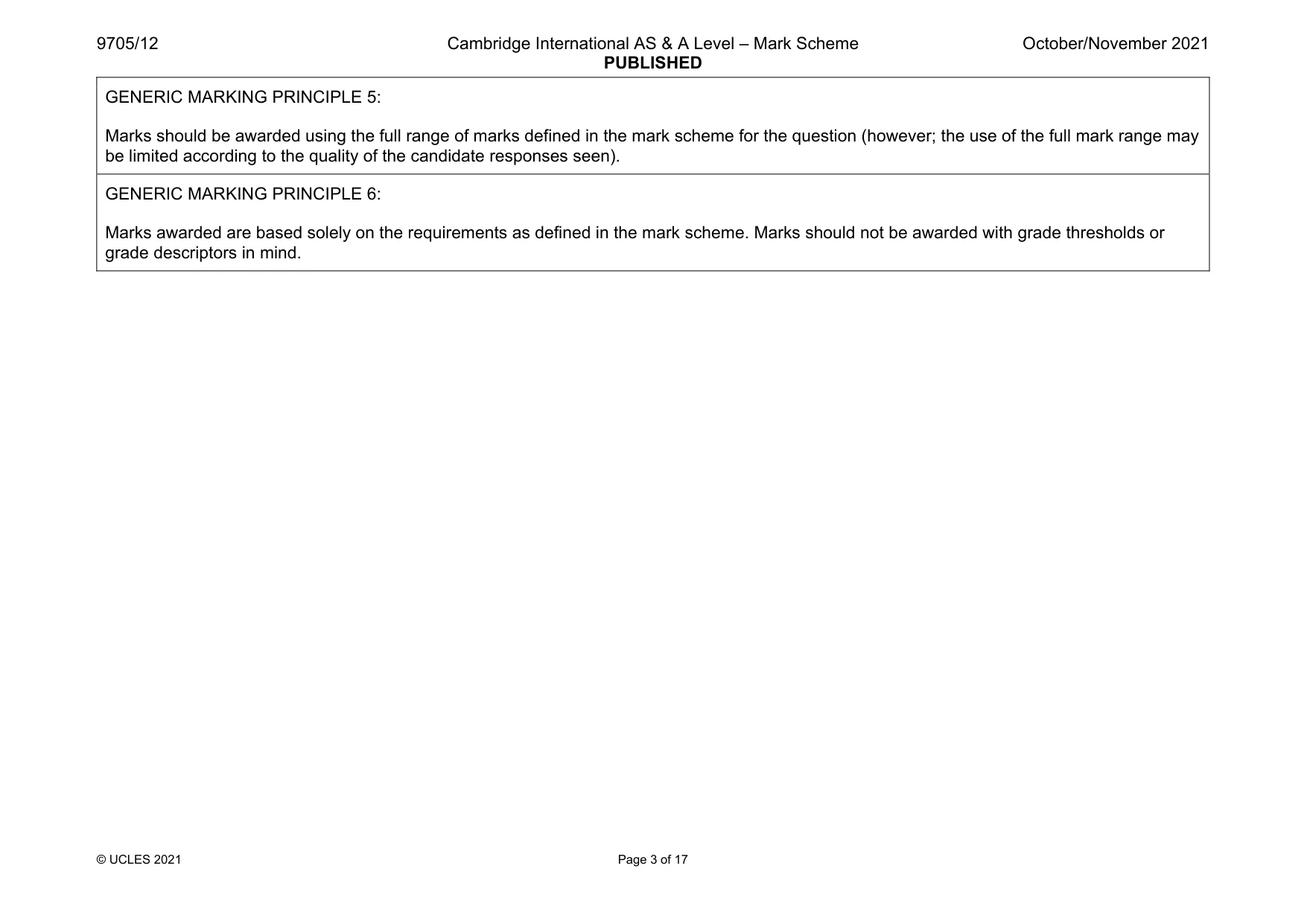
9705/12 Cambridge International AS & A Level – Mark Scheme PUBLISHED October/November 2021 © UCLES 2021 Page 2 of 17 Generic Marking Principles These general marking principles must be applied by all examiners when marking candidate answers. They should be applied alongside the specific content of the mark scheme or generic level descriptors for a question. Each question paper and mark scheme will also comply with these marking principles. GENERIC MARKING PRINCIPLE 1: Marks must be awarded in line with: • the specific content of the mark scheme or the generic level descriptors for the question • the specific skills defined in the mark scheme or in the generic level descriptors for the question • the standard of response required by a candidate as exemplified by the standardisation scripts. GENERIC MARKING PRINCIPLE 2: Marks awarded are always whole marks (not half marks, or other fractions). GENERIC MARKING PRINCIPLE 3: Marks must be awarded positively: • marks are awarded for correct/valid answers, as defined in the mark scheme. However, credit is given for valid answers which go beyond the scope of the syllabus and mark scheme, referring to your Team Leader as appropriate • marks are awarded when candidates clearly demonstrate what they know and can do • marks are not deducted for errors • marks are not deducted for omissions • answers should only be judged on the quality of spelling, punctuation and grammar when these features are specifically assessed by the question as indicated by the mark scheme. The meaning, however, should be unambiguous. GENERIC MARKING PRINCIPLE 4: Rules must be applied consistently, e.g. in situations where candidates have not followed instructions or in the application of generic level descriptors.
Mark scheme, page 3
9705/12 Cambridge International AS & A Level – Mark Scheme PUBLISHED October/November 2021 © UCLES 2021 Page 3 of 17 GENERIC MARKING PRINCIPLE 5: Marks should be awarded using the full range of marks defined in the mark scheme for the question (however; the use of the full mark range may be limited according to the quality of the candidate responses seen). GENERIC MARKING PRINCIPLE 6: Marks awarded are based solely on the requirements as defined in the mark scheme. Marks should not be awarded with grade thresholds or grade descriptors in mind.
Mark scheme, page 4
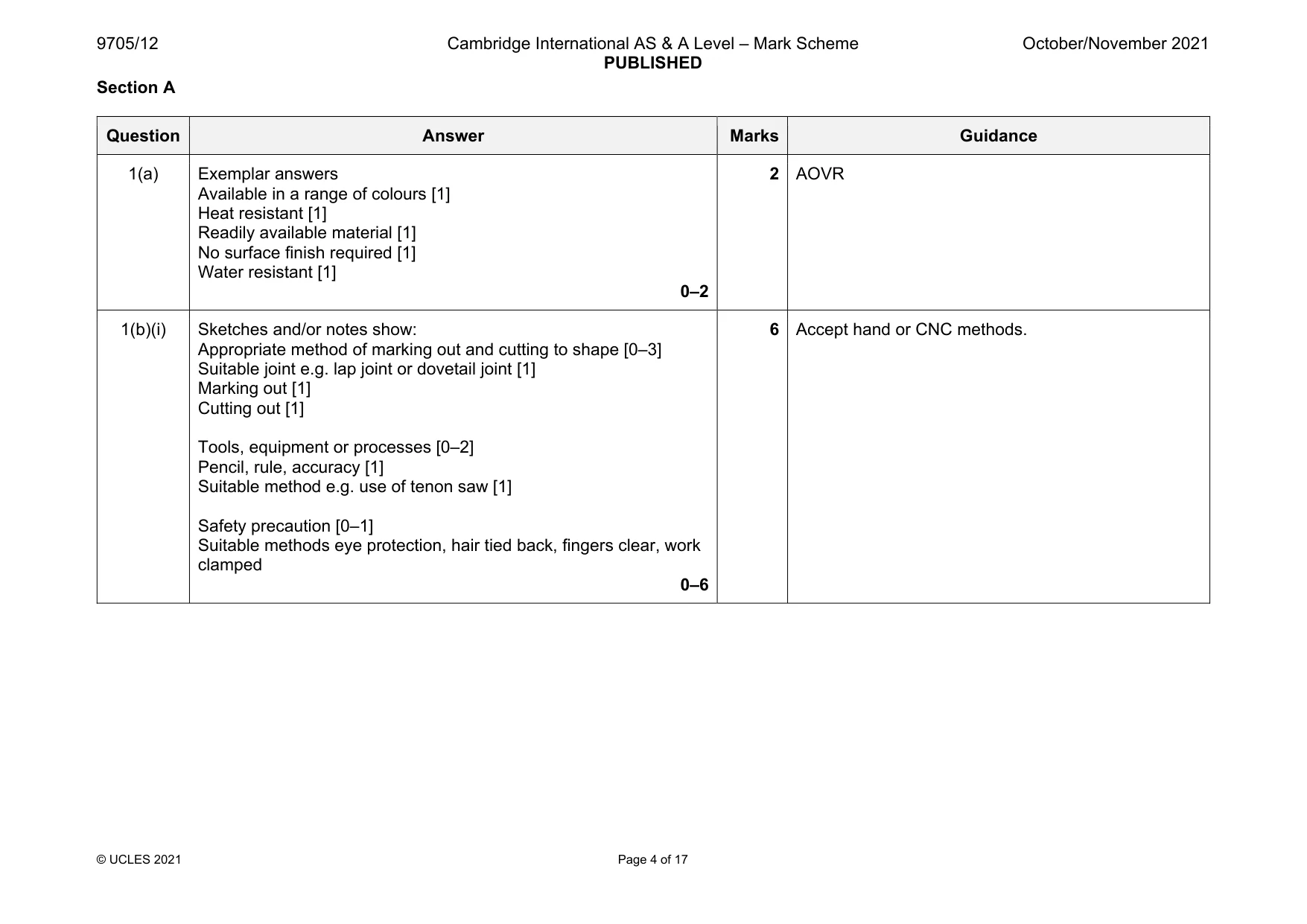
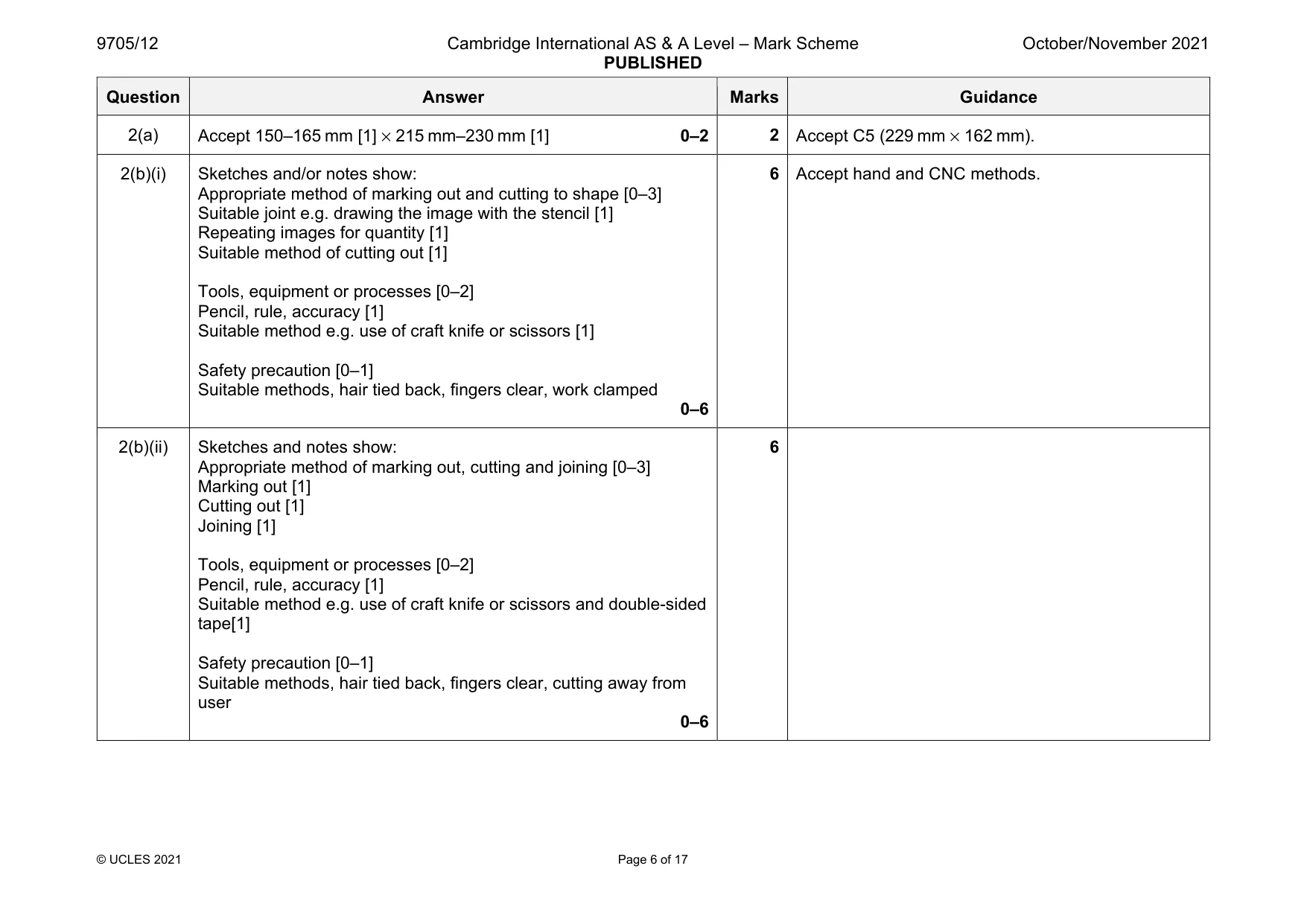
9705/12 Cambridge International AS & A Level – Mark Scheme PUBLISHED October/November 2021 © UCLES 2021 Page 4 of 17 Section A Question Answer Marks Guidance 1(a) Exemplar answers Available in a range of colours [1] Heat resistant [1] Readily available material [1] No surface finish required [1] Water resistant [1] 0–2 2 AOVR 1(b)(i) Sketches and/or notes show: Appropriate method of marking out and cutting to shape [0–3] Suitable joint e.g. lap joint or dovetail joint [1] Marking out [1] Cutting out [1] Tools, equipment or processes [0–2] Pencil, rule, accuracy [1] Suitable method e.g. use of tenon saw [1] Safety precaution [0–1] Suitable methods eye protection, hair tied back, fingers clear, work clamped 0–6 6 Accept hand or CNC methods.
Mark scheme, page 5
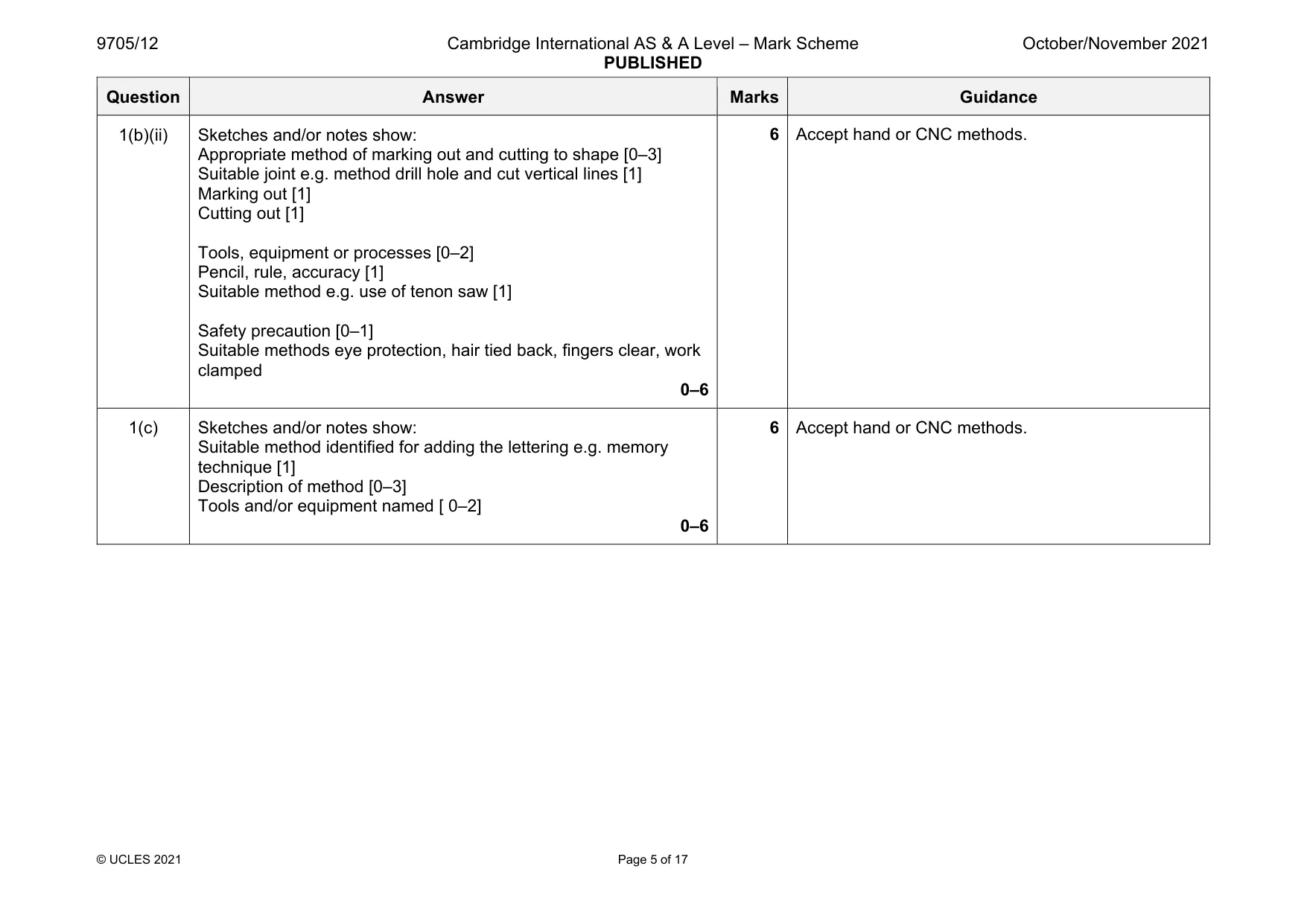
9705/12 Cambridge International AS & A Level – Mark Scheme PUBLISHED October/November 2021 © UCLES 2021 Page 5 of 17 Question Answer Marks Guidance 1(b)(ii) Sketches and/or notes show: Appropriate method of marking out and cutting to shape [0–3] Suitable joint e.g. method drill hole and cut vertical lines [1] Marking out [1] Cutting out [1] Tools, equipment or processes [0–2] Pencil, rule, accuracy [1] Suitable method e.g. use of tenon saw [1] Safety precaution [0–1] Suitable methods eye protection, hair tied back, fingers clear, work clamped 0–6 6 Accept hand or CNC methods. 1(c) Sketches and/or notes show: Suitable method identified for adding the lettering e.g. memory technique [1] Description of method [0–3] Tools and/or equipment named [ 0–2] 0–6 6 Accept hand or CNC methods.
Mark scheme, page 6
9705/12 Cambridge International AS & A Level – Mark Scheme PUBLISHED October/November 2021 © UCLES 2021 Page 6 of 17 Question Answer Marks Guidance 2(a) Accept 150–165 mm [1] × 215 mm–230 mm [1] 0–2 2 Accept C5 (229 mm × 162 mm). 2(b)(i) Sketches and/or notes show: Appropriate method of marking out and cutting to shape [0–3] Suitable joint e.g. drawing the image with the stencil [1] Repeating images for quantity [1] Suitable method of cutting out [1] Tools, equipment or processes [0–2] Pencil, rule, accuracy [1] Suitable method e.g. use of craft knife or scissors [1] Safety precaution [0–1] Suitable methods, hair tied back, fingers clear, work clamped 0–6 6 Accept hand and CNC methods. 2(b)(ii) Sketches and notes show: Appropriate method of marking out, cutting and joining [0–3] Marking out [1] Cutting out [1] Joining [1] Tools, equipment or processes [0–2] Pencil, rule, accuracy [1] Suitable method e.g. use of craft knife or scissors and double-sided tape[1] Safety precaution [0–1] Suitable methods, hair tied back, fingers clear, cutting away from user 0–6 6
Mark scheme, page 7
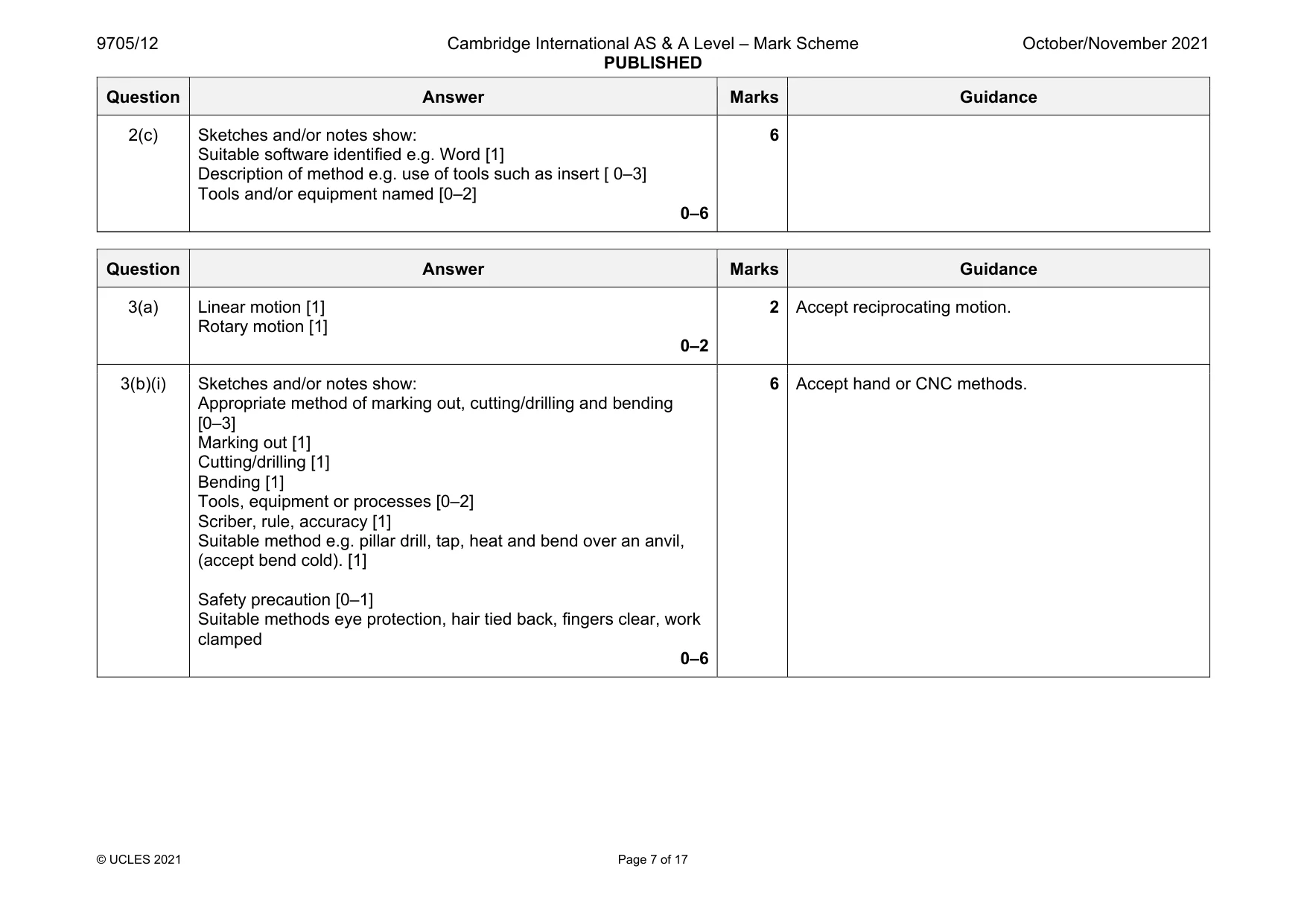
9705/12 Cambridge International AS & A Level – Mark Scheme PUBLISHED October/November 2021 © UCLES 2021 Page 7 of 17 Question Answer Marks Guidance 2(c) Sketches and/or notes show: Suitable software identified e.g. Word [1] Description of method e.g. use of tools such as insert [ 0–3] Tools and/or equipment named [0–2] 0–6 6 Question Answer Marks Guidance 3(a) Linear motion [1] Rotary motion [1] 0–2 2 Accept reciprocating motion. 3(b)(i) Sketches and/or notes show: Appropriate method of marking out, cutting/drilling and bending [0–3] Marking out [1] Cutting/drilling [1] Bending [1] Tools, equipment or processes [0–2] Scriber, rule, accuracy [1] Suitable method e.g. pillar drill, tap, heat and bend over an anvil, (accept bend cold). [1] Safety precaution [0–1] Suitable methods eye protection, hair tied back, fingers clear, work clamped 0–6 6 Accept hand or CNC methods.
Mark scheme, page 8
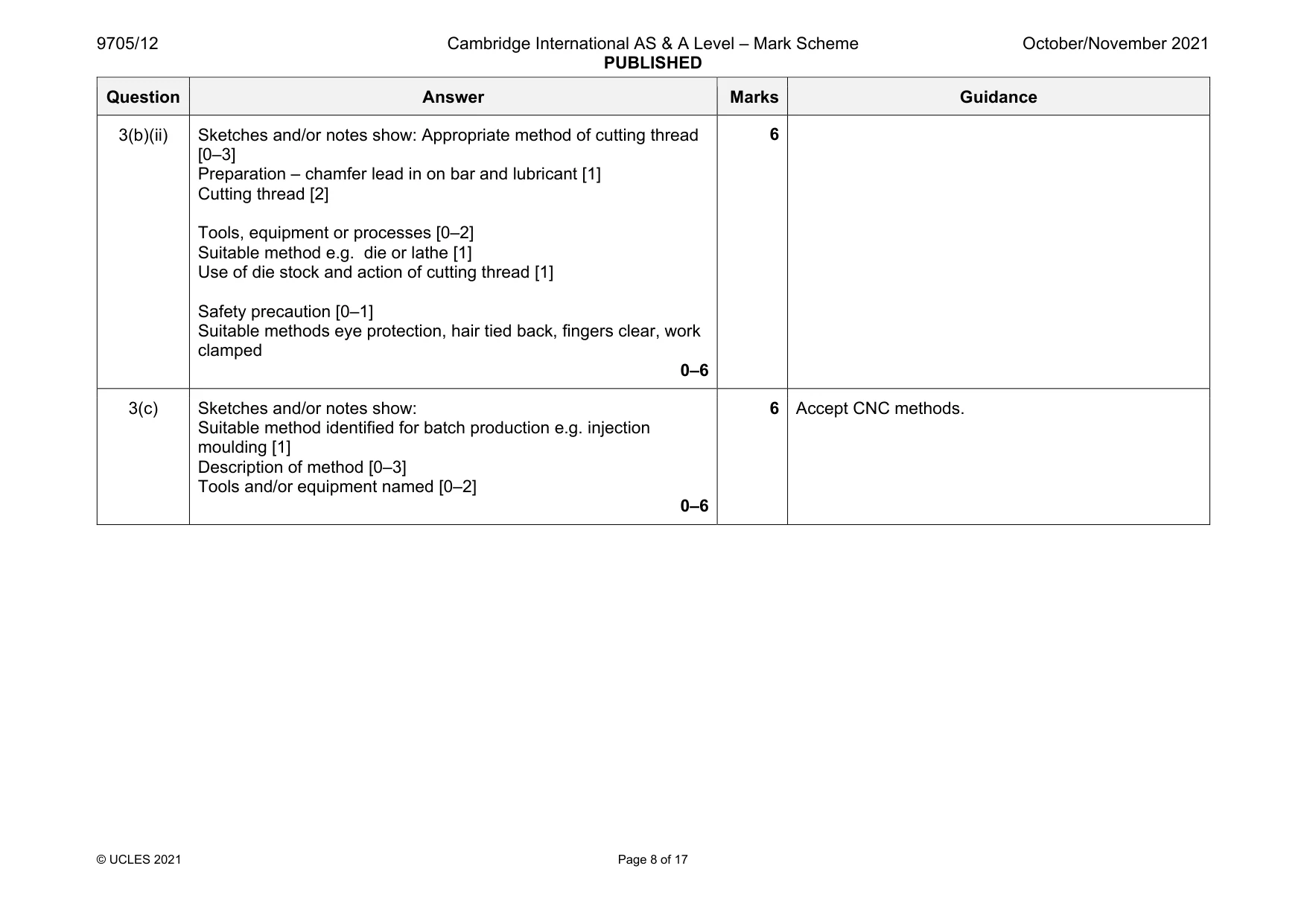
9705/12 Cambridge International AS & A Level – Mark Scheme PUBLISHED October/November 2021 © UCLES 2021 Page 8 of 17 Question Answer Marks Guidance 3(b)(ii) Sketches and/or notes show: Appropriate method of cutting thread [0–3] Preparation – chamfer lead in on bar and lubricant [1] Cutting thread [2] Tools, equipment or processes [0–2] Suitable method e.g. die or lathe [1] Use of die stock and action of cutting thread [1] Safety precaution [0–1] Suitable methods eye protection, hair tied back, fingers clear, work clamped 0–6 6 3(c) Sketches and/or notes show: Suitable method identified for batch production e.g. injection moulding [1] Description of method [0–3] Tools and/or equipment named [0–2] 0–6 6 Accept CNC methods.
Mark scheme, page 9
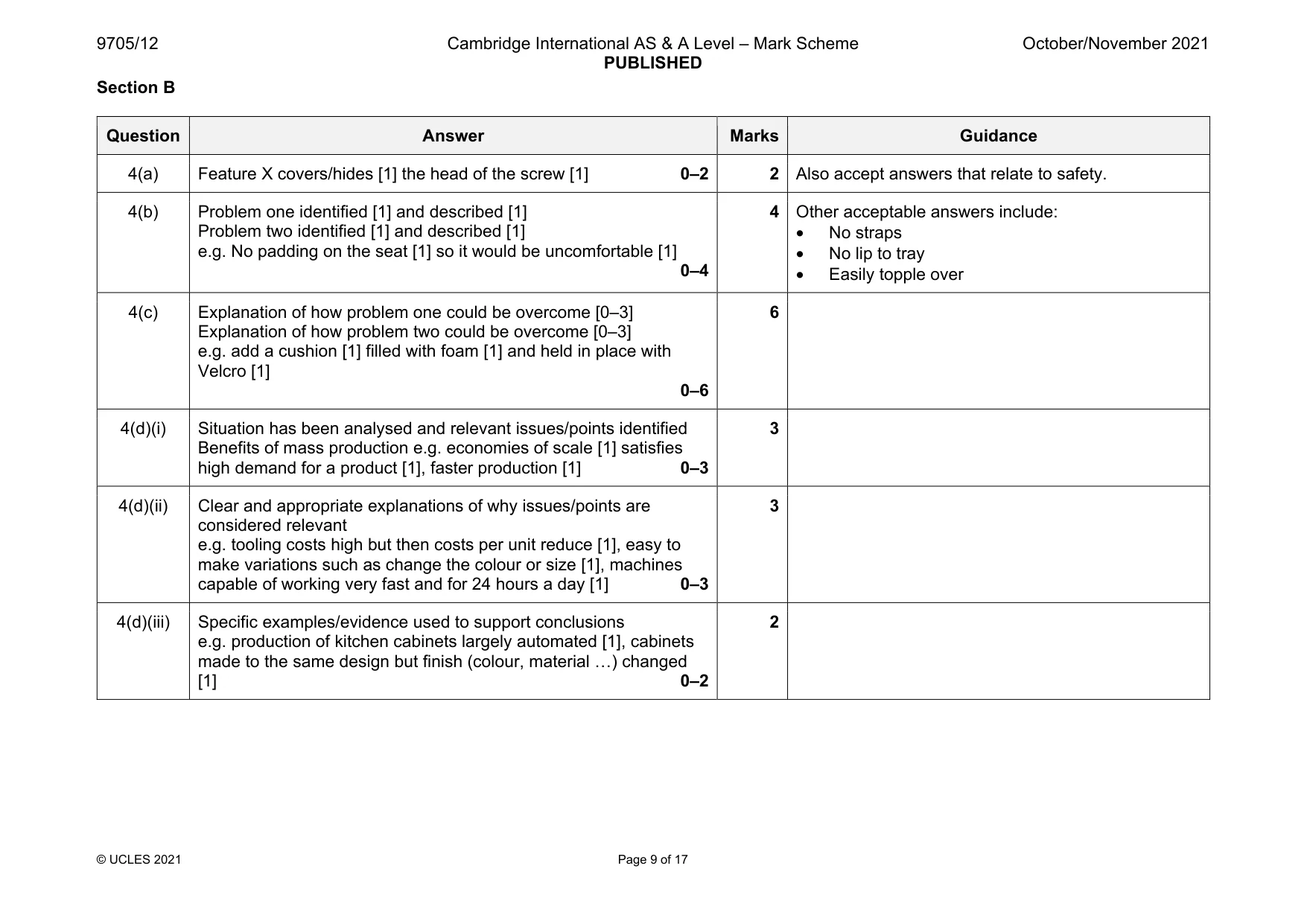
9705/12 Cambridge International AS & A Level – Mark Scheme PUBLISHED October/November 2021 © UCLES 2021 Page 9 of 17 Section B Question Answer Marks Guidance 4(a) Feature X covers/hides [1] the head of the screw [1] 0–2 2 Also accept answers that relate to safety. 4(b) Problem one identified [1] and described [1] Problem two identified [1] and described [1] e.g. No padding on the seat [1] so it would be uncomfortable [1] 0–4 4 Other acceptable answers include: • No straps • No lip to tray • Easily topple over 4(c) Explanation of how problem one could be overcome [0–3] Explanation of how problem two could be overcome [0–3] e.g. add a cushion [1] filled with foam [1] and held in place with Velcro [1] 0–6 6 4(d)(i) Situation has been analysed and relevant issues/points identified Benefits of mass production e.g. economies of scale [1] satisfies high demand for a product [1], faster production [1] 0–3 3 4(d)(ii) Clear and appropriate explanations of why issues/points are considered relevant e.g. tooling costs high but then costs per unit reduce [1], easy to make variations such as change the colour or size [1], machines capable of working very fast and for 24 hours a day [1] 0–3 3 4(d)(iii) Specific examples/evidence used to support conclusions e.g. production of kitchen cabinets largely automated [1], cabinets made to the same design but finish (colour, material …) changed [1] 0–2 2
Mark scheme, page 10
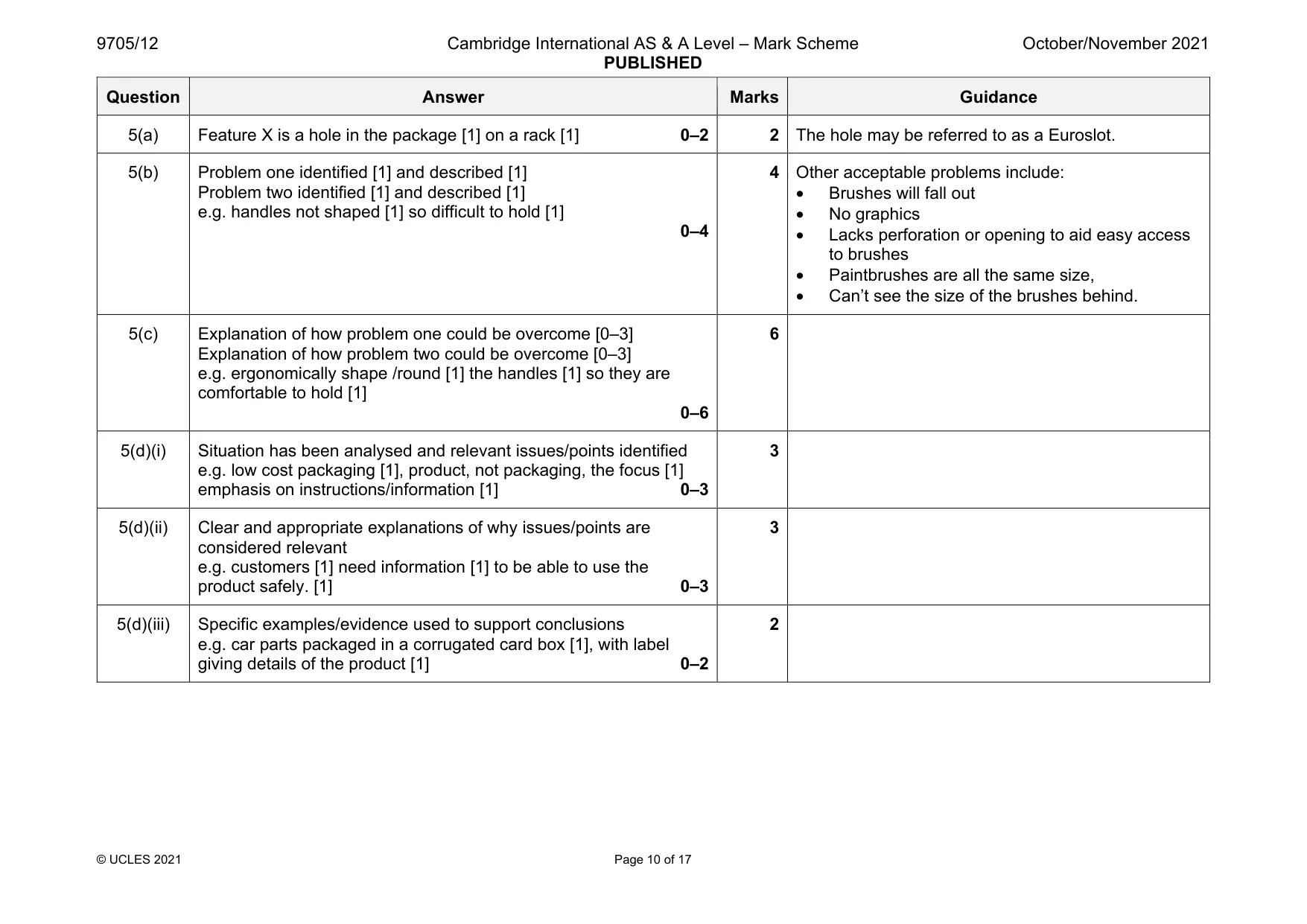
9705/12 Cambridge International AS & A Level – Mark Scheme PUBLISHED October/November 2021 © UCLES 2021 Page 10 of 17 Question Answer Marks Guidance 5(a) Feature X is a hole in the package [1] on a rack [1] 0–2 2 The hole may be referred to as a Euroslot. 5(b) Problem one identified [1] and described [1] Problem two identified [1] and described [1] e.g. handles not shaped [1] so difficult to hold [1] 0–4 4 Other acceptable problems include: • Brushes will fall out • No graphics • Lacks perforation or opening to aid easy access to brushes • Paintbrushes are all the same size, • Can’t see the size of the brushes behind. 5(c) Explanation of how problem one could be overcome [0–3] Explanation of how problem two could be overcome [0–3] e.g. ergonomically shape /round [1] the handles [1] so they are comfortable to hold [1] 0–6 6 5(d)(i) Situation has been analysed and relevant issues/points identified e.g. low cost packaging [1], product, not packaging, the focus [1] emphasis on instructions/information [1] 0–3 3 5(d)(ii) Clear and appropriate explanations of why issues/points are considered relevant e.g. customers [1] need information [1] to be able to use the product safely. [1] 0–3 3 5(d)(iii) Specific examples/evidence used to support conclusions e.g. car parts packaged in a corrugated card box [1], with label giving details of the product [1] 0–2 2
Mark scheme, page 11
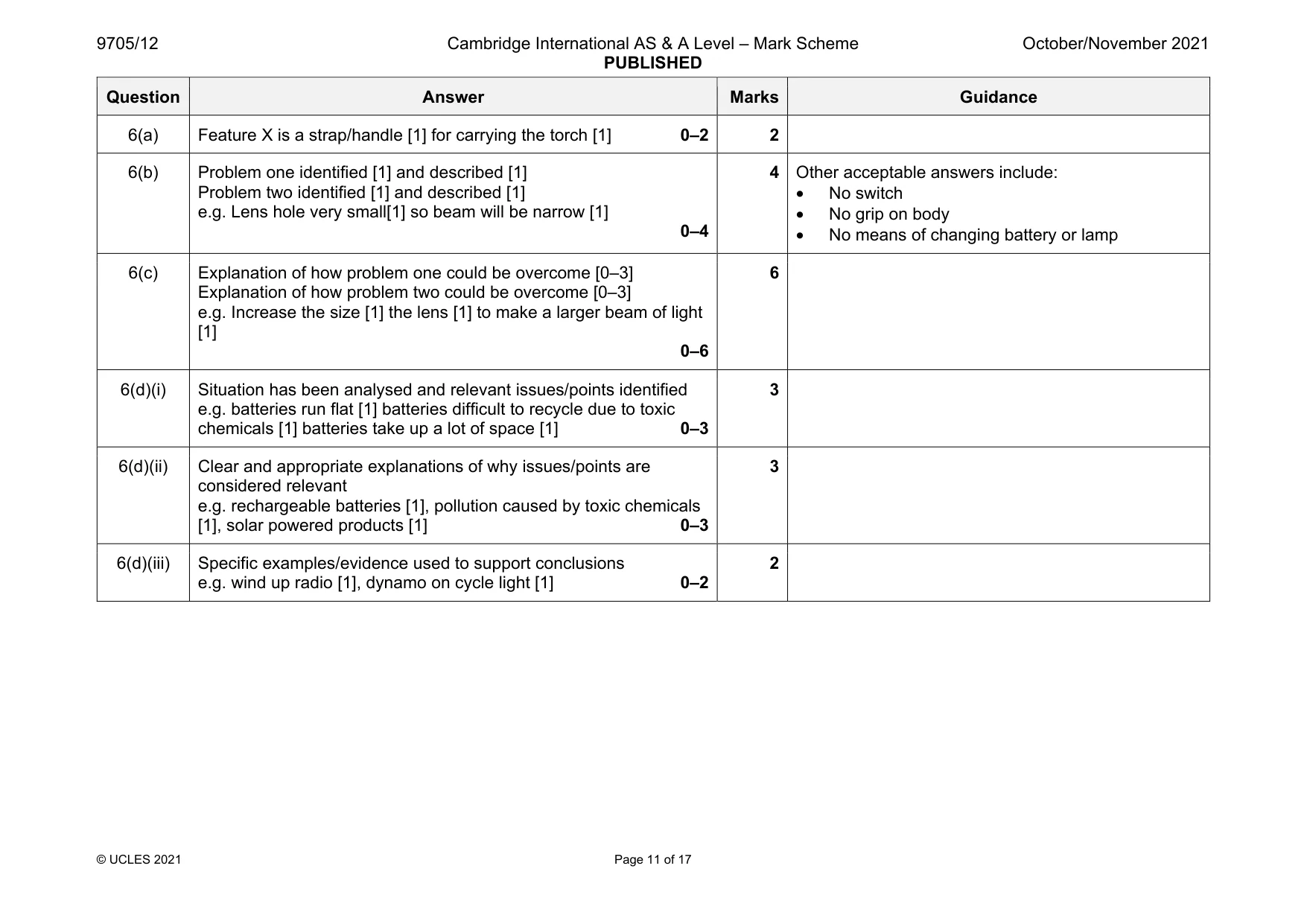
9705/12 Cambridge International AS & A Level – Mark Scheme PUBLISHED October/November 2021 © UCLES 2021 Page 11 of 17 Question Answer Marks Guidance 6(a) Feature X is a strap/handle [1] for carrying the torch [1] 0–2 2 6(b) Problem one identified [1] and described [1] Problem two identified [1] and described [1] e.g. Lens hole very small[1] so beam will be narrow [1] 0–4 4 Other acceptable answers include: • No switch • No grip on body • No means of changing battery or lamp 6(c) Explanation of how problem one could be overcome [0–3] Explanation of how problem two could be overcome [0–3] e.g. Increase the size [1] the lens [1] to make a larger beam of light [1] 0–6 6 6(d)(i) Situation has been analysed and relevant issues/points identified e.g. batteries run flat [1] batteries difficult to recycle due to toxic chemicals [1] batteries take up a lot of space [1] 0–3 3 6(d)(ii) Clear and appropriate explanations of why issues/points are considered relevant e.g. rechargeable batteries [1], pollution caused by toxic chemicals [1], solar powered products [1] 0–3 3 6(d)(iii) Specific examples/evidence used to support conclusions e.g. wind up radio [1], dynamo on cycle light [1] 0–2 2
Mark scheme, page 12
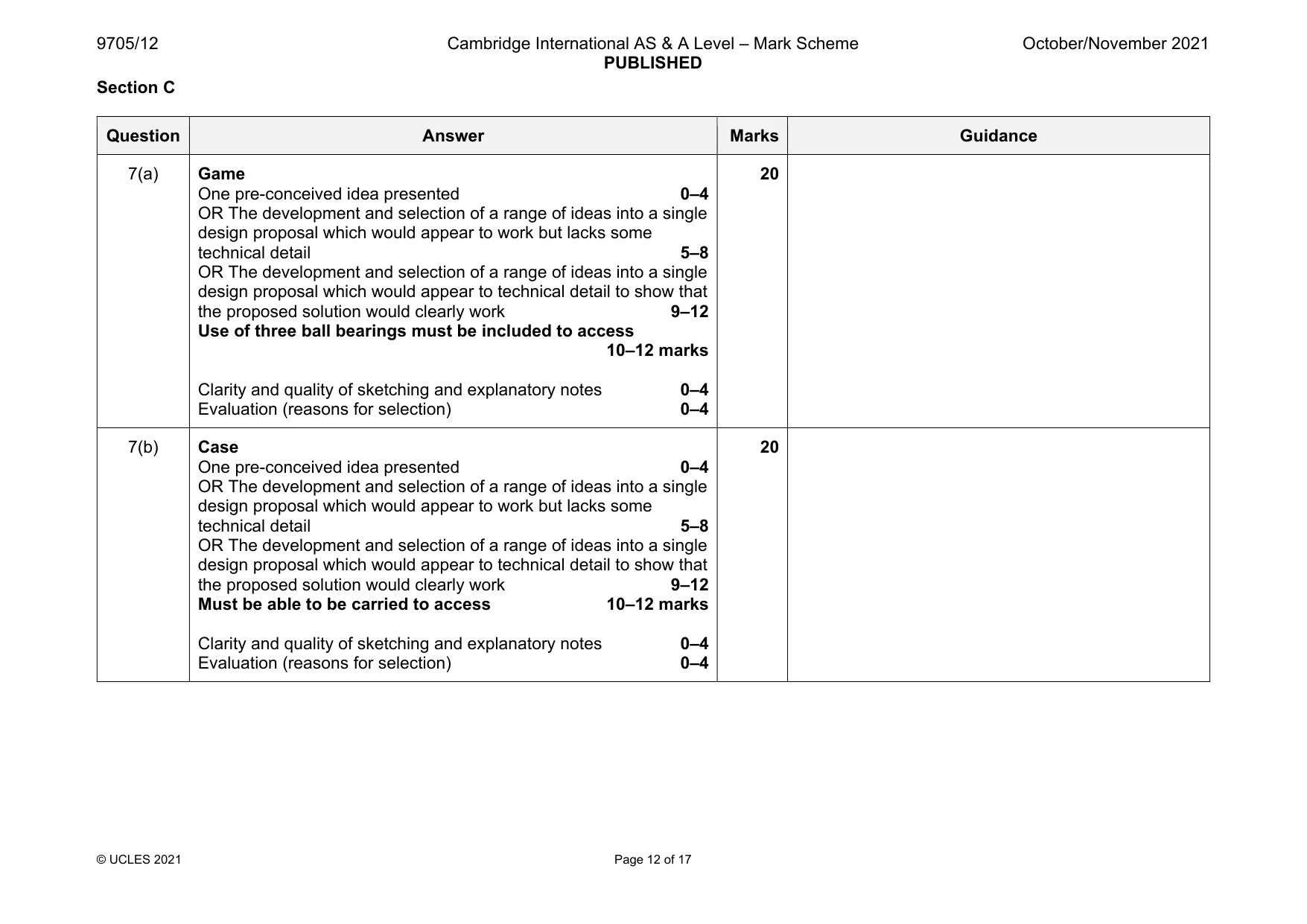
9705/12 Cambridge International AS & A Level – Mark Scheme PUBLISHED October/November 2021 © UCLES 2021 Page 12 of 17 Section C Question Answer Marks Guidance 7(a) Game One pre-conceived idea presented 0–4 OR The development and selection of a range of ideas into a single design proposal which would appear to work but lacks some technical detail 5–8 OR The development and selection of a range of ideas into a single design proposal which would appear to technical detail to show that the proposed solution would clearly work 9–12 Use of three ball bearings must be included to access 10–12 marks Clarity and quality of sketching and explanatory notes 0–4 Evaluation (reasons for selection) 0–4 20 7(b) Case One pre-conceived idea presented 0–4 OR The development and selection of a range of ideas into a single design proposal which would appear to work but lacks some technical detail 5–8 OR The development and selection of a range of ideas into a single design proposal which would appear to technical detail to show that the proposed solution would clearly work 9–12 Must be able to be carried to access 10–12 marks Clarity and quality of sketching and explanatory notes 0–4 Evaluation (reasons for selection) 0–4 20
Mark scheme, page 13
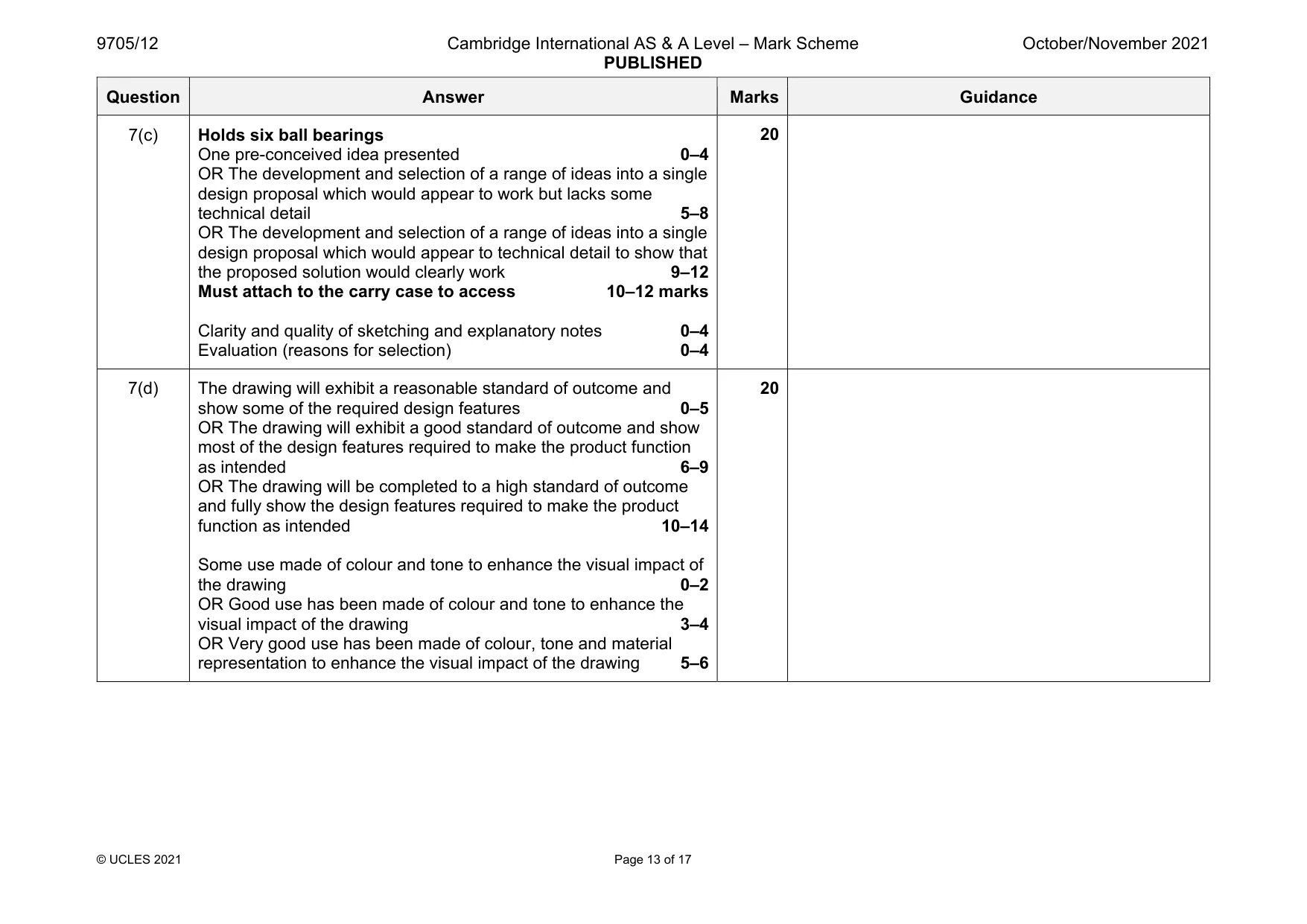
9705/12 Cambridge International AS & A Level – Mark Scheme PUBLISHED October/November 2021 © UCLES 2021 Page 13 of 17 Question Answer Marks Guidance 7(c) Holds six ball bearings One pre-conceived idea presented 0–4 OR The development and selection of a range of ideas into a single design proposal which would appear to work but lacks some technical detail 5–8 OR The development and selection of a range of ideas into a single design proposal which would appear to technical detail to show that the proposed solution would clearly work 9–12 Must attach to the carry case to access 10–12 marks Clarity and quality of sketching and explanatory notes 0–4 Evaluation (reasons for selection) 0–4 20 7(d) The drawing will exhibit a reasonable standard of outcome and show some of the required design features 0–5 OR The drawing will exhibit a good standard of outcome and show most of the design features required to make the product function as intended 6–9 OR The drawing will be completed to a high standard of outcome and fully show the design features required to make the product function as intended 10–14 Some use made of colour and tone to enhance the visual impact of the drawing 0–2 OR Good use has been made of colour and tone to enhance the visual impact of the drawing 3–4 OR Very good use has been made of colour, tone and material representation to enhance the visual impact of the drawing 5–6 20
Mark scheme, page 14
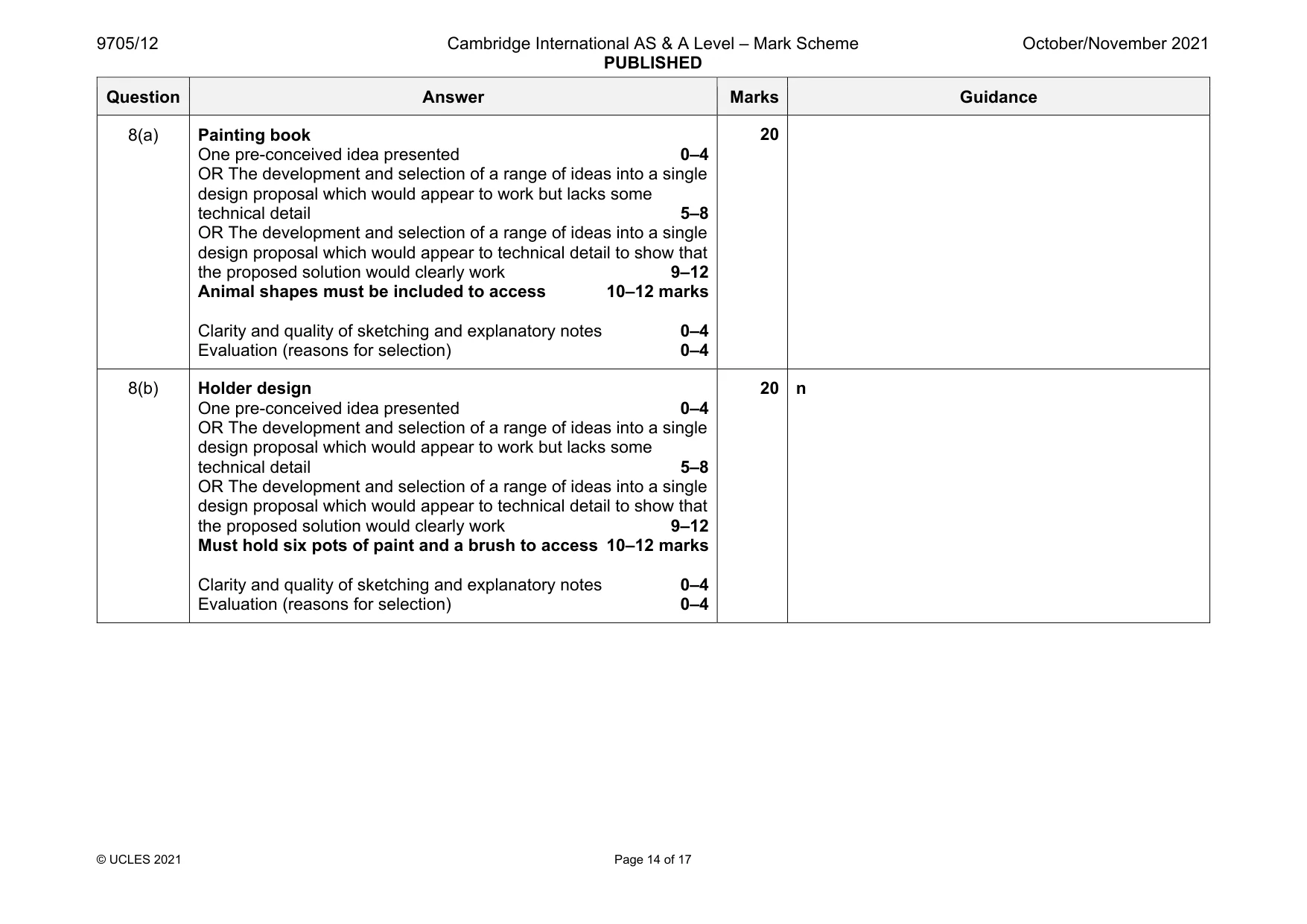
9705/12 Cambridge International AS & A Level – Mark Scheme PUBLISHED October/November 2021 © UCLES 2021 Page 14 of 17 Question Answer Marks Guidance 8(a) Painting book One pre-conceived idea presented 0–4 OR The development and selection of a range of ideas into a single design proposal which would appear to work but lacks some technical detail 5–8 OR The development and selection of a range of ideas into a single design proposal which would appear to technical detail to show that the proposed solution would clearly work 9–12 Animal shapes must be included to access 10–12 marks Clarity and quality of sketching and explanatory notes 0–4 Evaluation (reasons for selection) 0–4 20 8(b) Holder design One pre-conceived idea presented 0–4 OR The development and selection of a range of ideas into a single design proposal which would appear to work but lacks some technical detail 5–8 OR The development and selection of a range of ideas into a single design proposal which would appear to technical detail to show that the proposed solution would clearly work 9–12 Must hold six pots of paint and a brush to access 10–12 marks Clarity and quality of sketching and explanatory notes 0–4 Evaluation (reasons for selection) 0–4 20 n
Mark scheme, page 15
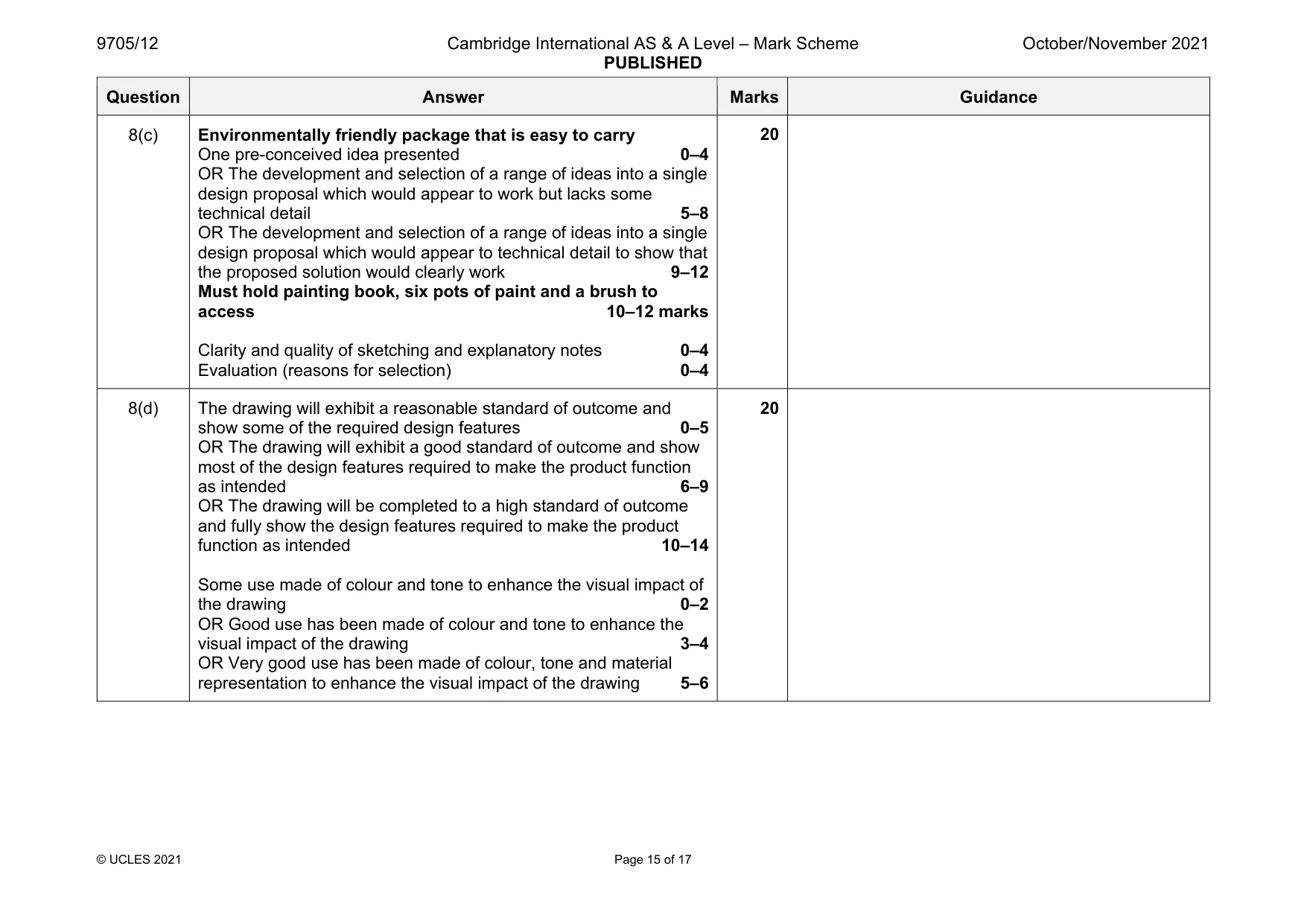
9705/12 Cambridge International AS & A Level – Mark Scheme PUBLISHED October/November 2021 © UCLES 2021 Page 15 of 17 Question Answer Marks Guidance 8(c) Environmentally friendly package that is easy to carry One pre-conceived idea presented 0–4 OR The development and selection of a range of ideas into a single design proposal which would appear to work but lacks some technical detail 5–8 OR The development and selection of a range of ideas into a single design proposal which would appear to technical detail to show that the proposed solution would clearly work 9–12 Must hold painting book, six pots of paint and a brush to access 10–12 marks Clarity and quality of sketching and explanatory notes 0–4 Evaluation (reasons for selection) 0–4 20 8(d) The drawing will exhibit a reasonable standard of outcome and show some of the required design features 0–5 OR The drawing will exhibit a good standard of outcome and show most of the design features required to make the product function as intended 6–9 OR The drawing will be completed to a high standard of outcome and fully show the design features required to make the product function as intended 10–14 Some use made of colour and tone to enhance the visual impact of the drawing 0–2 OR Good use has been made of colour and tone to enhance the visual impact of the drawing 3–4 OR Very good use has been made of colour, tone and material representation to enhance the visual impact of the drawing 5–6 20
Mark scheme, page 16
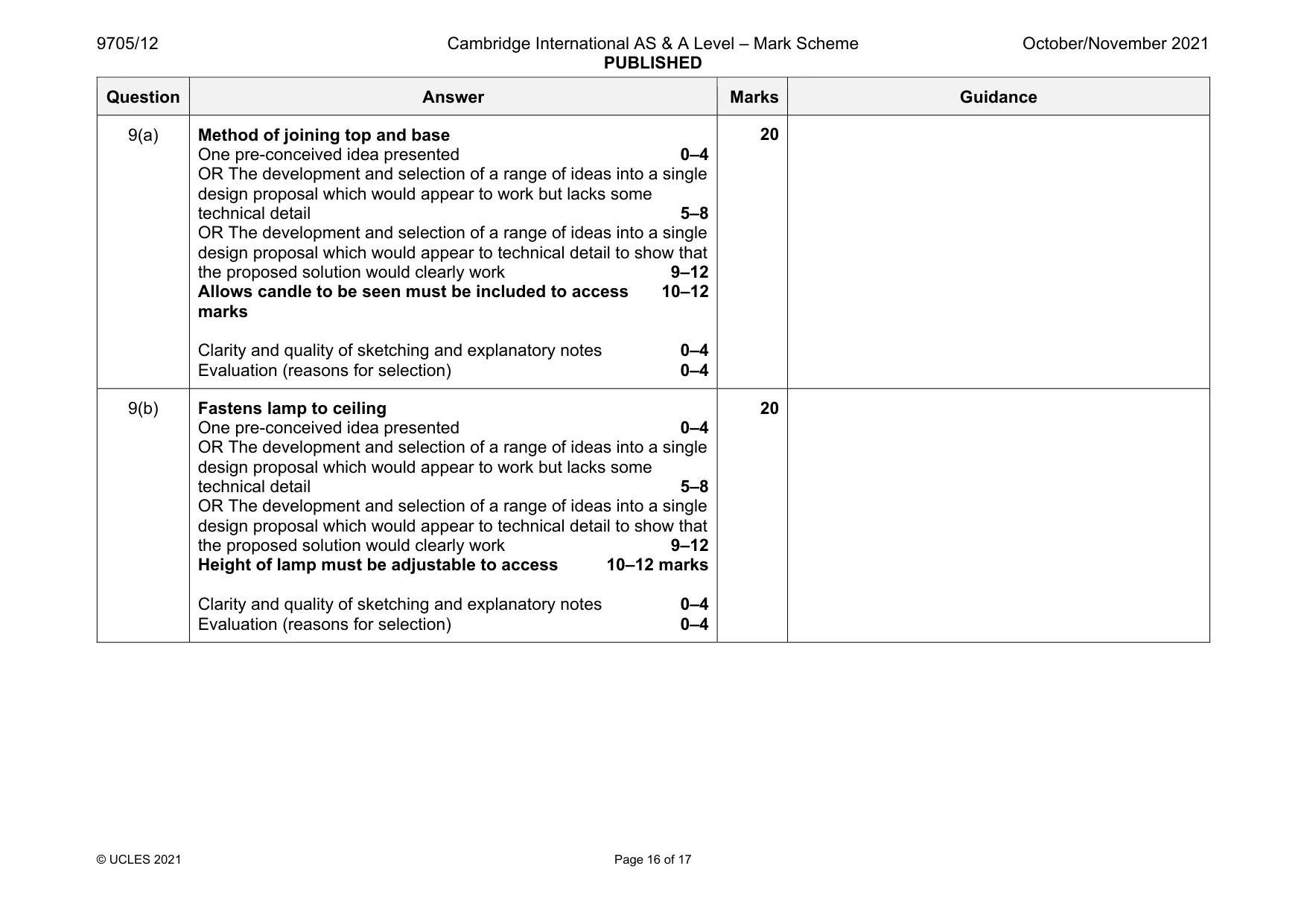
9705/12 Cambridge International AS & A Level – Mark Scheme PUBLISHED October/November 2021 © UCLES 2021 Page 16 of 17 Question Answer Marks Guidance 9(a) Method of joining top and base One pre-conceived idea presented 0–4 OR The development and selection of a range of ideas into a single design proposal which would appear to work but lacks some technical detail 5–8 OR The development and selection of a range of ideas into a single design proposal which would appear to technical detail to show that the proposed solution would clearly work 9–12 Allows candle to be seen must be included to access 10–12 marks Clarity and quality of sketching and explanatory notes 0–4 Evaluation (reasons for selection) 0–4 20 9(b) Fastens lamp to ceiling One pre-conceived idea presented 0–4 OR The development and selection of a range of ideas into a single design proposal which would appear to work but lacks some technical detail 5–8 OR The development and selection of a range of ideas into a single design proposal which would appear to technical detail to show that the proposed solution would clearly work 9–12 Height of lamp must be adjustable to access 10–12 marks Clarity and quality of sketching and explanatory notes 0–4 Evaluation (reasons for selection) 0–4 20
Mark scheme, page 17
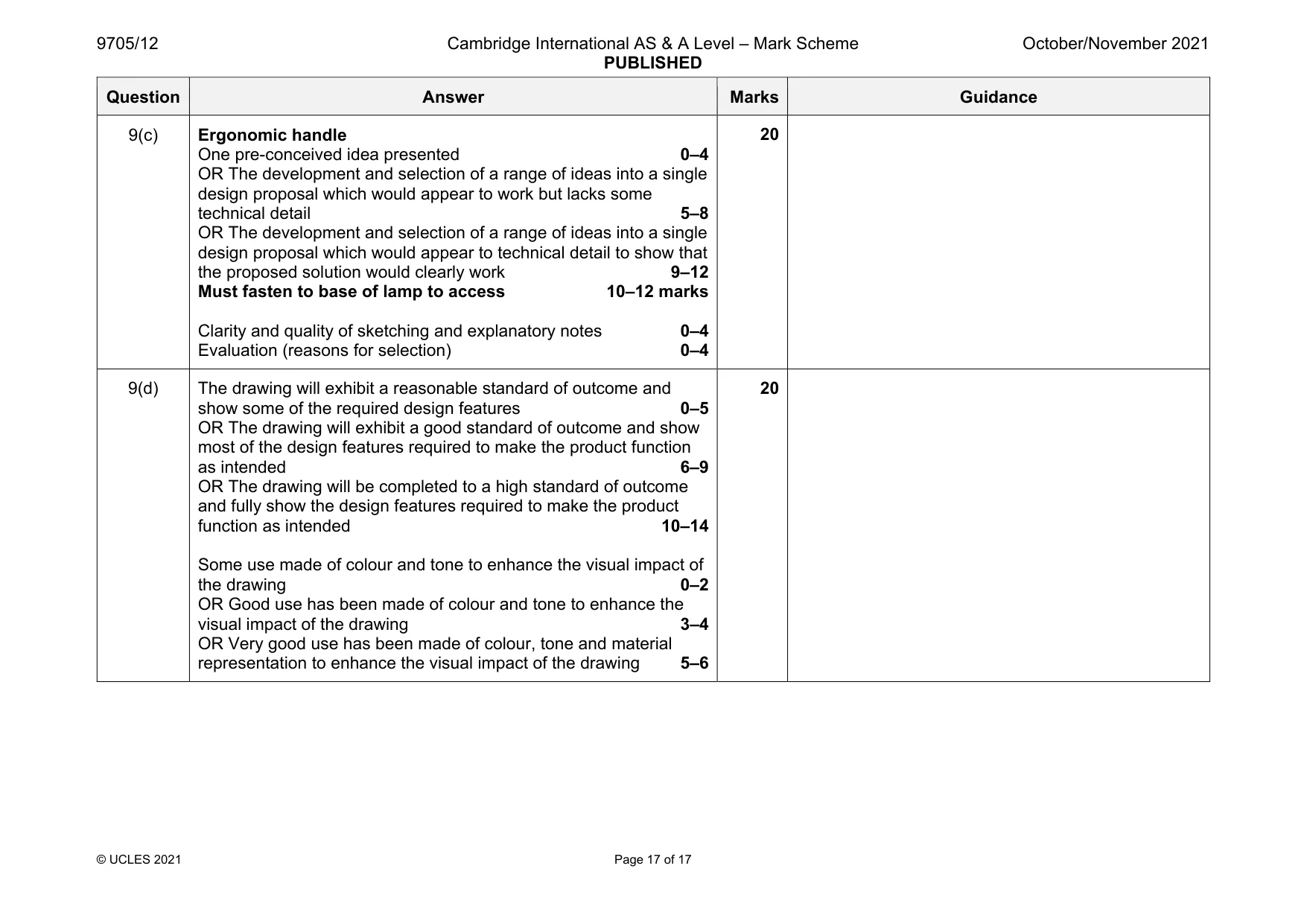
9705/12 Cambridge International AS & A Level – Mark Scheme PUBLISHED October/November 2021 © UCLES 2021 Page 17 of 17 Question Answer Marks Guidance 9(c) Ergonomic handle One pre-conceived idea presented 0–4 OR The development and selection of a range of ideas into a single design proposal which would appear to work but lacks some technical detail 5–8 OR The development and selection of a range of ideas into a single design proposal which would appear to technical detail to show that the proposed solution would clearly work 9–12 Must fasten to base of lamp to access 10–12 marks Clarity and quality of sketching and explanatory notes 0–4 Evaluation (reasons for selection) 0–4 20 9(d) The drawing will exhibit a reasonable standard of outcome and show some of the required design features 0–5 OR The drawing will exhibit a good standard of outcome and show most of the design features required to make the product function as intended 6–9 OR The drawing will be completed to a high standard of outcome and fully show the design features required to make the product function as intended 10–14 Some use made of colour and tone to enhance the visual impact of the drawing 0–2 OR Good use has been made of colour and tone to enhance the visual impact of the drawing 3–4 OR Very good use has been made of colour, tone and material representation to enhance the visual impact of the drawing 5–6 20
What you needed in this session
Cambridge’s own grade thresholds for 2021 Oct/Nov, Paper 1 · Variant 2. A higher threshold means an easier paper — the bar moves with how the cohort did.