Cambridge A Level Design and Technology 9705 — 2008 Oct/Nov Paper 3 · Variant 1
9705/31/O/N/08 · 120 marks · ≈135 min
The question paper and its mark scheme, free to read here and free to download. This is Cambridge’s own paper, exactly as it was sat.
Question paper12 pages
Mark scheme6 pages
Answers below. Sit the paper first if you are practising.
Paper as text
Question paper, page 1
This document consists of 10 printed pages and 2 blank pages. SPA (CW/DT) T61561/2 © UCLES 2008 [Turn over UNIVERSITY OF CAMBRIDGE INTERNATIONAL EXAMINATIONS General Certificate of Education Advanced Subsidiary Level and Advanced Level READ THESE INSTRUCTIONS FIRST Write your Centre number, candidate number and name on all the work you hand in. Write in dark blue or black pen. You may use a soft pencil for any diagrams, graphs or rough working. Do not use staples, paper clips, highlighters, glue or correction fluid. Section A Answer any two questions from one of the Parts A, B or C. Section B Answer one question. All dimensions are in millimetres. The instruction ‘discuss’ denotes that you should: • examine critically the issues raised by the question; • explain and interpret these issues as appropriate; • introduce evidence wherever possible to support conclusions of arguments. At the end of the examination, fasten all your work securely together. The number of marks is given in brackets [ ] at the end of each question or part question. * 5 3 6 6 9 6 4 7 3 3 * DESIGN AND TECHNOLOGY 9705/03 Paper 3 October/November 2008 3 hours Additional Materials: Answer Booklet/Paper A range of design drawing equipment A3 Drawing paper (5 sheets)
Question paper, page 2
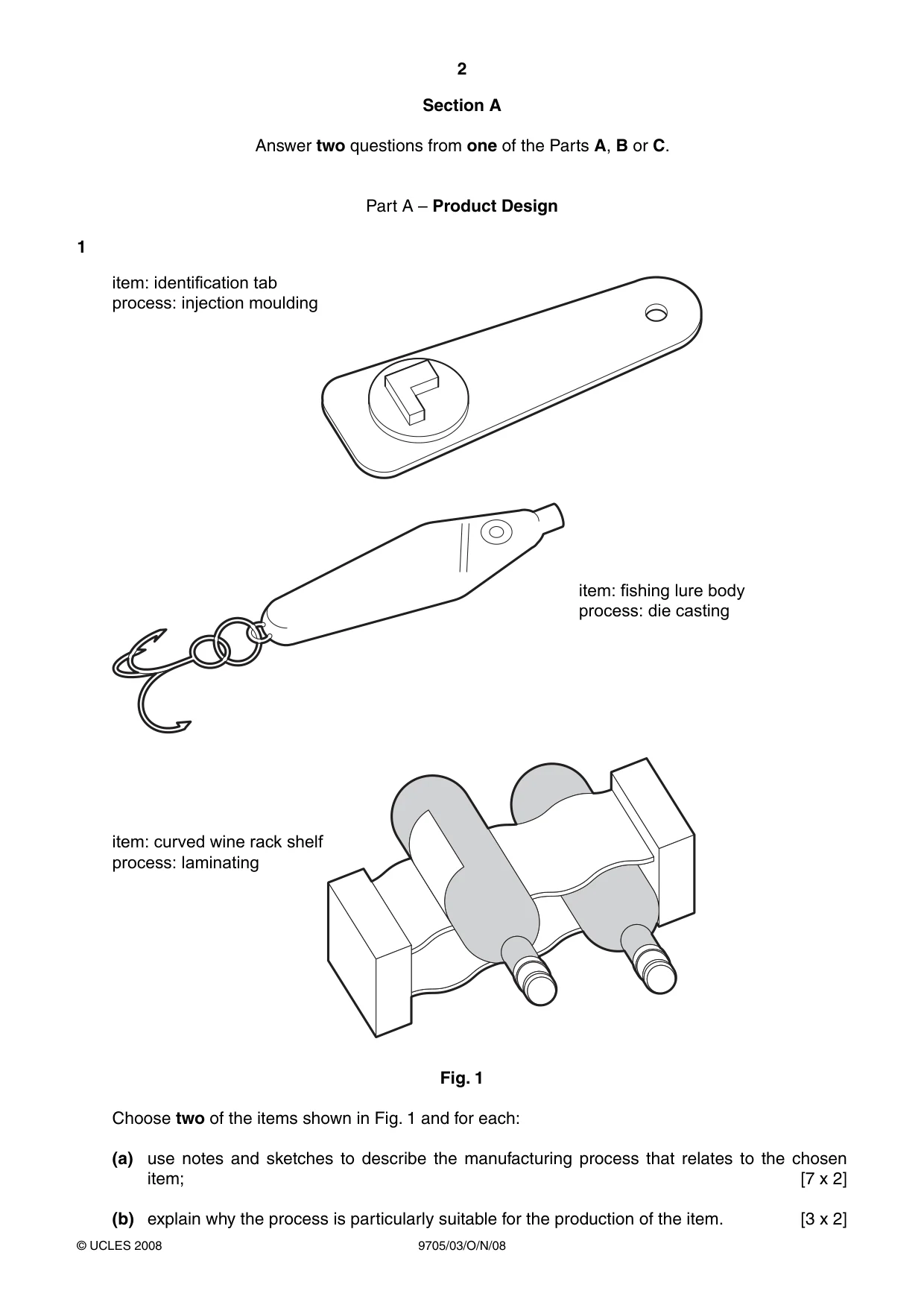
2 9705/03/O/N/08 © UCLES 2008 Section A Answer two questions from one of the Parts A, B or C. Part A – Product Design 1 item: identification tab process: injection moulding item: fishing lure body process: die casting item: curved wine rack shelf process: laminating Fig. 1 Choose two of the items shown in Fig. 1 and for each: (a) use notes and sketches to describe the manufacturing process that relates to the chosen item; [7 x 2] (b) explain why the process is particularly suitable for the production of the item. [3 x 2]
Question paper, page 3
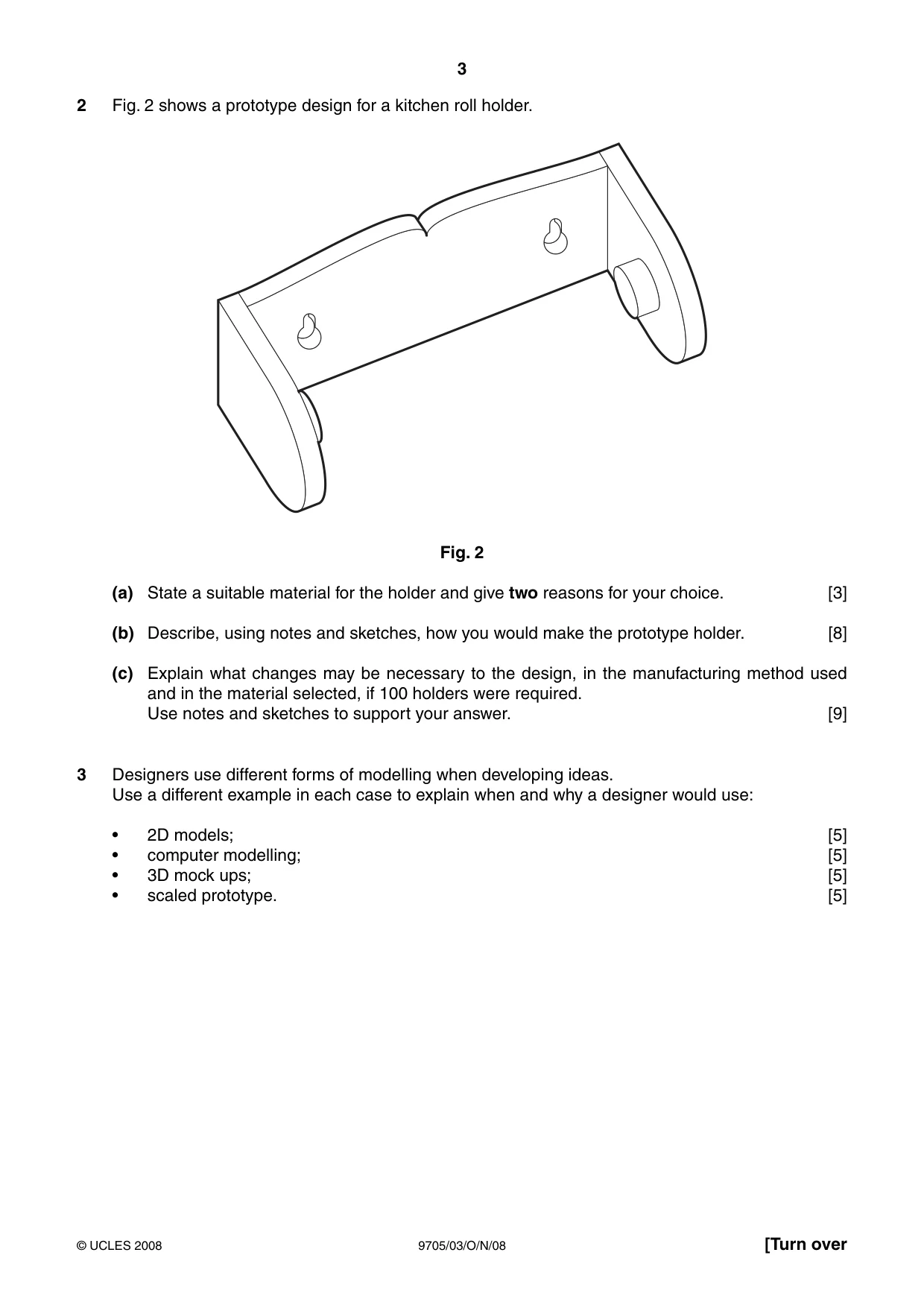
3 9705/03/O/N/08 © UCLES 2008 [Turn over 2 Fig. 2 shows a prototype design for a kitchen roll holder. Fig. 2 (a) State a suitable material for the holder and give two reasons for your choice. [3] (b) Describe, using notes and sketches, how you would make the prototype holder. [8] (c) Explain what changes may be necessary to the design, in the manufacturing method used and in the material selected, if 100 holders were required. Use notes and sketches to support your answer. [9] 3 Designers use different forms of modelling when developing ideas. Use a different example in each case to explain when and why a designer would use: • 2D models; [5] • computer modelling; [5] • 3D mock ups; [5] • scaled prototype. [5]
Question paper, page 4
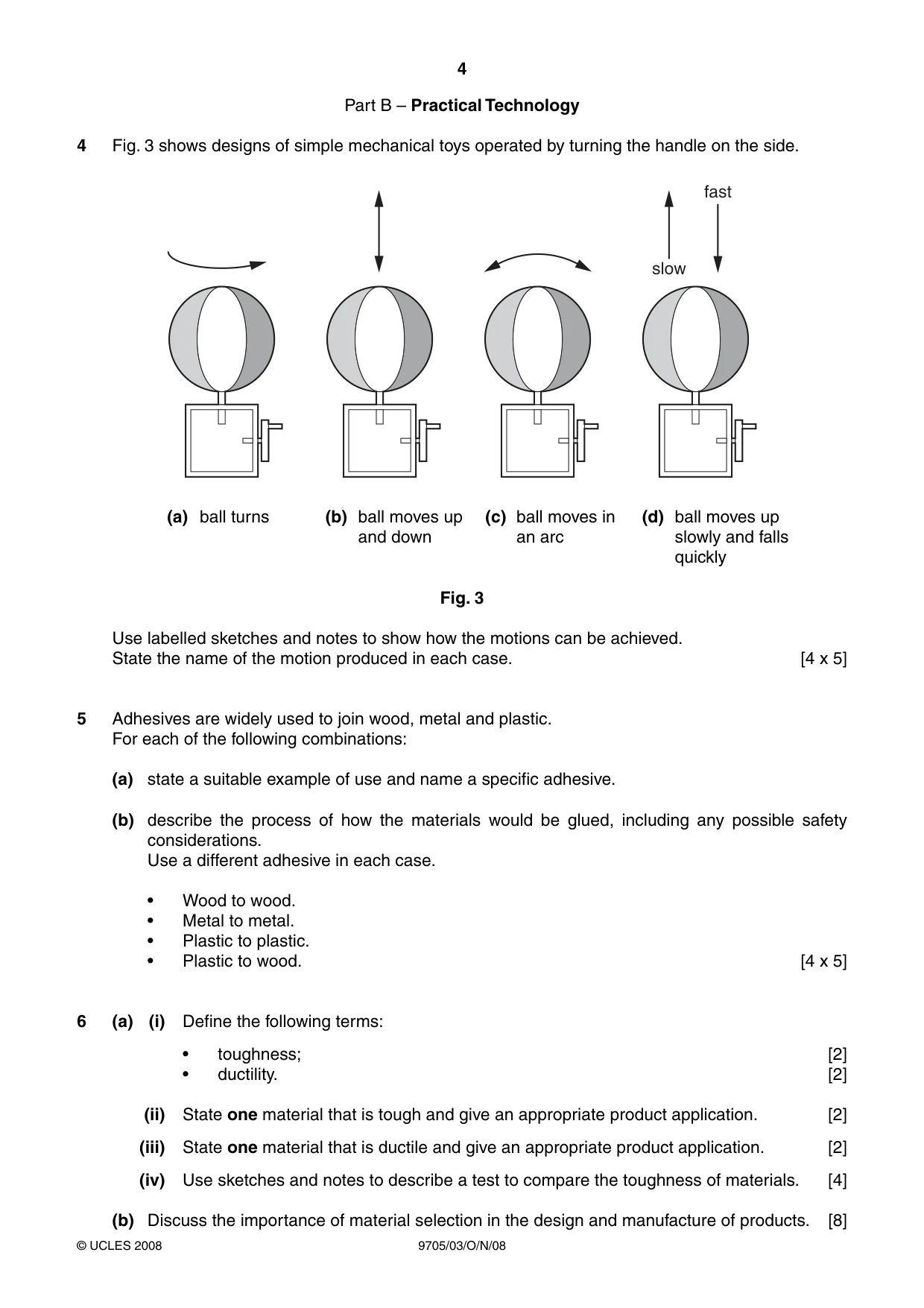
4 9705/03/O/N/08 © UCLES 2008 Part B – Practical Technology 4 Fig. 3 shows designs of simple mechanical toys operated by turning the handle on the side. slow fast (a) ball turns (b) ball moves up (c) ball moves in (d) ball moves up and down an arc slowly and falls quickly Fig. 3 Use labelled sketches and notes to show how the motions can be achieved. State the name of the motion produced in each case. [4 x 5] 5 Adhesives are widely used to join wood, metal and plastic. For each of the following combinations: (a) state a suitable example of use and name a specific adhesive. (b) describe the process of how the materials would be glued, including any possible safety considerations. Use a different adhesive in each case. • Wood to wood. • Metal to metal. • Plastic to plastic. • Plastic to wood. [4 x 5] 6 (a) (i) Define the following terms: • toughness; [2] • ductility. [2] (ii) State one material that is tough and give an appropriate product application. [2] (iii) State one material that is ductile and give an appropriate product application. [2] (iv) Use sketches and notes to describe a test to compare the toughness of materials. [4] (b) Discuss the importance of material selection in the design and manufacture of products. [8]
Question paper, page 5
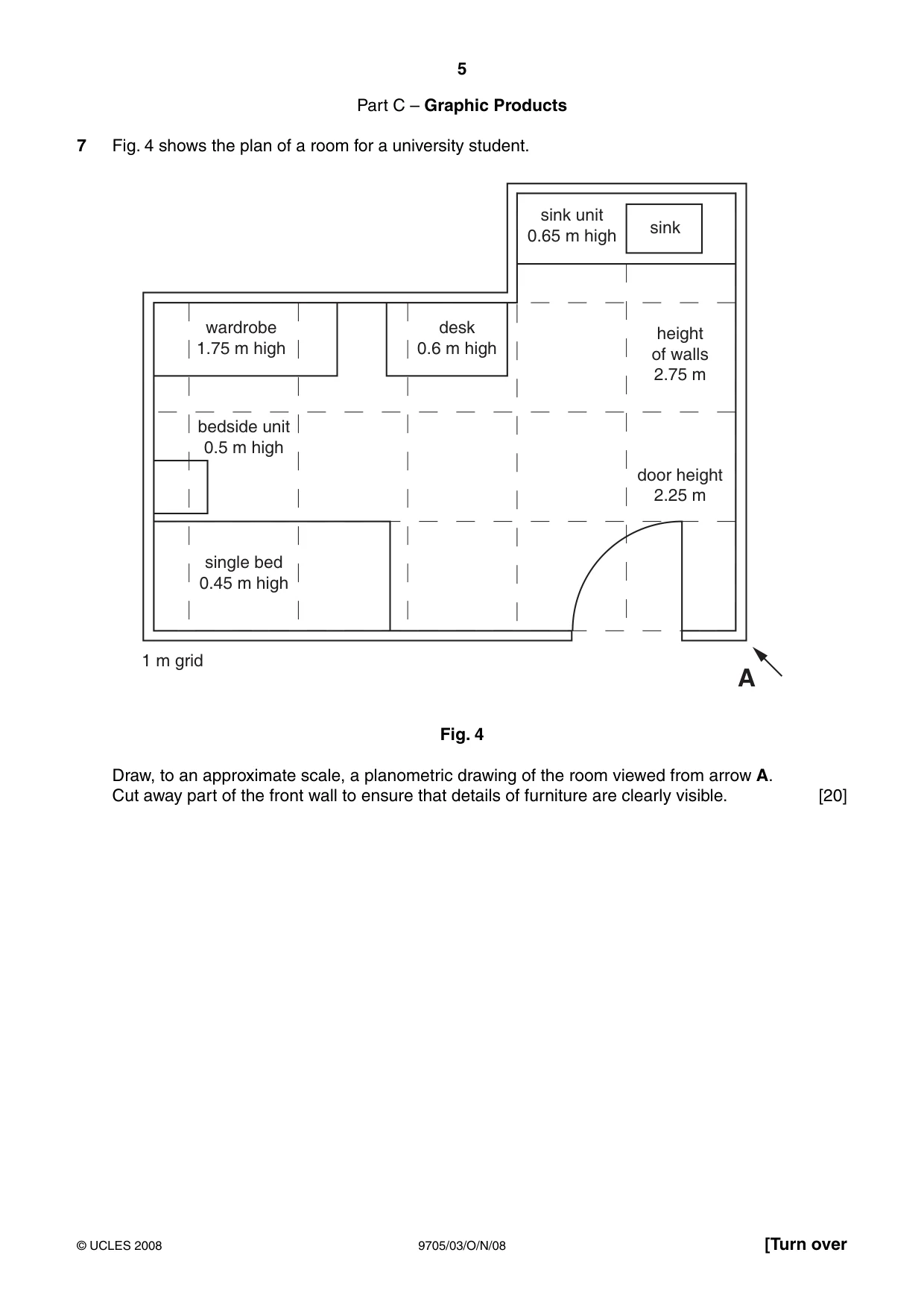
5 9705/03/O/N/08 © UCLES 2008 [Turn over Part C – Graphic Products 7 Fig. 4 shows the plan of a room for a university student. wardrobe 1.75 m high bedside unit 0.5 m high 1 m grid A single bed 0.45 m high desk 0.6 m high sink unit 0.65 m high sink height of walls 2.75 m door height 2.25 m Fig. 4 Draw, to an approximate scale, a planometric drawing of the room viewed from arrow A. Cut away part of the front wall to ensure that details of furniture are clearly visible. [20]
Question paper, page 6
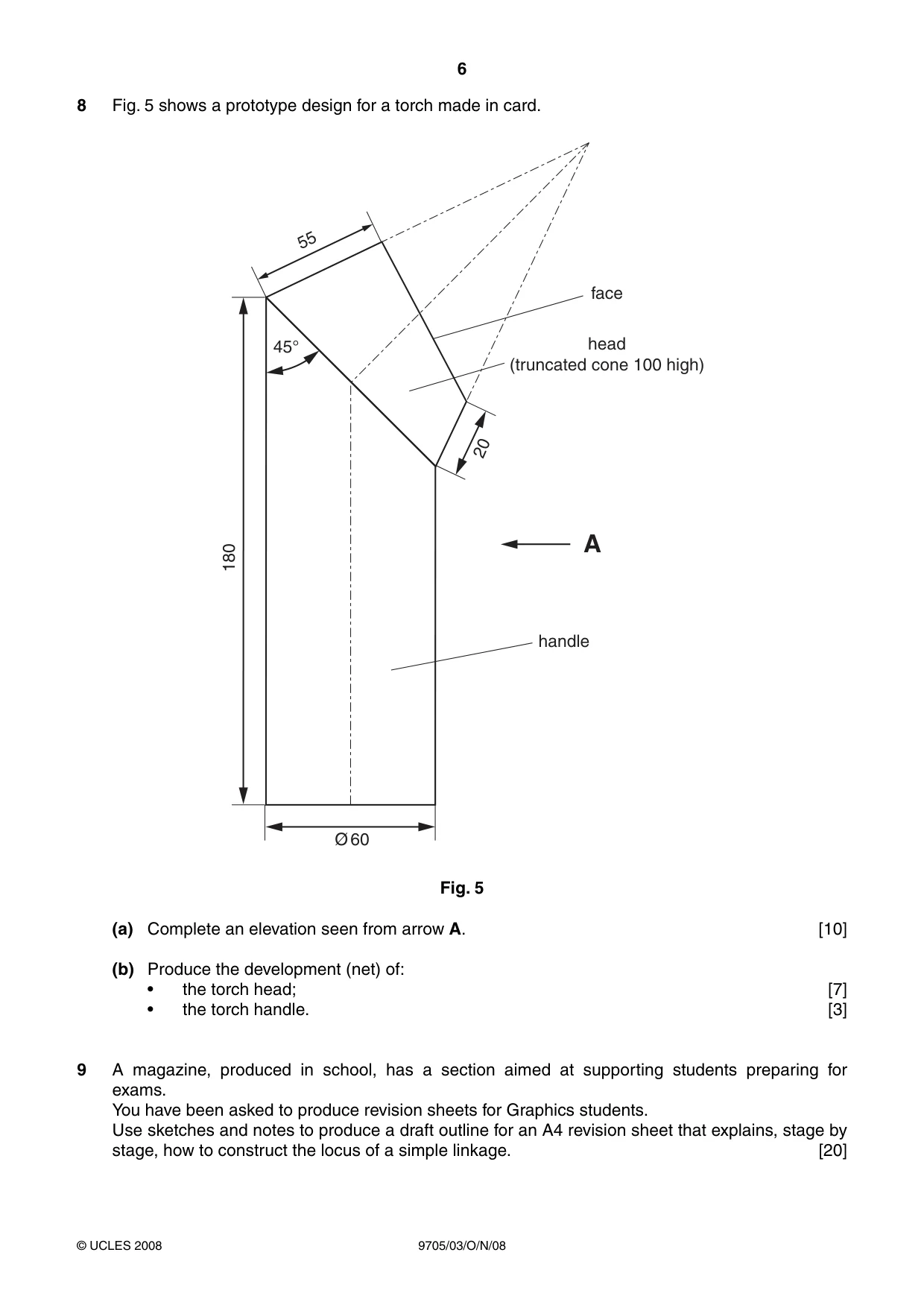
6 9705/03/O/N/08 © UCLES 2008 8 Fig. 5 shows a prototype design for a torch made in card. A face head (truncated cone 100 high) 55 20 45° 180 Ø 60 handle Fig. 5 (a) Complete an elevation seen from arrow A. [10] (b) Produce the development (net) of: • the torch head; [7] • the torch handle. [3] 9 A magazine, produced in school, has a section aimed at supporting students preparing for exams. You have been asked to produce revision sheets for Graphics students. Use sketches and notes to produce a draft outline for an A4 revision sheet that explains, stage by stage, how to construct the locus of a simple linkage. [20]
Question paper, page 7
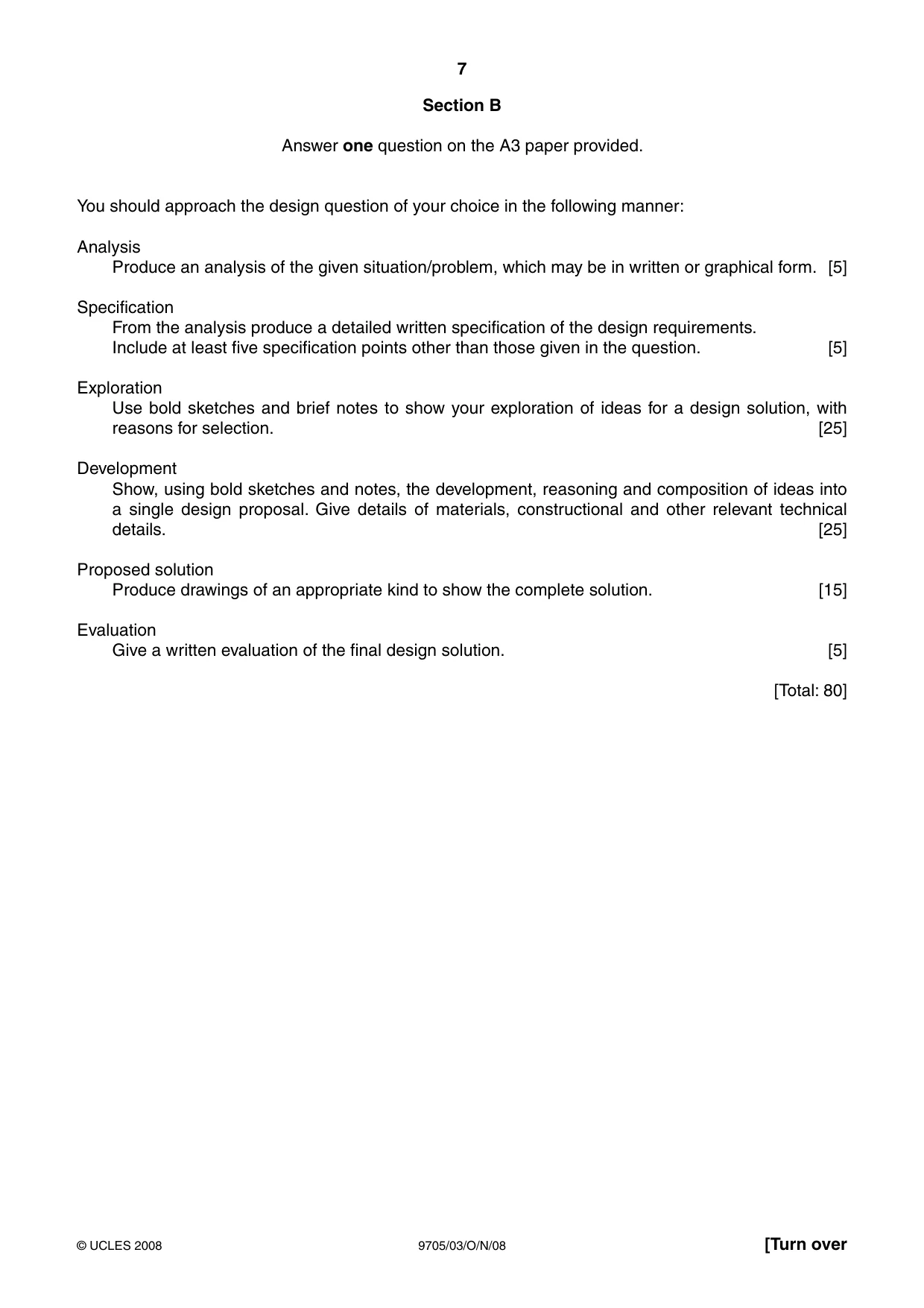
7 9705/03/O/N/08 © UCLES 2008 [Turn over Section B Answer one question on the A3 paper provided. You should approach the design question of your choice in the following manner: Analysis Produce an analysis of the given situation/problem, which may be in written or graphical form. [5] Specification From the analysis produce a detailed written specification of the design requirements. Include at least five specification points other than those given in the question. [5] Exploration Use bold sketches and brief notes to show your exploration of ideas for a design solution, with reasons for selection. [25] Development Show, using bold sketches and notes, the development, reasoning and composition of ideas into a single design proposal. Give details of materials, constructional and other relevant technical details. [25] Proposed solution Produce drawings of an appropriate kind to show the complete solution. [15] Evaluation Give a written evaluation of the final design solution. [5] [Total: 80]
Question paper, page 8
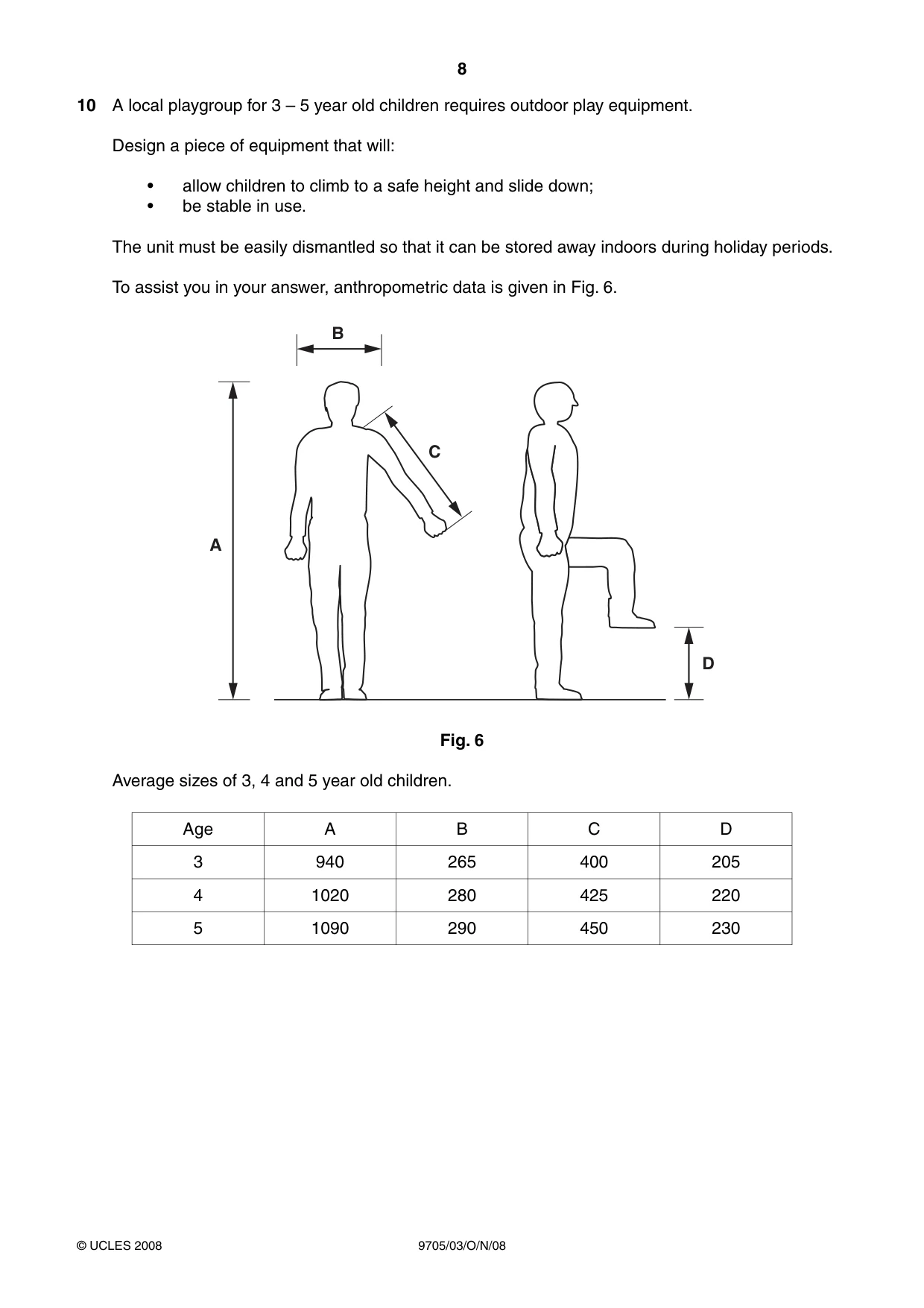
8 9705/03/O/N/08 © UCLES 2008 10 A local playgroup for 3 – 5 year old children requires outdoor play equipment. Design a piece of equipment that will: • allow children to climb to a safe height and slide down; • be stable in use. The unit must be easily dismantled so that it can be stored away indoors during holiday periods. To assist you in your answer, anthropometric data is given in Fig. 6. A D B C Fig. 6 Average sizes of 3, 4 and 5 year old children. Age A B C D 3 940 265 400 205 4 1020 280 425 220 5 1090 290 450 230
Question paper, page 9
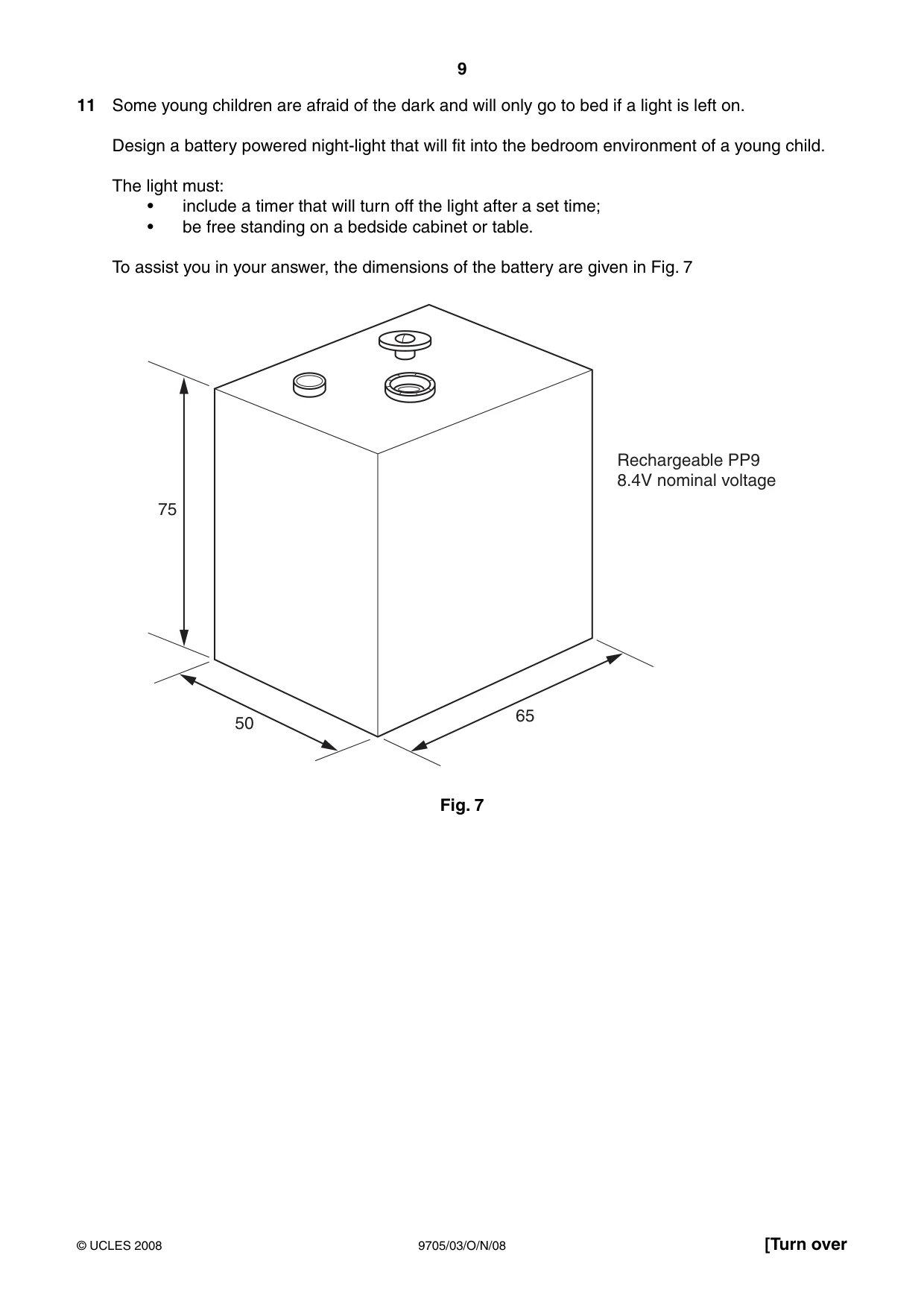
9 9705/03/O/N/08 © UCLES 2008 [Turn over 11 Some young children are afraid of the dark and will only go to bed if a light is left on. Design a battery powered night-light that will fit into the bedroom environment of a young child. The light must: • include a timer that will turn off the light after a set time; • be free standing on a bedside cabinet or table. To assist you in your answer, the dimensions of the battery are given in Fig. 7 75 50 65 Rechargeable PP9 8.4V nominal voltage Fig. 7
Question paper, page 10
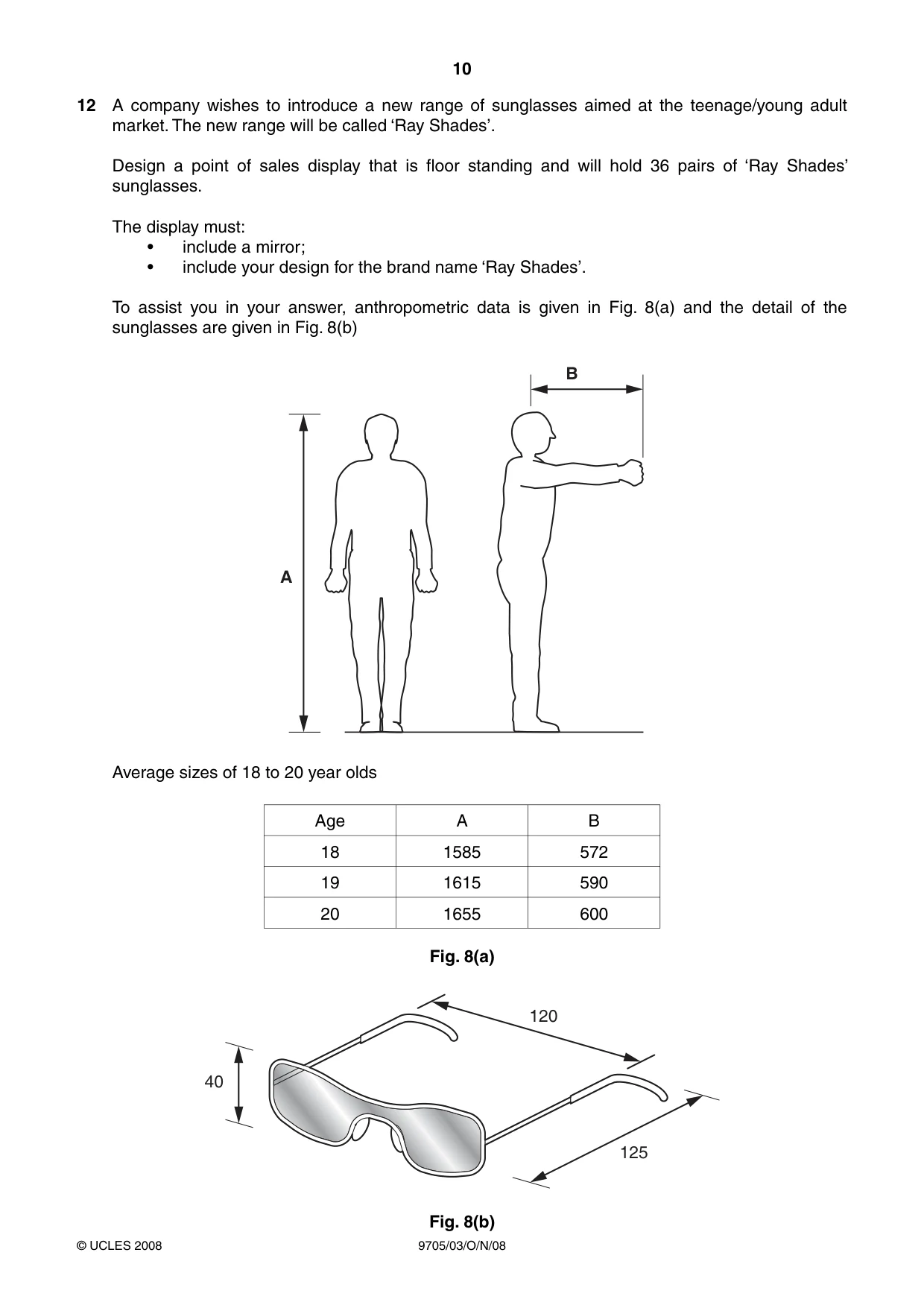
10 9705/03/O/N/08 © UCLES 2008 12 A company wishes to introduce a new range of sunglasses aimed at the teenage/young adult market. The new range will be called ‘Ray Shades’. Design a point of sales display that is floor standing and will hold 36 pairs of ‘Ray Shades’ sunglasses. The display must: • include a mirror; • include your design for the brand name ‘Ray Shades’. To assist you in your answer, anthropometric data is given in Fig. 8(a) and the detail of the sunglasses are given in Fig. 8(b) A B Average sizes of 18 to 20 year olds Age A B 18 1585 572 19 1615 590 20 1655 600 Fig. 8(a) 40 120 125 Fig. 8(b)
Question paper, page 12
12 9705/03/O/N/08 BLANK PAGE Permission to reproduce items where third-party owned material protected by copyright is included has been sought and cleared where possible. Every reasonable effort has been made by the publisher (UCLES) to trace copyright holders, but if any items requiring clearance have unwittingly been included, the publisher will be pleased to make amends at the earliest possible opportunity. University of Cambridge International Examinations is part of the Cambridge Assessment Group. Cambridge Assessment is the brand name of University of Cambridge Local Examinations Syndicate (UCLES), which is itself a department of the University of Cambridge.
Mark scheme, page 1
UNIVERSITY OF CAMBRIDGE INTERNATIONAL EXAMINATIONS GCE Advanced Subsidiary Level and GCE Advanced Level MARK SCHEME for the October/November 2008 question paper 9705 DESIGN AND TECHNOLOGY 9705/03 Paper 3 (Written 2), maximum raw mark 120 This mark scheme is published as an aid to teachers and candidates, to indicate the requirements of the examination. It shows the basis on which Examiners were instructed to award marks. It does not indicate the details of the discussions that took place at an Examiners’ meeting before marking began. All Examiners are instructed that alternative correct answers and unexpected approaches in candidates’ scripts must be given marks that fairly reflect the relevant knowledge and skills demonstrated. Mark schemes must be read in conjunction with the question papers and the report on the examination. • CIE will not enter into discussions or correspondence in connection with these mark schemes. CIE is publishing the mark schemes for the October/November 2008 question papers for most IGCSE, GCE Advanced Level and Advanced Subsidiary Level syllabuses and some Ordinary Level syllabuses.
Mark scheme, page 2
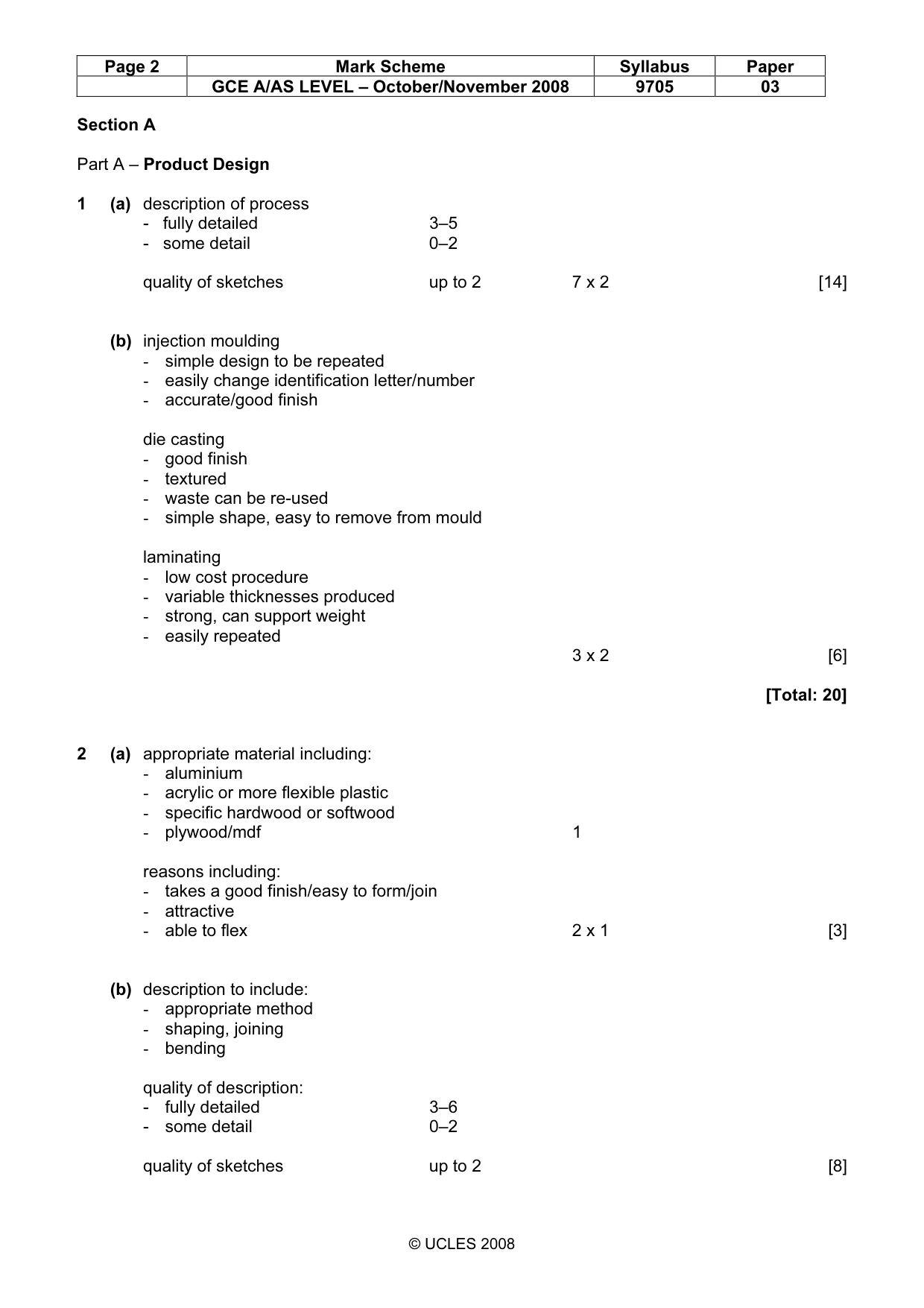
Page 2 Mark Scheme Syllabus Paper GCE A/AS LEVEL – October/November 2008 9705 03 © UCLES 2008 Section A Part A – Product Design 1 (a) description of process - fully detailed 3–5 - some detail 0–2 quality of sketches up to 2 7 x 2 [14] (b) injection moulding - simple design to be repeated - easily change identification letter/number - accurate/good finish die casting - good finish - textured - waste can be re-used - simple shape, easy to remove from mould laminating - low cost procedure - variable thicknesses produced - strong, can support weight - easily repeated 3 x 2 [6] [Total: 20] 2 (a) appropriate material including: - aluminium - acrylic or more flexible plastic - specific hardwood or softwood - plywood/mdf 1 reasons including: - takes a good finish/easy to form/join - attractive - able to flex 2 x 1 [3] (b) description to include: - appropriate method - shaping, joining - bending quality of description: - fully detailed 3–6 - some detail 0–2 quality of sketches up to 2 [8]
Mark scheme, page 3
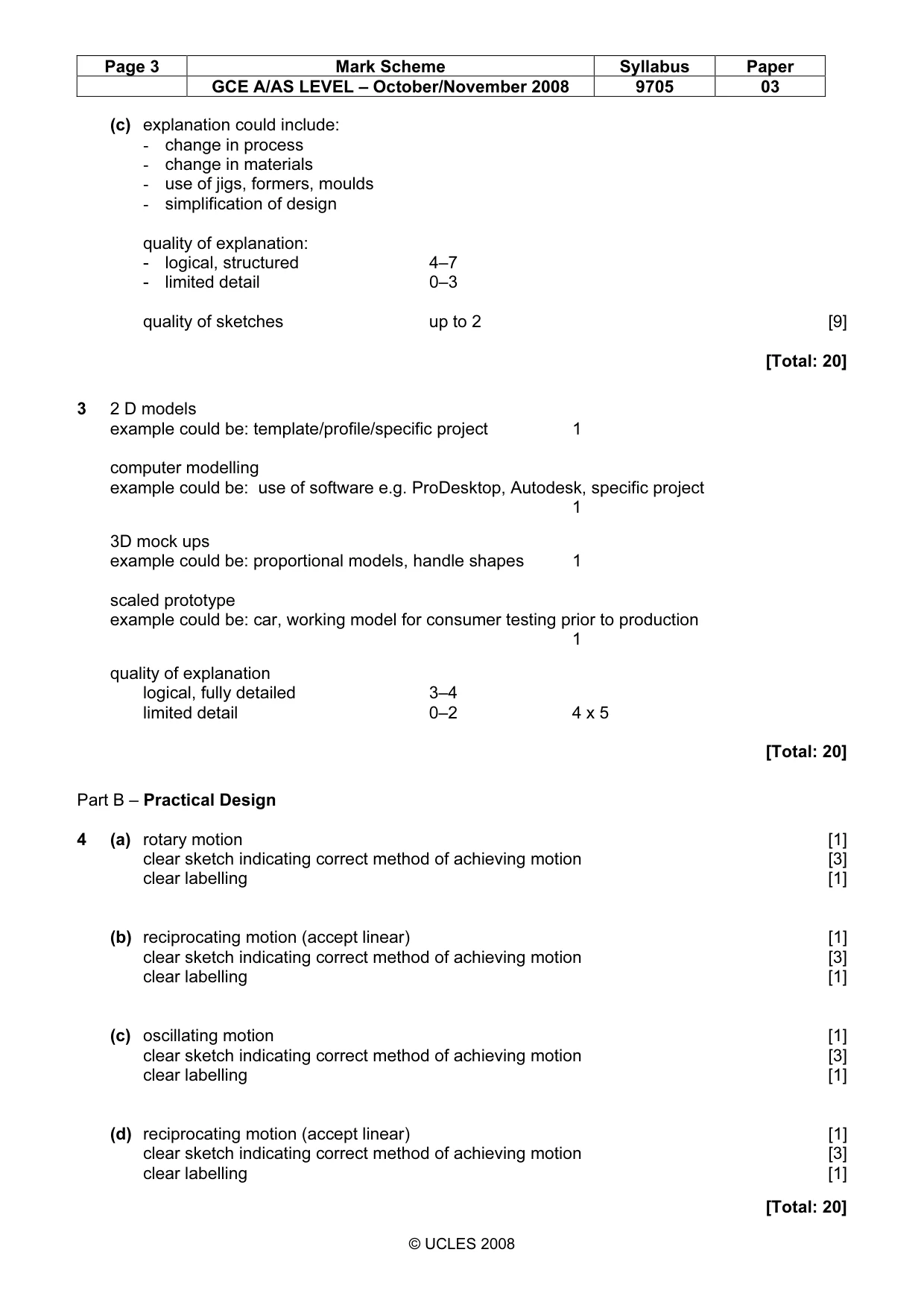
Page 3 Mark Scheme Syllabus Paper GCE A/AS LEVEL – October/November 2008 9705 03 © UCLES 2008 (c) explanation could include: - change in process - change in materials - use of jigs, formers, moulds - simplification of design quality of explanation: - logical, structured 4–7 - limited detail 0–3 quality of sketches up to 2 [9] [Total: 20] 3 2 D models example could be: template/profile/specific project 1 computer modelling example could be: use of software e.g. ProDesktop, Autodesk, specific project 1 3D mock ups example could be: proportional models, handle shapes 1 scaled prototype example could be: car, working model for consumer testing prior to production 1 quality of explanation logical, fully detailed 3–4 limited detail 0–2 4 x 5 [Total: 20] Part B – Practical Design 4 (a) rotary motion [1] clear sketch indicating correct method of achieving motion [3] clear labelling [1] (b) reciprocating motion (accept linear) [1] clear sketch indicating correct method of achieving motion [3] clear labelling [1] (c) oscillating motion [1] clear sketch indicating correct method of achieving motion [3] clear labelling [1] (d) reciprocating motion (accept linear) [1] clear sketch indicating correct method of achieving motion [3] clear labelling [1] [Total: 20]
Mark scheme, page 4
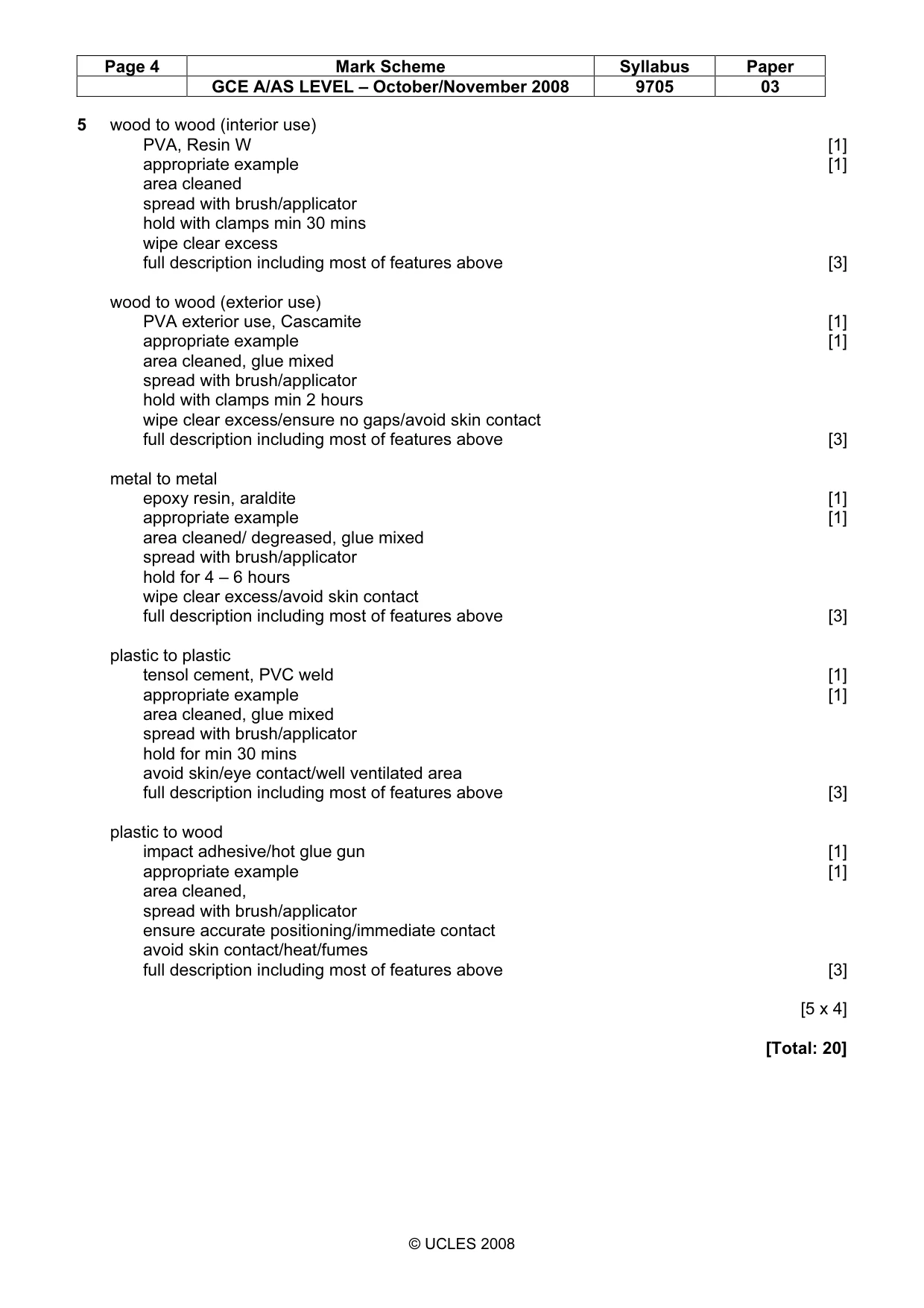
Page 4 Mark Scheme Syllabus Paper GCE A/AS LEVEL – October/November 2008 9705 03 © UCLES 2008 5 wood to wood (interior use) PVA, Resin W [1] appropriate example [1] area cleaned spread with brush/applicator hold with clamps min 30 mins wipe clear excess full description including most of features above [3] wood to wood (exterior use) PVA exterior use, Cascamite [1] appropriate example [1] area cleaned, glue mixed spread with brush/applicator hold with clamps min 2 hours wipe clear excess/ensure no gaps/avoid skin contact full description including most of features above [3] metal to metal epoxy resin, araldite [1] appropriate example [1] area cleaned/ degreased, glue mixed spread with brush/applicator hold for 4 – 6 hours wipe clear excess/avoid skin contact full description including most of features above [3] plastic to plastic tensol cement, PVC weld [1] appropriate example [1] area cleaned, glue mixed spread with brush/applicator hold for min 30 mins avoid skin/eye contact/well ventilated area full description including most of features above [3] plastic to wood impact adhesive/hot glue gun [1] appropriate example [1] area cleaned, spread with brush/applicator ensure accurate positioning/immediate contact avoid skin contact/heat/fumes full description including most of features above [3] [5 x 4] [Total: 20]
Mark scheme, page 5
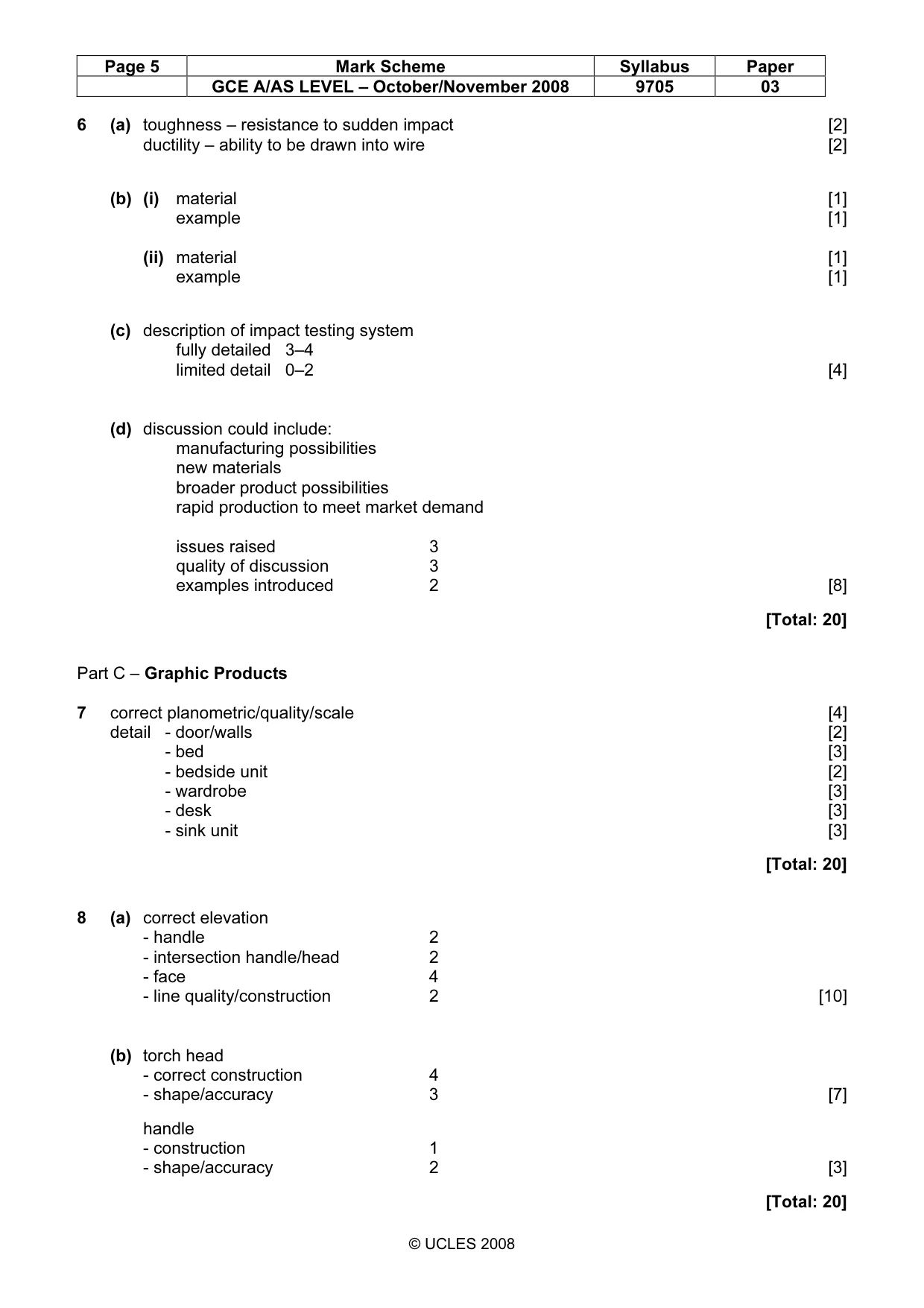
Page 5 Mark Scheme Syllabus Paper GCE A/AS LEVEL – October/November 2008 9705 03 © UCLES 2008 6 (a) toughness – resistance to sudden impact [2] ductility – ability to be drawn into wire [2] (b) (i) material [1] example [1] (ii) material [1] example [1] (c) description of impact testing system fully detailed 3–4 limited detail 0–2 [4] (d) discussion could include: manufacturing possibilities new materials broader product possibilities rapid production to meet market demand issues raised 3 quality of discussion 3 examples introduced 2 [8] [Total: 20] Part C – Graphic Products 7 correct planometric/quality/scale [4] detail - door/walls [2] - bed [3] - bedside unit [2] - wardrobe [3] - desk [3] - sink unit [3] [Total: 20] 8 (a) correct elevation - handle 2 - intersection handle/head 2 - face 4 - line quality/construction 2 [10] (b) torch head - correct construction 4 - shape/accuracy 3 [7] handle - construction 1 - shape/accuracy 2 [3] [Total: 20]
Mark scheme, page 6
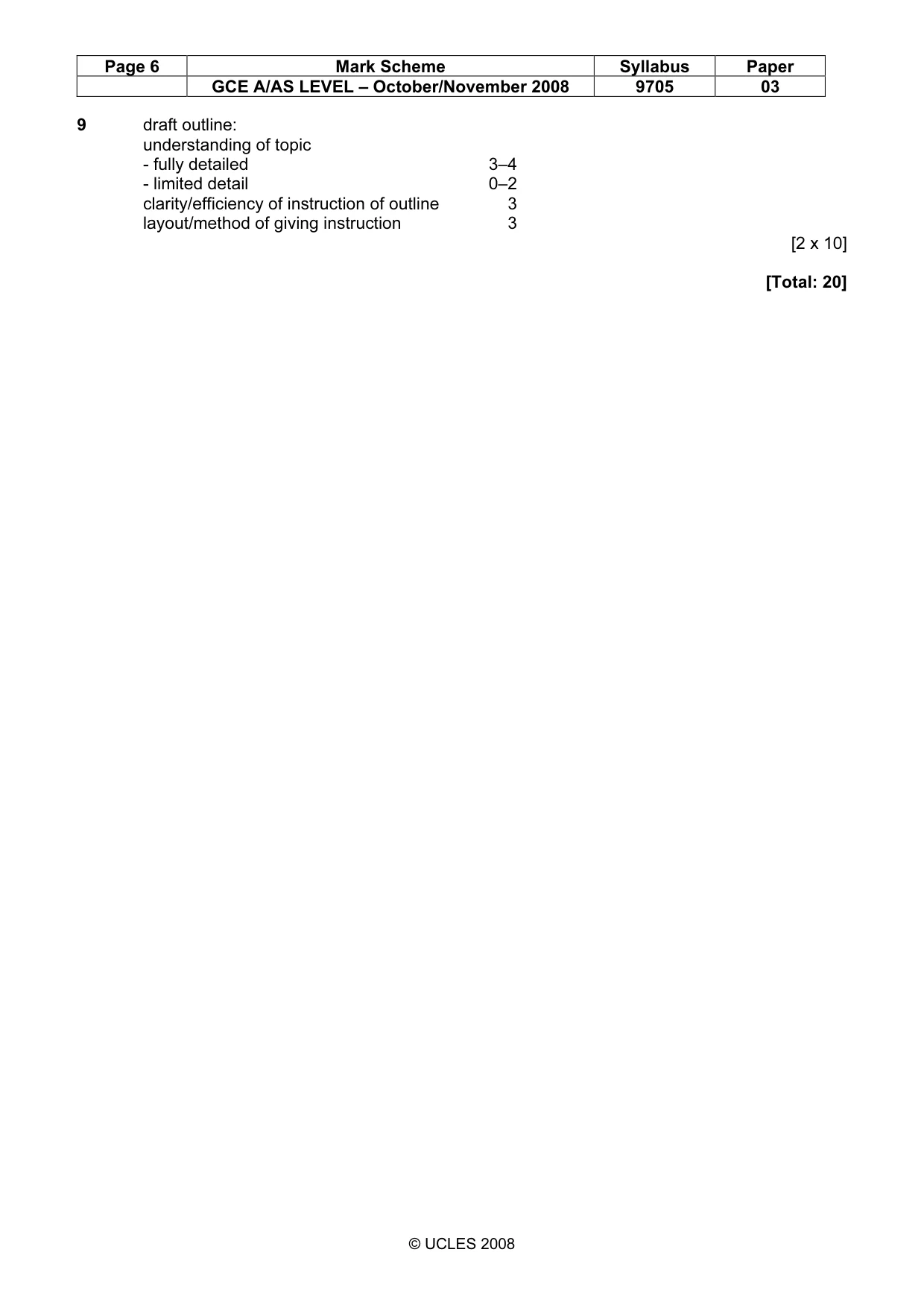
Page 6 Mark Scheme Syllabus Paper GCE A/AS LEVEL – October/November 2008 9705 03 © UCLES 2008 9 draft outline: understanding of topic - fully detailed 3–4 - limited detail 0–2 clarity/efficiency of instruction of outline 3 layout/method of giving instruction 3 [2 x 10] [Total: 20]
What you needed in this session
Cambridge’s own grade thresholds for 2008 Oct/Nov, Paper 3 · Variant 1. A higher threshold means an easier paper — the bar moves with how the cohort did.