Cambridge A Level Computer Science 9618 — 2022 Oct/Nov Paper 2 · Variant 3
9618/23/O/N/22 · 7 questions · 75 marks · ≈84 min
The question paper and its mark scheme, free to read here and free to download. This is Cambridge’s own paper, exactly as it was sat.
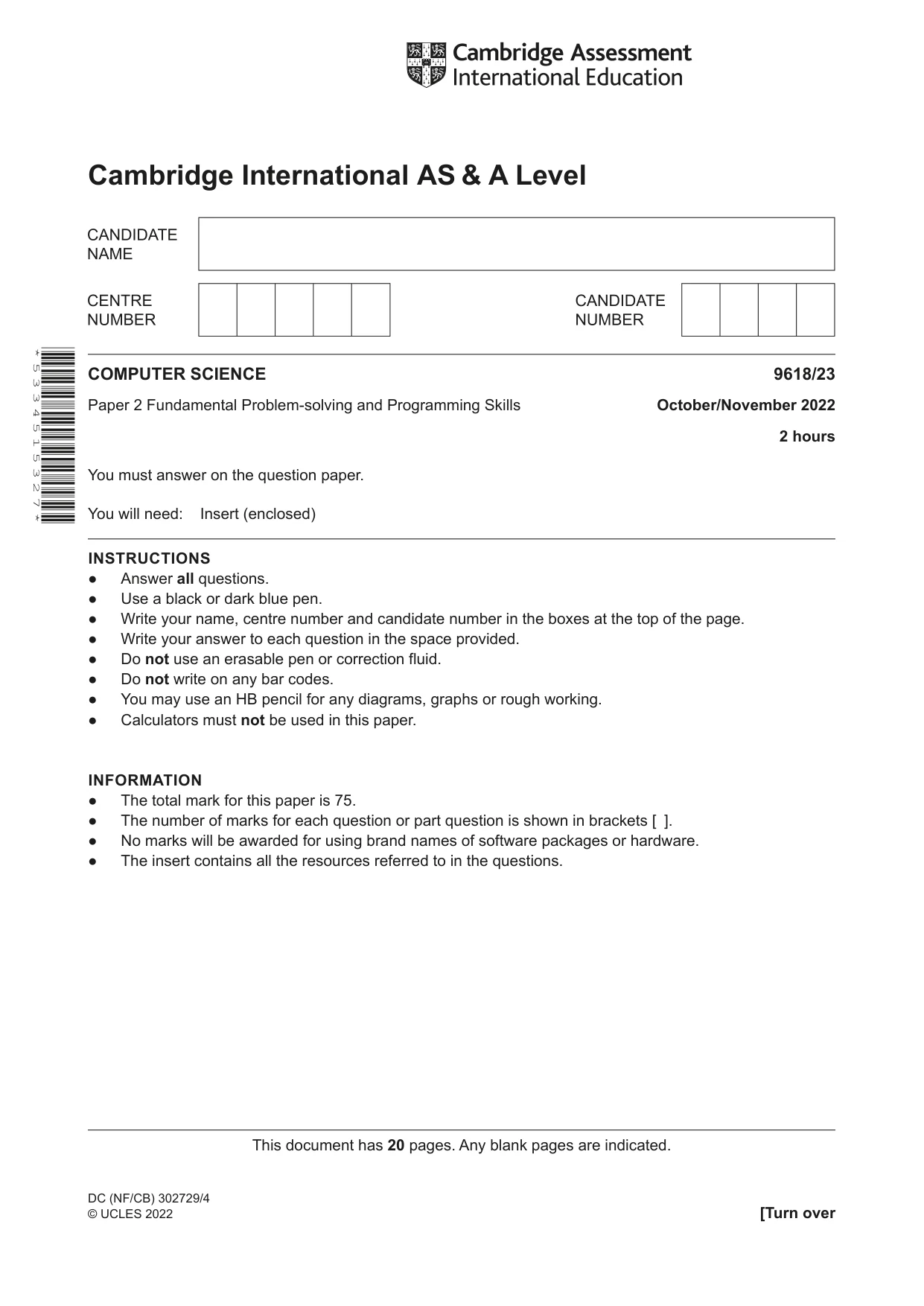
Question paper20 pages





Mark scheme9 pages
Answers below. Sit the paper first if you are practising.
Questions as text
Q1 · A program is required for a shopping website
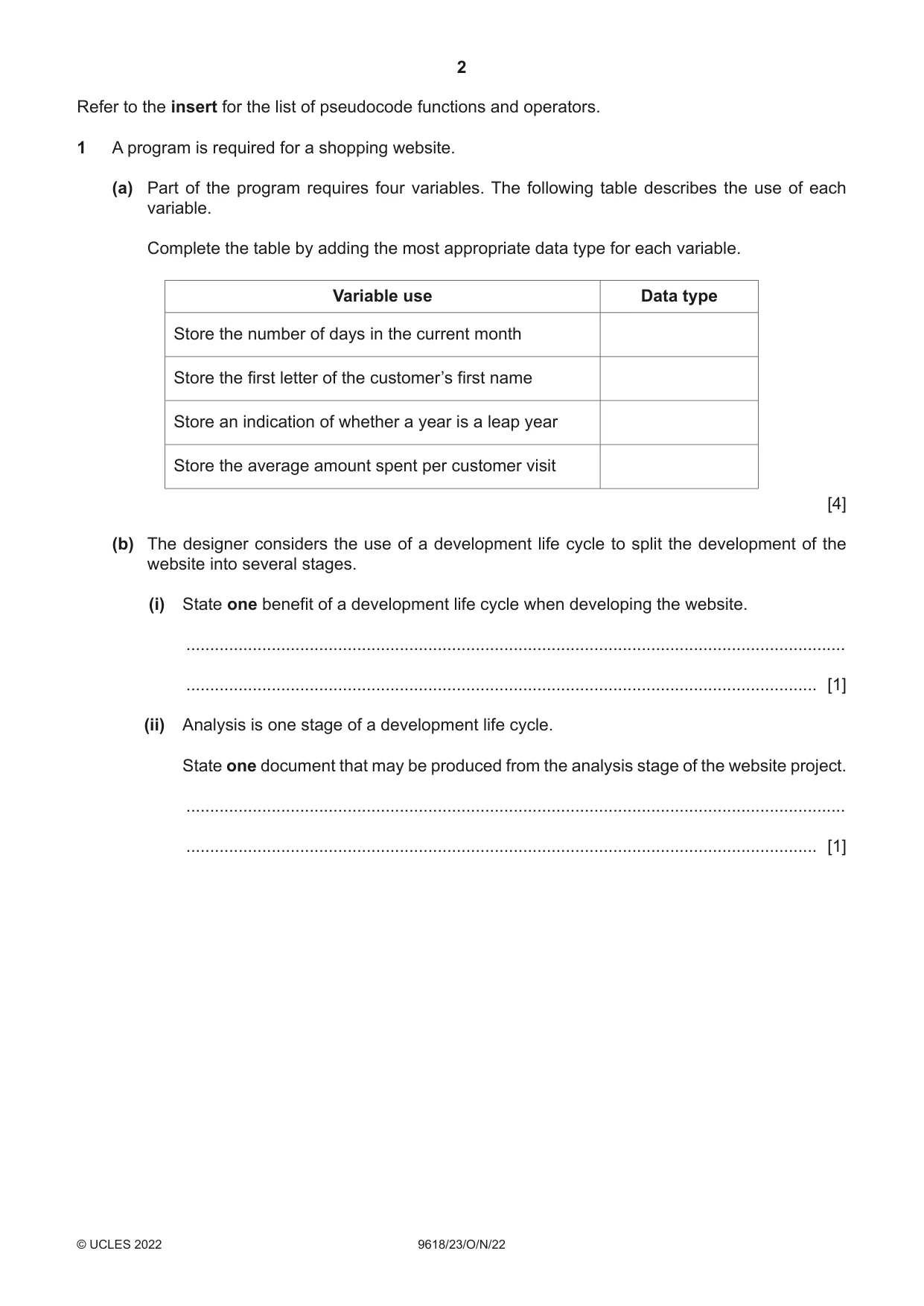
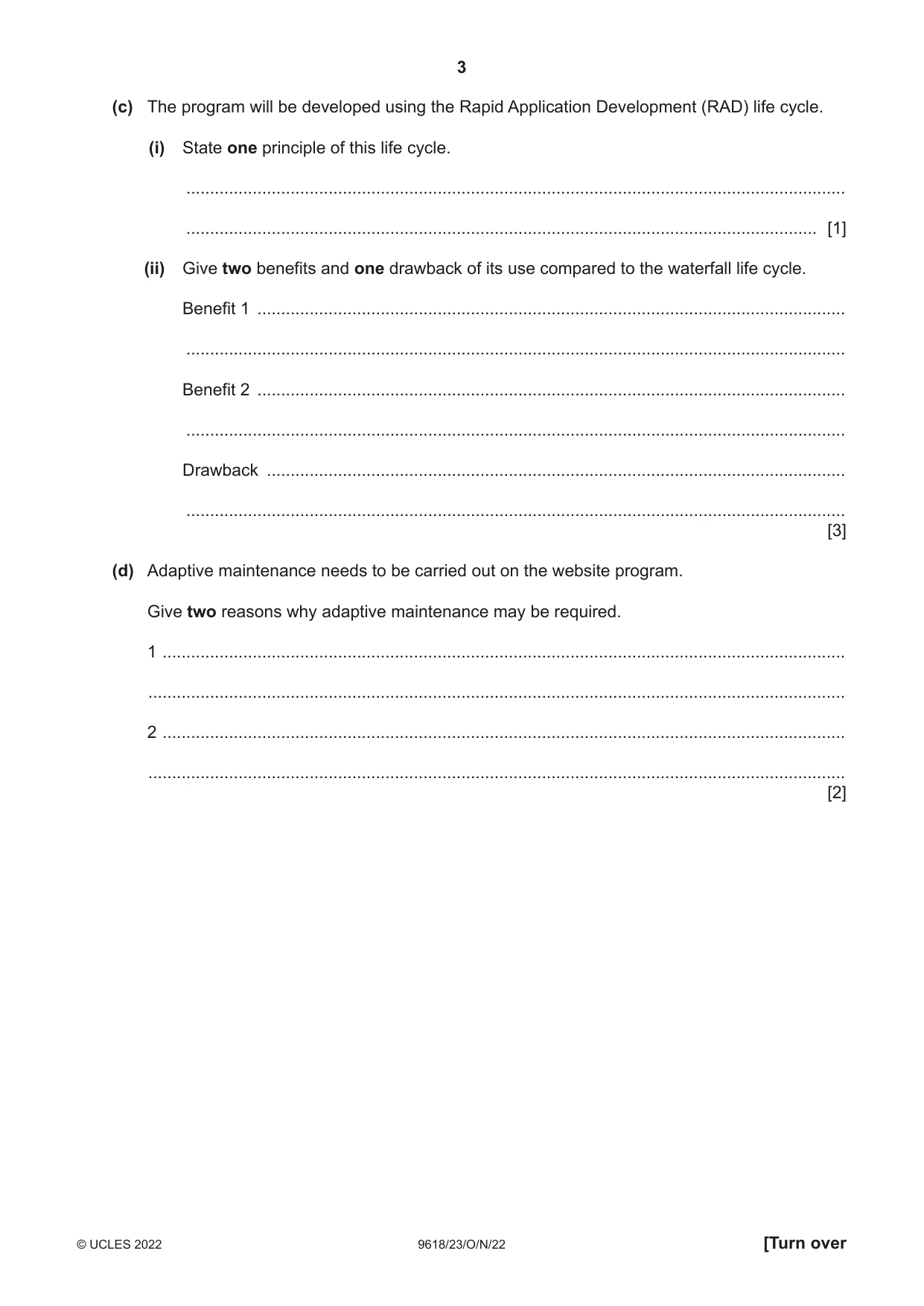
1 A program is required for a shopping website. (a) Part of the program requires four variables. The following table describes the use of each variable. Complete the table by adding the most appropriate data type for each variable. Variable use Data type Store the number of days in the current month Store the first letter of the customer’s first name Store an indication of whether a year is a leap year Store the average amount spent per customer visit [4] (b) The designer considers the use of a development life cycle to split the development of the website into several stages. (i) State one benefit of a development life cycle when developing the website. ........................................................................................................................................... ..................................................................................................................................... [1] (ii) Analysis is one stage of a development life cycle. State one document that may be produced from the analysis stage of the website project. ........................................................................................................................................... ..................................................................................................................................... [1] (c) The program will be developed using the Rapid Application Development (RAD) life cycle. (i) State one principle of this life cycle. ........................................................................................................................................... ..................................................................................................................................... [1] (ii) Give two benefits and one drawback of its use compared to the waterfall life cycle. Benefit 1 ............................................................................................................................ ........................................................................................................................................... Benefit 2 ............................................................................................................................ ........................................................................................................................................... Drawback .......................................................................................................................... ........................................................................................................................................... [3] (d) Adaptive maintenance needs to be carried out on the website program. Give two reasons why adaptive maintenance may be required. 1 ................................................................................................................................................ ................................................................................................................................................... 2 ................................................................................................................................................ ................................................................................................................................................... [2]
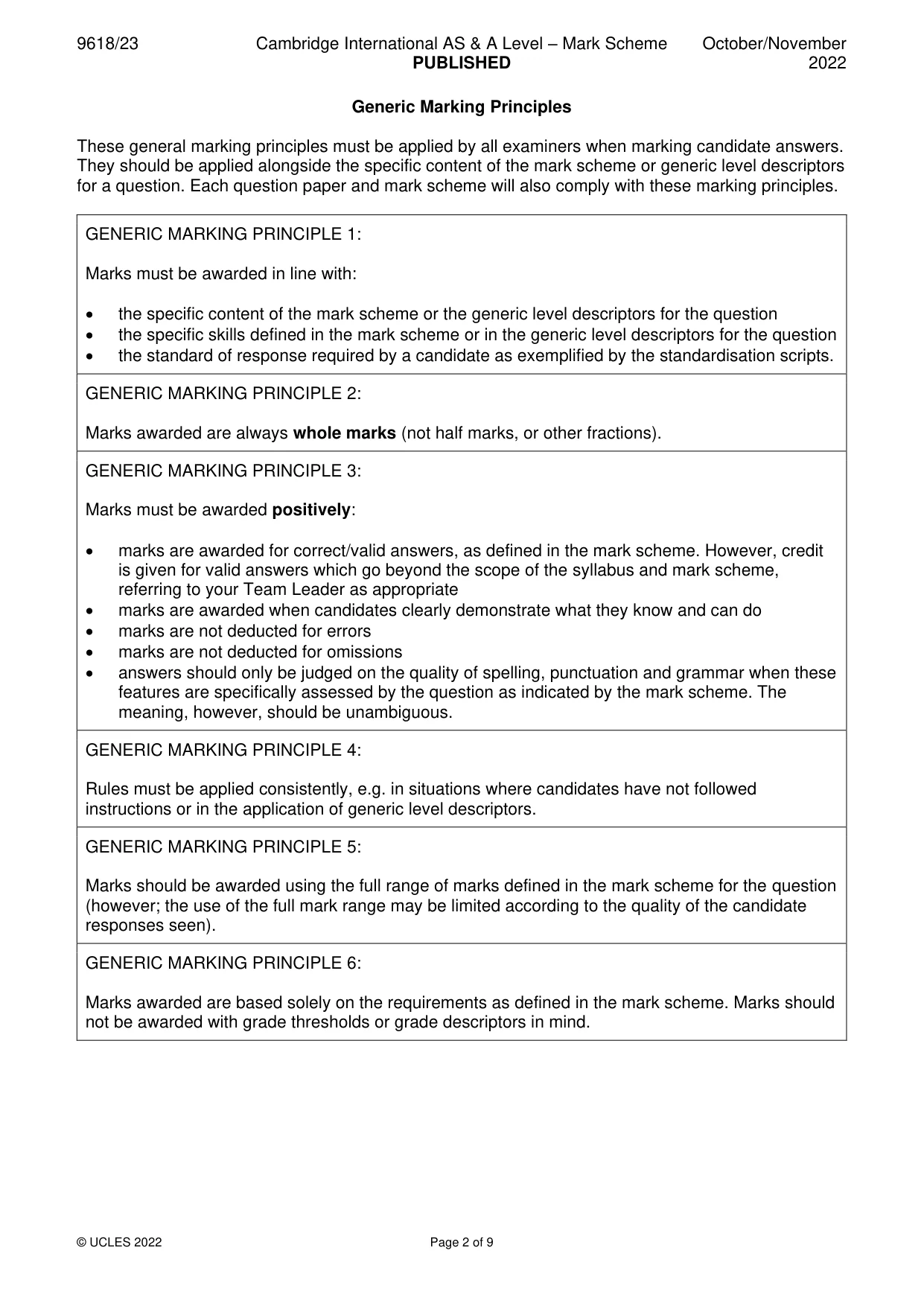
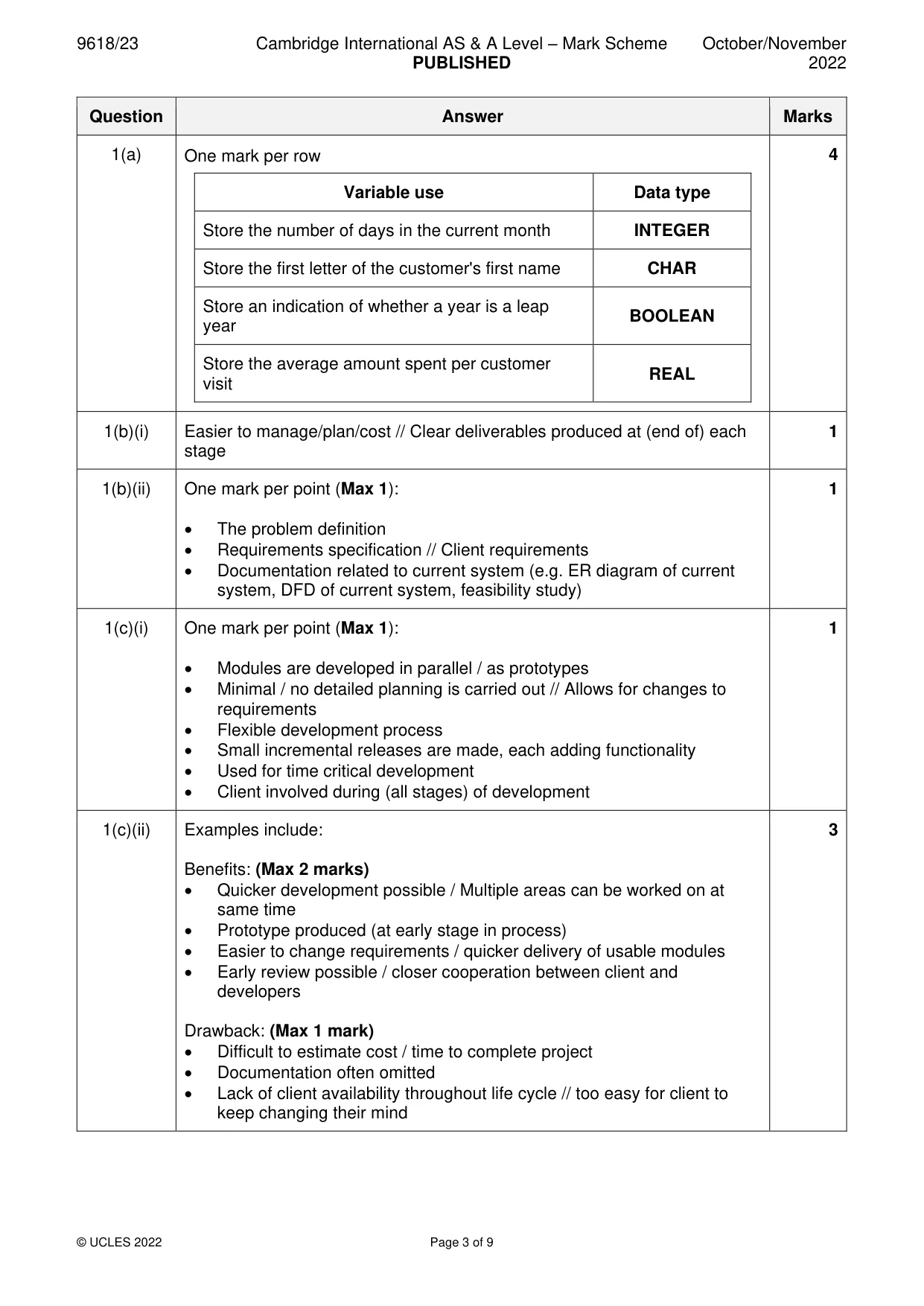
Mark scheme: Question Answer Marks 1(a) One mark per row 4 Variable use Data type Store the number of days in the current month INTEGER Store the first letter of the customer's first name CHAR Store an indication of whether a year is a leap BOOLEAN year Store the average amount spent per customer REAL visit 1(b)(i) Easier to manage/plan/cost // Clear deliverables produced at (end of) each 1 stage 1(b)(ii) One mark per point (Max 1): 1 • The problem definition • Requirements specification // Client requirements • Documentation related to current system (e.g. ER diagram of current system, DFD of current system, feasibility study) 1(c)(i) One mark per point (Max 1): 1 • Modules are developed in parallel / as prototypes • Minimal / no detailed planning is carried out // Allows for changes to requirements • Flexible development process • Small incremental releases are made, each adding functionality • Used for time critical development • Client involved during (all stages) of development 1(c)(ii) Examples include: 3 Benefits: (Max 2 marks) • Quicker development possible / Multiple areas can be worked on at same time • Prototype produced (at early stage in process) • Easier to change requirements / quicker delivery of usable modules • Early review possible / closer cooperation between client and developers Drawback: (Max 1 mark) • Difficult to estimate cost / time to complete project • Documentation often omitted • Lack of client availability throughout life cycle // too easy for client to keep changing their mind 1(d) One mark for each point (Max 2) 2 Examples include: 1 Change to website requirements 2 New technologies available to host website // changes made to library modules used 3 Change in relevant legislation
Q2 · A program is being designed for a smartphone to allow users to send money to the charity…
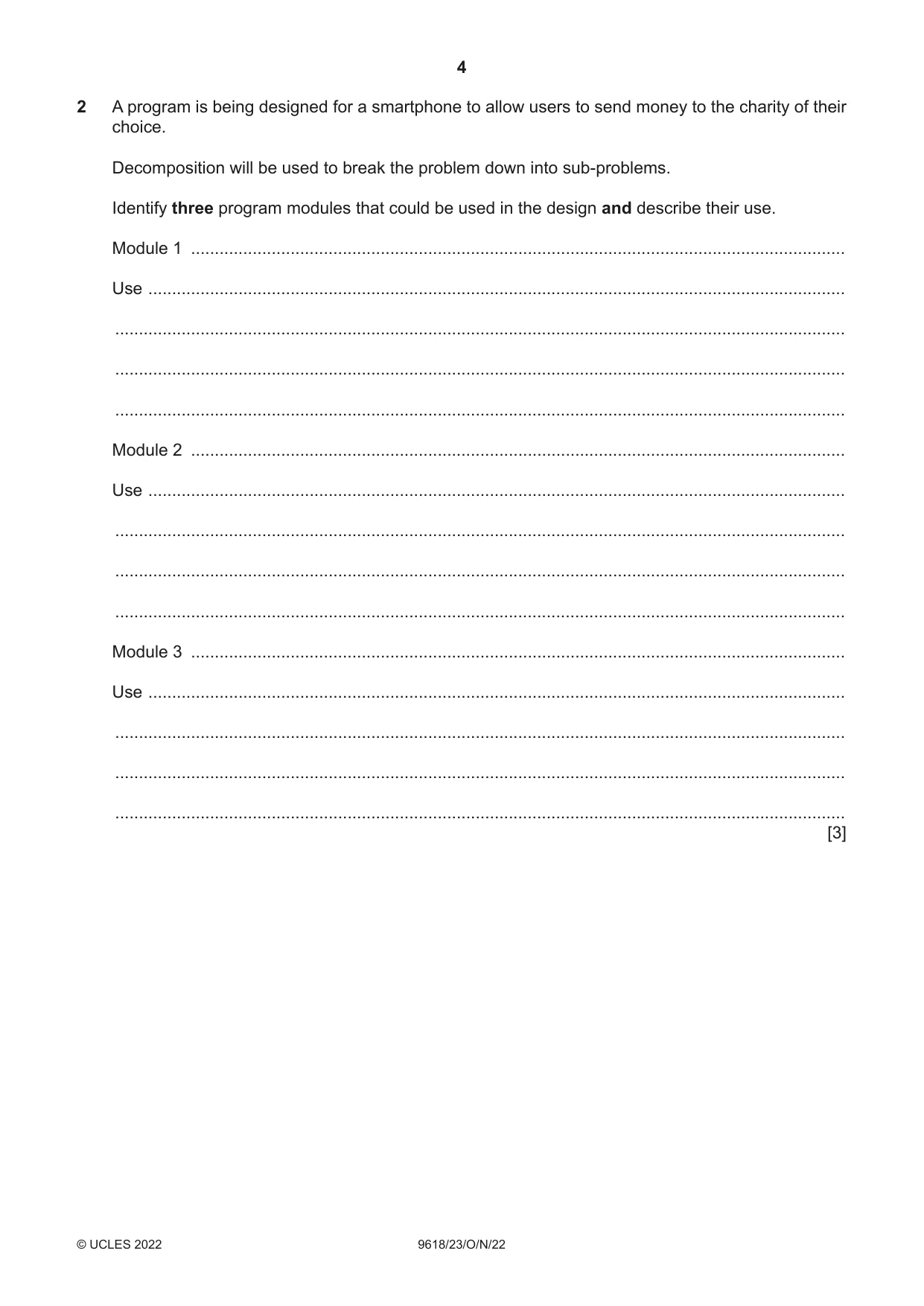
2 A program is being designed for a smartphone to allow users to send money to the charity of their choice. Decomposition will be used to break the problem down into sub-problems. Identify three program modules that could be used in the design and describe their use. Module 1 .......................................................................................................................................... Use ................................................................................................................................................... .......................................................................................................................................................... .......................................................................................................................................................... .......................................................................................................................................................... Module 2 .......................................................................................................................................... Use ................................................................................................................................................... .......................................................................................................................................................... .......................................................................................................................................................... .......................................................................................................................................................... Module 3 .......................................................................................................................................... Use ................................................................................................................................................... .......................................................................................................................................................... .......................................................................................................................................................... .......................................................................................................................................................... [3]
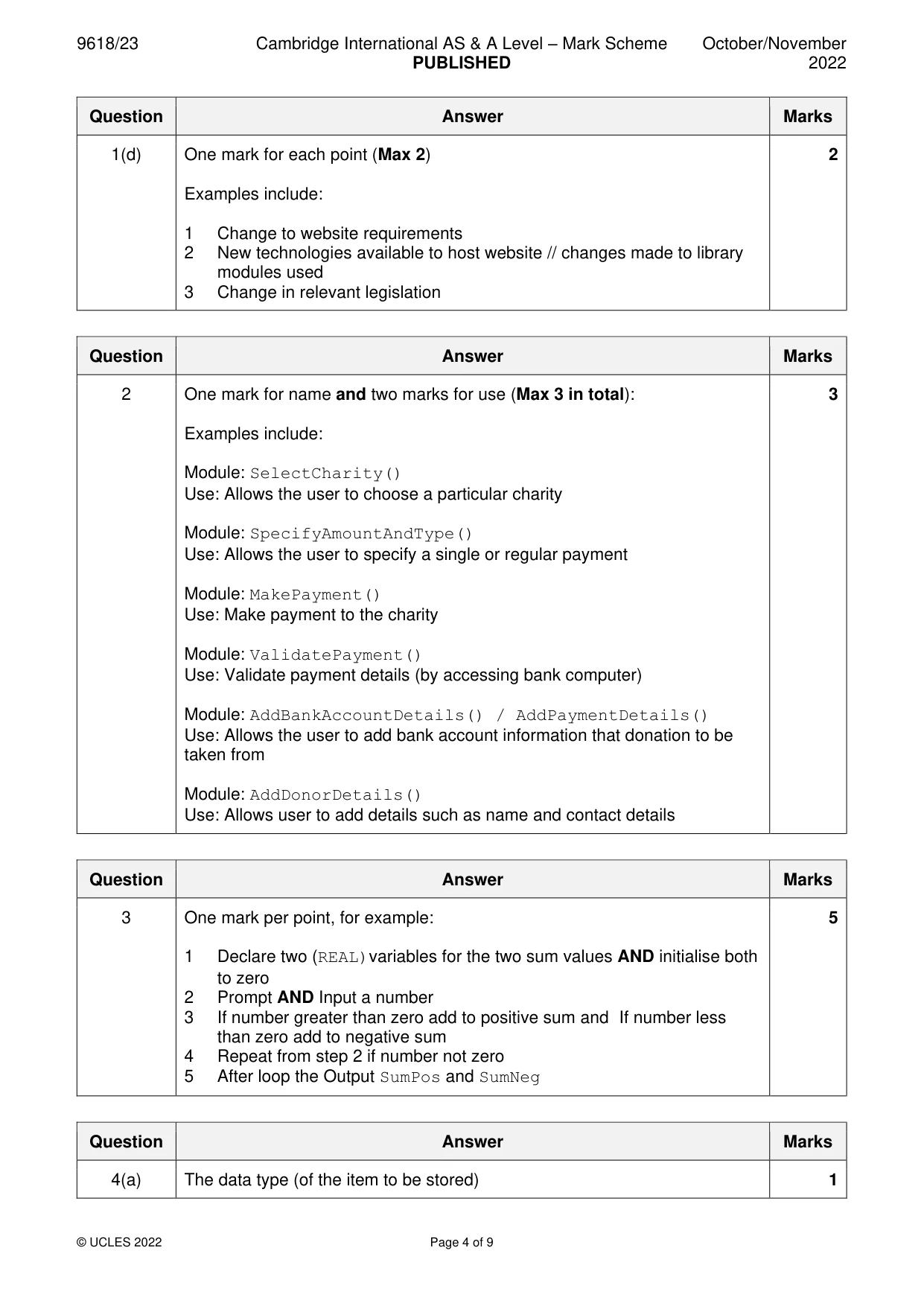
Mark scheme: 2 One mark for name and two marks for use (Max 3 in total): 3 Examples include: Module: SelectCharity() Use: Allows the user to choose a particular charity Module: SpecifyAmountAndType() Use: Allows the user to specify a single or regular payment Module: MakePayment() Use: Make payment to the charity Module: ValidatePayment() Use: Validate payment details (by accessing bank computer) Module: AddBankAccountDetails() / AddPaymentDetails() Use: Allows the user to add bank account information that donation to be taken from Module: AddDonorDetails() Use: Allows user to add details such as name and contact details
Q3 · An algorithm is needed to process a sequence of numbers
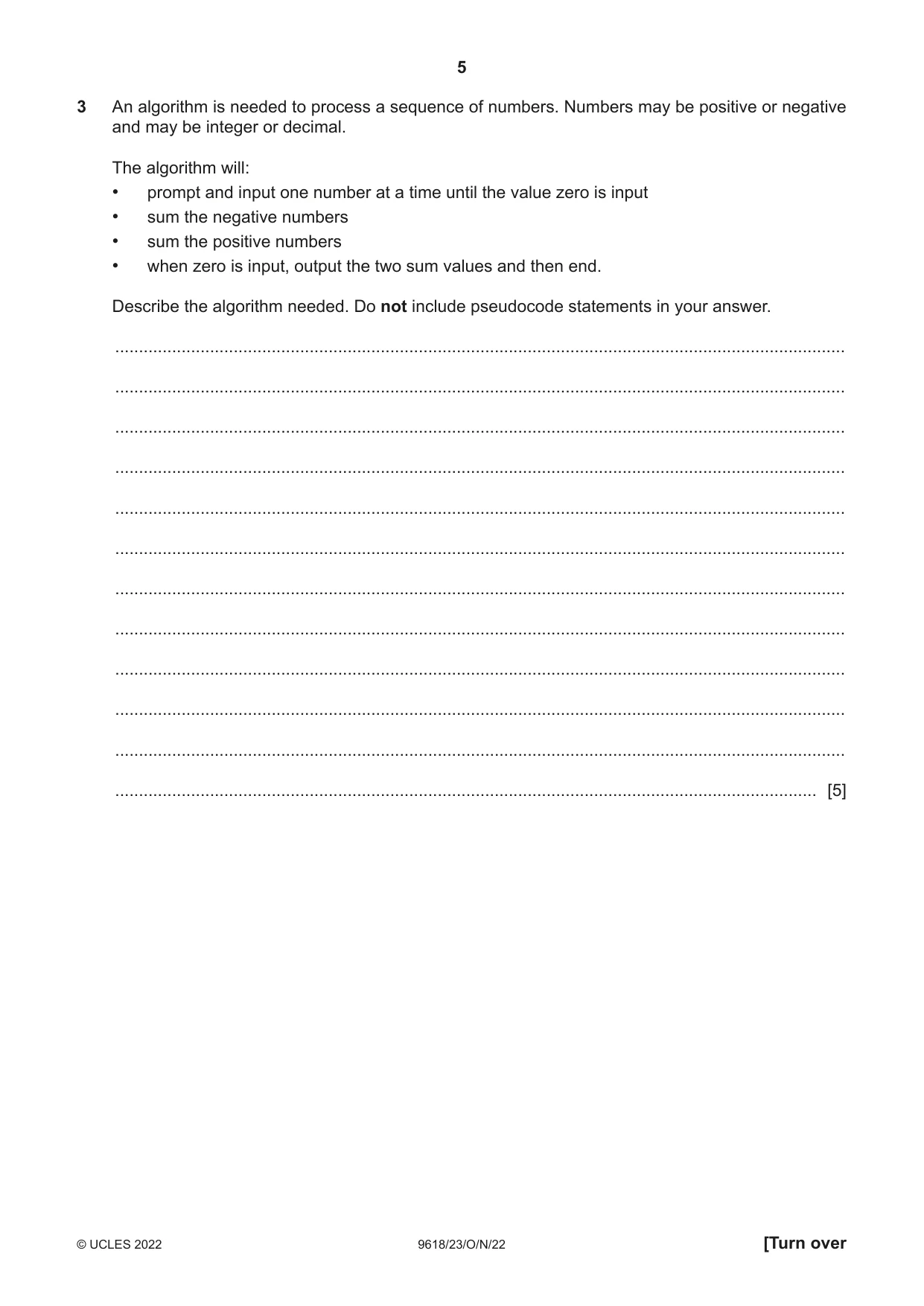
3 An algorithm is needed to process a sequence of numbers. Numbers may be positive or negative and may be integer or decimal. The algorithm will: • prompt and input one number at a time until the value zero is input • sum the negative numbers • sum the positive numbers • when zero is input, output the two sum values and then end. Describe the algorithm needed. Do not include pseudocode statements in your answer. .......................................................................................................................................................... .......................................................................................................................................................... .......................................................................................................................................................... .......................................................................................................................................................... .......................................................................................................................................................... .......................................................................................................................................................... .......................................................................................................................................................... .......................................................................................................................................................... .......................................................................................................................................................... .......................................................................................................................................................... .......................................................................................................................................................... .................................................................................................................................................... [5]
Mark scheme: 3 One mark per point, for example: 5 1 Declare two (REAL)variables for the two sum values AND initialise both to zero 2 Prompt AND Input a number 3 If number greater than zero add to positive sum and If number less than zero add to negative sum 4 Repeat from step 2 if number not zero 5 After loop the Output SumPos and SumNeg
Q4 · A program contains a 1D array DataItem with 100 elements
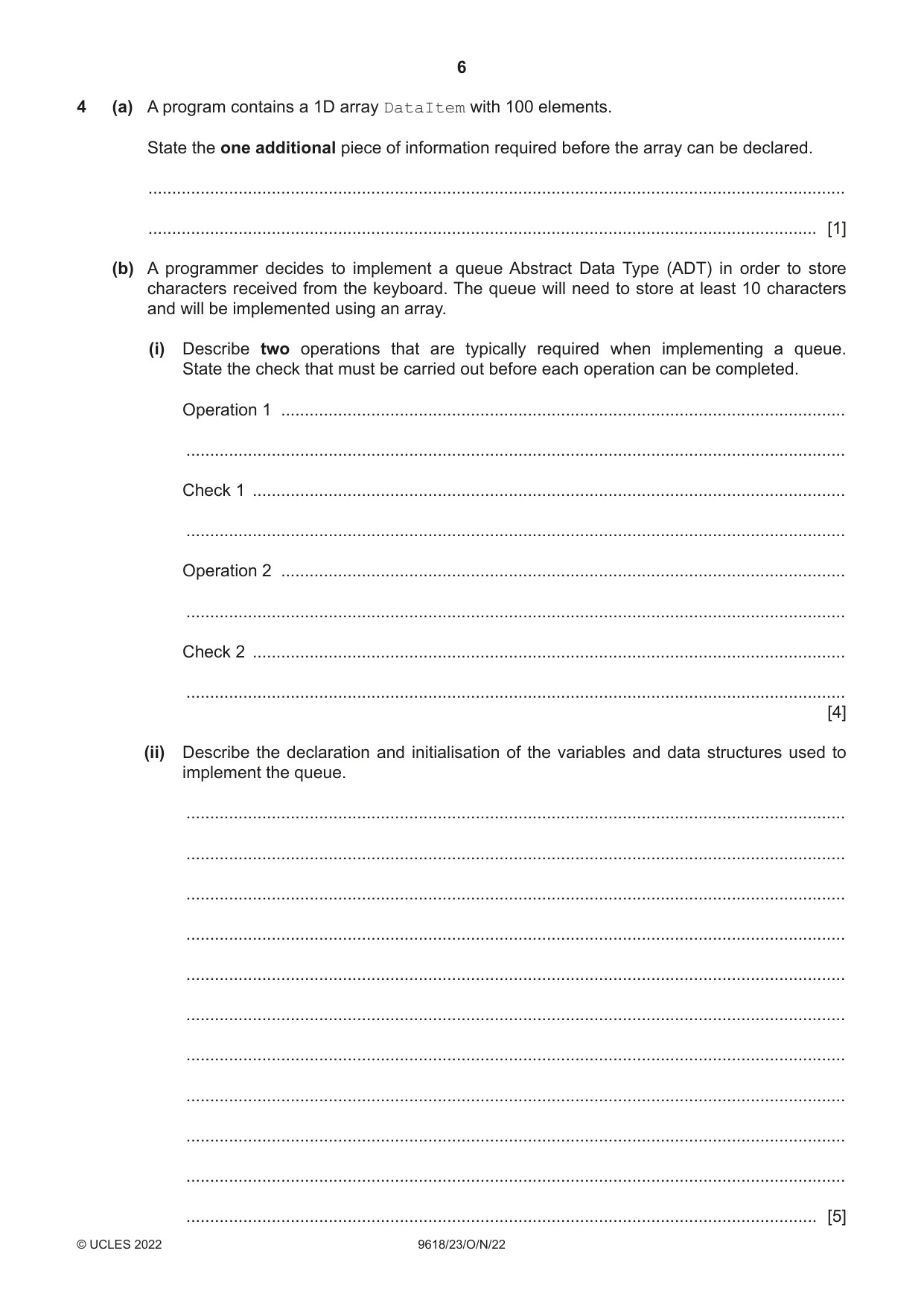
4 (a) A program contains a 1D array DataItem with 100 elements. State the one additional piece of information required before the array can be declared. ................................................................................................................................................... ............................................................................................................................................. [1] (b) A programmer decides to implement a queue Abstract Data Type (ADT) in order to store characters received from the keyboard. The queue will need to store at least 10 characters and will be implemented using an array. (i) Describe two operations that are typically required when implementing a queue. State the check that must be carried out before each operation can be completed. Operation 1 ....................................................................................................................... ........................................................................................................................................... Check 1 ............................................................................................................................. ........................................................................................................................................... Operation 2 ....................................................................................................................... ........................................................................................................................................... Check 2 ............................................................................................................................. ........................................................................................................................................... [4] (ii) Describe the declaration and initialisation of the variables and data structures used to implement the queue. ........................................................................................................................................... ........................................................................................................................................... ........................................................................................................................................... ........................................................................................................................................... ........................................................................................................................................... ........................................................................................................................................... ........................................................................................................................................... ........................................................................................................................................... ........................................................................................................................................... ........................................................................................................................................... ..................................................................................................................................... [5]
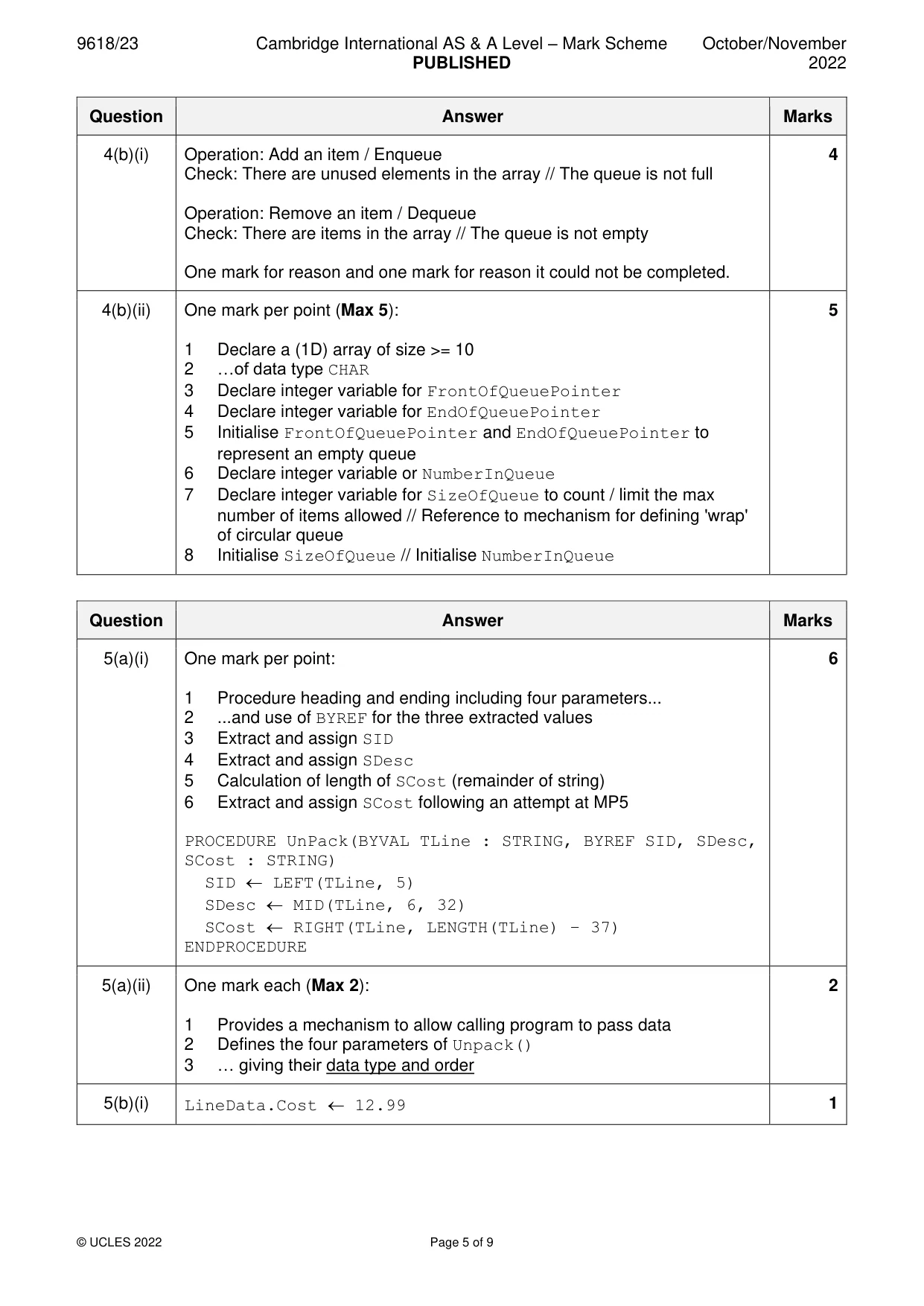
Mark scheme: 4(a) The data type (of the item to be stored) 1 4(b)(i) Operation: Add an item / Enqueue 4 Check: There are unused elements in the array // The queue is not full Operation: Remove an item / Dequeue Check: There are items in the array // The queue is not empty One mark for reason and one mark for reason it could not be completed. 4(b)(ii) One mark per point (Max 5): 5 1 Declare a (1D) array of size >= 10 2 …of data type CHAR 3 Declare integer variable for FrontOfQueuePointer 4 Declare integer variable for EndOfQueuePointer 5 Initialise FrontOfQueuePointer and EndOfQueuePointer to represent an empty queue 6 Declare integer variable or NumberInQueue 7 Declare integer variable for SizeOfQueue to count / limit the max number of items allowed // Reference to mechanism for defining 'wrap' of circular queue 8 Initialise SizeOfQueue // Initialise NumberInQueue
Q5 · A text string contains three data items concatenated as shown…
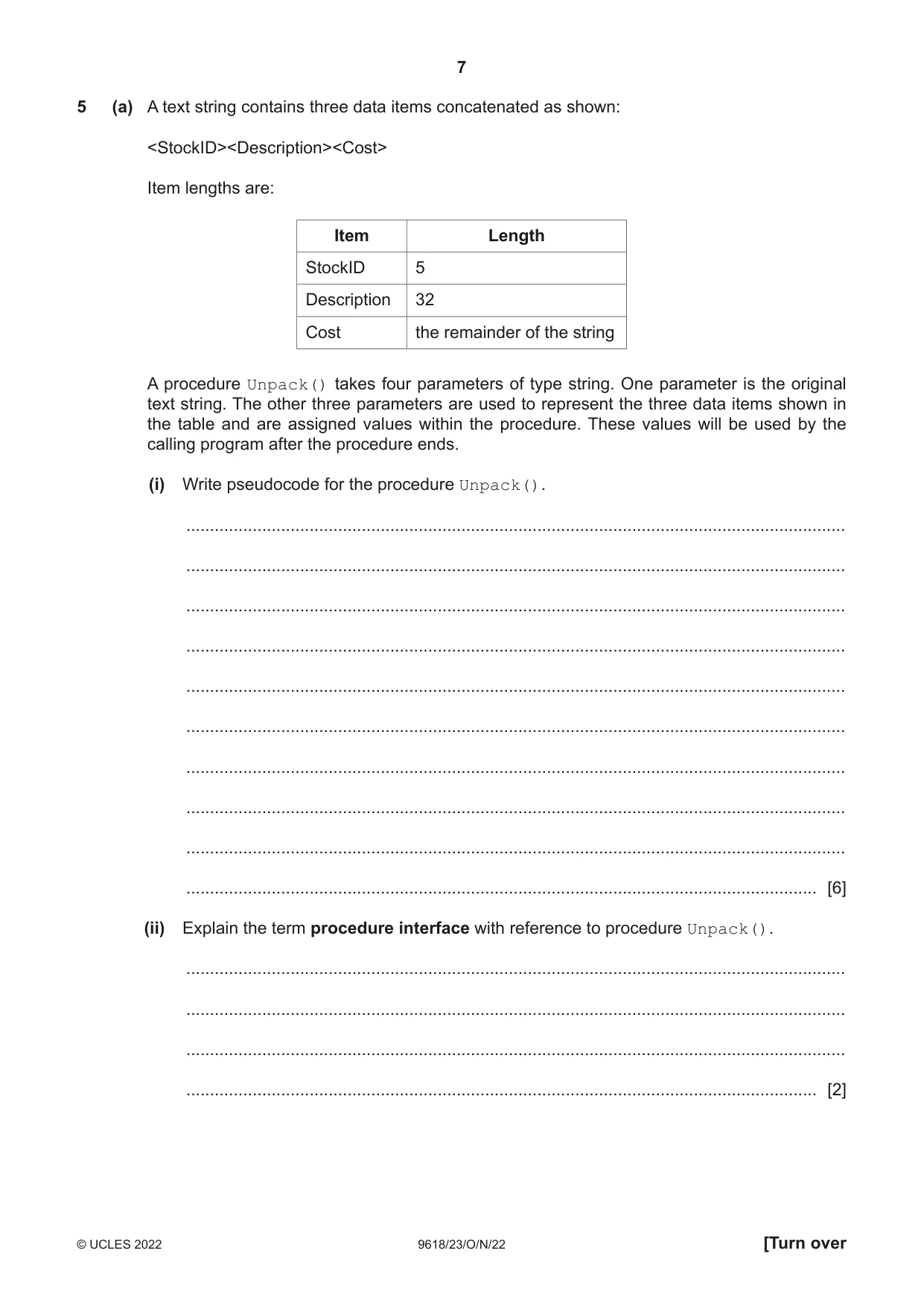
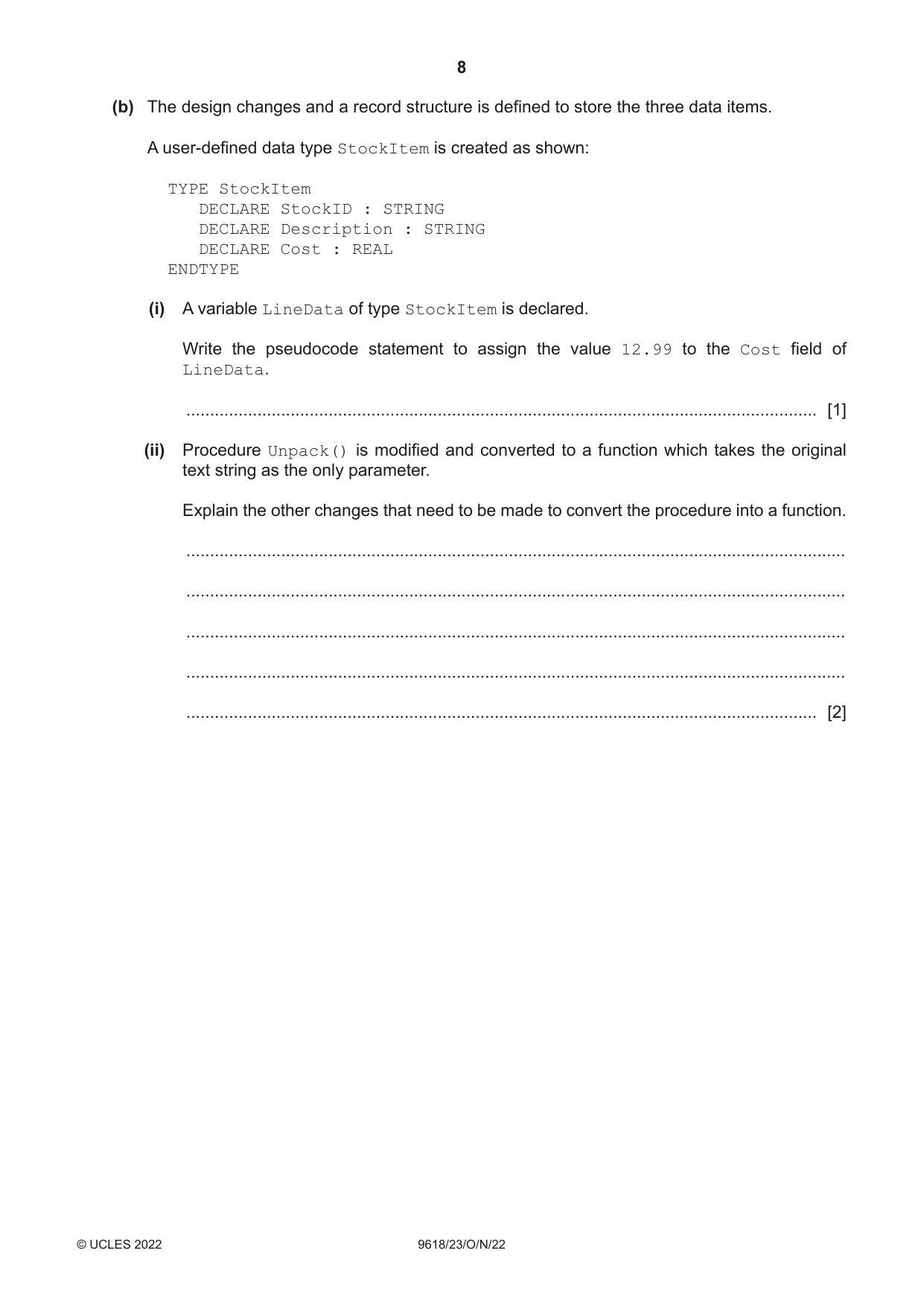
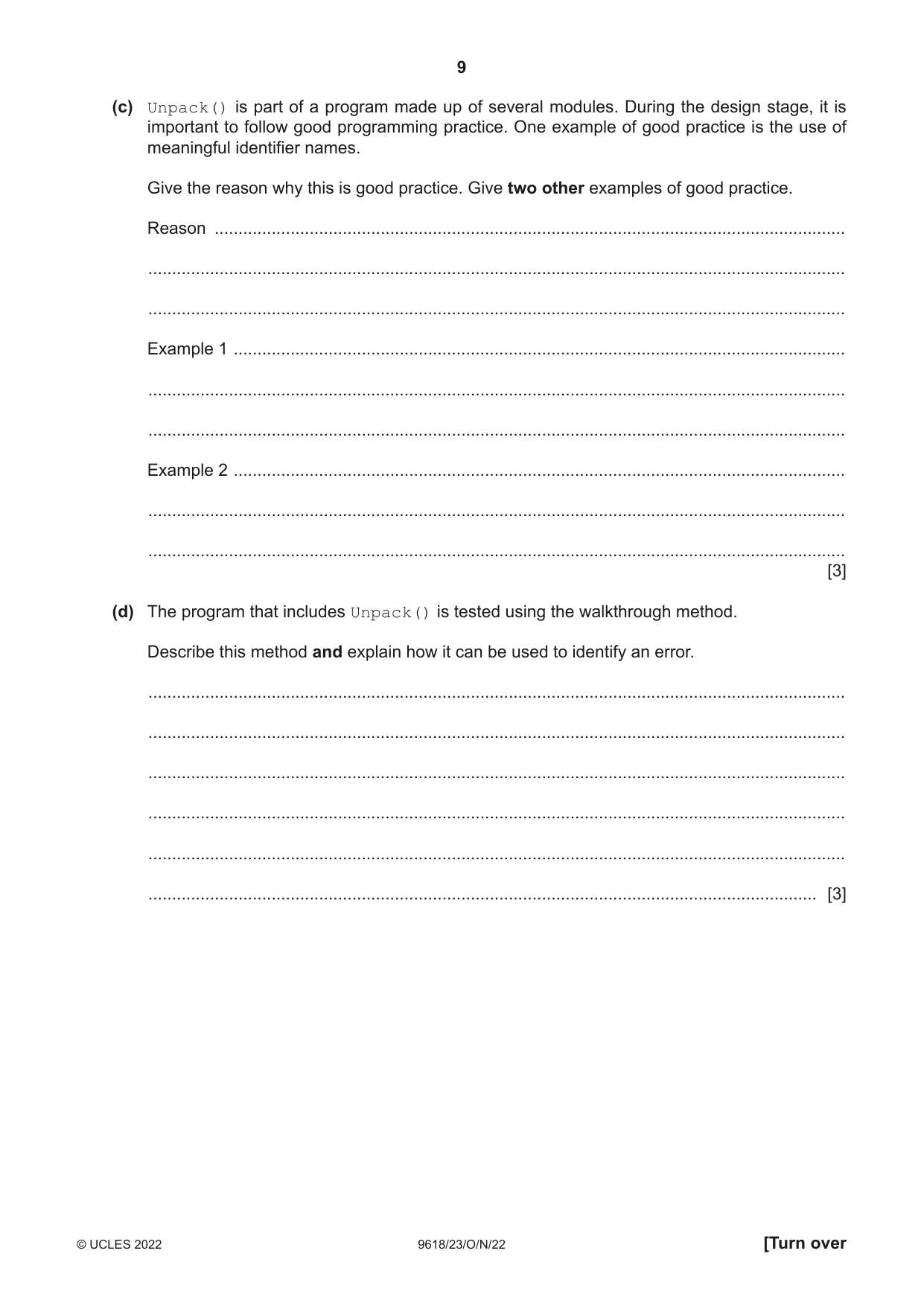
5 (a) A text string contains three data items concatenated as shown: <StockID><Description><Cost> Item lengths are: Item Length StockID 5 Description 32 Cost the remainder of the string A procedure Unpack() takes four parameters of type string. One parameter is the original text string. The other three parameters are used to represent the three data items shown in the table and are assigned values within the procedure. These values will be used by the calling program after the procedure ends. (i) Write pseudocode for the procedure Unpack(). ........................................................................................................................................... ........................................................................................................................................... ........................................................................................................................................... ........................................................................................................................................... ........................................................................................................................................... ........................................................................................................................................... ........................................................................................................................................... ........................................................................................................................................... ........................................................................................................................................... ..................................................................................................................................... [6] (ii) Explain the term procedure interface with reference to procedure Unpack(). ........................................................................................................................................... ........................................................................................................................................... ........................................................................................................................................... ..................................................................................................................................... [2] (b) The design changes and a record structure is defined to store the three data items. A user-defined data type StockItem is created as shown: TYPE StockItem DECLARE StockID : STRING DECLARE Description : STRING DECLARE Cost : REAL ENDTYPE (i) A variable LineData of type StockItem is declared. Write the pseudocode statement to assign the value 12.99 to the Cost field of LineData. ..................................................................................................................................... [1] (ii) Procedure Unpack() is modified and converted to a function which takes the original text string as the only parameter. Explain the other changes that need to be made to convert the procedure into a function. ........................................................................................................................................... ........................................................................................................................................... ........................................................................................................................................... ........................................................................................................................................... ..................................................................................................................................... [2] (c) Unpack() is part of a program made up of several modules. During the design stage, it is important to follow good programming practice. One example of good practice is the use of meaningful identifier names. Give the reason why this is good practice. Give two other examples of good practice. Reason ..................................................................................................................................... ................................................................................................................................................... ................................................................................................................................................... Example 1 ................................................................................................................................. ................................................................................................................................................... ................................................................................................................................................... Example 2 ................................................................................................................................. ................................................................................................................................................... ................................................................................................................................................... [3] (d) The program that includes Unpack() is tested using the walkthrough method. Describe this method and explain how it can be used to identify an error. ................................................................................................................................................... ................................................................................................................................................... ................................................................................................................................................... ................................................................................................................................................... ................................................................................................................................................... ............................................................................................................................................. [3]
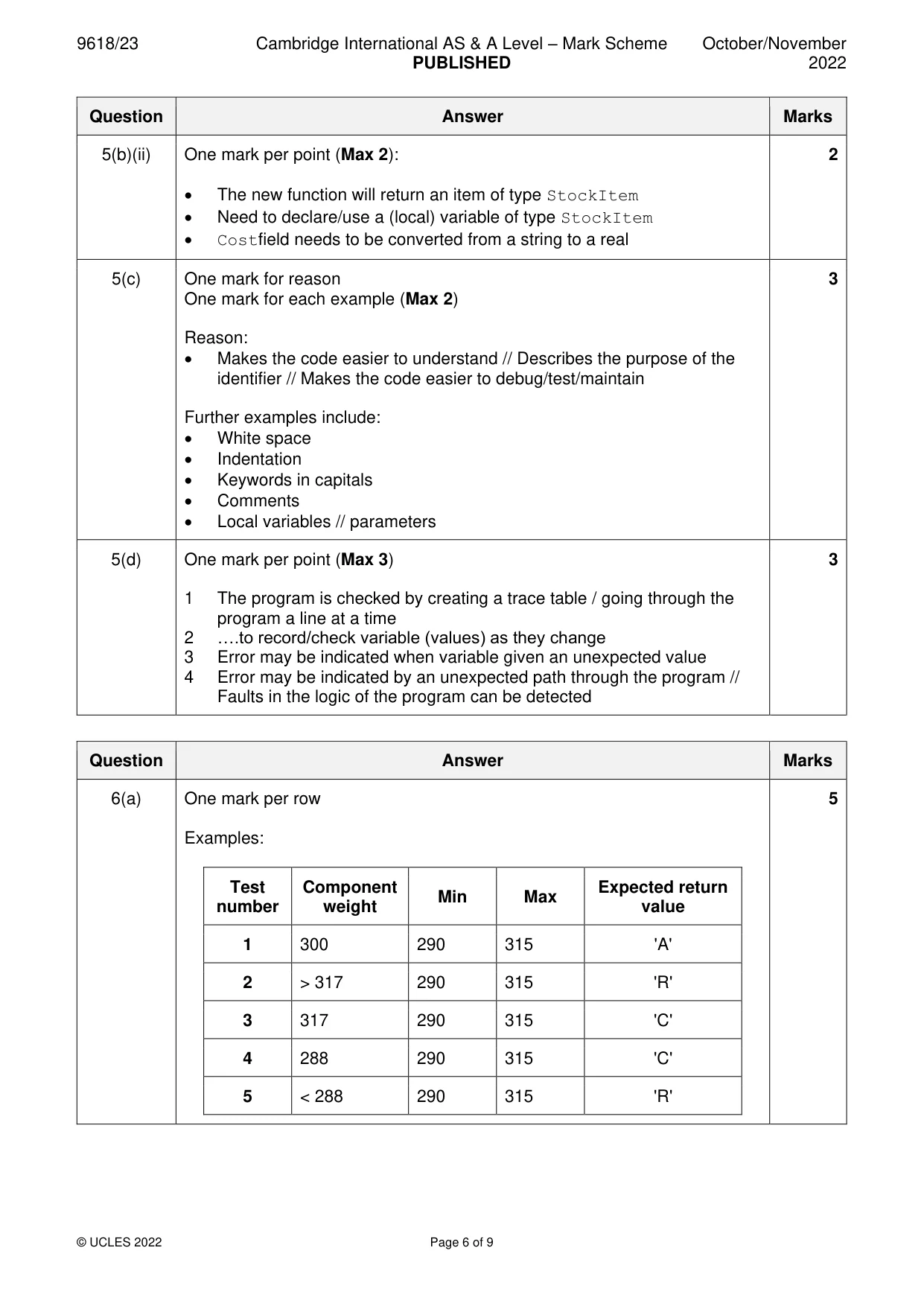
Mark scheme: 5(a)(i) One mark per point: 6 1 Procedure heading and ending including four parameters... 2 ...and use of BYREF for the three extracted values 3 Extract and assign SID 4 Extract and assign SDesc 5 Calculation of length of SCost (remainder of string) 6 Extract and assign SCost following an attempt at MP5 PROCEDURE UnPack(BYVAL TLine : STRING, BYREF SID, SDesc, SCost : STRING) SID LEFT(TLine, 5) SDesc MID(TLine, 6, 32) SCost RIGHT(TLine, LENGTH(TLine) – 37) ENDPROCEDURE 5(a)(ii) One mark each (Max 2): 2 1 Provides a mechanism to allow calling program to pass data 2 Defines the four parameters of Unpack() 3 … giving their data type and order 5(b)(i) LineData.Cost 12.99 1 5(b)(ii) One mark per point (Max 2): 2 • The new function will return an item of type StockItem • Need to declare/use a (local) variable of type StockItem • Costfield needs to be converted from a string to a real 5(c) One mark for reason 3 One mark for each example (Max 2) Reason: • Makes the code easier to understand // Describes the purpose of the identifier // Makes the code easier to debug/test/maintain Further examples include: • White space • Indentation • Keywords in capitals • Comments • Local variables // parameters 5(d) One mark per point (Max 3) 3 1 The program is checked by creating a trace table / going through the program a line at a time 2 ….to record/check variable (values) as they change 3 Error may be indicated when variable given an unexpected value 4 Error may be indicated by an unexpected path through the program // Faults in the logic of the program can be detected
Q6 · Components are weighed during manufacture
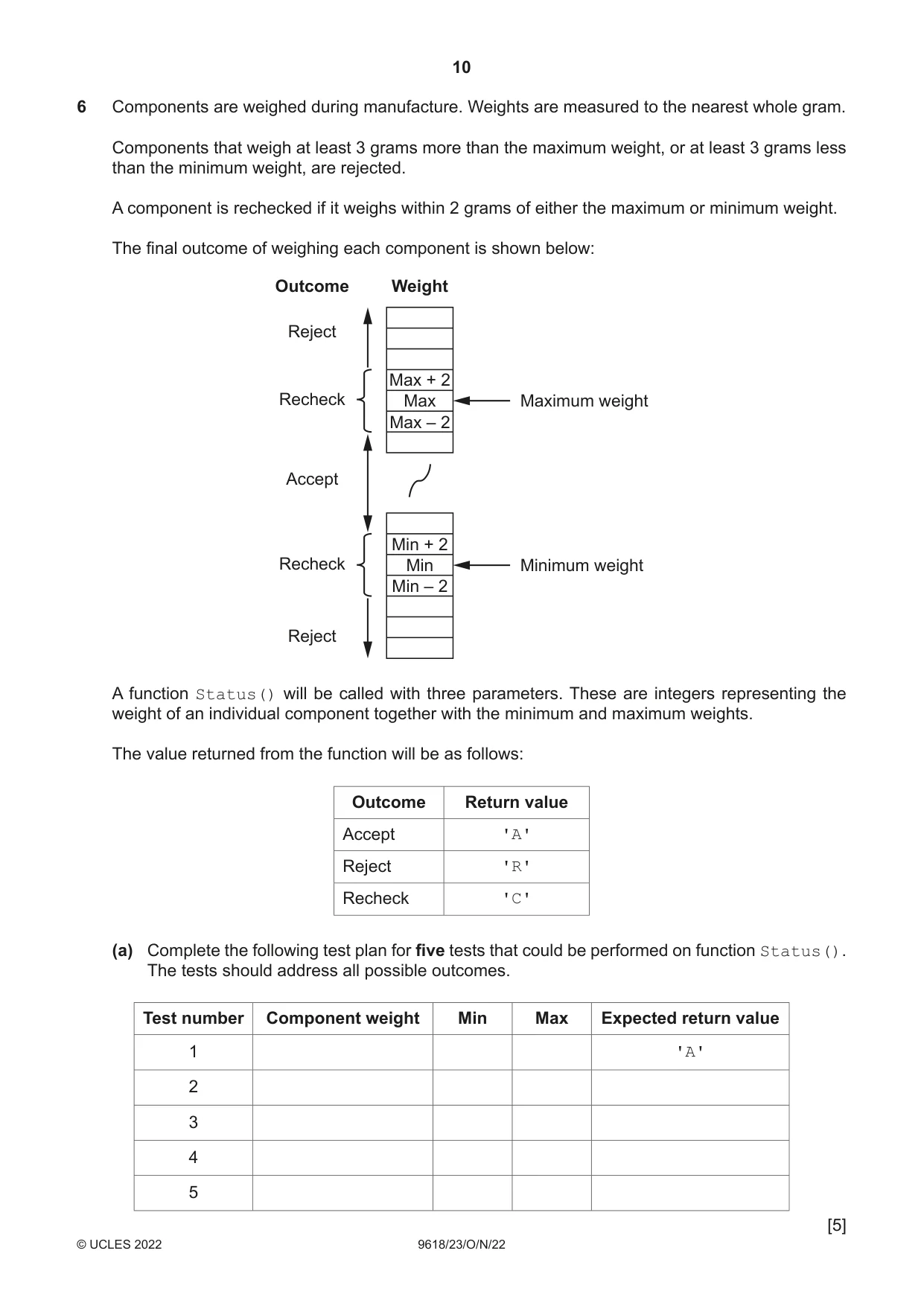
6 Components are weighed during manufacture. Weights are measured to the nearest whole gram. Components that weigh at least 3 grams more than the maximum weight, or at least 3 grams less than the minimum weight, are rejected. A component is rechecked if it weighs within 2 grams of either the maximum or minimum weight. The final outcome of weighing each component is shown below: Outcome Weight Reject Max + 2 Recheck Max Maximum weight Max – 2 Accept Min + 2 Recheck Min Minimum weight Min – 2 Reject A function Status() will be called with three parameters. These are integers representing the weight of an individual component together with the minimum and maximum weights. The value returned from the function will be as follows: Outcome Return value Accept 'A' Reject 'R' Recheck 'C' (a) Complete the following test plan for five tests that could be performed on function Status(). The tests should address all possible outcomes. Test number Component weight Min Max Expected return value 1 'A' 2 3 4 5 [5] (b) Write pseudocode for Status(). ................................................................................................................................................... ................................................................................................................................................... ................................................................................................................................................... ................................................................................................................................................... ................................................................................................................................................... ................................................................................................................................................... ................................................................................................................................................... ................................................................................................................................................... ................................................................................................................................................... ................................................................................................................................................... ................................................................................................................................................... ................................................................................................................................................... ................................................................................................................................................... ................................................................................................................................................... ................................................................................................................................................... ................................................................................................................................................... ................................................................................................................................................... ................................................................................................................................................... ................................................................................................................................................... ............................................................................................................................................. [6]
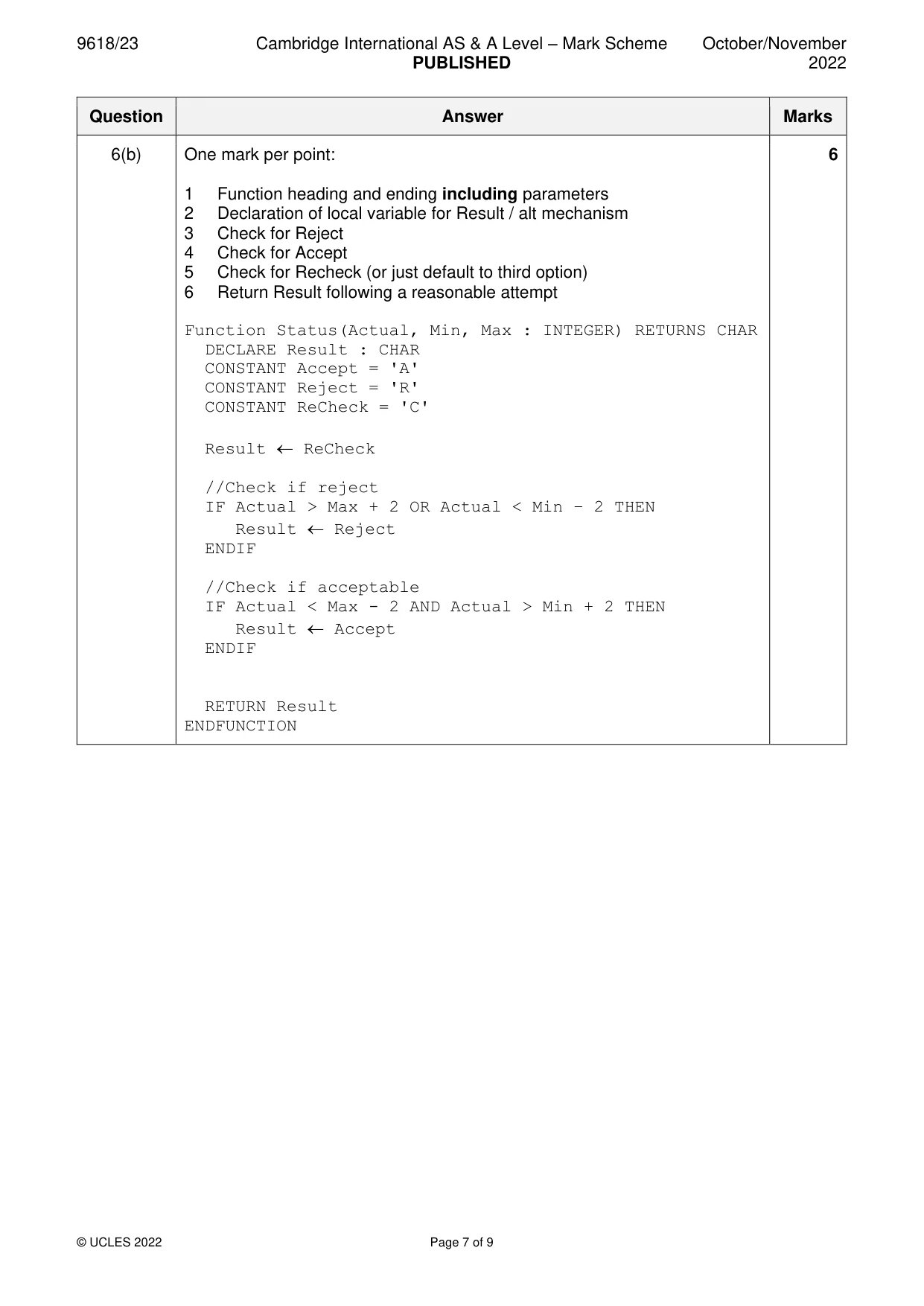
Mark scheme: 6(a) One mark per row 5 Examples: Test Component Expected return Min Max number weight value 1 300 290 315 'A' 2 > 317 290 315 'R' 3 317 290 315 'C' 4 288 290 315 'C' 5 < 288 290 315 'R' 6(b) One mark per point: 6 1 Function heading and ending including parameters 2 Declaration of local variable for Result / alt mechanism 3 Check for Reject 4 Check for Accept 5 Check for Recheck (or just default to third option) 6 Return Result following a reasonable attempt Function Status(Actual, Min, Max : INTEGER) RETURNS CHAR DECLARE Result : CHAR CONSTANT Accept = 'A' CONSTANT Reject = 'R' CONSTANT ReCheck = 'C' Result ReCheck //Check if reject IF Actual > Max + 2 OR Actual < Min – 2 THEN Result Reject ENDIF //Check if acceptable IF Actual < Max - 2 AND Actual > Min + 2 THEN Result Accept ENDIF RETURN Result ENDFUNCTION
Q7 · A teacher is designing a program to perform simple syntax checks on programs written by…
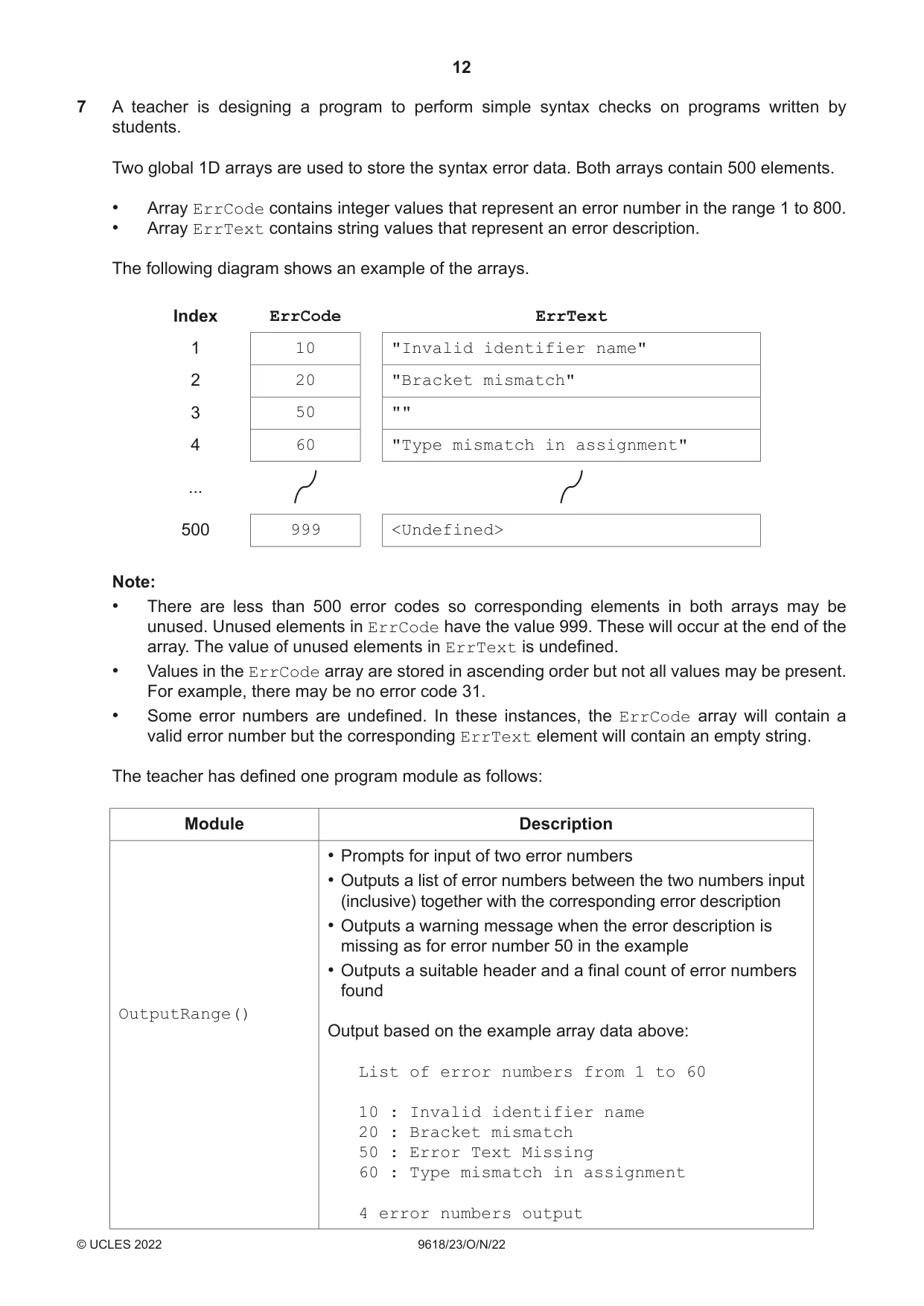
7 A teacher is designing a program to perform simple syntax checks on programs written by students. Two global 1D arrays are used to store the syntax error data. Both arrays contain 500 elements. • Array ErrCode contains integer values that represent an error number in the range 1 to 800. • Array ErrText contains string values that represent an error description. The following diagram shows an example of the arrays. Index ErrCode ErrText 1 10 "Invalid identifier name" 2 20 "Bracket mismatch" 3 50 "" 4 60 "Type mismatch in assignment" ... 500 999 <Undefined> Note: • There are less than 500 error codes so corresponding elements in both arrays may be unused. Unused elements in ErrCode have the value 999. These will occur at the end of the array. The value of unused elements in ErrText is undefined. • Values in the ErrCode array are stored in ascending order but not all values may be present. For example, there may be no error code 31. • Some error numbers are undefined. In these instances, the ErrCode array will contain a valid error number but the corresponding ErrText element will contain an empty string. The teacher has defined one program module as follows: Module Description • Prompts for input of two error numbers • Outputs a list of error numbers between the two numbers input (inclusive) together with the corresponding error description • Outputs a warning message when the error description is missing as for error number 50 in the example • Outputs a suitable header and a final count of error numbers found OutputRange() Output based on the example array data above: List of error numbers from 1 to 60 10 : Invalid identifier name 20 : Bracket mismatch 50 : Error Text Missing 60 : Type mismatch in assignment 4 error numbers output (a) Write pseudocode for module OutputRange(). Assume that the two numbers input represent a valid error number range. ................................................................................................................................................... ................................................................................................................................................... ................................................................................................................................................... ................................................................................................................................................... ................................................................................................................................................... ................................................................................................................................................... ................................................................................................................................................... ................................................................................................................................................... ................................................................................................................................................... ................................................................................................................................................... ................................................................................................................................................... ................................................................................................................................................... ................................................................................................................................................... ................................................................................................................................................... ................................................................................................................................................... ................................................................................................................................................... ................................................................................................................................................... ................................................................................................................................................... ................................................................................................................................................... ................................................................................................................................................... ................................................................................................................................................... ................................................................................................................................................... ................................................................................................................................................... ................................................................................................................................................... ................................................................................................................................................... ................................................................................................................................................... ................................................................................................................................................... ................................................................................................................................................... ................................................................................................................................................... ................................................................................................................................................... ................................................................................................................................................... ................................................................................................................................................... ................................................................................................................................................... ................................................................................................................................................... ................................................................................................................................................... ............................................................................................................................................. [8]
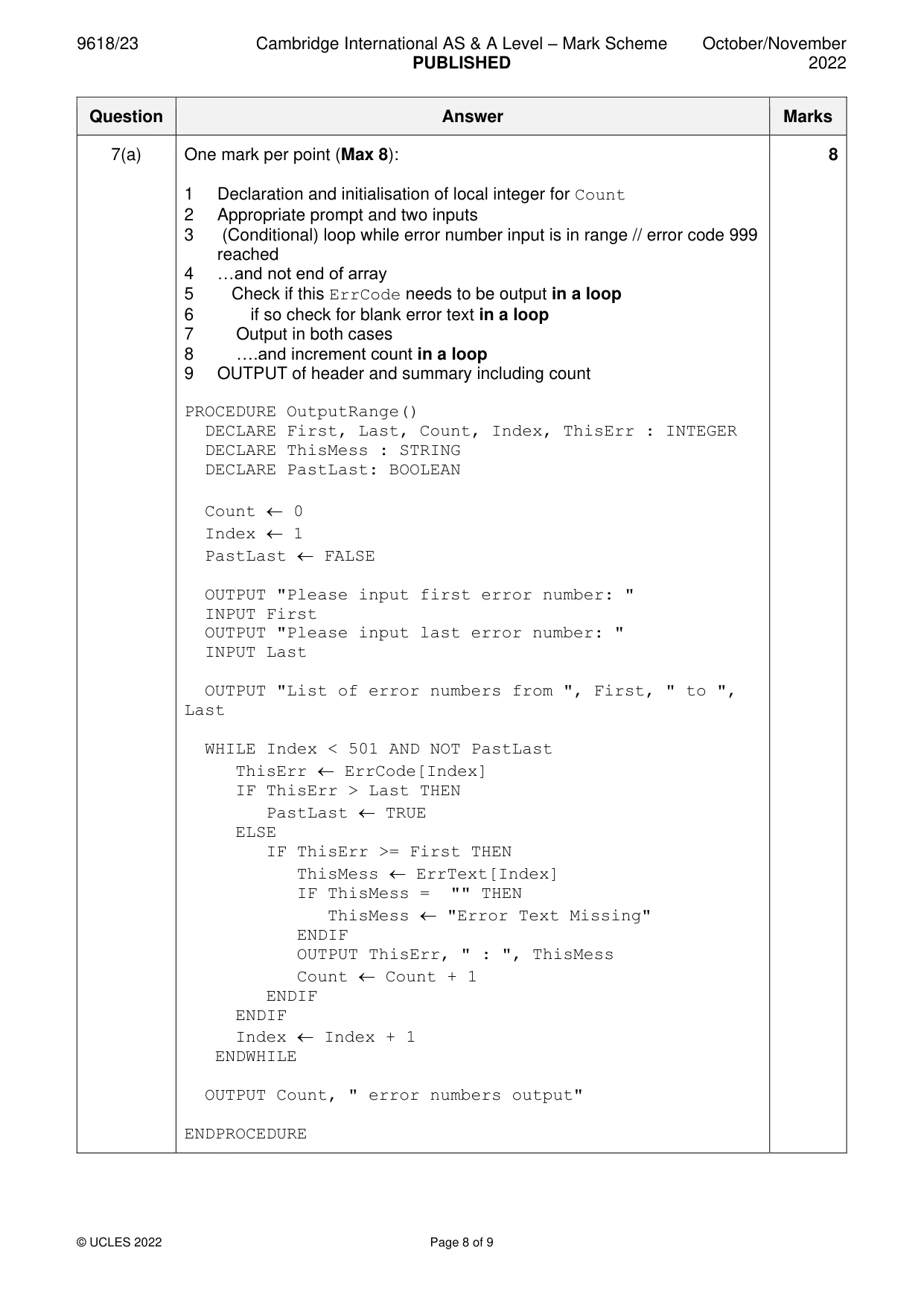
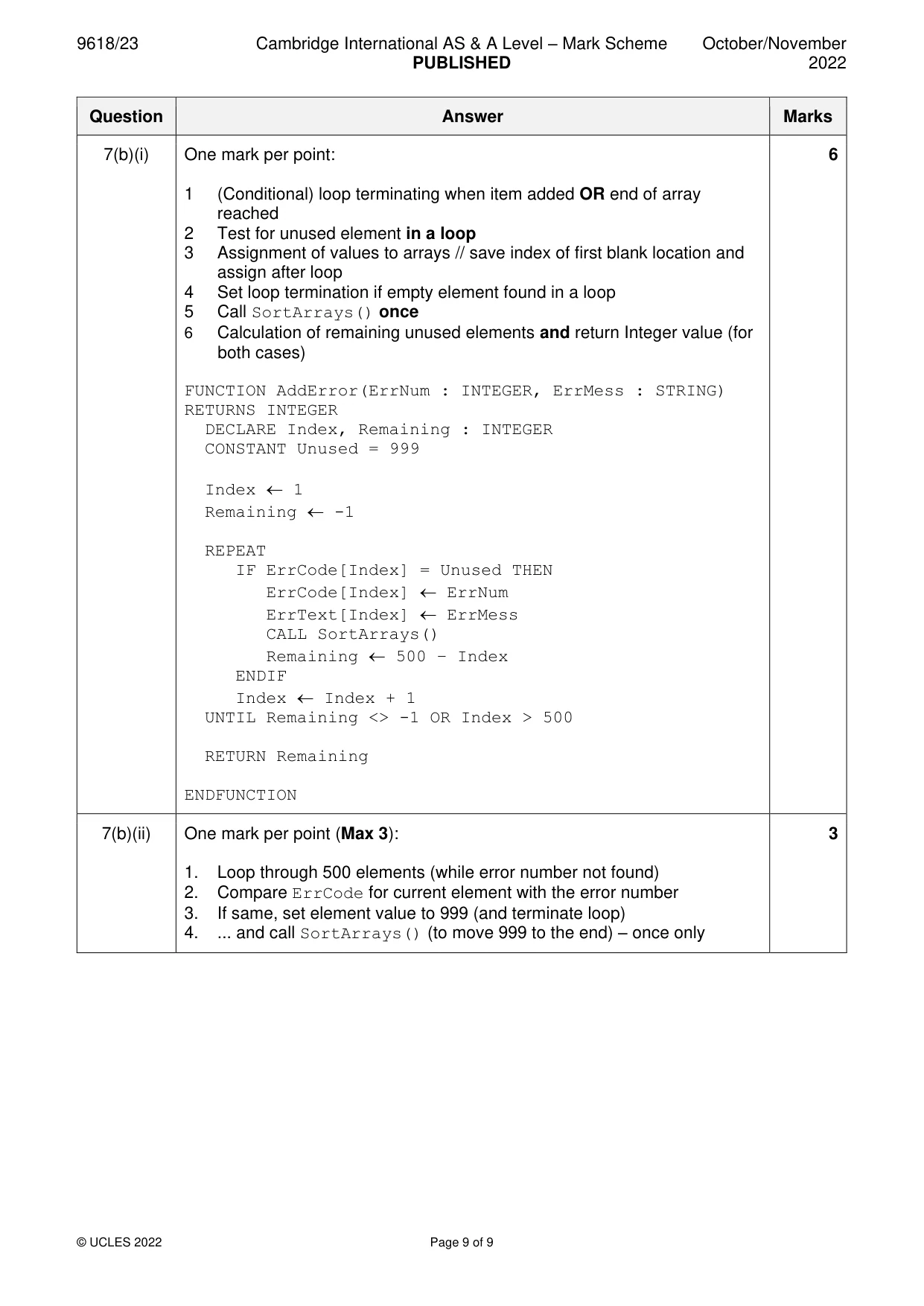
Mark scheme: 7(a) One mark per point (Max 8): 8 1 Declaration and initialisation of local integer for Count 2 Appropriate prompt and two inputs 3 (Conditional) loop while error number input is in range // error code 999 reached 4 …and not end of array 5 Check if this ErrCode needs to be output in a loop 6 if so check for blank error text in a loop 7 Output in both cases 8 ….and increment count in a loop 9 OUTPUT of header and summary including count PROCEDURE OutputRange() DECLARE First, Last, Count, Index, ThisErr : INTEGER DECLARE ThisMess : STRING DECLARE PastLast: BOOLEAN Count 0 Index 1 PastLast FALSE OUTPUT "Please input first error number: " INPUT First OUTPUT "Please input last error number: " INPUT Last OUTPUT "List of error numbers from ", First, " to ", Last WHILE Index < 501 AND NOT PastLast ThisErr ErrCode[Index] IF ThisErr > Last THEN PastLast TRUE ELSE IF ThisErr >= First THEN ThisMess ErrText[Index] IF ThisMess = "" THEN ThisMess "Error Text Missing" ENDIF OUTPUT ThisErr, " : ", ThisMess Count Count + 1 ENDIF ENDIF Index Index + 1 ENDWHILE OUTPUT Count, " error numbers output" ENDPROCEDURE 7(b)(i) One mark per point: 6 1 (Conditional) loop terminating when item added OR end of array reached 2 Test for unused element in a loop 3 Assignment of values to arrays // save index of first blank location and assign after loop 4 Set loop termination if empty element found in a loop 5 Call SortArrays() once 6 Calculation of remaining unused elements and return Integer value (for both cases) FUNCTION AddError(ErrNum : INTEGER, ErrMess : STRING) RETURNS INTEGER DECLARE Index, Remaining : INTEGER CONSTANT Unused = 999 Index 1 Remaining -1 REPEAT IF ErrCode[Index] = Unused THEN ErrCode[Index] ErrNum ErrText[Index] ErrMess CALL SortArrays() Remaining 500 – Index ENDIF Index Index + 1 UNTIL Remaining <> -1 OR Index > 500 RETURN Remaining ENDFUNCTION 7(b)(ii) One mark per point (Max 3): 3 1. Loop through 500 elements (while error number not found) 2. Compare ErrCode for current element with the error number 3. If same, set element value to 999 (and terminate loop) 4. ... and call SortArrays() (to move 999 to the end) – once only
What was in this paper
The subtopics covered by these 7 questions, and how many questions each got. Open one in a new tab to see every Cambridge question on it.
What you needed in this session
Cambridge’s own grade thresholds for 2022 Oct/Nov, Paper 2 · Variant 3. A higher threshold means an easier paper — the bar moves with how the cohort did.