Cambridge A Level Computer Science 9618 — 2021 Oct/Nov Paper 1 · Variant 2
9618/12/O/N/21 · 75 marks · ≈84 min
The question paper and its mark scheme, free to read here and free to download. This is Cambridge’s own paper, exactly as it was sat.
Question paper16 pages




Mark scheme10 pages
Answers below. Sit the paper first if you are practising.

Paper as text
Question paper, page 1
This document has 16 pages. Any blank pages are indicated. DC (RW/SG) 206391/2 © UCLES 2021 [Turn over * 5 4 4 0 4 4 0 9 9 3 * COMPUTER SCIENCE 9618/12 Paper 1 Theory Fundamentals October/November 2021 1 hour 30 minutes You must answer on the question paper. No additional materials are needed. INSTRUCTIONS ● Answer all questions. ● Use a black or dark blue pen. ● Write your name, centre number and candidate number in the boxes at the top of the page. ● Write your answer to each question in the space provided. ● Do not use an erasable pen or correction fluid. ● Do not write on any bar codes. ● You may use an HB pencil for any diagrams, graphs or rough working. ● Calculators must not be used in this paper. INFORMATION ● The total mark for this paper is 75. ● The number of marks for each question or part question is shown in brackets [ ]. ● No marks will be awarded for using brand names of software packages or hardware. Cambridge International AS & A Level
Question paper, page 2
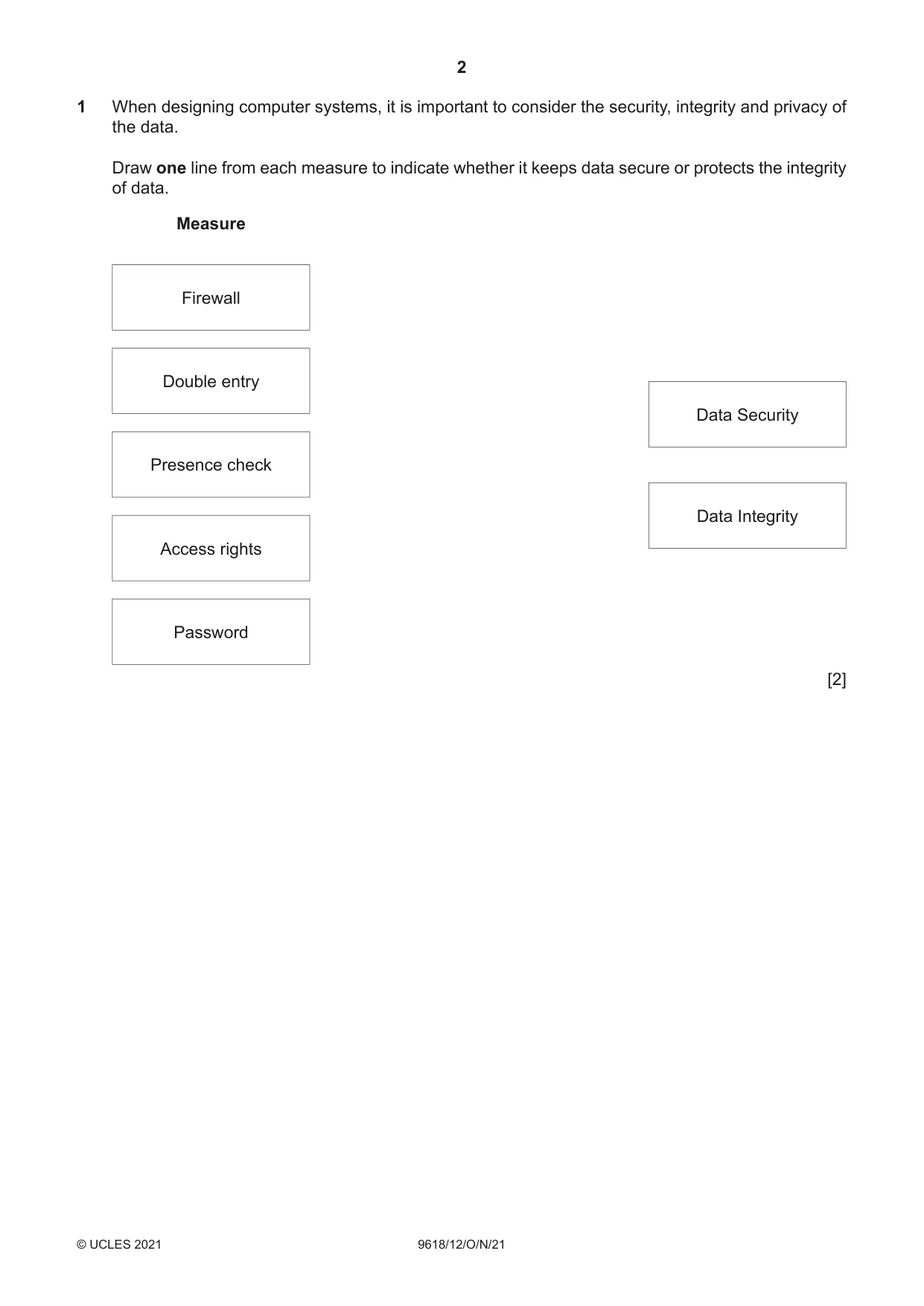
2 9618/12/O/N/21 © UCLES 2021 1 When designing computer systems, it is important to consider the security, integrity and privacy of the data. Draw one line from each measure to indicate whether it keeps data secure or protects the integrity of data. Data Security Data Integrity Measure Firewall Double entry Presence check Password Access rights [2]
Question paper, page 3
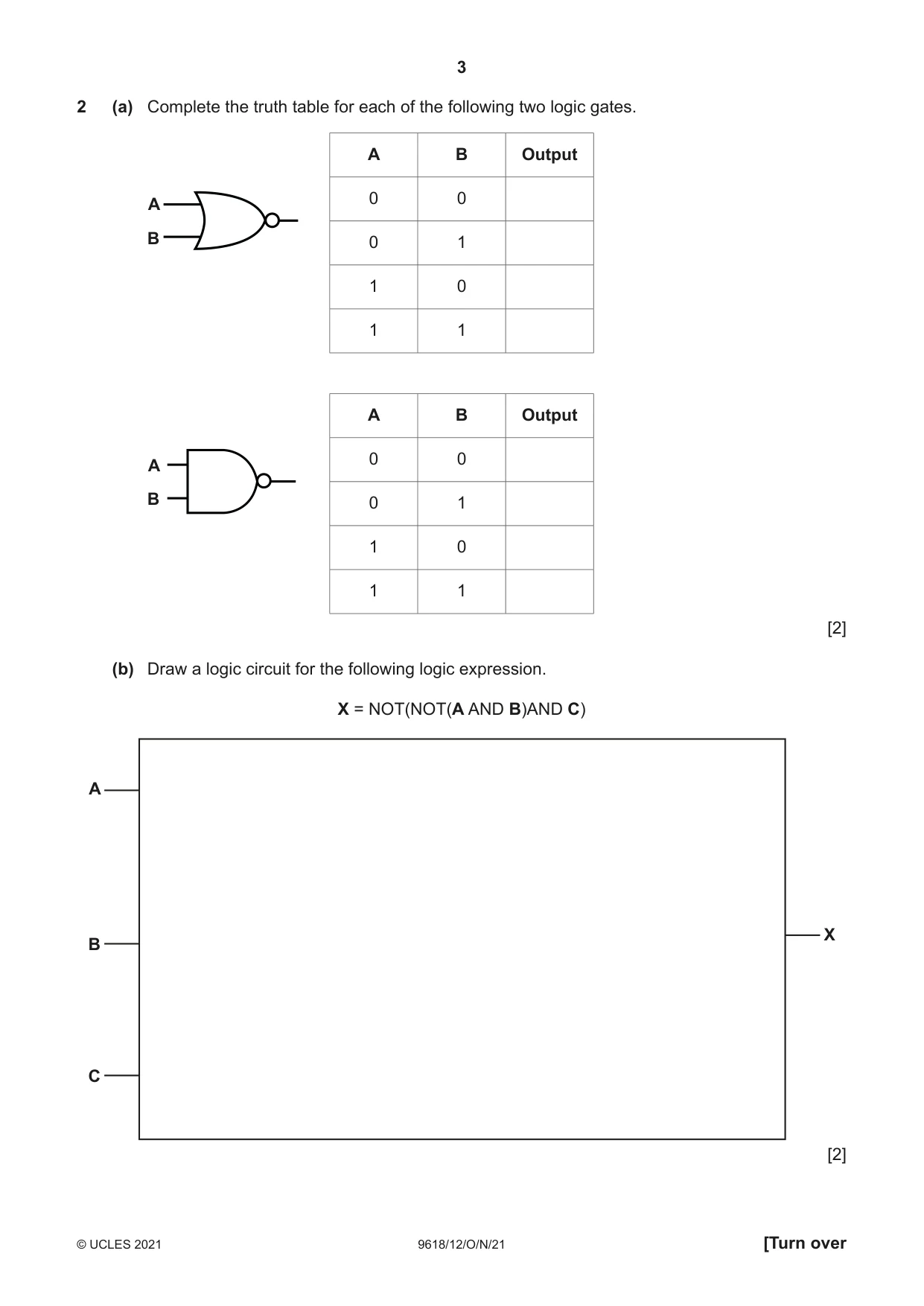
3 9618/12/O/N/21 © UCLES 2021 [Turn over 2 (a) Complete the truth table for each of the following two logic gates. A B Output 0 0 0 1 1 0 1 1 A B Output 0 0 0 1 1 0 1 1 [2] (b) Draw a logic circuit for the following logic expression. X = NOT(NOT(A AND B)AND C) A B C X [2] A B A B
Question paper, page 4
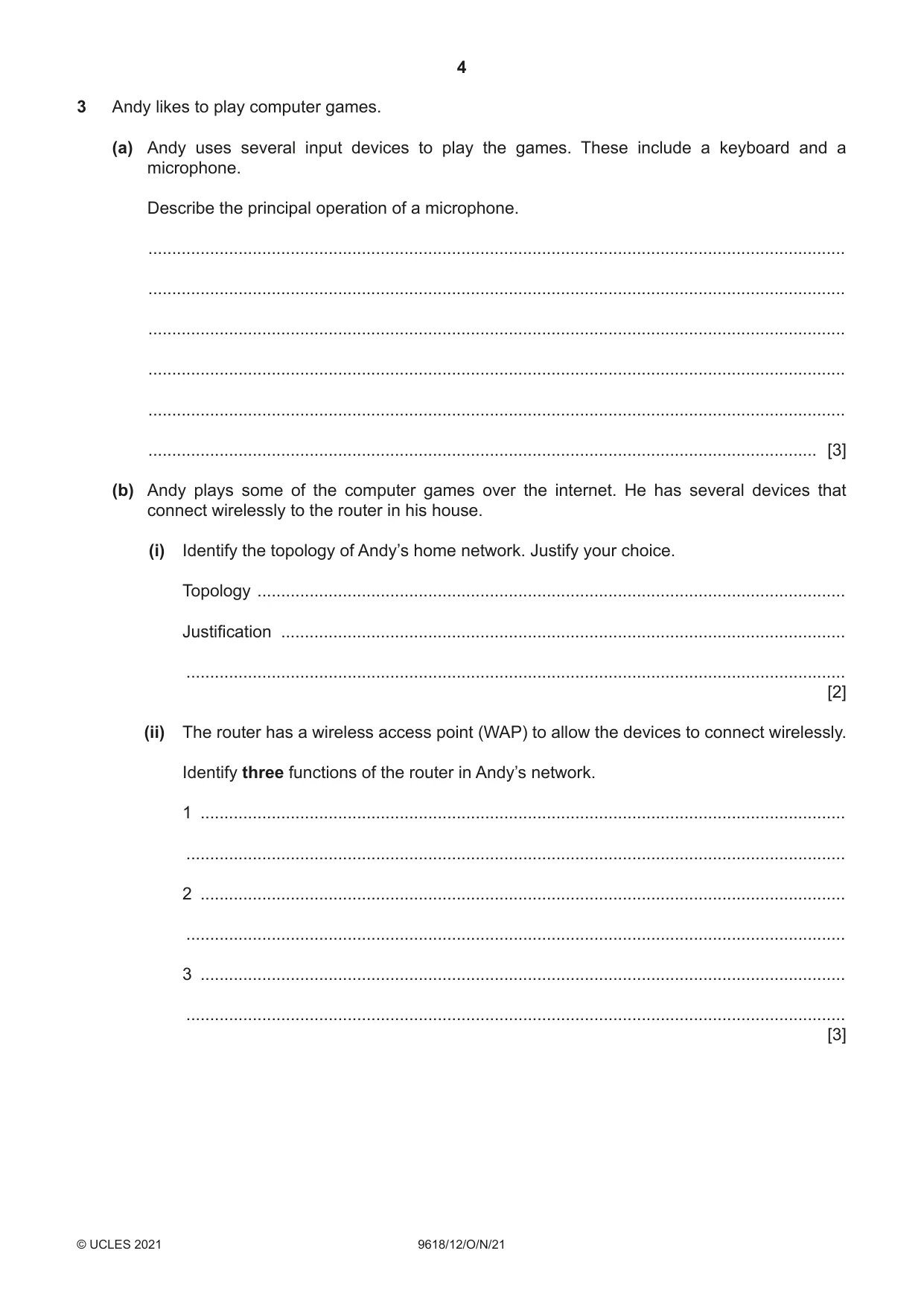
4 9618/12/O/N/21 © UCLES 2021 3 Andy likes to play computer games. (a) Andy uses several input devices to play the games. These include a keyboard and a microphone. Describe the principal operation of a microphone. … … … … … … [3] (b) Andy plays some of the computer games over the internet. He has several devices that connect wirelessly to the router in his house. (i) Identify the topology of Andy’s home network. Justify your choice. Topology … Justification … … [2] (ii) The router has a wireless access point (WAP) to allow the devices to connect wirelessly. Identify three functions of the router in Andy’s network. 1 … … 2 … … 3 … … [3]
Question paper, page 5
5 9618/12/O/N/21 © UCLES 2021 [Turn over BLANK PAGE
Question paper, page 6
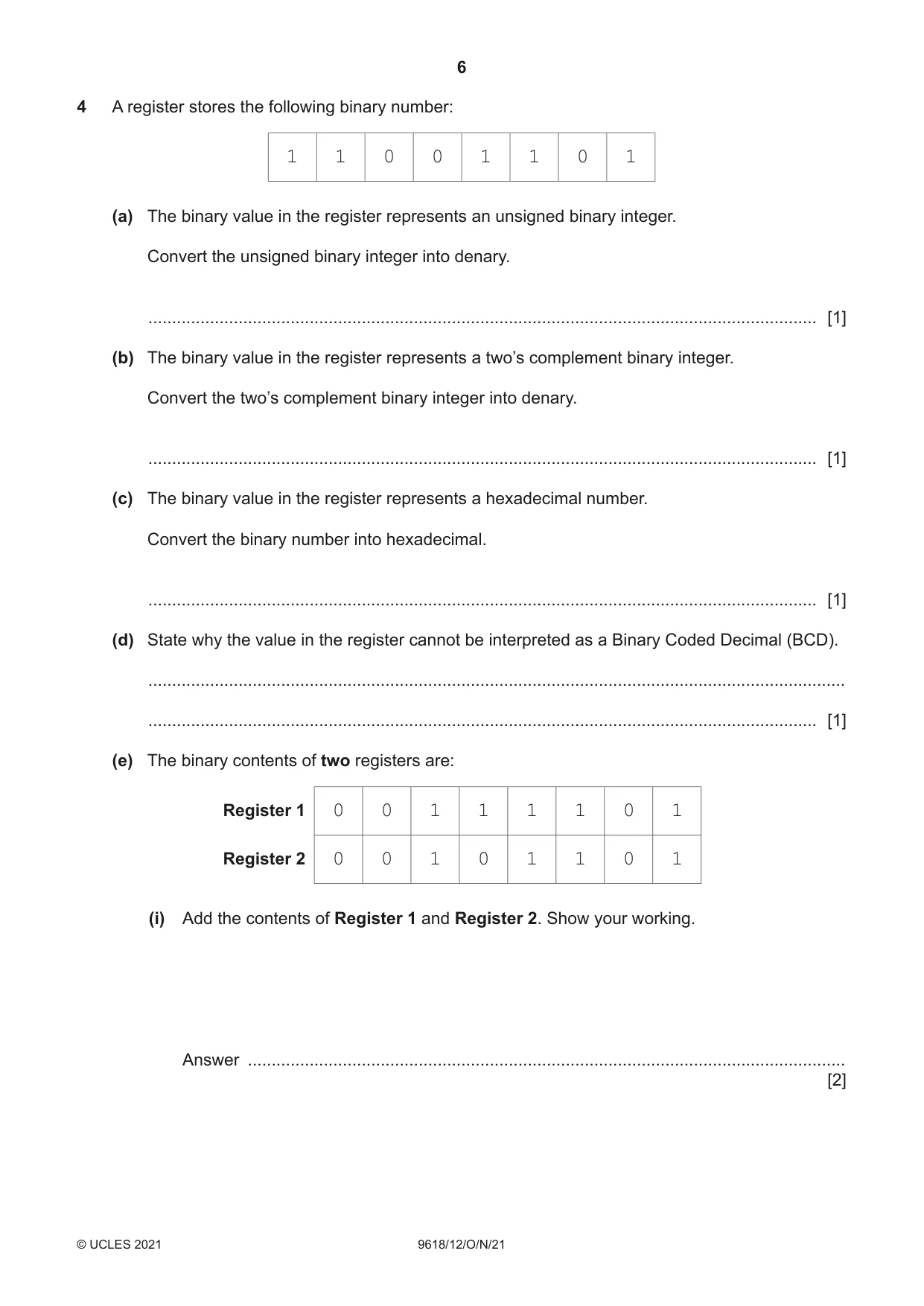
6 9618/12/O/N/21 © UCLES 2021 4 A register stores the following binary number: 1 1 0 0 1 1 0 1 (a) The binary value in the register represents an unsigned binary integer. Convert the unsigned binary integer into denary. … [1] (b) The binary value in the register represents a two’s complement binary integer. Convert the two’s complement binary integer into denary. … [1] (c) The binary value in the register represents a hexadecimal number. Convert the binary number into hexadecimal. … [1] (d) State why the value in the register cannot be interpreted as a Binary Coded Decimal (BCD). … … [1] (e) The binary contents of two registers are: Register 1 0 0 1 1 1 1 0 1 Register 2 0 0 1 0 1 1 0 1 (i) Add the contents of Register 1 and Register 2. Show your working. Answer … [2]
Question paper, page 7
7 9618/12/O/N/21 © UCLES 2021 [Turn over (ii) Subtract the contents of Register 2 from the contents of Register 1. Show your working. Answer … [2]
Question paper, page 8
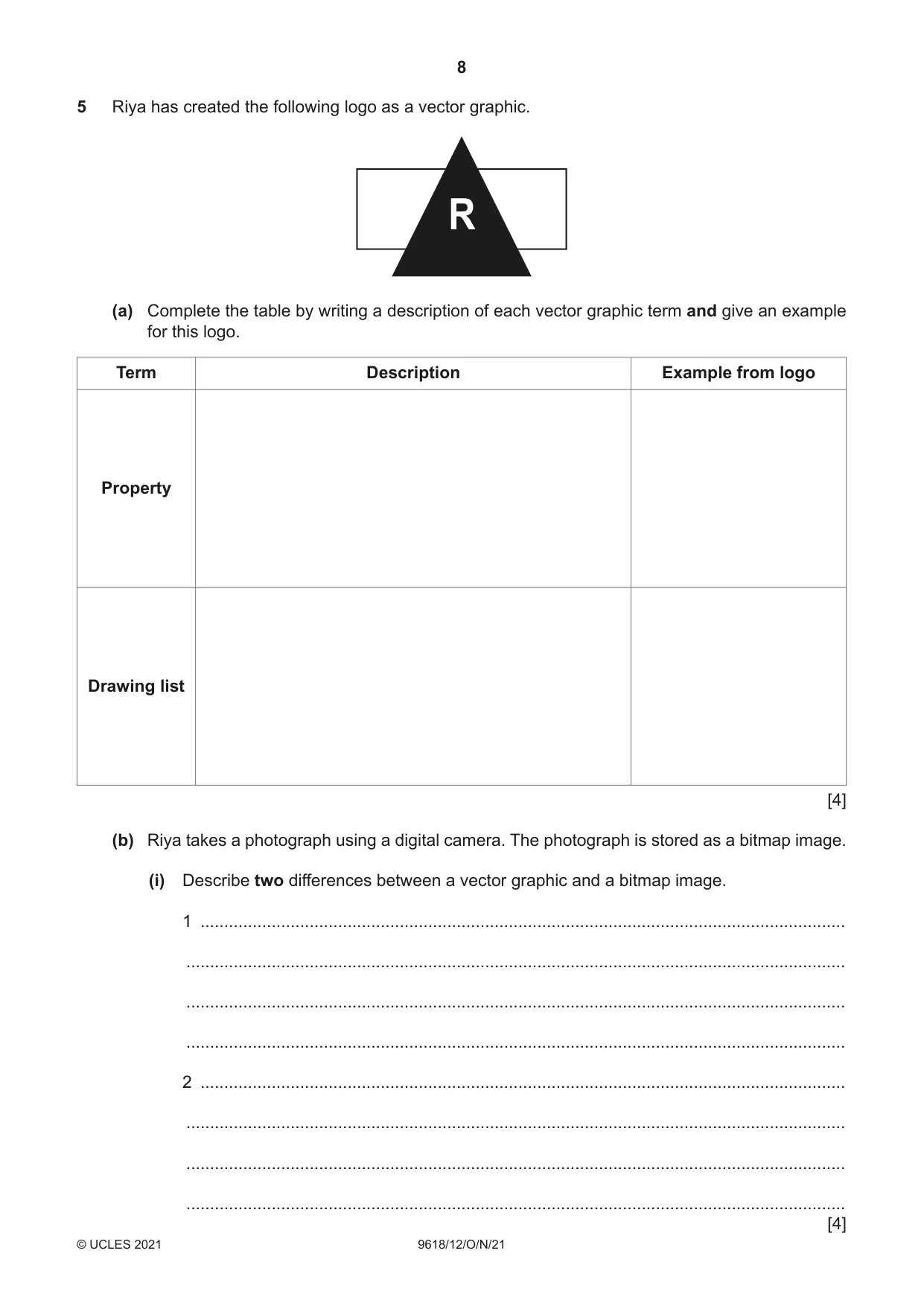
8 9618/12/O/N/21 © UCLES 2021 5 Riya has created the following logo as a vector graphic. R (a) Complete the table by writing a description of each vector graphic term and give an example for this logo. Term Description Example from logo Property Drawing list [4] (b) Riya takes a photograph using a digital camera. The photograph is stored as a bitmap image. (i) Describe two differences between a vector graphic and a bitmap image. 1 … … … … 2 … … … … [4]
Question paper, page 9
9 9618/12/O/N/21 © UCLES 2021 [Turn over (ii) Riya needs to email the photograph. She compresses the photograph before sending it using an email. Describe two lossy methods that Riya can use to compress the image. Method 1 … … … … Method 2 … … … … [4]
Question paper, page 10
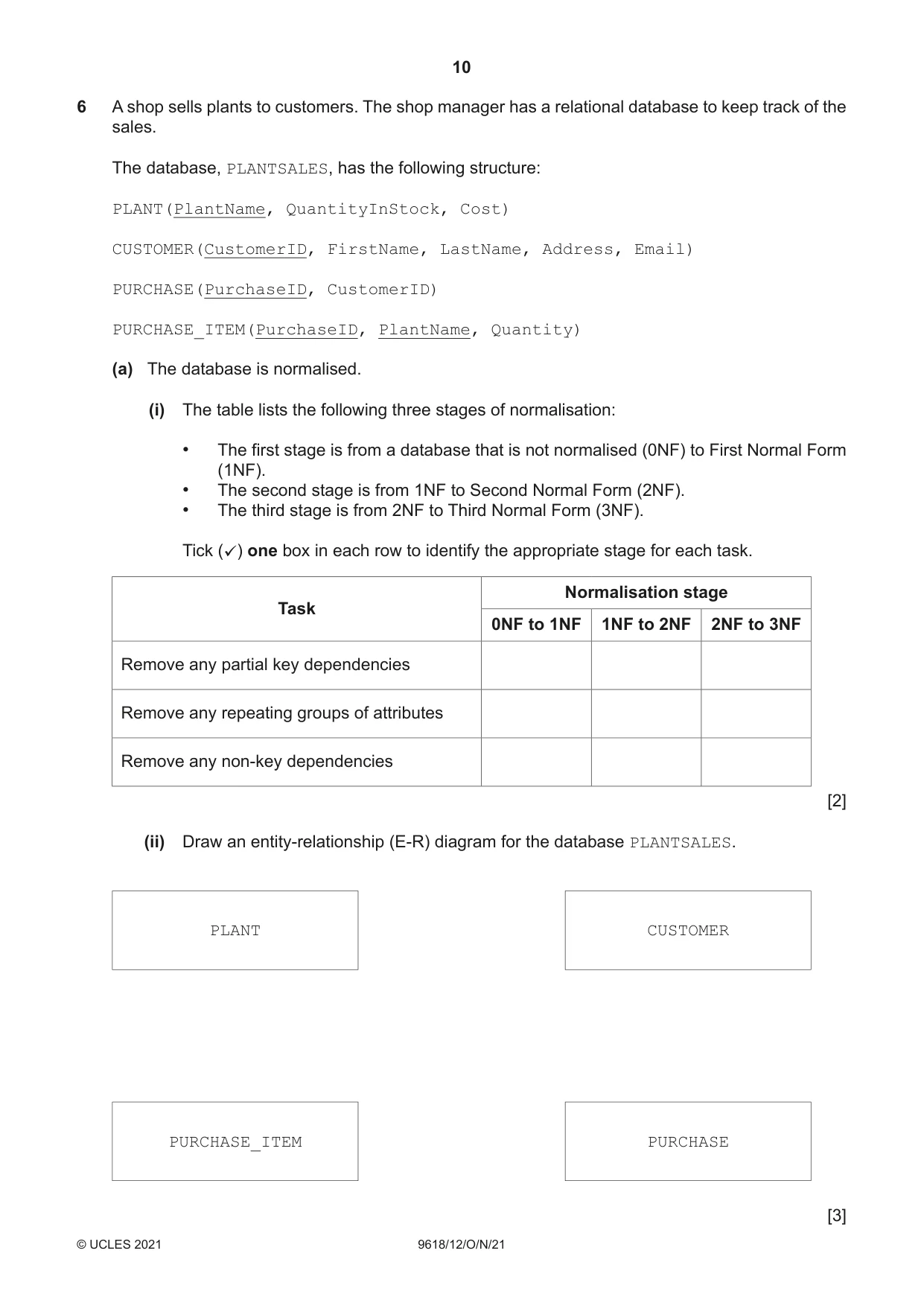
10 9618/12/O/N/21 © UCLES 2021 6 A shop sells plants to customers. The shop manager has a relational database to keep track of the sales. The database, PLANTSALES, has the following structure: PLANT(PlantName, QuantityInStock, Cost) CUSTOMER(CustomerID, FirstName, LastName, Address, Email) PURCHASE(PurchaseID, CustomerID) PURCHASE_ITEM(PurchaseID, PlantName, Quantity) (a) The database is normalised. (i) The table lists the following three stages of normalisation: • The first stage is from a database that is not normalised (0NF) to First Normal Form (1NF). • The second stage is from 1NF to Second Normal Form (2NF). • The third stage is from 2NF to Third Normal Form (3NF). Tick () one box in each row to identify the appropriate stage for each task. Task Normalisation stage 0NF to 1NF 1NF to 2NF 2NF to 3NF Remove any partial key dependencies Remove any repeating groups of attributes Remove any non-key dependencies [2] (ii) Draw an entity-relationship (E-R) diagram for the database PLANTSALES. PLANT PURCHASE_ITEM PURCHASE CUSTOMER [3]
Question paper, page 11
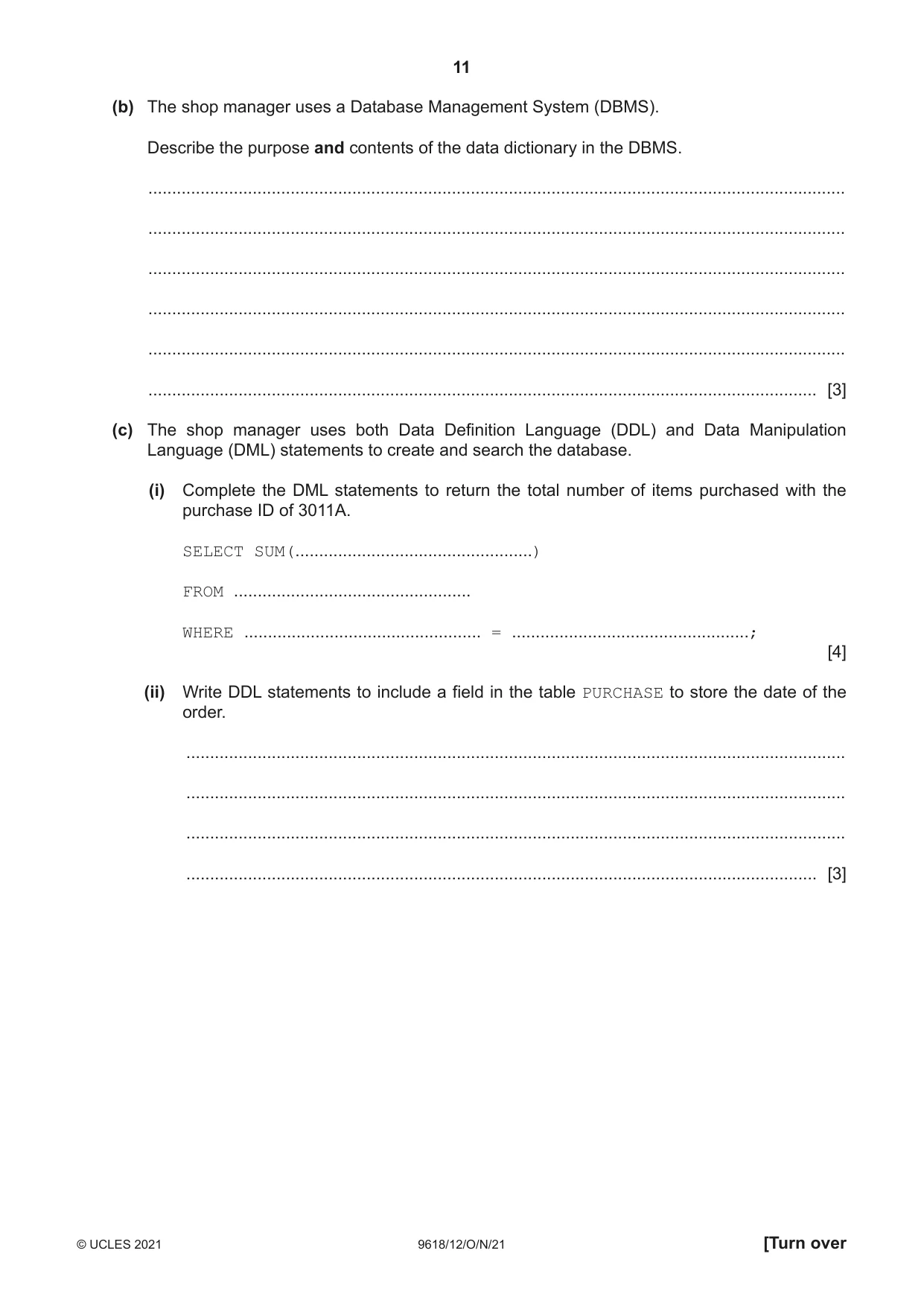
11 9618/12/O/N/21 © UCLES 2021 [Turn over (b) The shop manager uses a Database Management System (DBMS). Describe the purpose and contents of the data dictionary in the DBMS. … … … … … … [3] (c) The shop manager uses both Data Definition Language (DDL) and Data Manipulation Language (DML) statements to create and search the database. (i) Complete the DML statements to return the total number of items purchased with the purchase ID of 3011A. SELECT SUM(…) FROM … WHERE … = …; [4] (ii) Write DDL statements to include a field in the table PURCHASE to store the date of the order. … … … … [3]
Question paper, page 12
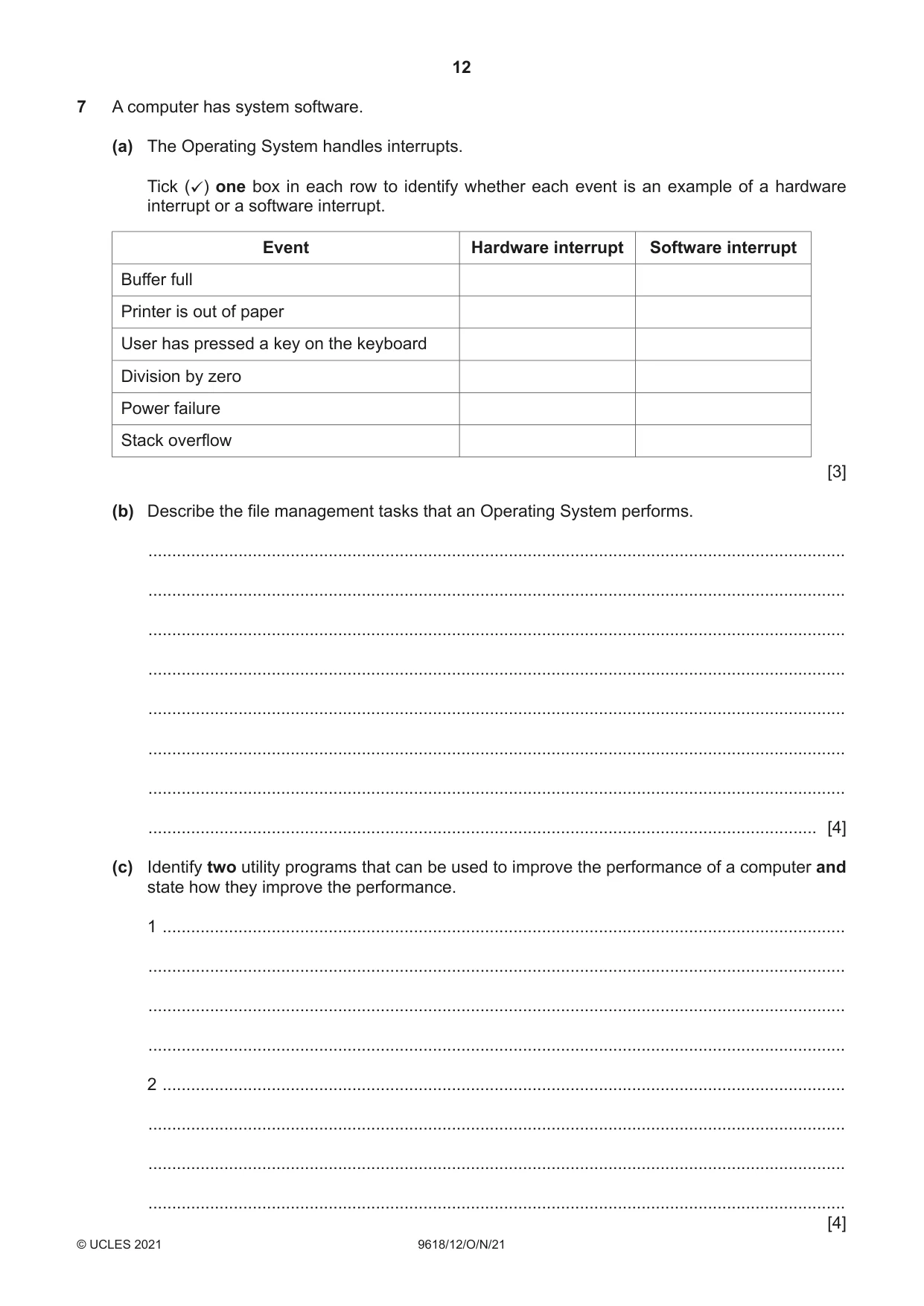
12 9618/12/O/N/21 © UCLES 2021 7 A computer has system software. (a) The Operating System handles interrupts. Tick () one box in each row to identify whether each event is an example of a hardware interrupt or a software interrupt. Event Hardware interrupt Software interrupt Buffer full Printer is out of paper User has pressed a key on the keyboard Division by zero Power failure Stack overflow [3] (b) Describe the file management tasks that an Operating System performs. … … … … … … … … [4] (c) Identify two utility programs that can be used to improve the performance of a computer and state how they improve the performance. 1 … … … … 2 … … … … [4]
Question paper, page 13
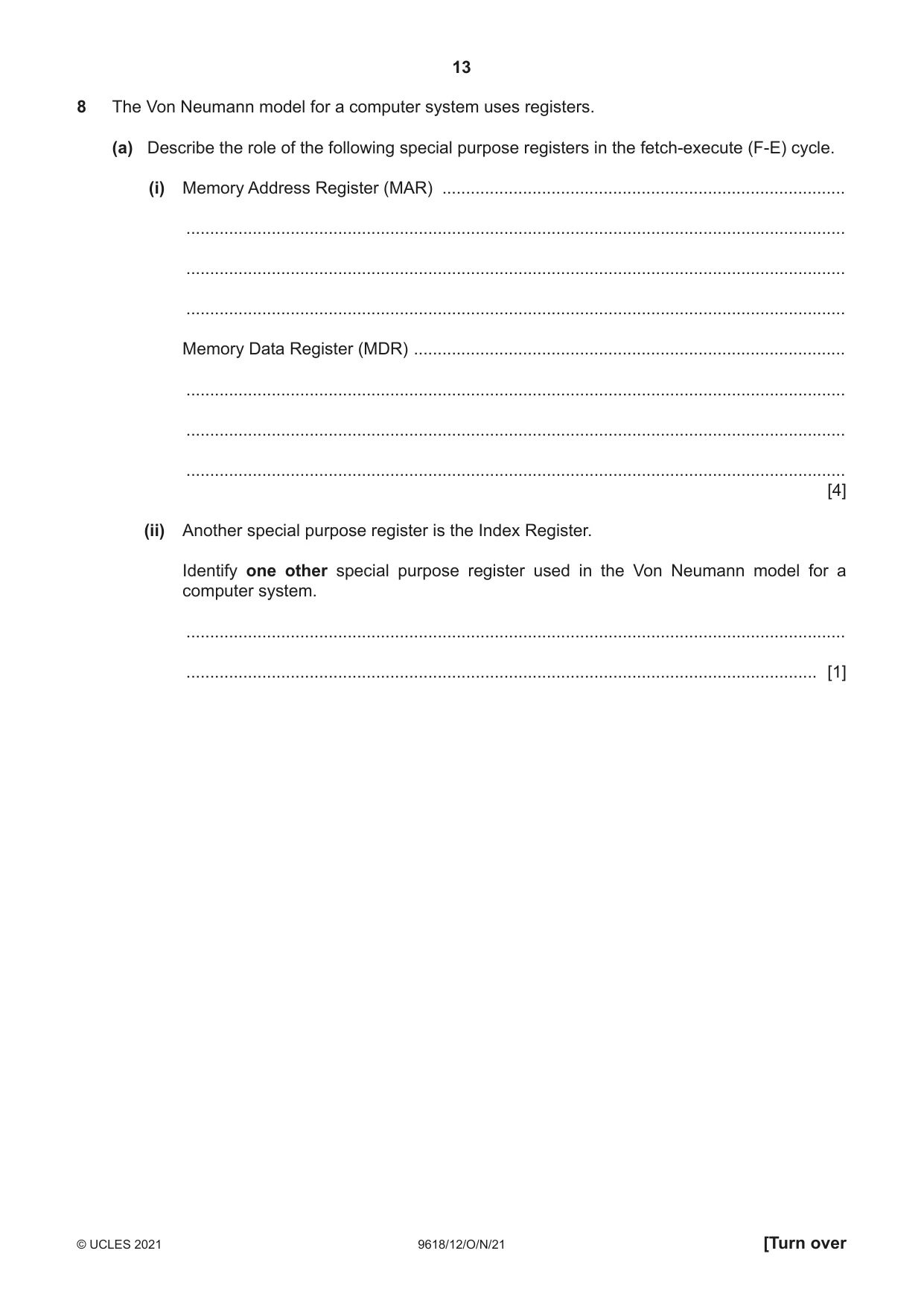
13 9618/12/O/N/21 © UCLES 2021 [Turn over 8 The Von Neumann model for a computer system uses registers. (a) Describe the role of the following special purpose registers in the fetch-execute (F-E) cycle. (i) Memory Address Register (MAR) … … … … Memory Data Register (MDR) … … … … [4] (ii) Another special purpose register is the Index Register. Identify one other special purpose register used in the Von Neumann model for a computer system. … … [1]
Question paper, page 14
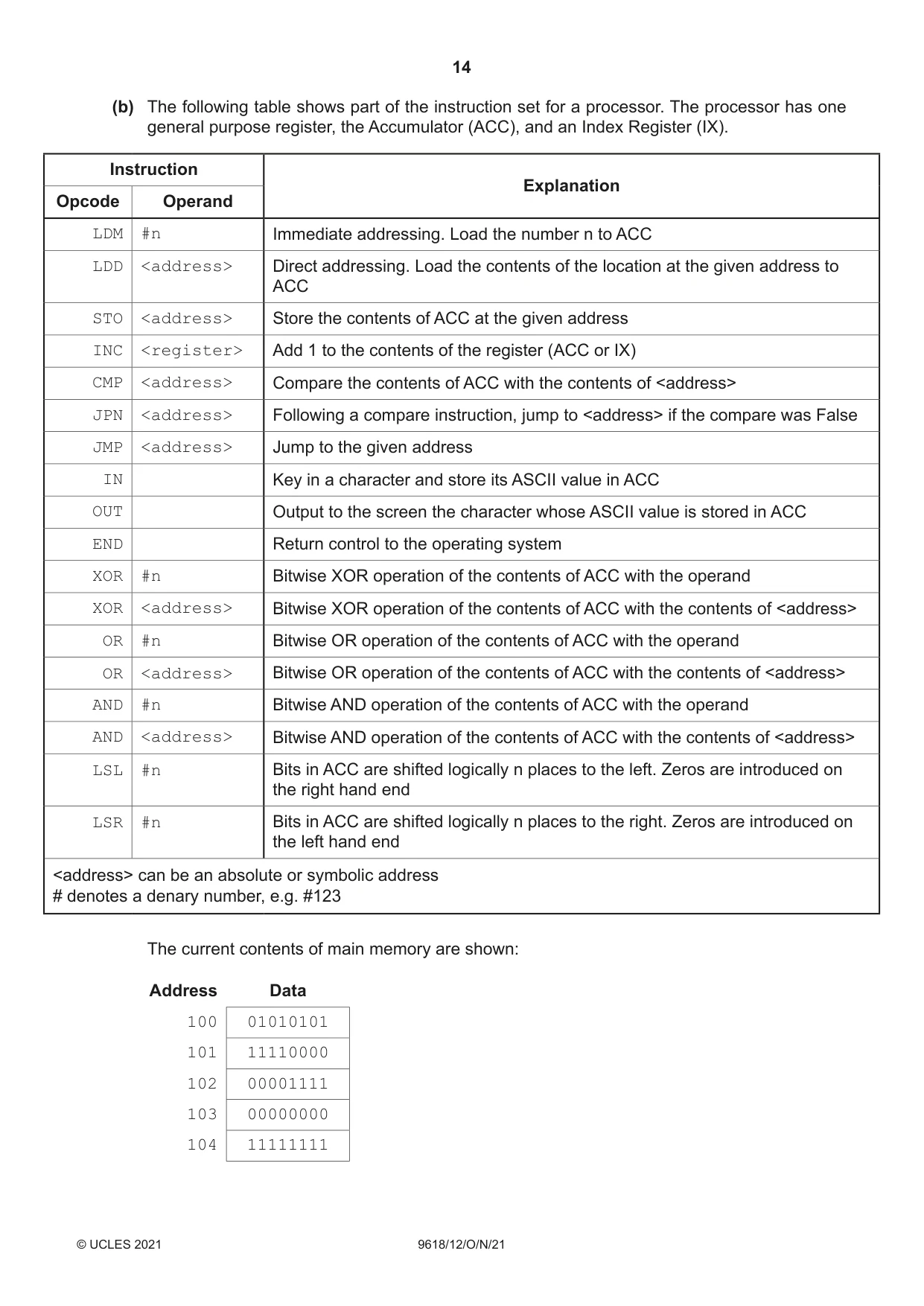
14 9618/12/O/N/21 © UCLES 2021 (b) The following table shows part of the instruction set for a processor. The processor has one general purpose register, the Accumulator (ACC), and an Index Register (IX). Instruction Explanation Opcode Operand LDM #n Immediate addressing. Load the number n to ACC LDD <address> Direct addressing. Load the contents of the location at the given address to ACC STO <address> Store the contents of ACC at the given address INC <register> Add 1 to the contents of the register (ACC or IX) CMP <address> Compare the contents of ACC with the contents of <address> JPN <address> Following a compare instruction, jump to <address> if the compare was False JMP <address> Jump to the given address IN Key in a character and store its ASCII value in ACC OUT Output to the screen the character whose ASCII value is stored in ACC END Return control to the operating system XOR #n Bitwise XOR operation of the contents of ACC with the operand XOR <address> Bitwise XOR operation of the contents of ACC with the contents of <address> OR #n Bitwise OR operation of the contents of ACC with the operand OR <address> Bitwise OR operation of the contents of ACC with the contents of <address> AND #n Bitwise AND operation of the contents of ACC with the operand AND <address> Bitwise AND operation of the contents of ACC with the contents of <address> LSL #n Bits in ACC are shifted logically n places to the left. Zeros are introduced on the right hand end LSR #n Bits in ACC are shifted logically n places to the right. Zeros are introduced on the left hand end <address> can be an absolute or symbolic address # denotes a denary number, e.g. #123 The current contents of main memory are shown: Address Data 100 01010101 101 11110000 102 00001111 103 00000000 104 11111111
Question paper, page 15
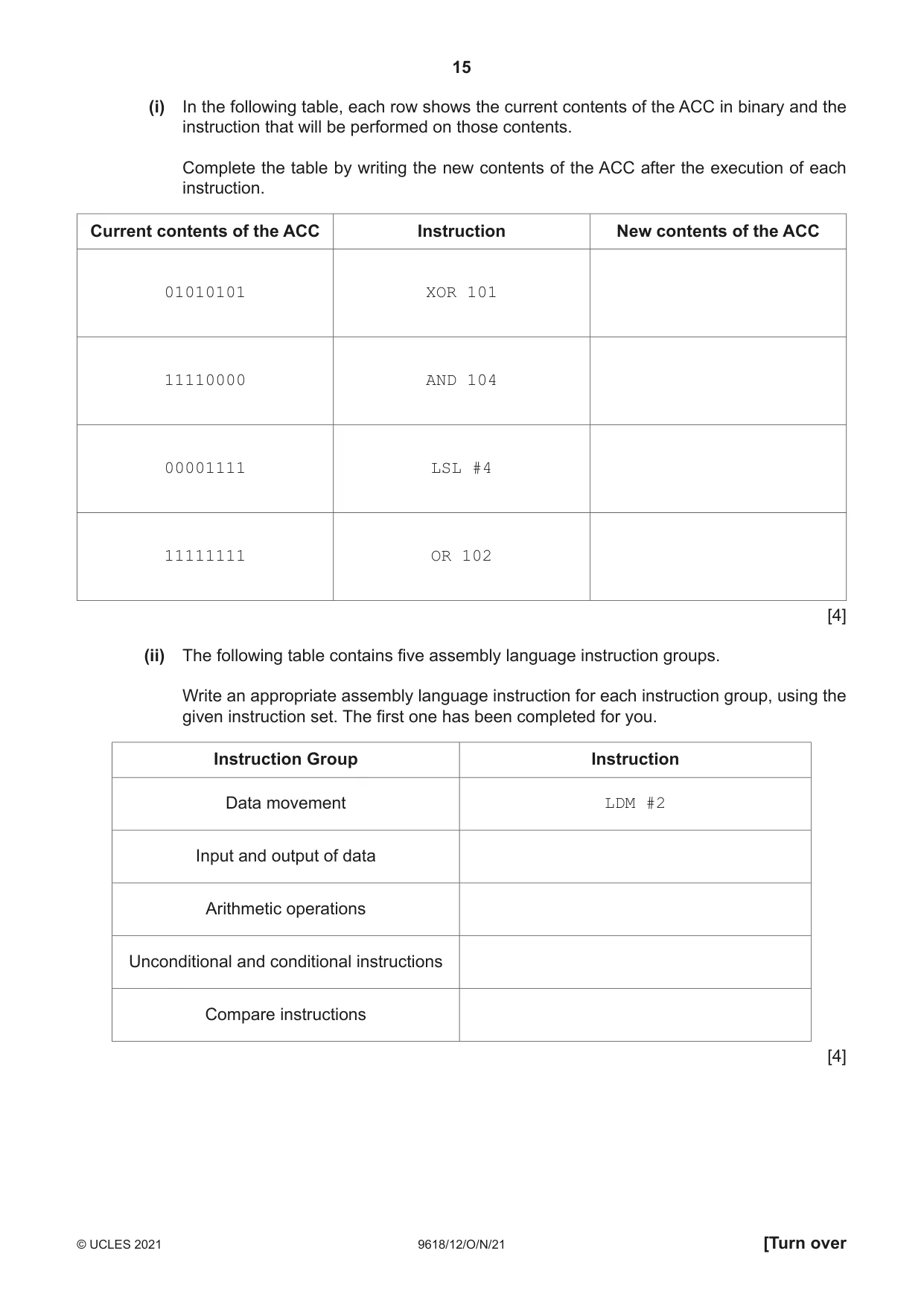
15 9618/12/O/N/21 © UCLES 2021 [Turn over (i) In the following table, each row shows the current contents of the ACC in binary and the instruction that will be performed on those contents. Complete the table by writing the new contents of the ACC after the execution of each instruction. Current contents of the ACC Instruction New contents of the ACC 01010101 XOR 101 11110000 AND 104 00001111 LSL #4 11111111 OR 102 [4] (ii) The following table contains five assembly language instruction groups. Write an appropriate assembly language instruction for each instruction group, using the given instruction set. The first one has been completed for you. Instruction Group Instruction Data movement LDM #2 Input and output of data Arithmetic operations Unconditional and conditional instructions Compare instructions [4]
Question paper, page 16
16 9618/12/O/N/21 © UCLES 2021 Permission to reproduce items where third-party owned material protected by copyright is included has been sought and cleared where possible. Every reasonable effort has been made by the publisher (UCLES) to trace copyright holders, but if any items requiring clearance have unwittingly been included, the publisher will be pleased to make amends at the earliest possible opportunity. To avoid the issue of disclosure of answer-related information to candidates, all copyright acknowledgements are reproduced online in the Cambridge Assessment International Education Copyright Acknowledgements Booklet. This is produced for each series of examinations and is freely available to download at www.cambridgeinternational.org after the live examination series. Cambridge Assessment International Education is part of the Cambridge Assessment Group. Cambridge Assessment is the brand name of the University of Cambridge Local Examinations Syndicate (UCLES), which itself is a department of the University of Cambridge. (iii) The opcode LDM uses immediate addressing. The opcode LDD uses direct addressing. Identify and describe one additional mode of addressing. Mode of addressing … Description … … … [2]
Mark scheme, page 1
This document consists of 10 printed pages. © UCLES 2021 [Turn over Cambridge International AS & A Level COMPUTER SCIENCE 9618/12 Paper 1 Theory Fundamentals October/November 2021 MARK SCHEME Maximum Mark: 75 Published This mark scheme is published as an aid to teachers and candidates, to indicate the requirements of the examination. It shows the basis on which Examiners were instructed to award marks. It does not indicate the details of the discussions that took place at an Examiners’ meeting before marking began, which would have considered the acceptability of alternative answers. Mark schemes should be read in conjunction with the question paper and the Principal Examiner Report for Teachers. Cambridge International will not enter into discussions about these mark schemes. Cambridge International is publishing the mark schemes for the October/November 2021 series for most Cambridge IGCSE™, Cambridge International A and AS Level components and some Cambridge O Level components.
Mark scheme, page 2
9618/12 Cambridge International AS & A Level – Mark Scheme PUBLISHED October/November 2021 © UCLES 2021 Page 2 of 10 Generic Marking Principles These general marking principles must be applied by all examiners when marking candidate answers. They should be applied alongside the specific content of the mark scheme or generic level descriptors for a question. Each question paper and mark scheme will also comply with these marking principles. GENERIC MARKING PRINCIPLE 1: Marks must be awarded in line with: • the specific content of the mark scheme or the generic level descriptors for the question • the specific skills defined in the mark scheme or in the generic level descriptors for the question • the standard of response required by a candidate as exemplified by the standardisation scripts. GENERIC MARKING PRINCIPLE 2: Marks awarded are always whole marks (not half marks, or other fractions). GENERIC MARKING PRINCIPLE 3: Marks must be awarded positively: • marks are awarded for correct/valid answers, as defined in the mark scheme. However, credit is given for valid answers which go beyond the scope of the syllabus and mark scheme, referring to your Team Leader as appropriate • marks are awarded when candidates clearly demonstrate what they know and can do • marks are not deducted for errors • marks are not deducted for omissions • answers should only be judged on the quality of spelling, punctuation and grammar when these features are specifically assessed by the question as indicated by the mark scheme. The meaning, however, should be unambiguous. GENERIC MARKING PRINCIPLE 4: Rules must be applied consistently, e.g. in situations where candidates have not followed instructions or in the application of generic level descriptors. GENERIC MARKING PRINCIPLE 5: Marks should be awarded using the full range of marks defined in the mark scheme for the question (however; the use of the full mark range may be limited according to the quality of the candidate responses seen). GENERIC MARKING PRINCIPLE 6: Marks awarded are based solely on the requirements as defined in the mark scheme. Marks should not be awarded with grade thresholds or grade descriptors in mind.
Mark scheme, page 3
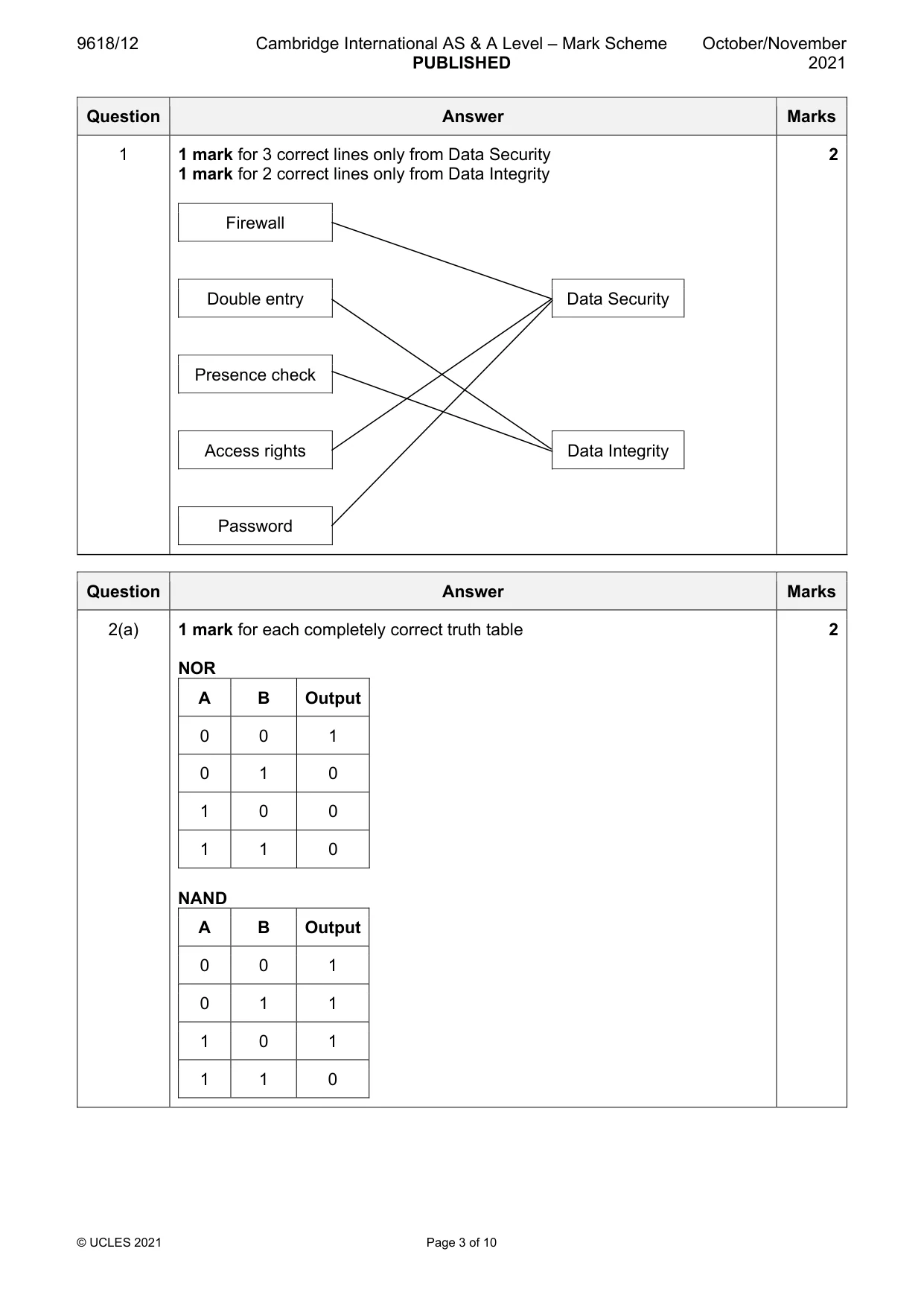
9618/12 Cambridge International AS & A Level – Mark Scheme PUBLISHED October/November 2021 © UCLES 2021 Page 3 of 10 Question Answer Marks 1 1 mark for 3 correct lines only from Data Security 1 mark for 2 correct lines only from Data Integrity Firewall Double entry Data Security Presence check Access rights Data Integrity Password 2 Question Answer Marks 2(a) 1 mark for each completely correct truth table NOR A B Output 0 0 1 0 1 0 1 0 0 1 1 0 NAND A B Output 0 0 1 0 1 1 1 0 1 1 1 0 2
Mark scheme, page 4
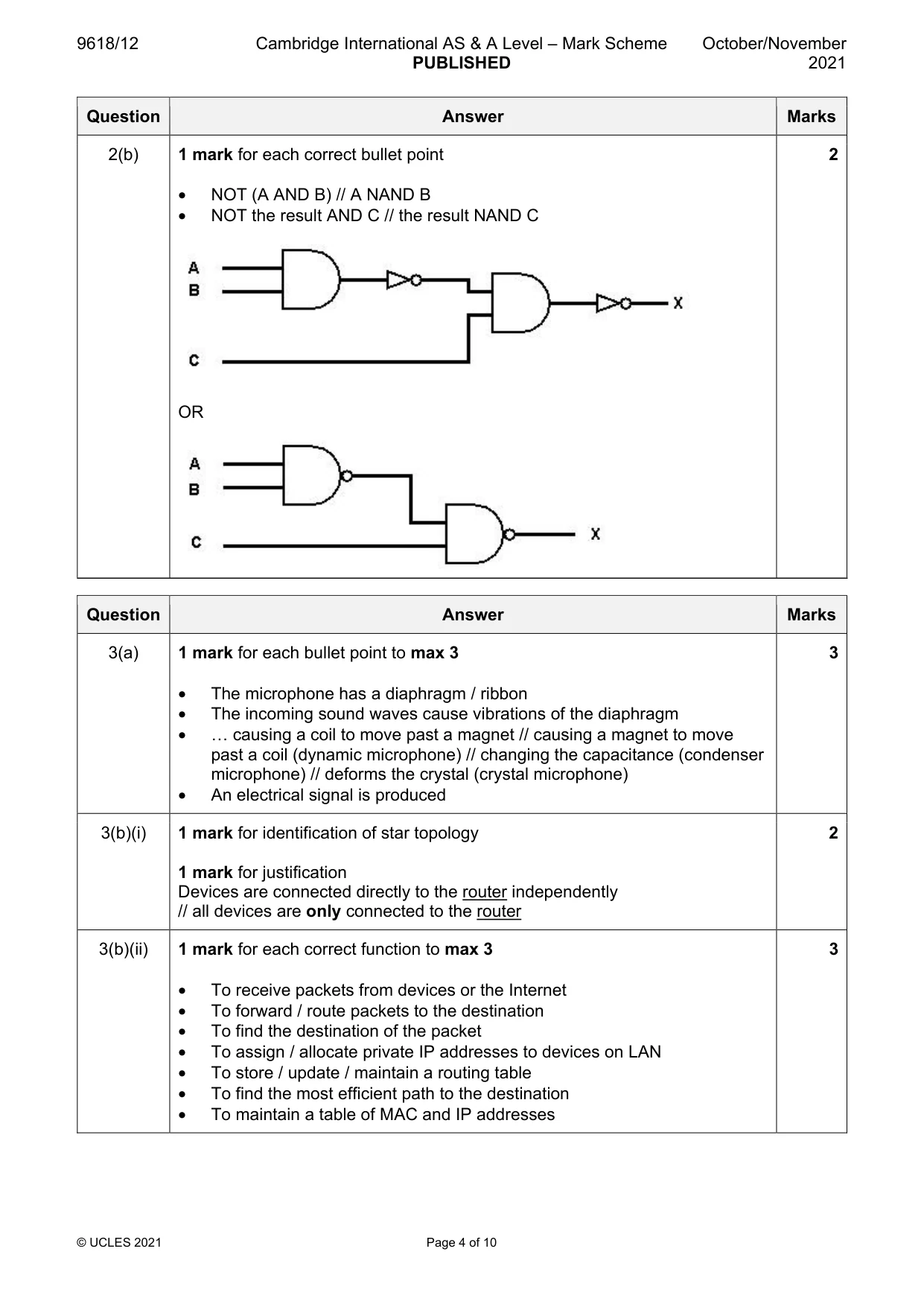
9618/12 Cambridge International AS & A Level – Mark Scheme PUBLISHED October/November 2021 © UCLES 2021 Page 4 of 10 Question Answer Marks 2(b) 1 mark for each correct bullet point • NOT (A AND B) // A NAND B • NOT the result AND C // the result NAND C OR 2 Question Answer Marks 3(a) 1 mark for each bullet point to max 3 • The microphone has a diaphragm / ribbon • The incoming sound waves cause vibrations of the diaphragm • … causing a coil to move past a magnet // causing a magnet to move past a coil (dynamic microphone) // changing the capacitance (condenser microphone) // deforms the crystal (crystal microphone) • An electrical signal is produced 3 3(b)(i) 1 mark for identification of star topology 1 mark for justification Devices are connected directly to the router independently // all devices are only connected to the router 2 3(b)(ii) 1 mark for each correct function to max 3 • To receive packets from devices or the Internet • To forward / route packets to the destination • To find the destination of the packet • To assign / allocate private IP addresses to devices on LAN • To store / update / maintain a routing table • To find the most efficient path to the destination • To maintain a table of MAC and IP addresses 3
Mark scheme, page 5
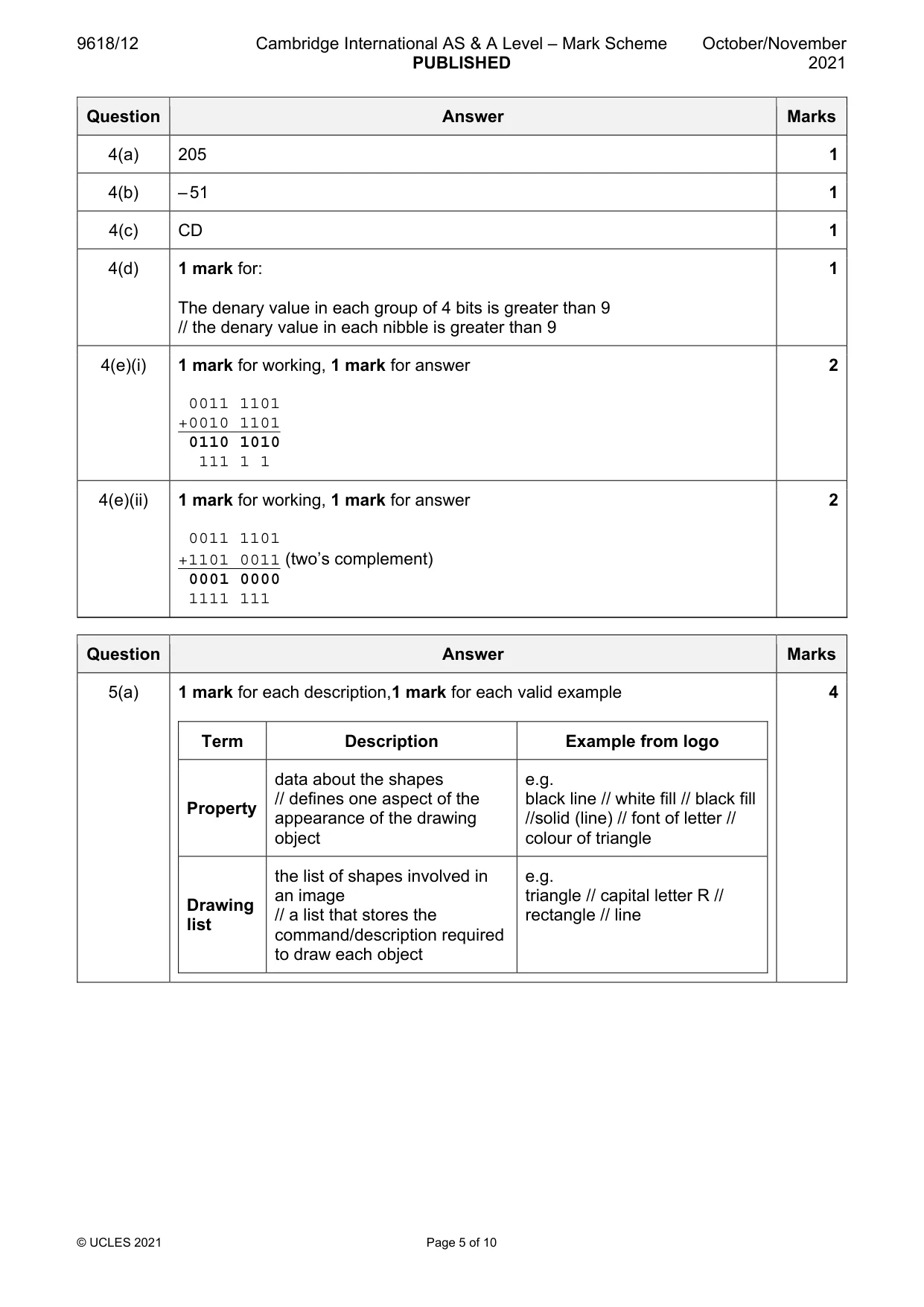
9618/12 Cambridge International AS & A Level – Mark Scheme PUBLISHED October/November 2021 © UCLES 2021 Page 5 of 10 Question Answer Marks 4(a) 205 1 4(b) – 51 1 4(c) CD 1 4(d) 1 mark for: The denary value in each group of 4 bits is greater than 9 // the denary value in each nibble is greater than 9 1 4(e)(i) 1 mark for working, 1 mark for answer 0011 1101 +0010 1101 0110 1010 111 1 1 2 4(e)(ii) 1 mark for working, 1 mark for answer 0011 1101 +1101 0011 (two’s complement) 0001 0000 1111 111 2 Question Answer Marks 5(a) 1 mark for each description,1 mark for each valid example Term Description Example from logo Property data about the shapes // defines one aspect of the appearance of the drawing object e.g. black line // white fill // black fill //solid (line) // font of letter // colour of triangle Drawing list the list of shapes involved in an image // a list that stores the command/description required to draw each object e.g. triangle // capital letter R // rectangle // line 4
Mark scheme, page 6
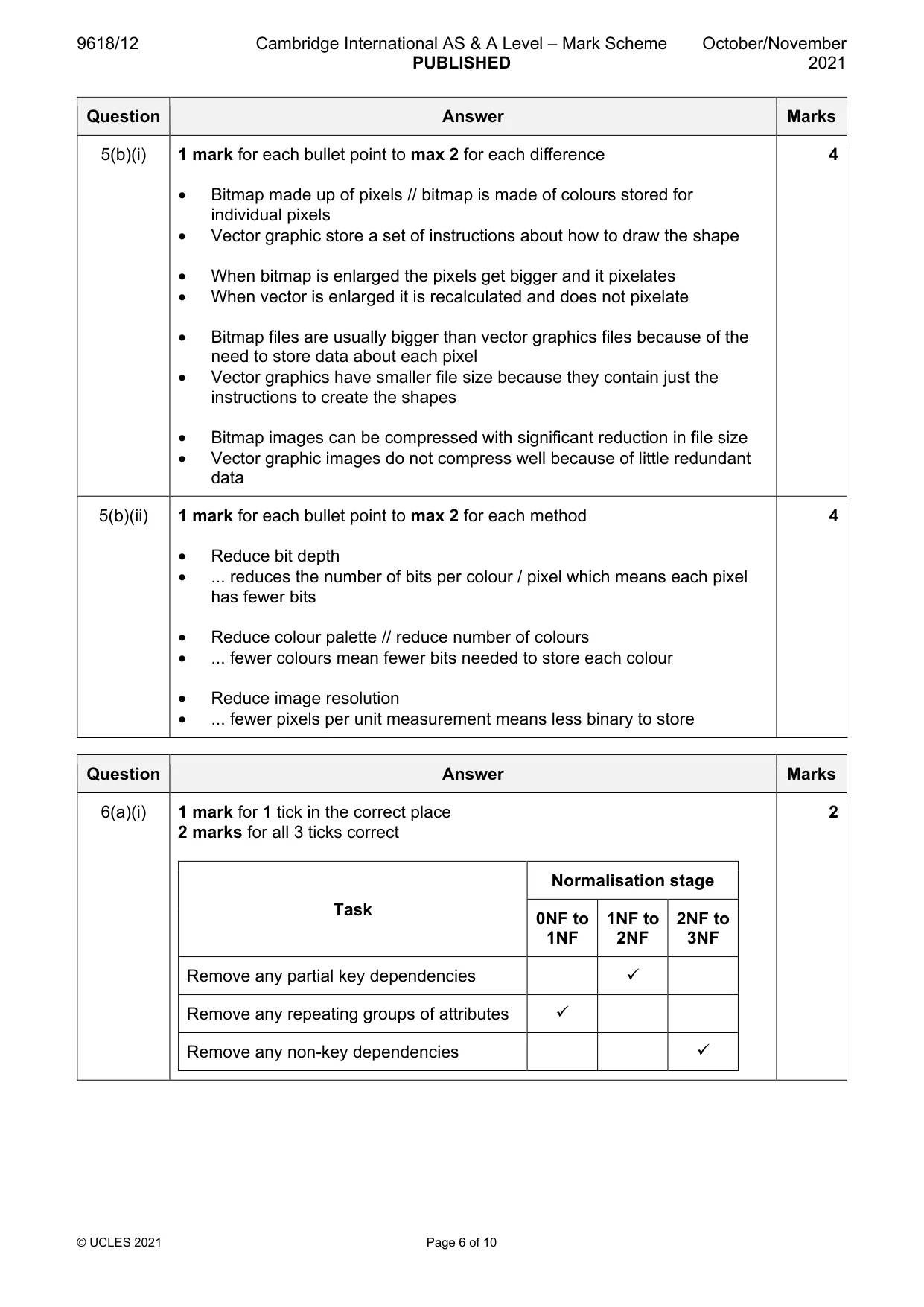
9618/12 Cambridge International AS & A Level – Mark Scheme PUBLISHED October/November 2021 © UCLES 2021 Page 6 of 10 Question Answer Marks 5(b)(i) 1 mark for each bullet point to max 2 for each difference • Bitmap made up of pixels // bitmap is made of colours stored for individual pixels • Vector graphic store a set of instructions about how to draw the shape • When bitmap is enlarged the pixels get bigger and it pixelates • When vector is enlarged it is recalculated and does not pixelate • Bitmap files are usually bigger than vector graphics files because of the need to store data about each pixel • Vector graphics have smaller file size because they contain just the instructions to create the shapes • Bitmap images can be compressed with significant reduction in file size • Vector graphic images do not compress well because of little redundant data 4 5(b)(ii) 1 mark for each bullet point to max 2 for each method • Reduce bit depth • ... reduces the number of bits per colour / pixel which means each pixel has fewer bits • Reduce colour palette // reduce number of colours • ... fewer colours mean fewer bits needed to store each colour • Reduce image resolution • ... fewer pixels per unit measurement means less binary to store 4 Question Answer Marks 6(a)(i) 1 mark for 1 tick in the correct place 2 marks for all 3 ticks correct Task Normalisation stage 0NF to 1NF 1NF to 2NF 2NF to 3NF Remove any partial key dependencies Remove any repeating groups of attributes Remove any non-key dependencies 2
Mark scheme, page 7
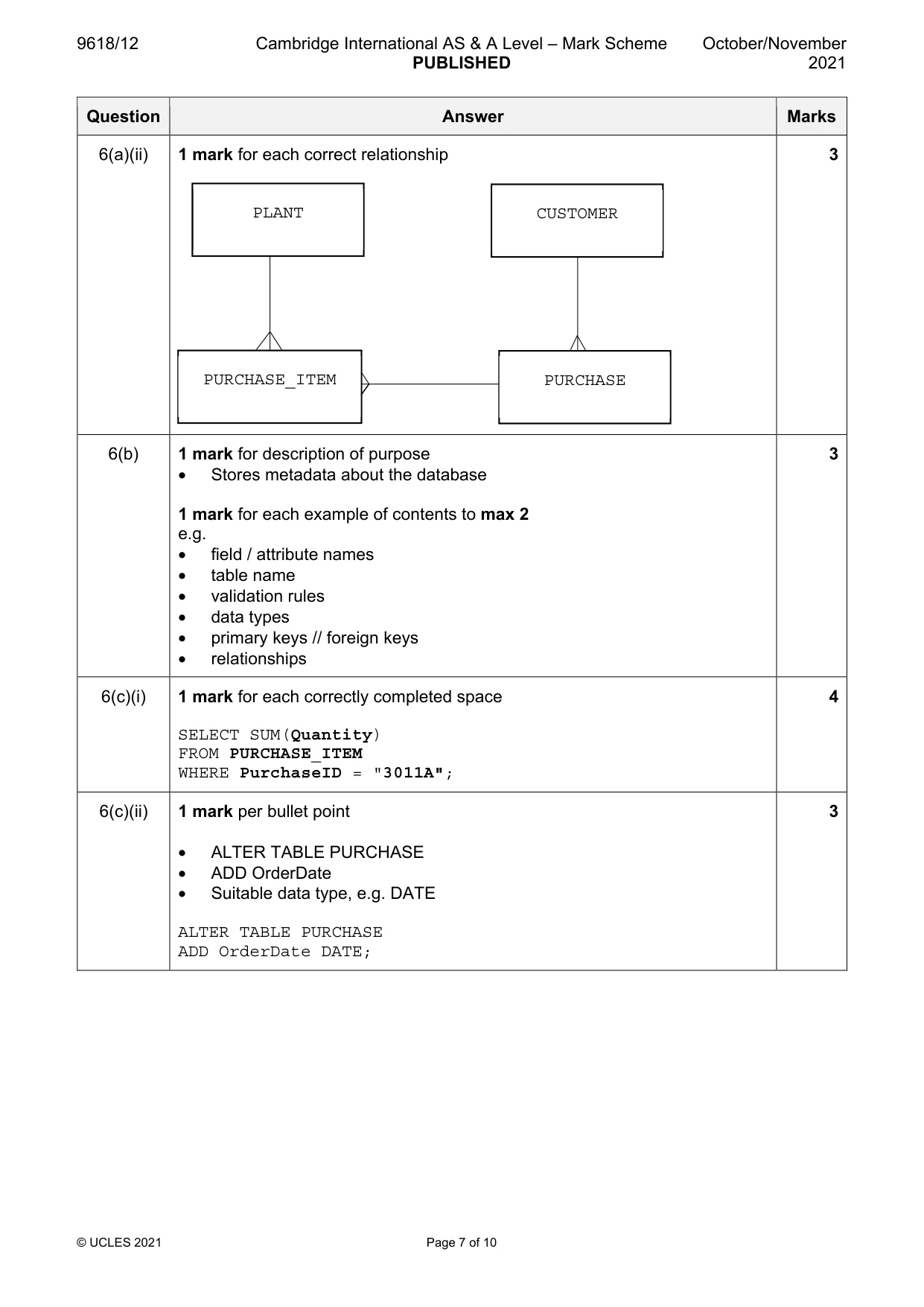
9618/12 Cambridge International AS & A Level – Mark Scheme PUBLISHED October/November 2021 © UCLES 2021 Page 7 of 10 Question Answer Marks 6(a)(ii) 1 mark for each correct relationship 3 6(b) 1 mark for description of purpose • Stores metadata about the database 1 mark for each example of contents to max 2 e.g. • field / attribute names • table name • validation rules • data types • primary keys // foreign keys • relationships 3 6(c)(i) 1 mark for each correctly completed space SELECT SUM(Quantity) FROM PURCHASE_ITEM WHERE PurchaseID = "3011A"; 4 6(c)(ii) 1 mark per bullet point • ALTER TABLE PURCHASE • ADD OrderDate • Suitable data type, e.g. DATE ALTER TABLE PURCHASE ADD OrderDate DATE; 3 PLANT PURCHASE_ITEM CUSTOMER PURCHASE
Mark scheme, page 8
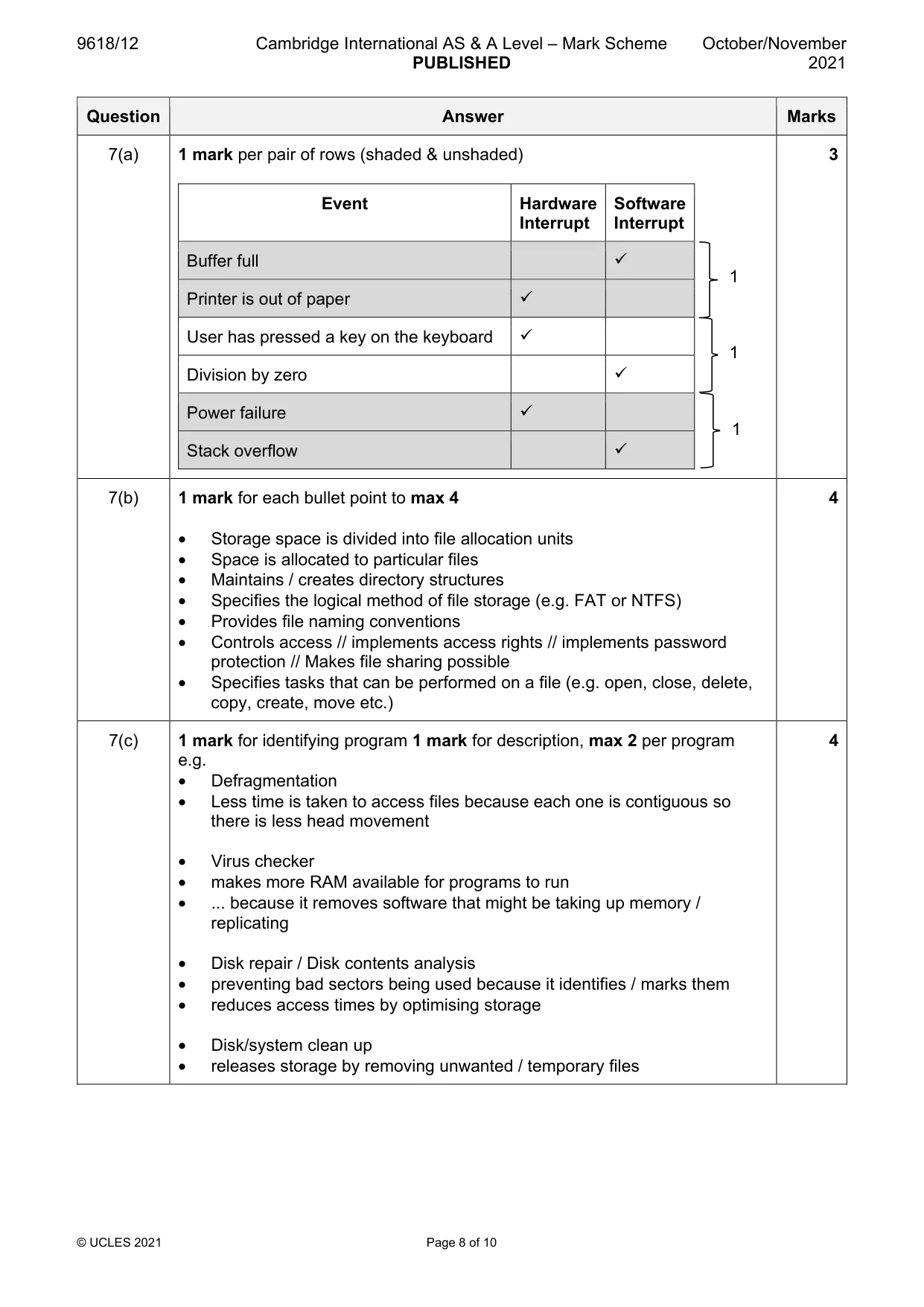
9618/12 Cambridge International AS & A Level – Mark Scheme PUBLISHED October/November 2021 © UCLES 2021 Page 8 of 10 Question Answer Marks 7(a) 1 mark per pair of rows (shaded & unshaded) Event Hardware Interrupt Software Interrupt Buffer full Printer is out of paper User has pressed a key on the keyboard Division by zero Power failure Stack overflow 3 7(b) 1 mark for each bullet point to max 4 • Storage space is divided into file allocation units • Space is allocated to particular files • Maintains / creates directory structures • Specifies the logical method of file storage (e.g. FAT or NTFS) • Provides file naming conventions • Controls access // implements access rights // implements password protection // Makes file sharing possible • Specifies tasks that can be performed on a file (e.g. open, close, delete, copy, create, move etc.) 4 7(c) 1 mark for identifying program 1 mark for description, max 2 per program e.g. • Defragmentation • Less time is taken to access files because each one is contiguous so there is less head movement • Virus checker • makes more RAM available for programs to run • ... because it removes software that might be taking up memory / replicating • Disk repair / Disk contents analysis • preventing bad sectors being used because it identifies / marks them • reduces access times by optimising storage • Disk/system clean up • releases storage by removing unwanted / temporary files 4 1 1 1
Mark scheme, page 9
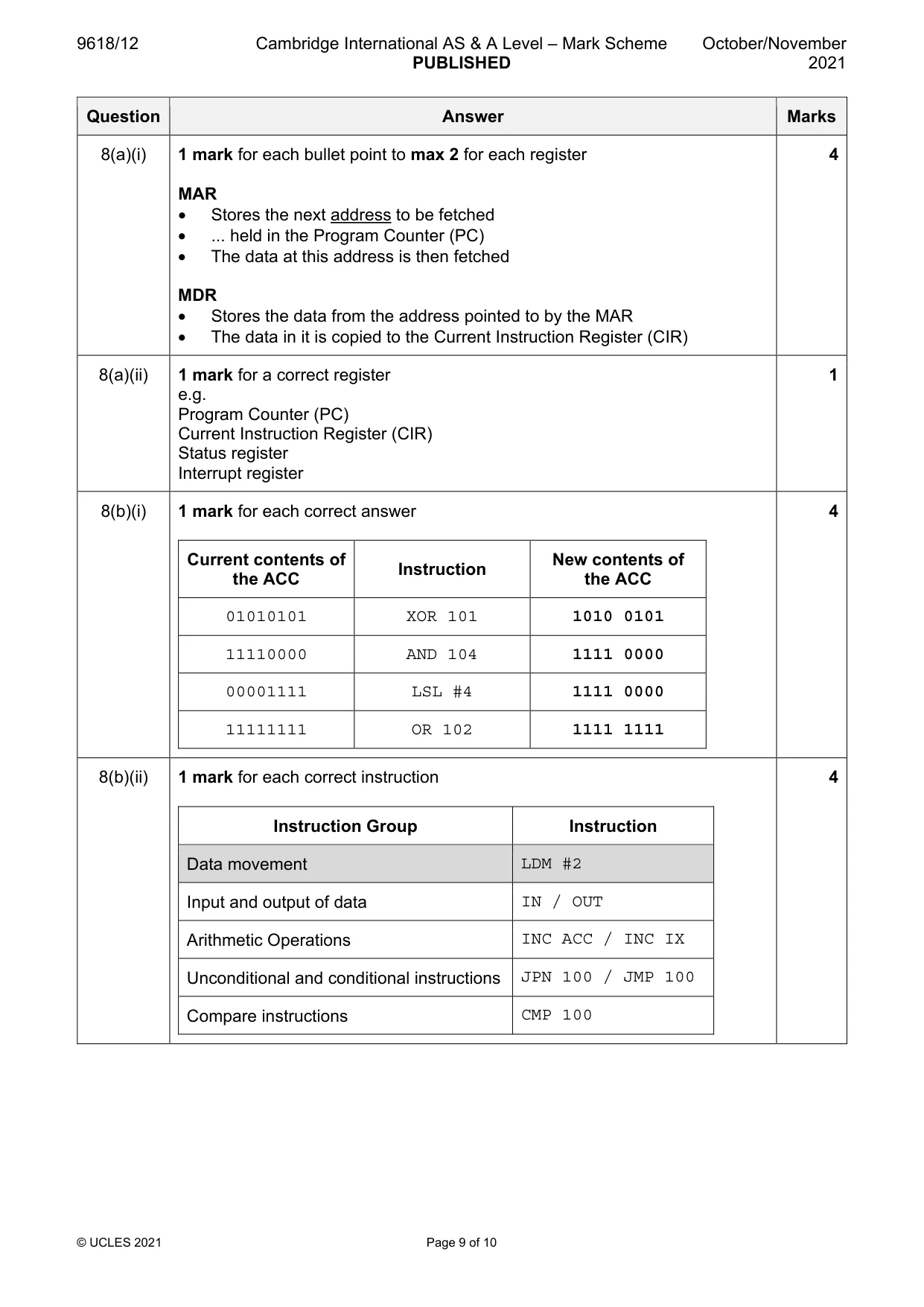
9618/12 Cambridge International AS & A Level – Mark Scheme PUBLISHED October/November 2021 © UCLES 2021 Page 9 of 10 Question Answer Marks 8(a)(i) 1 mark for each bullet point to max 2 for each register MAR • Stores the next address to be fetched • ... held in the Program Counter (PC) • The data at this address is then fetched MDR • Stores the data from the address pointed to by the MAR • The data in it is copied to the Current Instruction Register (CIR) 4 8(a)(ii) 1 mark for a correct register e.g. Program Counter (PC) Current Instruction Register (CIR) Status register Interrupt register 1 8(b)(i) 1 mark for each correct answer Current contents of the ACC Instruction New contents of the ACC 01010101 XOR 101 1010 0101 11110000 AND 104 1111 0000 00001111 LSL #4 1111 0000 11111111 OR 102 1111 1111 4 8(b)(ii) 1 mark for each correct instruction Instruction Group Instruction Data movement LDM #2 Input and output of data IN / OUT Arithmetic Operations INC ACC / INC IX Unconditional and conditional instructions JPN 100 / JMP 100 Compare instructions CMP 100 4
Mark scheme, page 10
9618/12 Cambridge International AS & A Level – Mark Scheme PUBLISHED October/November 2021 © UCLES 2021 Page 10 of 10 Question Answer Marks 8(b)(iii) 1 mark for name, 1 mark for description • Indirect addressing • the address to be used is at the given address • Relative addressing • the address to be used is an offset number of locations away, relative to the address of the current instruction • Indexed addressing • form the address from the given address plus the contents of the index register 2
What you needed in this session
Cambridge’s own grade thresholds for 2021 Oct/Nov, Paper 1 · Variant 2. A higher threshold means an easier paper — the bar moves with how the cohort did.