Cambridge A Level Chemistry 9701 — 2023 May/June Paper 3 · Variant 3
9701/33/M/J/23 · 3 questions · 40 marks · ≈45 min
The question paper and its mark scheme, free to read here and free to download. This is Cambridge’s own paper, exactly as it was sat.
Question paper12 pages
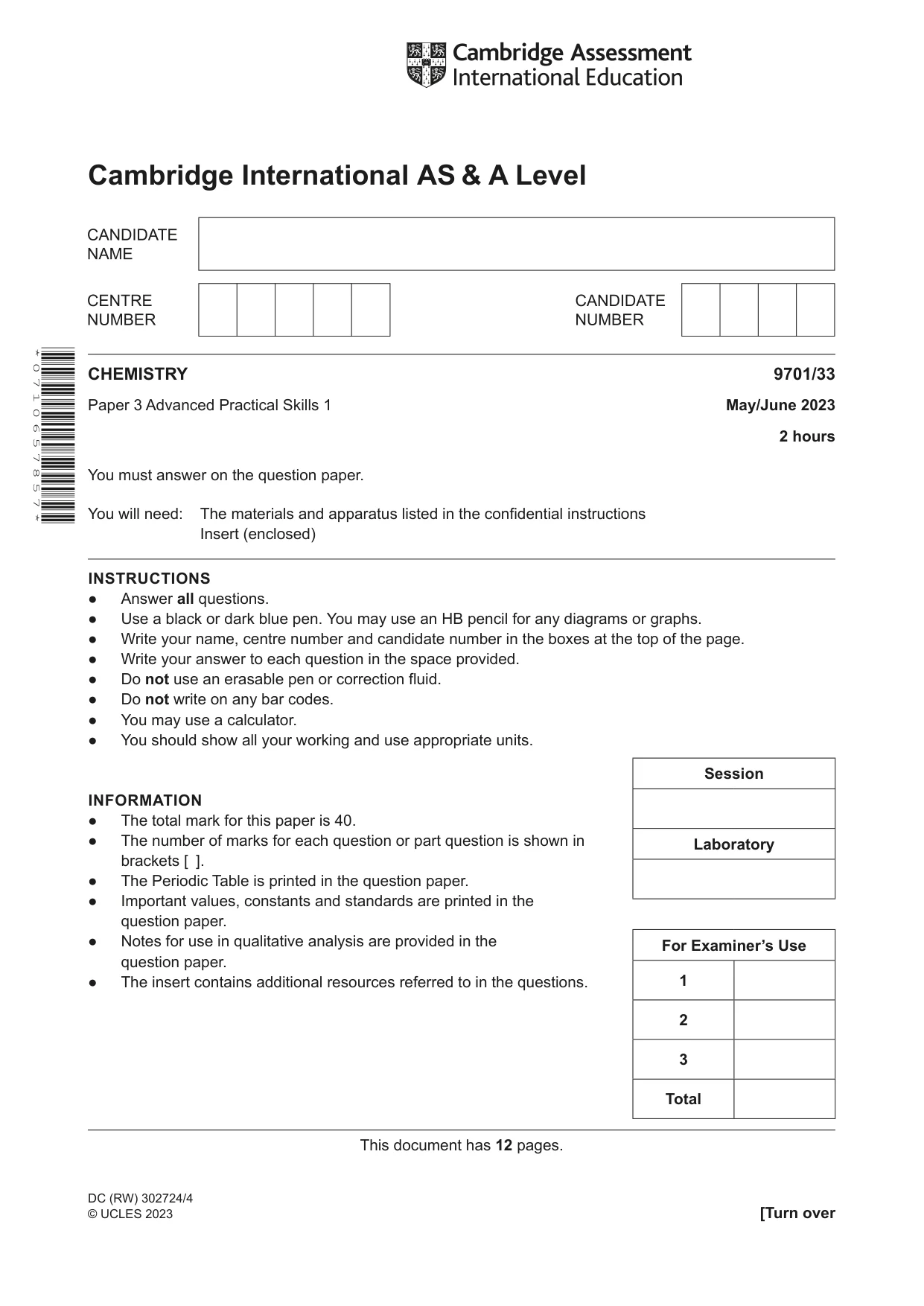
Mark scheme11 pages
Answers below. Sit the paper first if you are practising.
Questions as text
Q1 · A redox reaction takes place between hydroxylamine, NH2OH, and the iron(III) ion, Fe3+…
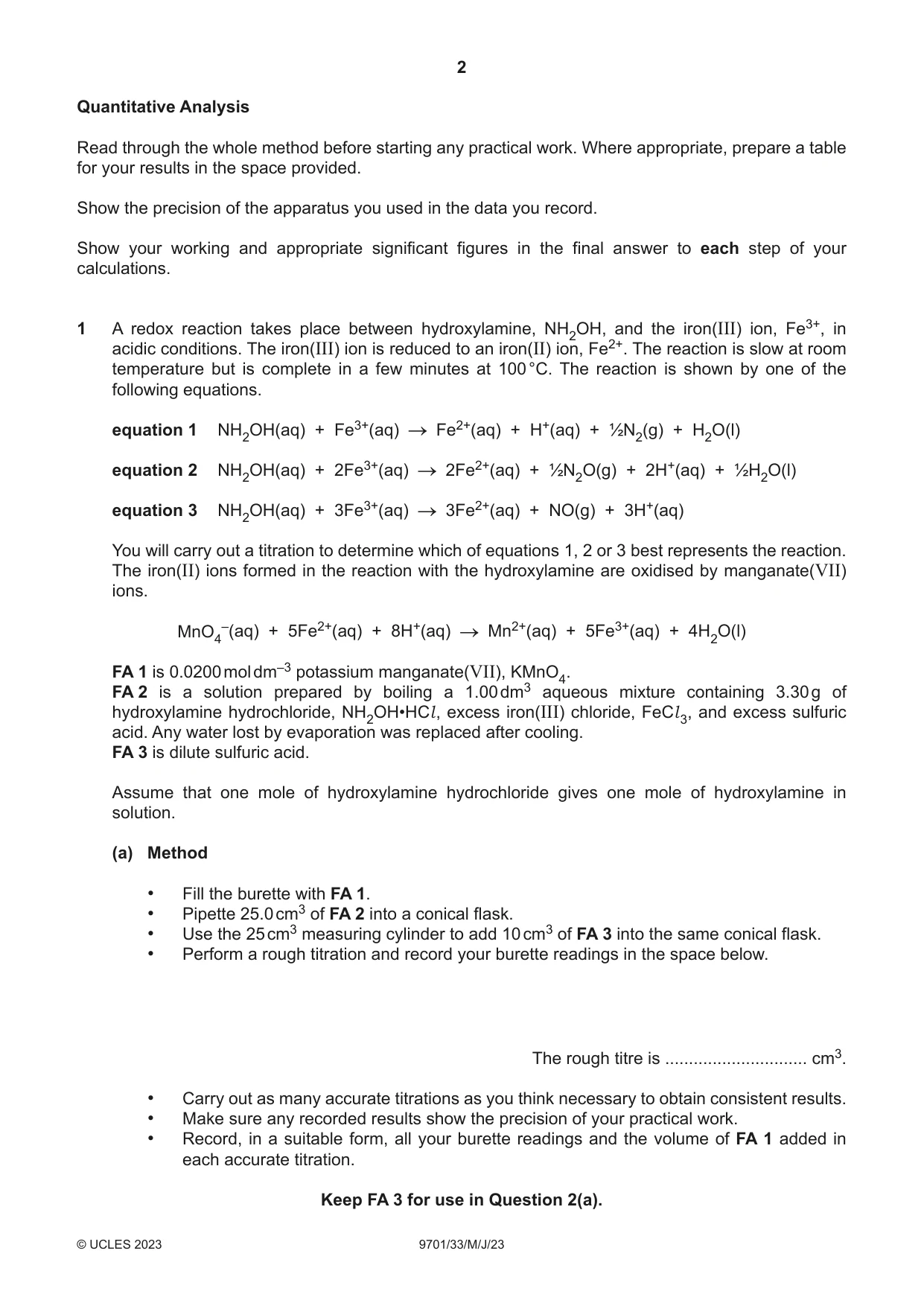
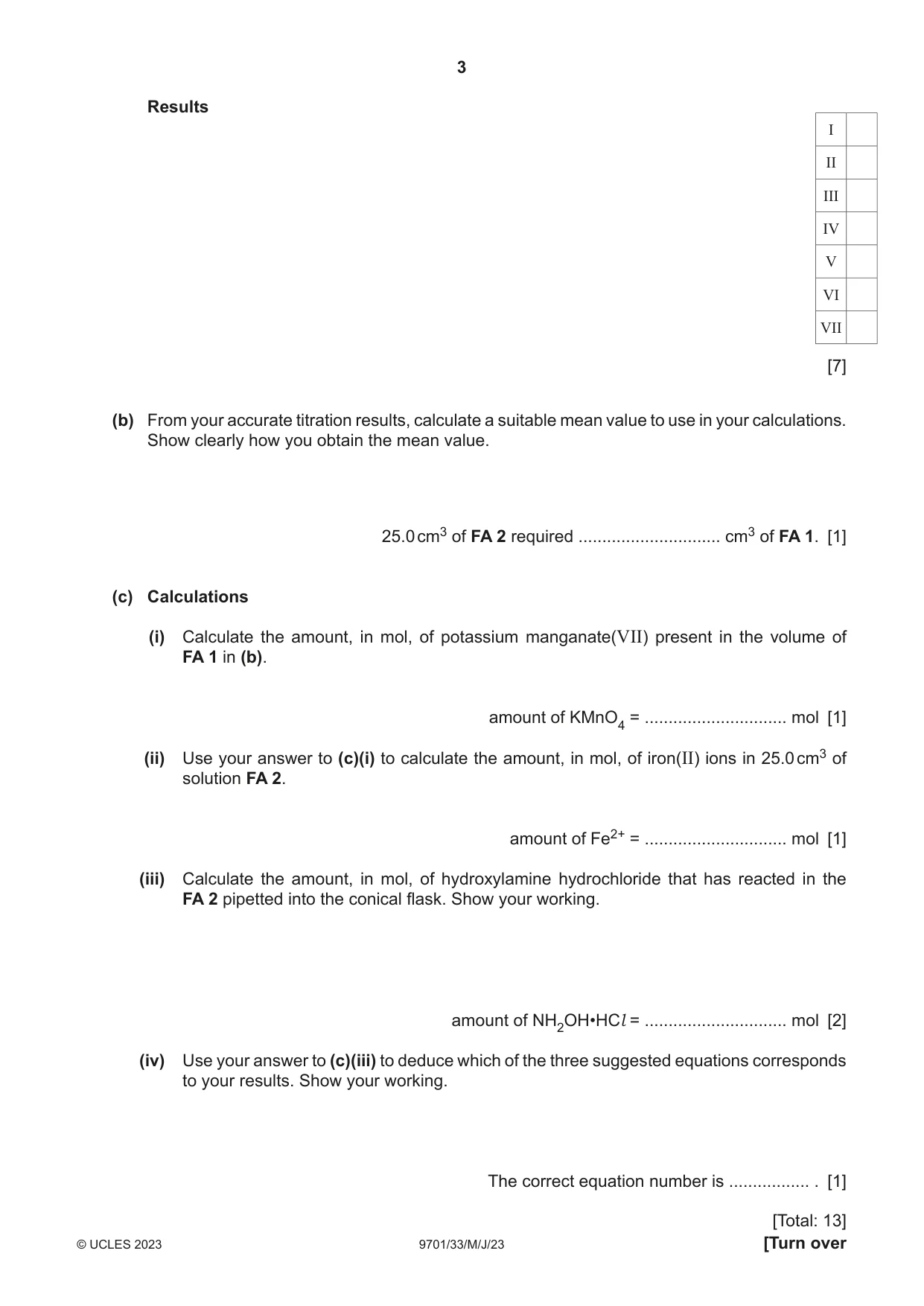
1 A redox reaction takes place between hydroxylamine, NH2OH, and the iron(III) ion, Fe3+, in acidic conditions. The iron(III) ion is reduced to an iron(II) ion, Fe2+. The reaction is slow at room temperature but is complete in a few minutes at 100 °C. The reaction is shown by one of the following equations. equation 1 NH2OH(aq) + Fe3+(aq) Fe2+(aq) + H+(aq) + ½N2(g) + H2O(l) equation 2 NH2OH(aq) + 2Fe3+(aq) 2Fe2+(aq) + ½N2O(g) + 2H+(aq) + ½H2O(l) equation 3 NH2OH(aq) + 3Fe3+(aq) 3Fe2+(aq) + NO(g) + 3H+(aq) You will carry out a titration to determine which of equations 1, 2 or 3 best represents the reaction. The iron(II) ions formed in the reaction with the hydroxylamine are oxidised by manganate(VII) ions. MnO4–(aq) + 5Fe2+(aq) + 8H+(aq) Mn2+(aq) + 5Fe3+(aq) + 4H2O(l) FA 1 is 0.0200 mol dm–3 potassium manganate(VII), KMnO4. FA 2 is a solution prepared by boiling a 1.00 dm3 aqueous mixture containing 3.30 g of hydroxylamine hydrochloride, NH2OH•HCl , excess iron(III) chloride, FeCl 3, and excess sulfuric acid. Any water lost by evaporation was replaced after cooling. FA 3 is dilute sulfuric acid. Assume that one mole of hydroxylamine hydrochloride gives one mole of hydroxylamine in solution. (a) Method • Fill the burette with FA 1. • Pipette 25.0 cm3 of FA 2 into a conical flask. • Use the 25 cm3 measuring cylinder to add 10 cm3 of FA 3 into the same conical flask. • Perform a rough titration and record your burette readings in the space below. The rough titre is .............................. cm3. • Carry out as many accurate titrations as you think necessary to obtain consistent results. • Make sure any recorded results show the precision of your practical work. • Record, in a suitable form, all your burette readings and the volume of FA 1 added in each accurate titration. Keep FA 3 for use in Question 2(a). Results I II III IV V VI VII [7] (b) From your accurate titration results, calculate a suitable mean value to use in your calculations. Show clearly how you obtain the mean value. 25.0 cm3 of FA 2 required .............................. cm3 of FA 1. [1] (c) Calculations (i) Calculate the amount, in mol, of potassium manganate(VII) present in the volume of FA 1 in (b). amount of KMnO4 = .............................. mol [1] (ii) Use your answer to (c)(i) to calculate the amount, in mol, of iron(II) ions in 25.0 cm3 of solution FA 2. amount of Fe2+ = .............................. mol [1] (iii) Calculate the amount, in mol, of hydroxylamine hydrochloride that has reacted in the FA 2 pipetted into the conical flask. Show your working. amount of NH2OH•HCl = .............................. mol [2] (iv) Use your answer to (c)(iii) to deduce which of the three suggested equations corresponds to your results. Show your working. The correct equation number is ................. . [1] [Total: 13]
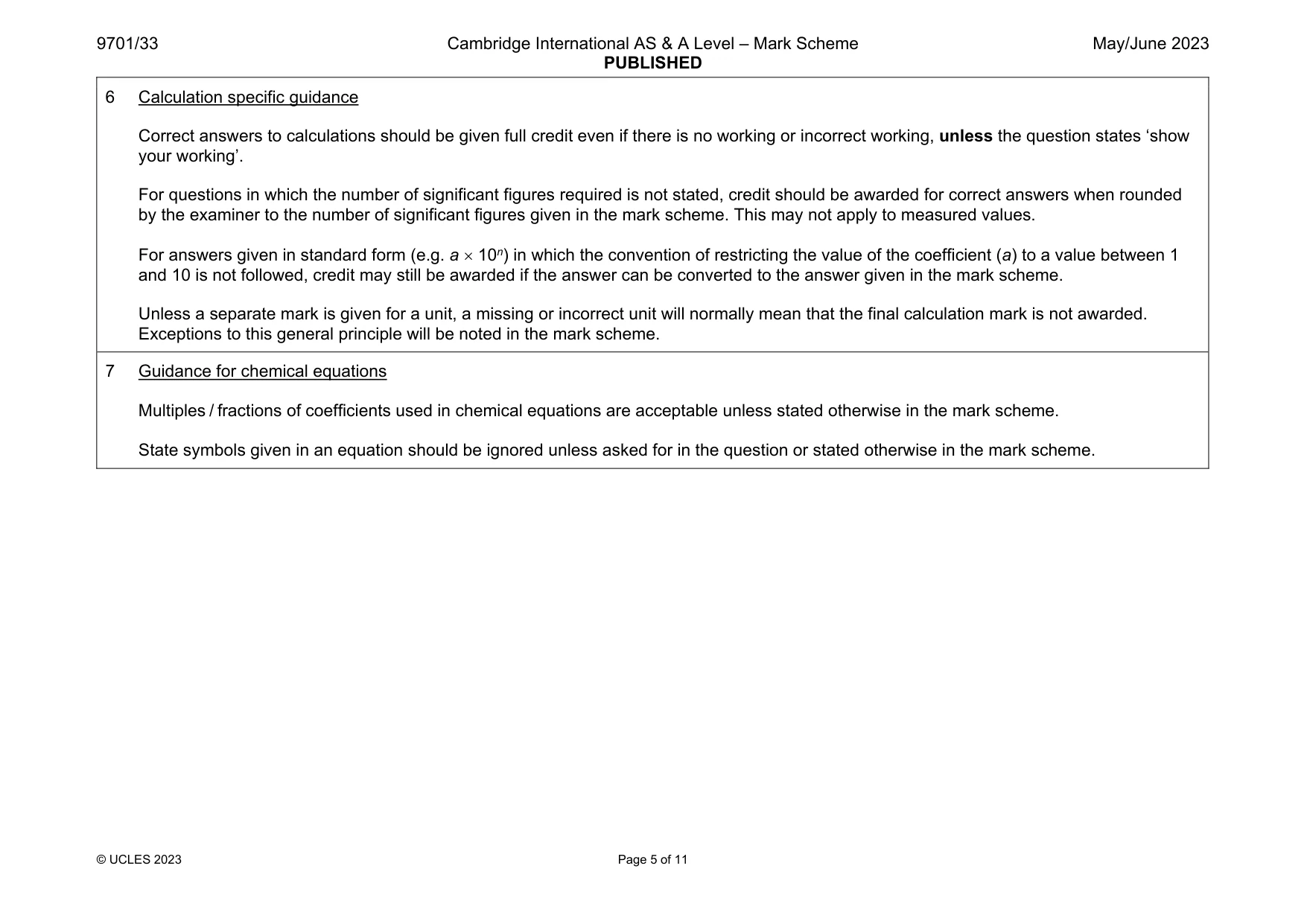
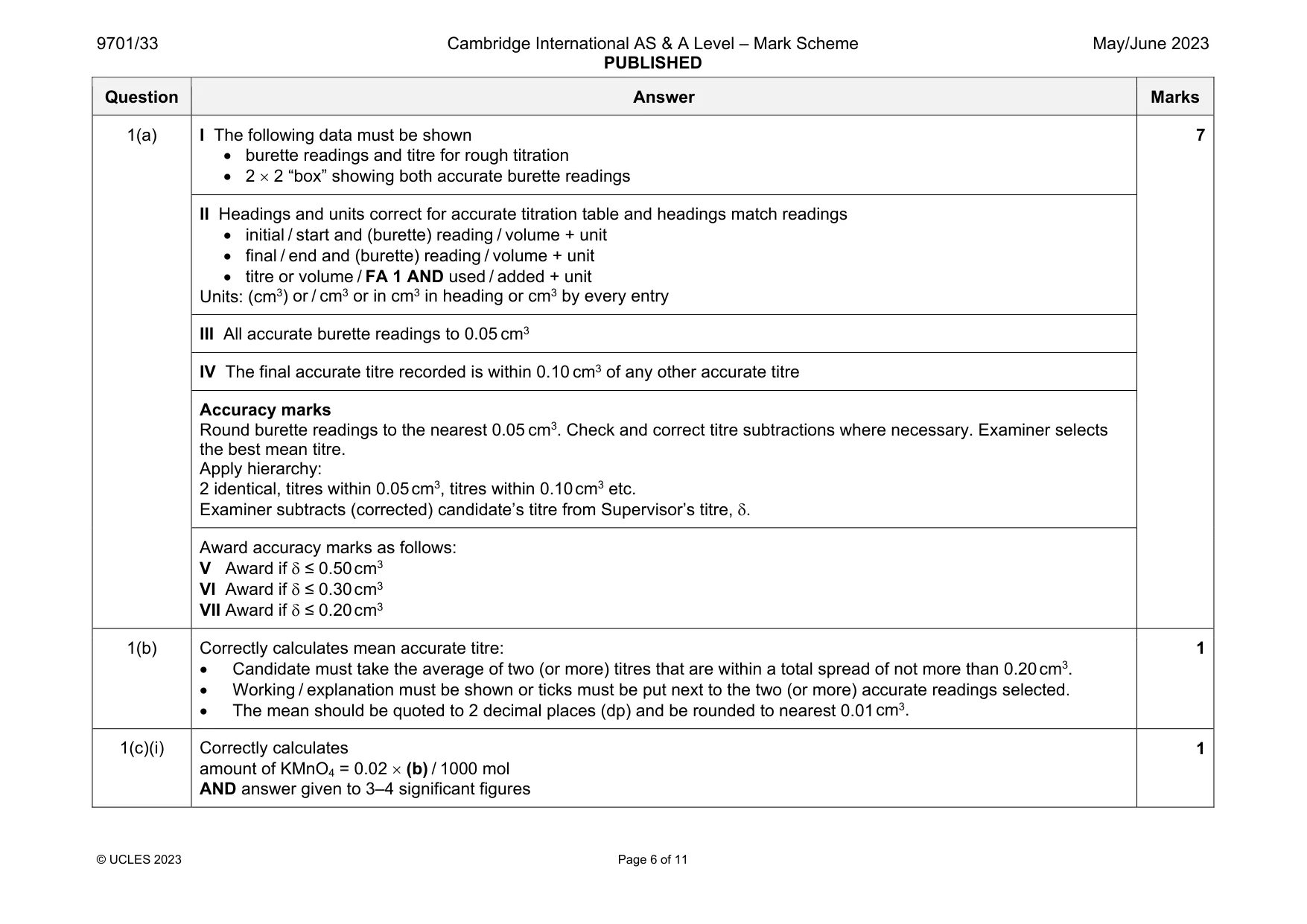
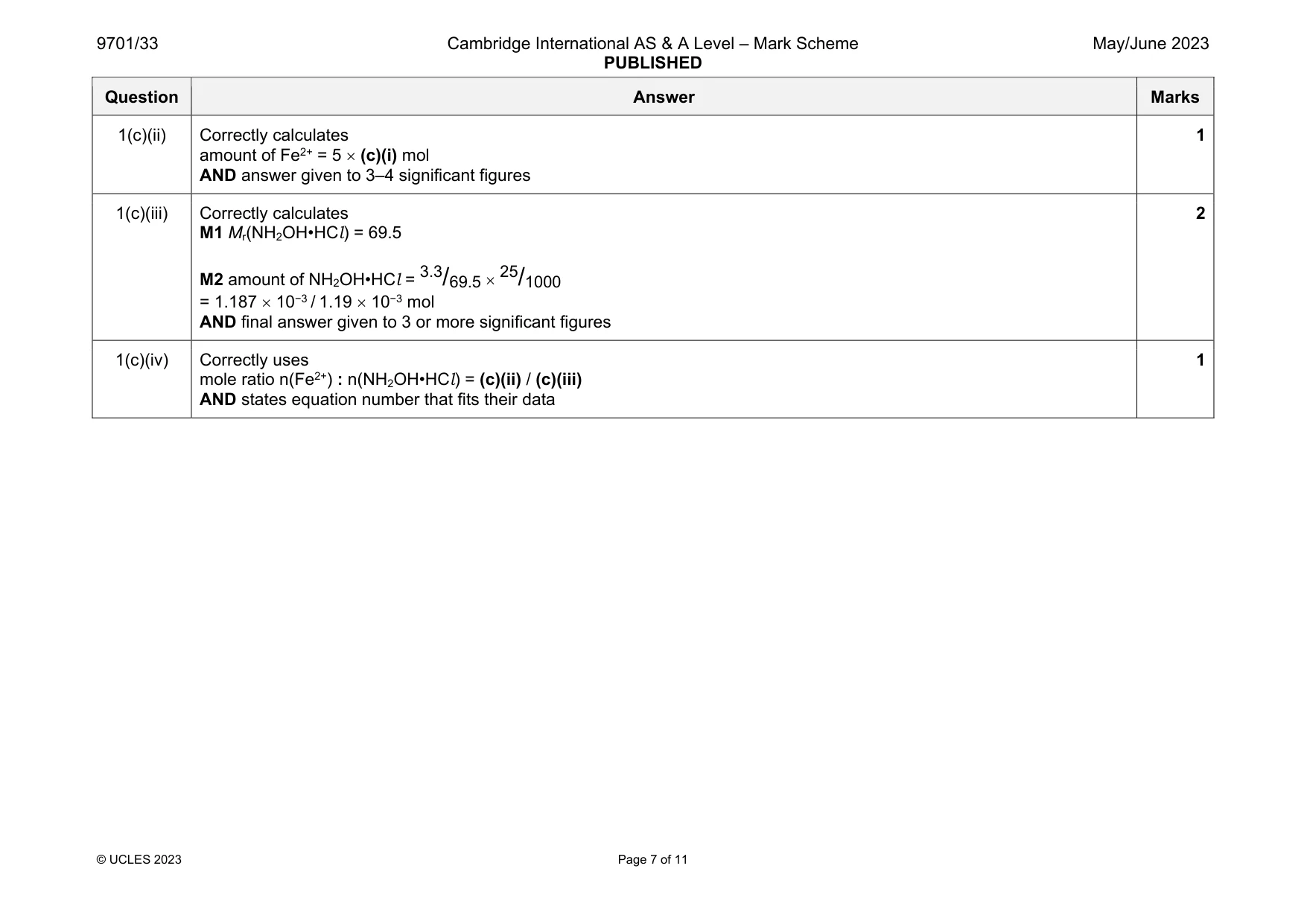
Mark scheme: 1(a) I The following data must be shown burette readings and titre for rough titration 2 2 “box” showing both accurate burette readings 7 II Headings and units correct for accurate titration table and headings match readings initial / start and (burette) reading / volume + unit final / end and (burette) reading / volume + unit titre or volume / FA 1 AND used / added + unit Units: (cm3) or / cm3 or in cm3 in heading or cm3 by every entry III All accurate burette readings to 0.05 cm3 IV The final accurate titre recorded is within 0.10 cm3 of any other accurate titre Accuracy marks Round burette readings to the nearest 0.05 cm3. Check and correct titre subtractions where necessary. Examiner selects the best mean titre. Apply hierarchy: 2 identical, titres within 0.05 cm3, titres within 0.10 cm3 etc. Examiner subtracts (corrected) candidate’s titre from Supervisor’s titre, . Award accuracy marks as follows: V Award if ≤ 0.50 cm3 VI Award if ≤ 0.30 cm3 VII Award if ≤ 0.20cm3 1(b) Correctly calculates mean accurate titre: Candidate must take the average of two (or more) titres that are within a total spread of not more than 0.20 cm3. Working / explanation must be shown or ticks must be put next to the two (or more) accurate readings selected. The mean should be quoted to 2 decimal places (dp) and be rounded to nearest 0.01cm3. 1 1(c)(i) Correctly calculates amount of KMnO4 = 0.02 (b) / 1000 mol AND answer given to 3–4 significant figures 1 Question Answer Marks 1(c)(ii) Correctly calculates amount of Fe2+ = 5 (c)(i) mol AND answer given to 3–4 significant figures 1 1(c)(iii) Correctly calculates M1 Mr(NH2OH•HCl) = 69.5 M2 amount of NH2OH•HCl = 3.3/69.5 25/1000 = 1.187 10−3 / 1.19 10−3 mol AND final answer given to 3 or more significant figures 2 1(c)(iv) Correctly uses mole ratio n(Fe2+) : n(NH2OH•HCl) = (c)(ii) / (c)(iii) AND states equation number that fits their data 1
More questions on Reacting masses and volumes (of solutions and gases)
Q2 · The reaction between thiosulfate ions and hydrogen ions produces a precipitate of sulfur
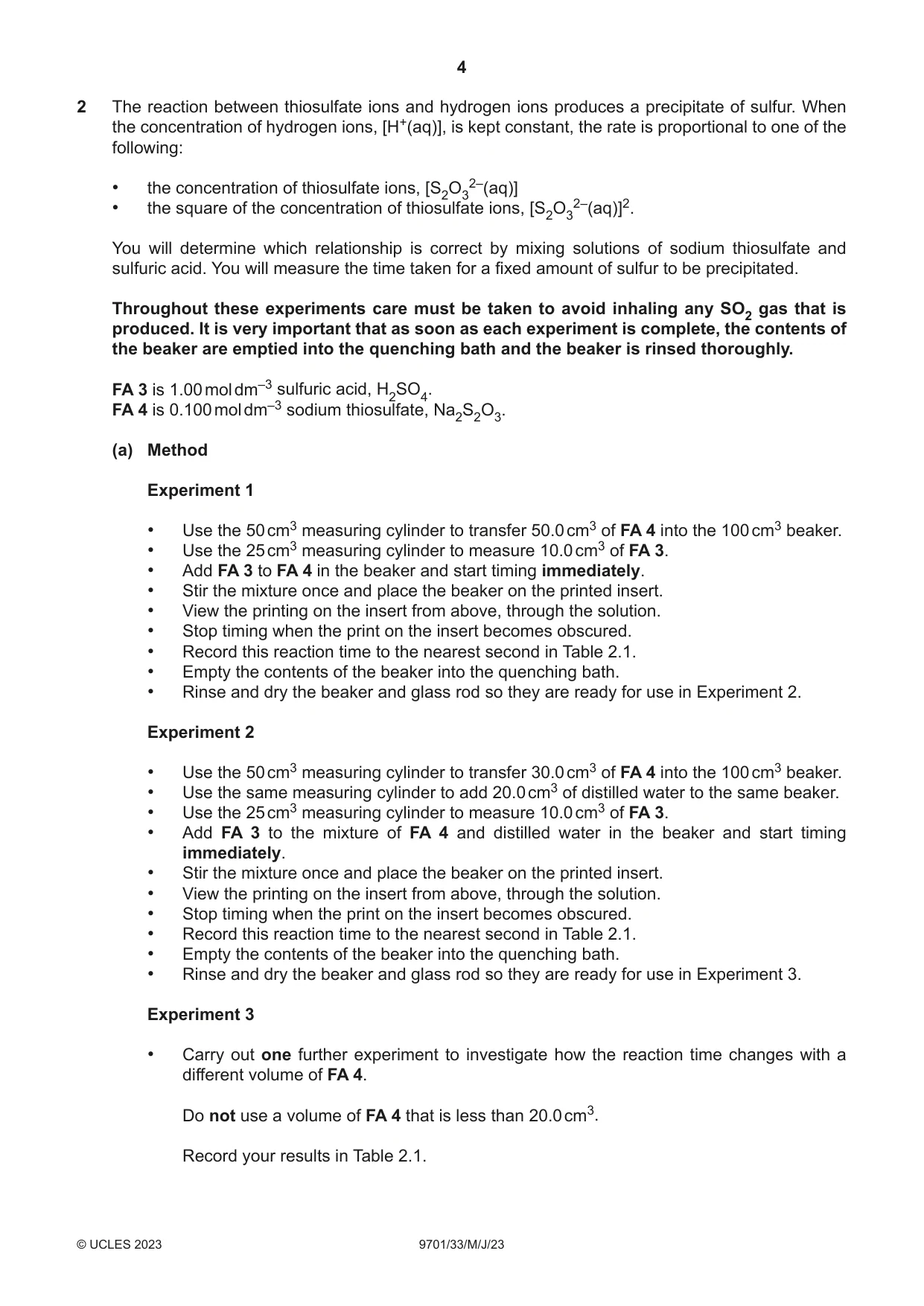
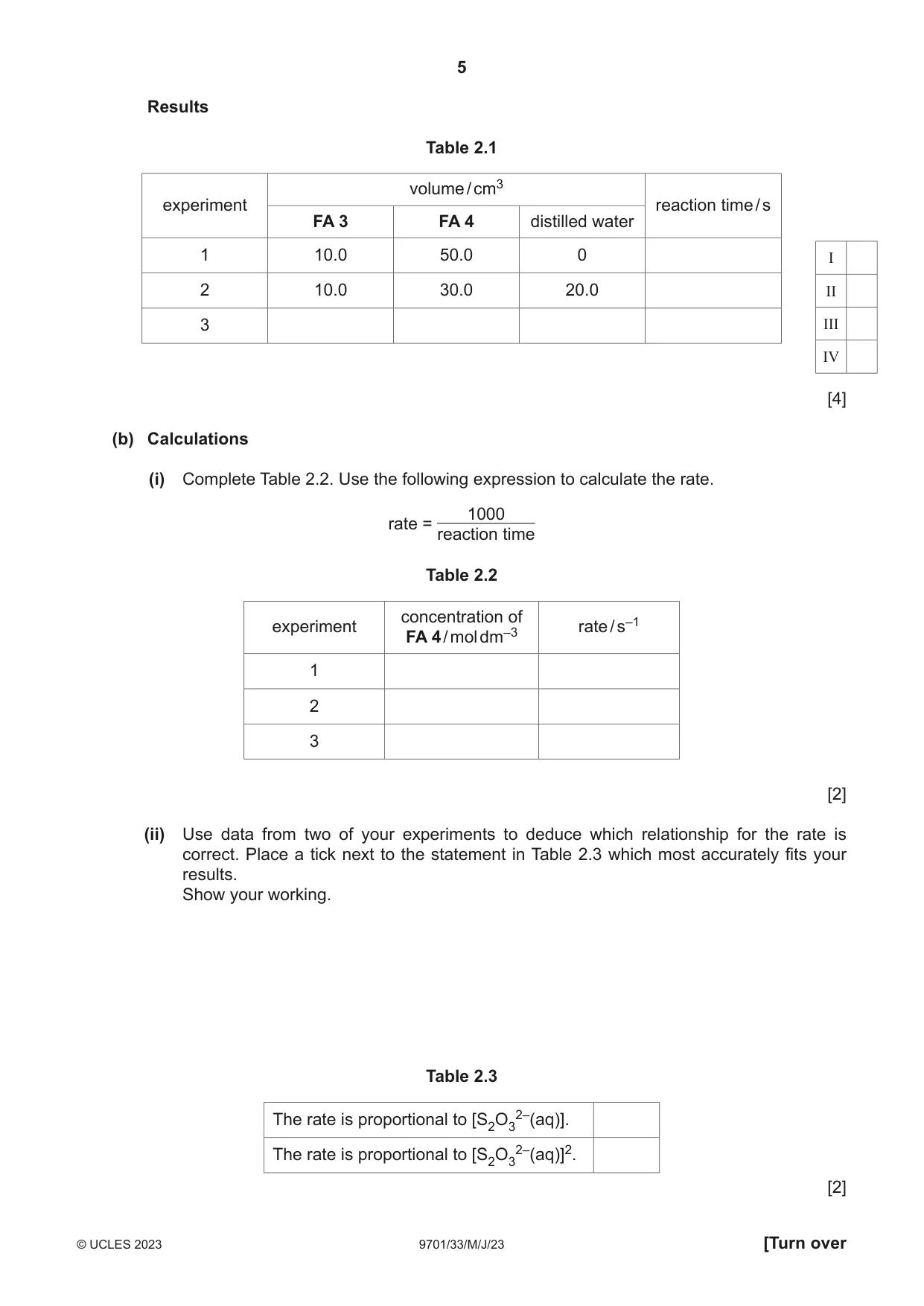
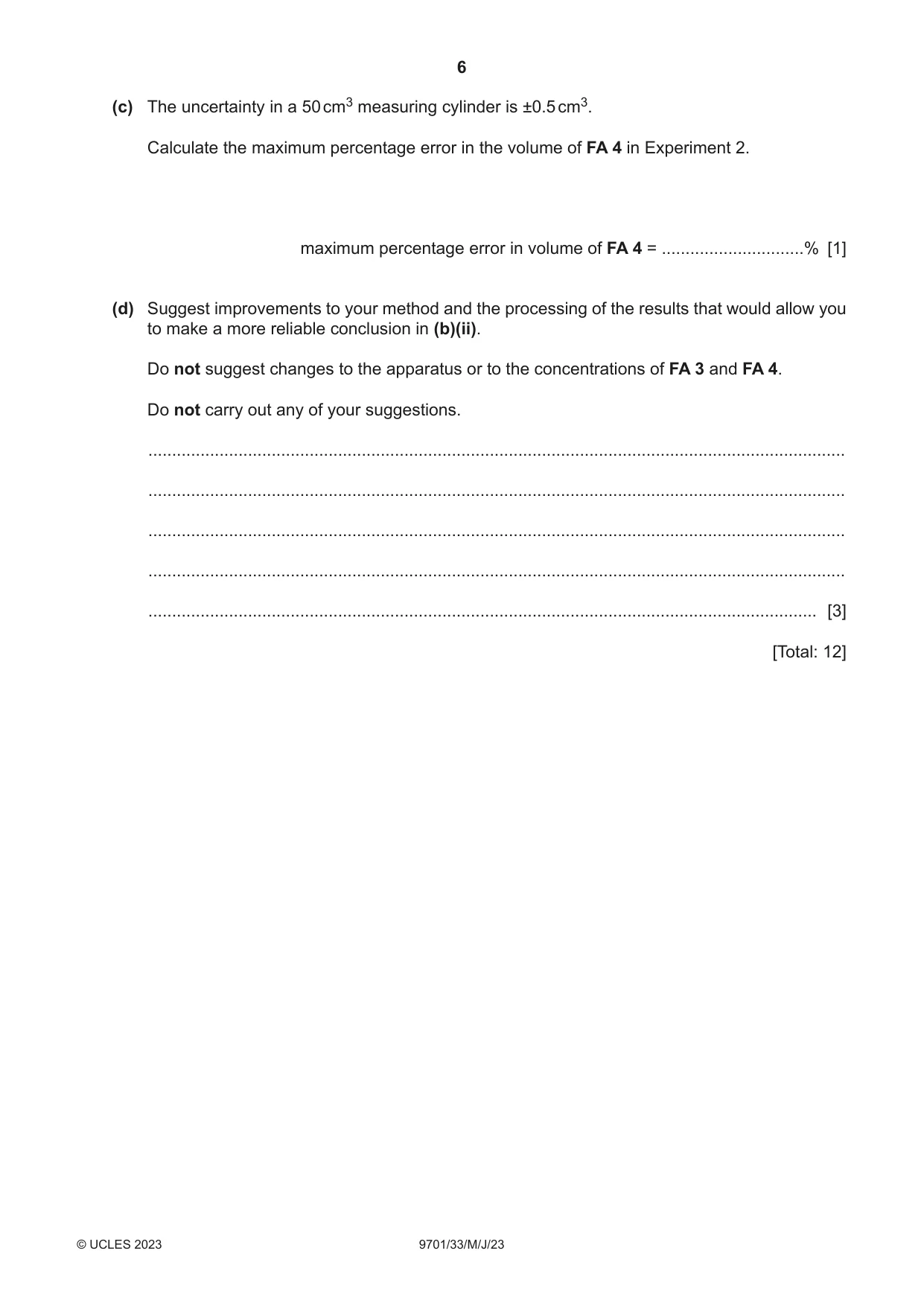
2 The reaction between thiosulfate ions and hydrogen ions produces a precipitate of sulfur. When the concentration of hydrogen ions, [H+(aq)], is kept constant, the rate is proportional to one of the following: • the concentration of thiosulfate ions, [S2O32–(aq)] • the square of the concentration of thiosulfate ions, [S2O32–(aq)]2. You will determine which relationship is correct by mixing solutions of sodium thiosulfate and sulfuric acid. You will measure the time taken for a fixed amount of sulfur to be precipitated. Throughout these experiments care must be taken to avoid inhaling any SO2 gas that is produced. It is very important that as soon as each experiment is complete, the contents of the beaker are emptied into the quenching bath and the beaker is rinsed thoroughly. FA 3 is 1.00 mol dm–3 sulfuric acid, H2SO4. FA 4 is 0.100 mol dm–3 sodium thiosulfate, Na2S2O3. (a) Method Experiment 1 • Use the 50 cm3 measuring cylinder to transfer 50.0 cm3 of FA 4 into the 100 cm3 beaker. • Use the 25 cm3 measuring cylinder to measure 10.0 cm3 of FA 3. • Add FA 3 to FA 4 in the beaker and start timing immediately. • Stir the mixture once and place the beaker on the printed insert. • View the printing on the insert from above, through the solution. • Stop timing when the print on the insert becomes obscured. • Record this reaction time to the nearest second in Table 2.1. • Empty the contents of the beaker into the quenching bath. • Rinse and dry the beaker and glass rod so they are ready for use in Experiment 2. Experiment 2 • Use the 50 cm3 measuring cylinder to transfer 30.0 cm3 of FA 4 into the 100 cm3 beaker. • Use the same measuring cylinder to add 20.0 cm3 of distilled water to the same beaker. • Use the 25 cm3 measuring cylinder to measure 10.0 cm3 of FA 3. • Add FA 3 to the mixture of FA 4 and distilled water in the beaker and start timing immediately. • Stir the mixture once and place the beaker on the printed insert. • View the printing on the insert from above, through the solution. • Stop timing when the print on the insert becomes obscured. • Record this reaction time to the nearest second in Table 2.1. • Empty the contents of the beaker into the quenching bath. • Rinse and dry the beaker and glass rod so they are ready for use in Experiment 3. Experiment 3 • Carry out one further experiment to investigate how the reaction time changes with a different volume of FA 4. Do not use a volume of FA 4 that is less than 20.0 cm3. Record your results in Table 2.1. Results Table 2.1 volume / cm3 experiment reaction time / s FA 3 FA 4 distilled water 1 10.0 50.0 0 I 2 10.0 30.0 20.0 II 3 III IV [4] (b) Calculations (i) Complete Table 2.2. Use the following expression to calculate the rate. 1000 rate = reaction time Table 2.2 concentration of experiment rate / s–1 FA 4 / mol dm–3 1 2 3 [2] (ii) Use data from two of your experiments to deduce which relationship for the rate is correct. Place a tick next to the statement in Table 2.3 which most accurately fits your results. Show your working. Table 2.3 The rate is proportional to [S2O32–(aq)]. The rate is proportional to [S2O32–(aq)]2. [2] (c) The uncertainty in a 50 cm3 measuring cylinder is ±0.5 cm3. Calculate the maximum percentage error in the volume of FA 4 in Experiment 2. maximum percentage error in volume of FA 4 = ..............................% [1] (d) Suggest improvements to your method and the processing of the results that would allow you to make a more reliable conclusion in (b)(ii). Do not suggest changes to the apparatus or to the concentrations of FA 3 and FA 4. Do not carry out any of your suggestions. ................................................................................................................................................... ................................................................................................................................................... ................................................................................................................................................... ................................................................................................................................................... ............................................................................................................................................. [3] [Total: 12] Qualitative Analysis For each test you should record all your observations in the spaces provided. Examples of observations include: • colour changes seen • the formation of any precipitate and its solubility (where appropriate) in an excess of the reagent added • the formation of any gas and its identification (where appropriate) by a suitable test. You should record clearly at what stage in a test an observation is made. Where no change is observed you should write ‘no change’. Where reagents are selected for use in a test, the name or correct formula of the element or compound must be given. If any solution is warmed, a boiling tube must be used. Rinse and reuse test‑tubes and boiling tubes where possible. No additional tests should be attempted.
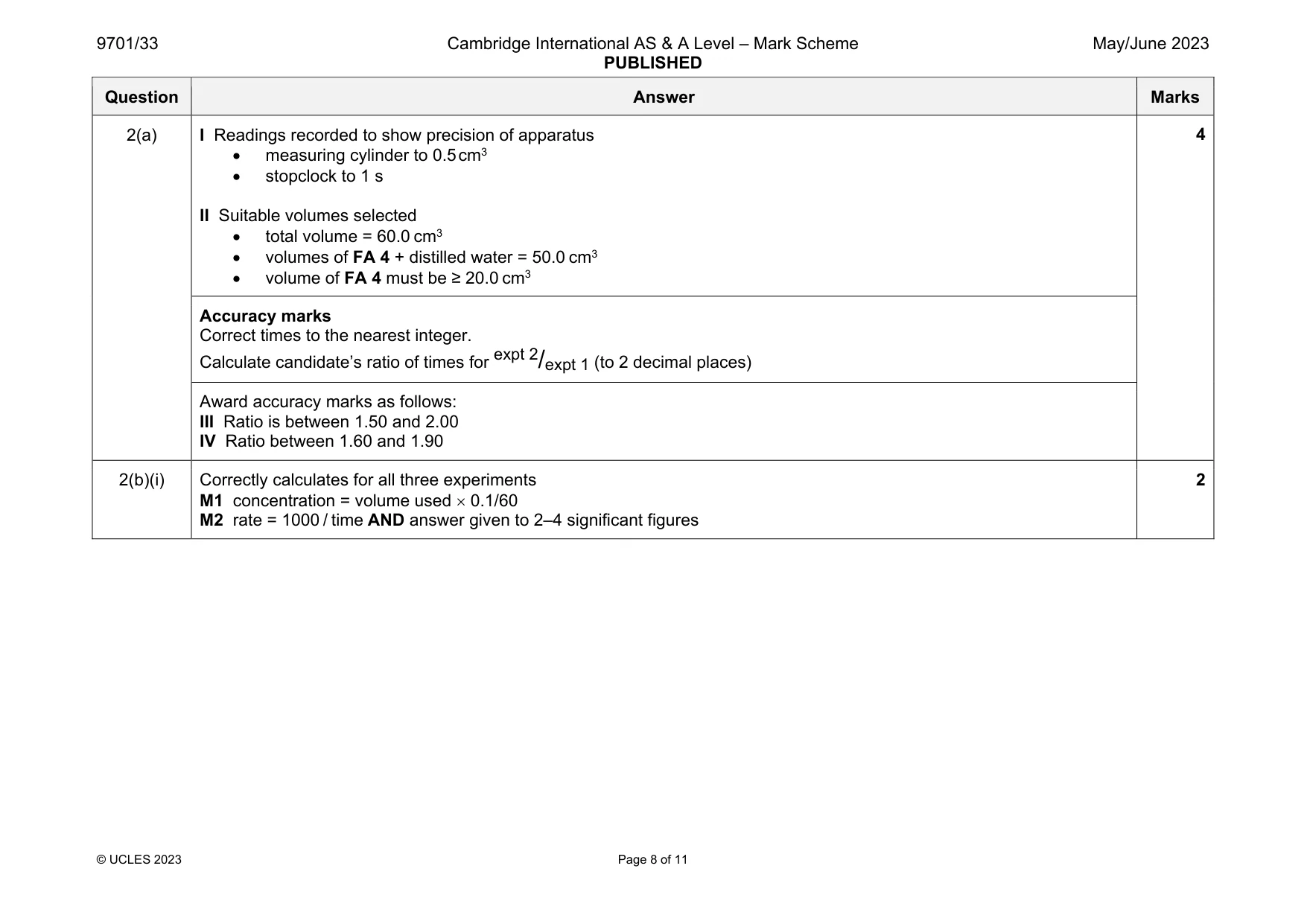
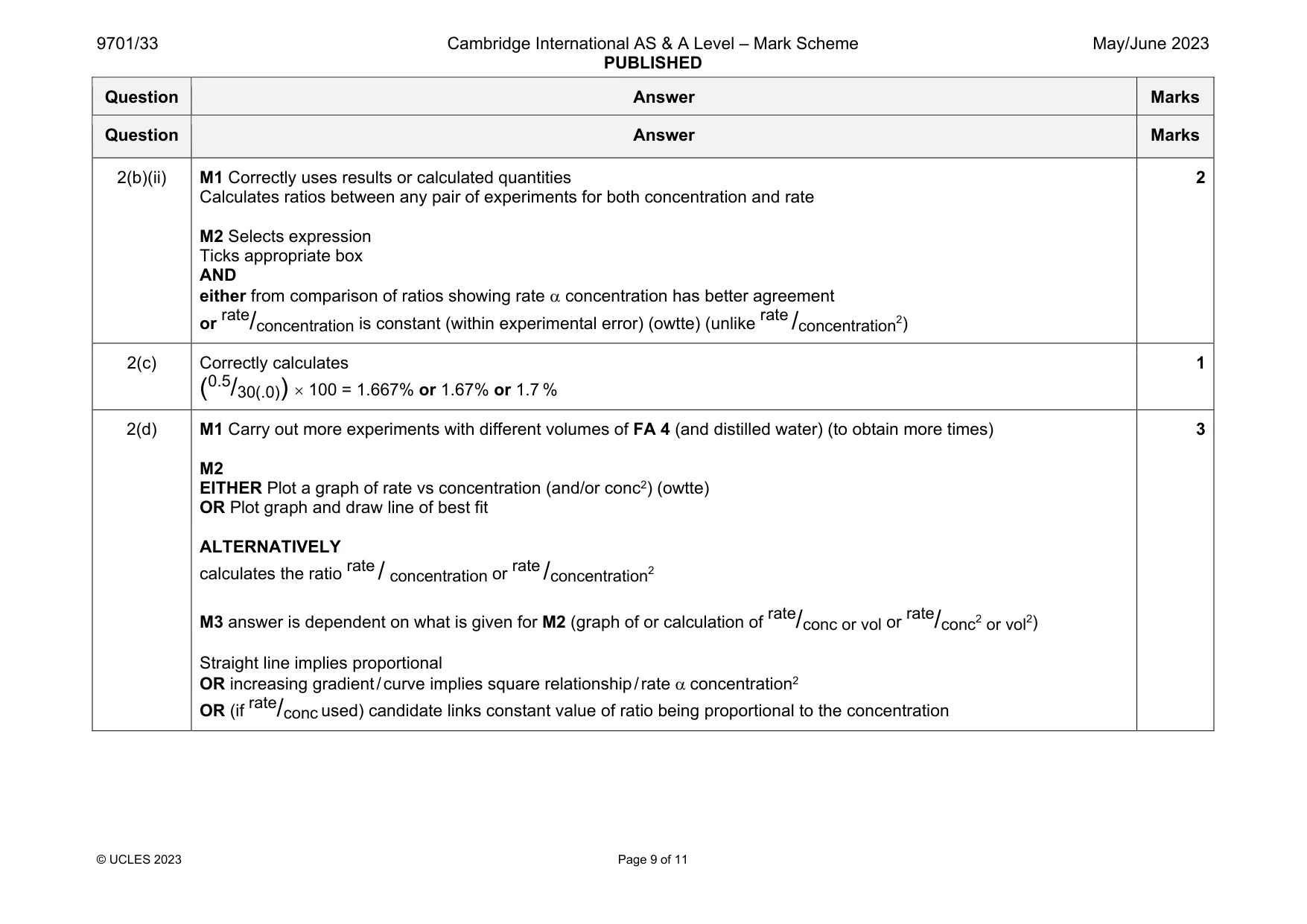
Mark scheme: 2(a) I Readings recorded to show precision of apparatus measuring cylinder to 0.5 cm3 stopclock to 1 s II Suitable volumes selected total volume = 60.0 cm3 volumes of FA 4 + distilled water = 50.0 cm3 volume of FA 4 must be ≥ 20.0 cm3 Accuracy marks Correct times to the nearest integer. Calculate candidate’s ratio of times for expt 2/expt 1 (to 2 decimal places) Award accuracy marks as follows: III Ratio is between 1.50 and 2.00 IV Ratio between 1.60 and 1.90 2(b)(i) Correctly calculates for all three experiments M1 concentration = volume used 0.1/60 M2 rate = 1000 / time AND answer given to 2–4 significant figures 2 Question Answer Marks Question Answer Marks 2(b)(ii) M1 Correctly uses results or calculated quantities Calculates ratios between any pair of experiments for both concentration and rate M2 Selects expression Ticks appropriate box AND either from comparison of ratios showing rate concentration has better agreement or rate/concentration is constant (within experimental error) (owtte) (unlike rate /concentration2) 2 2(c) Correctly calculates (0.5/30(.0)) 100 = 1.667% or 1.67% or 1.7 % 1 2(d) M1 Carry out more experiments with different volumes of FA 4 (and distilled water) (to obtain more times) M2 EITHER Plot a graph of rate vs concentration (and/or conc2) (owtte) OR Plot graph and draw line of best fit ALTERNATIVELY calculates the ratio rate / concentration or rate /concentration2 M3 answer is dependent on what is given for M2 (graph of or calculation of rate/conc or vol or rate/conc2 or vol2) Straight line implies proportional OR increasing gradient / curve implies square relationship / rate concentration2 OR (if rate/conc used) candidate links constant value of ratio being proportional to the concentration 3
Q3 · FA 5 is a solid mixture of two salts and contains two different anions
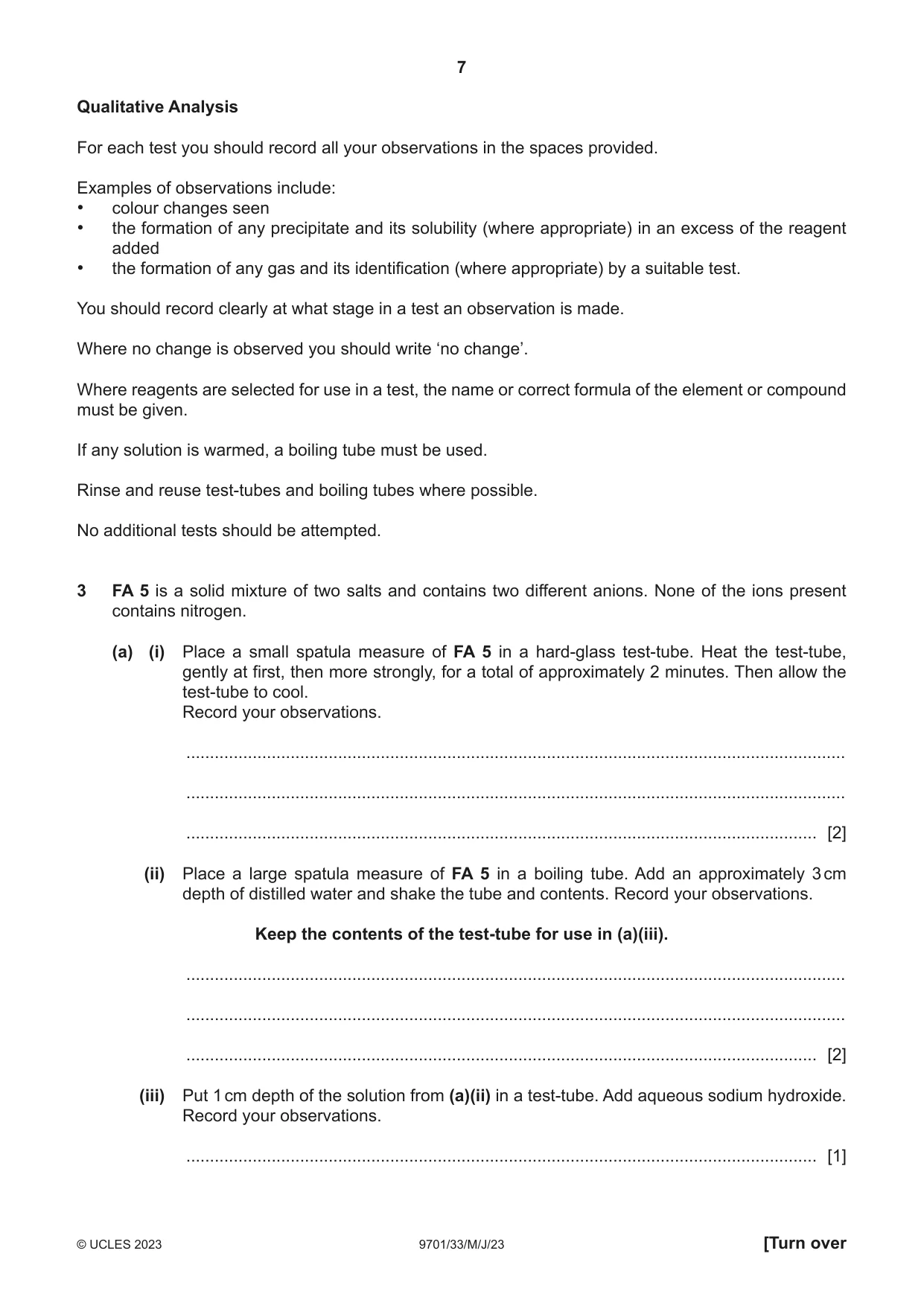
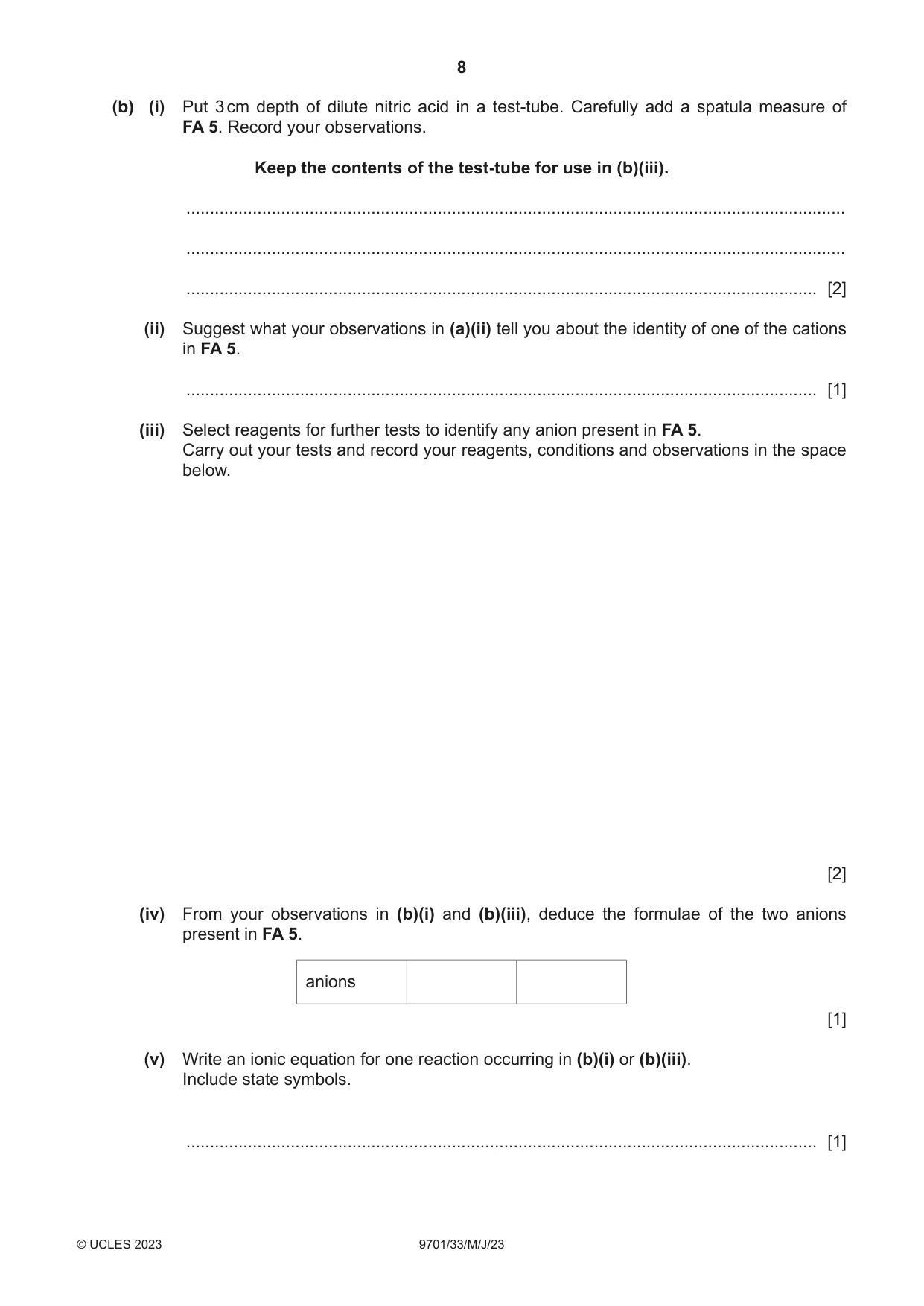
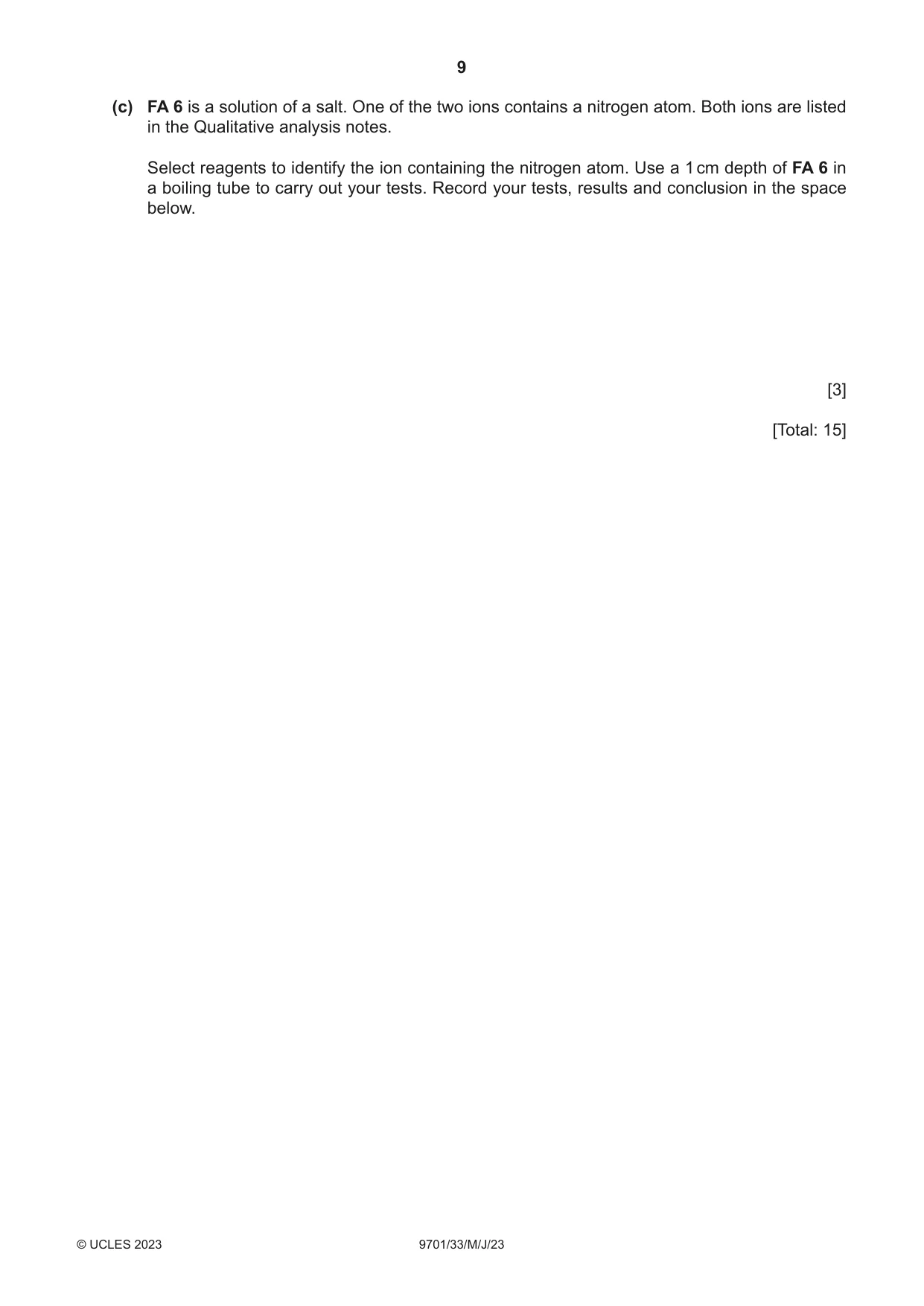
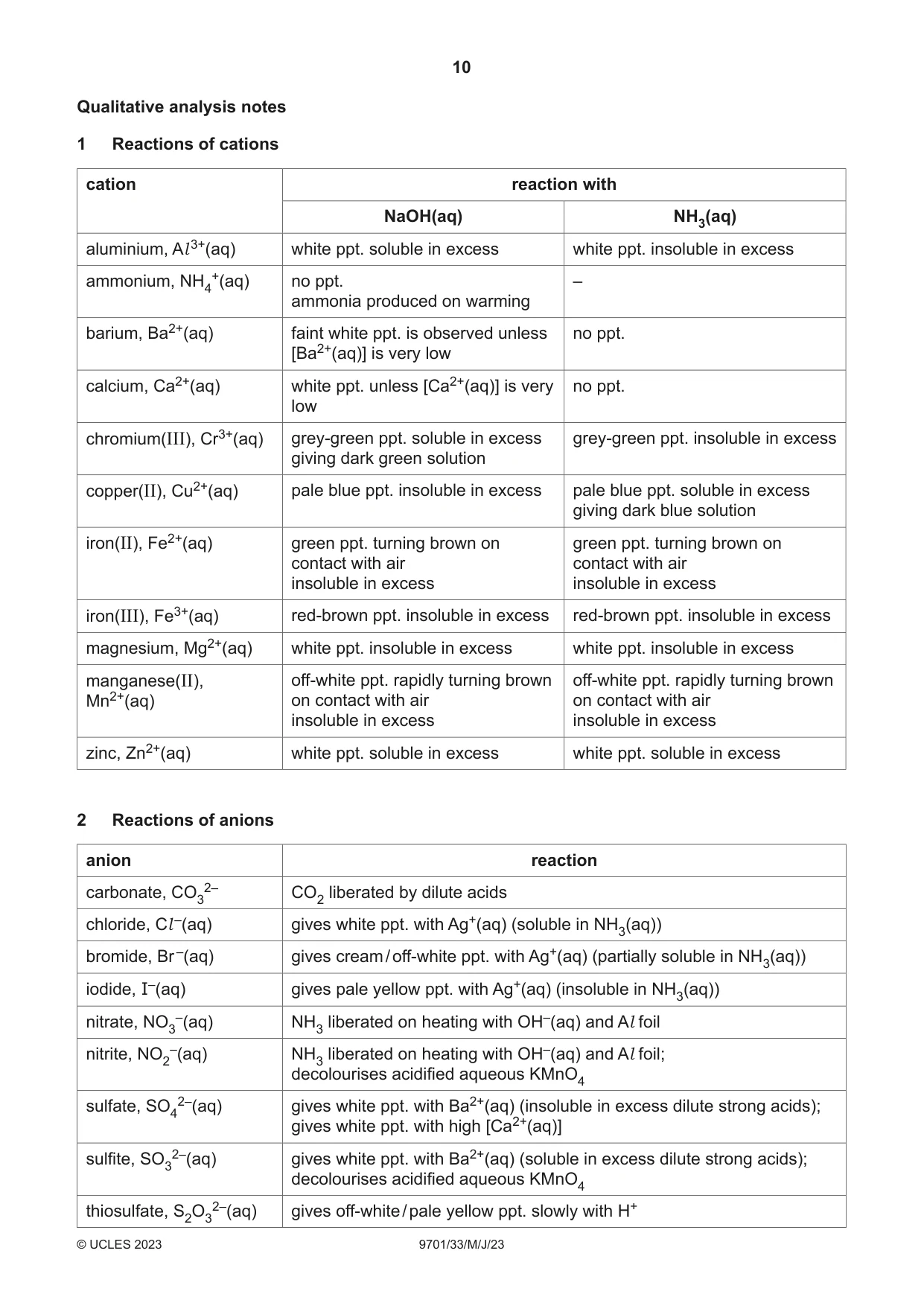
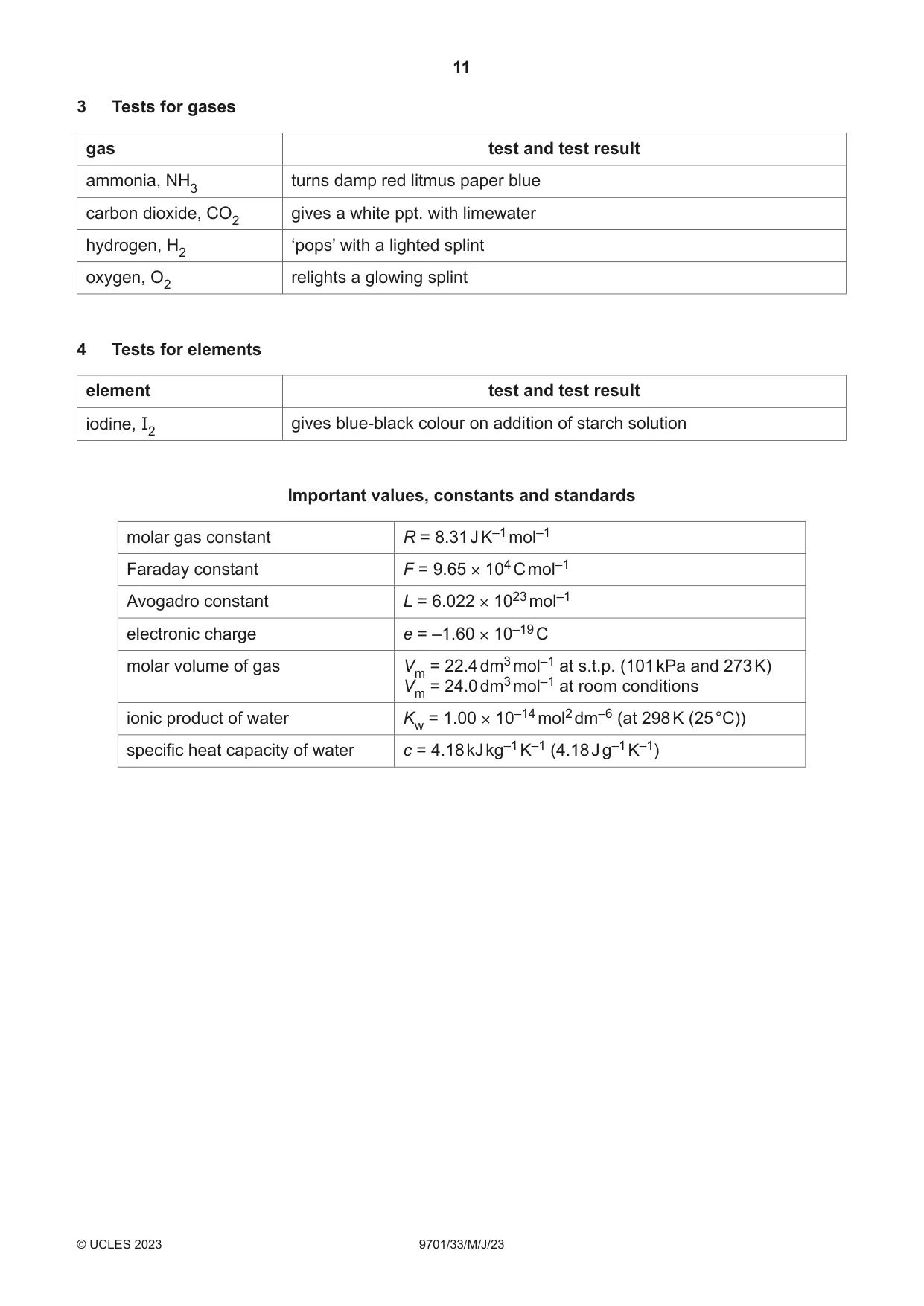
3 FA 5 is a solid mixture of two salts and contains two different anions. None of the ions present contains nitrogen. (a) (i) Place a small spatula measure of FA 5 in a hard‑glass test‑tube. Heat the test‑tube, gently at first, then more strongly, for a total of approximately 2 minutes. Then allow the test‑tube to cool. Record your observations. ........................................................................................................................................... ........................................................................................................................................... ..................................................................................................................................... [2] (ii) Place a large spatula measure of FA 5 in a boiling tube. Add an approximately 3 cm depth of distilled water and shake the tube and contents. Record your observations. Keep the contents of the test-tube for use in (a)(iii). ........................................................................................................................................... ........................................................................................................................................... ..................................................................................................................................... [2] (iii) Put 1 cm depth of the solution from (a)(ii) in a test‑tube. Add aqueous sodium hydroxide. Record your observations. ..................................................................................................................................... [1] (b) (i) Put 3 cm depth of dilute nitric acid in a test‑tube. Carefully add a spatula measure of FA 5. Record your observations. Keep the contents of the test-tube for use in (b)(iii). ........................................................................................................................................... ........................................................................................................................................... ..................................................................................................................................... [2] (ii) Suggest what your observations in (a)(ii) tell you about the identity of one of the cations in FA 5. ..................................................................................................................................... [1] (iii) Select reagents for further tests to identify any anion present in FA 5. Carry out your tests and record your reagents, conditions and observations in the space below. [2] (iv) From your observations in (b)(i) and (b)(iii), deduce the formulae of the two anions present in FA 5. anions [1] (v) Write an ionic equation for one reaction occurring in (b)(i) or (b)(iii). Include state symbols. ..................................................................................................................................... [1] (c) FA 6 is a solution of a salt. One of the two ions contains a nitrogen atom. Both ions are listed in the Qualitative analysis notes. Select reagents to identify the ion containing the nitrogen atom. Use a 1 cm depth of FA 6 in a boiling tube to carry out your tests. Record your tests, results and conclusion in the space below. [3] [Total: 15]
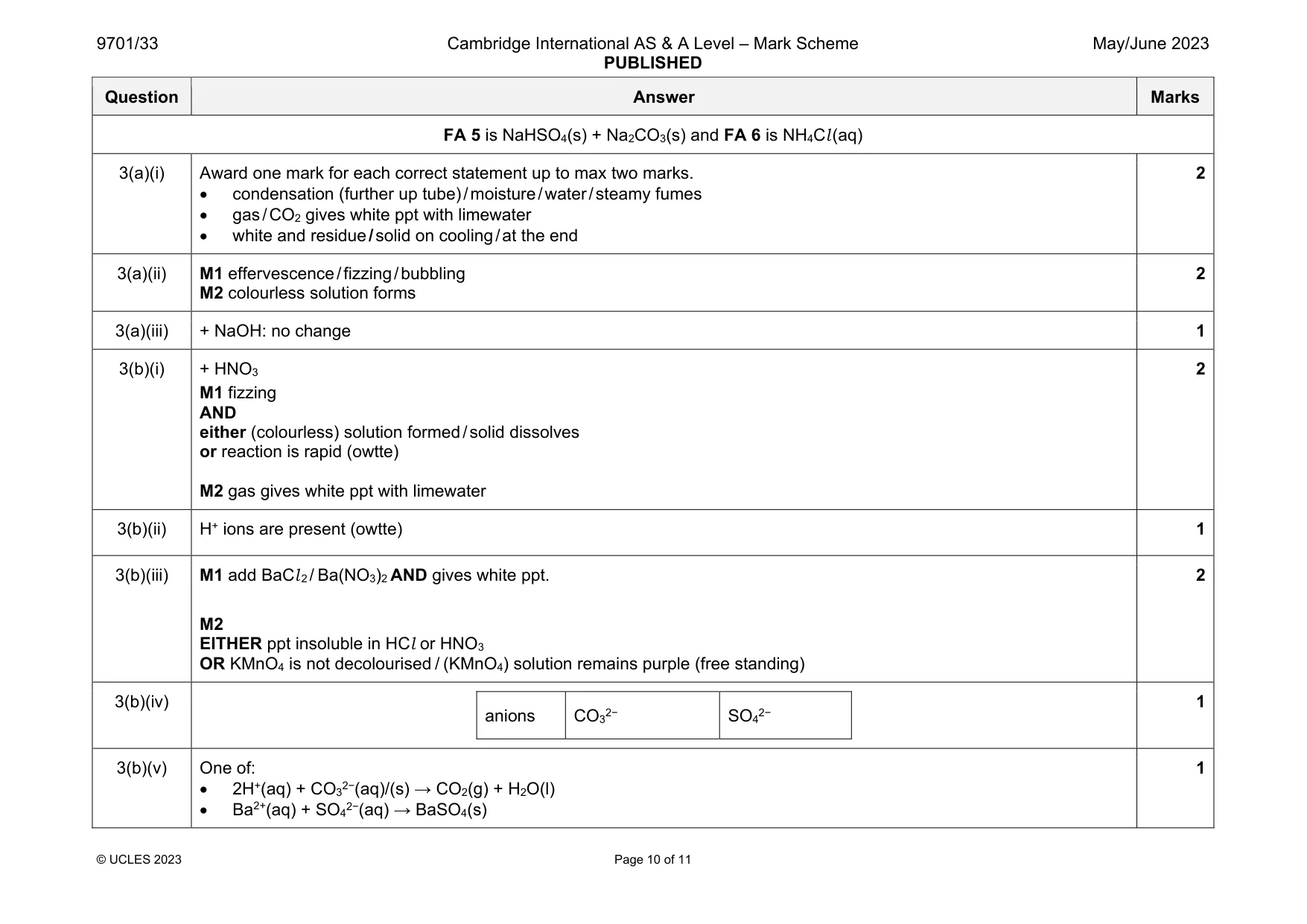
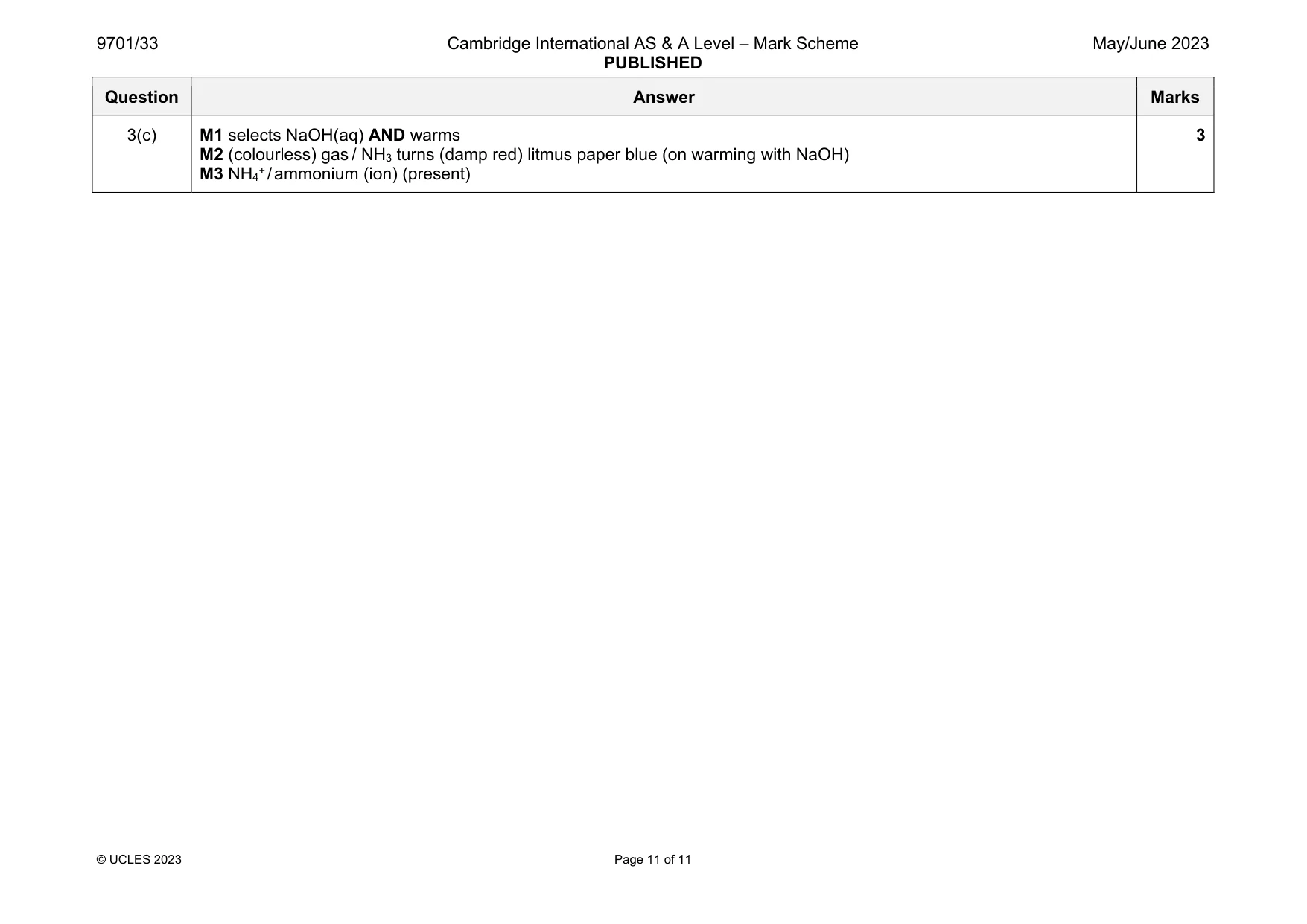
Mark scheme: 3(a)(i) Award one mark for each correct statement up to max two marks. condensation (further up tube) / moisture / water / steamy fumes gas / CO2 gives white ppt with limewater white and residue/solid on cooling/at the end 2 3(a)(ii) M1 effervescence / fizzing / bubbling M2 colourless solution forms 2 3(a)(iii) + NaOH: no change 1 3(b)(i) + HNO3 M1 fizzing AND either (colourless) solution formed / solid dissolves or reaction is rapid (owtte) M2 gas gives white ppt with limewater 2 3(b)(ii) H+ ions are present (owtte) 1 3(b)(iii) M1 add BaCl 2 / Ba(NO3)2 AND gives white ppt. M2 EITHER ppt insoluble in HCl or HNO3 OR KMnO4 is not decolourised / (KMnO4) solution remains purple (free standing) 2 3(b)(iv) anions CO32− SO42− 1 3(b)(v) One of: 2H+(aq) + CO32−(aq)/(s) → CO2(g) + H2O(l) Ba2+(aq) + SO42−(aq) → BaSO4(s) 1 Question Answer Marks 3(c) M1 selects NaOH(aq) AND warms M2 (colourless) gas / NH3 turns (damp red) litmus paper blue (on warming with NaOH) M3 NH4+ /ammonium (ion) (present) 3
What was in this paper
The subtopics covered by these 3 questions, and how many questions each got. Open one in a new tab to see every Cambridge question on it.
What you needed in this session
Cambridge’s own grade thresholds for 2023 May/June, Paper 3 · Variant 3. A higher threshold means an easier paper — the bar moves with how the cohort did.