Cambridge A Level Chemistry 9701 — 2023 May/June Paper 4 · Variant 1
9701/41/M/J/23 · 100 marks · ≈113 min
The question paper and its mark scheme, free to read here and free to download. This is Cambridge’s own paper, exactly as it was sat.
Question paper28 pages



Mark scheme17 pages
Answers below. Sit the paper first if you are practising.
Paper as text
Question paper, page 1
This document has 28 pages. Any blank pages are indicated. [Turn over Cambridge International AS & A Level * 2 5 6 3 6 1 9 2 8 2 * DC (EF/CT) 311840/6 © UCLES 2023 CHEMISTRY 9701/41 Paper 4 A Level Structured Questions May/June 2023 2 hours You must answer on the question paper. No additional materials are needed. INSTRUCTIONS ● Answer all questions. ● Use a black or dark blue pen. You may use an HB pencil for any diagrams or graphs. ● Write your name, centre number and candidate number in the boxes at the top of the page. ● Write your answer to each question in the space provided. ● Do not use an erasable pen or correction fluid. ● Do not write on any bar codes. ● You may use a calculator. ● You should show all your working and use appropriate units. INFORMATION ● The total mark for this paper is 100. ● The number of marks for each question or part question is shown in brackets [ ]. ● The Periodic Table is printed in the question paper. ● Important values, constants and standards are printed in the question paper.
Question paper, page 2
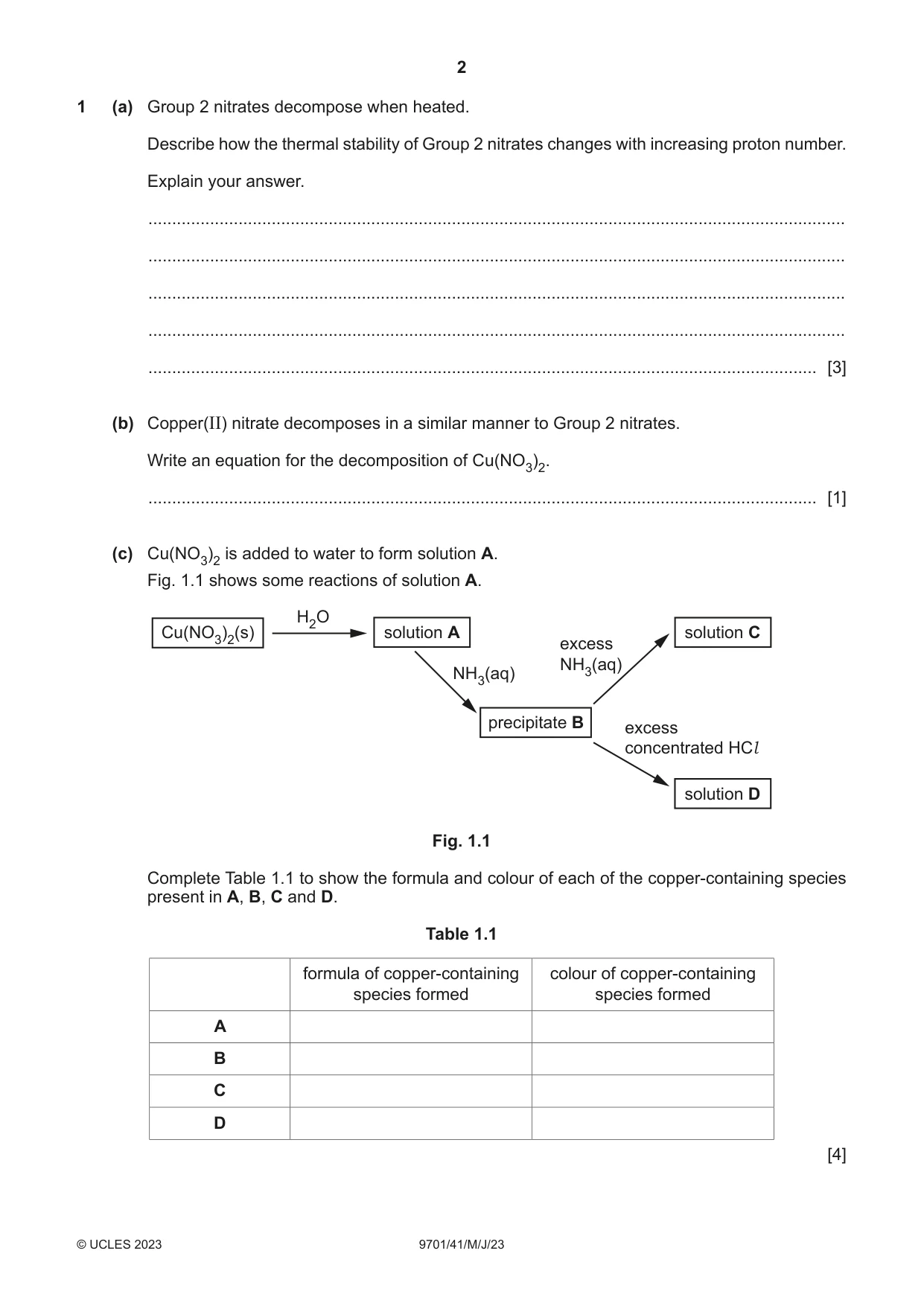
2 9701/41/M/J/23 © UCLES 2023 1 (a) Group 2 nitrates decompose when heated. Describe how the thermal stability of Group 2 nitrates changes with increasing proton number. Explain your answer. … … … … … [3] (b) Copper(II) nitrate decomposes in a similar manner to Group 2 nitrates. Write an equation for the decomposition of Cu(NO3)2. … [1] (c) Cu(NO3)2 is added to water to form solution A. Fig. 1.1 shows some reactions of solution A. solution A Cu(NO3)2(s) solution C solution D precipitate B H2O NH3(aq) excess NH3(aq) excess concentrated HCl Fig. 1.1 Complete Table 1.1 to show the formula and colour of each of the copper‑containing species present in A, B, C and D. Table 1.1 formula of copper‑containing species formed colour of copper‑containing species formed A B C D [4]
Question paper, page 3
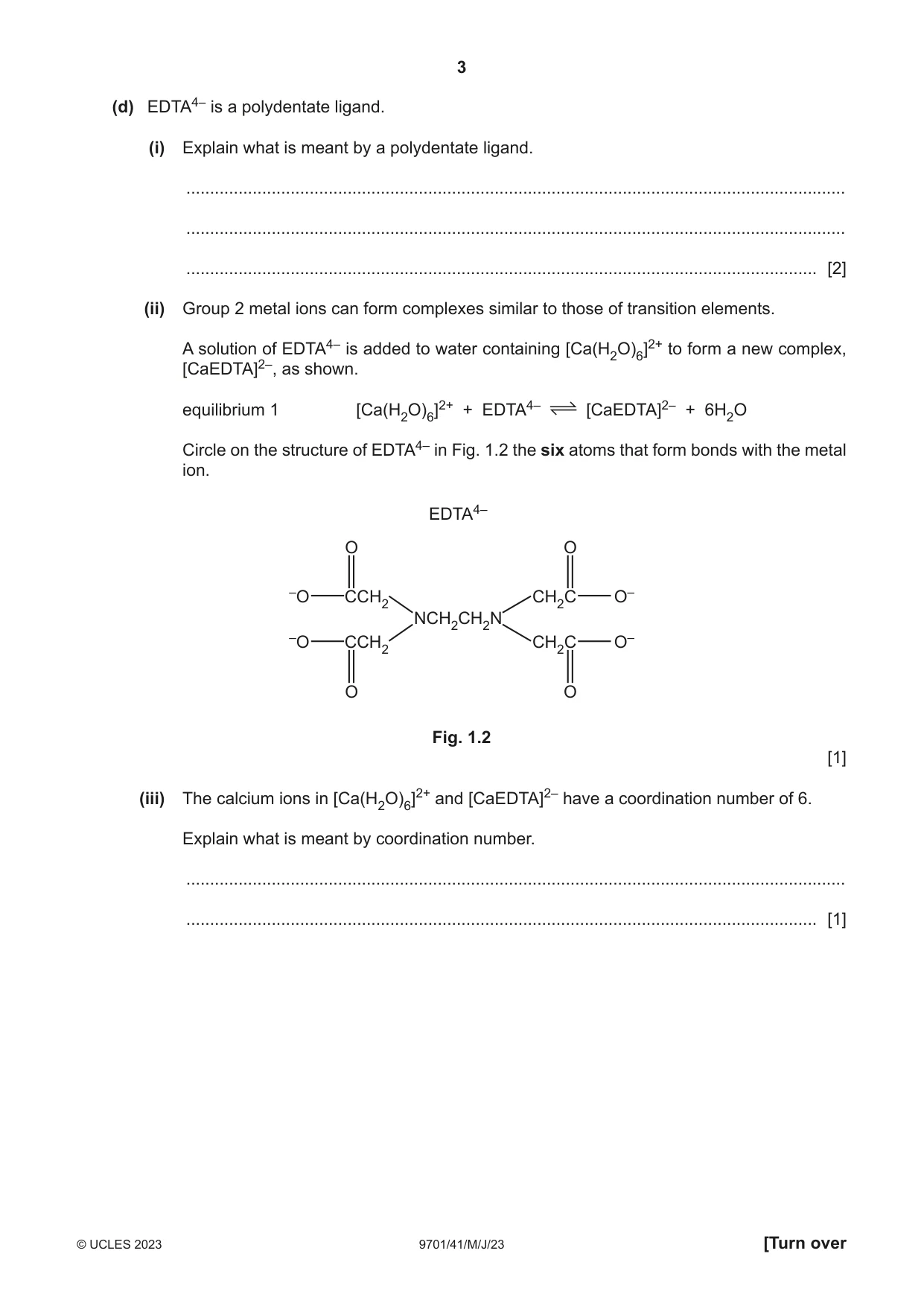
3 9701/41/M/J/23 © UCLES 2023 [Turn over (d) EDTA4– is a polydentate ligand. (i) Explain what is meant by a polydentate ligand. … … … [2] (ii) Group 2 metal ions can form complexes similar to those of transition elements. A solution of EDTA4– is added to water containing [Ca(H2O)6]2+ to form a new complex, [CaEDTA]2–, as shown. equilibrium 1 [Ca(H2O)6]2+ + EDTA4– [CaEDTA]2– + 6H2O Circle on the structure of EDTA4– in Fig. 1.2 the six atoms that form bonds with the metal ion. EDTA4– NCH2CH2N CCH2 –O O CCH2 CH2C CH2C –O O– O– O O O Fig. 1.2 [1] (iii) The calcium ions in [Ca(H2O)6]2+ and [CaEDTA]2– have a coordination number of 6. Explain what is meant by coordination number. … … [1]
Question paper, page 4
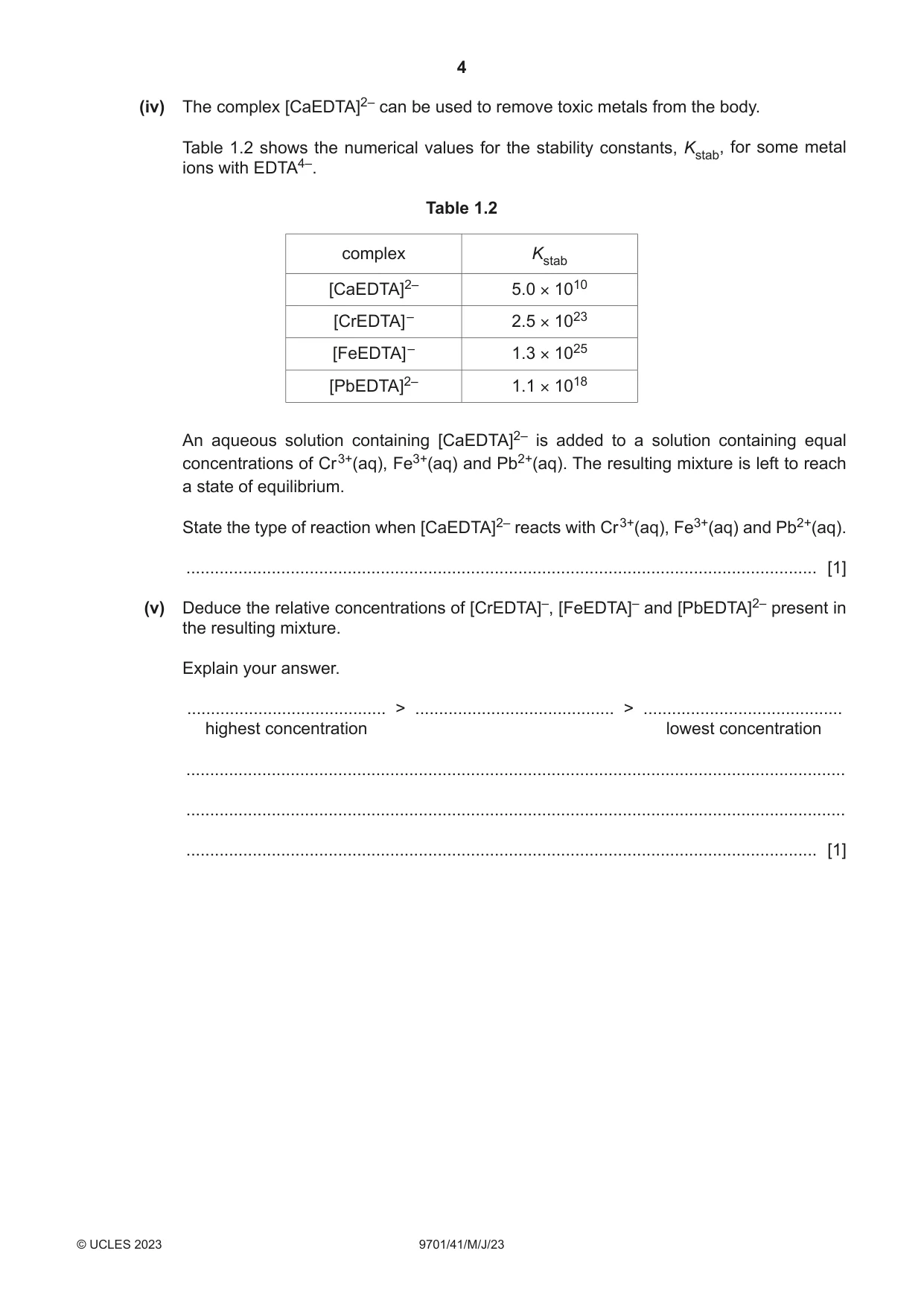
4 9701/41/M/J/23 © UCLES 2023 (iv) The complex [CaEDTA]2– can be used to remove toxic metals from the body. Table 1.2 shows the numerical values for the stability constants, Kstab, for some metal ions with EDTA4–. Table 1.2 complex Kstab [CaEDTA]2– 5.0 × 10¹⁰ [CrEDTA] – 2.5 × 10²³ [FeEDTA] – 1.3 × 1025 [PbEDTA]2– 1.1 × 10¹⁸ An aqueous solution containing [CaEDTA]2– is added to a solution containing equal concentrations of Cr 3+(aq), Fe3+(aq) and Pb2+(aq). The resulting mixture is left to reach a state of equilibrium. State the type of reaction when [CaEDTA]2– reacts with Cr 3+(aq), Fe3+(aq) and Pb2+(aq). … [1] (v) Deduce the relative concentrations of [CrEDTA]–, [FeEDTA]– and [PbEDTA]2– present in the resulting mixture. Explain your answer. … > … > … highest concentration lowest concentration … … … [1]
Question paper, page 5
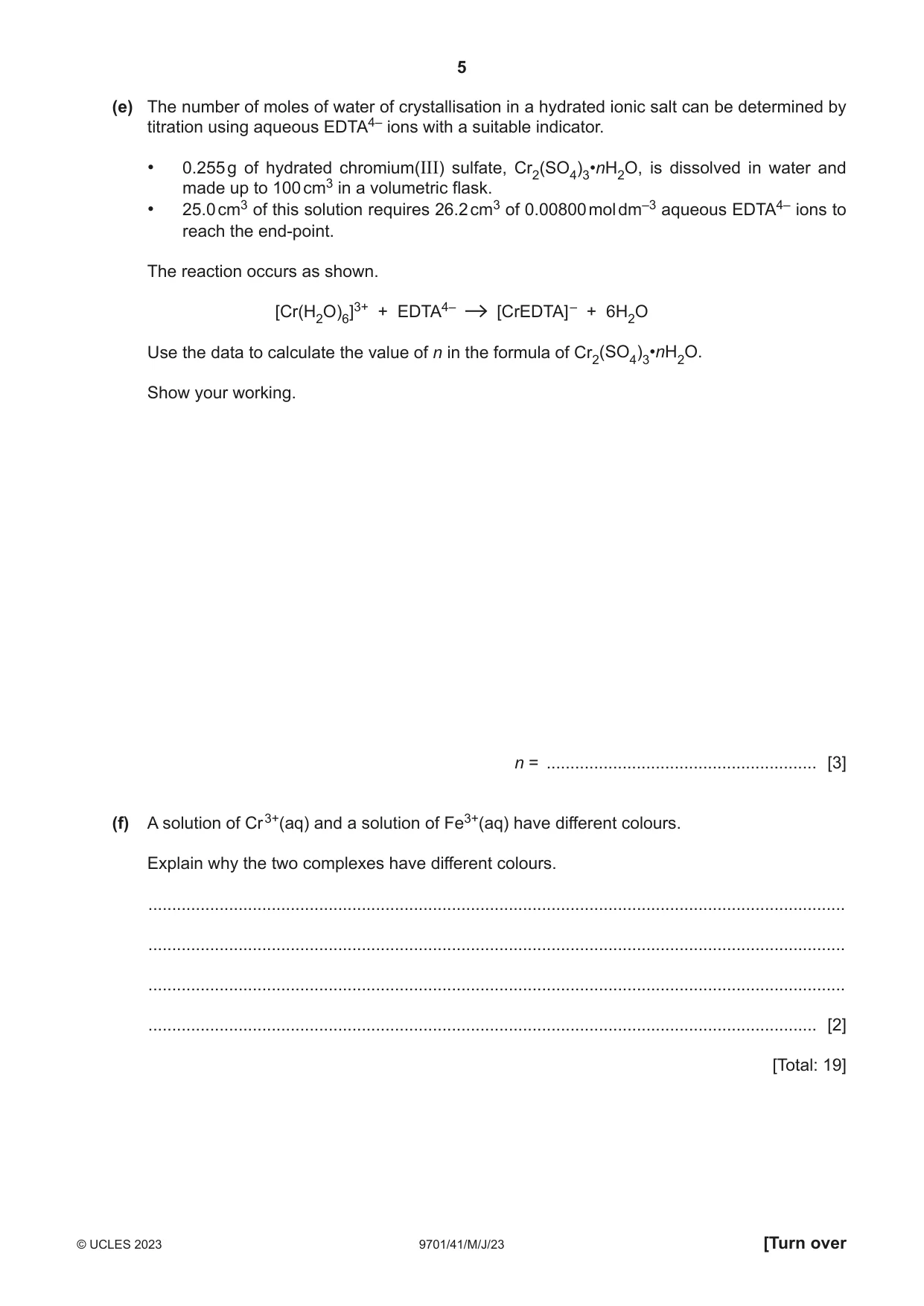
5 9701/41/M/J/23 © UCLES 2023 [Turn over (e) The number of moles of water of crystallisation in a hydrated ionic salt can be determined by titration using aqueous EDTA4– ions with a suitable indicator. • 0.255 g of hydrated chromium(III) sulfate, Cr2(SO4)3•nH2O, is dissolved in water and made up to 100 cm3 in a volumetric flask. • 25.0 cm3 of this solution requires 26.2 cm3 of 0.00800 mol dm–3 aqueous EDTA4– ions to reach the end‑point. The reaction occurs as shown. [Cr(H2O)6]3+ + EDTA4– [CrEDTA] – + 6H2O Use the data to calculate the value of n in the formula of Cr2(SO4)3•nH2O. Show your working. n = … [3] (f) A solution of Cr 3+(aq) and a solution of Fe3+(aq) have different colours. Explain why the two complexes have different colours. … … … … [2] [Total: 19]
Question paper, page 6
6 9701/41/M/J/23 © UCLES 2023 BLANK PAGE
Question paper, page 7
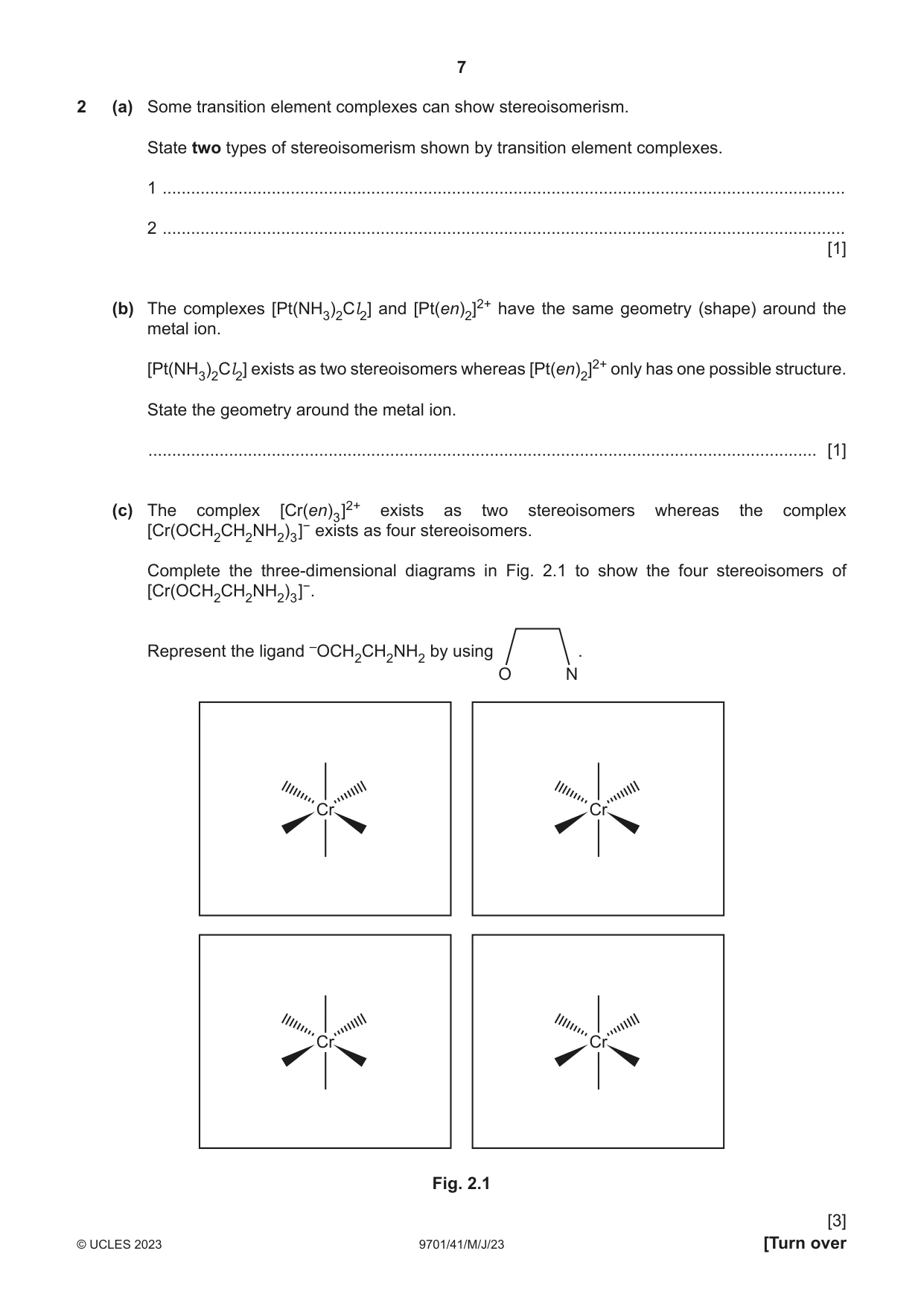
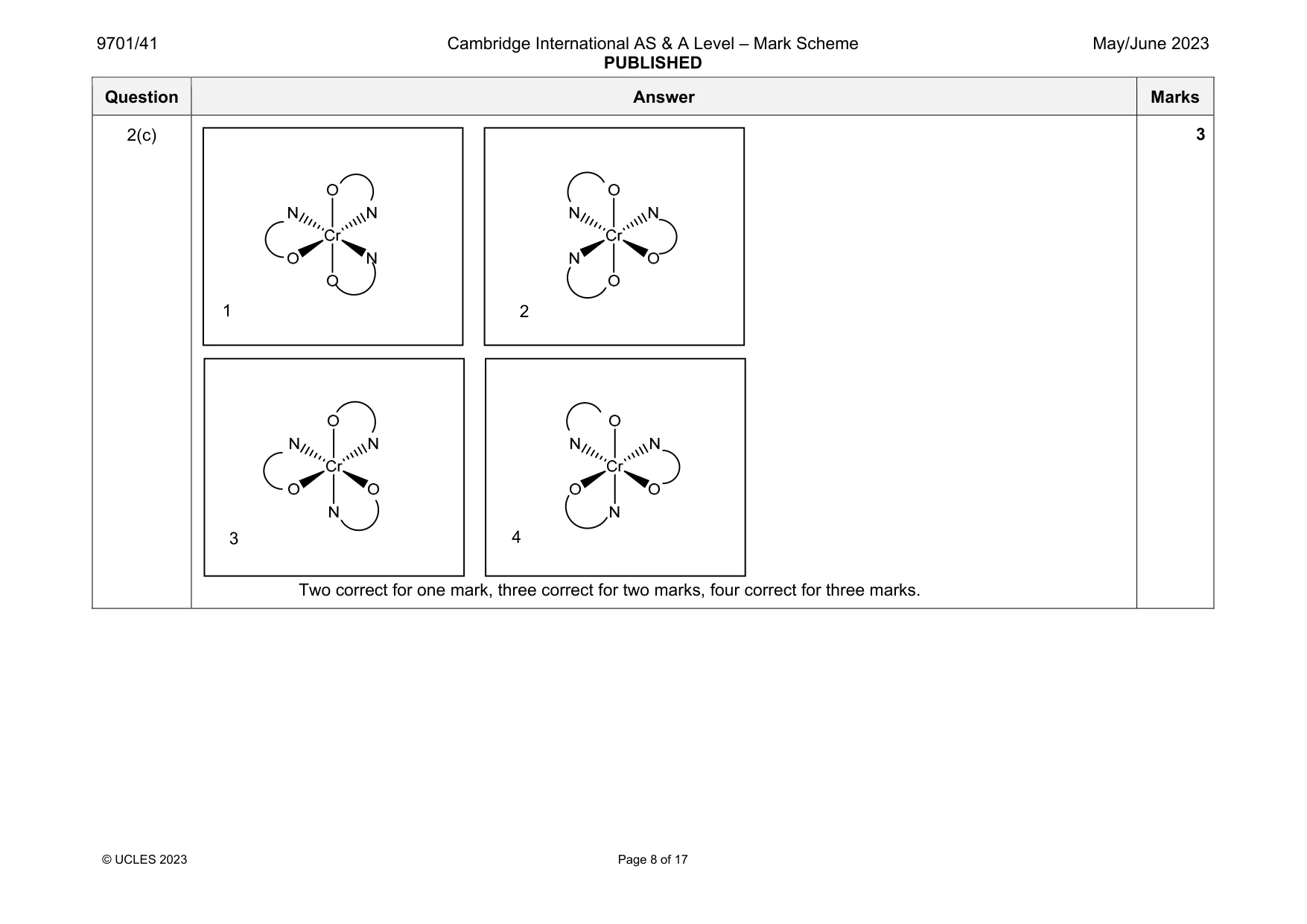
7 9701/41/M/J/23 © UCLES 2023 [Turn over 2 (a) Some transition element complexes can show stereoisomerism. State two types of stereoisomerism shown by transition element complexes. 1 … 2 … [1] (b) The complexes [Pt(NH3)2Cl2] and [Pt(en)2]2+ have the same geometry (shape) around the metal ion. [Pt(NH3)2Cl2] exists as two stereoisomers whereas [Pt(en)2]2+ only has one possible structure. State the geometry around the metal ion. … [1] (c) The complex [Cr(en)3 ]2+ exists as two stereoisomers whereas the complex [Cr(OCH2CH2NH2)3 ]− exists as four stereoisomers. Complete the three‑dimensional diagrams in Fig. 2.1 to show the four stereoisomers of [Cr(OCH2CH2NH2)3 ]−. Represent the ligand –OCH2CH2NH2 by using O N . Cr Cr Cr Cr Fig. 2.1 [3]
Question paper, page 8
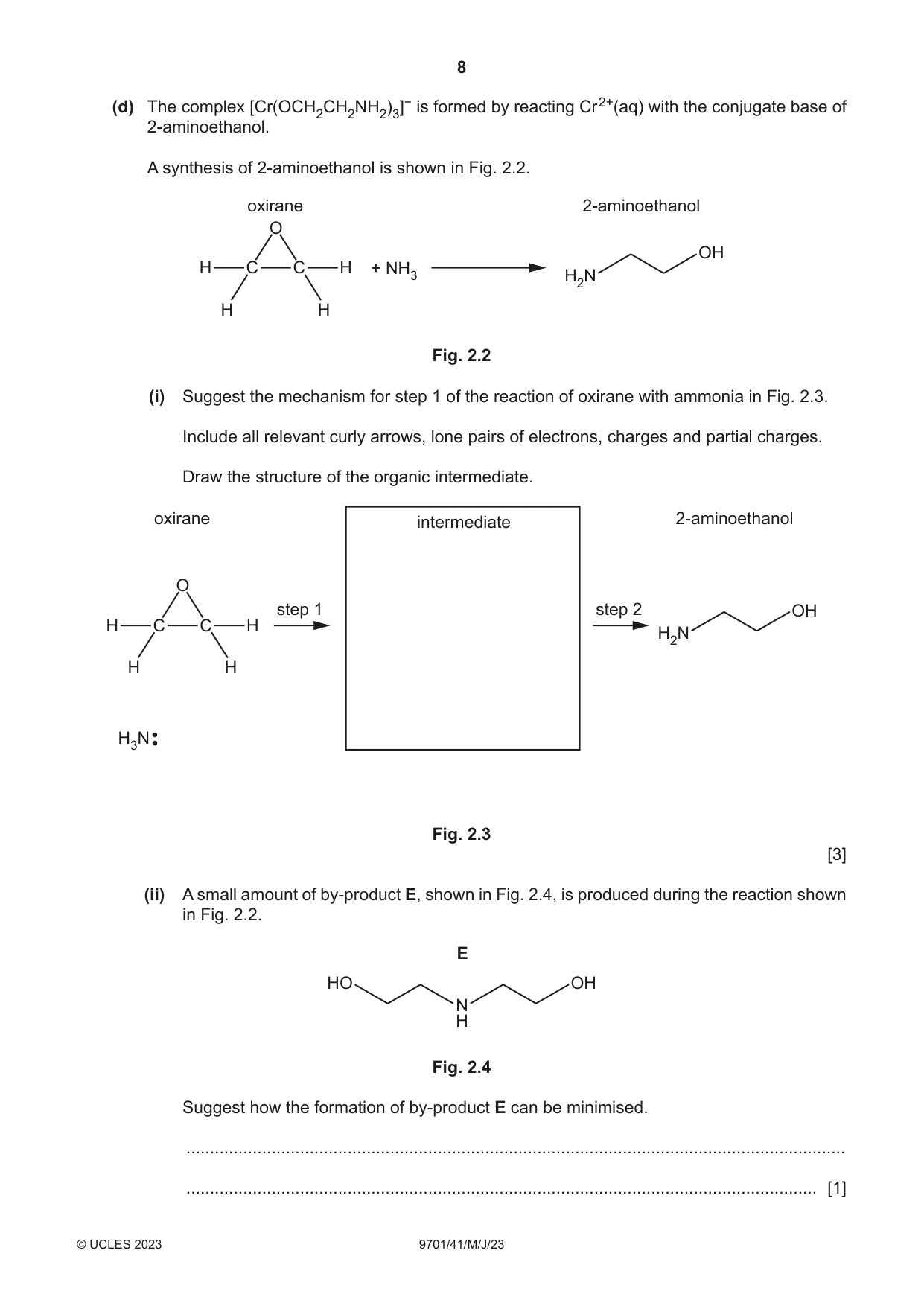
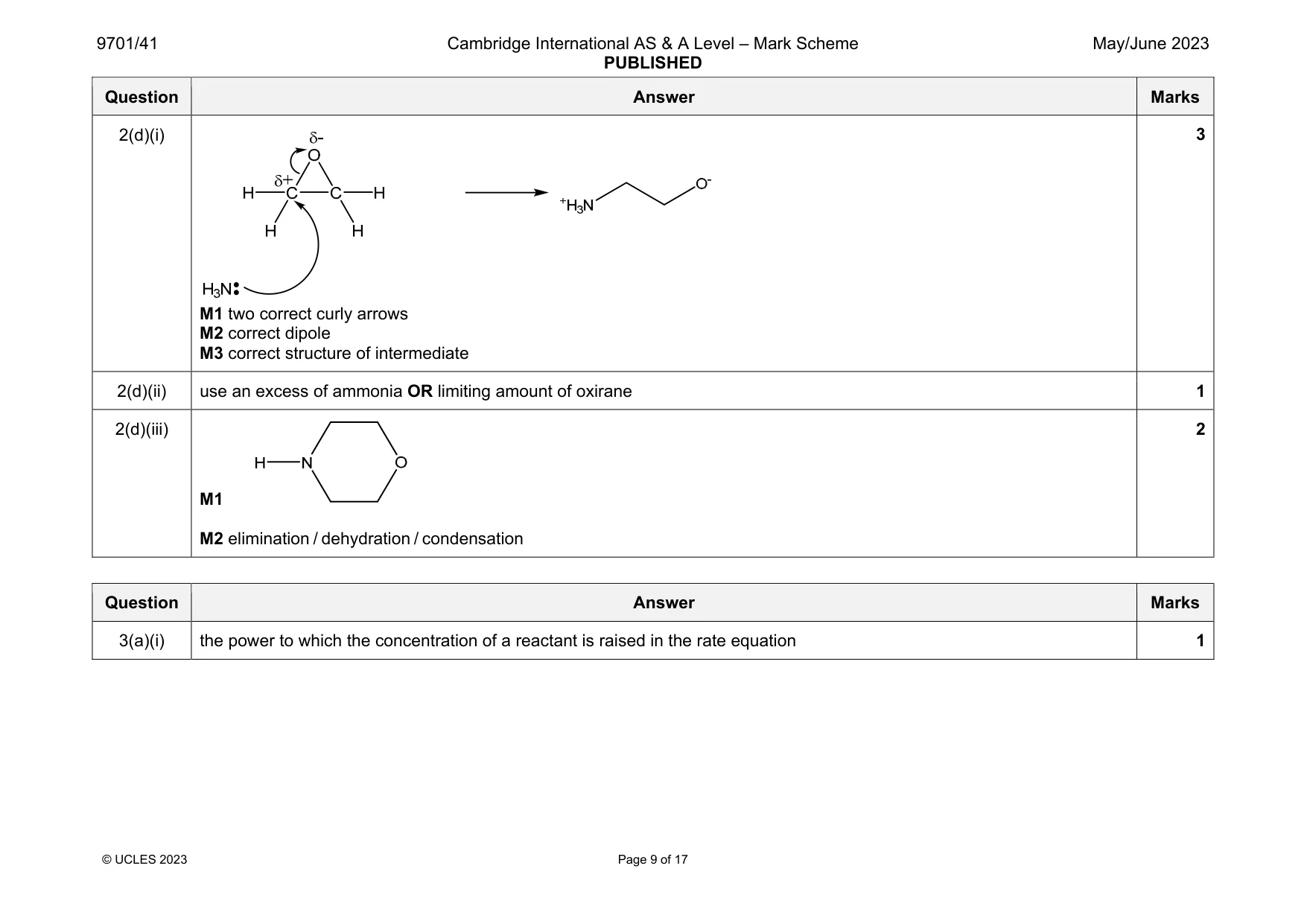
8 9701/41/M/J/23 © UCLES 2023 (d) The complex [Cr(OCH2CH2NH2)3]− is formed by reacting Cr 2+(aq) with the conjugate base of 2‑aminoethanol. A synthesis of 2‑aminoethanol is shown in Fig. 2.2. oxirane 2-aminoethanol H H H H2N + NH3 OH C O C H Fig. 2.2 (i) Suggest the mechanism for step 1 of the reaction of oxirane with ammonia in Fig. 2.3. Include all relevant curly arrows, lone pairs of electrons, charges and partial charges. Draw the structure of the organic intermediate. intermediate oxirane 2-aminoethanol step 1 step 2 H H H H3N H2N OH C O C H Fig. 2.3 [3] (ii) A small amount of by‑product E, shown in Fig. 2.4, is produced during the reaction shown in Fig. 2.2. E N H OH HO Fig. 2.4 Suggest how the formation of by‑product E can be minimised. … … [1]
Question paper, page 9
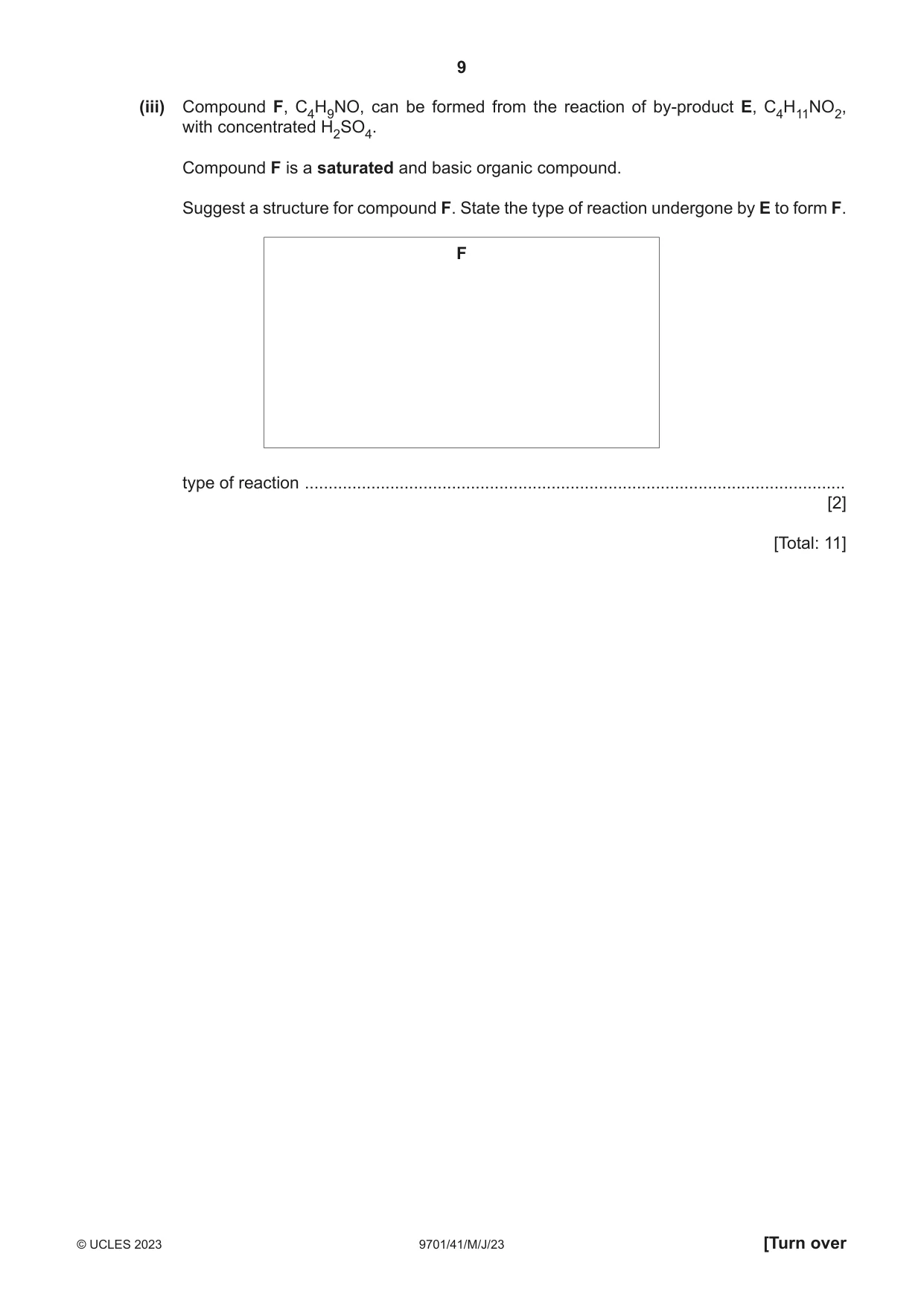
9 9701/41/M/J/23 © UCLES 2023 [Turn over (iii) Compound F, C4H9NO, can be formed from the reaction of by‑product E, C4H11NO2, with concentrated H2SO4. Compound F is a saturated and basic organic compound. Suggest a structure for compound F. State the type of reaction undergone by E to form F. F type of reaction … [2] [Total: 11]
Question paper, page 10
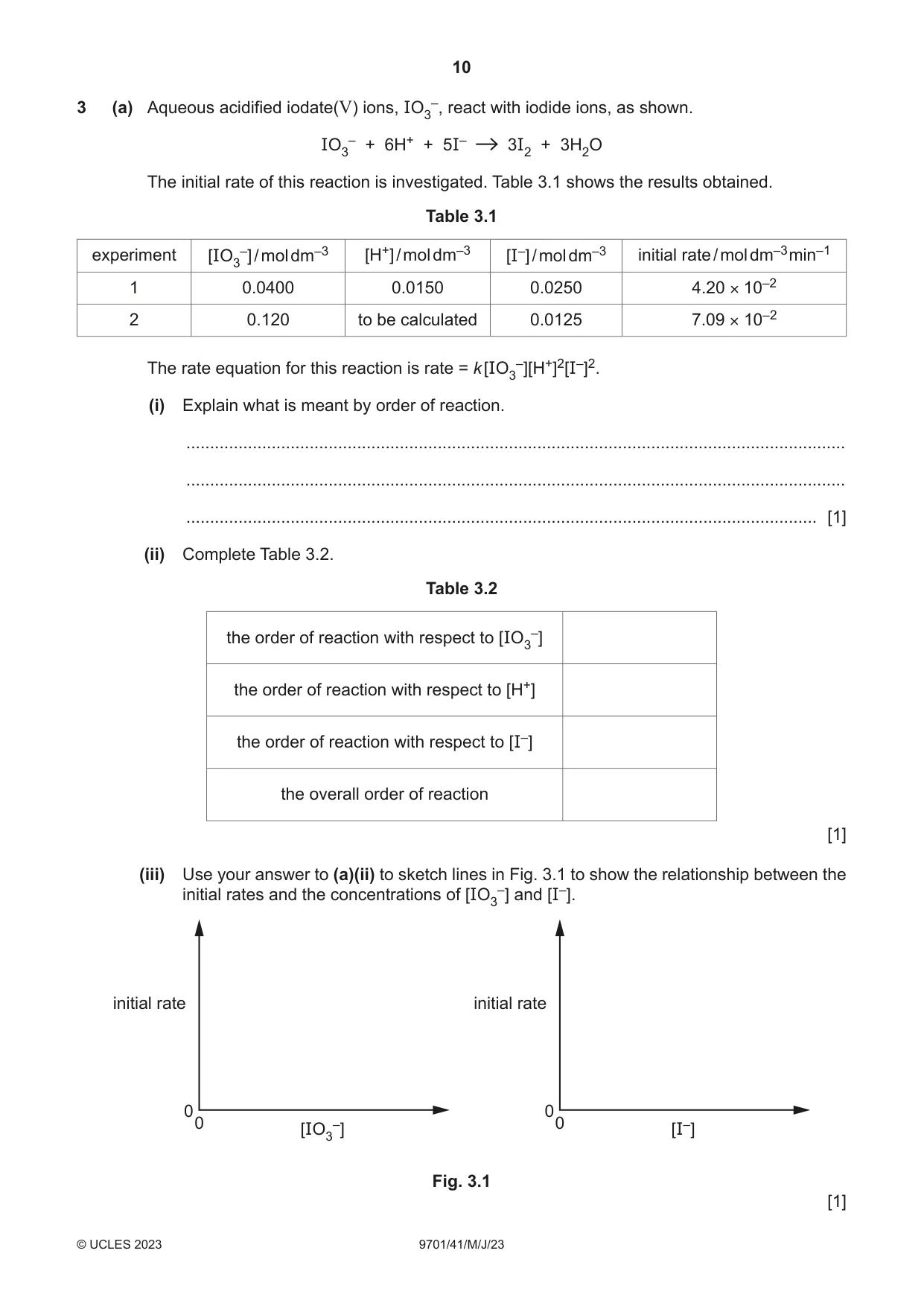
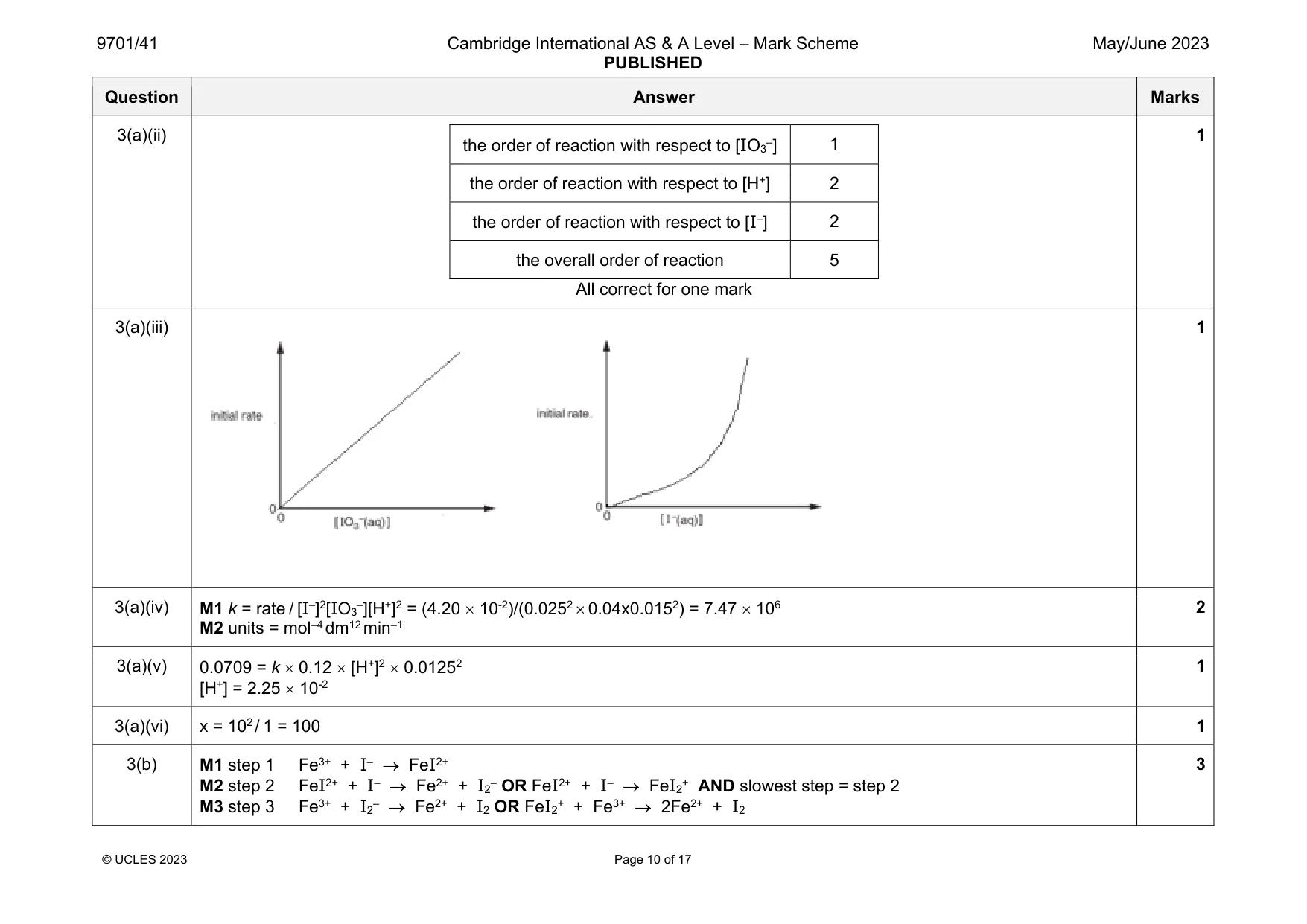
10 9701/41/M/J/23 © UCLES 2023 3 (a) Aqueous acidified iodate(V) ions, IO3 –, react with iodide ions, as shown. IO3 – + 6H+ + 5I– 3I2 + 3H2O The initial rate of this reaction is investigated. Table 3.1 shows the results obtained. Table 3.1 experiment [IO3 –] / mol dm–3 [H+] / mol dm–3 [I–] / mol dm–3 initial rate / mol dm–3 min–1 1 0.0400 0.0150 0.0250 4.20 × 10⁻² 2 0.120 to be calculated 0.0125 7.09 × 10⁻² The rate equation for this reaction is rate = k [IO3 –][H+]2[I–]2. (i) Explain what is meant by order of reaction. … … … [1] (ii) Complete Table 3.2. Table 3.2 the order of reaction with respect to [IO3 –] the order of reaction with respect to [H+] the order of reaction with respect to [I–] the overall order of reaction [1] (iii) Use your answer to (a)(ii) to sketch lines in Fig. 3.1 to show the relationship between the initial rates and the concentrations of [IO3 –] and [I–]. 00 00 initial rate [IO3 –] initial rate [I–] Fig. 3.1 [1]
Question paper, page 11
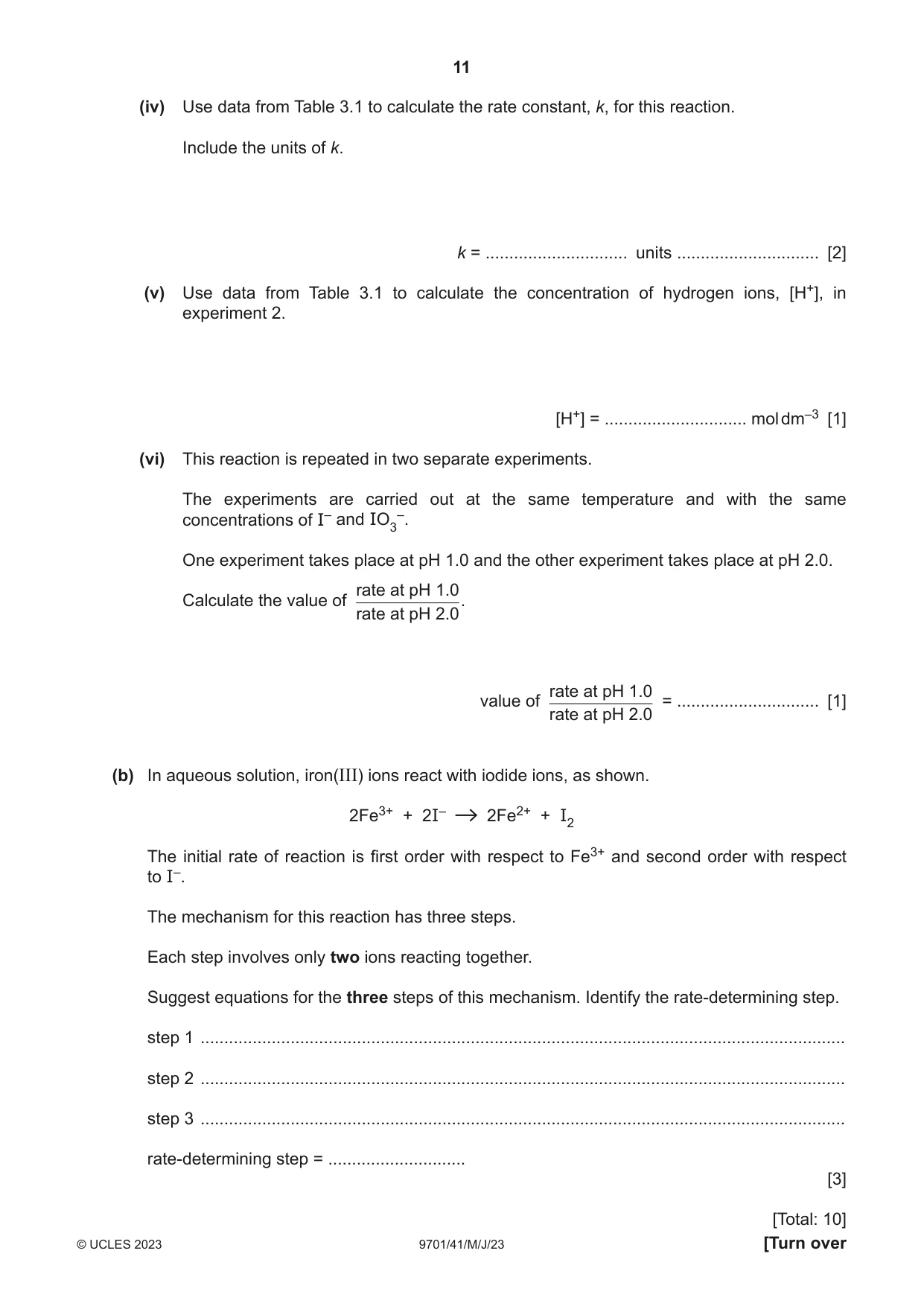
11 9701/41/M/J/23 © UCLES 2023 [Turn over (iv) Use data from Table 3.1 to calculate the rate constant, k, for this reaction. Include the units of k. k = … units … [2] (v) Use data from Table 3.1 to calculate the concentration of hydrogen ions, [H+], in experiment 2. [H+] = … mol dm–3 [1] (vi) This reaction is repeated in two separate experiments. The experiments are carried out at the same temperature and with the same concentrations of I– and IO3 –. One experiment takes place at pH 1.0 and the other experiment takes place at pH 2.0. Calculate the value of rate at pH 1.0 rate at pH 2.0 . value of rate at pH 1.0 rate at pH 2.0 = … [1] (b) In aqueous solution, iron(III) ions react with iodide ions, as shown. 2Fe3+ + 2I– 2Fe2+ + I2 The initial rate of reaction is first order with respect to Fe3+ and second order with respect to I–. The mechanism for this reaction has three steps. Each step involves only two ions reacting together. Suggest equations for the three steps of this mechanism. Identify the rate‑determining step. step 1 … step 2 … step 3 … rate‑determining step = … [3] [Total: 10]
Question paper, page 12
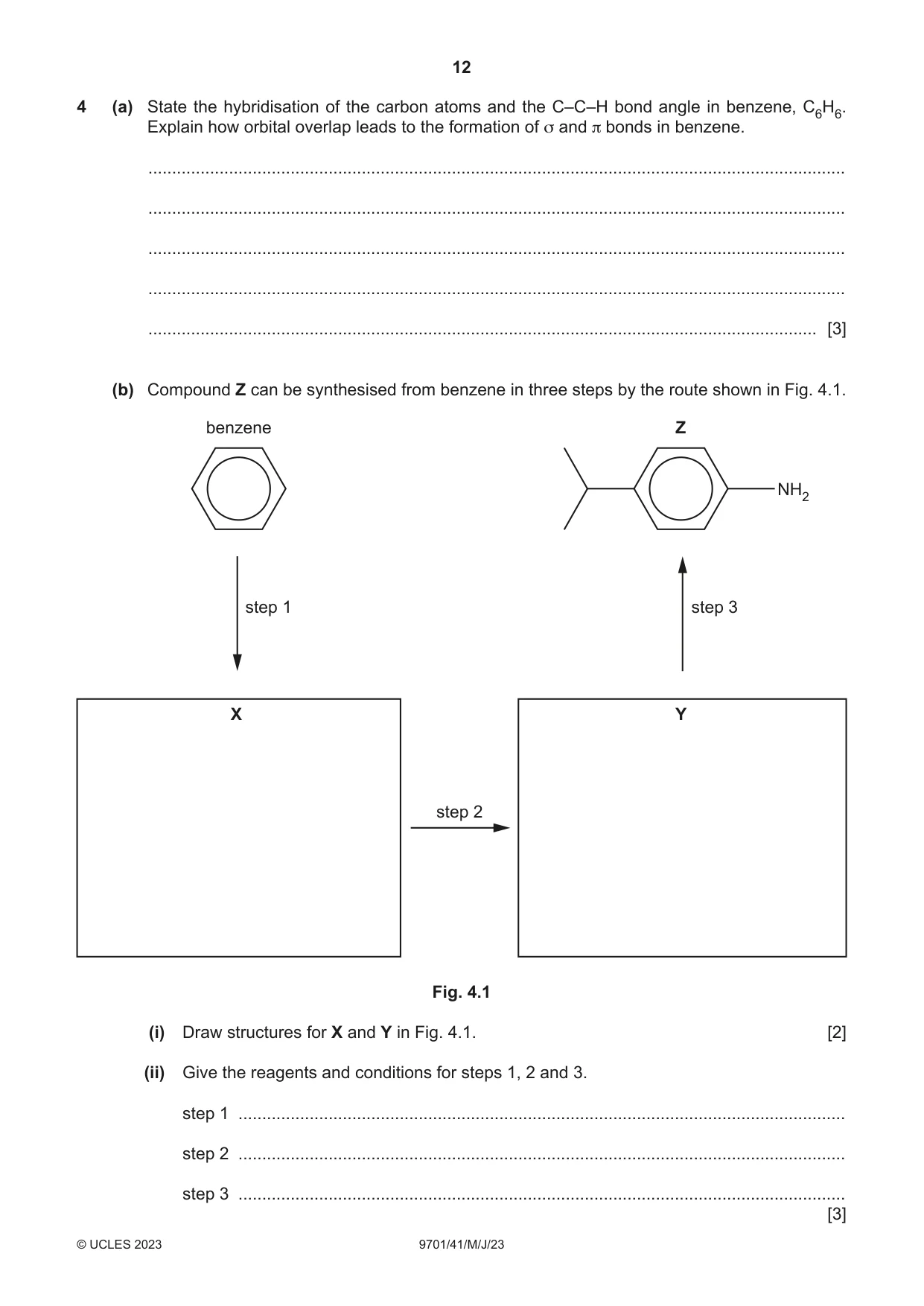
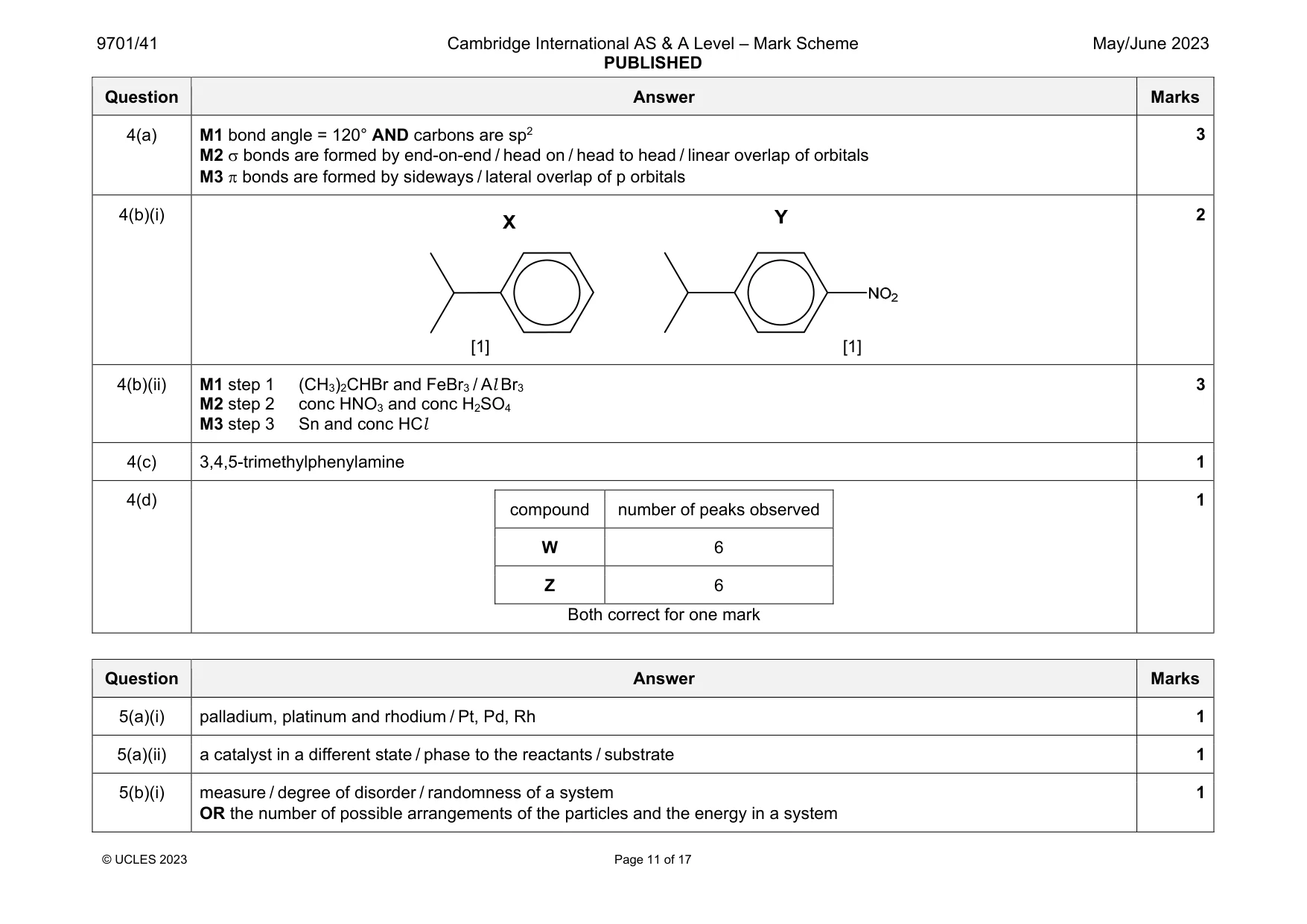
12 9701/41/M/J/23 © UCLES 2023 4 (a) State the hybridisation of the carbon atoms and the C–C–H bond angle in benzene, C6H6. Explain how orbital overlap leads to the formation of σ and π bonds in benzene. … … … … … [3] (b) Compound Z can be synthesised from benzene in three steps by the route shown in Fig. 4.1. step 1 step 2 step 3 Z benzene Y X NH2 Fig. 4.1 (i) Draw structures for X and Y in Fig. 4.1. [2] (ii) Give the reagents and conditions for steps 1, 2 and 3. step 1 … step 2 … step 3 … [3]
Question paper, page 13
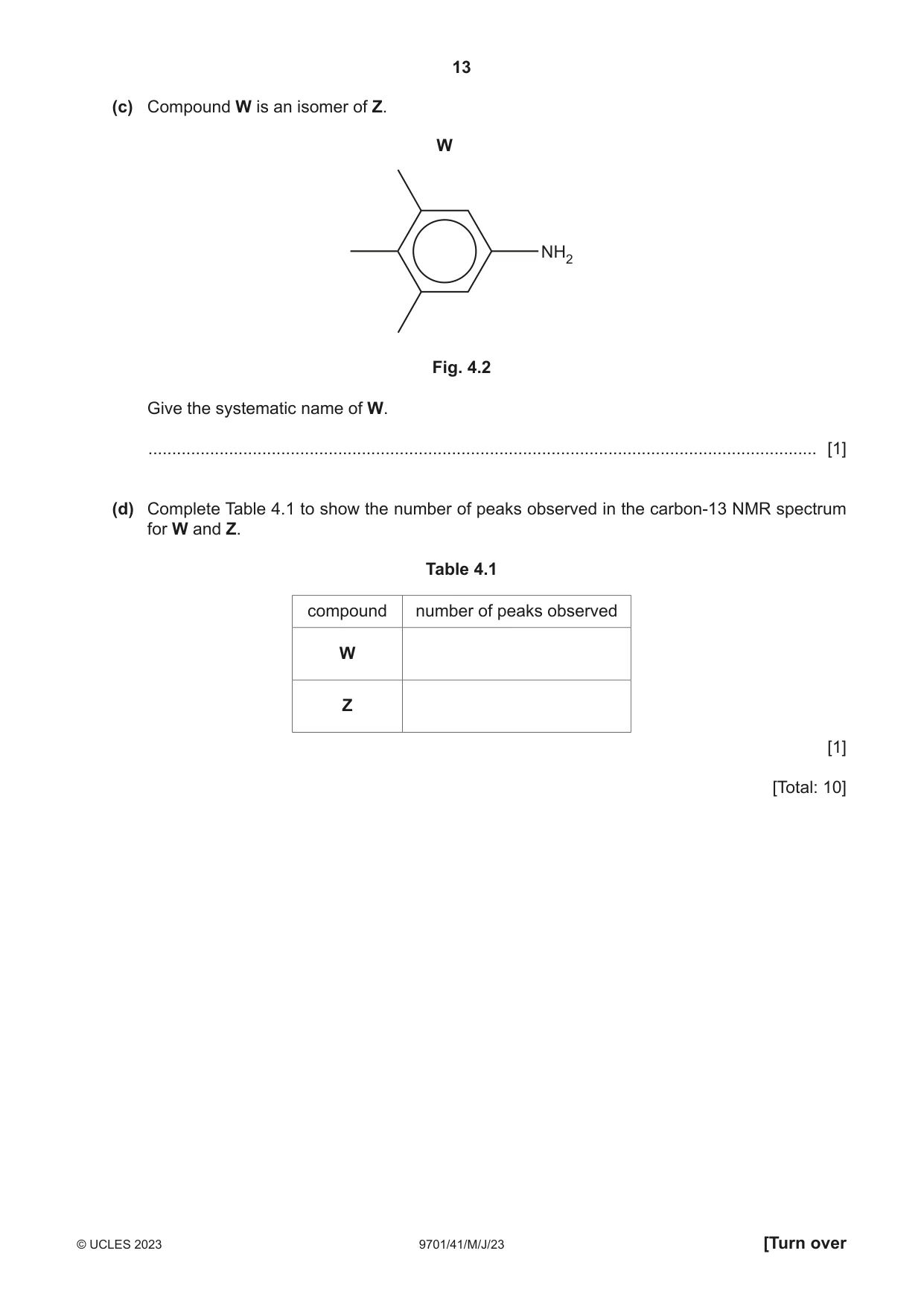
13 9701/41/M/J/23 © UCLES 2023 [Turn over (c) Compound W is an isomer of Z. W NH2 Fig. 4.2 Give the systematic name of W. … [1] (d) Complete Table 4.1 to show the number of peaks observed in the carbon‑13 NMR spectrum for W and Z. Table 4.1 compound number of peaks observed W Z [1] [Total: 10]
Question paper, page 14
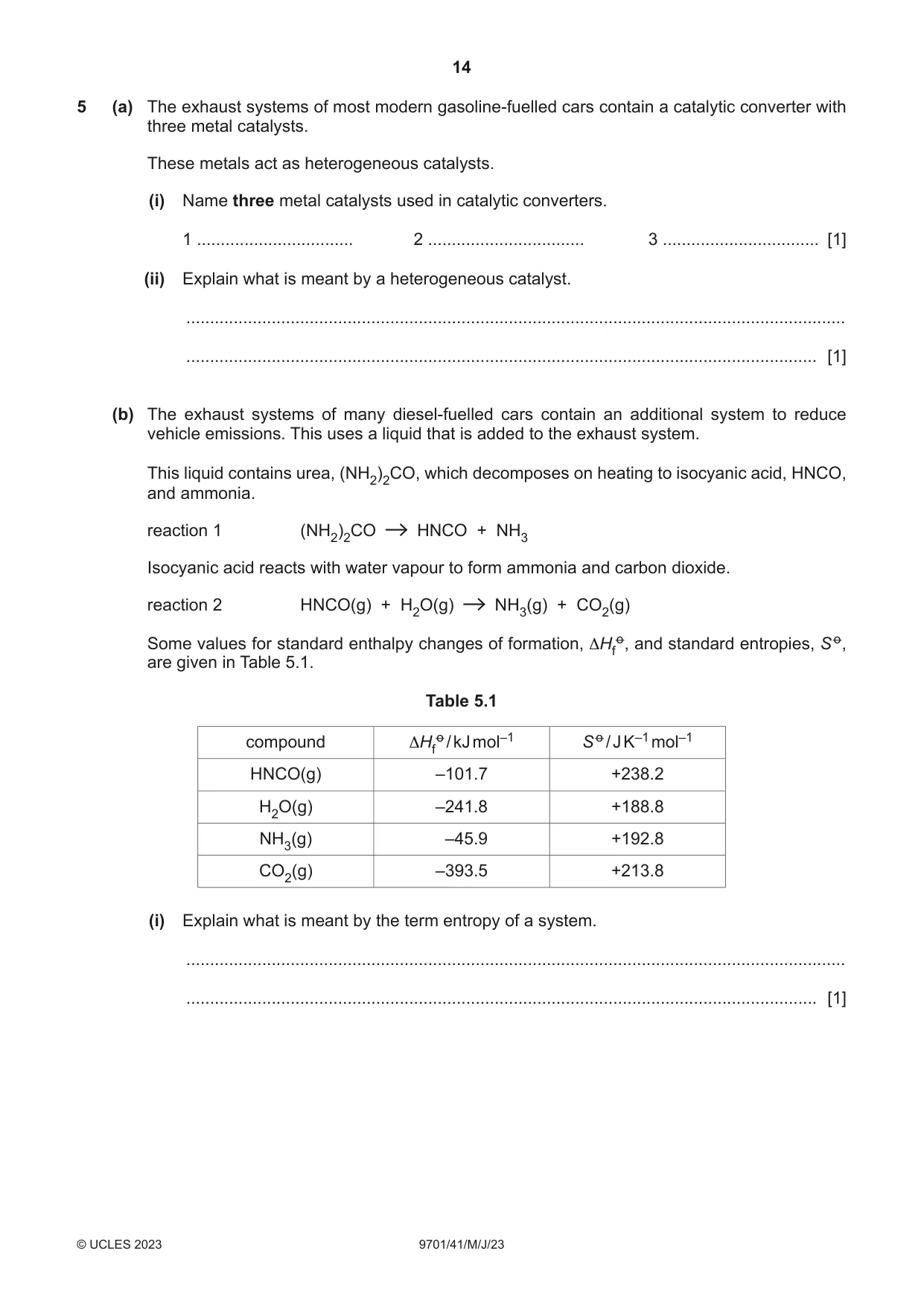
14 9701/41/M/J/23 © UCLES 2023 5 (a) The exhaust systems of most modern gasoline‑fuelled cars contain a catalytic converter with three metal catalysts. These metals act as heterogeneous catalysts. (i) Name three metal catalysts used in catalytic converters. 1 … 2 … 3 … [1] (ii) Explain what is meant by a heterogeneous catalyst. … … [1] (b) The exhaust systems of many diesel‑fuelled cars contain an additional system to reduce vehicle emissions. This uses a liquid that is added to the exhaust system. This liquid contains urea, (NH2)2CO, which decomposes on heating to isocyanic acid, HNCO, and ammonia. reaction 1 (NH2)2CO HNCO + NH3 Isocyanic acid reacts with water vapour to form ammonia and carbon dioxide. reaction 2 HNCO(g) + H2O(g) NH3(g) + CO2(g) Some values for standard enthalpy changes of formation, ΔHf o, and standard entropies, S o, are given in Table 5.1. Table 5.1 compound ΔHf o / kJ mol–1 S o / J K–1 mol–1 HNCO(g) –101.7 +238.2 H2O(g) –241.8 +188.8 NH3(g) –45.9 +192.8 CO2(g) –393.5 +213.8 (i) Explain what is meant by the term entropy of a system. … … [1]
Question paper, page 15
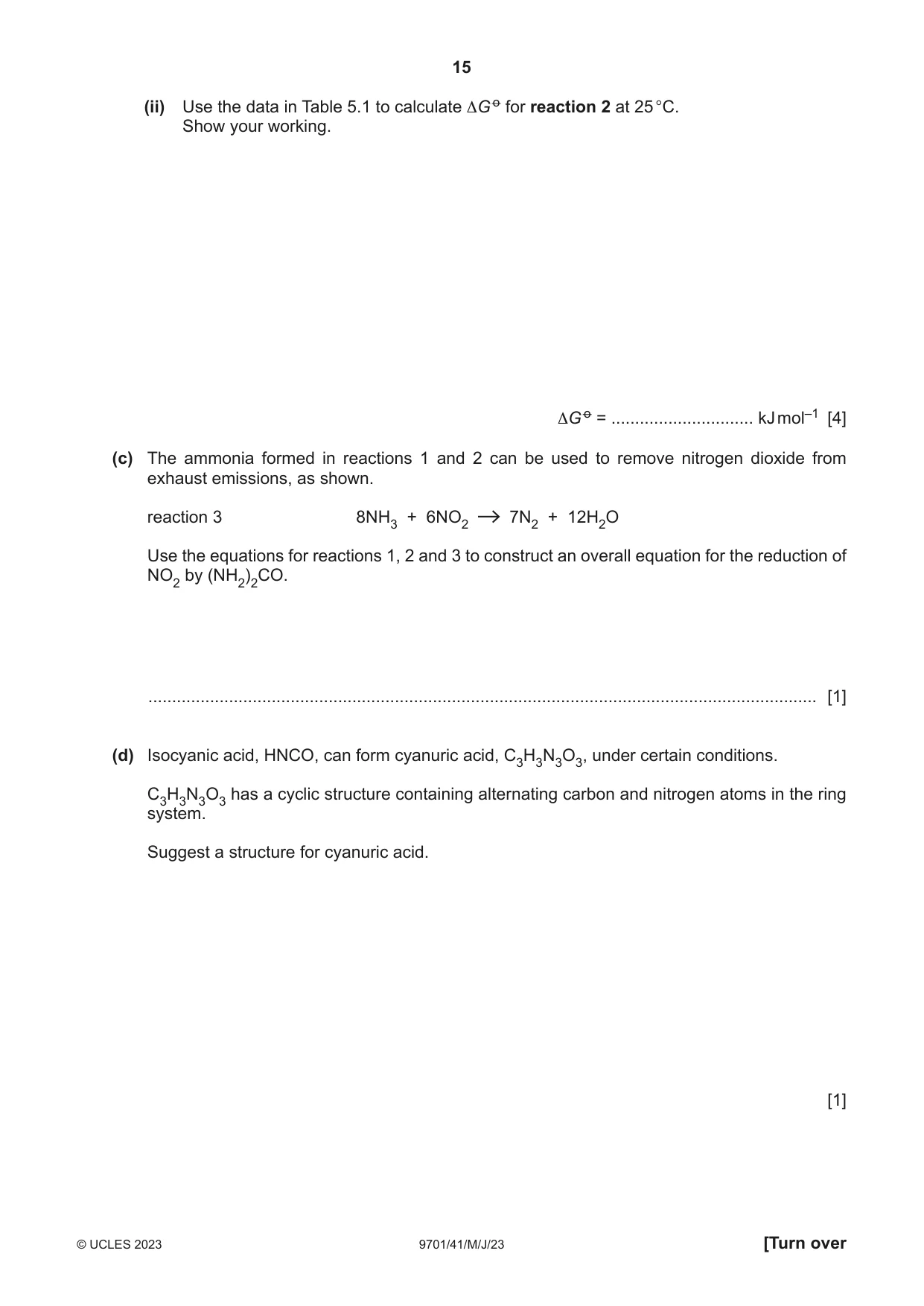
15 9701/41/M/J/23 © UCLES 2023 [Turn over (ii) Use the data in Table 5.1 to calculate ΔG o for reaction 2 at 25 °C. Show your working. ΔG o = … kJ mol–1 [4] (c) The ammonia formed in reactions 1 and 2 can be used to remove nitrogen dioxide from exhaust emissions, as shown. reaction 3 8NH3 + 6NO2 7N2 + 12H2O Use the equations for reactions 1, 2 and 3 to construct an overall equation for the reduction of NO2 by (NH2)2CO. … [1] (d) Isocyanic acid, HNCO, can form cyanuric acid, C3H3N3O3, under certain conditions. C3H3N3O3 has a cyclic structure containing alternating carbon and nitrogen atoms in the ring system. Suggest a structure for cyanuric acid. [1]
Question paper, page 16
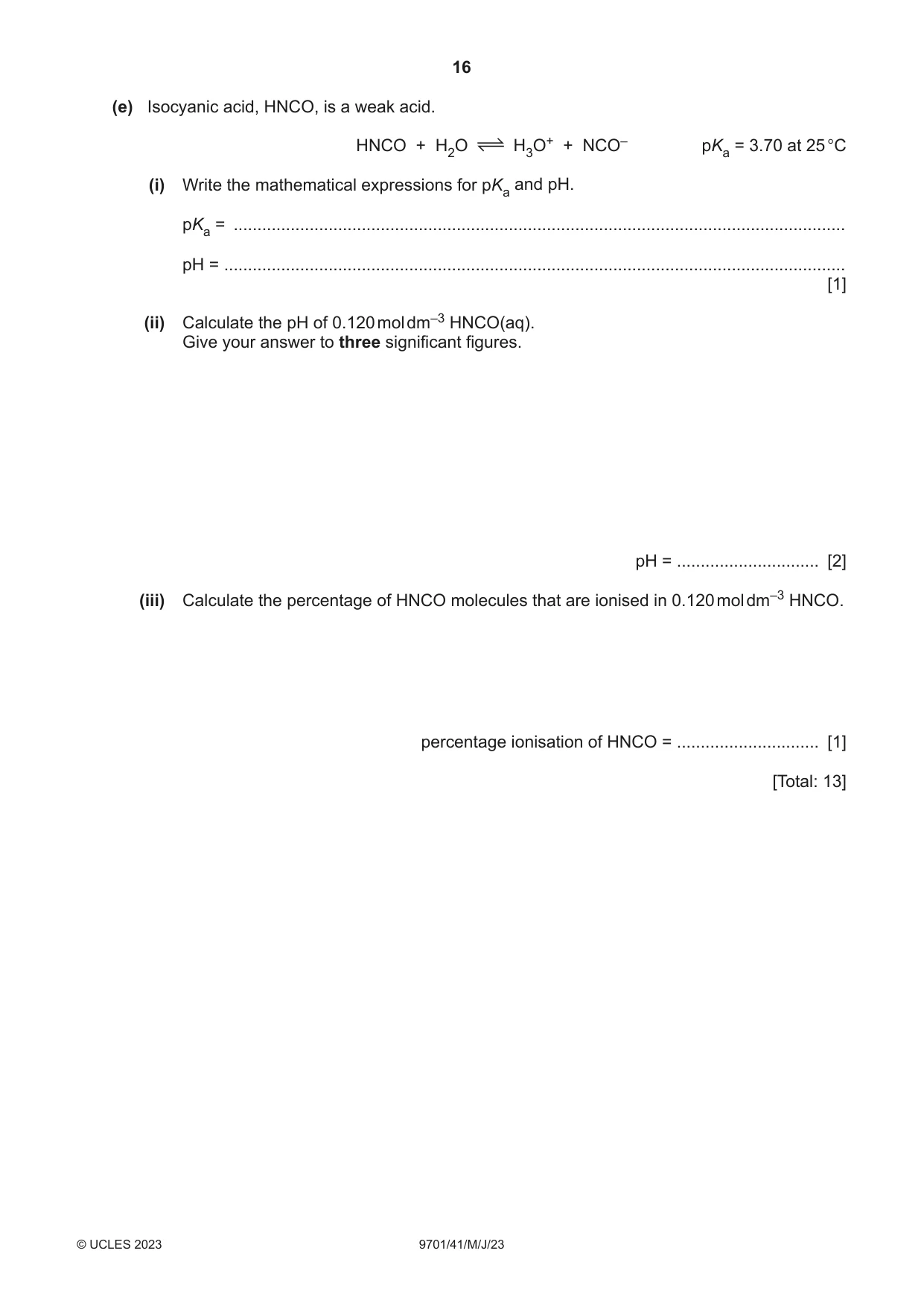
16 9701/41/M/J/23 © UCLES 2023 (e) Isocyanic acid, HNCO, is a weak acid. HNCO + H2O H3O+ + NCO– pKa = 3.70 at 25 °C (i) Write the mathematical expressions for pKa and pH. pKa = … pH = … [1] (ii) Calculate the pH of 0.120 mol dm–3 HNCO(aq). Give your answer to three significant figures. pH = … [2] (iii) Calculate the percentage of HNCO molecules that are ionised in 0.120 mol dm–3 HNCO. percentage ionisation of HNCO = … [1] [Total: 13]
Question paper, page 17
17 9701/41/M/J/23 © UCLES 2023 [Turn over BLANK PAGE
Question paper, page 18
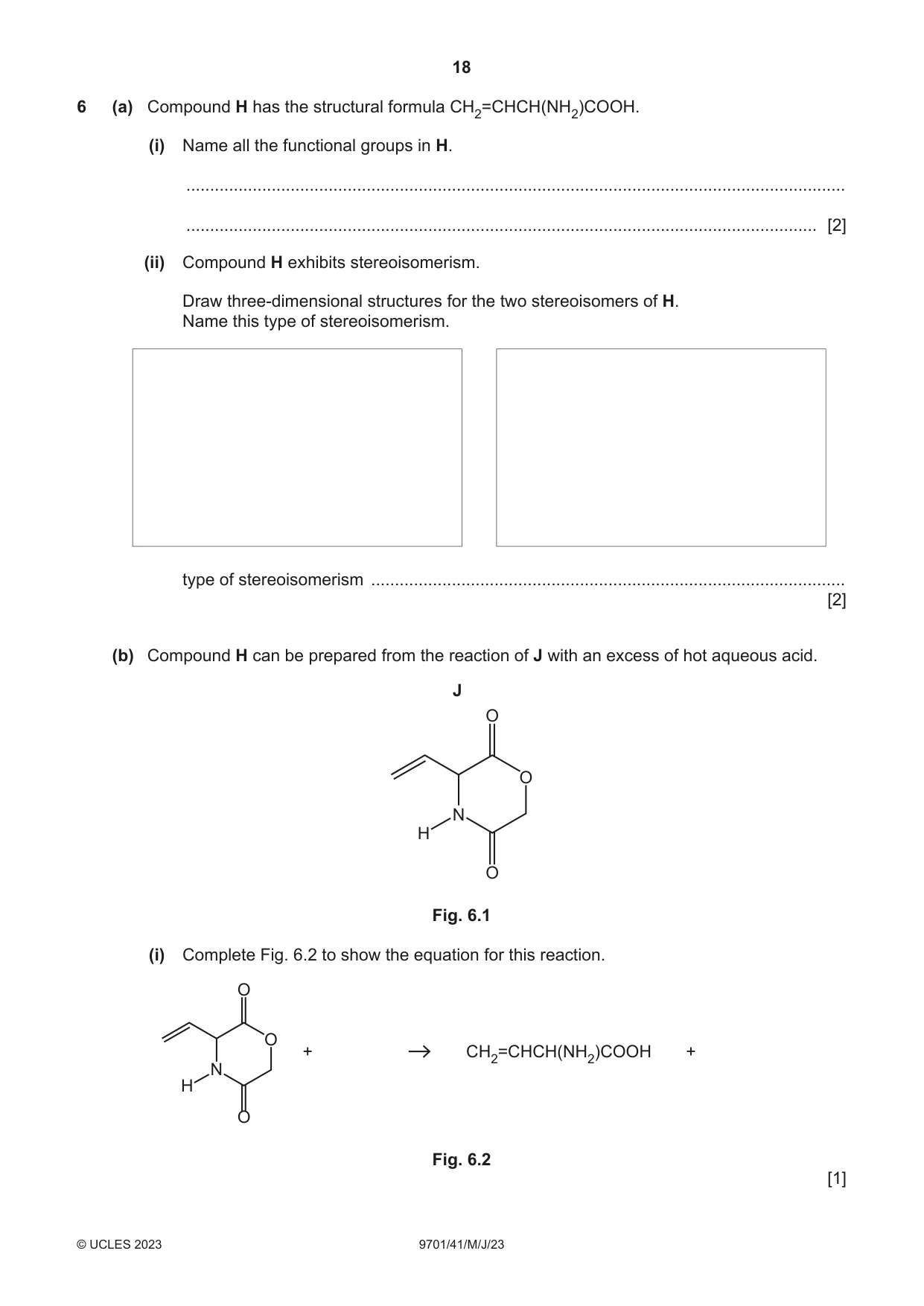
18 9701/41/M/J/23 © UCLES 2023 6 (a) Compound H has the structural formula CH2=CHCH(NH2)COOH. (i) Name all the functional groups in H. … … [2] (ii) Compound H exhibits stereoisomerism. Draw three‑dimensional structures for the two stereoisomers of H. Name this type of stereoisomerism. type of stereoisomerism … [2] (b) Compound H can be prepared from the reaction of J with an excess of hot aqueous acid. J O O O N H Fig. 6.1 (i) Complete Fig. 6.2 to show the equation for this reaction. O O O N H + CH2=CHCH(NH2)COOH + Fig. 6.2 [1]
Question paper, page 19
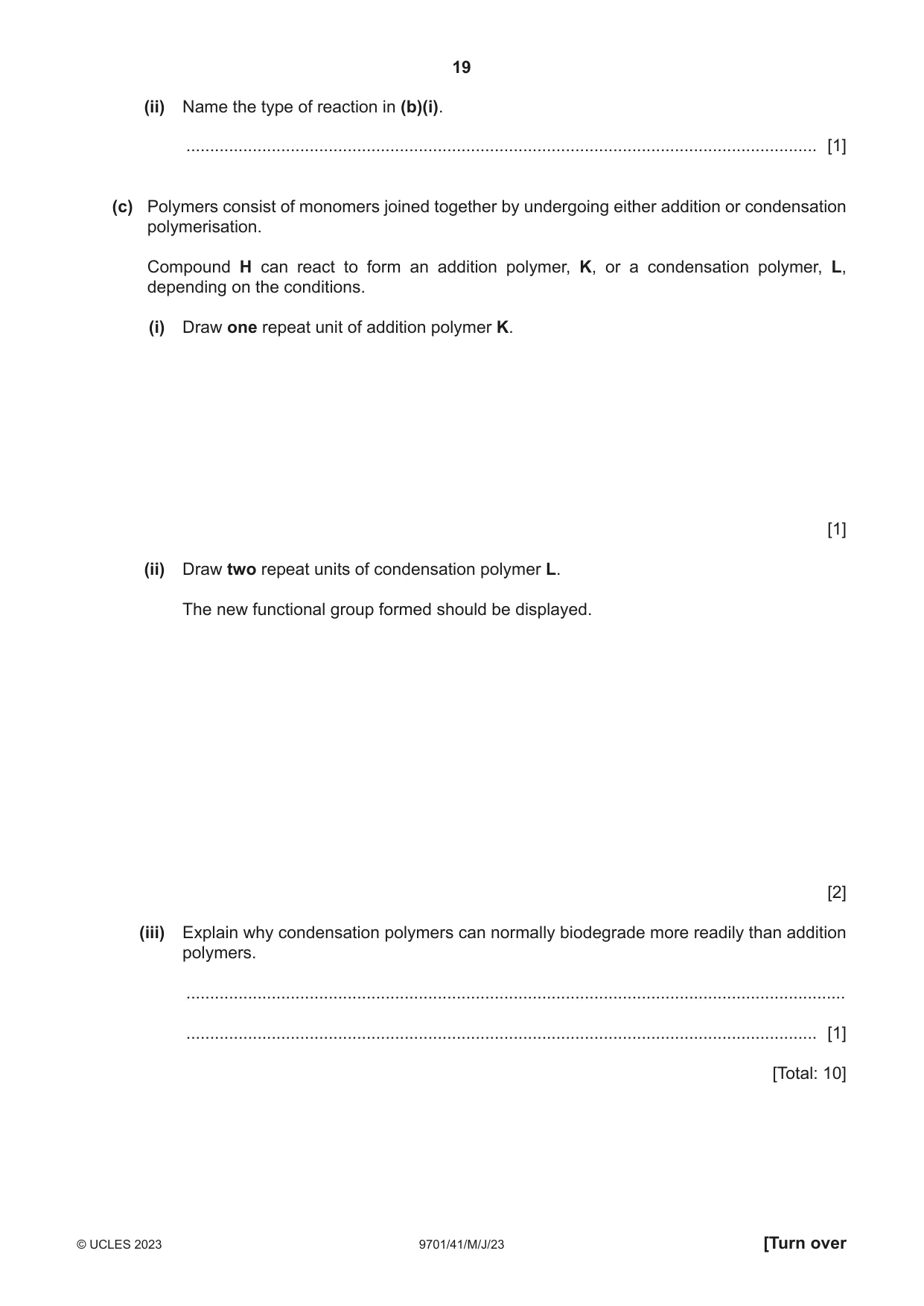
19 9701/41/M/J/23 © UCLES 2023 [Turn over (ii) Name the type of reaction in (b)(i). … [1] (c) Polymers consist of monomers joined together by undergoing either addition or condensation polymerisation. Compound H can react to form an addition polymer, K, or a condensation polymer, L, depending on the conditions. (i) Draw one repeat unit of addition polymer K. [1] (ii) Draw two repeat units of condensation polymer L. The new functional group formed should be displayed. [2] (iii) Explain why condensation polymers can normally biodegrade more readily than addition polymers. … … [1] [Total: 10]
Question paper, page 20
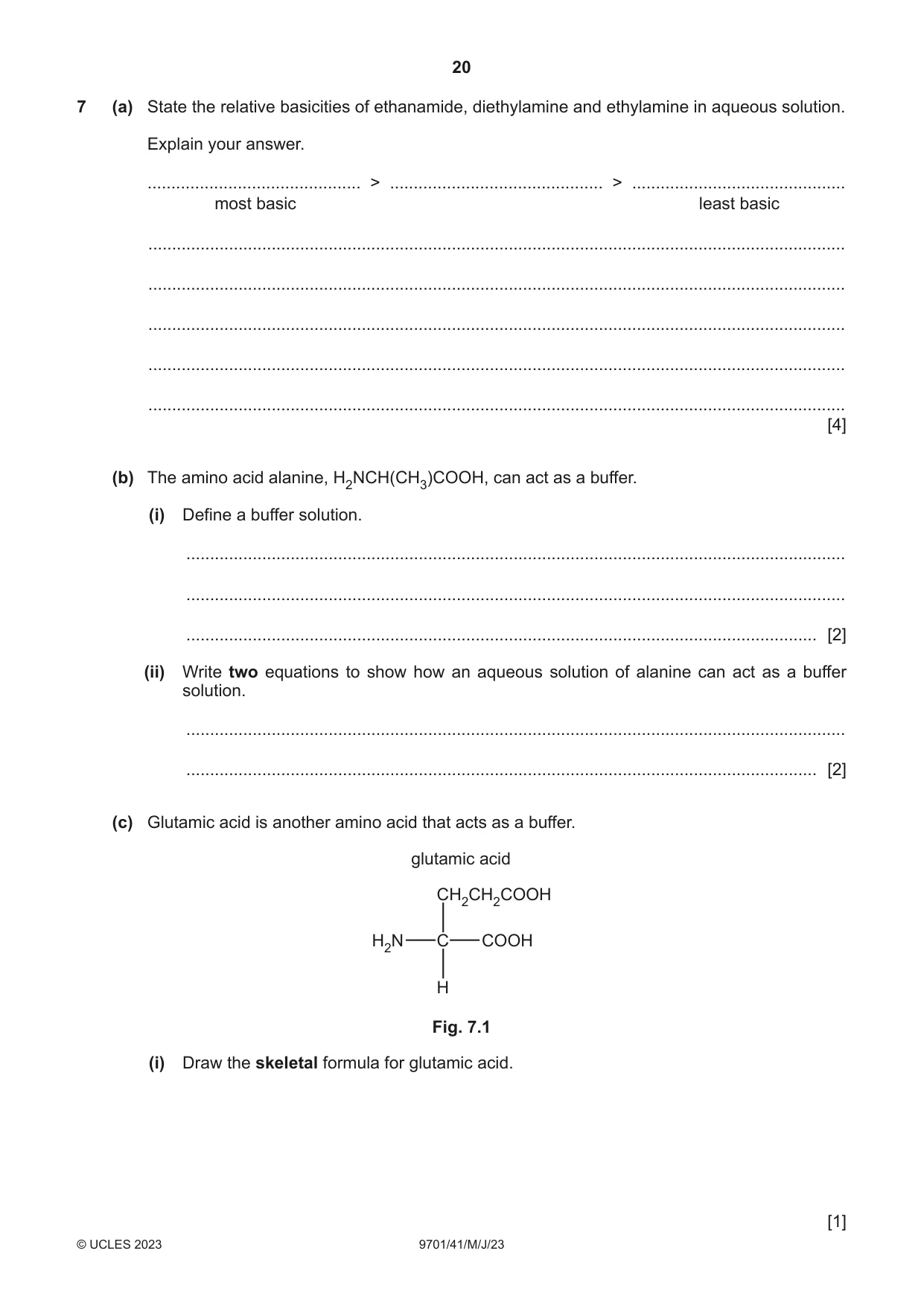
20 9701/41/M/J/23 © UCLES 2023 7 (a) State the relative basicities of ethanamide, diethylamine and ethylamine in aqueous solution. Explain your answer. … > … > … most basic least basic … … … … … [4] (b) The amino acid alanine, H2NCH(CH3)COOH, can act as a buffer. (i) Define a buffer solution. … … … [2] (ii) Write two equations to show how an aqueous solution of alanine can act as a buffer solution. … … [2] (c) Glutamic acid is another amino acid that acts as a buffer. glutamic acid C H2N COOH H CH2CH2COOH Fig. 7.1 (i) Draw the skeletal formula for glutamic acid. [1]
Question paper, page 21
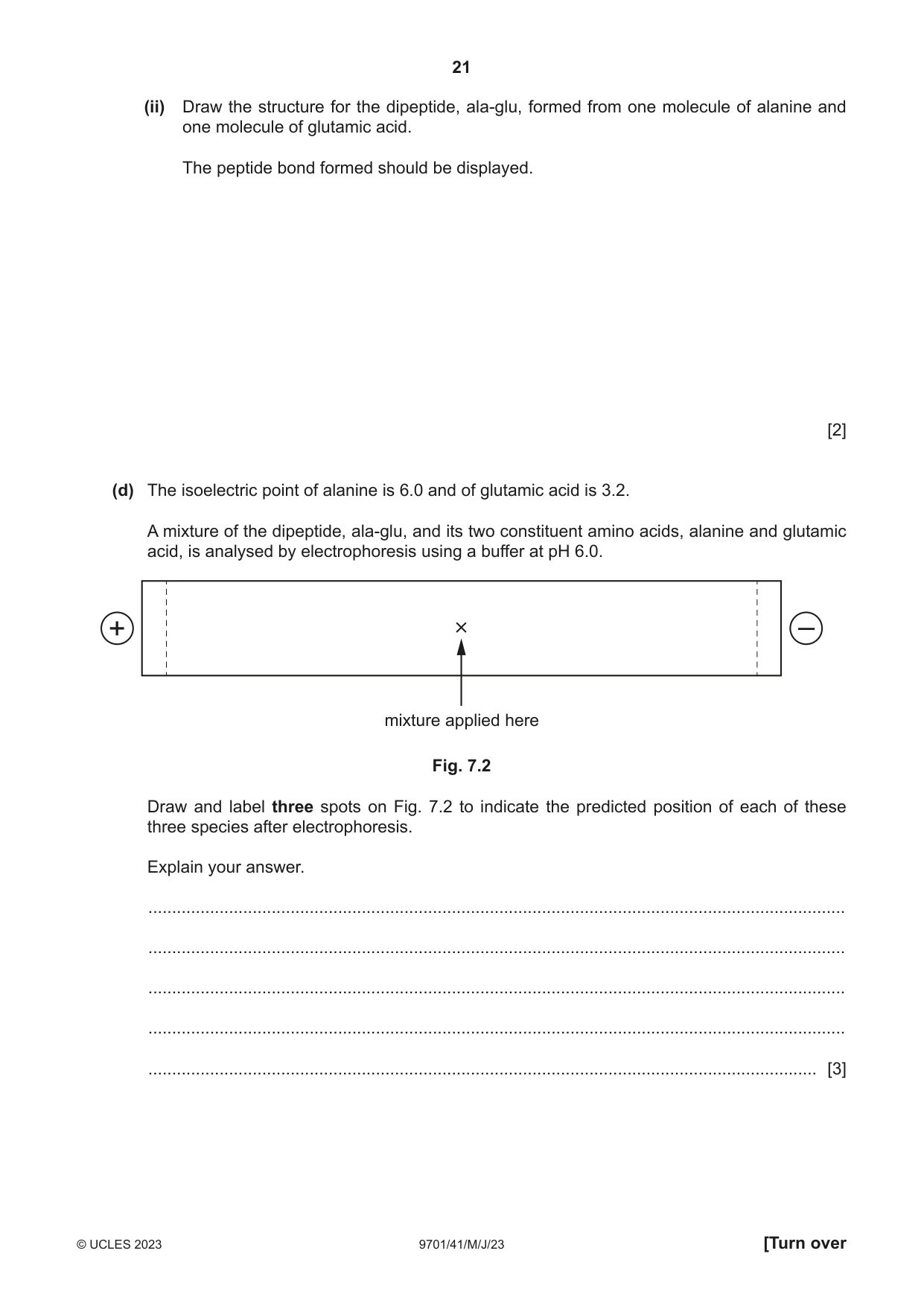
21 9701/41/M/J/23 © UCLES 2023 [Turn over (ii) Draw the structure for the dipeptide, ala‑glu, formed from one molecule of alanine and one molecule of glutamic acid. The peptide bond formed should be displayed. [2] (d) The isoelectric point of alanine is 6.0 and of glutamic acid is 3.2. A mixture of the dipeptide, ala‑glu, and its two constituent amino acids, alanine and glutamic acid, is analysed by electrophoresis using a buffer at pH 6.0. + – mixture applied here Fig. 7.2 Draw and label three spots on Fig. 7.2 to indicate the predicted position of each of these three species after electrophoresis. Explain your answer. … … … … … [3]
Question paper, page 22
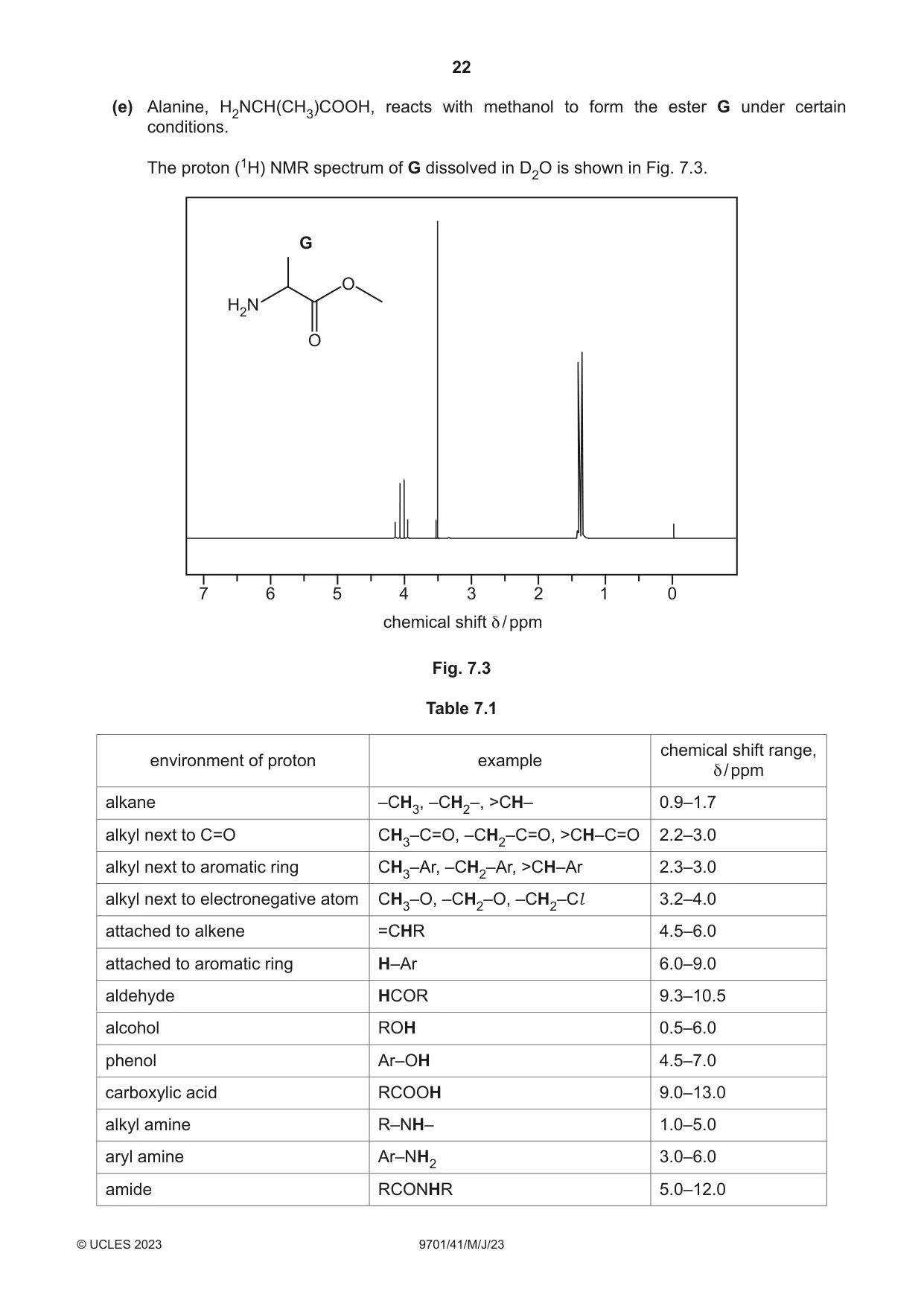
22 9701/41/M/J/23 © UCLES 2023 (e) Alanine, H2NCH(CH3)COOH, reacts with methanol to form the ester G under certain conditions. The proton (1H) NMR spectrum of G dissolved in D2O is shown in Fig. 7.3. G O O 5 6 7 4 3 chemical shift δ / ppm 2 1 0 H2N Fig. 7.3 Table 7.1 environment of proton example chemical shift range, δ / ppm alkane –CH3, –CH2–, >CH– 0.9–1.7 alkyl next to C=O CH3–C=O, –CH2–C=O, >CH–C=O 2.2–3.0 alkyl next to aromatic ring CH3–Ar, –CH2–Ar, >CH–Ar 2.3–3.0 alkyl next to electronegative atom CH3–O, –CH2–O, –CH2–Cl 3.2–4.0 attached to alkene =CHR 4.5–6.0 attached to aromatic ring H–Ar 6.0–9.0 aldehyde HCOR 9.3–10.5 alcohol ROH 0.5–6.0 phenol Ar–OH 4.5–7.0 carboxylic acid RCOOH 9.0–13.0 alkyl amine R–NH– 1.0–5.0 aryl amine Ar–NH2 3.0–6.0 amide RCONHR 5.0–12.0
Question paper, page 23
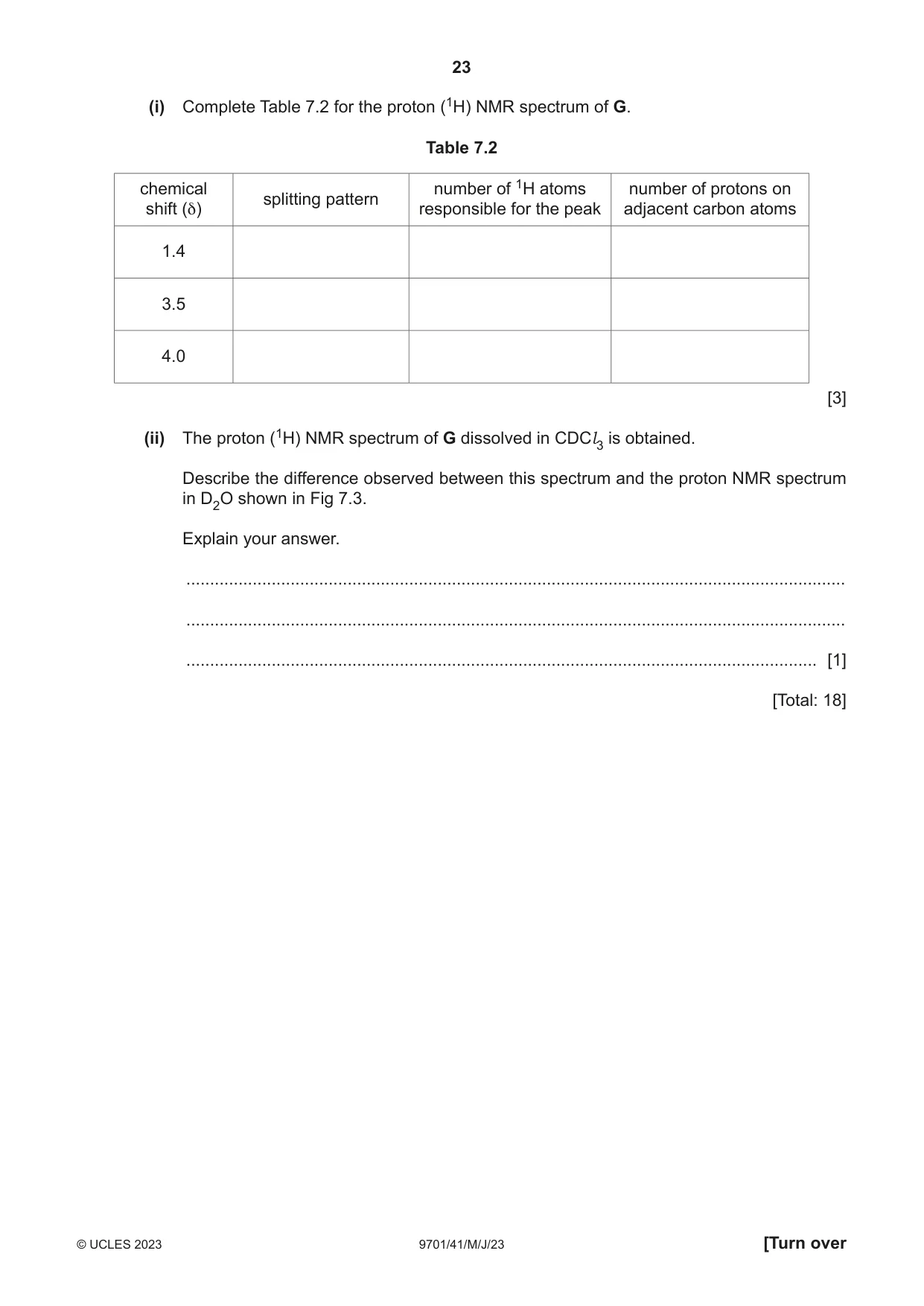
23 9701/41/M/J/23 © UCLES 2023 [Turn over (i) Complete Table 7.2 for the proton (1H) NMR spectrum of G. Table 7.2 chemical shift (δ) splitting pattern number of 1H atoms responsible for the peak number of protons on adjacent carbon atoms 1.4 3.5 4.0 [3] (ii) The proton (1H) NMR spectrum of G dissolved in CDCl3 is obtained. Describe the difference observed between this spectrum and the proton NMR spectrum in D2O shown in Fig 7.3. Explain your answer. … … … [1] [Total: 18]
Question paper, page 24
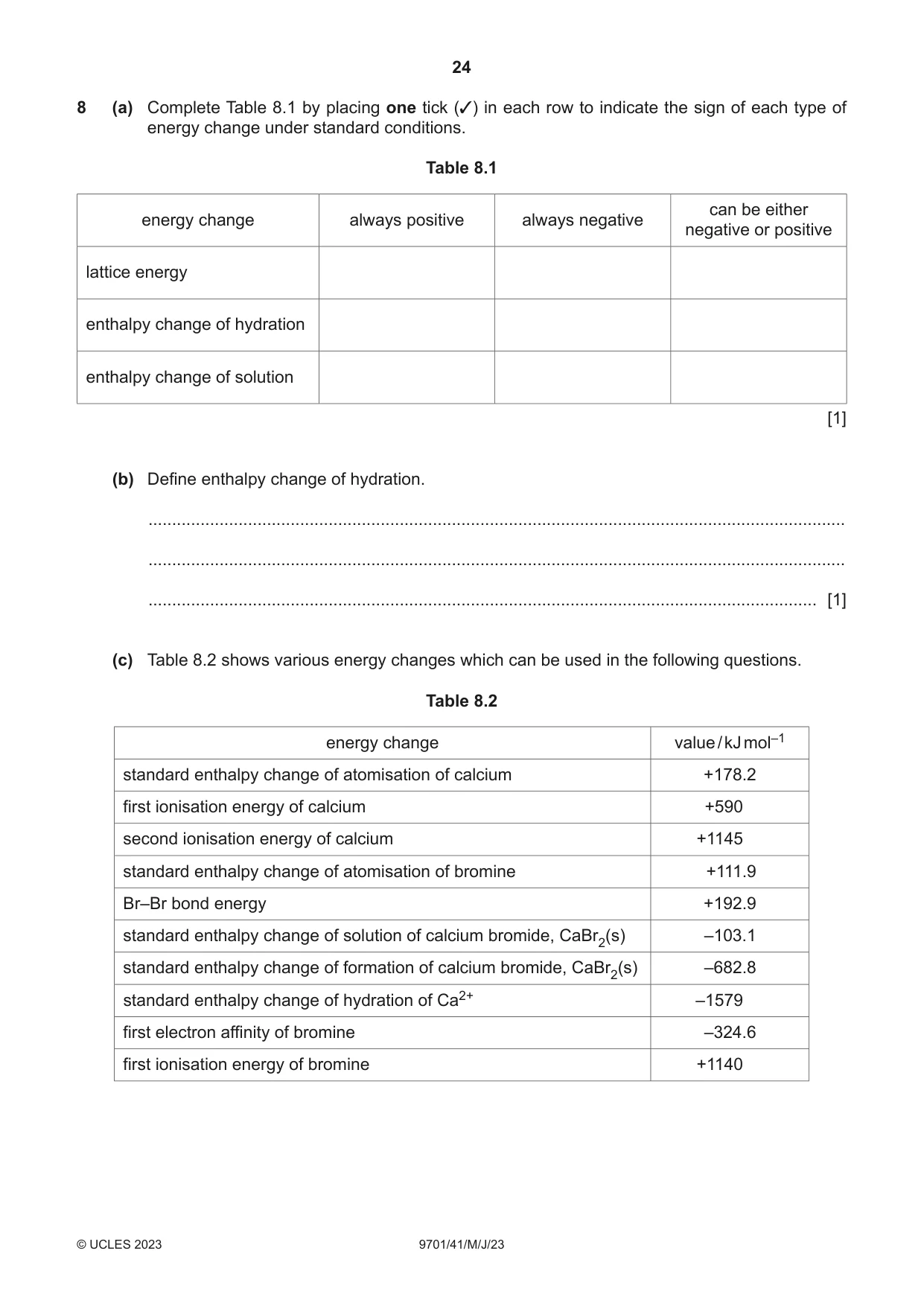
24 9701/41/M/J/23 © UCLES 2023 8 (a) Complete Table 8.1 by placing one tick (✓) in each row to indicate the sign of each type of energy change under standard conditions. Table 8.1 energy change always positive always negative can be either negative or positive lattice energy enthalpy change of hydration enthalpy change of solution [1] (b) Define enthalpy change of hydration. … … … [1] (c) Table 8.2 shows various energy changes which can be used in the following questions. Table 8.2 energy change value / kJ mol–1 standard enthalpy change of atomisation of calcium +178.2 first ionisation energy of calcium +590 second ionisation energy of calcium +1145 standard enthalpy change of atomisation of bromine +111.9 Br–Br bond energy +192.9 standard enthalpy change of solution of calcium bromide, CaBr2(s) –103.1 standard enthalpy change of formation of calcium bromide, CaBr2(s) –682.8 standard enthalpy change of hydration of Ca2+ –1579 first electron affinity of bromine –324.6 first ionisation energy of bromine +1140
Question paper, page 25
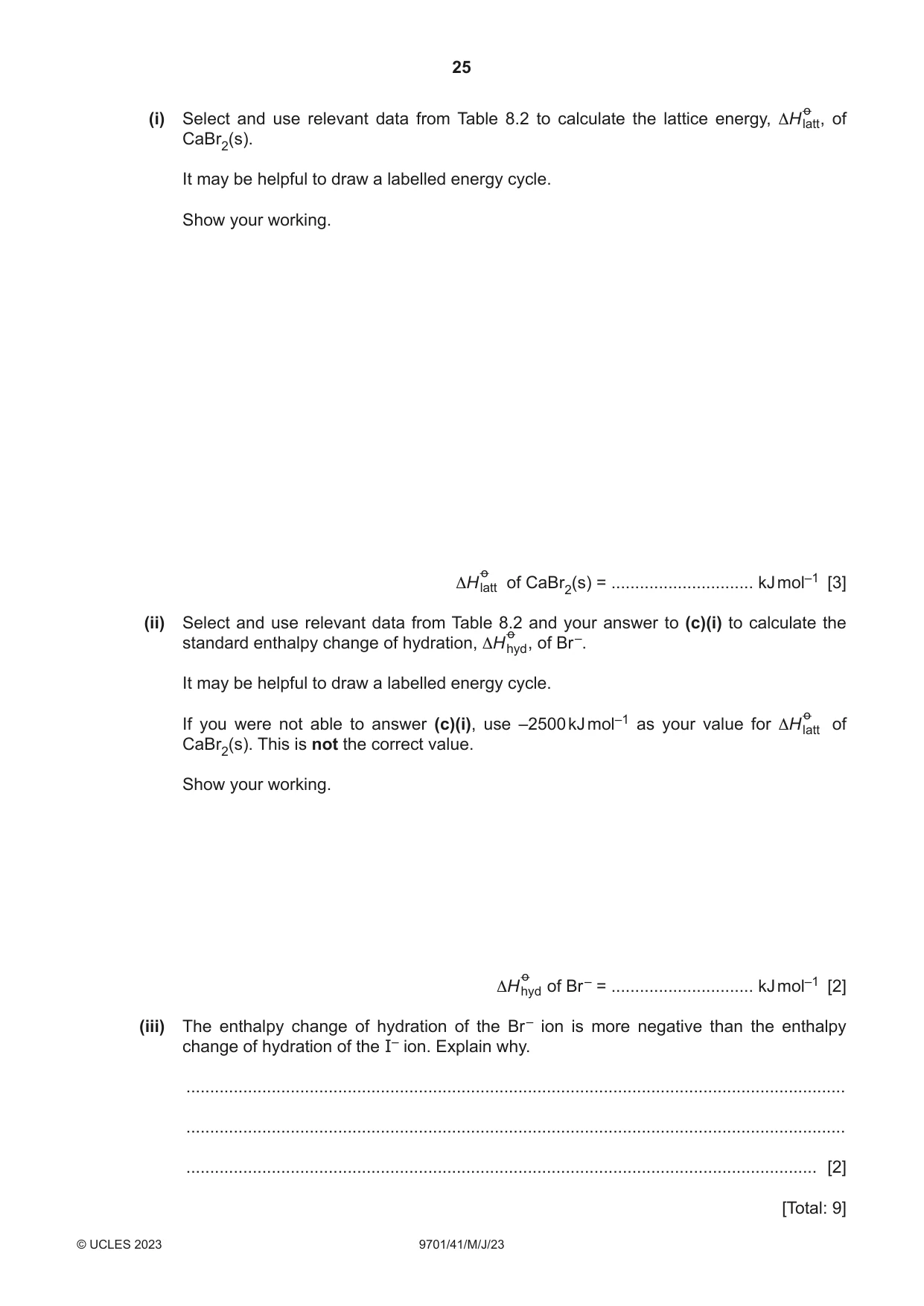
25 9701/41/M/J/23 © UCLES 2023 (i) Select and use relevant data from Table 8.2 to calculate the lattice energy, ΔH o latt, of CaBr2(s). It may be helpful to draw a labelled energy cycle. Show your working. ΔH o latt of CaBr2(s) = … kJ mol–1 [3] (ii) Select and use relevant data from Table 8.2 and your answer to (c)(i) to calculate the standard enthalpy change of hydration, ΔH o hyd, of Br –. It may be helpful to draw a labelled energy cycle. If you were not able to answer (c)(i), use –2500 kJ mol–1 as your value for ΔH o latt of CaBr2(s). This is not the correct value. Show your working. ΔH o hyd of Br – = … kJ mol–1 [2] (iii) The enthalpy change of hydration of the Br – ion is more negative than the enthalpy change of hydration of the I– ion. Explain why. … … … [2] [Total: 9]
Question paper, page 26
26 9701/41/M/J/23 © UCLES 2023 BLANK PAGE
Question paper, page 27
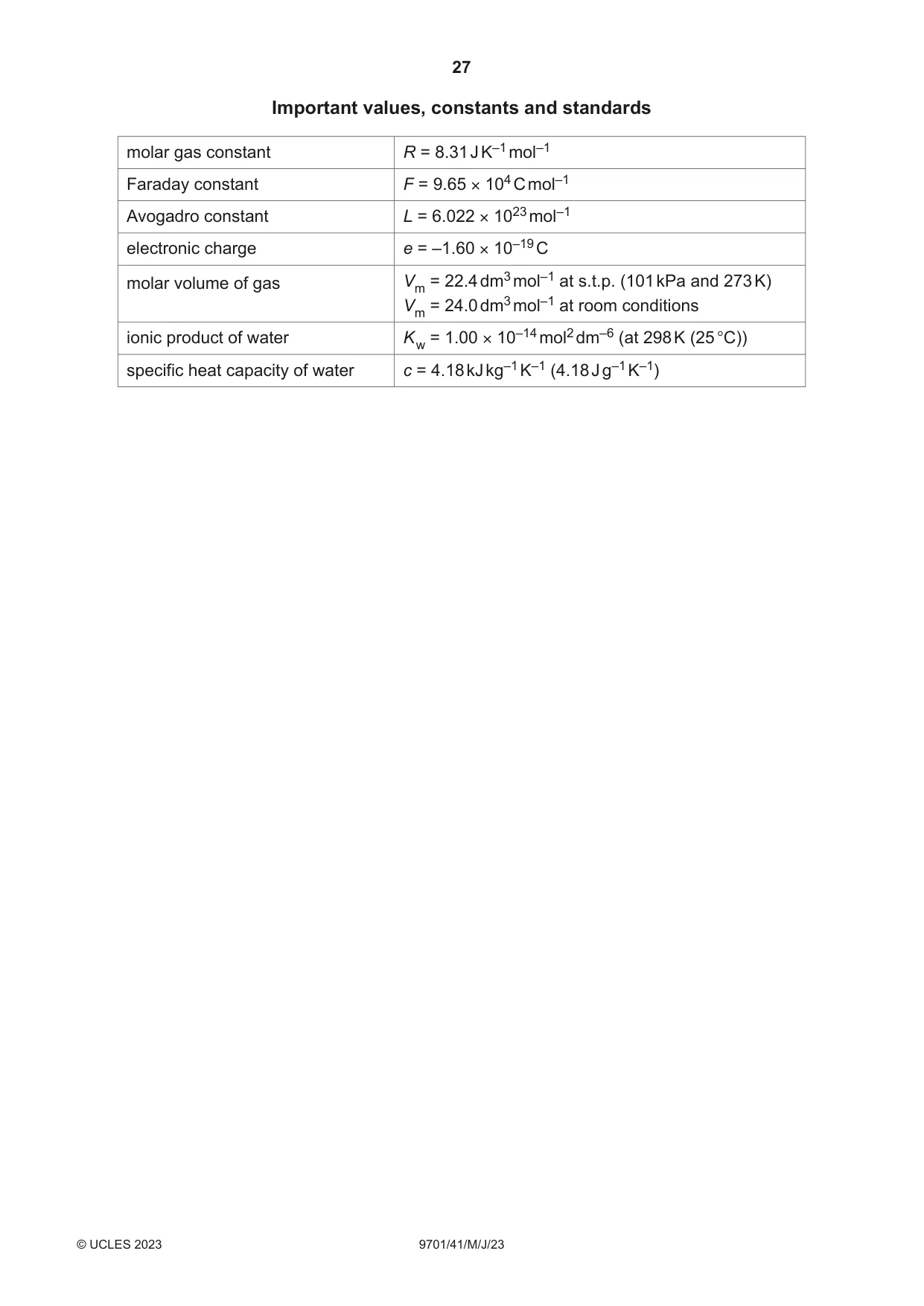
27 9701/41/M/J/23 © UCLES 2023 Important values, constants and standards molar gas constant R = 8.31 J K–1 mol–1 Faraday constant F = 9.65 × 10⁴ C mol–1 Avogadro constant L = 6.022 × 10²³ mol–1 electronic charge e = –1.60 × 10⁻¹⁹ C molar volume of gas Vm = 22.4 dm3 mol–1 at s.t.p. (101 kPa and 273 K) Vm = 24.0 dm3 mol–1 at room conditions ionic product of water K w = 1.00 × 10⁻¹⁴ mol2 dm–6 (at 298 K (25 °C)) specific heat capacity of water c = 4.18 kJ kg–1 K–1 (4.18 J g–1 K–1)
Question paper, page 28
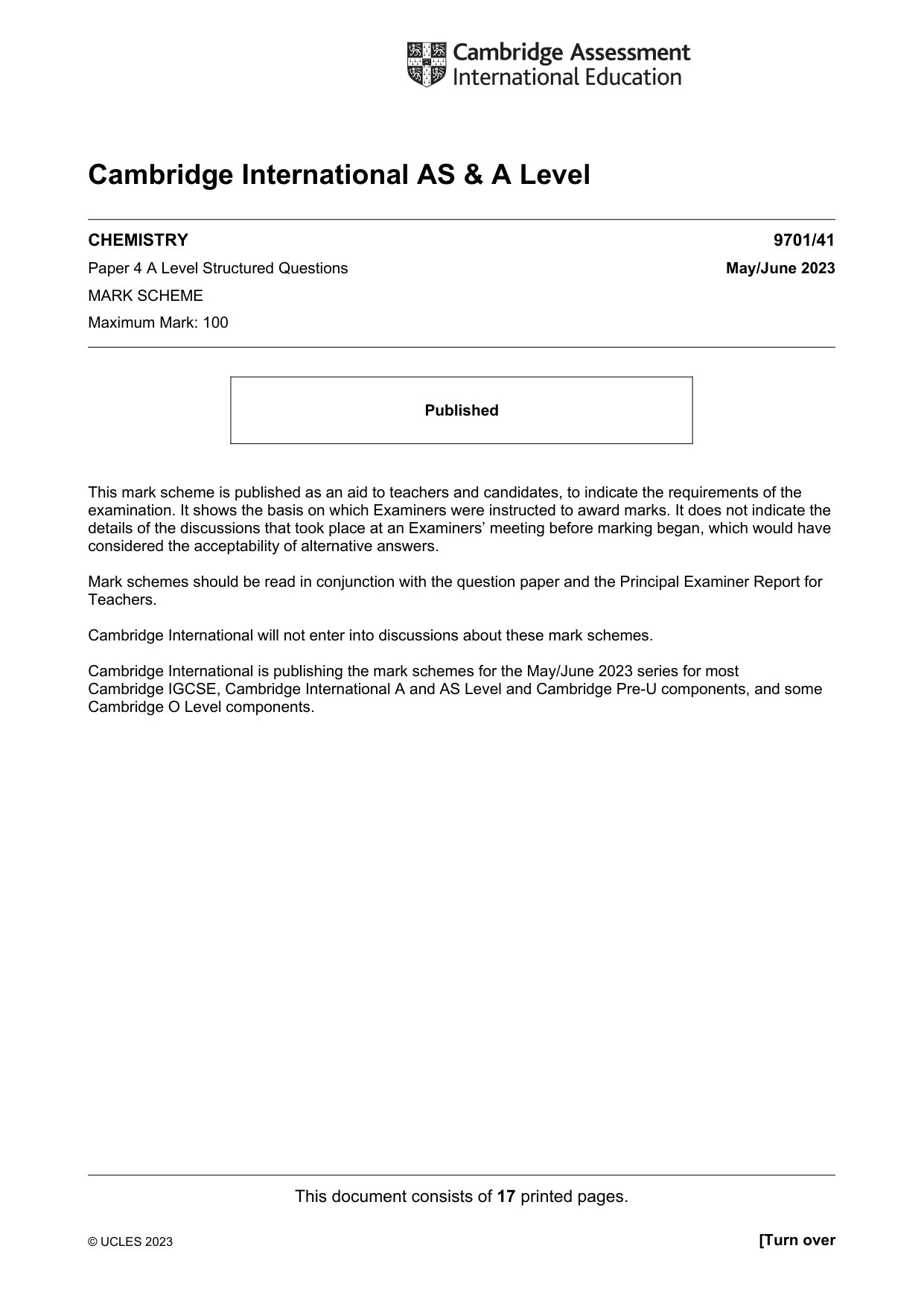
28 9701/41/M/J/23 © UCLES 2023 To avoid the issue of disclosure of answer‑related information to candidates, all copyright acknowledgements are reproduced online in the Cambridge Assessment International Education Copyright Acknowledgements Booklet. This is produced for each series of examinations and is freely available to download at www.cambridgeinternational.org after the live examination series. Group The Periodic Table of Elements 1 H hydrogen 1.0 2 He helium 4.0 1 2 13 14 15 16 17 18 3 4 5 6 7 8 9 10 11 12 3 Li lithium 6.9 4 Be beryllium 9.0 atomic number atomic symbol Key name relative atomic mass 11 Na sodium 23.0 12 Mg magnesium 24.3 19 K potassium 39.1 20 Ca calcium 40.1 37 Rb rubidium 85.5 38 Sr strontium 87.6 55 Cs caesium 132.9 56 Ba barium 137.3 87 Fr francium – 88 Ra radium – 5 B boron 10.8 13 Al aluminium 27.0 31 Ga gallium 69.7 49 In indium 114.8 81 Tl thallium 204.4 6 C carbon 12.0 14 Si silicon 28.1 32 Ge germanium 72.6 50 Sn tin 118.7 82 Pb lead 207.2 22 Ti titanium 47.9 40 Zr zirconium 91.2 72 Hf hafnium 178.5 104 Rf rutherfordium – 23 V vanadium 50.9 41 Nb niobium 92.9 73 Ta tantalum 180.9 105 Db dubnium – 24 Cr chromium 52.0 42 Mo molybdenum 95.9 74 W tungsten 183.8 106 Sg seaborgium – 25 Mn manganese 54.9 43 Tc technetium – 75 Re rhenium 186.2 107 Bh bohrium – 26 Fe iron 55.8 44 Ru ruthenium 101.1 76 Os osmium 190.2 108 Hs hassium – 27 Co cobalt 58.9 45 Rh rhodium 102.9 77 Ir iridium 192.2 109 Mt meitnerium – 28 Ni nickel 58.7 46 Pd palladium 106.4 78 Pt platinum 195.1 110 Ds darmstadtium – 29 Cu copper 63.5 47 Ag silver 107.9 79 Au gold 197.0 111 Rg roentgenium – 30 Zn zinc 65.4 48 Cd cadmium 112.4 80 Hg mercury 200.6 112 Cn copernicium – 114 Fl flerovium – 116 Lv livermorium – 7 N nitrogen 14.0 15 P phosphorus 31.0 33 As arsenic 74.9 51 Sb antimony 121.8 83 Bi bismuth 209.0 8 O oxygen 16.0 16 S sulfur 32.1 34 Se selenium 79.0 52 Te tellurium 127.6 84 Po polonium – 9 F fluorine 19.0 17 Cl chlorine 35.5 35 Br bromine 79.9 53 I iodine 126.9 85 At astatine – 10 Ne neon 20.2 18 Ar argon 39.9 36 Kr krypton 83.8 54 Xe xenon 131.3 86 Rn radon – 113 Nh nihonium – 115 Mc moscovium – 117 Ts tennessine – 118 Og oganesson – 21 Sc scandium 45.0 39 Y yttrium 88.9 57–71 lanthanoids 89–103 actinoids 57 La lanthanum 138.9 89 Ac lanthanoids actinoids actinium – 58 Ce cerium 140.1 90 Th thorium 232.0 59 Pr praseodymium 140.9 91 Pa protactinium 231.0 60 Nd neodymium 144.4 92 U uranium 238.0 61 Pm promethium – 93 Np neptunium – 62 Sm samarium 150.4 94 Pu plutonium – 63 Eu europium 152.0 95 Am americium – 64 Gd gadolinium 157.3 96 Cm curium – 65 Tb terbium 158.9 97 Bk berkelium – 66 Dy dysprosium 162.5 98 Cf californium – 67 Ho holmium 164.9 99 Es einsteinium – 68 Er erbium 167.3 100 Fm fermium – 69 Tm thulium 168.9 101 Md mendelevium – 70 Yb ytterbium 173.1 102 No nobelium – 71 Lu lutetium 175.0 103 Lr lawrencium –
Mark scheme, page 1
This document consists of 17 printed pages. © UCLES 2023 [Turn over Cambridge International AS & A Level CHEMISTRY 9701/41 Paper 4 A Level Structured Questions May/June 2023 MARK SCHEME Maximum Mark: 100 Published This mark scheme is published as an aid to teachers and candidates, to indicate the requirements of the examination. It shows the basis on which Examiners were instructed to award marks. It does not indicate the details of the discussions that took place at an Examiners’ meeting before marking began, which would have considered the acceptability of alternative answers. Mark schemes should be read in conjunction with the question paper and the Principal Examiner Report for Teachers. Cambridge International will not enter into discussions about these mark schemes. Cambridge International is publishing the mark schemes for the May/June 2023 series for most Cambridge IGCSE, Cambridge International A and AS Level and Cambridge Pre-U components, and some Cambridge O Level components.
Mark scheme, page 2
9701/41 Cambridge International AS & A Level – Mark Scheme PUBLISHED May/June 2023 © UCLES 2023 Page 2 of 17 Generic Marking Principles These general marking principles must be applied by all examiners when marking candidate answers. They should be applied alongside the specific content of the mark scheme or generic level descriptors for a question. Each question paper and mark scheme will also comply with these marking principles. GENERIC MARKING PRINCIPLE 1: Marks must be awarded in line with: the specific content of the mark scheme or the generic level descriptors for the question the specific skills defined in the mark scheme or in the generic level descriptors for the question the standard of response required by a candidate as exemplified by the standardisation scripts. GENERIC MARKING PRINCIPLE 2: Marks awarded are always whole marks (not half marks, or other fractions). GENERIC MARKING PRINCIPLE 3: Marks must be awarded positively: marks are awarded for correct/valid answers, as defined in the mark scheme. However, credit is given for valid answers which go beyond the scope of the syllabus and mark scheme, referring to your Team Leader as appropriate marks are awarded when candidates clearly demonstrate what they know and can do marks are not deducted for errors marks are not deducted for omissions answers should only be judged on the quality of spelling, punctuation and grammar when these features are specifically assessed by the question as indicated by the mark scheme. The meaning, however, should be unambiguous. GENERIC MARKING PRINCIPLE 4: Rules must be applied consistently, e.g. in situations where candidates have not followed instructions or in the application of generic level descriptors.
Mark scheme, page 3
9701/41 Cambridge International AS & A Level – Mark Scheme PUBLISHED May/June 2023 © UCLES 2023 Page 3 of 17 GENERIC MARKING PRINCIPLE 5: Marks should be awarded using the full range of marks defined in the mark scheme for the question (however; the use of the full mark range may be limited according to the quality of the candidate responses seen). GENERIC MARKING PRINCIPLE 6: Marks awarded are based solely on the requirements as defined in the mark scheme. Marks should not be awarded with grade thresholds or grade descriptors in mind.
Mark scheme, page 4
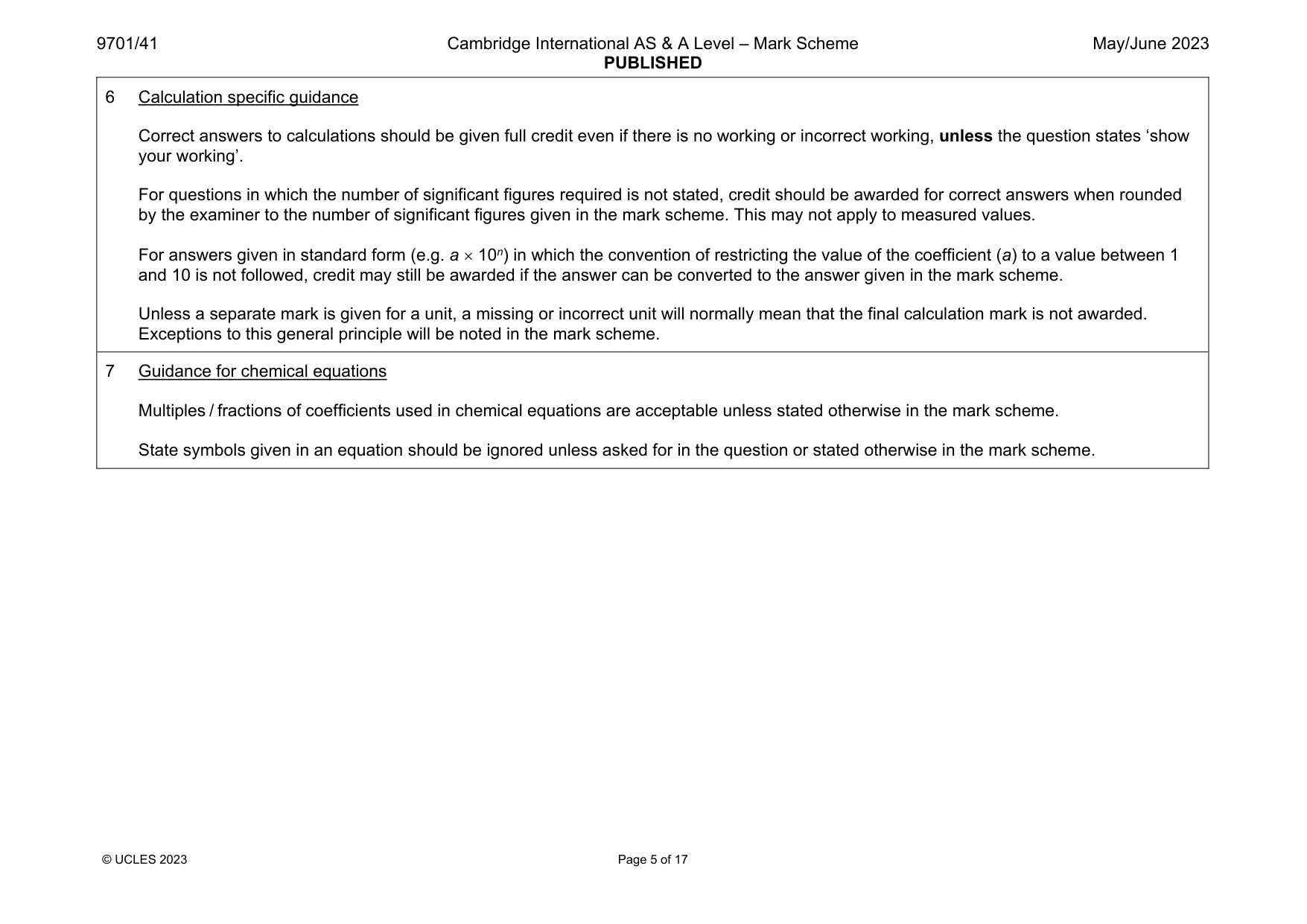
9701/41 Cambridge International AS & A Level – Mark Scheme PUBLISHED May/June 2023 © UCLES 2023 Page 4 of 17 Science-Specific Marking Principles 1 Examiners should consider the context and scientific use of any keywords when awarding marks. Although keywords may be present, marks should not be awarded if the keywords are used incorrectly. 2 The examiner should not choose between contradictory statements given in the same question part, and credit should not be awarded for any correct statement that is contradicted within the same question part. Wrong science that is irrelevant to the question should be ignored. 3 Although spellings do not have to be correct, spellings of syllabus terms must allow for clear and unambiguous separation from other syllabus terms with which they may be confused (e.g. ethane / ethene, glucagon / glycogen, refraction / reflection). 4 The error carried forward (ecf) principle should be applied, where appropriate. If an incorrect answer is subsequently used in a scientifically correct way, the candidate should be awarded these subsequent marking points. Further guidance will be included in the mark scheme where necessary and any exceptions to this general principle will be noted. 5 ‘List rule’ guidance For questions that require n responses (e.g. State two reasons …): The response should be read as continuous prose, even when numbered answer spaces are provided. Any response marked ignore in the mark scheme should not count towards n. Incorrect responses should not be awarded credit but will still count towards n. Read the entire response to check for any responses that contradict those that would otherwise be credited. Credit should not be awarded for any responses that are contradicted within the rest of the response. Where two responses contradict one another, this should be treated as a single incorrect response. Non-contradictory responses after the first n responses may be ignored even if they include incorrect science.
Mark scheme, page 5
9701/41 Cambridge International AS & A Level – Mark Scheme PUBLISHED May/June 2023 © UCLES 2023 Page 5 of 17 6 Calculation specific guidance Correct answers to calculations should be given full credit even if there is no working or incorrect working, unless the question states ‘show your working’. For questions in which the number of significant figures required is not stated, credit should be awarded for correct answers when rounded by the examiner to the number of significant figures given in the mark scheme. This may not apply to measured values. For answers given in standard form (e.g. a 10n) in which the convention of restricting the value of the coefficient (a) to a value between 1 and 10 is not followed, credit may still be awarded if the answer can be converted to the answer given in the mark scheme. Unless a separate mark is given for a unit, a missing or incorrect unit will normally mean that the final calculation mark is not awarded. Exceptions to this general principle will be noted in the mark scheme. 7 Guidance for chemical equations Multiples / fractions of coefficients used in chemical equations are acceptable unless stated otherwise in the mark scheme. State symbols given in an equation should be ignored unless asked for in the question or stated otherwise in the mark scheme.
Mark scheme, page 6
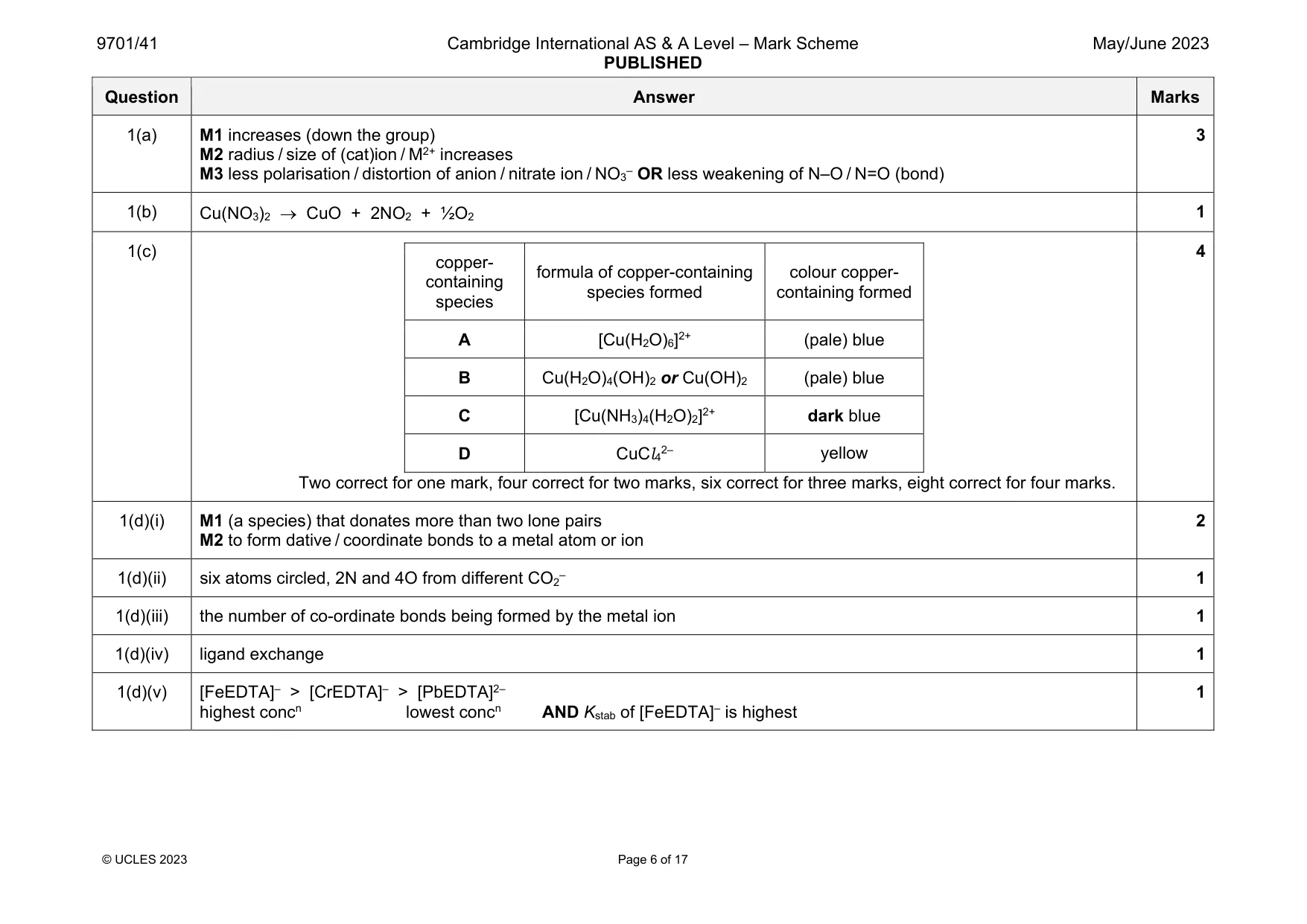
9701/41 Cambridge International AS & A Level – Mark Scheme PUBLISHED May/June 2023 © UCLES 2023 Page 6 of 17 Question Answer Marks 1(a) M1 increases (down the group) M2 radius / size of (cat)ion / M2+ increases M3 less polarisation / distortion of anion / nitrate ion / NO3– OR less weakening of N–O / N=O (bond) 3 1(b) Cu(NO3)2 CuO + 2NO2 + ½O2 1 1(c) copper- containing species formula of copper-containing species formed colour copper- containing formed A [Cu(H2O)6]2+ (pale) blue B Cu(H2O)4(OH)2 or Cu(OH)2 (pale) blue C [Cu(NH3)4(H2O)2]2+ dark blue D CuCl42– yellow Two correct for one mark, four correct for two marks, six correct for three marks, eight correct for four marks. 4 1(d)(i) M1 (a species) that donates more than two lone pairs M2 to form dative / coordinate bonds to a metal atom or ion 2 1(d)(ii) six atoms circled, 2N and 4O from different CO2– 1 1(d)(iii) the number of co-ordinate bonds being formed by the metal ion 1 1(d)(iv) ligand exchange 1 1(d)(v) [FeEDTA]– > [CrEDTA]– > [PbEDTA]2– highest concn lowest concn AND Kstab of [FeEDTA]– is highest 1
Mark scheme, page 7
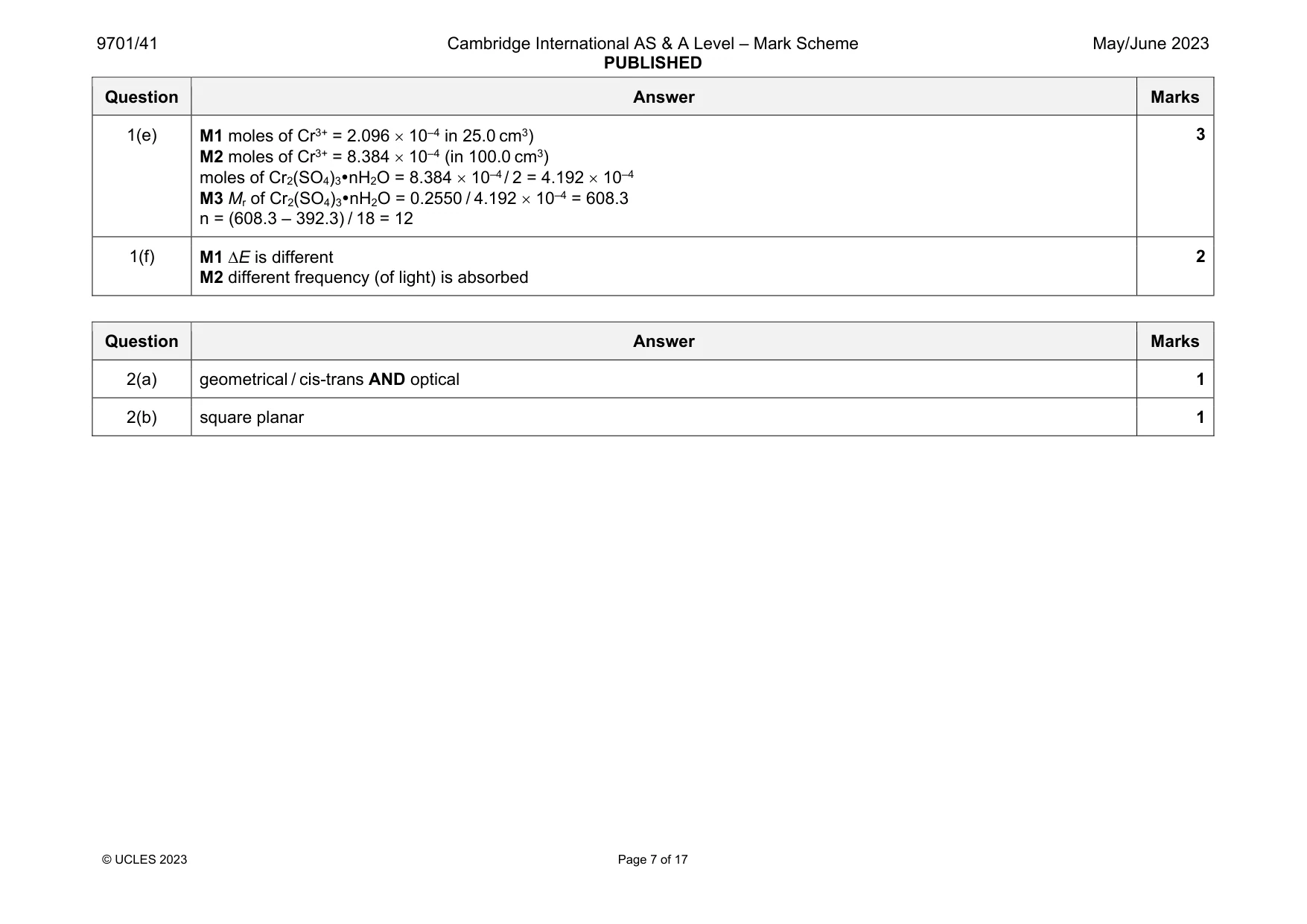
9701/41 Cambridge International AS & A Level – Mark Scheme PUBLISHED May/June 2023 © UCLES 2023 Page 7 of 17 Question Answer Marks 1(e) M1 moles of Cr3+ = 2.096 10–4 in 25.0 cm3) M2 moles of Cr3+ = 8.384 10–4 (in 100.0 cm3) moles of Cr2(SO4)3nH2O = 8.384 10–4 / 2 = 4.192 10–4 M3 Mr of Cr2(SO4)3nH2O = 0.2550 / 4.192 10–4 = 608.3 n = (608.3 – 392.3) / 18 = 12 3 1(f) M1 E is different M2 different frequency (of light) is absorbed 2 Question Answer Marks 2(a) geometrical / cis-trans AND optical 1 2(b) square planar 1
Mark scheme, page 8
9701/41 Cambridge International AS & A Level – Mark Scheme PUBLISHED May/June 2023 © UCLES 2023 Page 8 of 17 Question Answer Marks 2(c) Two correct for one mark, three correct for two marks, four correct for three marks. 3 1 2 3 4
Mark scheme, page 9
9701/41 Cambridge International AS & A Level – Mark Scheme PUBLISHED May/June 2023 © UCLES 2023 Page 9 of 17 Question Answer Marks 2(d)(i) M1 two correct curly arrows M2 correct dipole M3 correct structure of intermediate 3 2(d)(ii) use an excess of ammonia OR limiting amount of oxirane 1 2(d)(iii) M1 M2 elimination / dehydration / condensation 2 Question Answer Marks 3(a)(i) the power to which the concentration of a reactant is raised in the rate equation 1
Mark scheme, page 10
9701/41 Cambridge International AS & A Level – Mark Scheme PUBLISHED May/June 2023 © UCLES 2023 Page 10 of 17 Question Answer Marks 3(a)(ii) the order of reaction with respect to [IO3–] 1 the order of reaction with respect to [H+] 2 the order of reaction with respect to [I–] 2 the overall order of reaction 5 All correct for one mark 1 3(a)(iii) 1 3(a)(iv) M1 k = rate / [I–]2[IO3–][H+]2 = (4.20 10-2)/(0.0252 0.04x0.0152) = 7.47 106 M2 units = mol–4 dm12 min–1 2 3(a)(v) 0.0709 = k 0.12 [H+]2 0.01252 [H+] = 2.25 10-2 1 3(a)(vi) x = 102 / 1 = 100 1 3(b) M1 step 1 Fe3+ + I– FeI2+ M2 step 2 FeI2+ + I– Fe2+ + I2– OR FeI2+ + I– FeI2+ AND slowest step = step 2 M3 step 3 Fe3+ + I2– Fe2+ + I2 OR FeI2+ + Fe3+ 2Fe2+ + I2 3
Mark scheme, page 11
9701/41 Cambridge International AS & A Level – Mark Scheme PUBLISHED May/June 2023 © UCLES 2023 Page 11 of 17 Question Answer Marks 4(a) M1 bond angle = 120° AND carbons are sp2 M2 bonds are formed by end-on-end / head on / head to head / linear overlap of orbitals M3 bonds are formed by sideways / lateral overlap of p orbitals 3 4(b)(i) [1] [1] 2 4(b)(ii) M1 step 1 (CH3)2CHBr and FeBr3 / Al Br3 M2 step 2 conc HNO3 and conc H2SO4 M3 step 3 Sn and conc HCl 3 4(c) 3,4,5-trimethylphenylamine 1 4(d) compound number of peaks observed W 6 Z 6 Both correct for one mark 1 Question Answer Marks 5(a)(i) palladium, platinum and rhodium / Pt, Pd, Rh 1 5(a)(ii) a catalyst in a different state / phase to the reactants / substrate 1 5(b)(i) measure / degree of disorder / randomness of a system OR the number of possible arrangements of the particles and the energy in a system 1
Mark scheme, page 12
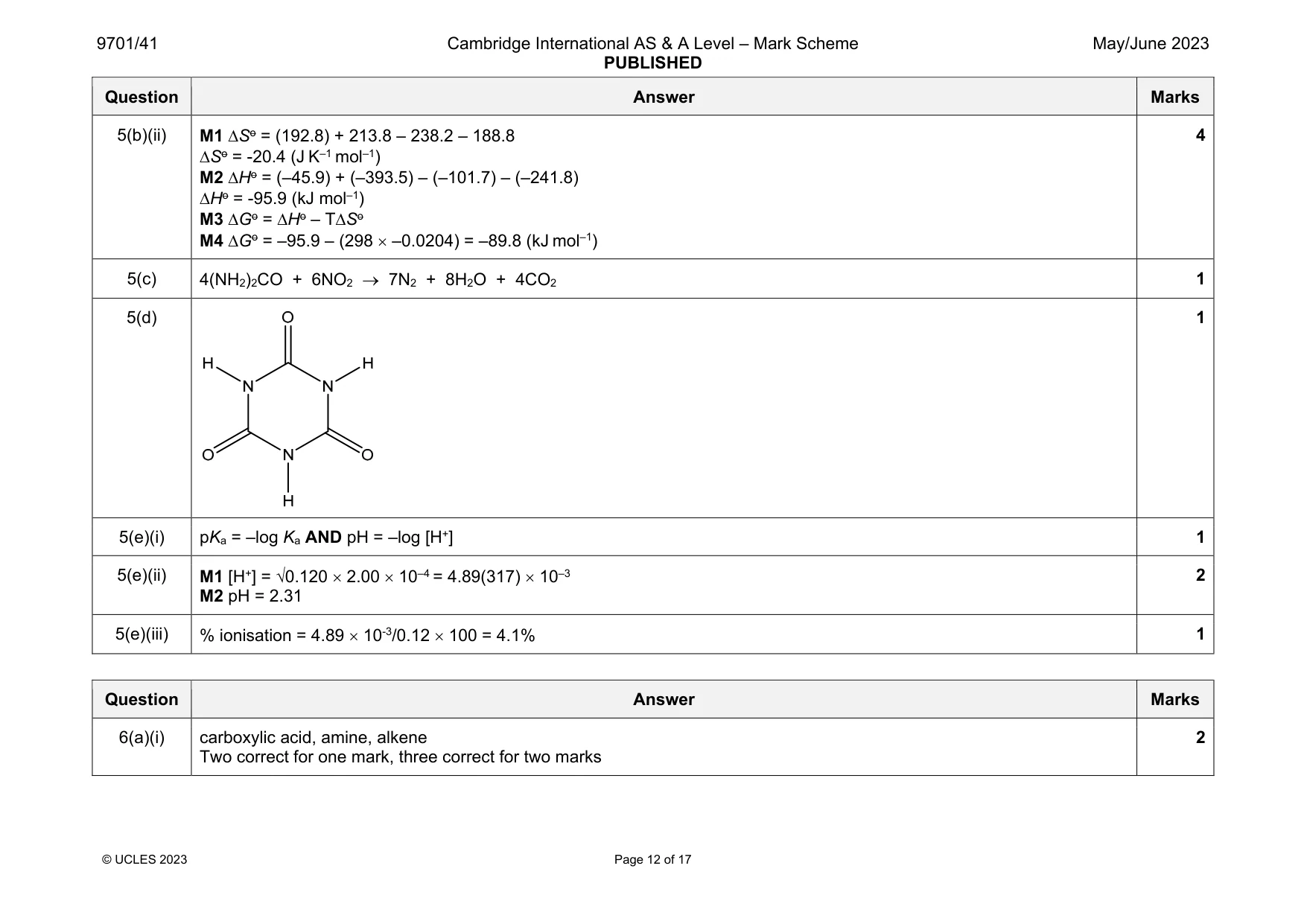
9701/41 Cambridge International AS & A Level – Mark Scheme PUBLISHED May/June 2023 © UCLES 2023 Page 12 of 17 Question Answer Marks 5(b)(ii) M1 So = (192.8) + 213.8 – 238.2 – 188.8 So = -20.4 (J K–1 mol–1) M2 Ho = (–45.9) + (–393.5) – (–101.7) – (–241.8) Ho = -95.9 (kJ mol–1) M3 Go = Ho – TSo M4 Go = –95.9 – (298 –0.0204) = –89.8 (kJ mol–1) 4 5(c) 4(NH2)2CO + 6NO2 7N2 + 8H2O + 4CO2 1 5(d) 1 5(e)(i) pKa = –log Ka AND pH = –log [H+] 1 5(e)(ii) M1 [H+] = √0.120 2.00 10–4 = 4.89(317) 10–3 M2 pH = 2.31 2 5(e)(iii) % ionisation = 4.89 10-3/0.12 100 = 4.1% 1 Question Answer Marks 6(a)(i) carboxylic acid, amine, alkene Two correct for one mark, three correct for two marks 2
Mark scheme, page 13
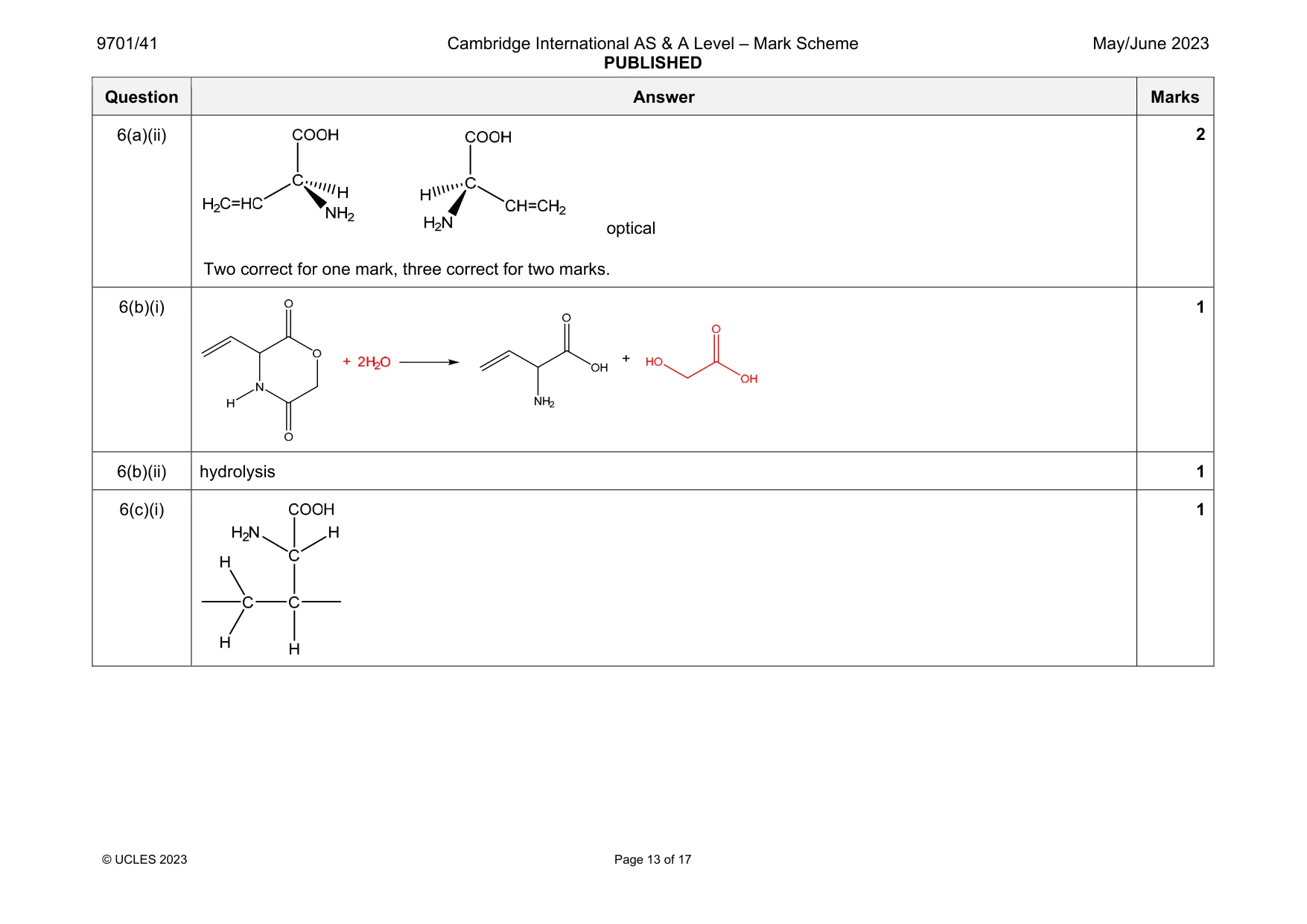
9701/41 Cambridge International AS & A Level – Mark Scheme PUBLISHED May/June 2023 © UCLES 2023 Page 13 of 17 Question Answer Marks 6(a)(ii) optical Two correct for one mark, three correct for two marks. 2 6(b)(i) 1 6(b)(ii) hydrolysis 1 6(c)(i) 1
Mark scheme, page 14
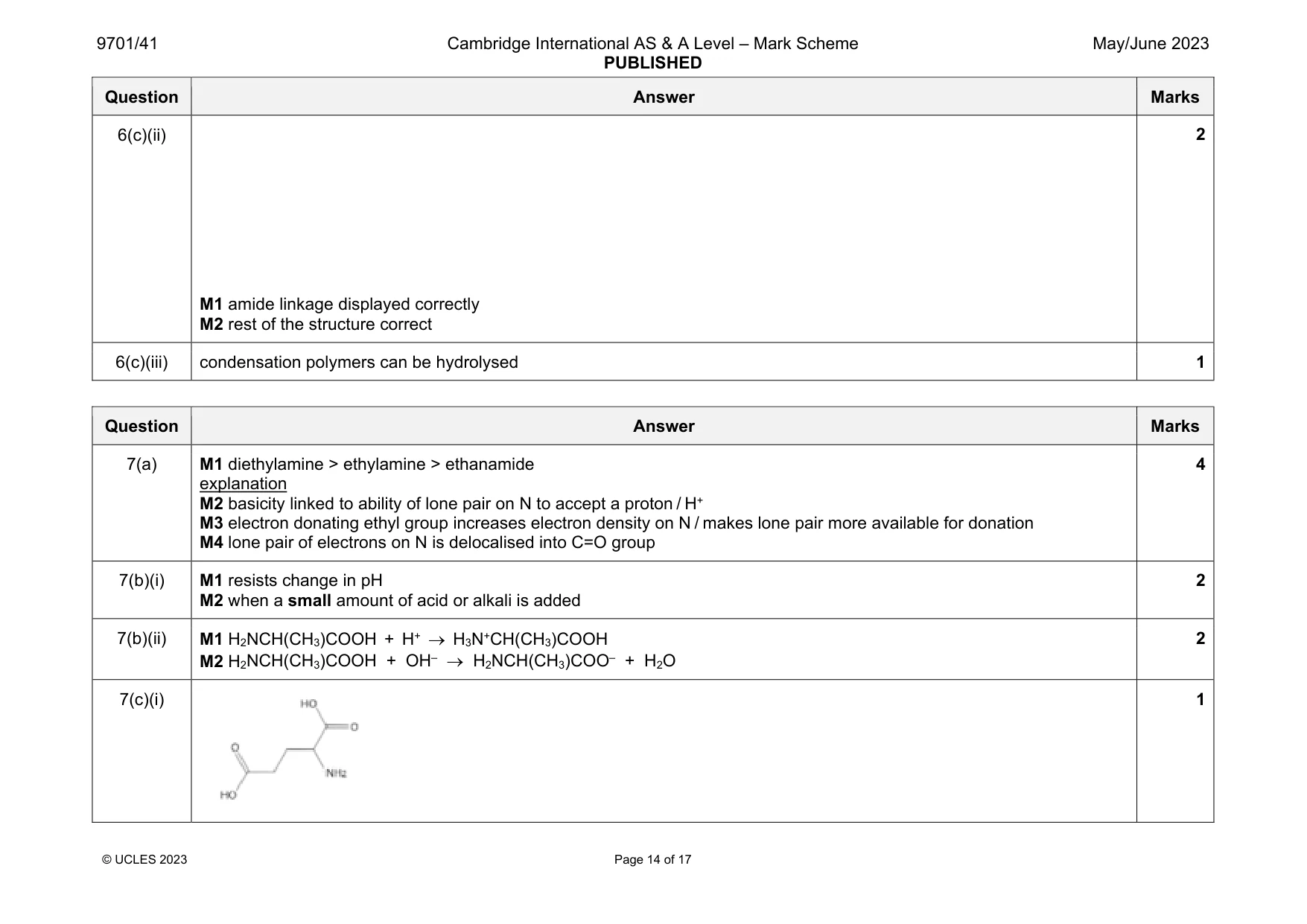
9701/41 Cambridge International AS & A Level – Mark Scheme PUBLISHED May/June 2023 © UCLES 2023 Page 14 of 17 Question Answer Marks 6(c)(ii) M1 amide linkage displayed correctly M2 rest of the structure correct 2 6(c)(iii) condensation polymers can be hydrolysed 1 Question Answer Marks 7(a) M1 diethylamine > ethylamine > ethanamide explanation M2 basicity linked to ability of lone pair on N to accept a proton / H+ M3 electron donating ethyl group increases electron density on N / makes lone pair more available for donation M4 lone pair of electrons on N is delocalised into C=O group 4 7(b)(i) M1 resists change in pH M2 when a small amount of acid or alkali is added 2 7(b)(ii) M1 H2NCH(CH3)COOH + H+ H3N+CH(CH3)COOH M2 H2NCH(CH3)COOH + OH– H2NCH(CH3)COO– + H2O 2 7(c)(i) 1
Mark scheme, page 15
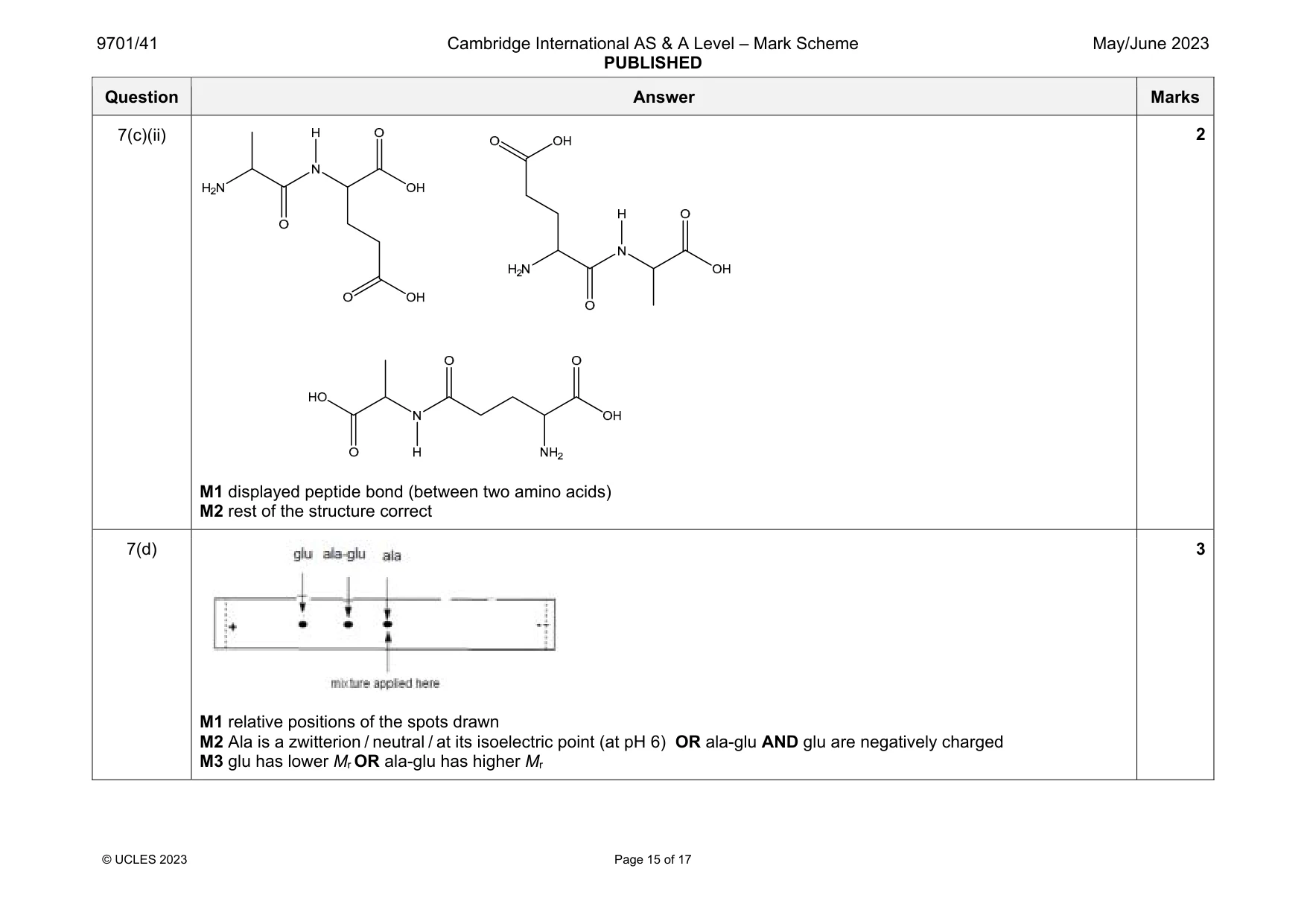
9701/41 Cambridge International AS & A Level – Mark Scheme PUBLISHED May/June 2023 © UCLES 2023 Page 15 of 17 Question Answer Marks 7(c)(ii) M1 displayed peptide bond (between two amino acids) M2 rest of the structure correct 2 7(d) M1 relative positions of the spots drawn M2 Ala is a zwitterion / neutral / at its isoelectric point (at pH 6) OR ala-glu AND glu are negatively charged M3 glu has lower Mr OR ala-glu has higher Mr 3
Mark scheme, page 16
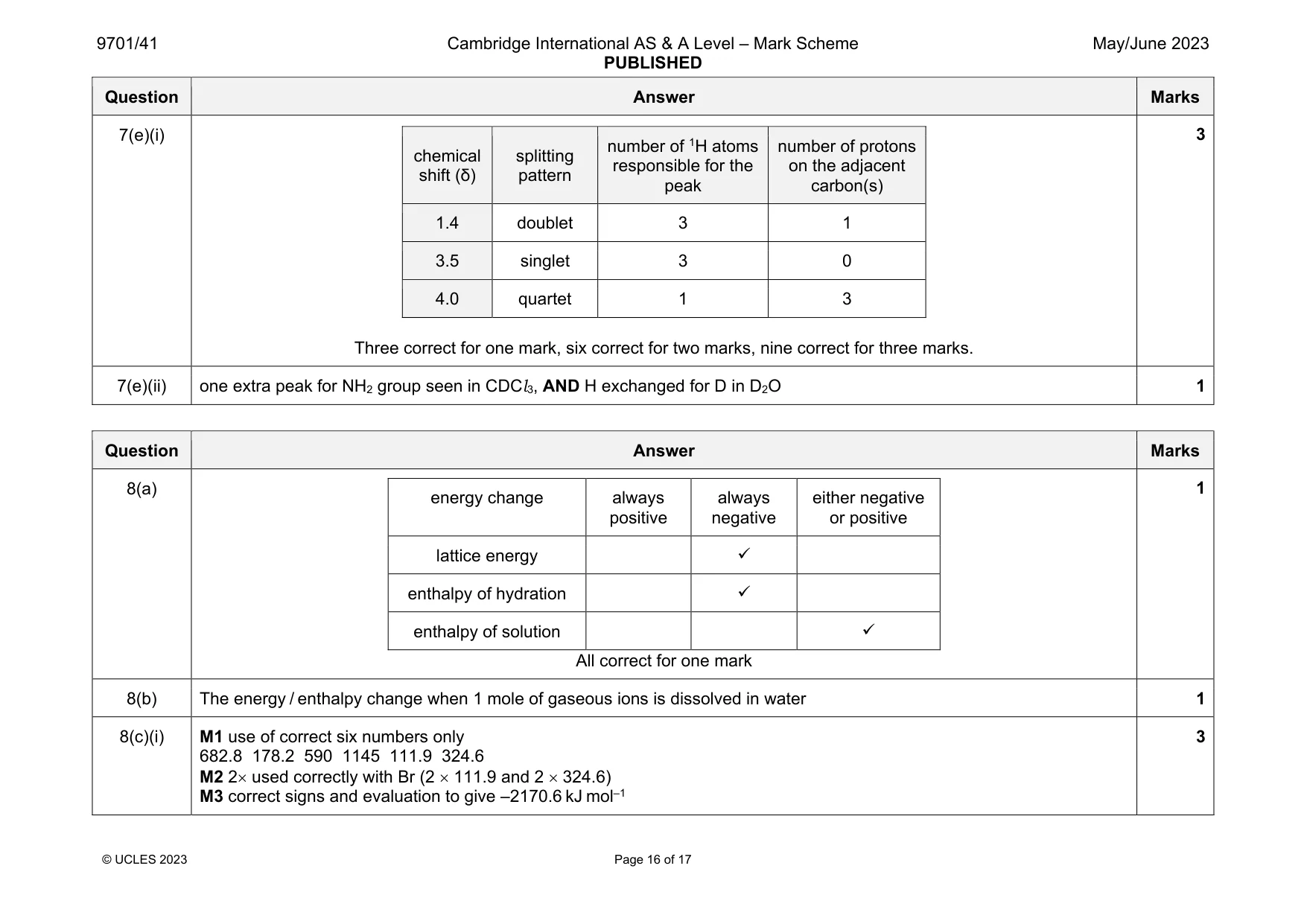
9701/41 Cambridge International AS & A Level – Mark Scheme PUBLISHED May/June 2023 © UCLES 2023 Page 16 of 17 Question Answer Marks 7(e)(i) chemical shift (δ) splitting pattern number of 1H atoms responsible for the peak number of protons on the adjacent carbon(s) 1.4 doublet 3 1 3.5 singlet 3 0 4.0 quartet 1 3 Three correct for one mark, six correct for two marks, nine correct for three marks. 3 7(e)(ii) one extra peak for NH2 group seen in CDCl3, AND H exchanged for D in D2O 1 Question Answer Marks 8(a) energy change always positive always negative either negative or positive lattice energy enthalpy of hydration enthalpy of solution All correct for one mark 1 8(b) The energy / enthalpy change when 1 mole of gaseous ions is dissolved in water 1 8(c)(i) M1 use of correct six numbers only 682.8 178.2 590 1145 111.9 324.6 M2 2 used correctly with Br (2 111.9 and 2 324.6) M3 correct signs and evaluation to give –2170.6 kJ mol–1 3
Mark scheme, page 17
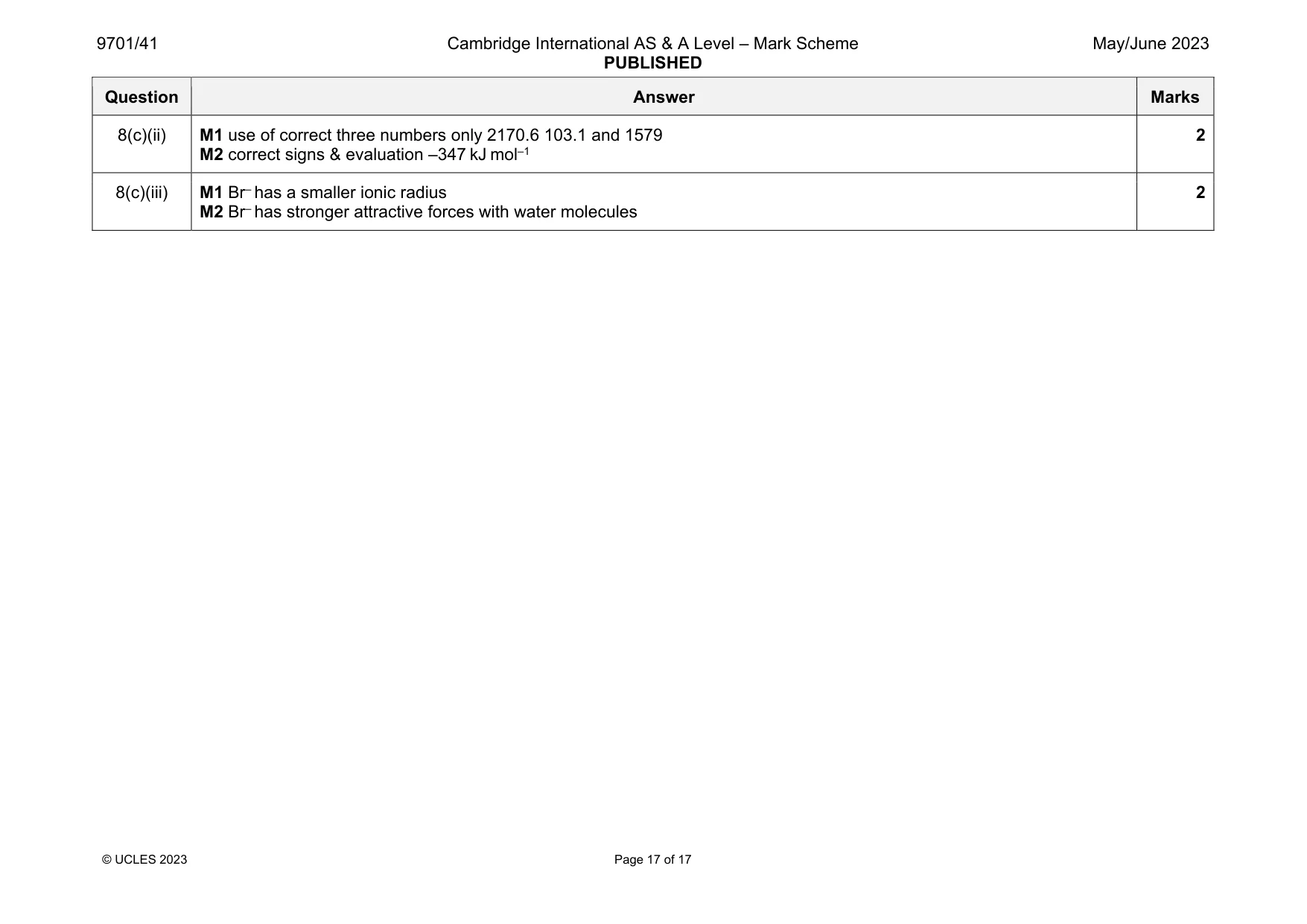
9701/41 Cambridge International AS & A Level – Mark Scheme PUBLISHED May/June 2023 © UCLES 2023 Page 17 of 17 Question Answer Marks 8(c)(ii) M1 use of correct three numbers only 2170.6 103.1 and 1579 M2 correct signs & evaluation –347 kJ mol–1 2 8(c)(iii) M1 Br– has a smaller ionic radius M2 Br– has stronger attractive forces with water molecules 2
What you needed in this session
Cambridge’s own grade thresholds for 2023 May/June, Paper 4 · Variant 1. A higher threshold means an easier paper — the bar moves with how the cohort did.