Cambridge A Level Chemistry 9701 — 2019 Oct/Nov Paper 5 · Variant 1
9701/51/O/N/19 · 2 questions · 30 marks · ≈34 min
The question paper and its mark scheme, free to read here and free to download. This is Cambridge’s own paper, exactly as it was sat.
Question paper12 pages

Mark scheme7 pages
Answers below. Sit the paper first if you are practising.
Questions as text
Q1 · Yttrium barium copper oxide, YBa2Cu3O7, is a crystalline compound
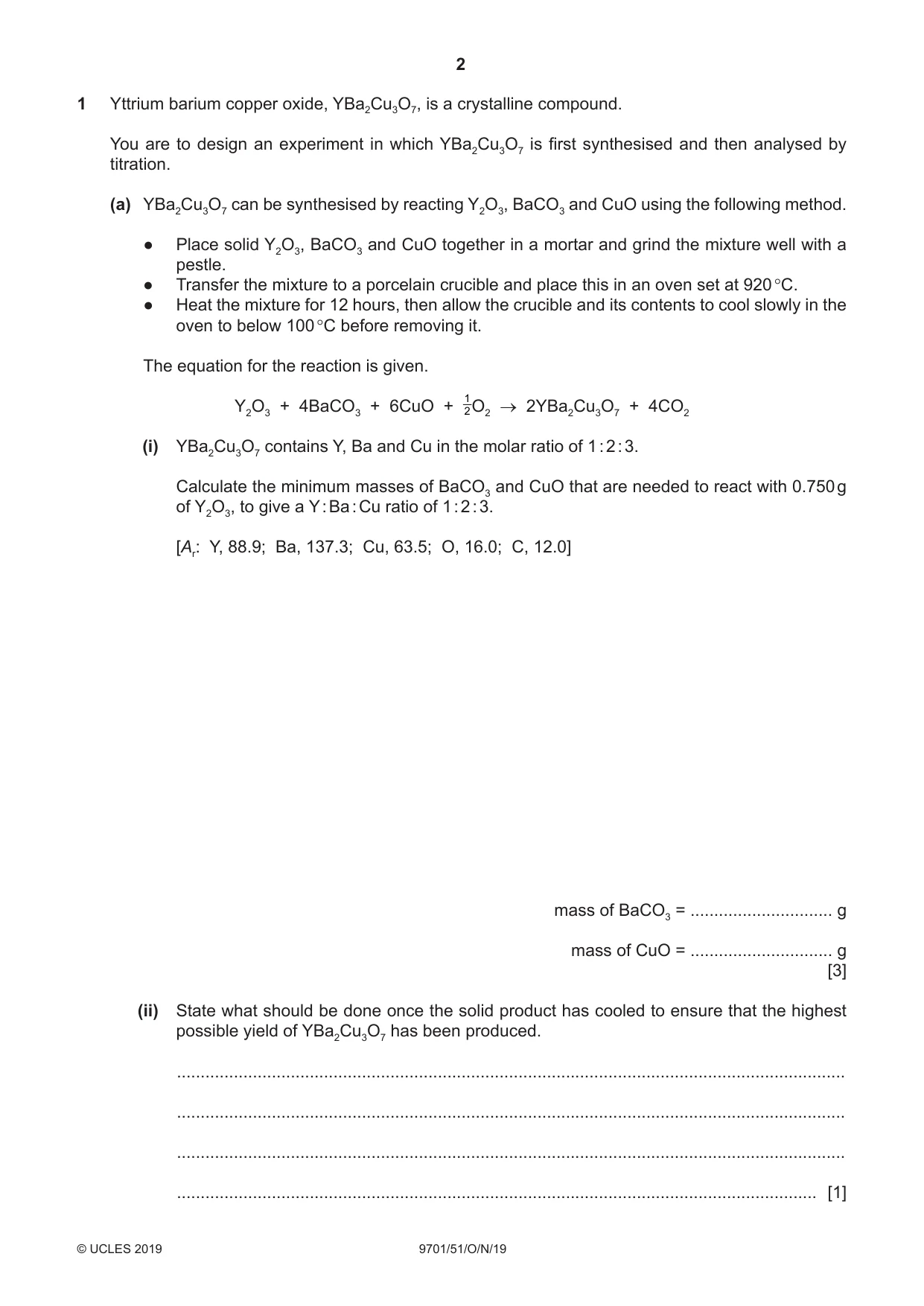
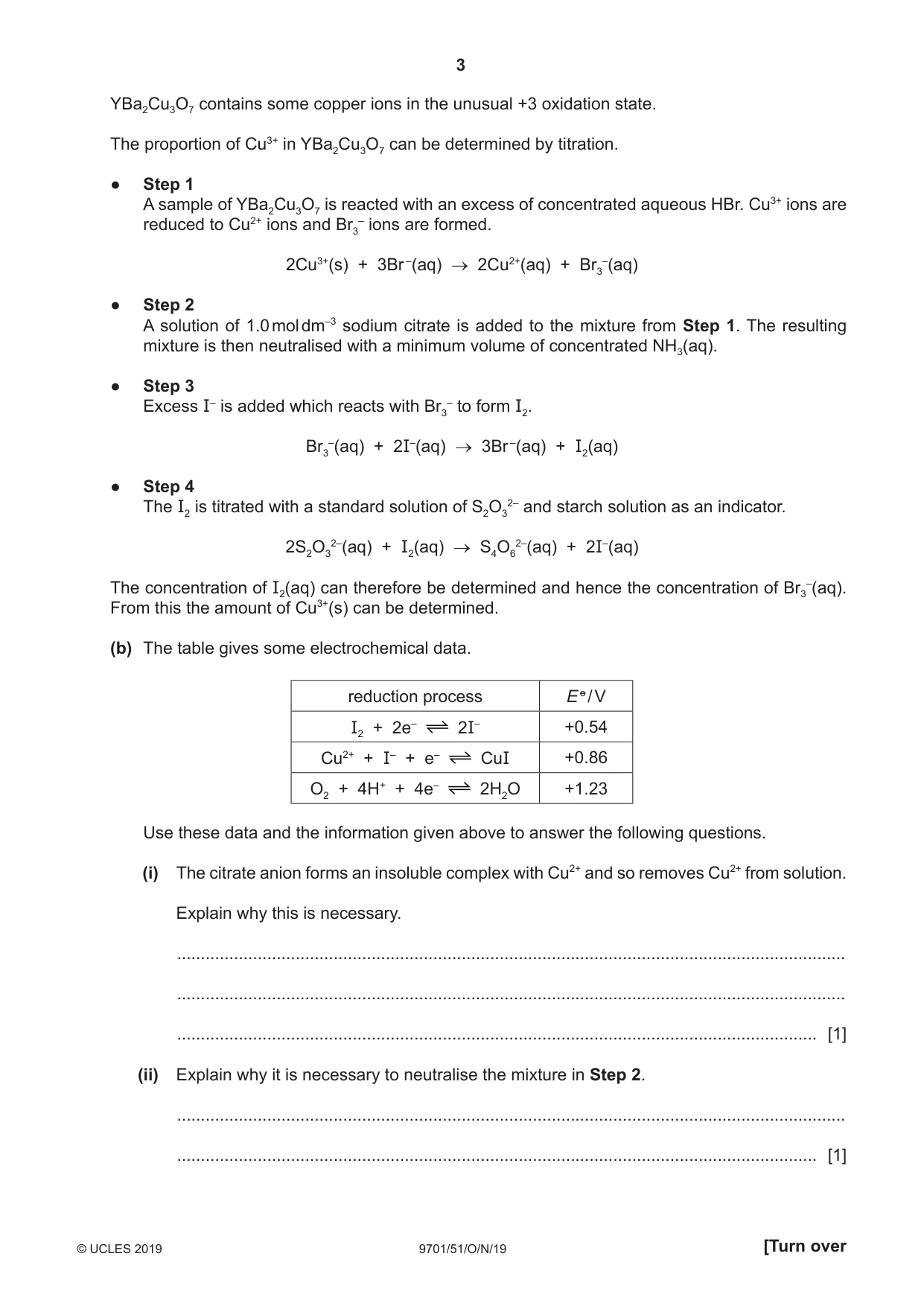
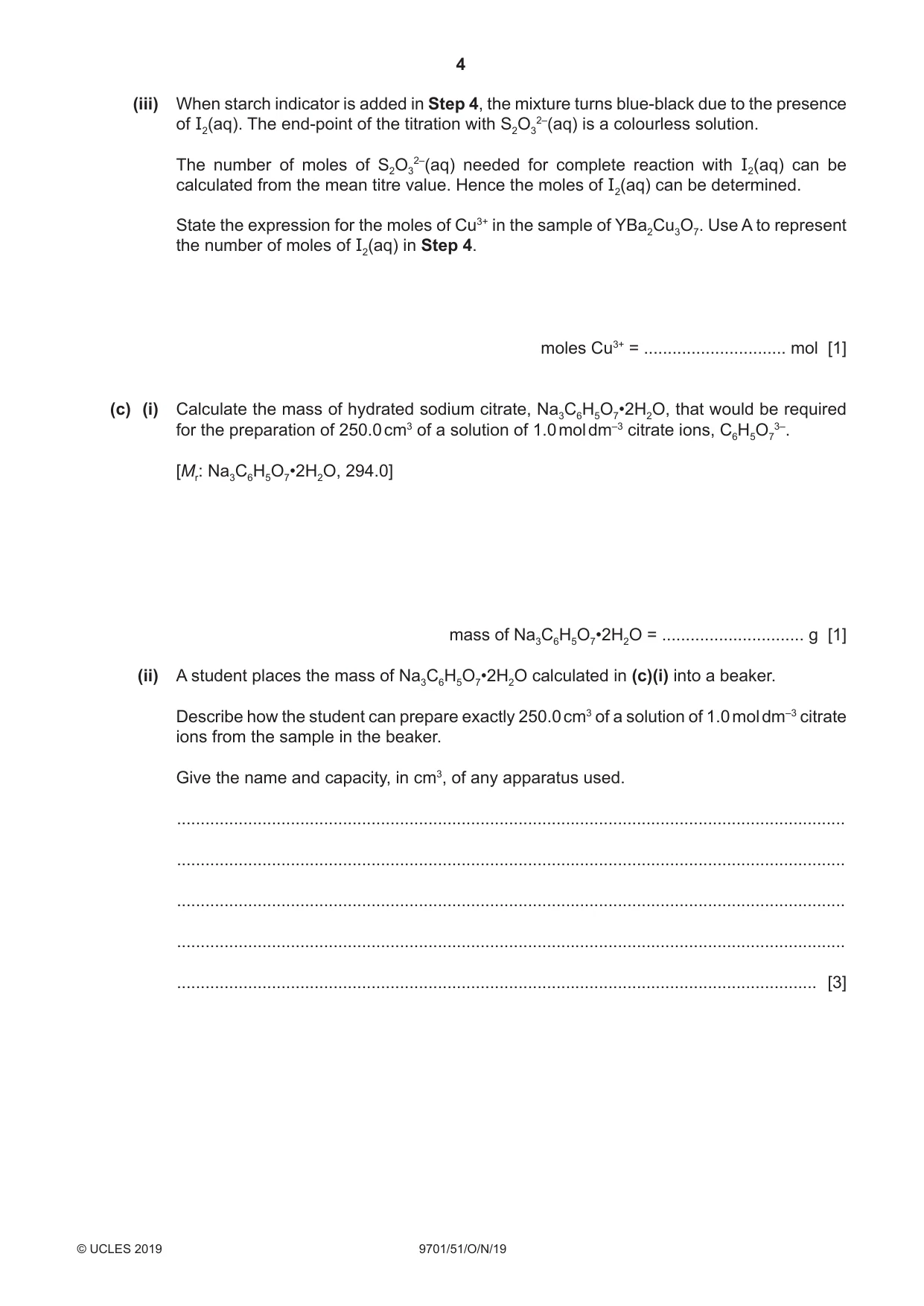
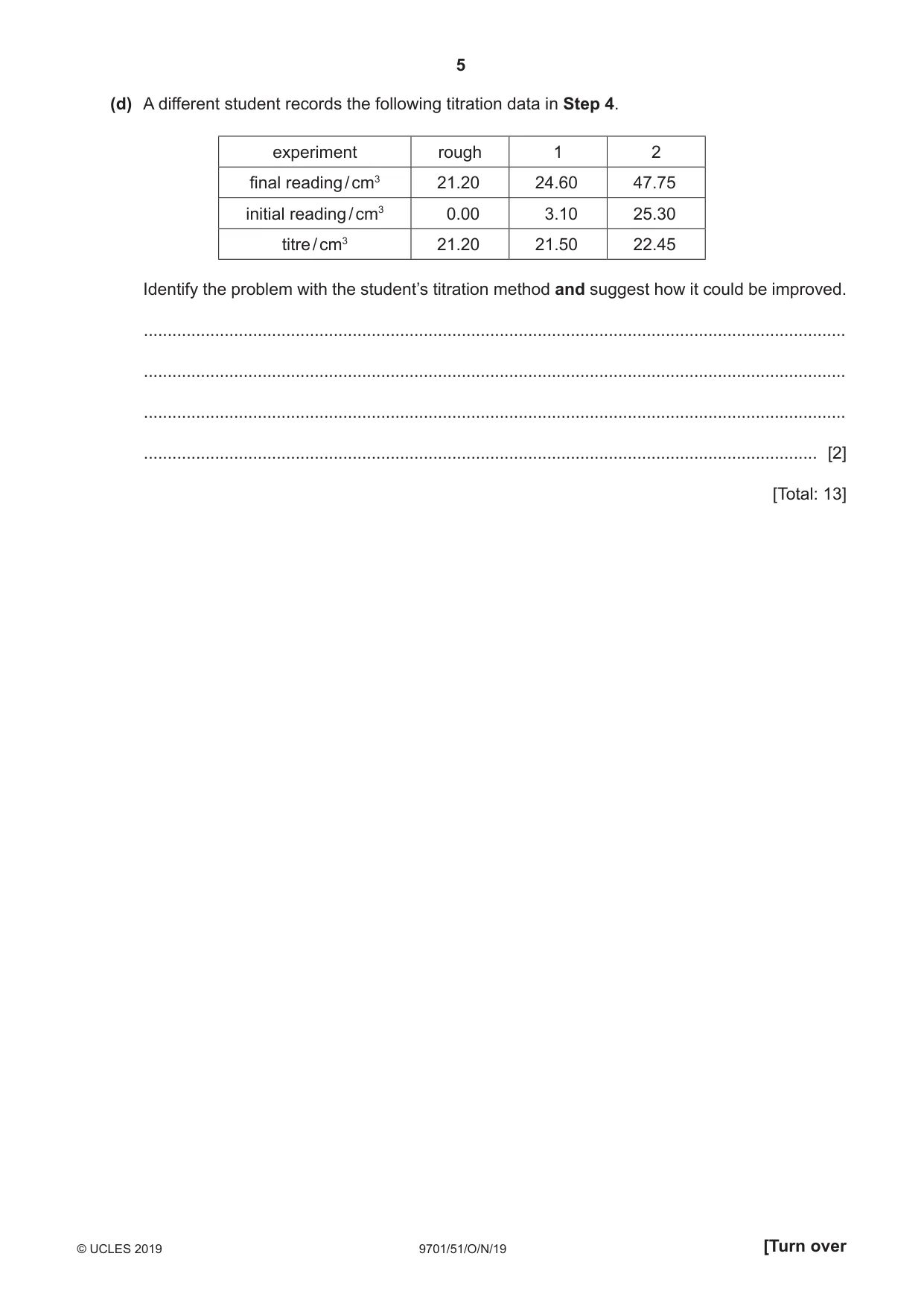
1 Yttrium barium copper oxide, YBa2Cu3O7, is a crystalline compound. You are to design an experiment in which YBa2Cu3O7 is first synthesised and then analysed by titration. (a) YBa2Cu3O7 can be synthesised by reacting Y2O3, BaCO3 and CuO using the following method. ●● Place solid Y2O3, BaCO3 and CuO together in a mortar and grind the mixture well with a pestle. ●● Transfer the mixture to a porcelain crucible and place this in an oven set at 920 °C. ●● Heat the mixture for 12 hours, then allow the crucible and its contents to cool slowly in the oven to below 100 °C before removing it. The equation for the reaction is given. Y2O3 + 4BaCO3 + 6CuO + 12O2 → 2YBa2Cu3O7 + 4CO2 (i) YBa2Cu3O7 contains Y, Ba and Cu in the molar ratio of 1 : 2 : 3. Calculate the minimum masses of BaCO3 and CuO that are needed to react with 0.750 g of Y2O3, to give a Y : Ba : Cu ratio of 1 : 2 : 3. [Ar: Y, 88.9; Ba, 137.3; Cu, 63.5; O, 16.0; C, 12.0] mass of BaCO3 = .............................. g mass of CuO = .............................. g [3] (ii) State what should be done once the solid product has cooled to ensure that the highest possible yield of YBa2Cu3O7 has been produced. ............................................................................................................................................. ............................................................................................................................................. ............................................................................................................................................. ....................................................................................................................................... [1] YBa2Cu3O7 contains some copper ions in the unusual +3 oxidation state. The proportion of Cu3+ in YBa2Cu3O7 can be determined by titration. ●● Step 1 A sample of YBa2Cu3O7 is reacted with an excess of concentrated aqueous HBr. Cu3+ ions are reduced to Cu2+ ions and Br3– ions are formed. 2Cu3+(s) + 3Br –(aq) → 2Cu2+(aq) + Br3–(aq) ●● Step 2 A solution of 1.0 mol dm–3 sodium citrate is added to the mixture from Step 1. The resulting mixture is then neutralised with a minimum volume of concentrated NH3(aq). ●● Step 3 Excess I– is added which reacts with Br3– to form I2. Br3–(aq) + 2I–(aq) → 3Br –(aq) + I2(aq) ●● Step 4 The I2 is titrated with a standard solution of S2O32– and starch solution as an indicator. 2S2O32–(aq) + I2(aq) → S4O62–(aq) + 2I–(aq) The concentration of I2(aq) can therefore be determined and hence the concentration of Br3–(aq). From this the amount of Cu3+(s) can be determined. (b) The table gives some electrochemical data. reduction process E o / V I2 + 2e– 2I– +0.54 Cu2+ + I– + e– CuI +0.86 O2 + 4H+ + 4e– 2H2O +1.23 Use these data and the information given above to answer the following questions. (i) The citrate anion forms an insoluble complex with Cu2+ and so removes Cu2+ from solution. Explain why this is necessary. ............................................................................................................................................. ............................................................................................................................................. ....................................................................................................................................... [1] (ii) Explain why it is necessary to neutralise the mixture in Step 2. ............................................................................................................................................. ....................................................................................................................................... [1] (iii) When starch indicator is added in Step 4, the mixture turns blue‑black due to the presence of I2(aq). The end‑point of the titration with S2O32–(aq) is a colourless solution. The number of moles of S2O32–(aq) needed for complete reaction with I2(aq) can be calculated from the mean titre value. Hence the moles of I2(aq) can be determined. State the expression for the moles of Cu3+ in the sample of YBa2Cu3O7. Use A to represent the number of moles of I2(aq) in Step 4. moles Cu3+ = .............................. mol [1] (c) (i) Calculate the mass of hydrated sodium citrate, Na3C6H5O7•2H2O, that would be required for the preparation of 250.0 cm3 of a solution of 1.0 mol dm–3 citrate ions, C6H5O73–. [Mr: Na3C6H5O7•2H2O, 294.0] mass of Na3C6H5O7•2H2O = .............................. g [1] (ii) A student places the mass of Na3C6H5O7•2H2O calculated in (c)(i) into a beaker. Describe how the student can prepare exactly 250.0 cm3 of a solution of 1.0 mol dm–3 citrate ions from the sample in the beaker. Give the name and capacity, in cm3, of any apparatus used. ............................................................................................................................................. ............................................................................................................................................. ............................................................................................................................................. ............................................................................................................................................. ....................................................................................................................................... [3] (d) A different student records the following titration data in Step 4. experiment rough 1 2 final reading / cm3 21.20 24.60 47.75 initial reading / cm3 0.00 3.10 25.30 titre / cm3 21.20 21.50 22.45 Identify the problem with the student’s titration method and suggest how it could be improved. .................................................................................................................................................... .................................................................................................................................................... .................................................................................................................................................... .............................................................................................................................................. [2] [Total: 13]
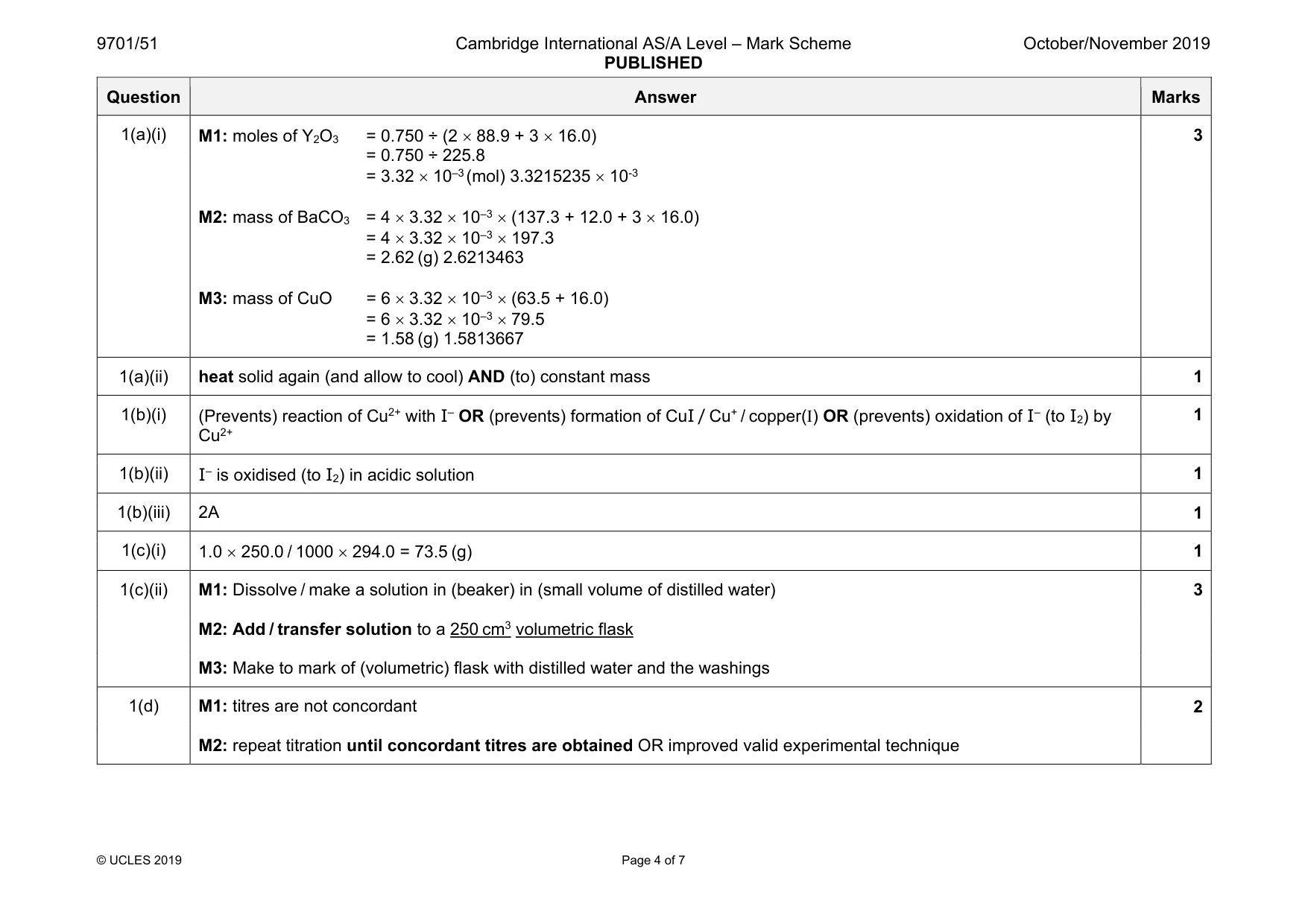
Mark scheme: 1(a)(i) M1: moles of Y2O3 = 0.750 ÷ 225.8 = 3.32 × 10⁻³ (mol) 3.3215235 × 10⁻³ M2: mass of BaCO3 = 4 × 3.32 × 10–3 × (137.3 + 12.0 + 3 × 16.0) = 4 × 3.32 × 10–3 × 197.3 = 2.62 (g) 2.6213463 M3: mass of CuO = 6 × 3.32 × 10–3 × (63.5 + 16.0) = 6 × 3.32 × 10–3 × 79.5 = 1.58 (g) 1.5813667 3 1(a)(ii) heat solid again (and allow to cool) AND (to) constant mass 1 1(b)(i) (Prevents) reaction of Cu2+ with I– OR (prevents) formation of CuI / Cu+ / copper(I) OR (prevents) oxidation of I– (to I2) by Cu2+ 1 1(b)(ii) I– is oxidised (to I2) in acidic solution 1 1(b)(iii) 2A 1 1(c)(i) 1.0 × 250.0 / 1000 × 294.0 = 73.5 (g) 1 1(c)(ii) M1: Dissolve / make a solution in (beaker) in (small volume of distilled water) M2: Add / transfer solution to a 250 cm3 volumetric flask M3: Make to mark of (volumetric) flask with distilled water and the washings 3 1(d) M1: titres are not concordant M2: repeat titration until concordant titres are obtained OR improved valid experimental technique 2
More questions on Reacting masses and volumes (of solutions and gases)
Q2 · The viscosity of a substance is a measure of how quickly the substance flows when it is…
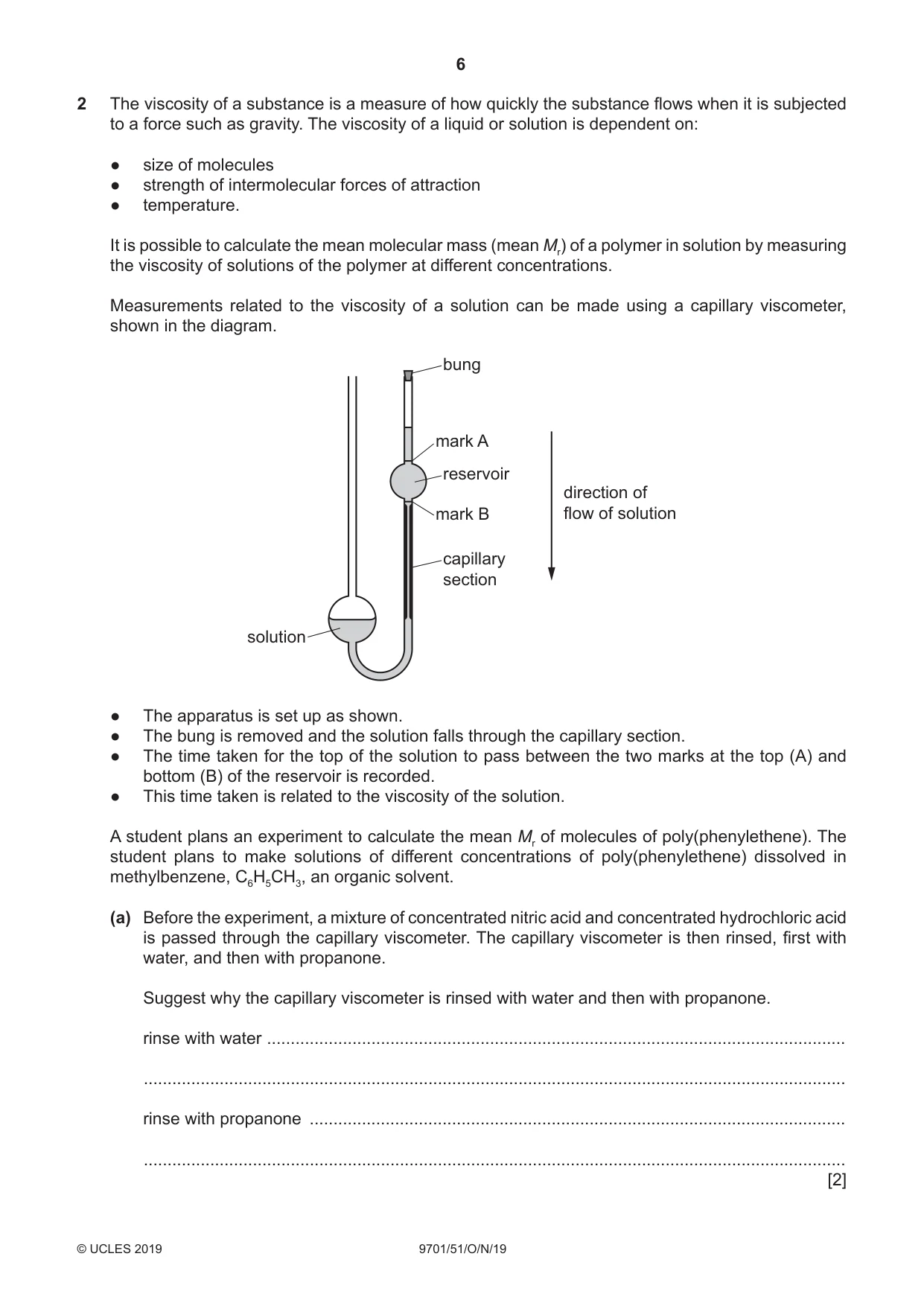
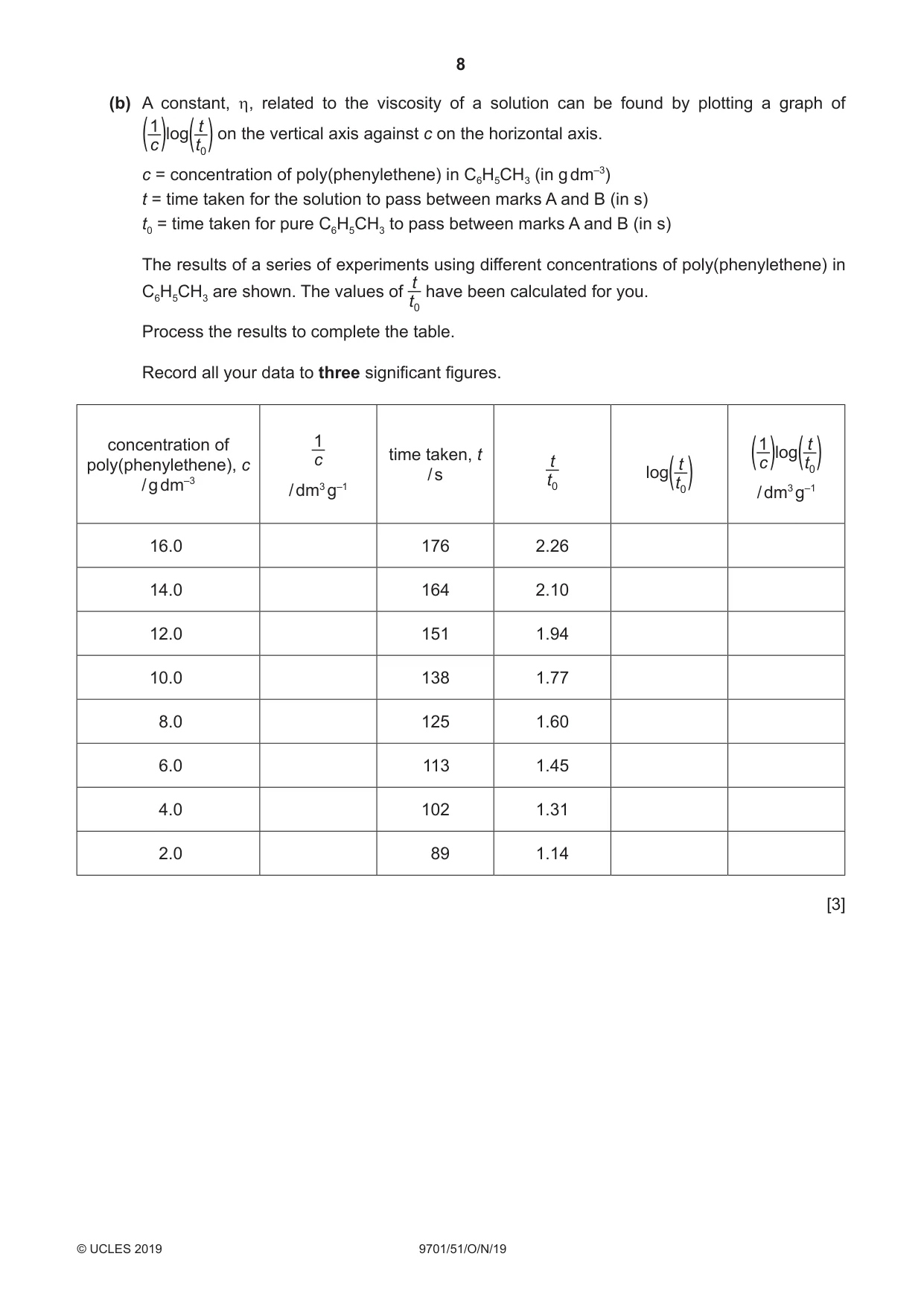
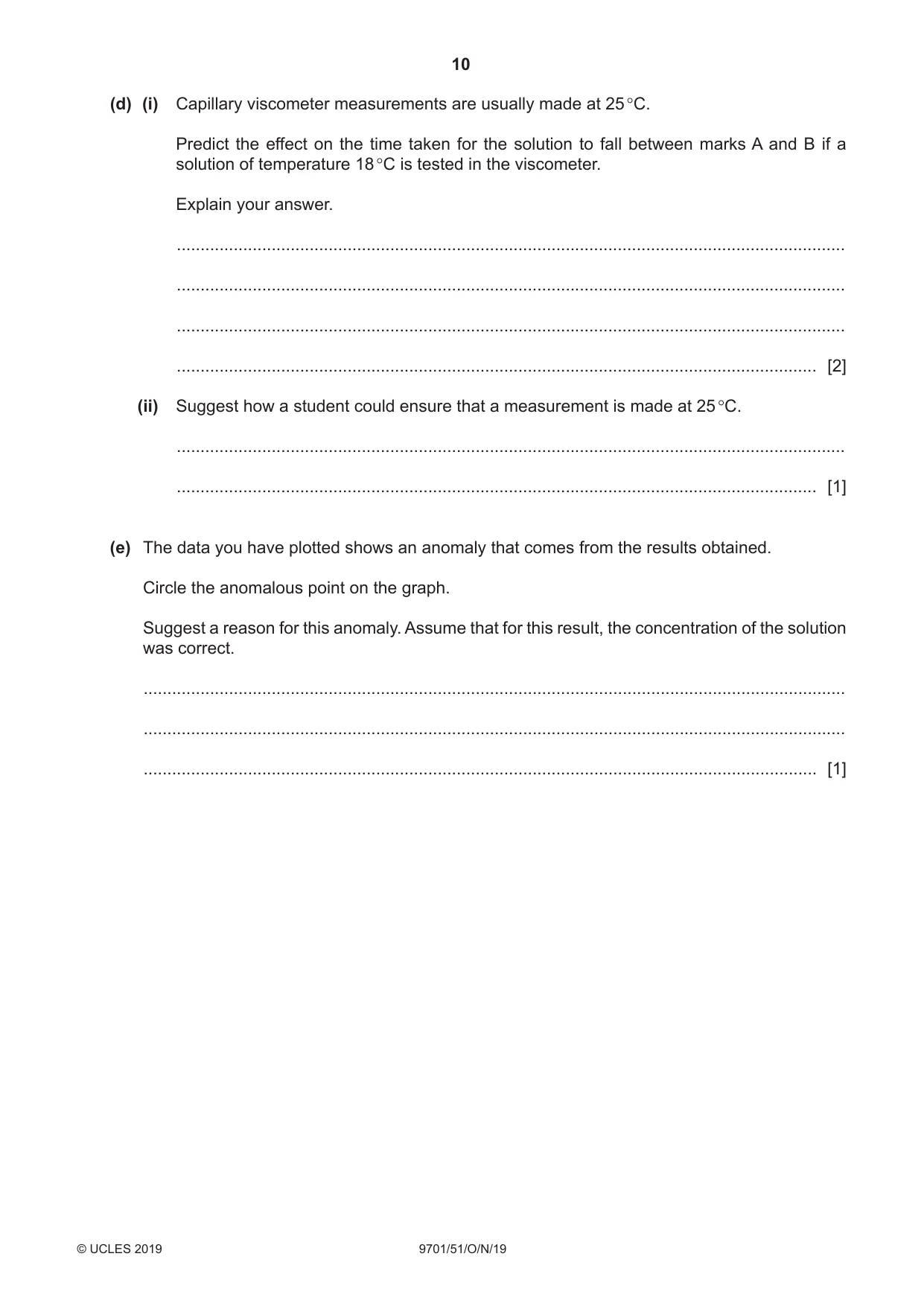
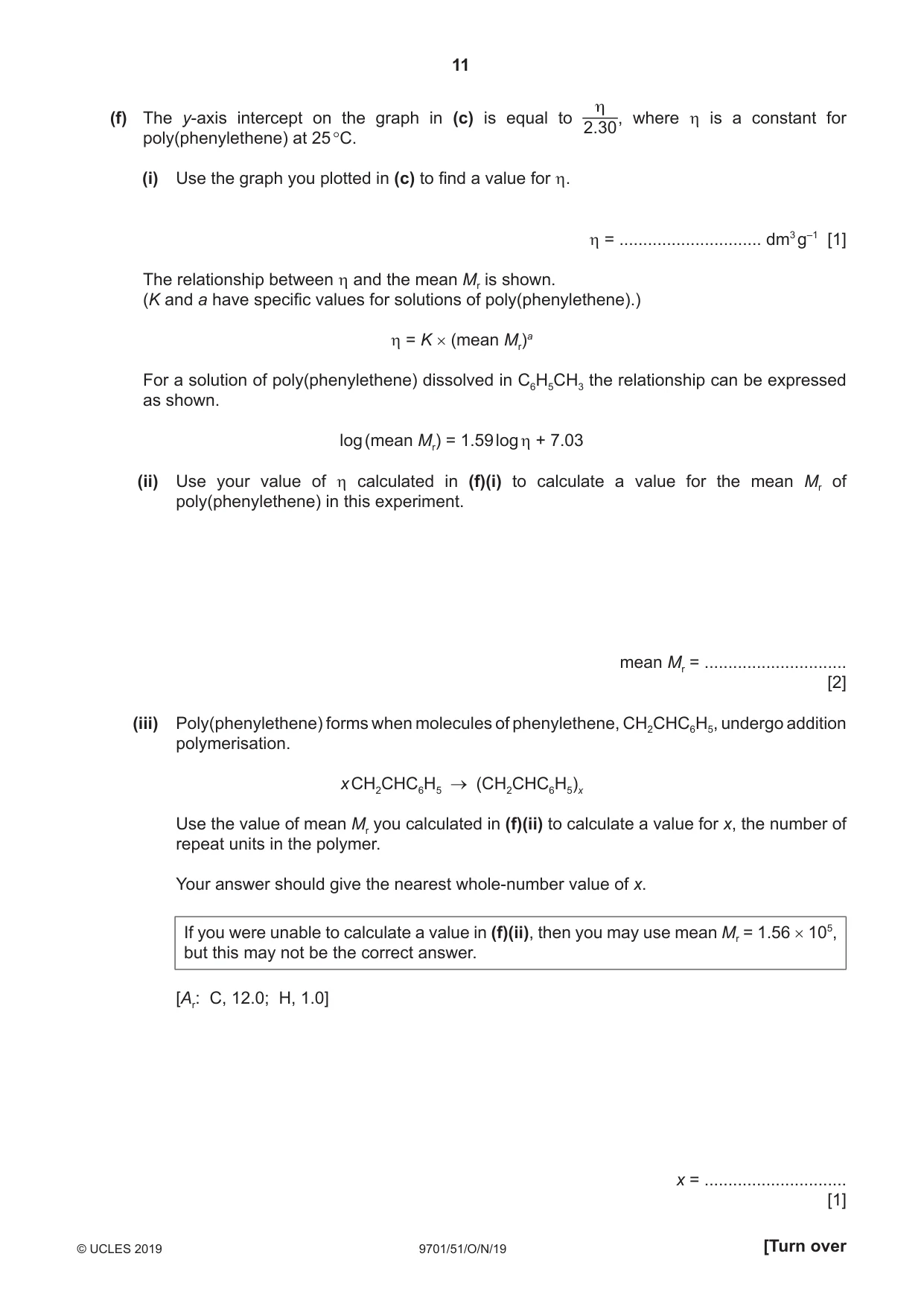
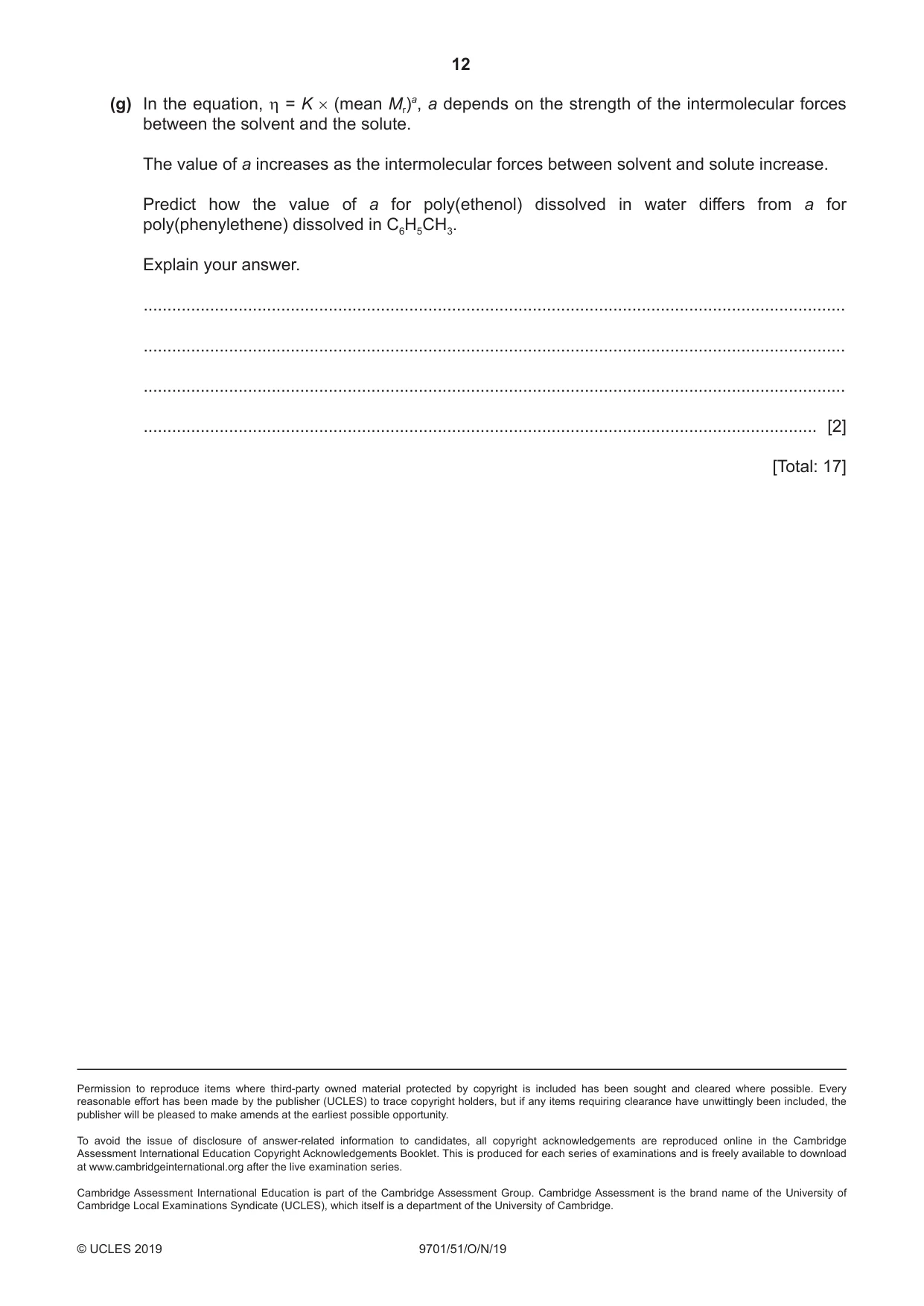
2 The viscosity of a substance is a measure of how quickly the substance flows when it is subjected to a force such as gravity. The viscosity of a liquid or solution is dependent on: ●● size of molecules ●● strength of intermolecular forces of attraction ●● temperature. It is possible to calculate the mean molecular mass (mean Mr) of a polymer in solution by measuring the viscosity of solutions of the polymer at different concentrations. Measurements related to the viscosity of a solution can be made using a capillary viscometer, shown in the diagram. bung mark A reservoir direction of mark B flow of solution capillary section solution ●● The apparatus is set up as shown. ●● The bung is removed and the solution falls through the capillary section. ●● The time taken for the top of the solution to pass between the two marks at the top (A) and bottom (B) of the reservoir is recorded. ●● This time taken is related to the viscosity of the solution. A student plans an experiment to calculate the mean Mr of molecules of poly(phenylethene). The student plans to make solutions of different concentrations of poly(phenylethene) dissolved in methylbenzene, C6H5CH3, an organic solvent. (a) Before the experiment, a mixture of concentrated nitric acid and concentrated hydrochloric acid is passed through the capillary viscometer. The capillary viscometer is then rinsed, first with water, and then with propanone. Suggest why the capillary viscometer is rinsed with water and then with propanone. rinse with water .......................................................................................................................... .................................................................................................................................................... rinse with propanone .................................................................................................................. .................................................................................................................................................... [2] Question 2 continues on the next page. (b) A constant, η, related to the viscosity of a solution can be found by plotting a graph of 1 t on the vertical axis against c on the horizontal axis. c( )log t0( ) c = concentration of poly(phenylethene) in C6H5CH3 (in g dm–3) t = time taken for the solution to pass between marks A and B (in s) t0 = time taken for pure C6H5CH3 to pass between marks A and B (in s) The results of a series of experiments using different concentrations of poly(phenylethene) in t C6H5CH3 are shown. The values of have been calculated for you. t0 Process the results to complete the table. Record all your data to three significant figures. concentration of 1 1 t time taken, tpoly(phenylethene), c c t t c( )log t0( ) / s log / g dm–3 t0 t0( ) / dm3 g–1 / dm3 g–1 16.0 176 2.26 14.0 164 2.10 12.0 151 1.94 10.0 138 1.77 8.0 125 1.60 6.0 113 1.45 4.0 102 1.31 2.0 89 1.14 [3]
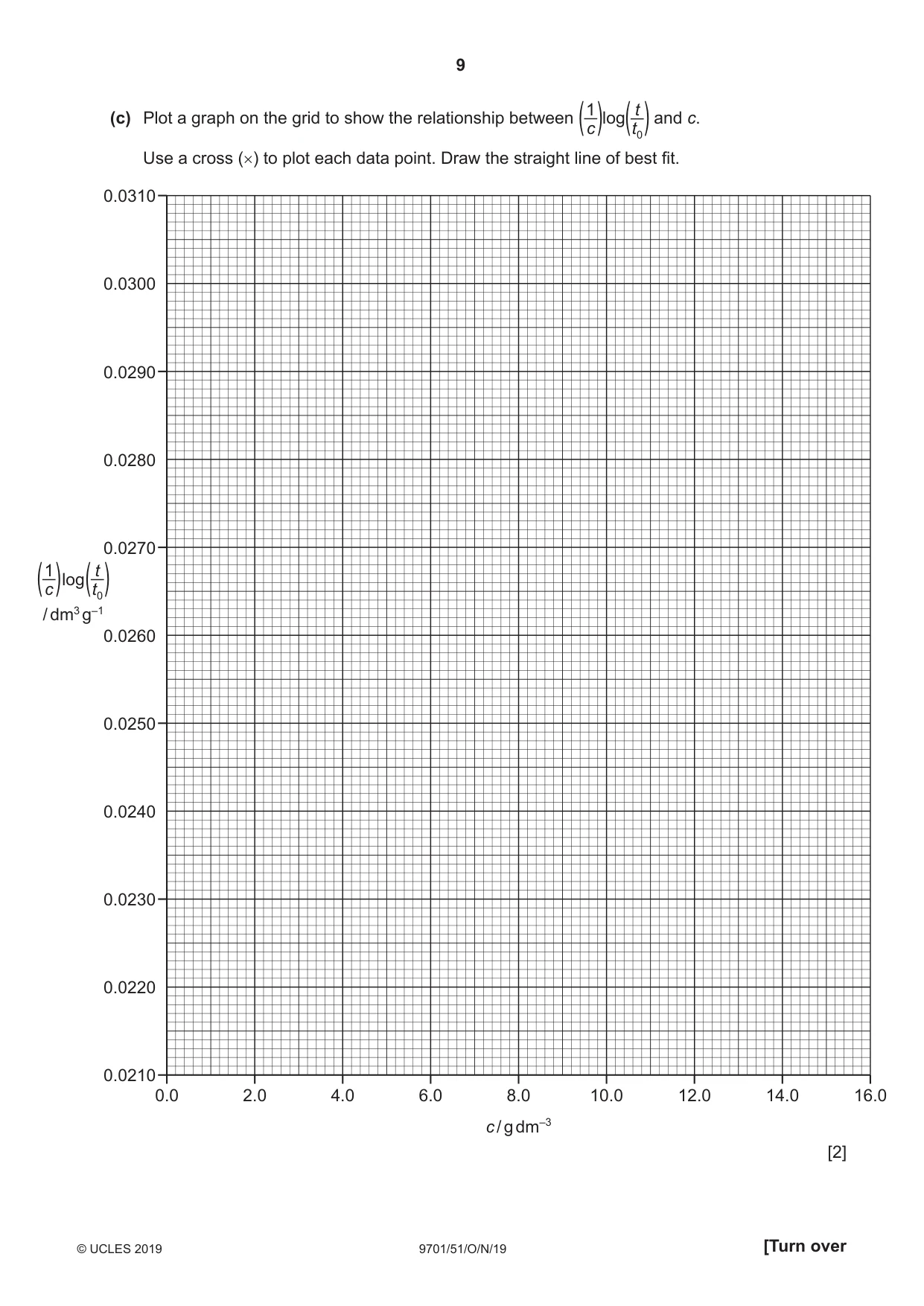
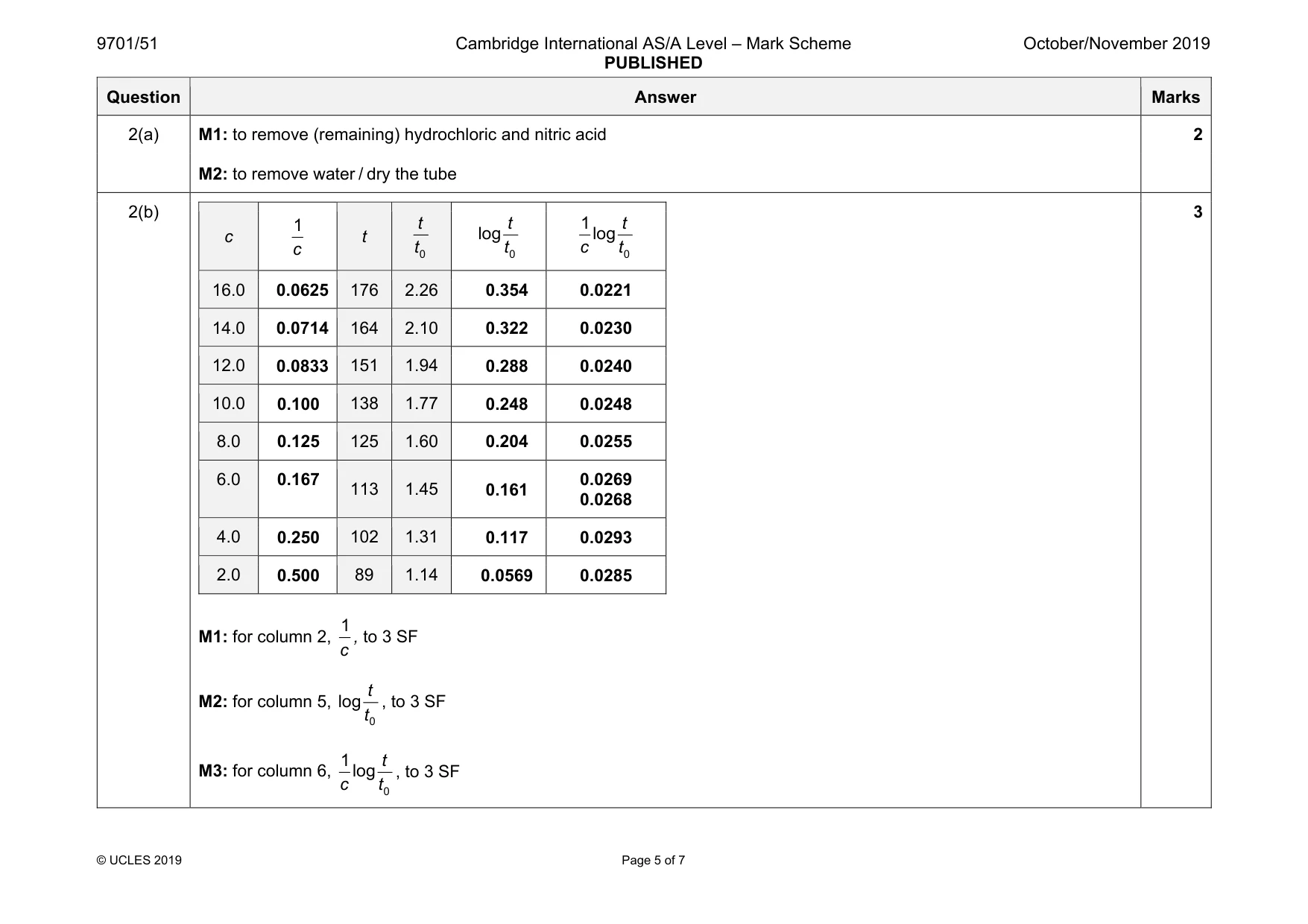
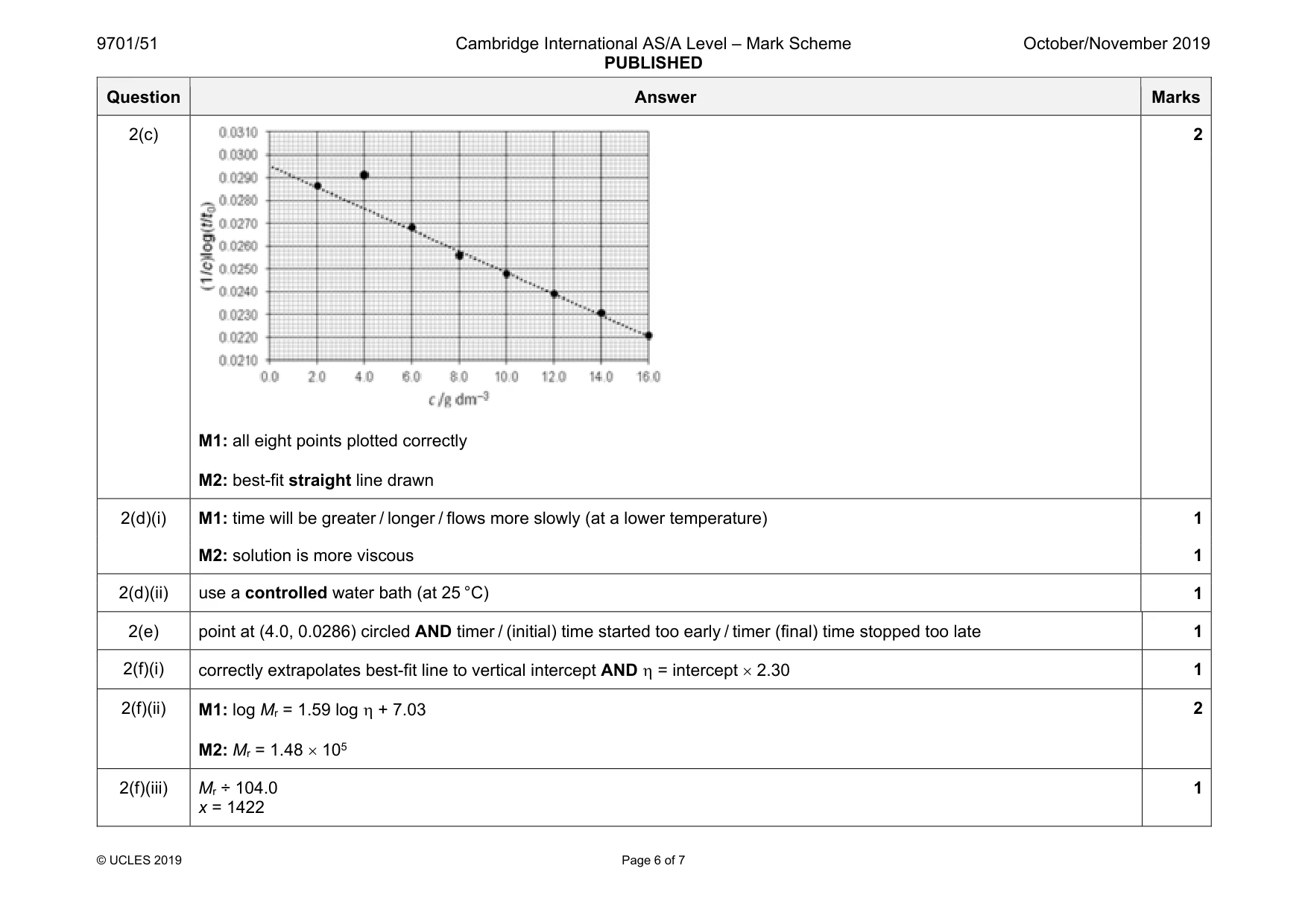
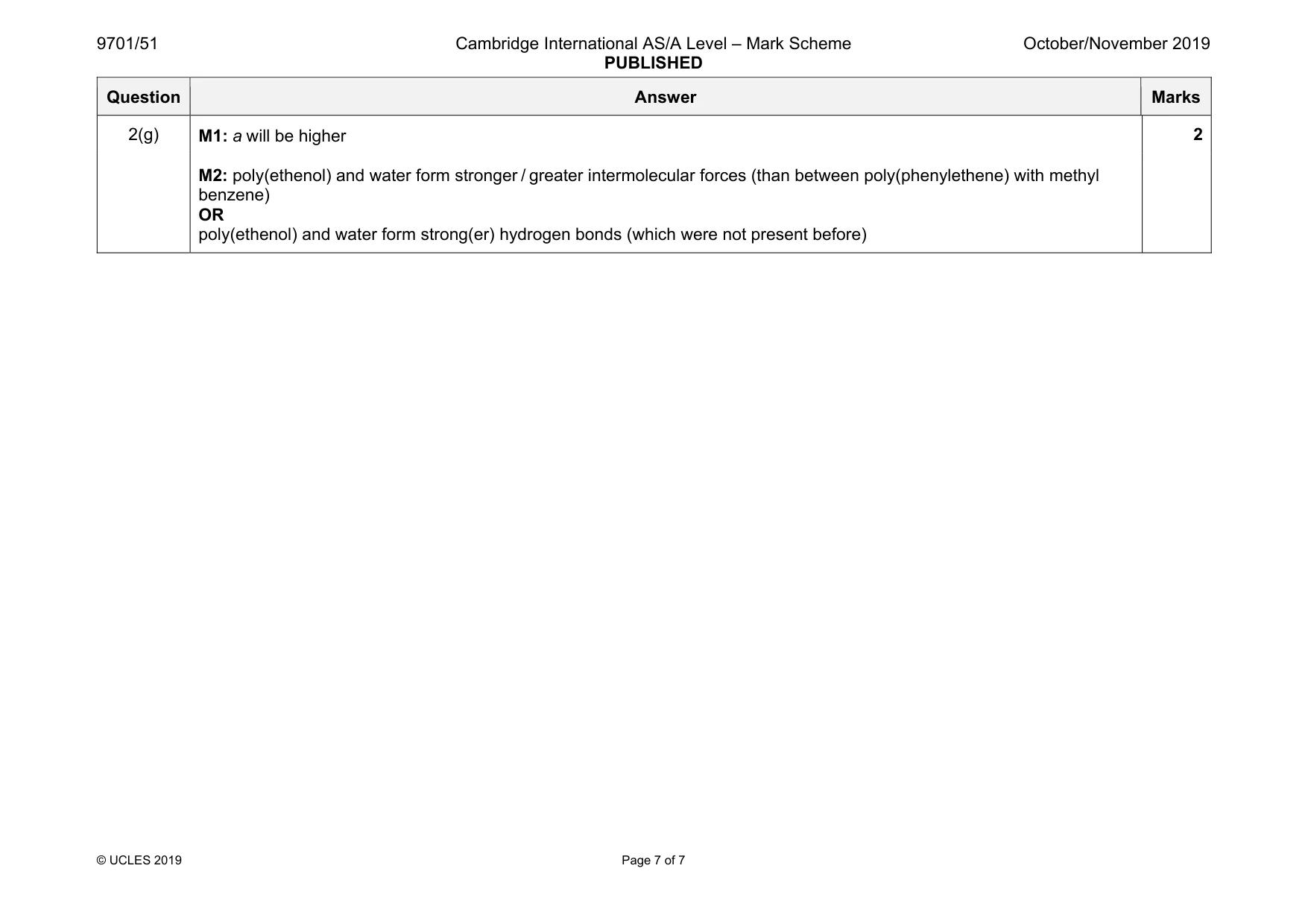
Mark scheme: 2(a) M1: to remove (remaining) hydrochloric and nitric acid M2: to remove water / dry the tube 2 2(b) c 1 c t 0 t t 0 log t t 0 1log t c t 16.0 0.0625 176 2.26 0.354 0.0221 14.0 0.0714 164 2.10 0.322 0.0230 12.0 0.0833 151 1.94 0.288 0.0240 10.0 0.100 138 1.77 0.248 0.0248 8.0 0.125 125 1.60 0.204 0.0255 6.0 0.167 113 1.45 0.161 0.0269 0.0268 4.0 0.250 102 1.31 0.117 0.0293 2.0 0.500 89 1.14 0.0569 0.0285 M1: for column 2, 1 c , to 3 SF M2: for column 5, 0 log t t , to 3 SF M3: for column 6, 0 1log t c t , to 3 SF 3 Question Answer Marks 2(c) M1: all eight points plotted correctly M2: best-fit straight line drawn 2 2(d)(i) M1: time will be greater / longer / flows more slowly (at a lower temperature) 1 M2: solution is more viscous 1 2(d)(ii) use a controlled water bath (at 25 °C) 1 2(e) point at (4.0, 0.0286) circled AND timer / (initial) time started too early / timer (final) time stopped too late 1 2(f)(i) correctly extrapolates best-fit line to vertical intercept AND η = intercept × 2.30 1 2(f)(ii) M1: log Mr = 1.59 log η + 7.03 M2: Mr = 1.48 × 10⁵ 2 2(f)(iii) Mr ÷ 104.0 x = 1422 1 Question Answer Marks 2(g) M1: a will be higher M2: poly(ethenol) and water form stronger / greater intermolecular forces (than between poly(phenylethene) with methyl benzene) OR poly(ethenol) and water form strong(er) hydrogen bonds (which were not present before) 2
More questions on Reacting masses and volumes (of solutions and gases)
What was in this paper
The subtopics covered by these 2 questions, and how many questions each got. Open one in a new tab to see every Cambridge question on it.
What you needed in this session
Cambridge’s own grade thresholds for 2019 Oct/Nov, Paper 5 · Variant 1. A higher threshold means an easier paper — the bar moves with how the cohort did.