Cambridge A Level Chemistry 9701 — 2019 May/June Paper 3 · Variant 3
9701/33/M/J/19 · 3 questions · 40 marks · ≈45 min
The question paper and its mark scheme, free to read here and free to download. This is Cambridge’s own paper, exactly as it was sat.
Question paper16 pages
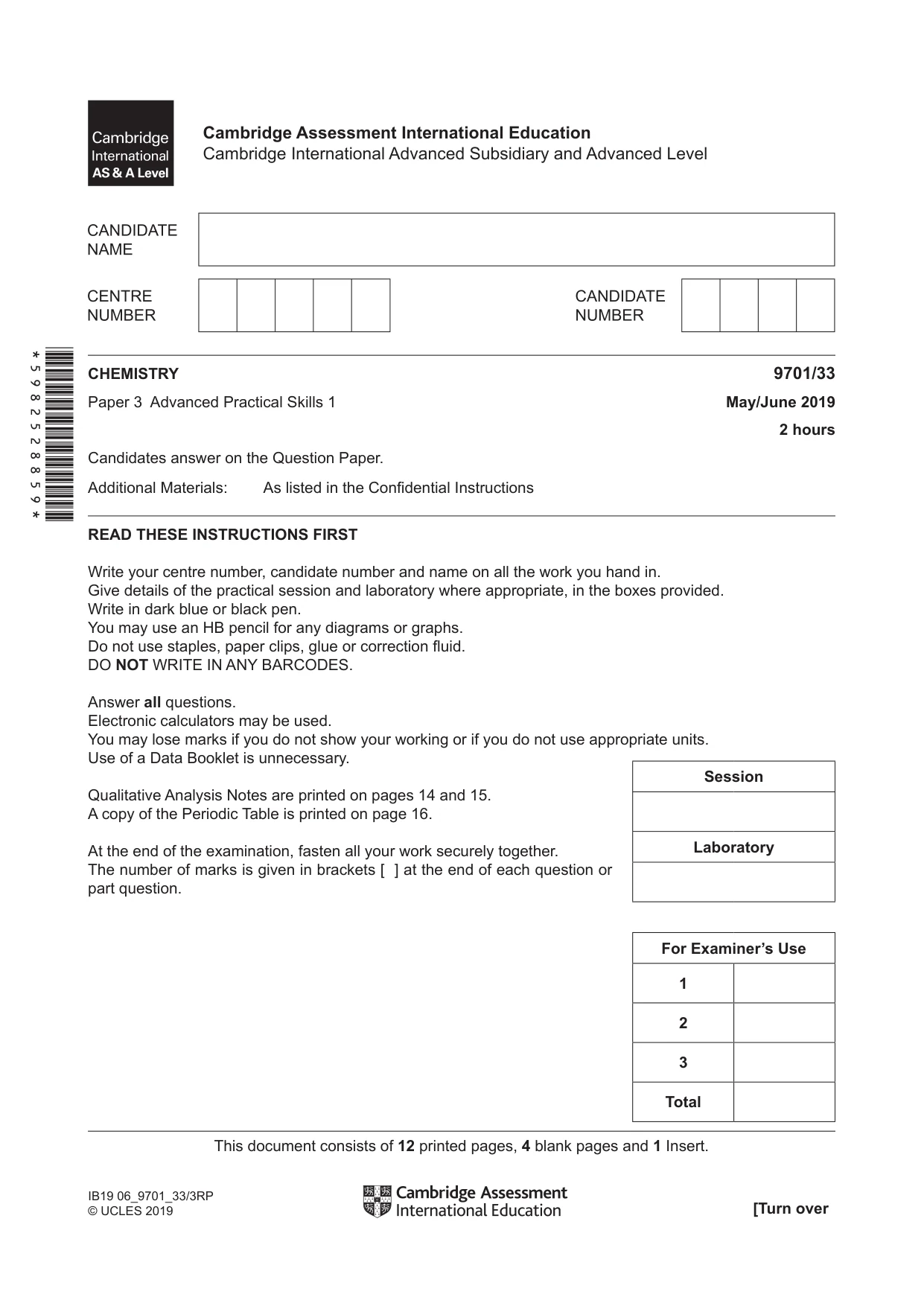





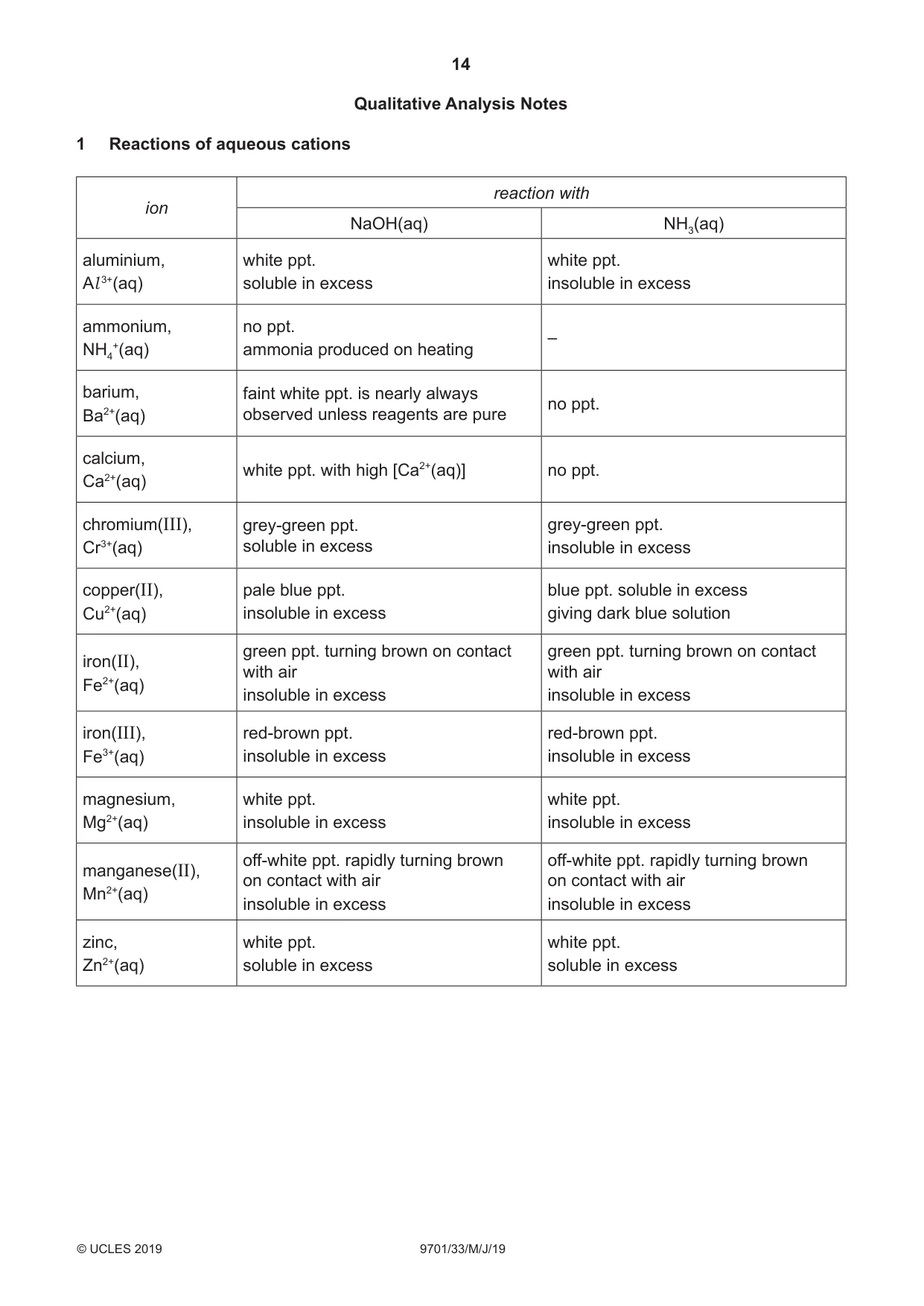
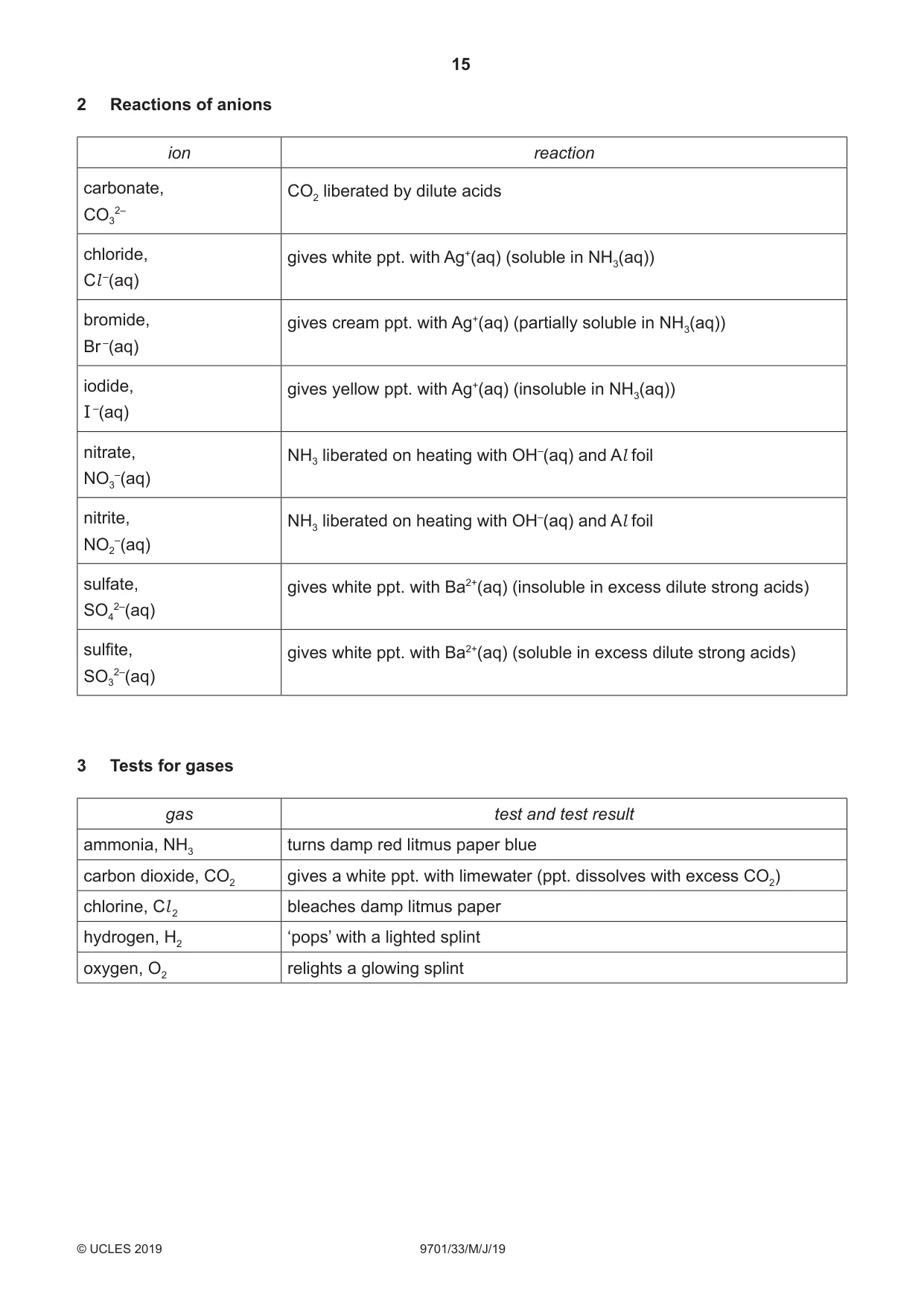
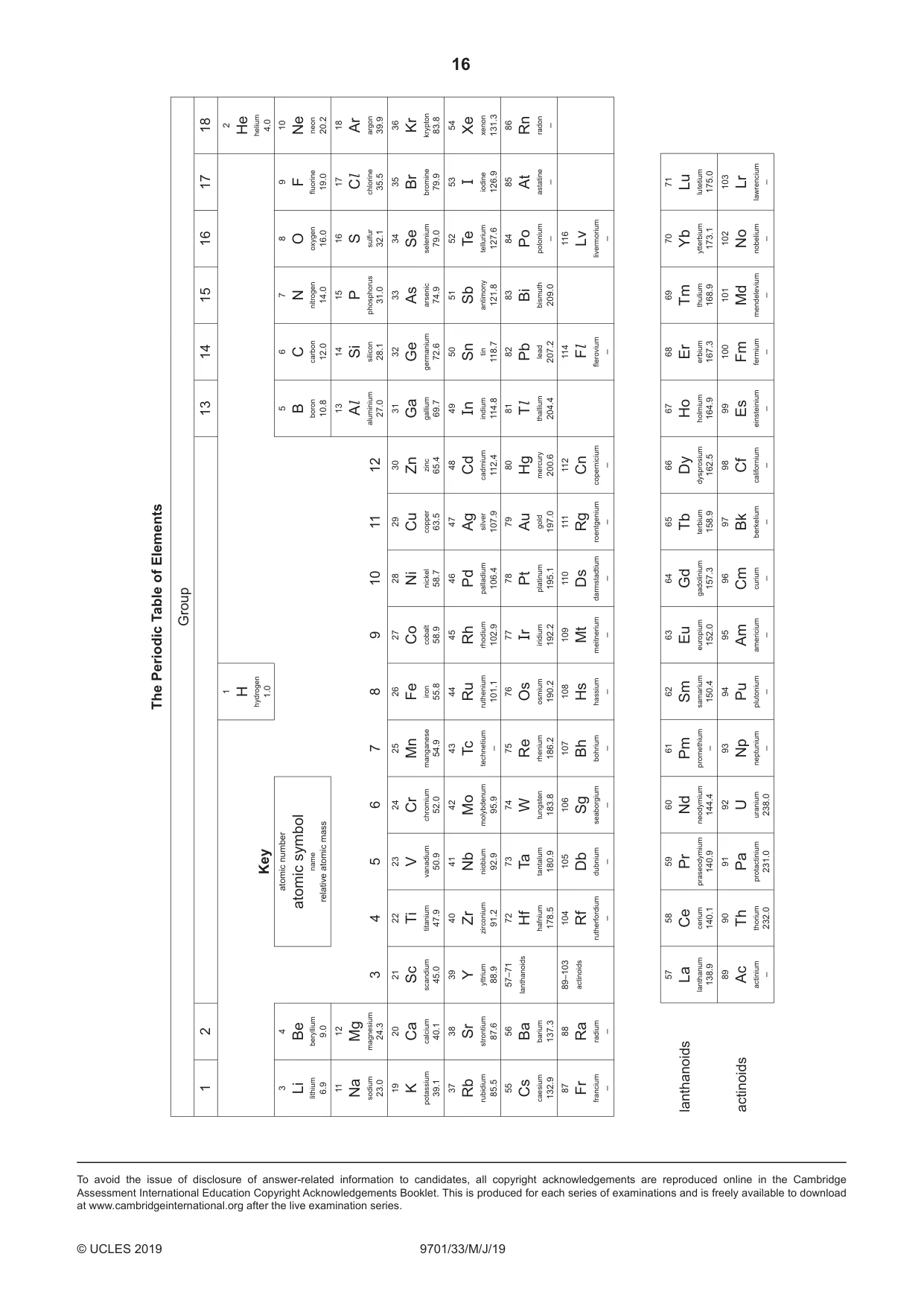
Mark scheme9 pages
Answers below. Sit the paper first if you are practising.
Questions as text
Q1 · The thiosulfate ion, S2O32–, reacts in acidic conditions as shown
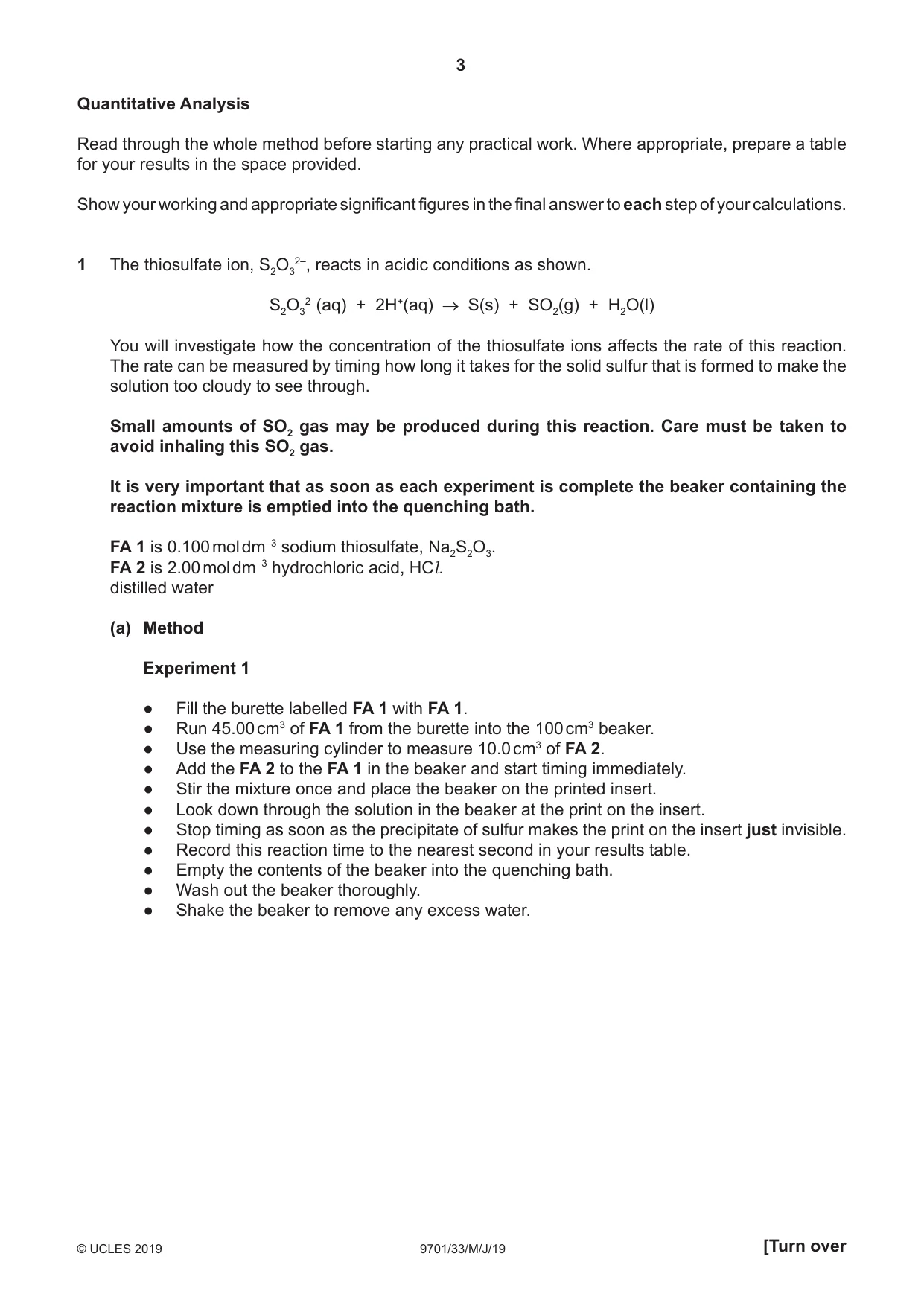
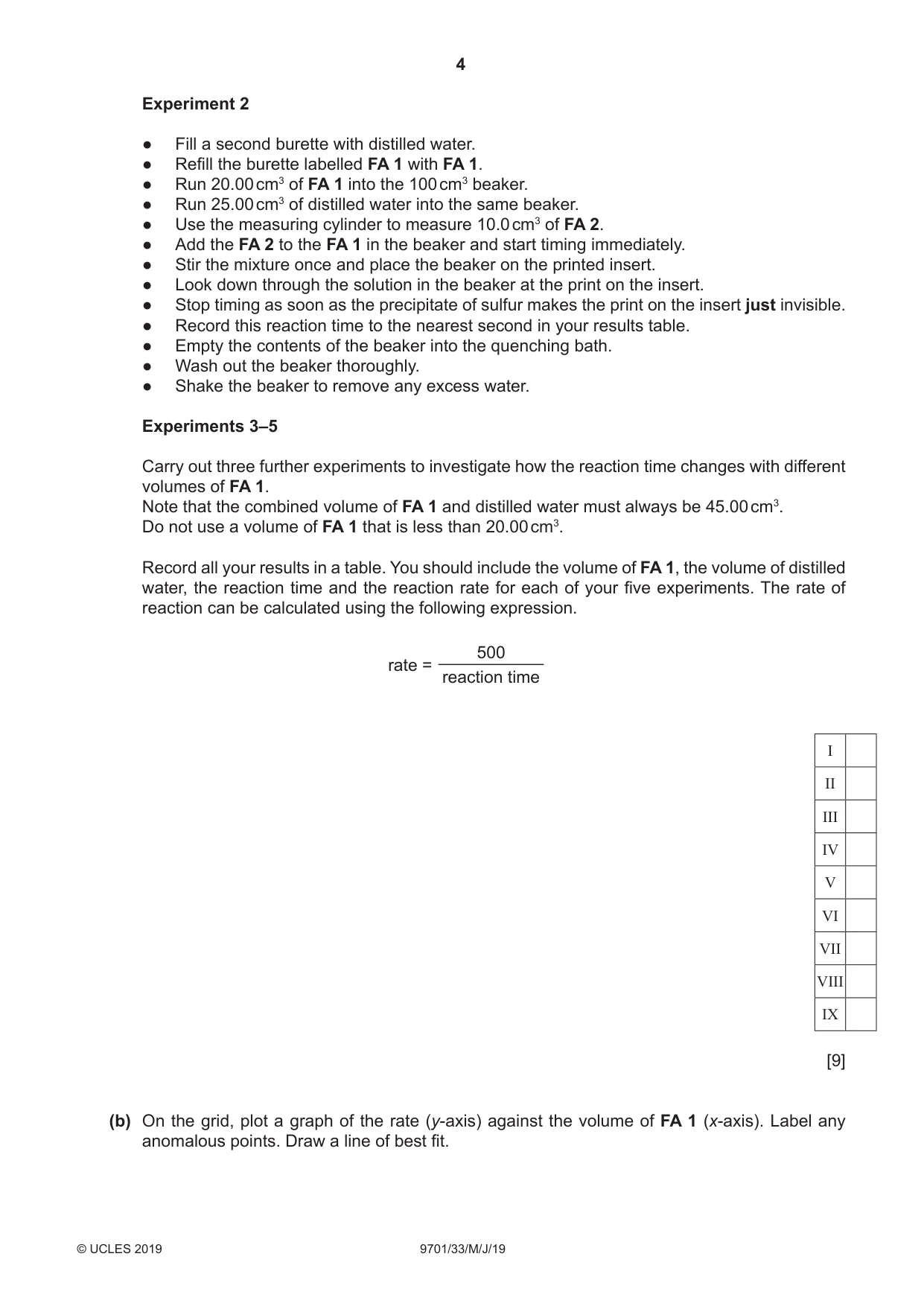
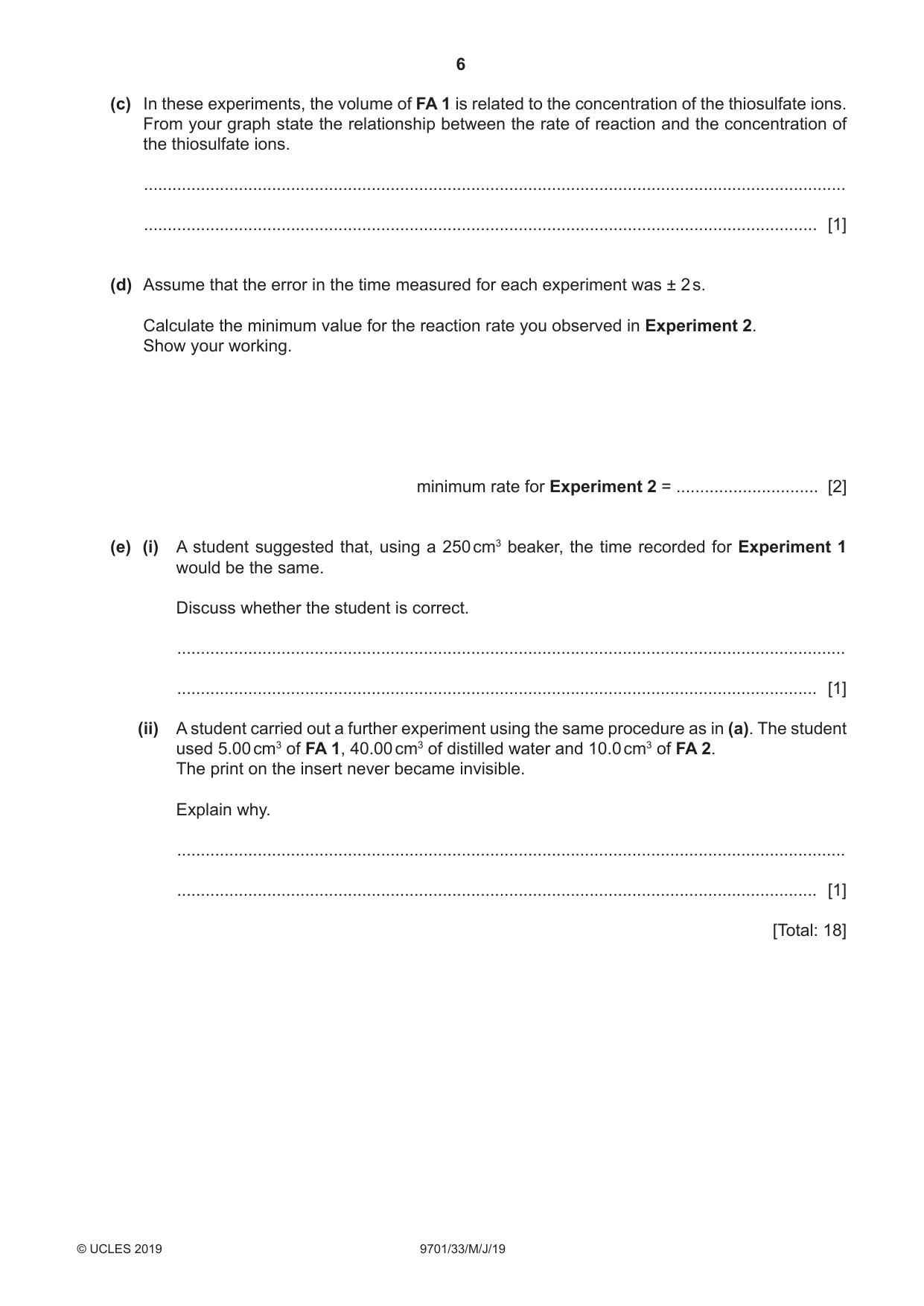
1 The thiosulfate ion, S2O32–, reacts in acidic conditions as shown. S2O32–(aq) + 2H+(aq) S(s) + SO2(g) + H2O(l) You will investigate how the concentration of the thiosulfate ions affects the rate of this reaction. The rate can be measured by timing how long it takes for the solid sulfur that is formed to make the solution too cloudy to see through. Small amounts of SO2 gas may be produced during this reaction. Care must be taken to avoid inhaling this SO2 gas. It is very important that as soon as each experiment is complete the beaker containing the reaction mixture is emptied into the quenching bath. FA 1 is 0.100 mol dm–3 sodium thiosulfate, Na2S2O3. FA 2 is 2.00 mol dm–3 hydrochloric acid, HCl. distilled water (a) Method Experiment 1 ●● Fill the burette labelled FA 1 with FA 1. ●● Run 45.00 cm3 of FA 1 from the burette into the 100 cm3 beaker. ●● Use the measuring cylinder to measure 10.0 cm3 of FA 2. ●● Add the FA 2 to the FA 1 in the beaker and start timing immediately. ●● Stir the mixture once and place the beaker on the printed insert. ●● Look down through the solution in the beaker at the print on the insert. ●● Stop timing as soon as the precipitate of sulfur makes the print on the insert just invisible. ●● Record this reaction time to the nearest second in your results table. ●● Empty the contents of the beaker into the quenching bath. ●● Wash out the beaker thoroughly. ●● Shake the beaker to remove any excess water. Experiment 2 ●● Fill a second burette with distilled water. ●● Refill the burette labelled FA 1 with FA 1. ●● Run 20.00 cm3 of FA 1 into the 100 cm3 beaker. ●● Run 25.00 cm3 of distilled water into the same beaker. ●● Use the measuring cylinder to measure 10.0 cm3 of FA 2. ●● Add the FA 2 to the FA 1 in the beaker and start timing immediately. ●● Stir the mixture once and place the beaker on the printed insert. ●● Look down through the solution in the beaker at the print on the insert. ●● Stop timing as soon as the precipitate of sulfur makes the print on the insert just invisible. ●● Record this reaction time to the nearest second in your results table. ●● Empty the contents of the beaker into the quenching bath. ●● Wash out the beaker thoroughly. ●● Shake the beaker to remove any excess water. Experiments 3–5 Carry out three further experiments to investigate how the reaction time changes with different volumes of FA 1. Note that the combined volume of FA 1 and distilled water must always be 45.00 cm3. Do not use a volume of FA 1 that is less than 20.00 cm3. Record all your results in a table. You should include the volume of FA 1, the volume of distilled water, the reaction time and the reaction rate for each of your five experiments. The rate of reaction can be calculated using the following expression. 500 rate = reaction time I II III IV V VI VII VIII IX [9] (b) On the grid, plot a graph of the rate (y-axis) against the volume of FA 1 (x-axis). Label any anomalous points. Draw a line of best fit. (c) In these experiments, the volume of FA 1 is related to the concentration of the thiosulfate ions. From your graph state the relationship between the rate of reaction and the concentration of the thiosulfate ions. .................................................................................................................................................... .............................................................................................................................................. [1] (d) Assume that the error in the time measured for each experiment was ± 2 s. Calculate the minimum value for the reaction rate you observed in Experiment 2. Show your working. minimum rate for Experiment 2 = .............................. [2] (e) (i) A student suggested that, using a 250 cm3 beaker, the time recorded for Experiment 1 would be the same. Discuss whether the student is correct. ............................................................................................................................................. ....................................................................................................................................... [1] (ii) A student carried out a further experiment using the same procedure as in (a). The student used 5.00 cm3 of FA 1, 40.00 cm3 of distilled water and 10.0 cm3 of FA 2. The print on the insert never became invisible. Explain why. ............................................................................................................................................. ....................................................................................................................................... [1] [Total: 18]
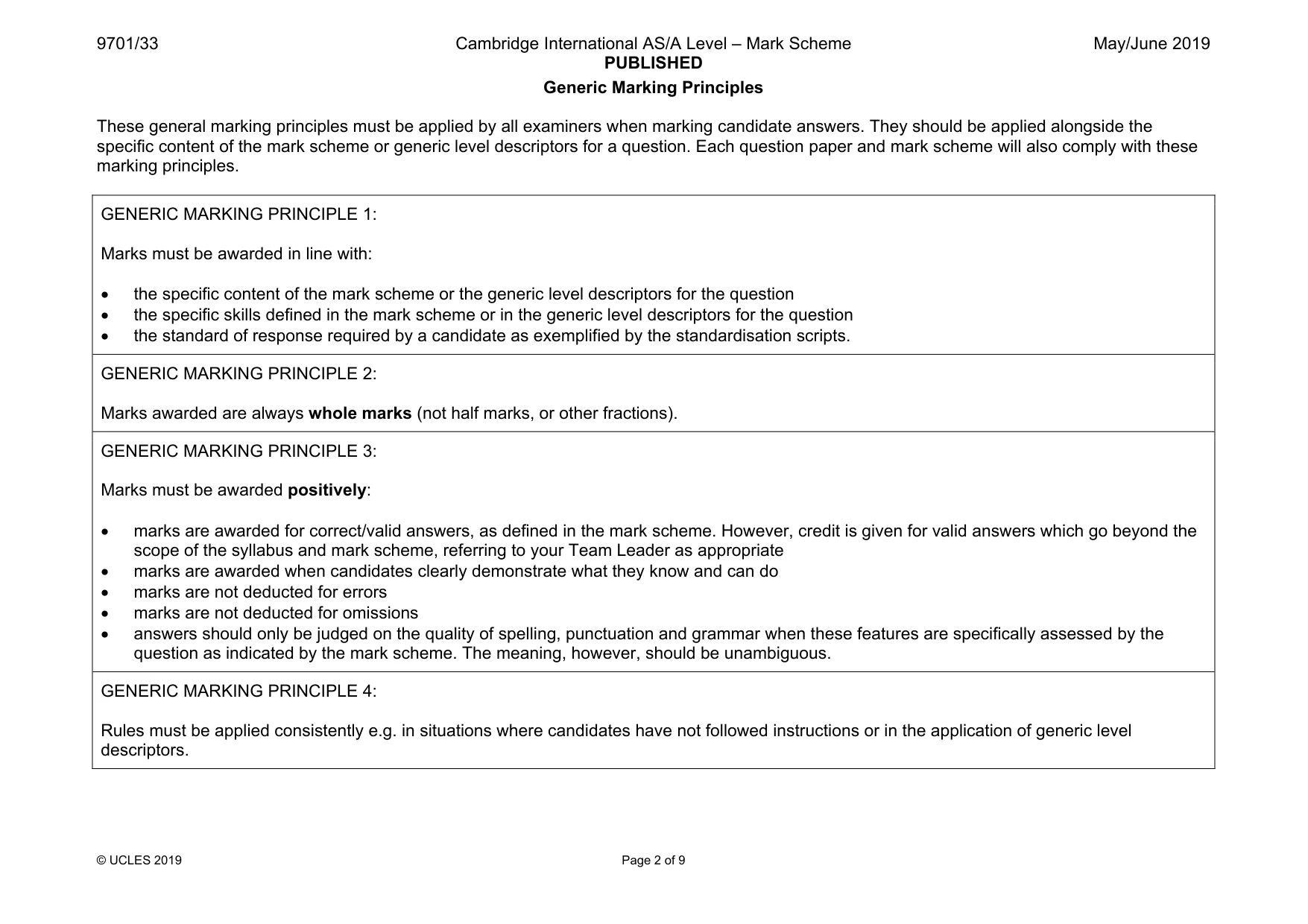
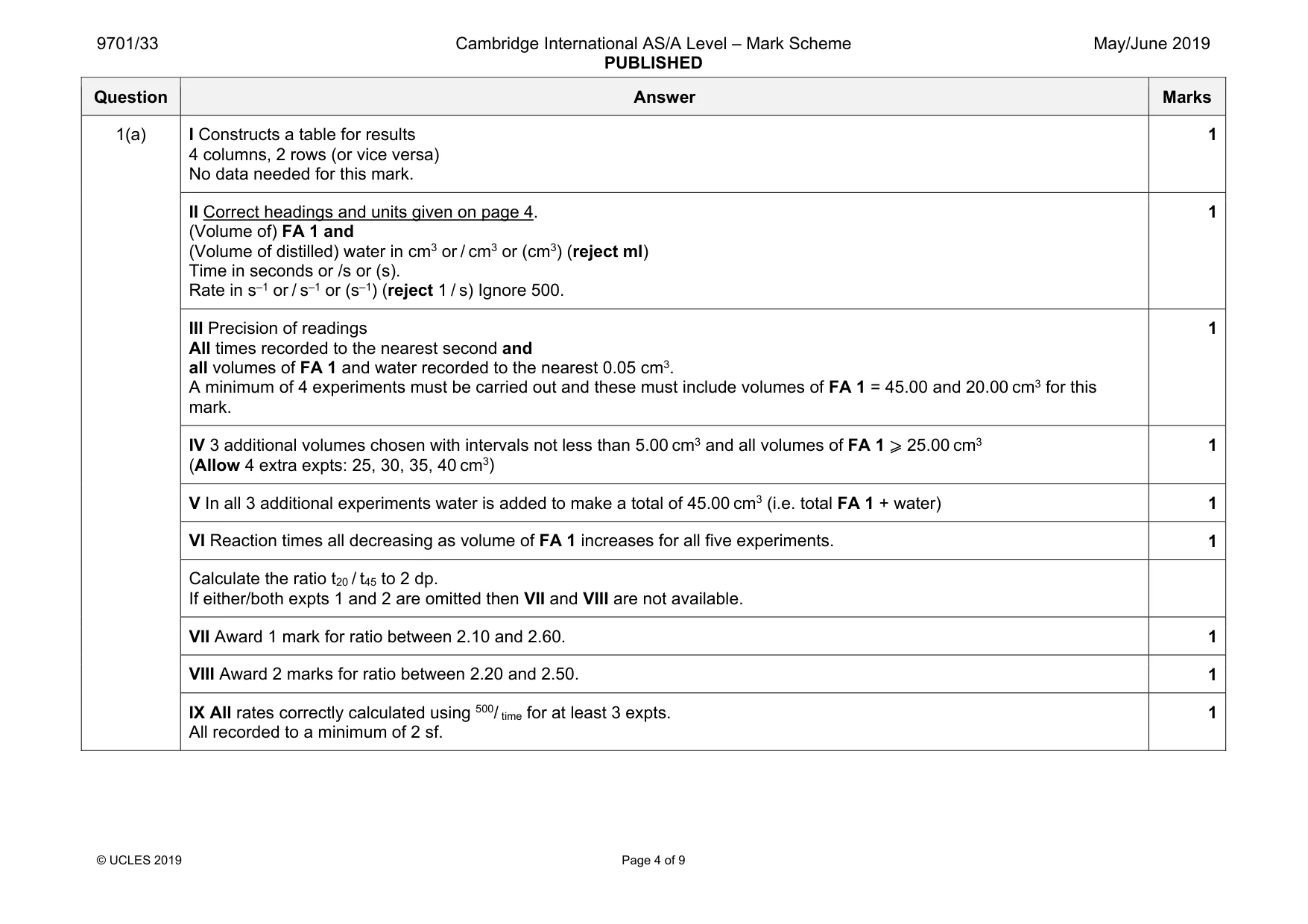
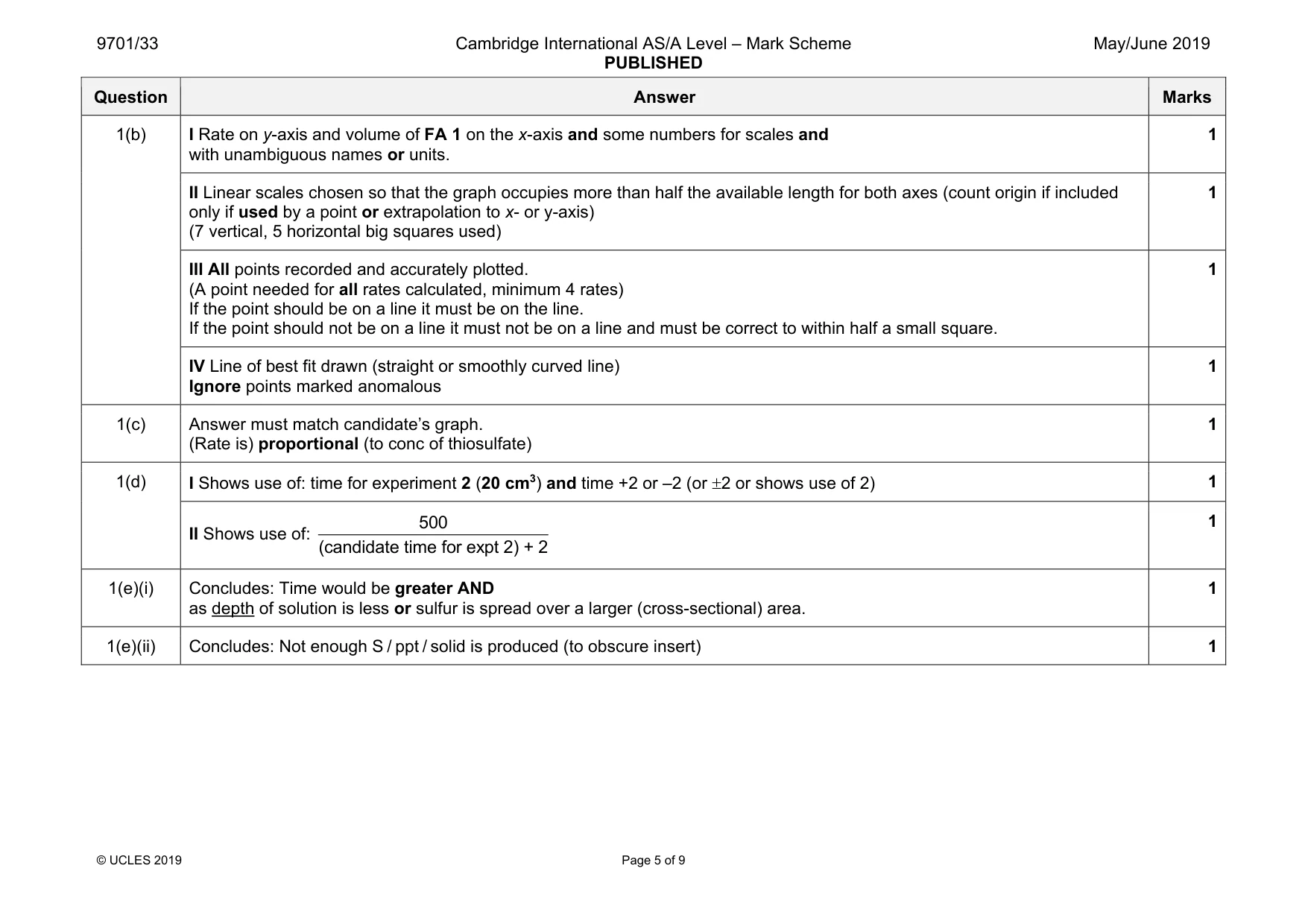
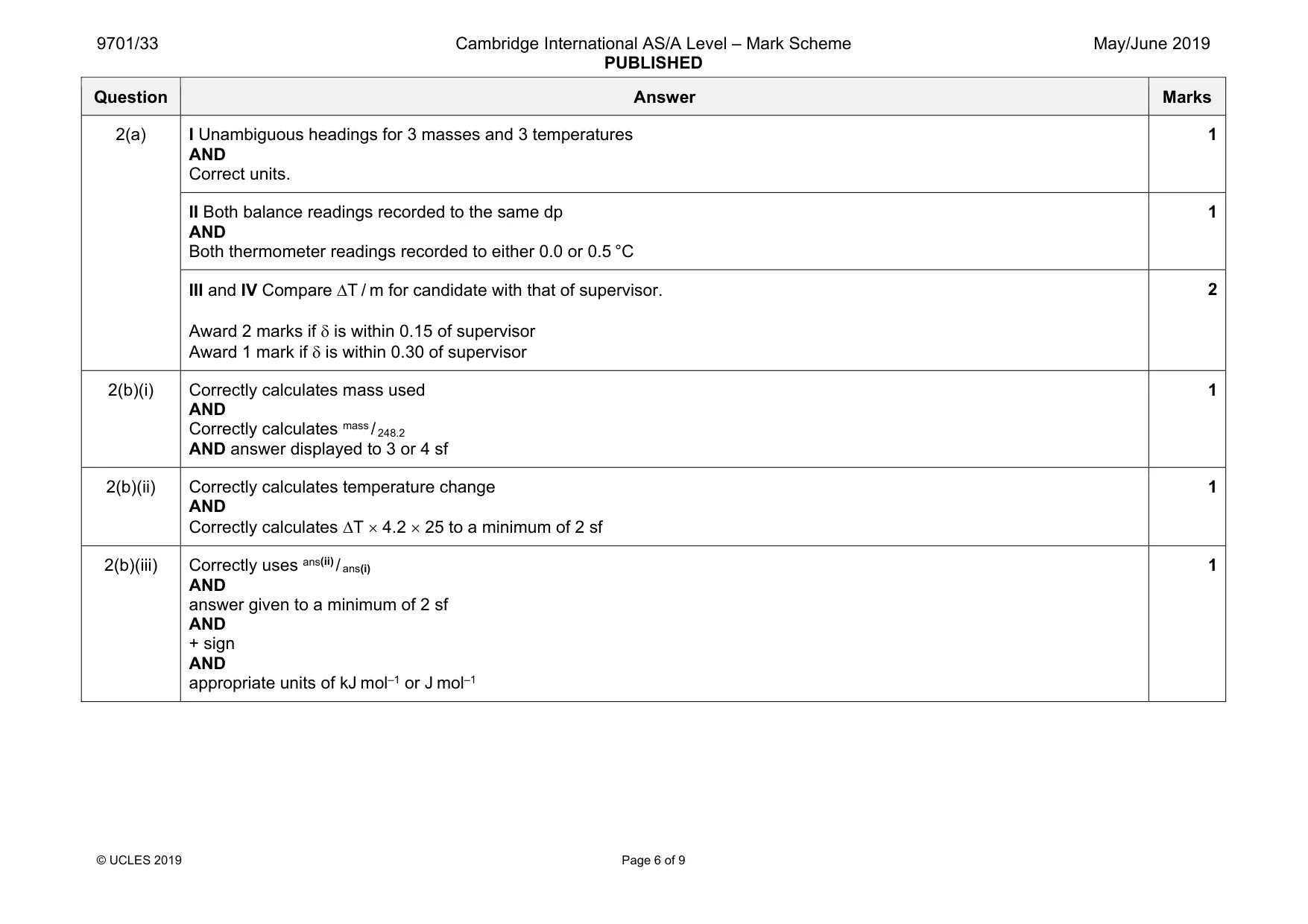
Mark scheme: 1(a) I Constructs a table for results 4 columns, 2 rows (or vice versa) No data needed for this mark. 1 II Correct headings and units given on page 4. (Volume of) FA 1 and (Volume of distilled) water in cm3 or / cm3 or (cm3) (reject ml) Time in seconds or /s or (s). Rate in s–1 or / s–1 or (s–1) (reject 1 / s) Ignore 500. 1 III Precision of readings All times recorded to the nearest second and all volumes of FA 1 and water recorded to the nearest 0.05 cm3. A minimum of 4 experiments must be carried out and these must include volumes of FA 1 = 45.00 and 20.00 cm3 for this mark. 1 IV 3 additional volumes chosen with intervals not less than 5.00 cm3 and all volumes of FA 1 ⩾ 25.00 cm3 (Allow 4 extra expts: 25, 30, 35, 40 cm3) 1 V In all 3 additional experiments water is added to make a total of 45.00 cm3 (i.e. total FA 1 + water) 1 VI Reaction times all decreasing as volume of FA 1 increases for all five experiments. 1 Calculate the ratio t20 / t45 to 2 dp. If either/both expts 1 and 2 are omitted then VII and VIII are not available. VII Award 1 mark for ratio between 2.10 and 2.60. 1 VIII Award 2 marks for ratio between 2.20 and 2.50. 1 IX All rates correctly calculated using 500/ time for at least 3 expts. All recorded to a minimum of 2 sf. 1 Question Answer Marks 1(b) I Rate on y-axis and volume of FA 1 on the x-axis and some numbers for scales and with unambiguous names or units. 1 II Linear scales chosen so that the graph occupies more than half the available length for both axes (count origin if included only if used by a point or extrapolation to x- or y-axis) (7 vertical, 5 horizontal big squares used) 1 III All points recorded and accurately plotted. (A point needed for all rates calculated, minimum 4 rates) If the point should be on a line it must be on the line. If the point should not be on a line it must not be on a line and must be correct to within half a small square. 1 IV Line of best fit drawn (straight or smoothly curved line) Ignore points marked anomalous 1 1(c) Answer must match candidate’s graph. (Rate is) proportional (to conc of thiosulfate) 1 1(d) I Shows use of: time for experiment 2 (20 cm3) and time +2 or –2 (or ±2 or shows use of 2) 1 II Shows use of: 500 (candidate time for expt 2) + 2 1 1(e)(i) Concludes: Time would be greater AND as depth of solution is less or sulfur is spread over a larger (cross-sectional) area. 1 1(e)(ii) Concludes: Not enough S / ppt / solid is produced (to obscure insert) 1
Q2 · In this experiment you will determine the enthalpy change of solution for hydrated sodium…
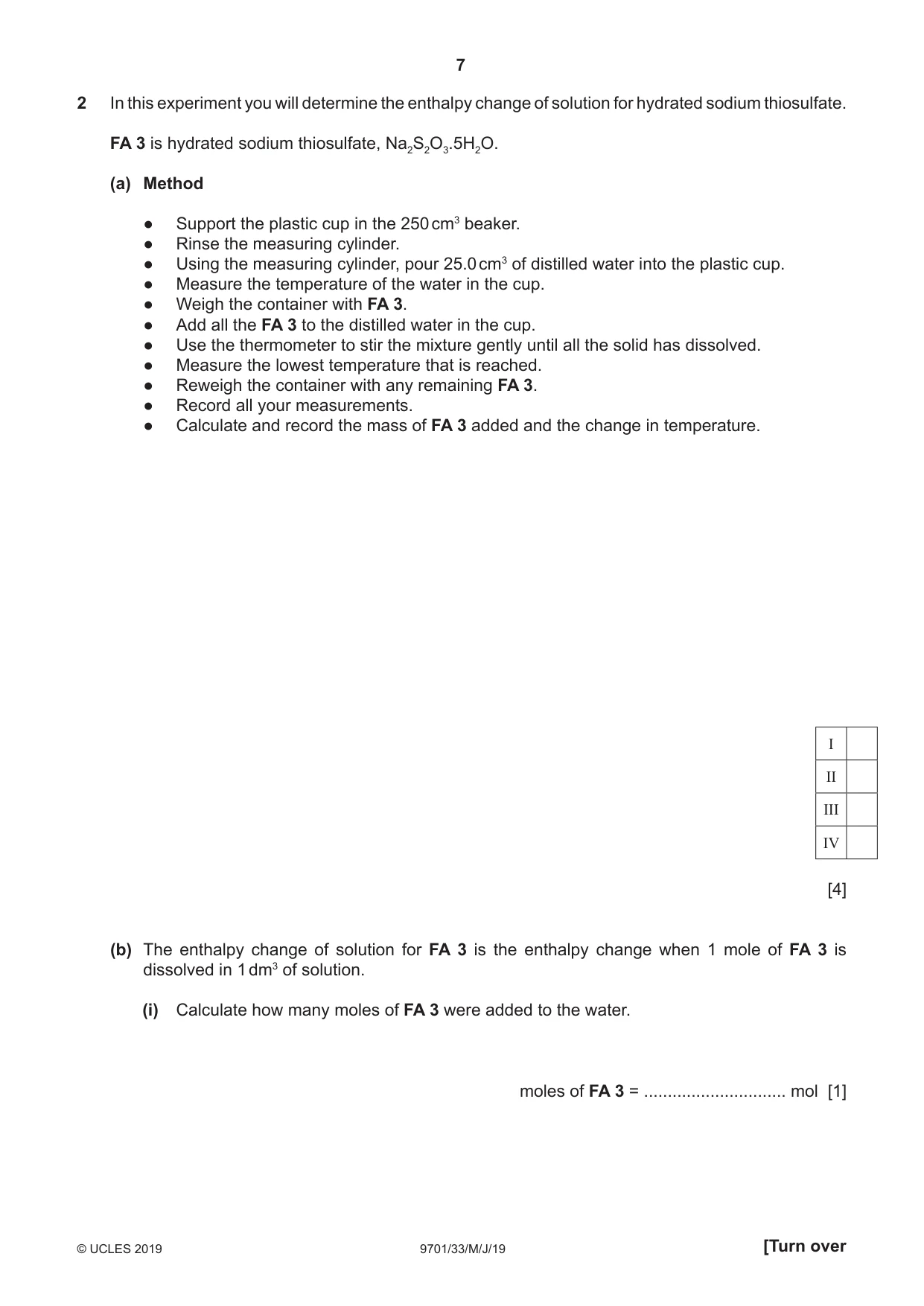
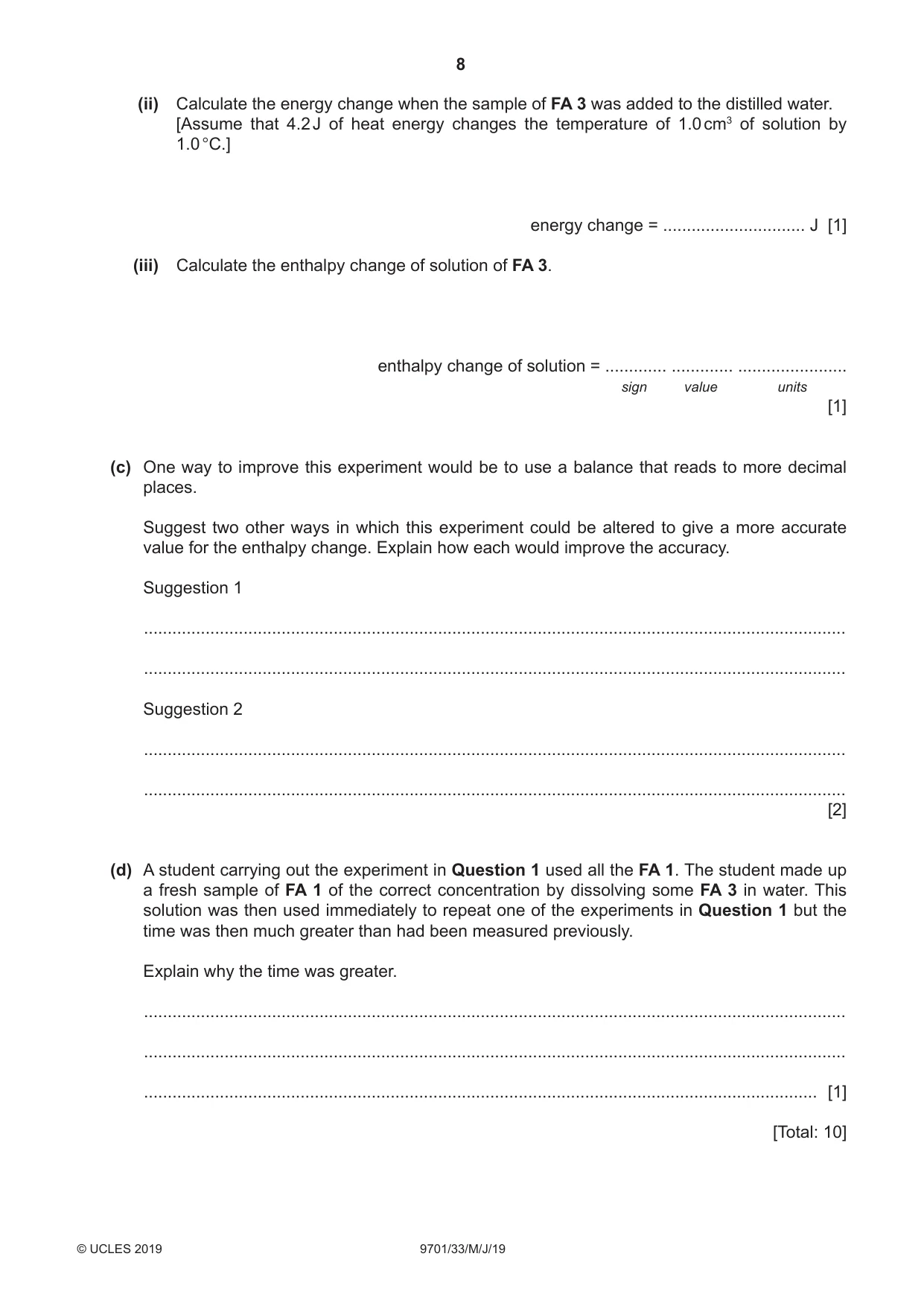
2 In this experiment you will determine the enthalpy change of solution for hydrated sodium thiosulfate. FA 3 is hydrated sodium thiosulfate, Na2S2O3.5H2O. (a) Method ●● Support the plastic cup in the 250 cm3 beaker. ●● Rinse the measuring cylinder. ●● Using the measuring cylinder, pour 25.0 cm3 of distilled water into the plastic cup. ●● Measure the temperature of the water in the cup. ●● Weigh the container with FA 3. ●● Add all the FA 3 to the distilled water in the cup. ●● Use the thermometer to stir the mixture gently until all the solid has dissolved. ●● Measure the lowest temperature that is reached. ●● Reweigh the container with any remaining FA 3. ●● Record all your measurements. ●● Calculate and record the mass of FA 3 added and the change in temperature. I II III IV [4] (b) The enthalpy change of solution for FA 3 is the enthalpy change when 1 mole of FA 3 is dissolved in 1 dm3 of solution. (i) Calculate how many moles of FA 3 were added to the water. moles of FA 3 = .............................. mol [1] (ii) Calculate the energy change when the sample of FA 3 was added to the distilled water. [Assume that 4.2 J of heat energy changes the temperature of 1.0 cm3 of solution by 1.0 °C.] energy change = .............................. J [1] (iii) Calculate the enthalpy change of solution of FA 3. enthalpy change of solution = ............. ............. ....................... sign value units [1] (c) One way to improve this experiment would be to use a balance that reads to more decimal places. Suggest two other ways in which this experiment could be altered to give a more accurate value for the enthalpy change. Explain how each would improve the accuracy. Suggestion 1 .................................................................................................................................................... .................................................................................................................................................... Suggestion 2 .................................................................................................................................................... .................................................................................................................................................... [2] (d) A student carrying out the experiment in Question 1 used all the FA 1. The student made up a fresh sample of FA 1 of the correct concentration by dissolving some FA 3 in water. This solution was then used immediately to repeat one of the experiments in Question 1 but the time was then much greater than had been measured previously. Explain why the time was greater. .................................................................................................................................................... .................................................................................................................................................... .............................................................................................................................................. [1] [Total: 10] Qualitative Analysis Where reagents are selected for use in a test, the name or correct formula of the element or compound must be given. At each stage of any test you are to record details of the following: ● colour changes seen; ● the formation of any precipitate and its solubility in an excess of the reagent added; ● the formation of any gas and its identification by a suitable test. You should indicate clearly at what stage in a test a change occurs. If any solution is warmed, a boiling tube must be used. Rinse and reuse test-tubes and boiling tubes where possible. No additional tests for ions present should be attempted.
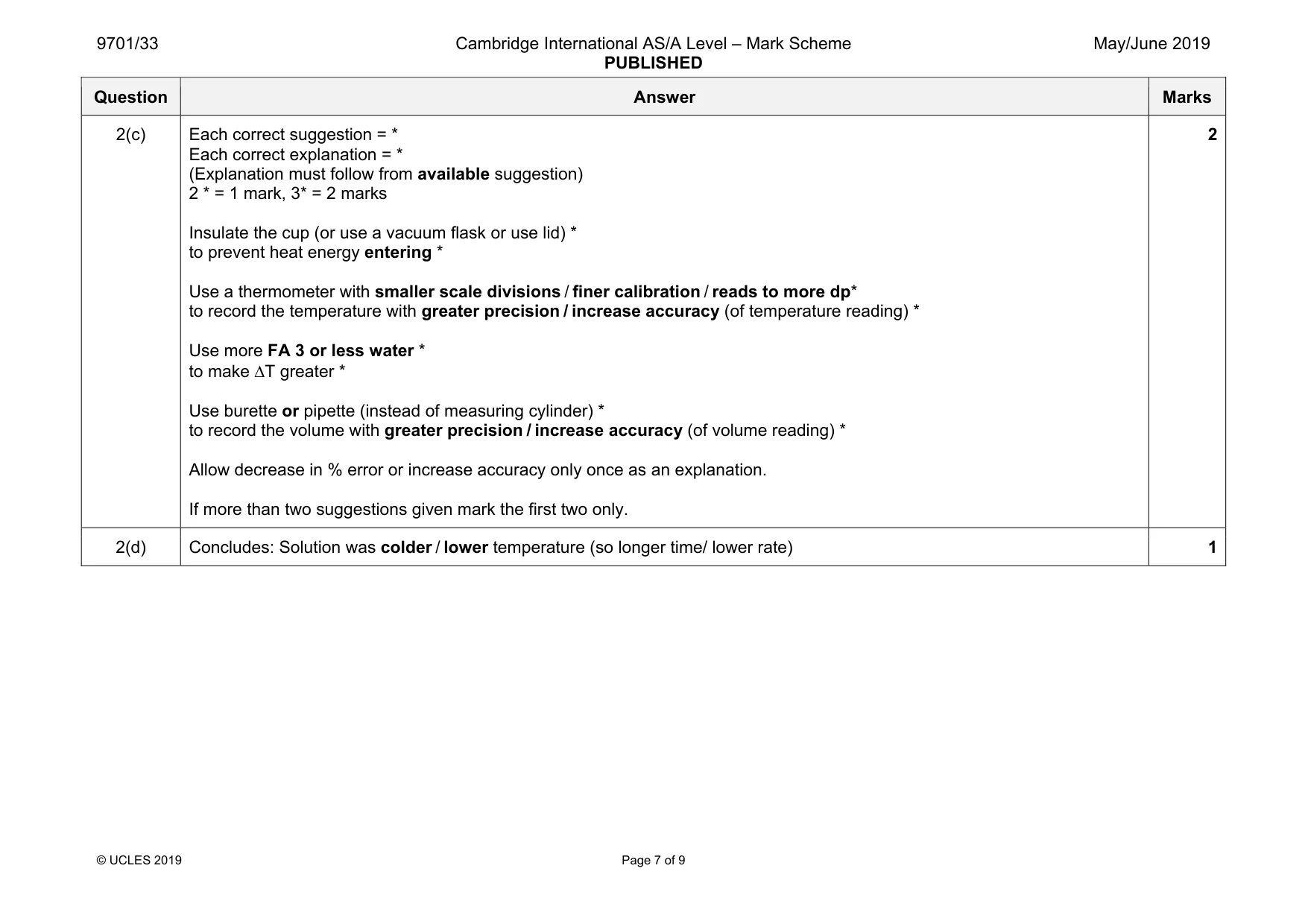
Mark scheme: 2(a) I Unambiguous headings for 3 masses and 3 temperatures AND Correct units. 1 II Both balance readings recorded to the same dp AND Both thermometer readings recorded to either 0.0 or 0.5 °C 1 III and IV Compare ∆T / m for candidate with that of supervisor. Award 2 marks if δ is within 0.15 of supervisor Award 1 mark if δ is within 0.30 of supervisor 2 2(b)(i) Correctly calculates mass used AND Correctly calculates mass / 248.2 AND answer displayed to 3 or 4 sf 1 2(b)(ii) Correctly calculates temperature change AND Correctly calculates ∆T × 4.2 × 25 to a minimum of 2 sf 1 2(b)(iii) Correctly uses ans(ii) / ans(i) AND answer given to a minimum of 2 sf AND + sign AND appropriate units of kJ mol–1 or J mol–1 1 Question Answer Marks 2(c) Each correct suggestion = * Each correct explanation = * (Explanation must follow from available suggestion) 2 * = 1 mark, 3* = 2 marks Insulate the cup (or use a vacuum flask or use lid) * to prevent heat energy entering * Use a thermometer with smaller scale divisions / finer calibration / reads to more dp* to record the temperature with greater precision / increase accuracy (of temperature reading) * Use more FA 3 or less water * to make ∆T greater * Use burette or pipette (instead of measuring cylinder) * to record the volume with greater precision / increase accuracy (of volume reading) * Allow decrease in % error or increase accuracy only once as an explanation. If more than two suggestions given mark the first two only. 2 2(d) Concludes: Solution was colder / lower temperature (so longer time/ lower rate) 1
Q3 · FA 4 is an aqueous solution containing a single cation and a single anion
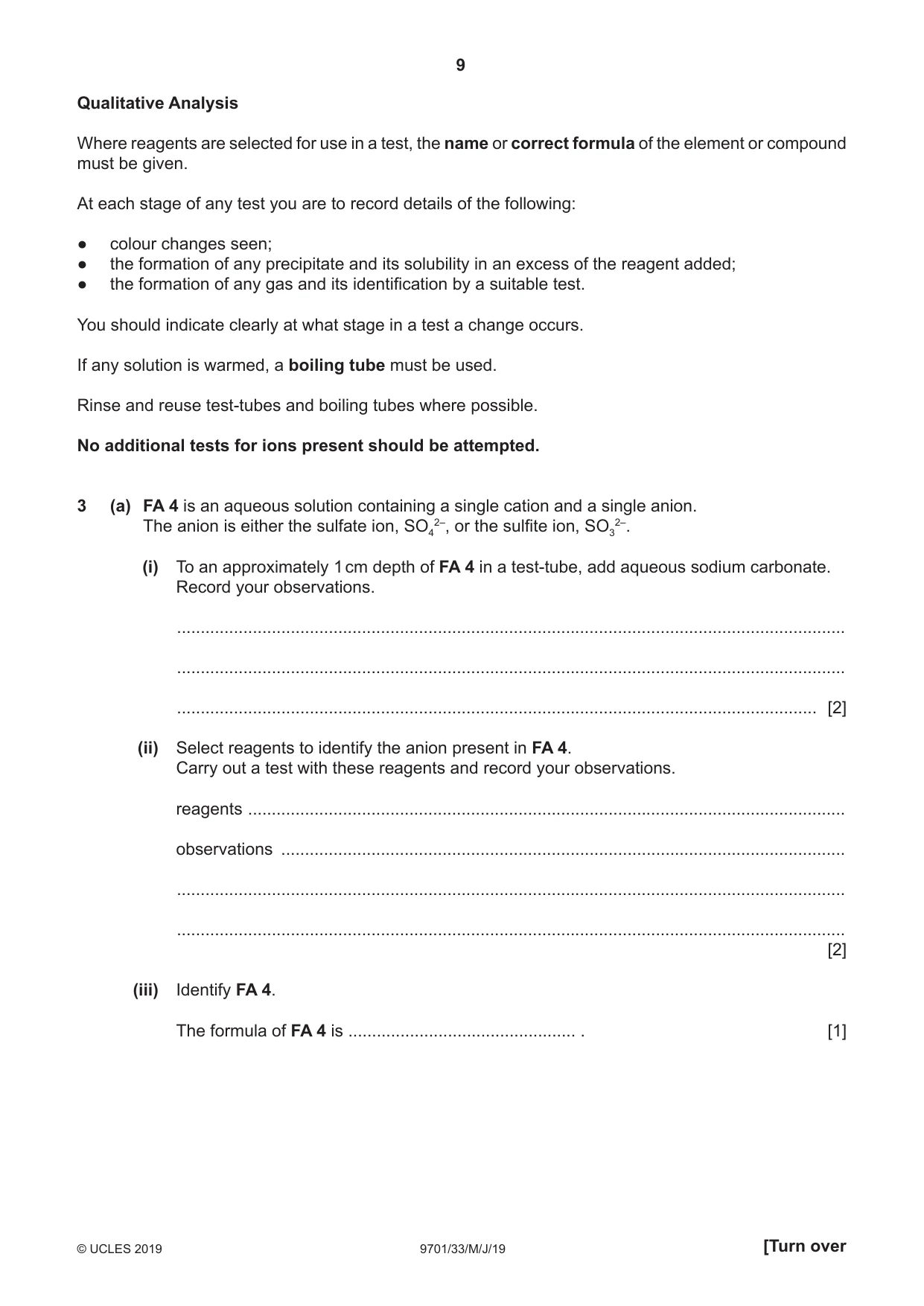
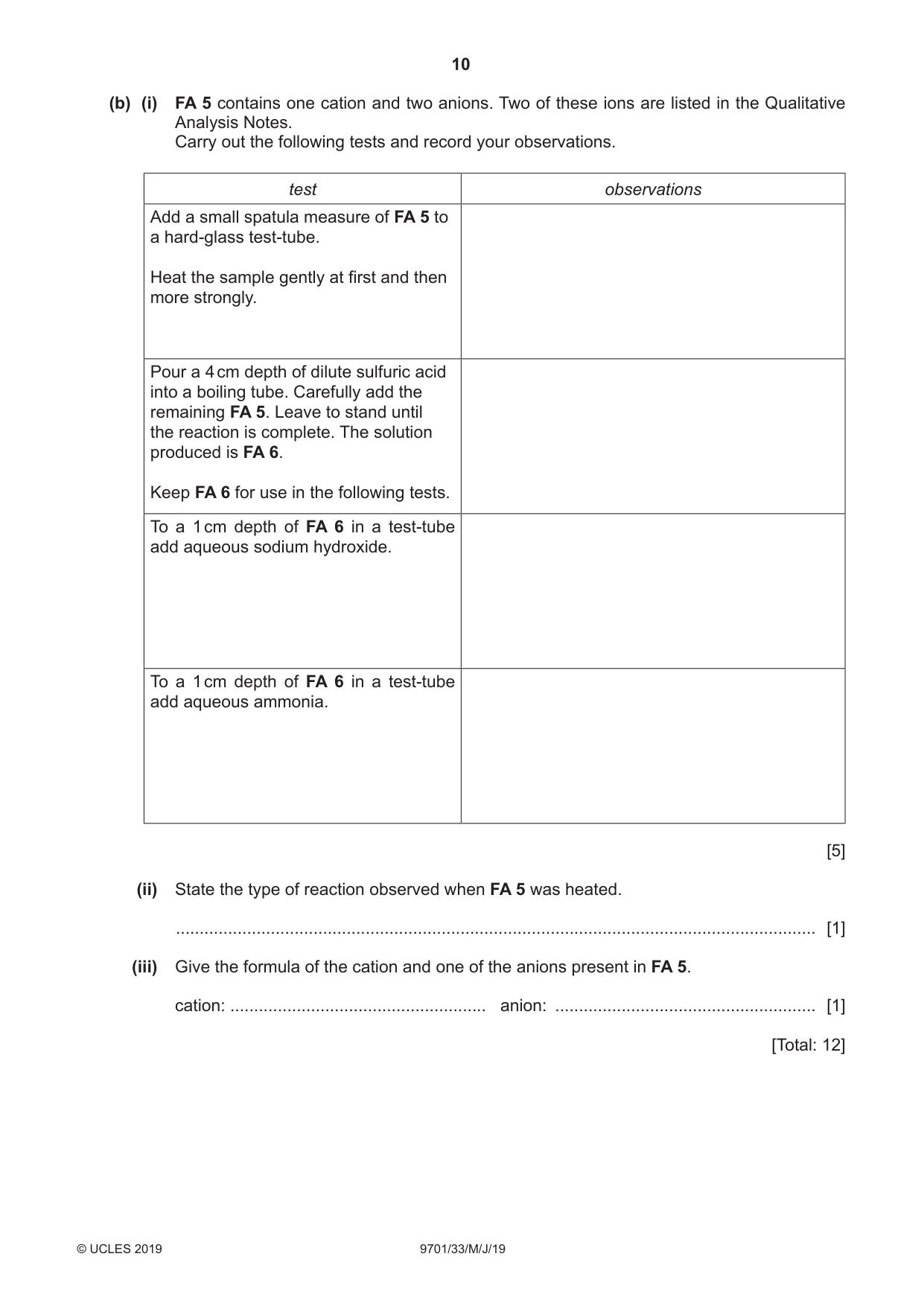
3 (a) FA 4 is an aqueous solution containing a single cation and a single anion. The anion is either the sulfate ion, SO42–, or the sulfite ion, SO32–. (i) To an approximately 1 cm depth of FA 4 in a test‑tube, add aqueous sodium carbonate. Record your observations. ............................................................................................................................................. ............................................................................................................................................. ....................................................................................................................................... [2] (ii) Select reagents to identify the anion present in FA 4. Carry out a test with these reagents and record your observations. reagents .............................................................................................................................. observations ........................................................................................................................ ............................................................................................................................................. ............................................................................................................................................. [2] (iii) Identify FA 4. The formula of FA 4 is ................................................ . [1] (b) (i) FA 5 contains one cation and two anions. Two of these ions are listed in the Qualitative Analysis Notes. Carry out the following tests and record your observations. test observations Add a small spatula measure of FA 5 to a hard‑glass test‑tube. Heat the sample gently at first and then more strongly. Pour a 4 cm depth of dilute sulfuric acid into a boiling tube. Carefully add the remaining FA 5. Leave to stand until the reaction is complete. The solution produced is FA 6. Keep FA 6 for use in the following tests. To a 1 cm depth of FA 6 in a test‑tube add aqueous sodium hydroxide. To a 1 cm depth of FA 6 in a test‑tube add aqueous ammonia. [5] (ii) State the type of reaction observed when FA 5 was heated. ....................................................................................................................................... [1] (iii) Give the formula of the cation and one of the anions present in FA 5. cation: ...................................................... anion: ........................................................ [1] [Total: 12]
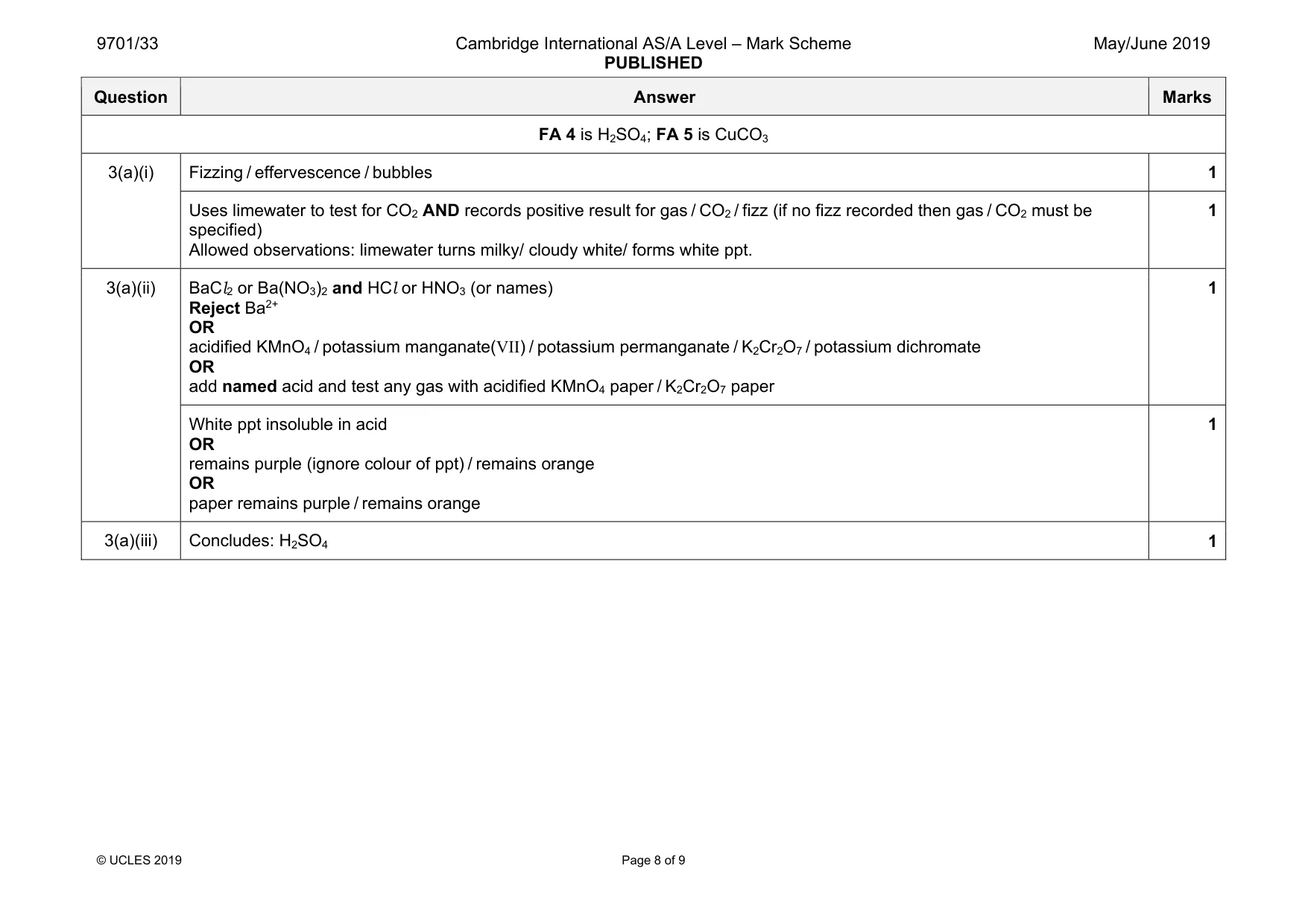
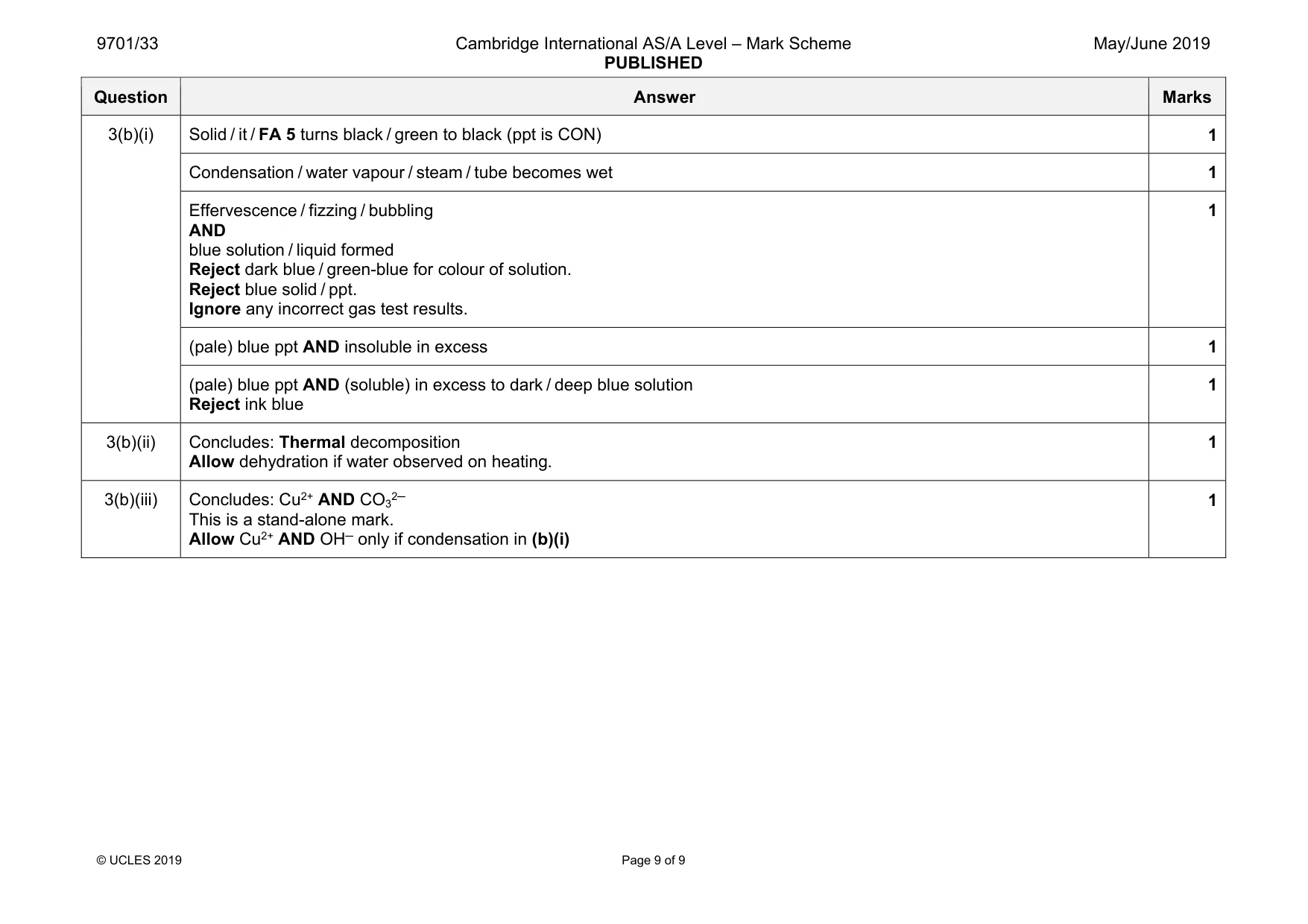
Mark scheme: 3(a)(i) Fizzing / effervescence / bubbles 1 Uses limewater to test for CO2 AND records positive result for gas / CO2 / fizz (if no fizz recorded then gas / CO2 must be specified) Allowed observations: limewater turns milky/ cloudy white/ forms white ppt. 1 3(a)(ii) BaCl2 or Ba(NO3)2 and HCl or HNO3 (or names) Reject Ba2+ OR acidified KMnO4 / potassium manganate(VII) / potassium permanganate / K2Cr2O7 / potassium dichromate OR add named acid and test any gas with acidified KMnO4 paper / K2Cr2O7 paper 1 White ppt insoluble in acid OR remains purple (ignore colour of ppt) / remains orange OR paper remains purple / remains orange 1 3(a)(iii) Concludes: H2SO4 1 Question Answer Marks 3(b)(i) Solid / it / FA 5 turns black / green to black (ppt is CON) 1 Condensation / water vapour / steam / tube becomes wet 1 Effervescence / fizzing / bubbling AND blue solution / liquid formed Reject dark blue / green-blue for colour of solution. Reject blue solid / ppt. Ignore any incorrect gas test results. 1 (pale) blue ppt AND insoluble in excess 1 (pale) blue ppt AND (soluble) in excess to dark / deep blue solution Reject ink blue 1 3(b)(ii) Concludes: Thermal decomposition Allow dehydration if water observed on heating. 1 3(b)(iii) Concludes: Cu2+ AND CO32─ This is a stand-alone mark. Allow Cu2+ AND OH─ only if condensation in (b)(i) 1
What was in this paper
The subtopics covered by these 3 questions, and how many questions each got. Open one in a new tab to see every Cambridge question on it.
What you needed in this session
Cambridge’s own grade thresholds for 2019 May/June, Paper 3 · Variant 3. A higher threshold means an easier paper — the bar moves with how the cohort did.