Cambridge A Level Chemistry 9701 — 2019 May/June Paper 3 · Variant 1
9701/31/M/J/19 · 3 questions · 40 marks · ≈45 min
The question paper and its mark scheme, free to read here and free to download. This is Cambridge’s own paper, exactly as it was sat.
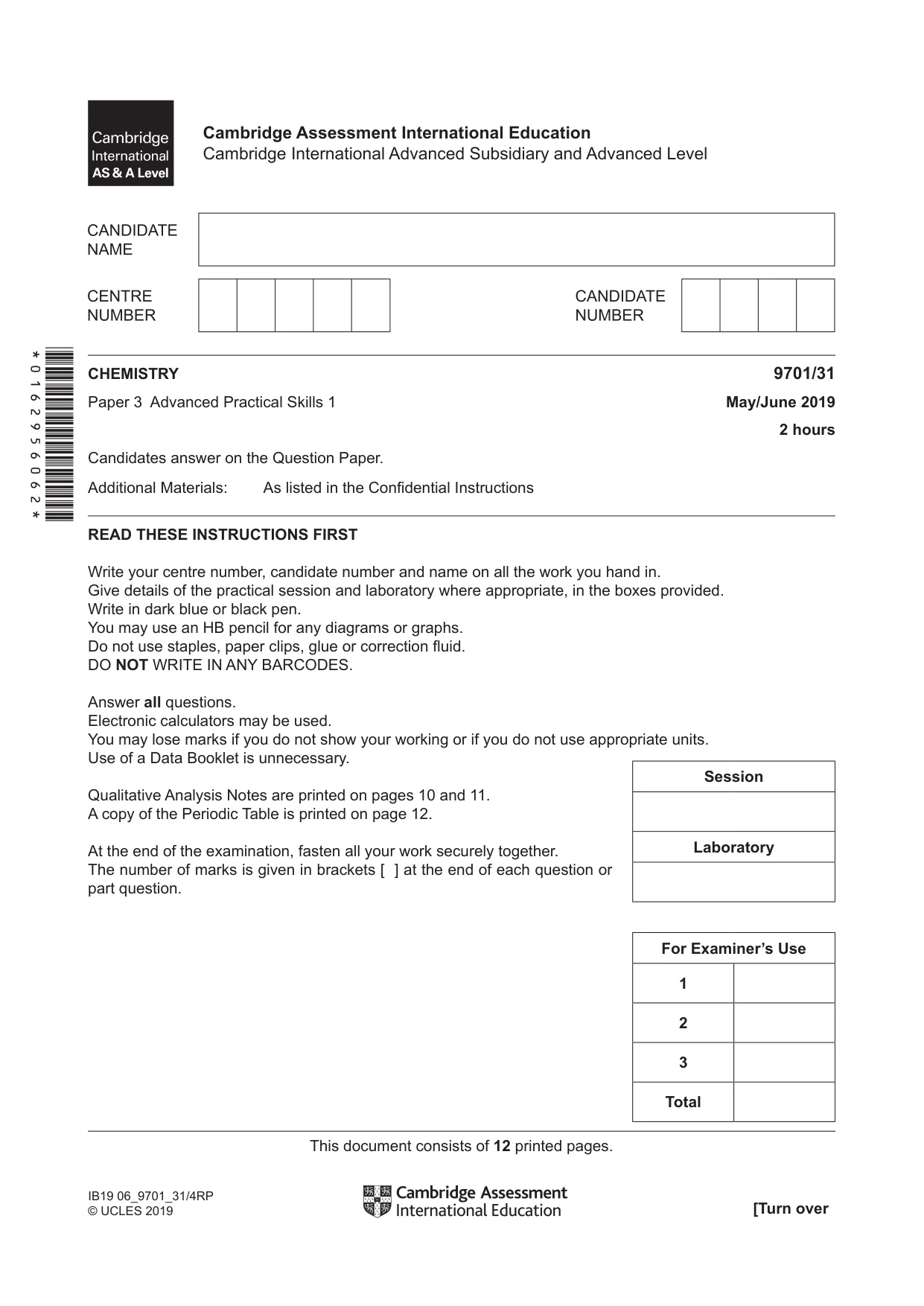
Question paper12 pages
Mark scheme8 pages
Answers below. Sit the paper first if you are practising.
Questions as text
Q1 · Metal carbonates react with acid to produce carbon dioxide
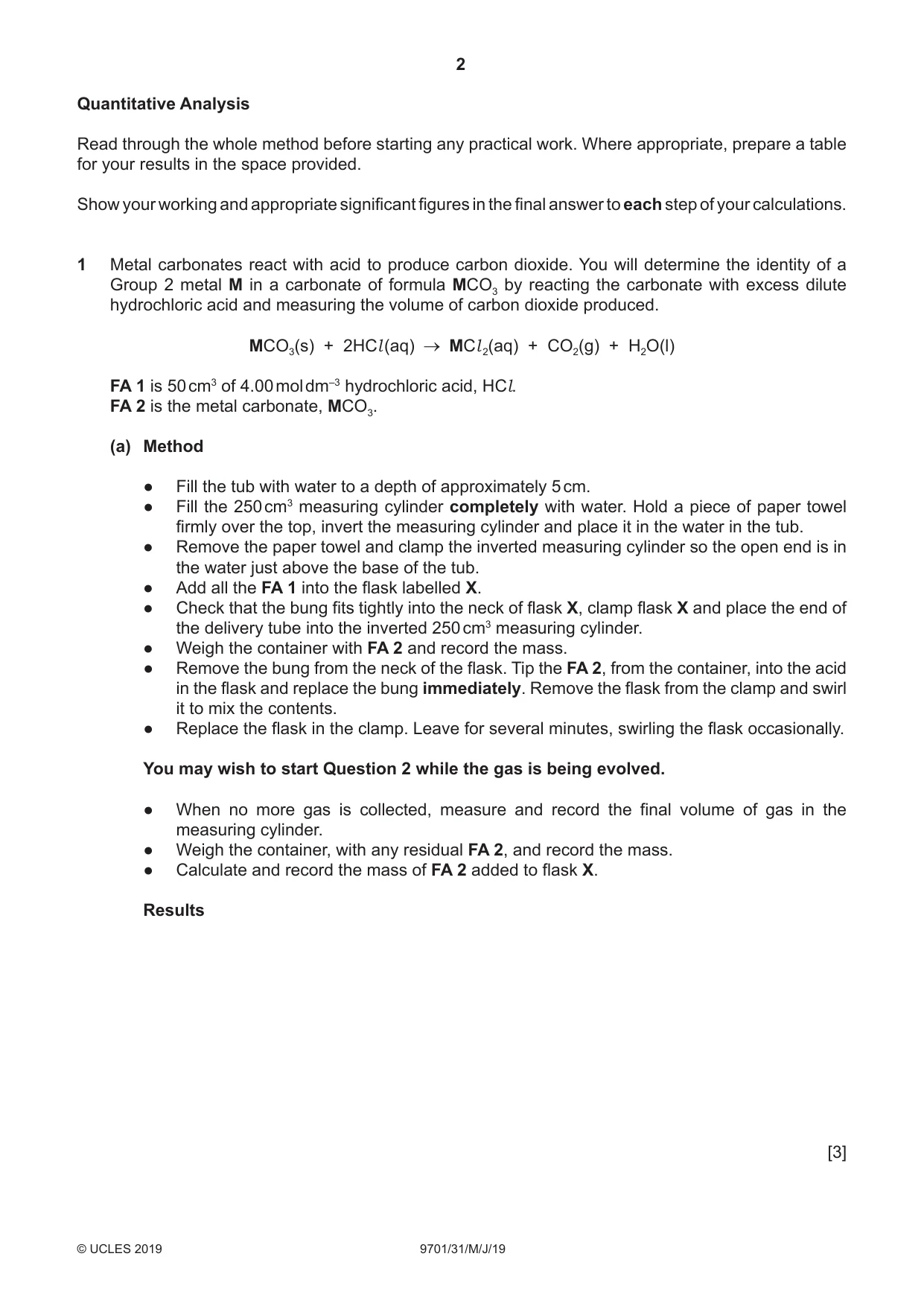
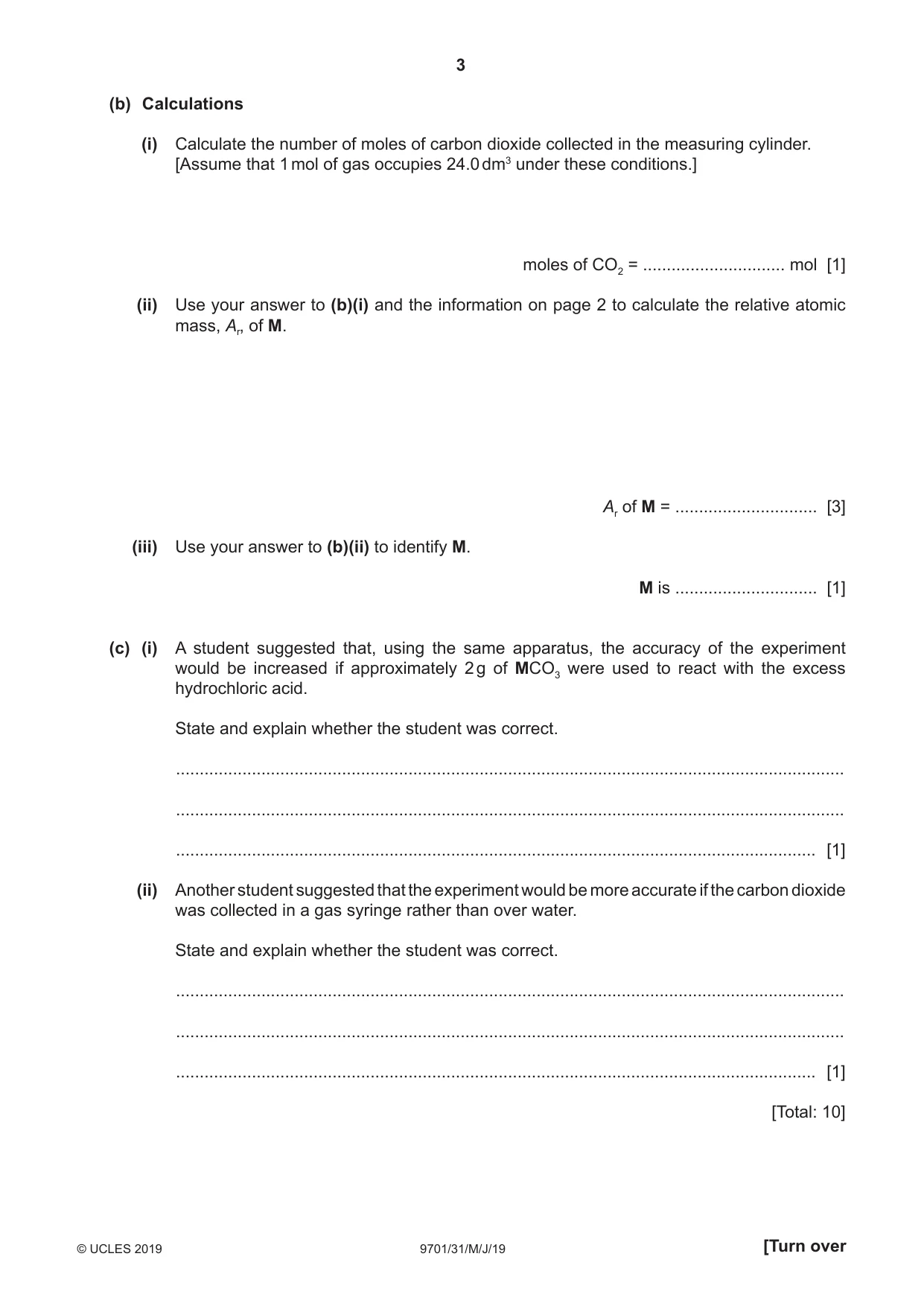
1 Metal carbonates react with acid to produce carbon dioxide. You will determine the identity of a Group 2 metal M in a carbonate of formula MCO3 by reacting the carbonate with excess dilute hydrochloric acid and measuring the volume of carbon dioxide produced. MCO3(s) + 2HCl (aq) MCl 2(aq) + CO2(g) + H2O(l) FA 1 is 50 cm3 of 4.00 mol dm–3 hydrochloric acid, HCl. FA 2 is the metal carbonate, MCO3. (a) Method ●● Fill the tub with water to a depth of approximately 5 cm. ●● Fill the 250 cm3 measuring cylinder completely with water. Hold a piece of paper towel firmly over the top, invert the measuring cylinder and place it in the water in the tub. ●● Remove the paper towel and clamp the inverted measuring cylinder so the open end is in the water just above the base of the tub. ●● Add all the FA 1 into the flask labelled X. ●● Check that the bung fits tightly into the neck of flask X, clamp flask X and place the end of the delivery tube into the inverted 250 cm3 measuring cylinder. ●● Weigh the container with FA 2 and record the mass. ●● Remove the bung from the neck of the flask. Tip the FA 2, from the container, into the acid in the flask and replace the bung immediately. Remove the flask from the clamp and swirl it to mix the contents. ●● Replace the flask in the clamp. Leave for several minutes, swirling the flask occasionally. You may wish to start Question 2 while the gas is being evolved. ●● When no more gas is collected, measure and record the final volume of gas in the measuring cylinder. ●● Weigh the container, with any residual FA 2, and record the mass. ●● Calculate and record the mass of FA 2 added to flask X. Results [3] (b) Calculations (i) Calculate the number of moles of carbon dioxide collected in the measuring cylinder. [Assume that 1 mol of gas occupies 24.0 dm3 under these conditions.] moles of CO2 = .............................. mol [1] (ii) Use your answer to (b)(i) and the information on page 2 to calculate the relative atomic mass, Ar, of M. Ar of M = .............................. [3] (iii) Use your answer to (b)(ii) to identify M. M is .............................. [1] (c) (i) A student suggested that, using the same apparatus, the accuracy of the experiment would be increased if approximately 2 g of MCO3 were used to react with the excess hydrochloric acid. State and explain whether the student was correct. ............................................................................................................................................. ............................................................................................................................................. ....................................................................................................................................... [1] (ii) Another student suggested that the experiment would be more accurate if the carbon dioxide was collected in a gas syringe rather than over water. State and explain whether the student was correct. ............................................................................................................................................. ............................................................................................................................................. ....................................................................................................................................... [1] [Total: 10]
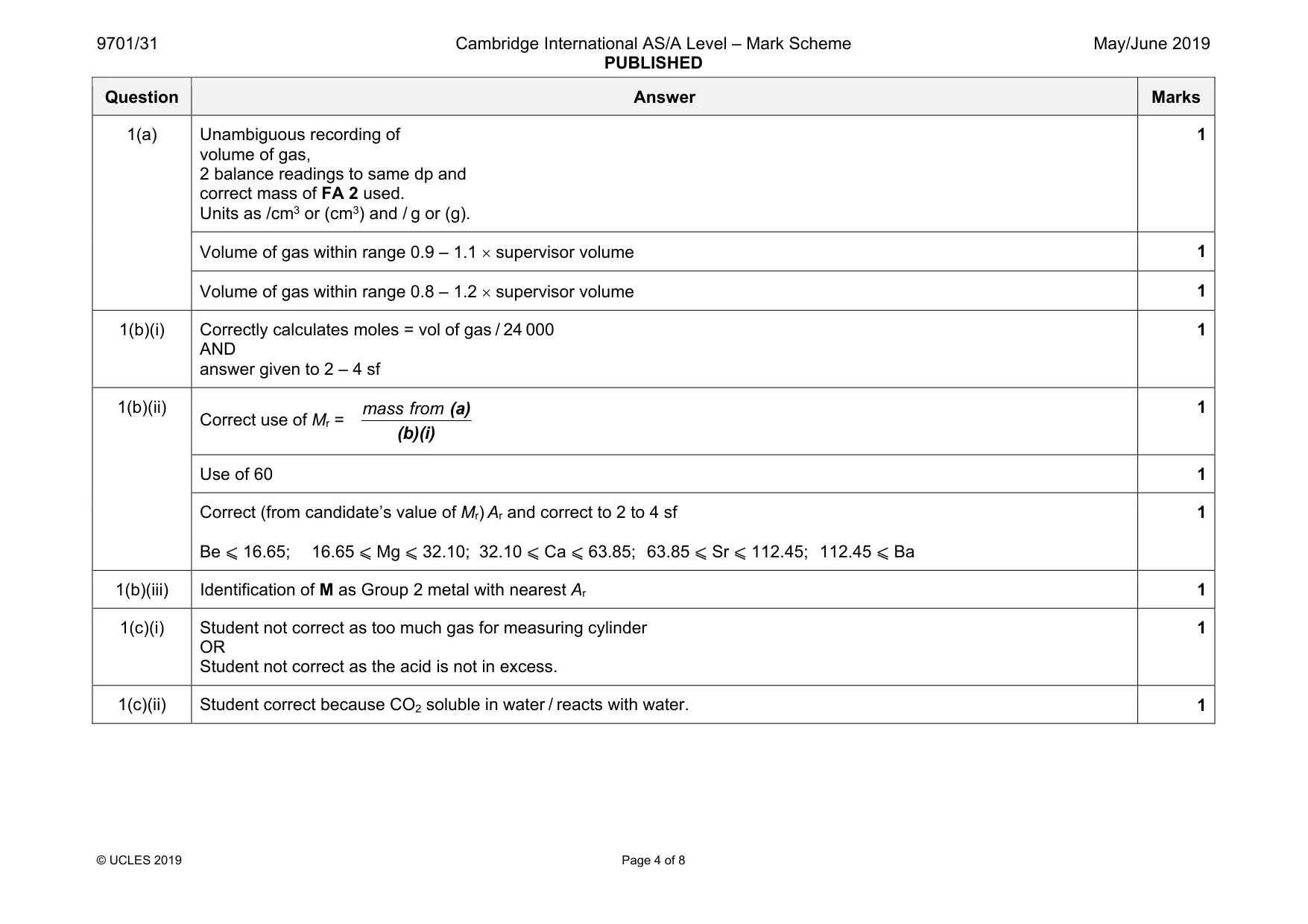
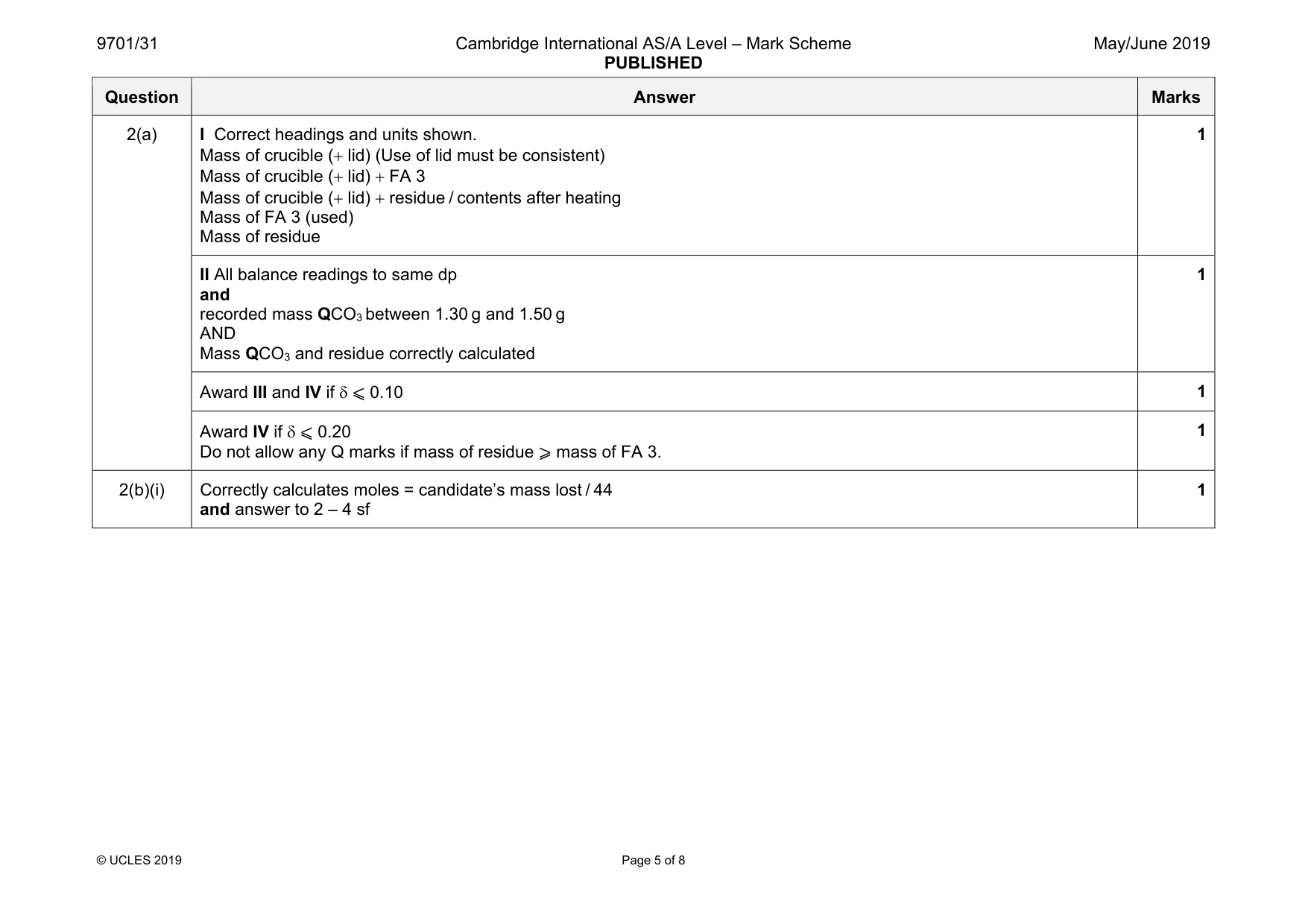
Mark scheme: 1(a) Unambiguous recording of volume of gas, 2 balance readings to same dp and correct mass of FA 2 used. Units as /cm3 or (cm3) and / g or (g). 1 Volume of gas within range 0.9 – 1.1 × supervisor volume 1 Volume of gas within range 0.8 – 1.2 × supervisor volume 1 1(b)(i) Correctly calculates moles = vol of gas / 24 000 AND answer given to 2 – 4 sf 1 1(b)(ii) Correct use of Mr = mass from (a) (b)(i) 1 Use of 60 1 Correct (from candidate’s value of Mr) Ar and correct to 2 to 4 sf Be ⩽ 16.65; 16.65 ⩽ Mg ⩽ 32.10; 32.10 ⩽ Ca ⩽ 63.85; 63.85 ⩽ Sr ⩽ 112.45; 112.45 ⩽ Ba 1 1(b)(iii) Identification of M as Group 2 metal with nearest Ar 1 1(c)(i) Student not correct as too much gas for measuring cylinder OR Student not correct as the acid is not in excess. 1 1(c)(ii) Student correct because CO2 soluble in water / reacts with water. 1
More questions on Reacting masses and volumes (of solutions and gases)
Q2 · In Question 1 you measured the volume of carbon dioxide produced by a metal carbonate…
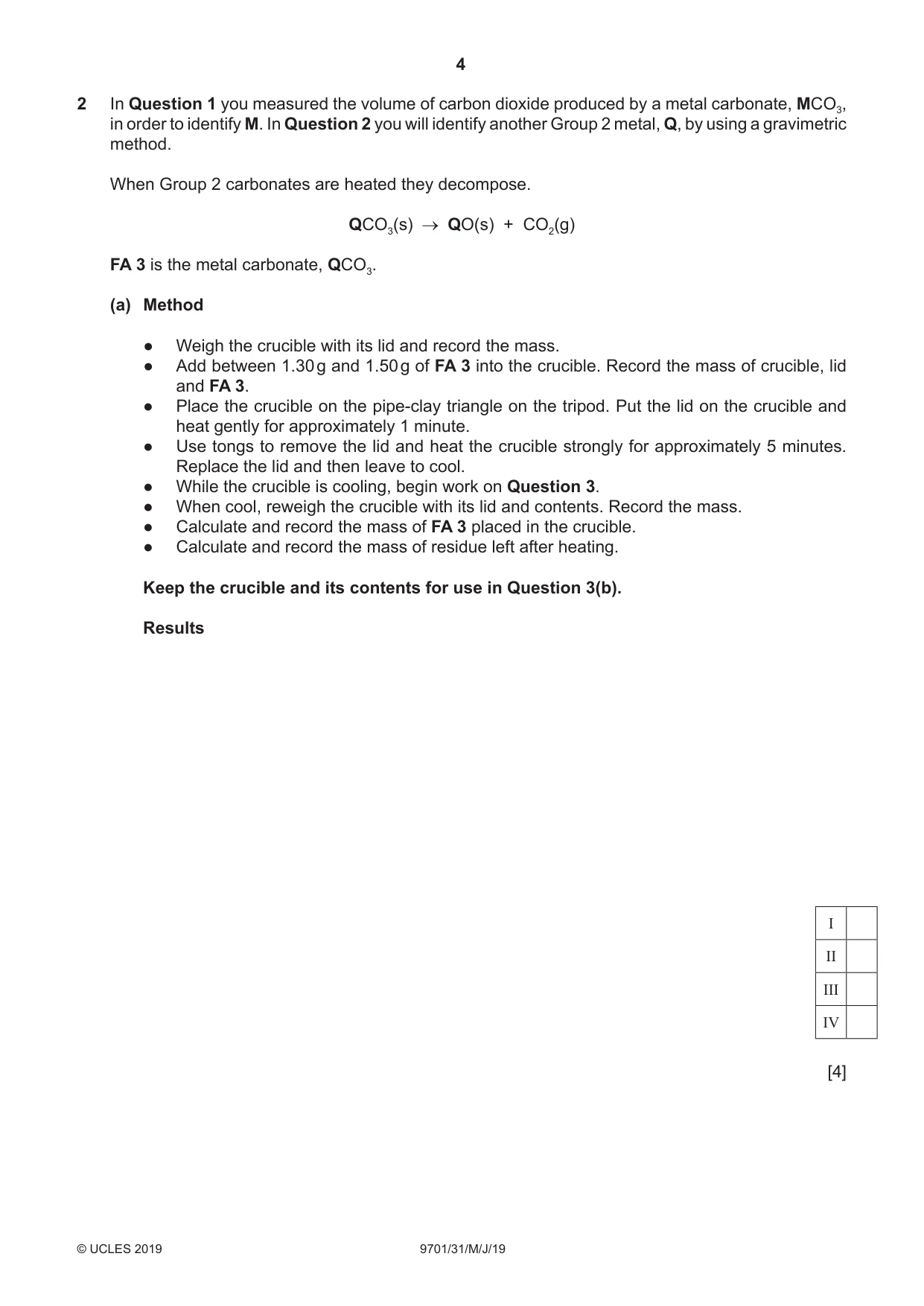
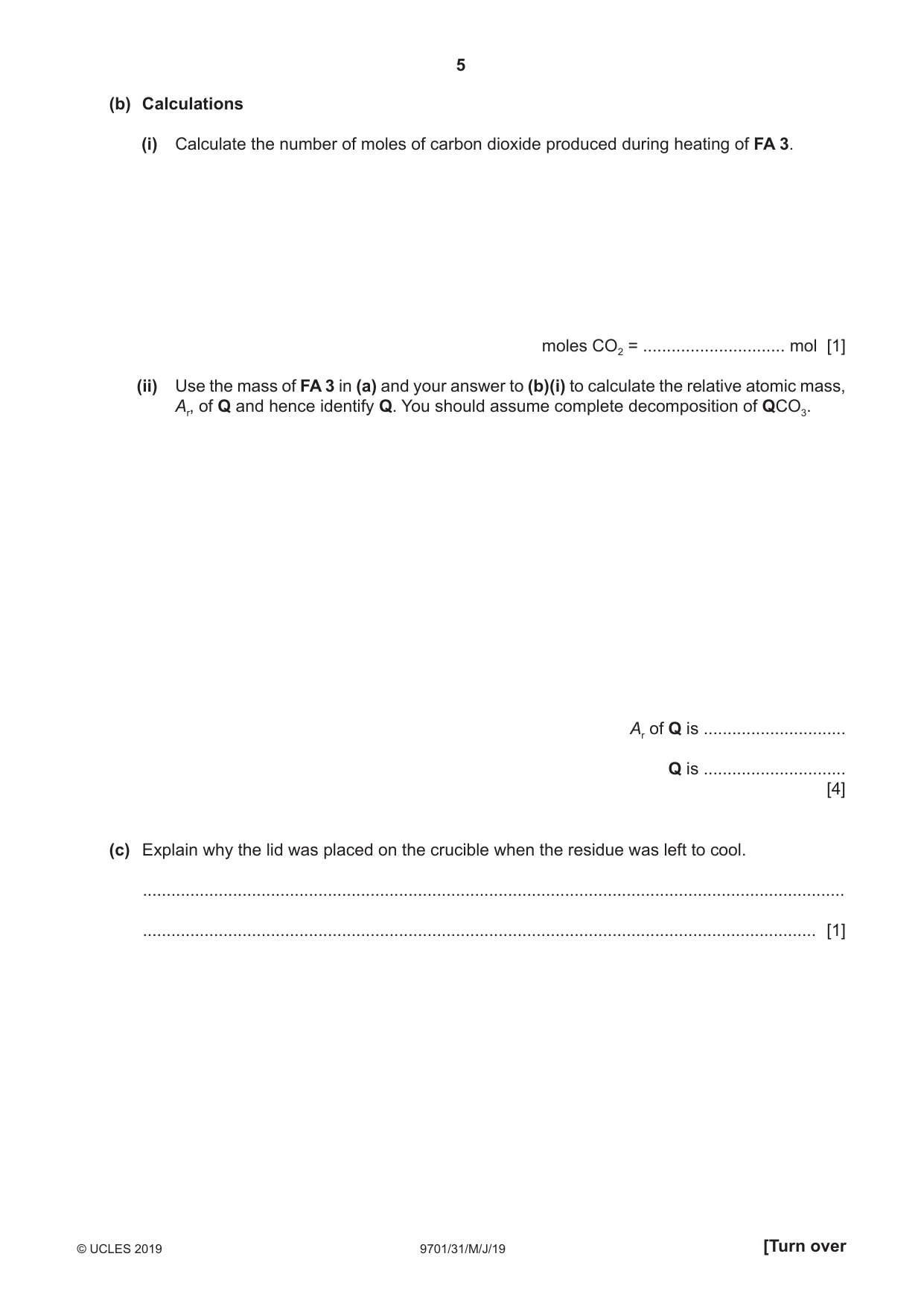
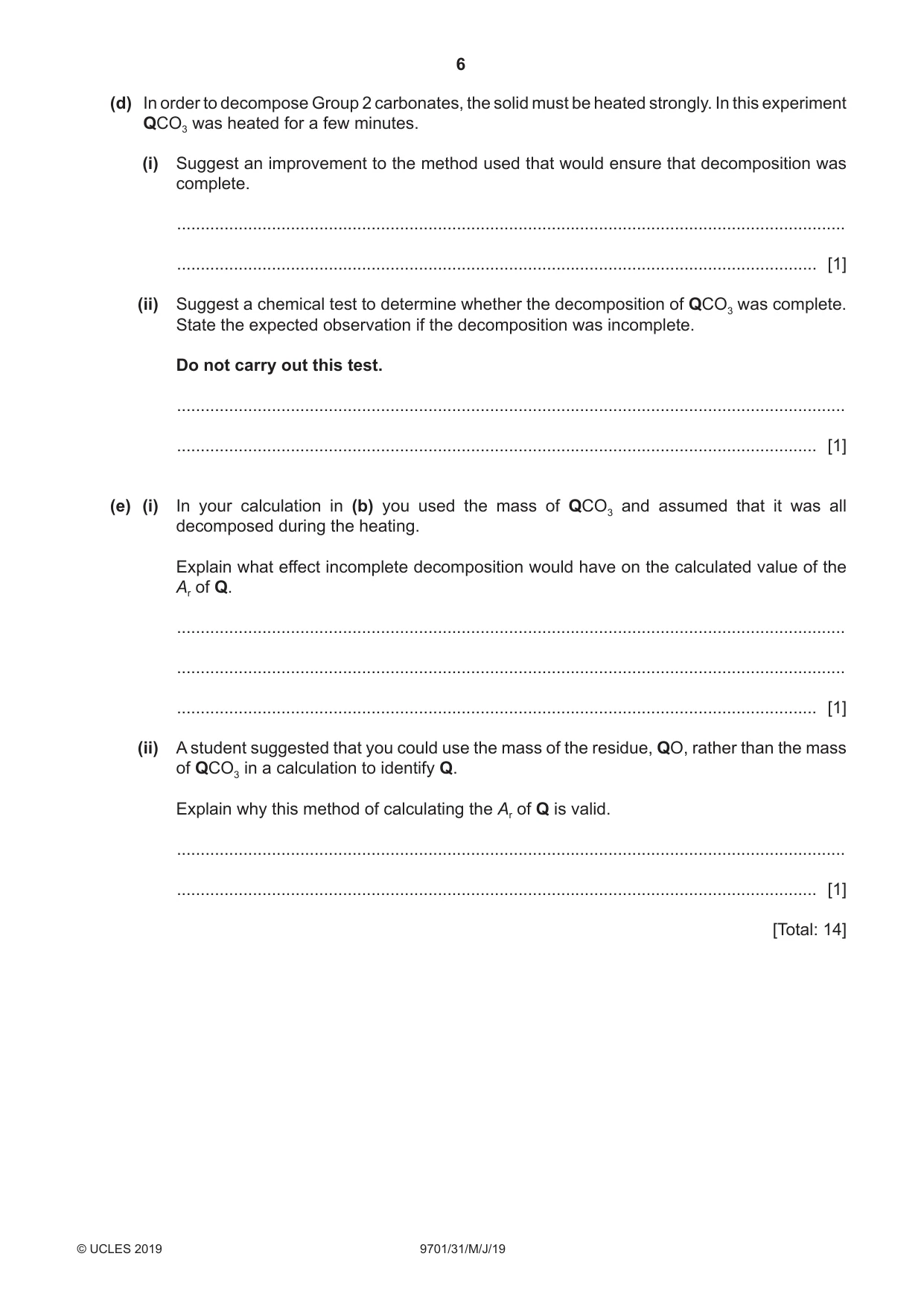
2 In Question 1 you measured the volume of carbon dioxide produced by a metal carbonate, MCO3, in order to identify M. In Question 2 you will identify another Group 2 metal, Q, by using a gravimetric method. When Group 2 carbonates are heated they decompose. QCO3(s) QO(s) + CO2(g) FA 3 is the metal carbonate, QCO3. (a) Method ●● Weigh the crucible with its lid and record the mass. ●● Add between 1.30 g and 1.50 g of FA 3 into the crucible. Record the mass of crucible, lid and FA 3. ●● Place the crucible on the pipe-clay triangle on the tripod. Put the lid on the crucible and heat gently for approximately 1 minute. ●● Use tongs to remove the lid and heat the crucible strongly for approximately 5 minutes. Replace the lid and then leave to cool. ●● While the crucible is cooling, begin work on Question 3. ●● When cool, reweigh the crucible with its lid and contents. Record the mass. ●● Calculate and record the mass of FA 3 placed in the crucible. ●● Calculate and record the mass of residue left after heating. Keep the crucible and its contents for use in Question 3(b). Results I II III IV [4] (b) Calculations (i) Calculate the number of moles of carbon dioxide produced during heating of FA 3. moles CO2 = .............................. mol [1] (ii) Use the mass of FA 3 in (a) and your answer to (b)(i) to calculate the relative atomic mass, Ar, of Q and hence identify Q. You should assume complete decomposition of QCO3. Ar of Q is .............................. Q is .............................. [4] (c) Explain why the lid was placed on the crucible when the residue was left to cool. .................................................................................................................................................... .............................................................................................................................................. [1] (d) In order to decompose Group 2 carbonates, the solid must be heated strongly. In this experiment QCO3 was heated for a few minutes. (i) Suggest an improvement to the method used that would ensure that decomposition was complete. ............................................................................................................................................. ....................................................................................................................................... [1] (ii) Suggest a chemical test to determine whether the decomposition of QCO3 was complete. State the expected observation if the decomposition was incomplete. Do not carry out this test. ............................................................................................................................................. ....................................................................................................................................... [1] (e) (i) In your calculation in (b) you used the mass of QCO3 and assumed that it was all decomposed during the heating. Explain what effect incomplete decomposition would have on the calculated value of the Ar of Q. ............................................................................................................................................. ............................................................................................................................................. ....................................................................................................................................... [1] (ii) A student suggested that you could use the mass of the residue, QO, rather than the mass of QCO3 in a calculation to identify Q. Explain why this method of calculating the Ar of Q is valid. ............................................................................................................................................. ....................................................................................................................................... [1] [Total: 14] Qualitative Analysis Where reagents are selected for use in a test, the name or correct formula of the element or compound must be given. At each stage of any test you are to record details of the following: ● colour changes seen; ● the formation of any precipitate and its solubility in an excess of the reagent added; ● the formation of any gas and its identification by a suitable test. You should indicate clearly at what stage in a test a change occurs. If any solution is warmed, a boiling tube must be used. Rinse and reuse test-tubes and boiling tubes where possible. No additional tests for ions present should be attempted.
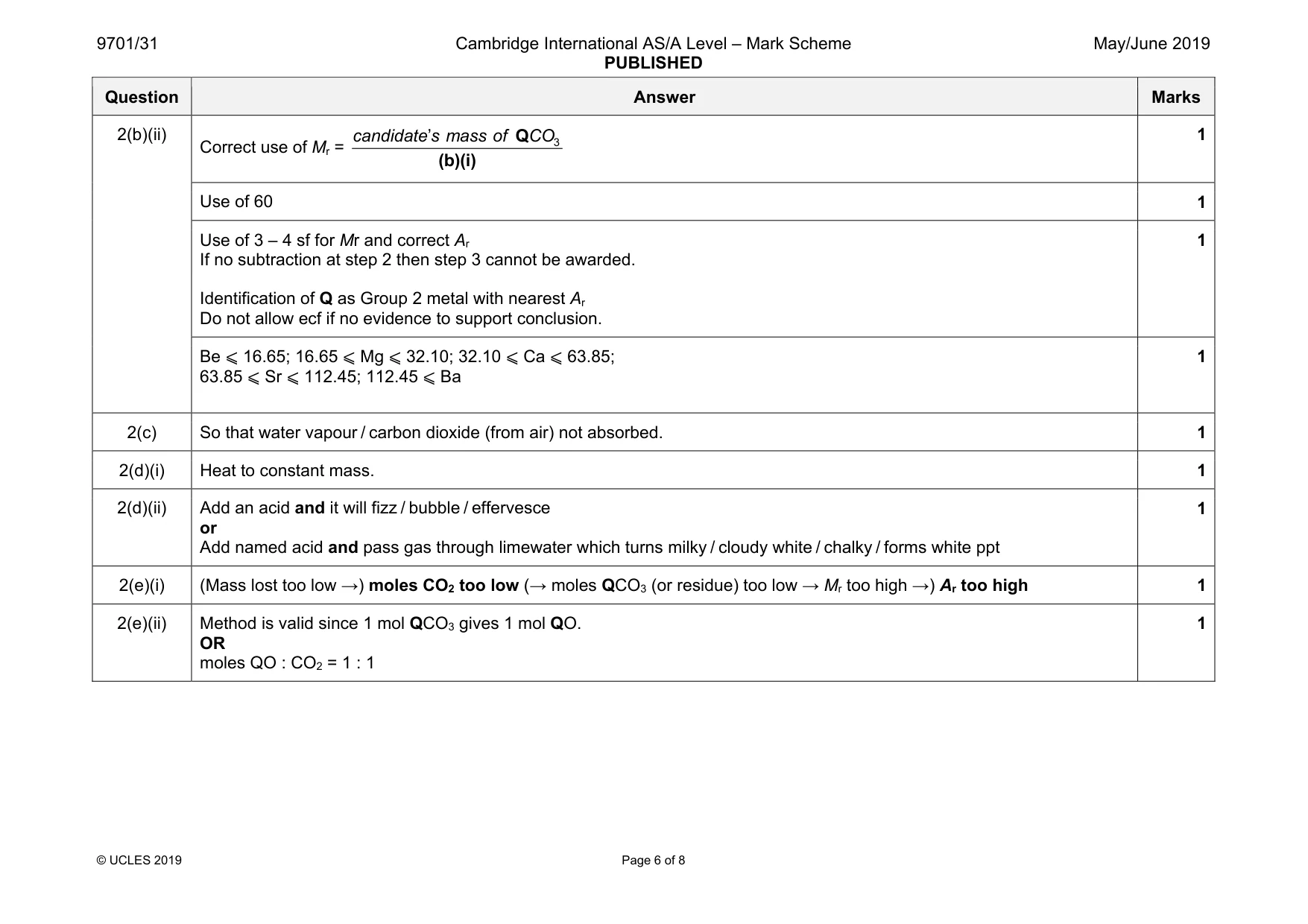
Mark scheme: 2(a) I Correct headings and units shown. Mass of crucible (+ lid) (Use of lid must be consistent) Mass of crucible (+ lid) + FA 3 Mass of crucible (+ lid) + residue / contents after heating Mass of FA 3 (used) Mass of residue 1 II All balance readings to same dp and recorded mass QCO3 between 1.30 g and 1.50 g AND Mass QCO3 and residue correctly calculated 1 Award III and IV if δ ⩽ 0.10 1 Award IV if δ ⩽ 0.20 Do not allow any Q marks if mass of residue ⩾ mass of FA 3. 1 2(b)(i) Correctly calculates moles = candidate’s mass lost / 44 and answer to 2 – 4 sf 1 Question Answer Marks 2(b)(ii) Correct use of Mr = 3 ’ candidate s mass of CO ( Q b)(i) 1 Use of 60 1 Use of 3 – 4 sf for Mr and correct Ar If no subtraction at step 2 then step 3 cannot be awarded. Identification of Q as Group 2 metal with nearest Ar Do not allow ecf if no evidence to support conclusion. 1 Be ⩽ 16.65; 16.65 ⩽ Mg ⩽ 32.10; 32.10 ⩽ Ca ⩽ 63.85; 63.85 ⩽ Sr ⩽ 112.45; 112.45 ⩽ Ba 1 2(c) So that water vapour / carbon dioxide (from air) not absorbed. 1 2(d)(i) Heat to constant mass. 1 2(d)(ii) Add an acid and it will fizz / bubble / effervesce or Add named acid and pass gas through limewater which turns milky / cloudy white / chalky / forms white ppt 1 2(e)(i) (Mass lost too low →) moles CO2 too low (→ moles QCO3 (or residue) too low → Mr too high →) Ar too high 1 2(e)(ii) Method is valid since 1 mol QCO3 gives 1 mol QO. OR moles QO : CO2 = 1 : 1 1
Q3 · FA 4 and FA 5 are aqueous solutions each containing one anion and one cation
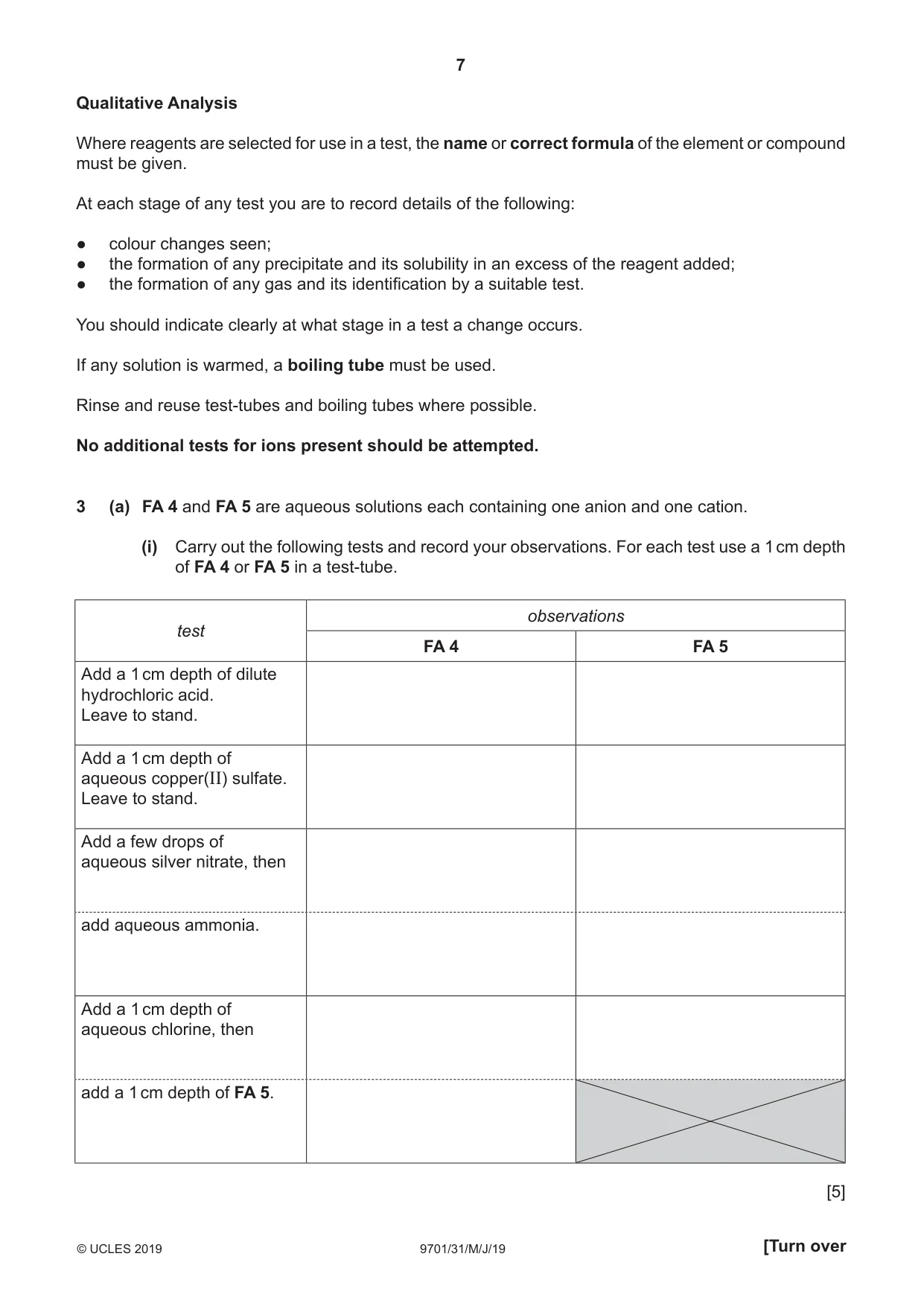
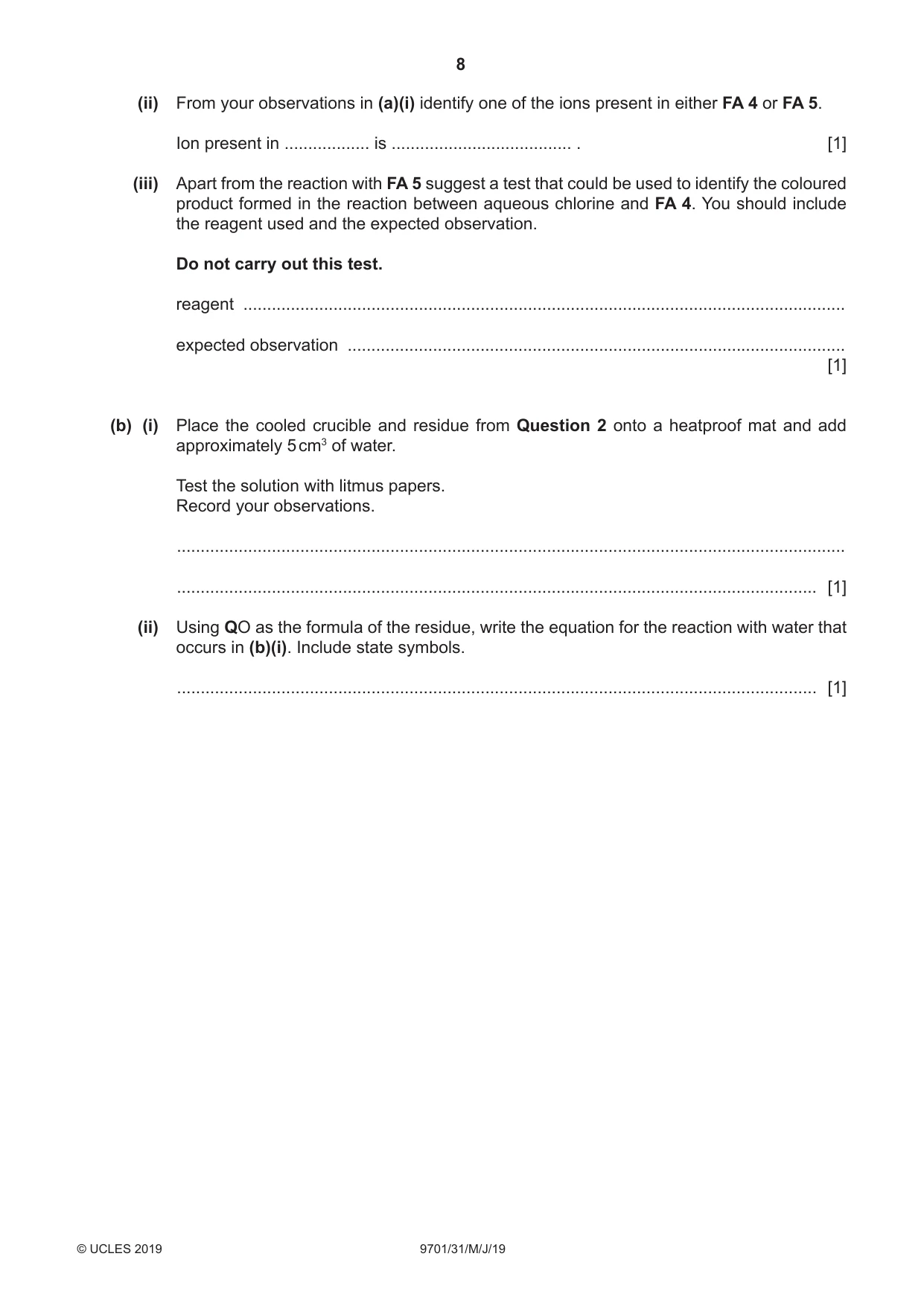
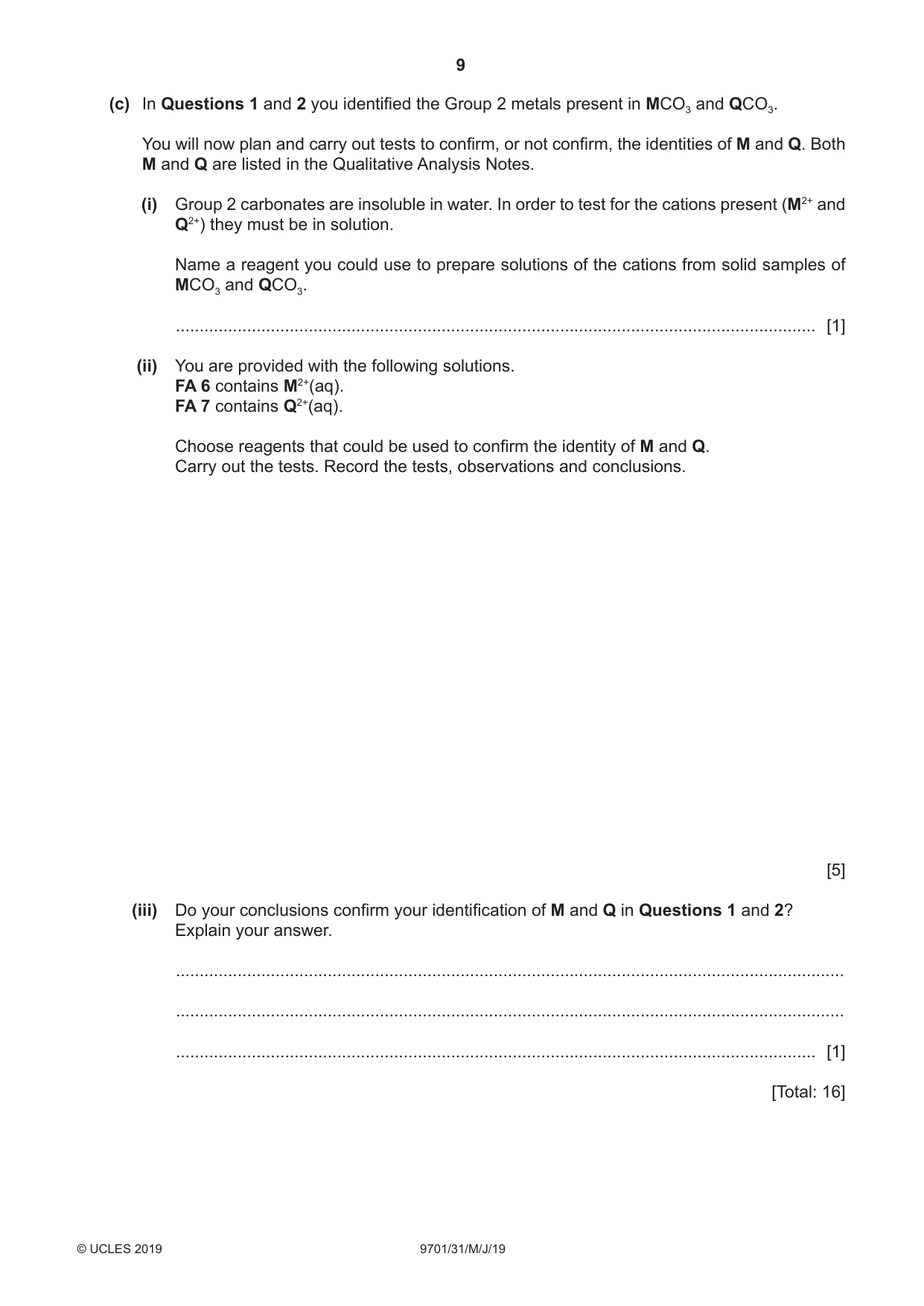
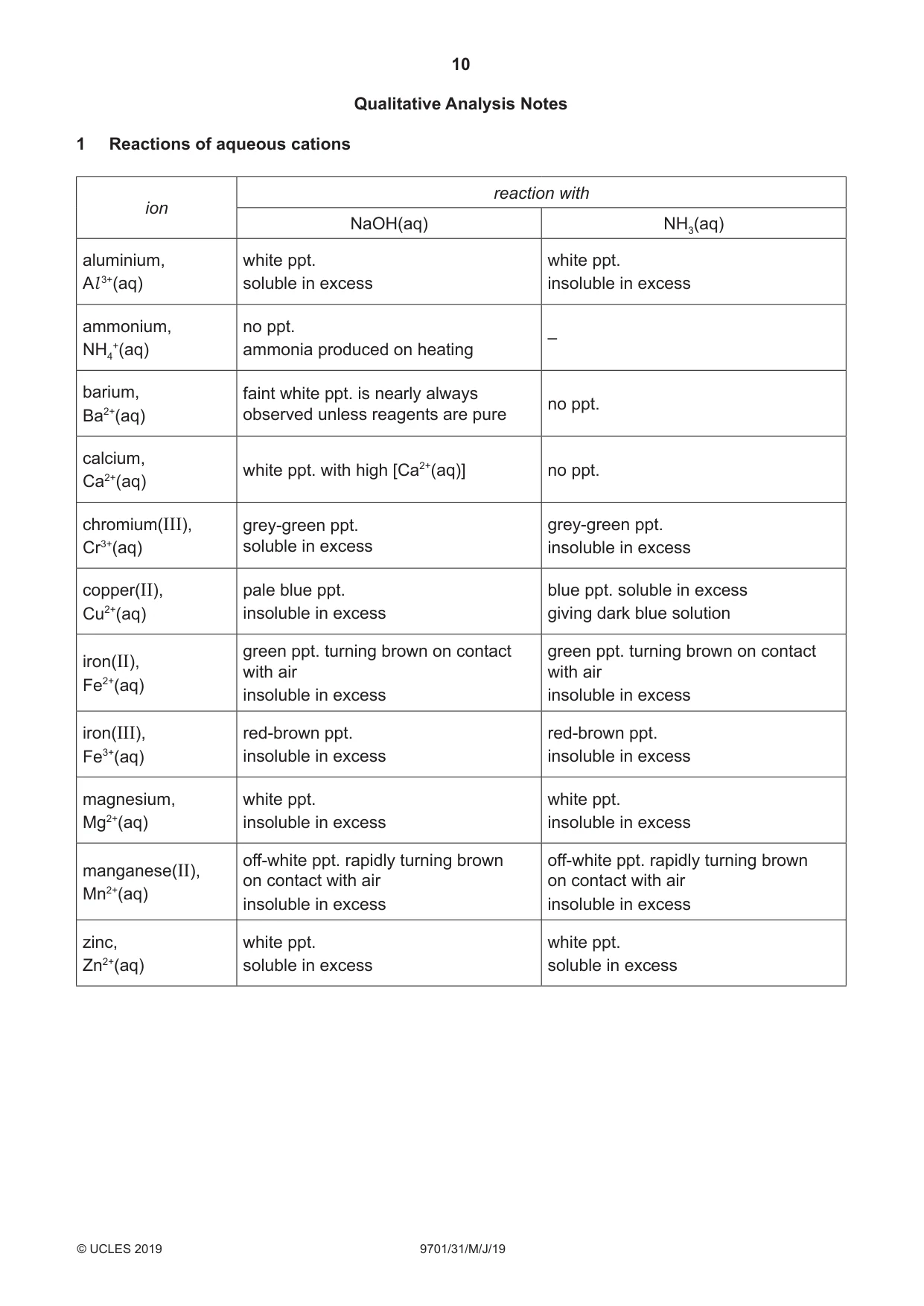
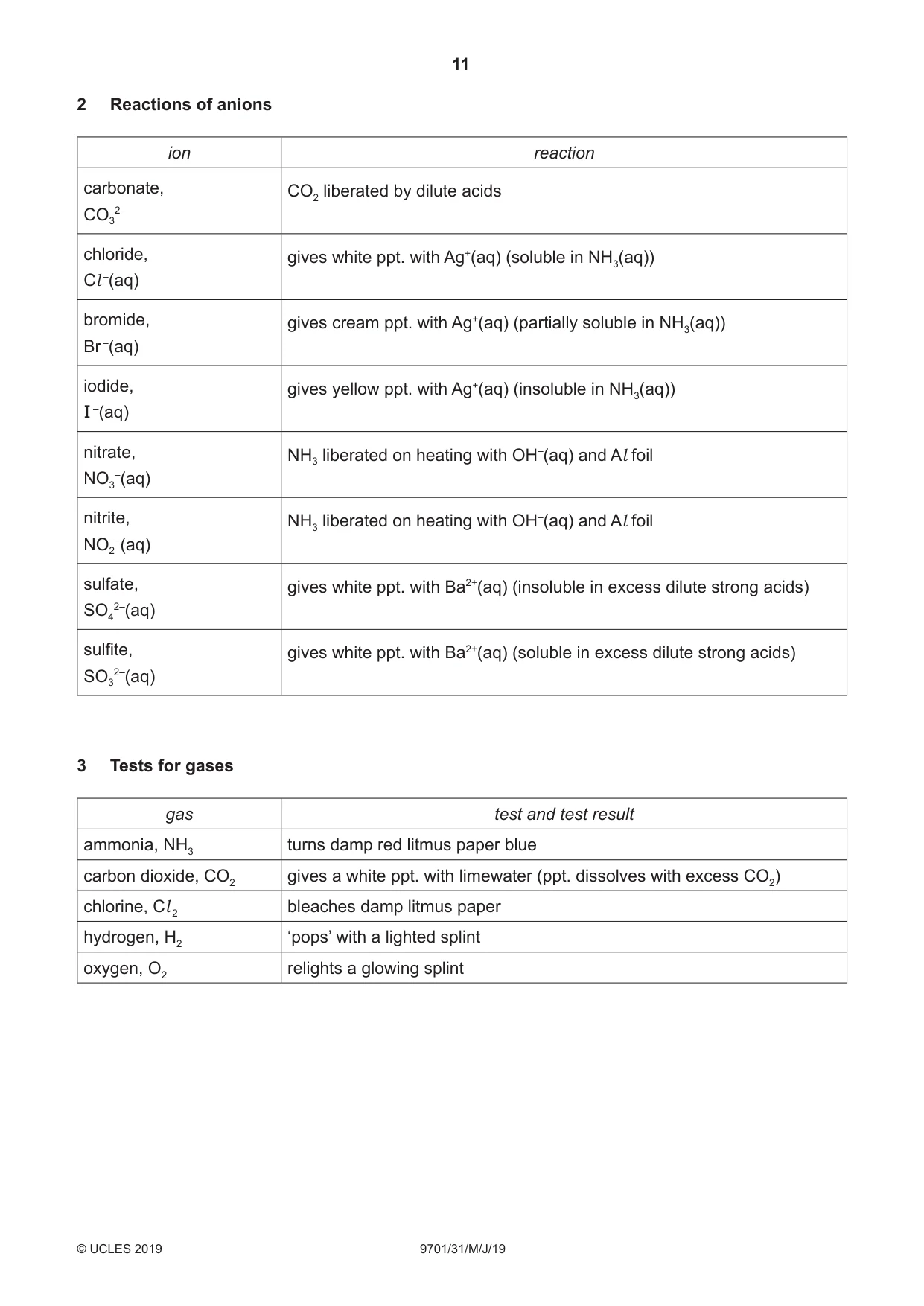
3 (a) FA 4 and FA 5 are aqueous solutions each containing one anion and one cation. (i) Carry out the following tests and record your observations. For each test use a 1 cm depth of FA 4 or FA 5 in a test-tube. observations test FA 4 FA 5 Add a 1 cm depth of dilute hydrochloric acid. Leave to stand. Add a 1 cm depth of aqueous copper(II) sulfate. Leave to stand. Add a few drops of aqueous silver nitrate, then add aqueous ammonia. Add a 1 cm depth of aqueous chlorine, then add a 1 cm depth of FA 5. [5] (ii) From your observations in (a)(i) identify one of the ions present in either FA 4 or FA 5. Ion present in .................. is ...................................... . [1] (iii) Apart from the reaction with FA 5 suggest a test that could be used to identify the coloured product formed in the reaction between aqueous chlorine and FA 4. You should include the reagent used and the expected observation. Do not carry out this test. reagent ................................................................................................................................ expected observation .......................................................................................................... [1] (b) (i) Place the cooled crucible and residue from Question 2 onto a heatproof mat and add approximately 5 cm3 of water. Test the solution with litmus papers. Record your observations. ............................................................................................................................................. ....................................................................................................................................... [1] (ii) Using QO as the formula of the residue, write the equation for the reaction with water that occurs in (b)(i). Include state symbols. ....................................................................................................................................... [1] (c) In Questions 1 and 2 you identified the Group 2 metals present in MCO3 and QCO3. You will now plan and carry out tests to confirm, or not confirm, the identities of M and Q. Both M and Q are listed in the Qualitative Analysis Notes. (i) Group 2 carbonates are insoluble in water. In order to test for the cations present (M2+ and Q2+) they must be in solution. Name a reagent you could use to prepare solutions of the cations from solid samples of MCO3 and QCO3. ....................................................................................................................................... [1] (ii) You are provided with the following solutions. FA 6 contains M2+(aq). FA 7 contains Q2+(aq). Choose reagents that could be used to confirm the identity of M and Q. Carry out the tests. Record the tests, observations and conclusions. [5] (iii) Do your conclusions confirm your identification of M and Q in Questions 1 and 2? Explain your answer. ............................................................................................................................................. ............................................................................................................................................. ....................................................................................................................................... [1] [Total: 16]
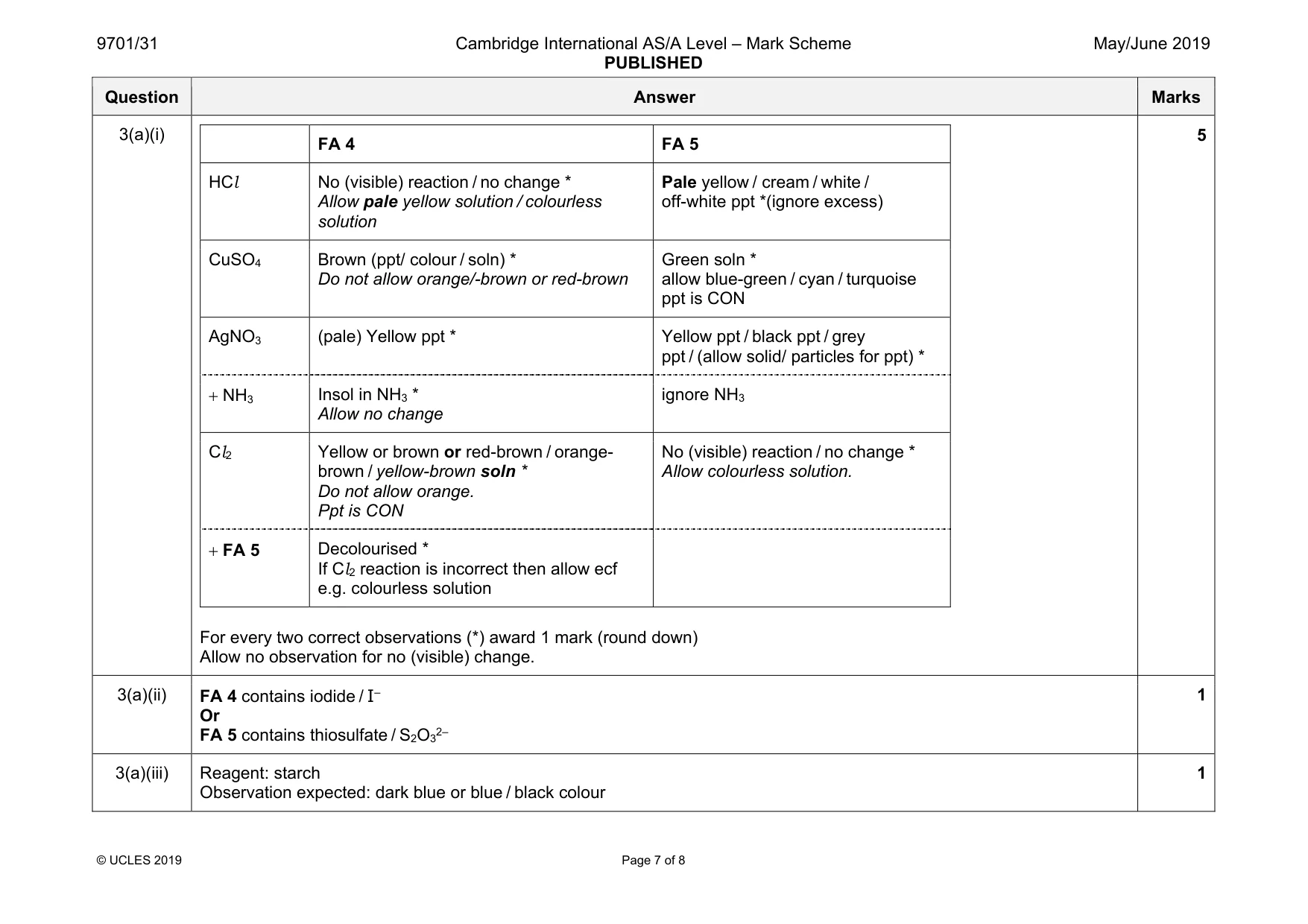
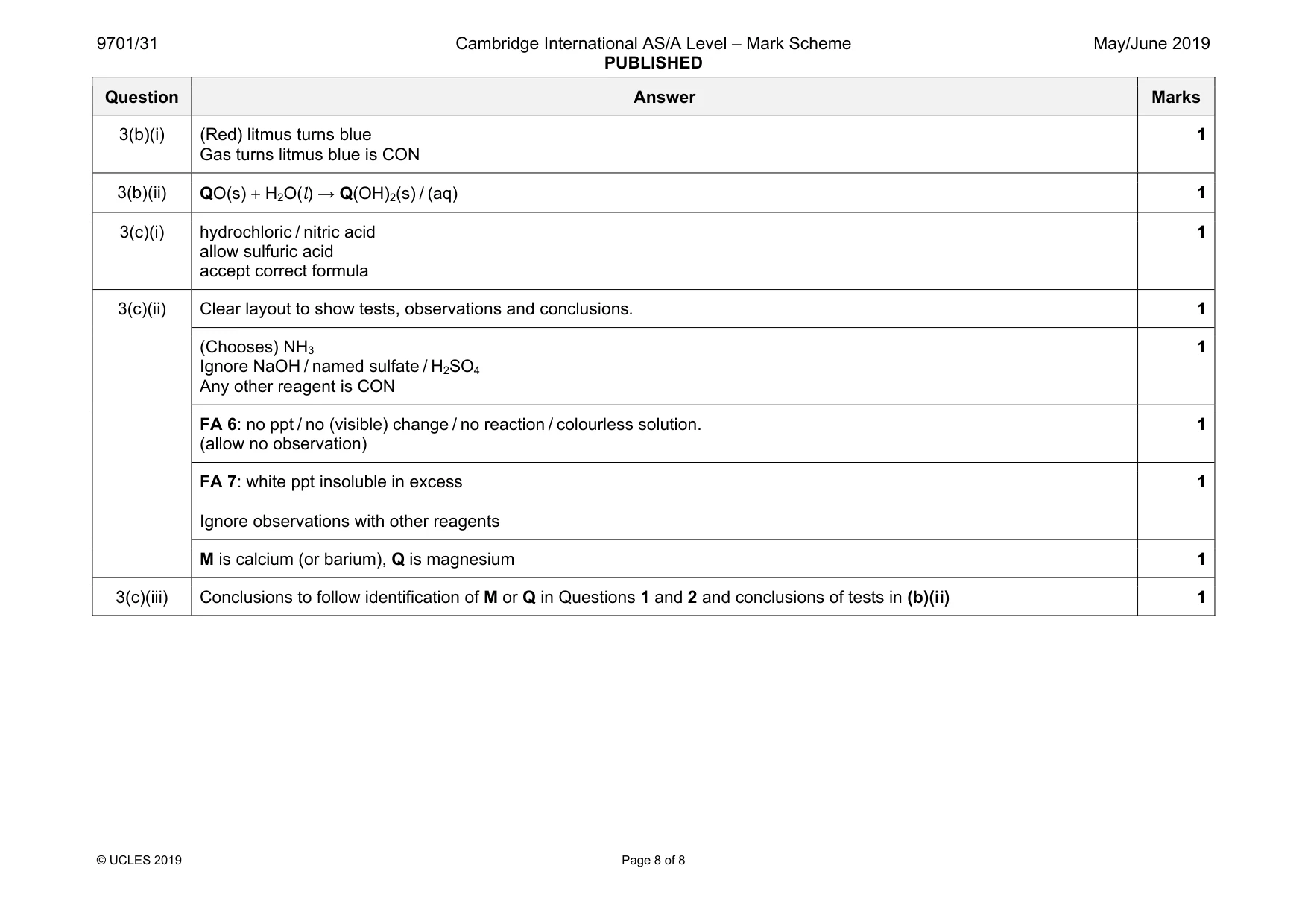
Mark scheme: 3(a)(i) FA 4 FA 5 HCl No (visible) reaction / no change * Allow pale yellow solution / colourless solution Pale yellow / cream / white / off-white ppt *(ignore excess) CuSO4 Brown (ppt/ colour / soln) * Do not allow orange/-brown or red-brown Green soln * allow blue-green / cyan / turquoise ppt is CON AgNO3 (pale) Yellow ppt * Yellow ppt / black ppt / grey ppt / (allow solid/ particles for ppt) * + NH3 Insol in NH3 * Allow no change ignore NH3 Cl2 Yellow or brown or red-brown / orange- brown / yellow-brown soln * Do not allow orange. Ppt is CON No (visible) reaction / no change * Allow colourless solution. + FA 5 Decolourised * If Cl2 reaction is incorrect then allow ecf e.g. colourless solution For every two correct observations (*) award 1 mark (round down) Allow no observation for no (visible) change. 5 3(a)(ii) FA 4 contains iodide / I– Or FA 5 contains thiosulfate / S2O32– 1 3(a)(iii) Reagent: starch Observation expected: dark blue or blue / black colour 1 Question Answer Marks 3(b)(i) (Red) litmus turns blue Gas turns litmus blue is CON 1 3(b)(ii) QO(s) + H2O(l) → Q(OH)2(s) / (aq) 1 3(c)(i) hydrochloric / nitric acid allow sulfuric acid accept correct formula 1 3(c)(ii) Clear layout to show tests, observations and conclusions. 1 (Chooses) NH3 Ignore NaOH / named sulfate / H2SO4 Any other reagent is CON 1 FA 6: no ppt / no (visible) change / no reaction / colourless solution. (allow no observation) 1 FA 7: white ppt insoluble in excess Ignore observations with other reagents 1 M is calcium (or barium), Q is magnesium 1 3(c)(iii) Conclusions to follow identification of M or Q in Questions 1 and 2 and conclusions of tests in (b)(ii) 1
What was in this paper
The subtopics covered by these 3 questions, and how many questions each got. Open one in a new tab to see every Cambridge question on it.
What you needed in this session
Cambridge’s own grade thresholds for 2019 May/June, Paper 3 · Variant 1. A higher threshold means an easier paper — the bar moves with how the cohort did.