Cambridge A Level Chemistry 9701 — 2018 May/June Paper 3 · Variant 2
9701/32/M/J/18 · 3 questions · 40 marks · ≈45 min
The question paper and its mark scheme, free to read here and free to download. This is Cambridge’s own paper, exactly as it was sat.
Question paper12 pages
Mark scheme9 pages
Answers below. Sit the paper first if you are practising.
Questions as text
Q1 · Many metal hydroxides decompose when heated to produce water vapour and the metal oxide…
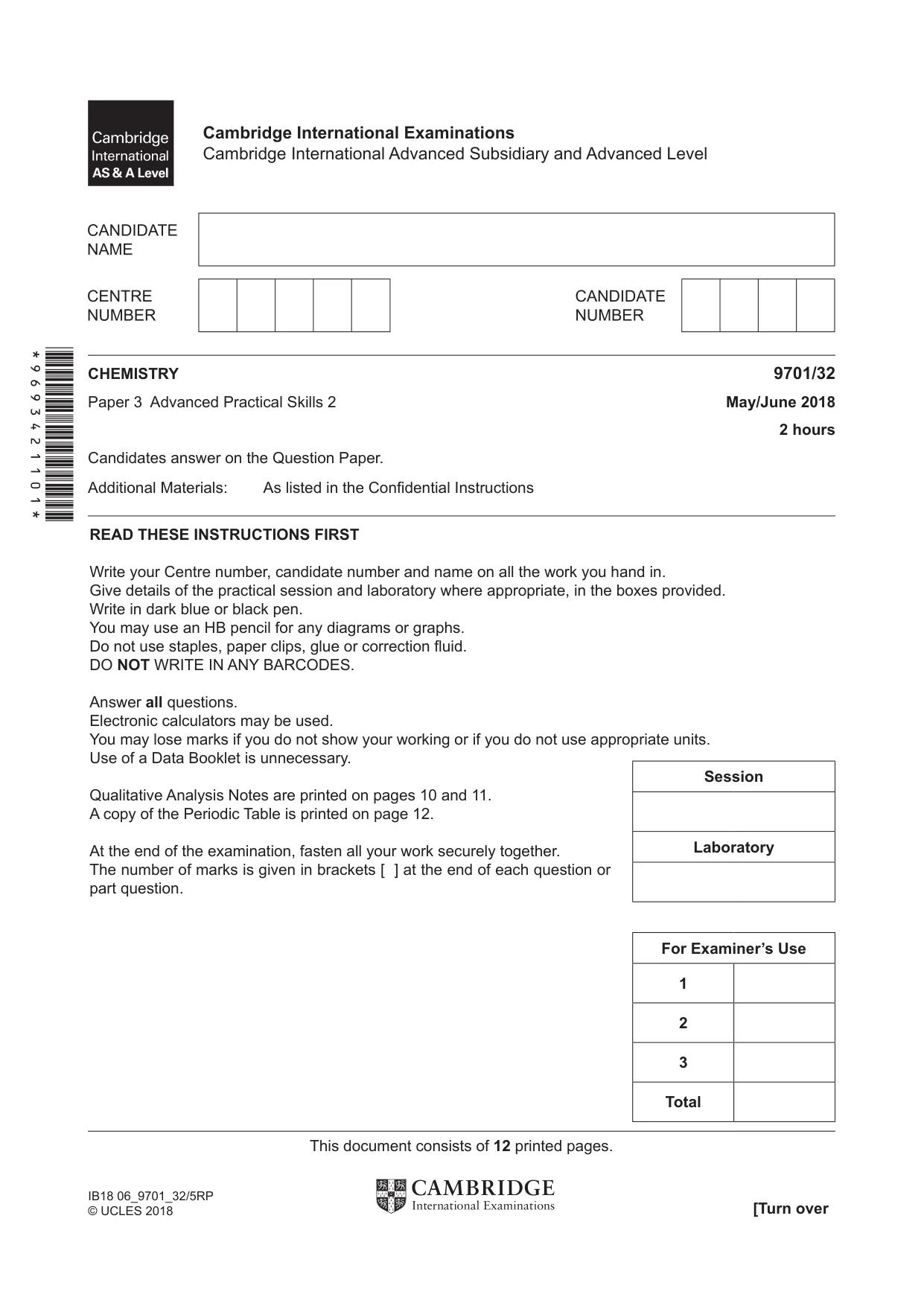
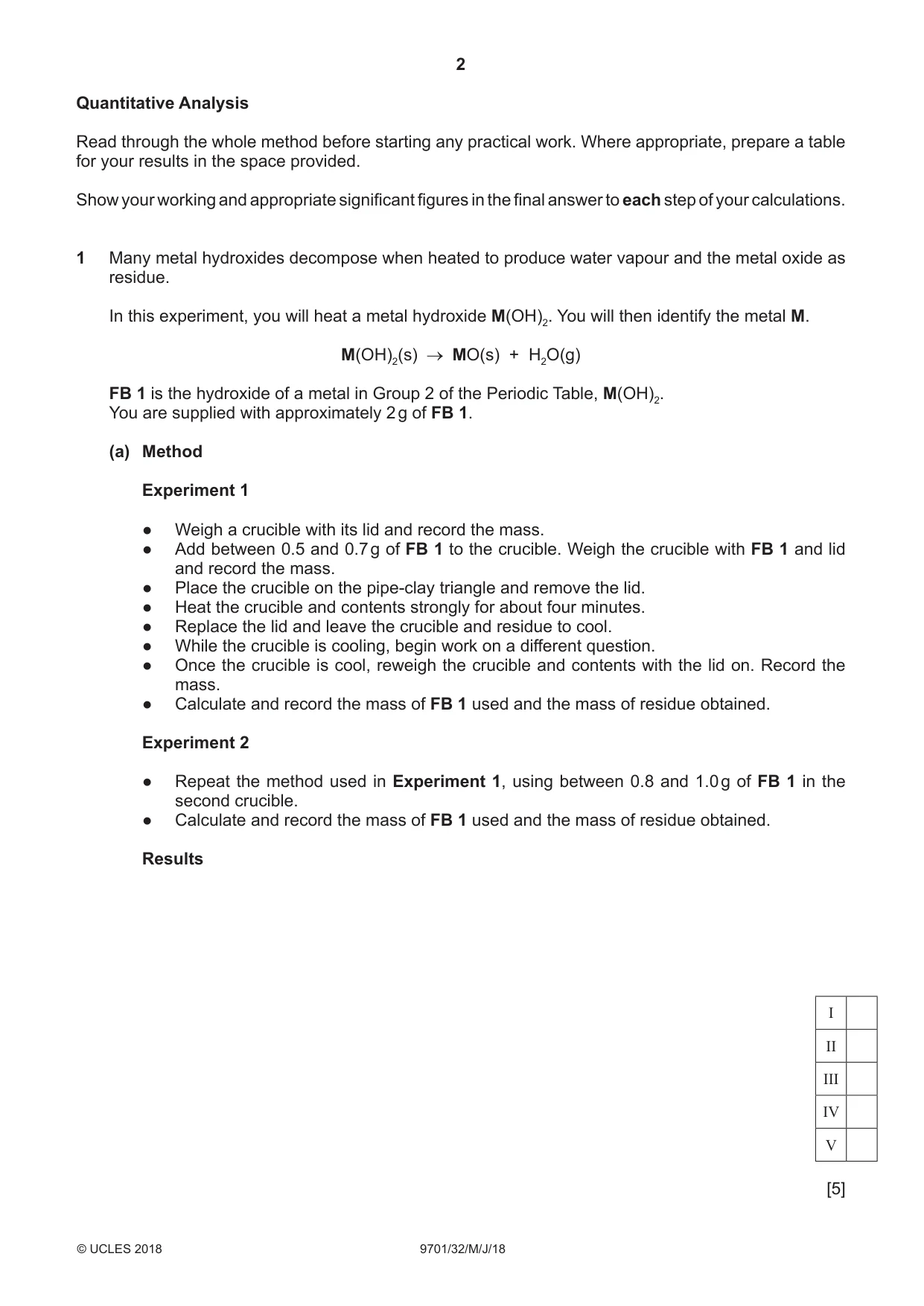
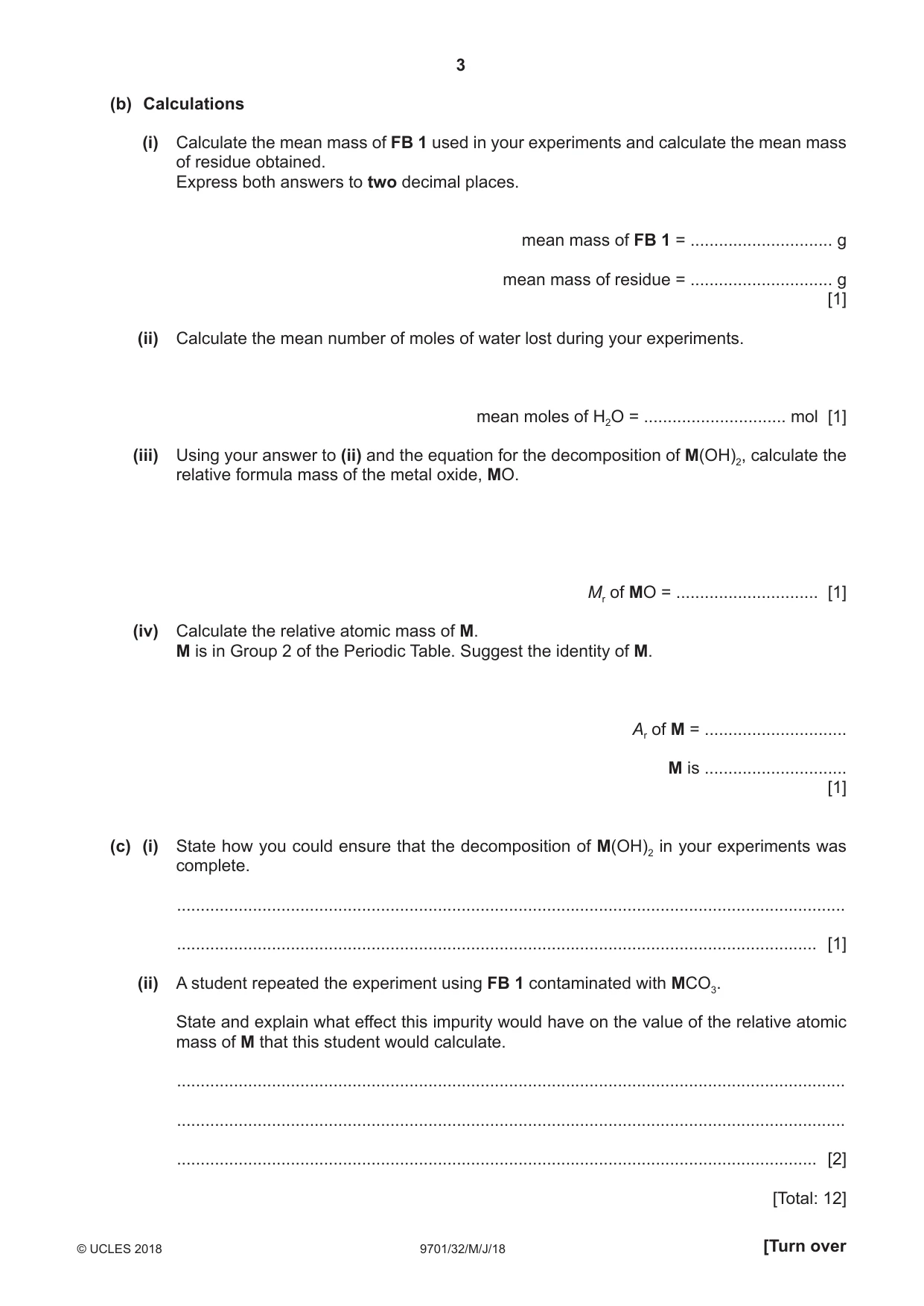
1 Many metal hydroxides decompose when heated to produce water vapour and the metal oxide as residue. In this experiment, you will heat a metal hydroxide M(OH)2. You will then identify the metal M. M(OH)2(s) MO(s) + H2O(g) FB 1 is the hydroxide of a metal in Group 2 of the Periodic Table, M(OH)2. You are supplied with approximately 2 g of FB 1. (a) Method Experiment 1 ● Weigh a crucible with its lid and record the mass. ● Add between 0.5 and 0.7 g of FB 1 to the crucible. Weigh the crucible with FB 1 and lid and record the mass. ● Place the crucible on the pipe-clay triangle and remove the lid. ● Heat the crucible and contents strongly for about four minutes. ● Replace the lid and leave the crucible and residue to cool. ● While the crucible is cooling, begin work on a different question. ● Once the crucible is cool, reweigh the crucible and contents with the lid on. Record the mass. ● Calculate and record the mass of FB 1 used and the mass of residue obtained. Experiment 2 ● Repeat the method used in Experiment 1, using between 0.8 and 1.0 g of FB 1 in the second crucible. ● Calculate and record the mass of FB 1 used and the mass of residue obtained. Results I II III IV V [5] (b) Calculations (i) Calculate the mean mass of FB 1 used in your experiments and calculate the mean mass of residue obtained. Express both answers to two decimal places. mean mass of FB 1 = .............................. g mean mass of residue = .............................. g [1] (ii) Calculate the mean number of moles of water lost during your experiments. mean moles of H2O = .............................. mol [1] (iii) Using your answer to (ii) and the equation for the decomposition of M(OH)2, calculate the relative formula mass of the metal oxide, MO. Mr of MO = .............................. [1] (iv) Calculate the relative atomic mass of M. M is in Group 2 of the Periodic Table. Suggest the identity of M. Ar of M = .............................. M is .............................. [1] (c) (i) State how you could ensure that the decomposition of M(OH)2 in your experiments was complete. ............................................................................................................................................. ....................................................................................................................................... [1] (ii) A student repeated the experiment using FB 1 contaminated with MCO3. State and explain what effect this impurity would have on the value of the relative atomic mass of M that this student would calculate. ............................................................................................................................................. ............................................................................................................................................. ....................................................................................................................................... [2] [Total: 12]
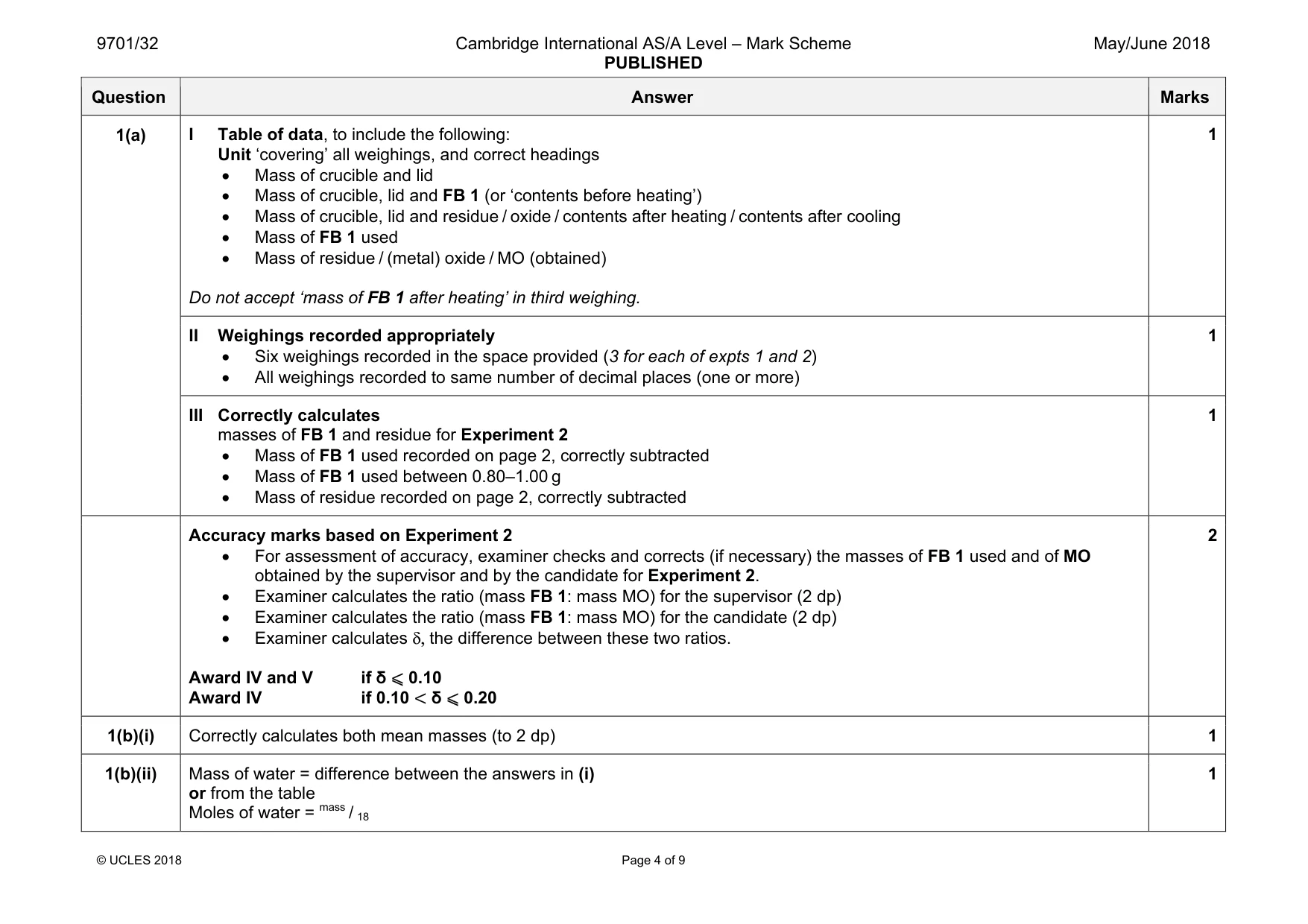
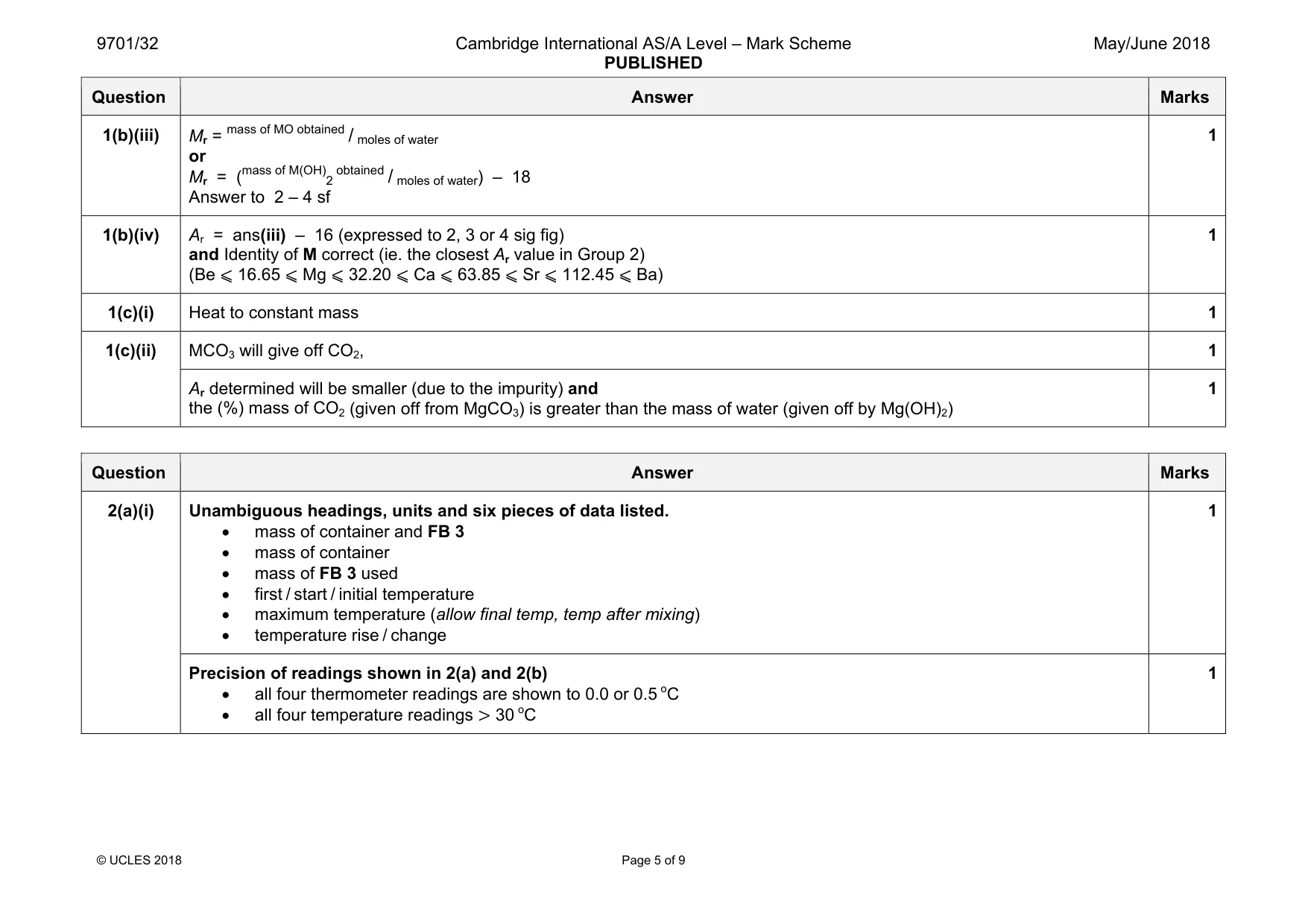
Mark scheme: 1(a) Unit ‘covering’ all weighings, and correct headings • Mass of crucible and lid • Mass of crucible, lid and FB 1 (or ‘contents before heating’) • Mass of crucible, lid and residue / oxide / contents after heating / contents after cooling • Mass of FB 1 used • Mass of residue / (metal) oxide / MO (obtained) Do not accept ‘mass of FB 1 after heating’ in third weighing. II Weighings recorded appropriately • Six weighings recorded in the space provided (3 for each of expts 1 and 2) • All weighings recorded to same number of decimal places (one or more) 1 III Correctly calculates masses of FB 1 and residue for Experiment 2 • Mass of FB 1 used recorded on page 2, correctly subtracted • Mass of FB 1 used between 0.80–1.00 g • Mass of residue recorded on page 2, correctly subtracted 1 Accuracy marks based on Experiment 2 • For assessment of accuracy, examiner checks and corrects (if necessary) the masses of FB 1 used and of MO obtained by the supervisor and by the candidate for Experiment 2. • Examiner calculates the ratio (mass FB 1: mass MO) for the supervisor (2 dp) • Examiner calculates the ratio (mass FB 1: mass MO) for the candidate (2 dp) • Examiner calculates δ, the difference between these two ratios. Award IV and V if δ ⩽ 0.10 Award IV if 0.10 < δ ⩽ 0.20 2 1(b)(i) Correctly calculates both mean masses (to 2 dp) 1 1(b)(ii) Mass of water = difference between the answers in (i) or from the table Moles of water = mass / 18 1 Question Answer Marks 1(b)(iii) Mr = mass of MO obtained / moles of water or Mr = (mass of M(OH) 2 obtained / moles of water) – 18 Answer to 2 – 4 sf 1 1(b)(iv) Ar = ans(iii) – 16 (expressed to 2, 3 or 4 sig fig) and Identity of M correct (ie. the closest Ar value in Group 2) (Be ⩽ 16.65 ⩽ Mg ⩽ 32.20 ⩽ Ca ⩽ 63.85 ⩽ Sr ⩽ 112.45 ⩽ Ba) 1 1(c)(i) Heat to constant mass 1 1(c)(ii) MCO3 will give off CO2, 1 Ar determined will be smaller (due to the impurity) and the (%) mass of CO2 (given off from MgCO3) is greater than the mass of water (given off by Mg(OH)2) 1
More questions on Reacting masses and volumes (of solutions and gases)
Q2 · In this experiment you will determine the enthalpy change, ΔHr , for the decomposition of…
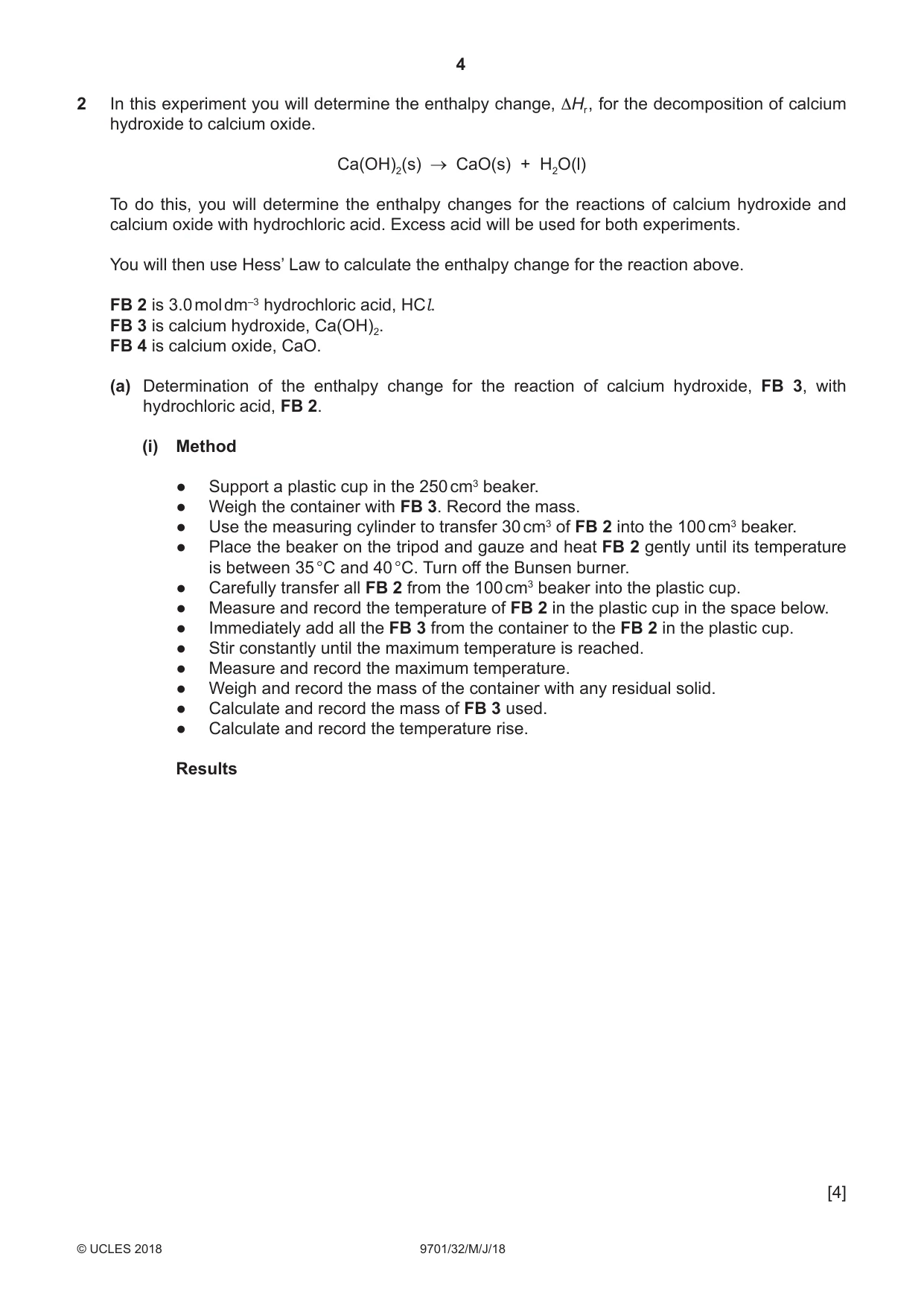
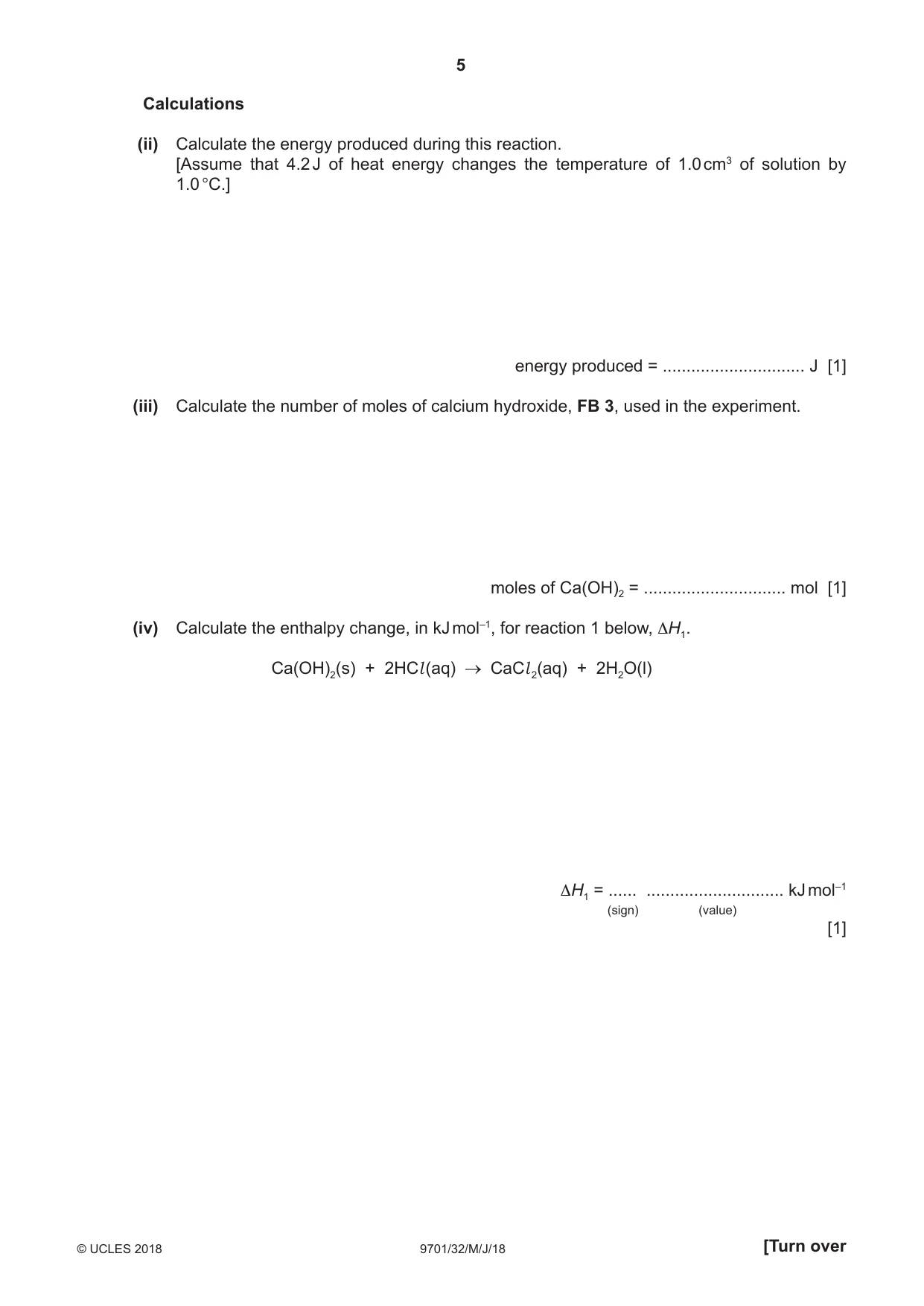
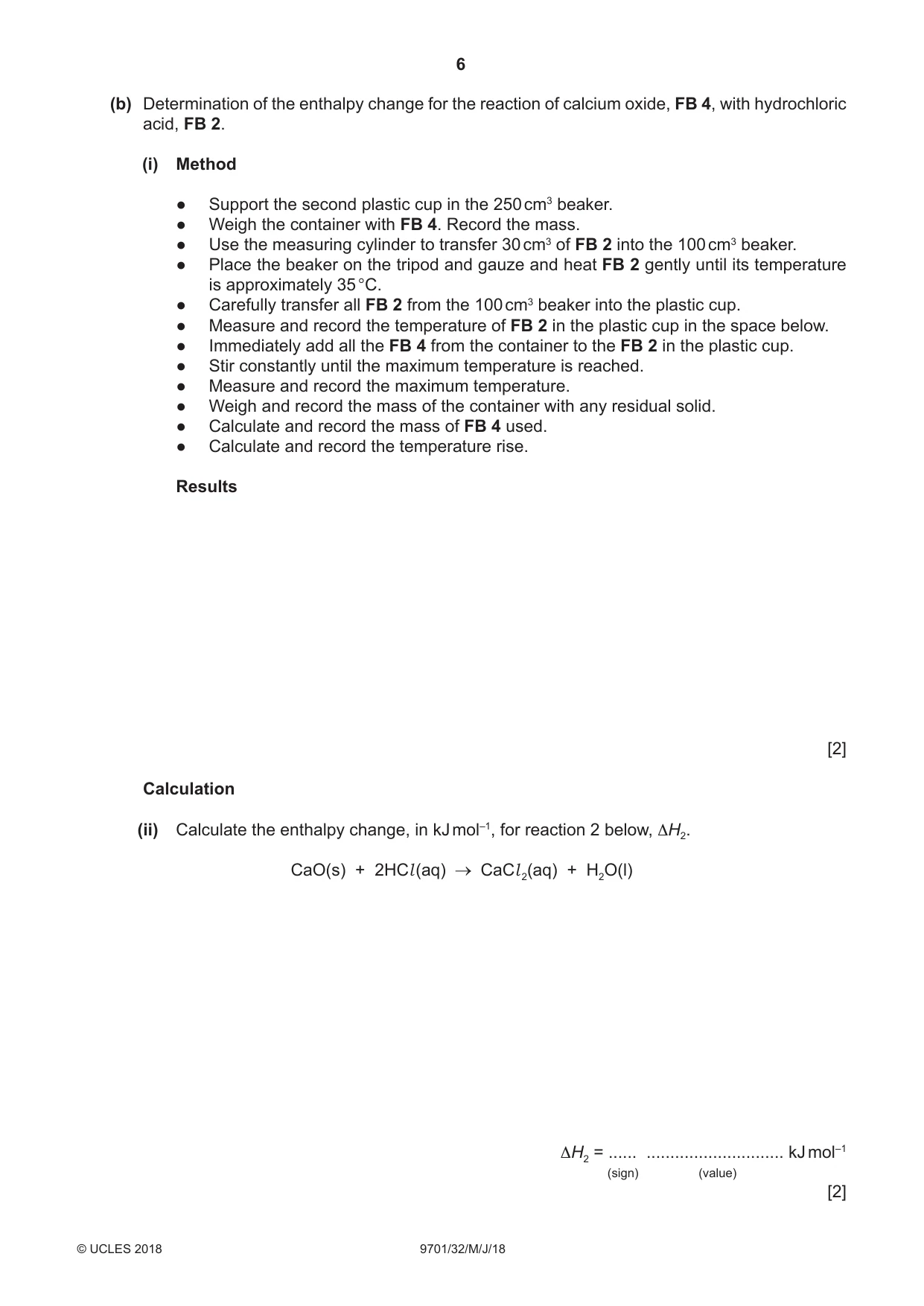
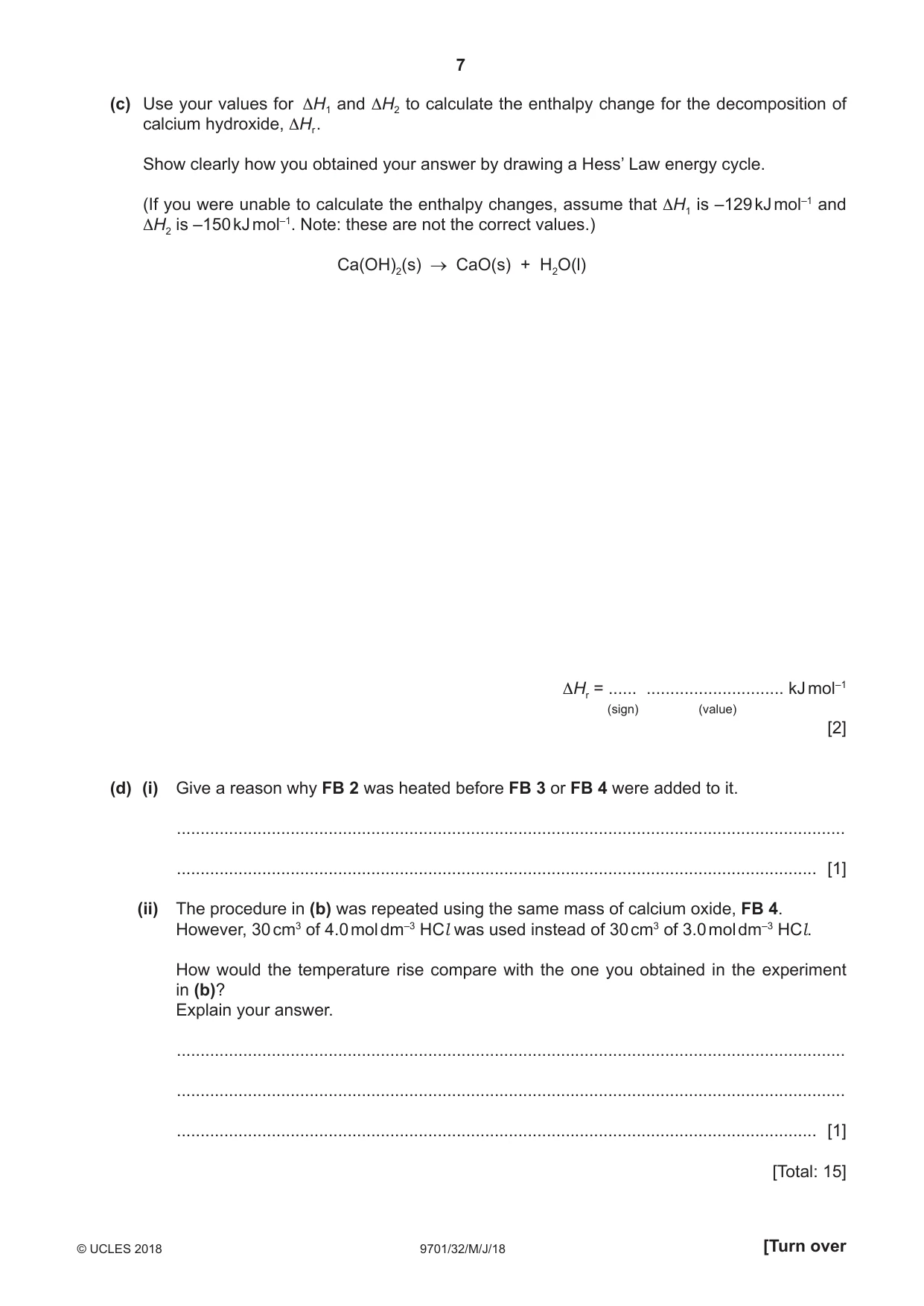
2 In this experiment you will determine the enthalpy change, ΔHr , for the decomposition of calcium hydroxide to calcium oxide. Ca(OH)2(s) CaO(s) + H2O(l) To do this, you will determine the enthalpy changes for the reactions of calcium hydroxide and calcium oxide with hydrochloric acid. Excess acid will be used for both experiments. You will then use Hess’ Law to calculate the enthalpy change for the reaction above. FB 2 is 3.0 mol dm–3 hydrochloric acid, HCl. FB 3 is calcium hydroxide, Ca(OH)2. FB 4 is calcium oxide, CaO. (a) Determination of the enthalpy change for the reaction of calcium hydroxide, FB 3, with hydrochloric acid, FB 2. (i) Method ● Support a plastic cup in the 250 cm3 beaker. ● Weigh the container with FB 3. Record the mass. ● Use the measuring cylinder to transfer 30 cm3 of FB 2 into the 100 cm3 beaker. ● Place the beaker on the tripod and gauze and heat FB 2 gently until its temperature is between 35 °C and 40 °C. Turn off the Bunsen burner. ● Carefully transfer all FB 2 from the 100 cm3 beaker into the plastic cup. ● Measure and record the temperature of FB 2 in the plastic cup in the space below. ● Immediately add all the FB 3 from the container to the FB 2 in the plastic cup. ● Stir constantly until the maximum temperature is reached. ● Measure and record the maximum temperature. ● Weigh and record the mass of the container with any residual solid. ● Calculate and record the mass of FB 3 used. ● Calculate and record the temperature rise. Results [4] Calculations (ii) Calculate the energy produced during this reaction. [Assume that 4.2 J of heat energy changes the temperature of 1.0 cm3 of solution by 1.0 °C.] energy produced = .............................. J [1] (iii) Calculate the number of moles of calcium hydroxide, FB 3, used in the experiment. moles of Ca(OH)2 = .............................. mol [1] (iv) Calculate the enthalpy change, in kJ mol–1, for reaction 1 below, ΔH1. Ca(OH)2(s) + 2HCl (aq) CaCl 2(aq) + 2H2O(l) ΔH1 = ...... ............................. kJ mol–1 (sign) (value) [1] (b) Determination of the enthalpy change for the reaction of calcium oxide, FB 4, with hydrochloric acid, FB 2. (i) Method ● Support the second plastic cup in the 250 cm3 beaker. ● Weigh the container with FB 4. Record the mass. ● Use the measuring cylinder to transfer 30 cm3 of FB 2 into the 100 cm3 beaker. ● Place the beaker on the tripod and gauze and heat FB 2 gently until its temperature is approximately 35 °C. ● Carefully transfer all FB 2 from the 100 cm3 beaker into the plastic cup. ● Measure and record the temperature of FB 2 in the plastic cup in the space below. ● Immediately add all the FB 4 from the container to the FB 2 in the plastic cup. ● Stir constantly until the maximum temperature is reached. ● Measure and record the maximum temperature. ● Weigh and record the mass of the container with any residual solid. ● Calculate and record the mass of FB 4 used. ● Calculate and record the temperature rise. Results [2] Calculation (ii) Calculate the enthalpy change, in kJ mol–1, for reaction 2 below, ΔH2. CaO(s) + 2HCl (aq) CaCl 2(aq) + H2O(l) ΔH2 = ...... ............................. kJ mol–1 (sign) (value) [2] (c) Use your values for ΔH1 and ΔH2 to calculate the enthalpy change for the decomposition of calcium hydroxide, ΔHr . Show clearly how you obtained your answer by drawing a Hess’ Law energy cycle. (If you were unable to calculate the enthalpy changes, assume that ΔH1 is –129 kJ mol–1 and ΔH2 is –150 kJ mol–1. Note: these are not the correct values.) Ca(OH)2(s) CaO(s) + H2O(l) ΔHr = ...... ............................. kJ mol–1 (sign) (value) [2] (d) (i) Give a reason why FB 2 was heated before FB 3 or FB 4 were added to it. ............................................................................................................................................. ....................................................................................................................................... [1] (ii) The procedure in (b) was repeated using the same mass of calcium oxide, FB 4. However, 30 cm3 of 4.0 mol dm–3 HCl was used instead of 30 cm3 of 3.0 mol dm–3 HCl. How would the temperature rise compare with the one you obtained in the experiment in (b)? Explain your answer. ............................................................................................................................................. ............................................................................................................................................. ....................................................................................................................................... [1] [Total: 15] Qualitative Analysis Where reagents are selected for use in a test, the name or correct formula of the element or compound must be given. At each stage of any test you are to record details of the following: ● colour changes seen; ● the formation of any precipitate and its solubility in an excess of the reagent added; ● the formation of any gas and its identification by a suitable test. You should indicate clearly at what stage in a test a change occurs. If any solution is warmed, a boiling tube must be used. Rinse and reuse test-tubes and boiling tubes where possible. No additional tests for ions present should be attempted.
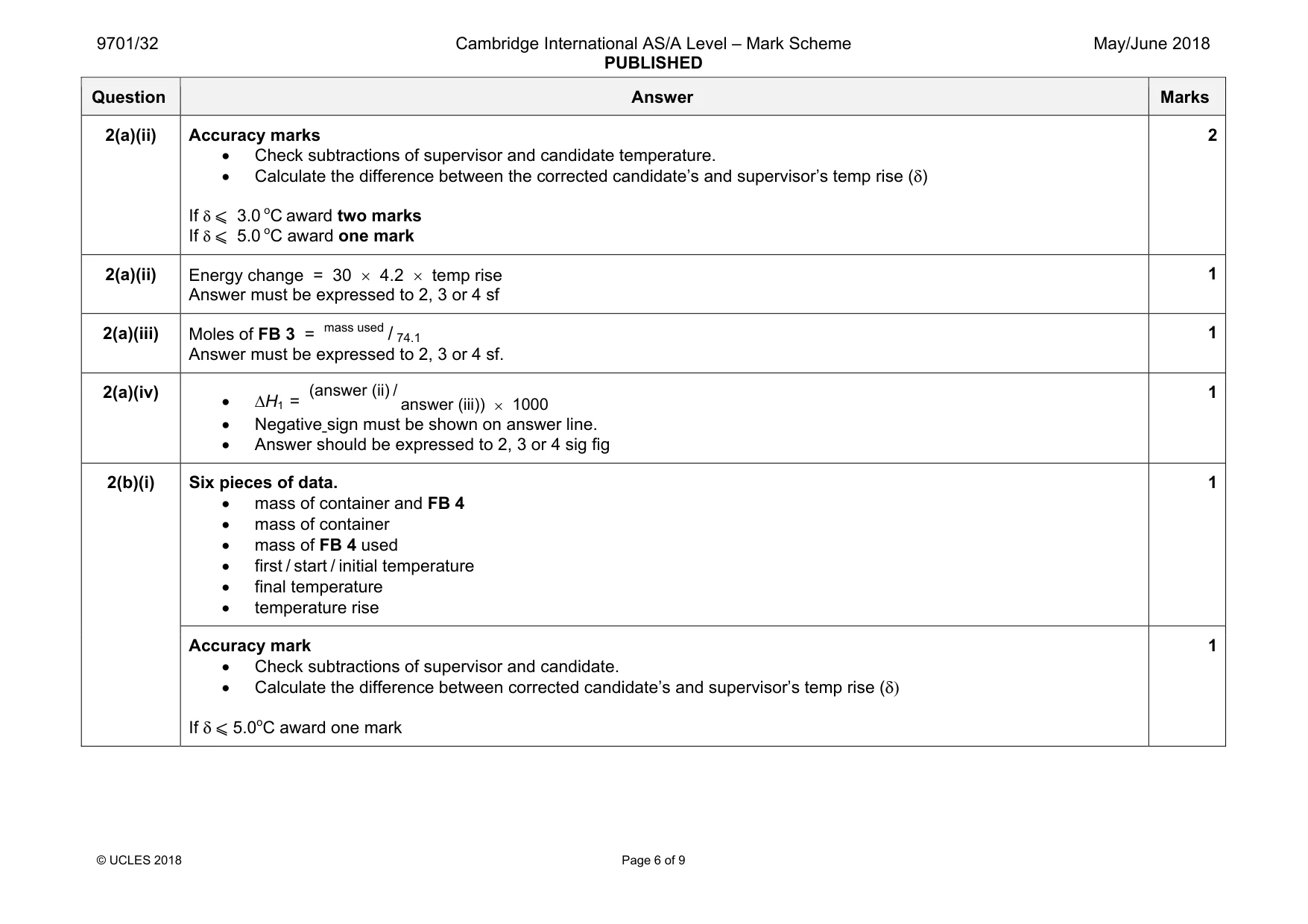
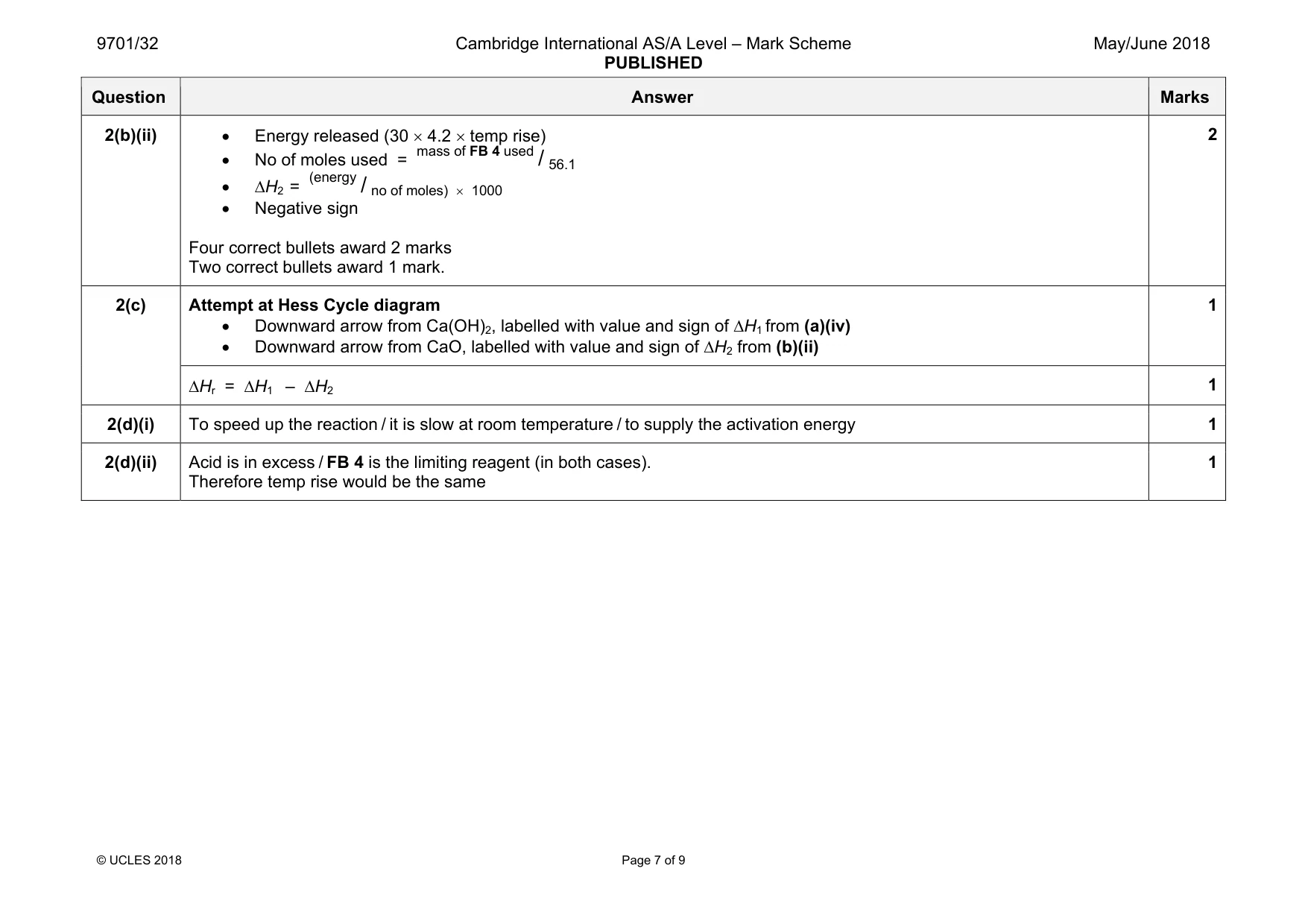
Mark scheme: 2(a)(i) Unambiguous headings, units and six pieces of data listed. • mass of container and FB 3 • mass of container • mass of FB 3 used • first / start / initial temperature • maximum temperature (allow final temp, temp after mixing) • temperature rise / change 1 Precision of readings shown in 2(a) and 2(b) • all four thermometer readings are shown to 0.0 or 0.5 oC • all four temperature readings > 30 oC 1 Question Answer Marks 2(a)(ii) Accuracy marks • Check subtractions of supervisor and candidate temperature. • Calculate the difference between the corrected candidate’s and supervisor’s temp rise (δ) If δ ⩽ 3.0 oC award two marks If δ ⩽ 5.0 oC award one mark 2 2(a)(ii) Energy change = 30 × 4.2 × temp rise Answer must be expressed to 2, 3 or 4 sf 1 2(a)(iii) Moles of FB 3 = mass used / 74.1 Answer must be expressed to 2, 3 or 4 sf. 1 2(a)(iv) • ∆H1 = (answer (ii) / answer (iii)) × 1000 • Negative sign must be shown on answer line. • Answer should be expressed to 2, 3 or 4 sig fig 1 2(b)(i) Six pieces of data. • mass of container and FB 4 • mass of container • mass of FB 4 used • first / start / initial temperature • final temperature • temperature rise 1 Accuracy mark • Check subtractions of supervisor and candidate. • Calculate the difference between corrected candidate’s and supervisor’s temp rise (δ) If δ ⩽ 5.0oC award one mark 1 Question Answer Marks 2(b)(ii) • Energy released (30 × 4.2 × temp rise) • No of moles used = mass of FB 4 used / 56.1 • ∆H2 = (energy / no of moles) × 1000 • Negative sign Four correct bullets award 2 marks Two correct bullets award 1 mark. 2 2(c) Attempt at Hess Cycle diagram • Downward arrow from Ca(OH)2, labelled with value and sign of ∆H1 from (a)(iv) • Downward arrow from CaO, labelled with value and sign of ∆H2 from (b)(ii) 1 ∆Hr = ∆H1 – ∆H2 1 2(d)(i) To speed up the reaction / it is slow at room temperature / to supply the activation energy 1 2(d)(ii) Acid is in excess / FB 4 is the limiting reagent (in both cases). Therefore temp rise would be the same 1
Q3 · FB 5, FB 6 and FB 7 are all aqueous solutions
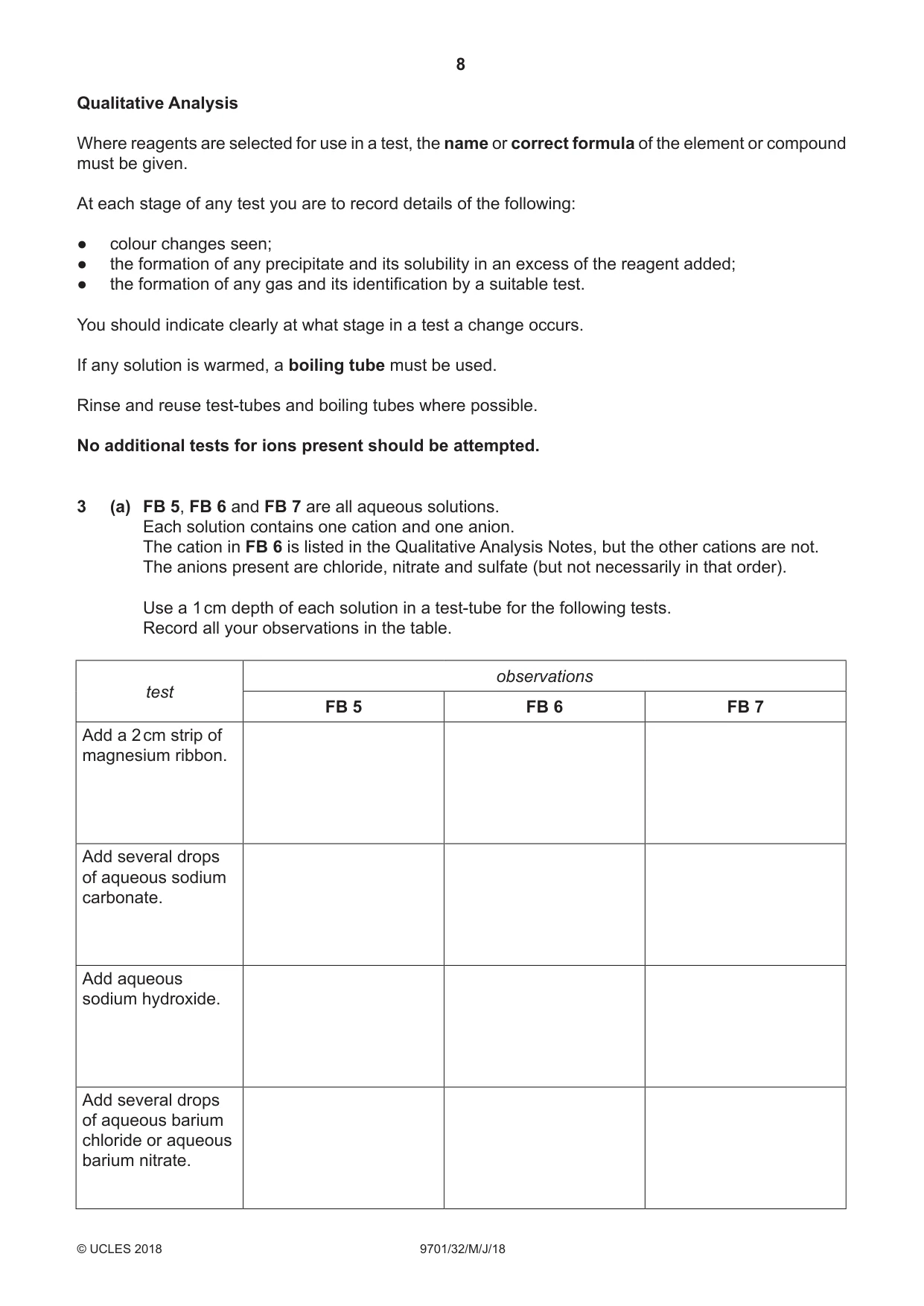
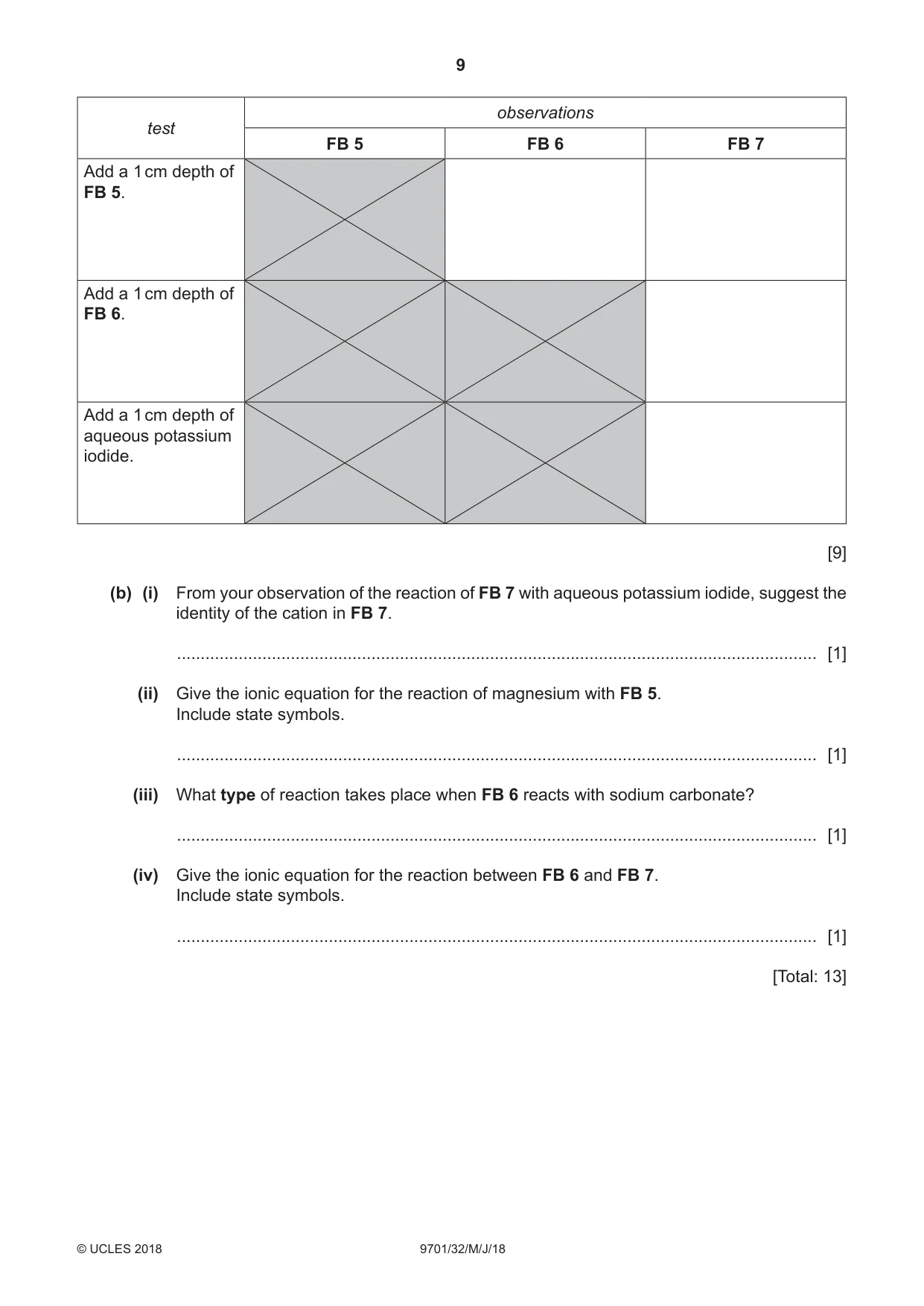
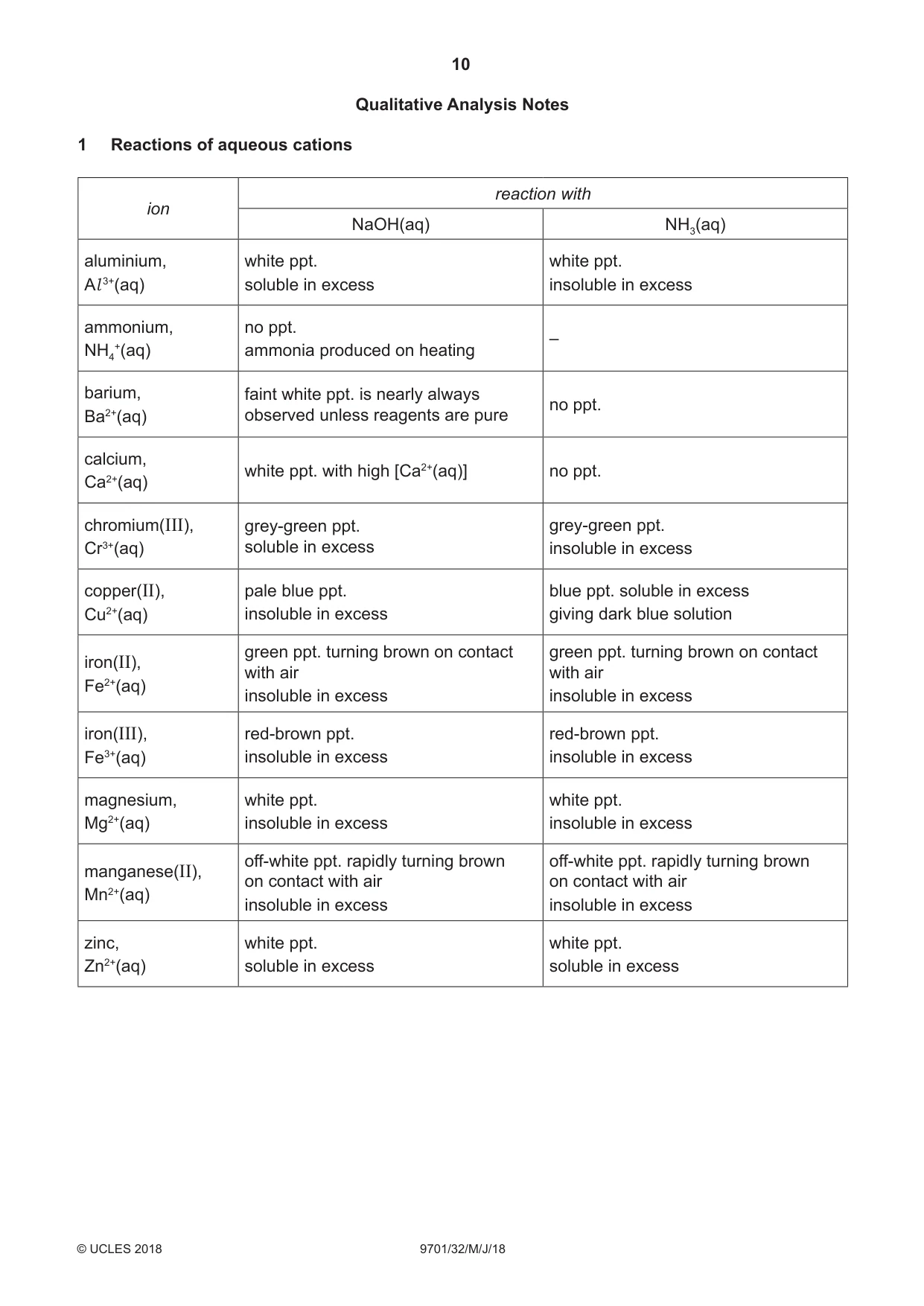
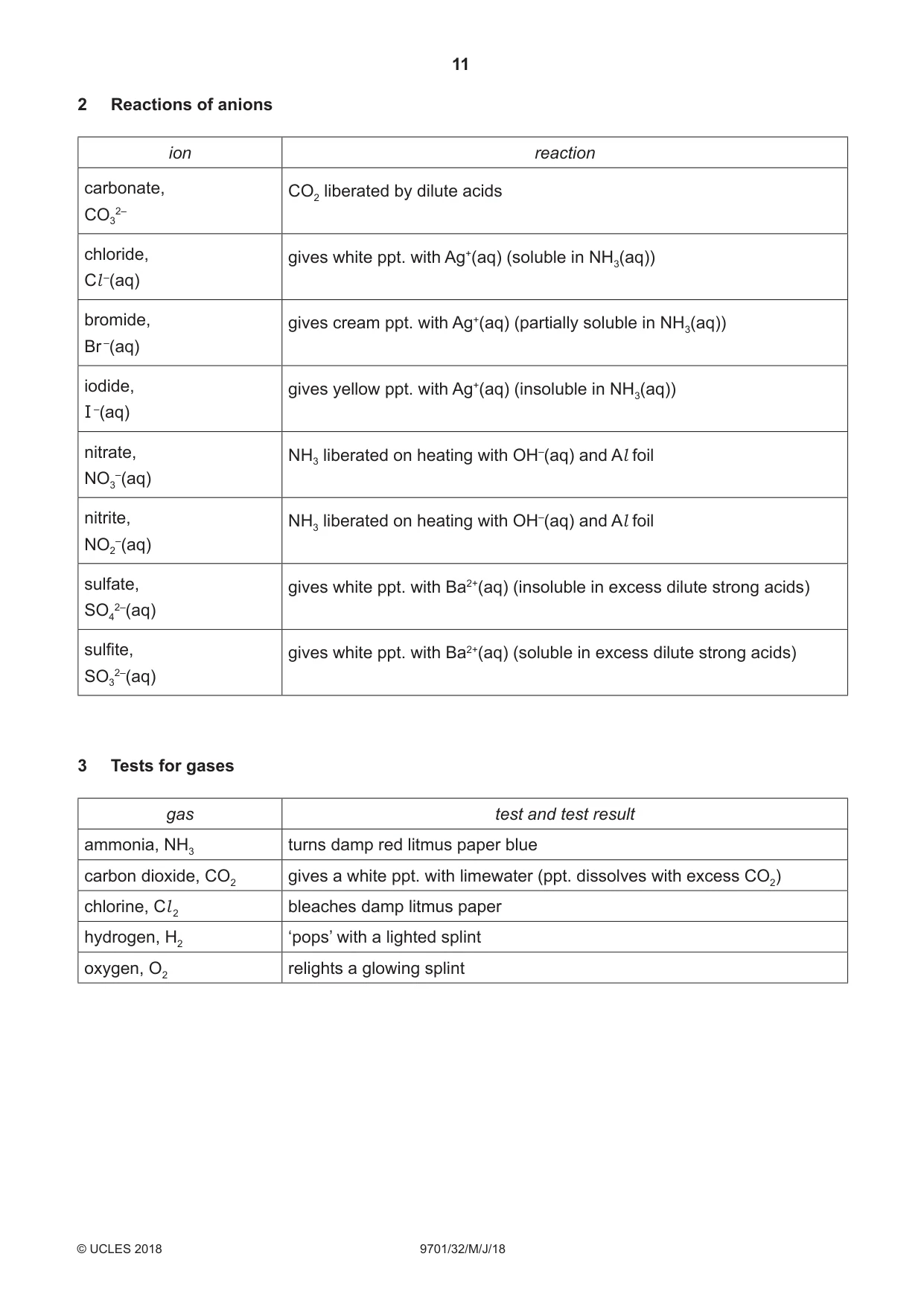
3 (a) FB 5, FB 6 and FB 7 are all aqueous solutions. Each solution contains one cation and one anion. The cation in FB 6 is listed in the Qualitative Analysis Notes, but the other cations are not. The anions present are chloride, nitrate and sulfate (but not necessarily in that order). Use a 1 cm depth of each solution in a test-tube for the following tests. Record all your observations in the table. observations test FB 5 FB 6 FB 7 Add a 2 cm strip of magnesium ribbon. Add several drops of aqueous sodium carbonate. Add aqueous sodium hydroxide. Add several drops of aqueous barium chloride or aqueous barium nitrate. observations test FB 5 FB 6 FB 7 Add a 1 cm depth of FB 5. Add a 1 cm depth of FB 6. Add a 1 cm depth of aqueous potassium iodide. [9] (b) (i) From your observation of the reaction of FB 7 with aqueous potassium iodide, suggest the identity of the cation in FB 7. ....................................................................................................................................... [1] (ii) Give the ionic equation for the reaction of magnesium with FB 5. Include state symbols. ....................................................................................................................................... [1] (iii) What type of reaction takes place when FB 6 reacts with sodium carbonate? ....................................................................................................................................... [1] (iv) Give the ionic equation for the reaction between FB 6 and FB 7. Include state symbols. ....................................................................................................................................... [1] [Total: 13] Qualitative Analysis Notes 1 Reactions of aqueous cations reaction with ion NaOH(aq) NH3(aq) aluminium, white ppt. white ppt. Al 3+(aq) soluble in excess insoluble in excess ammonium, no ppt. – NH4+(aq) ammonia produced on heating barium, faint white ppt. is nearly always no ppt. Ba2+(aq) observed unless reagents are pure calcium, white ppt. with high [Ca2+(aq)] no ppt. Ca2+(aq) chromium(III), grey-green ppt. grey-green ppt. Cr3+(aq) soluble in excess insoluble in excess copper(II), pale blue ppt. blue ppt. soluble in excess Cu2+(aq) insoluble in excess giving dark blue solution green ppt. turning brown on contact green ppt. turning brown on contact iron(II), with air with air Fe2+(aq) insoluble in excess insoluble in excess iron(III), red-brown ppt. red-brown ppt. Fe3+(aq) insoluble in excess insoluble in excess magnesium, white ppt. white ppt. Mg2+(aq) insoluble in excess insoluble in excess off-white ppt. rapidly turning brown off-white ppt. rapidly turning brown manganese(II), on contact with air on contact with air Mn2+(aq) insoluble in excess insoluble in excess zinc, white ppt. white ppt. Zn2+(aq) soluble in excess soluble in excess
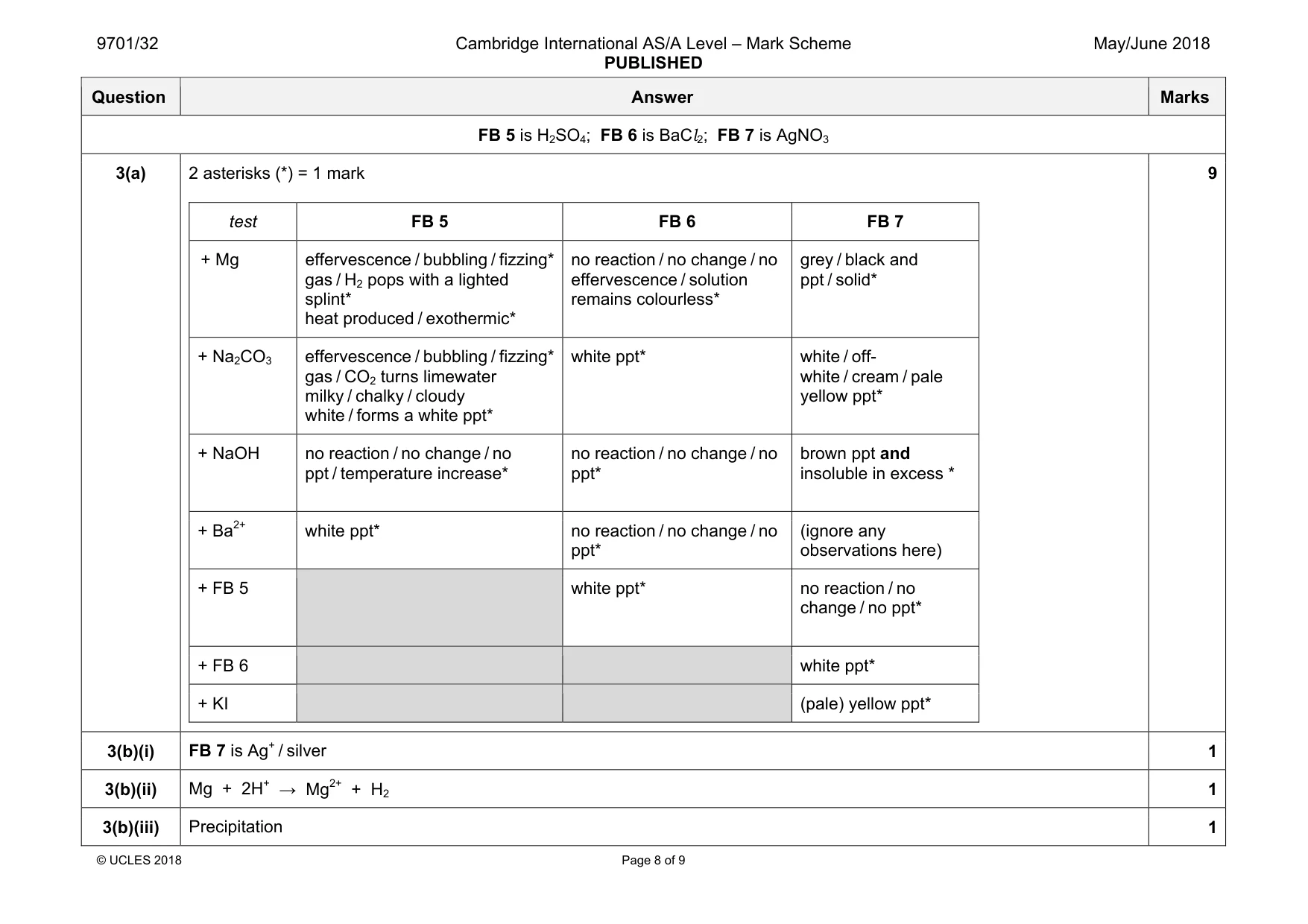
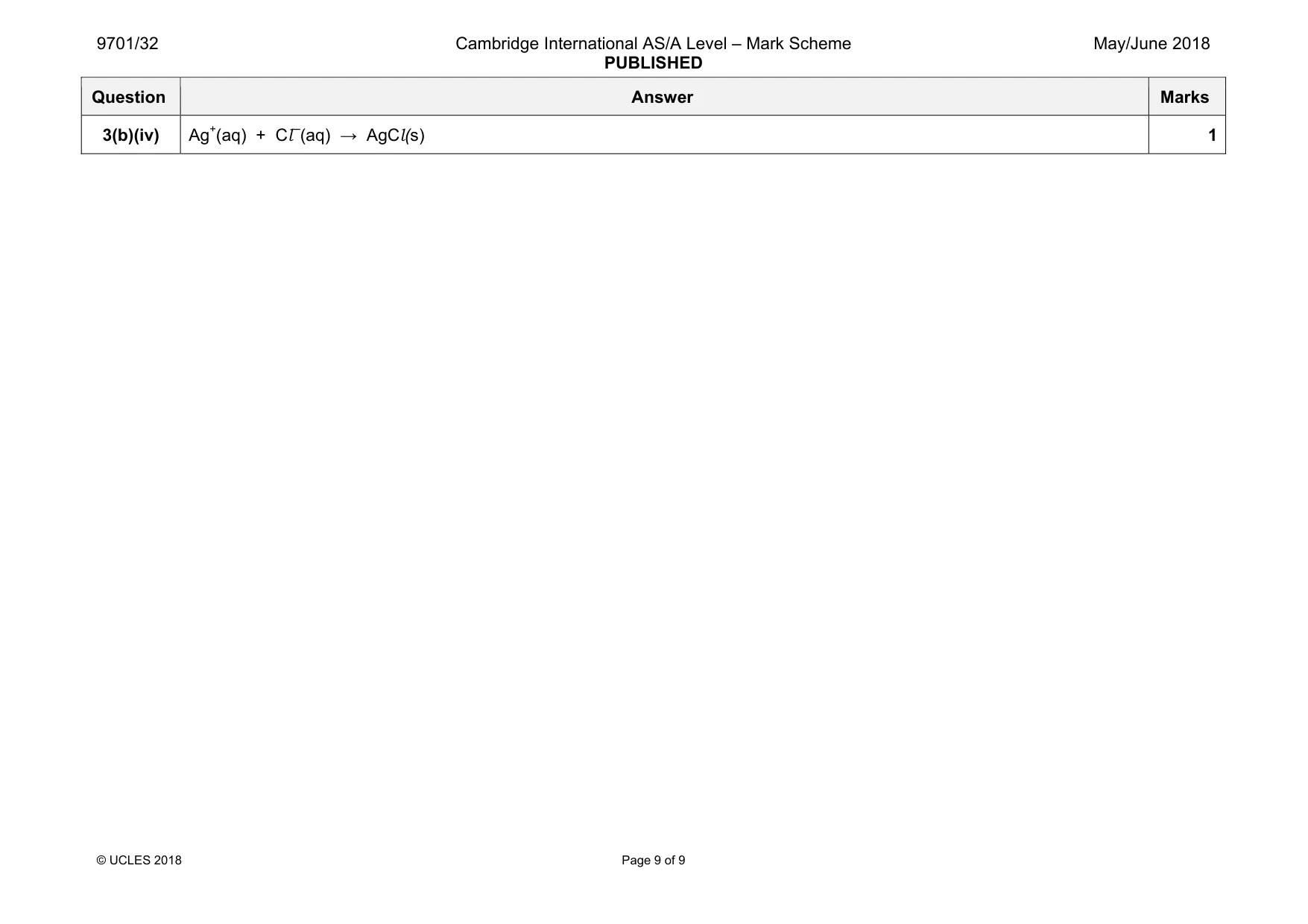
Mark scheme: 3(a) test FB 5 FB 6 FB 7 + Mg effervescence / bubbling / fizzing* gas / H2 pops with a lighted splint* heat produced / exothermic* no reaction / no change / no effervescence / solution remains colourless* grey / black and ppt / solid* + Na2CO3 effervescence / bubbling / fizzing* gas / CO2 turns limewater milky / chalky / cloudy white / forms a white ppt* white ppt* white / off- white / cream / pale yellow ppt* + NaOH no reaction / no change / no ppt / temperature increase* no reaction / no change / no ppt* brown ppt and insoluble in excess * + Ba2+ white ppt* no reaction / no change / no ppt* (ignore any observations here) + FB 5 white ppt* no reaction / no change / no ppt* + FB 6 white ppt* + KI (pale) yellow ppt* 9 3(b)(i) FB 7 is Ag+ / silver 1 3(b)(ii) Mg + 2H+ → Mg2+ + H2 1 3(b)(iii) Precipitation 1 Question Answer Marks 3(b)(iv) Ag+(aq) + Cl─(aq) → AgCl(s) 1
What was in this paper
The subtopics covered by these 3 questions, and how many questions each got. Open one in a new tab to see every Cambridge question on it.
What you needed in this session
Cambridge’s own grade thresholds for 2018 May/June, Paper 3 · Variant 2. A higher threshold means an easier paper — the bar moves with how the cohort did.