Cambridge A Level Chemistry 9701 — 2018 May/June Paper 3 · Variant 1
9701/31/M/J/18 · 3 questions · 40 marks · ≈45 min
The question paper and its mark scheme, free to read here and free to download. This is Cambridge’s own paper, exactly as it was sat.
Question paper16 pages


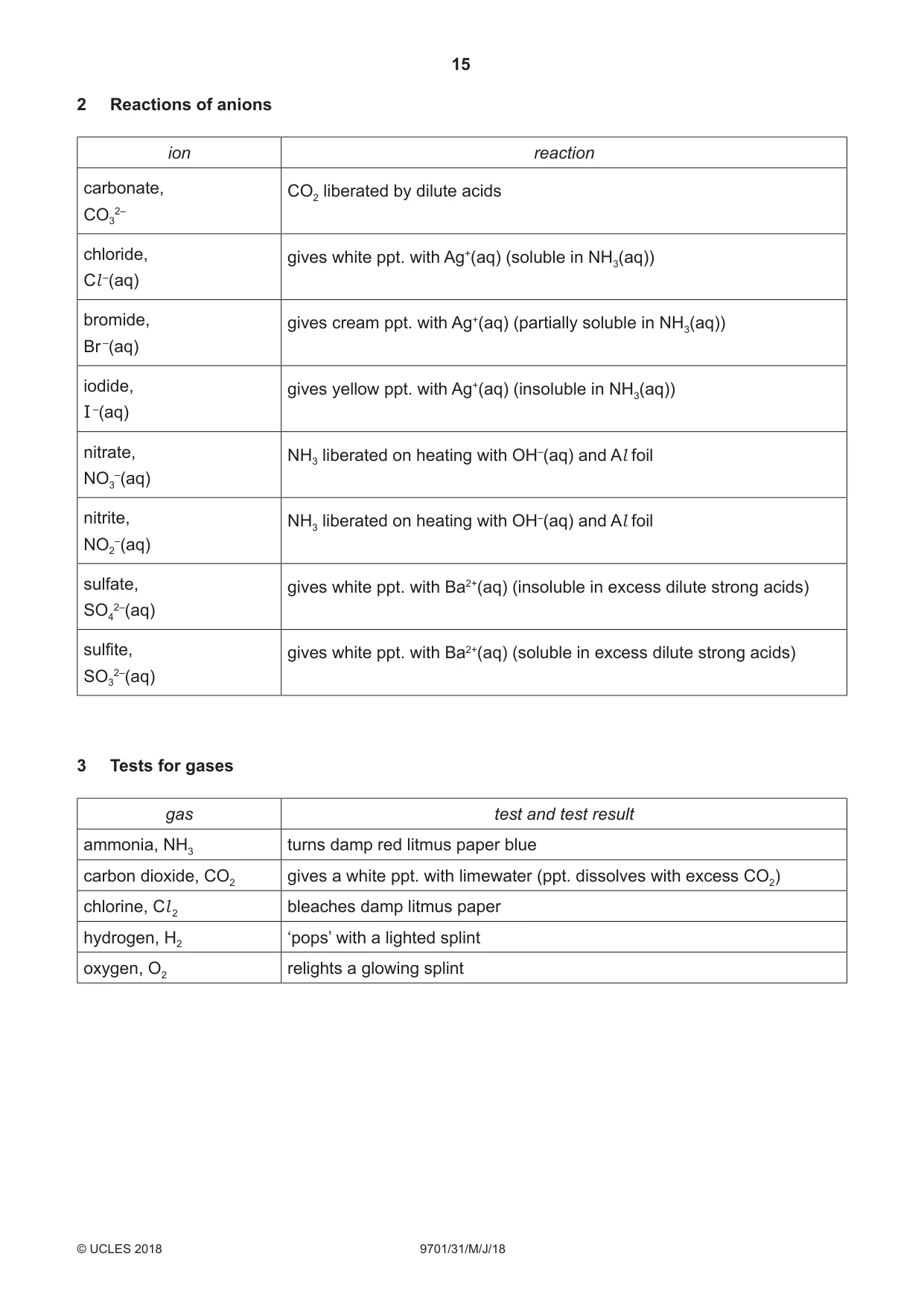
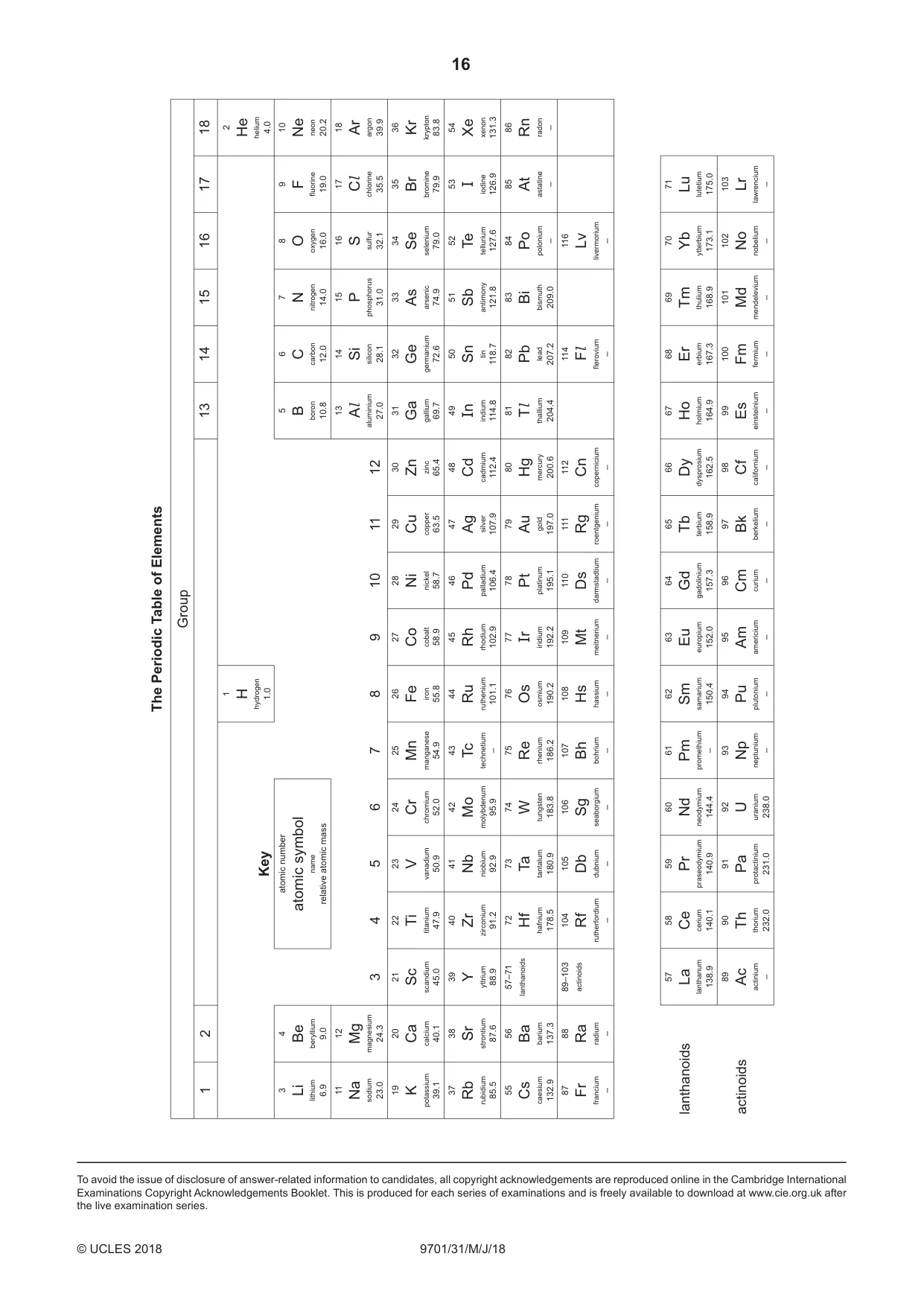
Mark scheme8 pages
Answers below. Sit the paper first if you are practising.
Questions as text
Q1 · In this experiment you will use a solution of sodium carbonate, Na2CO3, to determine the…
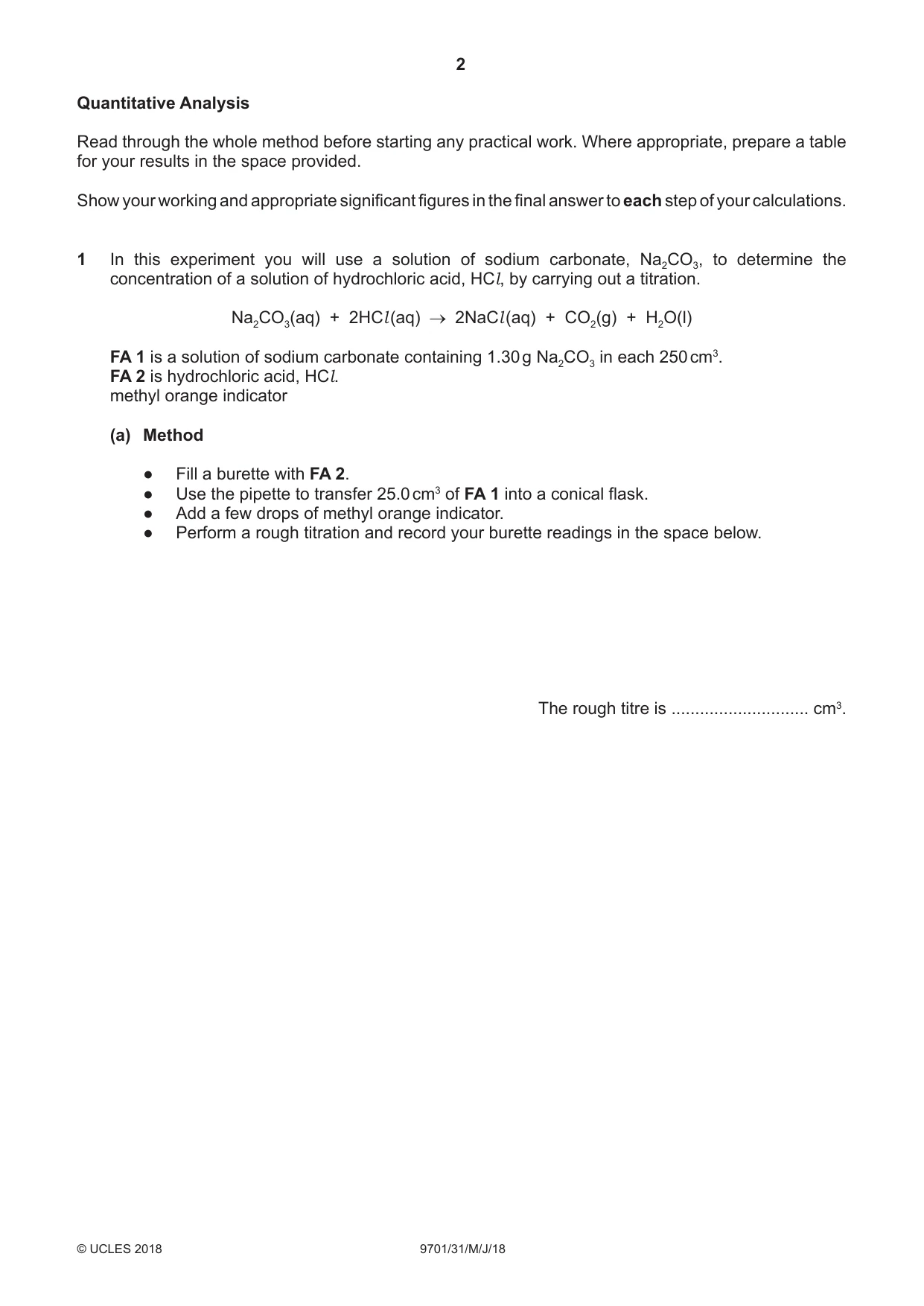
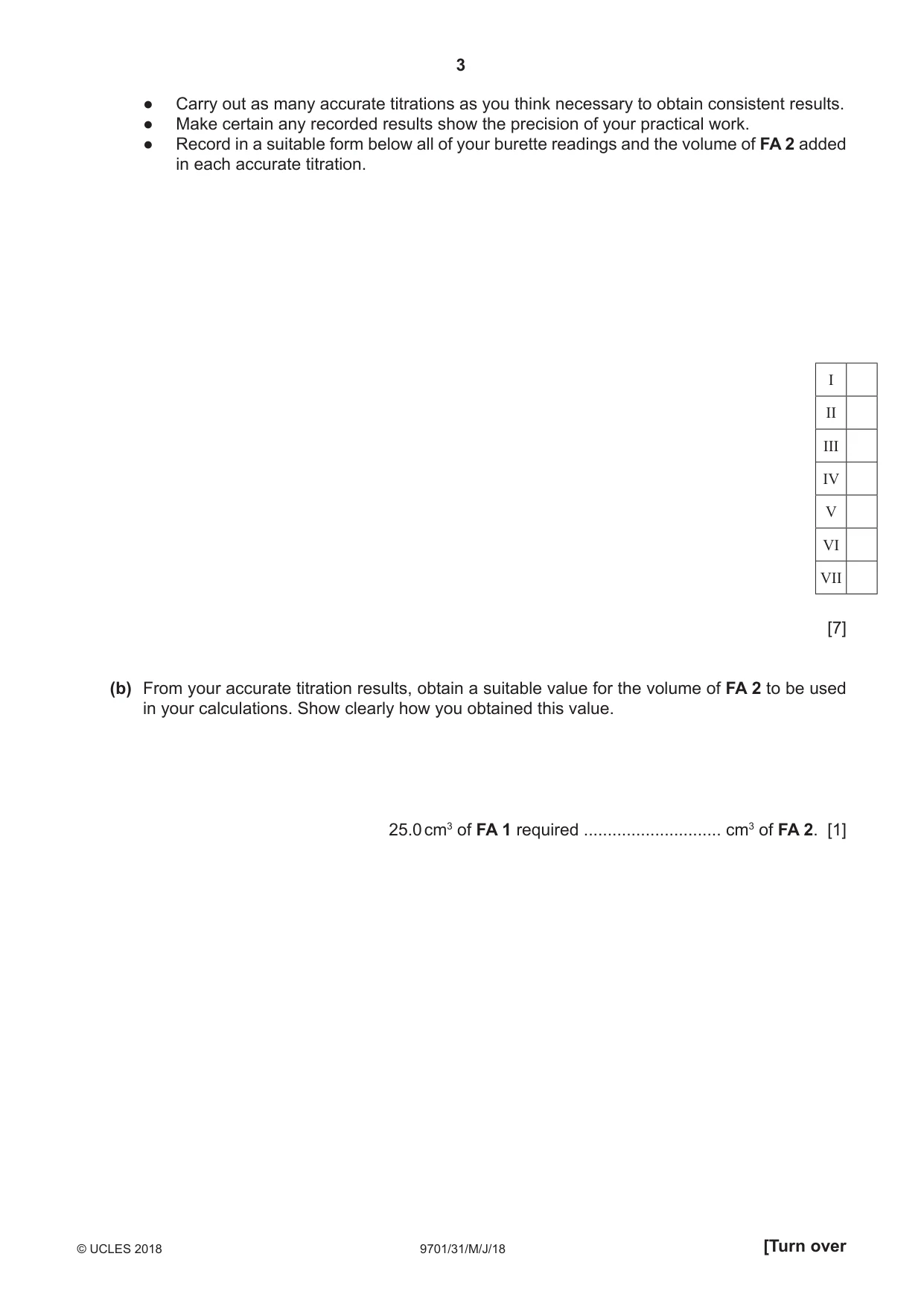
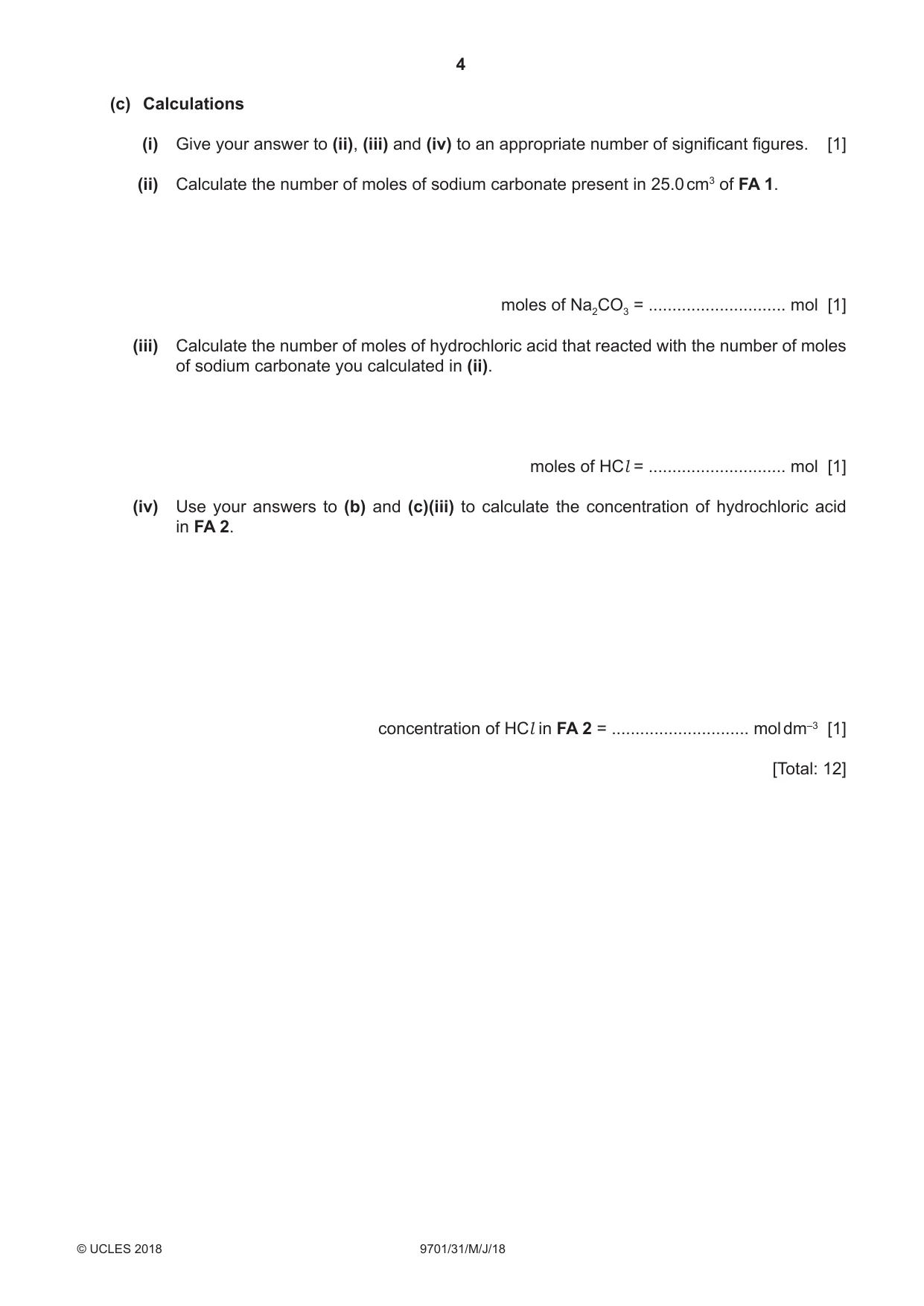
1 In this experiment you will use a solution of sodium carbonate, Na2CO3, to determine the concentration of a solution of hydrochloric acid, HCl, by carrying out a titration. Na2CO3(aq) + 2HCl (aq) 2NaCl (aq) + CO2(g) + H2O(l) FA 1 is a solution of sodium carbonate containing 1.30 g Na2CO3 in each 250 cm3. FA 2 is hydrochloric acid, HCl. methyl orange indicator (a) Method ● Fill a burette with FA 2. ● Use the pipette to transfer 25.0 cm3 of FA 1 into a conical flask. ● Add a few drops of methyl orange indicator. ● Perform a rough titration and record your burette readings in the space below. The rough titre is ............................. cm3. ● Carry out as many accurate titrations as you think necessary to obtain consistent results. ● Make certain any recorded results show the precision of your practical work. ● Record in a suitable form below all of your burette readings and the volume of FA 2 added in each accurate titration. I II III IV V VI VII [7] (b) From your accurate titration results, obtain a suitable value for the volume of FA 2 to be used in your calculations. Show clearly how you obtained this value. 25.0 cm3 of FA 1 required ............................. cm3 of FA 2. [1] (c) Calculations (i) Give your answer to (ii), (iii) and (iv) to an appropriate number of significant figures. [1] (ii) Calculate the number of moles of sodium carbonate present in 25.0 cm3 of FA 1. moles of Na2CO3 = ............................. mol [1] (iii) Calculate the number of moles of hydrochloric acid that reacted with the number of moles of sodium carbonate you calculated in (ii). moles of HCl = ............................. mol [1] (iv) Use your answers to (b) and (c)(iii) to calculate the concentration of hydrochloric acid in FA 2. concentration of HCl in FA 2 = ............................. mol dm–3 [1] [Total: 12]
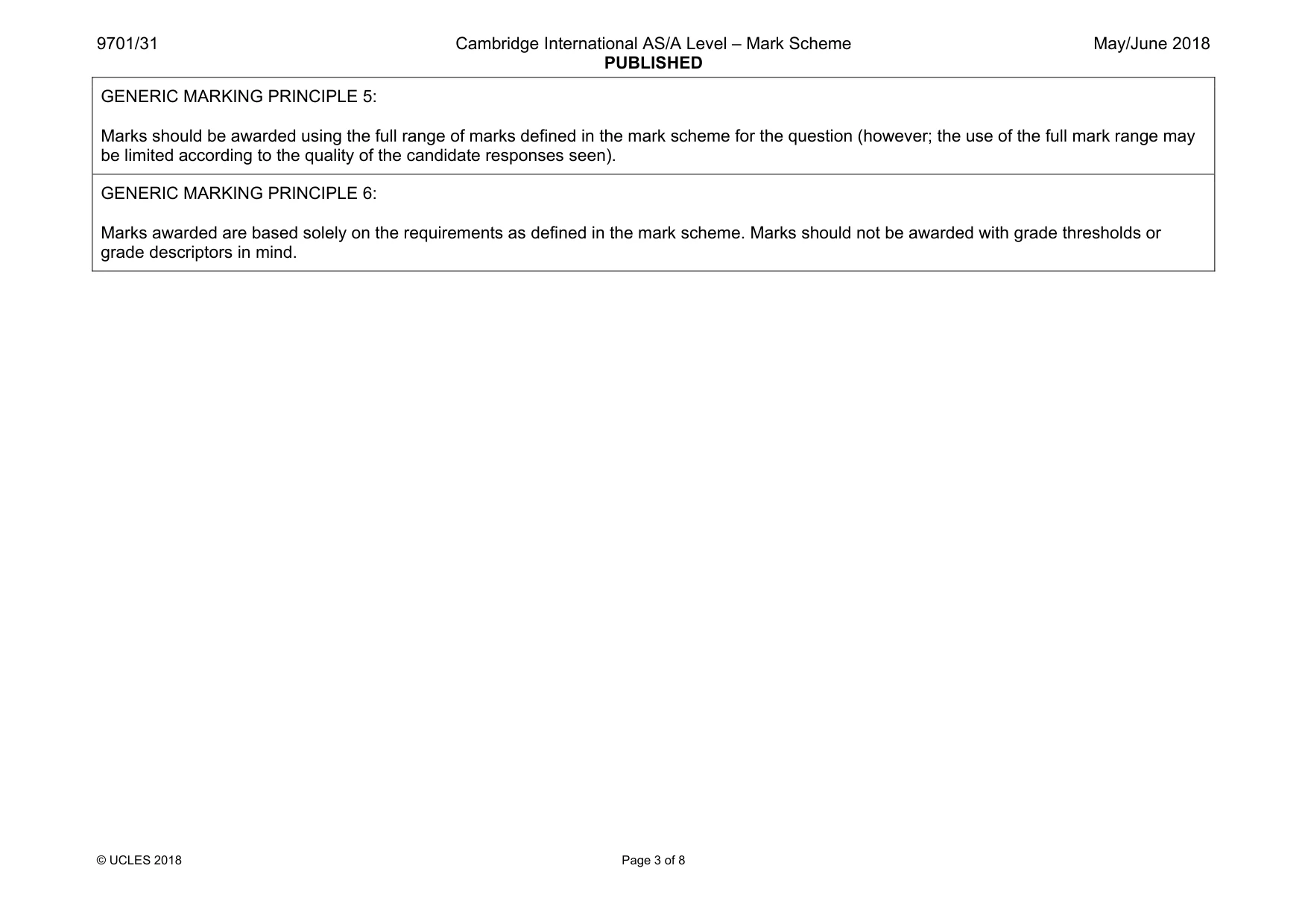
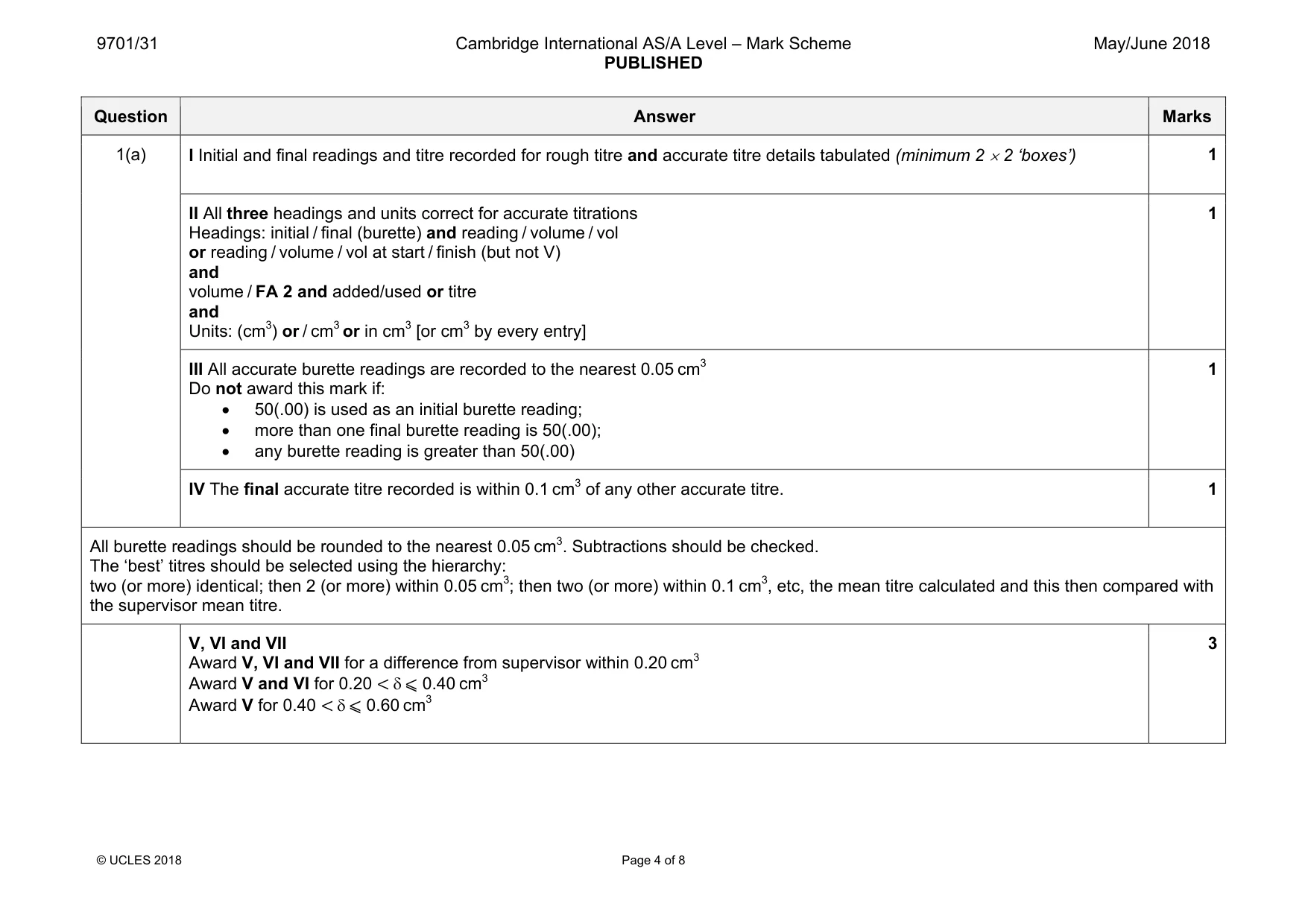
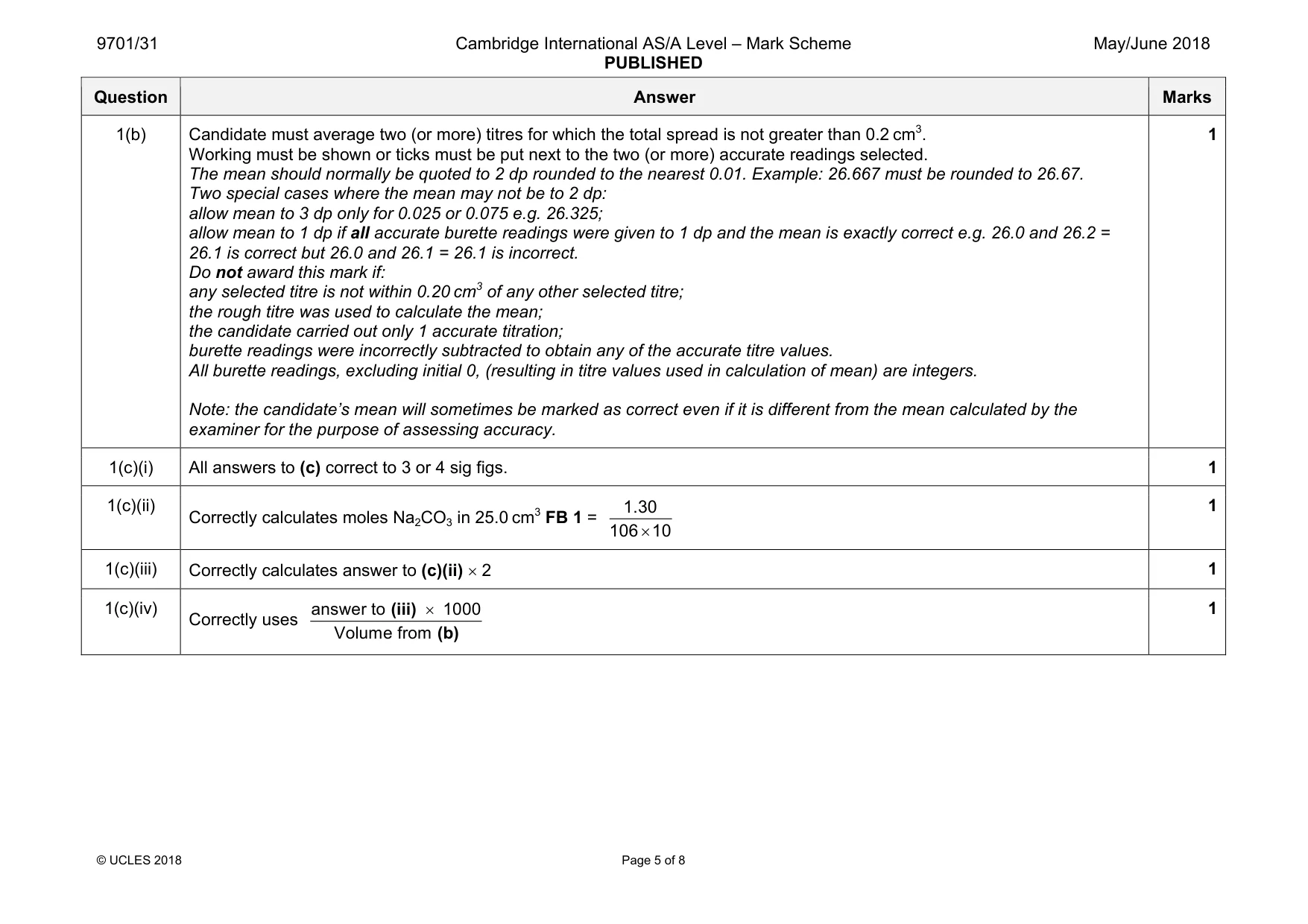
Mark scheme: 1(a) 1 II All three headings and units correct for accurate titrations Headings: initial / final (burette) and reading / volume / vol or reading / volume / vol at start / finish (but not V) and volume / FA 2 and added/used or titre and Units: (cm3) or / cm3 or in cm3 [or cm3 by every entry] 1 III All accurate burette readings are recorded to the nearest 0.05 cm3 Do not award this mark if: • 50(.00) is used as an initial burette reading; • more than one final burette reading is 50(.00); • any burette reading is greater than 50(.00) 1 IV The final accurate titre recorded is within 0.1 cm3 of any other accurate titre. 1 All burette readings should be rounded to the nearest 0.05 cm3. Subtractions should be checked. The ‘best’ titres should be selected using the hierarchy: two (or more) identical; then 2 (or more) within 0.05 cm3; then two (or more) within 0.1 cm3, etc, the mean titre calculated and this then compared with the supervisor mean titre. V, VI and VII Award V, VI and VII for a difference from supervisor within 0.20 cm3 Award V and VI for 0.20 < δ ⩽ 0.40 cm3 Award V for 0.40 < δ ⩽ 0.60 cm3 3 Question Answer Marks 1(b) Candidate must average two (or more) titres for which the total spread is not greater than 0.2 cm3. Working must be shown or ticks must be put next to the two (or more) accurate readings selected. The mean should normally be quoted to 2 dp rounded to the nearest 0.01. Example: 26.667 must be rounded to 26.67. Two special cases where the mean may not be to 2 dp: allow mean to 3 dp only for 0.025 or 0.075 e.g. 26.325; allow mean to 1 dp if all accurate burette readings were given to 1 dp and the mean is exactly correct e.g. 26.0 and 26.2 = 26.1 is correct but 26.0 and 26.1 = 26.1 is incorrect. Do not award this mark if: any selected titre is not within 0.20 cm3 of any other selected titre; the rough titre was used to calculate the mean; the candidate carried out only 1 accurate titration; burette readings were incorrectly subtracted to obtain any of the accurate titre values. All burette readings, excluding initial 0, (resulting in titre values used in calculation of mean) are integers. Note: the candidate’s mean will sometimes be marked as correct even if it is different from the mean calculated by the examiner for the purpose of assessing accuracy. 1 1(c)(i) All answers to (c) correct to 3 or 4 sig figs. 1 1(c)(ii) Correctly calculates moles Na2CO3 in 25.0 cm3 FB 1 = × 1.30 106 10 1 1(c)(iii) Correctly calculates answer to (c)(ii) × 2 1 1(c)(iv) Correctly uses × answer to 1000 Volume from (iii) (b) 1
More questions on Reacting masses and volumes (of solutions and gases)
Q2 · In this question you will determine the identity of the halogen in compound W
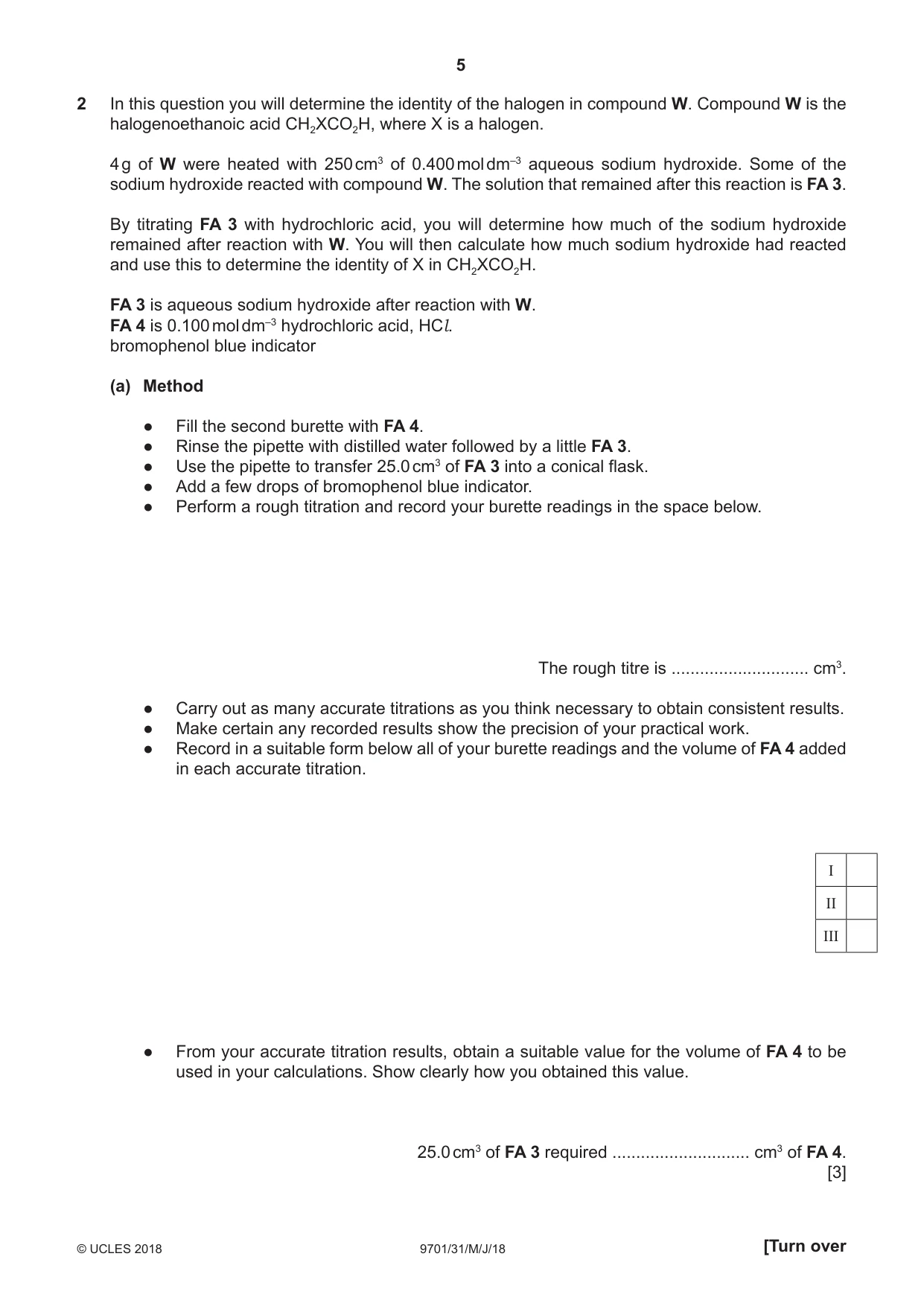
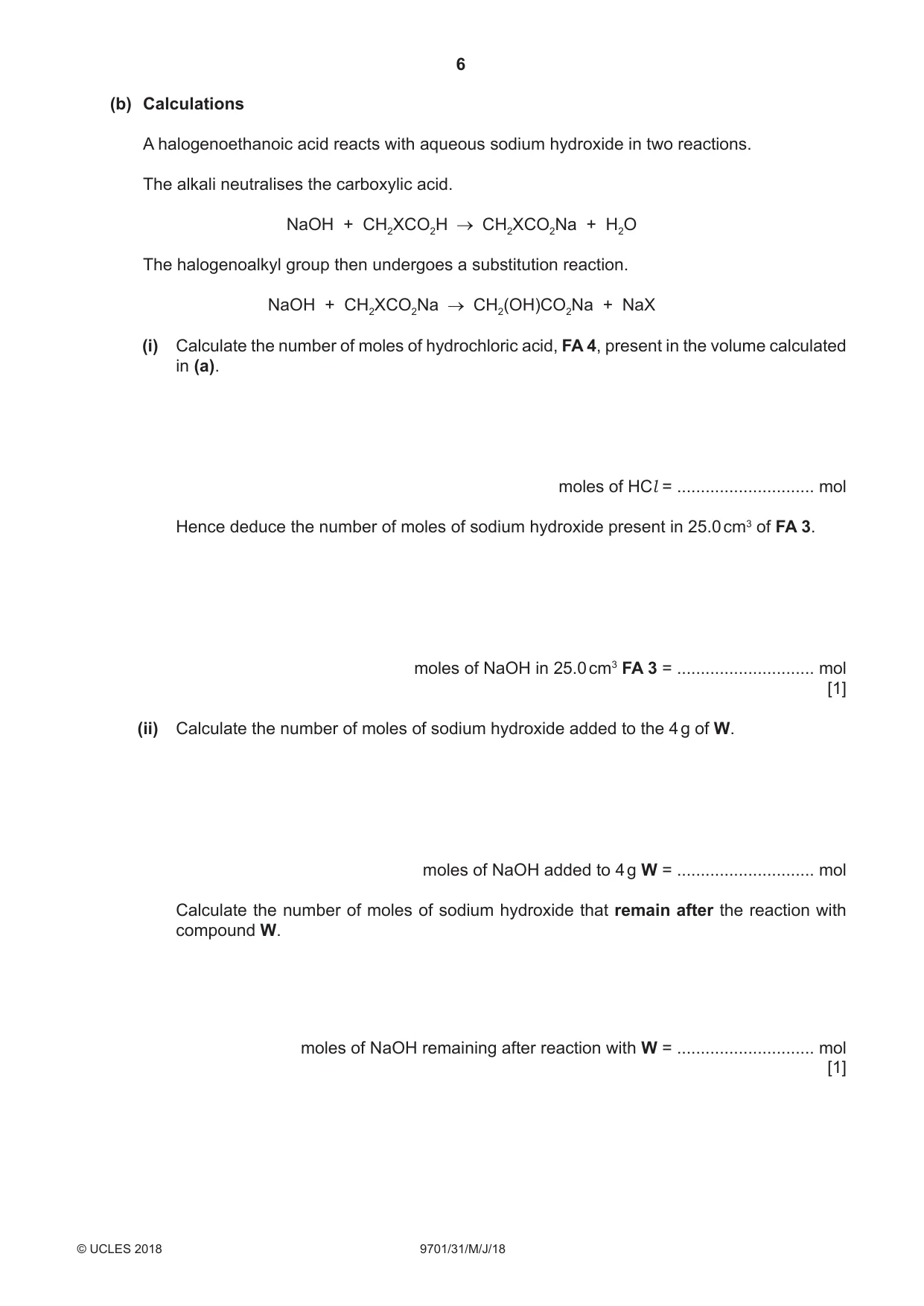
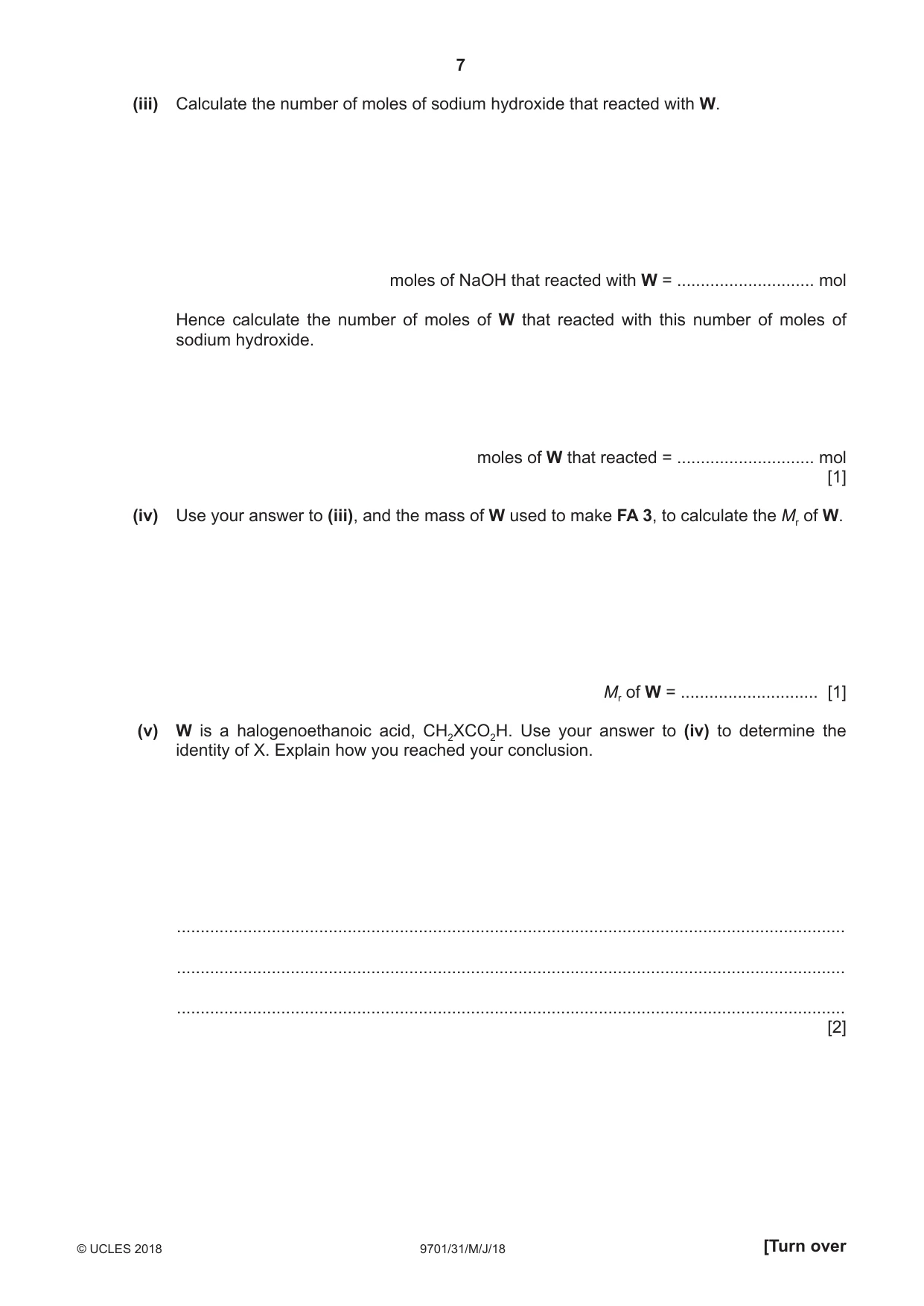
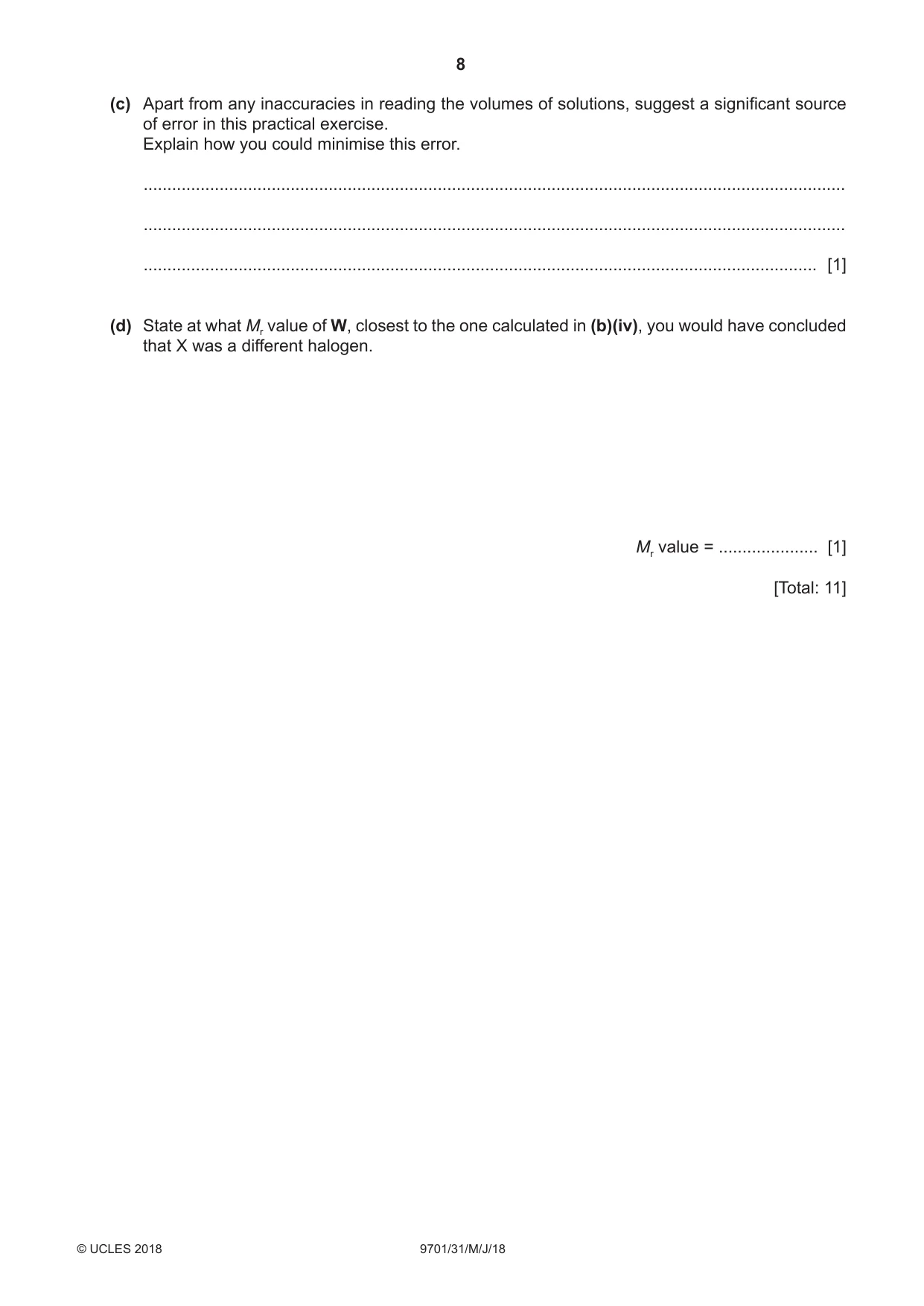
2 In this question you will determine the identity of the halogen in compound W. Compound W is the halogenoethanoic acid CH2XCO2H, where X is a halogen. 4 g of W were heated with 250 cm3 of 0.400 mol dm–3 aqueous sodium hydroxide. Some of the sodium hydroxide reacted with compound W. The solution that remained after this reaction is FA 3. By titrating FA 3 with hydrochloric acid, you will determine how much of the sodium hydroxide remained after reaction with W. You will then calculate how much sodium hydroxide had reacted and use this to determine the identity of X in CH2XCO2H. FA 3 is aqueous sodium hydroxide after reaction with W. FA 4 is 0.100 mol dm–3 hydrochloric acid, HCl. bromophenol blue indicator (a) Method ● Fill the second burette with FA 4. ● Rinse the pipette with distilled water followed by a little FA 3. ● Use the pipette to transfer 25.0 cm3 of FA 3 into a conical flask. ● Add a few drops of bromophenol blue indicator. ● Perform a rough titration and record your burette readings in the space below. The rough titre is ............................. cm3. ● Carry out as many accurate titrations as you think necessary to obtain consistent results. ● Make certain any recorded results show the precision of your practical work. ● Record in a suitable form below all of your burette readings and the volume of FA 4 added in each accurate titration. I II III ● From your accurate titration results, obtain a suitable value for the volume of FA 4 to be used in your calculations. Show clearly how you obtained this value. 25.0 cm3 of FA 3 required ............................. cm3 of FA 4. [3] (b) Calculations A halogenoethanoic acid reacts with aqueous sodium hydroxide in two reactions. The alkali neutralises the carboxylic acid. NaOH + CH2XCO2H CH2XCO2Na + H2O The halogenoalkyl group then undergoes a substitution reaction. NaOH + CH2XCO2Na CH2(OH)CO2Na + NaX (i) Calculate the number of moles of hydrochloric acid, FA 4, present in the volume calculated in (a). moles of HCl = ............................. mol Hence deduce the number of moles of sodium hydroxide present in 25.0 cm3 of FA 3. moles of NaOH in 25.0 cm3 FA 3 = ............................. mol [1] (ii) Calculate the number of moles of sodium hydroxide added to the 4 g of W. moles of NaOH added to 4 g W = ............................. mol Calculate the number of moles of sodium hydroxide that remain after the reaction with compound W. moles of NaOH remaining after reaction with W = ............................. mol [1] (iii) Calculate the number of moles of sodium hydroxide that reacted with W. moles of NaOH that reacted with W = ............................. mol Hence calculate the number of moles of W that reacted with this number of moles of sodium hydroxide. moles of W that reacted = ............................. mol [1] (iv) Use your answer to (iii), and the mass of W used to make FA 3, to calculate the Mr of W. Mr of W = ............................. [1] (v) W is a halogenoethanoic acid, CH2XCO2H. Use your answer to (iv) to determine the identity of X. Explain how you reached your conclusion. ............................................................................................................................................. ............................................................................................................................................. ............................................................................................................................................. [2] (c) Apart from any inaccuracies in reading the volumes of solutions, suggest a significant source of error in this practical exercise. Explain how you could minimise this error. .................................................................................................................................................... .................................................................................................................................................... .............................................................................................................................................. [1] (d) State at what Mr value of W, closest to the one calculated in (b)(iv), you would have concluded that X was a different halogen. Mr value = ..................... [1] [Total: 11] Qualitative Analysis Where reagents are selected for use in a test, the name or correct formula of the element or compound must be given. At each stage of any test you are to record details of the following: ● colour changes seen; ● the formation of any precipitate and its solubility in an excess of the reagent added; ● the formation of any gas and its identification by a suitable test. You should indicate clearly at what stage in a test a change occurs. If any solution is warmed, a boiling tube must be used. Rinse and reuse test-tubes and boiling tubes where possible. No additional tests for ions present should be attempted.
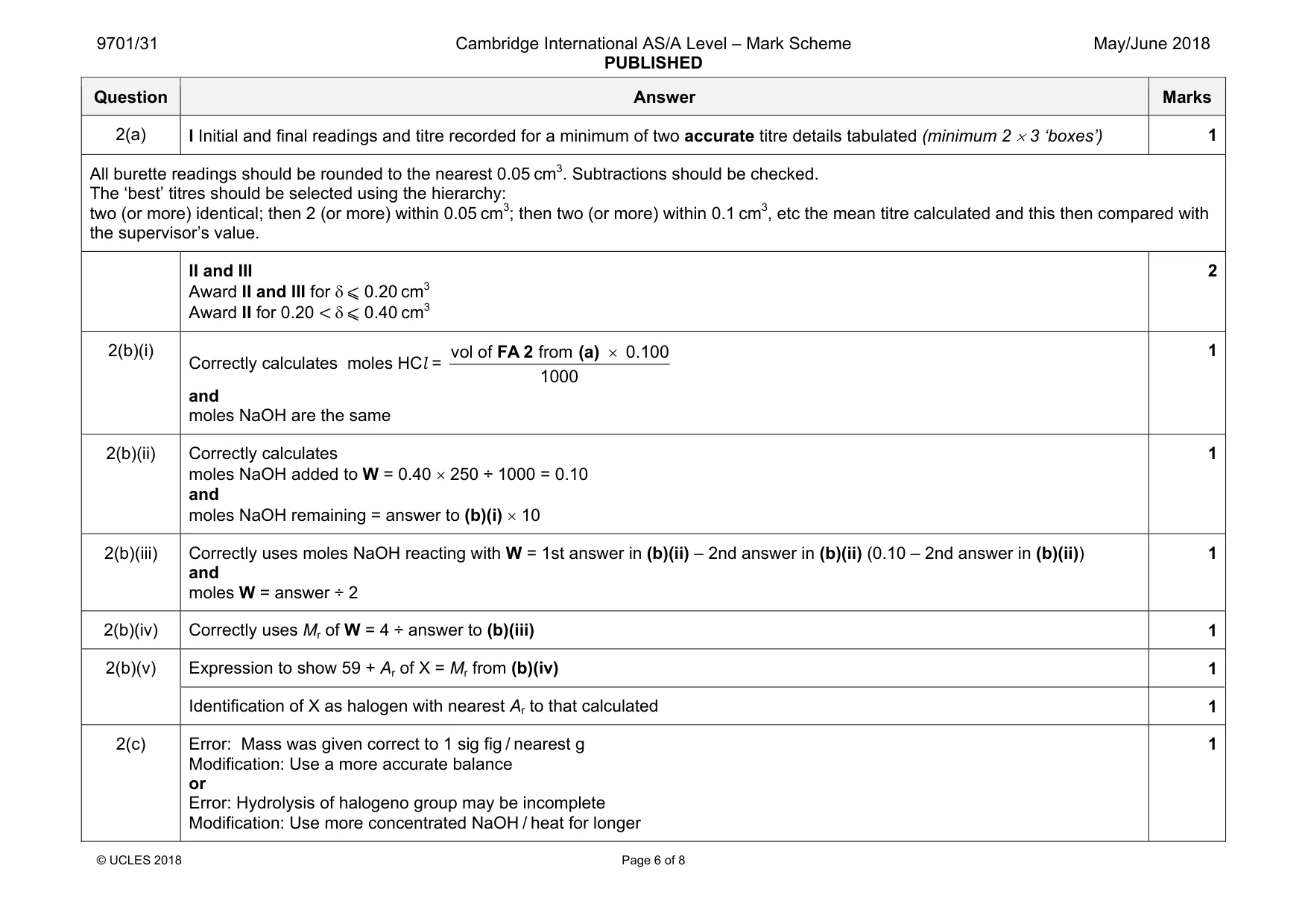
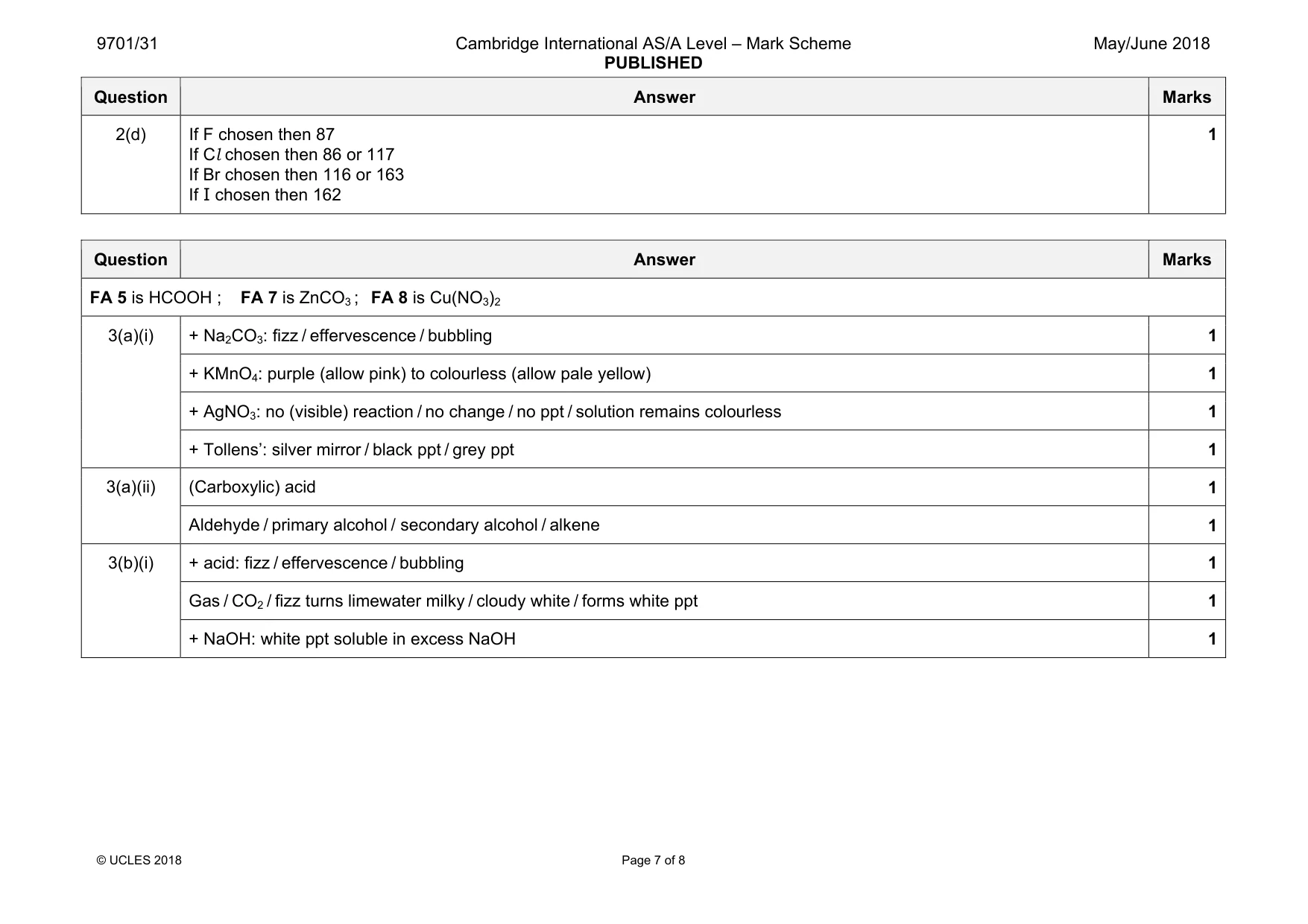
Mark scheme: 2(a) 1 All burette readings should be rounded to the nearest 0.05 cm3. Subtractions should be checked. The ‘best’ titres should be selected using the hierarchy: two (or more) identical; then 2 (or more) within 0.05 cm3; then two (or more) within 0.1 cm3, etc the mean titre calculated and this then compared with the supervisor’s value. II and III Award II and III for δ ⩽ 0.20 cm3 Award II for 0.20 < δ ⩽ 0.40 cm3 2 2(b)(i) Correctly calculates moles HCl = × vol of from 0.100 1000 FA 2 (a) and moles NaOH are the same 1 2(b)(ii) Correctly calculates moles NaOH added to W = 0.40 × 250 ÷ 1000 = 0.10 and moles NaOH remaining = answer to (b)(i) × 10 1 2(b)(iii) Correctly uses moles NaOH reacting with W = 1st answer in (b)(ii) – 2nd answer in (b)(ii) (0.10 – 2nd answer in (b)(ii)) and moles W = answer ÷ 2 1 2(b)(iv) Correctly uses Mr of W = 4 ÷ answer to (b)(iii) 1 2(b)(v) Expression to show 59 + Ar of X = Mr from (b)(iv) 1 Identification of X as halogen with nearest Ar to that calculated 1 2(c) Error: Mass was given correct to 1 sig fig / nearest g Modification: Use a more accurate balance or Error: Hydrolysis of halogeno group may be incomplete Modification: Use more concentrated NaOH / heat for longer 1 Question Answer Marks 2(d) If F chosen then 87 If Cl chosen then 86 or 117 If Br chosen then 116 or 163 If I chosen then 162 1
More questions on Reacting masses and volumes (of solutions and gases)
Q3 · Half fill the 250 cm3 beaker with water
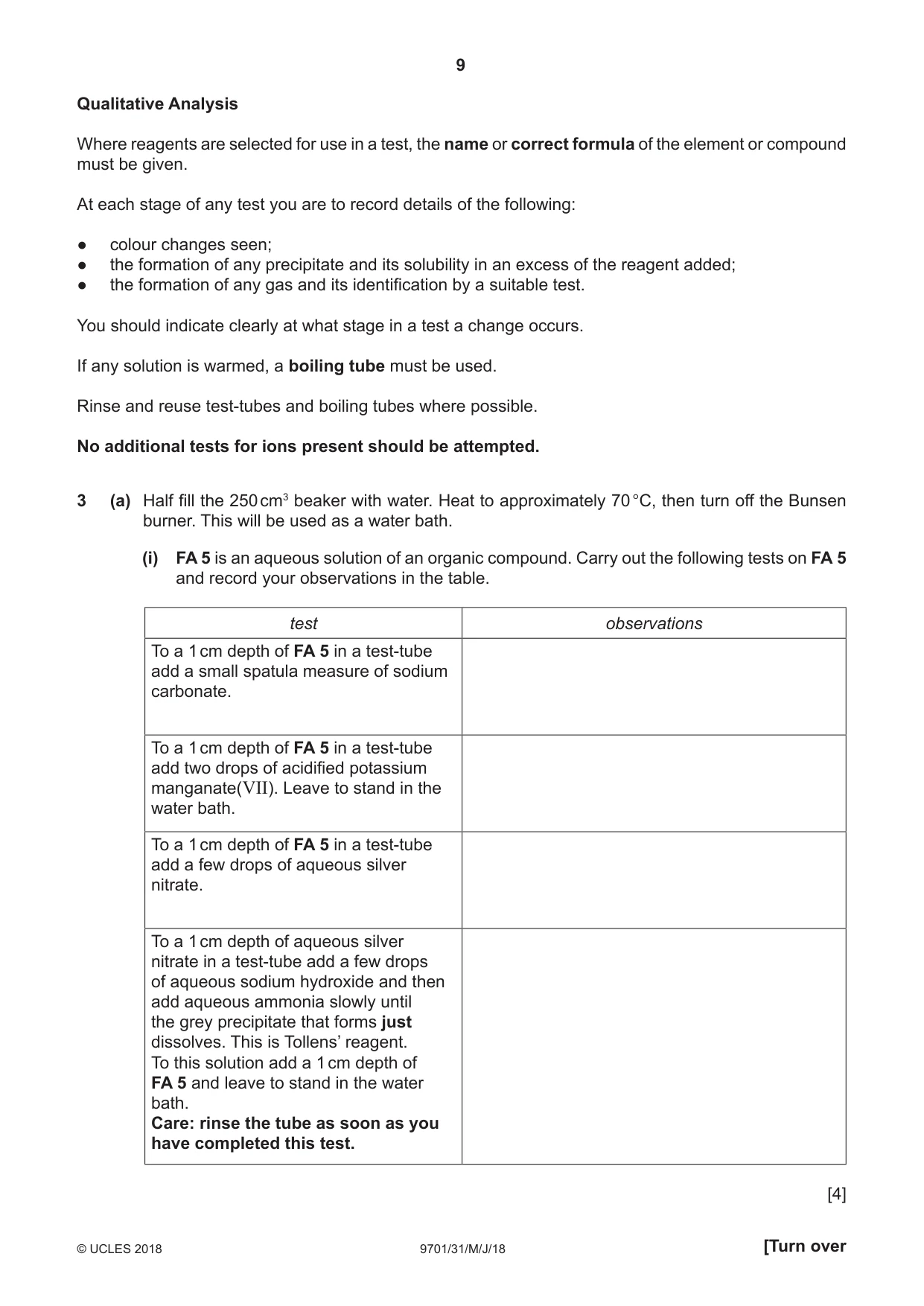
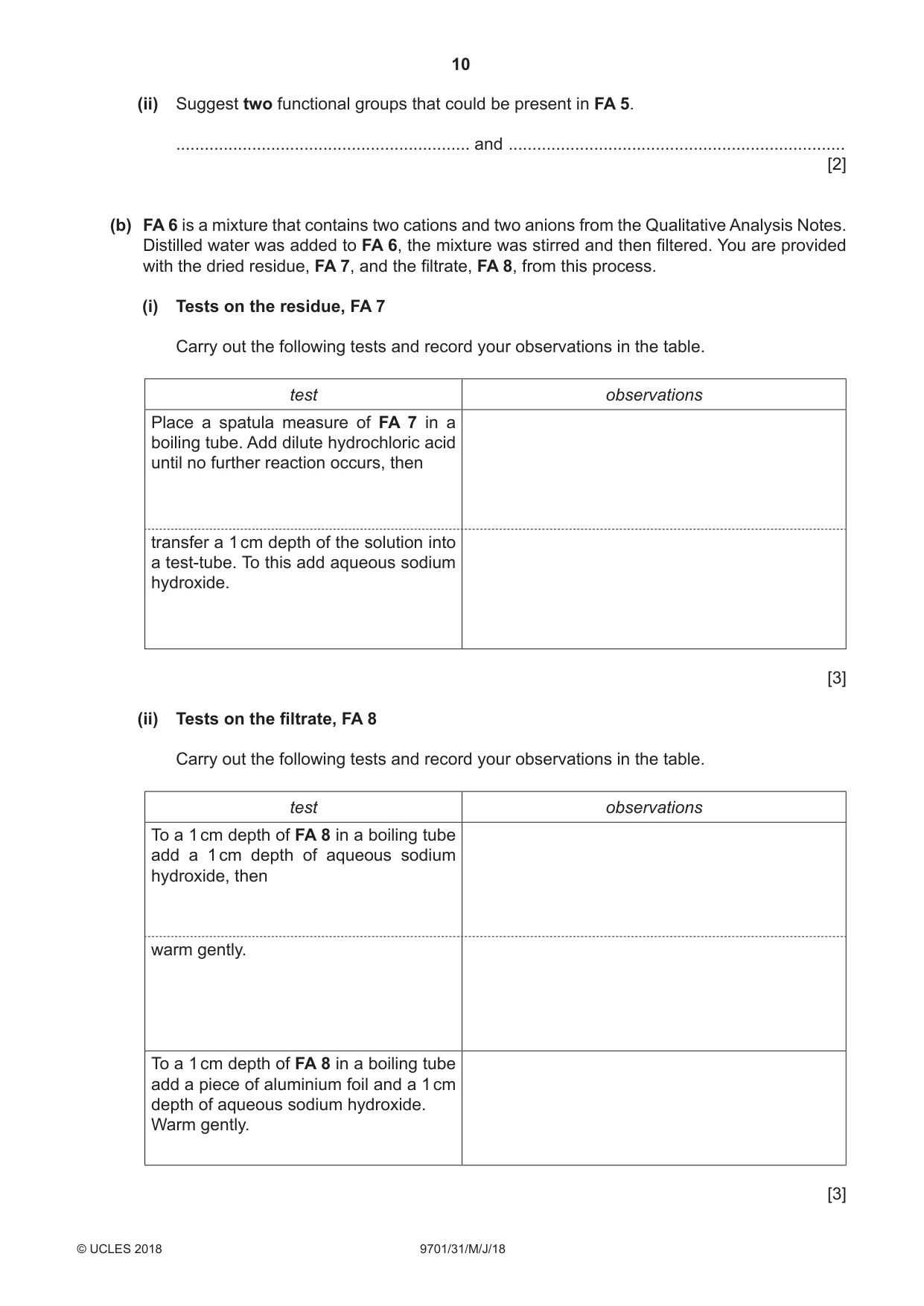
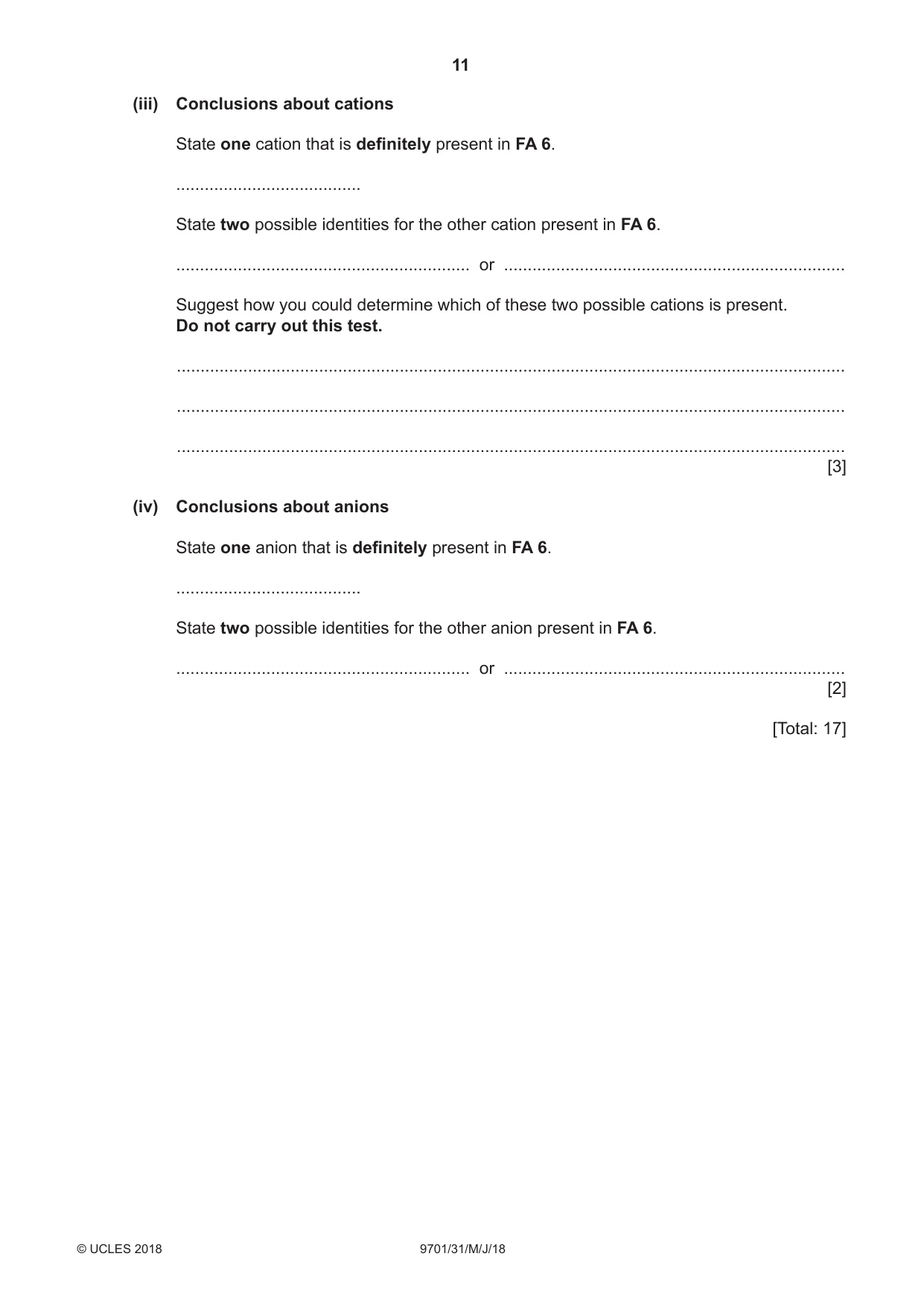
3 (a) Half fill the 250 cm3 beaker with water. Heat to approximately 70 °C, then turn off the Bunsen burner. This will be used as a water bath. (i) FA 5 is an aqueous solution of an organic compound. Carry out the following tests on FA 5 and record your observations in the table. test observations To a 1 cm depth of FA 5 in a test-tube add a small spatula measure of sodium carbonate. To a 1 cm depth of FA 5 in a test-tube add two drops of acidified potassium manganate(VII). Leave to stand in the water bath. To a 1 cm depth of FA 5 in a test-tube add a few drops of aqueous silver nitrate. To a 1 cm depth of aqueous silver nitrate in a test-tube add a few drops of aqueous sodium hydroxide and then add aqueous ammonia slowly until the grey precipitate that forms just dissolves. This is Tollens’ reagent. To this solution add a 1 cm depth of FA 5 and leave to stand in the water bath. Care: rinse the tube as soon as you have completed this test. [4] (ii) Suggest two functional groups that could be present in FA 5. .............................................................. and ....................................................................... [2] (b) FA 6 is a mixture that contains two cations and two anions from the Qualitative Analysis Notes. Distilled water was added to FA 6, the mixture was stirred and then filtered. You are provided with the dried residue, FA 7, and the filtrate, FA 8, from this process. (i) Tests on the residue, FA 7 Carry out the following tests and record your observations in the table. test observations Place a spatula measure of FA 7 in a boiling tube. Add dilute hydrochloric acid until no further reaction occurs, then transfer a 1 cm depth of the solution into a test-tube. To this add aqueous sodium hydroxide. [3] (ii) Tests on the filtrate, FA 8 Carry out the following tests and record your observations in the table. test observations To a 1 cm depth of FA 8 in a boiling tube add a 1 cm depth of aqueous sodium hydroxide, then warm gently. To a 1 cm depth of FA 8 in a boiling tube add a piece of aluminium foil and a 1 cm depth of aqueous sodium hydroxide. Warm gently. [3] (iii) Conclusions about cations State one cation that is definitely present in FA 6. ....................................... State two possible identities for the other cation present in FA 6. .............................................................. or ......................................................................... Suggest how you could determine which of these two possible cations is present. Do not carry out this test. ............................................................................................................................................. ............................................................................................................................................. ............................................................................................................................................. [3] (iv) Conclusions about anions State one anion that is definitely present in FA 6. ....................................... State two possible identities for the other anion present in FA 6. .............................................................. or ......................................................................... [2] [Total: 17]
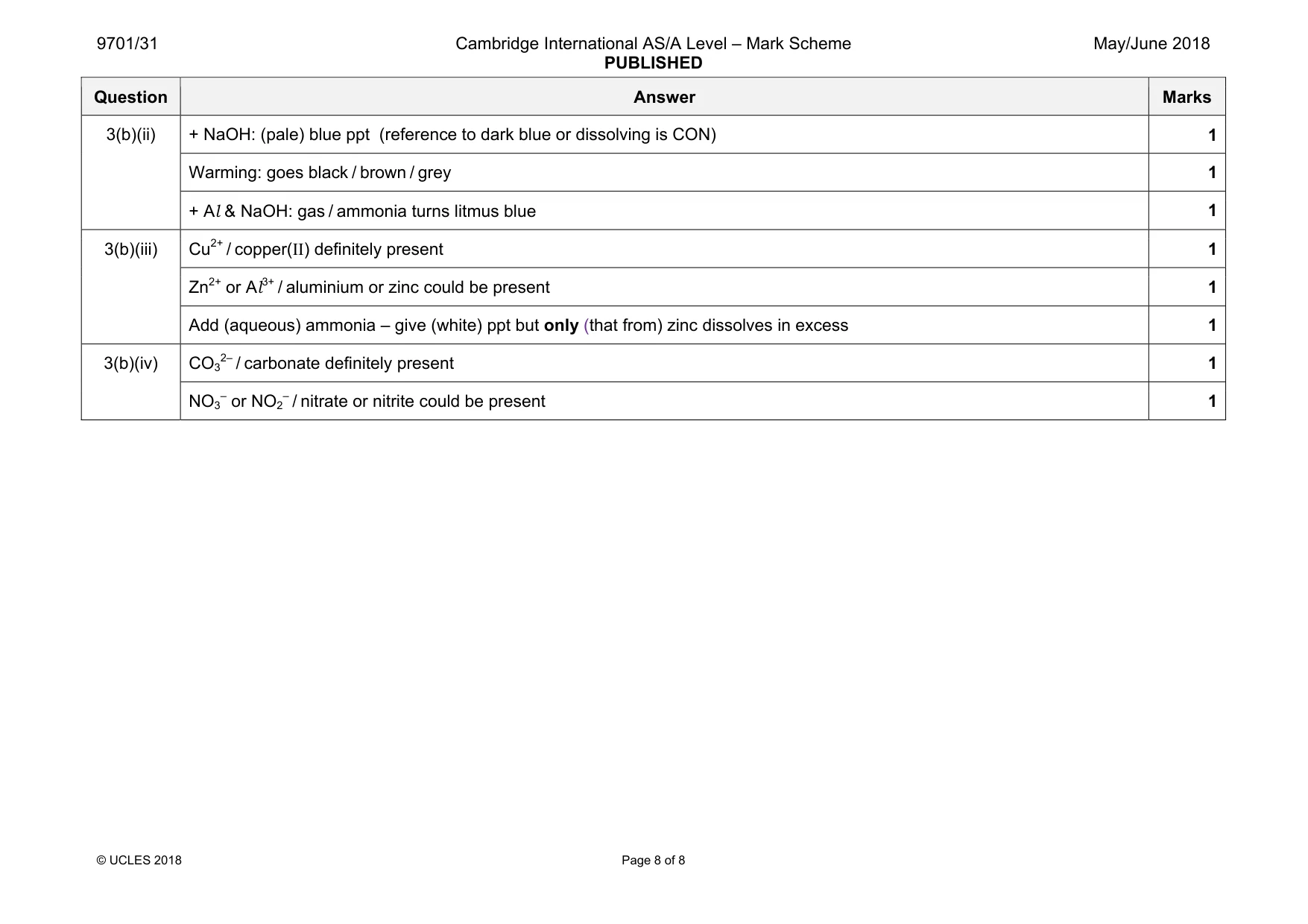
Mark scheme: 3(a)(i) + Na2CO3: fizz / effervescence / bubbling 1 + KMnO4: purple (allow pink) to colourless (allow pale yellow) 1 + AgNO3: no (visible) reaction / no change / no ppt / solution remains colourless 1 + Tollens’: silver mirror / black ppt / grey ppt 1 3(a)(ii) (Carboxylic) acid 1 Aldehyde / primary alcohol / secondary alcohol / alkene 1 3(b)(i) + acid: fizz / effervescence / bubbling 1 Gas / CO2 / fizz turns limewater milky / cloudy white / forms white ppt 1 + NaOH: white ppt soluble in excess NaOH 1 Question Answer Marks 3(b)(ii) + NaOH: (pale) blue ppt (reference to dark blue or dissolving is CON) 1 Warming: goes black / brown / grey 1 + Al & NaOH: gas / ammonia turns litmus blue 1 3(b)(iii) Cu2+ / copper(II) definitely present 1 Zn2+ or Al3+ / aluminium or zinc could be present 1 Add (aqueous) ammonia – give (white) ppt but only (that from) zinc dissolves in excess 1 3(b)(iv) CO3 2‒ / carbonate definitely present 1 NO3 – or NO2 – / nitrate or nitrite could be present 1
What was in this paper
The subtopics covered by these 3 questions, and how many questions each got. Open one in a new tab to see every Cambridge question on it.
What you needed in this session
Cambridge’s own grade thresholds for 2018 May/June, Paper 3 · Variant 1. A higher threshold means an easier paper — the bar moves with how the cohort did.