Cambridge A Level Chemistry 9701 — 2017 May/June Paper 3 · Variant 4
9701/34/M/J/17 · 2 questions · 40 marks · ≈45 min
The question paper and its mark scheme, free to read here and free to download. This is Cambridge’s own paper, exactly as it was sat.
Question paper16 pages


Mark scheme7 pages
Answers below. Sit the paper first if you are practising.
Questions as text
Q1 · Strong acids, such as hydrochloric acid, HCl, are completely ionised in aqueous solution
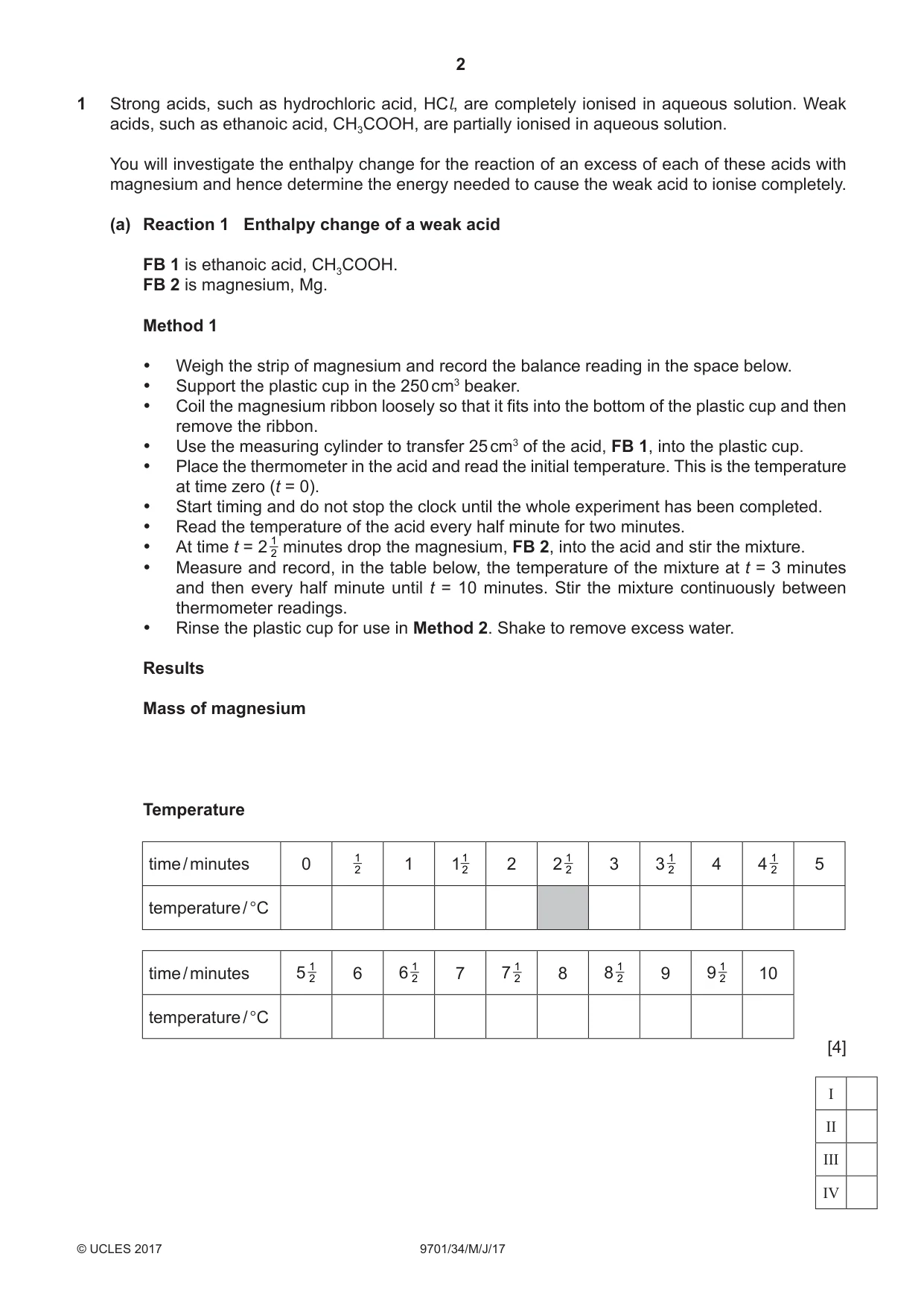
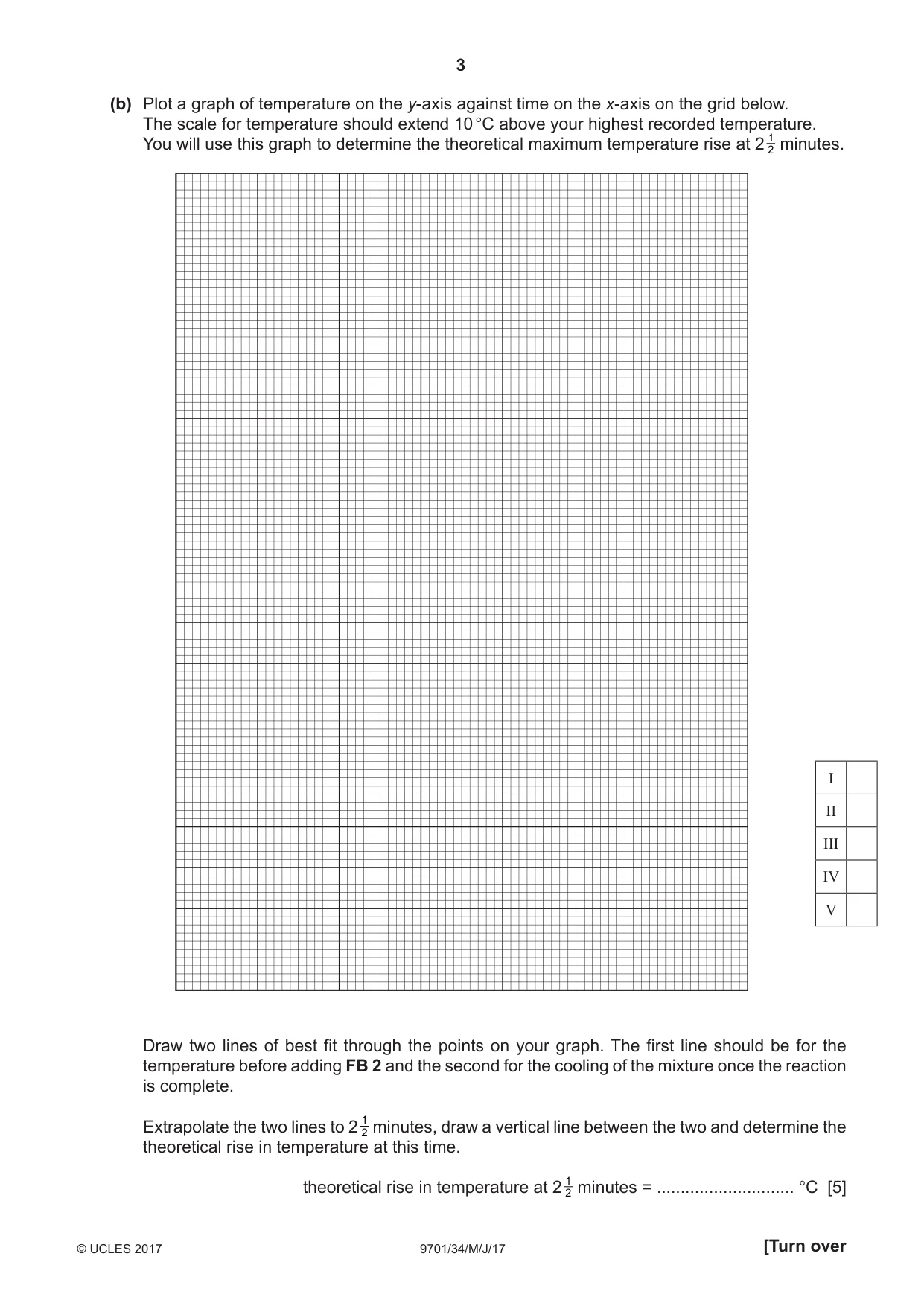
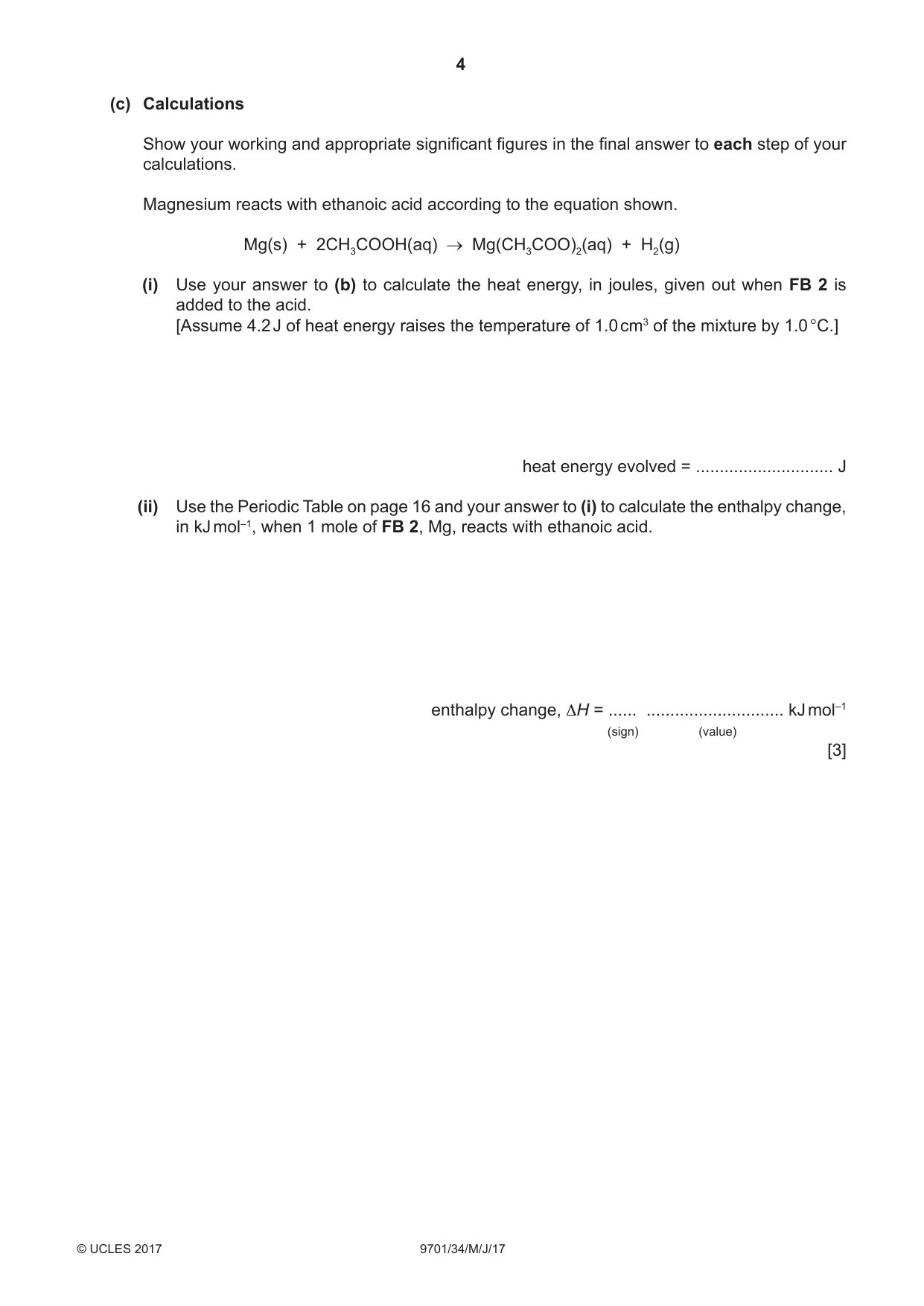
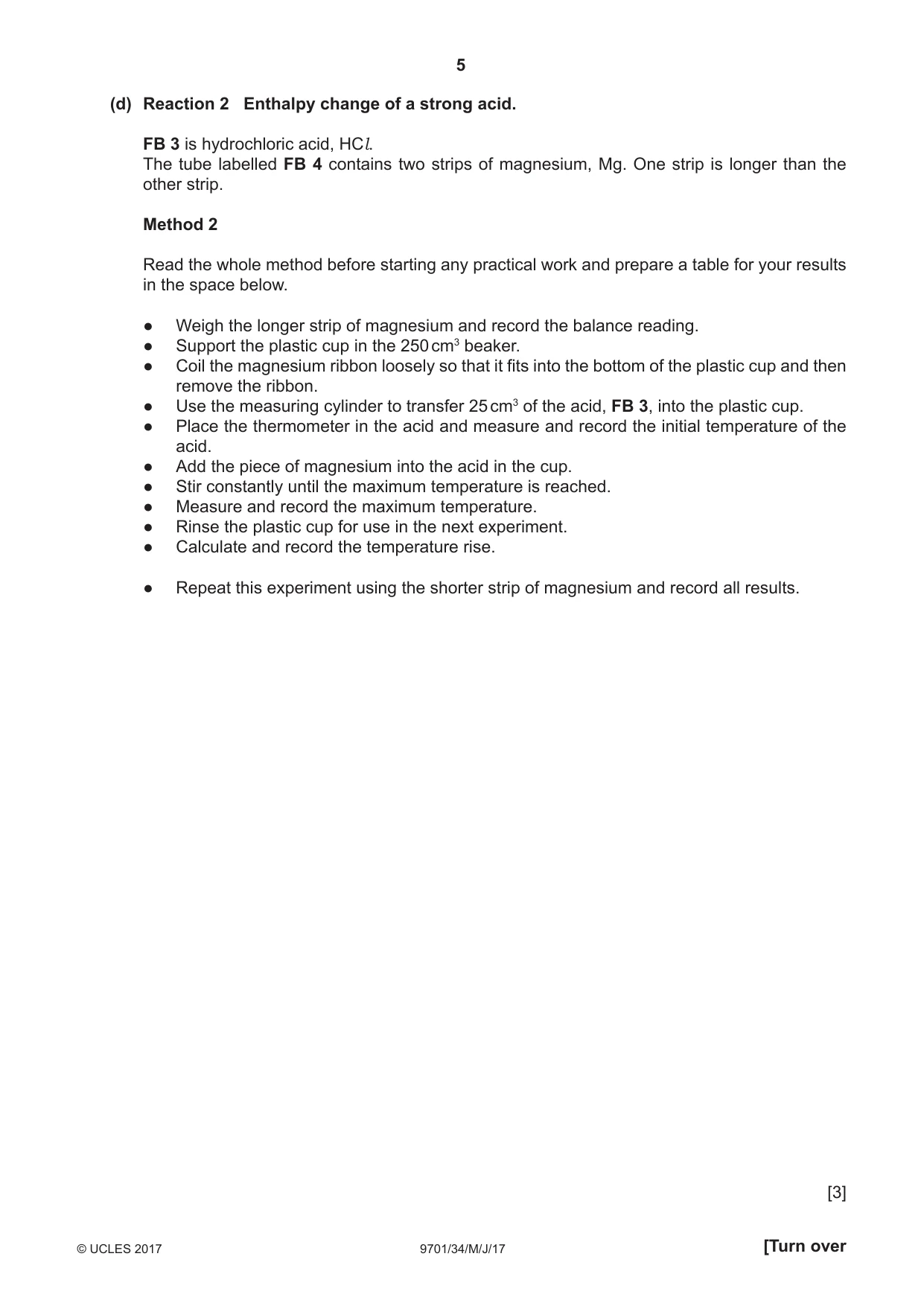
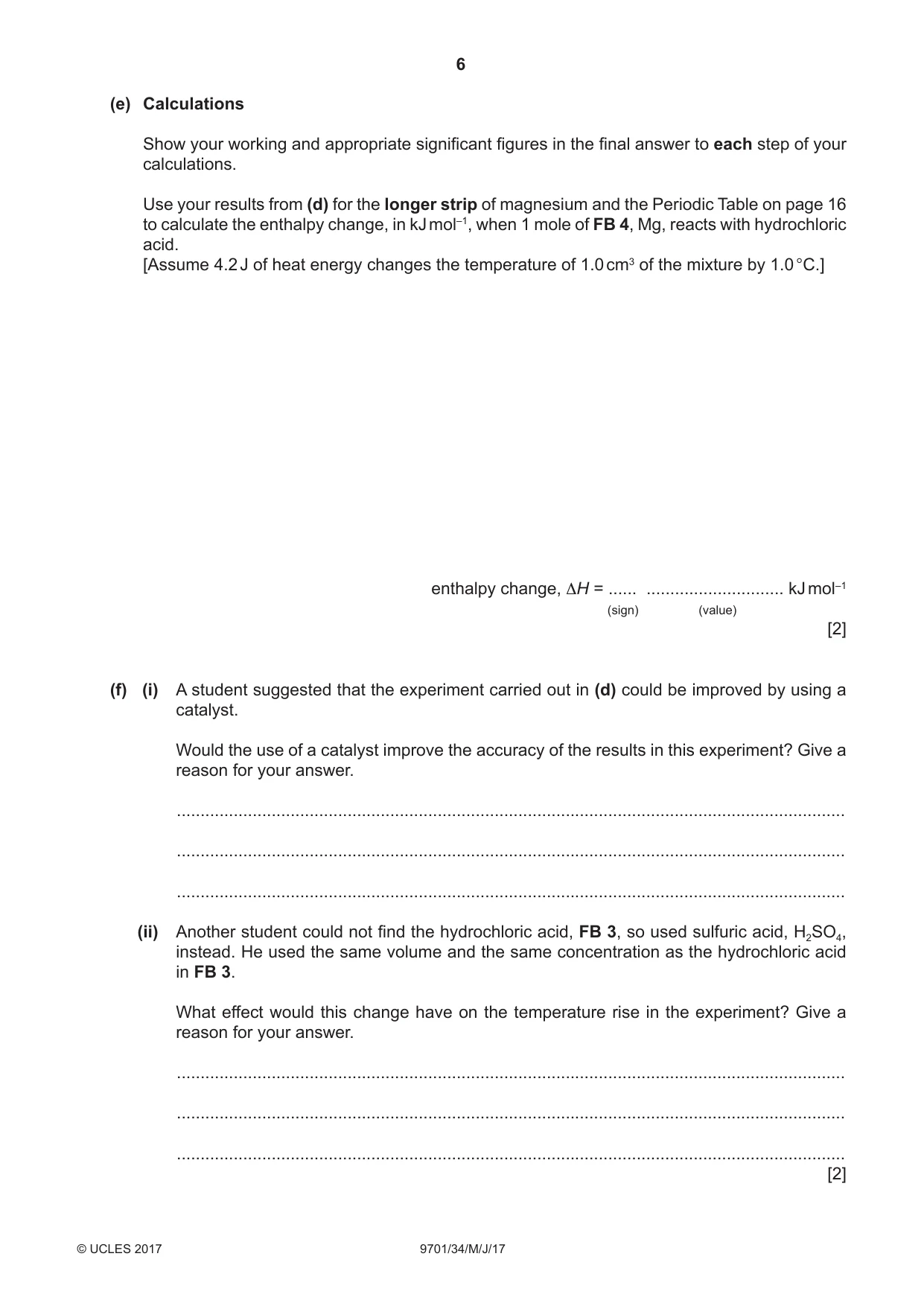
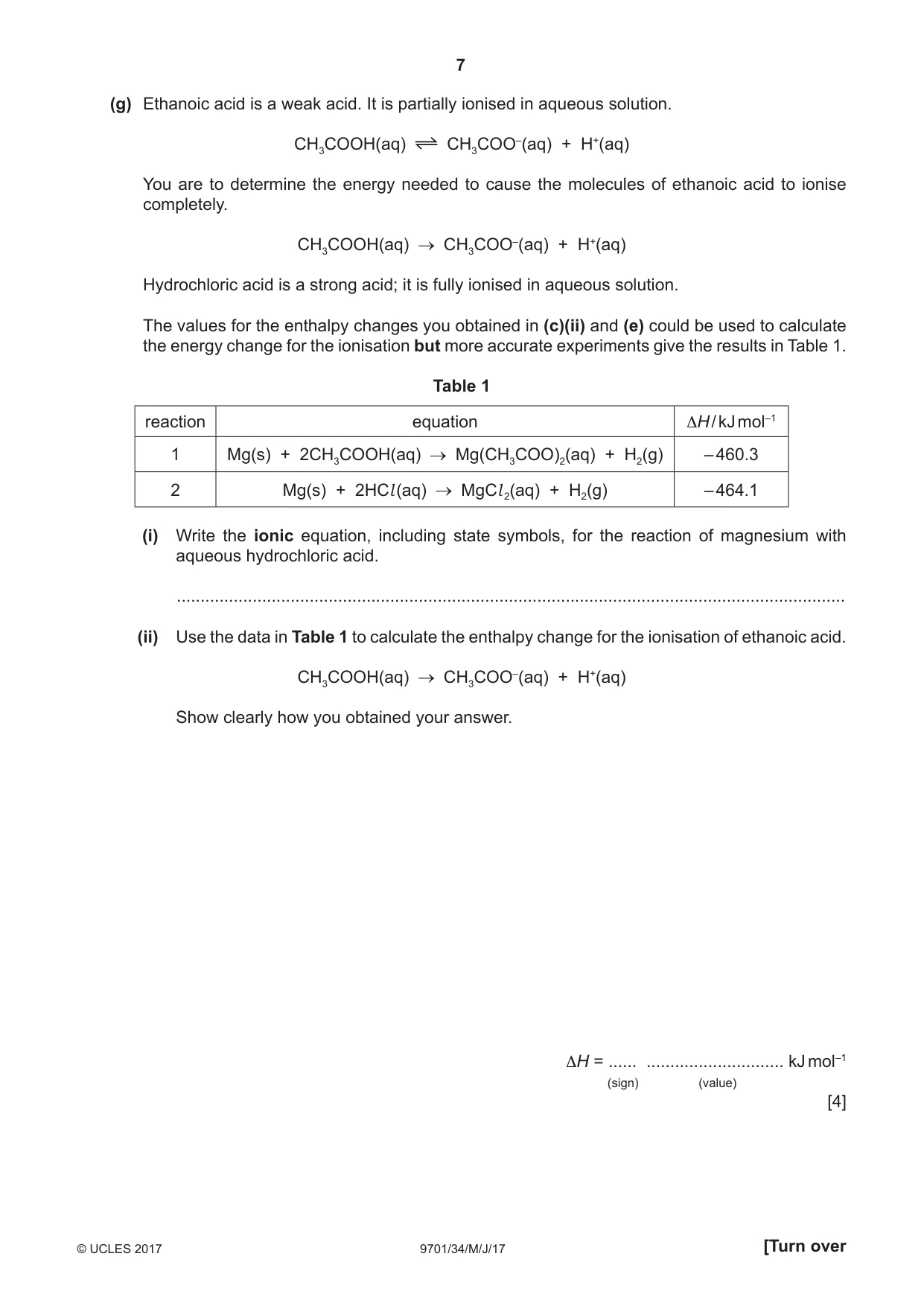
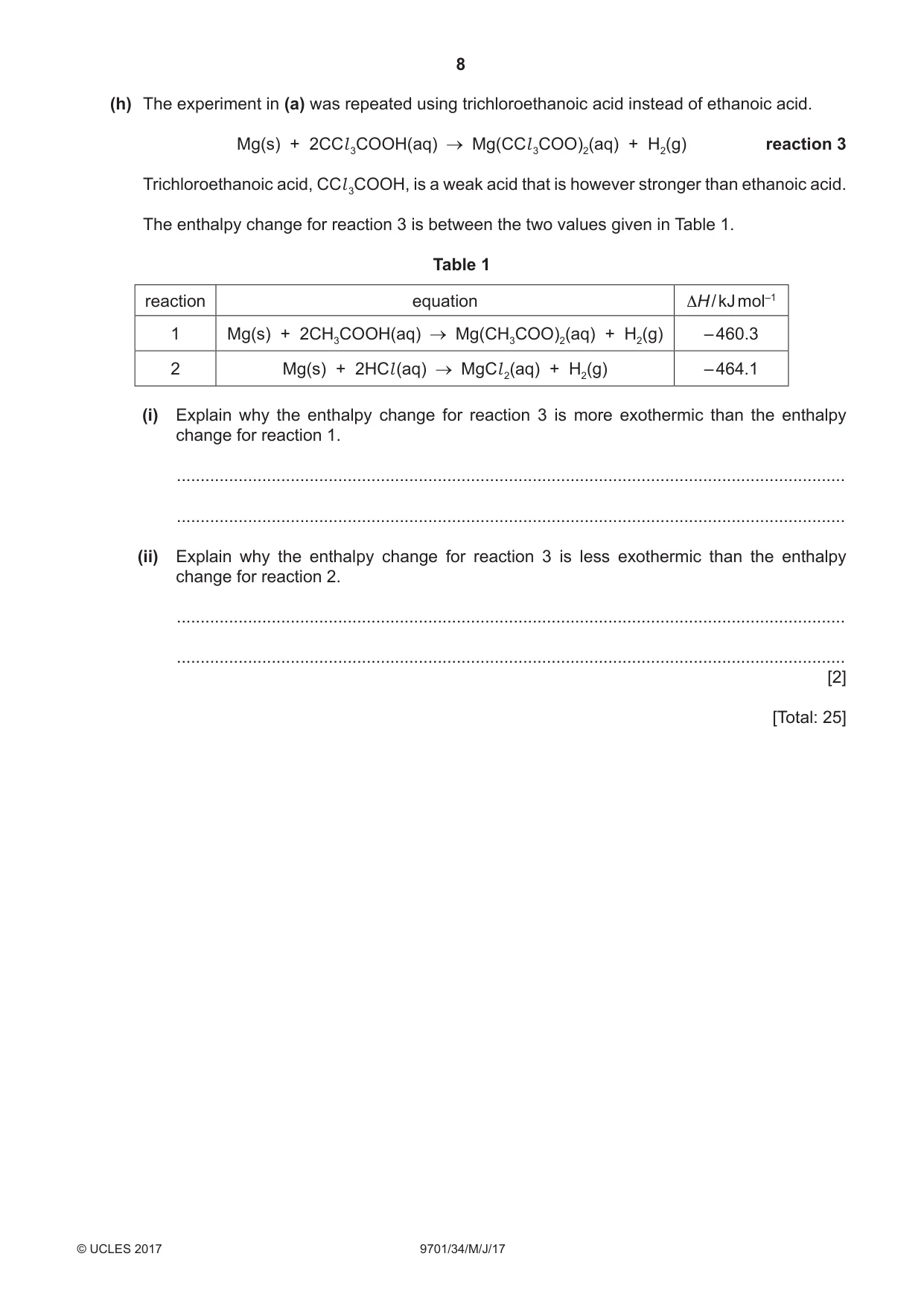
1 Strong acids, such as hydrochloric acid, HCl, are completely ionised in aqueous solution. Weak acids, such as ethanoic acid, CH3COOH, are partially ionised in aqueous solution. You will investigate the enthalpy change for the reaction of an excess of each of these acids with magnesium and hence determine the energy needed to cause the weak acid to ionise completely. (a) Reaction 1 Enthalpy change of a weak acid FB 1 is ethanoic acid, CH3COOH. FB 2 is magnesium, Mg. Method 1 • Weigh the strip of magnesium and record the balance reading in the space below. • Support the plastic cup in the 250 cm3 beaker. • Coil the magnesium ribbon loosely so that it fits into the bottom of the plastic cup and then remove the ribbon. • Use the measuring cylinder to transfer 25 cm3 of the acid, FB 1, into the plastic cup. • Place the thermometer in the acid and read the initial temperature. This is the temperature at time zero (t = 0). • Start timing and do not stop the clock until the whole experiment has been completed. • Read the temperature of the acid every half minute for two minutes. • At time t = 2 12 minutes drop the magnesium, FB 2, into the acid and stir the mixture. • Measure and record, in the table below, the temperature of the mixture at t = 3 minutes and then every half minute until t = 10 minutes. Stir the mixture continuously between thermometer readings. • Rinse the plastic cup for use in Method 2. Shake to remove excess water. Results Mass of magnesium Temperature time / minutes 0 12 1 112 2 2 12 3 3 12 4 4 12 5 temperature / °C time / minutes 5 12 6 6 12 7 7 12 8 8 12 9 9 12 10 temperature / °C [4] I II III IV (c) Calculations Show your working and appropriate significant figures in the final answer to each step of your calculations. Magnesium reacts with ethanoic acid according to the equation shown. Mg(s) + 2CH3COOH(aq) Mg(CH3COO)2(aq) + H2(g) (i) Use your answer to (b) to calculate the heat energy, in joules, given out when FB 2 is added to the acid. [Assume 4.2 J of heat energy raises the temperature of 1.0 cm3 of the mixture by 1.0 °C.] heat energy evolved = ............................. J (ii) Use the Periodic Table on page 16 and your answer to (i) to calculate the enthalpy change, in kJ mol–1, when 1 mole of FB 2, Mg, reacts with ethanoic acid. enthalpy change, ∆H = ...... ............................. kJ mol–1 (sign) (value) [3] (d) Reaction 2 Enthalpy change of a strong acid. FB 3 is hydrochloric acid, HCl. The tube labelled FB 4 contains two strips of magnesium, Mg. One strip is longer than the other strip. Method 2 Read the whole method before starting any practical work and prepare a table for your results in the space below. ● Weigh the longer strip of magnesium and record the balance reading. ● Support the plastic cup in the 250 cm3 beaker. ● Coil the magnesium ribbon loosely so that it fits into the bottom of the plastic cup and then remove the ribbon. ● Use the measuring cylinder to transfer 25 cm3 of the acid, FB 3, into the plastic cup. ● Place the thermometer in the acid and measure and record the initial temperature of the acid. ● Add the piece of magnesium into the acid in the cup. ● Stir constantly until the maximum temperature is reached. ● Measure and record the maximum temperature. ● Rinse the plastic cup for use in the next experiment. ● Calculate and record the temperature rise. ● Repeat this experiment using the shorter strip of magnesium and record all results. [3] (e) Calculations Show your working and appropriate significant figures in the final answer to each step of your calculations. Use your results from (d) for the longer strip of magnesium and the Periodic Table on page 16 to calculate the enthalpy change, in kJ mol–1, when 1 mole of FB 4, Mg, reacts with hydrochloric acid. [Assume 4.2 J of heat energy changes the temperature of 1.0 cm3 of the mixture by 1.0 °C.] enthalpy change, ∆H = ...... ............................. kJ mol–1 (sign) (value) [2] (f) (i) A student suggested that the experiment carried out in (d) could be improved by using a catalyst. Would the use of a catalyst improve the accuracy of the results in this experiment? Give a reason for your answer. ............................................................................................................................................. ............................................................................................................................................. ............................................................................................................................................. (ii) Another student could not find the hydrochloric acid, FB 3, so used sulfuric acid, H2SO4, instead. He used the same volume and the same concentration as the hydrochloric acid in FB 3. What effect would this change have on the temperature rise in the experiment? Give a reason for your answer. ............................................................................................................................................. ............................................................................................................................................. ............................................................................................................................................. [2] (g) Ethanoic acid is a weak acid. It is partially ionised in aqueous solution. CH3COOH(aq) CH3COO–(aq) + H+(aq) You are to determine the energy needed to cause the molecules of ethanoic acid to ionise completely. CH3COOH(aq) CH3COO–(aq) + H+(aq) Hydrochloric acid is a strong acid; it is fully ionised in aqueous solution. The values for the enthalpy changes you obtained in (c)(ii) and (e) could be used to calculate the energy change for the ionisation but more accurate experiments give the results in Table 1. Table 1 reaction equation ∆H / kJ mol–1 1 Mg(s) + 2CH3COOH(aq) Mg(CH3COO)2(aq) + H2(g) – 460.3 2 Mg(s) + 2HCl (aq) MgCl 2(aq) + H2(g) – 464.1 (i) Write the ionic equation, including state symbols, for the reaction of magnesium with aqueous hydrochloric acid. ............................................................................................................................................. (ii) Use the data in Table 1 to calculate the enthalpy change for the ionisation of ethanoic acid. CH3COOH(aq) CH3COO–(aq) + H+(aq) Show clearly how you obtained your answer. ∆H = ...... ............................. kJ mol–1 (sign) (value) [4] (h) The experiment in (a) was repeated using trichloroethanoic acid instead of ethanoic acid. Mg(s) + 2CCl 3COOH(aq) Mg(CCl 3COO)2(aq) + H2(g) reaction 3 Trichloroethanoic acid, CCl 3COOH, is a weak acid that is however stronger than ethanoic acid. The enthalpy change for reaction 3 is between the two values given in Table 1. Table 1 reaction equation ∆H / kJ mol–1 1 Mg(s) + 2CH3COOH(aq) Mg(CH3COO)2(aq) + H2(g) – 460.3 2 Mg(s) + 2HCl (aq) MgCl 2(aq) + H2(g) – 464.1 (i) Explain why the enthalpy change for reaction 3 is more exothermic than the enthalpy change for reaction 1. ............................................................................................................................................. ............................................................................................................................................. (ii) Explain why the enthalpy change for reaction 3 is less exothermic than the enthalpy change for reaction 2. ............................................................................................................................................. ............................................................................................................................................. [2] [Total: 25]
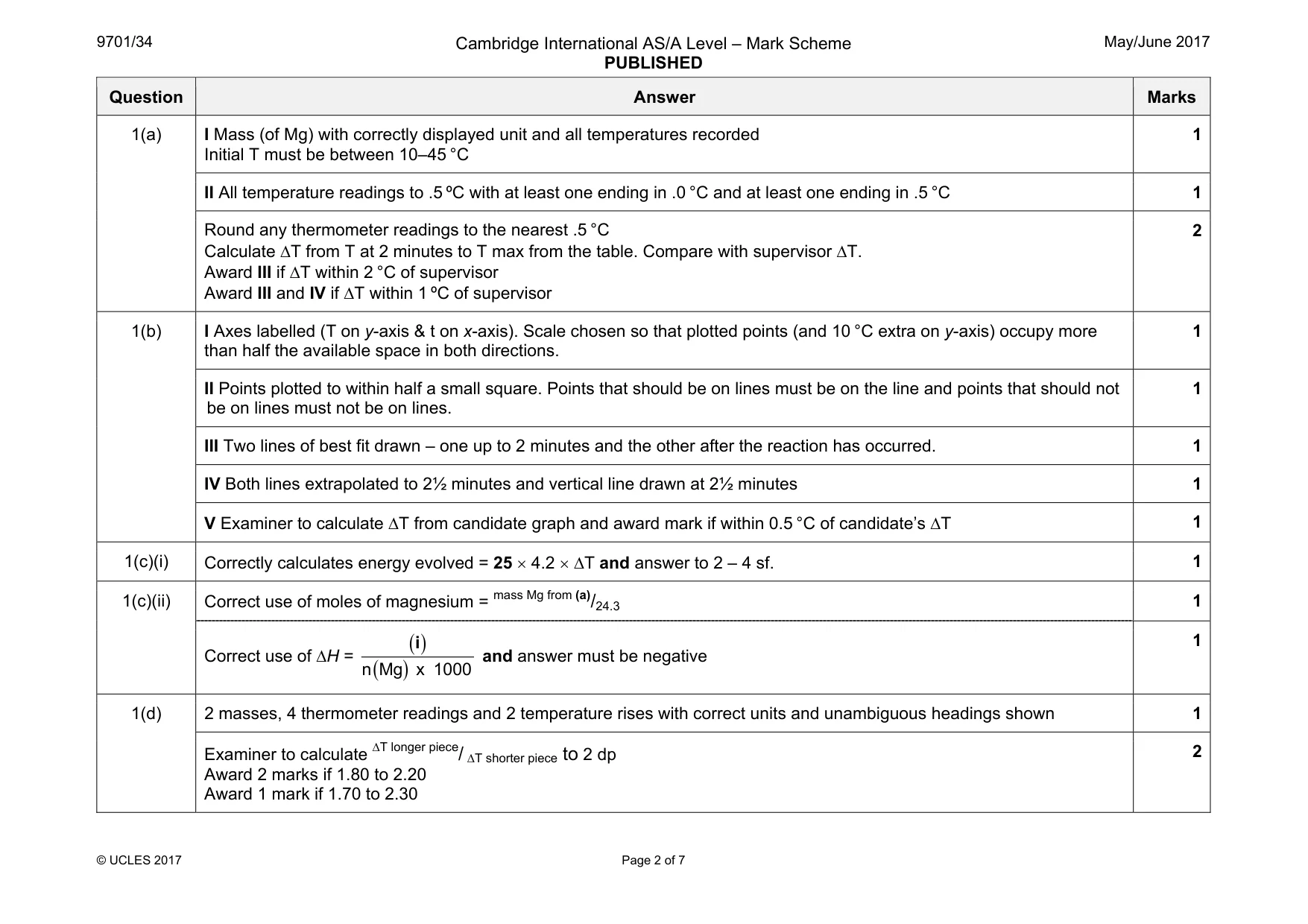
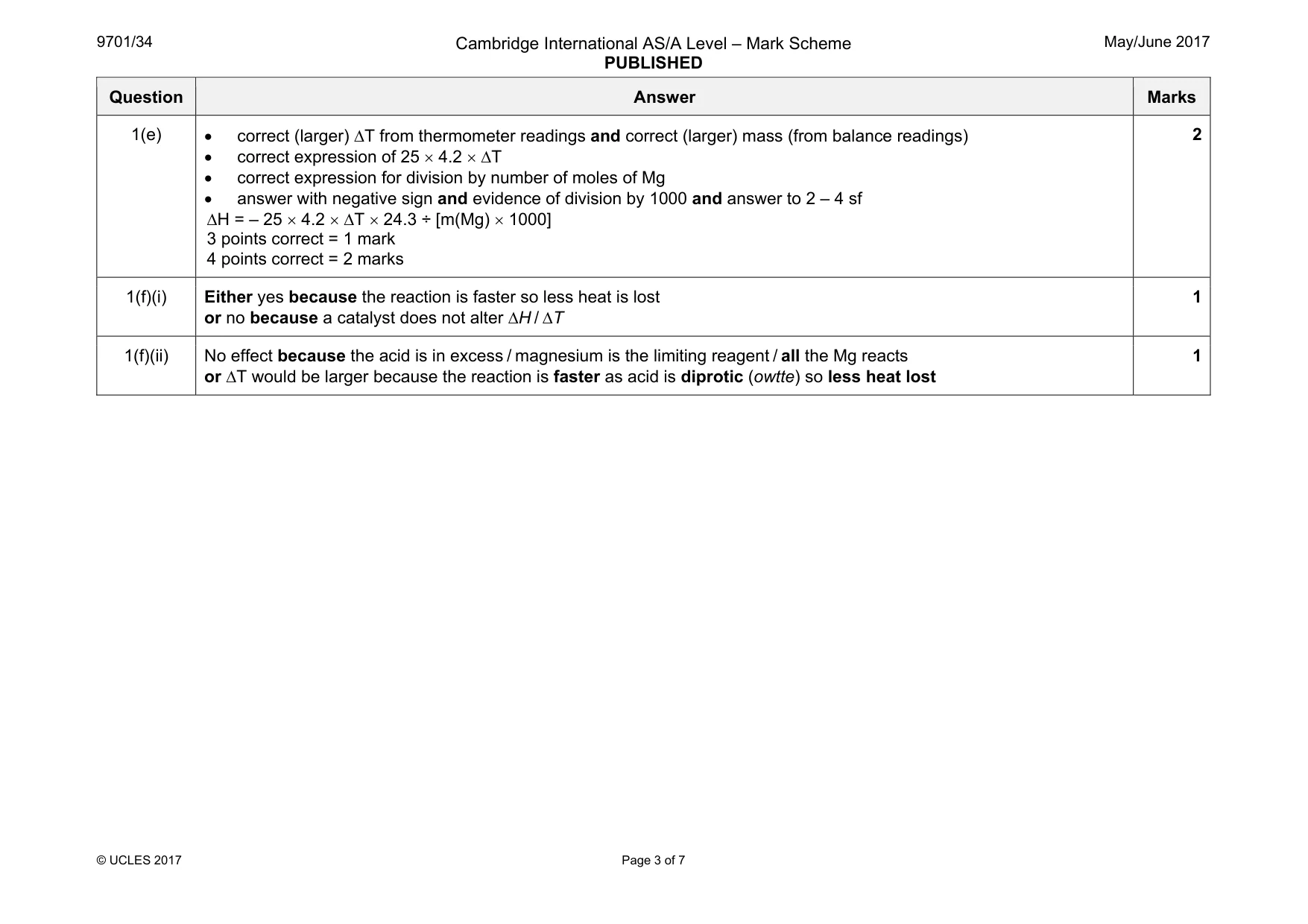
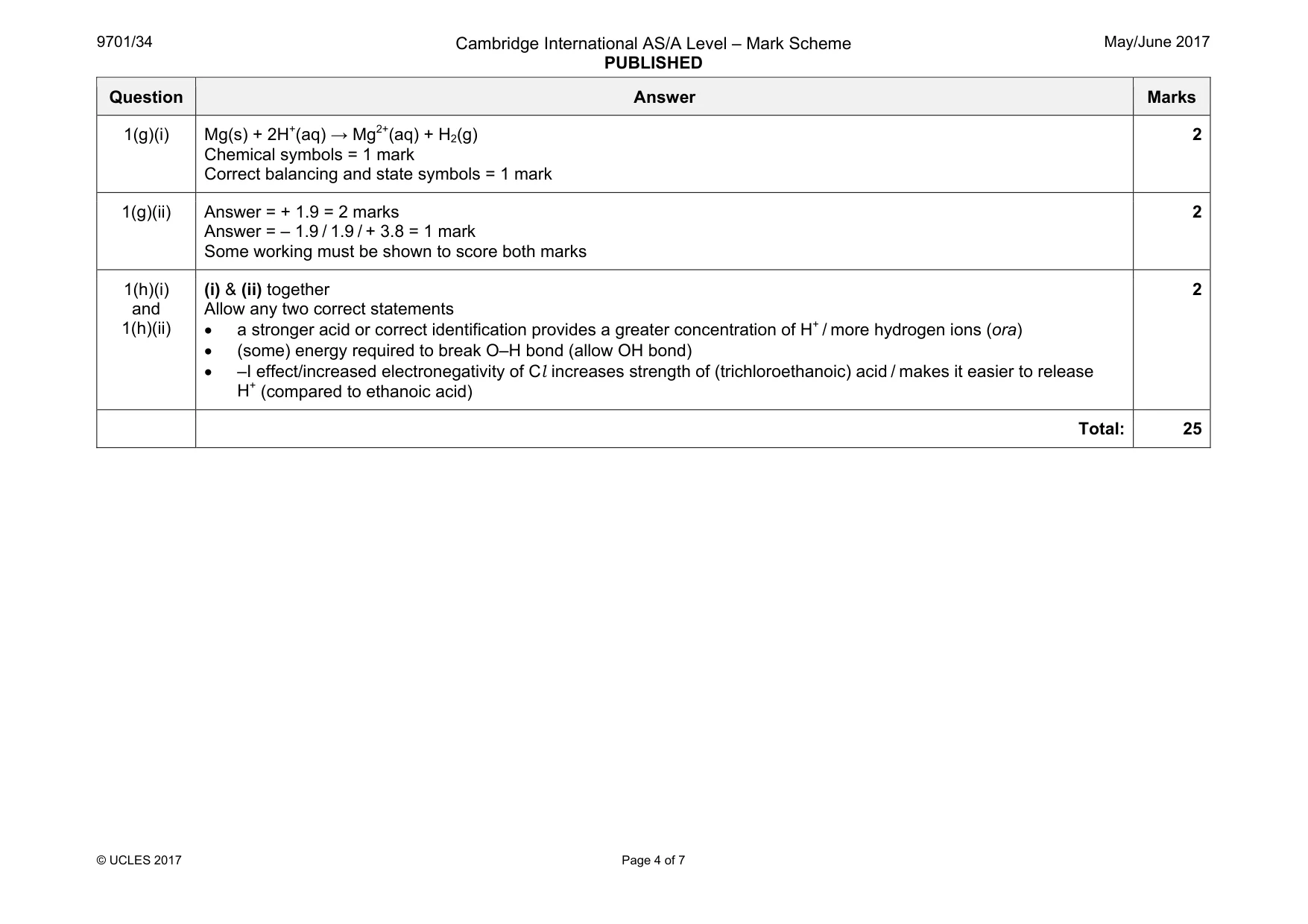
Mark scheme: 1(a) I Mass (of Mg) with correctly displayed unit and all temperatures recorded Initial T must be between 10–45 °C 1 II All temperature readings to .5 ºC with at least one ending in .0 °C and at least one ending in .5 °C 1 Round any thermometer readings to the nearest .5 °C Calculate ∆T from T at 2 minutes to T max from the table. Compare with supervisor ∆T. Award III if ∆T within 2 °C of supervisor Award III and IV if ∆T within 1 ºC of supervisor 2 1(b) I Axes labelled (T on y-axis & t on x-axis). Scale chosen so that plotted points (and 10 °C extra on y-axis) occupy more than half the available space in both directions. 1 II Points plotted to within half a small square. Points that should be on lines must be on the line and points that should not be on lines must not be on lines. 1 III Two lines of best fit drawn – one up to 2 minutes and the other after the reaction has occurred. 1 IV Both lines extrapolated to 2½ minutes and vertical line drawn at 2½ minutes 1 V Examiner to calculate ∆T from candidate graph and award mark if within 0.5 °C of candidate’s ∆T 1 1(c)(i) Correctly calculates energy evolved = 25 × 4.2 × ∆T and answer to 2 – 4 sf. 1 1(c)(ii) Correct use of moles of magnesium = mass Mg from (a)/24.3 1 Correct use of ∆H = ( ) ( ) n Mg x 1000 i and answer must be negative 1 1(d) 2 masses, 4 thermometer readings and 2 temperature rises with correct units and unambiguous headings shown 1 Examiner to calculate ∆T longer piece/ ∆T shorter piece to 2 dp Award 2 marks if 1.80 to 2.20 Award 1 mark if 1.70 to 2.30 2 Question Answer Marks 1(e) • correct (larger) ∆T from thermometer readings and correct (larger) mass (from balance readings) • correct expression of 25 × 4.2 × ∆T • correct expression for division by number of moles of Mg • answer with negative sign and evidence of division by 1000 and answer to 2 – 4 sf ∆H = – 25 × 4.2 × ∆T × 24.3 ÷ [m(Mg) × 1000] 3 points correct = 1 mark 4 points correct = 2 marks 2 1(f)(i) Either yes because the reaction is faster so less heat is lost or no because a catalyst does not alter ∆H / ∆T 1 1(f)(ii) No effect because the acid is in excess / magnesium is the limiting reagent / all the Mg reacts or ∆T would be larger because the reaction is faster as acid is diprotic (owtte) so less heat lost 1 Question Answer Marks 1(g)(i) Mg(s) + 2H+(aq) → Mg2+(aq) + H2(g) Chemical symbols = 1 mark Correct balancing and state symbols = 1 mark 2 1(g)(ii) Answer = + 1.9 = 2 marks Answer = – 1.9 / 1.9 / + 3.8 = 1 mark Some working must be shown to score both marks 2 1(h)(i) and 1(h)(ii) (i) & (ii) together Allow any two correct statements • a stronger acid or correct identification provides a greater concentration of H+ / more hydrogen ions (ora) • (some) energy required to break O–H bond (allow OH bond) • –I effect/increased electronegativity of Cl increases strength of (trichloroethanoic) acid / makes it easier to release H+ (compared to ethanoic acid) 2 Total: 25
Q2 · Qualitative Analysis At each stage of any test you are to record details of the following
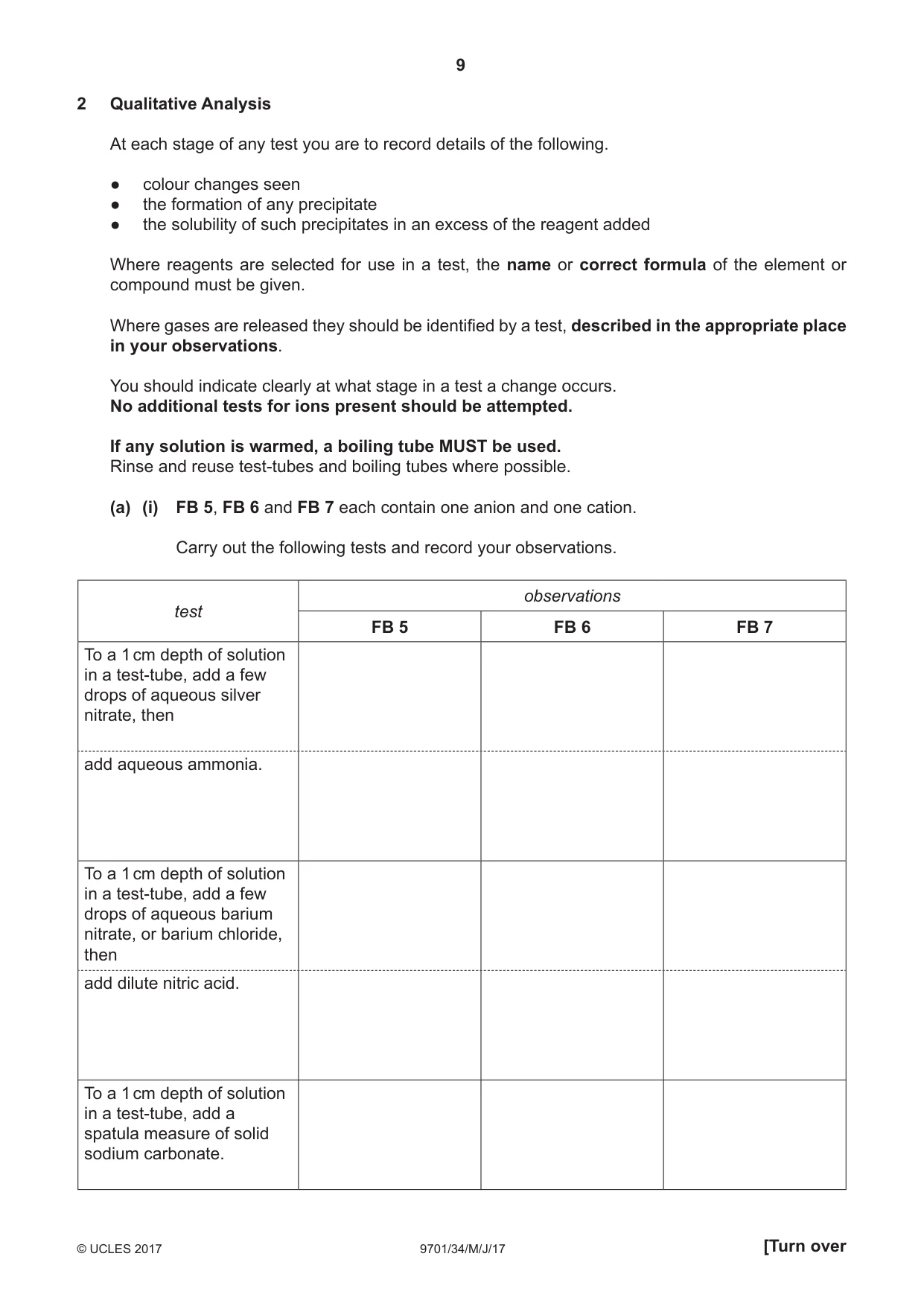
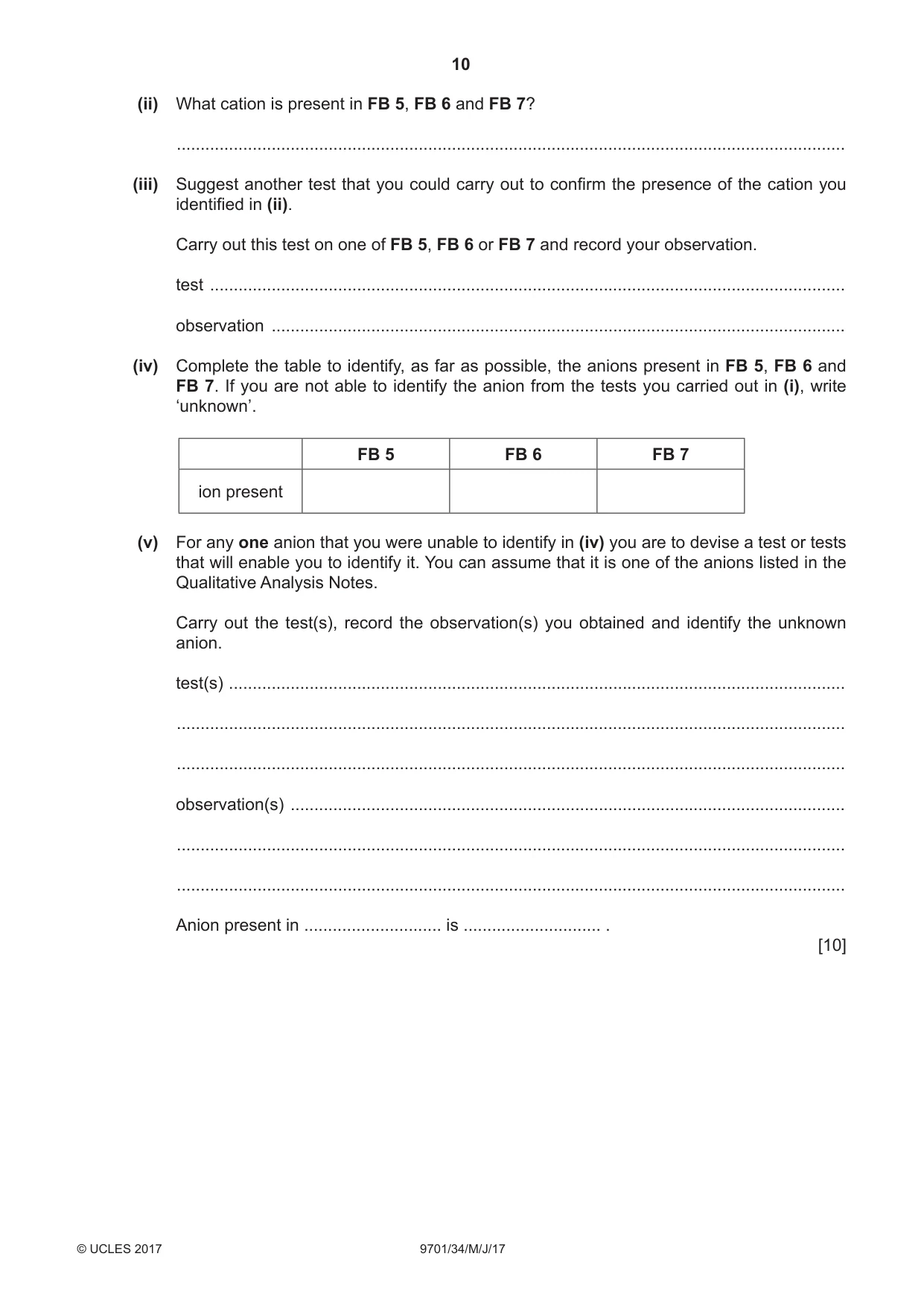
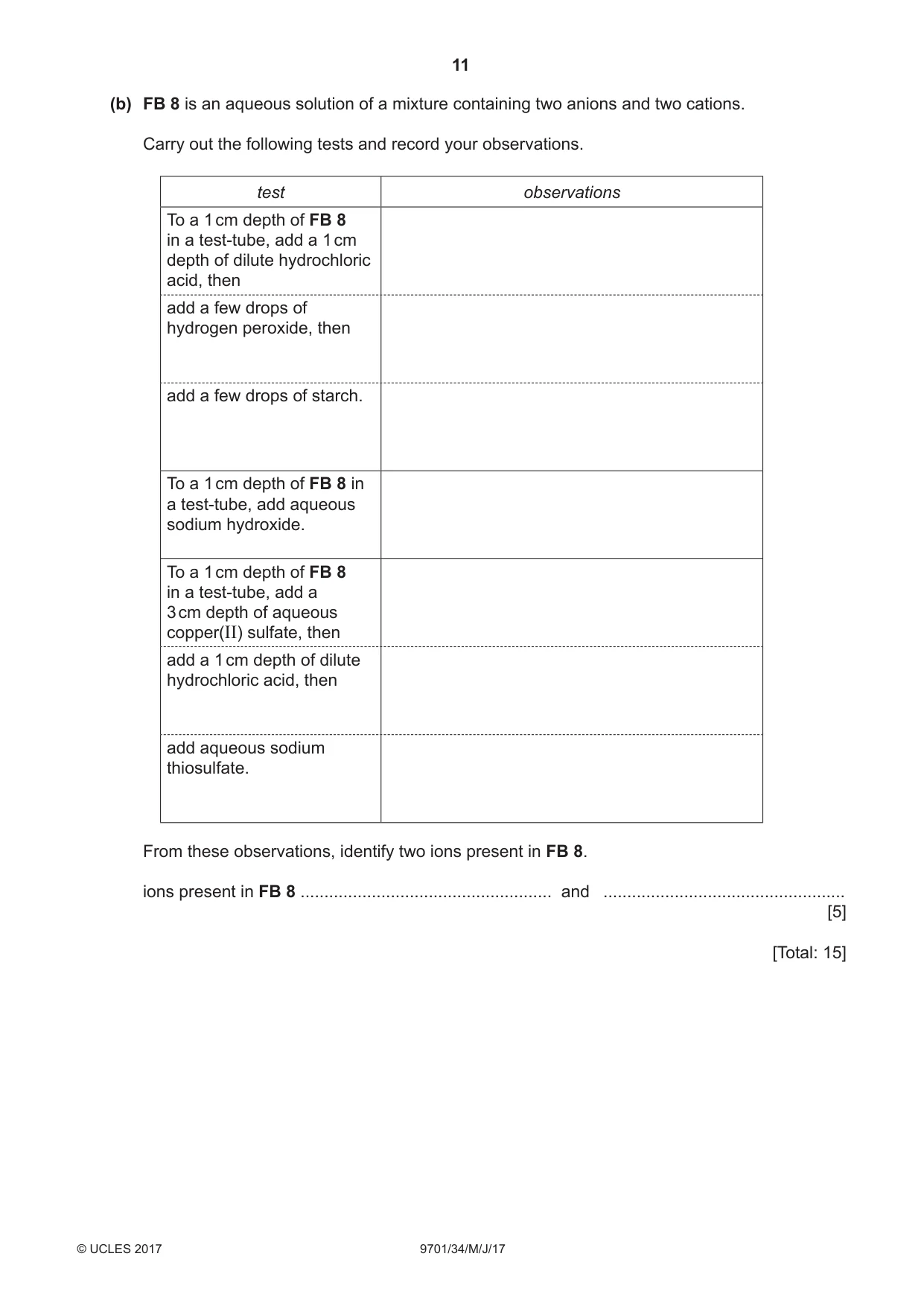
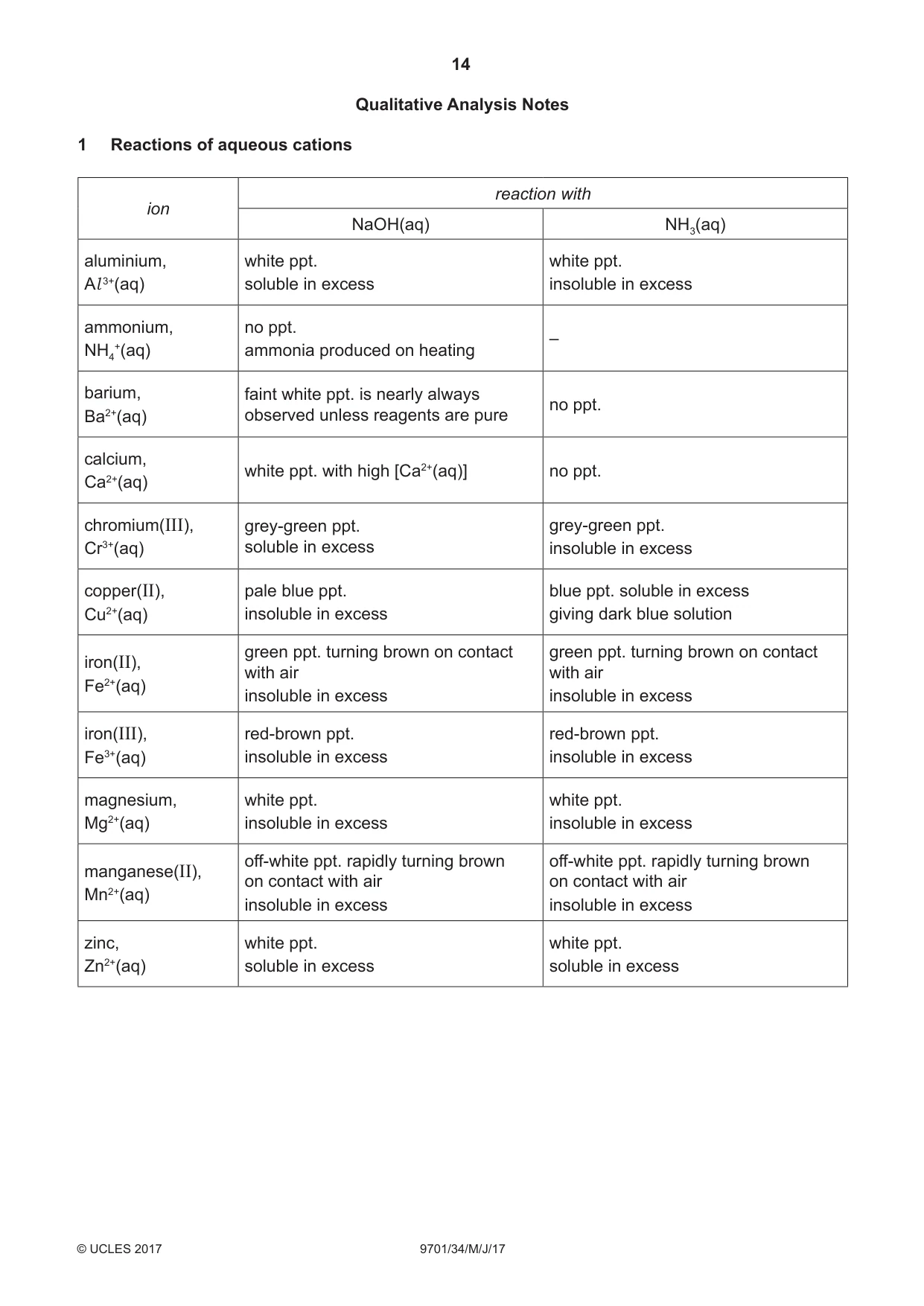
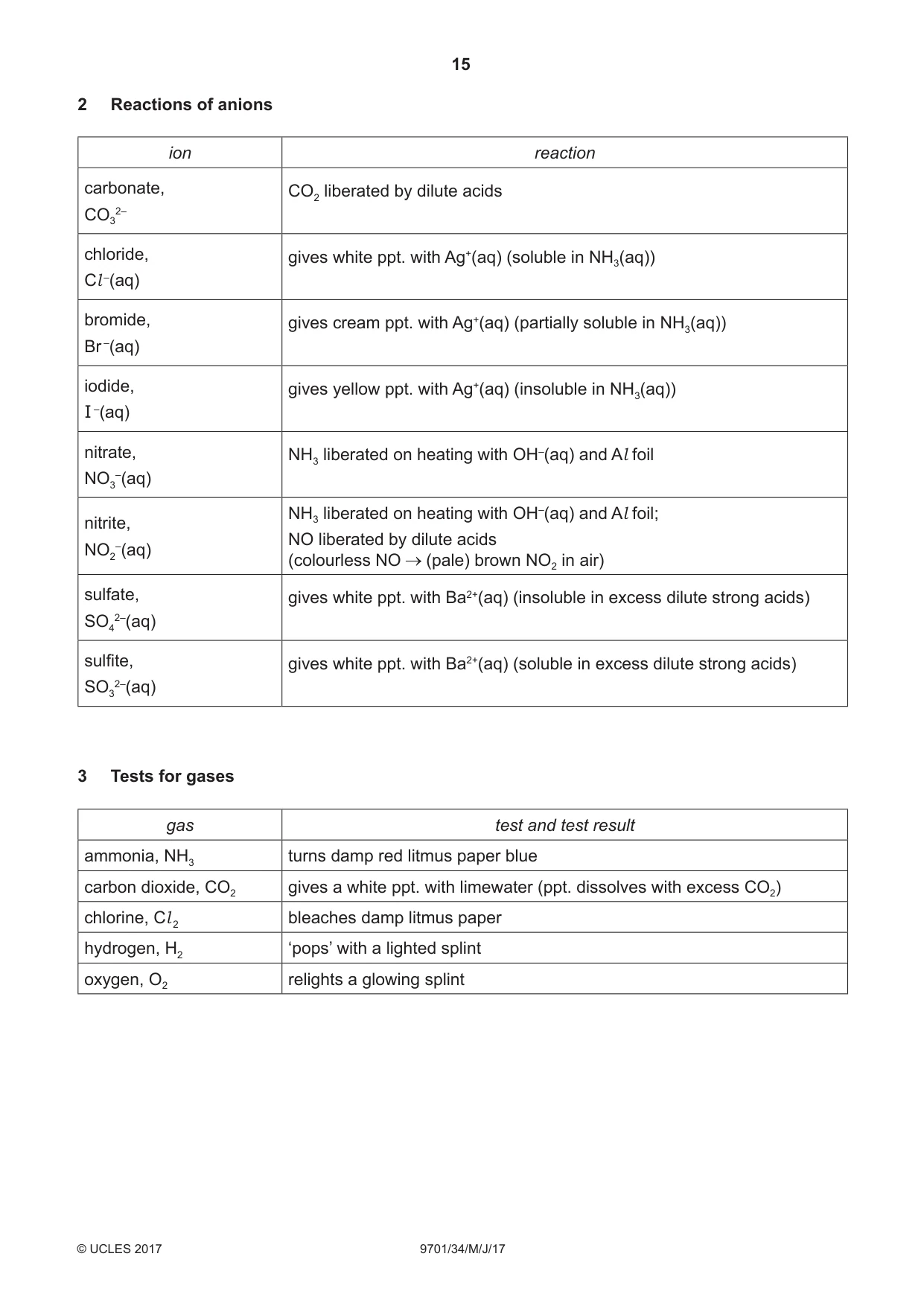
2 Qualitative Analysis At each stage of any test you are to record details of the following. ● colour changes seen ● the formation of any precipitate ● the solubility of such precipitates in an excess of the reagent added Where reagents are selected for use in a test, the name or correct formula of the element or compound must be given. Where gases are released they should be identified by a test, described in the appropriate place in your observations. You should indicate clearly at what stage in a test a change occurs. No additional tests for ions present should be attempted. If any solution is warmed, a boiling tube MUST be used. Rinse and reuse test-tubes and boiling tubes where possible. (a) (i) FB 5, FB 6 and FB 7 each contain one anion and one cation. Carry out the following tests and record your observations. observations test FB 5 FB 6 FB 7 To a 1 cm depth of solution in a test-tube, add a few drops of aqueous silver nitrate, then add aqueous ammonia. To a 1 cm depth of solution in a test-tube, add a few drops of aqueous barium nitrate, or barium chloride, then add dilute nitric acid. To a 1 cm depth of solution in a test-tube, add a spatula measure of solid sodium carbonate. (ii) What cation is present in FB 5, FB 6 and FB 7? ............................................................................................................................................. (iii) Suggest another test that you could carry out to confirm the presence of the cation you identified in (ii). Carry out this test on one of FB 5, FB 6 or FB 7 and record your observation. test ...................................................................................................................................... observation .......................................................................................................................... (iv) Complete the table to identify, as far as possible, the anions present in FB 5, FB 6 and FB 7. If you are not able to identify the anion from the tests you carried out in (i), write ‘unknown’. FB 5 FB 6 FB 7 ion present (v) For any one anion that you were unable to identify in (iv) you are to devise a test or tests that will enable you to identify it. You can assume that it is one of the anions listed in the Qualitative Analysis Notes. Carry out the test(s), record the observation(s) you obtained and identify the unknown anion. test(s) .................................................................................................................................. ............................................................................................................................................. ............................................................................................................................................. observation(s) ..................................................................................................................... ............................................................................................................................................. ............................................................................................................................................. Anion present in ............................. is ............................. . [10] (b) FB 8 is an aqueous solution of a mixture containing two anions and two cations. Carry out the following tests and record your observations. test observations To a 1 cm depth of FB 8 in a test-tube, add a 1 cm depth of dilute hydrochloric acid, then add a few drops of hydrogen peroxide, then add a few drops of starch. To a 1 cm depth of FB 8 in a test-tube, add aqueous sodium hydroxide. To a 1 cm depth of FB 8 in a test-tube, add a 3 cm depth of aqueous copper(II) sulfate, then add a 1 cm depth of dilute hydrochloric acid, then add aqueous sodium thiosulfate. From these observations, identify two ions present in FB 8. ions present in FB 8 ..................................................... and .................................................... [5] [Total: 15]
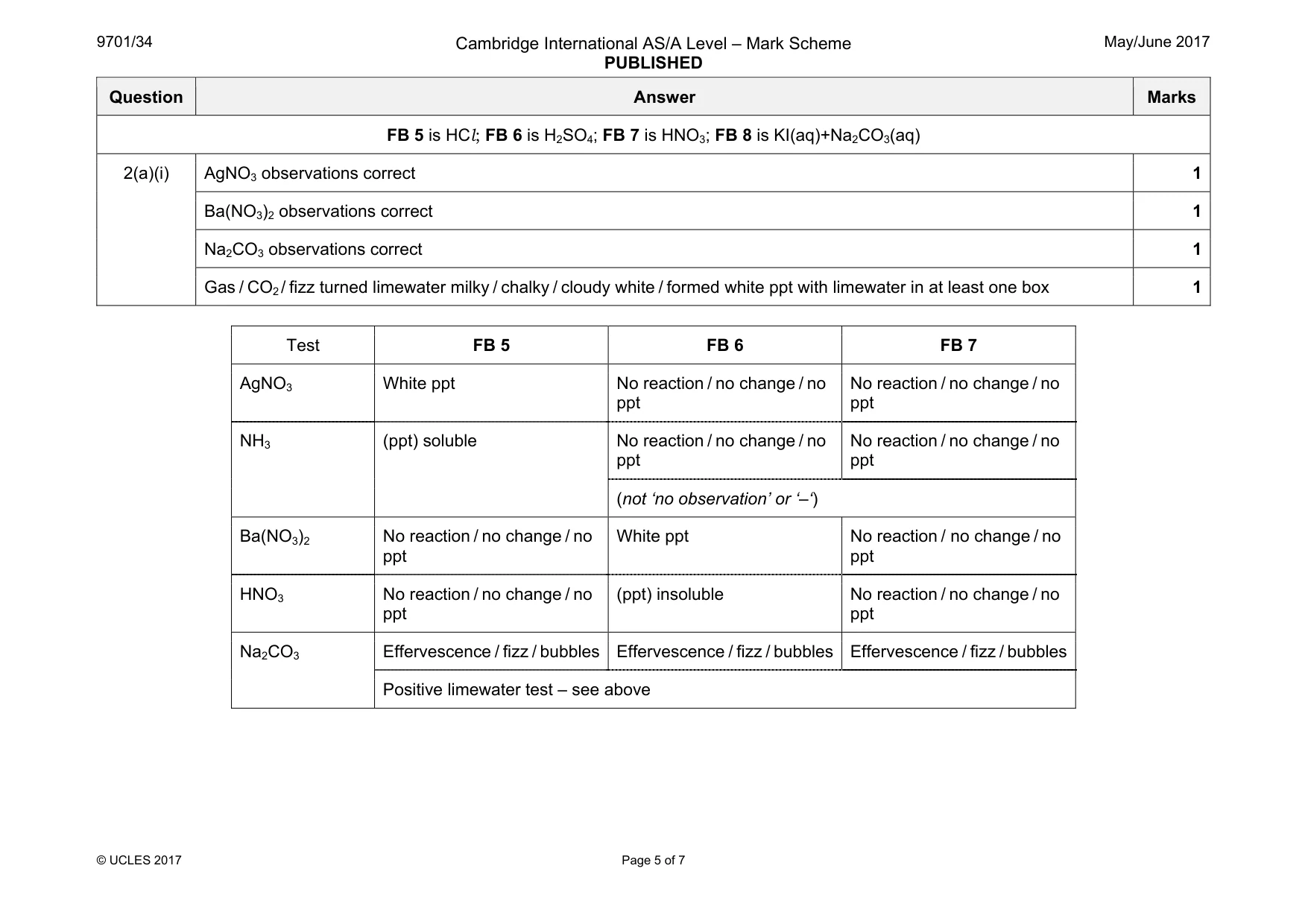
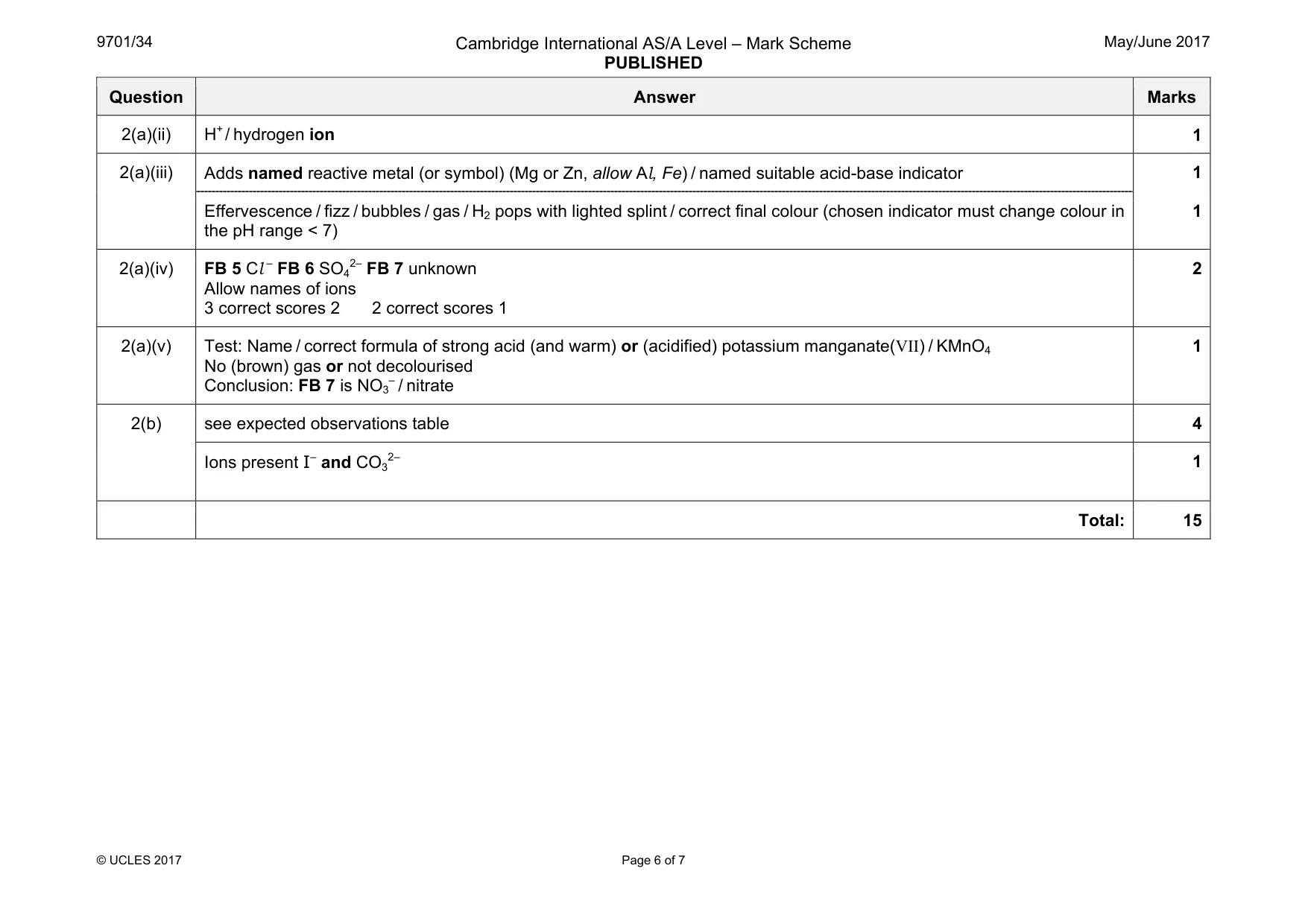
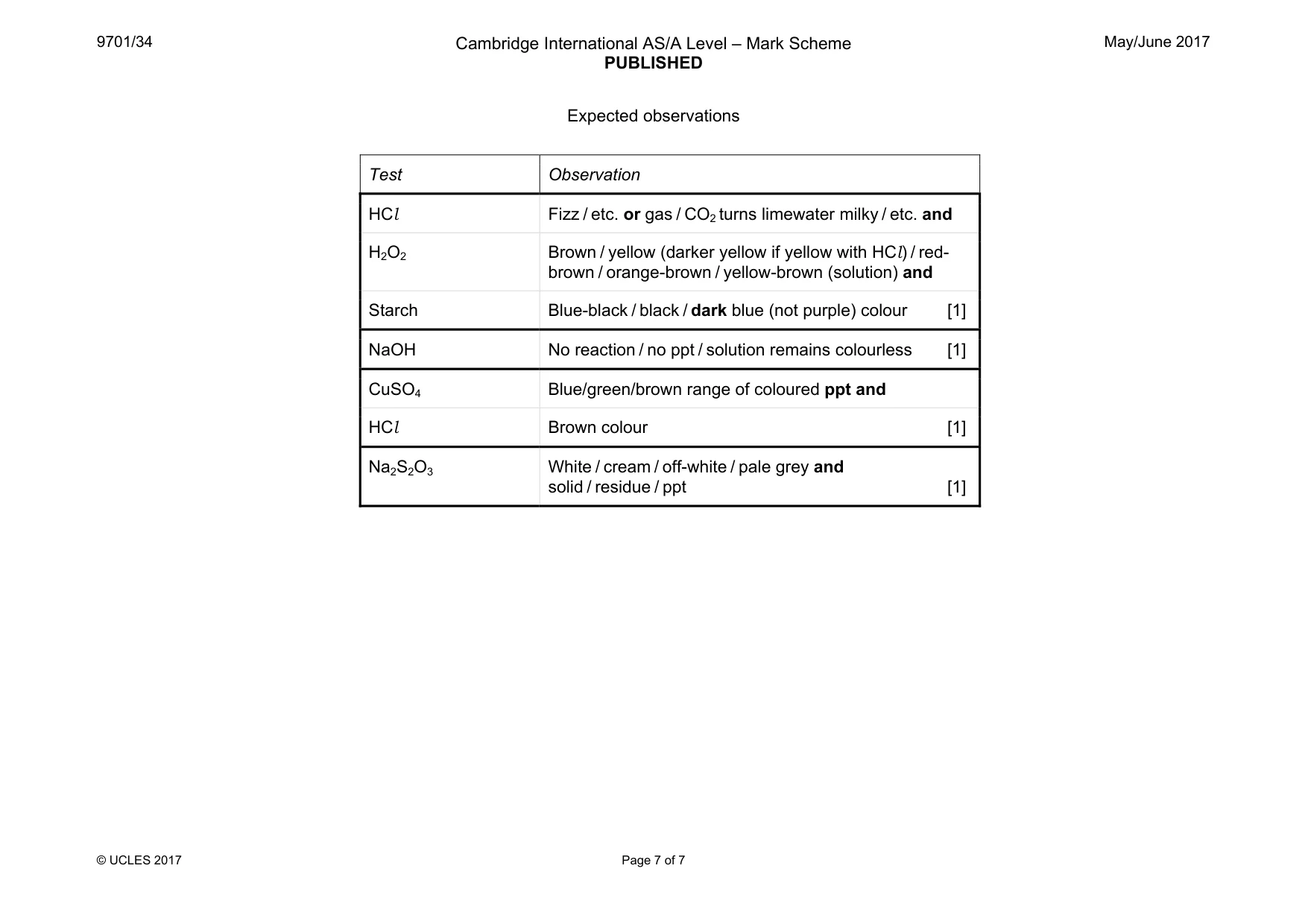
Mark scheme: 2(a)(i) AgNO3 observations correct 1 Ba(NO3)2 observations correct 1 Na2CO3 observations correct 1 Gas / CO2 / fizz turned limewater milky / chalky / cloudy white / formed white ppt with limewater in at least one box 1 Test FB 5 FB 6 FB 7 AgNO3 White ppt No reaction / no change / no ppt No reaction / no change / no ppt NH3 (ppt) soluble No reaction / no change / no ppt No reaction / no change / no ppt (not ‘no observation’ or ‘–‘) Ba(NO3)2 No reaction / no change / no ppt White ppt No reaction / no change / no ppt HNO3 No reaction / no change / no ppt (ppt) insoluble No reaction / no change / no ppt Na2CO3 Effervescence / fizz / bubbles Effervescence / fizz / bubbles Effervescence / fizz / bubbles Positive limewater test – see above Question Answer Marks 2(a)(ii) H+/ hydrogen ion 1 2(a)(iii) Adds named reactive metal (or symbol) (Mg or Zn, allow Al, Fe) / named suitable acid-base indicator 1 Effervescence / fizz / bubbles / gas / H2 pops with lighted splint / correct final colour (chosen indicator must change colour in the pH range < 7) 1 2(a)(iv) FB 5 Cl – FB 6 SO4 2– FB 7 unknown Allow names of ions 3 correct scores 2 2 correct scores 1 2 2(a)(v) Test: Name / correct formula of strong acid (and warm) or (acidified) potassium manganate(VII) / KMnO4 No (brown) gas or not decolourised Conclusion: FB 7 is NO3 – / nitrate 1 2(b) see expected observations table 4 Ions present I– and CO3 2– 1 Total: 15 Expected observations Test Observation HCl Fizz / etc. or gas / CO2 turns limewater milky / etc. and H2O2 Brown / yellow (darker yellow if yellow with HCl) / red- brown / orange-brown / yellow-brown (solution) and Starch Blue-black / black / dark blue (not purple) colour [1] NaOH No reaction / no ppt / solution remains colourless [1] CuSO4 Blue/green/brown range of coloured ppt and HCl Brown colour [1] Na2S2O3 White / cream / off-white / pale grey and solid / residue / ppt [1]
What was in this paper
The subtopics covered by these 2 questions, and how many questions each got. Open one in a new tab to see every Cambridge question on it.
What you needed in this session
Cambridge’s own grade thresholds for 2017 May/June, Paper 3 · Variant 4. A higher threshold means an easier paper — the bar moves with how the cohort did.