Cambridge A Level Chemistry 9701 — 2017 May/June Paper 3 · Variant 1
9701/31/M/J/17 · 3 questions · 40 marks · ≈45 min
The question paper and its mark scheme, free to read here and free to download. This is Cambridge’s own paper, exactly as it was sat.
Question paper12 pages
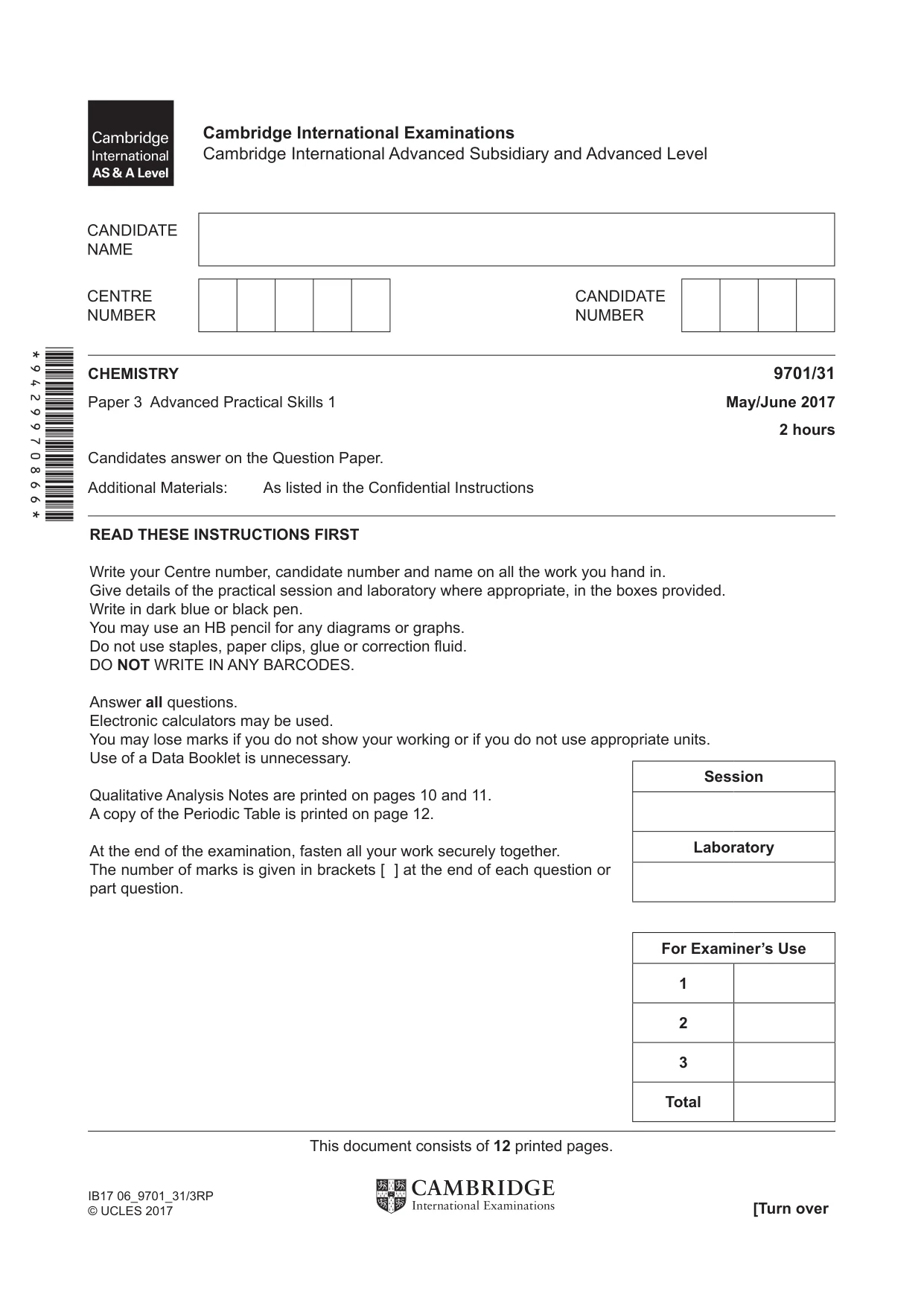
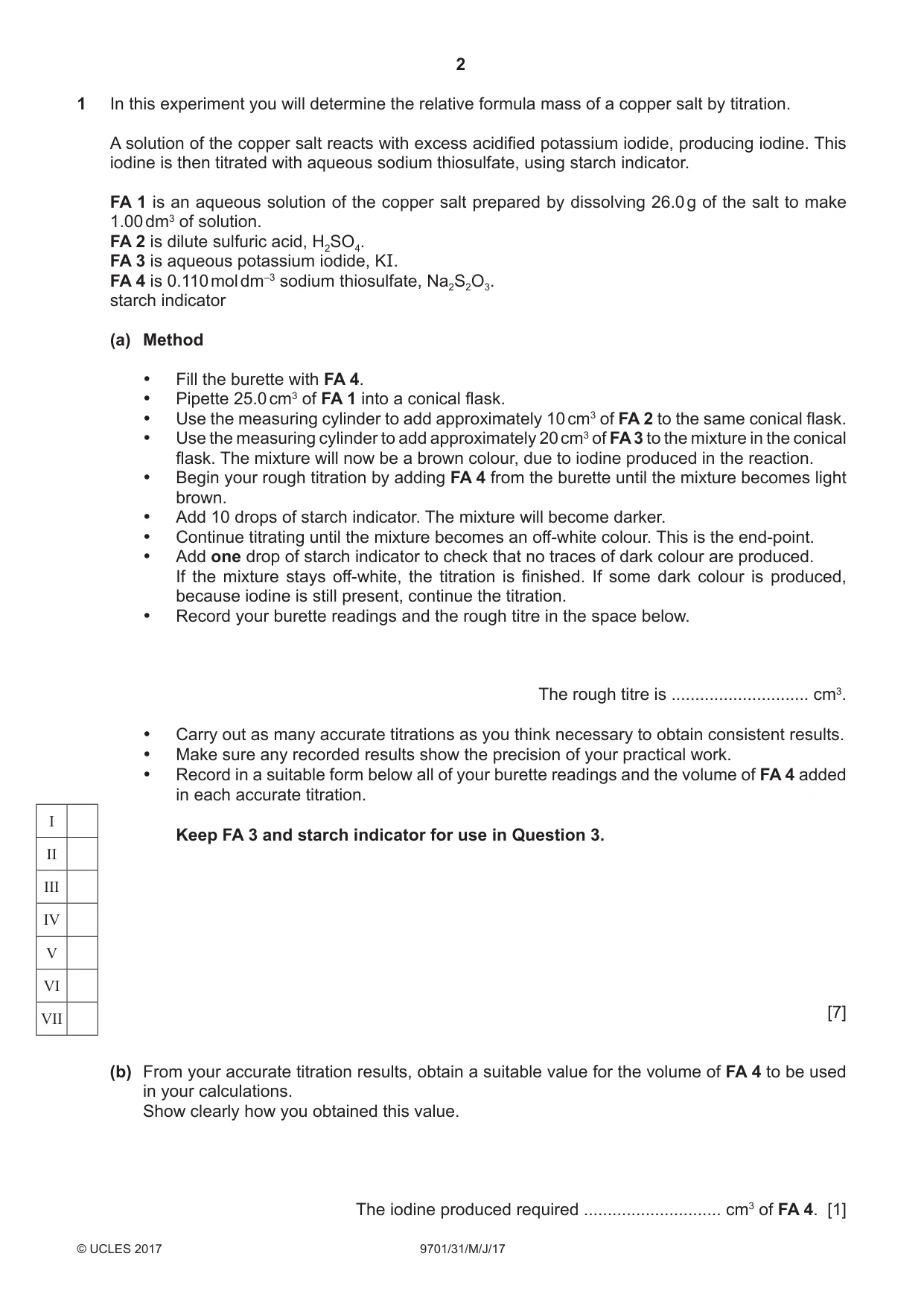
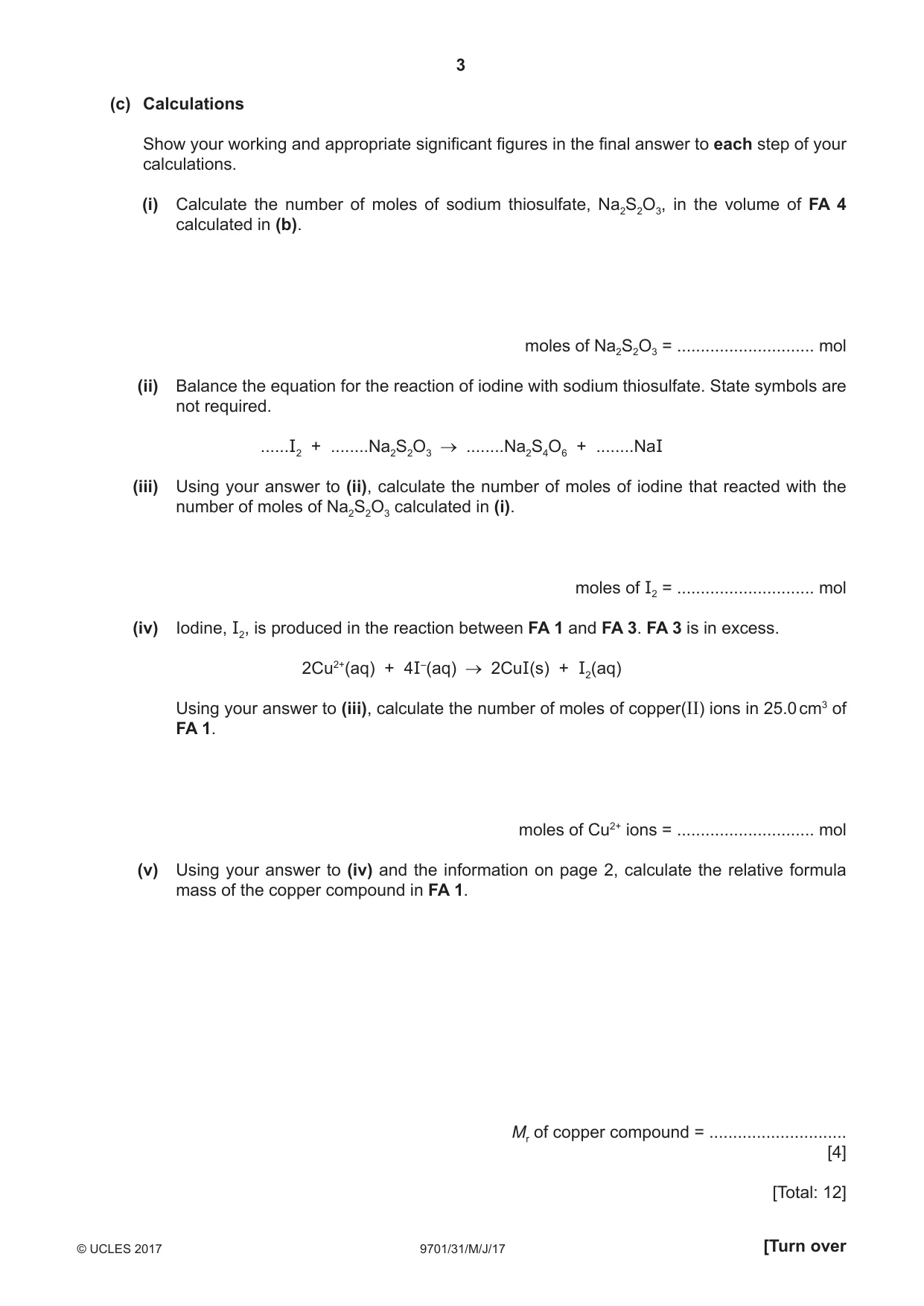
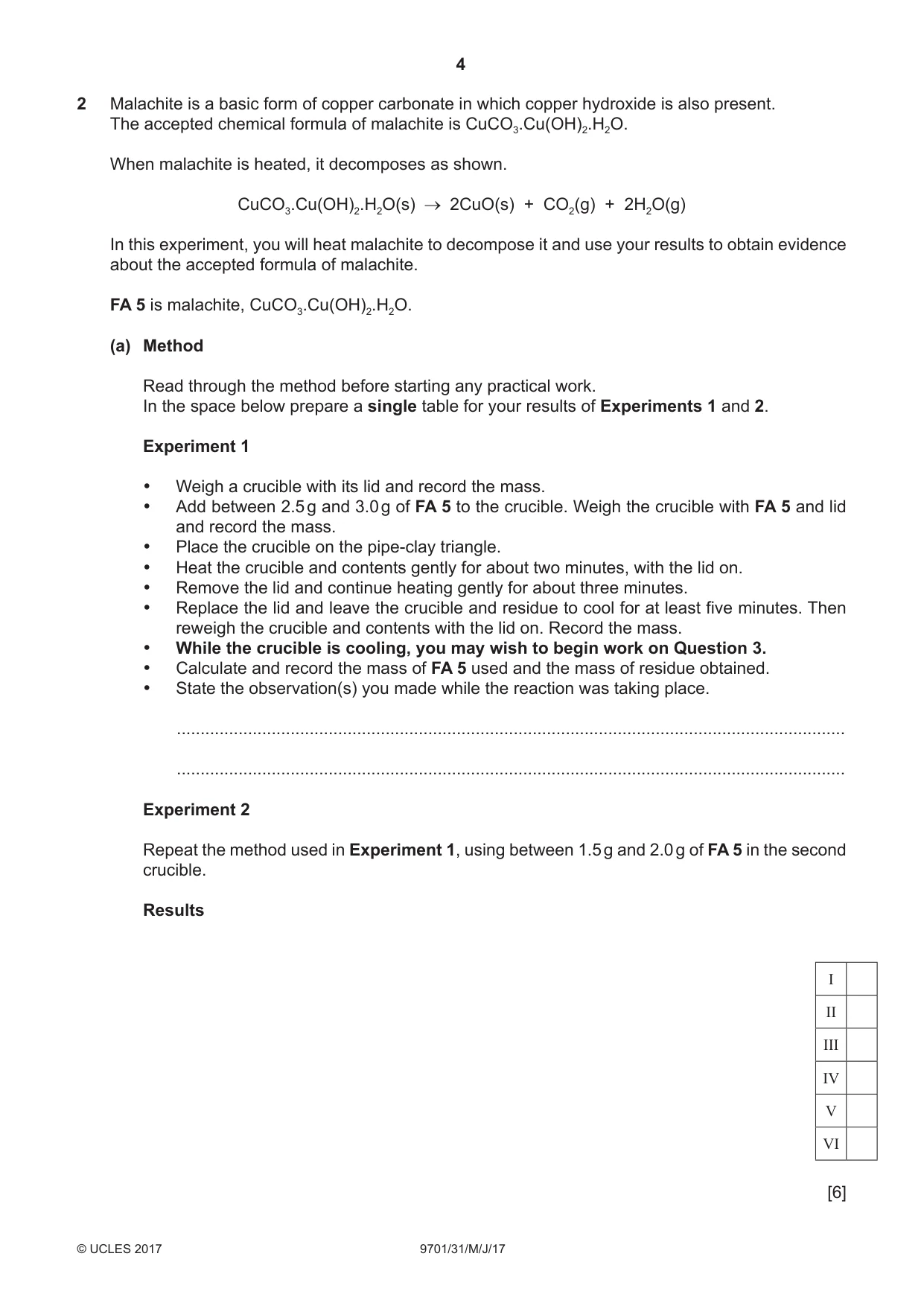
Mark scheme8 pages
Answers below. Sit the paper first if you are practising.
Questions as text
Q1 · In this experiment you will determine the relative formula mass of a copper salt by…
1 In this experiment you will determine the relative formula mass of a copper salt by titration. A solution of the copper salt reacts with excess acidified potassium iodide, producing iodine. This iodine is then titrated with aqueous sodium thiosulfate, using starch indicator. FA 1 is an aqueous solution of the copper salt prepared by dissolving 26.0 g of the salt to make 1.00 dm3 of solution. FA 2 is dilute sulfuric acid, H2SO4. FA 3 is aqueous potassium iodide, KI. FA 4 is 0.110 mol dm–3 sodium thiosulfate, Na2S2O3. starch indicator (a) Method • Fill the burette with FA 4. • Pipette 25.0 cm3 of FA 1 into a conical flask. • Use the measuring cylinder to add approximately 10 cm3 of FA 2 to the same conical flask. • Use the measuring cylinder to add approximately 20 cm3 of FA 3 to the mixture in the conical flask. The mixture will now be a brown colour, due to iodine produced in the reaction. • Begin your rough titration by adding FA 4 from the burette until the mixture becomes light brown. • Add 10 drops of starch indicator. The mixture will become darker. • Continue titrating until the mixture becomes an off-white colour. This is the end-point. • Add one drop of starch indicator to check that no traces of dark colour are produced. If the mixture stays off-white, the titration is finished. If some dark colour is produced, because iodine is still present, continue the titration. • Record your burette readings and the rough titre in the space below. The rough titre is ............................. cm3. • Carry out as many accurate titrations as you think necessary to obtain consistent results. • Make sure any recorded results show the precision of your practical work. • Record in a suitable form below all of your burette readings and the volume of FA 4 added in each accurate titration. I Keep FA 3 and starch indicator for use in Question 3. II III IV V VI [7]VII (b) From your accurate titration results, obtain a suitable value for the volume of FA 4 to be used in your calculations. Show clearly how you obtained this value. The iodine produced required ............................. cm3 of FA 4. [1] (c) Calculations Show your working and appropriate significant figures in the final answer to each step of your calculations. (i) Calculate the number of moles of sodium thiosulfate, Na2S2O3, in the volume of FA 4 calculated in (b). moles of Na2S2O3 = ............................. mol (ii) Balance the equation for the reaction of iodine with sodium thiosulfate. State symbols are not required. ......I2 + ........Na2S2O3 ........Na2S4O6 + ........NaI (iii) Using your answer to (ii), calculate the number of moles of iodine that reacted with the number of moles of Na2S2O3 calculated in (i). moles of I2 = ............................. mol (iv) Iodine, I2, is produced in the reaction between FA 1 and FA 3. FA 3 is in excess. 2Cu2+(aq) + 4I–(aq) 2CuI(s) + I2(aq) Using your answer to (iii), calculate the number of moles of copper(II) ions in 25.0 cm3 of FA 1. moles of Cu2+ ions = ............................. mol (v) Using your answer to (iv) and the information on page 2, calculate the relative formula mass of the copper compound in FA 1. Mr of copper compound = ............................. [4] [Total: 12]
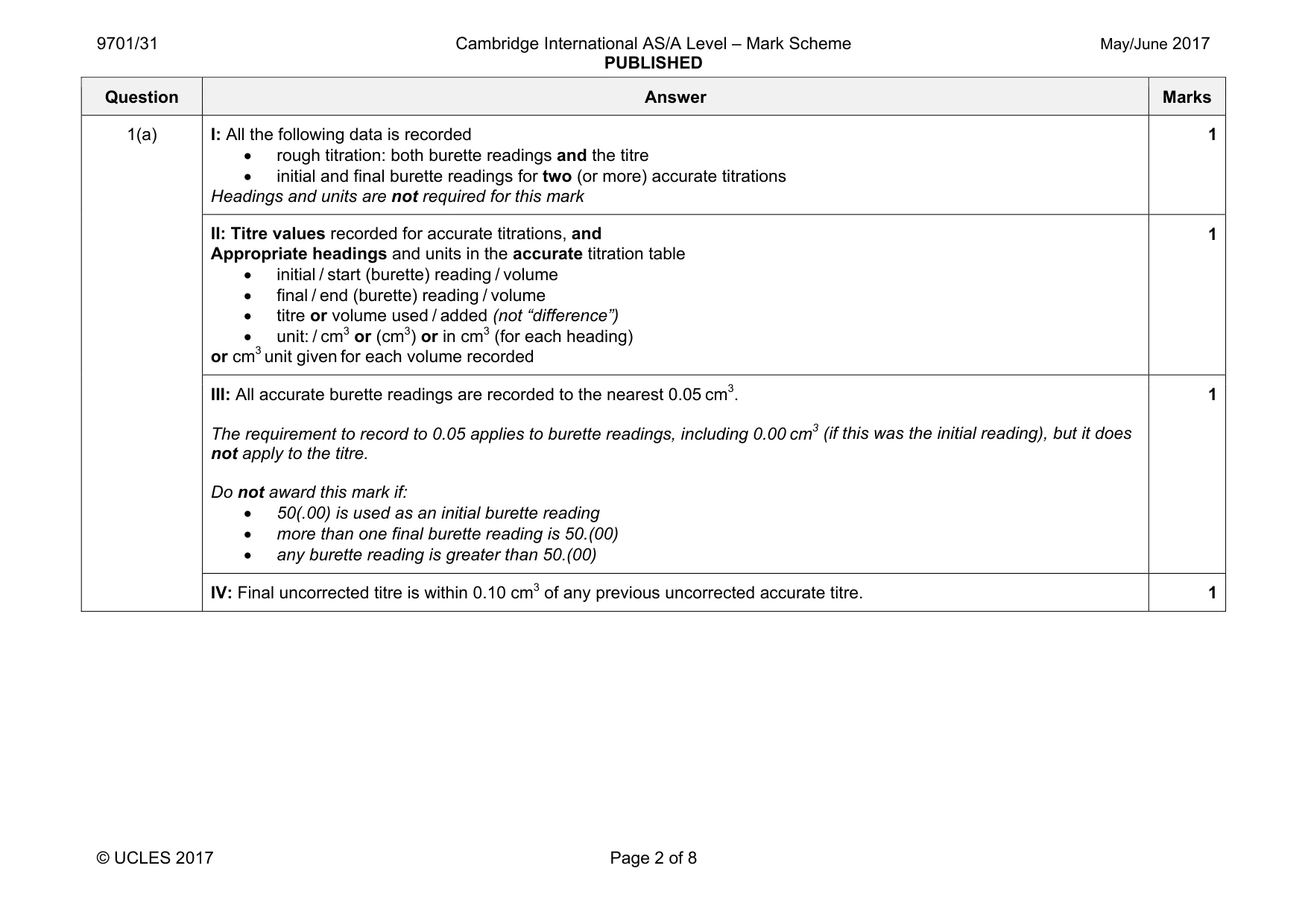
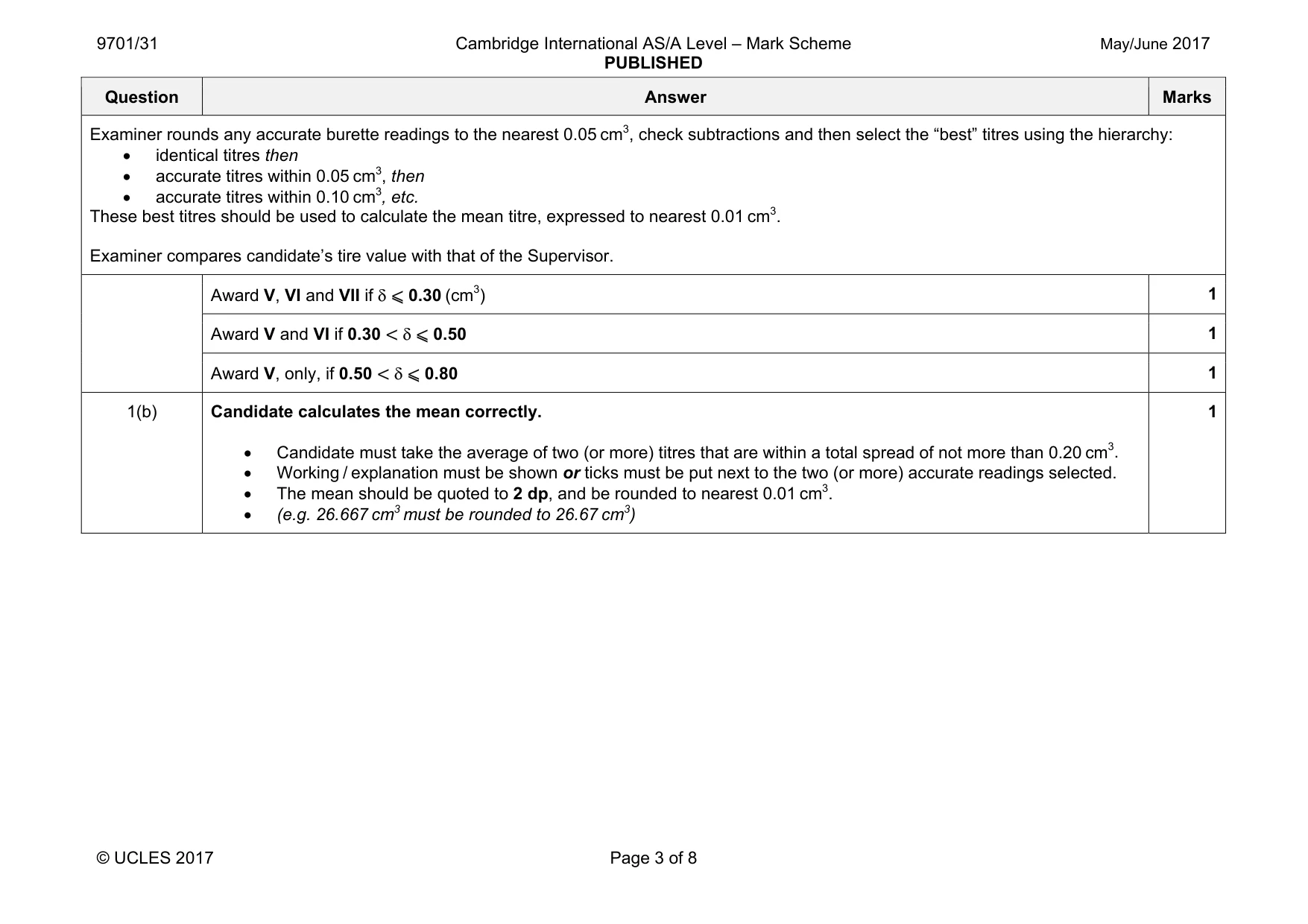
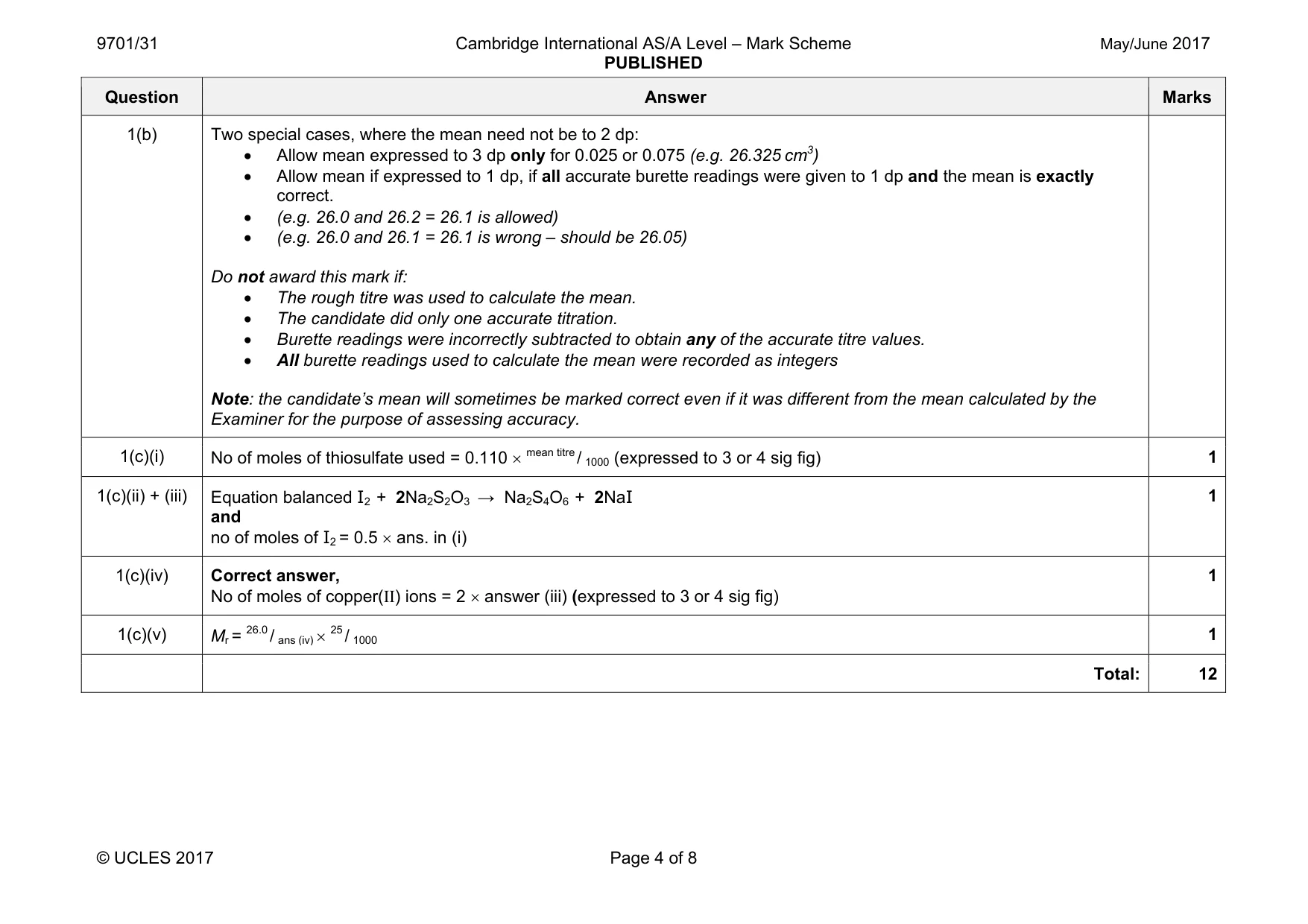
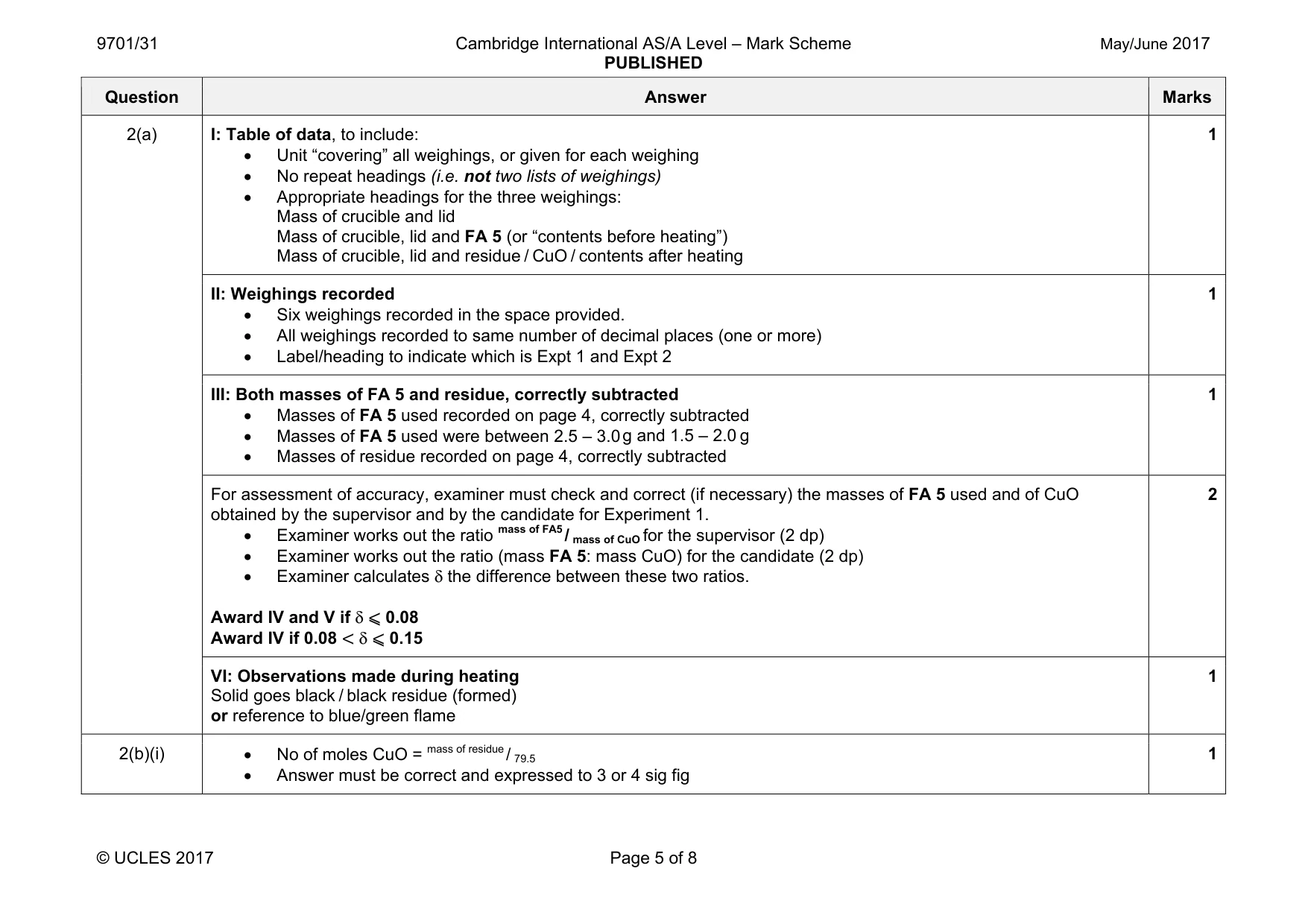
Mark scheme: 1(a) I: All the following data is recorded • rough titration: both burette readings and the titre • initial and final burette readings for two (or more) accurate titrations Headings and units are not required for this mark 1 II: Titre values recorded for accurate titrations, and Appropriate headings and units in the accurate titration table • initial / start (burette) reading / volume • final / end (burette) reading / volume • titre or volume used / added (not “difference”) • unit: / cm3 or (cm3) or in cm3 (for each heading) or cm3 unit given for each volume recorded 1 III: All accurate burette readings are recorded to the nearest 0.05 cm3. The requirement to record to 0.05 applies to burette readings, including 0.00 cm3 (if this was the initial reading), but it does not apply to the titre. Do not award this mark if: • 50(.00) is used as an initial burette reading • more than one final burette reading is 50.(00) • any burette reading is greater than 50.(00) 1 IV: Final uncorrected titre is within 0.10 cm3 of any previous uncorrected accurate titre. 1 Question Answer Marks Examiner rounds any accurate burette readings to the nearest 0.05 cm3, check subtractions and then select the “best” titres using the hierarchy: • identical titres then • accurate titres within 0.05 cm3, then • accurate titres within 0.10 cm3, etc. These best titres should be used to calculate the mean titre, expressed to nearest 0.01 cm3. Examiner compares candidate’s tire value with that of the Supervisor. Award V, VI and VII if δ ⩽ 0.30 (cm3) 1 Award V and VI if 0.30 < δ ⩽ 0.50 1 Award V, only, if 0.50 < δ ⩽ 0.80 1 1(b) Candidate calculates the mean correctly. • Candidate must take the average of two (or more) titres that are within a total spread of not more than 0.20 cm3. • Working / explanation must be shown or ticks must be put next to the two (or more) accurate readings selected. • The mean should be quoted to 2 dp, and be rounded to nearest 0.01 cm3. • (e.g. 26.667 cm3 must be rounded to 26.67 cm3) 1 Question Answer Marks 1(b) Two special cases, where the mean need not be to 2 dp: • Allow mean expressed to 3 dp only for 0.025 or 0.075 (e.g. 26.325 cm3) • Allow mean if expressed to 1 dp, if all accurate burette readings were given to 1 dp and the mean is exactly correct. • (e.g. 26.0 and 26.2 = 26.1 is allowed) • (e.g. 26.0 and 26.1 = 26.1 is wrong – should be 26.05) Do not award this mark if: • The rough titre was used to calculate the mean. • The candidate did only one accurate titration. • Burette readings were incorrectly subtracted to obtain any of the accurate titre values. • All burette readings used to calculate the mean were recorded as integers Note: the candidate’s mean will sometimes be marked correct even if it was different from the mean calculated by the Examiner for the purpose of assessing accuracy. 1(c)(i) No of moles of thiosulfate used = 0.110 × mean titre/ 1000 (expressed to 3 or 4 sig fig) 1 1(c)(ii) + (iii) Equation balanced I2 + 2Na2S2O3 → Na2S4O6 + 2NaI and no of moles of I2 = 0.5 × ans. in (i) 1 1(c)(iv) Correct answer, No of moles of copper(II) ions = 2 × answer (iii) (expressed to 3 or 4 sig fig) 1 1(c)(v) Mr = 26.0/ ans (iv) × 25 / 1000 1 Total: 12
More questions on Reacting masses and volumes (of solutions and gases)
Q2 · Malachite is a basic form of copper carbonate in which copper hydroxide is also present
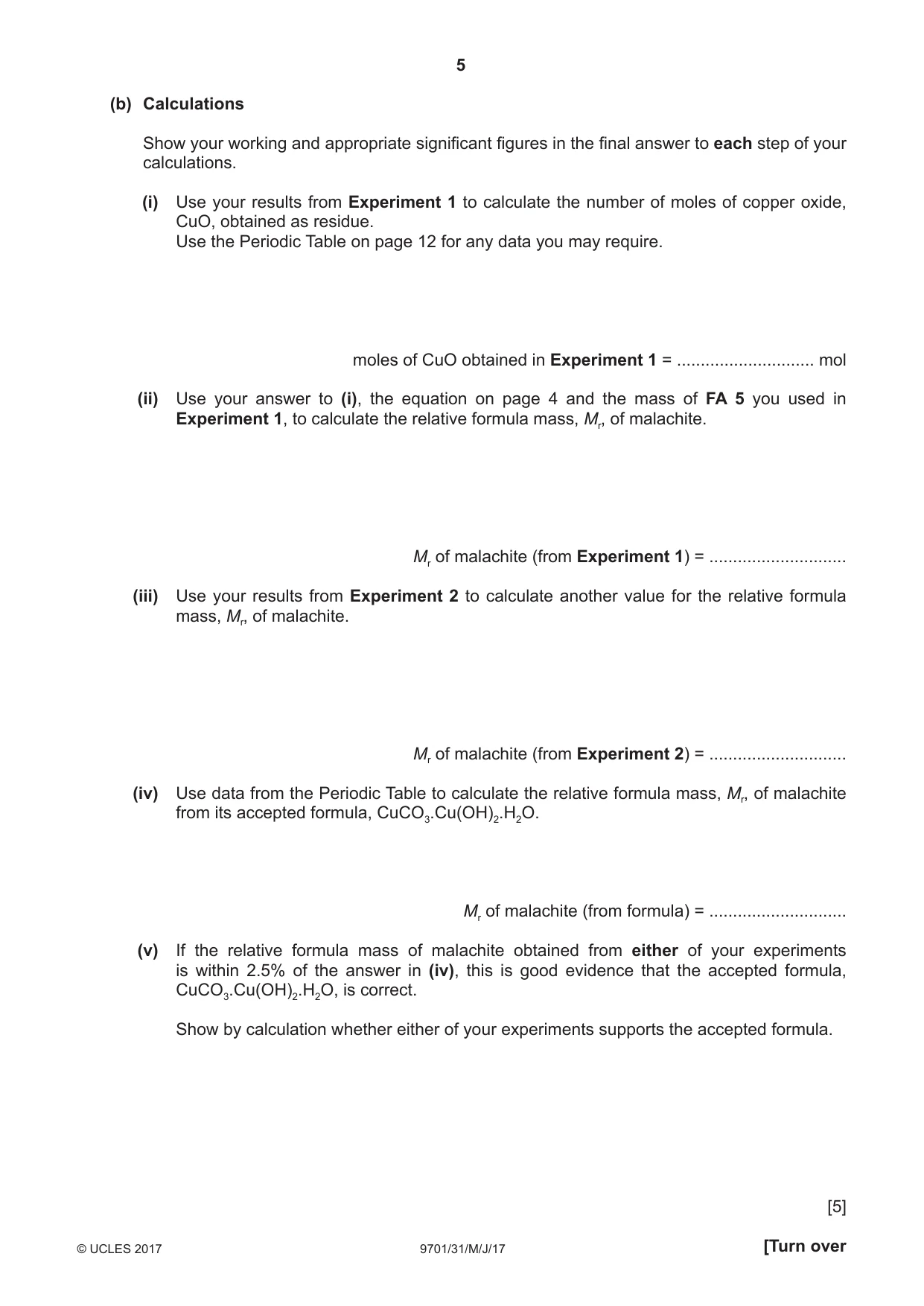
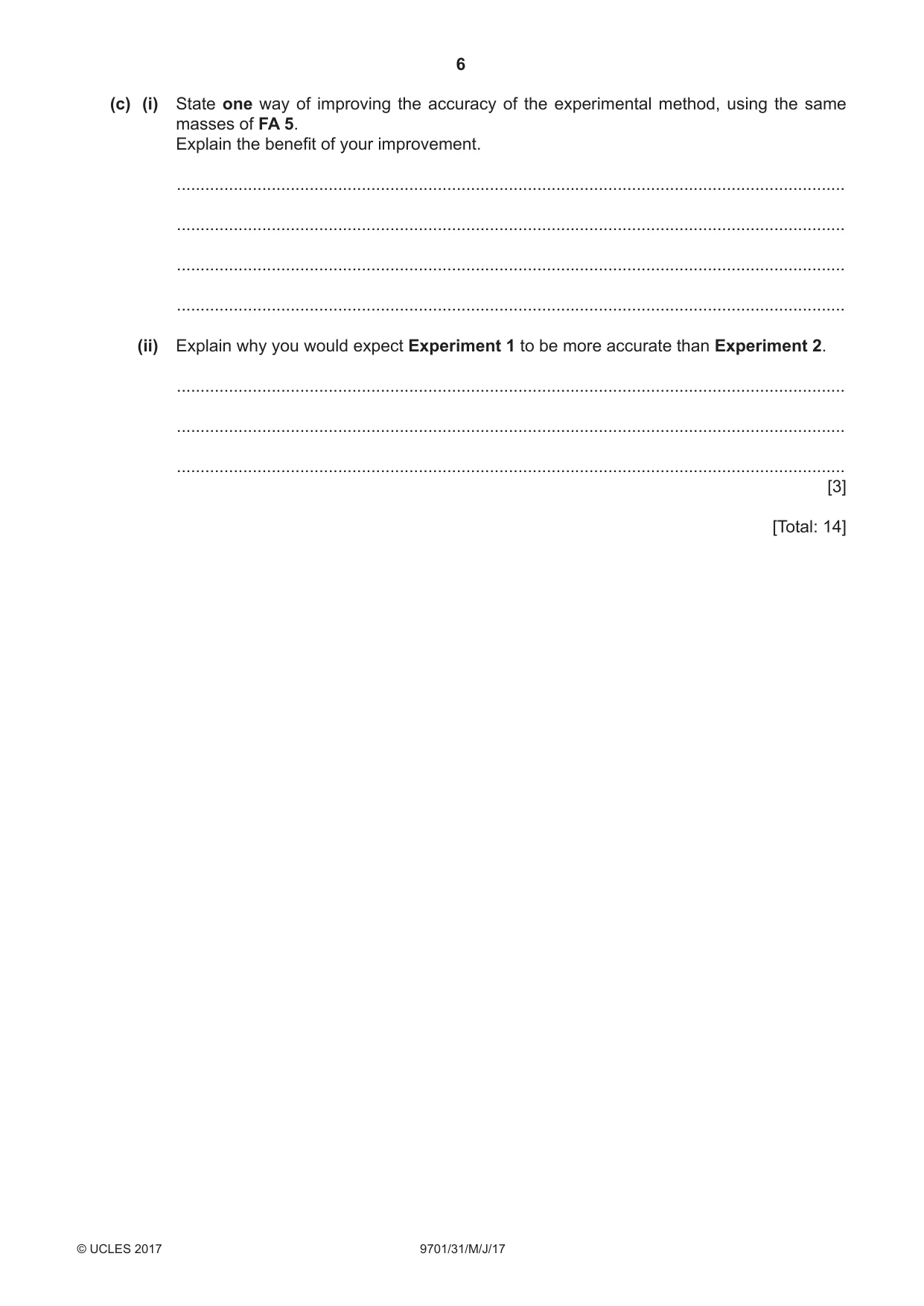
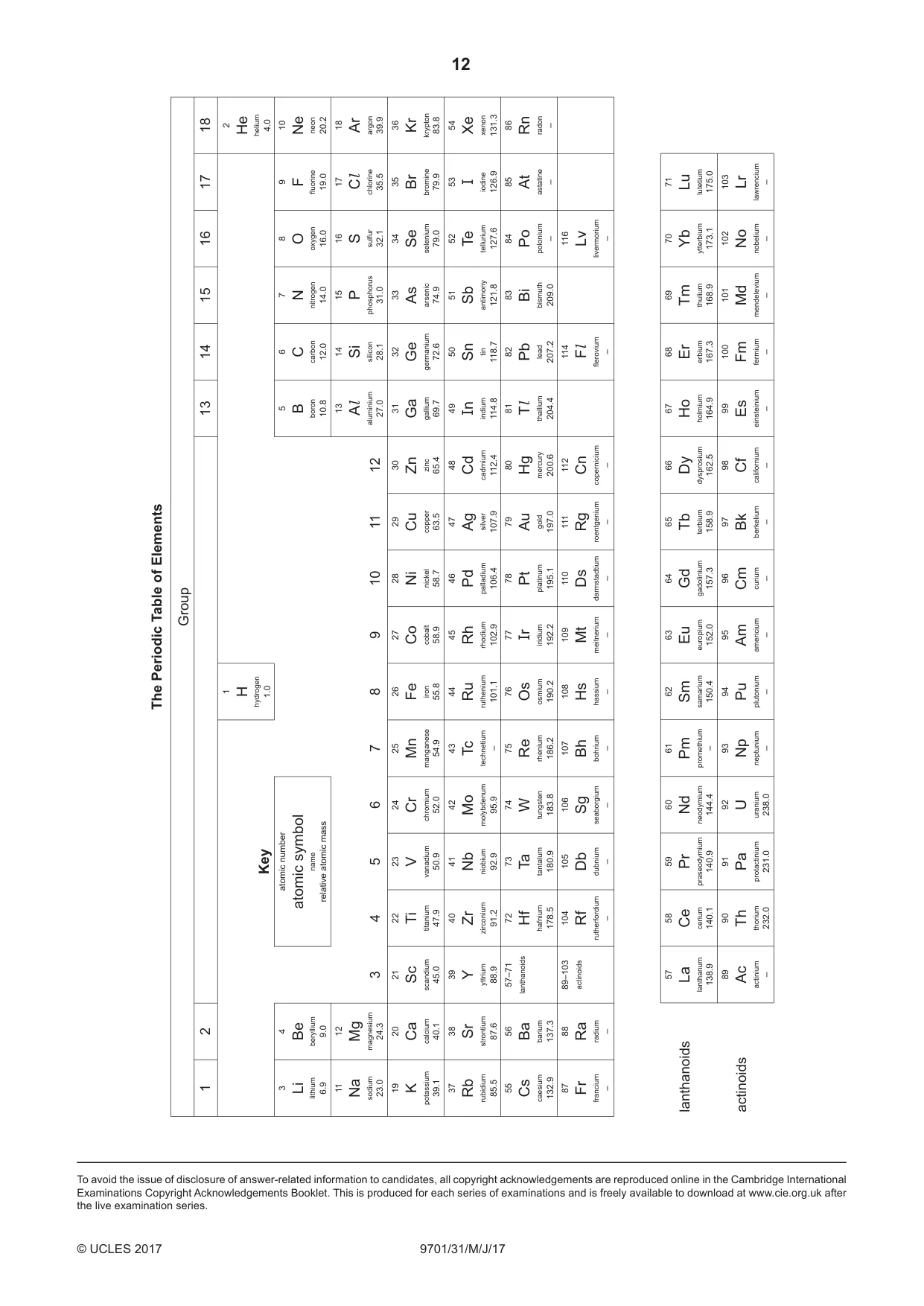
2 Malachite is a basic form of copper carbonate in which copper hydroxide is also present. The accepted chemical formula of malachite is CuCO3.Cu(OH)2.H2O. When malachite is heated, it decomposes as shown. CuCO3.Cu(OH)2.H2O(s) 2CuO(s) + CO2(g) + 2H2O(g) In this experiment, you will heat malachite to decompose it and use your results to obtain evidence about the accepted formula of malachite. FA 5 is malachite, CuCO3.Cu(OH)2.H2O. (a) Method Read through the method before starting any practical work. In the space below prepare a single table for your results of Experiments 1 and 2. Experiment 1 • Weigh a crucible with its lid and record the mass. • Add between 2.5 g and 3.0 g of FA 5 to the crucible. Weigh the crucible with FA 5 and lid and record the mass. • Place the crucible on the pipe-clay triangle. • Heat the crucible and contents gently for about two minutes, with the lid on. • Remove the lid and continue heating gently for about three minutes. • Replace the lid and leave the crucible and residue to cool for at least five minutes. Then reweigh the crucible and contents with the lid on. Record the mass. • While the crucible is cooling, you may wish to begin work on Question 3. • Calculate and record the mass of FA 5 used and the mass of residue obtained. • State the observation(s) you made while the reaction was taking place. ............................................................................................................................................. ............................................................................................................................................. Experiment 2 Repeat the method used in Experiment 1, using between 1.5 g and 2.0 g of FA 5 in the second crucible. Results I II III IV V VI [6] (b) Calculations Show your working and appropriate significant figures in the final answer to each step of your calculations. (i) Use your results from Experiment 1 to calculate the number of moles of copper oxide, CuO, obtained as residue. Use the Periodic Table on page 12 for any data you may require. moles of CuO obtained in Experiment 1 = ............................. mol (ii) Use your answer to (i), the equation on page 4 and the mass of FA 5 you used in Experiment 1, to calculate the relative formula mass, Mr, of malachite. Mr of malachite (from Experiment 1) = ............................. (iii) Use your results from Experiment 2 to calculate another value for the relative formula mass, Mr, of malachite. Mr of malachite (from Experiment 2) = ............................. (iv) Use data from the Periodic Table to calculate the relative formula mass, Mr, of malachite from its accepted formula, CuCO3.Cu(OH)2.H2O. Mr of malachite (from formula) = ............................. (v) If the relative formula mass of malachite obtained from either of your experiments is within 2.5% of the answer in (iv), this is good evidence that the accepted formula, CuCO3.Cu(OH)2.H2O, is correct. Show by calculation whether either of your experiments supports the accepted formula. [5] (c) (i) State one way of improving the accuracy of the experimental method, using the same masses of FA 5. Explain the benefit of your improvement. ............................................................................................................................................. ............................................................................................................................................. ............................................................................................................................................. ............................................................................................................................................. (ii) Explain why you would expect Experiment 1 to be more accurate than Experiment 2. ............................................................................................................................................. ............................................................................................................................................. ............................................................................................................................................. [3] [Total: 14]
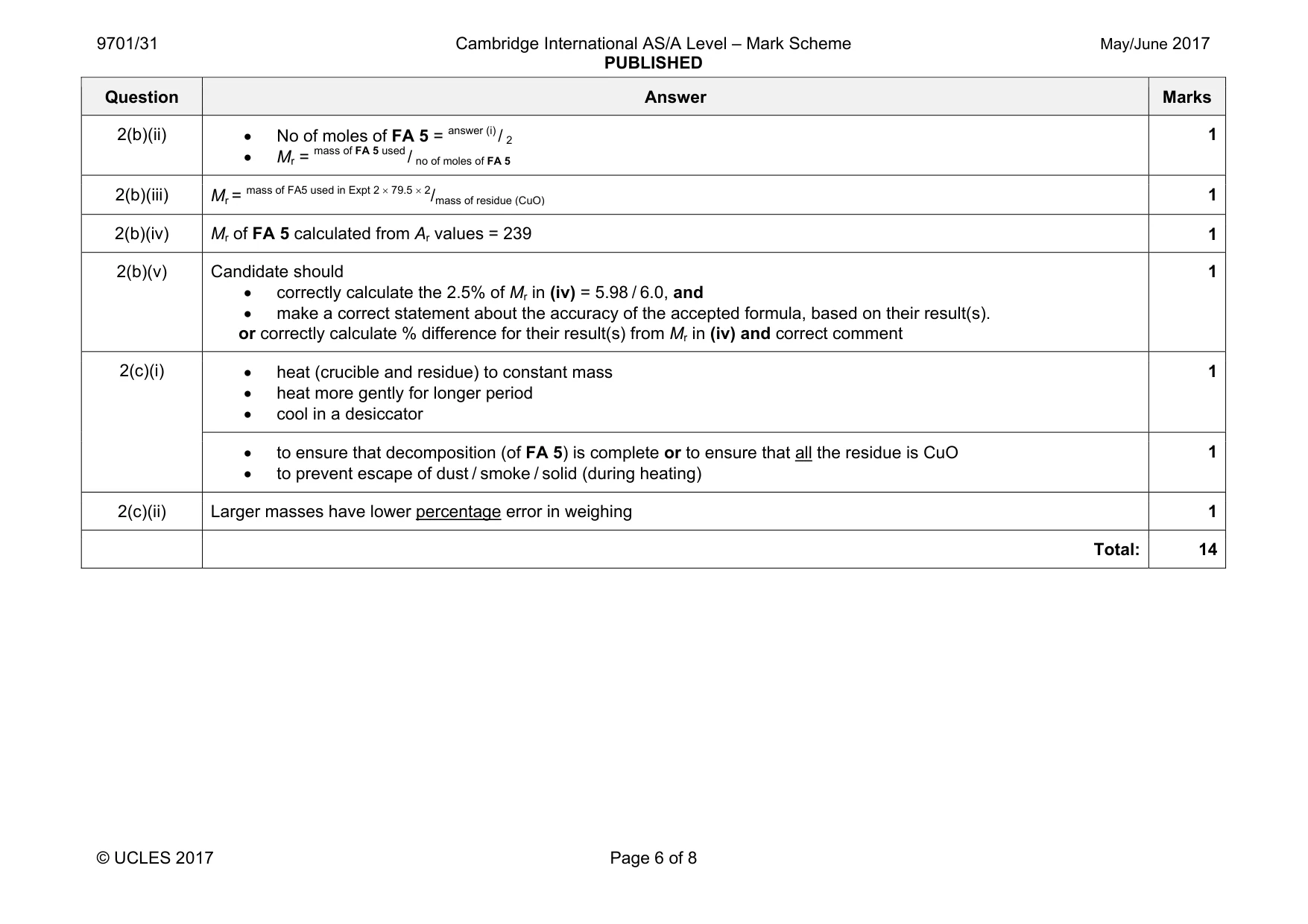
Mark scheme: 2(a) I: Table of data, to include: • Unit “covering” all weighings, or given for each weighing • No repeat headings (i.e. not two lists of weighings) • Appropriate headings for the three weighings: Mass of crucible and lid Mass of crucible, lid and FA 5 (or “contents before heating”) Mass of crucible, lid and residue / CuO / contents after heating 1 II: Weighings recorded • Six weighings recorded in the space provided. • All weighings recorded to same number of decimal places (one or more) • Label/heading to indicate which is Expt 1 and Expt 2 1 III: Both masses of FA 5 and residue, correctly subtracted • Masses of FA 5 used recorded on page 4, correctly subtracted • Masses of FA 5 used were between 2.5 – 3.0 g and 1.5 – 2.0 g • Masses of residue recorded on page 4, correctly subtracted 1 For assessment of accuracy, examiner must check and correct (if necessary) the masses of FA 5 used and of CuO obtained by the supervisor and by the candidate for Experiment 1. • Examiner works out the ratio mass of FA5 / mass of CuO for the supervisor (2 dp) • Examiner works out the ratio (mass FA 5: mass CuO) for the candidate (2 dp) • Examiner calculates δ the difference between these two ratios. Award IV and V if δ ⩽ 0.08 Award IV if 0.08 < δ ⩽ 0.15 2 VI: Observations made during heating Solid goes black / black residue (formed) or reference to blue/green flame 1 2(b)(i) • No of moles CuO = mass of residue/ 79.5 • Answer must be correct and expressed to 3 or 4 sig fig 1 Question Answer Marks 2(b)(ii) • No of moles of FA 5 = answer (i)/ 2 • Mr = mass of FA 5 used / no of moles of FA 5 1 2(b)(iii) Mr = mass of FA5 used in Expt 2 × 79.5 × 2/mass of residue (CuO) 1 2(b)(iv) Mr of FA 5 calculated from Ar values = 239 1 2(b)(v) Candidate should • correctly calculate the 2.5% of Mr in (iv) = 5.98 / 6.0, and • make a correct statement about the accuracy of the accepted formula, based on their result(s). or correctly calculate % difference for their result(s) from Mr in (iv) and correct comment 1 2(c)(i) • heat (crucible and residue) to constant mass • heat more gently for longer period • cool in a desiccator 1 • to ensure that decomposition (of FA 5) is complete or to ensure that all the residue is CuO • to prevent escape of dust / smoke / solid (during heating) 1 2(c)(ii) Larger masses have lower percentage error in weighing 1 Total: 14
More questions on Reacting masses and volumes (of solutions and gases)
Q3 · Qualitative Analysis At each stage of any test you are to record details of the following
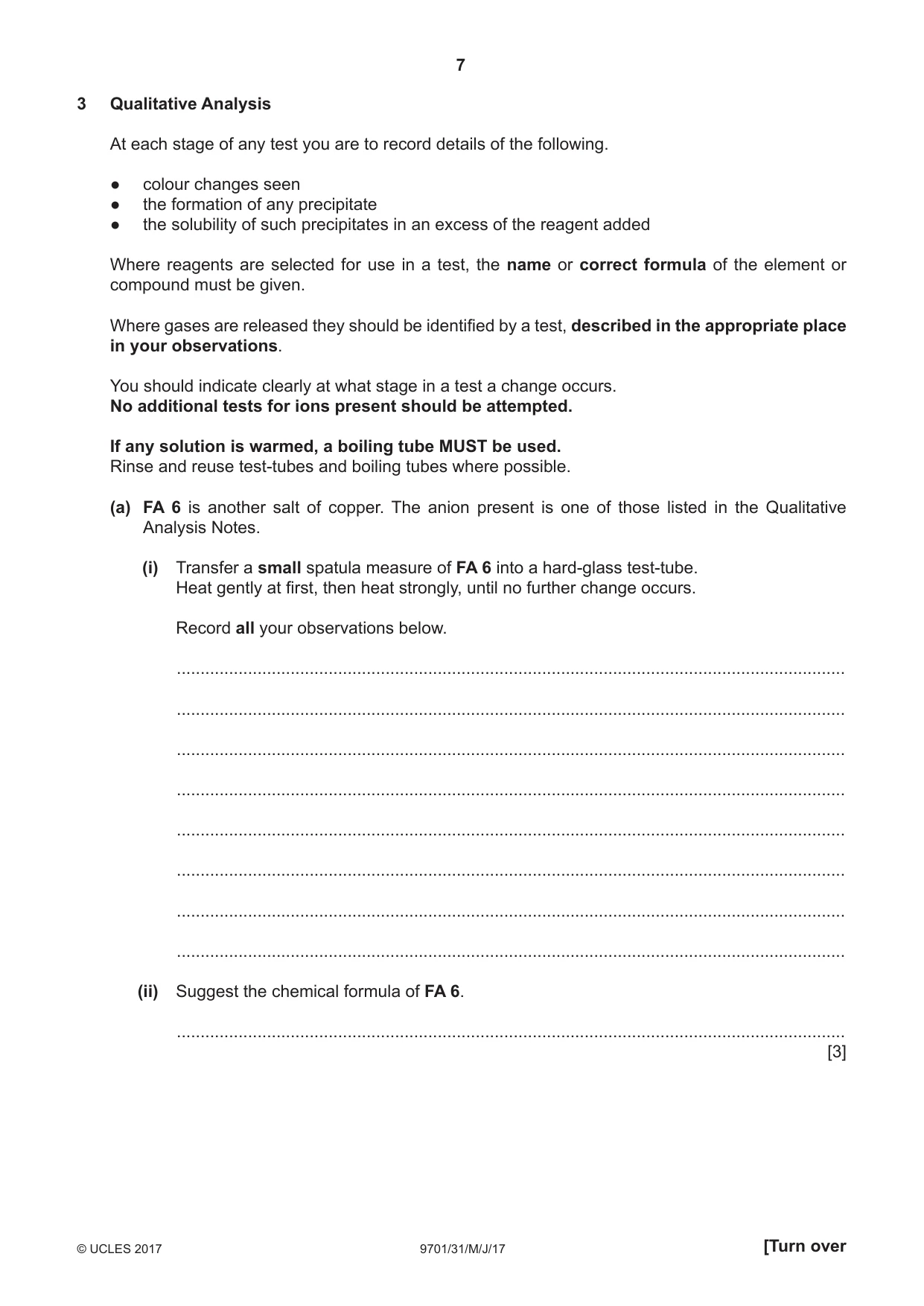
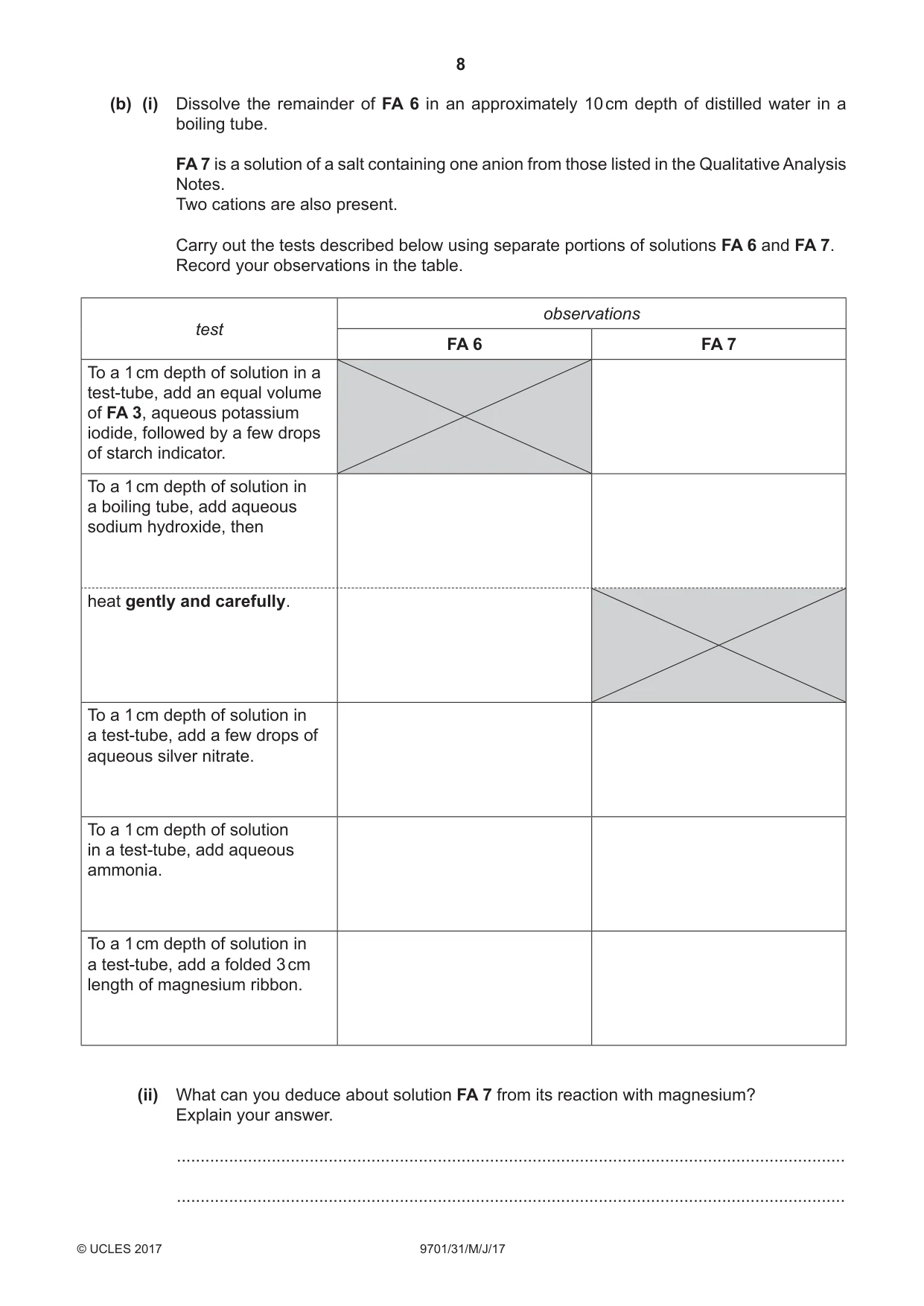
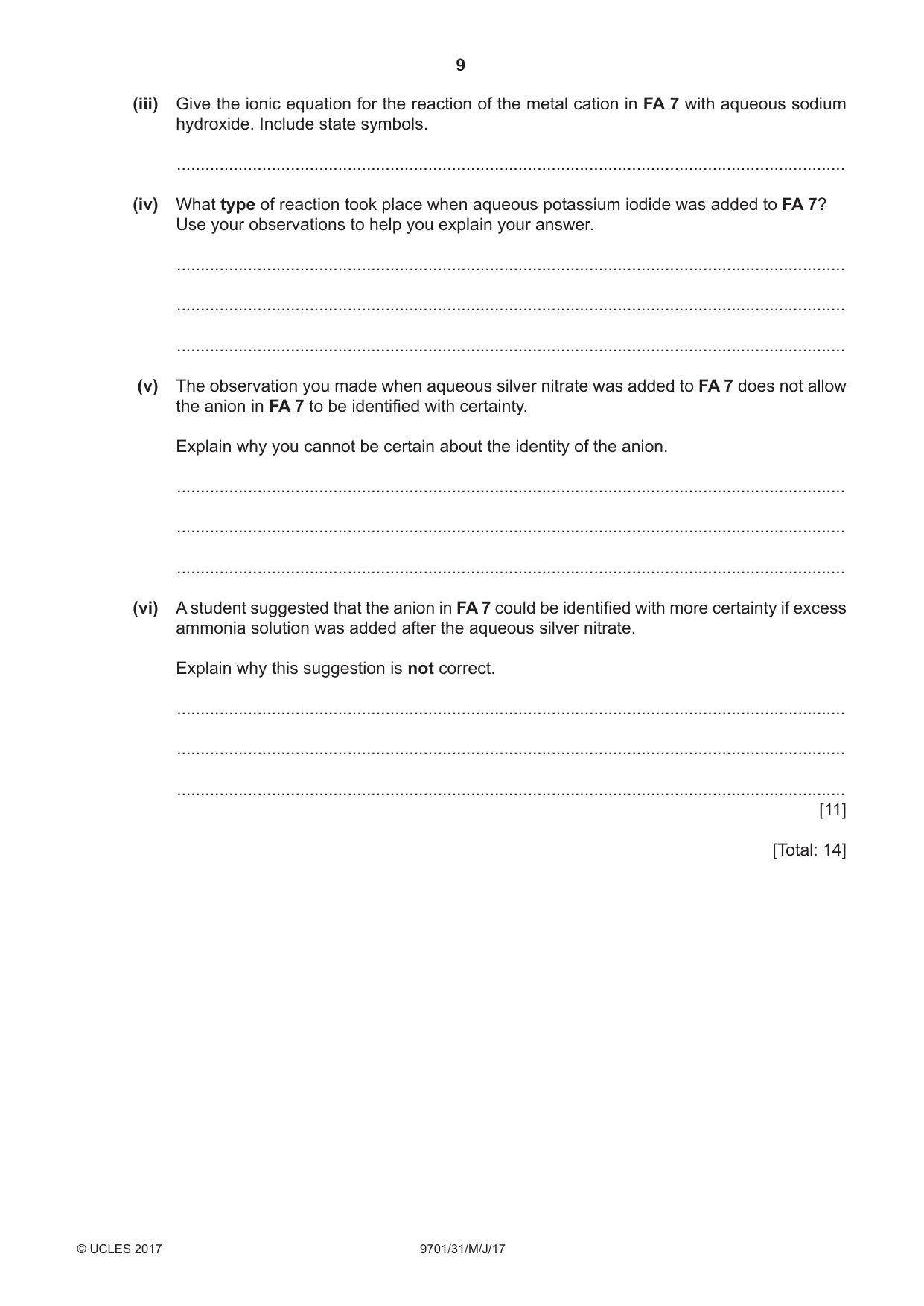
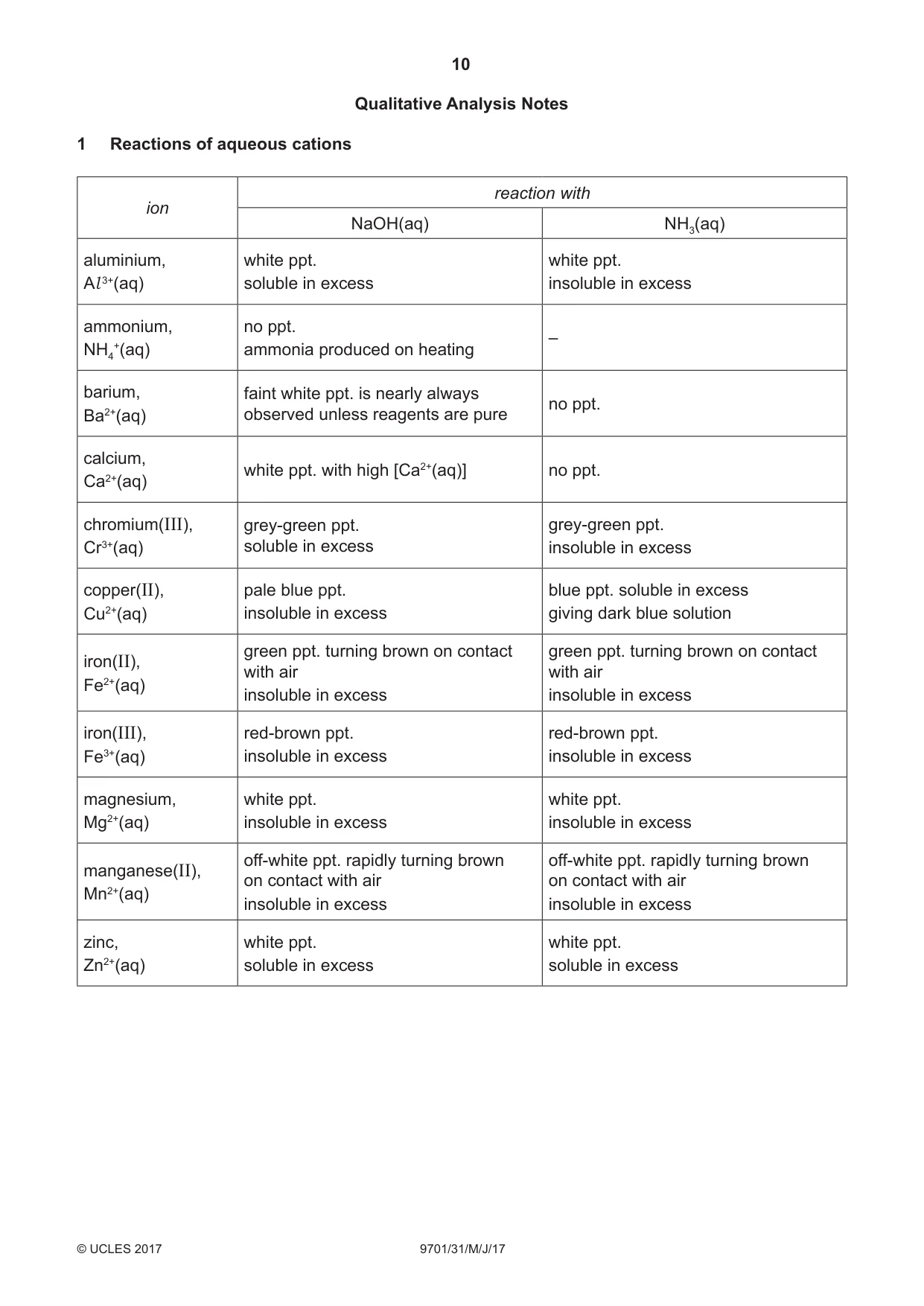
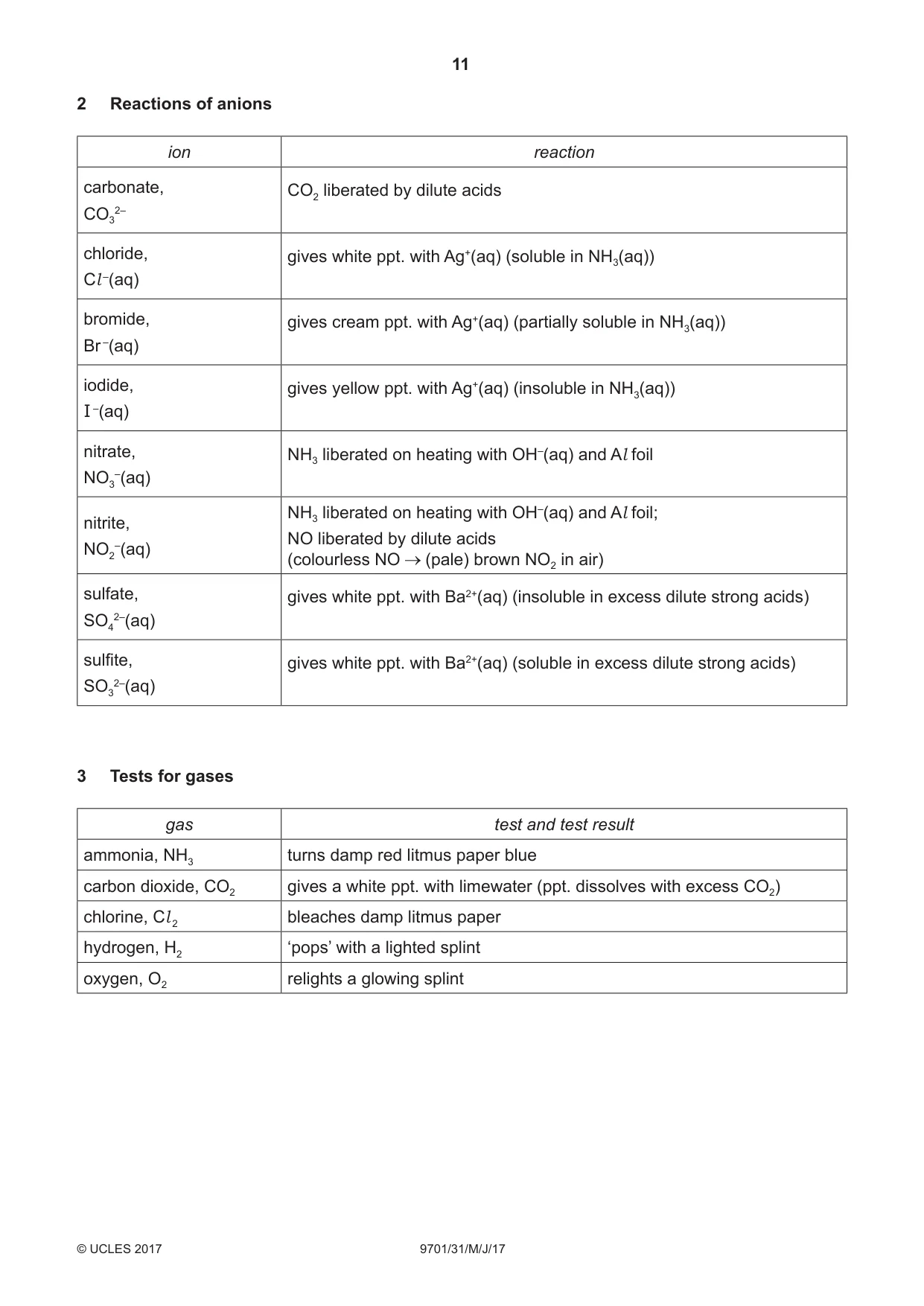
3 Qualitative Analysis At each stage of any test you are to record details of the following. ● colour changes seen ● the formation of any precipitate ● the solubility of such precipitates in an excess of the reagent added Where reagents are selected for use in a test, the name or correct formula of the element or compound must be given. Where gases are released they should be identified by a test, described in the appropriate place in your observations. You should indicate clearly at what stage in a test a change occurs. No additional tests for ions present should be attempted. If any solution is warmed, a boiling tube MUST be used. Rinse and reuse test-tubes and boiling tubes where possible. (a) FA 6 is another salt of copper. The anion present is one of those listed in the Qualitative Analysis Notes. (i) Transfer a small spatula measure of FA 6 into a hard-glass test-tube. Heat gently at first, then heat strongly, until no further change occurs. Record all your observations below. ............................................................................................................................................. ............................................................................................................................................. ............................................................................................................................................. ............................................................................................................................................. ............................................................................................................................................. ............................................................................................................................................. ............................................................................................................................................. ............................................................................................................................................. (ii) Suggest the chemical formula of FA 6. ............................................................................................................................................. [3] (b) (i) Dissolve the remainder of FA 6 in an approximately 10 cm depth of distilled water in a boiling tube. FA 7 is a solution of a salt containing one anion from those listed in the Qualitative Analysis Notes. Two cations are also present. Carry out the tests described below using separate portions of solutions FA 6 and FA 7. Record your observations in the table. observations test FA 6 FA 7 To a 1 cm depth of solution in a test-tube, add an equal volume of FA 3, aqueous potassium iodide, followed by a few drops of starch indicator. To a 1 cm depth of solution in a boiling tube, add aqueous sodium hydroxide, then heat gently and carefully. To a 1 cm depth of solution in a test-tube, add a few drops of aqueous silver nitrate. To a 1 cm depth of solution in a test-tube, add aqueous ammonia. To a 1 cm depth of solution in a test-tube, add a folded 3 cm length of magnesium ribbon. (ii) What can you deduce about solution FA 7 from its reaction with magnesium? Explain your answer. ............................................................................................................................................. ............................................................................................................................................. (iii) Give the ionic equation for the reaction of the metal cation in FA 7 with aqueous sodium hydroxide. Include state symbols. ............................................................................................................................................. (iv) What type of reaction took place when aqueous potassium iodide was added to FA 7? Use your observations to help you explain your answer. ............................................................................................................................................. ............................................................................................................................................. ............................................................................................................................................. (v) The observation you made when aqueous silver nitrate was added to FA 7 does not allow the anion in FA 7 to be identified with certainty. Explain why you cannot be certain about the identity of the anion. ............................................................................................................................................. ............................................................................................................................................. ............................................................................................................................................. (vi) A student suggested that the anion in FA 7 could be identified with more certainty if excess ammonia solution was added after the aqueous silver nitrate. Explain why this suggestion is not correct. ............................................................................................................................................. ............................................................................................................................................. ............................................................................................................................................. [11] [Total: 14]
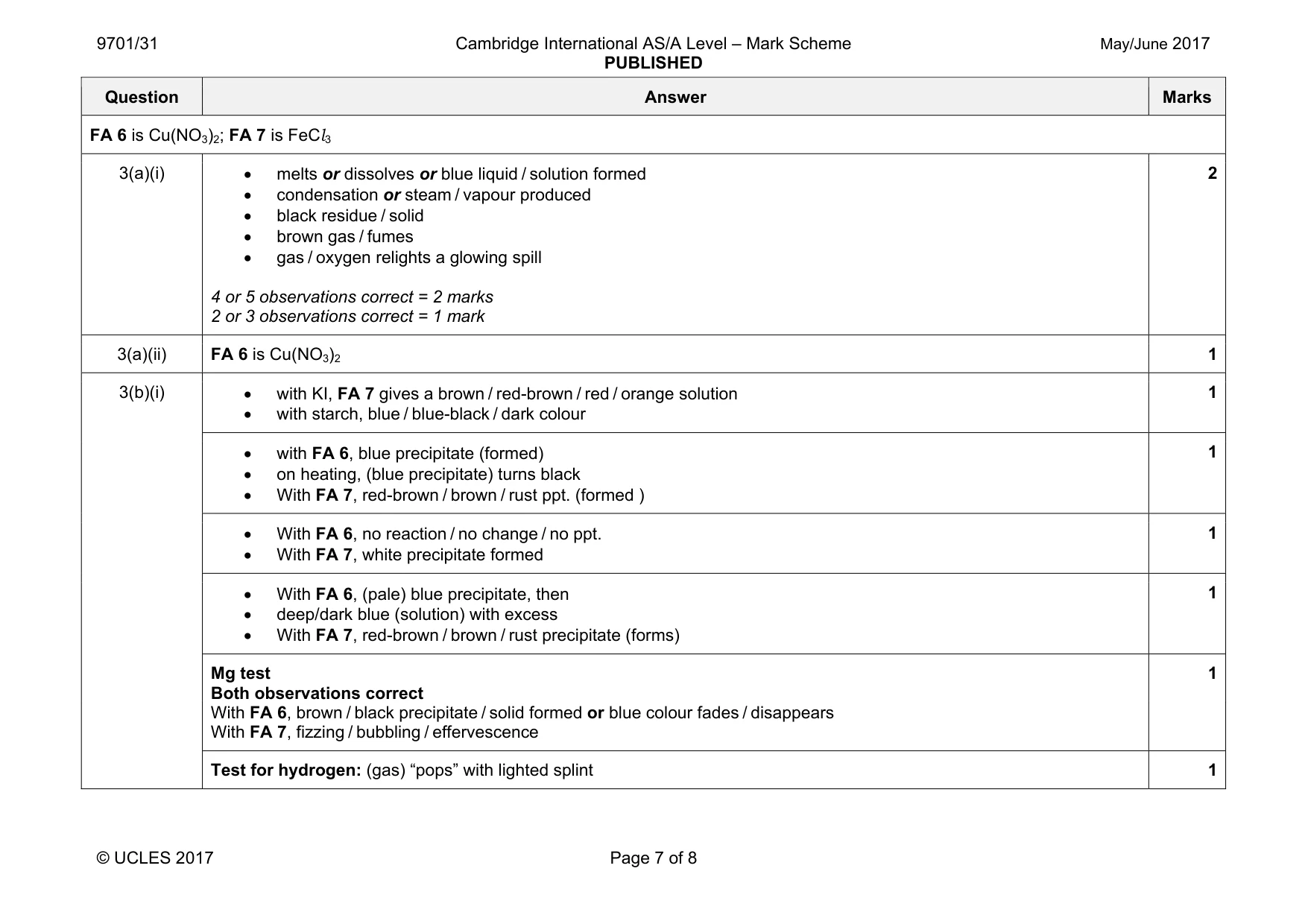
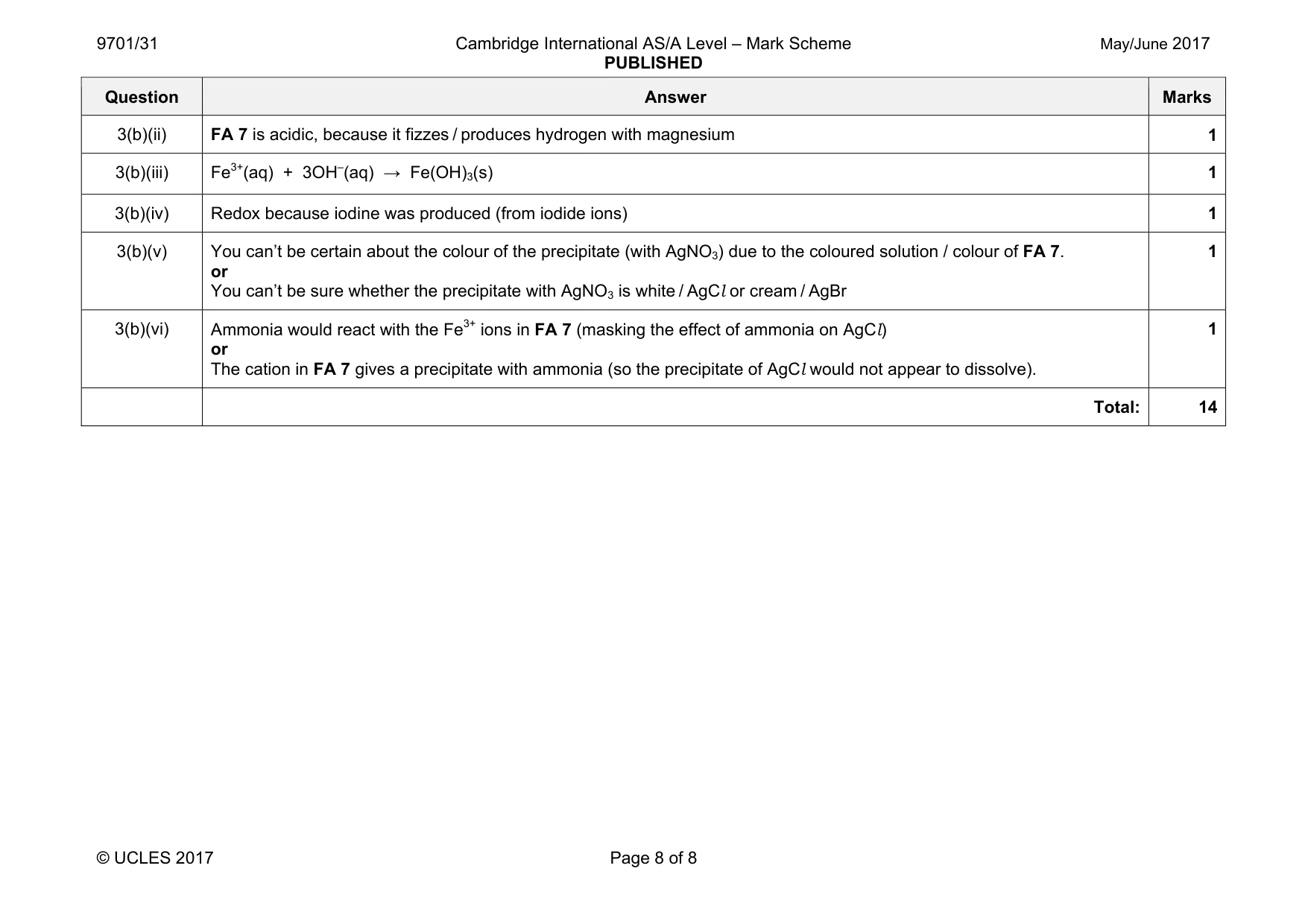
Mark scheme: 3(a)(i) melts or dissolves or blue liquid / solution formed • condensation or steam / vapour produced • black residue / solid • brown gas / fumes • gas / oxygen relights a glowing spill 4 or 5 observations correct = 2 marks 2 or 3 observations correct = 1 mark 2 3(a)(ii) FA 6 is Cu(NO3)2 1 3(b)(i) • with KI, FA 7 gives a brown / red-brown / red / orange solution • with starch, blue / blue-black / dark colour 1 • with FA 6, blue precipitate (formed) • on heating, (blue precipitate) turns black • With FA 7, red-brown / brown / rust ppt. (formed ) 1 • With FA 6, no reaction / no change / no ppt. • With FA 7, white precipitate formed 1 • With FA 6, (pale) blue precipitate, then • deep/dark blue (solution) with excess • With FA 7, red-brown / brown / rust precipitate (forms) 1 Mg test Both observations correct With FA 6, brown / black precipitate / solid formed or blue colour fades / disappears With FA 7, fizzing / bubbling / effervescence 1 Test for hydrogen: (gas) “pops” with lighted splint 1 Question Answer Marks 3(b)(ii) FA 7 is acidic, because it fizzes / produces hydrogen with magnesium 1 3(b)(iii) Fe3+(aq) + 3OH–(aq) → Fe(OH)3(s) 1 3(b)(iv) Redox because iodine was produced (from iodide ions) 1 3(b)(v) You can’t be certain about the colour of the precipitate (with AgNO3) due to the coloured solution / colour of FA 7. or You can’t be sure whether the precipitate with AgNO3 is white / AgCl or cream / AgBr 1 3(b)(vi) Ammonia would react with the Fe3+ ions in FA 7 (masking the effect of ammonia on AgCl) or The cation in FA 7 gives a precipitate with ammonia (so the precipitate of AgCl would not appear to dissolve). 1 Total: 14
What was in this paper
The subtopics covered by these 3 questions, and how many questions each got. Open one in a new tab to see every Cambridge question on it.
What you needed in this session
Cambridge’s own grade thresholds for 2017 May/June, Paper 3 · Variant 1. A higher threshold means an easier paper — the bar moves with how the cohort did.