Cambridge A Level Chemistry 9701 — 2011 May/June Paper 5 · Variant 1
9701/51/M/J/11 · 30 marks · ≈34 min
The question paper and its mark scheme, free to read here and free to download. This is Cambridge’s own paper, exactly as it was sat.
Question paper8 pages
Mark scheme4 pages
Answers below. Sit the paper first if you are practising.
Paper as text
Question paper, page 1
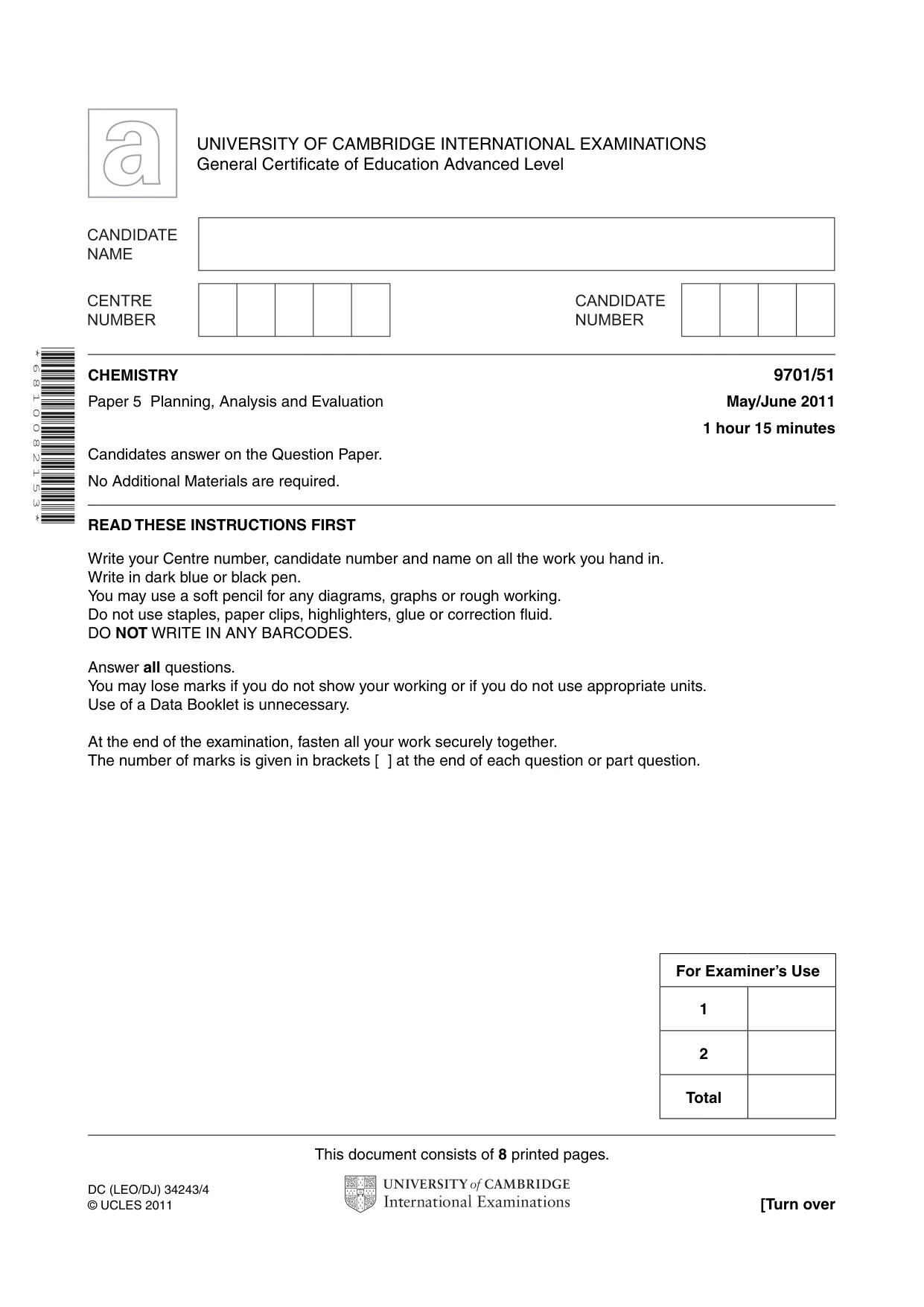
This document consists of 8 printed pages. DC (LEO/DJ) 34243/4 © UCLES 2011 [Turn over UNIVERSITY OF CAMBRIDGE INTERNATIONAL EXAMINATIONS General Certificate of Education Advanced Level READ THESE INSTRUCTIONS FIRST Write your Centre number, candidate number and name on all the work you hand in. Write in dark blue or black pen. You may use a soft pencil for any diagrams, graphs or rough working. Do not use staples, paper clips, highlighters, glue or correction fluid. DO NOT WRITE IN ANY BARCODES. Answer all questions. You may lose marks if you do not show your working or if you do not use appropriate units. Use of a Data Booklet is unnecessary. At the end of the examination, fasten all your work securely together. The number of marks is given in brackets [ ] at the end of each question or part question. * 6 8 1 0 0 8 2 1 5 3 * CHEMISTRY 9701/51 Paper 5 Planning, Analysis and Evaluation May/June 2011 1 hour 15 minutes Candidates answer on the Question Paper. No Additional Materials are required. For Examiner’s Use 1 2 Total
Question paper, page 2
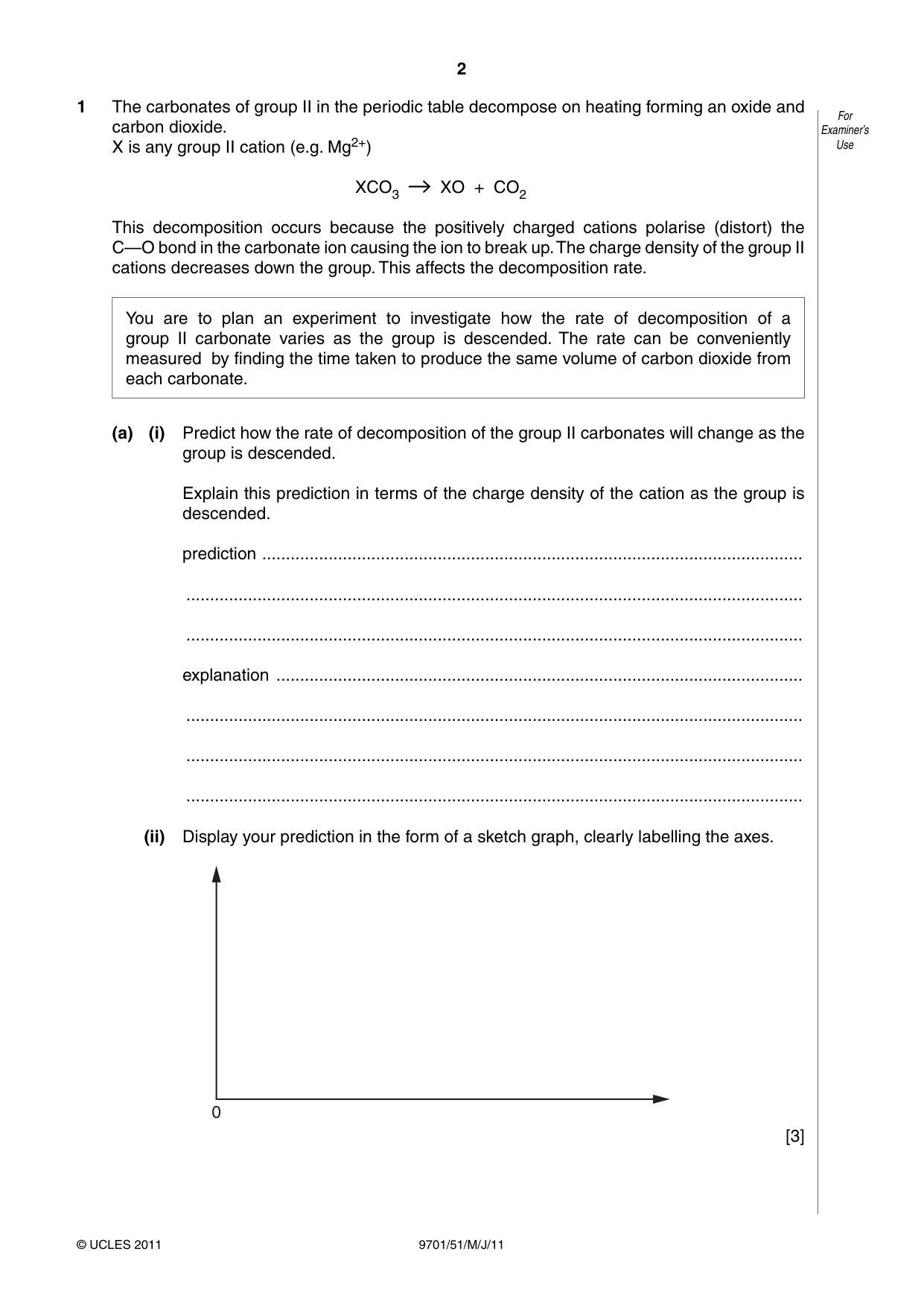
2 9701/51/M/J/11 © UCLES 2011 For Examiner’s Use 1 The carbonates of group II in the periodic table decompose on heating forming an oxide and carbon dioxide. X is any group II cation (e.g. Mg2+) XCO3 XO + CO2 This decomposition occurs because the positively charged cations polarise (distort) the C—O bond in the carbonate ion causing the ion to break up. The charge density of the group II cations decreases down the group. This affects the decomposition rate. You are to plan an experiment to investigate how the rate of decomposition of a group II carbonate varies as the group is descended. The rate can be conveniently measured by finding the time taken to produce the same volume of carbon dioxide from each carbonate. (a) (i) Predict how the rate of decomposition of the group II carbonates will change as the group is descended. Explain this prediction in terms of the charge density of the cation as the group is descended. prediction … … … explanation … … … … (ii) Display your prediction in the form of a sketch graph, clearly labelling the axes. 0 [3]
Question paper, page 3
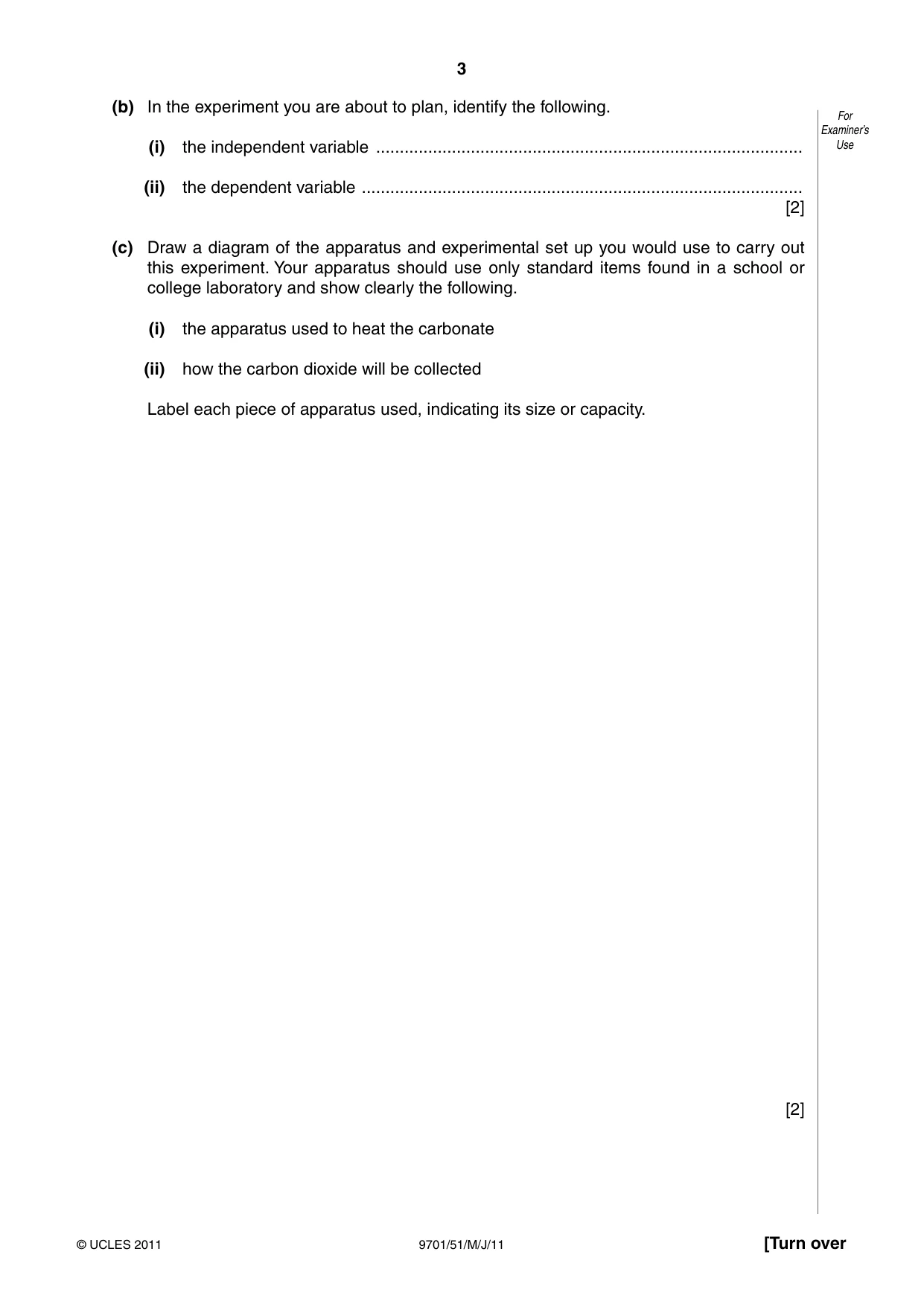
3 9701/51/M/J/11 © UCLES 2011 [Turn over For Examiner’s Use (b) In the experiment you are about to plan, identify the following. (i) the independent variable … (ii) the dependent variable … [2] (c) Draw a diagram of the apparatus and experimental set up you would use to carry out this experiment. Your apparatus should use only standard items found in a school or college laboratory and show clearly the following. (i) the apparatus used to heat the carbonate (ii) how the carbon dioxide will be collected Label each piece of apparatus used, indicating its size or capacity. [2]
Question paper, page 4
4 9701/51/M/J/11 © UCLES 2011 For Examiner’s Use (d) Using the apparatus shown in (c) design a laboratory experiment to test your prediction in (a). In addition to the standard apparatus present in a laboratory you are provided with the following materials, samples of the carbonates of magnesium, calcium, strontium and barium, a stop-watch/clock with second hand. Give a step-by-step description of how you would carry out the experiment by stating (i) the gas volume you would collect from each carbonate, (ii) how you would calculate the mass of each carbonate to ensure that this volume of carbon dioxide is produced, (iii) how you would control the factors in the heating so that different carbonates can be compared. … … … … … … … … … … … … … … … … … …[4]
Question paper, page 5
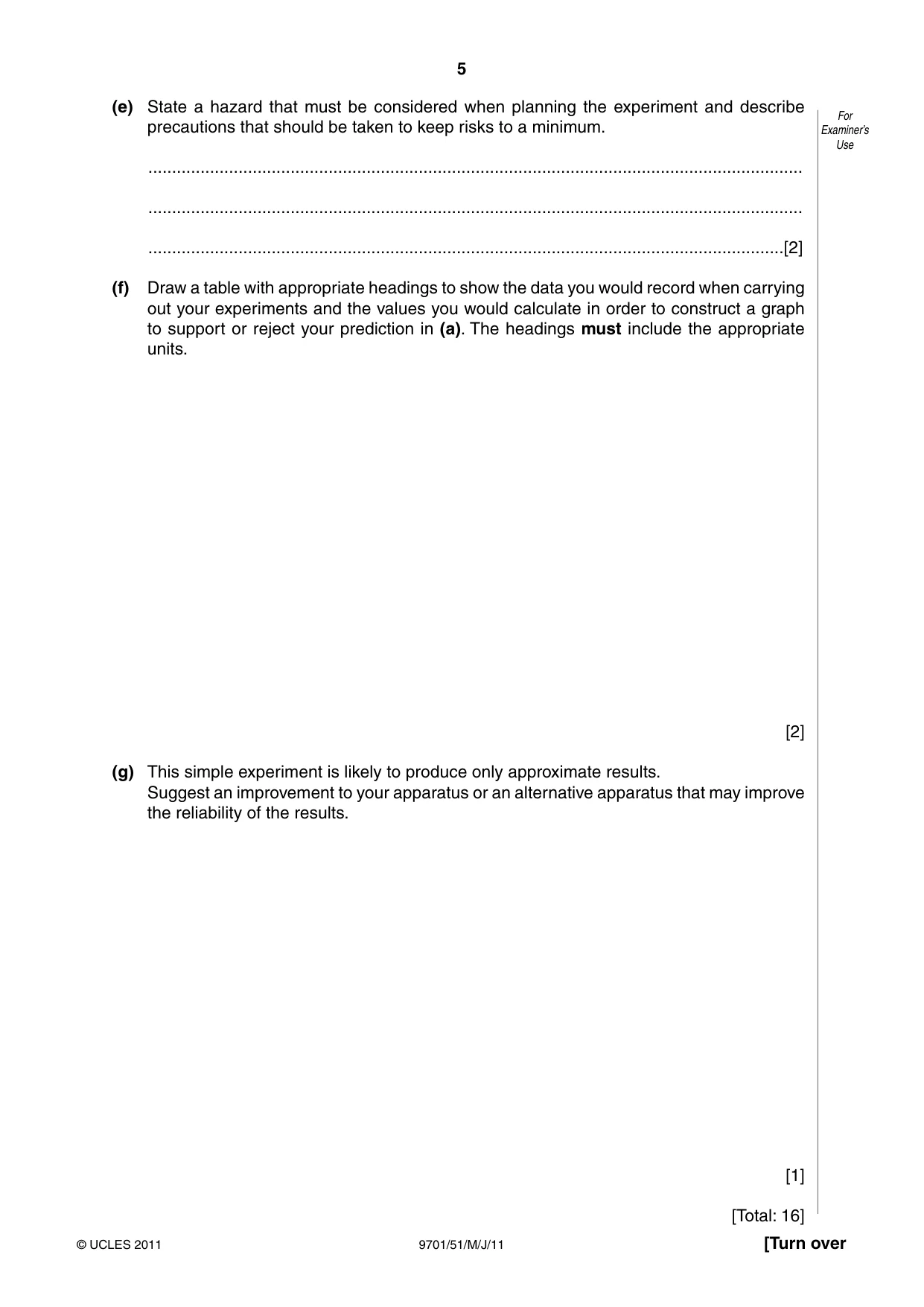
5 9701/51/M/J/11 © UCLES 2011 [Turn over For Examiner’s Use (e) State a hazard that must be considered when planning the experiment and describe precautions that should be taken to keep risks to a minimum. … … …[2] (f) Draw a table with appropriate headings to show the data you would record when carrying out your experiments and the values you would calculate in order to construct a graph to support or reject your prediction in (a). The headings must include the appropriate units. [2] (g) This simple experiment is likely to produce only approximate results. Suggest an improvement to your apparatus or an alternative apparatus that may improve the reliability of the results. [1] [Total: 16]
Question paper, page 6
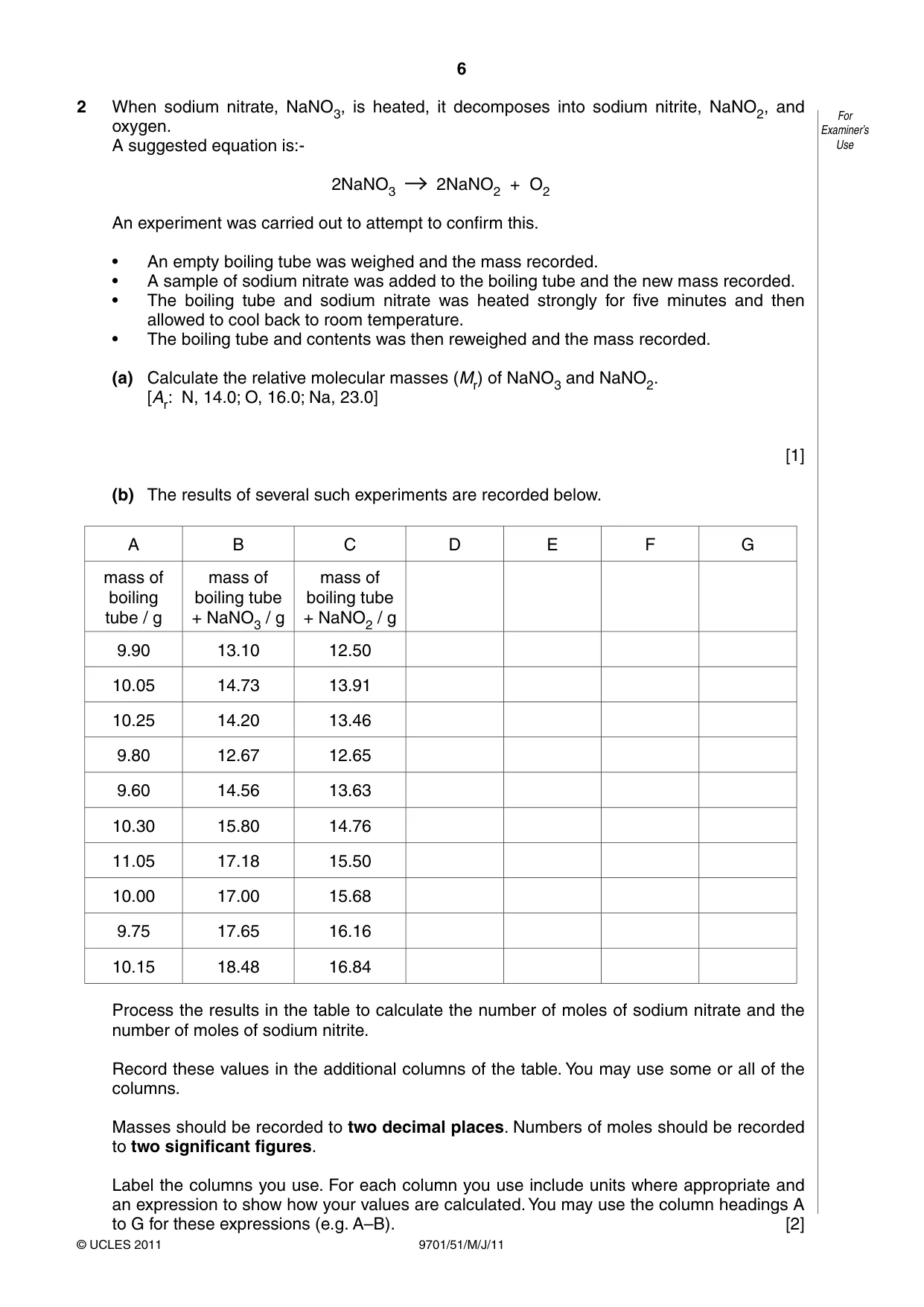
6 9701/51/M/J/11 © UCLES 2011 For Examiner’s Use 2 When sodium nitrate, NaNO3, is heated, it decomposes into sodium nitrite, NaNO2, and oxygen. A suggested equation is:- 2NaNO3 2NaNO2 + O2 An experiment was carried out to attempt to confirm this. • An empty boiling tube was weighed and the mass recorded. • A sample of sodium nitrate was added to the boiling tube and the new mass recorded. • The boiling tube and sodium nitrate was heated strongly for five minutes and then allowed to cool back to room temperature. • The boiling tube and contents was then reweighed and the mass recorded. (a) Calculate the relative molecular masses (Mr) of NaNO3 and NaNO2. [Ar: N, 14.0; O, 16.0; Na, 23.0] [1] (b) The results of several such experiments are recorded below. A B C D E F G mass of boiling tube / g mass of boiling tube + NaNO3 / g mass of boiling tube + NaNO2 / g 9.90 13.10 12.50 10.05 14.73 13.91 10.25 14.20 13.46 9.80 12.67 12.65 9.60 14.56 13.63 10.30 15.80 14.76 11.05 17.18 15.50 10.00 17.00 15.68 9.75 17.65 16.16 10.15 18.48 16.84 Process the results in the table to calculate the number of moles of sodium nitrate and the number of moles of sodium nitrite. Record these values in the additional columns of the table. You may use some or all of the columns. Masses should be recorded to two decimal places. Numbers of moles should be recorded to two significant figures. Label the columns you use. For each column you use include units where appropriate and an expression to show how your values are calculated. You may use the column headings A to G for these expressions (e.g. A–B). [2]
Question paper, page 7
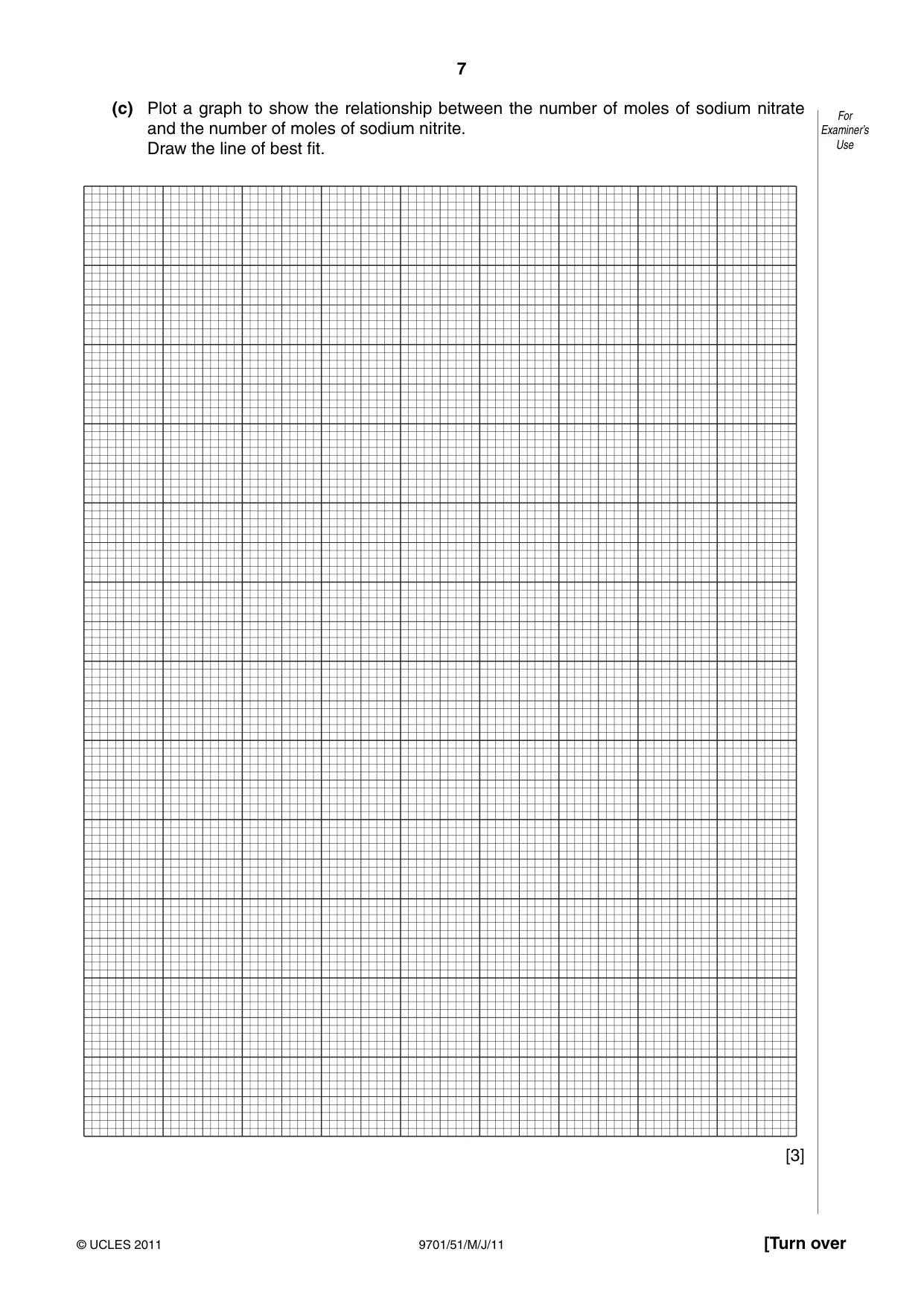
7 9701/51/M/J/11 © UCLES 2011 [Turn over For Examiner’s Use (c) Plot a graph to show the relationship between the number of moles of sodium nitrate and the number of moles of sodium nitrite. Draw the line of best fit. [3]
Question paper, page 8
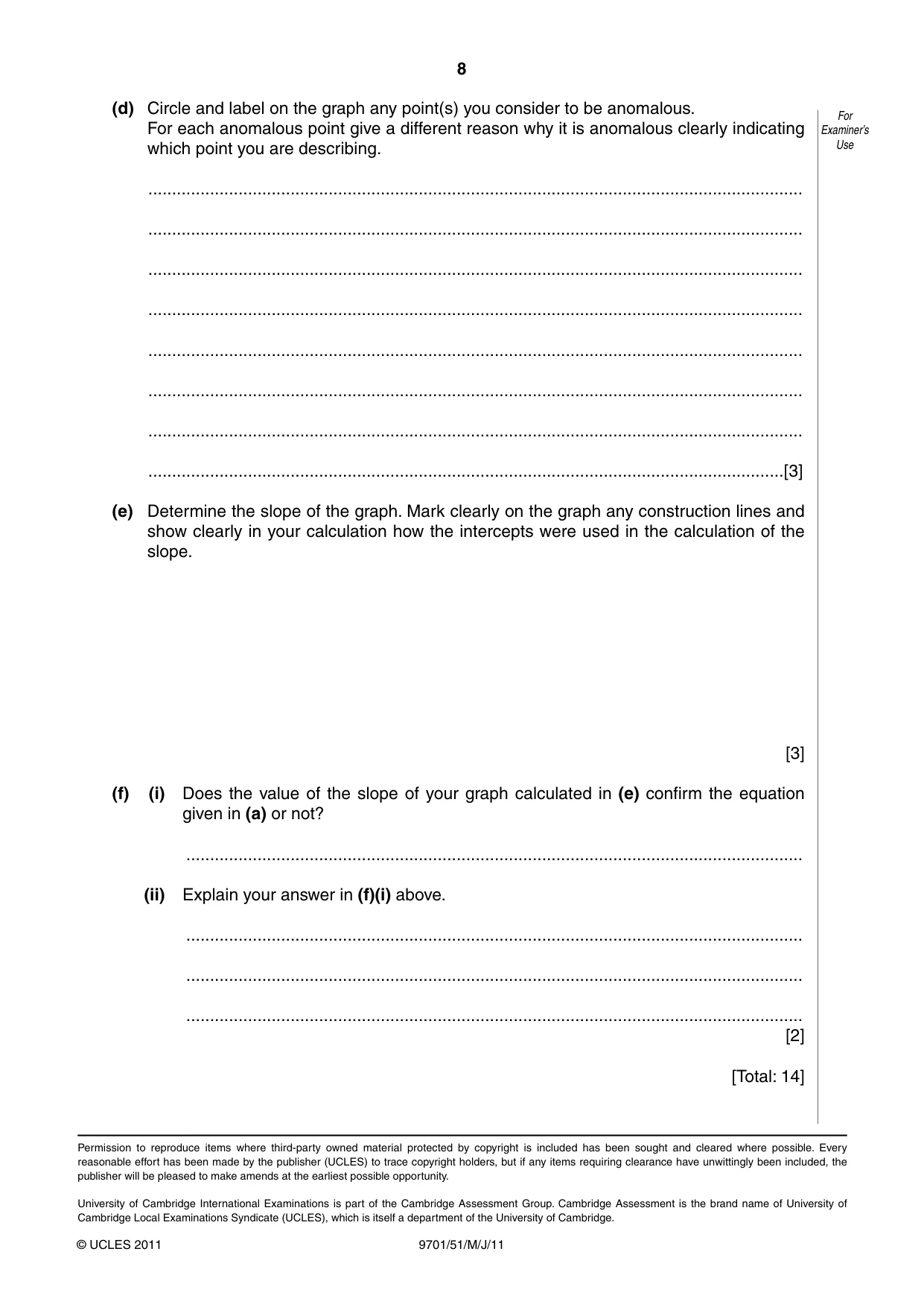
8 9701/51/M/J/11 © UCLES 2011 For Examiner’s Use (d) Circle and label on the graph any point(s) you consider to be anomalous. For each anomalous point give a different reason why it is anomalous clearly indicating which point you are describing. … … … … … … … …[3] (e) Determine the slope of the graph. Mark clearly on the graph any construction lines and show clearly in your calculation how the intercepts were used in the calculation of the slope. [3] (f) (i) Does the value of the slope of your graph calculated in (e) confirm the equation given in (a) or not? … (ii) Explain your answer in (f)(i) above. … … … [2] [Total: 14] Permission to reproduce items where third-party owned material protected by copyright is included has been sought and cleared where possible. Every reasonable effort has been made by the publisher (UCLES) to trace copyright holders, but if any items requiring clearance have unwittingly been included, the publisher will be pleased to make amends at the earliest possible opportunity. University of Cambridge International Examinations is part of the Cambridge Assessment Group. Cambridge Assessment is the brand name of University of Cambridge Local Examinations Syndicate (UCLES), which is itself a department of the University of Cambridge.
Mark scheme, page 1
UNIVERSITY OF CAMBRIDGE INTERNATIONAL EXAMINATIONS GCE Advanced Level MARK SCHEME for the May/June 2011 question paper for the guidance of teachers 9701 CHEMISTRY 9701/51 Paper 5 (Planning, Analysis and Evaluation), maximum raw mark 30 This mark scheme is published as an aid to teachers and candidates, to indicate the requirements of the examination. It shows the basis on which Examiners were instructed to award marks. It does not indicate the details of the discussions that took place at an Examiners’ meeting before marking began, which would have considered the acceptability of alternative answers. Mark schemes must be read in conjunction with the question papers and the report on the examination. • Cambridge will not enter into discussions or correspondence in connection with these mark schemes. Cambridge is publishing the mark schemes for the May/June 2011 question papers for most IGCSE, GCE Advanced Level and Advanced Subsidiary Level syllabuses and some Ordinary Level syllabuses.
Mark scheme, page 2
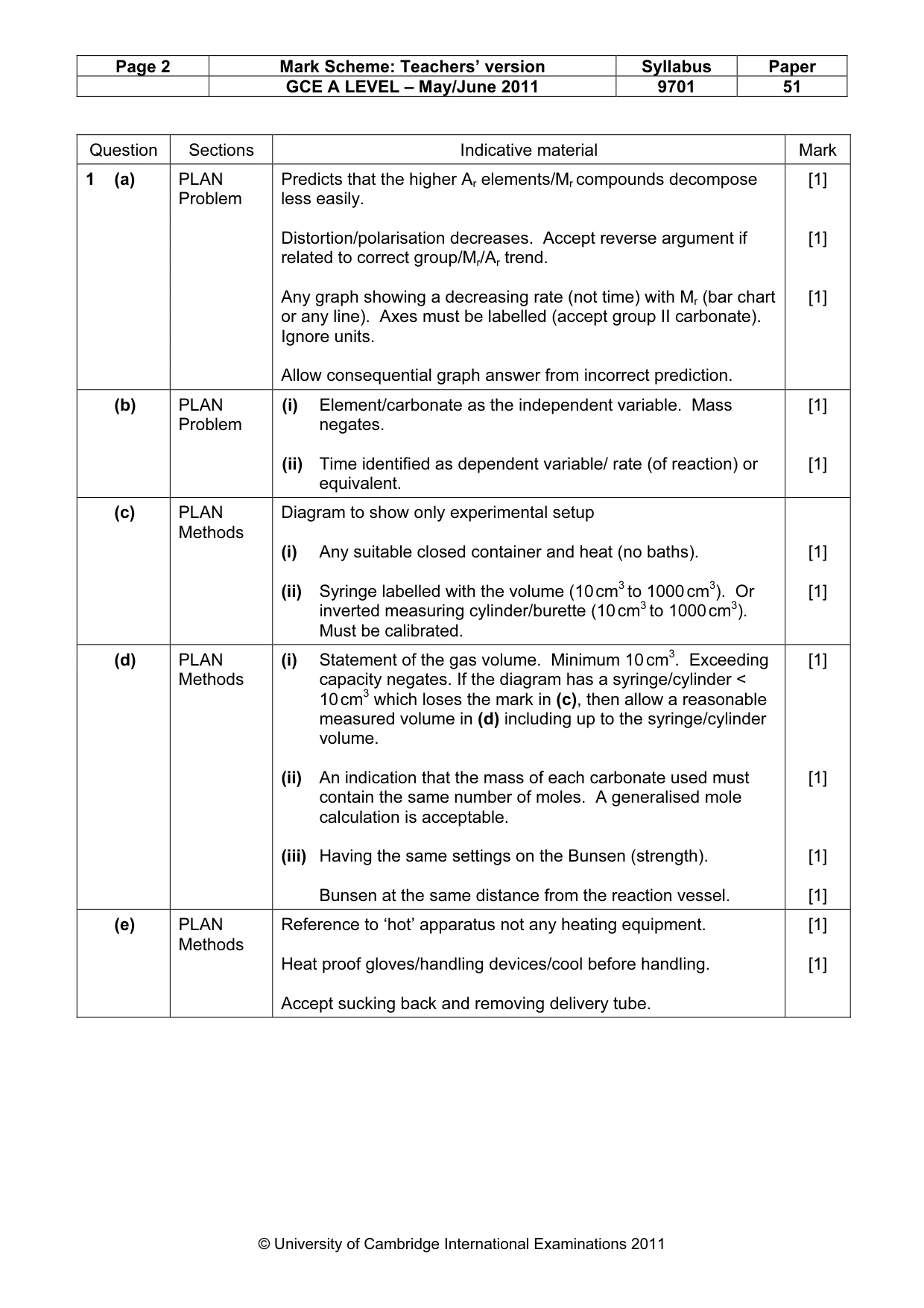
Page 2 Mark Scheme: Teachers’ version Syllabus Paper GCE A LEVEL – May/June 2011 9701 51 © University of Cambridge International Examinations 2011 Question Sections Indicative material Mark 1 (a) PLAN Problem Predicts that the higher Ar elements/Mr compounds decompose less easily. Distortion/polarisation decreases. Accept reverse argument if related to correct group/Mr/Ar trend. Any graph showing a decreasing rate (not time) with Mr (bar chart or any line). Axes must be labelled (accept group II carbonate). Ignore units. Allow consequential graph answer from incorrect prediction. [1] [1] [1] (b) PLAN Problem (i) Element/carbonate as the independent variable. Mass negates. (ii) Time identified as dependent variable/ rate (of reaction) or equivalent. [1] [1] (c) PLAN Methods Diagram to show only experimental setup (i) Any suitable closed container and heat (no baths). (ii) Syringe labelled with the volume (10 cm3 to 1000 cm3). Or inverted measuring cylinder/burette (10 cm3 to 1000 cm3). Must be calibrated. [1] [1] (d) PLAN Methods (i) Statement of the gas volume. Minimum 10 cm3. Exceeding capacity negates. If the diagram has a syringe/cylinder < 10 cm3 which loses the mark in (c), then allow a reasonable measured volume in (d) including up to the syringe/cylinder volume. (ii) An indication that the mass of each carbonate used must contain the same number of moles. A generalised mole calculation is acceptable. (iii) Having the same settings on the Bunsen (strength). Bunsen at the same distance from the reaction vessel. [1] [1] [1] [1] (e) PLAN Methods Reference to ‘hot’ apparatus not any heating equipment. Heat proof gloves/handling devices/cool before handling. Accept sucking back and removing delivery tube. [1] [1]
Mark scheme, page 3
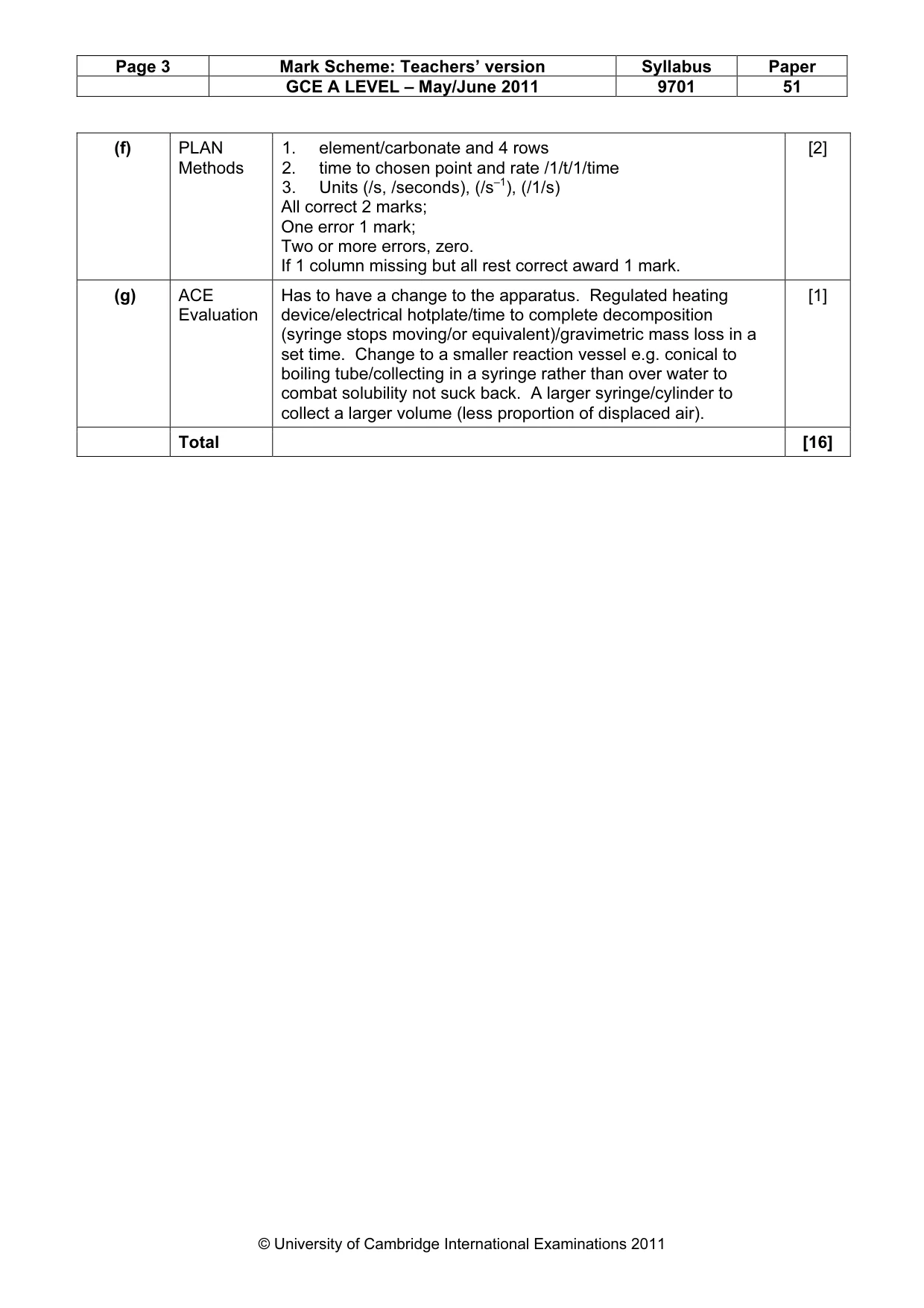
Page 3 Mark Scheme: Teachers’ version Syllabus Paper GCE A LEVEL – May/June 2011 9701 51 © University of Cambridge International Examinations 2011 (f) PLAN Methods 1. element/carbonate and 4 rows 2. time to chosen point and rate /1/t/1/time 3. Units (/s, /seconds), (/s–1), (/1/s) All correct 2 marks; One error 1 mark; Two or more errors, zero. If 1 column missing but all rest correct award 1 mark. [2] (g) ACE Evaluation Has to have a change to the apparatus. Regulated heating device/electrical hotplate/time to complete decomposition (syringe stops moving/or equivalent)/gravimetric mass loss in a set time. Change to a smaller reaction vessel e.g. conical to boiling tube/collecting in a syringe rather than over water to combat solubility not suck back. A larger syringe/cylinder to collect a larger volume (less proportion of displaced air). [1] Total [16]
Mark scheme, page 4
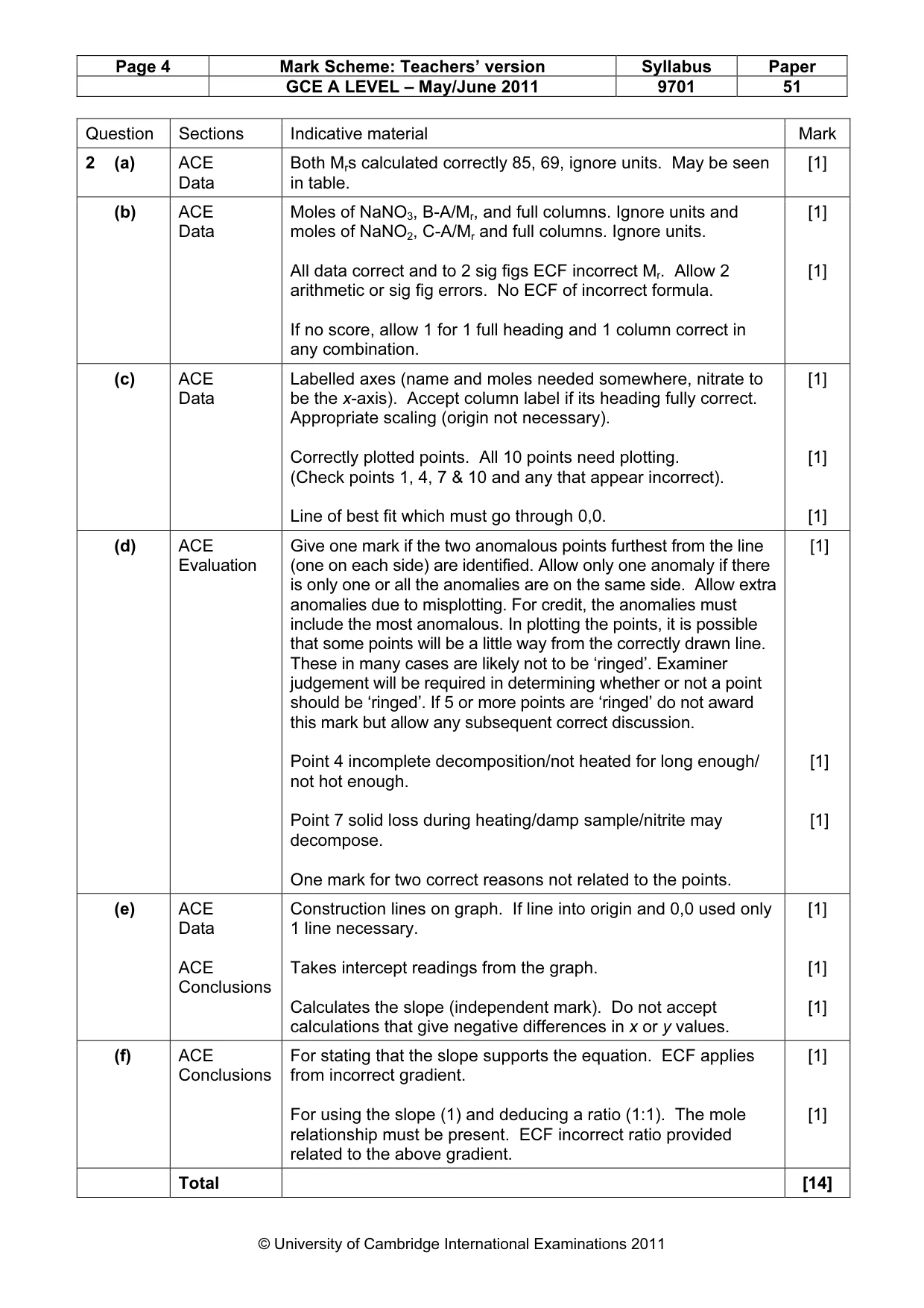
Page 4 Mark Scheme: Teachers’ version Syllabus Paper GCE A LEVEL – May/June 2011 9701 51 © University of Cambridge International Examinations 2011 Question Sections Indicative material Mark 2 (a) ACE Data Both Mrs calculated correctly 85, 69, ignore units. May be seen in table. [1] (b) ACE Data Moles of NaNO3, B-A/Mr, and full columns. Ignore units and moles of NaNO2, C-A/Mr and full columns. Ignore units. All data correct and to 2 sig figs ECF incorrect Mr. Allow 2 arithmetic or sig fig errors. No ECF of incorrect formula. If no score, allow 1 for 1 full heading and 1 column correct in any combination. [1] [1] (c) ACE Data Labelled axes (name and moles needed somewhere, nitrate to be the x-axis). Accept column label if its heading fully correct. Appropriate scaling (origin not necessary). Correctly plotted points. All 10 points need plotting. (Check points 1, 4, 7 & 10 and any that appear incorrect). Line of best fit which must go through 0,0. [1] [1] [1] (d) ACE Evaluation Give one mark if the two anomalous points furthest from the line (one on each side) are identified. Allow only one anomaly if there is only one or all the anomalies are on the same side. Allow extra anomalies due to misplotting. For credit, the anomalies must include the most anomalous. In plotting the points, it is possible that some points will be a little way from the correctly drawn line. These in many cases are likely not to be ‘ringed’. Examiner judgement will be required in determining whether or not a point should be ‘ringed’. If 5 or more points are ‘ringed’ do not award this mark but allow any subsequent correct discussion. Point 4 incomplete decomposition/not heated for long enough/ not hot enough. Point 7 solid loss during heating/damp sample/nitrite may decompose. One mark for two correct reasons not related to the points. [1] [1] [1] (e) ACE Data ACE Conclusions Construction lines on graph. If line into origin and 0,0 used only 1 line necessary. Takes intercept readings from the graph. Calculates the slope (independent mark). Do not accept calculations that give negative differences in x or y values. [1] [1] [1] (f) ACE Conclusions For stating that the slope supports the equation. ECF applies from incorrect gradient. For using the slope (1) and deducing a ratio (1:1). The mole relationship must be present. ECF incorrect ratio provided related to the above gradient. [1] [1] Total [14]
What you needed in this session
Cambridge’s own grade thresholds for 2011 May/June, Paper 5 · Variant 1. A higher threshold means an easier paper — the bar moves with how the cohort did.