Cambridge A Level Chemistry 9701 — 2010 May/June Paper 5 · Variant 1
9701/51/M/J/10 · 30 marks · ≈34 min
The question paper and its mark scheme, free to read here and free to download. This is Cambridge’s own paper, exactly as it was sat.
Question paper16 pages



Mark scheme6 pages
Answers below. Sit the paper first if you are practising.
Paper as text
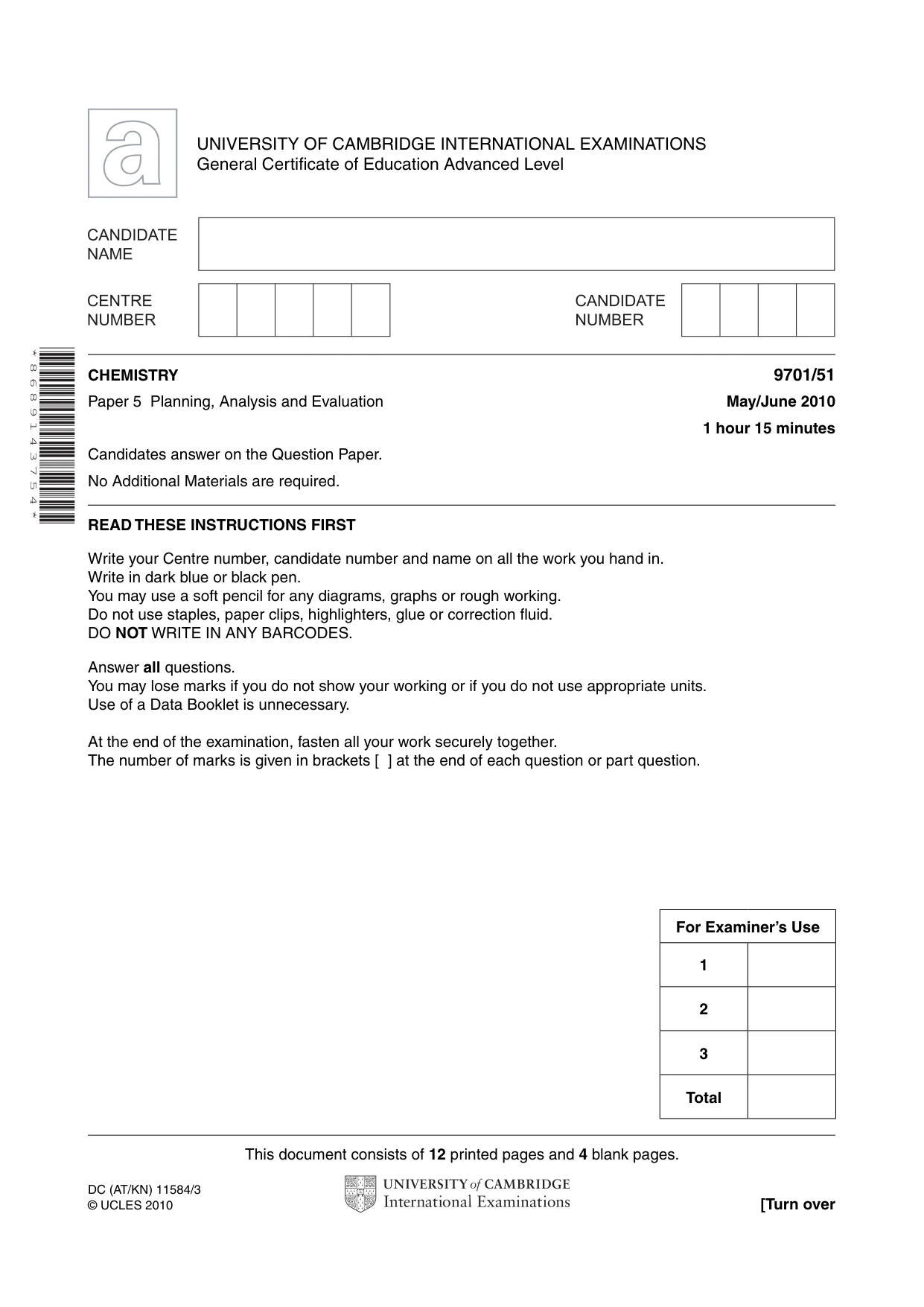
Question paper, page 1
This document consists of 12 printed pages and 4 blank pages. DC (AT/KN) 11584/3 © UCLES 2010 [Turn over UNIVERSITY OF CAMBRIDGE INTERNATIONAL EXAMINATIONS General Certificate of Education Advanced Level READ THESE INSTRUCTIONS FIRST Write your Centre number, candidate number and name on all the work you hand in. Write in dark blue or black pen. You may use a soft pencil for any diagrams, graphs or rough working. Do not use staples, paper clips, highlighters, glue or correction fluid. DO NOT WRITE IN ANY BARCODES. Answer all questions. You may lose marks if you do not show your working or if you do not use appropriate units. Use of a Data Booklet is unnecessary. At the end of the examination, fasten all your work securely together. The number of marks is given in brackets [ ] at the end of each question or part question. * 8 6 8 9 1 4 3 7 5 4 * CHEMISTRY 9701/51 Paper 5 Planning, Analysis and Evaluation May/June 2010 1 hour 15 minutes Candidates answer on the Question Paper. No Additional Materials are required. For Examiner’s Use 1 2 3 Total
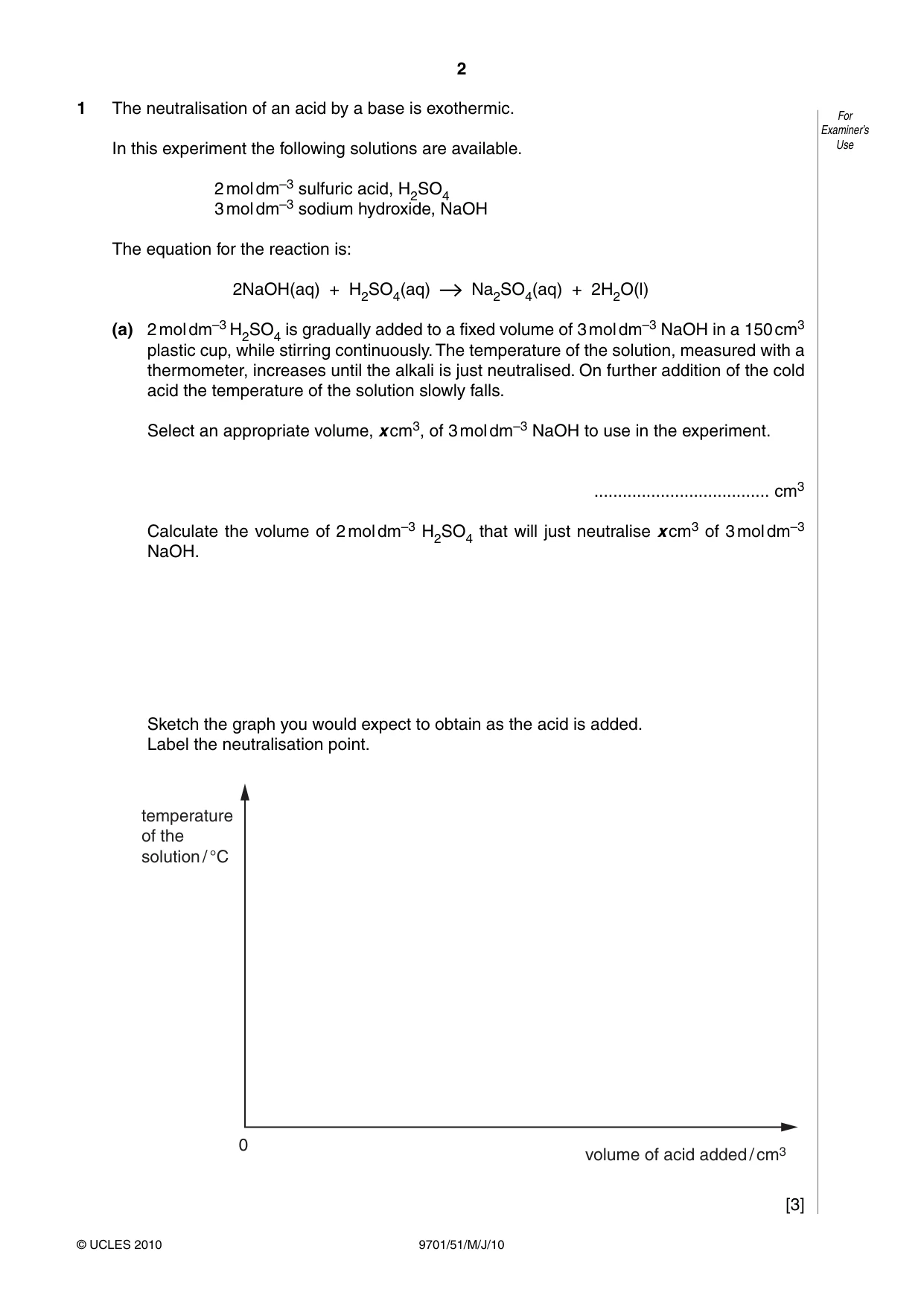
Question paper, page 2
2 © UCLES 2010 9701/51/M/J/10 For Examiner’s Use 1 The neutralisation of an acid by a base is exothermic. In this experiment the following solutions are available. 2 mol dm–3 sulfuric acid, H2SO4 3 mol dm–3 sodium hydroxide, NaOH The equation for the reaction is: 2NaOH(aq) + H2SO4(aq) Na2SO4(aq) + 2H2O(l) (a) 2 mol dm–3 H2SO4 is gradually added to a fixed volume of 3 mol dm–3 NaOH in a 150 cm3 plastic cup, while stirring continuously. The temperature of the solution, measured with a thermometer, increases until the alkali is just neutralised. On further addition of the cold acid the temperature of the solution slowly falls. Select an appropriate volume, x cm3, of 3 mol dm–3 NaOH to use in the experiment. … cm3 Calculate the volume of 2 mol dm–3 H2SO4 that will just neutralise x cm3 of 3 mol dm–3 NaOH. Sketch the graph you would expect to obtain as the acid is added. Label the neutralisation point. volume of acid added / cm3 0 temperature of the solution / °C [3]
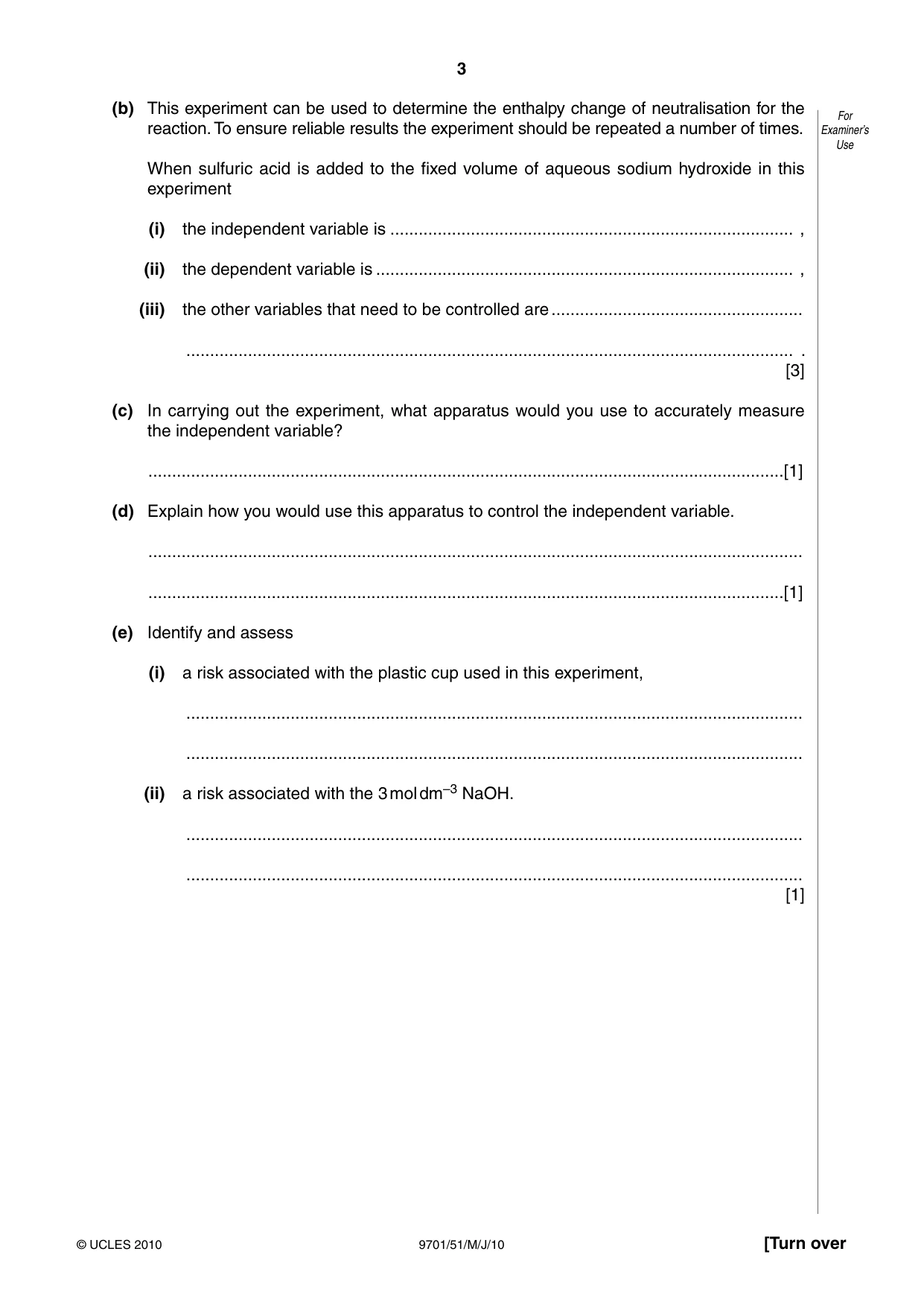
Question paper, page 3
3 © UCLES 2010 [Turn over 9701/51/M/J/10 For Examiner’s Use (b) This experiment can be used to determine the enthalpy change of neutralisation for the reaction. To ensure reliable results the experiment should be repeated a number of times. When sulfuric acid is added to the fixed volume of aqueous sodium hydroxide in this experiment (i) the independent variable is … , (ii) the dependent variable is … , (iii) the other variables that need to be controlled are … … . [3] (c) In carrying out the experiment, what apparatus would you use to accurately measure the independent variable? …[1] (d) Explain how you would use this apparatus to control the independent variable. … …[1] (e) Identify and assess (i) a risk associated with the plastic cup used in this experiment, … … (ii) a risk associated with the 3 mol dm–3 NaOH. … … [1]
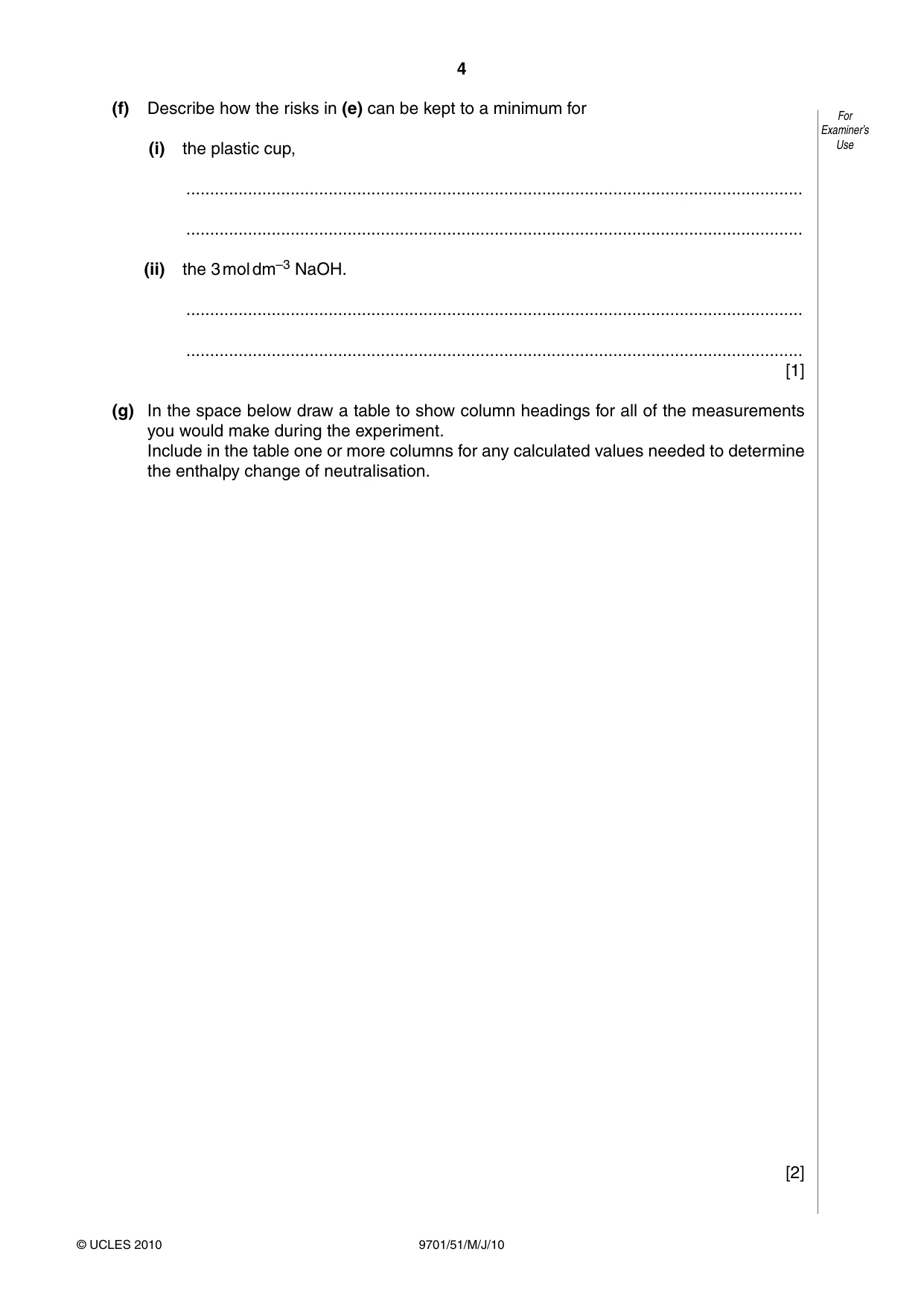
Question paper, page 4
4 © UCLES 2010 9701/51/M/J/10 For Examiner’s Use (f) Describe how the risks in (e) can be kept to a minimum for (i) the plastic cup, … … (ii) the 3 mol dm–3 NaOH. … … [1] (g) In the space below draw a table to show column headings for all of the measurements you would make during the experiment. Include in the table one or more columns for any calculated values needed to determine the enthalpy change of neutralisation. [2]
Question paper, page 5
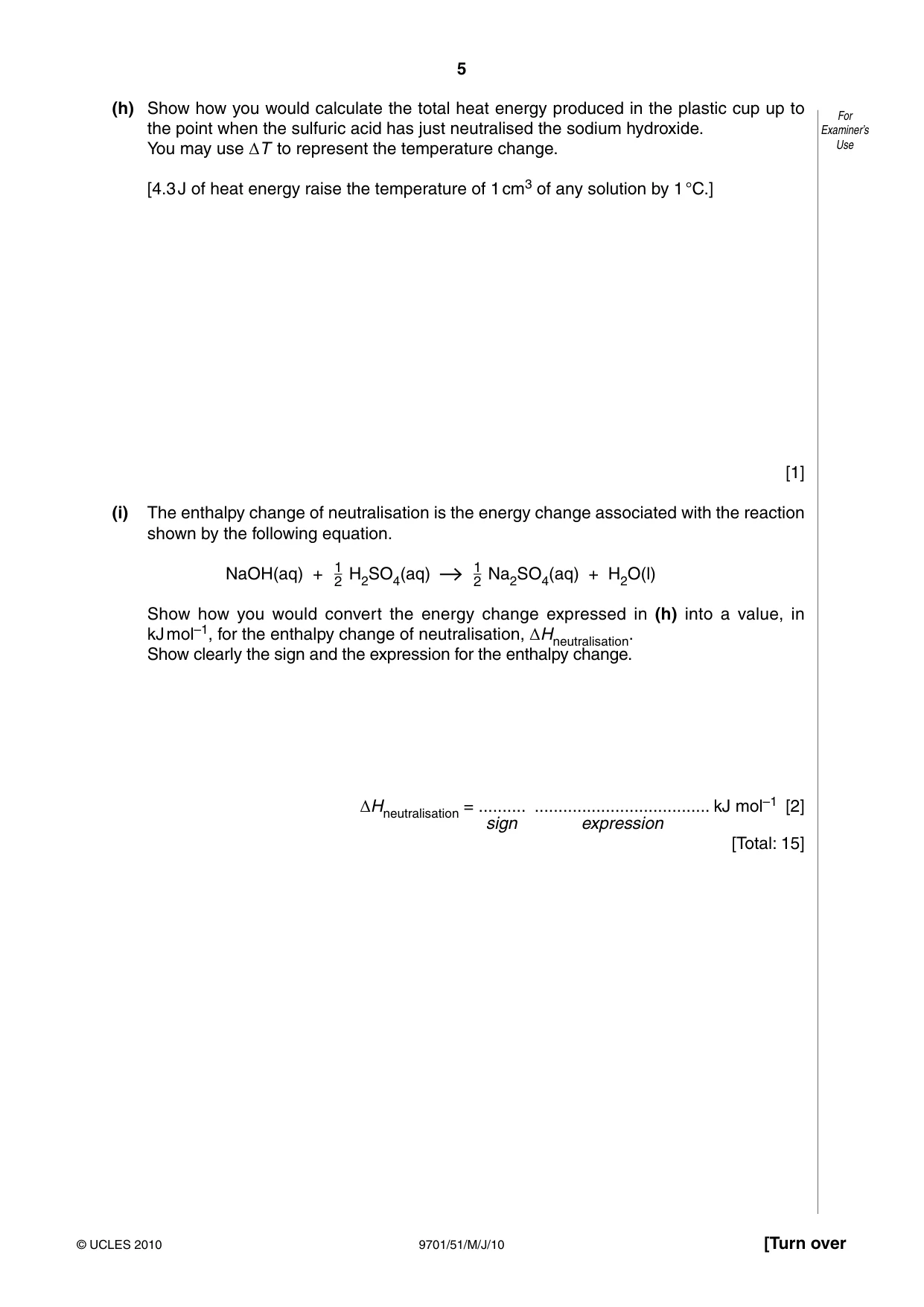
5 © UCLES 2010 [Turn over 9701/51/M/J/10 For Examiner’s Use (h) Show how you would calculate the total heat energy produced in the plastic cup up to the point when the sulfuric acid has just neutralised the sodium hydroxide. You may use ΔT to represent the temperature change. [4.3 J of heat energy raise the temperature of 1 cm3 of any solution by 1 °C.] [1] (i) The enthalpy change of neutralisation is the energy change associated with the reaction shown by the following equation. NaOH(aq) + 1 2 H2SO4(aq) 1 2 Na2SO4(aq) + H2O(l) Show how you would convert the energy change expressed in (h) into a value, in kJ mol–1, for the enthalpy change of neutralisation, ΔHneutralisation. Show clearly the sign and the expression for the enthalpy change. ΔHneutralisation = … … kJ mol–1 [2] sign expression [Total: 15]
Question paper, page 6
6 9701/51/M/J/10 © UCLES 2010 BLANK PAGE
Question paper, page 7
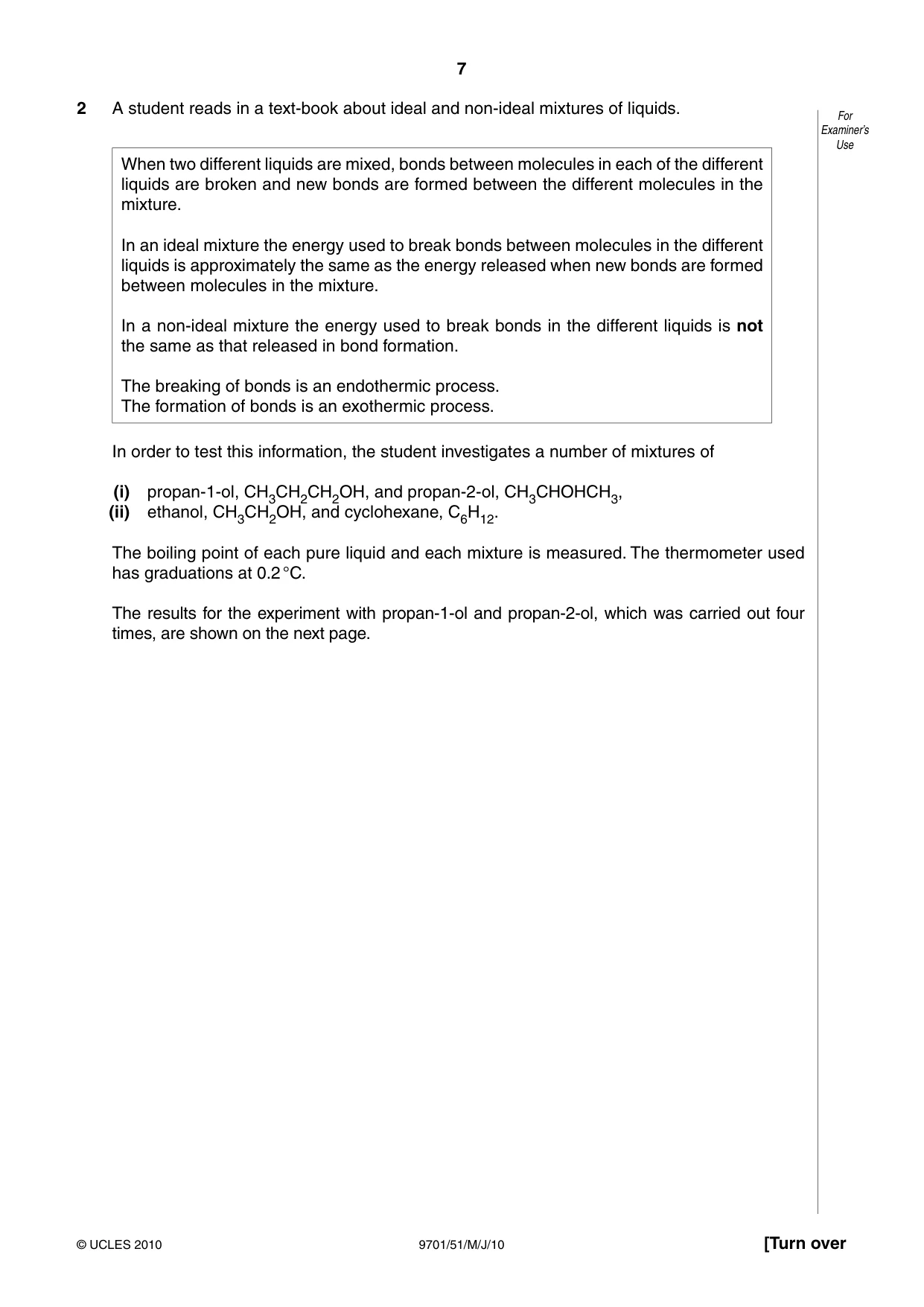
7 © UCLES 2010 [Turn over 9701/51/M/J/10 For Examiner’s Use 2 A student reads in a text-book about ideal and non-ideal mixtures of liquids. When two different liquids are mixed, bonds between molecules in each of the different liquids are broken and new bonds are formed between the different molecules in the mixture. In an ideal mixture the energy used to break bonds between molecules in the different liquids is approximately the same as the energy released when new bonds are formed between molecules in the mixture. In a non-ideal mixture the energy used to break bonds in the different liquids is not the same as that released in bond formation. The breaking of bonds is an endothermic process. The formation of bonds is an exothermic process. In order to test this information, the student investigates a number of mixtures of (i) propan-1-ol, CH3CH2CH2OH, and propan-2-ol, CH3CHOHCH3, (ii) ethanol, CH3CH2OH, and cyclohexane, C6H12. The boiling point of each pure liquid and each mixture is measured. The thermometer used has graduations at 0.2 °C. The results for the experiment with propan-1-ol and propan-2-ol, which was carried out four times, are shown on the next page.
Question paper, page 8
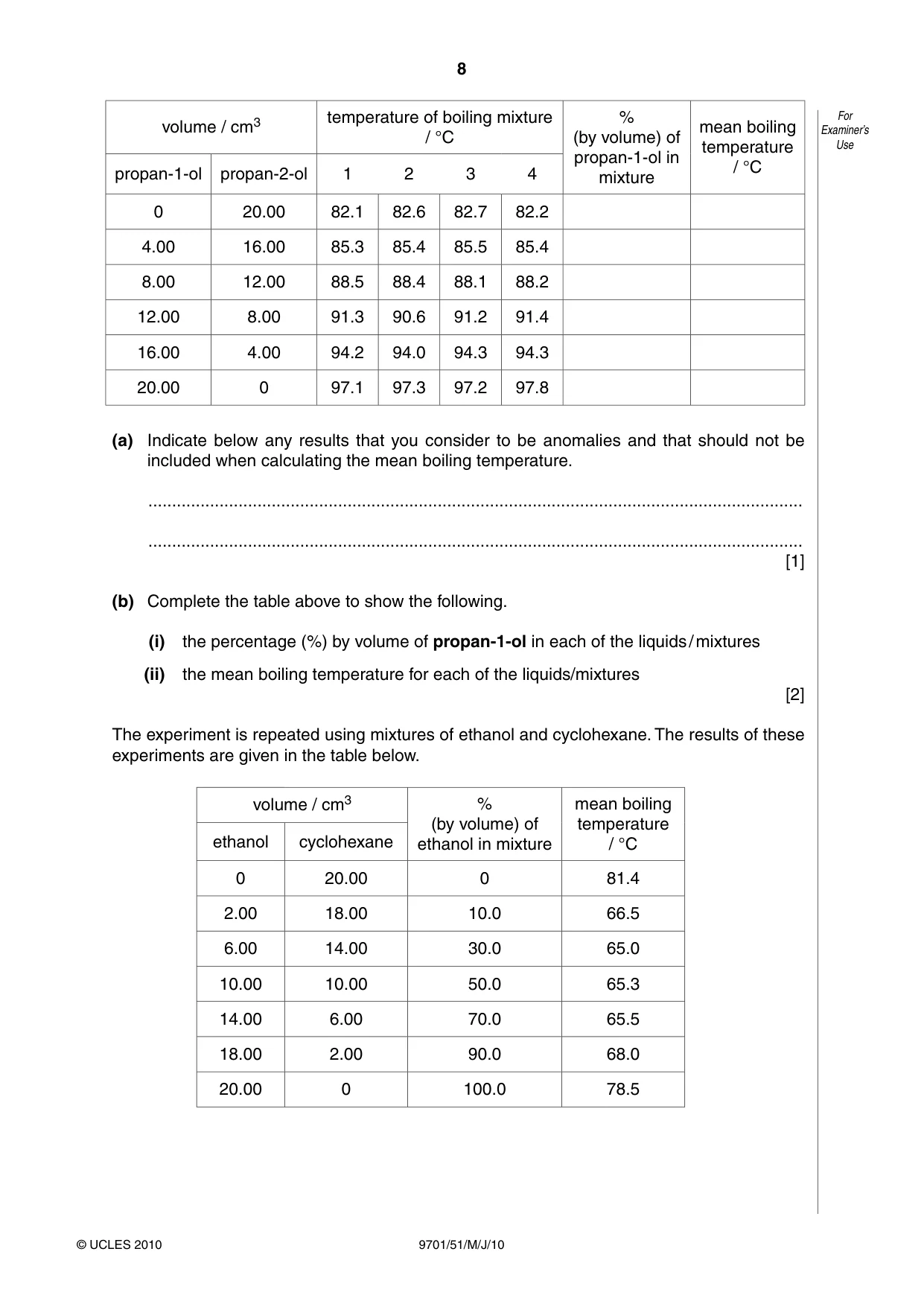
8 © UCLES 2010 9701/51/M/J/10 For Examiner’s Use volume / cm3 temperature of boiling mixture / °C % (by volume) of propan-1-ol in mixture mean boiling temperature / °C propan-1-ol propan-2-ol 1 2 3 4 0 20.00 82.1 82.6 82.7 82.2 4.00 16.00 85.3 85.4 85.5 85.4 8.00 12.00 88.5 88.4 88.1 88.2 12.00 8.00 91.3 90.6 91.2 91.4 16.00 4.00 94.2 94.0 94.3 94.3 20.00 0 97.1 97.3 97.2 97.8 (a) Indicate below any results that you consider to be anomalies and that should not be included when calculating the mean boiling temperature. … … [1] (b) Complete the table above to show the following. (i) the percentage (%) by volume of propan-1-ol in each of the liquids / mixtures (ii) the mean boiling temperature for each of the liquids/mixtures [2] The experiment is repeated using mixtures of ethanol and cyclohexane. The results of these experiments are given in the table below. volume / cm3 % (by volume) of ethanol in mixture mean boiling temperature / °C ethanol cyclohexane 0 20.00 0 81.4 2.00 18.00 10.0 66.5 6.00 14.00 30.0 65.0 10.00 10.00 50.0 65.3 14.00 6.00 70.0 65.5 18.00 2.00 90.0 68.0 20.00 0 100.0 78.5
Question paper, page 9
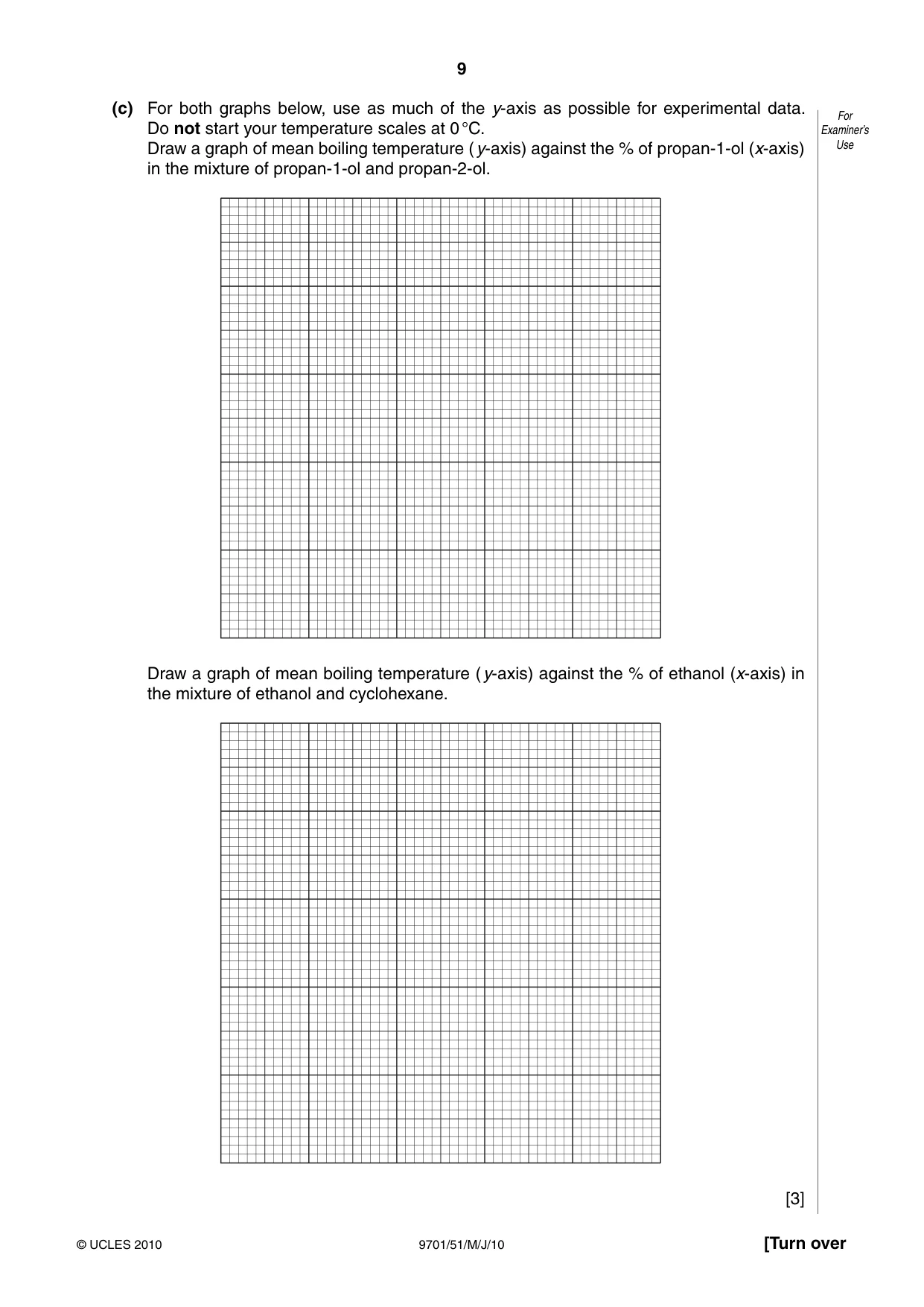
9 © UCLES 2010 [Turn over 9701/51/M/J/10 For Examiner’s Use (c) For both graphs below, use as much of the y-axis as possible for experimental data. Do not start your temperature scales at 0 °C. Draw a graph of mean boiling temperature ( y-axis) against the % of propan-1-ol (x-axis) in the mixture of propan-1-ol and propan-2-ol. Draw a graph of mean boiling temperature ( y-axis) against the % of ethanol (x-axis) in the mixture of ethanol and cyclohexane. [3]
Question paper, page 10
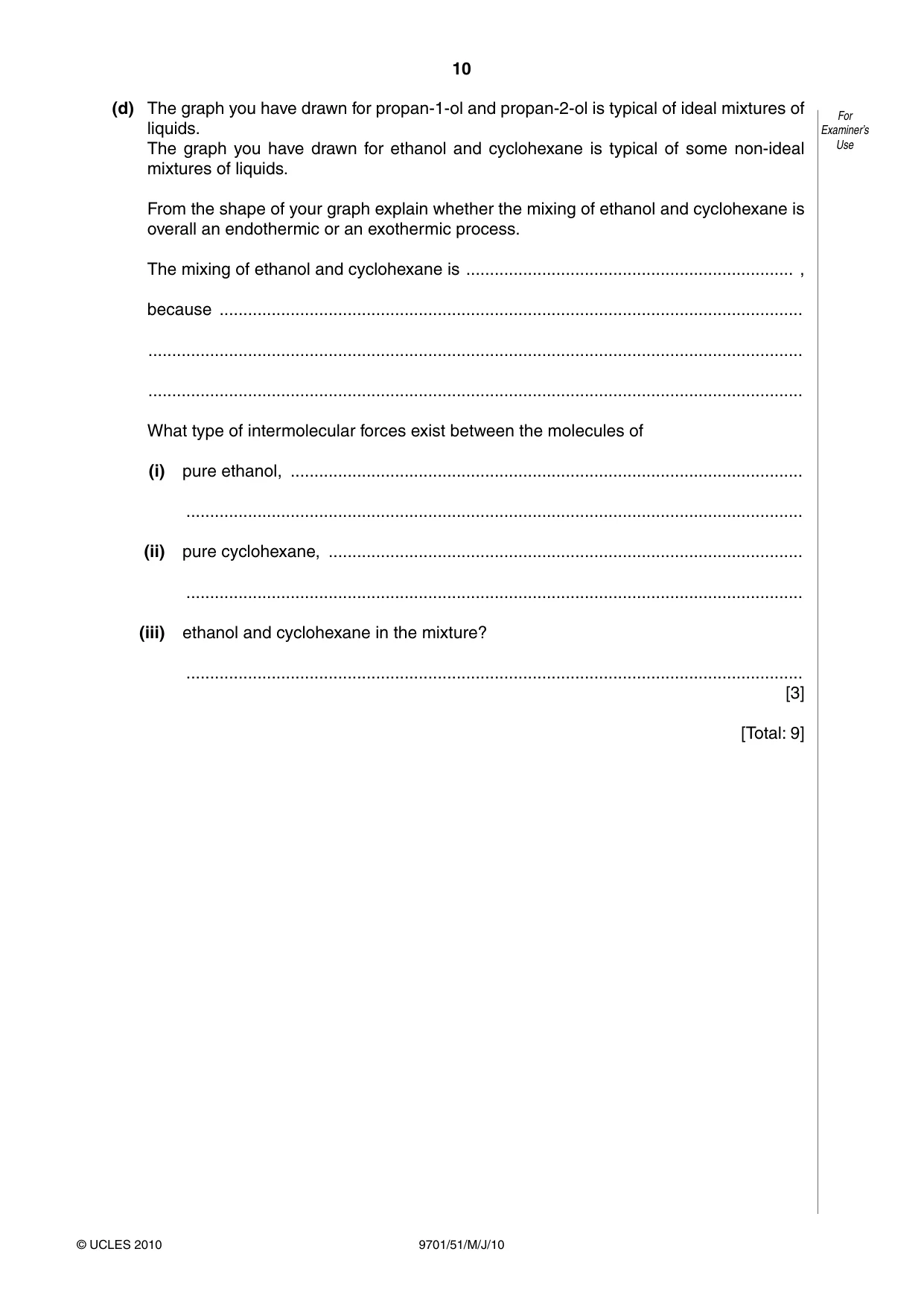
10 © UCLES 2010 9701/51/M/J/10 For Examiner’s Use (d) The graph you have drawn for propan-1-ol and propan-2-ol is typical of ideal mixtures of liquids. The graph you have drawn for ethanol and cyclohexane is typical of some non-ideal mixtures of liquids. From the shape of your graph explain whether the mixing of ethanol and cyclohexane is overall an endothermic or an exothermic process. The mixing of ethanol and cyclohexane is … , because … … … What type of intermolecular forces exist between the molecules of (i) pure ethanol, … … (ii) pure cyclohexane, … … (iii) ethanol and cyclohexane in the mixture? … [3] [Total: 9]
Question paper, page 11
11 9701/51/M/J/10 © UCLES 2010 [Turn over BLANK PAGE
Question paper, page 12
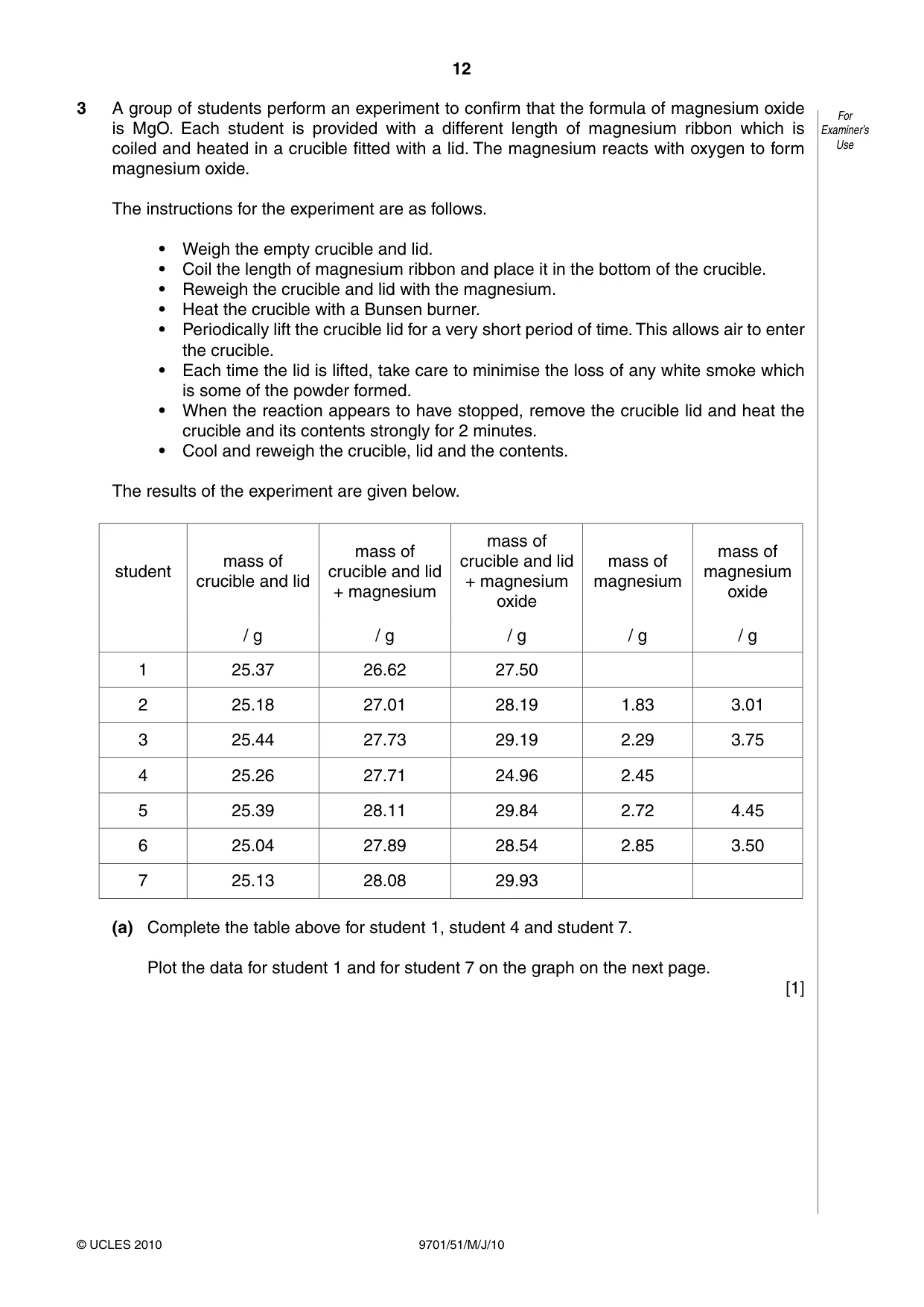
12 © UCLES 2010 9701/51/M/J/10 For Examiner’s Use 3 A group of students perform an experiment to confirm that the formula of magnesium oxide is MgO. Each student is provided with a different length of magnesium ribbon which is coiled and heated in a crucible fitted with a lid. The magnesium reacts with oxygen to form magnesium oxide. The instructions for the experiment are as follows. • Weigh the empty crucible and lid. • Coil the length of magnesium ribbon and place it in the bottom of the crucible. • Reweigh the crucible and lid with the magnesium. • Heat the crucible with a Bunsen burner. • Periodically lift the crucible lid for a very short period of time. This allows air to enter the crucible. • Each time the lid is lifted, take care to minimise the loss of any white smoke which is some of the powder formed. • When the reaction appears to have stopped, remove the crucible lid and heat the crucible and its contents strongly for 2 minutes. • Cool and reweigh the crucible, lid and the contents. The results of the experiment are given below. student mass of crucible and lid mass of crucible and lid + magnesium mass of crucible and lid + magnesium oxide mass of magnesium mass of magnesium oxide / g / g / g / g / g 1 25.37 26.62 27.50 2 25.18 27.01 28.19 1.83 3.01 3 25.44 27.73 29.19 2.29 3.75 4 25.26 27.71 24.96 2.45 5 25.39 28.11 29.84 2.72 4.45 6 25.04 27.89 28.54 2.85 3.50 7 25.13 28.08 29.93 (a) Complete the table above for student 1, student 4 and student 7. Plot the data for student 1 and for student 7 on the graph on the next page. [1]
Question paper, page 13
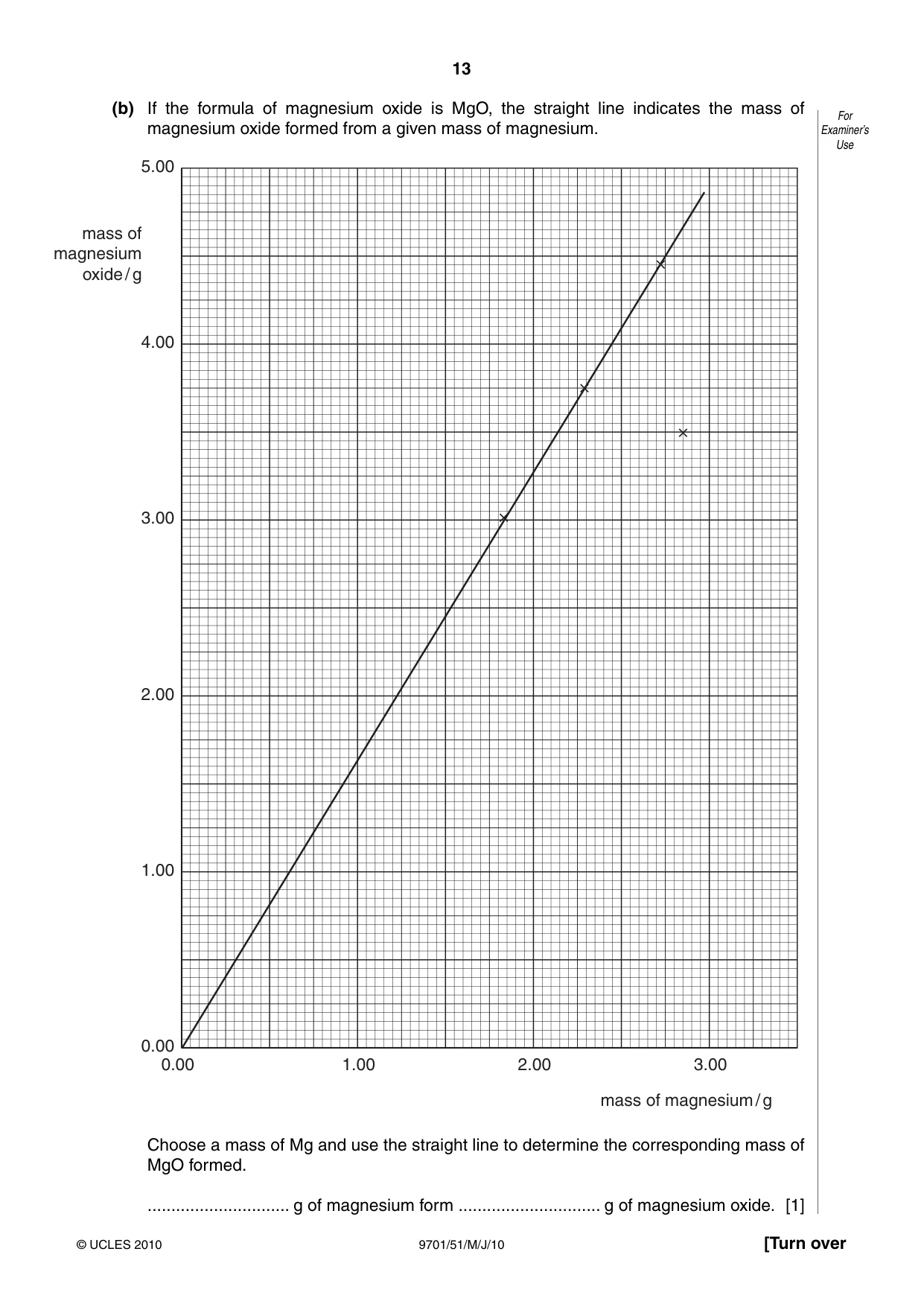
13 © UCLES 2010 [Turn over 9701/51/M/J/10 For Examiner’s Use (b) If the formula of magnesium oxide is MgO, the straight line indicates the mass of magnesium oxide formed from a given mass of magnesium. 0.00 0.00 1.00 2.00 3.00 4.00 5.00 1.00 2.00 3.00 mass of magnesium oxide / g mass of magnesium / g × × × × Choose a mass of Mg and use the straight line to determine the corresponding mass of MgO formed. … g of magnesium form … g of magnesium oxide. [1]
Question paper, page 14
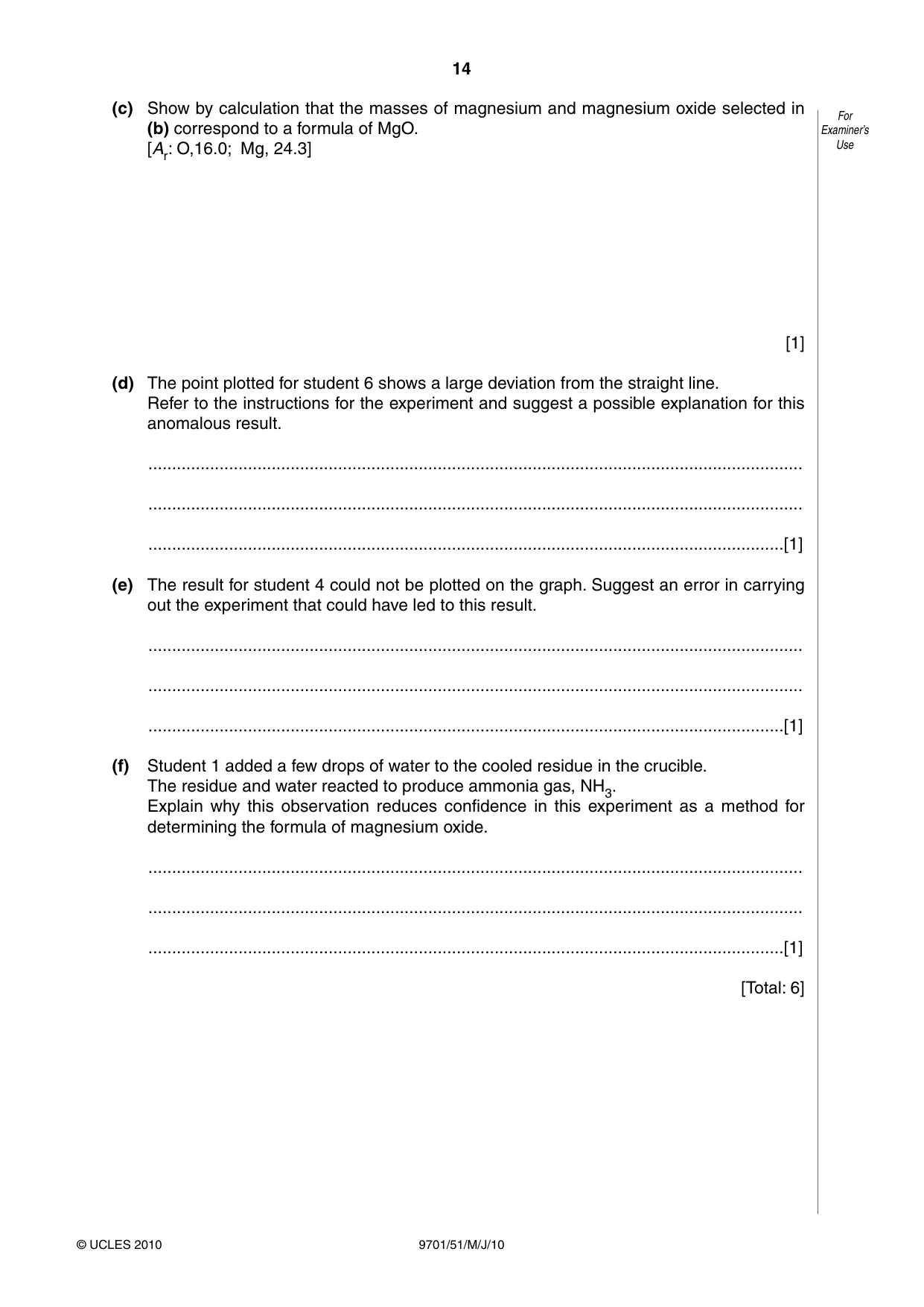
14 © UCLES 2010 9701/51/M/J/10 For Examiner’s Use (c) Show by calculation that the masses of magnesium and magnesium oxide selected in (b) correspond to a formula of MgO. [Ar: O,16.0; Mg, 24.3] [1] (d) The point plotted for student 6 shows a large deviation from the straight line. Refer to the instructions for the experiment and suggest a possible explanation for this anomalous result. … … …[1] (e) The result for student 4 could not be plotted on the graph. Suggest an error in carrying out the experiment that could have led to this result. … … …[1] (f) Student 1 added a few drops of water to the cooled residue in the crucible. The residue and water reacted to produce ammonia gas, NH3. Explain why this observation reduces confidence in this experiment as a method for determining the formula of magnesium oxide. … … …[1] [Total: 6]
Question paper, page 15
15 9701/51/M/J/10 © UCLES 2010 BLANK PAGE
Question paper, page 16
16 9701/51/M/J/10 © UCLES 2010 BLANK PAGE Permission to reproduce items where third-party owned material protected by copyright is included has been sought and cleared where possible. Every reasonable effort has been made by the publisher (UCLES) to trace copyright holders, but if any items requiring clearance have unwittingly been included, the publisher will be pleased to make amends at the earliest possible opportunity. University of Cambridge International Examinations is part of the Cambridge Assessment Group. Cambridge Assessment is the brand name of University of Cambridge Local Examinations Syndicate (UCLES), which is itself a department of the University of Cambridge.
Mark scheme, page 1
UNIVERSITY OF CAMBRIDGE INTERNATIONAL EXAMINATIONS GCE Advanced Subsidiary Level and GCE Advanced Level MARK SCHEME for the May/June 2010 question paper for the guidance of teachers 9701 CHEMISTRY 9701/51 Paper 5 (Planning, Analysis and Evaluation), maximum raw mark 30 This mark scheme is published as an aid to teachers and candidates, to indicate the requirements of the examination. It shows the basis on which Examiners were instructed to award marks. It does not indicate the details of the discussions that took place at an Examiners’ meeting before marking began, which would have considered the acceptability of alternative answers. Mark schemes must be read in conjunction with the question papers and the report on the examination. • CIE will not enter into discussions or correspondence in connection with these mark schemes. CIE is publishing the mark schemes for the May/June 2010 question papers for most IGCSE, GCE Advanced Level and Advanced Subsidiary Level syllabuses and some Ordinary Level syllabuses.
Mark scheme, page 2
Page 2 Mark Scheme: Teachers’ version Syllabus Paper GCE AS/A LEVEL – May/June 2010 9701 51 © UCLES 2010 Question Sections Indicative material Mark 1 (a) PLAN Methods PLAN Problem Selects a volume of 3 mol dm–3 NaOH between 10 and 80 cm3. Calculates the volume of 2 mol dm–3 H2SO4 that reacts with the volume of NaOH given. Ignore decimal places or significant figures. (ecf from (a) and accept 0.75x). Sketches a graph showing increasing temperature, reaching a maximum, then decreasing (or staying on plateau). AND indicating the neutralisation point at the maximum or the volume calculated above, Accept straight lines or curves with a maximum. [1] [1] [1] (b) PLAN Problem (i) volume of acid. (ii) temperature / temperature increase / temperature change. (iii) heat loss (given as being controlled) / use of same cup / apparatus. or same initial temperatures of both start solutions. [1] [1] [1] (c) PLAN Methods Burette / pipette to add acid. [1] (d) PLAN Methods The acid is added in successive volume portions (not dropwise). or adding the calculated acid volume in (a) slowly or gradually. [1] (e) PLAN Methods Risks or hazards identified (i) apparatus unstable (chemical spills on persons) or getting very hot / high heat / burns. Do not accept just temperature increase. Melting plastic is neutral. Do not accept irritant / harmful or itching or damage to clothing. (ii) NaOH is corrosive / burns / damage to skin. BOTH needed for mark. Do not accept burns twice. [1] (f) PLAN Methods Mark here is dependent on correct responses in (e). BOTH needed for mark. (i) plastic cup put in beaker / clamp for stability or appropriate handling of hot plastic cup. (ii) two of: gloves, face shield / goggles or lab coat in handling corrosive liquid. Where only 1 risk and the associated way of minimising that risk are given – award one mark maximum for (e) and (f) [1]
Mark scheme, page 3
Page 3 Mark Scheme: Teachers’ version Syllabus Paper GCE AS/A LEVEL – May/June 2010 9701 51 © UCLES 2010 (g) PLAN Methods EITHER A column for volume of acid added (in portions) with units and provision for an initial temperature at 0 cm3 acid, or a separate statement of initial temperature or a separate column of initial temperature. WITH Columns for temperature and temperature change, both with units. OR Table indicates in some way multiple repeats of the same experiment. Must have a statement or column of acid volume. WITH Column for initial temperature, final temperature and temperature change, all with units. Only penalise unit error once. [1] [1] OR [1] [1] (h) PLAN Methods (vol/mass NaOH + vol/mass H2SO4) × 4.3 × ∆T Added numerical values from (a) are required. Units not required. Conversion to kJ may be here. [1] (i) PLAN Methods Divides answer to (h) by moles of NaOH or water. Use of “n” or “moles” allowed if related to NaOH / H2O Allow moles of H2SO4 only if 2 × moles H2SO4 used or 2 × value of moles H2SO4 from part (a). Converts J to kJ in (h) or (i) AND gives –ve sign for an exothermic reaction. If values are used, calculations must be correct. [1] [1] Total [15]
Mark scheme, page 4
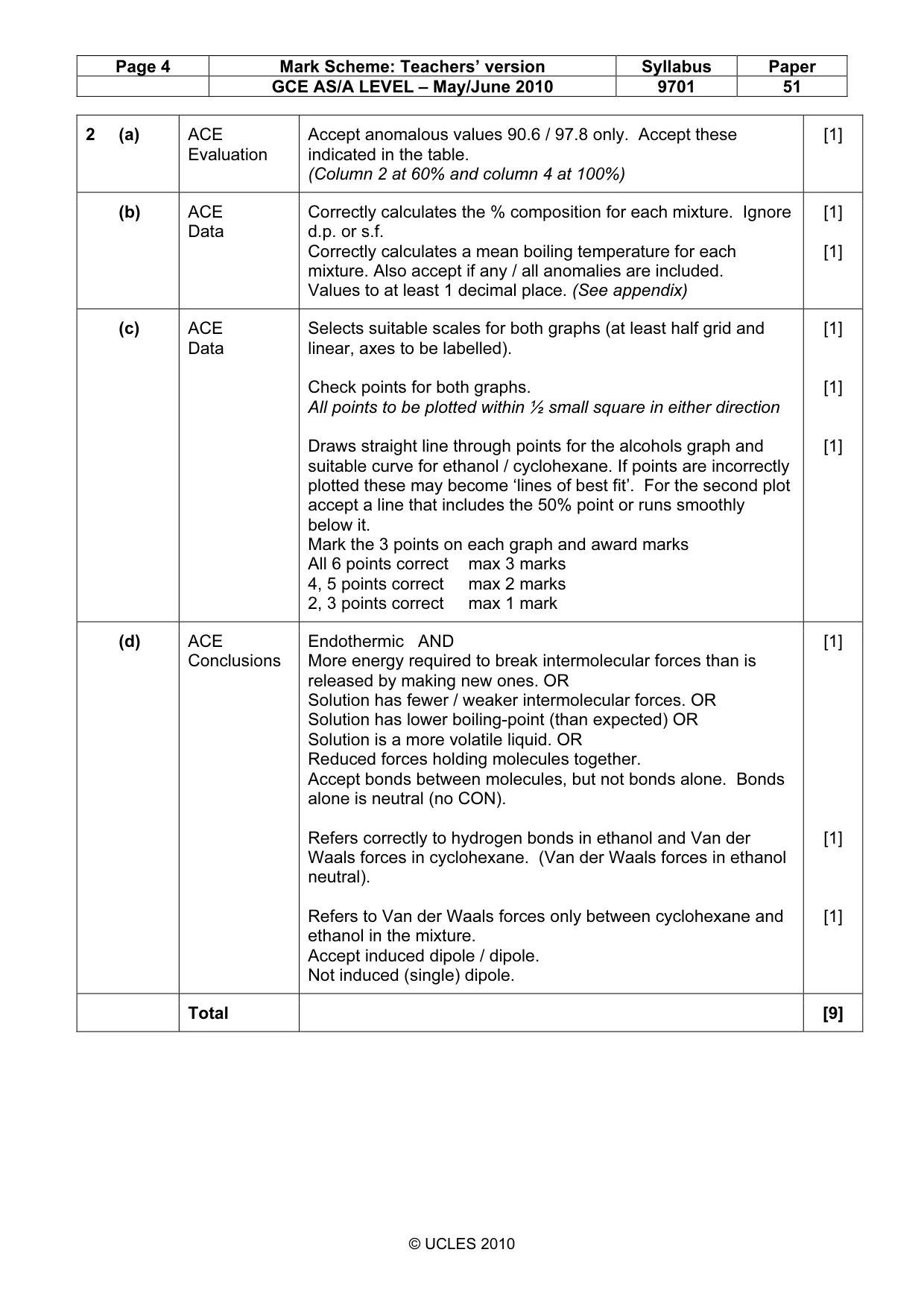
Page 4 Mark Scheme: Teachers’ version Syllabus Paper GCE AS/A LEVEL – May/June 2010 9701 51 © UCLES 2010 2 (a) ACE Evaluation Accept anomalous values 90.6 / 97.8 only. Accept these indicated in the table. (Column 2 at 60% and column 4 at 100%) [1] (b) ACE Data Correctly calculates the % composition for each mixture. Ignore d.p. or s.f. Correctly calculates a mean boiling temperature for each mixture. Also accept if any / all anomalies are included. Values to at least 1 decimal place. (See appendix) [1] [1] (c) ACE Data Selects suitable scales for both graphs (at least half grid and linear, axes to be labelled). Check points for both graphs. All points to be plotted within ½ small square in either direction Draws straight line through points for the alcohols graph and suitable curve for ethanol / cyclohexane. If points are incorrectly plotted these may become ‘lines of best fit’. For the second plot accept a line that includes the 50% point or runs smoothly below it. Mark the 3 points on each graph and award marks All 6 points correct max 3 marks 4, 5 points correct max 2 marks 2, 3 points correct max 1 mark [1] [1] [1] (d) ACE Conclusions Endothermic AND More energy required to break intermolecular forces than is released by making new ones. OR Solution has fewer / weaker intermolecular forces. OR Solution has lower boiling-point (than expected) OR Solution is a more volatile liquid. OR Reduced forces holding molecules together. Accept bonds between molecules, but not bonds alone. Bonds alone is neutral (no CON). Refers correctly to hydrogen bonds in ethanol and Van der Waals forces in cyclohexane. (Van der Waals forces in ethanol neutral). Refers to Van der Waals forces only between cyclohexane and ethanol in the mixture. Accept induced dipole / dipole. Not induced (single) dipole. [1] [1] [1] Total [9]
Mark scheme, page 5
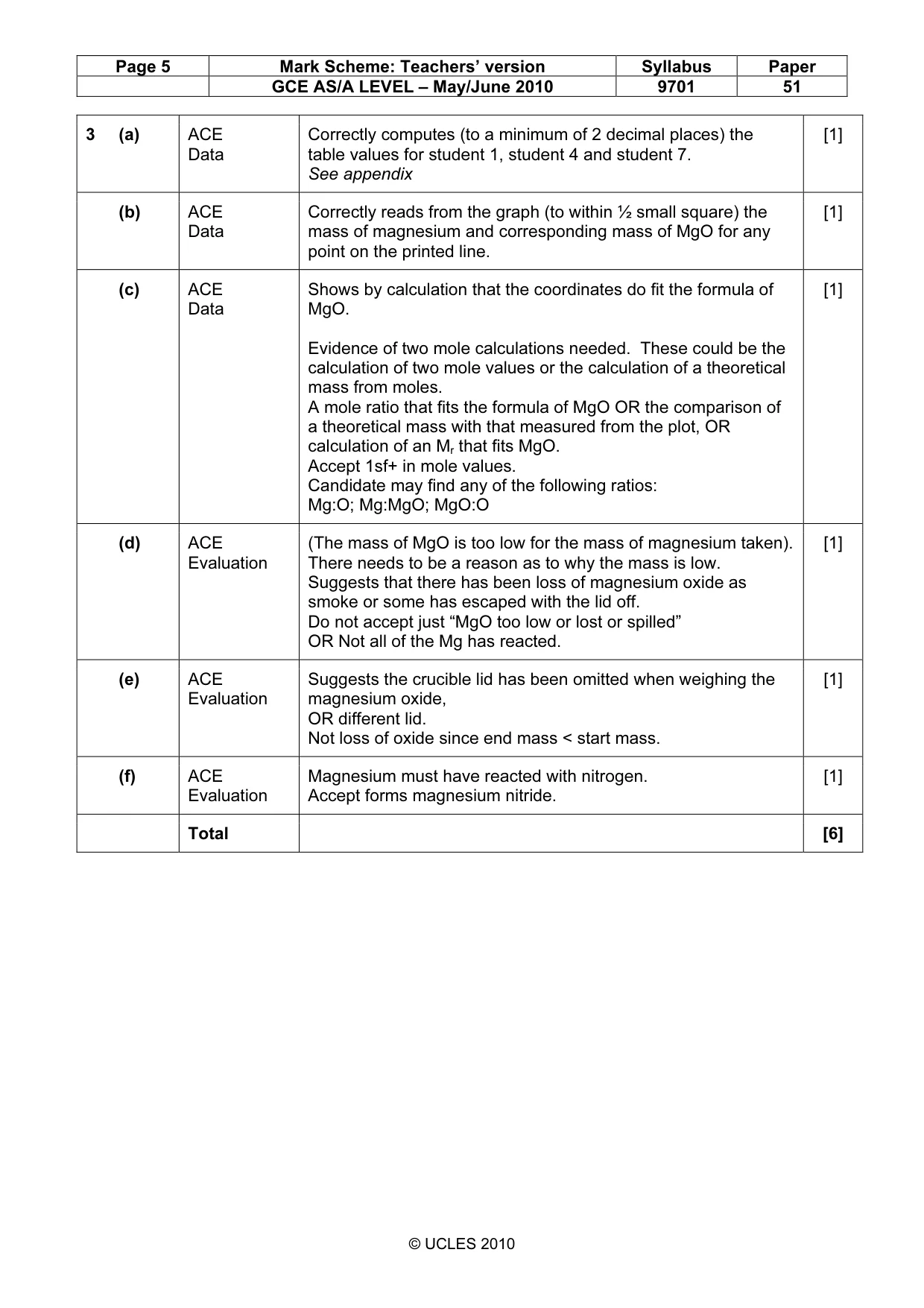
Page 5 Mark Scheme: Teachers’ version Syllabus Paper GCE AS/A LEVEL – May/June 2010 9701 51 © UCLES 2010 3 (a) ACE Data Correctly computes (to a minimum of 2 decimal places) the table values for student 1, student 4 and student 7. See appendix [1] (b) ACE Data Correctly reads from the graph (to within ½ small square) the mass of magnesium and corresponding mass of MgO for any point on the printed line. [1] (c) ACE Data Shows by calculation that the coordinates do fit the formula of MgO. Evidence of two mole calculations needed. These could be the calculation of two mole values or the calculation of a theoretical mass from moles. A mole ratio that fits the formula of MgO OR the comparison of a theoretical mass with that measured from the plot, OR calculation of an Mr that fits MgO. Accept 1sf+ in mole values. Candidate may find any of the following ratios: Mg:O; Mg:MgO; MgO:O [1] (d) ACE Evaluation (The mass of MgO is too low for the mass of magnesium taken). There needs to be a reason as to why the mass is low. Suggests that there has been loss of magnesium oxide as smoke or some has escaped with the lid off. Do not accept just “MgO too low or lost or spilled” OR Not all of the Mg has reacted. [1] (e) ACE Evaluation Suggests the crucible lid has been omitted when weighing the magnesium oxide, OR different lid. Not loss of oxide since end mass < start mass. [1] (f) ACE Evaluation Magnesium must have reacted with nitrogen. Accept forms magnesium nitride. [1] Total [6]
Mark scheme, page 6
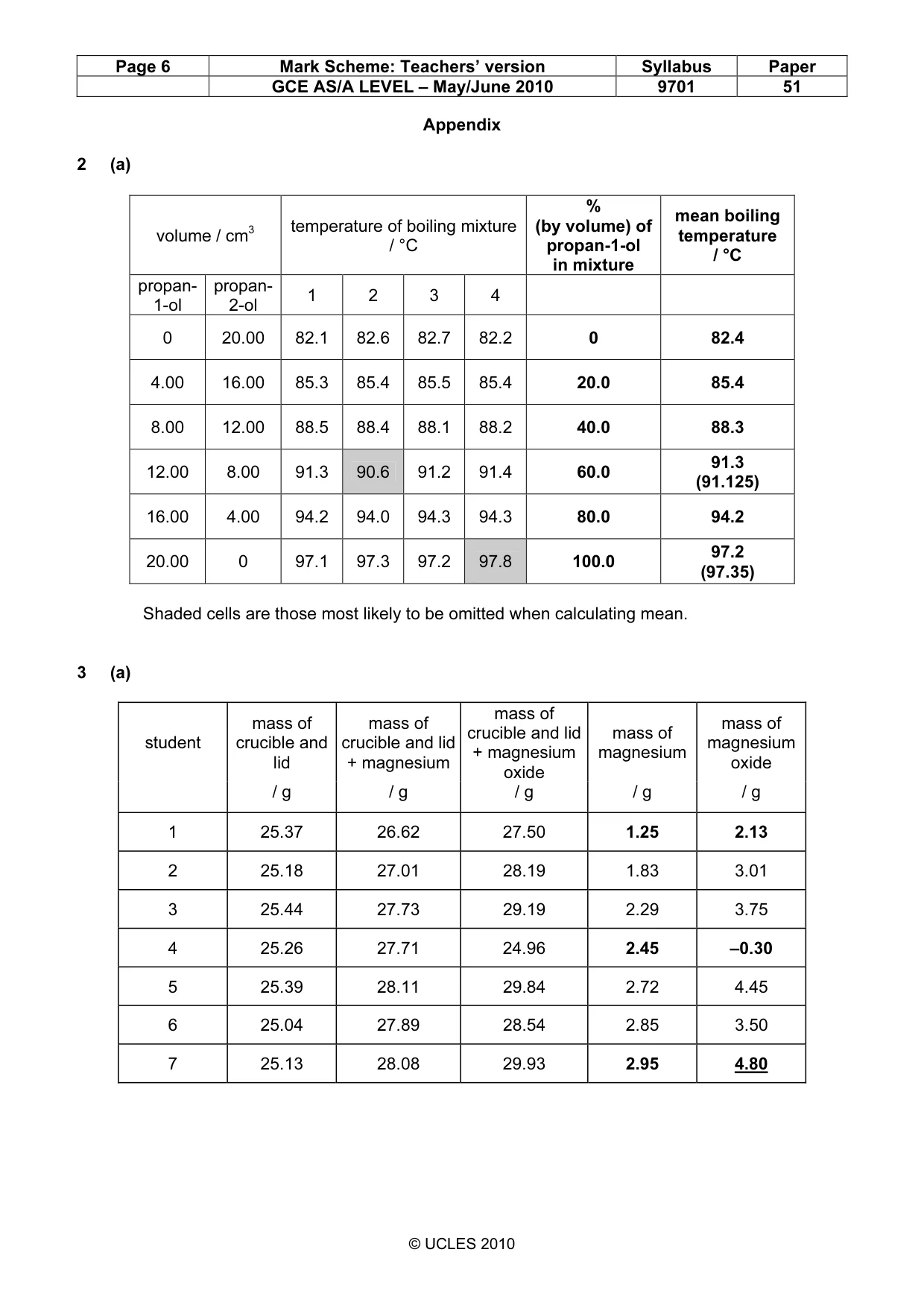
Page 6 Mark Scheme: Teachers’ version Syllabus Paper GCE AS/A LEVEL – May/June 2010 9701 51 © UCLES 2010 Appendix 2 (a) volume / cm3 temperature of boiling mixture / °C % (by volume) of propan-1-ol in mixture mean boiling temperature / °C propan- 1-ol propan- 2-ol 1 2 3 4 0 20.00 82.1 82.6 82.7 82.2 0 82.4 4.00 16.00 85.3 85.4 85.5 85.4 20.0 85.4 8.00 12.00 88.5 88.4 88.1 88.2 40.0 88.3 12.00 8.00 91.3 90.6 91.2 91.4 60.0 91.3 (91.125) 16.00 4.00 94.2 94.0 94.3 94.3 80.0 94.2 20.00 0 97.1 97.3 97.2 97.8 100.0 97.2 (97.35) Shaded cells are those most likely to be omitted when calculating mean. 3 (a) student mass of crucible and lid mass of crucible and lid + magnesium mass of crucible and lid + magnesium oxide mass of magnesium mass of magnesium oxide / g / g / g / g / g 1 25.37 26.62 27.50 1.25 2.13 2 25.18 27.01 28.19 1.83 3.01 3 25.44 27.73 29.19 2.29 3.75 4 25.26 27.71 24.96 2.45 –0.30 5 25.39 28.11 29.84 2.72 4.45 6 25.04 27.89 28.54 2.85 3.50 7 25.13 28.08 29.93 2.95 4.80
What you needed in this session
Cambridge’s own grade thresholds for 2010 May/June, Paper 5 · Variant 1. A higher threshold means an easier paper — the bar moves with how the cohort did.