Cambridge A Level Chemistry 9701 — 2006 May/June Paper 5 · Variant 1
9701/51/M/J/06 · 30 marks · ≈34 min
The question paper and its mark scheme, free to read here and free to download. This is Cambridge’s own paper, exactly as it was sat.
Question paper8 pages

Mark scheme6 pages
Answers below. Sit the paper first if you are practising.
Paper as text
Question paper, page 1
This document consists of 7 printed pages, 1 blank page and an Insert. SPA (SJF3981) T12461/3 © UCLES 2006 [Turn over UNIVERSITY OF CAMBRIDGE INTERNATIONAL EXAMINATIONS General Certificate of Education Advanced Subsidiary Level and Advanced Level CHEMISTRY 9701/05 Paper 5 Practical Test May/June 2006 1 hour 30 minutes Candidates answer on the Question Paper. Additional materials: As listed in the Instructions to Supervisors. READ THESE INSTRUCTIONS FIRST Write your details, including practical session and laboratory where appropriate, in the boxes provided. Write in dark blue or black pen. You may use a soft pencil for any diagrams, graphs or rough working. Do not use staples, paper clips, highlighters, glue or correction fluid. Answer all questions. You are advised to show all working in calculations. Use of a Data Booklet is unnecessary. You may use a calculator. At the end of the examination fasten all your work securely together. The number of marks is given in brackets [ ] at the end of each question or part question. Centre Number Candidate Number Name For Examiner’s Use 1 2 TOTAL SESSION LABORATORY
Question paper, page 2
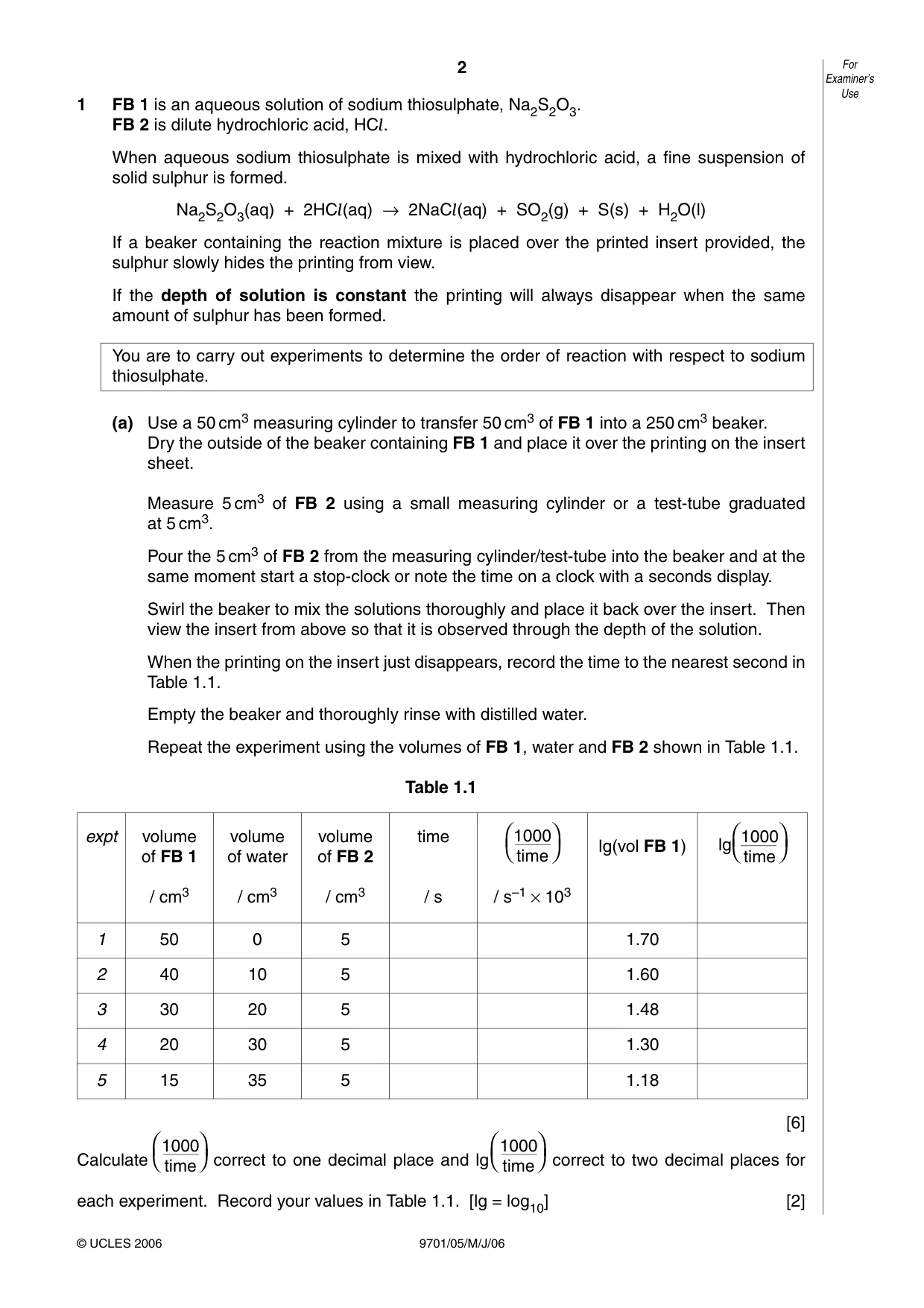
2 9701/05/M/J/06 1 FB 1 is an aqueous solution of sodium thiosulphate, Na2S2O3. FB 2 is dilute hydrochloric acid, HCl. When aqueous sodium thiosulphate is mixed with hydrochloric acid, a fine suspension of solid sulphur is formed. Na2S2O3(aq) + 2HCl(aq) →2NaCl(aq) + SO2(g) + S(s) + H2O(l) If a beaker containing the reaction mixture is placed over the printed insert provided, the sulphur slowly hides the printing from view. If the depth of solution is constant the printing will always disappear when the same amount of sulphur has been formed. You are to carry out experiments to determine the order of reaction with respect to sodium thiosulphate. (a) Use a 50 cm3 measuring cylinder to transfer 50 cm3 of FB 1 into a 250 cm3 beaker. Dry the outside of the beaker containing FB 1 and place it over the printing on the insert sheet. Measure 5 cm3 of FB 2 using a small measuring cylinder or a test-tube graduated at 5 cm3. Pour the 5 cm3 of FB 2 from the measuring cylinder/test-tube into the beaker and at the same moment start a stop-clock or note the time on a clock with a seconds display. Swirl the beaker to mix the solutions thoroughly and place it back over the insert. Then view the insert from above so that it is observed through the depth of the solution. When the printing on the insert just disappears, record the time to the nearest second in Table 1.1. Empty the beaker and thoroughly rinse with distilled water. Repeat the experiment using the volumes of FB 1, water and FB 2 shown in Table 1.1. Table 1.1 [6] Calculate correct to one decimal place and lg correct to two decimal places for each experiment. Record your values in Table 1.1. [lg = log10] [2] For Examiner’s Use © UCLES 2006 expt volume of FB 1 / cm3 volume of water / cm3 volume of FB 2 / cm3 time / s 1000 time / s–1 × 10³ lg(vol FB 1) 1000 time ⎛ ⎞ ⎝ ⎠ ⎛ ⎞ ⎝ ⎠ lg 1 50 0 5 1.70 1.60 1.48 1.30 1.18 5 5 5 5 40 10 30 20 20 30 15 35 2 3 4 5 1000 time ⎛ ⎞ ⎝ ⎠ 1000 time ⎛ ⎞ ⎝ ⎠
Question paper, page 3
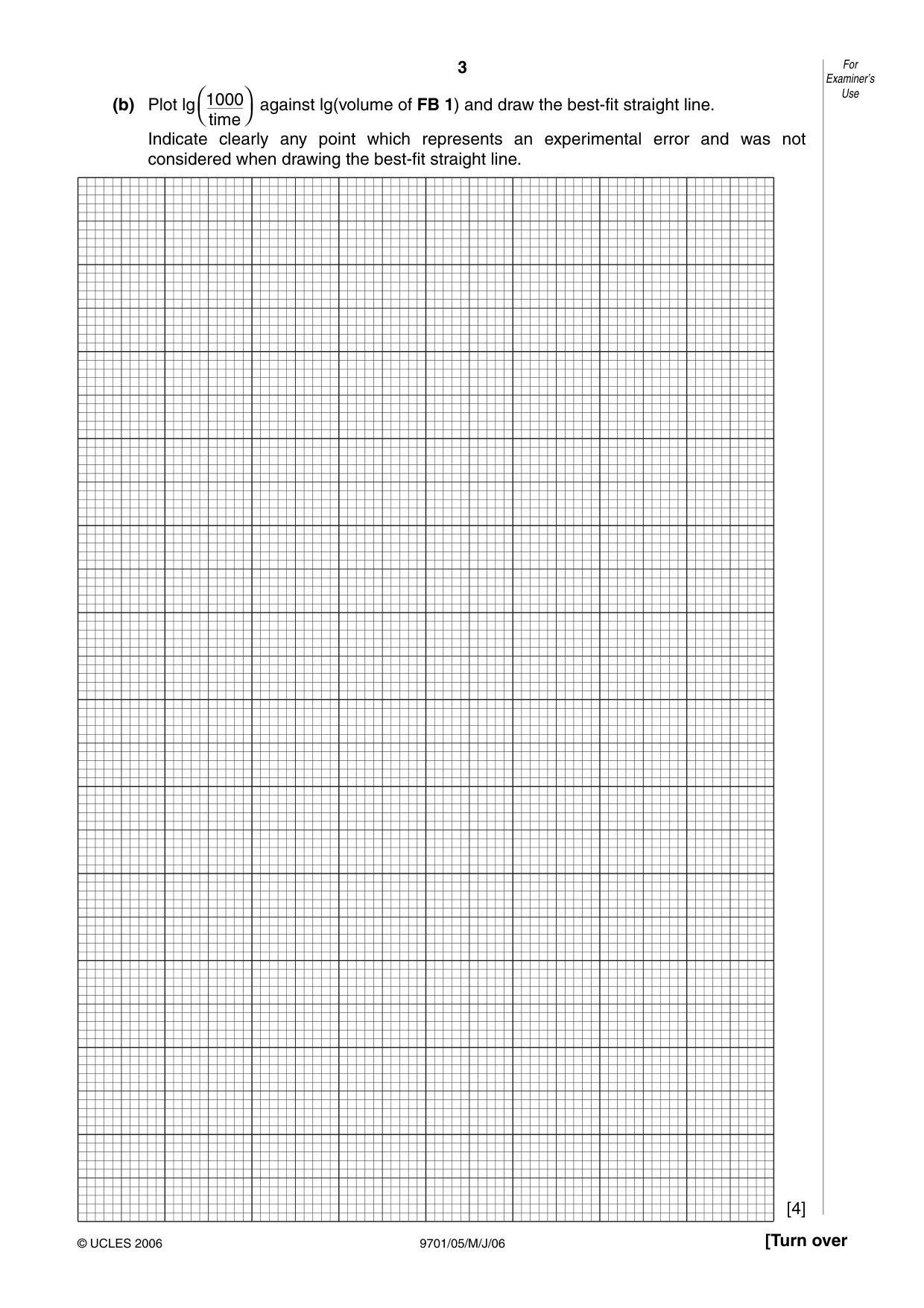
3 9701/05/M/J/06 [Turn over (b) Plot lg against lg(volume of FB 1) and draw the best-fit straight line. Indicate clearly any point which represents an experimental error and was not considered when drawing the best-fit straight line. [4] For Examiner’s Use © UCLES 2006 1000 time ⎛ ⎞ ⎝ ⎠
Question paper, page 4
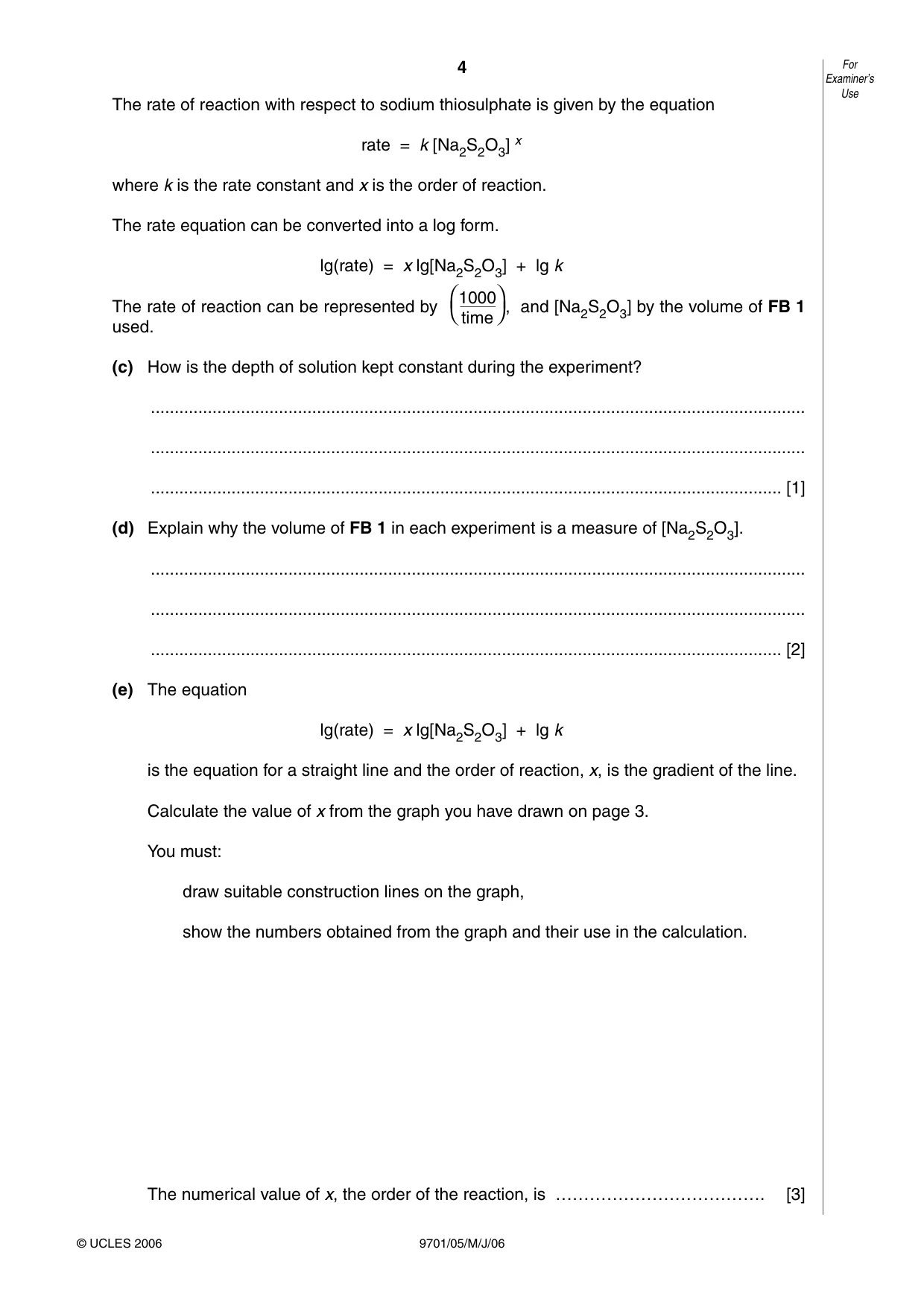
4 9701/05/M/J/06 The rate of reaction with respect to sodium thiosulphate is given by the equation rate = k [Na2S2O3] x where k is the rate constant and x is the order of reaction. The rate equation can be converted into a log form. lg(rate) = x lg[Na2S2O3] + lg k The rate of reaction can be represented by , and [Na2S2O3] by the volume of FB 1 used. (c) How is the depth of solution kept constant during the experiment? … … … [1] (d) Explain why the volume of FB 1 in each experiment is a measure of [Na2S2O3]. … … … [2] (e) The equation lg(rate) = x lg[Na2S2O3] + lg k is the equation for a straight line and the order of reaction, x, is the gradient of the line. Calculate the value of x from the graph you have drawn on page 3. You must: draw suitable construction lines on the graph, show the numbers obtained from the graph and their use in the calculation. The numerical value of x, the order of the reaction, is ………………………………. [3] For Examiner’s Use © UCLES 2006 1000 time ⎛ ⎞ ⎝ ⎠
Question paper, page 5
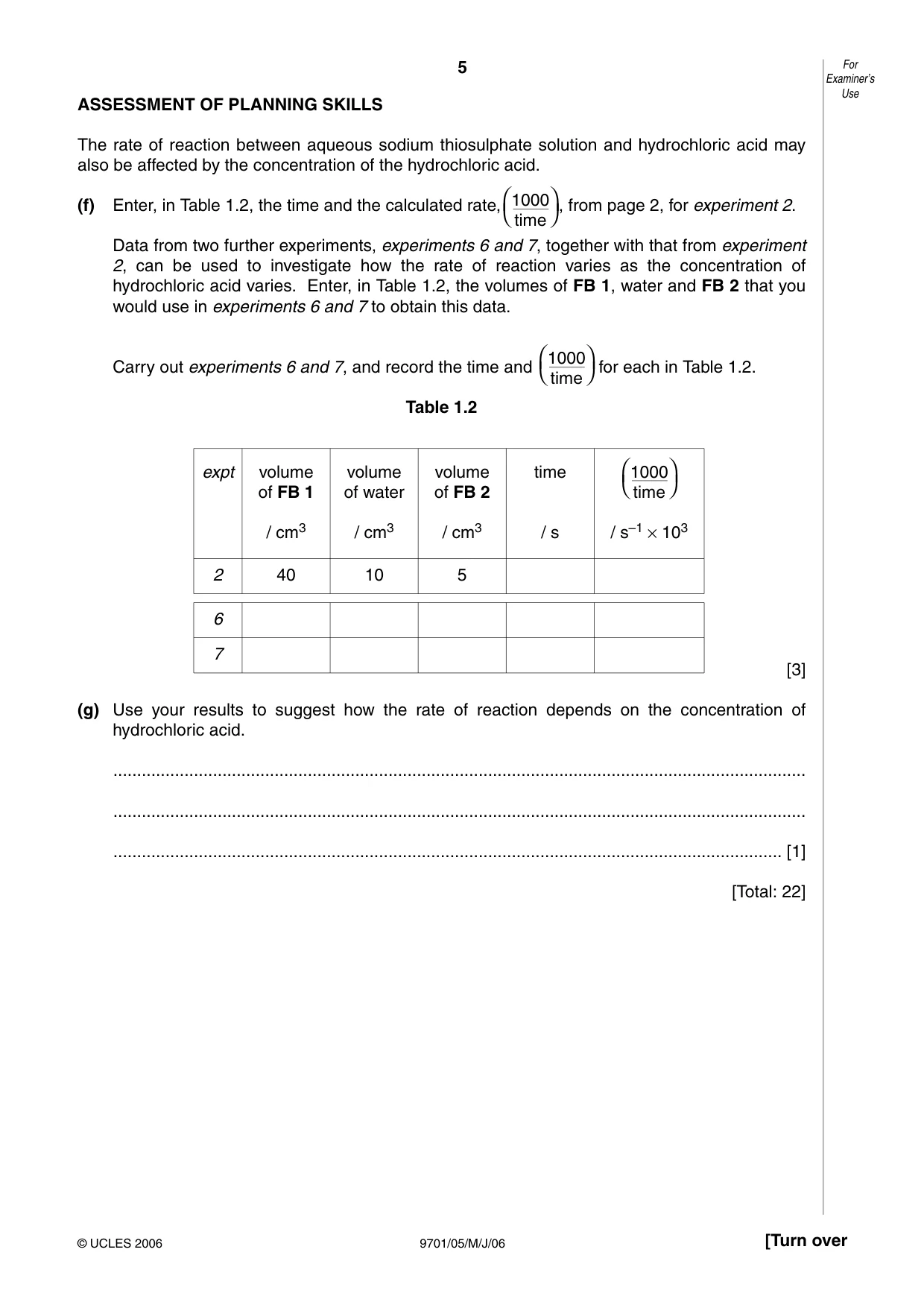
5 9701/05/M/J/06 [Turn over ASSESSMENT OF PLANNING SKILLS The rate of reaction between aqueous sodium thiosulphate solution and hydrochloric acid may also be affected by the concentration of the hydrochloric acid. (f) Enter, in Table 1.2, the time and the calculated rate, , from page 2, for experiment 2. Data from two further experiments, experiments 6 and 7, together with that from experiment 2, can be used to investigate how the rate of reaction varies as the concentration of hydrochloric acid varies. Enter, in Table 1.2, the volumes of FB 1, water and FB 2 that you would use in experiments 6 and 7 to obtain this data. Carry out experiments 6 and 7, and record the time and for each in Table 1.2. Table 1.2 [3] (g) Use your results to suggest how the rate of reaction depends on the concentration of hydrochloric acid. … … … [1] [Total: 22] For Examiner’s Use © UCLES 2006 1000 time ⎛ ⎞ ⎝ ⎠ expt volume of FB 1 / cm3 volume of water / cm3 volume of FB 2 / cm3 time / s 1000 time / s–1 × 10³ ⎛ ⎞ ⎝ ⎠ 2 6 7 40 10 5 1000 time ⎛ ⎞ ⎝ ⎠
Question paper, page 6
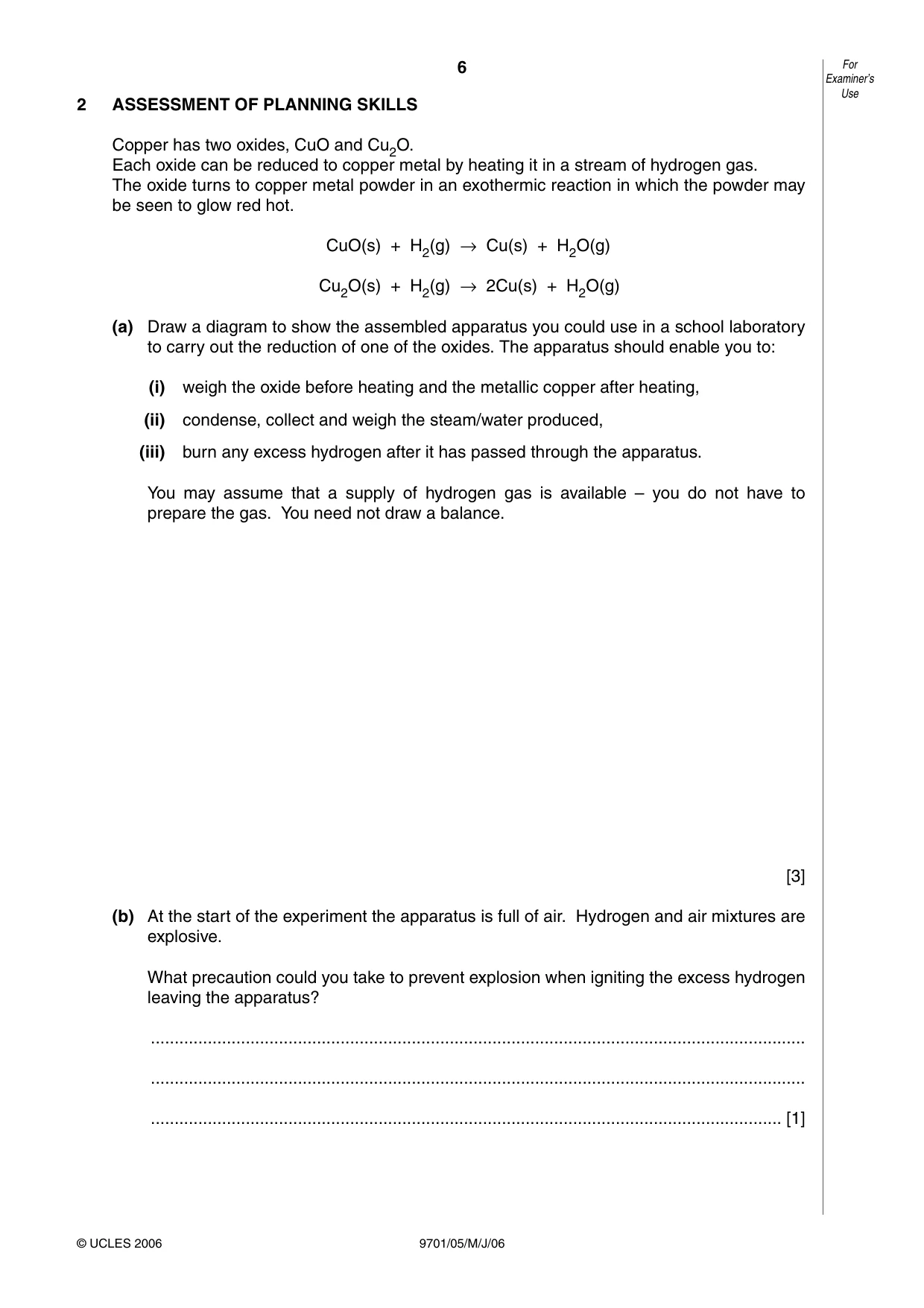
6 9701/05/M/J/06 2 ASSESSMENT OF PLANNING SKILLS Copper has two oxides, CuO and Cu2O. Each oxide can be reduced to copper metal by heating it in a stream of hydrogen gas. The oxide turns to copper metal powder in an exothermic reaction in which the powder may be seen to glow red hot. CuO(s) + H2(g) →Cu(s) + H2O(g) Cu2O(s) + H2(g) →2Cu(s) + H2O(g) (a) Draw a diagram to show the assembled apparatus you could use in a school laboratory to carry out the reduction of one of the oxides. The apparatus should enable you to: (i) weigh the oxide before heating and the metallic copper after heating, (ii) condense, collect and weigh the steam/water produced, (iii) burn any excess hydrogen after it has passed through the apparatus. You may assume that a supply of hydrogen gas is available – you do not have to prepare the gas. You need not draw a balance. [3] (b) At the start of the experiment the apparatus is full of air. Hydrogen and air mixtures are explosive. What precaution could you take to prevent explosion when igniting the excess hydrogen leaving the apparatus? … … … [1] For Examiner’s Use © UCLES 2006
Question paper, page 7
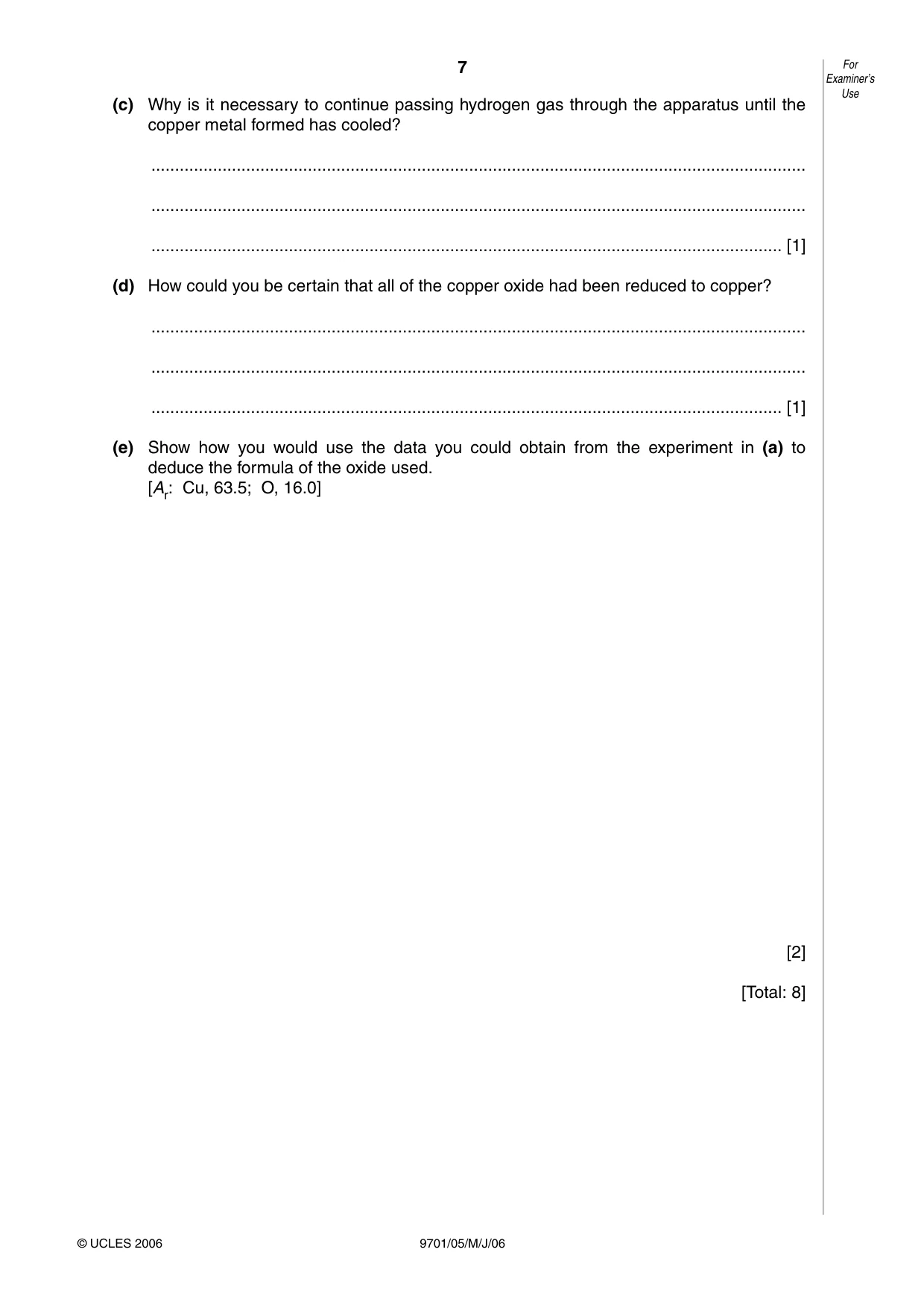
7 9701/05/M/J/06 (c) Why is it necessary to continue passing hydrogen gas through the apparatus until the copper metal formed has cooled? … … … [1] (d) How could you be certain that all of the copper oxide had been reduced to copper? … … … [1] (e) Show how you would use the data you could obtain from the experiment in (a) to deduce the formula of the oxide used. [Ar: Cu, 63.5; O, 16.0] [2] [Total: 8] For Examiner’s Use © UCLES 2006
Question paper, page 8
8 9701/05/M/J/06 BLANK PAGE Permission to reproduce items where third-party owned material protected by copyright is included has been sought and cleared where possible. Every reasonable effort has been made by the publisher (UCLES) to trace copyright holders, but if any items requiring clearance have unwittingly been included, the publisher will be pleased to make amends at the earliest possible opportunity. University of Cambridge International Examinations is part of the University of Cambridge Local Examinations Syndicate (UCLES), which is itself a department of the University of Cambridge.
Mark scheme, page 1
UNIVERSITY OF CAMBRIDGE INTERNATIONAL EXAMINATIONS GCE Advanced Level and GCE Advanced Subsidiary Level MARK SCHEME for the May/June 2006 question paper 9701 CHEMISTRY 9701/05 Paper 5 Maximum raw mark 30 This mark scheme is published as an aid to teachers and students, to indicate the requirements of the examination. It shows the basis on which Examiners were initially instructed to award marks. It does not indicate the details of the discussions that took place at an Examiners’ meeting before marking began. Any substantial changes to the mark scheme that arose from these discussions will be recorded in the published Report on the Examination. All Examiners are instructed that alternative correct answers and unexpected approaches in candidates’ scripts must be given marks that fairly reflect the relevant knowledge and skills demonstrated. Mark schemes must be read in conjunction with the question papers and the Report on the Examination. The minimum marks in these components needed for various grades were previously published with these mark schemes, but are now instead included in the Report on the Examination for this session. • CIE will not enter into discussion or correspondence in connection with these mark schemes. CIE is publishing the mark schemes for the May/June 2006 question papers for most IGCSE and GCE Advanced Level and Advanced Subsidiary Level syllabuses and some Ordinary Level syllabuses.
Mark scheme, page 2
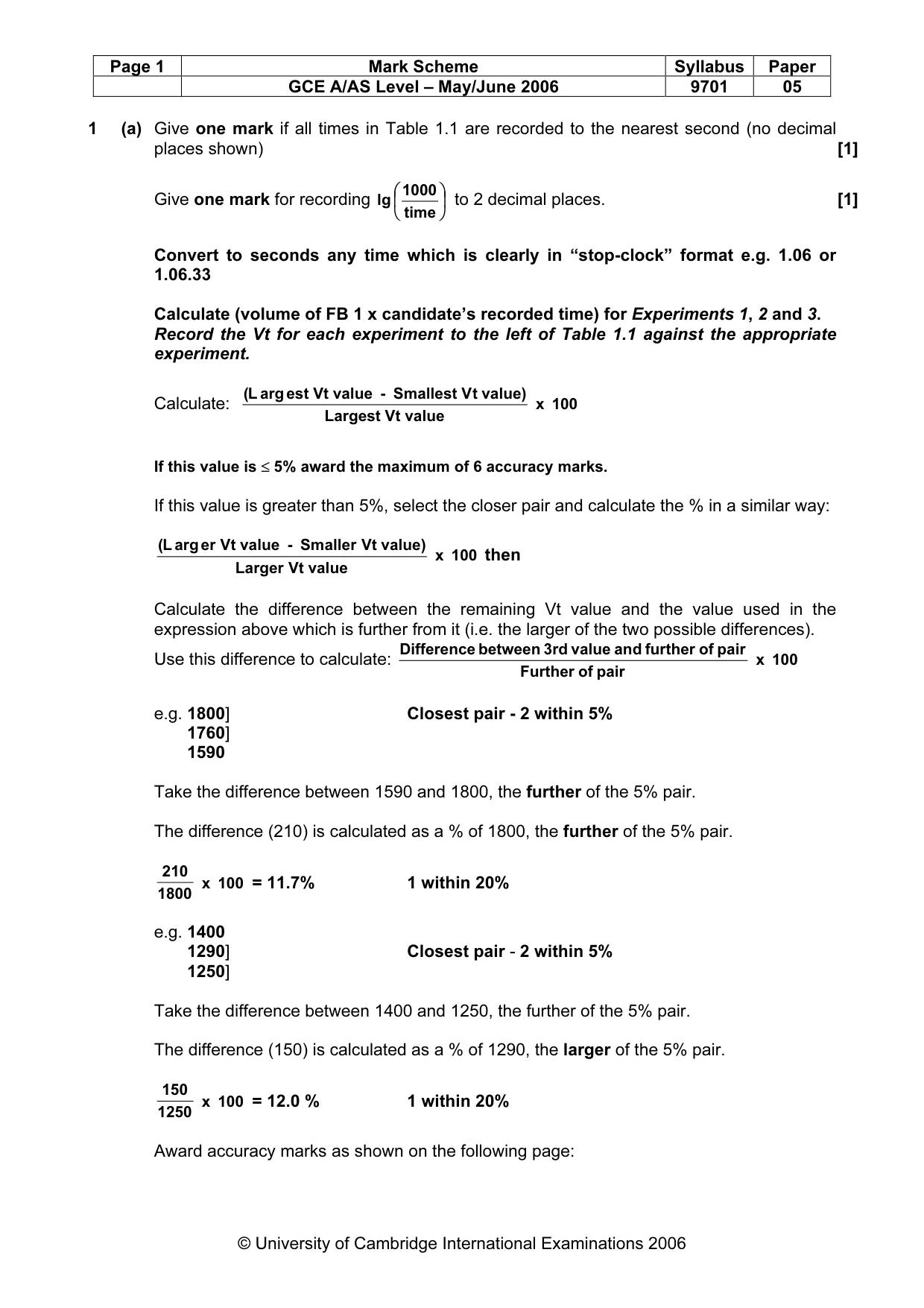
Page 1 Mark Scheme Syllabus Paper GCE A/AS Level – May/June 2006 9701 05 © University of Cambridge International Examinations 2006 1 (a) Give one mark if all times in Table 1.1 are recorded to the nearest second (no decimal places shown) [1] Give one mark for recording time 1000 lg to 2 decimal places. [1] Convert to seconds any time which is clearly in “stop-clock” format e.g. 1.06 or 1.06.33 Calculate (volume of FB 1 x candidate’s recorded time) for Experiments 1, 2 and 3. Record the Vt for each experiment to the left of Table 1.1 against the appropriate experiment. Calculate: 100 x value Largest Vt value) t Smallest V - value Vt est arg L ( If this value is ≤ 5% award the maximum of 6 accuracy marks. If this value is greater than 5%, select the closer pair and calculate the % in a similar way: 100 x value Vt Larger value) Vt Smaller - value Vt er arg L ( then Calculate the difference between the remaining Vt value and the value used in the expression above which is further from it (i.e. the larger of the two possible differences). Use this difference to calculate: 100 x pair of Further pair of further and value 3rd between Difference e.g. 1800] Closest pair - 2 within 5% 1760] 1590 Take the difference between 1590 and 1800, the further of the 5% pair. The difference (210) is calculated as a % of 1800, the further of the 5% pair. 100 x 1800 210 = 11.7% 1 within 20% e.g. 1400 1290] Closest pair - 2 within 5% 1250] Take the difference between 1400 and 1250, the further of the 5% pair. The difference (150) is calculated as a % of 1290, the larger of the 5% pair. 100 x 1250 150 = 12.0 % 1 within 20% Award accuracy marks as shown on the following page:
Mark scheme, page 3
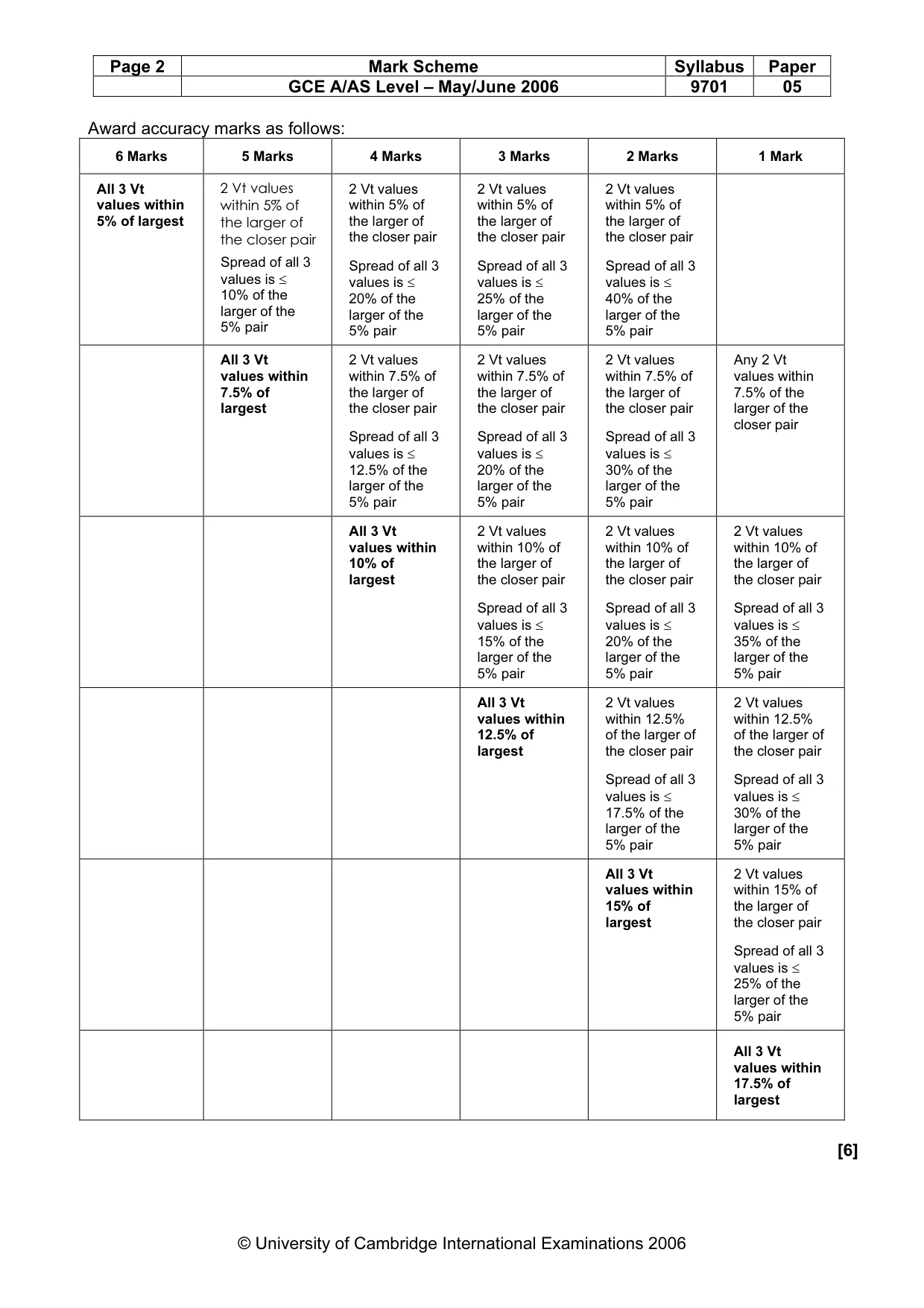
Page 2 Mark Scheme Syllabus Paper GCE A/AS Level – May/June 2006 9701 05 © University of Cambridge International Examinations 2006 Award accuracy marks as follows: 6 Marks 5 Marks 4 Marks 3 Marks 2 Marks 1 Mark All 3 Vt values within 5% of largest 2 Vt values within 5% of the larger of the closer pair Spread of all 3 values is ≤ 10% of the larger of the 5% pair 2 Vt values within 5% of the larger of the closer pair Spread of all 3 values is ≤ 20% of the larger of the 5% pair 2 Vt values within 5% of the larger of the closer pair Spread of all 3 values is ≤ 25% of the larger of the 5% pair 2 Vt values within 5% of the larger of the closer pair Spread of all 3 values is ≤ 40% of the larger of the 5% pair All 3 Vt values within 7.5% of largest 2 Vt values within 7.5% of the larger of the closer pair Spread of all 3 values is ≤ 12.5% of the larger of the 5% pair 2 Vt values within 7.5% of the larger of the closer pair Spread of all 3 values is ≤ 20% of the larger of the 5% pair 2 Vt values within 7.5% of the larger of the closer pair Spread of all 3 values is ≤ 30% of the larger of the 5% pair Any 2 Vt values within 7.5% of the larger of the closer pair All 3 Vt values within 10% of largest 2 Vt values within 10% of the larger of the closer pair Spread of all 3 values is ≤ 15% of the larger of the 5% pair 2 Vt values within 10% of the larger of the closer pair Spread of all 3 values is ≤ 20% of the larger of the 5% pair 2 Vt values within 10% of the larger of the closer pair Spread of all 3 values is ≤ 35% of the larger of the 5% pair All 3 Vt values within 12.5% of largest 2 Vt values within 12.5% of the larger of the closer pair Spread of all 3 values is ≤ 17.5% of the larger of the 5% pair 2 Vt values within 12.5% of the larger of the closer pair Spread of all 3 values is ≤ 30% of the larger of the 5% pair All 3 Vt values within 15% of largest 2 Vt values within 15% of the larger of the closer pair Spread of all 3 values is ≤ 25% of the larger of the 5% pair All 3 Vt values within 17.5% of largest [6]
Mark scheme, page 4
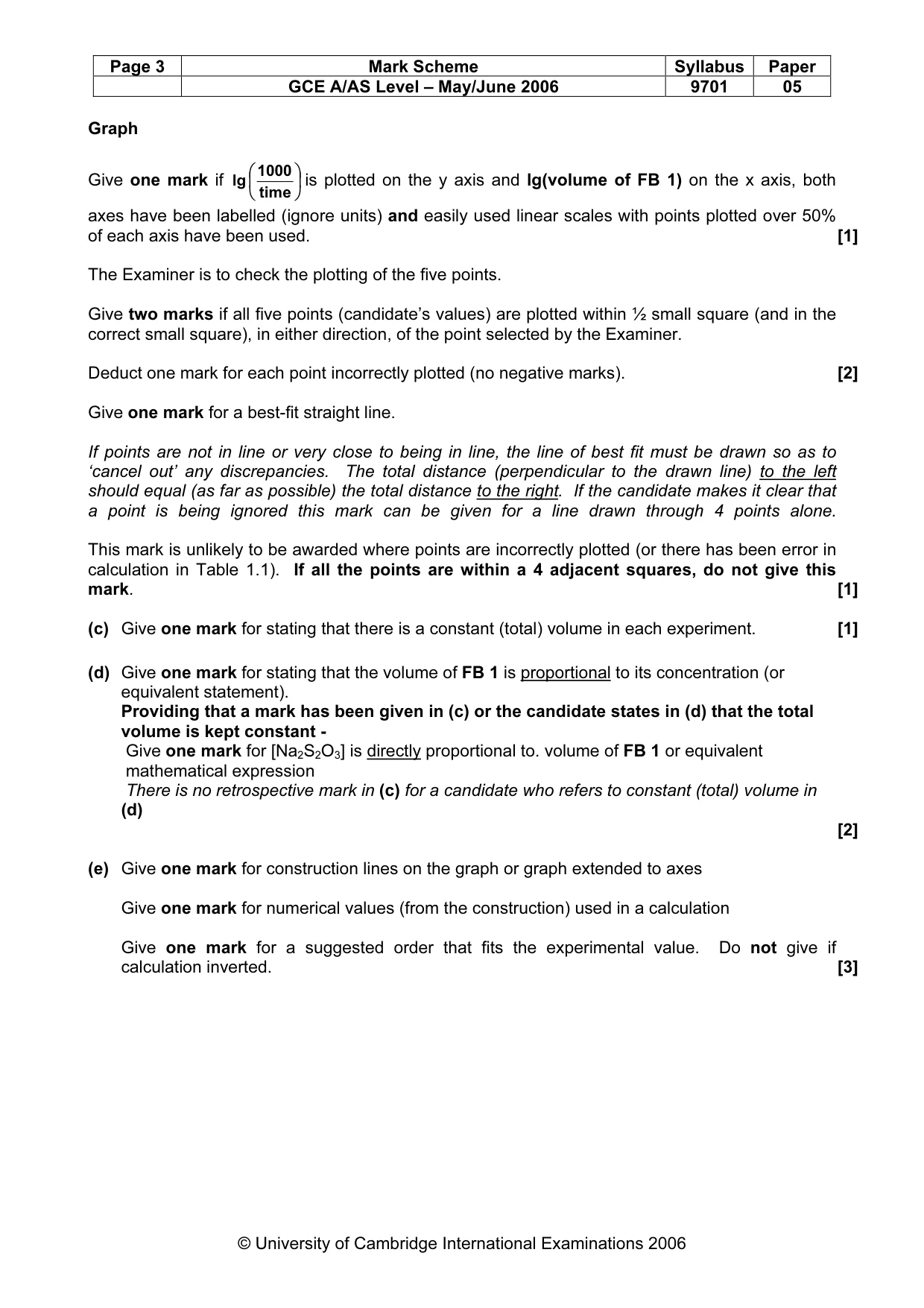
Page 3 Mark Scheme Syllabus Paper GCE A/AS Level – May/June 2006 9701 05 © University of Cambridge International Examinations 2006 Graph Give one mark if time 1000 lg is plotted on the y axis and lg(volume of FB 1) on the x axis, both axes have been labelled (ignore units) and easily used linear scales with points plotted over 50% of each axis have been used. [1] The Examiner is to check the plotting of the five points. Give two marks if all five points (candidate’s values) are plotted within ½ small square (and in the correct small square), in either direction, of the point selected by the Examiner. Deduct one mark for each point incorrectly plotted (no negative marks). [2] Give one mark for a best-fit straight line. If points are not in line or very close to being in line, the line of best fit must be drawn so as to ‘cancel out’ any discrepancies. The total distance (perpendicular to the drawn line) to the left should equal (as far as possible) the total distance to the right. If the candidate makes it clear that a point is being ignored this mark can be given for a line drawn through 4 points alone. This mark is unlikely to be awarded where points are incorrectly plotted (or there has been error in calculation in Table 1.1). If all the points are within a 4 adjacent squares, do not give this mark. [1] (c) Give one mark for stating that there is a constant (total) volume in each experiment. [1] (d) Give one mark for stating that the volume of FB 1 is proportional to its concentration (or equivalent statement). Providing that a mark has been given in (c) or the candidate states in (d) that the total volume is kept constant - Give one mark for [Na2S2O3] is directly proportional to. volume of FB 1 or equivalent mathematical expression There is no retrospective mark in (c) for a candidate who refers to constant (total) volume in (d) [2] (e) Give one mark for construction lines on the graph or graph extended to axes Give one mark for numerical values (from the construction) used in a calculation Give one mark for a suggested order that fits the experimental value. Do not give if calculation inverted. [3]
Mark scheme, page 5
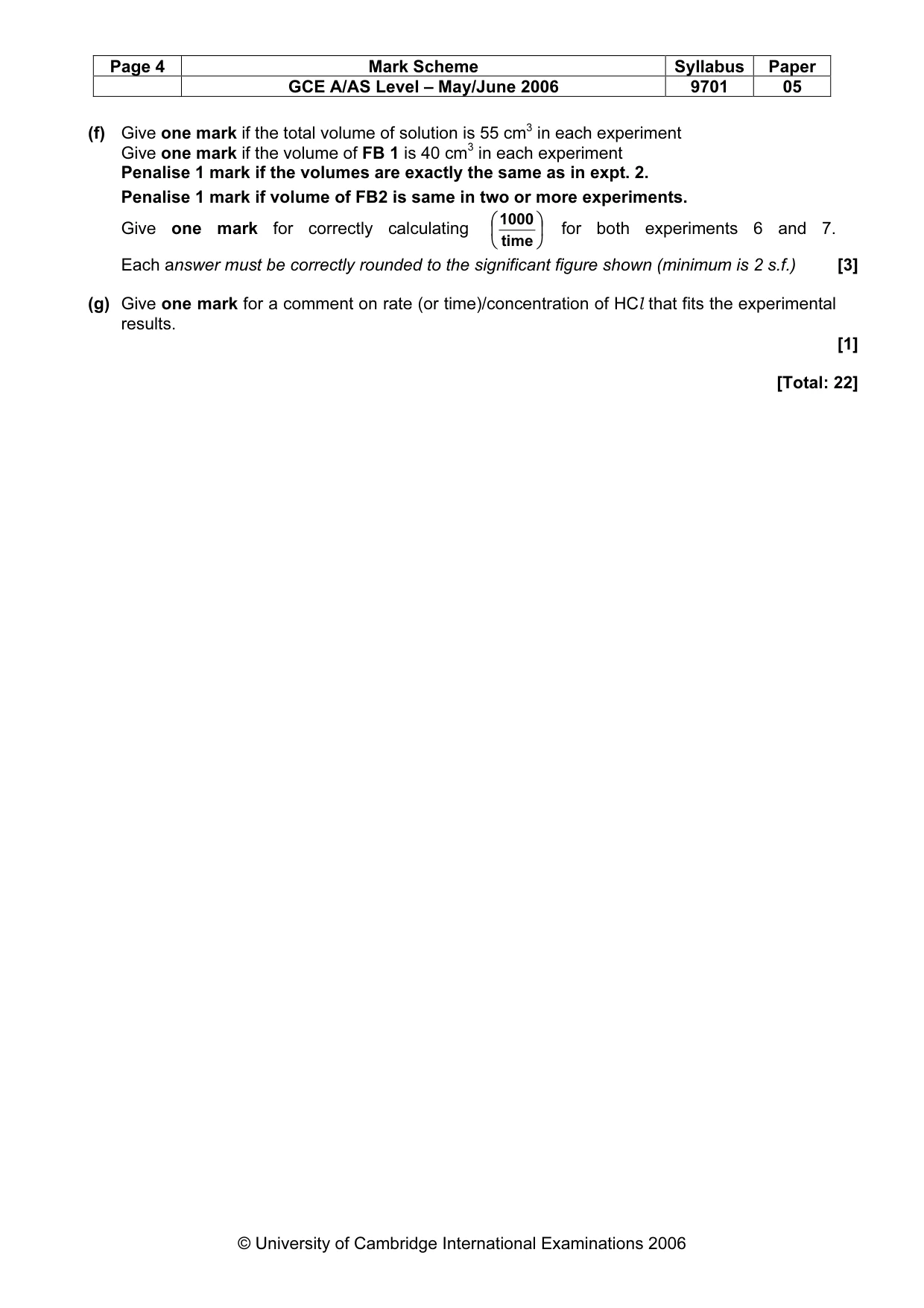
Page 4 Mark Scheme Syllabus Paper GCE A/AS Level – May/June 2006 9701 05 © University of Cambridge International Examinations 2006 (f) Give one mark if the total volume of solution is 55 cm3 in each experiment Give one mark if the volume of FB 1 is 40 cm3 in each experiment Penalise 1 mark if the volumes are exactly the same as in expt. 2. Penalise 1 mark if volume of FB2 is same in two or more experiments. Give one mark for correctly calculating time 1000 for both experiments 6 and 7. Each answer must be correctly rounded to the significant figure shown (minimum is 2 s.f.) [3] (g) Give one mark for a comment on rate (or time)/concentration of HCl that fits the experimental results. [1] [Total: 22]
Mark scheme, page 6
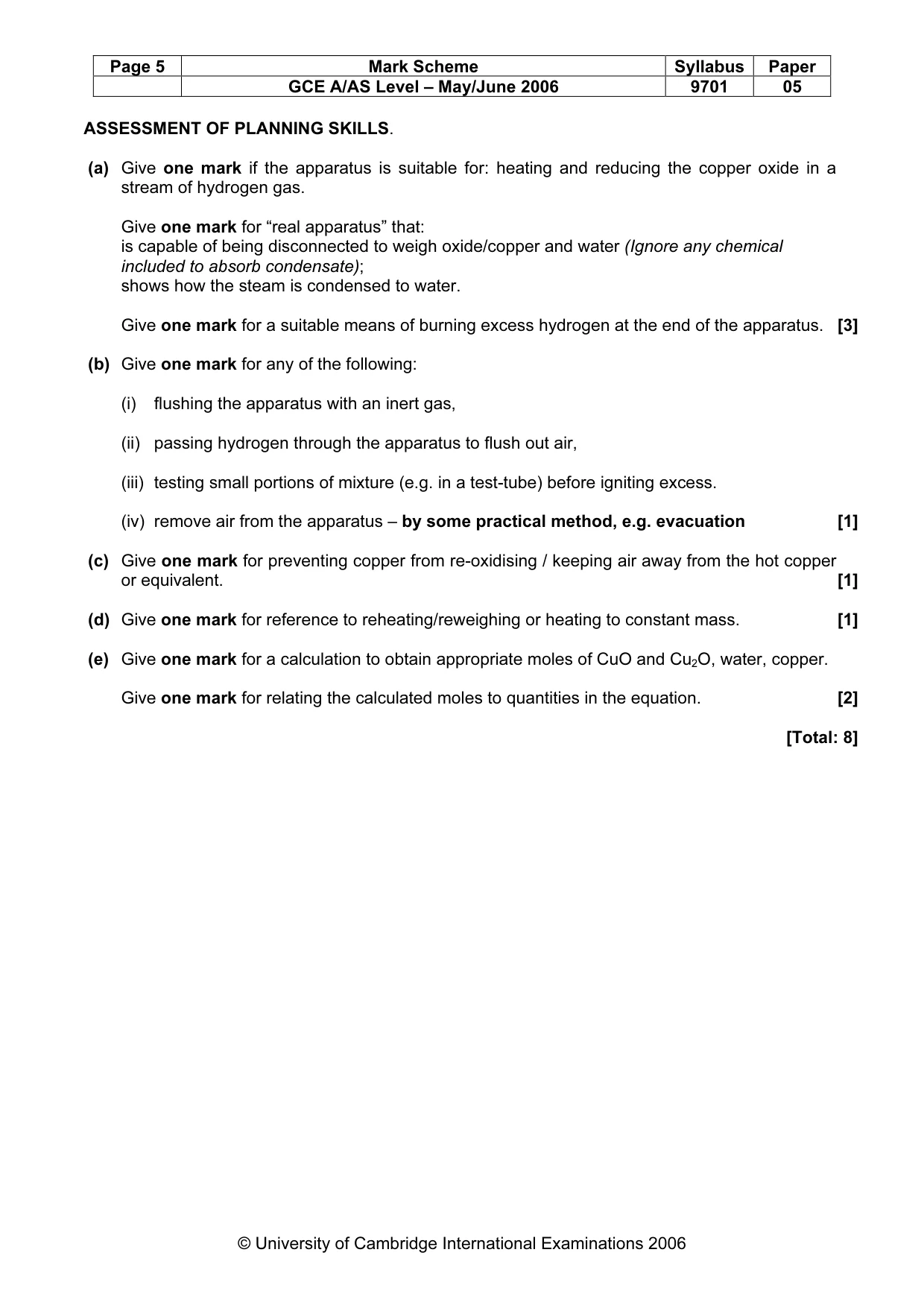
Page 5 Mark Scheme Syllabus Paper GCE A/AS Level – May/June 2006 9701 05 © University of Cambridge International Examinations 2006 ASSESSMENT OF PLANNING SKILLS. (a) Give one mark if the apparatus is suitable for: heating and reducing the copper oxide in a stream of hydrogen gas. Give one mark for “real apparatus” that: is capable of being disconnected to weigh oxide/copper and water (Ignore any chemical included to absorb condensate); shows how the steam is condensed to water. Give one mark for a suitable means of burning excess hydrogen at the end of the apparatus. [3] (b) Give one mark for any of the following: (i) flushing the apparatus with an inert gas, (ii) passing hydrogen through the apparatus to flush out air, (iii) testing small portions of mixture (e.g. in a test-tube) before igniting excess. (iv) remove air from the apparatus – by some practical method, e.g. evacuation [1] (c) Give one mark for preventing copper from re-oxidising / keeping air away from the hot copper or equivalent. [1] (d) Give one mark for reference to reheating/reweighing or heating to constant mass. [1] (e) Give one mark for a calculation to obtain appropriate moles of CuO and Cu2O, water, copper. Give one mark for relating the calculated moles to quantities in the equation. [2] [Total: 8]
What you needed in this session
Cambridge’s own grade thresholds for 2006 May/June, Paper 5 · Variant 1. A higher threshold means an easier paper — the bar moves with how the cohort did.