Cambridge A Level Chemistry 9701 — 2005 Oct/Nov Paper 5 · Variant 1
9701/51/O/N/05
The question paper and its mark scheme, free to read here and free to download. This is Cambridge’s own paper, exactly as it was sat.
Question paper8 pages
Mark scheme4 pages
Answers below. Sit the paper first if you are practising.
Paper as text
Question paper, page 1
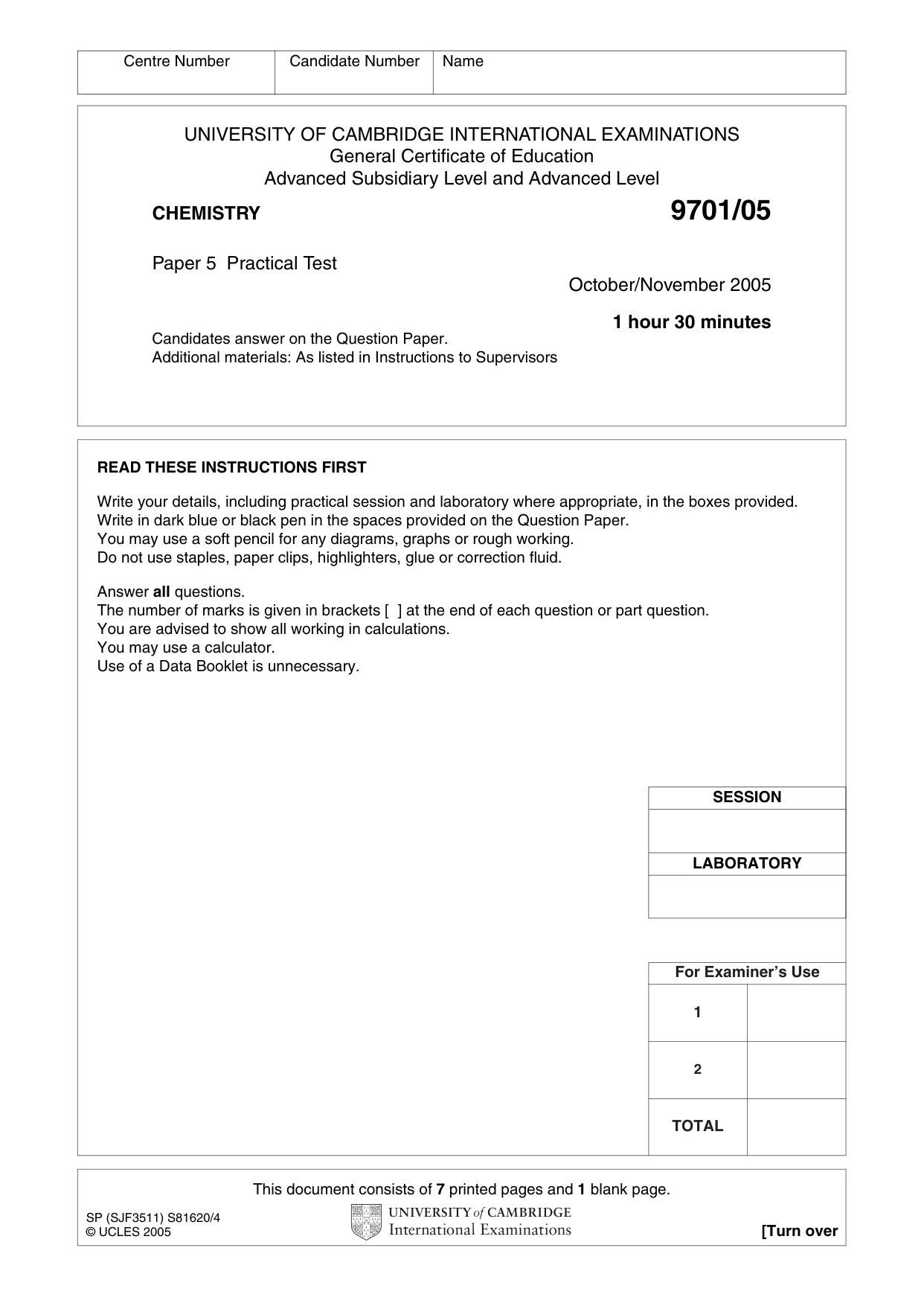
For Examiner’s Use 1 2 TOTAL This document consists of 7 printed pages and 1 blank page. SP (SJF3511) S81620/4 © UCLES 2005 [Turn over UNIVERSITY OF CAMBRIDGE INTERNATIONAL EXAMINATIONS General Certificate of Education Advanced Subsidiary Level and Advanced Level CHEMISTRY 9701/05 Paper 5 Practical Test October/November 2005 1 hour 30 minutes Candidates answer on the Question Paper. Additional materials: As listed in Instructions to Supervisors READ THESE INSTRUCTIONS FIRST Write your details, including practical session and laboratory where appropriate, in the boxes provided. Write in dark blue or black pen in the spaces provided on the Question Paper. You may use a soft pencil for any diagrams, graphs or rough working. Do not use staples, paper clips, highlighters, glue or correction fluid. Answer all questions. The number of marks is given in brackets [ ] at the end of each question or part question. You are advised to show all working in calculations. You may use a calculator. Use of a Data Booklet is unnecessary. Centre Number Candidate Number Name SESSION LABORATORY
Question paper, page 2
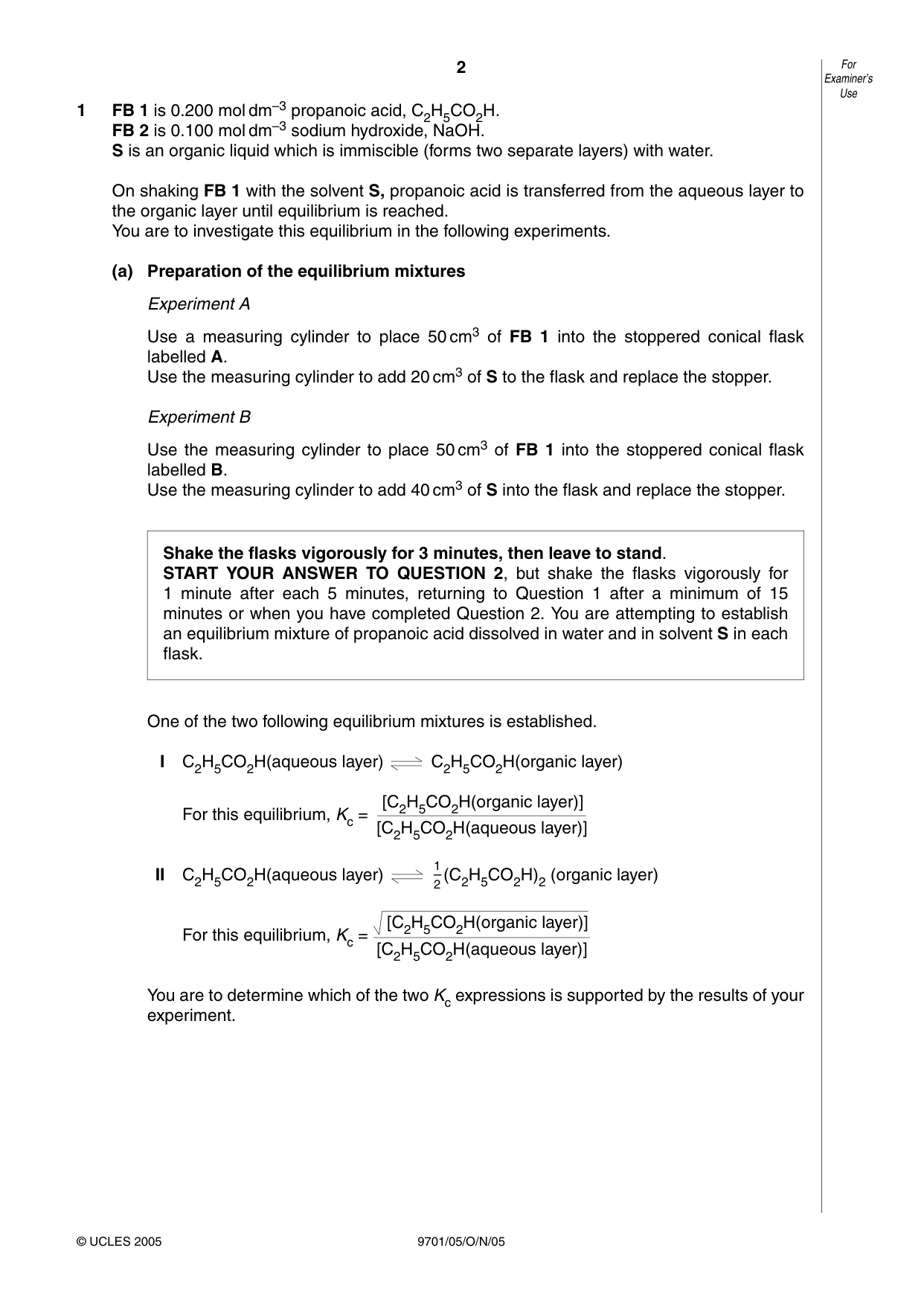
2 9701/05/O/N/05 1 FB 1 is 0.200 mol dm–3 propanoic acid, C2H5CO2H. FB 2 is 0.100 mol dm–3 sodium hydroxide, NaOH. S is an organic liquid which is immiscible (forms two separate layers) with water. On shaking FB 1 with the solvent S, propanoic acid is transferred from the aqueous layer to the organic layer until equilibrium is reached. You are to investigate this equilibrium in the following experiments. (a) Preparation of the equilibrium mixtures Experiment A Use a measuring cylinder to place 50 cm3 of FB 1 into the stoppered conical flask labelled A. Use the measuring cylinder to add 20 cm3 of S to the flask and replace the stopper. Experiment B Use the measuring cylinder to place 50 cm3 of FB 1 into the stoppered conical flask labelled B. Use the measuring cylinder to add 40 cm3 of S into the flask and replace the stopper. One of the two following equilibrium mixtures is established. I C2H5CO2H(aqueous layer) C2H5CO2H(organic layer) For this equilibrium, Kc = [C2H5CO2H(organic layer)] [C2H5CO2H(aqueous layer)] II C2H5CO2H(aqueous layer) (C2H5CO2H)2 (organic layer) For this equilibrium, Kc = [C2H5CO2H(organic layer)] [C2H5CO2H(aqueous layer)] You are to determine which of the two Kc expressions is supported by the results of your experiment. For Examiner’s Use © UCLES 2005 Shake the flasks vigorously for 3 minutes, then leave to stand. START YOUR ANSWER TO QUESTION 2, but shake the flasks vigorously for 1 minute after each 5 minutes, returning to Question 1 after a minimum of 15 minutes or when you have completed Question 2. You are attempting to establish an equilibrium mixture of propanoic acid dissolved in water and in solvent S in each flask. 1–2
Question paper, page 3
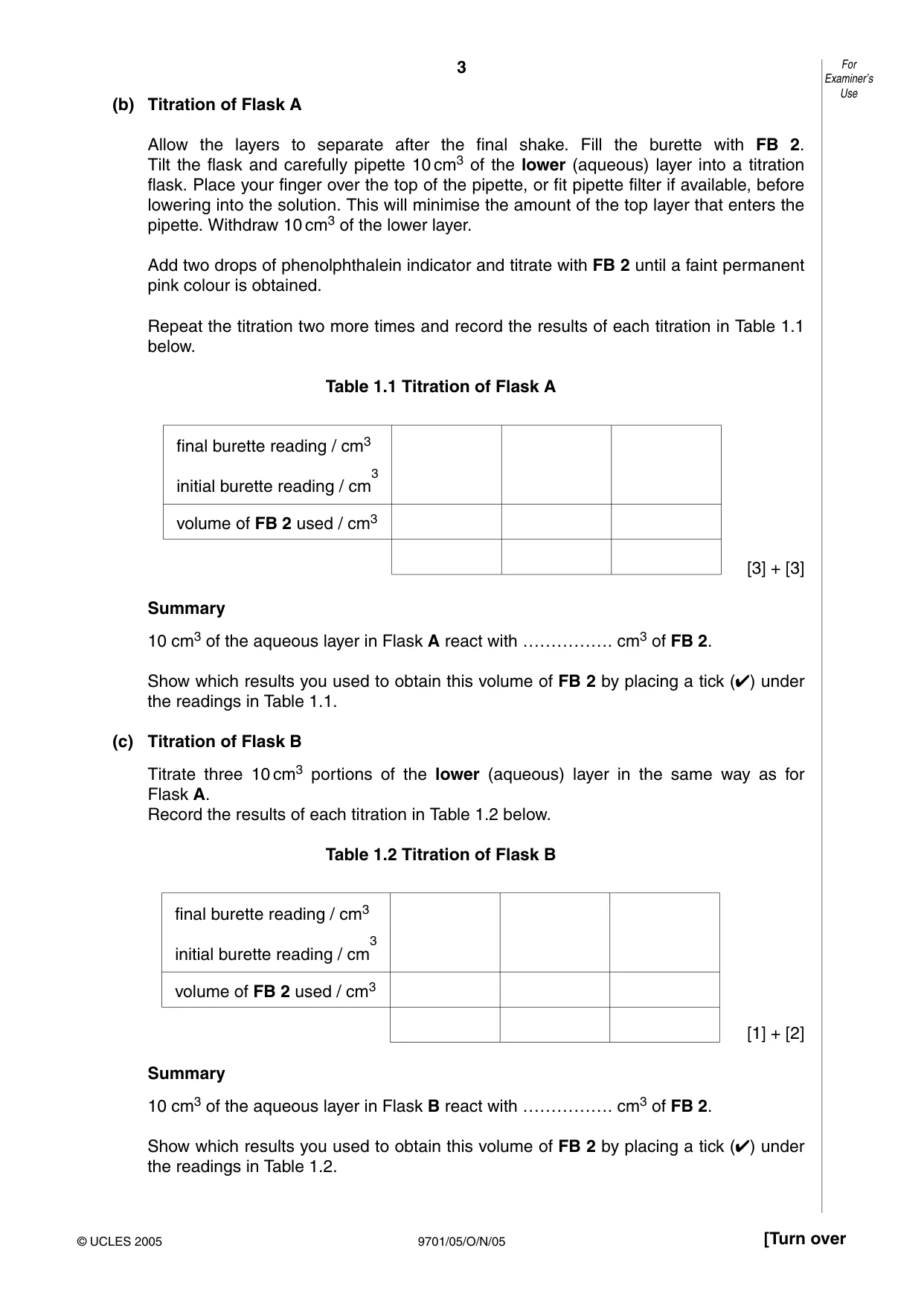
3 9701/05/O/N/05 [Turn over (b) Titration of Flask A Allow the layers to separate after the final shake. Fill the burette with FB 2. Tilt the flask and carefully pipette 10 cm3 of the lower (aqueous) layer into a titration flask. Place your finger over the top of the pipette, or fit pipette filter if available, before lowering into the solution. This will minimise the amount of the top layer that enters the pipette. Withdraw 10 cm3 of the lower layer. Add two drops of phenolphthalein indicator and titrate with FB 2 until a faint permanent pink colour is obtained. Repeat the titration two more times and record the results of each titration in Table 1.1 below. Table 1.1 Titration of Flask A [3] + [3] Summary 10 cm3 of the aqueous layer in Flask A react with ……………. cm3 of FB 2. Show which results you used to obtain this volume of FB 2 by placing a tick (✔) under the readings in Table 1.1. (c) Titration of Flask B Titrate three 10 cm3 portions of the lower (aqueous) layer in the same way as for Flask A. Record the results of each titration in Table 1.2 below. Table 1.2 Titration of Flask B [1] + [2] Summary 10 cm3 of the aqueous layer in Flask B react with ……………. cm3 of FB 2. Show which results you used to obtain this volume of FB 2 by placing a tick (✔) under the readings in Table 1.2. For Examiner’s Use © UCLES 2005 final burette reading / cm3 initial burette reading / cm 3 volume of FB 2 used / cm3 final burette reading / cm3 initial burette reading / cm 3 volume of FB 2 used / cm3
Question paper, page 4
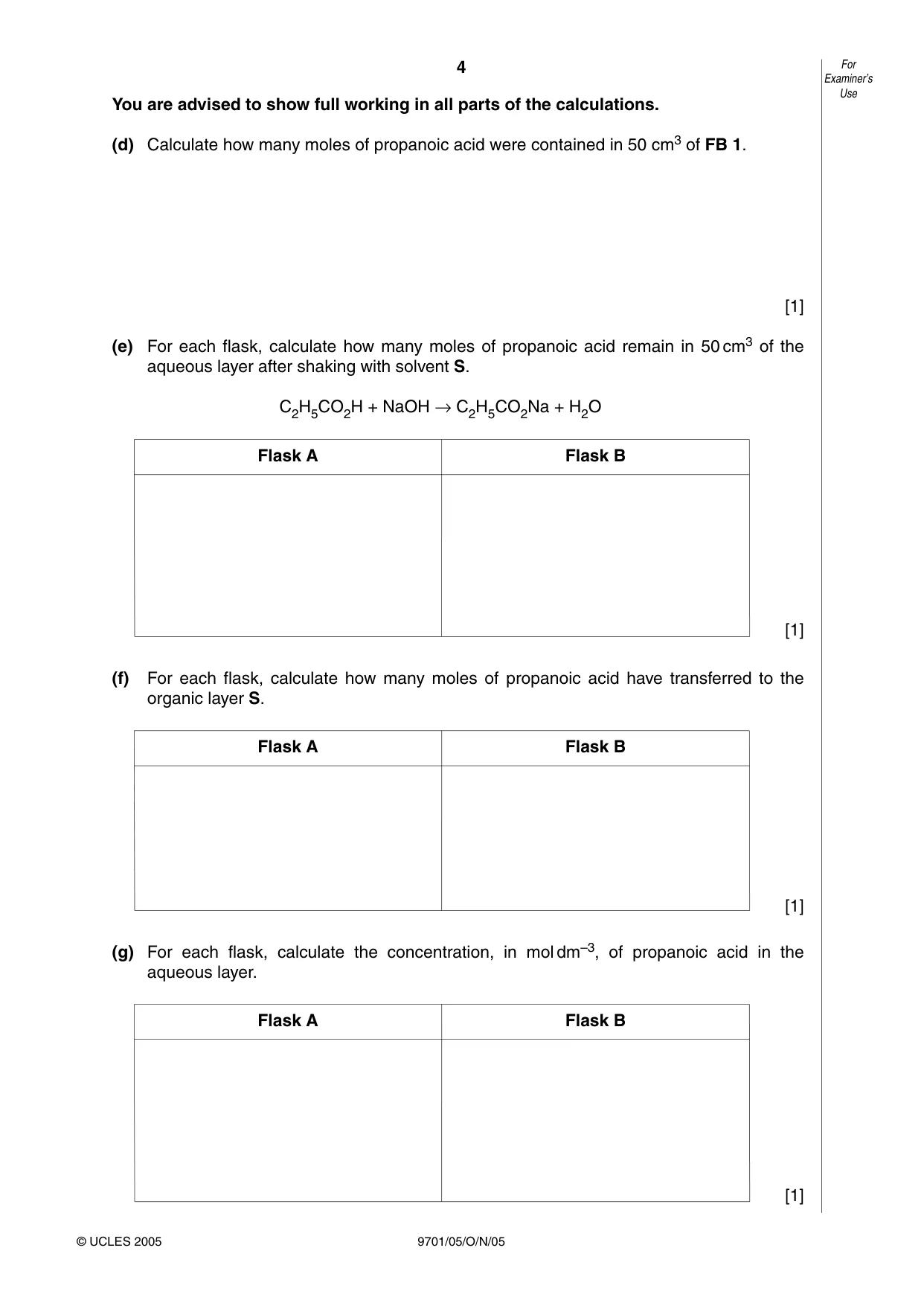
4 9701/05/O/N/05 You are advised to show full working in all parts of the calculations. (d) Calculate how many moles of propanoic acid were contained in 50 cm3 of FB 1. [1] (e) For each flask, calculate how many moles of propanoic acid remain in 50 cm3 of the aqueous layer after shaking with solvent S. C2H5CO2H + NaOH →C2H5CO2Na + H2O [1] (f) For each flask, calculate how many moles of propanoic acid have transferred to the organic layer S. [1] (g) For each flask, calculate the concentration, in mol dm–3, of propanoic acid in the aqueous layer. [1] For Examiner’s Use © UCLES 2005 Flask A Flask B Flask A Flask B Flask A Flask B
Question paper, page 5
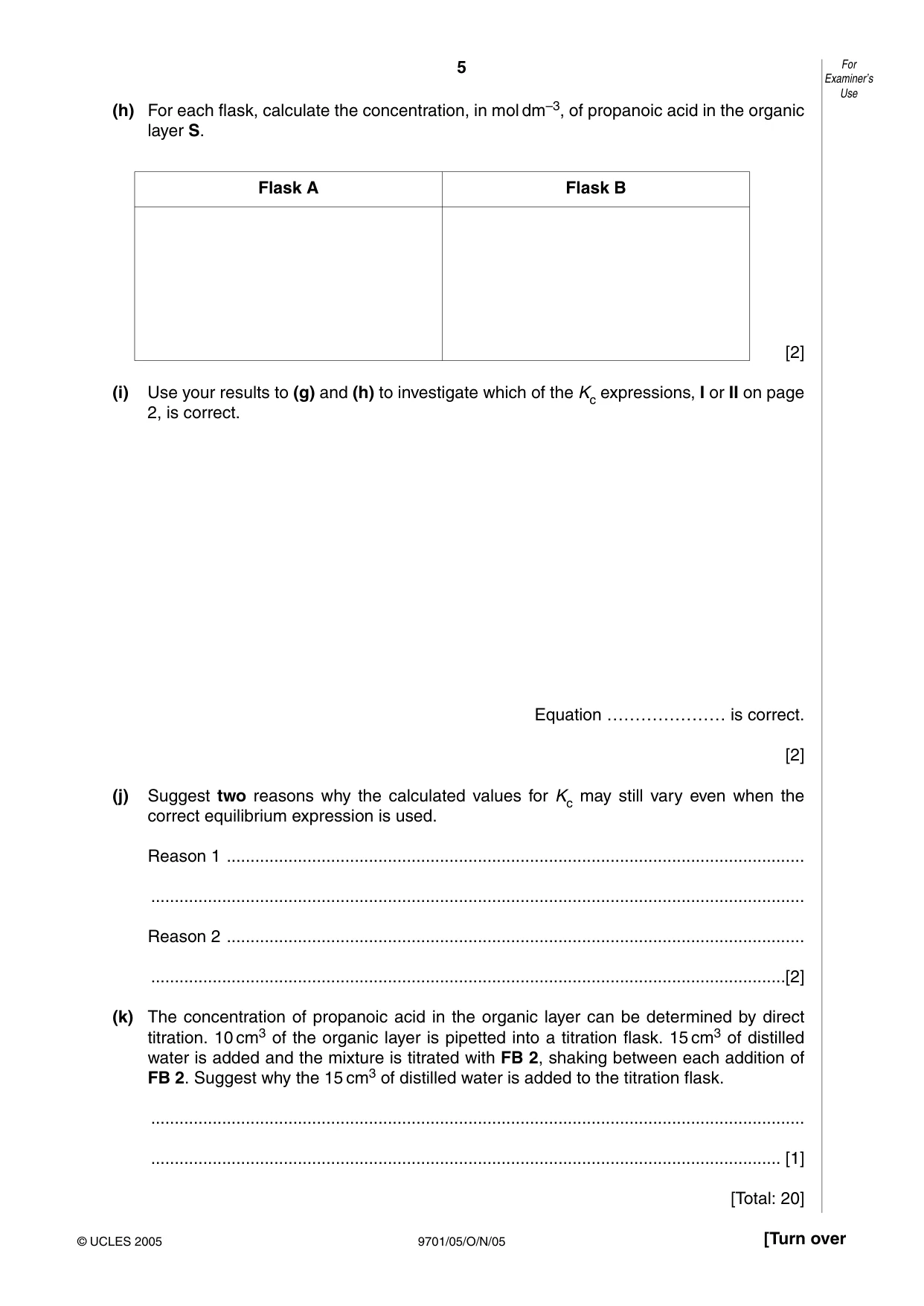
5 9701/05/O/N/05 [Turn over (h) For each flask, calculate the concentration, in mol dm–3, of propanoic acid in the organic layer S. [2] (i) Use your results to (g) and (h) to investigate which of the Kc expressions, I or II on page 2, is correct. Equation ………………… is correct. [2] (j) Suggest two reasons why the calculated values for Kc may still vary even when the correct equilibrium expression is used. Reason 1 … … Reason 2 … …[2] (k) The concentration of propanoic acid in the organic layer can be determined by direct titration. 10 cm3 of the organic layer is pipetted into a titration flask. 15 cm3 of distilled water is added and the mixture is titrated with FB 2, shaking between each addition of FB 2. Suggest why the 15 cm3 of distilled water is added to the titration flask. … … [1] [Total: 20] For Examiner’s Use © UCLES 2005 Flask A Flask B
Question paper, page 6
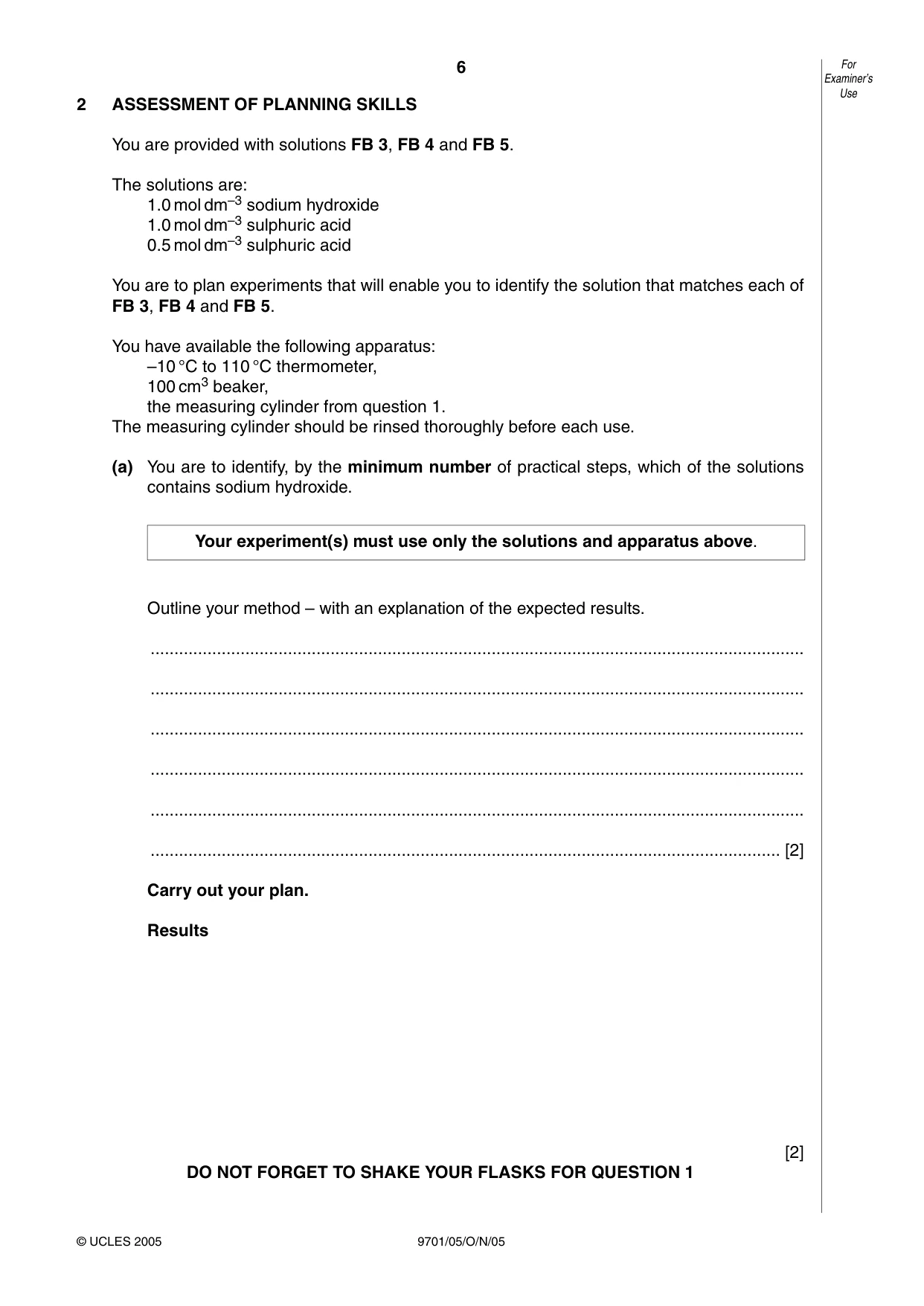
6 9701/05/O/N/05 2 ASSESSMENT OF PLANNING SKILLS You are provided with solutions FB 3, FB 4 and FB 5. The solutions are: 1.0 mol dm–3 sodium hydroxide 1.0 mol dm–3 sulphuric acid 0.5 mol dm–3 sulphuric acid You are to plan experiments that will enable you to identify the solution that matches each of FB 3, FB 4 and FB 5. You have available the following apparatus: –10 °C to 110 °C thermometer, 100 cm3 beaker, the measuring cylinder from question 1. The measuring cylinder should be rinsed thoroughly before each use. (a) You are to identify, by the minimum number of practical steps, which of the solutions contains sodium hydroxide. Outline your method – with an explanation of the expected results. … … … … … … [2] Carry out your plan. Results [2] DO NOT FORGET TO SHAKE YOUR FLASKS FOR QUESTION 1 For Examiner’s Use © UCLES 2005 Your experiment(s) must use only the solutions and apparatus above.
Question paper, page 7
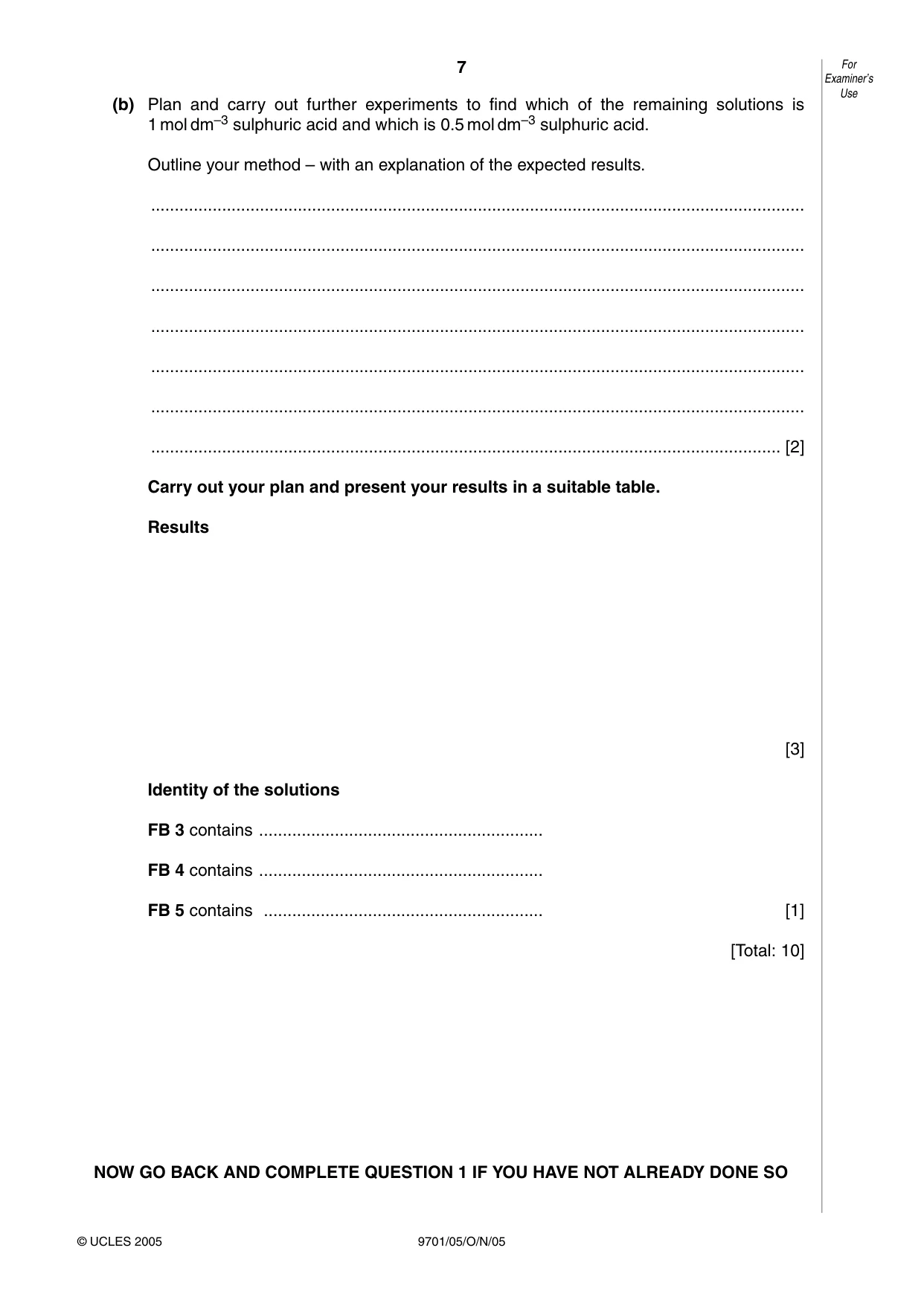
7 9701/05/O/N/05 (b) Plan and carry out further experiments to find which of the remaining solutions is 1 mol dm–3 sulphuric acid and which is 0.5 mol dm–3 sulphuric acid. Outline your method – with an explanation of the expected results. … … … … … … … [2] Carry out your plan and present your results in a suitable table. Results [3] Identity of the solutions FB 3 contains … FB 4 contains … FB 5 contains … [1] [Total: 10] NOW GO BACK AND COMPLETE QUESTION 1 IF YOU HAVE NOT ALREADY DONE SO For Examiner’s Use © UCLES 2005
Question paper, page 8
8 9701/05/O/N/05 BLANK PAGE Permission to reproduce items where third-party owned material protected by copyright is included has been sought and cleared where possible. Every reasonable effort has been made by the publisher (UCLES) to trace copyright holders, but if any items requiring clearance have unwittingly been included, the publisher will be pleased to make amends at the earliest possible opportunity. University of Cambridge International Examinations is part of the University of Cambridge Local Examinations Syndicate (UCLES), which is itself a department of the University of Cambridge.
Mark scheme, page 1
UNIVERSITY OF CAMBRIDGE INTERNATIONAL EXAMINATIONS GCE Advanced Level MARK SCHEME for the November 2005 question paper 9701 CHEMISTRY 9701/05 Paper 5 (Practical Test), maximum raw mark 30 This mark scheme is published as an aid to teachers and students, to indicate the requirements of the examination. It shows the basis on which Examiners were initially instructed to award marks. It does not indicate the details of the discussions that took place at an Examiners’ meeting before marking began. Any substantial changes to the mark scheme that arose from these discussions will be recorded in the published Report on the Examination. All Examiners are instructed that alternative correct answers and unexpected approaches in candidates’ scripts must be given marks that fairly reflect the relevant knowledge and skills demonstrated. Mark schemes must be read in conjunction with the question papers and the Report on the Examination. • CIE will not enter into discussion or correspondence in connection with these mark schemes. CIE is publishing the mark schemes for the November 2005 question papers for most IGCSE and GCE Advanced Level and Advanced Subsidiary Level syllabuses and some Ordinary Level syllabuses.
Mark scheme, page 2
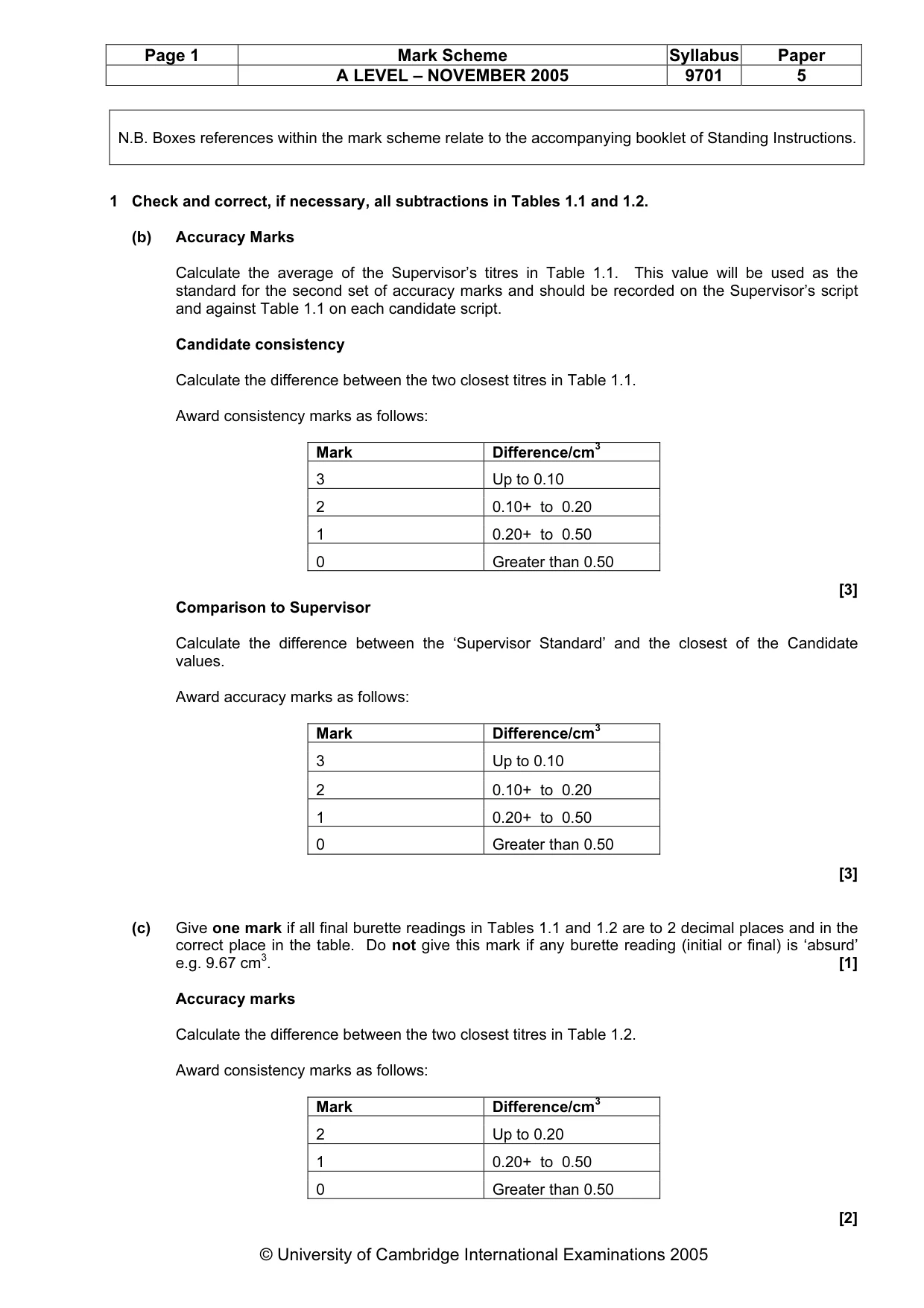
Page 1 Mark Scheme Syllabus Paper A LEVEL – NOVEMBER 2005 9701 5 © University of Cambridge International Examinations 2005 N.B. Boxes references within the mark scheme relate to the accompanying booklet of Standing Instructions. 1 Check and correct, if necessary, all subtractions in Tables 1.1 and 1.2. (b) Accuracy Marks Calculate the average of the Supervisor’s titres in Table 1.1. This value will be used as the standard for the second set of accuracy marks and should be recorded on the Supervisor’s script and against Table 1.1 on each candidate script. Candidate consistency Calculate the difference between the two closest titres in Table 1.1. Award consistency marks as follows: Mark Difference/cm3 3 Up to 0.10 2 0.10+ to 0.20 1 0.20+ to 0.50 0 Greater than 0.50 [3] Comparison to Supervisor Calculate the difference between the ‘Supervisor Standard’ and the closest of the Candidate values. Award accuracy marks as follows: Mark Difference/cm3 3 Up to 0.10 2 0.10+ to 0.20 1 0.20+ to 0.50 0 Greater than 0.50 [3] (c) Give one mark if all final burette readings in Tables 1.1 and 1.2 are to 2 decimal places and in the correct place in the table. Do not give this mark if any burette reading (initial or final) is ‘absurd’ e.g. 9.67 cm3. [1] Accuracy marks Calculate the difference between the two closest titres in Table 1.2. Award consistency marks as follows: Mark Difference/cm3 2 Up to 0.20 1 0.20+ to 0.50 0 Greater than 0.50 [2]
Mark scheme, page 3
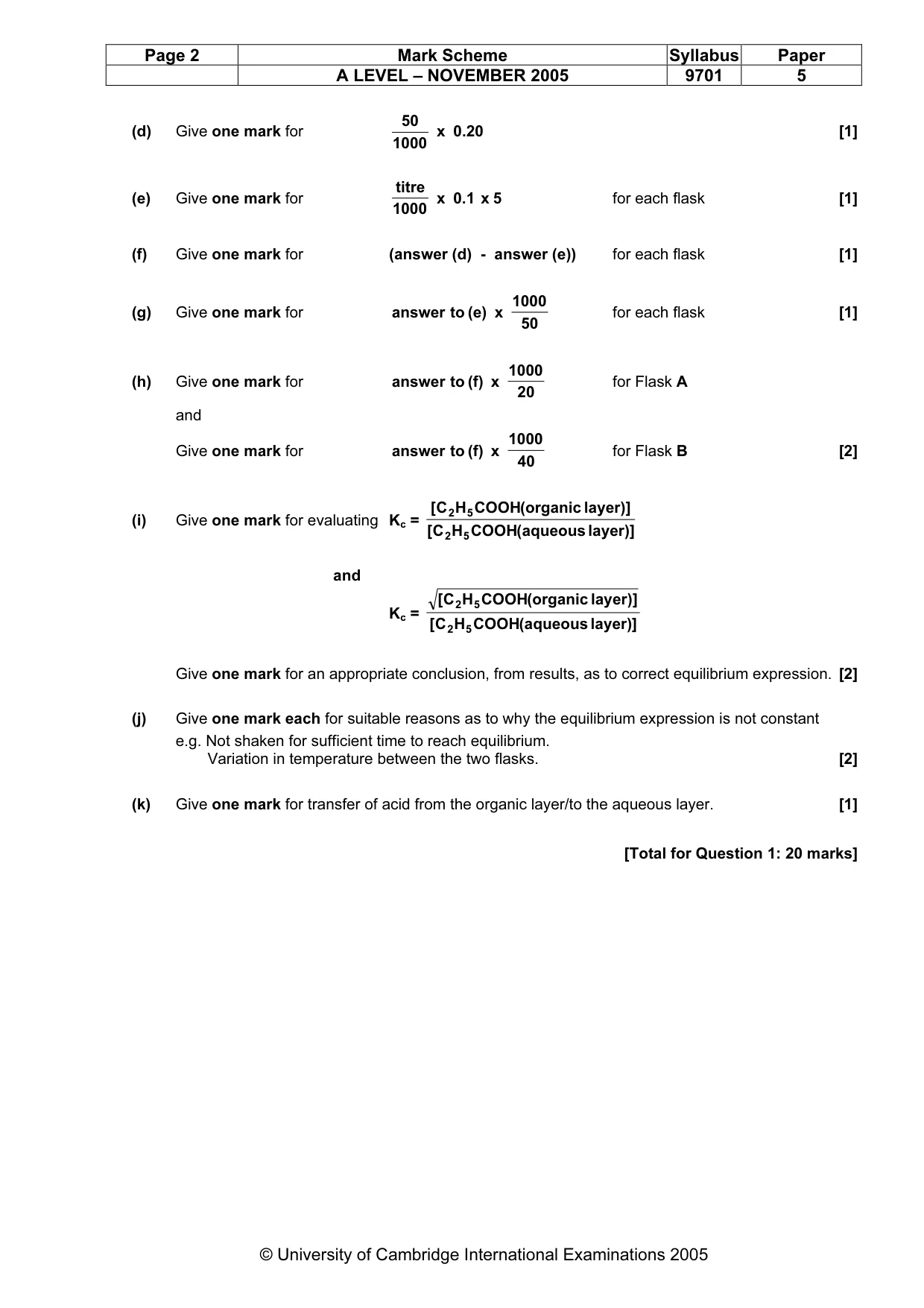
Page 2 Mark Scheme Syllabus Paper A LEVEL – NOVEMBER 2005 9701 5 © University of Cambridge International Examinations 2005 (d) Give one mark for 0.20 x 1000 50 [1] (e) Give one mark for 5 x 0.1 x 1000 titre for each flask [1] (f) Give one mark for (answer (d) - answer (e)) for each flask [1] (g) Give one mark for 50 1000 x (e) to answer for each flask [1] (h) Give one mark for 20 1000 x (f) to answer for Flask A and Give one mark for 40 1000 x (f) to answer for Flask B [2] (i) Give one mark for evaluating Kc = layer)] aqueous ( COOH H C [ ] layer) organic ( COOH H C [ 5 2 5 2 and Kc = layer)] aqueous ( COOH H C [ ] layer) organic ( COOH H C [ 5 2 5 2 Give one mark for an appropriate conclusion, from results, as to correct equilibrium expression. [2] (j) Give one mark each for suitable reasons as to why the equilibrium expression is not constant e.g. Not shaken for sufficient time to reach equilibrium. Variation in temperature between the two flasks. [2] (k) Give one mark for transfer of acid from the organic layer/to the aqueous layer. [1] [Total for Question 1: 20 marks]
Mark scheme, page 4
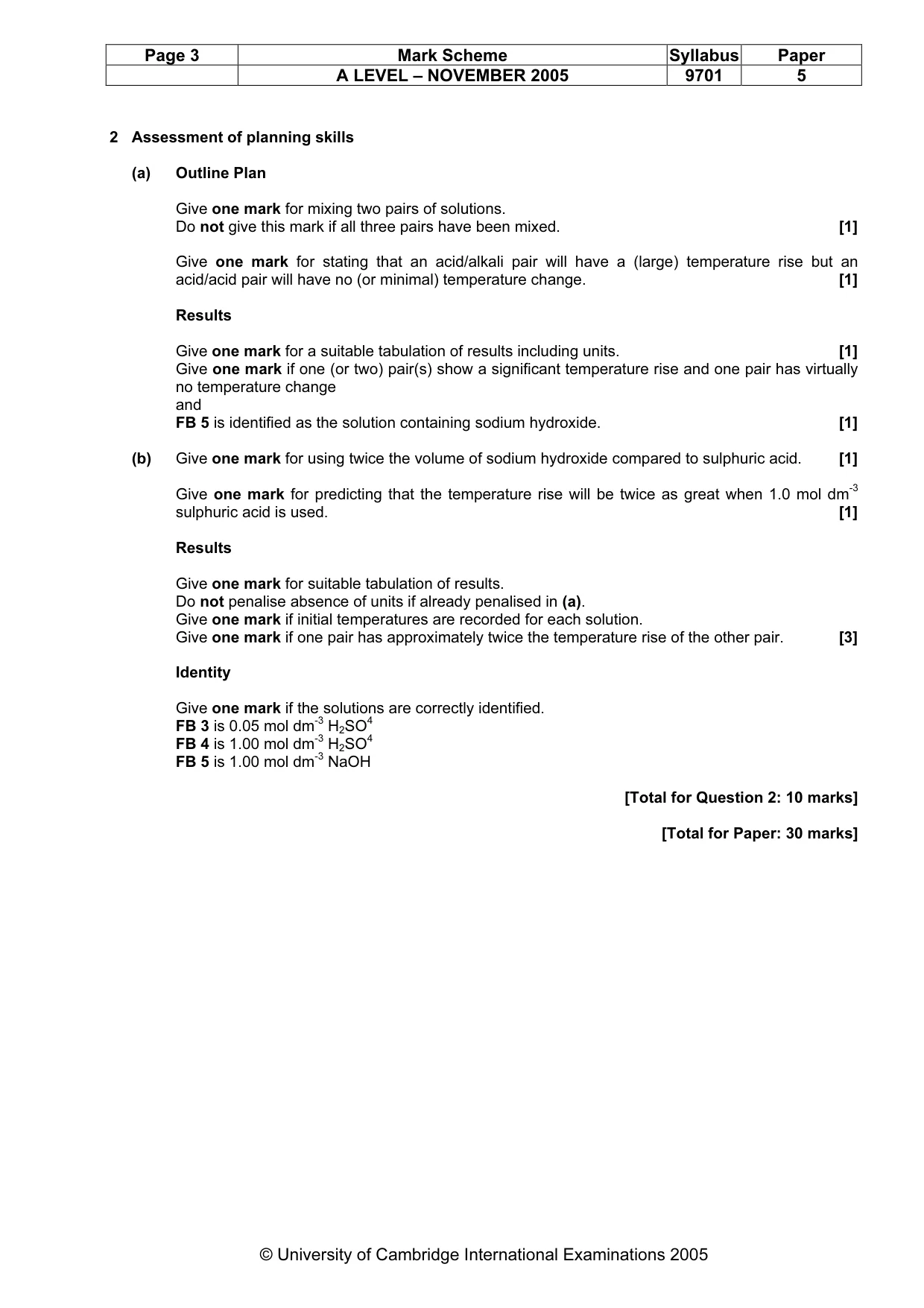
Page 3 Mark Scheme Syllabus Paper A LEVEL – NOVEMBER 2005 9701 5 © University of Cambridge International Examinations 2005 2 Assessment of planning skills (a) Outline Plan Give one mark for mixing two pairs of solutions. Do not give this mark if all three pairs have been mixed. [1] Give one mark for stating that an acid/alkali pair will have a (large) temperature rise but an acid/acid pair will have no (or minimal) temperature change. [1] Results Give one mark for a suitable tabulation of results including units. [1] Give one mark if one (or two) pair(s) show a significant temperature rise and one pair has virtually no temperature change and FB 5 is identified as the solution containing sodium hydroxide. [1] (b) Give one mark for using twice the volume of sodium hydroxide compared to sulphuric acid. [1] Give one mark for predicting that the temperature rise will be twice as great when 1.0 mol dm-3 sulphuric acid is used. [1] Results Give one mark for suitable tabulation of results. Do not penalise absence of units if already penalised in (a). Give one mark if initial temperatures are recorded for each solution. Give one mark if one pair has approximately twice the temperature rise of the other pair. [3] Identity Give one mark if the solutions are correctly identified. FB 3 is 0.05 mol dm-3 H2SO4 FB 4 is 1.00 mol dm-3 H2SO4 FB 5 is 1.00 mol dm-3 NaOH [Total for Question 2: 10 marks] [Total for Paper: 30 marks]