Cambridge A Level Chemistry 9701 — 2002 Oct/Nov Paper 5 · Variant 1
9701/51/O/N/02
The question paper and its mark scheme, free to read here and free to download. This is Cambridge’s own paper, exactly as it was sat.
Question paper8 pages



Mark scheme6 pages
Answers below. Sit the paper first if you are practising.
Paper as text
Question paper, page 1
This question paper consists of 5 printed pages and 3 blank pages. SP (SM) S24529/2 © CIE 2002 [Turn over CAMBRIDGE INTERNATIONAL EXAMINATIONS General Certificate of Education Advanced Level CHEMISTRY 9701/5 PAPER 5 Practical Test OCTOBER/NOVEMBER SESSION 2002 1 hour 30 minutes Candidates answer on the question paper. Additional materials: As listed in Instructions to Supervisors TIME 1 hour 30 minutes INSTRUCTIONS TO CANDIDATES Write your name, Centre number and candidate number in the spaces at the top of this page. Answer all questions. Write your answers in the spaces provided on the question paper. INFORMATION FOR CANDIDATES The number of marks is given in brackets [ ] at the end of each question or part question. You are advised to show all working in calculations. Use of a Data Booklet is unnecessary. FOR EXAMINER’S USE 1 2 TOTAL Candidate Centre Number Number Candidate Name
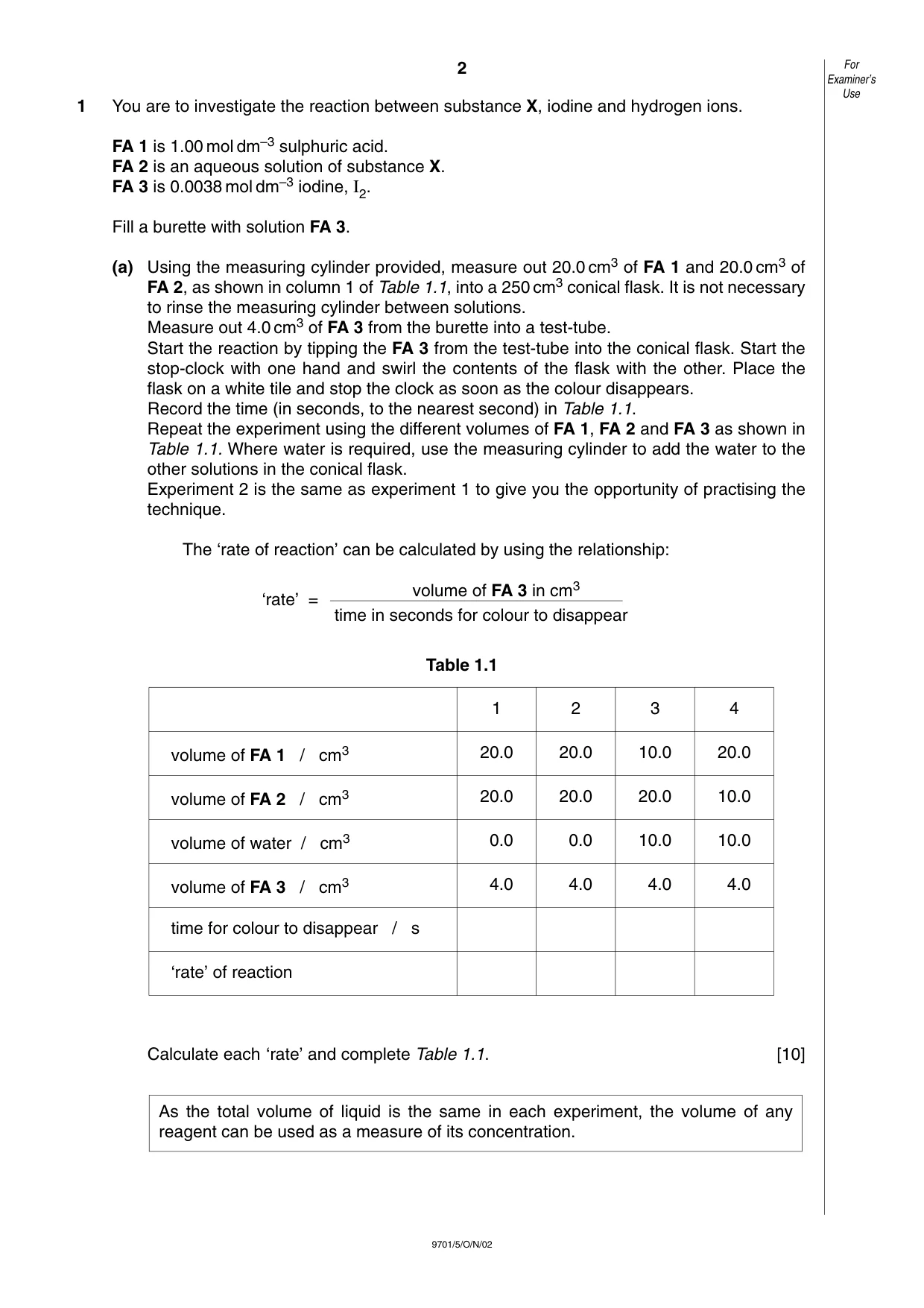
Question paper, page 2
2 9701/5/O/N/02 1 You are to investigate the reaction between substance X, iodine and hydrogen ions. FA 1 is 1.00 mol dm–3 sulphuric acid. FA 2 is an aqueous solution of substance X. FA 3 is 0.0038 mol dm–3 iodine, I2. Fill a burette with solution FA 3. (a) Using the measuring cylinder provided, measure out 20.0 cm3 of FA 1 and 20.0 cm3 of FA 2, as shown in column 1 of Table 1.1, into a 250 cm3 conical flask. It is not necessary to rinse the measuring cylinder between solutions. Measure out 4.0 cm3 of FA 3 from the burette into a test-tube. Start the reaction by tipping the FA 3 from the test-tube into the conical flask. Start the stop-clock with one hand and swirl the contents of the flask with the other. Place the flask on a white tile and stop the clock as soon as the colour disappears. Record the time (in seconds, to the nearest second) in Table 1.1. Repeat the experiment using the different volumes of FA 1, FA 2 and FA 3 as shown in Table 1.1. Where water is required, use the measuring cylinder to add the water to the other solutions in the conical flask. Experiment 2 is the same as experiment 1 to give you the opportunity of practising the technique. The ‘rate of reaction’ can be calculated by using the relationship: volume of FA 3 in cm3 ‘rate’ = time in seconds for colour to disappear Table 1.1 Calculate each ‘rate’ and complete Table 1.1. [10] As the total volume of liquid is the same in each experiment, the volume of any reagent can be used as a measure of its concentration. For Examiner’s Use volume of FA 1 / cm3 volume of FA 2 / cm3 volume of water / cm3 volume of FA 3 / cm3 time for colour to disappear / s ‘rate’ of reaction 1 20.0 20.0 0.0 4.0 2 20.0 20.0 0.0 4.0 3 10.0 20.0 10.0 4.0 4 20.0 10.0 10.0 4.0
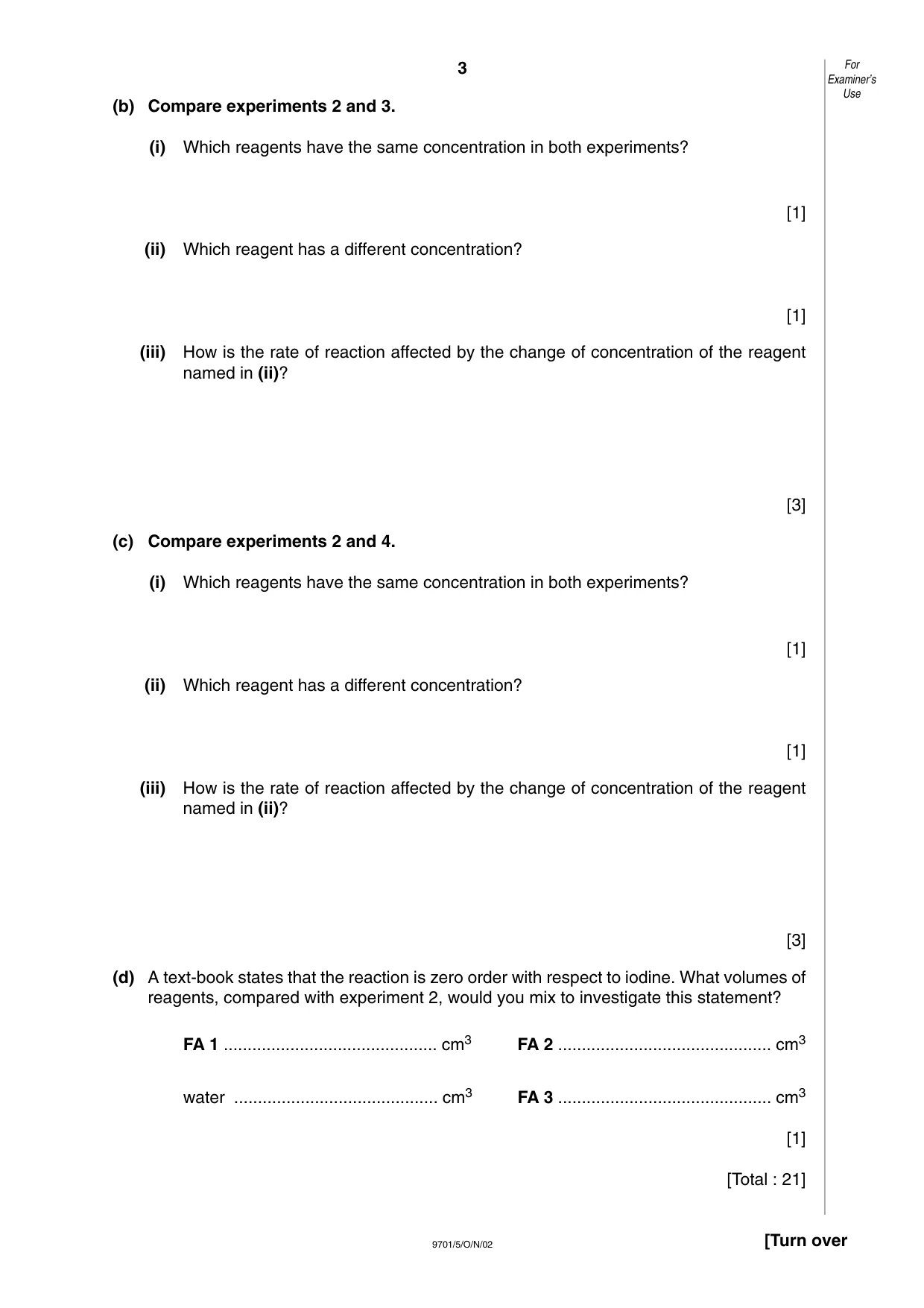
Question paper, page 3
3 9701/5/O/N/02 [Turn over (b) Compare experiments 2 and 3. (i) Which reagents have the same concentration in both experiments? [1] (ii) Which reagent has a different concentration? [1] (iii) How is the rate of reaction affected by the change of concentration of the reagent named in (ii)? [3] (c) Compare experiments 2 and 4. (i) Which reagents have the same concentration in both experiments? [1] (ii) Which reagent has a different concentration? [1] (iii) How is the rate of reaction affected by the change of concentration of the reagent named in (ii)? [3] (d) A text-book states that the reaction is zero order with respect to iodine. What volumes of reagents, compared with experiment 2, would you mix to investigate this statement? FA 1 … cm3 FA 2 … cm3 water … cm3 FA 3 … cm3 [1] [Total : 21] For Examiner’s Use
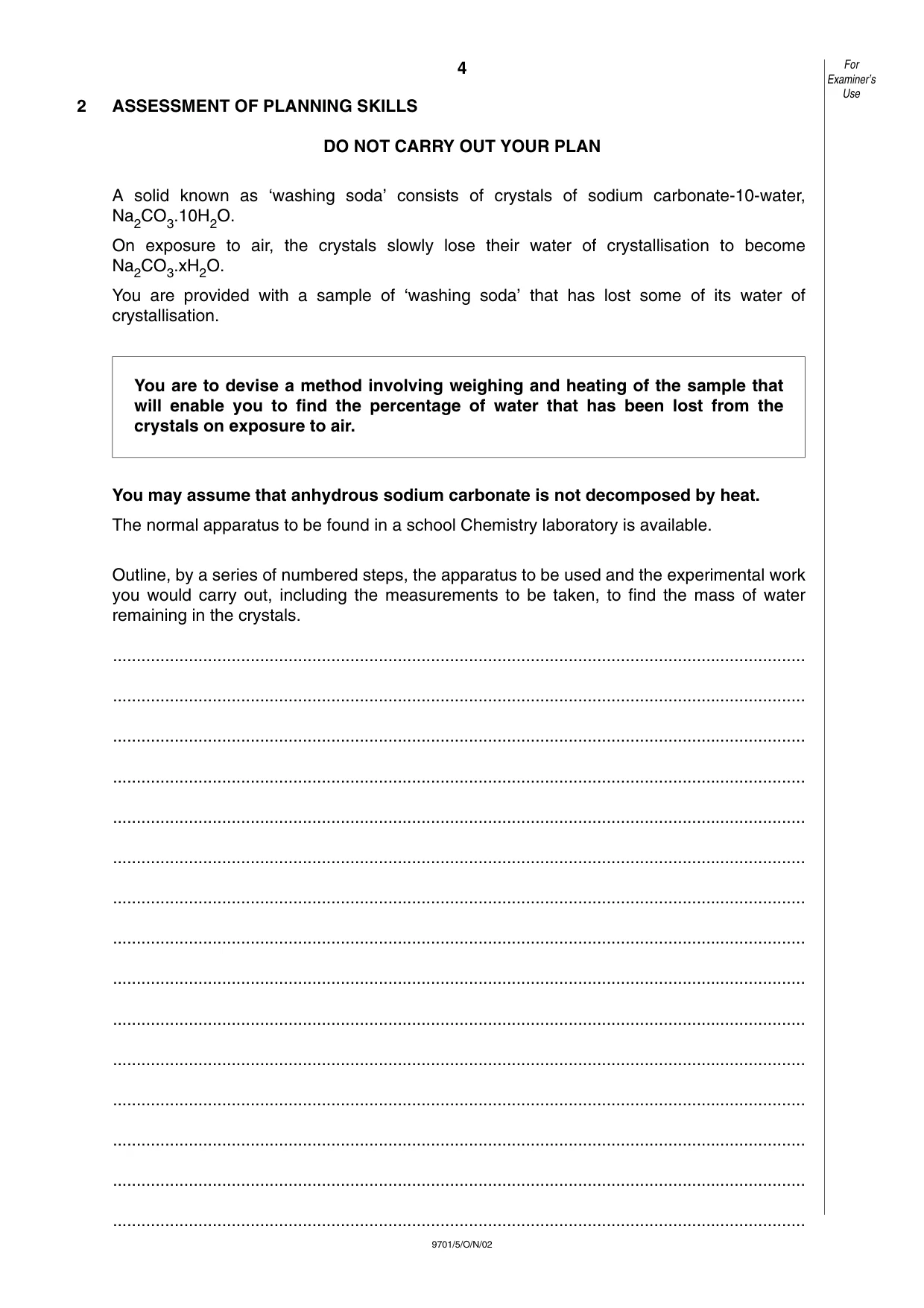
Question paper, page 4
4 9701/5/O/N/02 2 ASSESSMENT OF PLANNING SKILLS DO NOT CARRY OUT YOUR PLAN A solid known as ‘washing soda’ consists of crystals of sodium carbonate-10-water, Na2CO3.10H2O. On exposure to air, the crystals slowly lose their water of crystallisation to become Na2CO3.xH2O. You are provided with a sample of ‘washing soda’ that has lost some of its water of crystallisation. You are to devise a method involving weighing and heating of the sample that will enable you to find the percentage of water that has been lost from the crystals on exposure to air. You may assume that anhydrous sodium carbonate is not decomposed by heat. The normal apparatus to be found in a school Chemistry laboratory is available. Outline, by a series of numbered steps, the apparatus to be used and the experimental work you would carry out, including the measurements to be taken, to find the mass of water remaining in the crystals. … … … … … … … … … … … … … … … For Examiner’s Use
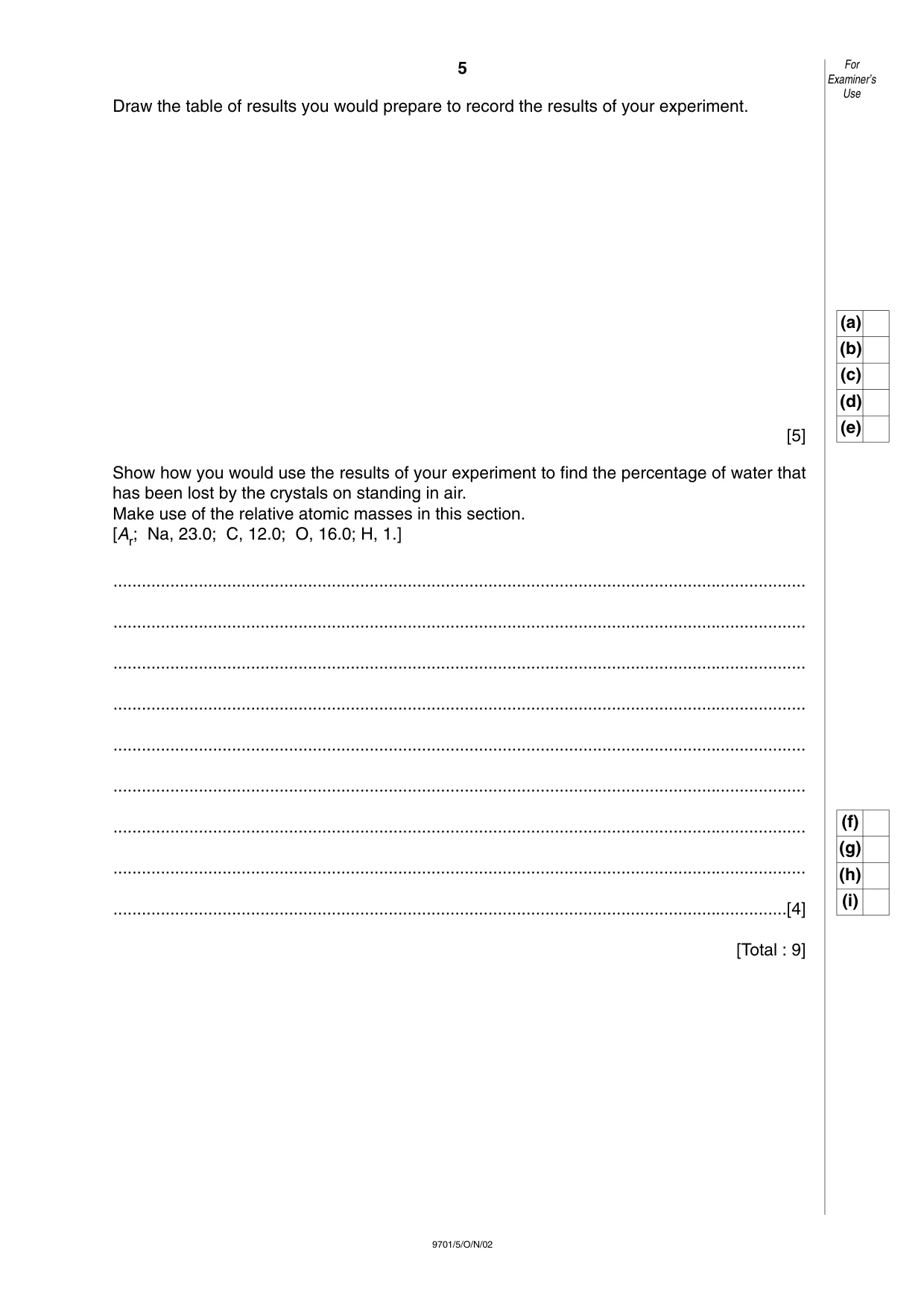
Question paper, page 5
5 9701/5/O/N/02 Draw the table of results you would prepare to record the results of your experiment. [5] Show how you would use the results of your experiment to find the percentage of water that has been lost by the crystals on standing in air. Make use of the relative atomic masses in this section. [Ar; Na, 23.0; C, 12.0; O, 16.0; H, 1.] … … … … … … … … …[4] [Total : 9] For Examiner’s Use (a) (b) (c) (d) (e) (f) (g) (h) (i)
Mark scheme, page 1
CAMBRIDGE INTERNATIONAL EXAMINATIONS NOVEMBER 2002 GCE Advanced Level UNIVERSITY of CAMBRIDGE Local Examinations Syndicate
Mark scheme, page 2
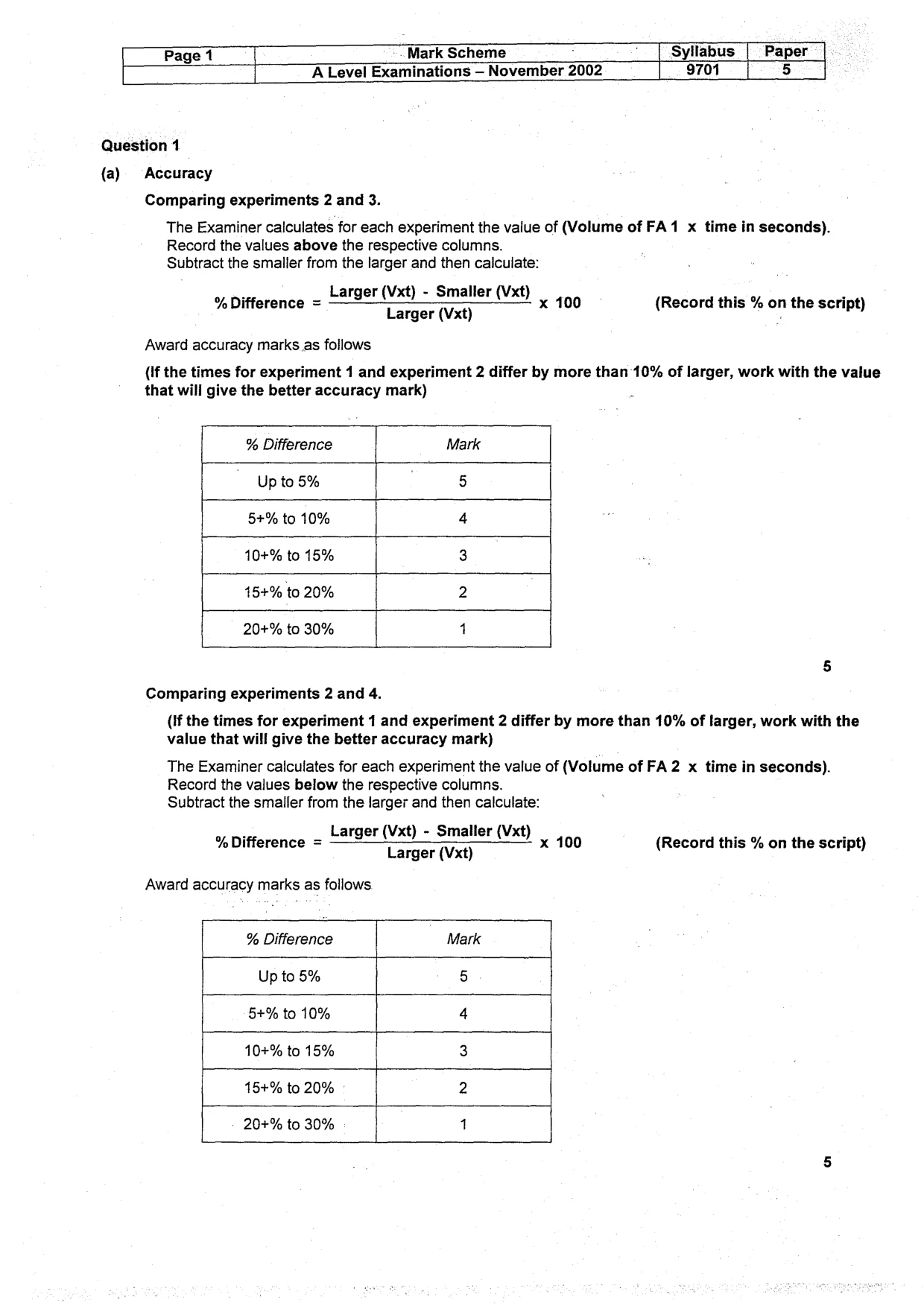
Mark Scheme Syllabus | Paper A Level Examinations — November 2002 9701 5 Page 1 Question 1 (a) Accuracy Comparing experiments 2 and 3. The Examiner calculates for each experiment the value of (Volume of FA1 x time in seconds). Record the values above the respective columns. Subtract the smaller from the larger and then calculate: Larger (Vxt) - Smaller (Vxt) is 9 Larger (Vxt) x 100 (Record this % on the script) % Difference = Award accuracy marks.as follows (If the times for experiment 1 and experiment 2 differ by more than 10% of larger, work with the value that will give the better accuracy mark) % Difference Mark Up to 5% : 5 5+% to 10% 4 10+% to 15% 3 15+% to 20% 2 20+% to 30% 4 Comparing experiments 2 and 4. (If the times for experiment 1 and experiment 2 differ by more than 10% of larger, work with the value that will give the better accuracy mark) The Examiner calculates for each experiment the value of (Volume of FA 2 x time in seconds). Record the values below the respective columns. Subtract the smaller from the larger and then calculate: Larger (Vxt) - Smaller (Vxt) % Difference = Larger (Vxt) x 100 (Record this % on the script) Award accuracy marks as follows % Difference Mark Up to 5% 5 5+% to 10% 4 10+% to 15% 3 15+% to 20% 2 20+% to 30% 1
Mark scheme, page 3
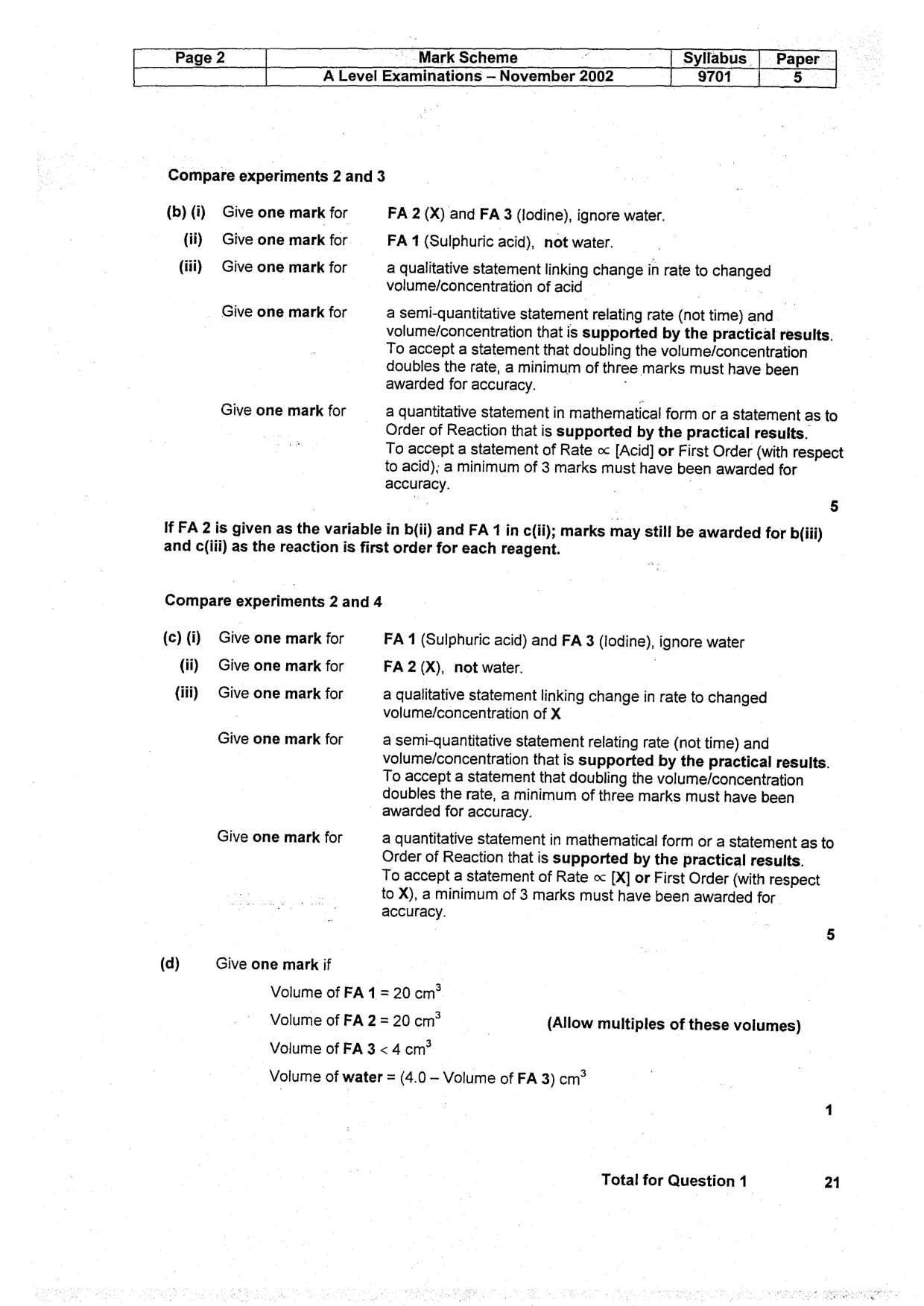
Page 2 Mark Scheme Syllabus Paper A Level Examinations — November 2002 9701 5 Compare experiments 2 and 3 (b) (i) Give one mark for (ii) Give one mark for (iii) Give one mark for Give one mark for Give one mark for FA 2 (X) and FA 3 (Iodine), ignore water. FA 1 (Sulphuric acid), not water. a qualitative statement linking change in rate to changed volume/concentration of acid a semi-quantitative statement relating rate (not time) and volume/concentration that is supported by the practical results. To accept a statement that doubling the volume/concentration doubles the rate, a minimum of three marks must have been awarded for accuracy. . a quantitative statement in mathematical form or a statement as to Order of Reaction that is supported by the practical results. To accept a statement of Rate oc [Acid] or First Order (with respect to acid); a minimum of 3 marks must have been awarded for accuracy. 5 If FA 2 is given as the variable in b(ii) and FA 1 in c(i); marks may still be awarded for b(iii) and c(iii) as the reaction is first order for each reagent. Compare experiments 2 and 4 (c) (i) (ii) (iii) (d) Give one mark for Give one mark for Give one mark for Give one mark for Give one mark for Give one mark if FA 1 (Sulphuric acid) and FA 3 (Iodine), ignore water FA 2 (X), not water. a qualitative statement linking change in rate to changed volume/concentration of X a semi-quantitative statement relating rate (not time) and volume/concentration that is supported by the practical results. To accept a statement that doubling the volume/concentration doubles the rate, a minimum of three marks must have been awarded for accuracy. a quantitative statement in mathematical form or a statement as to Order of Reaction that is supported by the practical results. To accept a statement of Rate cc [X] or First Order (with respect to X), a minimum of 3 marks must have been awarded for accuracy. Volume of FA 1 = 20 cm? Volume of FA 2 = 20 cm® (Allow multiples of these volumes) Volume of FA 3 < 4 cm? Volume of water = (4.0 — Volume of FA 3) cm? Total for Question 1 21
Mark scheme, page 4
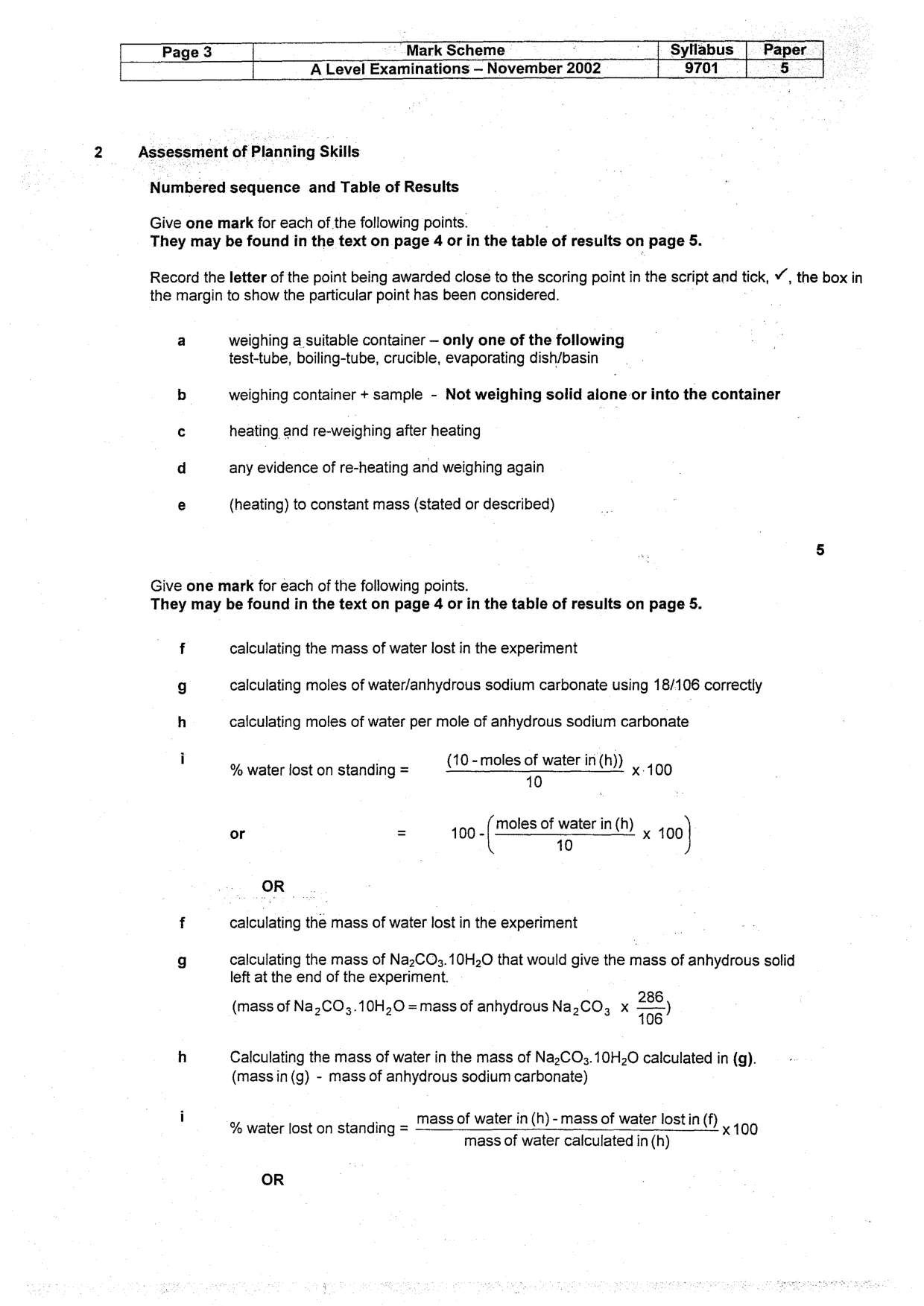
Page 3 Mark Scheme : Sytlabus Paper. 5 A Level Examinations — November 2002 9701 Assessment of Planning Skills Numbered sequence and Table of Results Give one mark for each of the following points. They may be found in the text on page 4 or in the table of results on page 5. Record the letter of the point being awarded close to the scoring point in the script and tick, ¥’, the box in the margin to show the particular point has been considered. a weighing a suitable container — only one of the following test-tube, boiling-tube, crucible, evaporating dish/basin b weighing container + sample - Not weighing solid alone or into the container c heating and re-weighing after heating d any evidence of re-heating and weighing again e (heating) to constant mass (stated or described) Give one mark for each of the following points. They may be found in the text on page 4 or in the table of results on page 5. f calculating the mass of water lost in the experiment 9g calculating moles of water/anhydrous sodium carbonate using 18/106 correctly h calculating moles of water per mole of anhydrous sodium carbonate i . , % water lost on standing = Cones cose enh x-100 or = 400 - moles of water in (h) x 100 10 OR f calculating the mass of water lost in the experiment g calculating the mass of NayCO3.10H,O that would give the mass of anhydrous solid left at the end of the experiment. 286 (mass of Na,CO3;.10H,O0 =mass of anhydrous Na,CO, x 708) h Calculating the mass of water in the mass of Na,CO3.10H,O calculated in (g). (mass in (g) - mass of anhydrous sodium carbonate) i % water lost on standing = mass of water in (h) - mass of water lost in (f) x100 mass of water calculated in (h) OR
Mark scheme, page 5
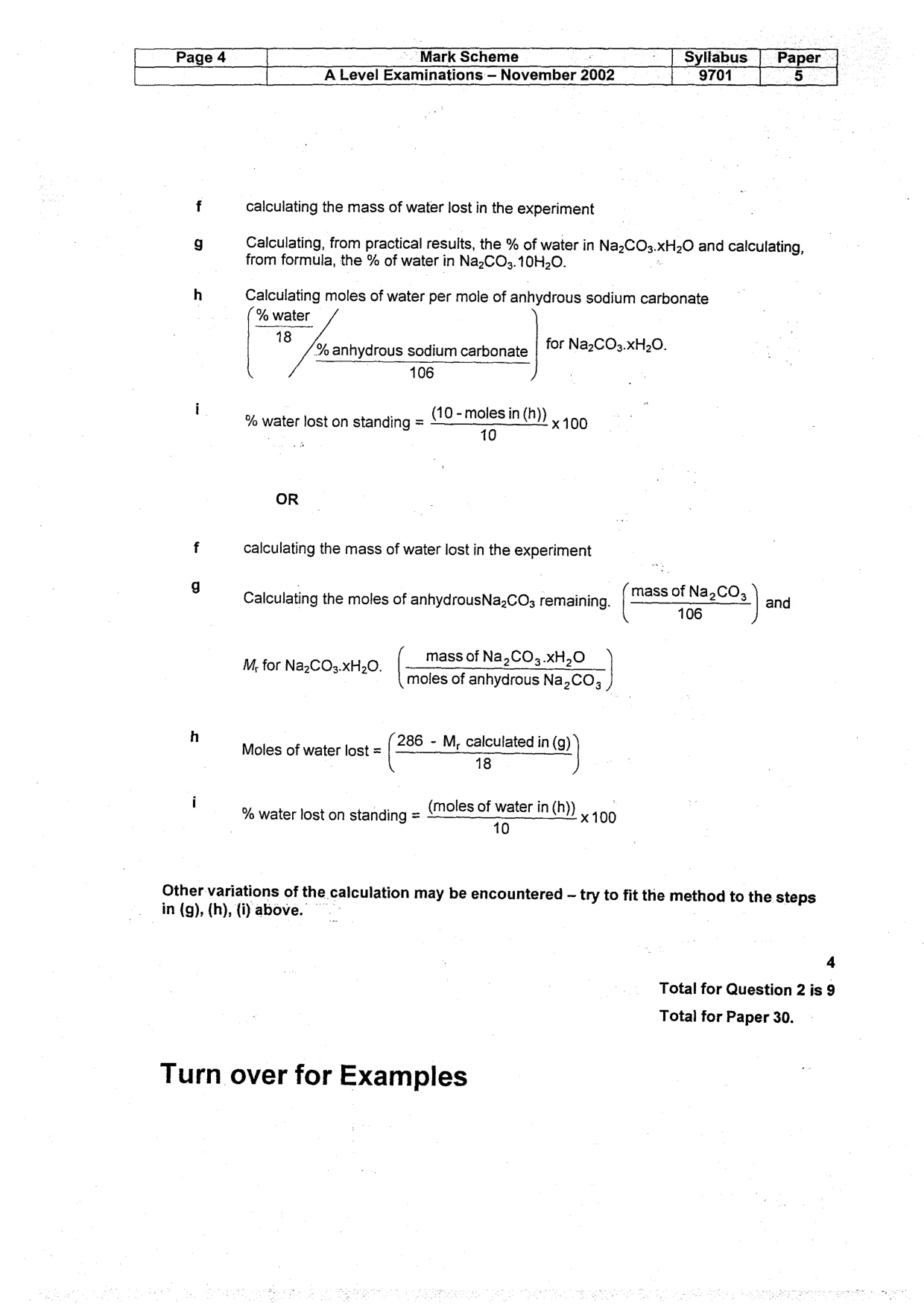
Page 4 Mark Scheme Syllabus | Paper A Level Examinations — November 2002 9701 5 f calculating the mass of water lost in the experiment g Calculating, from practical results, the % of water in NazCO3.xH2O and calculating, from formula, the % of water in NazCO3.10H.0. h Calculating moles of water per mole of anhydrous sodium carbonate water % anhydrous sodium carbonate for NazCO3.xH,0. 106 ' % water lost on standing = (10 -molesin(h)) 495 10 OR f calculating the mass of water lost in the experiment 8 Calculating the moles of anhydrousNazCO3 remaining. (aes) and CO, M, for NazCO;.xH,0. | —M™MASs.of NazCOs xH,O0 moles of anhydrous Na,CO, h Moles of water lost = (EM setetetin(s) i (moles of water in (h)) % water lost on standing = 10 x100 Other variations of the calculation may be encountered — try to fit the method to the steps in (g), (h), (i) above. 4 Total for Question 2 is 9 Total for Paper 30. Turn over for Examples
Mark scheme, page 6
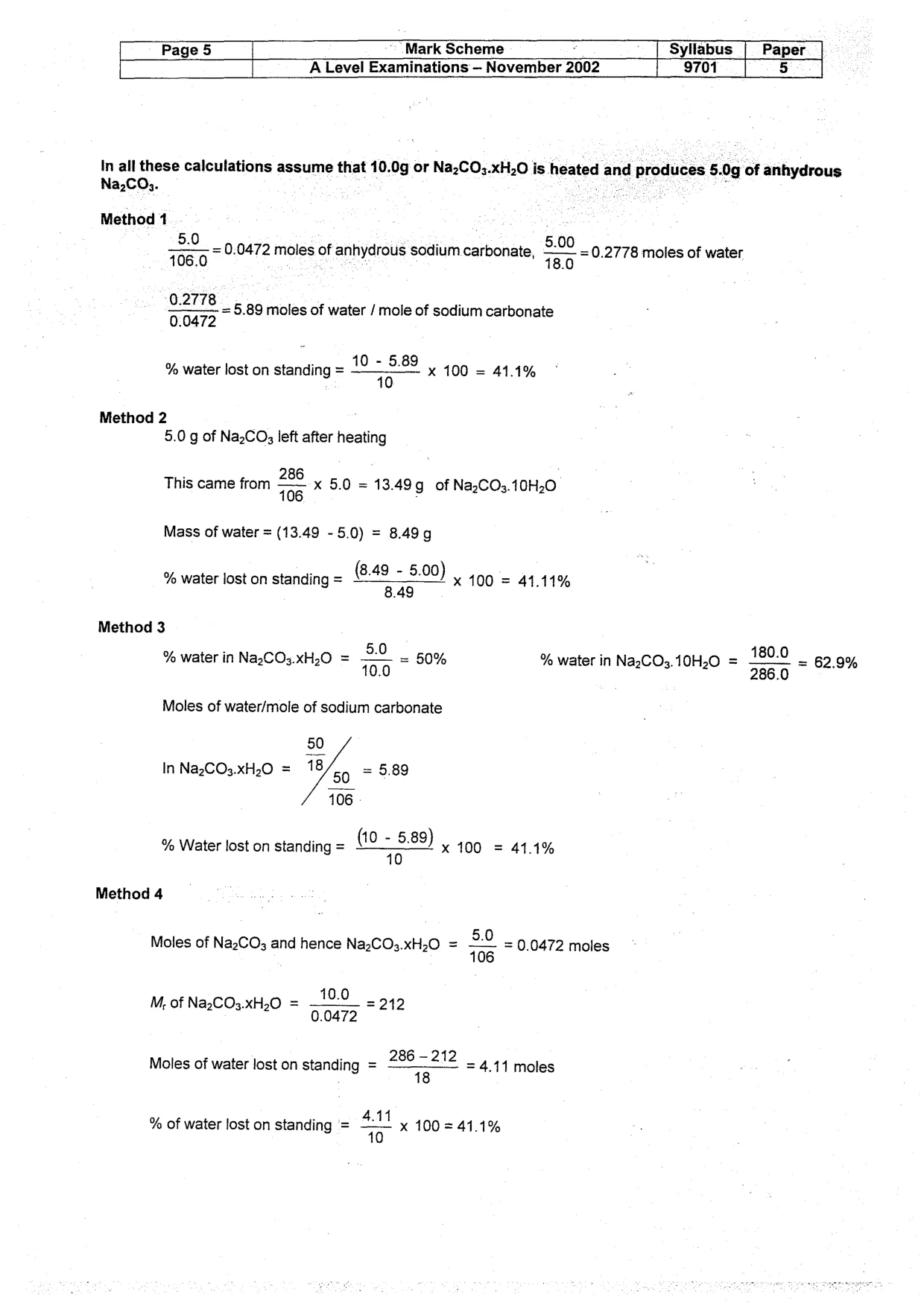
Page 5 Mark Scheme : Syllabus | Paper A Level Examinations — November 2002 9701 5 In all these calculations assume that 10.0g or NazCO;.xH,O is heated and produces 5.0g of anhydrous Na,CO3. : Method 1 5.0 5.00 => —~ = 0.0472 moles of anhydrous sodium. carbonate, ——— =0.2778 moles of water 106.0 18.0 0.2778 ———~ = 5.89 moles of water / mole of sodium carbonate 0.0472 % water lost on standing = eee x 100 = 41.1% Method 2 5.0 g of Na2CO; left after heating This came from = x 5.0 = 13.49g of NagCO3.10H,0 Mass of water = (13.49 - 5.0) = 8.49g % water lost on standing = (@.49 - 5.00) x 100 = 41.11% 8.49 Method 3 js 5.0 A 180.0 % water in NazCO3.xH,0 = —— = 50% % wate Na,CO3.10H20 = —— = 62.99 h Wi jazCO3.xHp! 10.0 hy f water in NazCOs. 2 286.0 12.9% Moles of water/mole of sodium carbonate 50 In NazCOs.xH,0 = 18/,, = 5.89 106 % Water lost on standing = 0 - 588) x 100 = 41.1% Method 4 5.0 Moles of NazCO3 and hence NazCO3.xH2O0 = 708 = 0.0472 moles M, of NazCO3.xH,0 = 10.0 =212 0.0472 Moles of water lost on standing = oa = 4.11 moles % of water lost on standing = = x 100 = 41.1%