Cambridge A Level Chemistry 9701 — 2002 May/June Paper 5 · Variant 1
9701/51/M/J/02
The question paper and its mark scheme, free to read here and free to download. This is Cambridge’s own paper, exactly as it was sat.
Question paper8 pages

Mark scheme5 pages
Answers below. Sit the paper first if you are practising.
Paper as text
Question paper, page 1
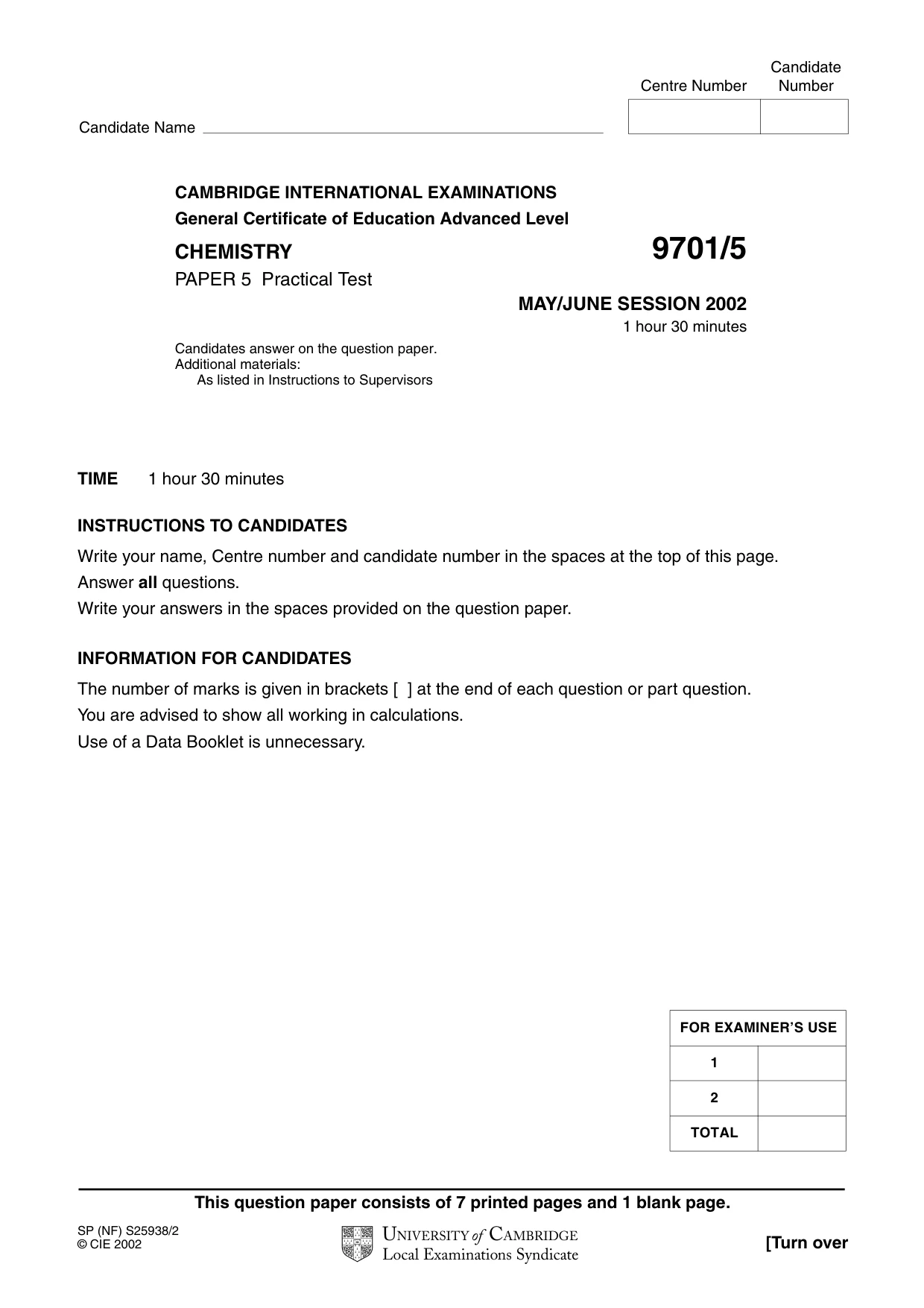
This question paper consists of 7 printed pages and 1 blank page. SP (NF) S25938/2 © CIE 2002 [Turn over CAMBRIDGE INTERNATIONAL EXAMINATIONS General Certificate of Education Advanced Level CHEMISTRY 9701/5 PAPER 5 Practical Test MAY/JUNE SESSION 2002 1 hour 30 minutes Candidates answer on the question paper. Additional materials: As listed in Instructions to Supervisors TIME 1 hour 30 minutes INSTRUCTIONS TO CANDIDATES Write your name, Centre number and candidate number in the spaces at the top of this page. Answer all questions. Write your answers in the spaces provided on the question paper. INFORMATION FOR CANDIDATES The number of marks is given in brackets [ ] at the end of each question or part question. You are advised to show all working in calculations. Use of a Data Booklet is unnecessary. FOR EXAMINER’S USE 1 2 TOTAL Candidate Centre Number Number Candidate Name
Question paper, page 2
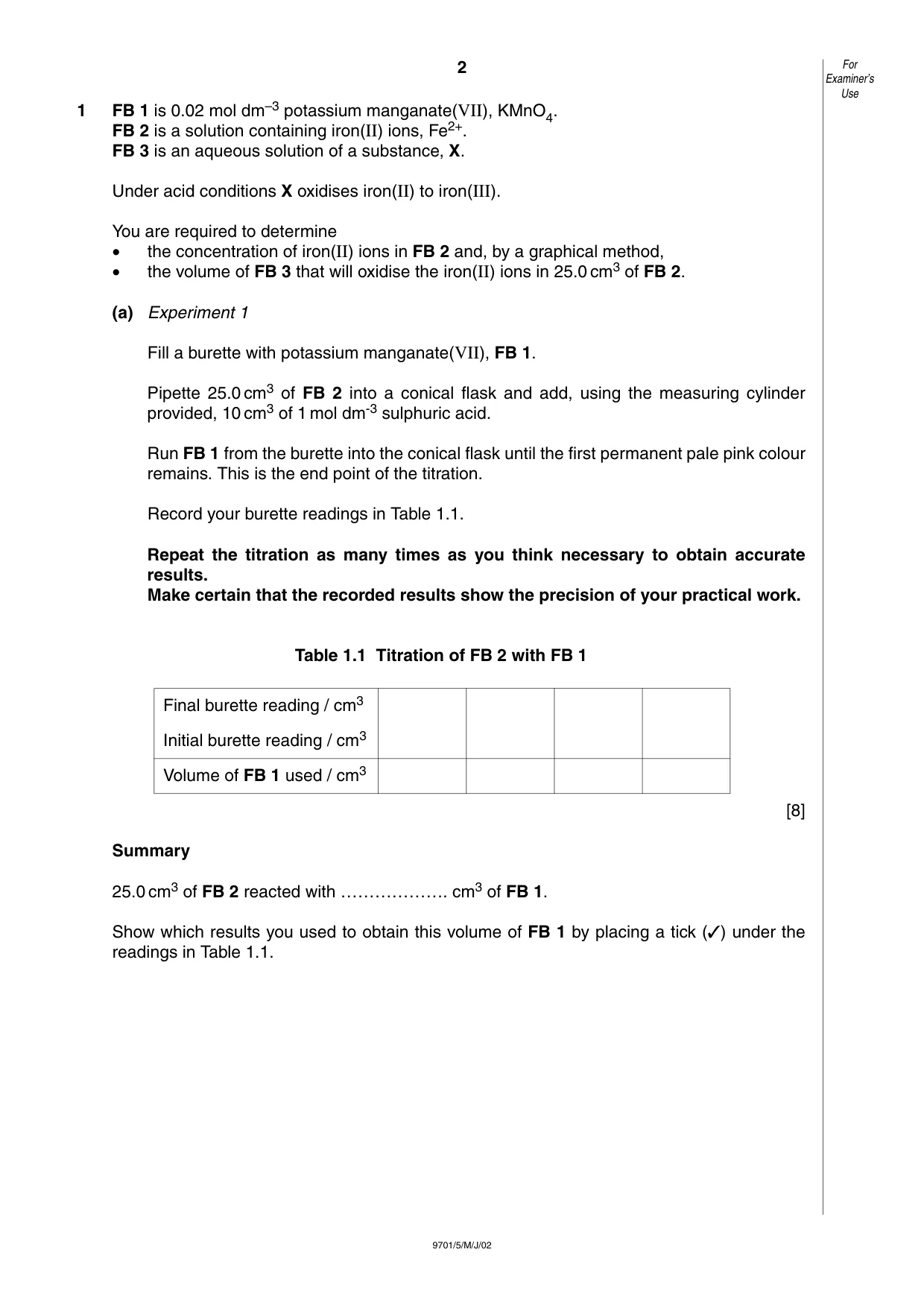
2 9701/5/M/J/02 1 FB 1 is 0.02 mol dm–3 potassium manganate(VII), KMnO4. FB 2 is a solution containing iron(II) ions, Fe2+. FB 3 is an aqueous solution of a substance, X. Under acid conditions X oxidises iron(II) to iron(III). You are required to determine • the concentration of iron(II) ions in FB 2 and, by a graphical method, • the volume of FB 3 that will oxidise the iron(II) ions in 25.0 cm3 of FB 2. (a) Experiment 1 Fill a burette with potassium manganate(VII), FB 1. Pipette 25.0 cm3 of FB 2 into a conical flask and add, using the measuring cylinder provided, 10 cm3 of 1 mol dm-3 sulphuric acid. Run FB 1 from the burette into the conical flask until the first permanent pale pink colour remains. This is the end point of the titration. Record your burette readings in Table 1.1. Repeat the titration as many times as you think necessary to obtain accurate results. Make certain that the recorded results show the precision of your practical work. Table 1.1 Titration of FB 2 with FB 1 [8] Summary 25.0 cm3 of FB 2 reacted with ………………. cm3 of FB 1. Show which results you used to obtain this volume of FB 1 by placing a tick (✓) under the readings in Table 1.1. For Examiner’s Use Final burette reading / cm3 Initial burette reading / cm3 Volume of FB 1 used / cm3
Question paper, page 3
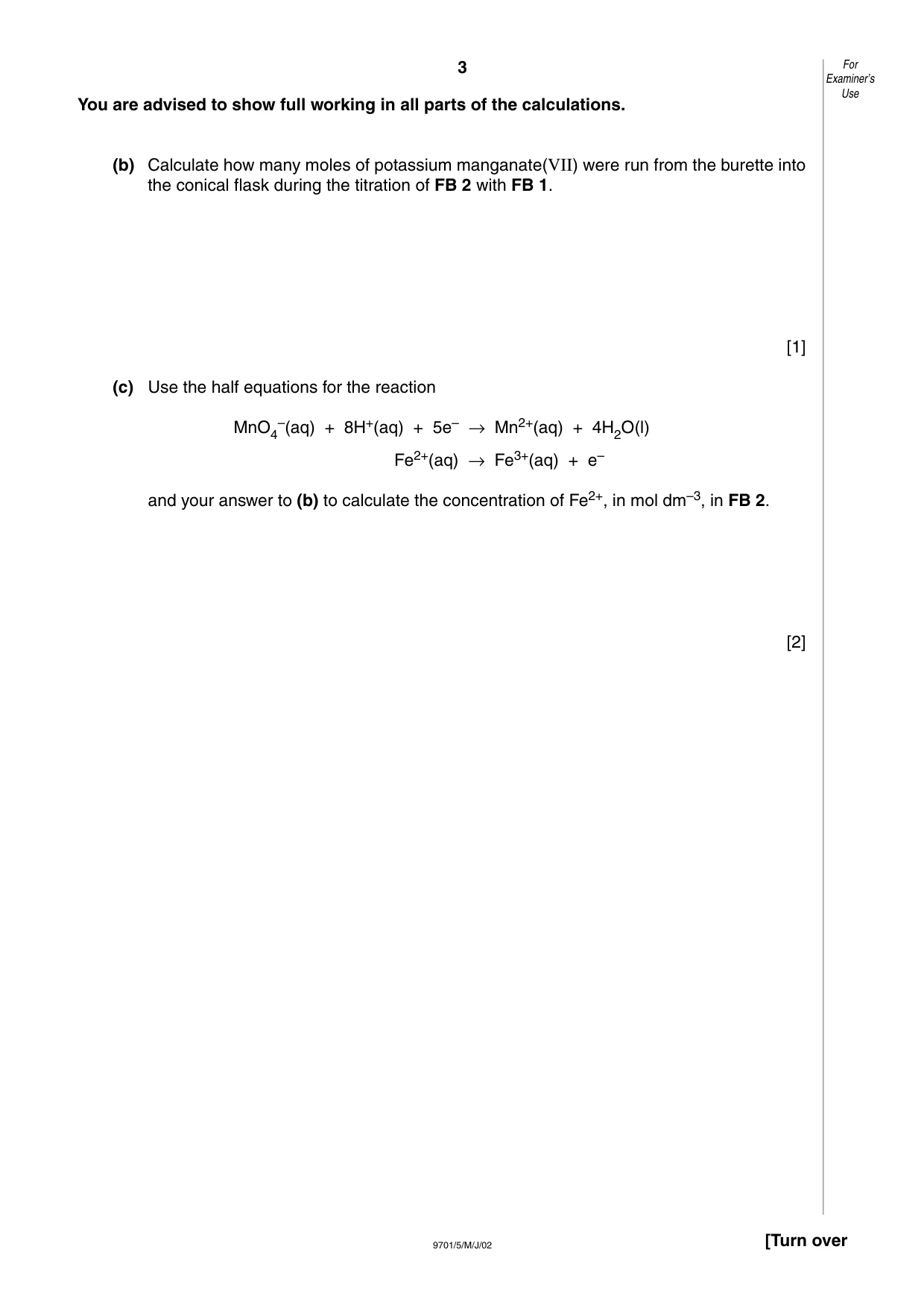
3 9701/5/M/J/02 [Turn over You are advised to show full working in all parts of the calculations. (b) Calculate how many moles of potassium manganate(VII) were run from the burette into the conical flask during the titration of FB 2 with FB 1. [1] (c) Use the half equations for the reaction MnO4 –(aq) + 8H+(aq) + 5e– →Mn2+(aq) + 4H2O(l) Fe2+(aq) →Fe3+(aq) + e– and your answer to (b) to calculate the concentration of Fe2+, in mol dm–3, in FB 2. [2] For Examiner’s Use
Question paper, page 4
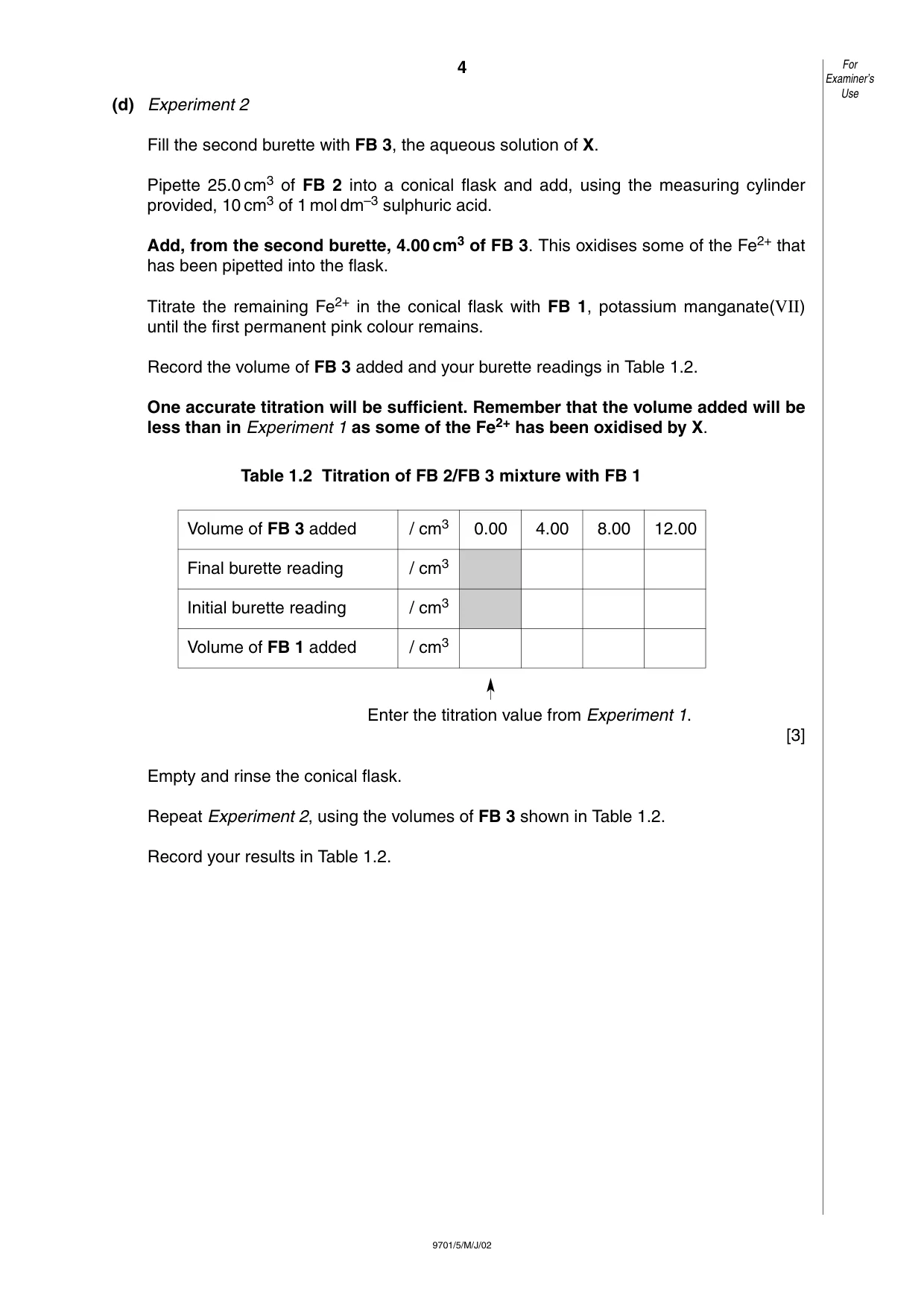
4 9701/5/M/J/02 (d) Experiment 2 Fill the second burette with FB 3, the aqueous solution of X. Pipette 25.0 cm3 of FB 2 into a conical flask and add, using the measuring cylinder provided, 10 cm3 of 1 mol dm–3 sulphuric acid. Add, from the second burette, 4.00 cm3 of FB 3. This oxidises some of the Fe2+ that has been pipetted into the flask. Titrate the remaining Fe2+ in the conical flask with FB 1, potassium manganate(VII) until the first permanent pink colour remains. Record the volume of FB 3 added and your burette readings in Table 1.2. One accurate titration will be sufficient. Remember that the volume added will be less than in Experiment 1 as some of the Fe2+ has been oxidised by X. Table 1.2 Titration of FB 2/FB 3 mixture with FB 1 Enter the titration value from Experiment 1. [3] Empty and rinse the conical flask. Repeat Experiment 2, using the volumes of FB 3 shown in Table 1.2. Record your results in Table 1.2. For Examiner’s Use Volume of FB 3 added / cm3 0.00 4.00 8.00 12.00 Final burette reading / cm3 Initial burette reading / cm3 Volume of FB 1 added / cm3
Question paper, page 5
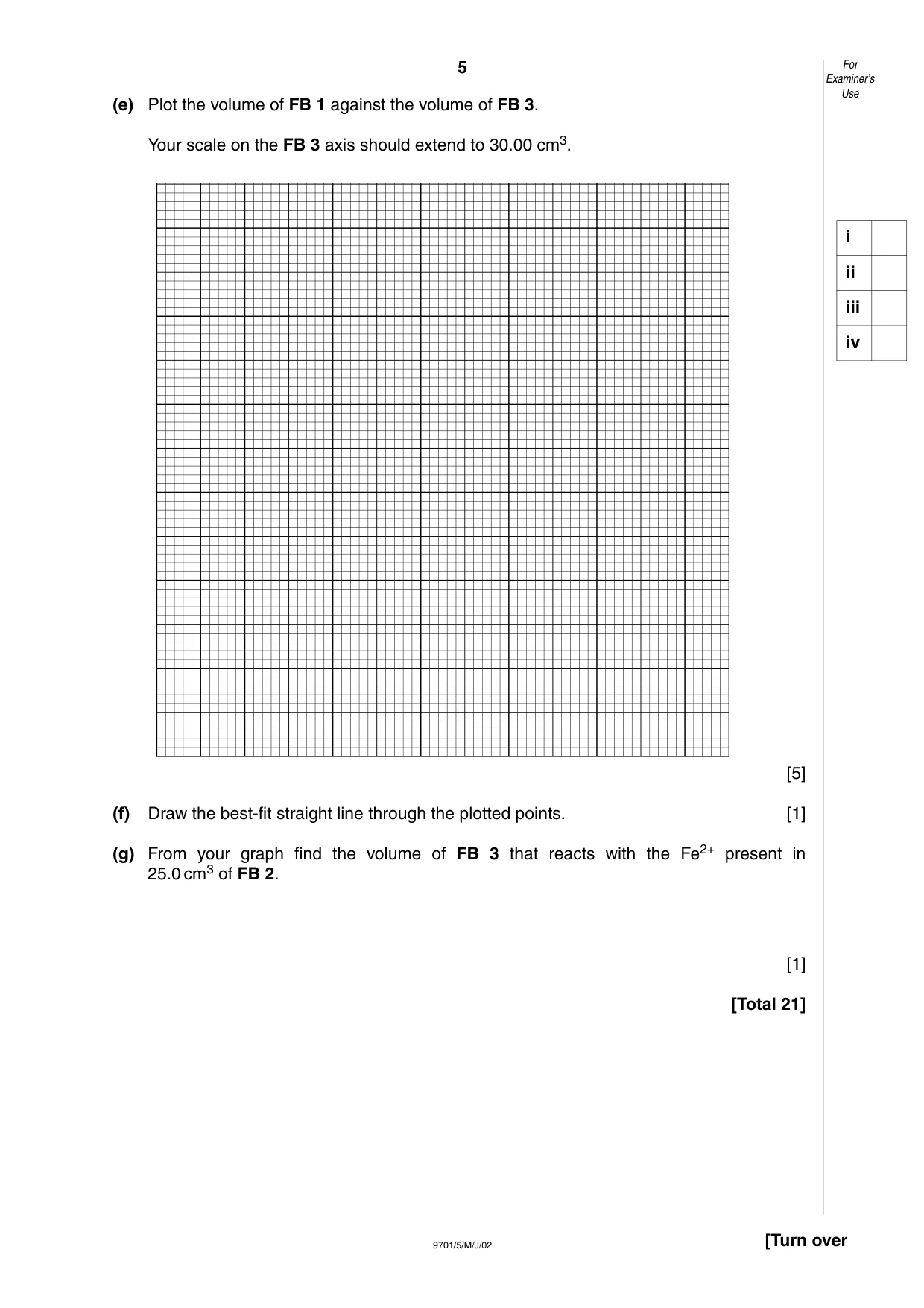
5 9701/5/M/J/02 [Turn over (e) Plot the volume of FB 1 against the volume of FB 3. Your scale on the FB 3 axis should extend to 30.00 cm3. [5] (f) Draw the best-fit straight line through the plotted points. [1] (g) From your graph find the volume of FB 3 that reacts with the Fe2+ present in 25.0 cm3 of FB 2. [1] [Total 21] For Examiner’s Use i ii iii iv
Question paper, page 6
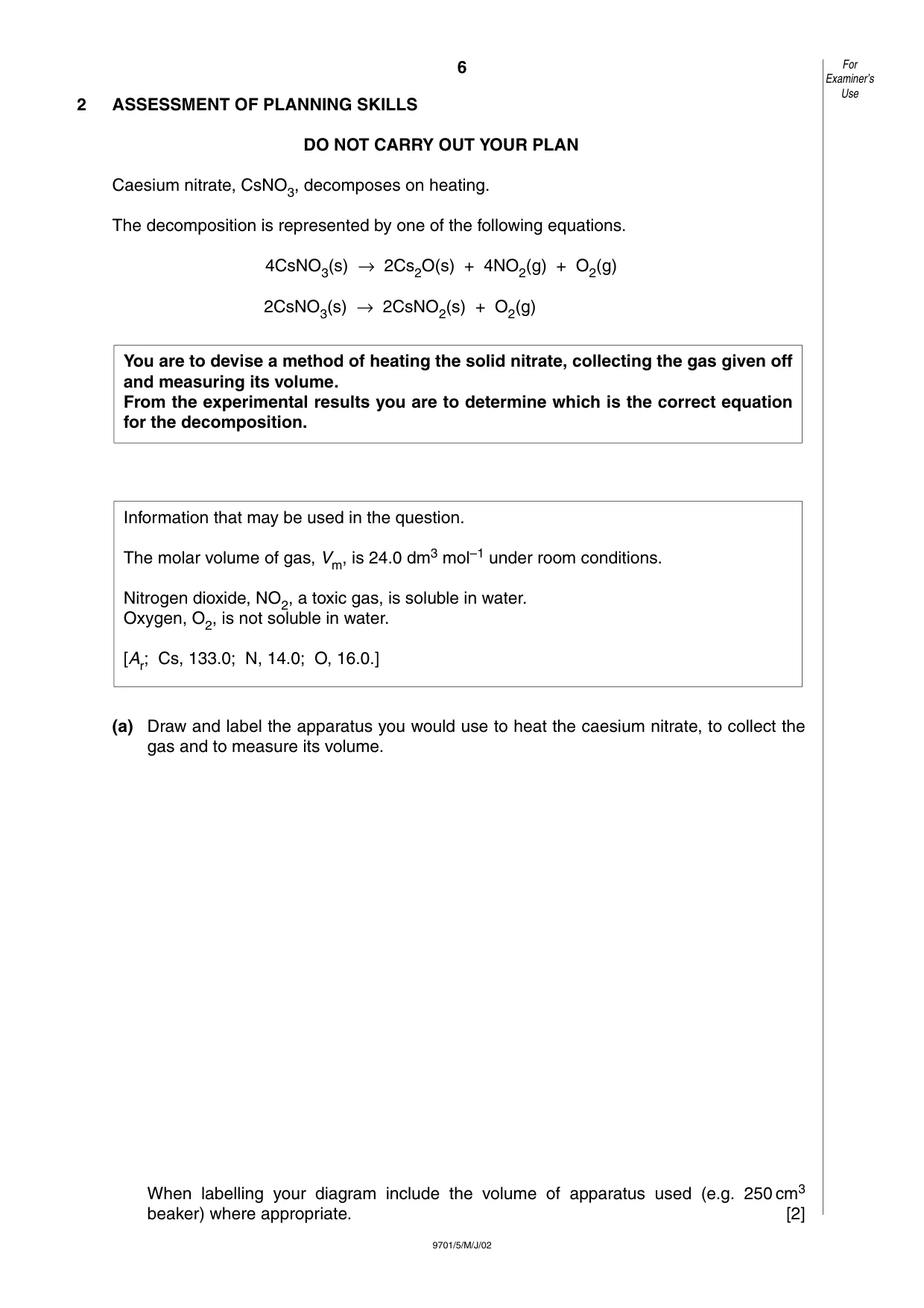
6 9701/5/M/J/02 2 ASSESSMENT OF PLANNING SKILLS DO NOT CARRY OUT YOUR PLAN Caesium nitrate, CsNO3, decomposes on heating. The decomposition is represented by one of the following equations. 4CsNO3(s) →2Cs2O(s) + 4NO2(g) + O2(g) 2CsNO3(s) →2CsNO2(s) + O2(g) (a) Draw and label the apparatus you would use to heat the caesium nitrate, to collect the gas and to measure its volume. When labelling your diagram include the volume of apparatus used (e.g. 250 cm3 beaker) where appropriate. [2] Information that may be used in the question. The molar volume of gas, Vm, is 24.0 dm3 mol–1 under room conditions. Nitrogen dioxide, NO2, a toxic gas, is soluble in water. Oxygen, O2, is not soluble in water. [Ar; Cs, 133.0; N, 14.0; O, 16.0.] You are to devise a method of heating the solid nitrate, collecting the gas given off and measuring its volume. From the experimental results you are to determine which is the correct equation for the decomposition. For Examiner’s Use
Question paper, page 7
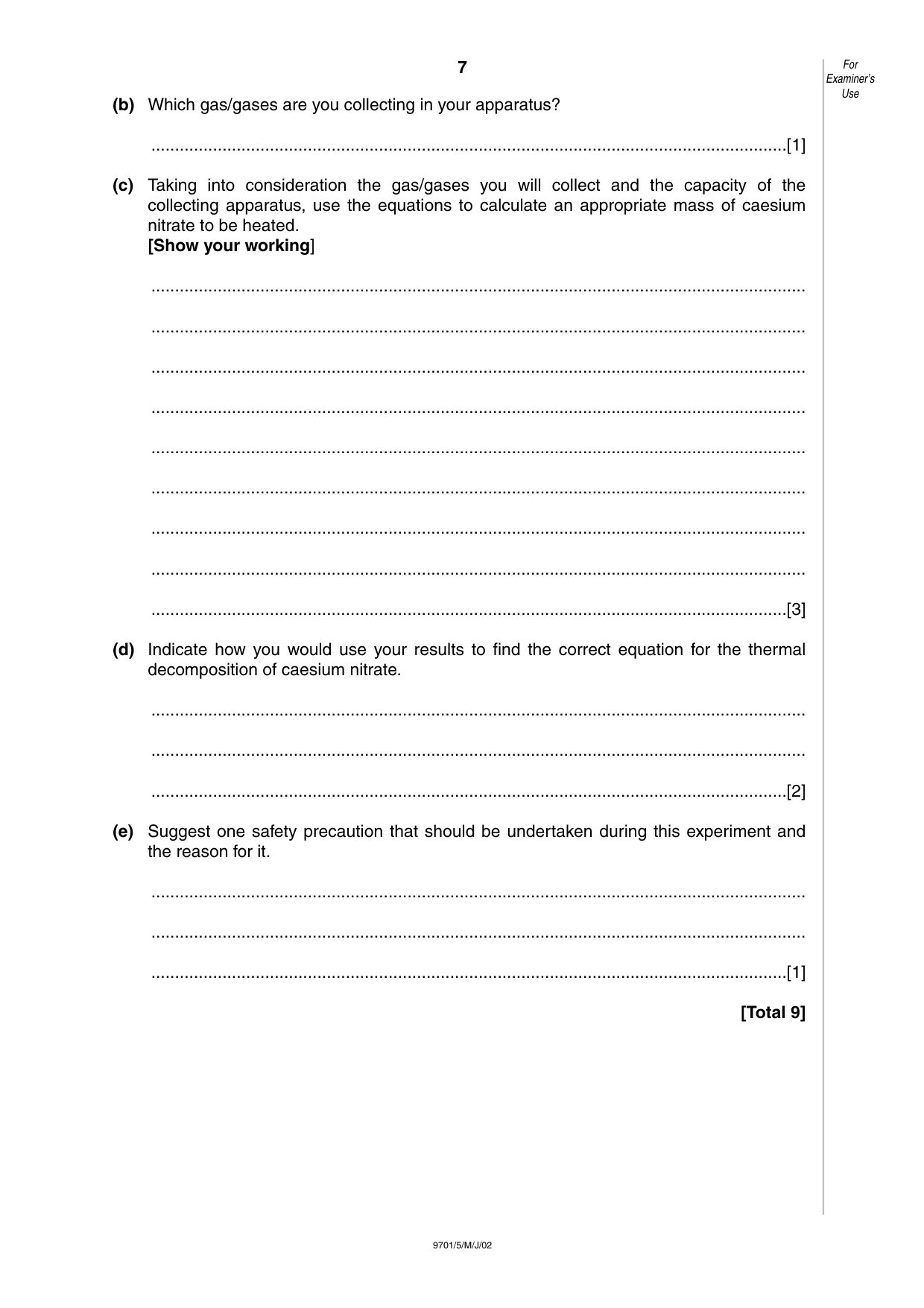
7 9701/5/M/J/02 (b) Which gas/gases are you collecting in your apparatus? …[1] (c) Taking into consideration the gas/gases you will collect and the capacity of the collecting apparatus, use the equations to calculate an appropriate mass of caesium nitrate to be heated. [Show your working] … … … … … … … … …[3] (d) Indicate how you would use your results to find the correct equation for the thermal decomposition of caesium nitrate. … … …[2] (e) Suggest one safety precaution that should be undertaken during this experiment and the reason for it. … … …[1] [Total 9] For Examiner’s Use
Mark scheme, page 1
CAMBRIDGE INTERNATIONAL EXAMINATIONS JUNE 2002 GCE Advanced Level MARK SCHEME MAXIMUM MARK : 30 SYLLABUS/COMPONENT :9701 /5 CHEMISTRY (PRACTICAL) SE UNIVERSITY of CAMBRIDGE %” Local Examinations Syndicate
Mark scheme, page 2
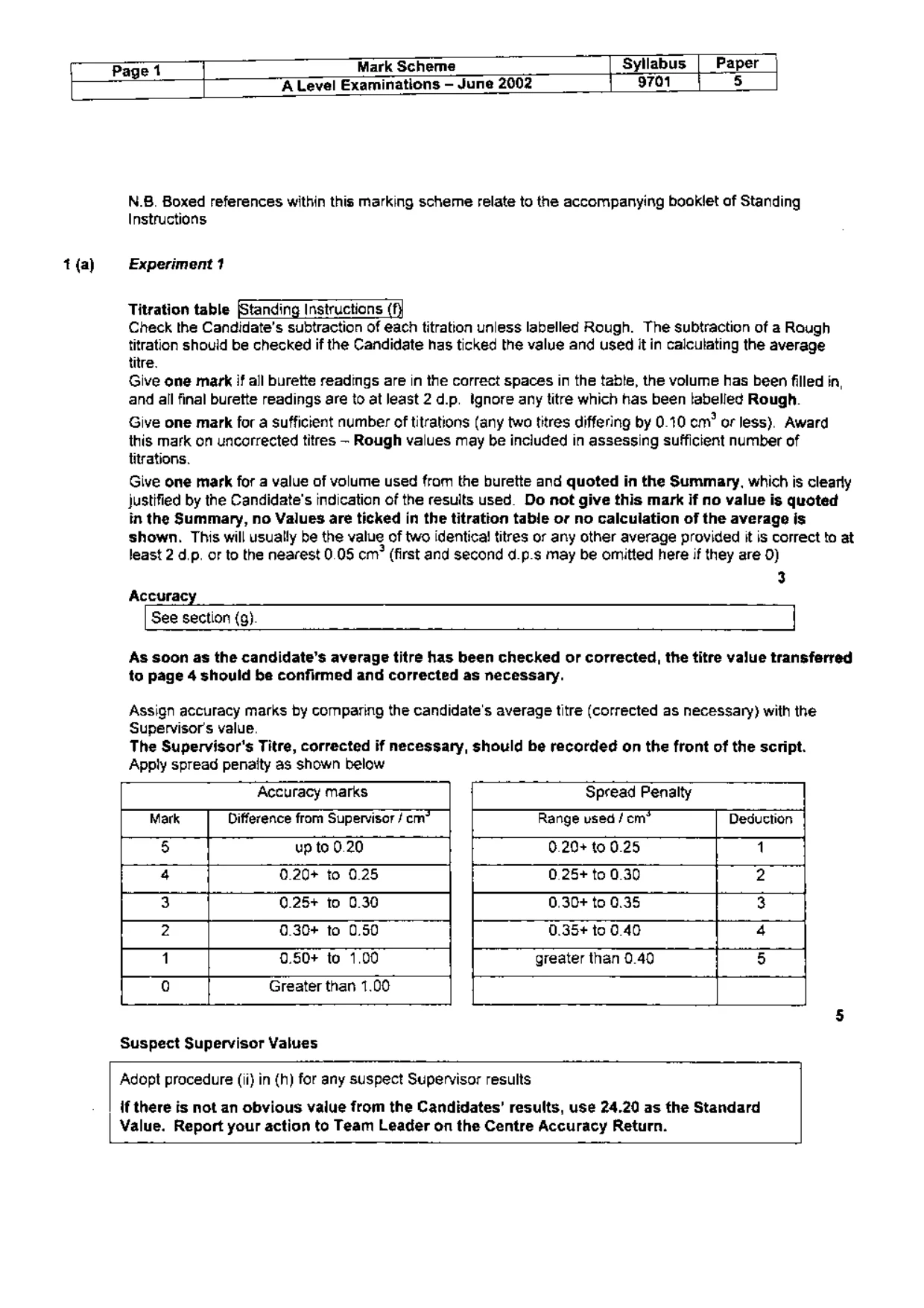
{ Page 1 Mark Scheme Syllabus Paper ‘A Level Examinations — June 2002 9701 5 t{a) N.8. Boxed references within this marking scheme relate to the accompanying booklet of Standing Instructions Experiment 1 Titration table Standing Instructions (f} Check the Candidate's subtraction of each titration unless labelled Rough. The subtraction of a Rough titration should be checked if the Candidate has ticked the value and used it in calculating the average titre. Give one mark if all burette readings are in the correct spaces in the table, the volume has been filled in, and all final burette readings are to at least 2 d.p. ignore any titre which has been labelled Rough. Give one mark for a sufficient number of titrations (any two titres differing by 0.10 cm’ or less). Award this mark on uncorrected titres - Rough values may be included in assessing sufficient number of titrations. Give one mark for a value of volume used from the burette and quoted in the Summary, which is clearly justified by the Candidate's indication of the results used. Do not give this mark if no value is quoted in the Summary, no Values are ticked in the titration table or no calculation of the average is shown. This will usually be the valug of two identical! titres or any other average provided it is correct to at least 2 d.p. or to the nearest 0.05 cm” (first and second d.p.s may be omitted here if they are 0) 3 Accurac See section (g). As soon as the candidate’s average titre has been checked or corrected, the titre value transferred to page 4 should be confirmed and corrected as necessary. Assign accuracy marks by comparing the candidate's average titre (corrected as necessary) with the Supervisor's value. The Supervisor's Titre, corrected if necessary, should be recorded on the front of the script. Apply spread penaity as shown below Accuracy marks Spread Penalty Difference from Supervisor / cov 4 0.20+ to 0.25 Range used / cm Deduction 0.20+ to 0.25 1 0.25+ to 0.30 2 0.35+ to 0.40 greater than 0.40 0.30+ to 0.50 0.50+ to 1.00 Greater than 1.00 Suspect Supervisor Values Adopt procedure (ii} in (h) for any suspect Supervisor results if there is not an obvious value from the Candidates’ results, use 24.20 as the Standard Value. Report your action to Team Leader on the Centre Accuracy Return.
Mark scheme, page 3
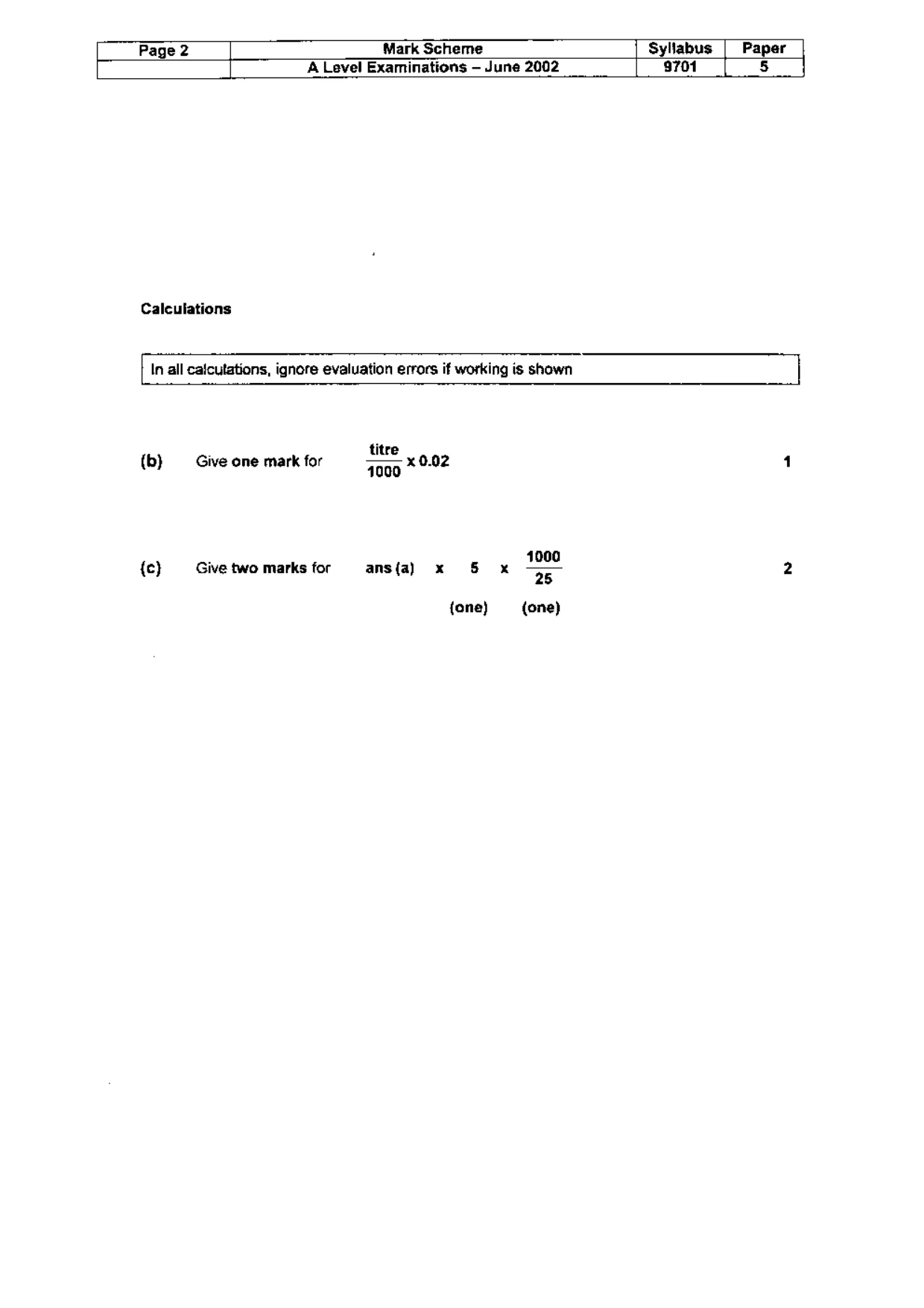
Page 2 Mark Scheme Syllabus | Paper A Level Examinations — June 2002 9701 [| 5 Calculations In all caicutations, ignore evaluation errors if working is shown titre 1000 (b} Give one mark for x 0.02 1 1000 25 {one) (one) {ce} Give two marks for ans{a) x 5
Mark scheme, page 4
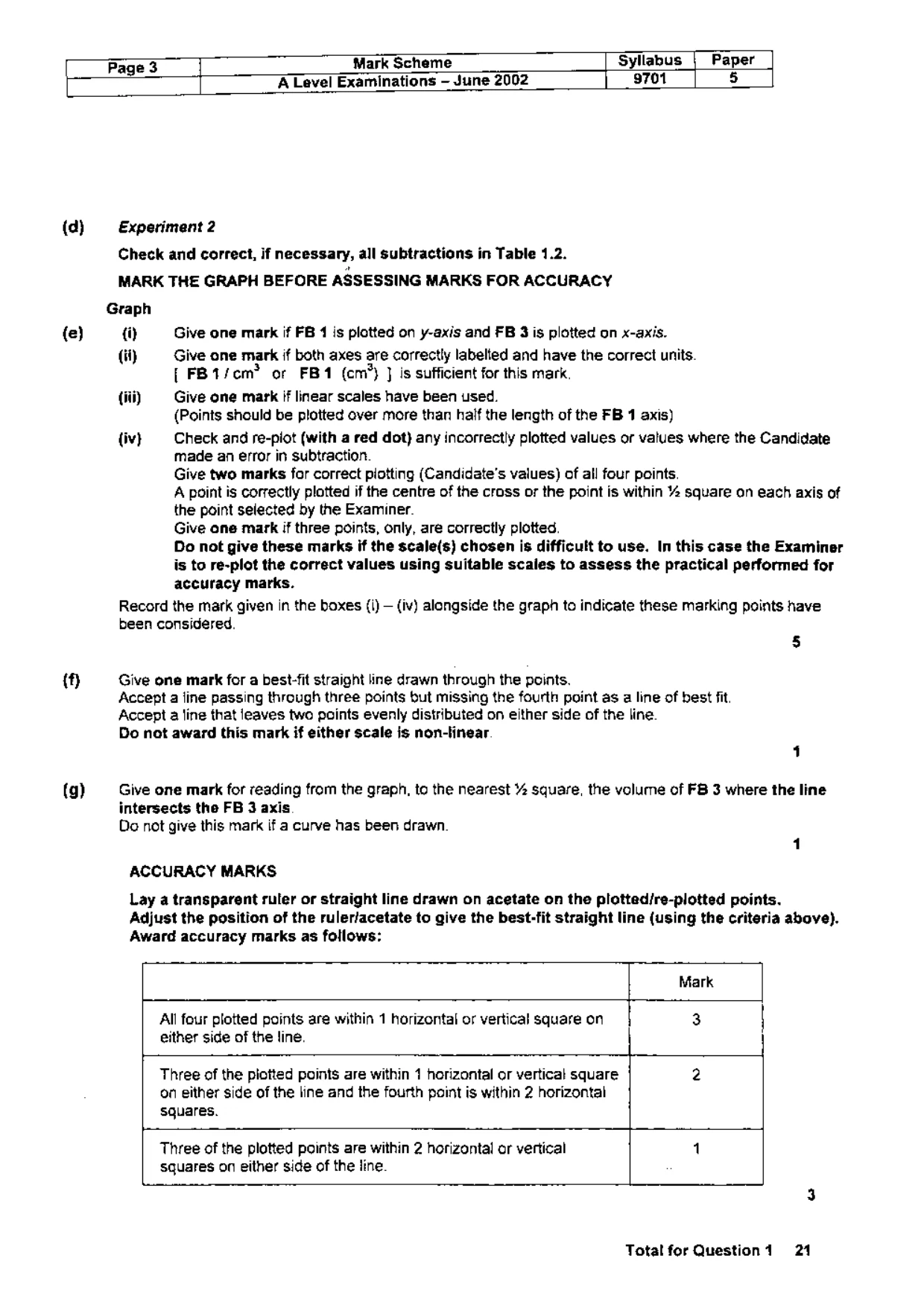
Page 3 I Mark Scheme Syllabus Paper A Level Examinations — June 2002 9701 6 (9) {e) {ft (9) Experiment 2 Check and correct, if necessary, all subtractions in Table 1.2. MARK THE GRAPH BEFORE ASSESSING MARKS FOR ACCURACY Graph @ Give one mark if FB 1 is plotted on y-axis and FB 3 is plotted on x-axis. (ii) Give one mark if both axes are correctly labelted and have the correct units. [| FB1/cm?® or FB1 (cm’} } is sufficient for this mark, Give one mark if linear scales have been used. (Points should be plotted over more than half the length of the FB 1 axis) {iv} Check and re-piot (with a red dot) any incorrectly plotted values or values where the Candidate made an error in subtraction. Give two marks for correct piotting (Candidate's values) of all four points. A point is correctly plotted if the centre of the cross or the point is within % square on each axis of the point selected by the Examiner. Give one mark if three points, only, are correctly plotted. Do not give these marks if the scale(s) chosen is difficult to use. In this case the Examiner is to re-plot the correct values using suitable scales to assess the practical performed for accuracy marks. Record the mark given in the boxes (i) — (iv) alongside the graph to indicate these marking points have been considered. 5 Give one mark for a best-fit straight line drawn through the points. Accept a line passing through three points but missing the fourth point as a line of best fit. Accept a line that leaves two points evenly distributed on either side of the line. Do not award this mark if either scale is non-linear 1 Give one mark for reading from the graph, to the nearest % square, the volume of FB 3 where the line intersects the FB 3 axis Do not give this mark if a curve has been drawn. ACCURACY MARKS Lay a transparent ruler or straight line drawn on acetate on the plotted/re-plotted points. Adjust the position of the ruler/acetate to give the best-fit straight line (using the criteria above). Award accuracy marks as follows: Mark All four plotted points are within 1 horizontal or vertical square on 3 either side of the line. ee Three of the plotted points are within 1 horizontal or vertical square 2 on either side of the line and the fourth paint is within 2 horizontal squares. Three of the plotted points are within 2 horizontal or vertical 1 squares on either side of the line. Total for Question? 21
Mark scheme, page 5
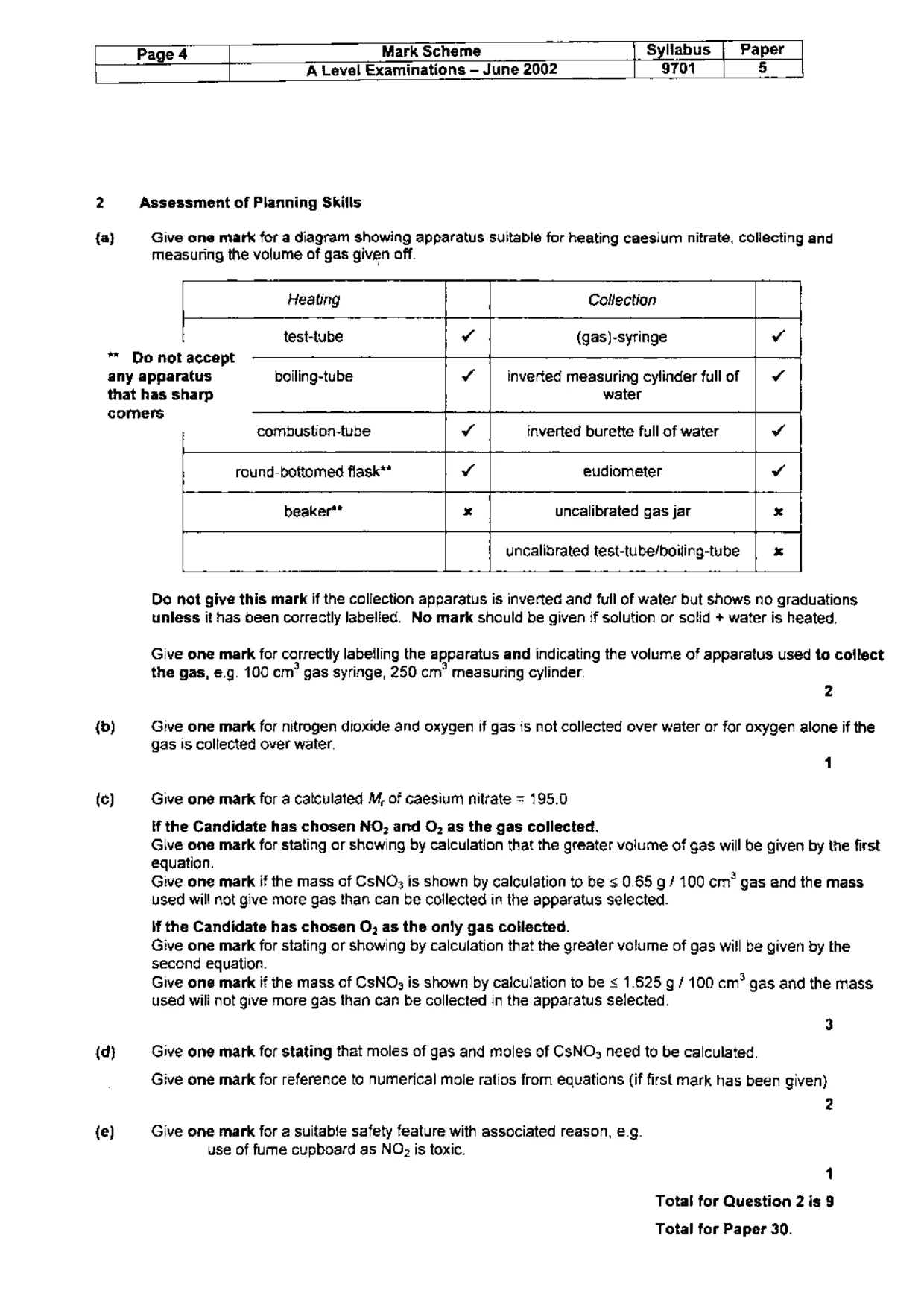
Page 4 Mark Scheme Syllabus Paper A Level Examinations — June 2002 9701 5 2 {a} ** Do not accept any apparatus boiling-tube that has sharp comers {b) (c) (d) {e) Assessment of Planning Skills Give one mark for a diagram showing apparatus suitable for heating caesium nitrate, collecting and measuring the volume of gas given off. Heating Collection test-tube (gas)-syringe BN inverted measuring cylinder full of water combustion-tube inverted burette full of water eudiometer round-bottomed flask** beaker** x uncalibrated gas jar * uncalibrated test-tube/boiling-tube x Bo not give this mark if the collection apparatus is inverted and full of water but shows no graduations unless it has been correctly labelled. No mark should be given if solution or solid + water is heated. Give one mark for correctly labelling the apparatus and indicating the volume of apparatus used to collect the gas, e.g. 100 cm” gas syringe, 250 cm* measuring cylinder. 2 Give one mark for nitrogen dioxide and oxygen if gas is not collected over water or for oxygen alone if the gas is collected over water. 1 Give one mark for a catculated M, of caesium nitrate = 195.0 if the Candidate has chosen NO, and O, as the gas collected. Give one mark for stating or showing by calculation that the greater volume of gas will be given by the first equation. Give one mark if the mass of CsNOs is shown by calculation to be < 0.65 g/ 100 cm* gas and the mass used will not give more gas than can be collected in the apparatus selected. if the Candidate has chosen O; as the only gas collected. Give one mark for stating or showing by calculation that the greater volume of gas will be given by the second equation. Give one mark if the mass of CsNO; is shown by calculation to be < 1.625 g / 100 cm* gas and the mass used will not give more gas than can be collected in the apparatus selected. 3 Give one mark for stating that moles of gas and moles of CsNO, need to be calculated. Give one mark for reference to numerical moie ratios from equations (if first mark has been given) 2 Give one mark for a suitable safety feature with associated reason, e.g. use of furne cupboard as NO; is toxic. 1 Total for Question 2 is 9 Total for Paper 30.